“Tides of the
p. 27 · Read in the full issue
Review
“Tides of the Pacific”
Reviewed by Derek Parker
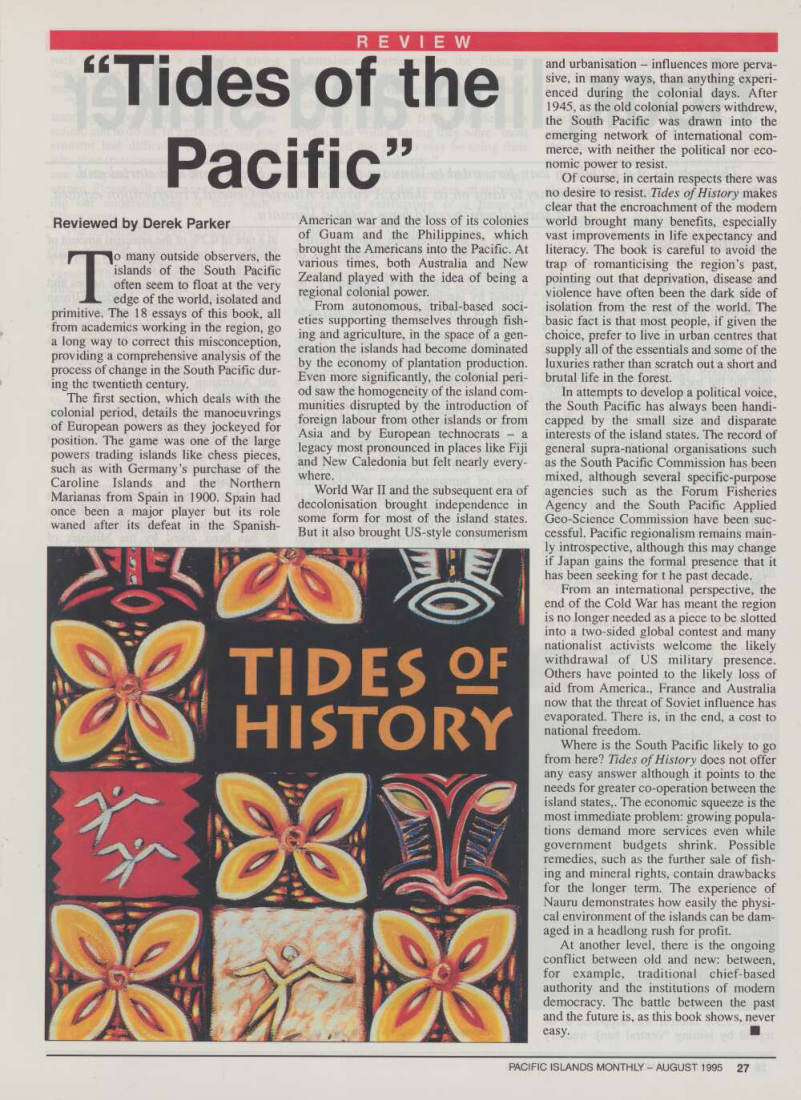
To many outside observers, the islands of the South Pacific often seem to float at the very edge of the world, isolated and primitive. The 18 essays of this book, all from academics working in the region, go a long way to correct this misconception, providing a comprehensive analysis of the process of change in the South Pacific dur ing the twentieth century.
The first section, which deals with the colonial period, details the manoeuvrings of European powers as they jockeyed for position. The game was one of the large powers trading islands like chess pieces, such as with Germany’s purchase of the Caroline Islands and the Northern Marianas from Spain in 1900. Spain had once been a major player but its role waned after its defeat in the Spanish-
American war and the loss of its colonies of Guam and the Philippines, which brought the Americans into the Pacific. At various times, both Australia and New Zealand played with the idea of being a regional colonial power.
From autonomous, tribal-based soci eties supporting themselves through fish ing and agriculture, in the space of a gen eration the islands had become dominated by the economy of plantation production.
Even more significantly, the colonial peri od saw the homogeneity of the island com munities disrupted by the introduction of foreign labour from other islands or from Asia and by European technocrats - a legacy most pronounced in places like Fiji and New Caledonia but felt nearly every where.
World War II and the subsequent era of decolonisation brought independence in some form for most of the island states.
But it also brought US-style consumerism
and urbanisation - influences more perva sive, in many ways, than anything experi enced during the colonial days. After 1945, as the old colonial powers withdrew, the South Pacific was drawn into the emerging network of international com merce, with neither the political nor eco nomic power to resist.
Of course, in certain respects there was no desire to resist. Tides of History makes clear that the encroachment of the modem world brought many benefits, especially vast improvements in life expectancy and literacy. The book is careful to avoid the trap of romanticising the region’s past, pointing out that deprivation, disease and violence have often been the dark side of isolation from the rest of the world. The basic fact is that most people, if given the choice, prefer to live in urban centres that supply all of the essentials and some of the luxuries rather than scratch out a short and brutal life in the forest.
In attempts to develop a political voice, the South Pacific has always been handi capped by the small size and disparate interests of the island states. The record of general supra-national organisations such as the South Pacific Commission has been
mixed, although several specific-purpose
agencies such as the Forum Fisheries Agency and the South Pacific Applied Geo-Science Commission have been suc cessful. Pacific regionalism remains main ly introspective, although this may change if Japan gains the formal presence that it has been seeking for t he past decade.
From an international perspective, the end of the Cold War has meant the region is no longer needed as a piece to be slotted into a two-sided global contest and many nationalist activists welcome the likely withdrawal of US military presence.
Others have pointed to the likely loss of aid from America., France and Australia now that the threat of Soviet influence has evaporated. There is, in the end, a cost to national freedom.
Where is the South Pacific likely to go from here? Tides of History does not offer any easy answer although it points to the needs for greater co-operation between the island states,. The economic squeeze is the
most immediate problem: growing popula
tions demand more services even while government budgets shrink. Possible remedies, such as the further sale of fish ing and mineral rights, contain drawbacks for the longer term. The experience of Nauru demonstrates how easily the physi cal environment of the islands can be dam aged in a headlong rush for profit.
At another level, there is the ongoing conflict between old and new: between, for example, traditional chief-based authority and the institutions of modem democracy. The battle between the past and the future is, as this book shows, never easy. ■