“Hello, is anybody
pp. 36-37 · Read in the full issue
Communication
“Hello, is anybody there?”
By David North
Dialling the islands is sometimes more of a challenge than the
phone companies would like
you to believe.
Sometimes there are busy circuits, bad connections and ancient equipment at the other end. For example, I never have been able to get anyone in American Samoa to transfer a call from one extension to anoth er, even within the same government agency.
Another problem - which the phone
companies are doing something about in
some places - is the uncertain number of digits in the phone numbers. Americans, for instance, are accustomed to always using 10 digits when calling long distance within the US. (Three digits for the area code, three more for the exchange and four more for the individual number.) If you see a nine-digit number or an 11-digit number you know it is wrong.
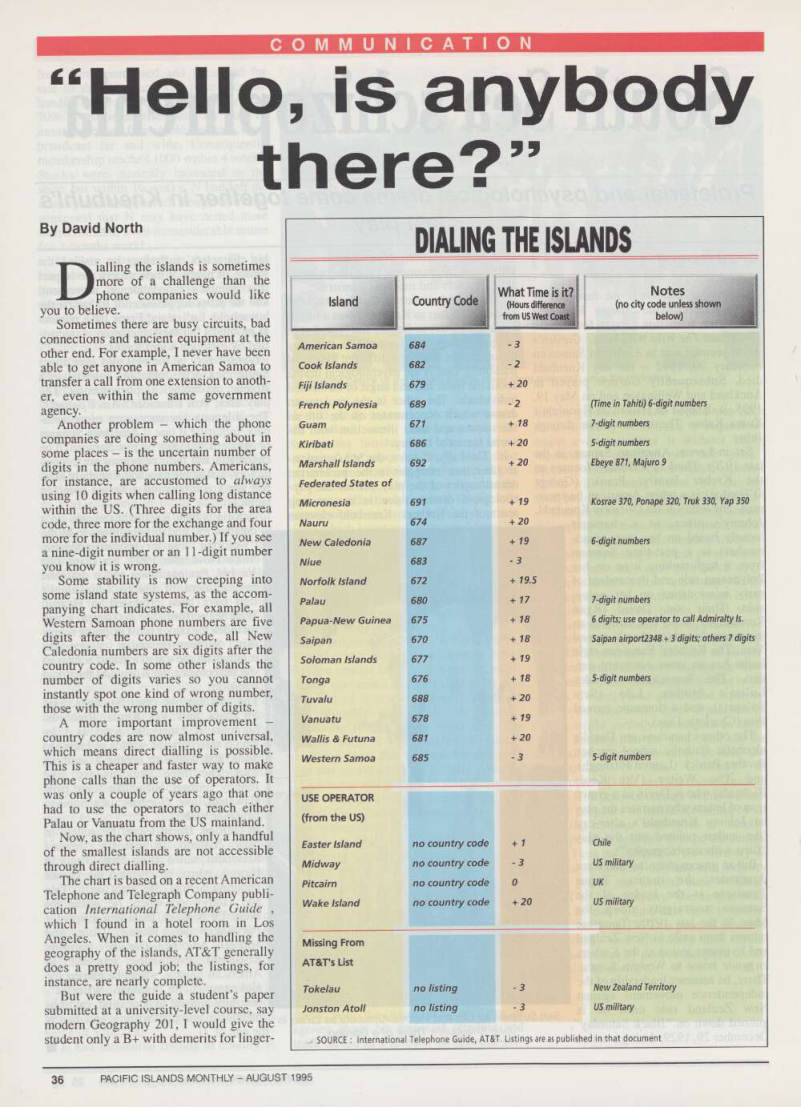
Some stability is now creeping into some island state systems, as the accom panying chart indicates. For example, all Western Samoan phone numbers are five digits after the country code, all New Caledonia numbers are six digits after the country code. In some other islands the number of digits varies so you cannot instantly spot one kind of wrong number, those with the wrong number of digits.
A more important improvement country codes are now almost universal, which means direct dialling is possible.
This is a cheaper and faster way to make phone calls than the use of operators. It was only a couple of years ago that one had to use the operators to reach either Palau or Vanuatu from the US mainland.
Now, as the chart shows, only a handful of the smallest islands are not accessible
through direct dialling.
The chart is based on a recent American
Telephone and Telegraph Company publi
cation International Telephone Guide , which I found in a hotel room in Los Angeles. When it comes to handling the geography of the islands, AT&T generally does a pretty good job; the listings, for
instance, are nearly complete.
But were the guide a student’s paper submitted at a university-level course, say modem Geography 201, I would give the student only a B+ with demerits for linger
ing colonialism and for incompleteness.
As to the whiffs of colonialism, look at how Fiji is identified. It shows up as “Fiji Islands” a term that has not been used by the Fijian government in decades. The nation is called Fiji.
Similarly, Saipan is the name of an island within the jurisdiction known as the Commonwealth of the Northern Marianas Islands. It is the principal island but the political entity does not have a name.
AT&T also has not yet caught up with the more recent spelling change (decreed by the locals) from Truk to Chuuk, Elsewhere in the world AT&T is still sometimes in the colonial past - for exampie, it calls the God-forsaken place “Spanish Sahara”, though the Spanish have been gone for a long time. It is Western Sahara.
The incompleteness relates to two entities recognised by the ClA’s World Factbook but not by AT&T - islands which presumably do have telephone systerns. These are Tokelau, the three-island
New Zealand dependency near Western Samoa, and Johnston Atoll, the US mili tary facility where terrifying nerve-gas bombs are being destroyed at a location about halfway between Hawaii and the Marshalls.
If you want to reach Tokelau by phone, do not call the AT&T operator - they will deny its very existence. Nor the New Zealand Embassy in Washington. The peo
pie there, while friendly and knowledge
able about the lightly populated islets (1500 or so people), could not tell me how to ring up the place - but they did give me the Wellington number of Mr Lindsay Watt, New Zealand’s administrator of Tokelau, who works in that city.
A quicker approach is to call the tele phone operators in Western Samoa and they will try to help, providing you don’t want to talk to someone in the middle of Tokelau’s night. There is no phone service before B.ooam Tokelau time.
My first couple of tries to reach Johnston Atoll were also unsuccessful.
AT&T’s overseas operators had no listing, nor did the regular telephone information people in Honolulu. But they did suggest that I call the 24-hour military telephone information service in Hawaii, something I had never encountered. I reached a pleas ant woman, at 3.00 am Hawaii time, and she quickly gave me several numbers on Johnston Atoll, all of which can be reached as if they were in the suburbs of Honolulu. Next time you are curious about how the bomb destruction is going on Johnston, dial (if you are in the US) 1-808- 621-3044; the dialling formula may be a little different elsewhere in the world.
I asked the military information opera tor if things were quiet at 3.00 am for her.
“Not really - we hear from people all over the world, 24 hours a day.”
Good service like this in the middle of the night may be a partial reason why the Pentagon is so expensive to the US tax payers. ■