No to nukes
pp. 13-15 · Read in the full issue
Chronology of Opposition to a resumption of Testing in the South Pacific.
May 7: Jacques Chirac is elected President of France May 8: The South Pacific Forum, in a formal statement welcoming the election President Chirac, said France’s relations with the region would be damaged if tests resumed.
The New Zealand and Australian gov ernments reiterate their opposition to a resumption of nuclear testing.
May 9: Denmark, on behalf of the five Nordic countries, issued a statement at the NPT Review and Extension Conference, calling for a continued moratorium: “The negotiations on a comprehensive test-ban treaty should be concluded as soon as possible. Until that has been accomplished all nuclear testing moratoria and agree a Comprehensive Test Ban Treaty in 1995 or 1996 at the latest.
May 12: Australia issues a formal statement welcoming the indefinite exten sion of the NPT and opposing French nuclear tests. Foreign Minister Gareth Evans said: “I repeat my appeal to the new French President to maintain the suspen sion of nuclear testing in the South Pacific...”
May 22: French Prime Minister Alain Juppe tells Parliament that France would soon be in a position to decide if it needed to resume nuclear weapons tests.
May 23: The Philippines President, Fidel Ramos, urges France to abandon any plans of resuming nuclear testing in the pacific. He said in a statement the Philippines was deeply concerned with the issue of nuclear testing in the Pacific because of the environmental damage it caused and other hazards it posed to coun tries in the area. “The Philippines calls upon France to display the sense of global responsibility that it has shown on many other occasions, by not resuming nuclear testing in the Pacific,” Ramos said.
June 6: France’s Defence Minister Charles Millon welcomes a report by a military experts panel, headed by Admiral Lanxade, recommending a resumption of nuclear testing at Mururoa. The panel said
ten tests would be ‘politically palatable’, and should occur as soon as possible.
June 6: Greenpeace announces in Paris that it is sending its ship the Rainbow Warrior to Mururoa.
June 7: The South Pacific Forum protests the suggestion that France will resume testing.
June 7: The Director of the US Arms Control and Disarmament Agency, John Holum, said the US hoped France would not resume testing. “When the world is in the process of eliminating, dramatically reducing their nuclear weapons, no coun try really needs to be modernising and updating their nuclear capabilities.”
June 7: The Fiji Government sends a diplomatic note to the French ambassador to Fiji protesting any resumption.
June 7: The Australian Federal Cabinet endorses a joint diplomatic offensive with New Zealand and other Pacific Island states to deter France from resuming. New Zealand’s Prime Minister personally rebukes the French Ambassador to New Zealand over any resumption. The leader of the Labour opposition party calls for a suspension of joint military co-operation with France in the South Pacific.
June 7 : The Foreign Affairs Minister of Chile announces that the Chilean Government will make an official protest to France about any resumption of nuclear testing and would work with other Latin American Governments to prevent further tests.
June 7: The Foreign Affairs Minister of Chile announces that the Chilean Government will make an official protest to France about any resumption of nuclear testing and would work with other Latin American Governments to prevent further tests.
June 7: The secretariat of the Nuclear Free and Independent Pacific Movement, the Pacific Concerns Resources Centre, calls for an immediate suspension of France’s South Pacific Forum Dialogue Partner status should French testing resume.
June 9: Germany’s opposition Social Democrat Party (SPD) calls on France not to resume nuclear testing, saying it would be a slap in the face for those countries which had accepted indefinite extension of the Non-Proliferation Treaty.
June 10: Chile, Ecuador and Peru, meeting at a session of the Association of American States, issued a statement urg ing France not to resume tests at Mururoa atoll. The General Secretariat of the Permanent Commission for the South pacific representing Colombia, Chile, Ecuador and Peru announces its opposi tion to further testing in the Pacific.
June 12: President Chirac presides over a meeting of the Counseil de Defense (Defence Council) during which a resumption of testing is agreed.
June 13: President Chirac announces France will resume testing at Mururoa atoll. Eight tests will take place between September 1995 and May 1996, he says, before France agrees to a comprehensive test ban treaty. The Socialist opposition oppose the decision.
June 14: A massive storm of interna tional outrage and domestic protest is pro voked by Chirac’s decision.
France’s former Socialist prime minis ter Laurent Fabius said Chirac’s decision was a “slap in the face” for the other states which agreed to extend the NPT. French Socialist leader Henri Emmanuelli called the decision a “grave error” and said there was no military need for more tests since France’s arsenal would be operational until the year 2010. The French Socialist Party has launched a nation-wide petition opposing the decision to resume tests.
Demonstrations are planned in Paris at the Place de la Bastille, Cherbourg and Caen on Tuesday. An independent French labo ratory, CRII-RAD, has challenged President Chirac to allow it to monitor the tests at Mururoa. A week of protest is planned at the Geneva Conference on Disarmament from June 27th. Famous French scientists and intellectuals have condemned the decision, saying it is a political not technical decision. In a full page article in the Liberation newspaper, Raymond Castaing (well-known for his work on radioactive waste). Professor Robert Guillaumont (professor at the University of Orsay and a specialist in plu tonium chemistry), physicist Jean-Paul Schapiro, Nobel Prize winning physicists Louis Neal and Simon Van de Meer, the President of the French Academy of Sciences, Marianne Grunburg-biologist Jacques Testard, geneticist Albert Jacquard, physicist Raymond Sene and the president of the Group of Scientists for Information on Nuclear Energy, Monique Sene opposed the decision.
Notably, a scientist from the Commisariat a L’Energie Atomique (Atomic Energy Agency), the agency
responsible for the testing programme made a public protest. Physicist Michel Cribier said he was ashamed to belong to an organisation promoting the resumption of testing. He said he would launch a spe cial appeal to other scientists at an interna tional gathering in Trieste and on electron ic mail.
Notably, a scientist from the Commisariat a L’Energie Atomique (Atomic Energy Agency), the agency responsible for the testing programme made a public protest. Physicist Michel Cribier said he was ashamed to belong to an organisation promoting the resumption of testing. He said he would launch a spe cial appeal to other scientists at an interna tional gathering in Trieste and on electron ic mail.
Australia announces it is freezing all military co-operation with France at exist ing levels.
New Zealand dismisses the French ambassador from a meeting with Foreign Minister Don McKinnon, and also freezes military co-operation. It says it does not rule out sending a NZ frigate to the test zone. The military activities being can celled include: * Planned visit by HMNZS Waikato, Endeavour and Wellington to Noumea in New Caledonia in November. * Troop and military personnel exchanges with French forces in New Caledonia in September * Visits to New Zealand by French naval vessels and aircraft. There will also be a review of military procurement activ ities involving French supplies.
The Minister of Foreign Affairs, Don McKinnon, will no longer attend the 50th anniversary of the end of the war in the Pacific commemorations planned in New Caledonia and other Ministerial contact will be reviewed.
Belgium officially condemns the deci sion to resume testing: “Belgium is deeply disillusioned by the French decision to resume nuclear testing in the Pacific Ocean. Belgium regrets the French atti tude even more because it runs counter to the spirit of the Non-Proliferation Treaty, which was signed last April in New York.
The French decision threatens to under mine the solidarity which was convened by the extension of the NPT. Belgium notes that France wants to restrict the number of nuclear tests to 8 and that it intends to sign a Comprehensive Test Ban Treaty in 1996 at the latest.” (Ministry of Foreign Affairs statement).
The United States says it ‘regrets’
France’s decision to resume testing.
Twenty one Congress representatives write to President Clinton asking him to urge President Chirac to reverse his deci sion. At a press conference after meeting President Chirac in Washington D.C., President Clinton says; “As you know, we regret the decision and we have worked
hard to try to stop the tests as a way of set ting up greater willingness to have a com prehensive test ban treaty. We have fore gone testing ourselves. But I do want to point out that the French have pledged before President Chirac came here - and he has reaffirmed that pledge, which you just heard - to achieve a comprehensive test ban treaty by next year. Also, France was very helpful in supporting the indefinite extension of the NPT.”
Sweden’s Prime Minister Ingvar Carlsson issues a formal statement, deeply regretting France’s decision to resume nuclear tests. “We have also conveyed this directly to the French government,” says prime minister Ingvar Carlsson. “The French decision is particularly disappoint ing because it comes only one month after the conference on the Non-Proliferation Treaty (NPT), where the nuclear weapons states promised to demonstrate the utmost constraint on continued nuclear testing.
The Swedish government hopes that the ongoing negotiations in Geneva on a test ban treaty are not negatively affected by France’s decision...” (Swedish Ministry of State, Press Release, June 14, 1995).
Finland’s Foreign Affairs Minister, Ms Tarja Halonen, said: “Finland regrets the decision of France to continue nuclear testing between September 1995 and May 1996.” She reminded all Comprehensive Test Ban Treaty by 1996.
Denmark’s Foreign Minister states: “It is with surprise and sincere regret that I leam that the President of France, Jacques Chirac, today has decided to carry out 8 nuclear tests within the period from September this year till May next year. In doing so, France lifts the temporary mora torium on nuclear tests it has maintained for a number of years. It is particularly regrettable because the 178 nations, including France, that have joined the Non-Proliferation Treaty (NPT) only one
month ago, agreed on a recommendation must be seen in relation to the ongoing negotiations on a treaty on a comprehen sive test ban. The French decision is also surprising because France had declared that is prepared to join such a ban. I will discuss this issue with my French col league as soon as possible. (Danish Ministry of Foreign Affairs, Press Release, June 13, 1995).
Japan’s Foreign Minister Yohei Kono told French Foreign Minister Herve de Charette by telephone on Wednesday that the French decision had “seriously betrayed” the trust of non nuclear states and the decision was disappointing. Kono told Charette that Prime Minister Tomiichi Murayama would take up the issue when he meets Chirac in Paris after the June 15- 17 Halifax summit of the G-7 countries.
Kono said Japan would also raise the ques tion during the Franco-Japanese summit in Paris next week.
Ireland protested at France’s plans. The Prime Minister, Mr Burton, and the Minister of Foreign Affairs Mr Spring, expressed “strong concern” to the French authorities. The decision would be viewed as a setback to the efforts to bring about an early and complete ban on nuclear testing, Mr Spring said. “There is still time for the French government to change its mind and I believe that they should reconsider that decision”. Mr Spring pointed out that at the recent NPT review and extension con ference in New York, the nuclear powers undertook to exercise the utmost restraint and to conclude a Comprehensive Test Ban Treaty no later than 1996. “In the light of the outcome of the conference, it is par ticularly disappointing that two nuclear powers, France and China, have decided to continue testing,” he said.
The Netherlands said it regretted France’s decision to resume nuclear tests in the Pacific and called for the earliest
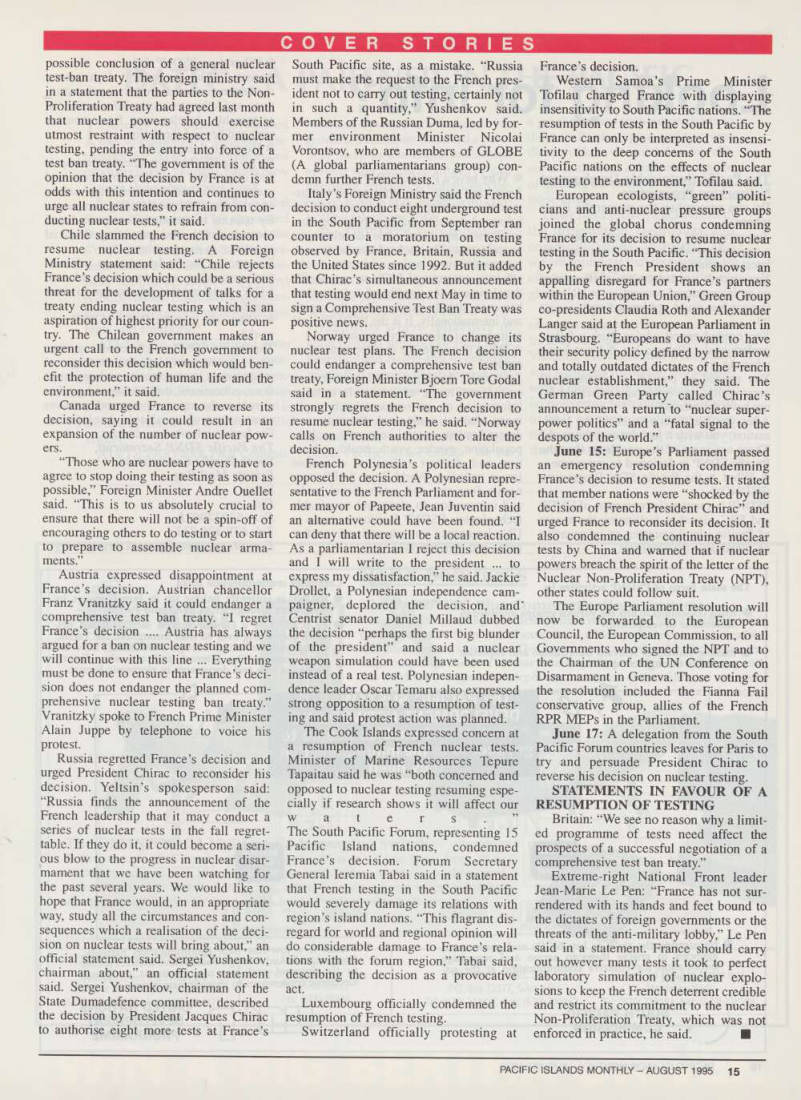
No to nuclear testing.
possible conclusion of a general nuclear test-ban treaty. The foreign ministry said in a statement that the parties to the Non- Proliferation Treaty had agreed last month that nuclear powers should exercise utmost restraint with respect to nuclear testing, pending the entry into force of a test ban treaty. “The government is of the opinion that the decision by France is at odds with this intention and continues to urge all nuclear states to refrain from con ducting nuclear tests,” it said.
Chile slammed the French decision to resume nuclear testing. A Foreign Ministry statement said: “Chile rejects France’s decision which could be a serious threat for the development of talks for a treaty ending nuclear testing which is an aspiration of highest priority for our coun try. The Chilean government makes an urgent call to the French government to reconsider this decision which would ben efit the protection of human life and the environment,” it said.
Canada urged France to reverse its decision, saying it could result in an expansion of the number of nuclear pow ers.
“Those who are nuclear powers have to agree to stop doing their testing as soon as possible,” Foreign Minister Andre Ouellet said. “This is to us absolutely crucial to ensure that there will not be a spin-off of encouraging others to do testing or to start to prepare to assemble nuclear arma ments.”
Austria expressed disappointment at France’s decision. Austrian chancellor Franz Vranitzky said it could endanger a comprehensive test ban treaty. “I regret France’s decision ... Austria has always argued for a ban on nuclear testing and we will continue with this line ... Everything must be done to ensure that France’s deci sion does not endanger the planned com prehensive nuclear testing ban treaty.”
Vranitzky spoke to French Prime Minister Alain Juppe by telephone to voice his protest.
Russia regretted France’s decision and urged President Chirac to reconsider his decision. Yeltsin’s spokesperson said; “Russia finds the announcement of the French leadership that it may conduct a series of nuclear tests in the fall regret table. If they do it, it could become a seri ous blow to the progress in nuclear disar mament that we have been watching for the past several years. We would like to hope that France would, in an appropriate way, study all the circumstances and con sequences which a realisation of the deci sion on nuclear tests will bring about,” an official statement said. Sergei Yushenkov, chairman about,” an official statement said. Sergei Yushenkov, chairman of the State Dumadefence committee, described the decision by President Jacques Chirac to authorise eight more tests at France’s
South Pacific site, as a mistake. “Russia must make the request to the French pres ident not to carry out testing, certainly not in such a quantity,” Yushenkov said.
Members of the Russian Duma, led by for mer environment Minister Nicolai Vorontsov, who are members of GLOBE
(A global parliamentarians group) con
demn further French tests.
Italy’s Foreign Ministry said the French decision to conduct eight underground test in the South Pacific from September ran counter to a moratorium on testing observed by France, Britain, Russia and the United States since 1992. But it added that Chirac’s simultaneous announcement that testing would end next May in time to sign a Comprehensive Test Ban Treaty was
positive news.
Norway urged France to change its nuclear test plans. The French decision could endanger a comprehensive test ban treaty, Foreign Minister Bjoem Tore Godal said in a statement. “The government strongly regrets the French decision to resume nuclear testing,” he said. “Norway calls on French authorities to alter the decision.
French Polynesia’s political leaders opposed the decision. A Polynesian repre sentative to the French Parliament and for mer mayor of Papeete, Jean Juventin said an alternative could have been found. “I can deny that there will be a local reaction.
As a parliamentarian I reject this decision and I will write to the president ... to express my dissatisfaction,” he said. Jackie Drollet, a Polynesian independence cam paigner, deplored the decision, and* Centrist senator Daniel Millaud dubbed the decision “perhaps the first big blunder of the president” and said a nuclear weapon simulation could have been used instead of a real test. Polynesian indepen dence leader Oscar Temaru also expressed strong opposition to a resumption of test ing and said protest action was planned.
The Cook Islands expressed concern at a resumption of French nuclear tests.
Minister of Marine Resources Tepure Tapaitau said he was “both concerned and opposed to nuclear testing resuming espe cially if research shows it will affect our waters.
The South Pacific Forum, representing 15 Pacific Island nations, condemned France’s decision. Forum Secretary General leremia Tabai said in a statement that French testing in the South Pacific would severely damage its relations with region’s island nations. “This flagrant dis regard for world and regional opinion will do considerable damage to France’s rela tions with the forum region,” Tabai said, describing the decision as a provocative act.
Luxembourg officially condemned the
resumption of French testing.
Switzerland officially protesting at
France’s decision.
Western Samoa’s Prime Minister Tofilau charged France with displaying insensitivity to South Pacific nations. “The resumption of tests in the South Pacific by France can only be interpreted as insensi tivity to the deep concerns of the South Pacific nations on the effects of nuclear testing to the environment,” Tofilau said.
European ecologists, “green” politi
cians and anti-nuclear pressure groups
joined the global chorus condemning
France for its decision to resume nuclear testing in the South Pacific. “This decision by the French President shows an appalling disregard for France’s partners within the European Union,” Green Group co-presidents Claudia Roth and Alexander Langer said at the European Parliament in Strasbourg. “Europeans do want to have their security policy defined by the narrow and totally outdated dictates of the French nuclear establishment,” they said. The German Green Party called Chirac’s announcement a return do “nuclear super power politics” and a “fatal signal to the despots of the world.”
June 15: Europe’s Parliament passed an emergency resolution condemning France’s decision to resume tests. It stated that member nations were “shocked by the decision of French President Chirac” and urged France to reconsider its decision. It also condemned the continuing nuclear tests by China and warned that if nuclear powers breach the spirit of the letter of the Nuclear Non-Proliferation Treaty (NPT), other states could follow suit.
The Europe Parliament resolution will now be forwarded to the European Council, the European Commission, to all Governments who signed the NPT and to the Chairman of the UN Conference on Disarmament in Geneva. Those voting for the resolution included the Fianna Fail conservative group, allies of the French RPR MEPs in the Parliament.
June 17: A delegation from the South Pacific Forum countries leaves for Paris to try and persuade President Chirac to reverse his decision on nuclear testing.
Statements In Favour Of A
Resumption Of Testing
Britain; “We see no reason why a limit ed programme of tests need affect the prospects of a successful negotiation of a comprehensive test ban treaty.”
Extreme-right National Front leader Jean-Marie Le Pen: “France has not sur rendered with its hands and feet bound to the dictates of foreign governments or the threats of the anti-military lobby,” Le Pen said in a statement. France should carry out however many tests it took to perfect laboratory simulation of nuclear explo sions to keep the French deterrent credible and restrict its commitment to the nuclear Non-Proliferation Treaty, which was not enforced in practice, he said. ■