Bowing to Paris
p. 11 · Read in the full issue
pressure
By lan Williams
The French reputation in the Pacific has never been very high in recent years, but when they
suspended nuclear testing and signed the
Matignon accords in New Caledonia, thus defusing two very explosive diplomatic issues, relations had begun to improve
again. But no longer.
President Jacques Chirac’s announce ment of a new series of nuclear tests in the Pacific was dulled slightly by China’s actual explosion within a few days of the end of the successful negotiations for the nuclear non-proliferation treaty. But at least, as several UN diplomats pointed out, the Chinese had the decency to explode their bomb in their own country rather than at the enhanced the spirit of the non proliferation treaty renewal conference at which the major complaint was the total failure of the nuclear powers to disarm as they had promised back in 1965.
The criticism was in part headed off by President Clinton’s belated adherence to an indefinite extension of the test ban treaty, and its acceptance by the others.
The nuclear powers promised that they would confirm the treat by 1996, and in the meantime “exercise utmost restraint.”.
So the French attempt to squeeze in an extra tests before finally shutting down had all the sincerity and charm of an alco holic promising to give up but after just eight more crates of brandy.
Only days after the announcement, Chirac arrived in New York on his way to the heads of state summit in Halifax, and was indeed asked why he did not follow the Chinese example and explode his bombs at home. Like Marie Antoinette, he begged he question. She wondered why starving people without bread should not eat cake. In the same spirit, the President remarked upon the lack of facilities for testing in France, as if the nuclear complex in Polynesia were a natural feature like the coral, rather than the product of decades of European indifference to the sensibilities of Pacific Islanders. As well as the diplo matic protests, Kiwi Alyn Ware handed over a letter signed by politicians and church leaders from across the Pacific, including 95 out of the 99 New Zealand
MOs to Chirac while he was in New York.
Of course, being a permanent member with a veto, and a somewhat overblown of its own importance, France has often gone its own way, but rarely with such a dis dainful thumbing of its nose at friendly nations. Secretary General Boutros Ghali, regretted the test with as much force as one could expect from someone who will
need the France vote if he is to run for a second term in office. He was “reassured that the tests would be limited in nature and would be conducted under the super vision of international monitors to ensure that there was no damage to the environ ment.”
More forcefully, and not in the least reassured, the South Pacific Forum UN Missions, with the notable exception of Vanuatu, together and individually issued
statements roundly condemning the
French action. Forum diplomats searched in vain for the ambassador of Vanuatu, who coincidentally or diplomatically was absent. Back in Vanuatu, Premier Maxim Carlot had confused the issue by deciding that French nuclear testing was an interna tional affair of France, while signing the Forum protest, but also censoring news of the row to prevent it being head in Vanuatu.
Once can’t be sure what it will do for Carlot’s future in politics in Vanuatu, but he is always assured of a warm welcome in Paris. Which is more than can be said for the Pacific Delegation that went to the French capital to register its protest. Like most of the delegations it stuck to the nuclear issue and avoided “French bash ing.” As a reward for their restraint, with in days, the French Foreign Ministry let it be known that its foreign aid cheques to protesting countries might get lost in the mail.
So what can be done? Very little, some island diplomats fear. There is talk of a
boycott of French goods, by organizations
such as the international Peace Bureau, and of course Greenpeace will be heading to the region. But memories of the Rainbow Warrior, and FRance’s unilateral breaking of its subsequent agreements show what a determined and monomaniac medium sized nation with a nuclear arse nal can do.
Papua New Guinea tried to raise the issue at the Non Aligned Movement, but with little effect. The former French colonies often seem to forget that they are no longer colonies. “So far, perhaps the only result is that one from the Pacific will vote for a French candidate for anything in the United Nations,” said one Pacific
diplomat.
That threat may become a little more potent over the next year or so. If propos als under discussion are adopted in this session, it will allow the smaller Pacific States to join the UN and vote at lesser cost. At present the minimum membership fee is just over US$lOO,OOO, which is a sizable slice of budget of nations like Kiribati or Tuvalu. If as proposed it is reduced to $lO,OOO, or even $l,OOO, it could lead to a small boost to the Pacific, and anti-nuclear vote in the organization.
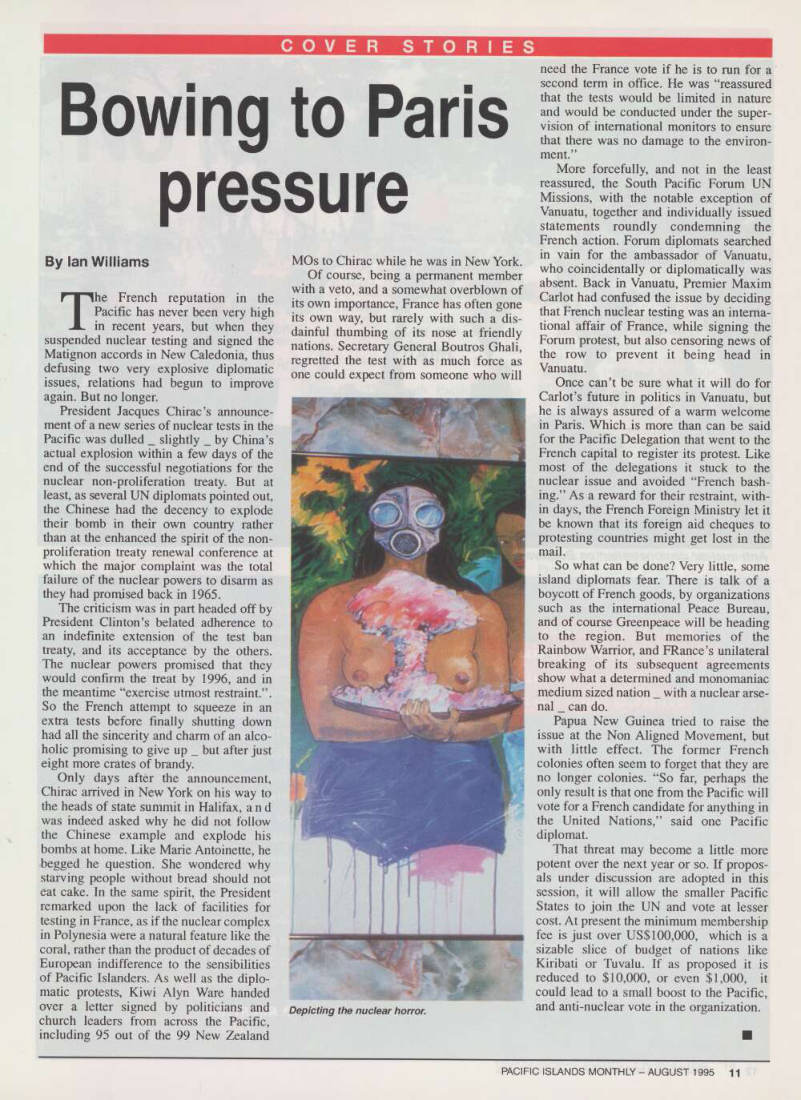
Depicting the nuclear horror.