wake of the
pp. 44-45 · Read in the full issue
Canoeing
Sailing in the wake of the ancestors
Polynesian voyaging canoes rekindle interest in traditional navigational skills
By Barry Markowitz
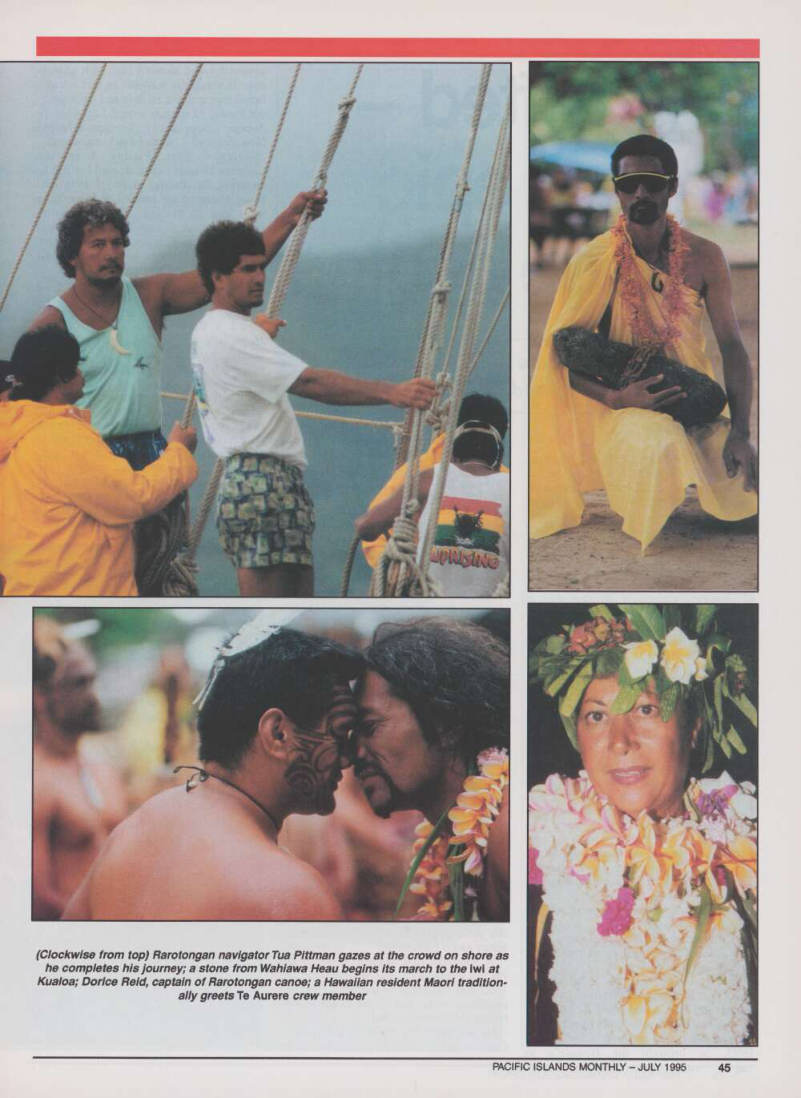
offerings and were given a lei greeting by Hawaiians. They then moved through a gauntlet of traditional protocol offered by the Cook Islanders, New Zealand Maori and thousands of cheering well-wishers.
At sunset and by torch-light each crew member solemnly placed a pohaku (sacred stone) from their home island before the Ahu (sacred shrine). With the formalities over, the crews faced the rewarding chal lenge of piling high plates of crab, salmon, poi, taro and fish from what seemed like miles of tables provided by the Windward Oahu Hawaiian families.
Nainoa Thompson, legendary voyaging captain and navigator, glowed with a sense of achievement as the formalities ended.
“We are one single nation coming togeth er that has been split apart maybe a couple hundred years ago. In their time, the Polynesians were the greatest explorers.
We are trying real hard to sail in the wake of our ancestry. In doing so, we are col lecting people and bringing them back together. It’s an incredibly good feeling to come to m y home island to this sacred beach at Kualoa and have these other canoes here ... This is probably the most special of all trips. So many canoes, so many different people.”
Former Cook Islands Prime Minister Sir Tom Davis saluted Samoa’s contribution to his Takitumu. “I’ve been interested in voyaging canoes for a very long time. The Takitumu was built for the sixth South Pacific Arts Festival. I sailed her to Tahiti and she’s a lovely boat. She is of the Alia type, which is Samoan. It (the Alia style) was originally built about 1000 AD. The Takitumu is a third of the size of the origi nal which remains in the Cooks.”
Sir Tom had no reservations about the crew. “They never showed any sign of apprehension. They took everything that
For 4000 Hawaiian and Pacific island peoples waiting in heavy rain for the Polynesian voyaging canoes at Kuola Beach, Hawaii, it was almost a spiritual reunion. Hawaiian leader Bill Wallace, also of Samoan and Tongan lineage, said, “These voyaging canoes are the origins of our people here in Hawaii. They are a his torical link which kept our Polynesian people connected. They are now the con temporary link that reunites us at a critical time in many Polynesian cultures.”
Wallace, also a Hawaiian spiritual leader, had blessed the voyagers arrival path the night before. He then slept on the tea-leaf, rope-lined site to assure its purified state.
Kualoa, the traditional home of royalty and the seat of learning, was selected as the landing spot for the voyaging canoes just as it had been before the conquest of King Kamehameha.
While fair weather accompanied the voy agers through Tahiti and the Marquesas, arrival plans were first delayed for two days to allow for fumigation of the sting ing nono fly. Then en route to Hawaii, there was another delay of six hours and plans changed three more time as 15-foot swells and heavy rains fell on the already
fatigued crews.
Originally all canoes were to land at Kualoa. After the mast had broken on the Rarotongan Takitumu, the decision was made for only the Hawaiian Hokuleia, the Hawai’iloa and Maui’s Mo’olele to land at Kualoa, while all others went to safer Honolulu harbours.
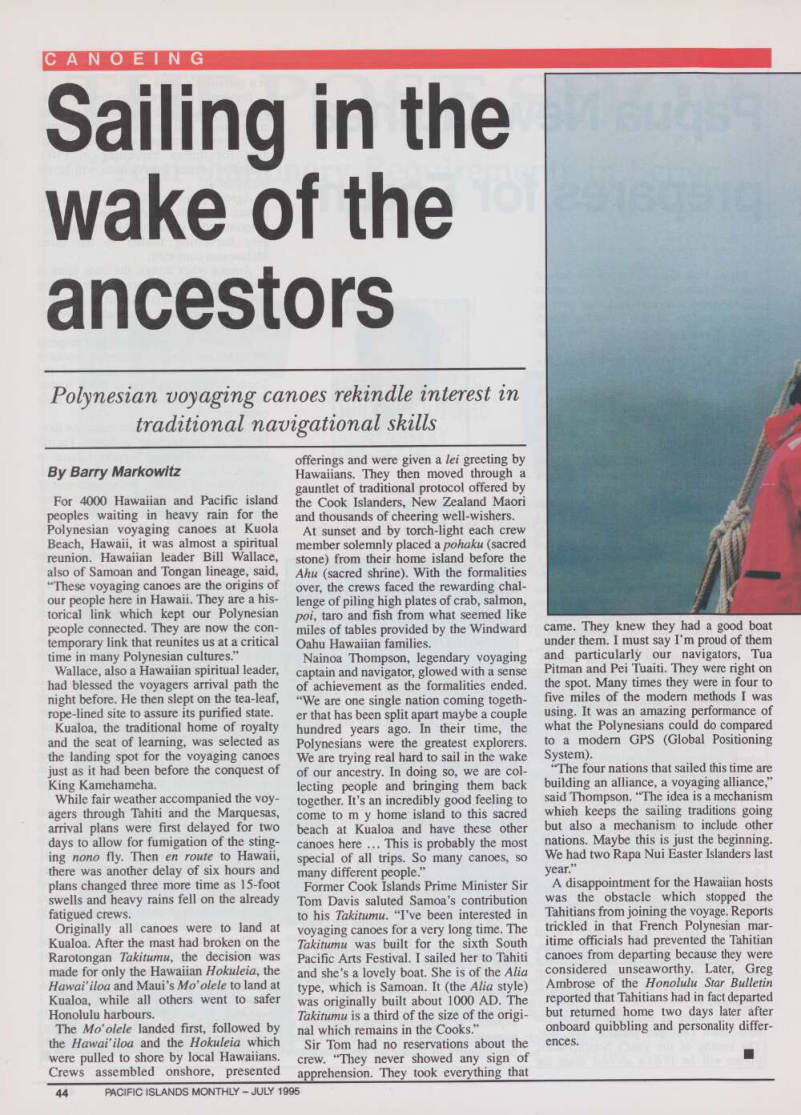
The Mo’olele landed first, followed by the Hawai’iloa and the Hokuleia which were pulled to shore by local Hawaiians.
Crews assembled onshore, presented
came. They knew they had a good boat under them. I must say I’m proud of them and particularly our navigators, Tua Pitman and Pei Tuaiti. They were right on the spot. Many times they were in four to five miles of the modem methods I was using. It was an amazing performance of what the Polynesians could do compared to a modem GPS (Global Positioning System).
“The four nations that sailed this time are building an alliance, a voyaging alliance,” said Thompson. “The idea is a mechanism which keeps the sailing traditions going but also a mechanism to include other nations. Maybe this is just the beginning.
We had two Rapa Nui Easter Islanders last year.”
A disappointment for the Hawaiian hosts was the obstacle which stopped the Tahitians from joining the voyage. Reports trickled in that French Polynesian mar itime officials had prevented the Tahitian canoes from departing because they were considered unseaworthy. Later, Greg Ambrose of the Honolulu Star Bulletin reported that Tahitians had in fact departed but returned home two days later after onboard quibbling and personality differ ences.
(Clockwise from top) Rarotongan navigator Tua Pittman gazes at the crowd on shore as he completes his journey; a stone from Wahiawa Heau begins its march to the iwi at Kuaioa; Dorice Reid, captain of Rarotongan canoe; a Hawaiian resident Maori tradition ally greets Te Aurere crew member