Papua New Guinea
p. 43 · Read in the full issue
Opinion
Papua New Guinea prepares for Forum
Papua New Guinea’s northern coastal town of Madang is expected to be abuzz with regional activities later this year as national leaders of the 15-nation South Pacific Forum gather for their annual sum mit.
The PNG government has already allo cated U 5525,000 to help the provincial town prepare for this major event. The money will be used to upgrade roads and amenities to be used by the region’s top politicians.
Up to 150 delegates and media repre sentatives are expected to invade the tran quil seaside township in the second week of September.
The South Pacific Forum and associat ed meetings will get underway from 10-11 September with the Forum Officials Committee, the pre-Forum session of senior officials from member nations.
It will be followed by the official open ing of the main South Pacific Forum - the annual general meeting of political leaders of Australia, Cook Islands, Federated States of Micronesia, Fiji, Kiribati, Nauru New Zealand, Niue, Papua New Guinea, the Republic of the Marshall Islands, Solomon Islands, Tonga, Tuvalu, Vanuatu and Western Samoa on September 13.
The newly independent state of Palau in the north-west Pacific is expected to join as the 16th member.
Private discussions by leaders on eco nomic, political and associated issues, oth erwise known as the retreat, will take place on September 14.
They are expected to break up from their meeting a day later to join the Prime Minister, Sir Julius Chan, and other digni taries in Port Moresby celebrate PNG’s 20th independence anniversary on September 16.
Associated meetings of the South Pacific Forum, such as the post-Forum Dialogue with donor countries like Canada, France, Japan, the United Kingdom, the Untied States of America, the People’s Republic of China and donor agencies such as the European Union, will be held in Port Moresby, beginning September 17.
South Korea is expected to join the post-Forum Dialogue partners this year.
The hosting of the year’s South Pacific Forum will be PNG’s second since the
...forestry manage ment, trade and invest ment and environment will be high on the
agenda
regional bloc was formed in 1970. Like Niue and FSM, Papua New Guinea hosted the South Pacific Forum only once before, in 1977.
Papua New Guinea has specifically requested that this year’s gathering be held in September to coincide with its indepen dence anniversary celebrations.
The Republic of the Marshall Islands, one of the newest members, will complete the cycle of members hosting this gather ing when its turn comes next year.
Port Moresby is expected to follow a similar format to last year’s South Pacific Forum - that is, that discussions will revolve around a theme.
Sir Julius, who will assume the chair of the South Pacific Forum this year, has begun the ball rolling by suggesting a pos sible theme to his colleagues. It is likely to be built around securing development for the region beyond the year 2000. In other words, PNG’s paper on the theme is expected to highlight areas conducive to securing long-term, rather than short-term, development in managing their resources
at a sustainable level.
Important issues such as forestry man agement, trade and investment and the environment will be high on the agenda.
On forestry, a draft proposed code of con duct for timber harvesting in PNG, Solomon Islands and Vanuatu will be on the agenda.
Agreed at last year’s 25th South Pacific Forum in Brisbane, Australia, the draft proposed code is intended for foreign log gers harvesting timber in the three Melanesian countries.
Among other things, the code aims at protecting the environment and promoting forest development consistent with princi ples of ecologically sustainable develop ment.
The code also recognises and respects the rights and needs of customary resource owners and ensures the people of the South Pacific region get a much higher return from logging operations in their countries.
On trade and investment front, the like lihood of establishing a South Pacific Economic Exchange Support Centre in Japan is also a highlight on the agenda.
After years of talking, the government of Japan has finally agreed to conduct a fea sibility study in the viability of the propos al. A final report is due by the end of the year.
A similar set-up, to be funded by the government of the People’s Republic of China, is also in the offing. This follows a visit to mainland China last year by a group of private sector representatives from the Forum Island Countries.
On environment, a draft regional Convention on Hazardous Wastes will be tabled at the South Pacific Forum.
The objectives of the proposed conven tion are to impose a ban on importation into Forum Island Countries of all haz ardous wastes generated outside the con vention area and to ensure that trans boundary movements of hazardous wastes generated within the area are completed in a controlled and environmentally sound manner.
Complementary to existing global regimes, such as the Basel Convention on the Control of Trans-boundary Movements of Hazardous Wastes and their Disposal, the draft Regional Convention, among other things, aims at protecting the special vulnerability of island member countries from the whims of unscrupulous dealers in international wastes trade.
The draft convention, expected to be called the Waigani Convention, also con tains some important provisions on co operation among the parties on the imple mentation of the convention.
Once it is approved by the South Pacific Forum, regional leaders are hoping the United States and France will adopt the convention. ■
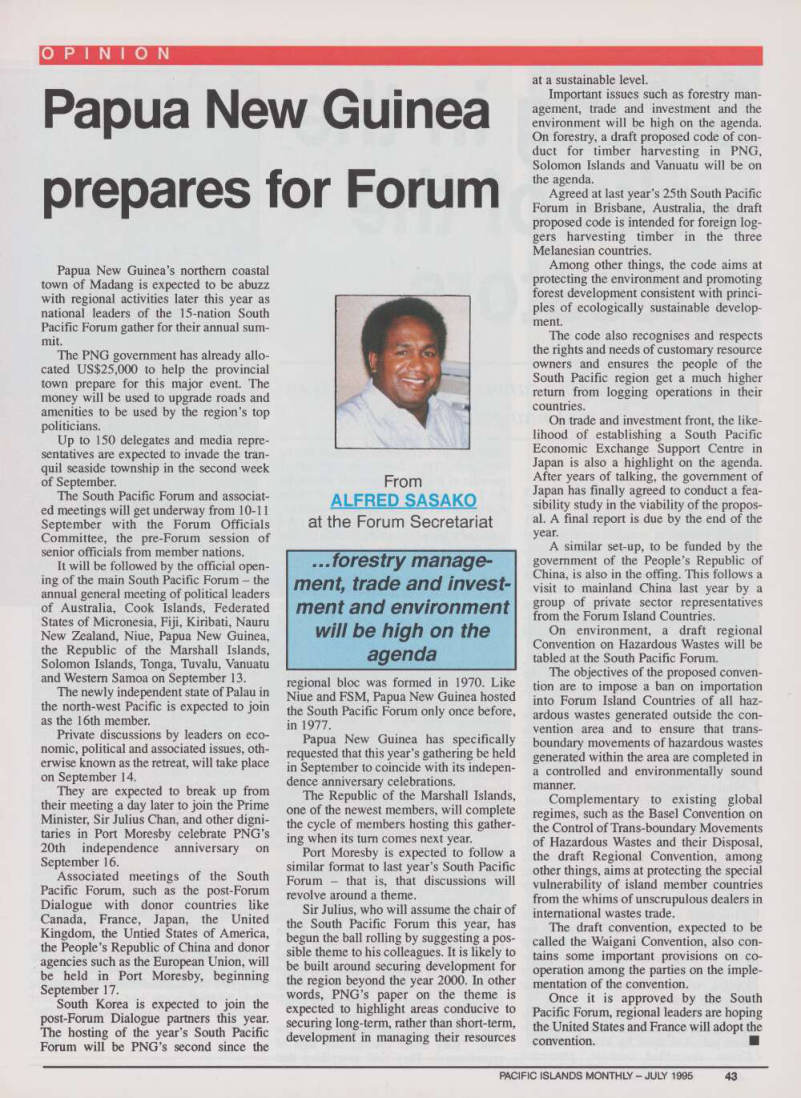
From
Alfred Sasako
at the Forum Secretariat