voyage begins
pp. 46-47 · Read in the full issue
Tapu lifted and an epic voyage begins
The “Te Aurere’s” ocean voyage demonstrates its seaworthiness and traditional craft
By Sally Andrew
On March 18, 1995, the Maori voyaging canoe Te Aurere sailed through the pass in the reef at Raiatea, French Polynesia. It was a historic and emotionally charged moment, especially for tohunga tarai waka Hekenukumai Hec Busby of Doubtless Bay Aotearoa. “We are trying to get ourselves back to one family in the Pacific.”
According to legend, the last gathering of voyaging canoes in Raiatea was in 1350 when a curse was placed on the temple of Taputapuatea by a Maori tohunga in revenge for murder. With the arrival of Te Aurere and her escort of sail ing canoes from Hawaii, Tahiti and Rarotonga, the ancient tapu was lifted off this sacred site. As a symbol of renewed friendship between the islands, Busby placed a stone from Aotearoa on the marae at Taputapuatea.
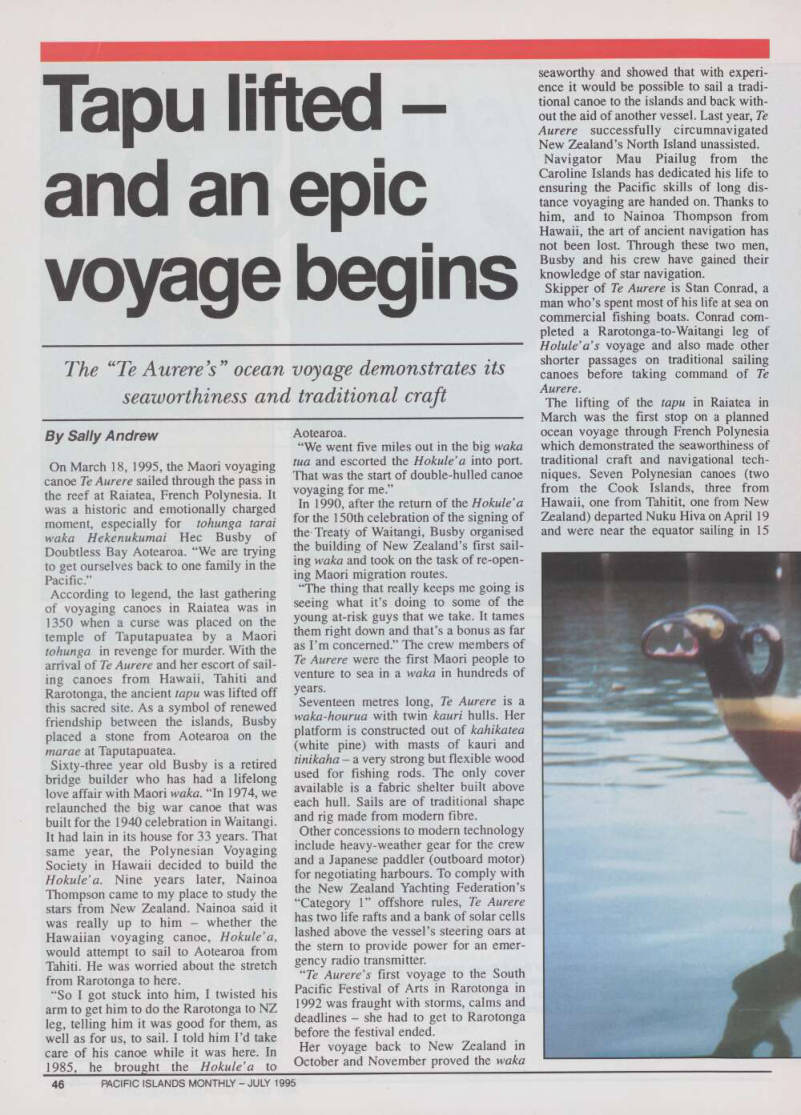
Sixty-three year old Busby is a retired bridge builder who has had a lifelong love affair with Maori waka. “In 1974, we relaunched the big war canoe that was built for the 1940 celebration in Waitangi.
It had lain in its house for 33 years. That same year, the Polynesian Voyaging Society in Hawaii decided to build the Hokule’a. Nine years later, Nainoa Thompson came to my place to study the stars from New Zealand. Nainoa said it was really up to him - whether the Hawaiian voyaging canoe, Hokule’a, would attempt to sail to Aotearoa from Tahiti. He was worried about the stretch from Rarotonga to here.
“So I got stuck into him, I twisted his arm to get him to do the Rarotonga to NZ leg, telling him it was good for them, as well as for us, to sail. I told him I’d take care of his canoe while it was here. In 1985, he brought the Hokule’a to
Aotearoa.
“We went five miles out in the big waka tua and escorted the Hokule’a into port.
That was the start of double-hulled canoe voyaging for me.”
In 1990, after the return of the Hokule’a for the 150th celebration of the signing of the Treaty of Waitangi, Busby organised the building of New Zealand’s first sail ing waka and took on the task of re-open ing Maori migration routes.
“The thing that really keeps me going is seeing what it’s doing to some of the young at-risk guys that we take. It tames them right down and that’s a bonus as far as I’m concerned.” The crew members of Te Aurere were the first Maori people to venture to sea in a waka in hundreds of years.
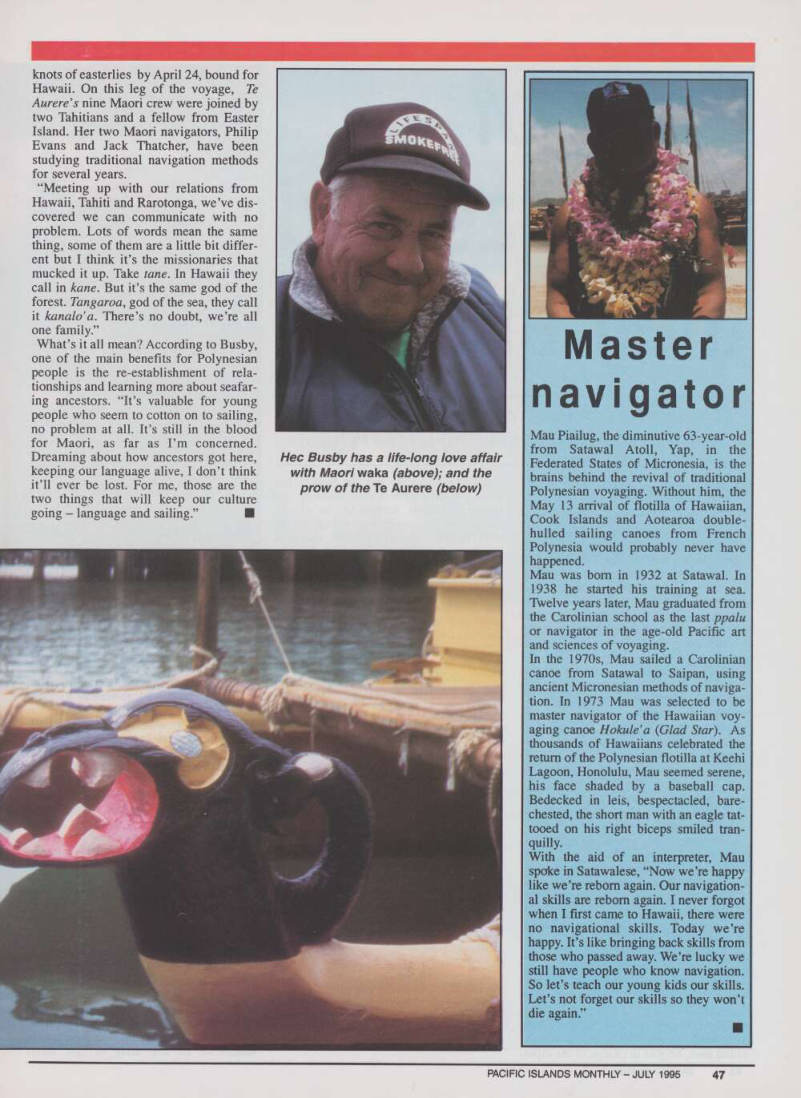
Seventeen metres long, Te Aurere is a waka-hourua with twin kauri hulls. Her platform is constructed out of kahikatea (white pine) with masts of kauri and tinikaha - a very strong but flexible wood used for fishing rods. The only cover available is a fabric shelter built above each hull. Sails are of traditional shape and rig made from modern fibre.
Other concessions to modern technology include heavy-weather gear for the crew and a Japanese paddler (outboard motor) for negotiating harbours. To comply with the New Zealand Yachting Federation’s “Category 1” offshore rules, Te Aurere has two life rafts and a bank of solar cells lashed above the vessel’s steering oars at the stern to provide power for an emer gency radio transmitter.
“Te Aurere’s first voyage to the South Pacific Festival of Arts in Rarotonga in 1992 was fraught with storms, calms and deadlines - she had to get to Rarotonga before the festival ended.
Her voyage back to New Zealand in October and November proved the waka
seaworthy and showed that with experi ence it would be possible to sail a tradi tional canoe to the islands and back with out the aid of another vessel. Last year, Te
Aurere successfully circumnavigated
New Zealand’s North Island unassisted.
Navigator Mau Piailug from the Caroline Islands has dedicated his life to ensuring the Pacific skills of long dis tance voyaging are handed on. Thanks to him, and to Nainoa Thompson from Hawaii, the art of ancient navigation has not been lost. Through these two men, Busby and his crew have gained their
knowledge of star navigation.
Skipper of Te Aurere is Stan Conrad, a man who’s spent most of his life at sea on commercial fishing boats. Conrad com pleted a Rarotonga-to-Waitangi leg of Holule’a’s voyage and also made other shorter passages on traditional sailing canoes before taking command of Te Aurere.
The lifting of the tapu in Raiatea in March was the first stop on a planned ocean voyage through French Polynesia which demonstrated the seaworthiness of traditional craft and navigational tech niques. Seven Polynesian canoes (two from the Cook Islands, three from Hawaii, one from Tahitit, one from New Zealand) departed Nuku Hiva on April 19 and were near the equator sailing in 15
knots of easterlies by April 24, bound for Hawaii. On this leg of the voyage, Te Aurere’s nine Maori crew were joined by two Tahitians and a fellow from Easter Island. Her two Maori navigators, Philip Evans and Jack Thatcher, have been studying traditional navigation methods for several years.
“Meeting up with our relations from Hawaii, Tahiti and Rarotonga, we’ve dis covered we can communicate with no problem. Lots of words mean the same thing, some of them are a little bit differ ent but I think it’s the missionaries that mucked it up. Take tane. In Hawaii they call in kane. But it’s the same god of the forest. Tangaroa, god of the sea, they call it kanalo’a. There’s no doubt, we’re all one family.”
What’s it all mean? According to Busby, one of the main benefits for Polynesian people is the re-establishment of rela tionships and learning more about seafar ing ancestors. “It’s valuable for young people who seem to cotton on to sailing, no problem at all. It’s still in the blood for Maori, as far as I’m concerned.
Dreaming about how ancestors got here, keeping our language alive, I don’t think it’ll ever be lost. For me, those are the two things that will keep our culture going - language and sailing.” ■
Hec Busby has a life-long love affair with Maori waka (above); and the prow of the Te Aurere (below)