and green?
pp. 22-23 · Read in the full issue
Economy
Has the World Bank gone soft and green?
By Roman Grynberg
If you open the most recent the most recent World Bank report on the South Pacific, entitled Pacific Island Economies - Building a Resilient Economic Base for the Twenty First Century, you would get the impression the much vilified bank had gone soft as it approaches its 50th birthday.
The report, which emphasises areas of economic concern to the South Pacific such as transfer pricing rip-offs in fisheries and forestry degradation, are such a dra matic departure from the standard analy ses that many officials in the region are wondering whether the bank has changed its position from its free market position of the 1980 s.
The bank’s changes began when envi
ronmental issues began to appear on the global agenda in the last 10 years. Its response has been two-track. On the one hand, it has started emphasising environ mental issues in its reports, something that was unheard of in the 1970’5. This is in no small part a result of the fact that some of the bank’s larger projects, especially some of the hydro-electric dams have been seen to be environmental disasters. But there has been another, much less positive side to its work in environment. It has been pushing a strong environmental line that economic growth, free trade and liberali sation policies are not only consistent with good environmental practices but that they are good for the environment.
There have been a number of reasons for change in the World Bank. The first and most obvious has been a Democratic administration in Washington which recently appointed Australian-bom
financier James Wolfensohn as the new president. Wolfensohn is not your usual bank president. He has a strong environ mental bent which fits well into US vice- President A 1 Gore’s own preference but he is by no means a liberal wimp. He has the most impeccable of banking backgrounds.
Senior officials within the bank indicate his appointment will mean not only a change in direction but, more importantly, it will mean that staff are likely to have some sense of direction. Bank insiders fre quently complain that they suffer from low morale stemming from the lack of leader ship of the organisation.
But Wolfensohn and the Democratic administration do not explain all the changes within the Bank. On the econom ic front, there have been some major changes in the thinking on economic poli cy. One important reason for them is that the East Asian countries provided a model of economic development throughout the 1980 s that was not only successful, but arguably nowhere remotely close to the free market, free trade position that has been the hallmark of Anglo-Saxon economies for the last 15 years and has been accepted by the World Bank. The success of highly regulated, outward look ing and extremely competitive East Asian economies throughout the Reagan/Thatcher decade made for real tensions within the development banking community. Japan, which controls the Asian Development Bank, has never accepted the free market position.
It has been difficult to justify free mar ket policies in light of Asia’s success. The response has been two-track, reflecting the World Bank’s own economic schizophre nia. One the one hand, the bank and its for mer employees have devoted enormous effort to demonstrate how much faster the Asian countries would have grown if they
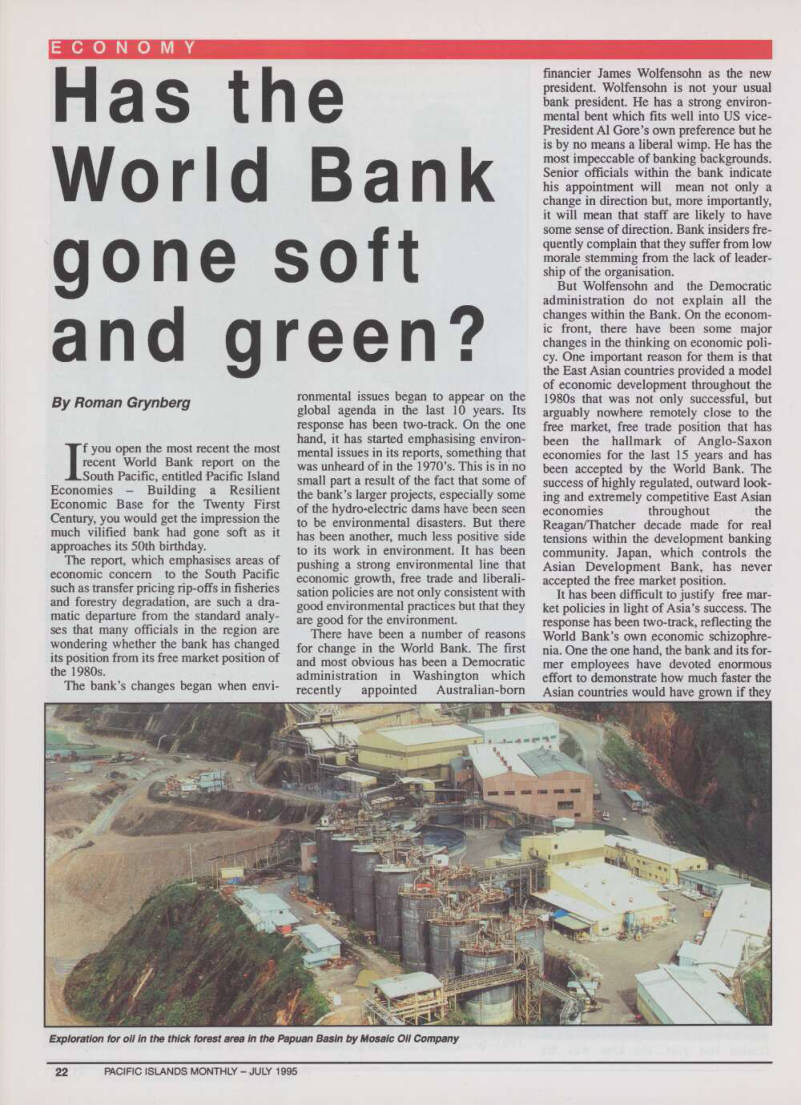
Exploration for oil in the thick forest area in the Papuan Basin by Mosaic Oil Company
had just followed the Anglo-Saxon free market model.
But inside the World Bank there is the sound of backtrack. Free market is no longer the buzz-word in Washington that it was in the heady hey day of Reaganite economics. Bank staff now talk of “market friendly” reforms. Moreover, the reports of the World Bank have been more focused on issues such as inequality and poverty.
The recently leaked but not-yet-released World Development Report emphasises these sorts of issues.
In the South Pacific, the World Bank and its sister organisation, the International Monetary Fund, have been embroiled in economic disasters in two countries. While there is no doubt a change inside the World Bank, the IMF remains a no-nonsense banker that has no time for big spending governments that spend their countries into insolvency.
Papua New Guinea has so mismanaged its economy that two years into oil exports it has been forced to sign a Kina 200 million rescue package with the IMF and the World Bank. Late in April, Finance Minister Chris Haiveta obtained the unan imous cabinet agreement for the rescue package while the Prime Minister, Sir Julius Chan, was in New Zealand desper ately attempting to obtain foreign exchange from New Zealand and Australian Reserve banks. On both occa sions he was met with precisely the same response - first agreements with the IMF and the World Bank and then there will be loans.
Reeling from the effects of the closure of the Bougainville mine the PNG govern ment had to negotiate its first structural adjustment package from the IMF in 1989.
When oil came on stream in 1993 the PNG government, rather than acting prudently from what was widely seen as a short spurt of very large foreign exchange earnings, has begun a widely predicted orgy of pub lic sector consumption that has resulted in the absurd situation that after opening two gold mines and one oil field, the PNG gov ernment is broke. IMF has imposed strict austerity measures on the public sector in PNG. Most of the measures are supposed to fall not upon education and health but directly upon PNG’s bloated public sector which is set to shrink by some 4000 work ers under the 18-month plan. The PNG cabinet agreed to abolish the much criticisedElectoral Development or slush fund as it is known in PNG. The funds of K 300,000 per MP (108 MPs) which is used at the discretion of the individual MP has been widely criticised as being abused to assure relection.
While the PNG government had argued it would never permit IMF or the World Bank to dictate internal policies, it was in the forestry sector, reputedly PNG’s most corrupt sector, that the international bank came down hard. The World Bank insisted
the government continue to provide fund ing for the Swiss company, Soceite General de Suveillance, which was recruited last year to monitor and control illegal trade practices, such as transfer pricing and species misidentification in the PNG forestry sector. The company, which is widely considered to be a relatively high cost service has provided the PNG govern ment with reliable information about the log export trade.
With agreement from the IMF/World Bank, the Australian Reserve Bank will release a loan of K4O million. Meanwhile, the government has been forced to further tighten lending as the Central Bank raised the minimum liquid asset ratio to 32 per cent on sth May. This is an increase from 11 percent six months ago. Commercial bankers in Port Moresby indicated that importers are simply unable to get money out of the country and that at the beginning of May there was unfulfilled import bill of K3O million.
While the situation in PNG has moved quickly to an agreement with the IMF and the World Bank, Solomon Islands has made little progress towards a structural adjustment package. The Mamoloni gov
emment has continued the rapacious poli cy of deforestation of the country with exports at levels that most forestry experts feel are utterly unsustainable and predict will lead to a complete deforestation with in 10 to 15 years. Unprocessed logs is now the Solomon Islands largest export. The World Bank and IMF will not agree to any loans until the forestry sector is brought under control.
While there is no doubt that changes are occurring within the World Bank, the sys tem is not going to change fundamentally.
While it may be willing to give more and more loans to what were previously “soft” areas such as education, environment, women’s issues, there will be no change in policy on structural adjustments that are needed when countries like PNG system
atically overspend and deplete their for
eign exchange reserves. In the final analy sis, the rules that apply to individual big spenders also apply to nations - if you spend more than you earn and deplete your savings, then you will end up in the hands of the bailiff - and that is a role the IMF and the World Bank will continue to per form, no matter who rules Washington. ■
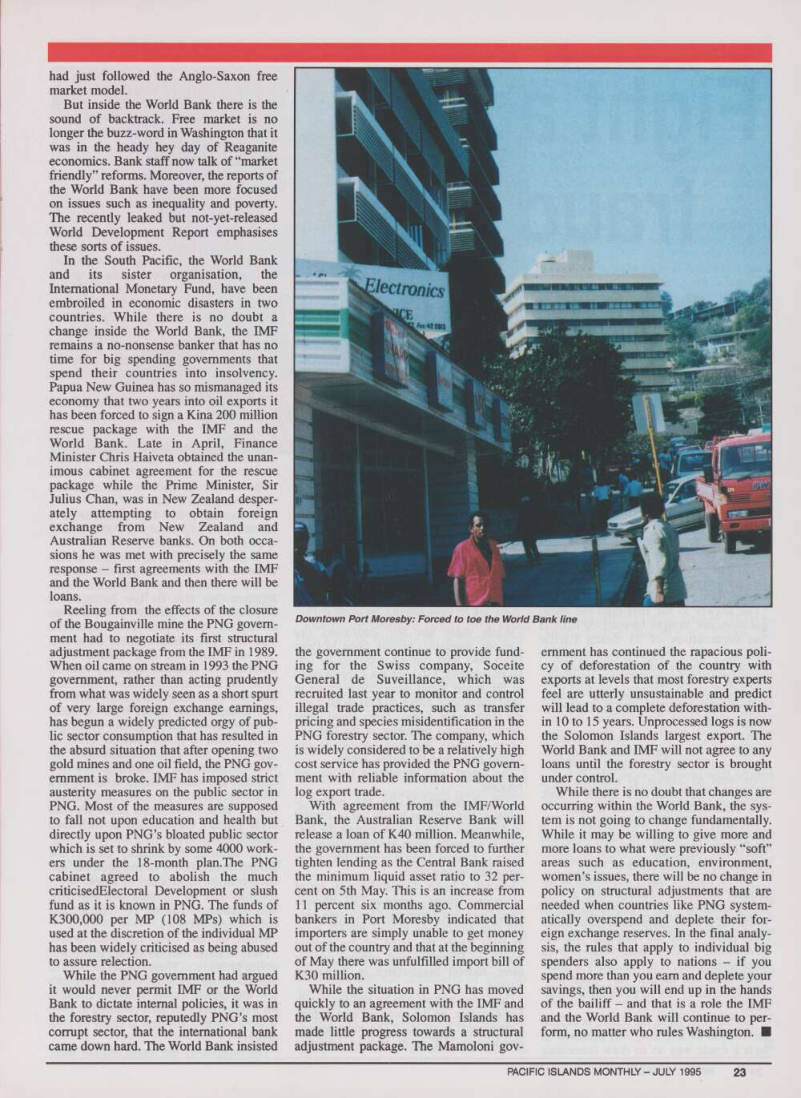
Downtown Port Moresby: Forced to toe the World Bank line