Fight against
pp. 24-25 · Read in the full issue
Crime
Fight against fraud and corruption
Mainland investigators unravel the extent of and problems with prosecuting white collar crime in American Samoa
By David North
What is the South Pacific Islands Criminal Intelligence Network (SPICIN)?
What is American Samoa’s Police Department doing to harm SPICIN? Why are we asking these questions?
The answer to the first (and the third) questions are straight forward. SPICIN is “an organisation of 21 South Pacific nations’ law enforcement agencies, formed for the purpose of collecting and sharing criminal intelligence.
Headquartered in American Samoa, SPICIN has access to various law enforce ment data bases ...”
The lines above are quoted from a remarkable US Department of Justice doc ument written by three mainlanders who were sent to Samoa in response to a request by Governor A. P. Lutali to look into white-collar crime in the islands.
The trio, two FBI investigators and a lawyer, spent 90 days in Pago Pago and then went home and wrote a document notable in two quite different ways: * On the positive side, it appears to be the product of sound research into a very sticky situation ( the extensive pattern of white-collar crime, apparently all of which takes place within the American Samoan government (ASG)). And what is even more remarkable, it is beautifully written. (That does not happen very often any where, certainly not in government agen cies.) * On the other hand, the report, or at least the version of it I saw, was censored in such a crude way as to draw immediate
attention to SPICIN and its relations to the Samoan cops, a point to which we will return.
More than 99.9 percent of the report was addressed to subjects other than the intelli gence network. Its primary focus was on the woeful state of federal and Samoan efforts to control fraud and corruption in
Asg.
While there are two enormous (by Samoan standards) private firms in Pago Pago, two tuna canneries owned by off shore interests, I did not see a single word in the report about white-collar crime in their operations, although I do recall a sin gle story in the Samoa News about some cannery payroll problems in the last few years. I guess the tuna companies run tighter ships than the public sector.
The report was impressive for several reasons; First, it recognised the big picture white-collar crime is totally out of control in American Samoa, it is costing the tax payers a bundle, there are few systems in place to control it and it is very difficult to prosecute wrong-doers.
Second, it has a clear and logical set of recommendations - open an FBI office in Pago Pago, put American Samoa (the only US flag jurisdiction outside the US court system) under the wing of the federal courts in Honolulu and appoint one or more federal magistrates in American Samoa.
Third, the authors had an eye for detail.
For example, on the local jail (the Tafuna Correctional Facility); “The most serious problem at TCF is its lack of adequate
security ... The fence surrounding the facility is only 12 feet high and the entrance gate, leading from the main high way, usually remains open ...”
Fourth, the writers were sensitive to cross-cultural issues, devoting consider able space to the conflict between main land rules (law and order and accounting) and the traditional Samoan way of life (Fa’a Samoa) with its stress on family obligations.
It was noted in the report, for example, that ASG’s Attorney-General, Malaetasi M. Togafau, most of whose lawyers are mainlanders, personally checks on poten tial conflicts of interest among potential jurors in criminal case. This he does on the grounds that most of his lawyers would not be sensitive to the complications caused by Samoan recognition of extend ed family ties and thus might not eliminate a potential juror who should not be hearing a specific case.
The mainland team seemed favourably impressed with Togafau on these and other grounds.
Finally, the report is well written. There is little obfuscation, issues are discussed clearly and there is no retreat into legalese.
The team found much to write about and very little goods news.
The Samoan police department, or more formally, the Department of Public Safety, apparently is in shambles.
For example: “DPS has a number of fun damental problems affecting not only its ability to handle white-collar crime inves tigations but also its law enforcement responsibilities in general. Its officers are among the lowest paid ASG employees.
The DPS administrative offices are in seri ous disrepair and lack certain basic enforcement features, such as holding cells for prisoners, interview rooms and evidence-processing and storage rooms.
“The department suffers from continual re-organisation and personnel re-assign ment. When a newly elected governor appoints a new DPS commissioner, the new commissioner in turn appoints new deputies and ranking chiefs, resulting in a major upheaval of personnel responsibili ties ... there is so much confusion that some officers are unaware of their own classifications within DPS ...”
The authors, presumably career law enforcement officers, do not point out that such political disruptions of career struc tures are rare on the mainland generally, and almost unknown in federal law enforcement agencies.
While on the DPS, the team noted: “There is some concern about incidents of police brutality .. .There was an incident of alleged police brutality where a suspect’s jaw was broken during a routine arrest. A far more serious incident occurred in 1992 when a suspect was beat to death by DPS officers ...”
The suspect, as the report did not men-
tion, belonged to a disadvantaged local minority - he was from Western Samoa and the death created tensions between the two Samoan governments.
The writers did make one slip, however, when discussing the rapid turnover in the DPS Commissioner’s office - three incumbents in the first two years of the Lutali administration (one was fired because of misbehaviour years earlier when he was with the Los Angeles Police Department.) Their error dealt with anoth er commissioner, Julius Lutali - he is the Governor’s son, not his brother.
There is a little history in the report, as well. About eight years, ago the Inspector General for the US Department of Interior created a one-person sub-office in Pago Pago to go after white-collar crime.
The office was an immediate success, presenting information to the then territor ial attorney-general which resulted in con victions of the president and an attorney of Development Bank (which owns the money-losing Rainmaker Hotel) and the
bookkeeper at the territory’s money-losing
golf course. (If ASG touches an enterprise, it is doomed to lose money.) The Inspector General, however, closed down the office on the grounds that the then attorney-general was rejecting sug gested prosecutions (for what appeared to be political reasons) and there was no way to bring the matters into any federal court.
But back to SPICIN.
I would have read through the reference to the international criminal intelligence agency if some clumsy person, presum ably in the US Department of Justice had not used the old World War II technique of editing - running a black pen through the offending (or too honest) lines and leaving
the rest of the document intact. Two of the three deletions dealt with SPICIN which, of course, immediately whets the reader’s interest.
In this day of computers and word processors, such a treatment of copy is hard to understand. It’s as if the official did not know how to use the block function and the delete key or was too lazy to do so.
So there are clumsy censors in Washington just as there are clumsy cops in Samoa.
One of the deletions covers what looks like a list of suspects being investigated.
The other two bits of censorship were much more interesting.
One came after the following passage: “The assessment team heard widespread complaints about the manner in which DPS administers SPICIN ... which has access to various law enforcement data bases, including NCIC (the FBl’s principal system), EPIC (which deals with drug crimes), WSIN (new to me) and Interpol (the traditional international police intelli gence system.) The only officers with access to these databases are Deputy Commissioner Michael Sala, his adminis trative assistant, two DPS officers assigned to SPICIN and two clerical employees.”
The next two and half lines of the text are obliterated.
Then later in the report, in the recom mendations section, the first three-and-a half lines dealing with SPICIN are blacked out, with the following partial sentence surviving: “ ... the assessment team rec ommends that the operations of SPICIN be thoroughly reviewed by the Attorney- General’s office. The team also recom mends that the databases not be restricted to the use of SPICIN alone, but they be shared with other divisions of DPS as
needed in their investigations of criminal
activity.”
So one of the things that DPS is appar ently doing wrong with SPICIN appears to be that the intelligence goodies are not shared with anyone outside the secret ser vice six.
Reading between lines elsewhere in the report it seems DPS may be misusing SPICIN in other ways as well. There are references to taping into the networks for information not needed for criminal inves tigations - always a temptation in such systems.
Further, another (non-deleted) reference suggests DPS officers with access to SPICIN may be sharing US information too freely with the police in other jurisdic tions in the system.
The reference, incidentally, to the “21 nations” in the South Pacific suggests that either SPICIN goes well beyond that part of the world or, more likely, that a number of non-nations, like American Samoa, Guam and French Polynesia, are defined as “nations” by SPICIN.
The report, fortunately for those who want to see federal money continue to flow to Pago Pago, has not surfaced in the Washington media at this writing, but not because Congressman Faleomavaega has not tried.
In a damage-controlled exercise, the con gressman issued a press release (presum ably written for island consumption) in which he said he had been worrying about and working on the question of white-col lar crime for 15 years. Then he went on to say: “My fear now is that the report may reflect negatively on our current efforts to pass a budget allocation for Samoa this year.”
Well might he worry, but unless the report secures mainland Press attention, it will probably pass into the night, as have countless earlier damning reports from various auditors and accountants. They
return from Pago Pago shaking their
heads, write their reports and presumably go on to less interesting chores.
It will take more than one well written report on this subject to awaken mainland decision makers to the frequent fate of fed eral dollars heading for Samoa.
The amount of money involved is too small for the major players to worry about.
Samoa usually gets $2O million in a direct
subsidy from Washington, plus several
times that in specific operational grants, but these numbers get easily lost in a $1.4 trillion budget. Stated another way, only a single dollar does to American Samoa out of every $20,000 spent by the US govern ment.
Further, it is always easier for politicians to do nothing than to do something that’s painful to anyone, even the clumsy
money-handlers in Pago Pago, a group
with absolutely no clout in Washington.
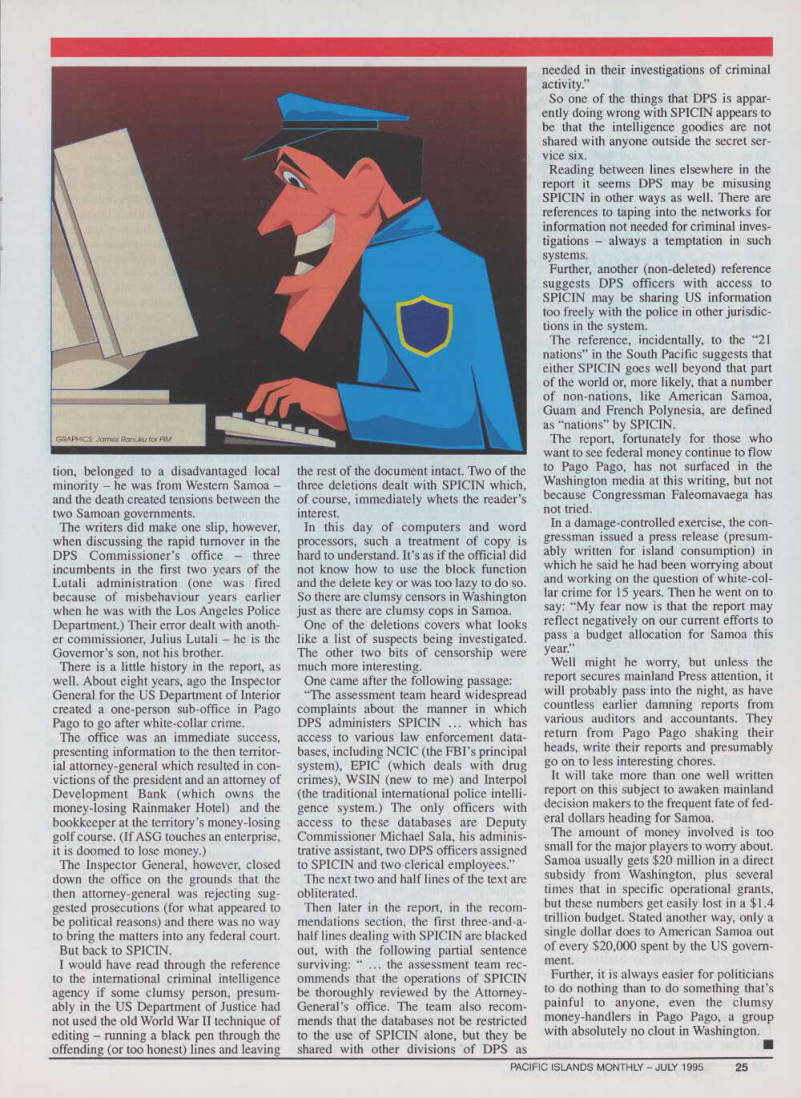
GRAPHICS: James Ranuku for PIM