Changing
pp. 19-21 · Read in the full issue
Cover Story
Course
Papua New Guinea attempts a new approach in fixing its internal problems. But the question remains whether it will work
Papua New Guinea is marking its
20th independence anniversary
later this year since it divorced
Australia through independence on
September 16, 1975. Despite a mineral resources boom in the early post-indepen dence era, the transition over the last two decades has been anything but smooth.
Law and order continue to threaten peace and quiet. In many instances, sky rocketing land compensation has slowed down the pace of development, frustrating efforts by both the government and devel opers to proceed with many multi-million dollar projects.
The education system appears to have bottle-necked and the provincial govern ment system is facing the ire of the nation al lawmakers and could be axed.
As a country the very mention of Papua New Guinea immediately conjures up images (sometimes imagined) of violent crimes and serious allegations of wide spread corruption reaching the echelons of leadership at all levels.
These and a host of other factors have contributed to an unfavourable image of PNG and its people, both at home and abroad. Since taking office in September, Prime Minister Sir Julius Chan and his coalition government have been doing some serious soul-searching to find out what had gone wrong and how to fix it.
But untangling the mess which succes sive governments have been unable to contain in the last two decades is a daunt ing task indeed. But Chan’s government is determined to tackle the problem head on.
It has appointed a five-member National Events Council and given it a broad mandate to fix the problem. Part of its mandate is to “instil in the hearts and minds of Papua New Guineans self esteem and self-respect for their country”.
Heading the “Fix-it” team is former Air Niugini general manager Joe Tauvasa. As chairman of NEC, Tauvasa’s team will be
in charge of organising and co-ordinating
all international and national events to fur ther this end, starting this year.
It means the NEC must find the money for the events. For instance, Tauvasa has set his sights on raising K 750,000 to cover the costs associated with this year’s inde pendence anniversary celebrations and the hosting of the 26th South Pacific Forum, the annual summit of the region’s political leaders.
One private firm has so far provided K 250,000 towards this and more compa nies are expected to follow.
Like Chan, Tauvasa is determined to raise the awareness level within the coun try so that every Papua New Guinean knows the country has an image problem.
And the NEC wants to change that image.
Critics are already questioning whether
the new image-building campaign would work. They say that the money will be thrown into a bottomless pit. The NEC has
acknowledged that change will not hap
pen overnight but it is determined. It wants its campaign to be the catalyst for change in PNG.
No one argues that it’s a colossal task ahead for Tauvasa’s council. He would need the co-operation and assistance of every Papua New Guinean as much as he needs government and private sector help.
Where does Tauvasa start and what are
his plans?
The country’s tens of thousands of school children will be the main target.
Already the council has created a national logo, a song and a pledge. These will be used for the first time in September to
commemorate the country’s 20th independence anniversary. From then on, they will be used everyday in schools throughout the nation.
Under the motto One Nation, One People, One Country, the council hopes to instil and rekindle in the minds of the four million Papua New Guineans self-esteem, pride and respect for their country.
Under consideration is a plan to incorporate the new motto, the new national song and the pledge into the education
system by making it compulsory for
schools to recite them each morning before class starts.
The idea is that once the younger generation is taught self-esteem, pride and respect for their country - something that has been lacking in the past two decades they will be able to respect their fellowmen as well.
The spin-off is that they will also be able to pass it on to their children. One PNG official called this approach an “investment in the future of PNG”.
The NEC is pinning its hope on the belief that hosting international events in the next five years will act as a unifying force.
“It’s a starting point for us. We want to try to unite the people of Papua New Guinea,” the official said.
According to the official, the hosting of the South Pacific Forum’s annual summit will be the first of many international events PNG intends to host before the start of the next millennium.
“It’s part of the exercise to try to get the country on its right footing and for the
country to be united.”
Present and past governments have
acknowledged that indigenous Papua New
Guineans lacked self-dignity and that this has arguably contributed to the country’s social and economic dilemma. Instilling pride and self-respect should take care of this. It is a long shot indeed. The task will not easy.
Politically, socially and economically,
the past 20 years have been a bumpy ride for mineral -rich PNG. It seemed many Papua New Guineans only heard about the wealth of their country but never shared in it. Today problems loom in many areas.
The education system has bottle-
necked, especially in the community (pri-
mary) school level. Lack of student places in high schools has forced tens of thousands of children to leave school at the end of their six years of primary schooling, dashing their parents’ hopes for a
brighter future.
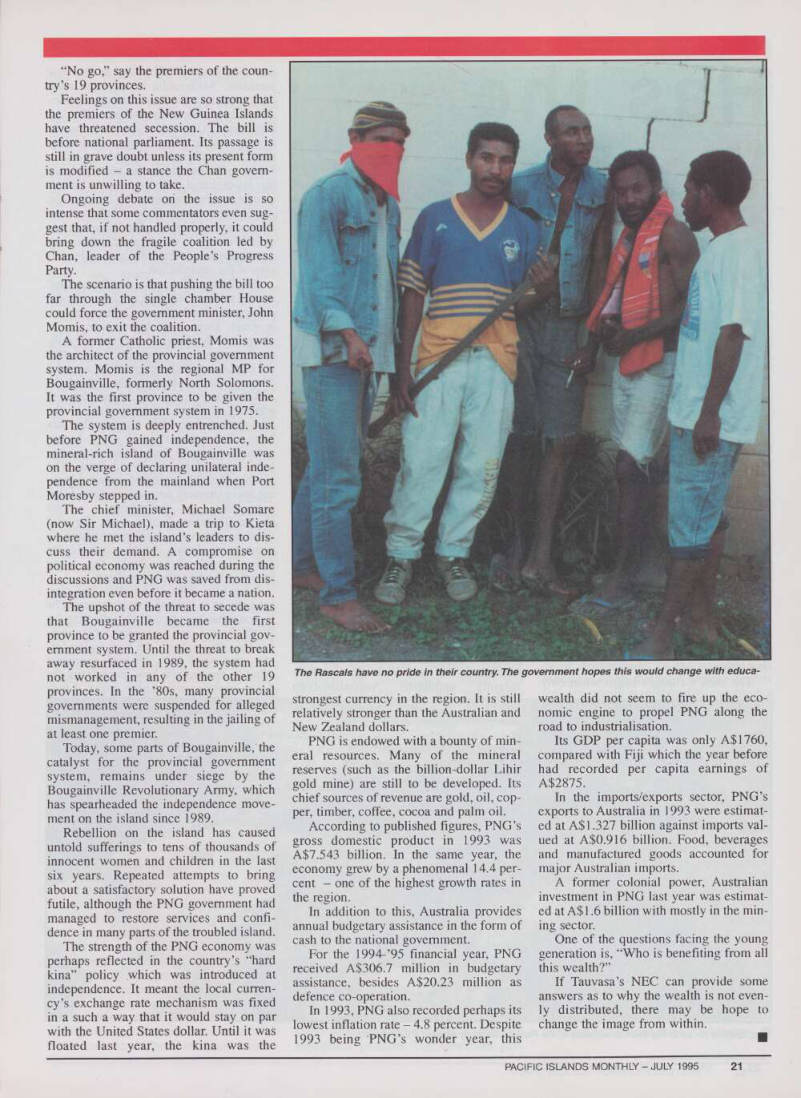
These children drifted aimlessly into towns and cities with a foregone conclusion. With nothing but boredom to look forward to, many eventually sign up with the rank and file of the growing “rascal” gangs that operate out of city suburbs.
According to PNG’s former ambassador to Fiji, Peter Tsiamalili, 44 percent of his country’s population are under the age of 15. “This has the potential for further growth. With a population of 3.9 million already, PNG’s annual population growth rate of 2.3 percent is adding 97,000 more people each year. This means that more schools, hospitals and other social infrastructure must be built to
accommodate the growth.
In fact, Tsiamalili, now PNG’s ambas sador in Brussels, says that by the year 2010, PNG would need 30,000 nurses (an increase of 12,000 over the current staffing level) and an additional 2000 trained teachers in the community school system.
At the provincial level, trouble is brew ing over attempts by the national govern ment to bring in sweeping reforms to the provincial government system.
A bi-partisan committee has recom mended drastic changes as a result of its findings that the provincial government system, introduced two decades ago, has been inefficient, costly and that those
charged with administering it have poorly
managed it.
The provincial government system
was introduced in PNG in the mid-’7os in a bid to take the government closer to the people. In other words, the grassroots should have more say in the way their government is run.
The idea is that instead of centralising power in Port Moresby, the political machinery should be shifted to the provin cial level through the process of decentral isation. In most of the 19 provinces, the provincial government system has obvi ously not worked. Instead, it has bred mis management, inefficiency and other short
comings.
Waigani is still determined to get the Provincial Government Reform Bill through but the response from the provinces has been anything but encour
aging.
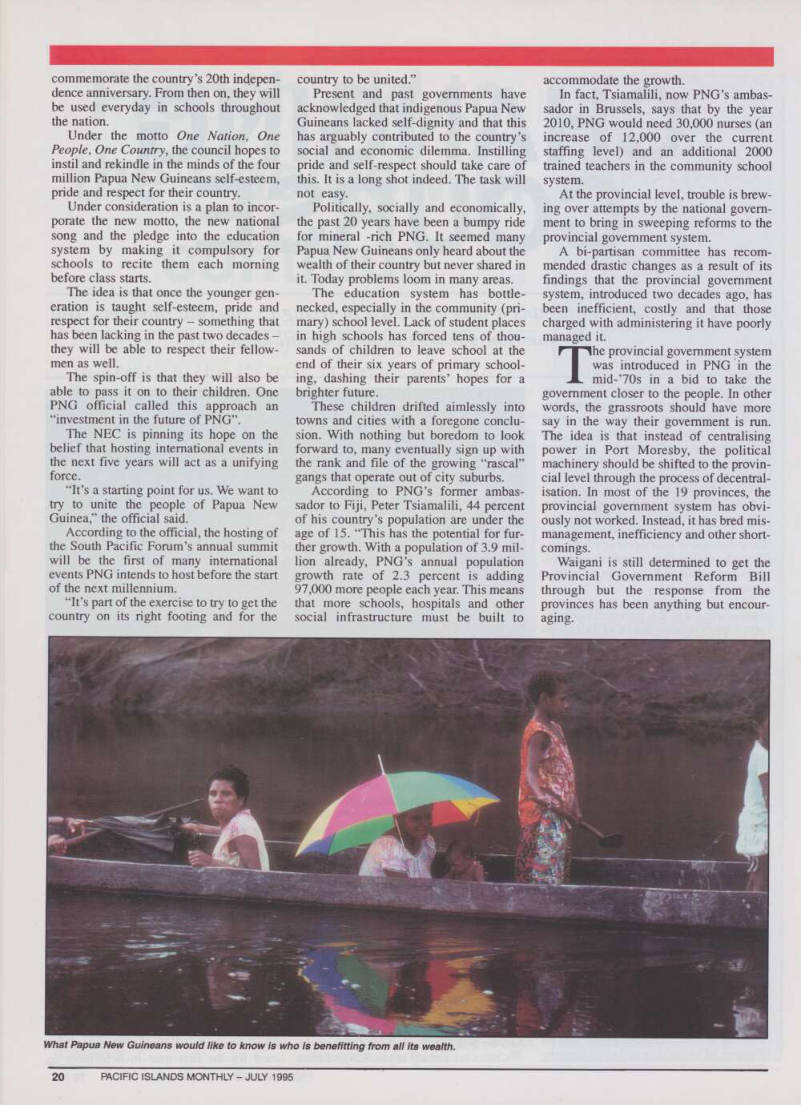
What Papua New Guineans would like to know is who is benefiting from all its wealth.
“No go,” say the premiers of the coun
try’s 19 provinces.
Feelings on this issue are so strong that the premiers of the New Guinea Islands have threatened secession. The bill is before national parliament. Its passage is still in grave doubt unless its present form is modified - a stance the Chan govern ment is unwilling to take.
Ongoing debate on the issue is so intense that some commentators even sug gest that, if not handled properly, it could bring down the fragile coalition led by Chan, leader of the People’s Progress Party.
The scenario is that pushing the bill too far through the single chamber House could force the government minister, John Momis, to exit the coalition.
A former Catholic priest, Momis was the architect of the provincial government system. Momis is the regional MP for
Bougainville, formerly North Solomons.
It was the first province to be given the provincial government system in 1975.
The system is deeply entrenched. Just before PNG gained independence, the mineral-rich island of Bougainville was on the verge of declaring unilateral inde pendence from the mainland when Port Moresby stepped in.
The chief minister, Michael Somare (now Sir Michael), made a trip to Kieta where he met the island’s leaders to dis cuss their demand. A compromise on political economy was reached during the discussions and PNG was saved from dis integration even before it became a nation.
The upshot of the threat to secede was that Bougainville became the first province to be granted the provincial gov ernment system. Until the threat to break away resurfaced in 1989, the system had not worked in any of the other 19 provinces. In the ’Bos, many provincial governments were suspended for alleged
mismanagement, resulting in the jailing of
at least one premier.
Today, some parts of Bougainville, the catalyst for the provincial government system, remains under siege by the
Bougainville Revolutionary Army, which
has spearheaded the independence move ment on the island since 1989.
Rebellion on the island has caused untold sufferings to tens of thousands of innocent women and children in the last six years. Repeated attempts to bring about a satisfactory solution have proved futile, although the PNG government had managed to restore services and confi dence in many parts of the troubled island.
The strength of the PNG economy was perhaps reflected in the country’s “hard kina” policy which was introduced at independence. It meant the local curren cy’s exchange rate mechanism was fixed in a such a way that it would stay on par with the United States dollar. Until it was floated last year, the kina was the
strongest currency in the region. It is still relatively stronger than the Australian and New Zealand dollars.
PNG is endowed with a bounty of min eral resources. Many of the mineral reserves (such as the billion-dollar Lihir gold mine) are still to be developed. Its chief sources of revenue are gold, oil, cop per, timber, coffee, cocoa and palm oil.
According to published figures, PNG’s
gross domestic product in 1993 was A 57.543 billion. In the same year, the economy grew by a phenomenal 14.4 per cent - one of the highest growth rates in
the region.
In addition to this, Australia provides annual budgetary assistance in the form of cash to the national government.
For the 1994-’95 financial year, PNG received A 5306.7 million in budgetary assistance, besides A 520.23 million as
defence co-operation.
In 1993, PNG also recorded perhaps its lowest inflation rate - 4.8 percent. Despite 1993 being PNG’s wonder year, this
wealth did not seem to fire up the eco nomic engine to propel PNG along the road to industrialisation.
Its GDP per capita was only A 51760, compared with Fiji which the year before had recorded per capita earnings of A 52875.
In the imports/exports sector, PNG’s exports to Australia in 1993 were estimat ed at A$ 1.327 billion against imports val ued at A 50.916 billion. Food, beverages and manufactured goods accounted for major Australian imports.
A former colonial power, Australian investment in PNG last year was estimat ed at Asl.6 billion with mostly in the min
ing sector.
One of the questions facing the young generation is, “Who is benefiting from all this wealth?”
If Tauvasa’s NEC can provide some answers as to why the wealth is not even ly distributed, there may be hope to change the image from within.
The Rascals have no pride in their country. The government hopes this would change with educa-