Hell
pp. 56-57 · Read in the full issue
Shipping
Mad
AS
Hell
Each year more than 1000 yachts sail the ocean covered by New Zealand's search and rescue team.
Are the days of the country being a hassle-free cruising paradise for overseas visitors nearly overl
By Sally Andrew
“We passed a new law ... and they’re mad as hell,” says Peter Rachtman, executive director of MAREX (Marine Export Group, New Zealand). The law he’s referring to is Section 21 of New Zealand’s new Maritime Transport Act.
Effective from February 1, 1995, foreign yachts departing New Zealand are required to obtain a Certificate of Inspection from the New Zealand Yachting Federation before customs clearance will be given.
Foreign boat owners are outraged.
Americans Jim and Sue Corenman of Heart of Gold are distressed by this new law. “It is completely inap propriate for any government to impose their safety requirements upon a foreign private vessel that is not carrying passengers, not carrying
hired crew, and already subject to the requirements of her own govern ment. This imposition of safety requirements on foreign private ves sels is also without precedent.”
New Zealand’s new law is even more ridiculous because there are no nation-wide safety standards for local boats sailing in local waters, some of the roughest in the Pacific. Instead of requiring something as simple and practical as lifejackets or flares aboard all boats, the Maritime Safety Authority has instead decided to leg islate foreign vessels heading for for eign waters.
Each year, more than 1000 yachts sail the ocean covered by New Zealand’s search and rescue opera tion. Only a minuscule percentage ever require assistance. Even in last June’s storm, no yacht required assis tance because of an ill-found boat
and no time was wasted searching for vessels because of lack of EPIRBS or radios. There is no justification, and probably no jurisdiction, for the new law. In fact, it contravenes the 1958 UN Convention on the Law of the Sea.
The cruisers are angry.
Retired businessman Doug Belsher of the Canadian yacht Free Spirit asks: “Why did New Zealand welcome these yachts with open arms without so much as a hint that such legislation was in the offing? To change the law and make the law applicable to yachts that are presently in the country is the treatment you might expect in some third world country, but cer tainly not of New Zealand.”
American Richard Chesher has been sailing in the South Pacific aboard his yacht Moira since 1976.“! am not a New Zealand citizen and my vessel ... has no New Zealand citizens aboard. I have the safety equipment I believe is needed for my vessel and maintain her in excellent condition.
Why should I pay a New Zealand offi cial to determine if my wife and I can handle the vessel we have sailed for the past 19 years, or pay for equip ment I might not require?”
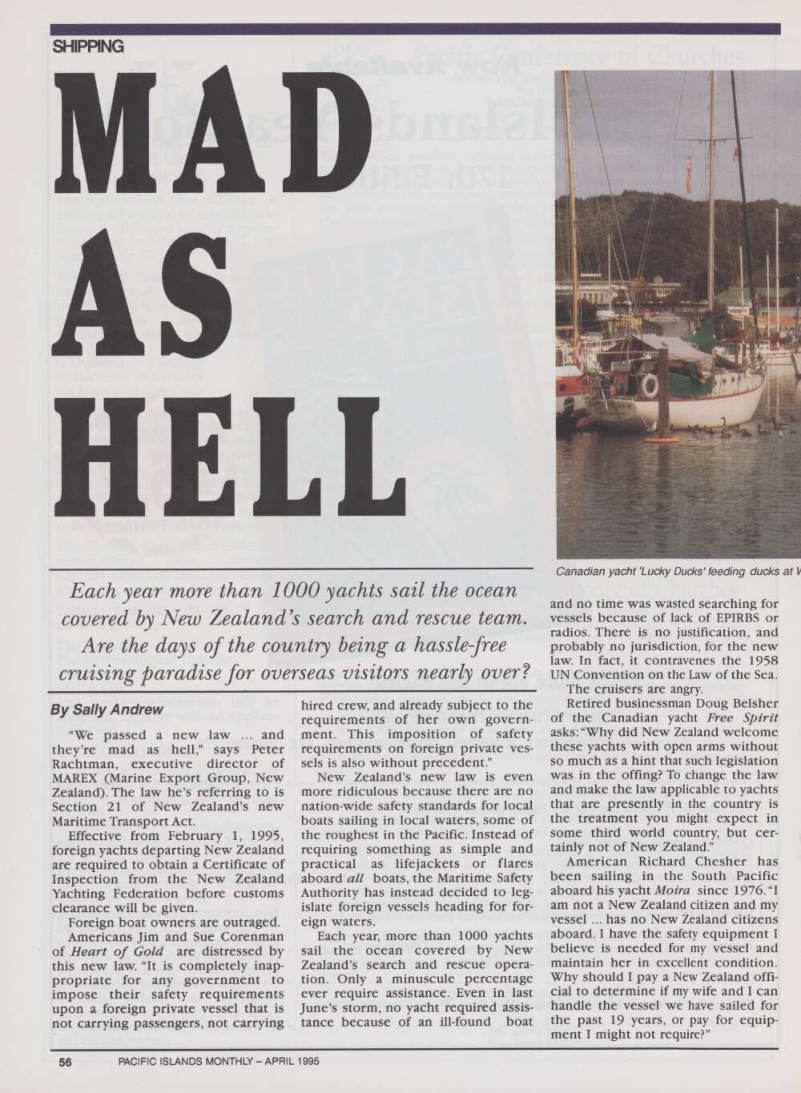
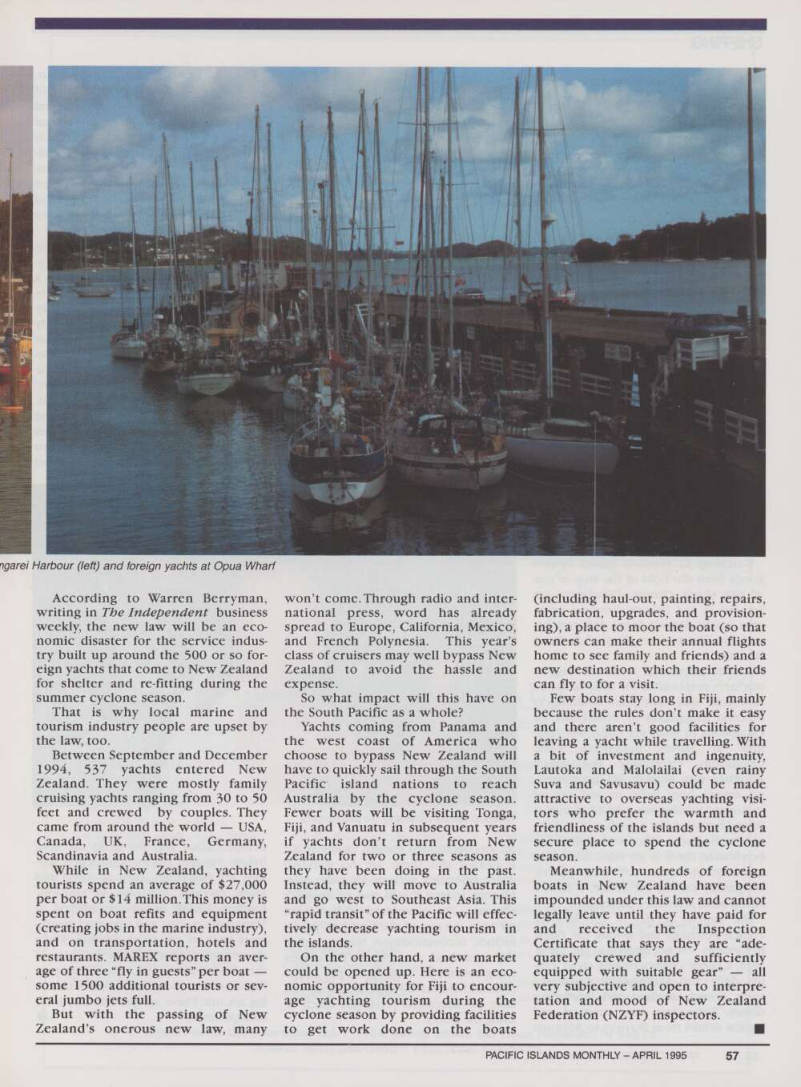
Canadian yacht ‘Lucky Ducks’ feeding ducks at
According to Warren Berryman, writing in The Independent business weekly, the new law will be an eco nomic disaster for the service indus try built up around the 500 or so for eign yachts that come to New Zealand for shelter and re-fitting during the summer cyclone season.
That is why local marine and tourism industry people are upset by the law, too.
Between September and December 1994, 537 yachts entered New Zealand. They were mostly family cruising yachts ranging from 30 to 50 feet and crewed by couples. They came from around the world USA, Canada, UK, France, Germany, Scandinavia and Australia.
While in New Zealand, yachting tourists spend an average of $27,000 per boat or $l4 million. This money is spent on boat refits and equipment (creating jobs in the marine industry), and on transportation, hotels and restaurants. MAREX reports an aver age of three “fly in guests” per boat some 1500 additional tourists or sev
eral jumbo jets full.
But with the passing of New Zealand’s onerous new law, many
won’t come. Through radio and inter national press, word has already spread to Europe, California, Mexico, and French Polynesia. This year’s class of cruisers may well bypass New Zealand to avoid the hassle and expense.
So what impact will this have on the South Pacific as a whole?
Yachts coming from Panama and the west coast of America who choose to bypass New Zealand will have to quickly sail through the South Pacific island nations to reach Australia by the cyclone season.
Fewer boats will be visiting Tonga, Fiji, and Vanuatu in subsequent years if yachts don’t return from New Zealand for two or three seasons as they have been doing in the past.
Instead, they will move to Australia and go west to Southeast Asia. This “rapid transit” of the Pacific will effec tively decrease yachting tourism in the islands.
On the other hand, a new market could be opened up. Here is an eco nomic opportunity for Fiji to encour age yachting tourism during the cyclone season by providing facilities to get work done on the boats
(including haul-out, painting, repairs, fabrication, upgrades, and provision ing), a place to moor the boat (so that owners can make their annual flights home to see family and friends) and a new destination which their friends can fly to for a visit.
Few boats stay long in Fiji, mainly because the rules don’t make it easy and there aren’t good facilities for leaving a yacht while travelling. With a bit of investment and ingenuity, Lautoka and Malolailai (even rainy Suva and Savusavu) could be made attractive to overseas yachting visi tors who prefer the warmth and friendliness of the islands but need a secure place to spend the cyclone season.
Meanwhile, hundreds of foreign boats in New Zealand have been impounded under this law and cannot legally leave until they have paid for and received the Inspection Certificate that says they are “ade quately crewed and sufficiently equipped with suitable gear” all very subjective and open to interpre tation and mood of New Zealand Federation (NZYF) inspectors. ■
[?]garei Harbour (left) and foreign yachts at Opua Wharf