The charm
pp. 52-53 · Read in the full issue
Yachting
The charm of the channel
Tucked away, south of Hobart, lies an enchanting place to rewind and bask in the
little pleasures of life
By Sally Andrew
In a quiet bay deep inside Tasmania s D’Entrecasteaux Channel, a fishing boat came alongside. The friendly skipper hollered,“Hey, you like crayfish? Before I could answer, “You betcha , a crayfish flew through the air and landed in our cockpit.
The D Entrecasteaux Channel, south of Hobart, offers fantastic high latitude South Pacific sailing all in protected waterways that abound with penguins, dolphins and seabirds.
Tasmania’s food is equally enticing berries and cherries, organic vegeta bles, smoked venison and wallaby, Tasmanian scallops, and fine Tasmanian wines exceeded all my epicurean fan tasies.
Here, the fishing is easy flatheads can be hauled up almost as fast as you can get your line back down. With net fishing, trevally and “escaped” salmon make for a good feed. If you dive, there’s abalone and crayfish. Sometimes we anchored near salmon, mussel or oyster farms, met the local aquaculturists and sampled their products. We usually pre ferred to forage along the coast, picking oysters and mussels from the rocks at low tide. Foraging for something to eat, then cooking it ashore on a campfire is the greatest pleasure of Tasmanian cruising.
Our first Tasmanian barbecue, on a rocky foreshore with John and Sue, off Aurielle, their friends Nick and Jenny, and seven hungry kids, was a gastro nomic delight. During the day, the older kids dived for abalone and crayfish, caught flathead fish and collected fire wood.
While we dined on fresh seafood cooked over an open fire, the sunset
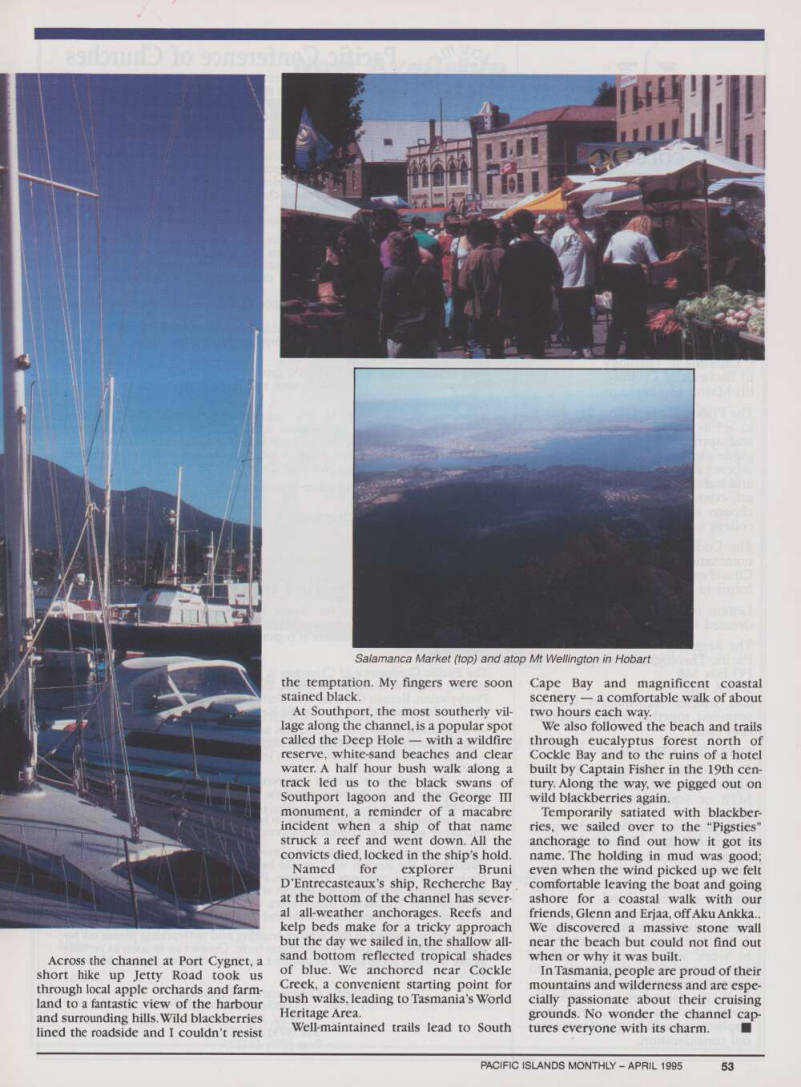
gave way to a long and beautiful twi light. Kookaburras sat in the trees laugh jng a deme nted laugh that can only be deS cribed as the sound of a small child being tick i e d to dea th. Penguins came ashore at dusk and proceeded to bray like donkeys in the bush. Later, as we sat around the campfire, one pen guin moved in close and kept an eye on our strange activities, Hobart is great fun and on Saturday morning we enjoyed Salamanca Market’s marvellous potpourri of local ly made crafts and souvenirs, home made foods and bibelot, entertainment and enchantment. At Salamanca, there are millions G f woo den handicrafts and whimsical creations, and hundreds of de i ec table edibles - locally made mus tards, chutneys and cheeses, fresh pas tas and p a stries, organic breads and pro duce Leatherwood honey. The Retro Cafe ’ in the m i dd i e of the market, is where we wou ld meet friends, sip cap pUccino and enjoy the haunting flutes of the Chilean street band, “Arauco Libre”.
Close to Hobart, the most popular des tination for local cruisers is Barnes gay on Bruny island. Duckpond anchor age is so sheltered that it’s a favoured weekend spot when a gale is blowing in t h e channel.
Bruny itself is a rugged, unspoilt island, the largest in the channel. James cook, Tobias Furneaux, Bruni D’Entrecasteaux (hence the name), Matt h ew Flinders and William Bligh all made a land f a n G n the exposed east side at Adventure Bay which is sur rounded by long, white sandy beaches and spectacular cliffs, From Great Taylor Bay, on the south west corner of Bruny Island, we hiked
to Cloudy Bay Lagoon and the Cape Bruny Lighthouse, which for 150 years has warned mariners of the dangers of the island’s rugged southern coastline.
It is one of the oldest manned light houses in Australia.
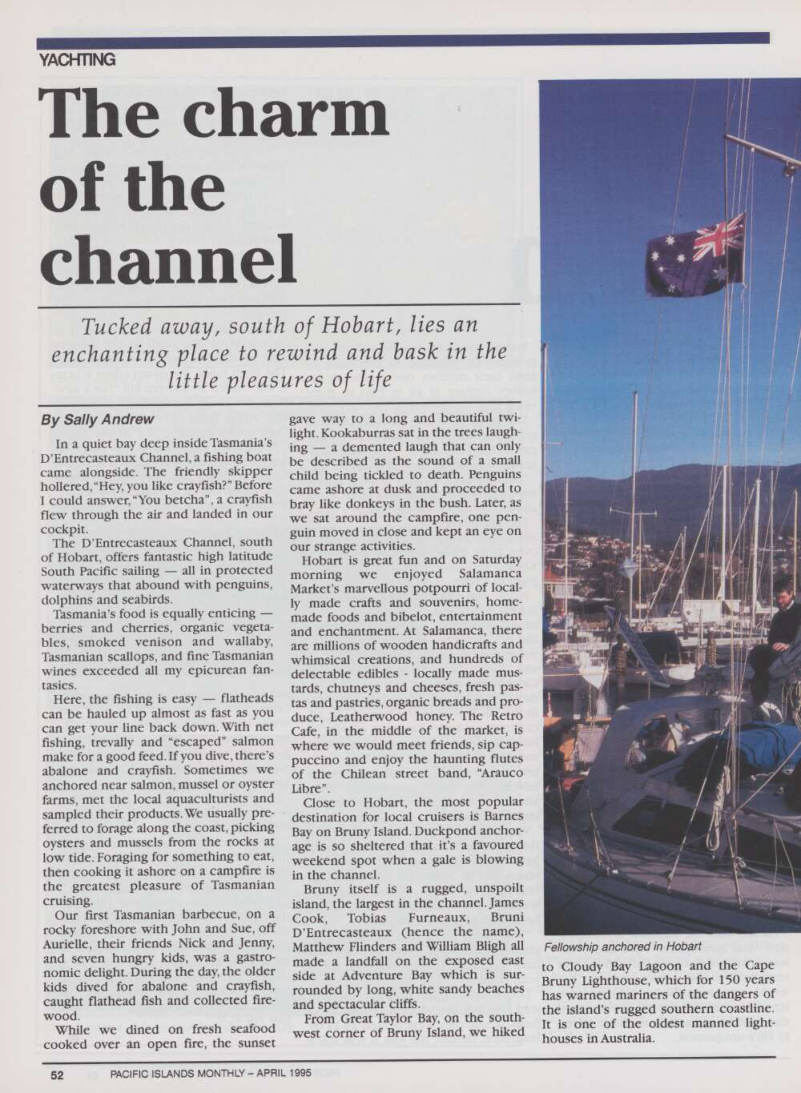
Fellowship anchored in Hobart
Across the channel at Port Cygnet, a short hike up Jetty Road took us through local apple orchards and farm land to a fantastic view of the harbour and surrounding hills. Wild blackberries lined the roadside and I couldn’t resist
the temptation. My fingers were soon stained black.
At Southport, the most southerly vil lage along the channel, is a popular spot called the Deep Hole with a wildfire reserve, white-sand beaches and clear water. A half hour bush walk along a track led us to the black swans of Southport lagoon and the George 111 monument, a reminder of a macabre incident when a ship of that name struck a reef and went down. All the convicts died, locked in the ship’s hold.
Named for explorer Bruni D’Entrecasteaux’s ship, Recherche Bay at the bottom of the channel has sever al all-weather anchorages. Reefs and kelp beds make for a tricky approach but the day we sailed in, the shallow all sand bottom reflected tropical shades of blue. We anchored near Cockle Creek, a convenient starting point for bush walks, leading to Tasmania’s World Heritage Area.
Well-maintained trails lead to South
Cape Bay and magnificent coastal scenery a comfortable walk of about two hours each way.
We also followed the beach and trails through eucalyptus forest north of Cockle Bay and to the ruins of a hotel built by Captain Fisher in the 19th cen tury. Along the way, we pigged out on wild blackberries again.
Temporarily satiated with blackber ries, we sailed over to the “Pigsties” anchorage to find out how it got its name. The holding in mud was good; even when the wind picked up we felt comfortable leaving the boat and going ashore for a coastal walk with our friends, Glenn and Erjaa, off Aku Ankka..
We discovered a massive stone wall near the beach but could not find out when or why it was built.
In Tasmania, people are proud of their mountains and wilderness and are espe cially passionate about their cruising grounds. No wonder the channel cap tures everyone with its charm. ■
Salamanca Market (top) and atop Mt Wellington in Hobart