Fiji’s [?]n top
pp. 50-51 · Read in the full issue
sevens form
Fiji staged another successful inter national rugby sevens tourna ment last month. And as it grows in size and prestige, the Fiji International Sevens looks more and more an attrac tive alternative to the Hong Kong Sevens, should it be scrapped in 1997 after the Chinese take-over.
In three years, the Fiji event has become the biggest sevens tournament in the southern hemisphere, attracting teams from America, Asia and the Pacific.
More than 23,000 people watched 24 teams battle it out over two days at Suva’s National Stadium.
Sialeni Vuetaki, chairman of the tour nament organising committee, was impressed with the level of competi tion and foresees bigger things ahead.
“’’Each year it’s getting better,” he said.
Vuetaki, an insurance executive, said the priority now was to see how the tour nament could be further improved and more overseas teams attracted.
The Fiji sevens is seen as the major warm-up event for the Hong Kong Sevens, which is held two weeks later.
But since the Hong Kong Rugby Union is run by British expatriates, a question mark hangs over the Hong Kong tourna ment once the Chinese take over. Even Hong Kong rugby officials are uncertain about its future.
And Vuetaki says rather than wait for things to happen, he is working on bringing the Fiji tournament and facili ties to standard. He believes Fiji can replace Hong Kong in staging what is known as the greatest rugby show on earth.
“”If we make a request to the International Rugby Board, we first have to show them we have the facilities and the ability to do it.
“And we are proving ourselves to a cer tain extent with our tournament,”
Vuetaki said.
He pointed out the Hong Kong Rugby Football Union had shown its capability over the years through its sevens tour naments and thus had little trouble win ning approval from the board to host the 1997 World Sevens.
The Fiji Rugby Football Union (FRFU) can expect government support in its bid when, and if, the time comes.
In his opening speech, FRFU chairman Tom Vuetilovoni said the government considers the Fiji sevens of “great national importance”. In the three years, the government has given $130,00 towards the staging of the tournament and has declared a public holiday to mark the event.
It is in response to the needs of the tournament that government is consid ering building an additional pavilion at the National Stadium. It is looking at a $6 million-plan drawn up after the 1993 tournament.
If the Fiji tournament lacks anything, its better facilities and more seating space. These are definite pre-requisites for the tournament to develop further.
Even if the Chinese authorities decid ed to continue Hong Kong Sevens, the Fiji tournament will still grow and carve out an identity of its own.
National teams from Uruguay, Canada, Japan, Taiwan, Malaysia Singapore and Thailand participated in the Fiji event , hoping to learn something from the masters of the game. Some of the world’s best players have graced past
tournaments: Wallaby George Gregan,
All Black Eric Rush and Fiji’s own Waisale Serevi, to name a few.
Vuetaki said the standard of competi tion and atmosphere were major fac tors in attracting teams. He said Fiji was renowned for its sevens prowess the world over.An established tourism infra structure plus its unspoilt environment and friendly, relaxed atmosphere added to Fiji’s uniqueness.
Vuetaki believes, Fiji would be in a position to stipulate to countries to send their number one teams or not bother coming at all in two to three years.
The aim finally is to have 23 overseas teams and the Fiji national team partici pate. This year, there were four local teams to make up for a shortfall for 24.
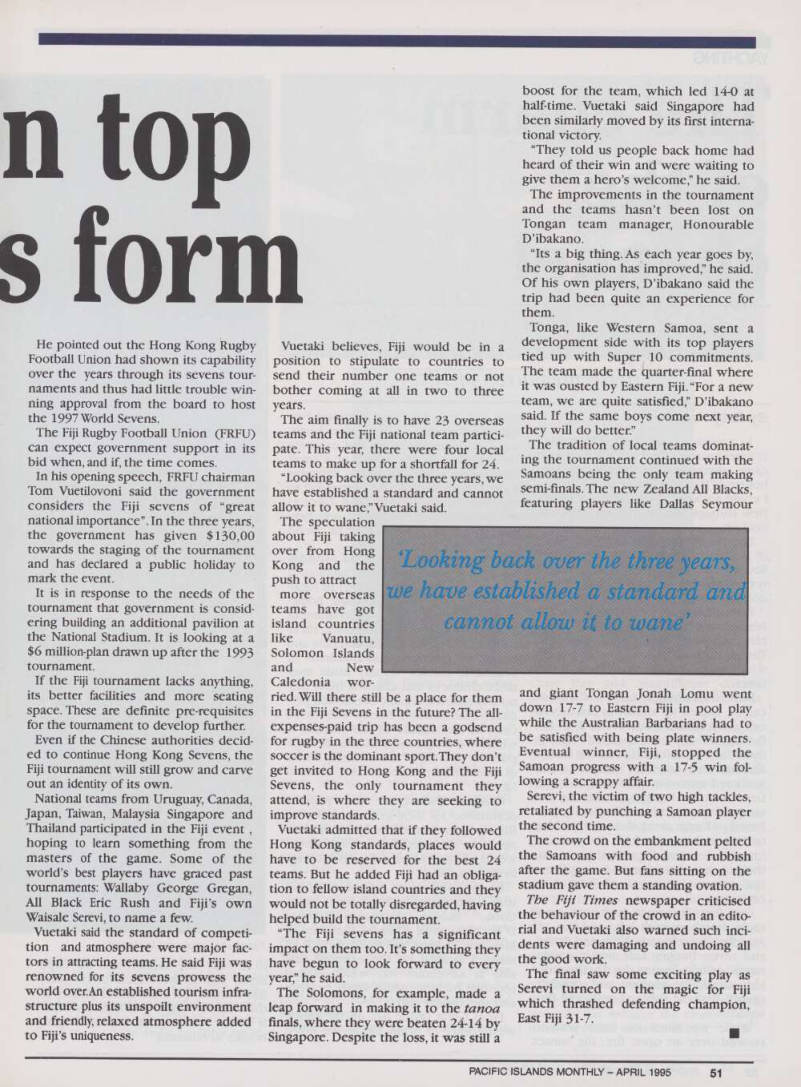
“Looking back over the three years, we have established a standard and cannot allow it to wane "Vuetaki said.
The speculation
about Fiji taking over from Hong Kong and the push to attract more overseas teams have got island countries like Vanuatu, Solomon Islands and New
Caledonia wor ried. Will there still be a place for them in the Fiji Sevens in the future? The all expenses-paid trip has been a godsend for rugby in the three countries, where soccer is the dominant sport. They don’t get invited to Hong Kong and the Fiji Sevens, the only tournament they attend, is where they are seeking to improve standards.
Vuetaki admitted that if they followed Hong Kong standards, places would have to be reserved for the best 24 teams. But he added Fiji had an obliga tion to fellow island countries and they would not be totally disregarded, having helped build the tournament.
“The Fiji sevens has a significant impact on them too. It’s something they have begun to look forward to every year,” he said.
The Solomons, for example, made a leap forward in making it to the tanoa finals, where they were beaten 24-14 by Singapore. Despite the loss, it was still a
boost for the team, which led 14-0 at half-time. Vuetaki said Singapore had been similarly moved by its first interna tional victory.
“They told us people back home had heard of their win and were waiting to give them a hero’s welcome,” he said.
The improvements in the tournament and the teams hasn’t been lost on Tongan team manager, Honourable D’ibakano.
“Its a big thing. As each year goes by, the organisation has improved,” he said.
Of his own players, D’ibakano said the trip had been quite an experience for them.
Tonga, like Western Samoa, sent a development side with its top players tied up with Super 10 commitments.
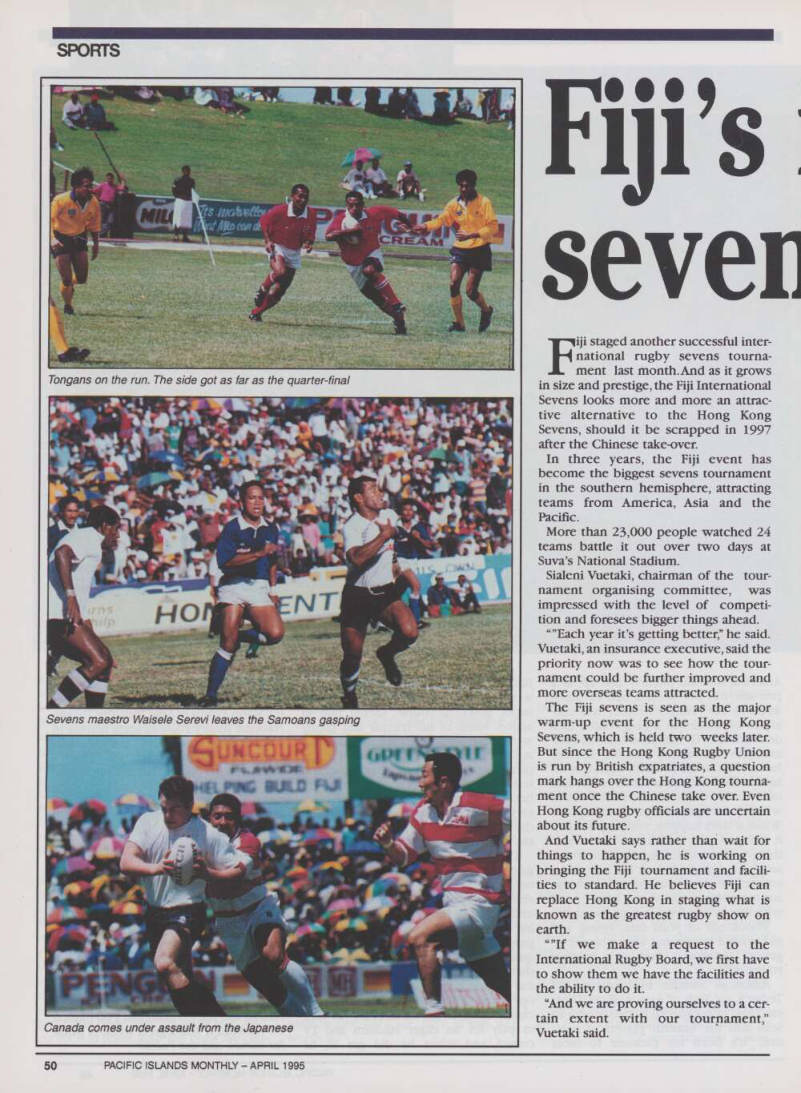
The team made the Quarter-final where it was ousted by Eastern Fiji. “For a new team, we are quite satisfied,” D’ibakano said. If the same boys come next year, they will do better.”
The tradition of local teams dominat ing the tournament continued with the Samoans being the only team making semi-finals. The new Zealand All Blacks, featuring players like Dallas Seymour
‘Looking back over the three years, we have established a standard and cannot allow it to wane’ ’
and giant Tongan Jonah Lomu went down 17-7 to Eastern Fiji in pool play while the Australian Barbarians had to be satisfied with being plate winners.
Eventual winner, Fiji, stopped the Samoan progress with a 17-5 win fol lowing a scrappy affair.
Serevi, the victim of two high tackles, retaliated by punching a Samoan player the second time.
The crowd on the embankment pelted the Samoans with food and rubbish after the game. But fans sitting on the stadium gave them a standing ovation.
The Fiji Times newspaper criticised the behaviour of the crowd in an edito rial and Vuetaki also warned such inci dents were damaging and undoing all the good work.
The final saw some exciting play as Serevi turned on the magic for Fiji which thrashed defending champion, East Fiji 31-7. ■