Adventure
p. 58 · Read in the full issue
Shipping
Adventure on the South Seas
By Ed Rampell
The Aranui is for travellers dreaming of South Pacific adventures in paradise.
Fifteen times a year this cargo-cruiser makes its 15-day voyage 800 miles north-east of Tahiti, through the Tuamotus archipelago to the Marquesas.
The 343-foot, 1974-built ship is one of French Polynesia’s top tourism enter prises and a pillar of Marquesan econo my.
Most of the visitors arrive by Aranui, which unloads cargo and picks up copra from throughout French Polynesia.
Watching 32 tattooed sailors deliver goods from the hold of the ship is one of the ship’s charms. Passengers are amazed as the brawny, bronzed crew men safely deposit jeeps, refrigerators and the like on the piers of far-flung landfalls.
They’re impressed with the mighty mariners responsible for their safety, as American and European landlubbers descend gangplanks to whaleboats for excursions to what are often wet land ings at barely accessible isles.
Conditions warranting, the island Adonises may gingerly lift passengers, no matter how hefty, in and out of motorised whaleboats.A bond of trust is forged between the greenhorns and the old Pacific hands. Filled with Polynesian bonhomie, there is no stand-offishness between Aranui staff and guests.
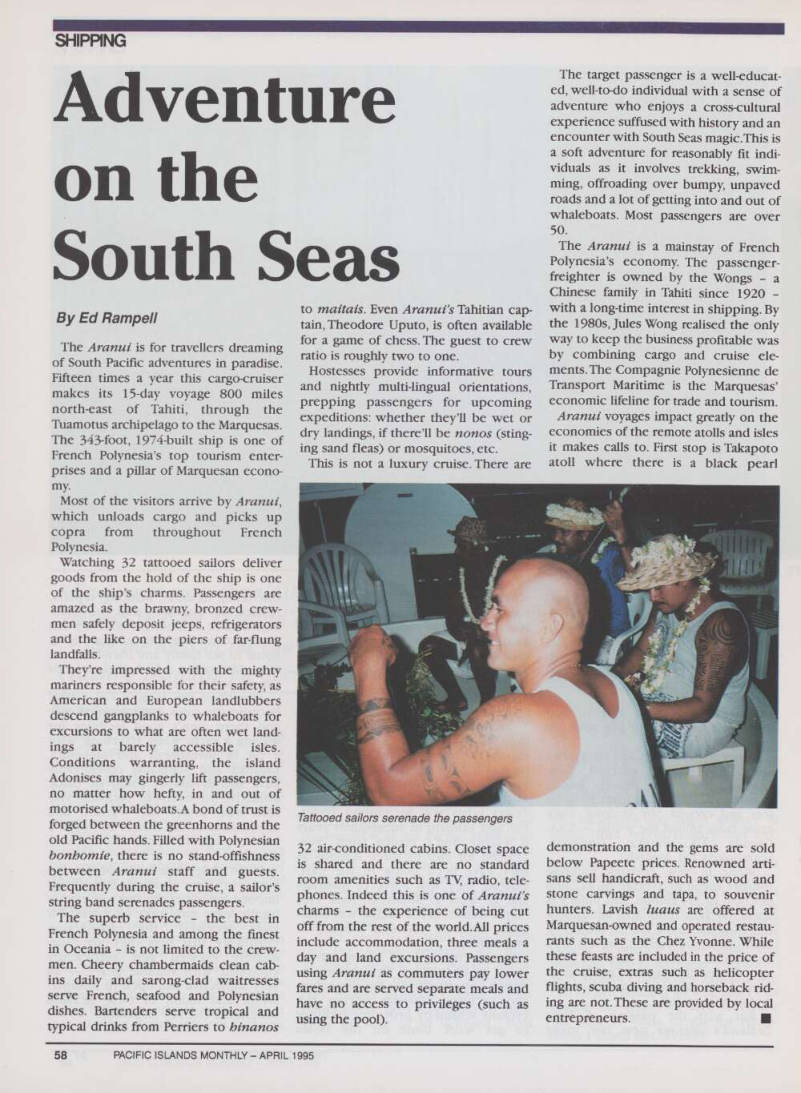
Frequently during the cruise, a sailor’s string band serenades passengers.
The superb service - the best in French Polynesia and among the finest in Oceania - is not limited to the crew men. Cheery chambermaids clean cab ins daily and sarong-clad waitresses serve French, seafood and Polynesian dishes. Bartenders serve tropical and typical drinks from Perriers to hinanos
to maitais. Even Aranui’s Tahitian cap tain, Theodore Uputo, is often available for a game of chess. The guest to crew ratio is roughly two to one.
Hostesses provide informative tours and nightly multi-lingual orientations, prepping passengers for upcoming expeditions: whether they’ll be wet or dry landings, if there’ll be nonos (sting ing sand fleas) or mosquitoes, etc.
This is not a luxury cruise. There are
32 air-conditioned cabins. Closet space is shared and there are no standard room amenities such as Ty radio, tele phones. Indeed this is one of Aranui’s charms - the experience of being cut off from the rest of the world. All prices include accommodation, three meals a day and land excursions. Passengers using Aranui as commuters pay lower fares and are served separate meals and have no access to privileges (such as using the pool).
The target passenger is a well-educat ed, well-to-do individual with a sense of adventure who enjoys a cross-cultural experience suffused with history and an encounter with South Seas magic. This is a soft adventure for reasonably fit indi viduals as it involves trekking, swim ming, offroading over bumpy, unpaved roads and a lot of getting into and out of whaleboats. Most passengers are over 30.
The Aranui is a mainstay of French Polynesia’s economy. The passenger freighter is owned by the Wongs - a Chinese family in Tahiti since 1920 with a long-time interest in shipping. By the 1980 s, Jules Wong realised the only way to keep the business profitable was by combining cargo and cruise ele ments. The Compagnie Polynesienne de Transport Maritime is the Marquesas’ economic lifeline for trade and tourism.
Aranui voyages impact greatly on the economies of the remote atolls and isles it makes calls to. First stop is Takapoto atoll where there is a black pearl
demonstration and the gems are sold below Papeete prices. Renowned arti sans sell handicraft, such as wood and stone carvings and tapa, to souvenir hunters. Lavish luaus are offered at Marquesan-owned and operated restau rants such as the Chez Yvonne. While these feasts are included in the price of the cruise, extras such as helicopter flights, scuba diving and horseback rid ing are not. These are provided by local entrepreneurs. ■
Tattooed sailors serenade the passengers