flag-burning
pp. 14-15 · Read in the full issue
Tahiti
Strikes riots and flag-burning
An industrial dispute leads Polynesia , emphasising c
By Ed Rampell
Labour unrest and civil disturbances have swept French Polynesia in recent months. The latest, in February, saw vio lent protests triggered by the dismissal of two brewery workers at the Hinano beer plant at Tiperui.
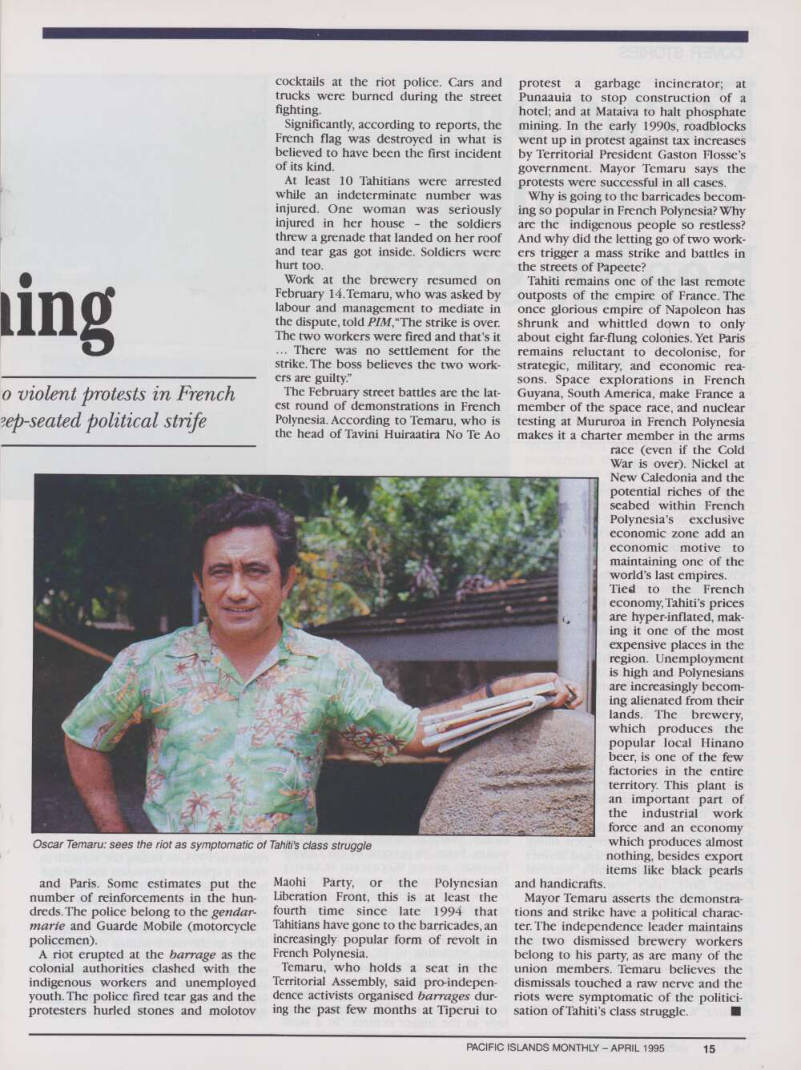
“The workers were accused of steal ing two cartons of beer,” said Oscar Temaru, the mayor of Faaa.The employ ees went to court and won their case but the brewery refused to reinstate the workers. Instead, the employers offered a cash settlement.
But insisting that the two union mem bers be given their jobs back, the Confederation of Independent Unions of Polynesia went on strike. Because of its connections with heavily unionised France, many Tahitian workers belong to
workers’ syndicates.
By February 15, the industrial action had escalated. Strikers set up barricades on a main thoroughfare near the brew ery at Tiperui in Papeete, the territorial capital. As Tahiti has many cars and few roads, a barrage - as barricades are called in French - can cut Papeete off from the rest of the island and cause massive traffic jams.
At least 150 members of organised labour were joined by about 50 unem ployed youth. Tahiti has a high unem ployment rate among its young people.
Some in the Tahitian community report edly expressed solidarity with the pro testers.
Tension mounted and France flew in at least 150 police from New Caledonia
o violent protests in French ?ep-seated political strife
and Paris. Some estimates put the number of reinforcements in the hun dreds. The police belong to the gendar marie and Guarde Mobile (motorcycle policemen).
A riot erupted at the barrage as the colonial authorities clashed with the indigenous workers and unemployed youth. The police fired tear gas and the protesters hurled stones and molotov
cocktails at the riot police. Cars and trucks were burned during the street
fighting.
Significantly, according to reports, the French flag was destroyed in what is believed to have been the first incident of its kind.
At least 10 Tahitians were arrested while an indeterminate number was injured. One woman was seriously injured in her house - the soldiers threw a grenade that landed on her roof and tear gas got inside. Soldiers were hurt too.
Work at the brewery resumed on
February 14.Temaru, who was asked by
labour and management to mediate in the dispute, told PIM, “The strike is over.
The two workers were fired and that’s it ... There was no settlement for the strike. The boss believes the two work ers are guilty.”
The February street battles are the lat est round of demonstrations in French Polynesia. According to Temaru, who is the head of Tavini Huiraatira No Te Ao
Maohi Party, or the Polynesian Liberation Front, this is at least the fourth time since late 1994 that Tahitians have gone to the barricades, an increasingly popular form of revolt in French Polynesia.
Temaru, who holds a seat in the Territorial Assembly, said pro-indepen dence activists organised barrages dur ing the past few months at Tiperui to
protest a garbage incinerator; at Punaauia to stop construction of a hotel; and at Mataiva to halt phosphate mining. In the early 19905, roadblocks went up in protest against tax increases by Territorial President Gaston Flosse’s government. Mayor Temaru says the protests were successful in all cases.
Why is going to the barricades becom ing so popular in French Polynesia? Why are the indigenous people so restless?
And why did the letting go of two work ers trigger a mass strike and battles in the streets of Papeete?
Tahiti remains one of the last remote outposts of the empire of France. The once glorious empire of Napoleon has shrunk and whittled dcywn to only about eight far-flung colonies. Yet Paris remains reluctant to decolonise, for strategic, military, and economic rea sons. Space explorations in French Guyana, South America, make France a member of the space race, and nuclear testing at Mururoa in French Polynesia makes it a charter member in the arms
race (even if the Cold War is over). Nickel at New Caledonia and the potential riches of the seabed within French Polynesia’s exclusive economic zone add an economic motive to maintaining one of the world’s last empires.
Tied to the French economy, Tahiti’s prices are hyper-inflated, mak ing it one of the most expensive places in the region. Unemployment is high and Polynesians are increasingly becom ing alienated from their lands. The brewery, which produces the popular local Flinano beer, is one of the few factories in the entire territory. This plant is an important part of the industrial work force and an economy which produces almost nothing, besides export items like black pearls
and handicrafts.
Mayor Temaru asserts the demonstra tions and strike have a political charac ter. The independence leader maintains the two dismissed brewery workers belong to his party, as are many of the union members. Temaru believes the dismissals touched a raw nerve and the riots were symptomatic of the politici sation of Tahiti’s class struggle. ■
Oscar Temaru: sees the riot as symptomatic of Tahiti’s class struggle