Vanuatu’s boiling lake
p. 13 · Read in the full issue
Volcano
By Patrick Decloitre
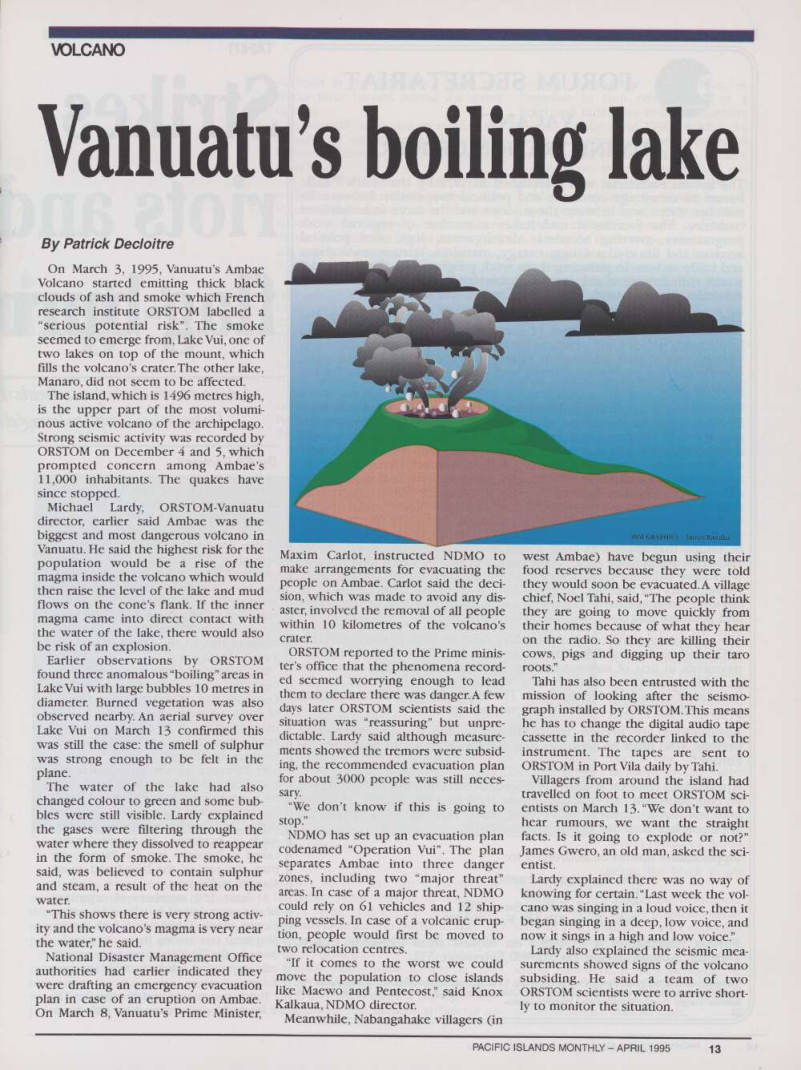
On March 3, 1993, Vanuatu’s Ambae Volcano started emitting thick black clouds of ash and smoke which French research institute ORSTOM labelled a “serious potential risk”. The smoke seemed to emerge from, Lake Vui, one of two lakes on top of the mount, which fills the volcano’s crater. The other lake, Manaro, did not seem to be affected.
The island, which is 1496 metres high, is the upper part of the most volumi nous active volcano of the archipelago.
Strong seismic activity was recorded by ORSTOM on December 4 and 5, which prompted concern among Ambae’s 11,000 inhabitants. The quakes have since stopped.
Michael Lardy, ORSTOM-Vanuatu director, earlier said Ambae was the biggest and most dangerous volcano in Vanuatu. He said the highest risk for the population would be a rise of the magma inside the volcano which would then raise the level of the lake and mud flows on the cone’s flank. If the inner magma came into direct contact with the water of the lake, there would also be risk of an explosion.
Earlier observations by ORSTOM found three anomalous “boiling” areas in Lake Vui with large bubbles 10 metres in diameter. Burned vegetation was also observed nearby. An aerial survey over Lake Vui on March 13 confirmed this was still the case: the smell of sulphur was strong enough to be felt in the plane.
The water of the lake had also changed colour to green and some bub bles were still visible. Lardy explained the gases were filtering through the water where they dissolved to reappear in the form of smoke. The smoke, he said, was believed to contain sulphur and steam, a result of the heat on the water.
“This shows there is very strong activ ity and the volcano’s magma is very near the water,” he said.
National Disaster Management Office authorities had earlier indicated they were drafting an emergency evacuation plan in case of an eruption on Ambae.
On March 8, Vanuatu’s Prime Minister,
Maxim Carlot, instructed NDMO to make arrangements for evacuating the people on Ambae. Carlot said the deci sion, which was made to avoid any dis aster, involved the removal of all people within 10 kilometres of the volcano’s crater.
ORSTOM reported to the Prime minis ter’s office that the phenomena record ed seemed worrying enough to lead them to declare there was danger. A few days later ORSTOM scientists said the situation was “reassuring” but unpre dictable. Lardy said although measure ments showed the tremors were subsid ing, the recommended evacuation plan for about 3000 people was still neces sary.
“We don’t know if this is going to
stop.”
NDMO has set up an evacuation plan codenamed “Operation Vui”. The plan separates Ambae into three danger zones, including two “major threat” areas. In case of a major threat, NDMO could rely on 61 vehicles and 12 ship ping vessels. In case of a volcanic erup tion, people would first be moved to two relocation centres.
“If it comes to the worst we could move the population to close islands like Maewo and Pentecost,” said Knox Kalkaua, NDMO director.
Meanwhile, Nabangahake villagers (in
west Ambae) have begun using their food reserves because they were told they would soon be evacuated. A village chief, Noel Tahi, said, “The people think they are going to move quickly from their homes because of what they hear on the radio. So they are killing their cows, pigs and digging up their taro roots.”
Tahi has also been entrusted with the mission of looking after the seismo graph installed by ORSTOM.This means he has to change the digital audio tape cassette in the recorder linked to the instrument. The tapes are sent to ORSTOM in Port Vila daily by Tahi.
Villagers from around the island had travelled on foot to meet ORSTOM sci entists on March 13. “We don’t want to hear rumours, we want the straight facts. Is it going to explode or not?”
James Gwero, an old man, asked the sci entist.
Lardy explained there was no way of knowing for certain. “Last week the vol cano was singing in a loud voice, then it began singing in a deep, low voice, and now it sings in a high and low voice.”
Lardy also explained the seismic mea surements showed signs of the volcano subsiding. He said a team of two ORSTOM scientists were to arrive short ly to monitor the situation.