Coming to
p. 11 · Read in the full issue
terms with the kina
The real effects of the devaluation of Papua New Guinea currency are now being felt , four months later
The official effects of the devalua tion and the subsequent float of Papua New Guinea’s kina last year - the latter bringing a further devaluation for the currency - were recognised this month when the coun try’s National Statistics Office revealed a 7,3 percent surge in prices for the three months to the end of December.
The government also believed those effects will continue to be felt through higher prices in 1995, forecasting a 15percent rise in inflation this year in last month’s national Budget.
But while the official recognition of the impact on consumers has only just been realised, Papua New Guineans were already aware of the diminished purchasing power of their pay packets and the broad aspects of the devalua tion on their daily lives.
While higher prices have hurt many the NSO says the food group grew 4.2 percent in the last quarter of 1994, the drink/tobacco/betel nut sector posted a 9 3 percent rise, clothing and footwear lifted 3.1 percent, rents/coun cil charges/fuel/power gained 1.2 per cent, household equipment rose 2.1 percent and transport and communica tions saw 15.9 percent added - perhaps the most difficult aspect to come to terms with has been the drying up of funds available for lending by banks.
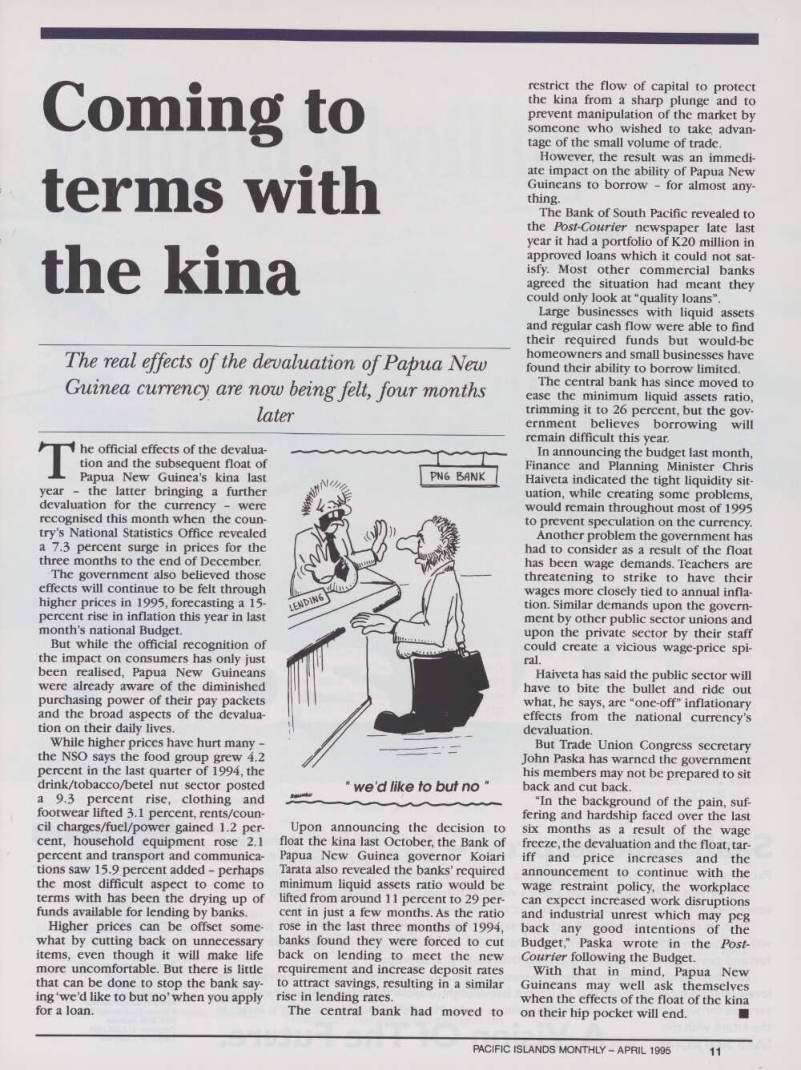
Higher prices can be offset some what by cutting back on unnecessary items, even though it will make life more uncomfortable. But there is little that can be done to stop the bank say ing ‘we’d like to but no’ when you apply for a loan.
Upon announcing the decision to float the kina last October, the Bank of Papua New Guinea governor Koiari Tarata also revealed the banks’ required minimum liquid assets ratio would be lifted from around 11 percent to 29 per cent in just a few months. As the ratio rose in the last three months of 1994, banks found they were forced to cut back on lending to meet the new requirement and increase deposit rates to attract savings, resulting in a similar rise in lending rates.
The central bank had moved to
restrict the flow of capital to protect the kina from a sharp plunge and to prevent manipulation of the market by someone who wished to take; advan tage of the small volume of trade.
However, the result was an immedi ate impact on the ability of Papua New Guineans to borrow - for almost any thing.
The Bank of South Pacific revealed to the Post-Courier newspaper late last year it had a portfolio of K2O million in approved loans which it could not sat isfy. Most other commercial banks agreed the situation had meant they could only look at “quality loans”.
Large businesses with liquid assets and regular cash flow were able to find their required funds but would-be homeowners and small businesses have found their ability to borrow limited.
The central bank has since moved to ease the minimum liquid assets ratio, trimming it to 26 percent, but the gov ernment believes borrowing will remain difficult this year.
In announcing the budget last month, Finance and Planning Minister Chris Haiveta indicated the tight liquidity sit uation, while creating some problems, would remain throughout most of 1993 to prevent speculation on the currency.
Another problem the government has had to consider as a result of the float has been wage demands. Teachers are threatening to strike to have their wages more closely tied to annual infla tion. Similar demands upon the govern ment by other public sector unions and upon the private sector by their staff could create a vicious wage-price spi ral.
Haiveta has said the public sector will have to bite the bullet and ride out what, he says, are “one-off” inflationary effects from the national currency’s devaluation.
But Trade Union Congress secretary John Paska has warned the government his members may not be prepared to sit back and cut back.
“In the background of the pain, suf fering and hardship faced over the last six months as a result of the wage freeze, the devaluation and the float, tar iff and price increases and the announcement to continue with the wage restraint policy, the workplace can expect increased work disruptions and industrial unrest which may peg back any good intentions of the Budget,” Paska wrote in the Post- Courier following the Budget.
With that in mind, Papua New Guineans may well ask themselves when the effects of the float of the kina on their hip pocket will end. ■
" we'd like to but no"