I ‘Localising
pp. 16-17 · Read in the full issue
Cover Stories
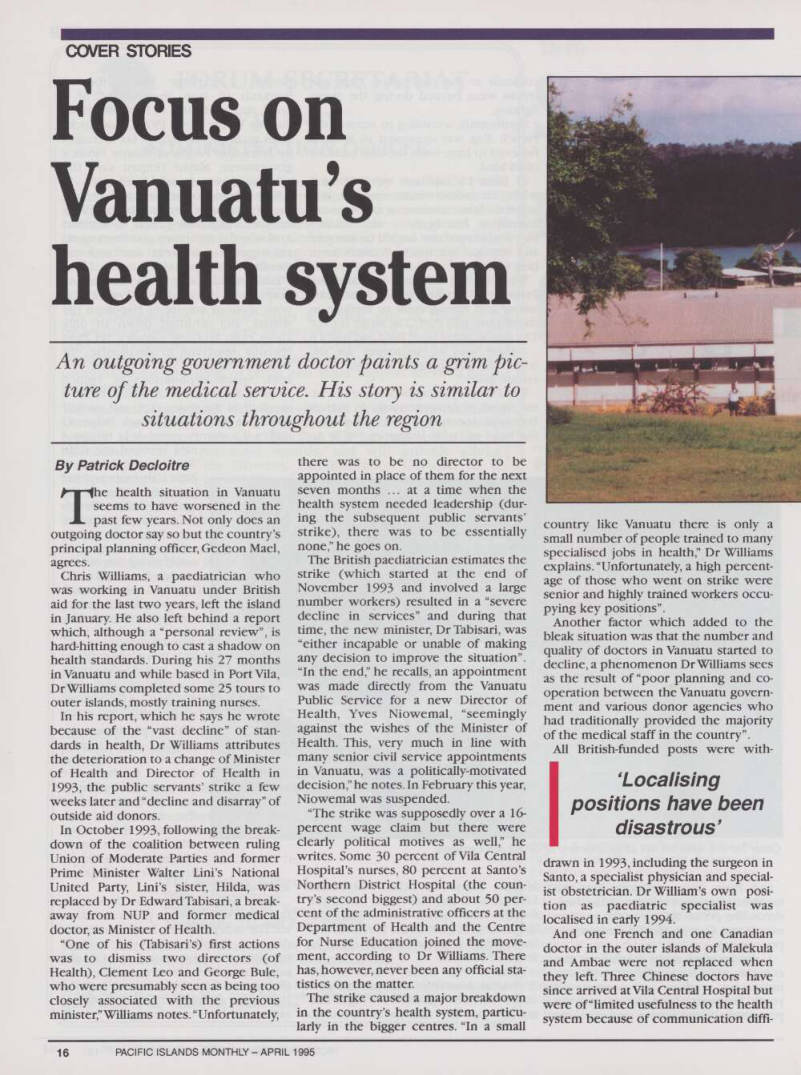
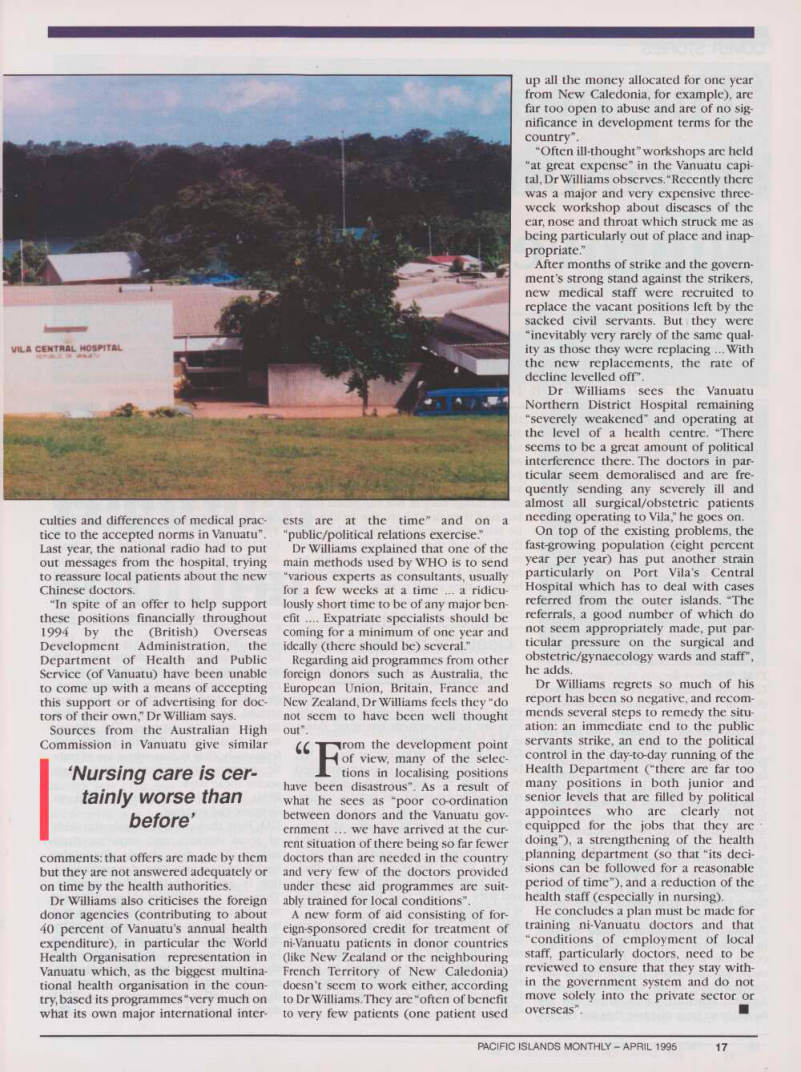
Focus on Vanuatu's health system
An outgoing government doctor paints a grim pic ture of the medical service. His story is similar to situations throughout the region
By Patrick Decloitre
The health situation in Vanuatu seems to have worsened in the past few years. Not only does an outgoing doctor say so but the country’s principal planning officer, Gedeon Mael, agrees.
Chris Williams, a paediatrician who was working in Vanuatu under British aid for the last two years, left the island in January. He also left behind a report which, although a “personal review”, is hard-hitting enough to cast a shadow on health standards. During his 27 months in Vanuatu and while based in Port Vila, Dr Williams completed some 25 tours to outer islands, mostly training nurses.
In his report, which he says he wrote because of the “vast decline” of stan dards in health, Dr Williams attributes the deterioration to a change of Minister of Health and Director of Health in 1993, the public servants’ strike a few weeks later and “decline and disarray” of outside aid donors.
In October 1993, following the break down of the coalition between ruling Union of Moderate Parties and former Prime Minister Walter Lini’s National United Party, Lini’s sister, Hilda, was replaced by Dr Edward Tabisari, a break away from NUP and former medical doctor, as Minister of Health.
“One of his (Tabisari’s) first actions was to dismiss two directors (of Health), Clement Leo and George Buie, who were presumably seen as being too closely associated with the previous minister,”Williams notes. “Unfortunately,
there was to be no director to be appointed in place of them for the next seven months ... at a time when the health system needed leadership (dur ing the subsequent public servants’ strike), there was to be essentially none,” he goes on.
The British paediatrician estimates the strike (which started at the end of November 1993 and involved a large number workers) resulted in a “severe decline in services” and during that time, the new minister, Dr Tabisari, was “either incapable or unable of making any decision to improve the situation”.
“In the end,” he recalls, an appointment was made directly from the Vanuatu Public Service for a new Director of Health, Yves Niowemal, “seemingly against the wishes of the Minister of Health. This, very much in line with many senior civil service appointments in Vanuatu, was a politically-motivated decision,” he notes. In February this year, Niowemal was suspended.
“The strike was supposedly over a 16percent wage claim but there were clearly political motives as well,” he writes. Some 30 percent of Vila Central Hospital’s nurses, 80 percent at Santo’s Northern District Hospital (the coun try’s second biggest) and about 50 per cent of the administrative officers at the Department of Health and the Centre for Nurse Education joined the move ment, according to Dr Williams. There has, however, never been any official sta tistics on the matter.
The strike caused a major breakdown in the country’s health system, particu larly in the bigger centres. “In a small
country like Vanuatu there is only a small number of people trained to many specialised jobs in health,” Dr Williams explains. “Unfortunately, a high percent age of those who went on strike were senior and highly trained workers occu pying key positions”.
Another factor which added to the bleak situation was that the number and quality of doctors in Vanuatu started to decline, a phenomenon Dr Williams sees as the result of “poor planning and co operation between the Vanuatu govern ment and various donor agencies who had traditionally provided the majority of the medical staff in the country”.
All British-funded posts were with-
I ‘Localising
positions have been
disastrous’
drawn in 1993, including the surgeon in
Santo, a specialist physician and special
ist obstetrician. Dr William’s own posi tion as paediatric specialist was localised in early 1994.
And one French and one Canadian doctor in the outer islands of Malekula and Ambae were not replaced when they left. Three Chinese doctors have since arrived at Vila Central Hospital but were of “limited usefulness to the health system because of communication diffi
culties and differences of medical prac tice to the accepted norms in Vanuatu”.
Last year, the national radio had to put out messages from the hospital, trying to reassure local patients about the new Chinese doctors.
“In spite of an offer to help support these positions financially throughout 1994 by the (British) Overseas Development Administration, the Department of Health and Public Service (of Vanuatu) have been unable to come up with a means of accepting this support or of advertising for doc tors of their own,” Dr William says.
Sources from the Australian High Commission in Vanuatu give similar
I ‘Nursing care is cer
tainly worse than
before ’
comments: that offers are made by them but they are not answered adequately or on time by the health authorities.
Dr Williams also criticises the foreign donor agencies (contributing to about 40 percent of Vanuatu’s annual health expenditure), in particular the World Health Organisation representation in Vanuatu which, as the biggest multina tional health organisation in the coun try, based its programmes “very much on what its own major international inter
ests are at the time” and on a “public/political relations exercise.”
Dr Williams explained that one of the main methods used by WHO is to send “various experts as consultants, usually for a few weeks at a time ... a ridicu lously short time to be of any major ben efit ... Expatriate specialists should be coming for a minimum of one year and ideally (there should be) several.”
Regarding aid programmes from other foreign donors such as Australia, the European Union, Britain, France and New Zealand, Dr Williams feels they “do not seem to have been well thought out”.
QQ '■-'irom the development point I—4 of view, many of the selec- JL tions in localising positions have been disastrous”. As a result of what he sees as “poor co-ordination between donors and the Vanuatu gov ernment ... we have arrived at the cur rent situation of there being so far fewer doctors than are needed in the country and very few of the doctors provided under these aid programmes are suit ably trained for local conditions”.
A new form of aid consisting of for eign-sponsored credit for treatment of ni-Vanuatu patients in donor countries (like New Zealand or the neighbouring French Territory of New Caledonia) doesn’t seem to work either, according to Dr Williams. They are “often of benefit to very few patients (one patient used
up all the money allocated for one year from New Caledonia, for example), are far too open to abuse and are of no sig nificance in development terms for the
country”.
“Often ill-thought” workshops are held “at great expense” in the Vanuatu capi tal, Dr Williams observes.“ Recently there was a major and very expensive three week workshop about diseases of the ear, nose and throat which struck me as being particularly out of place and inap
propriate.”
After months of strike and the govern ment’s strong stand against the strikers, new medical staff were recruited to replace the vacant positions left by the sacked civil servants. But i they were “inevitably very rarely of the same qual ity as those they were replacing ... With the new replacements, the rate of decline levelled off”.
Dr Williams sees the Vanuatu Northern District Hospital remaining “severely weakened” and operating at the level of a health centre. “There seems to be a great amount of political interference there. The doctors in par ticular seem demoralised and are fre quently sending any severely ill and almost all surgical/obstetric patients needing operating to Vila,” he goes on.
On top of the existing problems, the fast-growing population (eight percent year per year) has put another strain particularly on Port Vila’s Central Hospital which has to deal with cases referred from the outer islands. “The referrals, a good number of which do not seem appropriately made, put par ticular pressure on the surgical and obstetric/gynaecology wards and staff”, he adds.
Dr Williams regrets so much of his report has been so negative, and recom mends several steps to remedy the situ ation: an immediate end to the public servants strike, an end to the political control in the day-to-day running of the Health Department (“there are far too many positions in both junior and senior levels that are filled by political appointees who are clearly not equipped for the jobs that they are doing”), a strengthening of the health planning department (so that “its deci sions can be followed for a reasonable period of time”), and a reduction of the health staff (especially in nursing).
He concludes a plan must be made for training ni-Vanuatu doctors and that “conditions of employment of local staff, particularly doctors, need to be reviewed to ensure that they stay with in the government system and do not move solely into the private sector or overseas”. ■