Cover Stories
pp. 32-34 · Read in the full issue
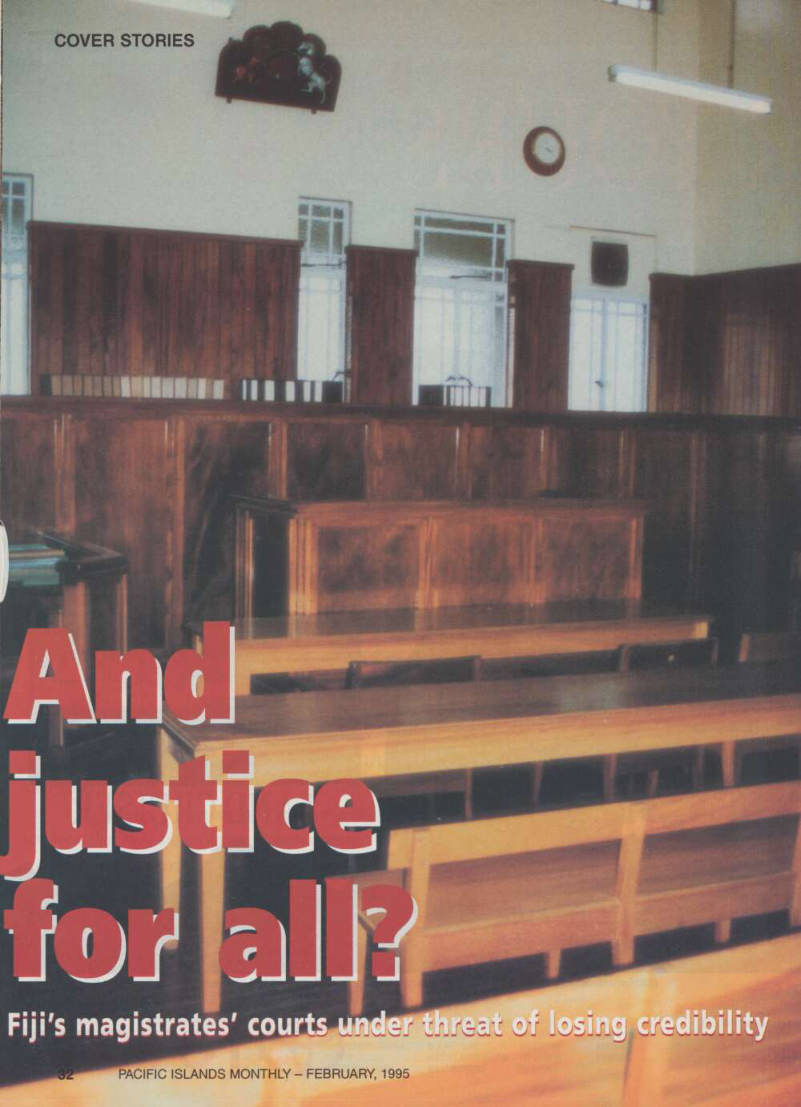
And justice for all?
Fiji's magistrates' cour tsibilitv
By Yunus Rashid
On November 11 1994, a 15year-old girl, was the victim of a sexual attack by six men, one of whom was her boyfriend. Charges of rape and defile ment were subsequently laid against the six - rape because the six alleged ly took turns at holding her down and covering her mouth, and defilement because the girl was a minor (under 16 years old). When they appeared before Labasa (a town on Fiji’s island of Vanua Levu) Court, the men plead ed guilty to both charges, but magis trate Moses Fernando pointed out they could not plead guilty to both because rape is “carnal knowledge” without consent while the defile ment charge is irrespective of con sent .
The men were given an option between rape and defilement. The men opted to plead guilty to defile ment.
The facts of the case were read out and the men verified them. The crunch came when it was time for the men to make their statements in mitigation. They said they had not realised the girl was under 16 and that she had looked bigger than her age.
Fernando called the girl before the court. After seeing the victim, he acquitted all six and commented that the girl “looked hefty for someone her age”.
Statements of shock and horror flooded The Fiji Times which first reported the case. Women’s rights movements, politicians and lawyers criticised Fernando’s decision.
Lawyers argued that if the men had said the girl looked older for her age then the magistrate should have entered a plea of not guilty and pro ceeded with a trial. A more disturbing question is how the accused, who all pleaded guilty to the charge, could be acquitted?
Director of Public Prosecutions Nazhat Shameem and the Permanent Secretary for Justice and Solicitor- General, Isikeli Mataitoga, called for more details of the case so that an appeal could be lodged. (It has since been filed). The matter is now before the High Court for its adjudication.
After the initial hue and cry sub sided, public attitude to the case is
one of “but this is nothing new”. And indeed it is not.
Three days before the end of 1994, Suva magistrate Syed Mukhtar Shah, in a custody battle, threatened to send a 10-year-old boy to prison if he did not go with his father who had divorced his wife seven years ago. The father had been a stranger to the boy. The boy had lived with his mother after his parents divorced in 1986. His father sought custody for the child on December 28, 1994. The father told Shah he wanted to keep his son until the custody application was heard on January 25. Without calling witnesses, Shah ordered the child go with his father. The child said he wanted to be with his mother, to which Shah replied, the boy could be sent to prison if he fussed.
The mother made an application before Suva High Court judge Mr Justice Scott who said of Shah’s deci sion: “In my judgment this order by the Resident Magistrate was seriously at fault. Not only had no evidence been heard before the order was made but also the Welfare Reports on file were completely ignored. There is no proper judgment and no reason shown at all why the obviously dis turbing effect of separating a small child from his mother and grandpar ents should so immediately be taken, given the long period during which he had not seen his father. The Resident Magistrate’s order was, I am satisfied, made without jurisdiction, was premature and unwise. The order is revoked.” At least a happy end - for a while anyway.
Let us consider the case of Epi Nakanacagi, a policeman. Nakanacagi was charged with abuse of office and larceny in 1991 and has been appear ing before the Suva Magistrates’ Court for mention since. On December 20, 1994, when his trial was scheduled to begin, magistrate Salesi Temo could not find the charge sheet because it was not placed in the court file given to him that day. Temo discharged Nakanacagi, saying since the charge sheet was not available, there was no case and ordered the DPP’s office to file new charges.
The immediate reaction from prose cutors was: how can a man not charged be discharged? If the magis trate saw there were no charges then he should have acquitted the accused. The DPP’s office has since laid new charges.
In Nadi, a town on the western coast of Fiji’s main island, magistrate Naresh Prasad blamed a victim for being raped because she got drunk and fell asleep at a party and sen tenced the accused to a lenient three year term . “The situation could have been avoided if she was sober,” magis trate Prasad said. “The behaviour of the complainant on this occasion leaves me to take a somewhat lenient attitude in sentencing the accused.”
He even added the victim was “the author of her own vulnerability” and the rapist was tempted by the sight of a sleeping girl.
This is another example of the type of judgments handed down in the magistrates’ courts which deal with 95 percent of the cases registered with the police. Decisions such as these have led to a lack of faith in the integrity, impartiality and wisdom of the judiciary.
Some informed sources put the blame on lack of training, lack of supervision and, in other instances, simply a lack of ethics. But surely people who have the ability to obtain law degrees should not be totally devoid of common sense. But cynical lawyers simply say, “Wise people do not become magistrates”. Perhaps better pay for magistrates would be an answer in attracting senior mem bers of the bar to sit on the benches.
But the situation is further com pounded by the fact that a decree was passed in 1988 removing the cri terion that one had to have qualifica tions as a lawyer before he/she could be appointed a magistrate.
Three magistrates have since been appointed to Fiji’s bench who do not have legal qualifications. They are Aminiasi Katonivualiku, resident mag istrate in Tavua, Viliame Nadakuitavuki, resident magistrate in Nausori and Eroni Sauvakacolo, mag istrate at Suva Domestic Court. (Sauvakacolo was reportedly moved to the domestic court in September 1993 after a public outcry over mani festly lenient sentences given while presiding over criminal cases.) The three who had been civil servants prior to their appointments as magis trates (two were teachers and one an administrator) had also acted as medi ators in Fiji’s traditional court system which deals with minor disputes at the village level.
But in all fairness to them, while they may take more time to unravel
legal technicalities, the first two have not given any reported controversial decisions - not yet anyway. They are able to hear trials which the Chief Magistrate, a graduate from the University of Papua New Guinea, rarely has time to do.
It is difficult to understand how magistrates seem to have the leeway to act on their own, sometimes even in breach of the law, without any apparent repercussions. Recently magistrate Shah held proceedings at a suburban police station in Suva dur ing a public holiday. Shah remanded four alleged rapists, one murder sus pect, and nine others - in the absence of any defence lawyers, interpreters or court clerks - during the Christmas holidays. The court sitting was reported in the media which praised Shah’s initiative. The media also carried a picture of Shah appar ently hearing the cases with division al prosecuting officer Jahir Khan looking over his shoulders.
The DPP consequently wrote to the Chief Registrar, the Chief Magistrate and the Police Commissioner object ing to the sitting on the grounds that it compromised the court system .
She said the sitting had violated fun damental concepts of the law where the prosecution and defence are given equal weight. The hearing, she claimed, was not held in a neutral setting.
If this is so, Shah has set a danger ous precedent whereby defence lawyers could, by the same token, ask magistrates to hold hearings in their offices in the absence of prosecutors.
While holding special hearings on holidays is not new in Fiji, these have until now been held at the court com plexes.
Shah’s response to the queries has been that he had gone to the police station to remand suspects and no court was ever held. This statement is contradictory in itself - how can Shah remand people without the jurisdic tion of the court? In most instances a magistrate can only exercise his vest ed powers within the confines of the court , that is, in the presence of both parties and court officers.
There were no defence lawyers and no court clerks. Every accused brought before Shah’s “court” was remanded in custody, some until December 28 while the others until January 6.
The obvious question raised is whether there is any safeguard against collusion between a magis
trate and police to the detriment of the accused? It unfortunately appears that despite everyone knowing about these incidents, no action seems to be taken to discipline those at fault or to prevent further violations of justice.
Responding to PlM’s questions, Chief Magistrate Sekove Naqiolevu admitted there were lapses but said not all magistrates gave controversial decisions. He blamed the government for a lot of the problems within the magistracy, saying that while the country’s population had grown con siderably since the establishment of the court system, the number of mag istrates and their pay-packets had not been increased accordingly.
Naqiolevu defended his magistrates saying they did their work diligently despite being under constant pres sure. He said where magistrates used to hear 100 to 200 cases per week 10 years ago, they were now having to hear at least 500 to 700 cases.
“We can’t attract seasoned lawyers to come and sit on the bench because there is more money to be made in private practice,” he said.
Perhaps the greatest laxity in the judiciary arises from the fact that it is not independent. The Public Service Commission has to have a say in how the budget is spent and what appoint ments are made.
Sir David Beattie, a former Governor-General of New Zealand, conducted a Commission of Inquiry, at the request of the Fiji government, into the court system to streamline the entire operation. Sir David has compiled his report and handed it over to government which is expect ed to implement some recommenda tions and shelve others until funds are available. No recommendations appear to have been implemented.
The Chief Justice, Sir Timoci Tuivaga, had made recommendations to the Beattie Commission that the judiciary be independent, but this was knocked back in favour of the Attorney-General’s submission that this was not possible on the grounds that it would be too expensive.
Hence, Sir David Beattie’s report on the court system has come under attack as being dictated to by the gov ernment.
While the public is outraged, by the number of complaints and appeals lodged against magistrates’ decisions, Sir Timoci, a highly respected judge, attributes this to “ignorance”. Asked why such criticisms rarely existed t before the coups, Sir Timoci said the
criticisms originated out “of utter ignorance on the part of the public about the processes of law” and the increasing criticism was a result of “increasing ignorance”.
Responding to what PIM described as “controversial” decisions, SirTimoci said,“All cases are controversial”. He said he could not comment on the Labasa rape/defilement case because it was before the courts. On magis trate Shah’s custody case, Sir Timoci said he was away in Lau (an outer island group) and had not heard of the decision. Asked if it was ethical for magistrates to hear cases where their personal friends appeared for one of the parties, SirTimoci said the judicial system in the country was based on ethics and it was improper to allege unethical conduct on the part of “My Lords” without any evi dence. He said people should realise that if they were dissatisfied with a magistrate’s decision, they could go further up by way of appeal.
Sir Timoci said it was difficult to analyse decisions because such an analysis could take up to a year and could only be done by a professor of law, who may eventually get it wrong anyway.
Sir Timoci said he “could not see what the excitement was all about”.
It is worth repeating here Sir Timoci’s points relating to judicial ethics which he made during a magis trates seminar on November 5, 1991.
He had said a magistrate should “dis qualify himself in a proceeding in which his impartiality might reason ably be questioned”. And a general observation he had made then was: “It was no secret that some judgments had been inadequate because they lacked cohesion and coherence.”
Another warning given to magis trates was that they should not min gle in civic and charitable activities if this would reflect adversely on their impartiality or interfere with the per formance of their judicial duties. It was unethical for them to serve organisations conducted “for the eco nomic and political advantage of its members”.
He said magistrates should not solicit funds for any organisation “or use or permit the use of the prestige of his office for that purpose”. They should not be guest speakers at fund raising events.
PIM was unable to get any views from Fiji Law Society president Ram Krishna. ■