bubble bursts
pp. 35-37 · Read in the full issue

The economic bubble bursts
By Roman Grynberg
The rapid recovery Fiji experienced fol lowing the 1987 coups was always going to be a hard act to follow. Few in Fiji could imag ine how hard. Immediately following the coups the government implemented policies that hurt the pocket in a way beyond what most Fijians had ever expected. But the mas sive 50-percent effective devaluation of the Fiji dollar in 1987, which slashed living stan dards, also stimulated economic growth beyond all expectations.
The devaluation was not intended to stim ulate anything. The Reserve Bank of Fiji, when it devalued, was not following policies of international competitiveness - it does not and has never really believed in a vigorous competitive exchange rate policy. The deval uation was undertaken with the standard and conservative economic objective of halting the haemorrhaging foreign exchange reserves caused by the outflow of capital by terrified Fiji citizens. It was a matter of stabil ity - not competitiveness - but the 1987 devaluations changed relative competitive ness.
The standard of living and real wages in Fiji plummeted in what was the most painful economic contraction in the history of post independence Fiji. It was the unemployment, low real wages and the paradoxical rise in income of Fiji sugar farmers (who saw the value of their earnings increase by 30 per cent in three years after the coup) that caused the economic recovery and change in direction of the economy.
The Fiji dollar in the post-coup era decreased in value much more substantially against the British pound and the European
ECU than it did against the value of the Australian and New Zealand dollars. As a result there was a sharp increase in the dollar value of sugar exports to the UK. As a result the prices of imported consumer goods from Australia and New Zealand did not rise as sharply as the value of earnings and sugar cane farmers saw an increase in their living standards directly as a result of the devalua tions.
What also caused the transformation of the economy was the creation of the tax-free factory system. These factories offered not only lower taxes but a way in which local investors could get their money out of Fiji.
This was because of the relatively weak exchange control regulations in that sector.
The third important factor that created the very brief “Fiji Miracle” was the liberalisation in 1987 of New Zealand and subsequently of Australian garment import regulations. This allowed duty free import of garments from Pacific island countries under the terms of the SPARTECA treaty.
Between 1988 and 1991, the garment export industry grew from virtually nothing to peak at exports of $l3l million. The indus try created the most rapid growth in manu facturing employment in the history of Fiji, with employment in the sector growing from 13,000 in 1987 to almost 23,000 by 1991. A substantial part of the growth in employment was in low-wage garment fac tories.
In many ways the growth of the garment industry was a vindication of the tough poli cies recommended by the World Bank and the IMF While parts of the government of Fiji supported these policies, in particular the Trade and Finance departments, these views
were not by any means accepted by the rest of the government or by the political leader
ship.
All 13 Forum island countries could have benefited from the Australian and New Zealand liberalisation in garment imports, but it was only Fiji that had done the difficult things in 1988 to create a competitive envi ronment that would make investors want to invest in the country. No other country ben efited from the liberalisation inAustralian and New Zealand trade. The Cook Islands, in fact, lost garment export capacity to Fiji.
Since 1990, however, the economy of Fiji has stagnated. Employment in the country’s manufacturing sector has gone nowhere and there appears to be little growth in other sec tors, with the exception of tourism and fish eries. There has been a continuous increase in tourist arrivals (as depicted in chart).
The tourism industry is now complaining its growth is being hampered by the absence of five-star accommodation. The top-line hotels, including the Sheraton,The Fijian and the Regent, are fully booked for months in advance. However, there have been no takers for the substantial investment needed for a large five-star hotel despite the obvious growth in demand.
The one truly miraculous sector of the Fiji economy in the last two years has been the unprecedented growth of the chilled tuna export market. From virtually nothing in 1992, chilled sashimi-grade tuna is being exported to Japan and the United States.
Exports in 1993 are expected to be in the vicinity of $lB million and by 1993 this had grown to some $3O million, rivaling the importance of Fiji’s state-owned PAFCO can nery which exports canned tuna to the United Kingdom and Canada.
The sugar industry has exhibited almost no growth since the huge rise in earnings caused by the 1987 devaluation which, ironi cally, benefited the Indian-dominated indus try.
The sugar industry now faces major adjust ments as EU sugar prices are set to drop by some 15 percent by the year 2000 as a result of the closure of the Uruguay Round of GATT. The other source of trade preference for Fiji’s economy has been the US sugar quota and this too is under a cloud as a result of US commitments to the creation of a free trade area in the Americas by the year 2005.
The situation is further compounded by the absence of an agreement on the renewal of land leases in the sugar belt, which are sched uled to begin expiring by 1997. Due to the sensitivity of the subject, the government has been reluctant to move quickly on the issue.
In January, sugar cane farmers threatened to boycott the 1995 harvest unless there is some resolution on the issue.
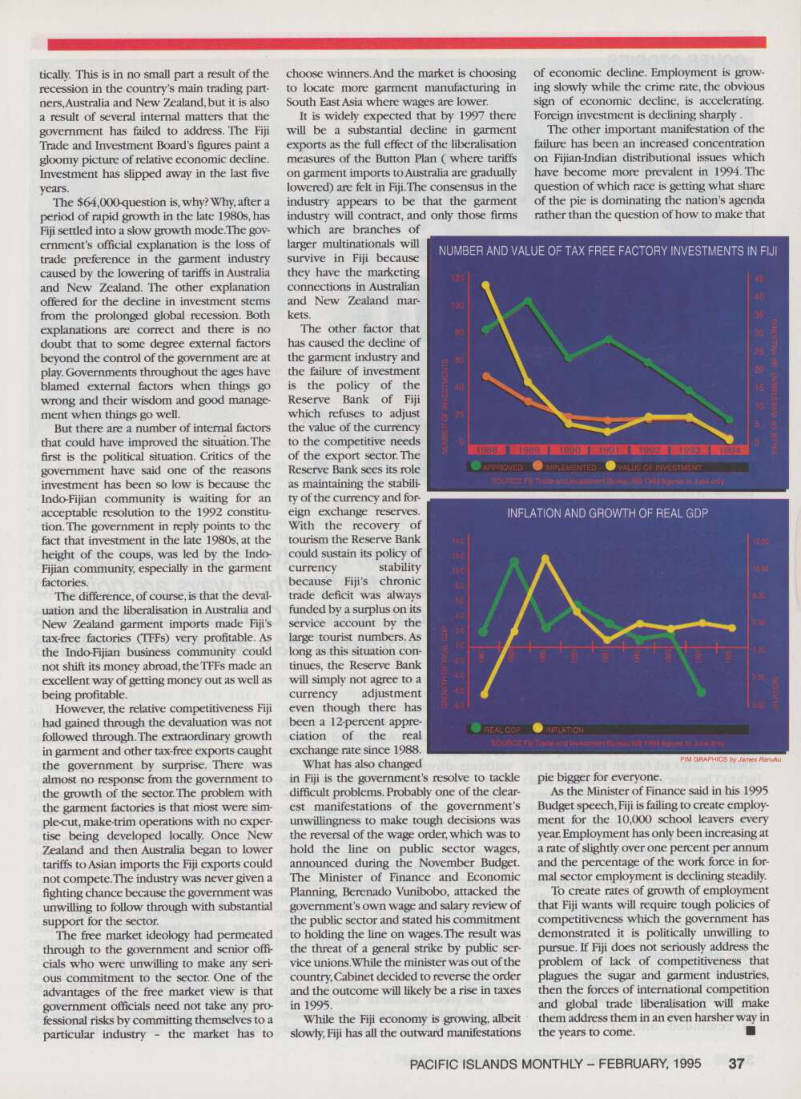
Investment in Fiji has been declining dras
tically. This is in no small part a result of the recession in the country’s main trading part ners, Australia and New Zealand, but it is also a result of several internal matters that the government has failed to address. The Fiji Trade and Investment Board’s figures paint a gloomy picture of relative economic decline.
Investment has slipped away in the last five years.
The $64,000-question is, why? Why, after a period of rapid growth in the late 1980 s, has Fiji settled into a slow growth mode. The gov ernment’s official explanation is the loss of trade preference in the garment industry caused by the lowering of tariffs in Australia and New Zealand. The other explanation offered for the decline in investment stems from the prolonged global recession. Both explanations are correct and there is no doubt that to some degree external factors beyond the control of the government are at play. Governments throughout the ages have blamed external factors when things go wrong and their wisdom and good manage ment when things go well.
But there are a number of internal factors that could have improved the situation. The first is the political situation. Critics of the government have said one of the reasons investment has been so low is because the Indo-Fijian community is waiting for an acceptable resolution to the 1992 constitu tion. The government in reply points to the fact that investment in the late 1980 s, at the height of the coups, was led by the Indo- Fijian community, especially in the garment factories.
The difference, of course, is that the deval uation and the liberalisation in Australia and New Zealand garment imports made Fiji’s tax-free factories (TFFs) very profitable. As the Indo-Fijian business community could not shift its money abroad, the TFFs made an excellent way of getting money out as well as being profitable.
However, the relative competitiveness Fiji had gained through the devaluation was not followed through. The extraordinary growth in garment and other tax-free exports caught the government by surprise. There was almost no response from the government to the growth of the sector. The problem with the garment factories is that most were sim ple-cut, make-trim operations with no exper tise being developed locally. Once New Zealand and then Australia began to lower tariffs to Asian imports the Fiji exports could not compete. The industry was never given a fighting chance because the government was unwilling to follow through with substantial support for the sector.
The free market ideology had permeated through to the government and senior offi cials who were unwilling to make any seri ous commitment to the sector. One of the advantages of the free maiket view is that government officials need not take any pro fessional risks by committing themselves to a particular industry - the market has to
choose winners. And the market is choosing to locate more garment manufacturing in South East Asia where wages are lower.
It is widely expected that by 1997 there will be a substantial decline in garment exports as the full effect of the liberalisation measures of the Button Plan ( where tariffs on garment imports to Australia are gradually lowered) are felt in Fiji. The consensus in the industry appears to be that the garment industry will contract, and only those firms
which are branches of larger multinationals will survive in Fiji because they have the marketing connections in Australian and New Zealand mar kets.
The other factor that has caused the decline of the garment industry and the failure of investment is the policy of the Reserve Bank of Fiji which refuses to adjust the value of the currency to the competitive needs of the export sector. The Reserve Bank sees its role as maintaining the stabili ty of the currency and for eign exchange reserves.
With the recovery of tourism the Reserve Bank could sustain its policy of
currency stability
because Fiji’s chronic trade deficit was always funded by a surplus on its service account by the large tourist numbers. As long as this situation con tinues, the Reserve Bank will simply not agree to a
currency adjustment
even though there has been a 12-percent appre ciation of the real exchange rate since 1988.
What has also changed
in Fiji is the government’s resolve to tackle difficult problems. Probably one of the clear est manifestations of the government’s unwillingness to make tough decisions was the reversal of the wage order, which was to hold the line on public sector wages, announced during the November Budget.
The Minister of Finance and Economic Planning, Berenado Vunibobo, attacked the government’s own wage and salary review of the public sector and stated his commitment to holding the line on wages. The result was the threat of a general strike by public ser vice unions. While the minister was out of the country, Cabinet decided to reverse the order and the outcome will likely be a rise in taxes in 1995.
While the Fiji economy is growing, albeit slowly, Fiji has all the outward manifestations
of economic decline. Employment is grow ing slowly while the crime rate, the obvious sign of economic decline, is accelerating.
Foreign investment is declining sharply .
The other important manifestation of the failure has been an increased concentration on Fijian-Indian distributional issues which have become more prevalent in 1994. The question of which race is getting what share of the pie is dominating the nation’s agenda rather than the question of how to make that
pie bigger for everyone.
As the Minister of Finance said in his 1995 Budget speech, Fiji is failing to create employ ment for the 10,000 school leavers every year. Employment has only been increasing at a rate of slightly over one percent per annum and the percentage of the work force in for mal sector employment is declining steadily.
To create rates of growth of employment that Fiji wants will require tough policies of competitiveness which the government has demonstrated it is politically unwilling to pursue. If Fiji does not seriously address the problem of lack of competitiveness that plagues the sugar and garment industries, then the forces of international competition and global trade liberalisation will make them address them in an even harsher way in the years to come. ■
PIM GRAPHICS by James Ranuku