The Forum
p. 29 · Read in the full issue
Opinion
The Forum comes of age
The South Pacific Forum is now an observer at the United Nations General Assembly. One hundred and sixteen coun tries co-sponsored the South Pacific Forum resolution seeking observer status.
It was eventually adopted by consensus at the 49th General Assembly in New York on October 17 (New York time), October 18 (Pacific time).
For an organisation such as the South Pacific Forum, which has barely crossed the 20-year mark of existence, it was a his toric event. South Pacific Forum Secretariat’s secretary general, leremia Tabai, echoed that sentiment when he thanked the world body.
“This is an historic event for us, marking (yet) another milestone for our small organisation as it tries to expand its role in representing the joint interests of its 15 members in the international arena.
“Our desire to be part of the General Assembly process stems not only from the South Pacific Forum’s own growing con tribution to representing the region’s col lective concerns in a rapidly changing environment, but also from our support for the expanded and invigorated role being played by the United Nations in the post-Cold War era.”
What does observer status at the UN mean, especially for island members of the South Pacific Forum? This is probably a dif ficult question to answer in terms of quan tifying benefits that Forum Island Countries will derive.
Many of the 13 FICs, by virtue of their membership of the UN, are already bene fiting from various programmes adminis tered by UN agencies, such as the United Nations Development Programme and the World Health Organisation, to name a few.
One of the immediate benefits to the region is the South Pacific Forum now has
a permanent seat at the UN General
Assembly.
Under mutual agreement, the seat will be filled by members of the SOPAC group (South Pacific Forum island countries with permanent UN missions in New York) when the UN General Assembly is dis cussing matters of direct and immediate relevance to the Forum.
FICs with UN missions are Federated States of Micronesia, Fiji, Papua New Guinea, the Republic of Marshall Islands, Solomon Islands, Vanuatu and Western Samoa.
The importance of the formal links with the UN cannot be over-emphasised.
Developed properly this link can be an effective avenue for making Pacific voices heard at the international arena on Pacific issues with international dimensions population, disarmament, global warming and fisheries resources.
Until now only Pacific countries who are members of the UN were able to raise these issues at the world body and at other international forums. So the South Pacific observer status will be useful for those island members of the regional organisa tion who are non-UN members.
Tabai has already hinted at issues criti cal to the survival of many FICs - issues which the UN is equipped to tackle.
“Development and its sustainability are critical issues for our region,” he said.
“From the earliest days of the South Pacific Forum, economic growth and how to achieve it in small island countries with limited resources have been high on our agenda. It is still the most important single problem for all of us and is increasingly linked to sound environmental manage ment because of the fragility of the resource base in most countries.”
South Pacific Forum’s efforts to work
with other extra-regional bodies in exchange of ideas, joint collaboration in technical, trade and other areas will not stop with the UN. In many instances, this co-operation is already in full swing through the South Pacific Forum Secretariat’s participation at meetings of technical bodies such as the Asia-Pacific Economic Co-operation Forum, and the Pacific Economic Co-operation Council.
Indeed, the observer status at the UN General Assembly has given impetus to the South Pacific Secretariat to vigorously pur sue co-operation with other international organisations. A staff member of the South Pacific Forum Secretariat was in Jakarta, Indonesia, last month on an attachment with the Secretariat of the Association of South East Asian Nations.
In many ways, the South Pacific Forum has come of age. Its admission as an observer at the UN General Assembly is no mean feat. But nor are its successes in other equally important areas.
It was just two-and-a-half decades ago that what is now the South Pacific Forum came into being. From that first meeting in Wellington, New Zealand, of the seven founding members - Australia, Cook Islands, Fiji, Nauru, New Zealand, Tonga, Western Samoa - the organisation has grown into a towering body.
The seven have been joined by the Federated States of Micronesia, Kiribati, Niue, Papua New Guinea, Republic of the Marshall Islands, Solomon Islands, Tuvalu and Vanuatu. Its membership now stands at 15 with political influence over about 30 million square kilometres of the Pacific Ocean. With the admission of Palau as a full Forum member later this year almost a certainty, the organisation’s sphere of influence will be even larger. ■ The founding fathers of the South
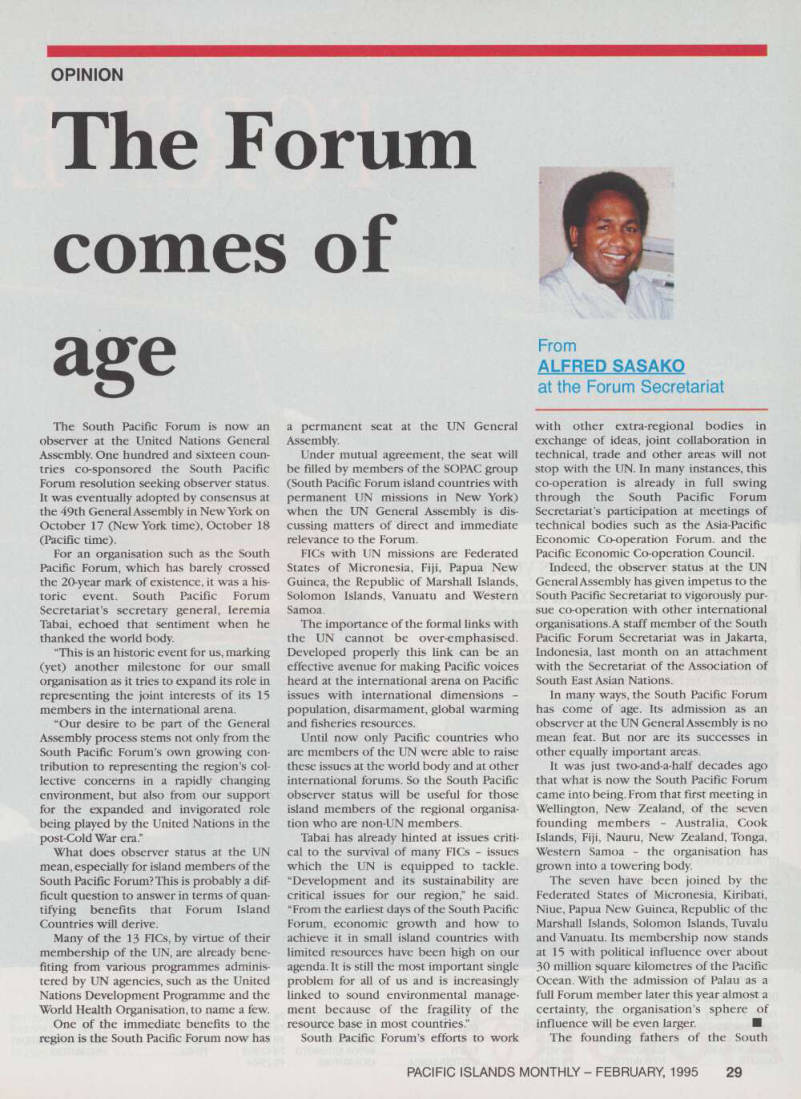
From
Alfred Sasako
at the Forum Secretariat