Fiji’s
pp. 13-18 · Read in the full issue

Cover Stories
Fiji’s television dilemma
By Yunus Rashid
At least 12 years ago Fiji decided it was time to set up a television ser vice in the country. Now, after years of negotiations, calling for tenders, and leaving behind a trail of disgruntled investors, a decision appears “finally” made allowing Fiji Television Ltd to air a service to consumers who have been putting up with a temporary service since 1991.
Television New Zealand and Fiji government-owned entities Fiji Development Bank and Fiji Post and Telecommunications Limited (along with not-yet-forthcoming members of the public) were given the ominous task of operating the company as of July 1.
Almost five months later, Fiji’s con sumers are still being fed the same diet which includes a daily news bulletin compiled by the government’s Ministry of Information.
Concerns are being raised about the viability of the venture as flaws are becoming evident in the manner Fiji Television Ltd was set up and, more worrying, how it will fare in the future.
The company’s share holding is : Television New Zealand, 15 percent, FDB , 51 percent ( being held in trust for the eventual purchase by indige nous shareholders) and FPTL, 14 per cent. The remaining 20 percent is to be sold to the public.
This means the Fiji government has forked out $5,355,000 in paid up capi tal towards this venture. In addition to that, for the last four years that TVNZ has been running the temporary show, Fiji government has been paying a monthly fee for the service, bringing
total government contribution in excess of $1 million.
Not a small amount by any means, and more so for a government which by its own admission is unable to meet its expenses within the present eco nomic policies.
The venture is further complicated by the fact that the only study on its viability , carried out by TVNZ points out it will make losses to the tune of $8 million in the first five years of opera tion.
The government’s actions belie its stated conviction that the arrangement is a viable one - particularly in its deci sion to bar any competition for the first 12 years, to grant concessions.
Five months after taking over, the company is beginning to give at the seams - it has a net operating loss of
$114,000 for the first three months and the government has decided to charge it $lOOO a day for the news ser vice it produces.
Company chairman Laisenia Qarase (also FDB managing director) says gov ernment’s demand for payment would further increase losses beyond $200,000 for the first three months.
Qarase will consider a number of options, including omitting the local news bulletin until it sets up its own facility.
The company had planned to have its own news team ready by May next year. Qarase expressed concern that government’s decision would put severe strain on the company purse.
Qarase said the company would make substantial losses during the first five years but it was not made clear if the
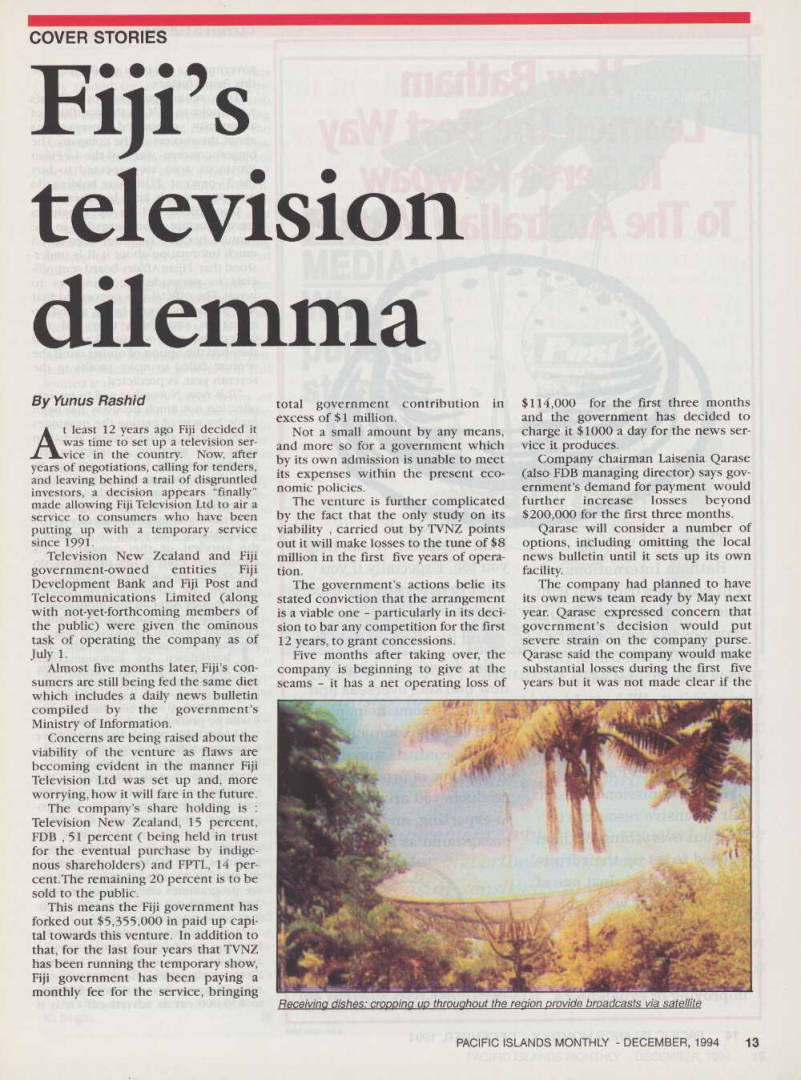
Receiving dishes: cropping up throughout the region provide broadcasts via satellite
Cover Stories
government’s decision would increase this figure further.
Two senior government officials who spoke to PIM on the condition of anonymity, expressed reservations about the success of the company. The biggest concern was that the 14 Fijian Provinces, who are expected to buy the 51-percent FDB share holding, do not appear overly keen buy them.
One official said the the provinces were reluctant about investing in the venture because they not been given much information about it. It is under stood that Fijian Affairs Board sent offi cials to persuade the provinces to invest. The official was concerned that the provinces were being asked to invest in something they did not understand and without knowing if they had the option of opting out if the venture failed to make profits in the seventh year, as predicted.
“It is now November and to my rec ollection not much headway has been made by way of getting the provinces to participate in the venture. But then again, the question is whether the provinces would be wise enough to buy shares in something they don’t know about. My worry is that the gov ernment has seen fit to give Fiji Television a monopoly, contrary to its deregulation policy just to guarantee the survival of the company. This means that even if the provinces do buy shares, they should be allowed to abandon the company if it fails to make money. After all, the monopoly is like giving a guarantee that the compa ny would succeed,” the official said.
These comments highlight the breakdown of communication between senior government offi cers and the bank.A bank source said the provinces were not expected to buy shares until they were sure the company would be profitable as anticipated.
Meanwhile, other concerns have been raised about people being “force fed” an alien culture and lifestyle.
“What we see on television is not something everybody here can identify with. What should be shown are pro grammes which enhance the living standards of the people within the existing resources. Suitable pro grammes have not been introduced in the last five months. What we see here are programmes already aired in New Zealand and the cost for such screen ings are recouped here in Fiji.
“Even the advertisements indirectly hint that the lifestyle of people in rural areas does not conform to normal lifestyles elsewhere. How can an ordi nary villager or farmer afford a $40,000 to $50,000 car as advertised? Or is it
that the rural people’s views on what they should see is irrelevant?” a gov ernment official asked. The official also raised the issue of concessions, saying if government provided funds for the company to recover from its initial loss es, then what assurance would the peo ple of the country, as tax payers, have that their money was soundly invested.
“I personally feel that the govern ment has decided to unwisely put a lot at stake on the television deal when there are more important and pressing matters to be resolved,” the official said.
It is becoming apparent that the television deal is not something all par ties had mutually agreed upon, as is fur ther evident by statements made by a Fiji Development Bank source who said the bank had undertaken the pro ject only because the government had wanted it to.
The government’s initial terms of reference for a local television compa ny had stipulated it should be at no cost to government. And it had also, along the way, stated that it was opposed to cross- media ownership that is, allowing one entity ownership of more than one medium. Applications to set up a television service were also rejected on this basis.
But in an about-turn in policy, it has now awarded licence to the Fiji Development Bank and its corporation, Fiji Posts and Telecommunications Ltd.
The bank already has another media interest - a daily newspaper.
If the Fijian provinces are not con vinced the venture is viable and decide against buying shares, then the govern ment is saddled with paying for it. If the venture is a failure, then the gov ernment would have wasted millions of dollars of tax-payers’ money.
In addition to the forecast losses, the company will also be required to pay a licence fee of $230,000 annually for the first four years, $1 million for the next two and then it comes under review.
The problem does not stop here either. If the government had looked beyond the immediate future, it would have found that there is a likelihood Australian Broadcasting Corporation will broadcast a free-to-air television service in the South Pacific in the next two years. And with the rapid advance ment in technology, Fiji could easily fall in the foot-print of a satellite, providing viewers here more access to interna tional channels.
So much for the government’s
monopoly clause.
As they say, the show is only about to begin. ■
“ ...freedom of the press ...is a freedom which is inviolable, being directly linked to our constitutional provisions on the freedom of expression - a
fundamental freedom,” so spoke
Information Minister Ratu Josefa Dimuri at the recent opening of Fiji
Journalism Training Institute.
Admirable sentiments indeed, especially when they come from a government minister, a position traditionally known for brandishing threats to muzzle this freedom in an attempt to end any criticism of the government.
And the sentiments were welcomed by journalists around the country who cherish and protect this soveriegnty of the media, knowing all too well that any threat to the sanctity of this freedom is in effect a threat to the public’s right to free speech. For ultimately media freedom is the public’s freedom to hold views (which may be contrary to the official line) and a right to express these views publicly without fear or censure, within the limitations of our existing laws relating to libel, slander and defamation.
These laws adequately protect individuals/groups from being wrongfully maligned in public and act as a check and balance measure to ensure freedom of speech does have a sound base.
That was the reason local media had
presented a united opposition to any attempts to throttle this freedom - from the complete ban on news immediately following the coups to the harsh Internal Secuirty Decree to threats issued on and off about censoring and licensing the industry.
Have we really progressed so far so soon?
A close examination of the industry in Fiji has revealed a disturbing trend - one which is becoming so ingrained so quietly that it most likely has gone unnoticed by defenders of a free Press.
The creeping worry concerns the question of ownership - and ultimately control.Who decides what Fiji’s public gets to view, hear and read and, more impor-
tantly, how they perceive the world
around them?
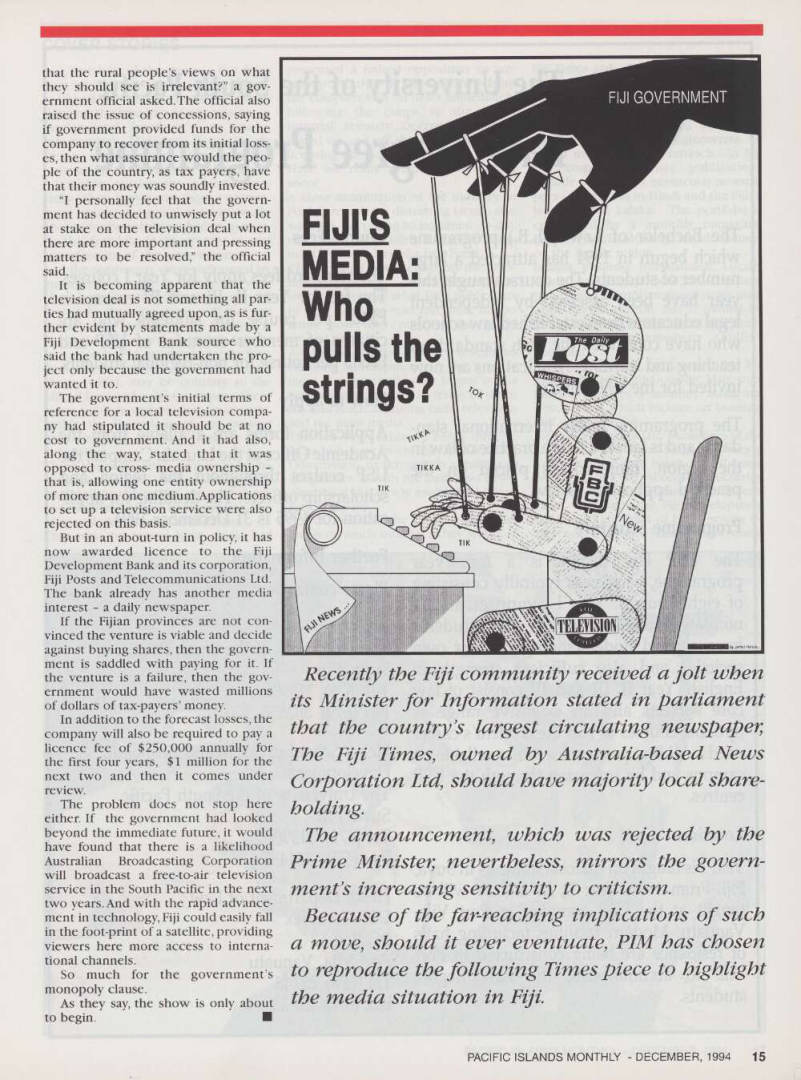
An analysis of the industry reveals an alarming development - the government has emerged as the largest media owner in the country in terms of diversity and reach, spanning radio, television and the print media.
This has been achieved either directly, as is the case with Fiji Broadcasting Commission, or through its subsidiaries or agencies as with the Daily Post newspaper and the newly established television company.
Let us examine the media companies and how much influence they wield.
Fiji Times Ltd: Publishing the nation’s largest circulation (an average audtied figure of about 37,000 daily) and oldest (123 years) English language daily news paper, it is foreign-owned and forms part of the global conglomerate of media mogul Rupert Murdoch. In Fiji the company’s other publications include two weekly vernacular newspa pers - Shanti Dut in Hindi and the Fijian language Nai Lalakai. The portfolio is completed by a monthly magazine, Pacific Islands Monthly, which focuses on the Pacific region.
Islands Business International: Locally owned and incorporated, the company publishes a monthly regional news mag azine similar to PIM, and is owned by journalists Robert Keith-Reid and Peter Lomas and businessman Godfrey Scoullar.
Associated Media Ltd: owned by Fiji journalist Yashwant Goundar. Main pub lication involves a monthly magazine, The Review, which focuses on business and politics in Fiji, Fiji Post Company Ltd; Publishers of the Daily Post and Fijian language weekly, Volasiga, came into being after the sec ond coup of 1987. Recent restructuring of share holders has resulted in govern ment - through the Fiji Development Bank and Unit Trust of Fiji - owning 84 per cent. PublisherTaniela Bolea retains
two per cent and a management posi tion. The remaining 14 per cent is divid ed among staff members (some of whom are no longer with the company) and other interested parties, such as Attorney-General Kelemedi Bulewa (five per cent).
Fiji Broadcasting Commission: wholly government-owned enterprise providing programmes in the three main languages, through its three AM stations - Radio Fiji One,Two and Three.
Also has the FM 104 station which is more music-oriented.
Communications Fiji Ltd: A newcomer to the radio scene, it nevertheless has taken a significant share of radio listen ers in Fiji’s urban areas. The company has two radio stations - FM 96 and the Hindi language Navtarang. Both concen trate on music with hourly news spots.
Owners are William Parkinson, Unit Trust of Fiji and business people.
Fiji Television Ltd: recently incoprorated holding with dominant government control through FDB’s 51 per cent shareholding and Fiji Post and Telecommunication Ltd’s 14 per cent. In addition, a New Zealand government through its ownership of TVNZ - has a 15 per cent stake in the venture. The remaining 20 per cent will be offered to
the public.
All this after initial government guide lines that the television venture should be at no cost to government, followed by rejection of some applications on the grounds that it did not believe in cross media ownership The media enterprises with the major influence in Fiji are naturally those focusing on local issues - Pacific Islands Monthly and Islands Business are of peripheral importance. The Review, with its target readership of business men and higher income earners, does not reach the masses.
The two daily newspapers are the only players in the print media to reach the population at large. The Fiji Times, by virtue of its larger circulation, has a larg er reach. The Daily Post, for which there are no audited circulation figures avail able, would, according to industry esti mates, have a daily print run of around 10,000.
As for radio listnership, a survey con ducted last year showed FM 96 and Navtarang, where available, attracted more loyal listeners than the FBC sta tions. However, FM96 and Navtarang are not yet available throughout the coun try, especially in all outlying islands as a result of weaker signals.
Television, which is so far only available in some parts ofViti Levu, with no defi nite timeframe set for when it will go national, has no competitor.
Fiji government’s
foray into the media
industry is cause for
concern and poses a threat to free and open discussion of issues in
the community.
While government-owned media do not have a significant audience in each cate gory per se (except for television and where FM stations do not reach), the three mediums combined provide the government with a powerful voice in the media.
A voice which, when it chooses to do so, can be brought to bear upon the unfettered disemmination of news and information.
In the months following the coups, the government was keenly studying the system in place in Malaysia relating to the media. While there is a general belief that the government is loosening con trol of the media with the reliquishing of the main newspaper, New Straits Times, there is still an unwritten policy that media do not touch “sensitive” issues. And there are directive from the Home Affairs Ministry on the do’s and don’ts.
It would be naive to think that with the change to parliamentary democracy and an elected government, these studies and the ideas which urged the govern ment to consider adapting stricter con trol of the media are now behind us.
As far as the remaining “free” media are concerned, the present government is not averse to putting out threats to cur tail this freedom when criticism appears too intense.
An example of this was at the time of the furore created by allegations of Prime Minister Sitiveni Rabuka’s extra marital affairs.
Countering the allegations as reported in The Review, Information Minister Ratu Josefa Dimuri (the same who spoke of Press freedom being inviolable and a fundamental freedom) had con sidered suspending the magazine’s operations and reviewing the Media Registration Act because he was con vinced it had “misled its readers”.
There is no denying the government is also inclined to manipulate news as is evident by the treatment given to cov
erage on television. The “news” as wit nessed nightly on Fiji One is produced by civil servants at the government’s Ministry of Information. From its incep tion Fiji One news has come under crit icism from citizens, opposition political parties and viewers in general for its heavy pro-government stance, often at the exclusion of all contrary viewpoints.
There are no clear-cut guidelines on how news will be presented when the new company, Fiji Television Ltd, is fully operational. Suffice to say, the majority shareholders will have the dominant voice in appointment of the board of directors who will in turn appoint key staff members.
The government has also been known to remove items from its Radio Fiji news bulletins. Former Information Minister Ratu Inoke Kubuabola, apparently angered by what he thought was an inaccuracy went into the Radio Fiji stu dio as it was about to go on air for the 7.00 am newsbreak and walked out with the script. Much commotion was created as a result of this ministerial intervention.
Now with its control of the Daily Post , the government’s influence over the focus given to events in the media is even stronger.
An example of The Daily Post’s pro-gov ernment slant came to light in the news paper’s coverage last week of govern ment’s decision to reduce its annual grant to the Fiji Broadcasting Commission. This would mean major job losses at the commission and possi ble cuts to services. Next year’s govern ment allocation is expected to be reduced by 75 per cent.
The independent media highlighted the most newsworthy angle of the story that people would lose their jobs.
The Daily Post chose to highlight the “positive” aspect and said the govern ment had given Radio Fiji a new lease on life for the sake of Fijian listeners.
It wasn’t until the second half of the story that a brief mention of redundan cy was made.
Why is it that there hasn’t been so much as a hiccup from the media - its spokespeople, its various associations against government’s growing control?
Is it because the media generally is becoming too reliant on support and assistance from government to develop the industry here?
After all, if Fiji’s media is to grow to become a credible watchdog for the community, then an objective relation ship with the officials is recommended.
The dangers of becoming too comfort able with the authorities in so small a community are too great for Press free dom. ■