Tightening the belt
pp. 9-11 · Read in the full issue

South Pacific Commission
By Patrick Decloitre
SPC is plagued with financial problems as former colonial powers phase out
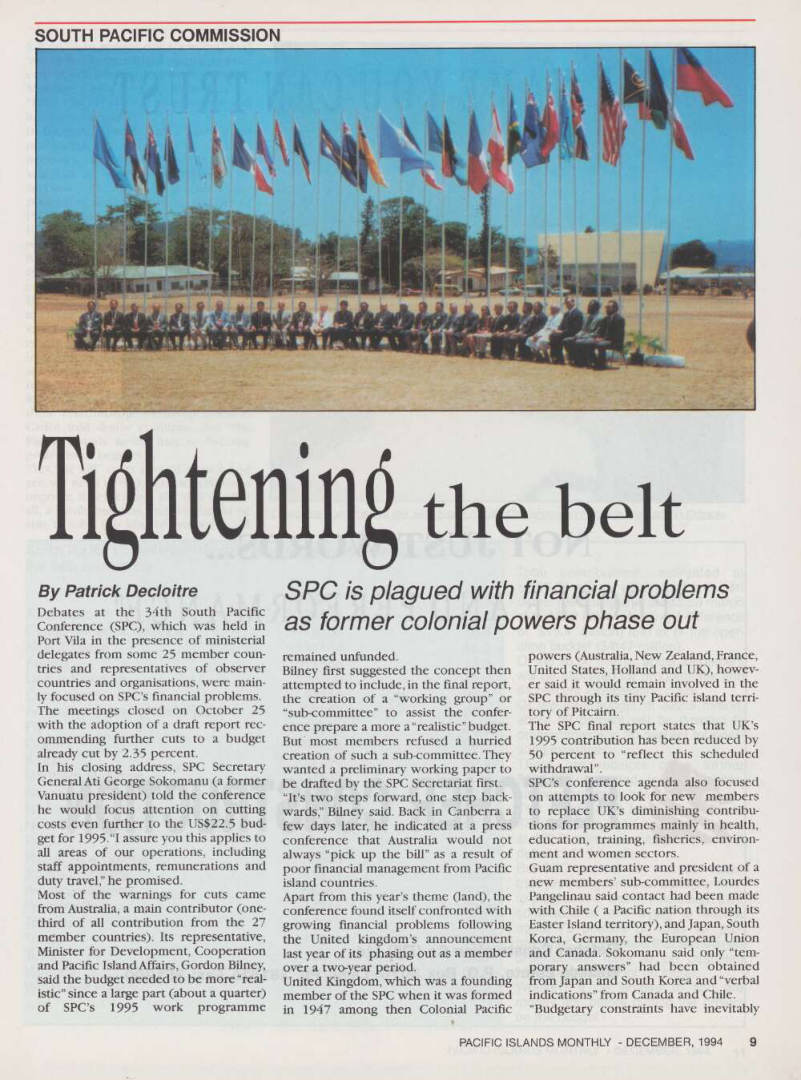
Debates at the 34th South Pacific Conference (SPC), which was held in Port Vila in the presence of ministerial delegates from some 25 member coun tries and representatives of observer countries and organisations, were main ly focused on SPC’s financial problems.
The meetings closed on October 25 with the adoption of a draft report rec ommending further cuts to a budget already cut by 2.35 percent.
In his closing address, SPC Secretary General Ati George Sokomanu (a former Vanuatu president) told the conference he would focus attention on cutting costs even further to the U 5522.5 bud get for 1995.“! assure you this applies to all areas of our operations, including staff appointments, remunerations and duty travel,” he promised.
Most of the warnings for cuts came from Australia, a main contributor (one third of all contribution from the 27 member countries). Its representative, Minister for Development, Cooperation and Pacific Island Affairs, Gordon Bilney, said the budget needed to be more “real istic” since a large part (about a quarter) of SPC’s 1995 work programme
remained unfunded.
Bilney first suggested the concept then attempted to include, in the final report, the creation of a “working group” or “sub-committee” to assist the confer ence prepare a more a “realistic” budget.
But most members refused a hurried creation of such a sub-committee. They wanted a preliminary working paper to be drafted by the SPC Secretariat first.
“It’s two steps forward, one step back wards,” Bilney said. Back in Canberra a few days later, he indicated at a press conference that Australia would not always “pick up the bill” as a result of poor financial management from Pacific island countries.
Apart from this year’s theme (land), the conference found itself confronted with growing financial problems following the United kingdom’s announcement last year of its phasing out as a member over a two-year period.
United Kingdom, which was a founding member of the SPC when it was formed in 1947 among then Colonial Pacific
powers (Australia, New Zealand, France, United States, Holland and UK), howev er said it would remain involved in the SPC through its tiny Pacific island terri tory of Pitcairn.
The SPC final report states that UK’s 1993 contribution has been reduced by 50 percent to “reflect this scheduled withdrawal”.
SPC’s conference agenda also focused on attempts to look for new members to replace UK’s diminishing contribu tions for programmes mainly in health, education, training, fisheries, environ ment and women sectors.
Guam representative and president of a new members’ sub-committee, Lourdes Pangelinau said contact had been made with Chile ( a Pacific nation through its Easter Island territory), and Japan, South Korea, Germany, the European Union and Canada. Sokomanu said only “tem porary answers” had been obtained from Japan and South Korea and “verbal indications” from Canada and Chile.
“Budgetary constraints have inevitably
forced us to reduce our spending,” said Sokomanu at the official opening of the conference. But Vanuatu Prime Minister Maxime Carlot put it more bluntly: “How can SPC justify its existence and its operating costs?”
In the same speech Carlot said he did not accept the arguments of financial necessity put forward by the United kingdom to justify its withdrawal. He accused “officials from several major powers” of not caring about the fate of Pacific Island nations.
He said according to the major powers represented at the conference, “the future revolves around the rim of the Pacific, what happens inside is of little or no consequence”.
He added that “at the same time, a grow ing number of governments or large pri vate companies are pursuing our small er nations either to seek their votes in international organisations, or to come and exploit the few resources we may have.”
Referring to developmental issues and their relationship to independence, Carlot told donor countries that “the Pacific islands would hate to become
professional beggars”.
“Yes, the SPC costs a lot of money. And yes, we need to make greater efforts to improve its efficiency. But this is, after all, a family business and we should be able to solve this kind of problem.” ■
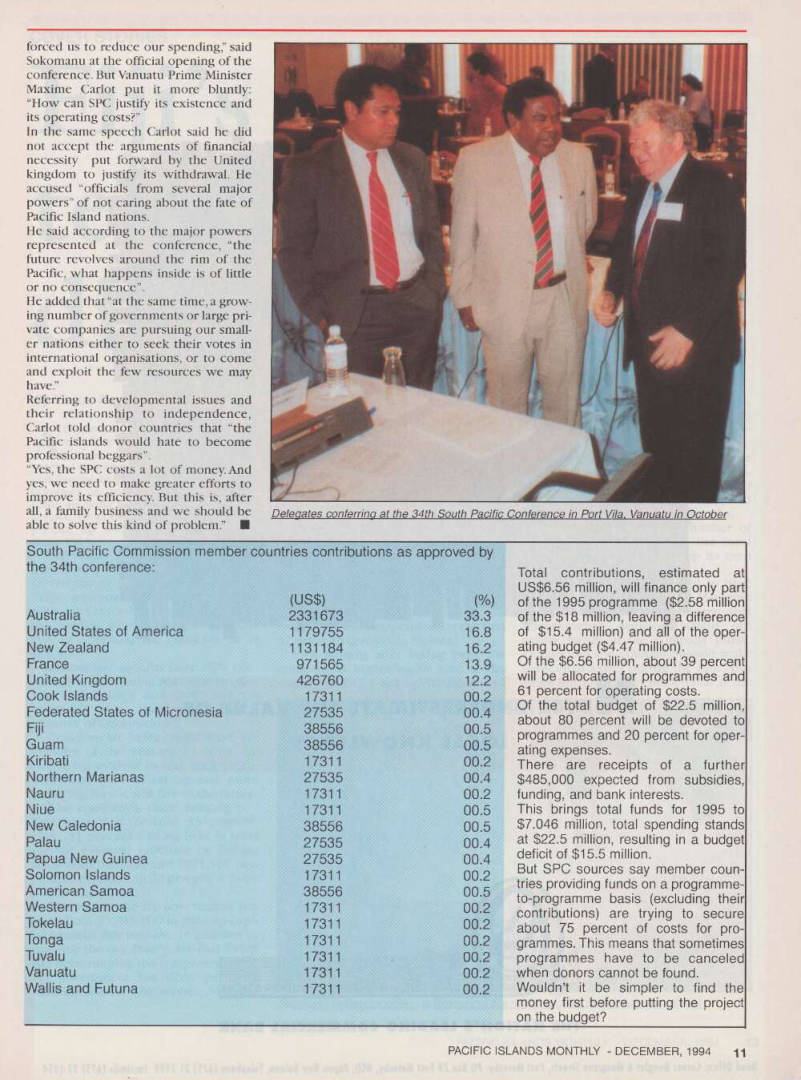
Delegates conferring at the 34th South Pacific Conference in Port Vila. Vanuatu in October