Another year,
p. 19 · Read in the full issue
Tourism
Another year, another convention
By Sudesh Kissun
THE Fiji tourism industry was told dur ing the annual Fiji Tourism Convention to increase Fijian participation in executive positions especially in the management of hotels and resorts. Fiji’s Finance minister Serenade Vunibobo and Tourism minister Harold Powell both made the call that the government was concerned Fijians were clearly under-represented in these areas.
“The industry cannot afford to portray an image that Fijians clean rooms, serve at the bars and restaurants and provide entertainment while other races and expa triates run the show,”Vunibobo said.
He called on the industry to address the issue so that next year’s convention would report some progress.
Powell said Fijians enjoyed very few senior management positions even though they had been in the industry for over 30 years.
Fiji Hotel Association president Dick Smith said the issue was a long and com plicated one and asked whether the min isters meant indigenous Fijians or Fiji nationals. “If they are talking about indige nous Fijians then there is no rule stopping them from managing hotels and resorts.”
He said the industry should stop debating such issues but strive towards a strong and viable industry so everyone involved in it would benefit.
“What we should try to do is employ the largest number of locals we can find. If we can’t find suitable locals then we can get the expatriates.”
According to figures provided by the association, 101 hotels were owned by Fiji nationals, 19 by Australians, 11 by Asians, 10 by Americans, eight by New Zealanders and six by nationals from Austria, Canada, Italy and Britain.
Smith pointed out that most multi national hotels in Fiji employed Fiji nation als in the number two position.
Sheraton Fiji Resort’s resident manager,
Kevin Mutton, was an expatriate, married to a local and now residing in Fiji. Regent of Fiji’s assistant manager, Jackson Mar, is a local.
Shangri-La Fiji has Radike Qereqeretabua, an indigenous Fijian, as general manager and Fiji Mocambo Flotel is managed by another local, Bill Gavoka.
The European Union-sponsored Tourism
Council of Fiji is headed by Levani Tuinabua (indigenous Fijian) as is Fiji Visitors Bureau’s chief executive, Isimeli Bainimara.
Fijian women in the tourism industry include Beachcomber Cruises and Resorts general manager Akanisi Dreunamisimisi and Fiji Hotel Association Executive Olivia Pareti.
Smith said this proved that if people had the ability they could get top jobs in the
industry. He suggested Fijians be encour
aged to operate small scale tourism-related activities like water taxis and boats to
enhance their participation in the indus try.
The four-day tourism convention, which attracted about 400 delegates, also focused on tourism and environment, marketing, duty free shopping and government’s involvement in infrastructure develop ment.
Fiji Visitors Bureau predicted Fiji would get 310,900 visitors this year, with an earn ing potential of about $4OO million in for eign exchange and creating about 40,000 jobs.
The FVB has forecast 336,000 visitor for next year, representing growths in arrivals from Japan (29 percent), Britain (seven percent) and the United States of America (six percent).
But the bureau was concerned that a shortage of hotel rooms during the peak period (from June to October) could hin der the record arrivals forecast for next year. ■
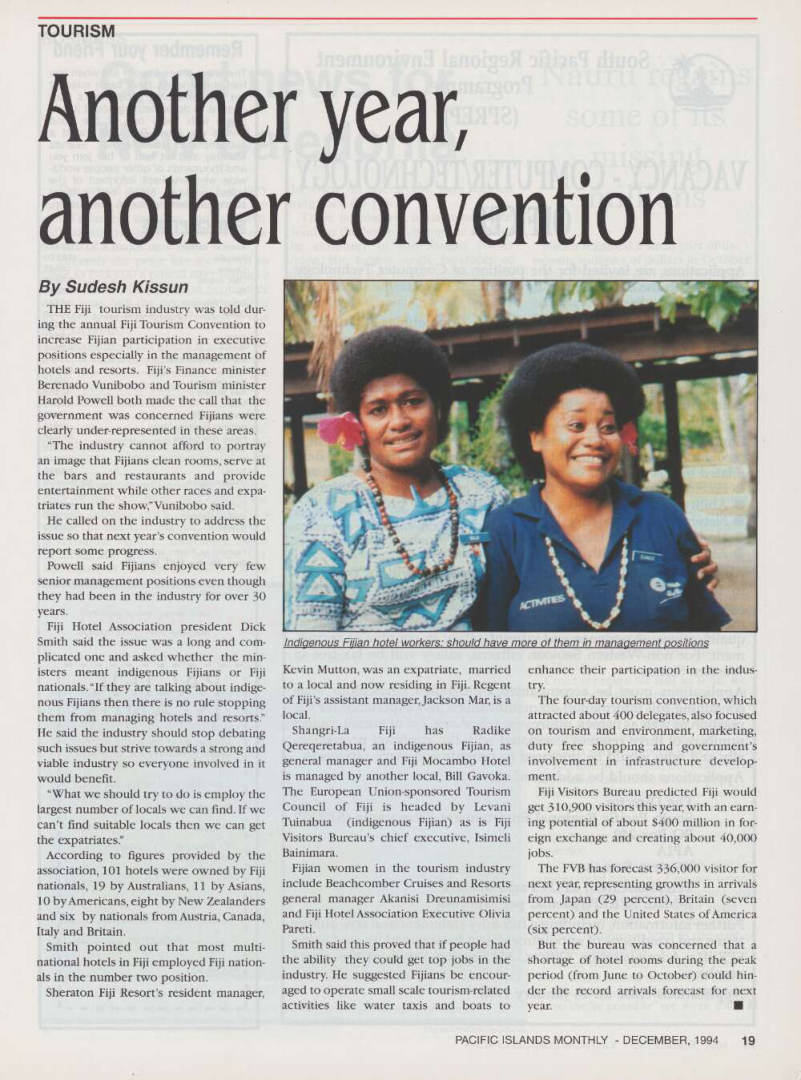
Indigenous Fijian hotel workers: should have more of them in management positions