The rise and
pp. 24-25 · Read in the full issue
Money
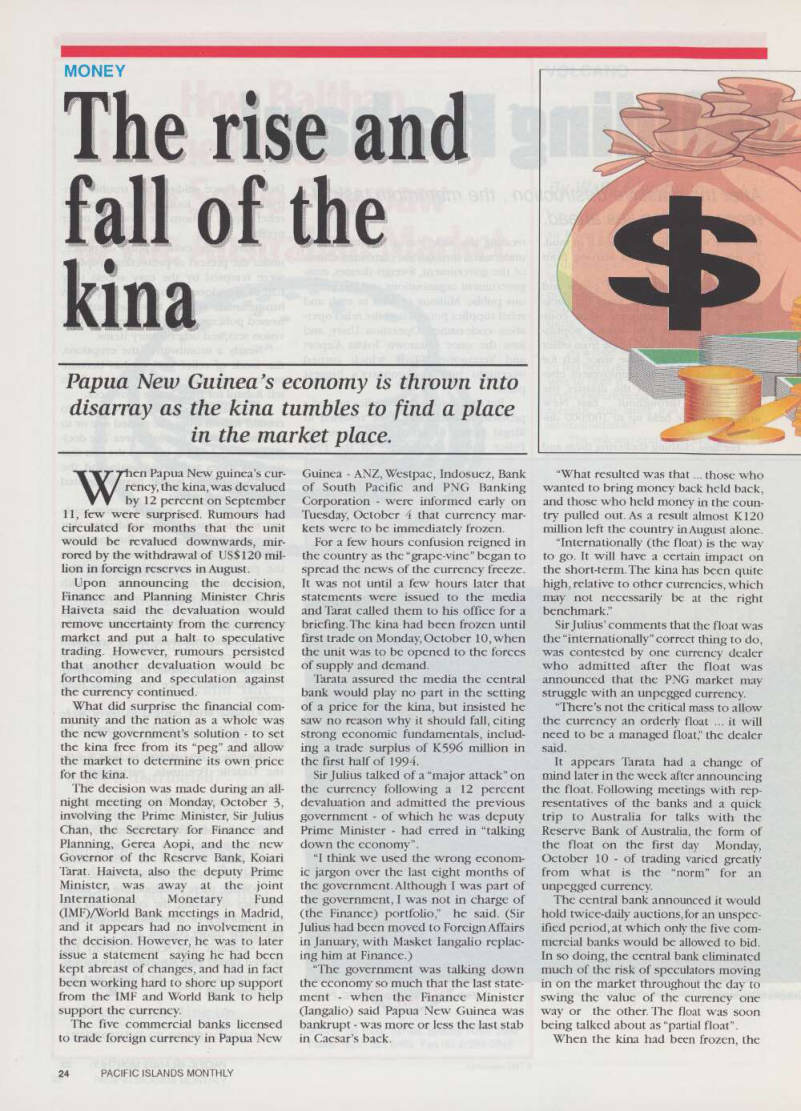
The rise and fall of the kina
Papua New Guinea's economy is thrown into disarray as the kina tumbles to find a place in the market place.
When Papua New guinea’s cur rency, the kina, was devalued by 12 percent on September 11, few were surprised. Rumours had circulated for months that the unit would be revalued downwards, mir rored by the withdrawal of US$l2O mil lion in foreign reserves in August.
Upon announcing the decision, Finance and Planning Minister Chris Haiveta said the devaluation would remove uncertainty from the currency market and put a halt to speculative trading. However, rumours persisted that another devaluation would be forthcoming and speculation against the currency continued.
What did surprise the financial com munity and the nation as a whole was the new government’s solution - to set the kina free from its “peg” and allow the market to determine its own price for the kina.
The decision was made during an all night meeting on Monday, October 3, involving the Prime Minister, Sir Julius Chan, the Secretary for Finance and Planning, Gerea Aopi, and the new Governor of the Reserve Bank, Koiari Tarat. Haiveta, also the deputy Prime Minister, was away at the joint International Monetary Fund (JMF)/World Bank meetings in Madrid, and it appears had no involvement in the decision. However, he was to later issue a statement saying he had been kept abreast of changes, and had in fact been working hard to shore up support from the IMF and World Bank to help support the currency.
The five commercial banks licensed to trade foreign currency in Papua New
Guinea - ANZ, Westpac, Indosuez, Bank of South Pacific and PNG Banking Corporation - were informed early on Tuesday, October 4 that currency mar kets were to be immediately frozen.
For a few hours confusion reigned in the country as the “grape-vine” began to spread the news of the currency freeze.
It was not until a few hours later that statements were issued to the media and Tarat called them to his office for a briefing. The kina had been frozen until first trade on Monday, October 10, when the unit was to be opened to the forces of supply and demand.
Tarata assured the media the central bank would play no part in the setting of a price for the kina, but insisted he saw no reason why it should fall, citing strong economic fundamentals, includ ing a trade surplus of K 596 million in the first half of 1994.
Sir Julius talked of a “major attack” on the currency following a 12 percent devaluation and admitted the previous government - of which he was deputy Prime Minister - had erred in “talking down the economy”.
“I think we used the wrong econom ic jargon over the last eight months of the government. Although I was part of the government, I was not in charge of (the Finance) portfolio,” he said. (Sir Julius had been moved to Foreign Affairs in January, with Masket langalio replac ing him at Finance.) “The government was talking down the economy so much that the last state ment - when the Finance Minister (langalio) said Papua New Guinea was bankrupt - was more or less the last stab in Caesar’s back.
“What resulted was that ... those who wanted to bring money back held back, and those who held money in the coun try pulled out. As a result almost Kl2O million left the country in August alone.
“Internationally (the float) is the way to go. It will have a certain impact on the short-term. The kina has been quite high, relative to other currencies, which may not necessarily be at the right benchmark.”
Sir Julius’ comments that the float was the “internationally” correct thing to do, was contested by one currency' dealer who admitted after the float was announced that the PNG market may struggle with an unpegged currency.
“There’s not the critical mass to allow the currency an orderly float ... it will need to be a managed float,” the dealer said.
It appears Tarata had a change of mind later in the week after announcing the float. Following meetings with rep resentatives of the banks and a quick trip to Australia for talks with the Reserve Bank of Australia, the form of the float on the first day Monday, October 10 - of trading varied greatly from what is the “norm” for an unpegged currency The central bank announced it would hold twice-daily auctions, for an unspec ified period, at which only the five com mercial banks would be allowed to bid.
In so doing, the central bank eliminated much of the risk of speculators moving in on the market throughout the day to swing the value of the currency one way or the other. The float was soon being talked about as “partial float”.
When the kina had been frozen, the
unit had traded around US92 cents. It quickly slid on the first day, losing 6.5 percent in all to finish at U 586.05 cents.
That trend continued the next day, with the kina losing a further 4.7 percent, to finish at U 582.00 cents.
The market appeared to be unsettled, with one going as far as to say: “Problems are starting to appear in the process here.” Another was quoted by Reuters as saying: “The central bank could have stopped the kina falling as far as it did just by buying US$l million or so ... but it didn’t. It’s starting to feel like the central bank is not fully aware of the implications of the system it’s set up, and the market’s power in it.”
Other dealers complained there was an attempt by the central bank to turn them into brokers. “We are not inde pendent brokers,” one protested. “We have to serve our clients’interests.The central bank has to move quickly or things will fall apart.”
But by Wednesday, the selling of the kina began to ease, with only a margin al loss of USO. 2 cents on the day.
Dealers said exporters had begun to return foreign currency to the market and had taken the opportunity of the low price to buy kina.
Tarata had earlier revealed he had forced the return to PNG of “significant foreign currency holdings” by a number of exporters who had held funds off shore for periods exceeding exchange control guidelines.
On Thursday it was becoming evi dent the exporters were indeed doing the buying. It gained US 1.75 cents on the day - a “totally unexpected” result, according to trading sources.
Although volume dropped, the pen dulum had swung and smiles were appearing in Waigani (the government complex) and at the central bank offices. The smiles became wider on the fifth day of trade when the kina made perhaps its most significant move, leap ing U 52.45 cents to finish the week at U 586.00 cents.
However, despite impressive gains on the last two days of the week, dealers remain cautious, pointing out first week trade was bound to be a roller coaster ride and it will take some time yet before the currency levels off into a comfortable range.
Even then, should the central bank alter the machinations of the market to allow it freer trade, given the relative size of the market, any large order, whether buying or selling the kina, could result in large swings in the cur rency’s value.
Most commentators on the market are maintaining a wait-and-see approach to the ramifications of the float, although some have taken a firm stand in either support or defiance of the action.
Among the potential losers are the trade unions who are now calling for across the board wage hikes.
Government workers copped a wage freeze at the time of the 12-percent devaluation as part of a package of gov ernment economic reforms and stop gap remedies. The PNG Trade Union Congress had accepted the wage freeze in the interests of the nation, with its general secretary,John Paska, saying the union was “committed to work with this government to help bail the nation out of the current difficulties...”
But the prospect of a further devalu ation following the float does not sit well with the workers’ representatives, and Paska has since called for wage rises of up to 20 percent.
“Wages must surely go up to meet the balance, to counter the coming massive increases in the cost of living,” he said later. langalio, now Opposition spokesman on Finance, has maintained a steady flow of brutal attacks on the govern ment since the announcement of the float, predicting a massive slide in the value of the kina, a rising cost of living, higher lending rates and an artificial shortage of funds for lending due to central bank moves - linked with the float - to tighten liquidity within PNG’s monetary system.
Institute for National Affairs econo mist John Milled, who was a staunch critic of the initial devaluation, has backed the float, saying a short-term devaluation would make way for a longer-term appreciation in the value of
the kina, based on the nation’s strong trading base.
The enormous resource projects within the country - such as Porgera gold mine, Kutubu, Ok Tedi copper mine and the potential developments of the l.ihir gold mine and the Gobe oil fields - would continue to bring wealth to PNG and support the currency, he said.
Higher interest rates resulting from a devalued currency would actually attract funds from offshore and also aid in boosting the buying power of the kina, he said.
University of Papua New Guinea eco nomics lecturer Dr Agogo Mawuli also supported the need for a floating cur rency. During a seminar which coincid ed with the float announcement, Dr Mawuli said continuing strong perfor mances from the resource sector would “result in the over-valuation of the kina, which would undermine competitive ness and comparative advantage of the tradeables and non-tradeables, particu larly in resource-based domestic pro duction.”
A flexible exchange rate system would avert such an impact, he said.
Further, any additional devaluations would be unnecessary as the unit found its proper trading range.
With the kina having been devalued by up to 18 percent since the begin ning of September (at the most recent rate prior to going to press) shoppers are now beginning to see the results on the shelves of their local stores.
Deposit rates have already risen by 1.5 percentage points at one bank, and lending rates are expected to follow shortly.
Further, overseas borrowing has now taken on the devaluation to impose a burden on those repaying the debts the national government being one of the most significant casualties.
However, there are positives.
Exporters will win. Coffee growers will accept more for their produce (although much of that advantage has recently been taken away by a govern ment exporting levy' on coffee) and mineral and petroleum products will also reap more after being converted to kina.
And the news is not all bad for the government either. Defined amounts of overseas aid and loans will now convert into a figure some 20 percent higher than before the devaluation and float, at the present rate, easing some of the pressure from the tight fiscal situation which left a domestic financing require ment of some K 323.7 million at the end of June as a result of accumulated bud get deficits and net loan repayments.