Facing facts
pp. 27-28 · Read in the full issue
Business
Things are not all rosy for Tonga’s Small Industry Centre , as the manufacturing sector continues to decline
By Roman Grynberg
NUKUALOFA’S small industry centre was up until two or three years ago a showpiece of the nation’s confidence and success. For years now, other small Pacific island nations would send their officials on tours of the centre in the hope that they would be able to mimic what was considered to be their out standing success in developing small and appropriate industries which are largely export-oriented.
However, in the last year or two, things are not all rosy and the hordes of vacationing trade officials on their sinecures in Tonga have less reason to be impressed because there are serious problems with the centre.
The small industry centre was estab lished almost 14 years ago with the assistance of grants and loans from the Asian Development Bank as well as from Australia and New Zealand. Export orientation, which was the pat formula given out by the IMF and the World Bank in the 1980 s, has definitely started to develop a less-than-salubrious reputa tion throughout the seemingly endless recession of the 19905.
In both Fiji and Tonga, the countries in the South Pacific that appeared to take the matter most seriously, the results have been less than encouraging, especially in the manufacturing sector.
Manufactured exports in Tonga, which only a few years ago looked as though they were about to take off in a big way, are now on the verge of disap pearing altogether. In 1988 manufac tured exports from Tonga, which were never very large, stood at US$2.5 mil lion, but by 1993 have fallen to
Us$6Oo,Ooo.
Of the export firms operating in the small industry centre, only one exporter of T-shirt is now left. By far the biggest
firm was South Pacific Manufacturers, producers of woollen knitwear which had been operating at the centre since 1981 and in its heyday provided the country with over 200 jobs. The reason for the company’s failure, as cited by Tongan officials at the centre, was that it had been hit by increased competition from Asia as well as the recession in its main market in New Zealand. The com pany is said to have had substantial debts to both the Westpac controlled
Bank of Tonga as well as the Tonga Development Bank.
The other main garment producer in the SIC, South Pacific Leather, also went belly-up in late 1993 with a loss of
70 jobs.
At present there are 33 firms operat ing in the centre with some 300 employees. In 1990 there were 630 peo ple working in the centre with 30 firms operating.
What has happened? Clearly the
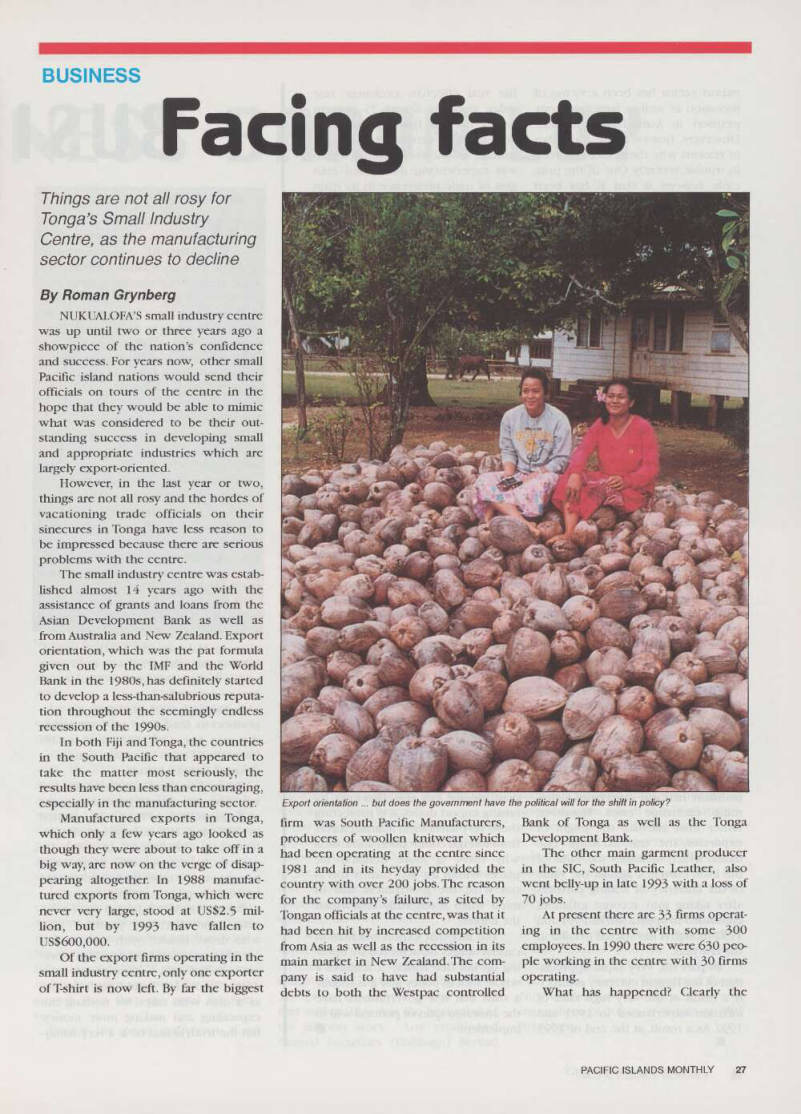
Export orientation ... but does the government have the political will for the shift in policy?
export sector has been a‘ victim of recession as well as increased com petition in Australasian markets.
Observers, however, cite a number of reasons why the centfe has been in trouble recently. One of the prin ciple reasons is that it has been unable to attract labour in large part because the squash industry has been so profitable that it has pushed up both demand and wages in the agricultural sector.
Another reason for the decline is that the five-year tax holidays that were initially granted to firms that operated in the SIC have now expired, and even with the very low rates of company tax in Tonga (15 percent), many of the firms have packed up and gone. In the case of garment manufacturers, the reason cited was that the firms involved in exports were unable to maintain products that were up-to-date in a very competitive market.
Some manufacturers cite exchange rates for the decline in manufactured exports. Up until 1991, the Tonga pa’anga was set on par to the Australia dollar and for years officials had told the Tongan government that it was unnecessari ly linking the Tongan economy to the fortunes of the Australian econo my. Especially with the rise of the value of the Australian dollar in the late 1980 s, this was seen as a disin centive to the exporting sector as a whole.
As a result, in early 1991 the government linked the currency to the value of a basket of currencies which included the value of the US, New Zealand and Australian dollars: this trade weighted basket is the way most Pacific island countries that maintain national currencies deter mine exchange rates. However, rather than alleviate the plight of exporters, the real exchange rate index, which measures the value of the local currency against the value of the currency of trading partners after taking into account inflation, continued to appreciate in 1991 and 1992 though it has started to fall if in the last year.
In part the very rapid apprecia tion of the Tongan currency is direct ly a result of the very high rates of inflation experienced in 1991 and 1992. As a result, at the end of 1993
the real effective exchange rate index stood at almost 25 percent higher than in 1988. Inflation has now fallen to virtually zero, but the damage is done. For a country which was experiencing diminished mar gins of trade preference in its main export markets to allow the curren cy to appreciate in the way that Tonga has done in the last few years meant it was bound to kill the man
ufacturing sector.
Oddly enough, this particular type of macroeconomic suicide is exactly what Fiji is practicing. Since 1988, Fiji has permitted its real effec tive exchange rate to appreciate by 15 percent while it is also losing its margin of preference in the Australian and New Zealand mar kets. Predictably the Fiji garment industry also appears to be in decline.
The response of people to what appears to others to be economic adversity is sometimes a bit hard to fathom. Some officials want to increase the amount of factory space in the SIC and there is talk of yet other centres. Why , one would ask, would anyone increase the amount of factory space when firms are shutting down? Firms producing for the local market, which in the past received the same tax incentives as exporters are staying open and expanding. The reason for the demand for a place in the centre is in part a result of the government’s tax policy.
The government of Tonga has increased import duties to raise gov ernment revenues. It does this because it is increasingly dependent upon trade taxes for its revenue as it does not want to raise its flat 10-per cent income tax rate. However, by raising import duties, it is protecting these very small local manufacturers from foreign competition and that is why there is more demand for places within the SIC. Clearly this is not what the government had in mind when it originally established the centre.
The fact that export orientation cannot simply be achieved by open ing up tax free zones; it requires a whole shift in policy and it is usually a shift that few governments have the attention span or political will to
implement. ■