Rebuilding Rabaul
pp. 22-23 · Read in the full issue
Volcano
By Wally Hiambohn
Papua New Guinea Prime Minister Sir Julius Chan inspected volcano devas tated Rabaul on more than one occasion, as did many of his government officials.A World Bank team and insurance compa ny representatives also made similar trips to the town. And they all agreed on one thirlg - to rebuild Rabaul would be a major exercise costing millions of kina.
At a time when the country’s curren cy has been devalued as a result of a deci sion to float it, and in light of the recent crises experienced in Papua New Guinea recently, this latest feat seemed almost insurmountable.
The volcano eruptions had spared lit-
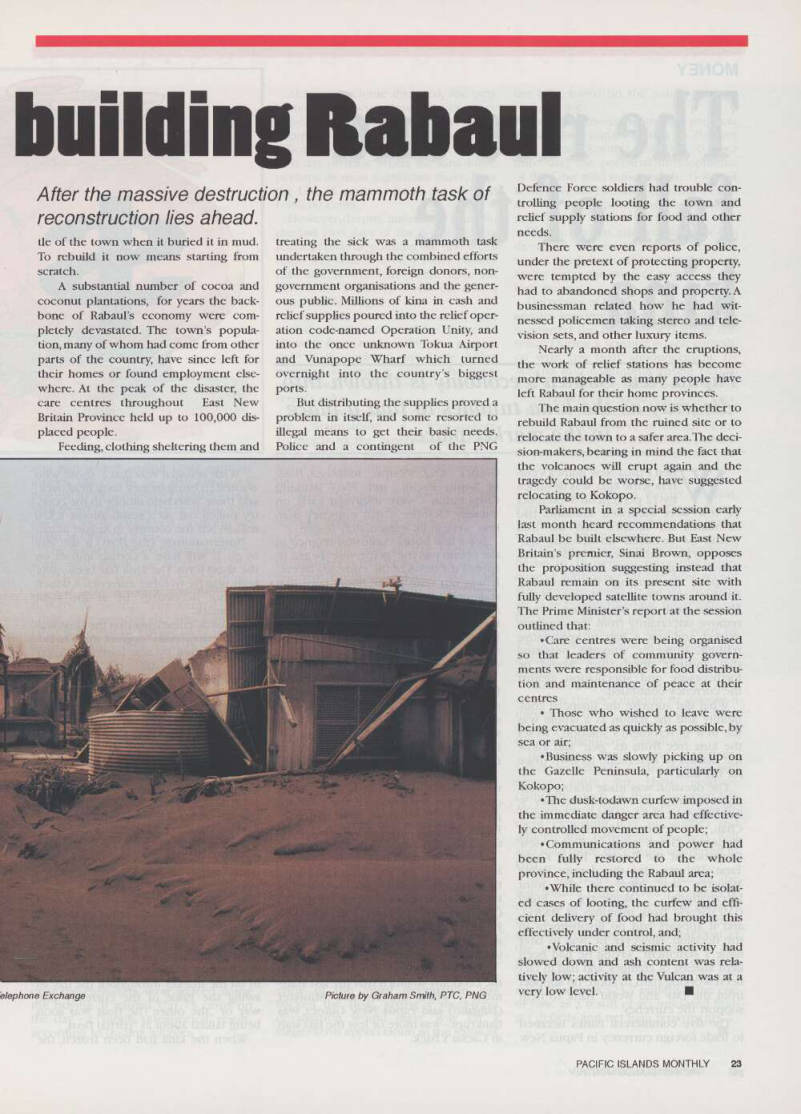
Telecommunications equipment destroyed at the Rabaul
After the massive destruction, the mammoth task of reconstruction lies ahead.
tie of the town when it buried it in mud.
To rebuild it now means starting from scratch.
A substantial number of cocoa and coconut plantations, for years the back bone of Rabaul’s economy were com pletely devastated. The town’s popula tion, many of whom had come from other parts of the country, have since left for their homes or found employment else where. At the peak of the disaster, the care centres throughout East New Britain Province held up to 100,000 dis
placed people.
Feeding, clothing sheltering them and
treating the sick was a mammoth task undertaken through the combined efforts of the government, foreign donors, non government organisations and the gener ous public. Millions of kina in cash and relief supplies poured into the relief oper ation code-named Operation Unity, and into the once unknown Tokua Airport and Vunapope Wharf which turned
overnight into the country’s biggest
ports.
But distributing the supplies proved a problem in itself, and some resorted to illegal means to get their basic needs.
Police and a contingent of the PNG
Defence Force soldiers had trouble con
trolling people looting the town and
relief supply stations for food and other needs.
There were even reports of police, under the pretext of protecting property, were tempted by the easy access they had to abandoned shops and property. A businessman related how he had wit nessed policemen taking stereo and tele vision sets, and other luxury items.
Nearly a month after the eruptions, the work of relief stations has become more manageable as many people have left Rabaul for their home provinces.
The main question now is whether to rebuild Rabaul from the ruined site or to relocate the town to a safer area. The deci sion-makers, bearing in mind the fact that the volcanoes will erupt again and the tragedy could be worse, have suggested
relocating to Kokopo.
Parliament in a special session early last month heard recommendations that Rabaul be built elsewhere. But East New Britain’s premier, Sinai Brown, opposes the proposition suggesting instead that Rabaul remain on its present site with fully developed satellite towns around it.
The Prime Minister’s report at the session outlined that: • Care centres were being organised so that leaders of community govern ments were responsible for food distribu tion and maintenance of peace at their centres • Those who wished to leave were being evacuated as quickly as possible, by sea or air; •Business was slowly picking up on the Gazelle Peninsula, particularly on
Kokopo;
•The dusk-todawn curfew imposed in the immediate danger area had effective ly controlled movement of people; •Communications and power had been fully restored to the whole province, including the Rabaul area; •While there continued to be isolat ed cases of looting, the curfew and effi cient delivery of food had brought this effectively under control, and; •Volcanic and seismic activity had slowed down and ash content was rela tively low; activity at the Vulcan was at a very low level. ■
Telephone Exchange
Picture by Graham Smith, PTC, PNG