'Incubating a time bomb’
pp. 19-21 · Read in the full issue

time bomb’
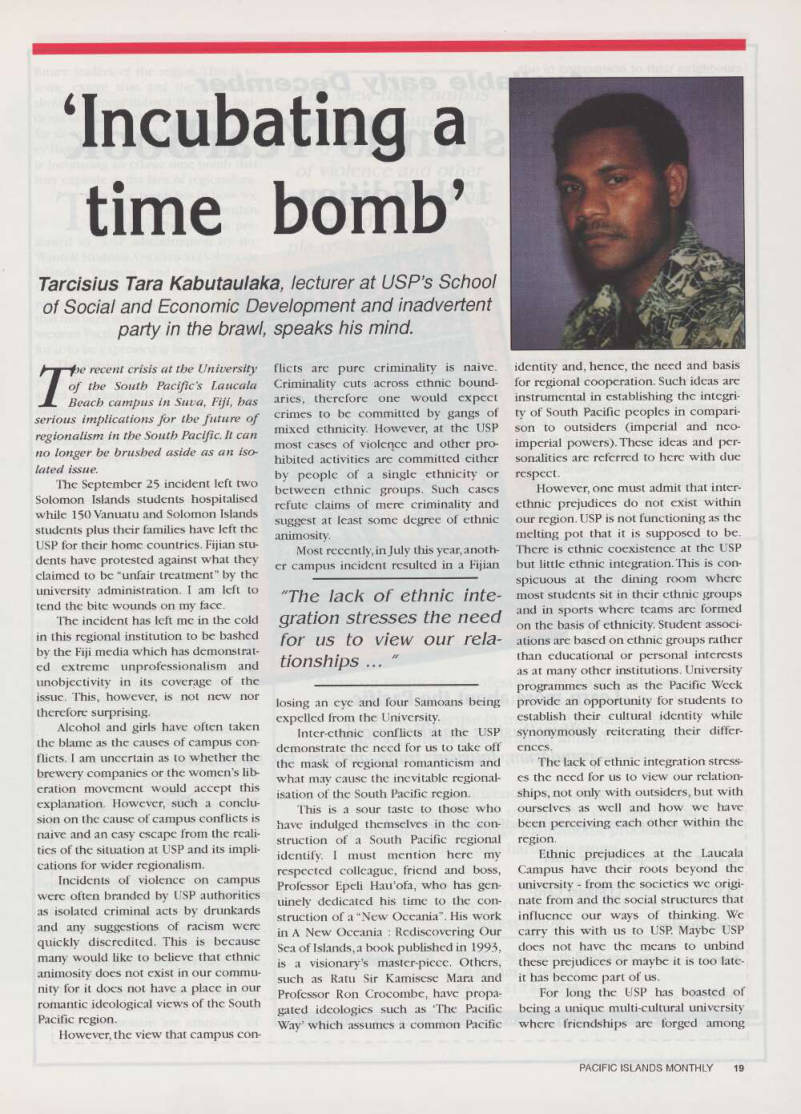
Tarcisius Tara Kabutaulaka, lecturer at USP’s School of Social and Economic Development and inadvertent party in the brawl, speaks his mind.
T'fye recent crisis at the University of the South Pacific’s Laucala Beach campus in Suva, Fiji, has
serious implications for the future of
regionalism in the South Pacific. It can no longer be brushed aside as an iso lated issue.
The September 23 incident left two Solomon Islands students hospitalised while 150 Vanuatu and Solomon Islands students plus their families have left the USP for their home countries. Fijian stu dents have protested against what they claimed to be “unfair treatment” by the university administration. I am left to tend the bite wounds on my face.
The incident has left me in the cold in this regional institution to be bashed by the Fiji media which has demonstrat ed extreme unprofessionalism and unobjectivity in its coverage of the issue. This, however, is not new nor therefore surprising.
Alcohol and girls have often taken the blame as the causes of campus con flicts. I am uncertain as to whether the brewery companies or the women’s lib eration movement would accept this explanation. However, such a conclu sion on the cause of campus conflicts is naive and an easy escape from the reali ties of the situation at USP and its impli cations for wider regionalism.
Incidents of violence on campus were often branded by USP authorities as isolated criminal acts by drunkards and any suggestions of racism were quickly discredited. This is because many would like to believe that ethnic animosity does not exist in our commu nity for it does not have a place in our romantic ideological views of the South Pacific region.
However, the view that campus con
flicts are pure criminality is naive.
Criminality cuts across ethnic bound aries, therefore one would expect crimes to be committed by gangs of mixed ethnicity. However, at the USP most cases of violence and other pro hibited activities are committed either by people of a single ethnicity or between ethnic groups. Such cases refute claims of mere criminality and suggest at least some degree of ethnic animosity.
Most recently, in July this year, anoth er campus incident resulted in a Fijian
"The lack of ethnic inte gration stresses the need for us to view our rela tionships ... "
losing an eye and four Samoans being expelled from the University.
Inter-ethnic conflicts at the USP demonstrate the need for us to take off the mask of regional romanticism and what may cause the inevitable regional isation of the South Pacific region.
This is a sour taste to those who have indulged themselves in the con struction of a South Pacific regional identify. I must mention here my respected colleague, friend and boss, Professor Epeli Hau’ofa, who has gen uinely dedicated his time to the con struction of a “New Oceania”. His work in A New Oceania : Rediscovering Our Sea of Islands, a book published in 1993, is a visionary’s master-piece. Others, such as Ratu Sir Kamisese Mara and Professor Ron Crocombe, have propa gated ideologies such as ‘The Pacific Way’ which assumes a common Pacific
identity and, hence, the need and basis for regional cooperation. Such ideas are instrumental in establishing the integri ty of South Pacific peoples in compari son to outsiders (imperial and neo imperial powers). These ideas and per sonalities are referred to here with due respect.
However, one must admit that inter ethnic prejudices do not exist within our region. USP is not functioning as the melting pot that it is supposed to be.
There is ethnic coexistence at the USP but little ethnic integration. This is con spicuous at the dining room where most students sit in their ethnic groups and in sports where teams are formed on the basis of ethnicity. Student associ ations are based on ethnic groups rather than educational or personal interests as at many other institutions. University programmes such as the Pacific Week provide an opportunity' for students to establish their cultural identity while synonymously reiterating their differ ences.
The lack of ethnic integration stress es the need for us to view our relation ships, not only with outsiders, but with ourselves as well and how we have been perceiving each other within the region.
Ethnic prejudices at the Laucala Campus have their roots beyond the university - from the societies we origi nate from and the social structures that influence our ways of thinking. We carry this with us to USP. Maybe USP does not have the means to unbind these prejudices or maybe it is too late it has become part of us.
For long the USP has boasted of being a unique multi-cultural university where friendships are forged among
future leaders of the region. This is to some extent true and the university should be congratulated. However, inci dents of ethnic violence signal the need for us to look beyond the congratulato ry flags and see whether the institution is incubating an ethnic time bomb that may explode in the face of regionalism.
This time bomb lies in how we perceive each other within the region. The petition pre sented to USP administration by the Wantok Students Association (Solomons Islands, Vanuatu and Papua New Guinea) reflects the nature of our regional relationship. It is something that has been felt amongst the people of western Pacific for a long time. The time for it to be expressed is long overdue.
The Wantok students stated that for years they felt they have been margin alised and made to feel inferior by their neighbours from eastern Pacific. This sense of inferiority is not new. It has developed as a result of interactions at the USP campus and throughout the region.
Many people come to USP with a preconceived conception of their status in the regional community. The meaa suring yardstick often used is civilisa tion (westernisation) and race - assum ing one race is superior to another.
This is the pattern of thought that has its roots in mordernisation theory and the lineal perception of social evolu tion. Hence, a society regarded as behind in the line of social evolution is therefore inferior. It is a thought pattern entertained and perpetuated in many of our societies through the teaching of churches, school curricula and other means of social interactions.
These thought patterns are reflect ed in the relationship between students at USP which in turn depicts in a fun damental way the politics of the wider region.
The ongoing regionalisation of the region - what others have referred to as the development of sub regionalism - is a demonstration of the enormity of the problem underlying the crisis at USP’s Laucala Campus. One may wonder why “subregional” groups such as the
Melanesian Spearhead Group (MSG)
have developed. Why not one South Pacific regional organisation? Why advo cate a Melanesian Way as separate from a Pacific Way?
There are several reasons. Race and geographical location have often been stressed. Melanesians are ethnically of
"The view that campus conflicts are pure crimi nality is naive, ... cases of violence and other prohibited activities are committed either by peo ple of a single ethnicity or between ethnic groups."
darker complexion than those of the eastern and northern Pacific. However, there is more to it than this. Those of the western Pacific have, for a long time, been viewed as inferior by their neigh bours in eastern Pacific.As a result, they have often felt unfairly treated in the South Pacific community. In my reply to Professor Hau’ofa’s New Oceania arti cle I stated that in Melanesia “many peo ple have been led to believe that they are inferior, not only in the internation al community of the “white man”, but
also in comparison to their neighbours in the eastern Pacific”.
Confronted with these attitudes Melanesians have been forced to reassert their own group identity. This has led to the development of “sub regional” organisations such as the Wantok Students Association and the Melanesian Spearhead Group, as well as ideologies such as the Melanesian Way which defines Melanesia as different from the rest of the South Pacific. Such regionalism is a consequence of the nature of our relationship within the region and of how we perceive each other.
There is therefore a need to reassess our relationships and our perceptions of each other. In a way, the conflicts between our students at USP is posi tive. It awakens us to the need to reeval uate our relationships. If we truly hope to create a “New Oceania”, we must cre ate a “community of equals” in fact as well as in rhetoric. Attitudes of ethnic prejudice and superiority within the region must be both recognised and changed. If not, the regionalisation of the region will continue unabated as Melanesia forges its own path. ■