Conflict
pp. 15-17 · Read in the full issue

Focus
ON
Campos
By Yunus Rashid
University of the South Pacific, arguably home to the Pacific’s academic and intellectual cream , and a place where the region’s future leaders are nurtured and groomed, has been plagued with a disease which threatens its very existence. The disease is racism. The tragedy of the situation is that the dis ease is prevalent in an institution one would normally expect to be charged with ridding the society at large of such a malaise. Many of the students will play key roles in regional poli tics which presumably would push for greater regional solidarity.
Will it be a place for moulding leaders who can work amicably with neighbouring counterparts to resolve the region’s problems or will the graduates leave the institution with racial prejudices against others in the region?
Recent on-campus incidents have put the whole concept of a regional university to the test and have seen the eruption of what appears to be long-simmering ten sion.
It was about 3am on September 25 when the early morning atmos phere of the University of the South Pacific exploded into ugly student violence. Fijian and Solomon Island students were involved in a night marish brawl in which a (Solomon Island) lecturer was beaten and bit ten, and two Solomon Island students hospitalised with serious injuries,
including broken bones.
The lecturer, Tarcisius Tara Kabutaulaka, recounted his version to PIM : He had just returned to campus with a group of Want ok students in a bus when a Fijian student swung a punch into the bus and hit a Solomon student. Tara quickly stepped in, hop ing to avert any further attack, and got the boys to shake hands and make up.
He thought the matter had been taken care of. But he was wrong.
Not much later, Tara saw a group of Fijian students giving chase to screaming Solomon students. Tara went to stop the fight and asked the boys to report to the security officers.
Before anything could be reported ,
however, and in the presence of the security guards, there was yet another onslaught of punches and kicks. This time round Tara got punched, kicked and bitten along with the students.
Police was called to end the brawl. Tara and the injured boys were taken to hospital.
When the new day broke, all hell broke loose.
A major row erupted, involving the students, their governments and the university administration. What emerged as a result was a disturbing picture that, despite statements made to the contrary throughout the years, a nasty form of racism was rife on campus.
After 26 years of being, USP had failed to address and resolve the deep rooted fears and suspicions island stu dents had of each other.
Unfortunately, these fears were based
along national and racial lines.
It also became apparent that Vanuatu students felt they had been victims at the university, as well, recounting in a petition to their gov ernment, instances of harassment.
“Hatred and misunderstanding between different groups existed since the birth of this university but the administration usually plays it down,” said the Vanuatu students’ petition. They believed their lives were at “constant risk” and perceived they were being treated as “second class human beings”. “... most East Pacific students and staff of the uni versity see those of us from the Western Pacific (particularly Solomon Islands and Vanuatu) as inferior.”
Solomon and Vanuatu students demanded their governments agree to have them return home until the ten sion had diffused and they felt safer.
Their governments and sponsors obliged. It appeared nobody was will ing to guarantee that a similar inci dent would not be repeated.
After all, it was only about four months ago that another vicious attack at USP had left students seri
ously injured and in hospital. One
Fijian student had lost an eye after it was gouged out with a broken beer bottle. There were criminal charges laid against the Samoan perpetrators and convictions made.
But what startled the university community was the extent of vio lence resorted to in settling scores.
This has left a disquieting effect on campus.
Following the September inci dent, USP’s Vice-Chancellor Esekia Solofa, after listening to witnesses, suspended five Fijian students alleged ly involved in the brawl. The Fijian Students Association asked him to reconsider and allow them to contin ue their studies, especially since it was so close to examinations. Solofa agreed. But the USP Senate did not.
They decided on complete suspen sion until the university’s disciplinary committee had concluded its hearing.
Solofa abided by the Senate ruling, although he had powers to overturn their decision.
The Fijian Students Association boycotted lectures as a result, saying the students had been unfairly treat ed. Solomon and Vanuatu students left - the Solomon students on a especially chartered flight - after the university agreed to have them sit their exams in their home countries.
Solofa admitted there were per ceptions that racial problems existed on campus. “It is possible that these perceptions are valid. We have to try and dispel them. That can come about by actually providing for activities and actions which can dispel percep tions.”
He said fights which normally started from arguments over girls ended in racial conflicts.
“There is no danger until there is a spark from a fight between two stu dents which quickly becomes a fight between two groups.”
However, Tara, did not mince his words when it came to describing the situation at the university . “Racism exists here. It is unfortunate, but it is true”.
Tara, a Solomon Islander, added that the “Wantok” students, who are gener ally darker-skinned, were looked down upon by their counterparts from Fiji, Tonga, Western Samoa and some other countries. The root of the problem lay in the fact that students came to campus with varying degrees of prejudices of their fellow students from neighbouring countries.
Tara believes it is important for Wantok students to shed their inferi ority complex and mingle with oth ers to build a more harmonious envi ronment.
Solofa, on the other hand, has expressed concern that if the problem is not resolved, member countries would consider withdrawing financial support from what is supposed to be
a regional school.
Tara further claims that many crimes committed along racial lines have gone unreported and the two recent major fights have been a culmination of this tension.
In the meantime, the USP administra tion has increased security numbers from six to 13 for the 3000-odd stu dents and has asked police to include USP in its patrol list.
But these temporary measures cannot cure the racial problems. Students and lecturers agree that there is not much cross-cultural assimilation. Racism is further encouraged by the very struc ture of student associations. For exam ple: the University of the South Pacific Students Association has a Fiji Students Association which then has sub-groups along further racial lines - Fijian Students Association, Indian Students Association, Chinese Students Association and the Rotuman Students Association.
“Go anywhere in the university, except perhaps in the classes, and you will find students grouping along cultural lines. For any lasting solution to this university’s problems, students need to break away from racial groups and mingle with other students,” one senior lecturer said.
Solofa agreed with this principle. He said for many years now the universi ty had been trying to get students to form hobby groups, professional groups and other associations which would help break down racial barri ers. While some students have taken
the initiative to do this, many remain cold to this idea. A read of the USP’s regulation book shows there are no clear-cut rules against racism.
Solomon Island’s government infor mation director, Johnson Honimae, says the immediate withdrawal of more than 100 of their students was a temporary measure to help diffuse the tension at USR He said the USP administration had made arrange ments for the returning students to sit
exams by correspondence. Honimae
said the experience had not left a bit ter note between Fiji and Solomons, but he, all the same, called for an immediate review of the security sys tem at USR A former student and now Fiji Prime Minister’s press secretary, Jone Dakuvula, said such conflicts were not new. In the ‘7os, as a senior stu dent , he was called in to diffuse a sit uation where Fijian and Western Samoan students had had a major con frontation.
He said in the ‘7os there was a smaller number of students and it was easier to talk to them, unlike today , when the number of students exceeds the 3000-mark and it is easier to group along national lines.
What needs to be emphasised is that students, irrespective of their back grounds, who criticised the assaults and the resulting fight are a ray of hope for the university. It is through these students that the ideals upon which the university was built can still be realised.
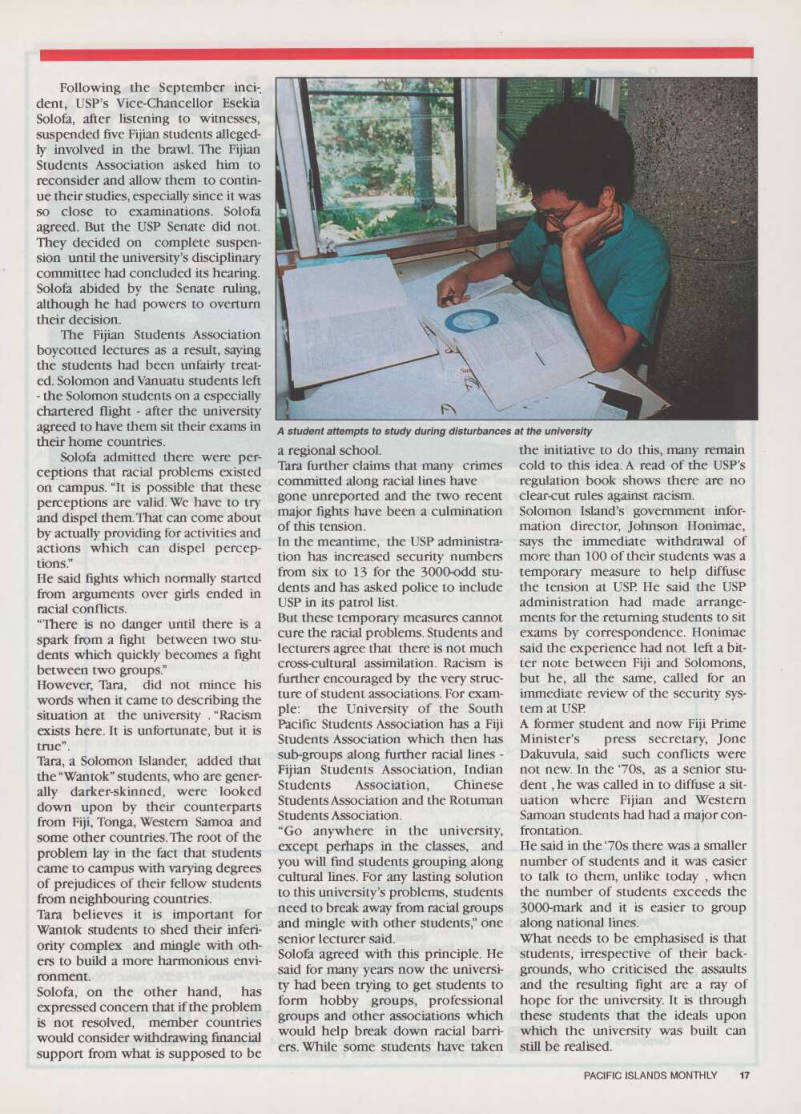
A student attempts to study during disturbances at the university