Sorry saga of the Reef Endeavour
pp. 22-23 · Read in the full issue
By Asha Lakhan
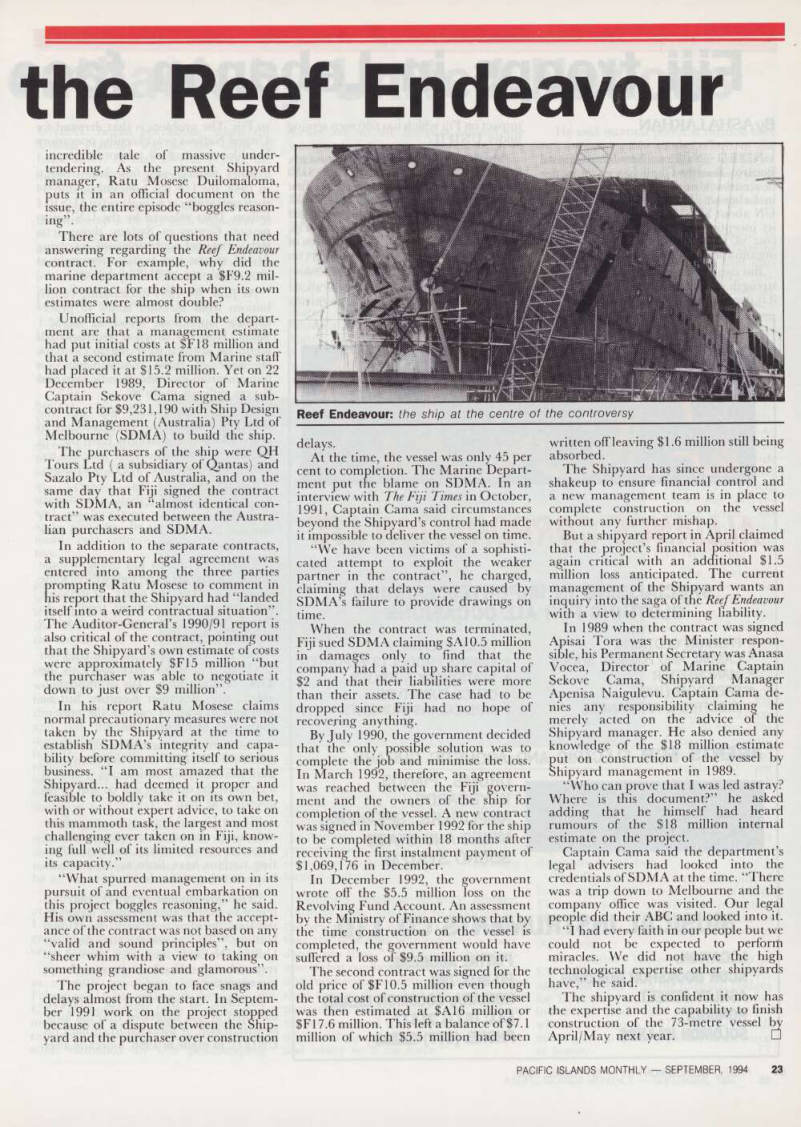
SEVEN years ago Fiji made an am bitious bid to carve a name for itself in the region as a reputable shipbuilder but the sorry saga of the Reef Endeavour is bound to have done more to tarnish its image than enhance it.
The vessel is a 73-metre luxury cruise ship commissioned by Australian com panies for operation in the Great Barrier
Reef, Queensland.
Negotiations on the construction of the vessel began as early as 1988, a contract was signed in December, 1989 but five years later the vessel is still at the Government slipway in Walu Bay, still under construction and the delivery date
keeps getting extended.
Today the Reef Endeavour has become a shipyard scandal that has already cost the Fiji taxpayer $5 million, written off
in losses last year. An official government report estimates that by the time the vessel is constructed, Fiji would have lost close to $lO million on it. That was two years ago. It is likely to be at least a couple of millions more if delivery does take place April, 1995 as now scheduled.
Under a new contract signed at the end of 1992, Fiji was to have made delivery of the vessel a month ago in August. Earlier this year the delivery time was revised to December. It is now given as April/May next year.
Under the 1992 contract, after a grace period of 90 days, Fiji is liable to a $5OOO penalty a day for late delivery. It faces
an additional fine of $300,000 if delivery is not made within five months of the
delivery date.
The $5OOO a day penalty becomes effective from November. After January, Fiji would be liable to the additional $300,000 penalty... a total ofsl million in penalties alone if the vessel keeps to the revised delivery date.
In April this year, the financial position on the ship was again reported critical with the shipyard estimating another $1.5 million in losses. 11 is hardly surprising that The Reef Endeavour has become synonymous in Fiji with official bungling on a mammoth scale. It is an
incredible tale of massive under tendering. As the present Shipyard manager, Ratu Mosese Duilomaloma, puts it in an official document on the issue, the entire episode “boggles reason
ing”.
There are lots of questions that need
answering regarding the Reef Endeavour
contract. For example, why did the marine department accept a $F9.2 mil lion contract for the ship when its own estimates were almost double?
Unofficial reports from the depart ment are that a management estimate had put initial costs at SFIB million and that a second estimate from Marine staff had placed it at $15.2 million. Yet on 22 December 1989, Director of Marine Captain Sekove Cama signed a sub contract for $9,231,190 with Ship Design
and Management (Australia) Pty Ltd of
Melbourne (SDMA) to build the ship.
The purchasers of the ship were QH Tours Ltd ( a subsidiary of Qantas) and Sazalo Pty Ltd of Australia, and on the same day that Fiji signed the contract with SDMA, an “almost identical con tract” was executed between the Austra lian purchasers and SDMA.
In addition to the separate contracts, a supplementary legal agreement was entered into among the three parties prompting Ratu Mosese to comment in his report that the Shipyard had “landed itself into a weird contractual situation”.
The Auditor-General’s 1990/91 report is also critical of the contract, pointing out that the Shipyard’s own estimate of costs were approximately SFIS million “but the purchaser was able to negotiate it down to just over $9 million”.
In his report Ratu Mosese claims normal precautionary measures were not taken by the Shipyard at the time to establish SDMA’s integrity and capa bility before committing itself to serious business. “I am most amazed that the Shipyard... had deemed it proper and feasible to boldly take it on its own bet, with or without expert advice, to take on this mammoth task, the largest and most challenging ever taken on in Fiji, know ing full well of its limited resources and
its capacity.”
“What spurred management on in its pursuit of and eventual embarkation on
this project boggles reasoning,” he said.
His own assessment was that the accept ance of the contract was not based on any “valid and sound principles”, but on “sheer whim with a view to taking on
something grandiose and glamorous”.
The project began to face snags and delays almost from the start. In Septem ber 1991 work on the project stopped because of a dispute between the Ship yard and the purchaser over construction
delays.
At the time, the vessel was only 45 per cent to completion. The Marine Department put the blame on SDMA. In an interview with The Fiji Times in October, 1991, Captain Cama said circumstances beyond the Shipyard’s control had made it impossible to deliver the vessel on time.
“We have been victims of a sophisticated attempt to exploit the weaker partner in the contract”, he charged,
claiming that delays were caused by
SDMA’s failure to provide drawings on time.
When the contract was terminated, Fiji sued SDMA claiming $A10.5 million in damages only to find that the company had a paid up share capital of $2 and that their liabilities were more than their assets. The case had to be dropped since Fiji had no hope of
recovering anything.
By July 1990, the government decided that the only possible solution was to complete the job and minimise the loss.
In March 1992, therefore, an agreement was reached between the Fiji government and the owners of the snip for completion of the vessel. A new contract was signed in November 1992 for the ship to be completed within 18 months after receiving the first instalment payment of $1,069,176 in December.
In December 1992, the government wrote oil the $5.5 million loss on the Revolving Fund Account. An assessment by the Ministry of Finance shows that by the time construction on the vessel is completed, the government would have suffered a loss of $9.5 million on it.
The second contract was signed for the old price of $F10.5 million even though the total cost of construction of the vessel was then estimated at SAI6 million or $F17.6 million. This left a balance of $7.1 million of which $5.5 million had been
written off leaving $1.6 million still being absorbed, The Shipyard has since undergone a shakeup to ensure financial control and a new management team is in place to complete construction on the vessel without any further mishap, But a shipyard report in April claimed that the project’s financial position was again critical with an additional $1.5 million loss anticipated. The current management of the Shipyard wants an inquiry into the saga of the Reef Endeavour with a view to determining liability.
In 1989 when the contract was signed Apisai Tora was the Minister respon sible, his Permanent Secretary was Anasa Vocea, Director of Marine Captain
Sekove Cama, Shipyard Manager
Apenisa Naigulevu. Captain Cama de
nies any responsibility claiming he merely acted on the advice of the Shipyard manager. He also denied any knowledge of the $lB million estimate put on construction of the vessel by Shipyard management in 1989.
“Who can prove that I was led astray?
Where is this document? he asked adding that he himself had heard rumours of the $lB million internal estimate on the project, Captain Cama said the department’s legal advisers had looked into the credentials of SDMA at the time. “There was a trip down to Melbourne and the company office was visited. Our legal people did their ABC and looked into it.
“I had every faith in our people but we could not be expected to perform miracles. We did not have the high
technological expertise other shipyards
have,” he said.
The shipyard is confident it now has the expertise and the capability to finish construction of the 73-metre vessel by April/May next year. □
Reef Endeavour: the ship at the centre of the controversy