Fiji troops in Lebanon face
pp. 24-25 · Read in the full issue
Peacekeeping
By Ashalakhan
UNITED Nations Secretary-General Boutros Boutros-Ghali has given notice of a cutback in peacekeeping operations in Lebanon. The mission is costing the UN about SUSI3B million a year. Since its inception in March, 1978 the total cost of the peacekeeping force to the organisation has been over $2 billion.
But can Boutros-Ghali cut back on the strength of the mission in Lebanon? And if it does decide to do so what will be the
impact on Fiji which has 650 men serving under UNIFIL?
According to Fiji Government sources, the country has earned about SISO million from the UNIFIL since its first contingent took up duties in May, 1978.
The United Nations has always lagged behind in its reimbursements to Fiji, which meant that much of the burden of the humanitarian mission has fallen on the shoulders of the Fiji government.
Today the UN is believed to be about Sl2-Sl4 million in arrears in its payments
to Fiji. The problem is that demand for
United Nations peacekeeping operations
has blown out of all proportion.
Since peacekeeping operations began
in 1948, the UN has been engaged in 34 such operations at a total cost of$USlO.4 billion. Data released by the UN Infor mation Centre in Sydney shows it is
today engaged in 17 missions involving
71,543 troops and civilian personnel at an annual cost of SUS3.B billion.
At June 30, 1994 outstanding contri butions from member states to peace keeping operations stood at SUS2.I billion. However, much as Boutros-Ghali might be justified in trying to cut back -on some of these commitments, on humanitarian grounds alone he may find it very difficult to do so.
At least that’s how Fiji sees the situation. Despite the breakthrough in peace efforts in the Middle East, the Fiji Military Forces believes it may be too soon to cut back on UNIFIL operations.
Says Fiji Military Forces chief of staff
Brigadier George Konrote “The
situation out there is quite volatile. It remains unpredictable ... likely to flare up without warning.”
The peace process has brought some stability to the area and today there some semblance of law and order. At the same time, the warring factions tend to do their own thing. “It’s a question of who’s
controlling whom.”
On the UN’s plans to cut back on UNIFIL, Fiji is still very much in the dark. “I don’t know. It’s so unpredict able..., says Brigadier Konrote. But he ventured to add: “I can see the present status quo being maintained.”
Lesi Korovavala, a former senior plans officer for UNIFIL who is in Fiji on leave from peacekeeping duties, says if there is a cutback the decision will be sent to his government first.
“If the United Nations has to enforce reductions based on operational or financial considerations, then contribu ting nations have little say apart from implementing these decisions.
“The government or FMF may at tempt to protest that decision; however, the final decision rests with the United Nations.” This is not the first time the United Nations has been forced to reconsider or cutback on its peacekeep
ing operations.
In 1986, as the costs of UNIFIL mounted, it was suggested that the force be withdrawn. A proposal to cutback on UNIFIL as made in 1988, a decade after
UNIFIL began operations, when the United Nations was on the brink of
bankruptcy. In that 10-year period, the
mission had cost the United Nations about 1.5 billion.
About that time the United Nations had directed a 10 per cent reduction in all contingents in line with a 10 per cent cutback in the UNIFIL budget. The Fiji contingent, which had risen from the initial 500 troops to 750 in the mid-1980s just after the second Israeli invasion of Lebanon, was reduced to 650.
Major Lesi said the United Nations last year directed a 10 per cent budget cut on UNIFIL. “Naturally it should be
expected that a corresponding strength
reduction should follow.”
“After the budget cut last year, the United Nations had di rected all missions to study its own
organisations with
a view to
streamlining itself
and its functions and also to be more cost effec tive.”
Supposing a 10 per cent reduction
was implemented,
it would not affect the basic setup of
the contingents.
“I could foresee that any reduction would be in the form of reducing the rifle sub-units and not the ad ministration and
logistics support
elements at its
headquarters as
long as Fiji is required to contribute a battalion to UNIFIL,” he said.
“Given the worst scenario, the head quarters support elements will carry out its secondary roles of basic infantry duties to support the rifle companies. This will be an internal command responsibility.”
The 10 per cent budget cut announced at United Nations headquarters forced UNIFIL to re-assess its operations re garding armed elements and to maximise on its existing resources, Major Lesi said.
Changes in operation brought about
as a result have been in force since February. It has changed the focus of UNIFIL operations from a static to a mobile force with a major emphasis on extensive patrolling. Meanwhile, even while demands for UN peacekeeping
duties are on the increase around the world, pressures are mounting on it to contain costs and cutback on operations.
One of the UN’s most vocal critics in this area is its major donor, the United States. The United States pays 30.1 per Cent ° f ’ the UN Peacekeeping budget and b the end of this month will be billion j n arrears . . .
United States intends to reduce its peacekeeping commitment to 25 per cent by January 1996 and believes that other newly-nch countries should pay their fair s D har ?. A "f" P °‘ Cy from President Bill Clinton governing United States participation m multilateral
peacekeeping operations aims to impose
more discipline in the area of peaeekeep-
ing.
The Clinton directive issued three months ago spells out new conditions for United States engagement in peaeekeep missions and aimed at ensuring that peacekeeping will be “a more effective collective security tool for American
foreign policy”.
Clinton’s national security adviser,
. , T 1 .. 7 ’
Anthony Lake, speaking to reporters on the new policy m early May pointed out that the post-cold war era was a more dangerous time “Its defining character istic is that conflicts m this era take place now more within societies, within nations than among them. And this makes it a particularly difficult time ... for us all in the international community to come to grips with questions of when and how and where we’ll use force.”
He said internal political turmoil may not be susceptible to the efforts of the international community. “So neither we nor the international community have either the mandate, nor the resources, nor the possibility of resolving every conflict of this kind.
Lake reiterated US commitment to strengthening United Nations peacekeeping capabilities, but said mis sions must now carry “sunset pro visions”. “Before we go in or before we sign up for an extension, that we know when it will end or how we will know that it has ended” that is, the United States is demanding definite limits to the duration and conditions of peacekeeping.
Fiji for its part has a contingency plan
for the day when its forces has to pull out of Leb anon and Sinai. At Sinai, Fiji has 300 men serving with the Multinational Observer Force, which has been re duced from 500 men when the op eration first began in April 1982.
The Lebanon venture began in May, 1978 soon after the first Israeli invasion with a contingent of 500 men.
At the time, the total strength of
the Royal Fiji
Military Forces
was 770 men. The Lebanon contin
gent comprised
roughly 70 per cent territorials
and 30 per cent career soldiers, The Fiji force swelled to 750 men after the second invasion in the mid-‘Bos and then came down to 650 men a number regarded as insufficient to cope with the demands of the task, The Fiji Military Force has come a
Idwi
from a tiny force of // 0 men, it swelled a ft er the coups to 7000 men but has in the past couple of years gone down to 5000 men The mi |;, bud , has to $3O mdbon f rom $l5 million in 1986, a j most on a par with the national budget f or Education and Health. There is no indication from the military as yet whether a cutback in UNIFIL forces will mean a cut in the overall size of the force at home. □
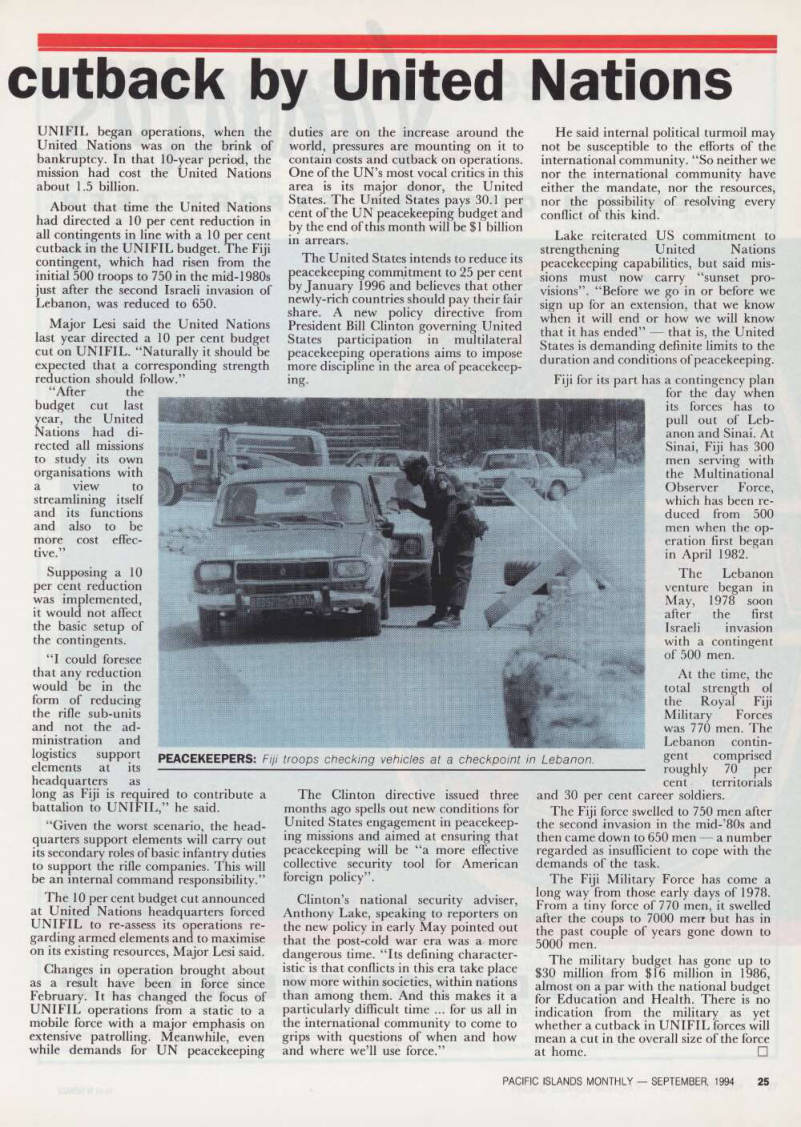
PEACEKEEPERS: Fiji troops checking vehicles at a checkpoint in Lebanon.