Business
pp. 21-22 · Read in the full issue
Pacific
Western Samoa: could the economy get worse?
By Roman Grynberg
IF you had not been in Western Samoa for the past year or two and went straight into Apia and stood in front of the Clock Tower on Beach Road you would think that the economy had gone through a major transformation. The shabby run down beach front that had long been a source of unfortunate comparison for many American Samoans has been
changed almost irrevocably.
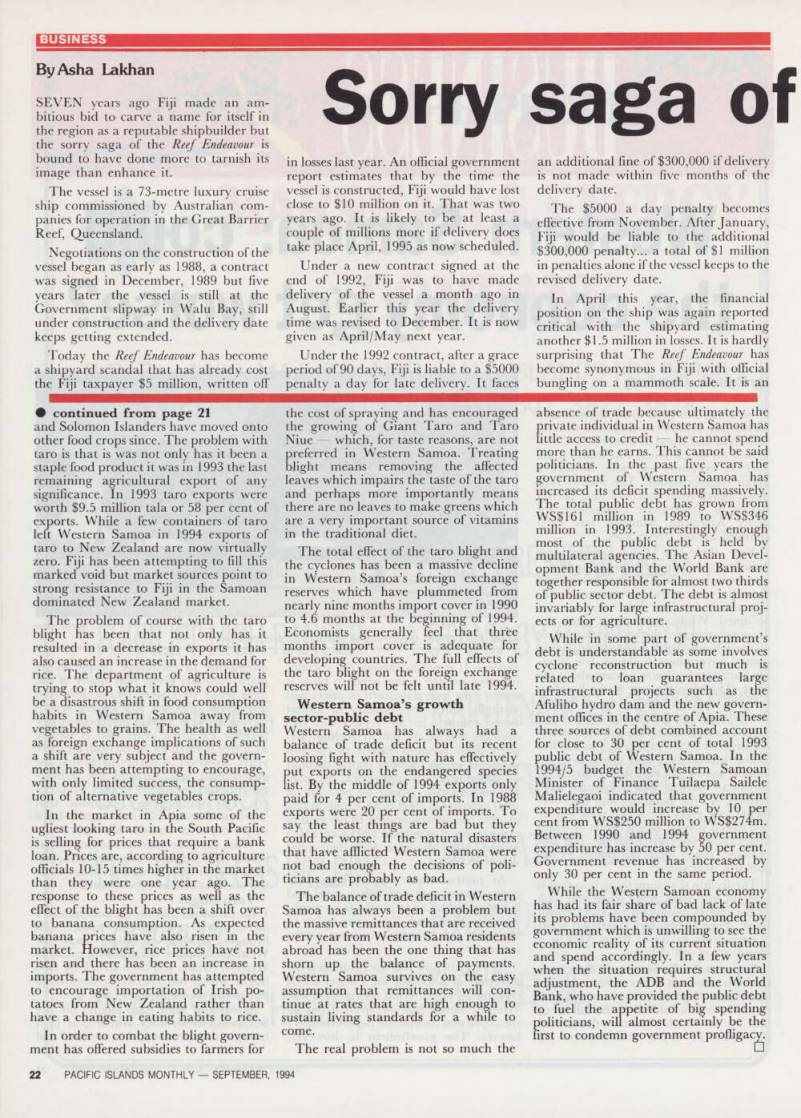
Now there are two shinning new
buildings standing on the water’s edge
one them the Central Bank of Samoa and the other the central government build ing which by late July was not yet occupied. While some argue about the appropriateness of the architectural style of the Chinese built eight-storey, onion domed government building, few West ern Samoans few know or care about the price. The ultimate cost of the building is WSS3S million which is owed, interest free to the government of China.
As you walk along the sea wall, newly constructed by the Japanese, you and feel almost instinctively that this is Western Samoa saying to its richer cousins in American Samoa that they too have arrived. All the buildings and improve ments look good but if you walk one or two streets behind Beach Street or Main Street and you see that life has not changed much and for many it has gotten a deal worse.
The feeling that something is unreal is brought into stark relief when you look at the figures published by the Central Bank. Then it becomes clear that what is happening in down town Apia is a grand act of self delusion.
Exports-An Endangered Species
God has not dealt Western Samoa a fair hand lately. Three years ago it was struck by cyclone Ofa and then the following year by Val which absolutely devastated the country’s copra and coconut oil
exports. It is not as though the coconut industry needed a big wind to blow it over the long downturn in prices had virtually killed the industry in almost every country in the region but two
cyclones absolutely sent it reeling. Ex-
ports from Western Samoa of coconut products which includes copra, coconut oil coconut cream copra meal fell from SI9 million tala (about 60 per cent of total exports) in 1988 to 53.4 million tala in 1993 (or approximately 18 per cent of exports. Total exports in 1993 were $16.5 million tala, almost a half their total value in 1989. .
At present there are no exports of copra coconut oil and copra meal and
coconuts are being imported from neigh-
bourmg Niue and Tonga m order to maintain the country s coconut cream industry.
As a sign of how bad the problem is the government is looking for a buyer for its coconut oil plant. What is evident is that Western Samoa has effectively given up the copra and coconut oil export industry forever. The government is, however,
attempting to encourage people to re plant coconuts given that many of the most senile trees were totally destroyed during the cyclones. The government is paying growers $2 tala per coconut tree planted for three years and is paying SI .5/tree planted for cocoa bush for three years. However, it is very likely that the government will suspend the subsidy programme because of abuses by farm ers. Few farmers are optimistic that Western Samoa will ever again be a major copra or coconut oil exporter, W h at the government is hoping is that it will have enough coconut production to satisfy domestic consumption as well as the coconut cream export nee ds.
Taro Bli ht If theproblems that the coconut industry faced P were nQt en h nature has brought anothcr visitation upon the Western Samoans. On top of the cyclones Western Samoa has been struck by taro blight which has effectively devastated the country’s staple food crop.
When the same taro blight hit the Solomon Islands after World War II it brought taro production to a virtual end
Arvind Kumar
Apia: the central government building in the capital
• continued from page 21 and Solomon Islanders have moved onto other food crops since. The problem with taro is that is was not only has it been a staple food product it was in 1993 the last remaining agricultural export of any significance. In 1993 taro exports were worth 59.5 million tala or 58 per cent of exports. While a few containers of taro left Western Samoa in 1994 exports of taro to New Zealand are now virtually zero. Fiji has been attempting to fill this marked void but market sources point to strong resistance to Fiji in the Samoan dominated New Zealand market.
The problem of course with the taro blight has been that not only has it resulted in a decrease in exports it has also caused an increase in the demand for rice. The department of agriculture is trying to stop what it knows could well be a disastrous shift in food consumption habits in Western Samoa away from vegetables to grains. The health as well
as foreign exchange implications of such
a shift are very subject and the govern ment has been attempting to encourage, with only limited success, the consump tion of alternative vegetables crops.
In the market in Apia some of the ugliest looking taro in the South Pacific is selling for prices that require a bank loan. Prices are, according to agriculture officials 10-15 times higher in the market than they were one year ago. The response to these prices as well as the effect of the blight has been a shift over to banana consumption. As expected banana prices have also risen in the market. However, rice prices have not risen and there has been an increase in imports. The government has attempted to encourage importation of Irish po tatoes from New Zealand rather than have a change in eating habits to rice.
In order to combat the blight govern ment has offered subsidies to farmers for
the cost of spraying and has encouraged the growing of Giant Taro and Taro Niue which, for taste reasons, are not preferred in Western Samoa. Treating blight means removing the affected leaves which impairs the taste of the taro and perhaps more importantly means there are no leaves to make greens which are a very important source of vitamins in the traditional diet.
The total effect of the taro blight and the cyclones has been a massive decline m Western Samoa’s foreign exchange reserves which have plummeted from nearly nine months import cover m 1990 to 4.6 months at the beginning of 1994.
Economists generally feel that three months import cover is adequate for developing countries. Ihe full effects of the taro blight on the foreign exchange reserves will not be felt until late 1994.
Western Samoa’s growth
sector-public debt
Western Samoa has always had a balance of trade deficit but its recent
loosing fight with nature has effectively
pu t exports on the endangered species h s t. By the middle of 1994 exports only pa id for 4 per cent of imports. In 1988 exports were 20 per cent of imports. To sa Y the least thin g s are bad but the Y could be worse. If the natural disasters that have afflicted Western Samoa were enough the decisions of noli not bad enough the decisions ol poll "aans are probably as bad.
The balance of trade deficit in Western Samoa has always been a problem but the massive remittances that are received every year from Western Samoa residents abroad has been the one thing that has u r * shorn up the balance of payments.
Western Samoa survives on the easy assumption that remittances will con tmue at rates that are high enough to sustain living standards for a while to
come ‘
The real problem is not so much the
absence of trade because ultimately the private individual in Western Samoa has little access to credit he cannot spend more than he earns. This cannot be said politicians. In the past five years the government of Western Samoa has increased its deficit spending massively.
The total public debt has grown from WSSI6I million in 1989 to WS$346 million in 1993. Interestingly enough most of the public debt is held by multilateral agencies. The Asian Devel opment Bank and the World Bank are together responsible for almost two thirds of public sector debt. The debt is almost
invariably for large infrastructural proj
ects or for agriculture.
While in some part of government’s debt is understandable as some involves cyclone reconstruction but much is related to loan guarantees large infrastructural projects such as the Afuliho hydro dam and the new govern ment offices in the centre of Apia. These three sources of debt combined account for close to 30 per cent of total 1993 public debt of Western Samoa. In the 1994/5 budget the Western Samoan Minister of Finance Tuilaepa Sailele Malielegaoi indicated that government expenditure would increase by 10 per cent from WS$25O million to WSS274m.
Between 1990 and 1994 government expenditure has increase by 50 per cent.
Government revenue has increased by only 30 per cent in the same period.
While the Western Samoan economy has had its fair share of bad lack of late
its problems have been compounded by
government which is unwilling to see the economic reality of its current situation and spend accordingly. In a few years when the situation requires structural adjustment, the ADB and the World Bank, who have provided the public debt to fuel the appetite of big spending fjoliticians, will almost certainly be the irst to condemn government profligacy.