A matter of style
pp. 18-19 · Read in the full issue
Sovereignty
By David North
FRANCE has a policy towards its island territories the US does not. American judges play a much larger role in Mainland-Island relations than do French judges. Both metropolitan pow ers spend relatively large sums of moneys on their islands.
These were among the conclusions suggested during a recent Washington conference which, perhaps for the first time, analysed the comparative island governing styles of France, the US and New Zealand. (Holland’s relations with its Caribbean islands were also dis cussed).
The conference, sponsored by US flag island universities and the US Depart ment of Interior, drew delegations from Guam, Commonwealth of Northern Mariana Islands and American Samoa, as well as the two Caribbean territories, Puerto Rico and the US Virgin Islands.
Managed by Lisboa Associates, a Wash ington firm, it gave island politicians and academics a chance to rub elbows, swap gossip, blow off steam, and say goodbye to Ron de Lugo, the retiring delegate from the US Virgin Islands, and chair of the islands’ sub-committee of the US House of Representatives.
The most interesting of the substantive sessions covered the always difficult question of how metropolitan powers deal with distant island territories short of giving them full independence, the British model.
The most heartfelt of the session’s presentations came from a Puerto Rican academic who has studied New Zea land’s relations with Nieu and the Cook Islands. Juan R Fernandez, one-time chancellor of the University of Puerto Rico (Rio Pedras), came to the subject after a lifetime of watching his island’s relations with the US mainland, and it showed. He found Wellington’s ap proach much more acceptable than that
of Washington.
New Zealand did not sit back and simply respond to the islanders on the relationship question the Kiwis took the initiative and carefully negotiated associated state arrangements with the islands, Dr Fernandex reported.
There were four potential alternative approaches, according to the speaker independence, federation with othe Pa cific Islands, associated state status or integration with New Zealand (on the French model); the last choice, Dr Fernandez said, had been ruled out by the New Zealand government.
The comparison between the French and the US approaches was outlined by Stephen Henningham, a senior research fellow at the Australian National University. France not only has a coherent policy towards its islands; that policy is
readily subject to analysis.
For example, all of Gaul’s island territories are divided into three categories. First there are four overseas departments, which are fully assimilated into European France - Guadeloupe and
Martinique (in the Caribbean), Reunion
(in the Indian Ocean), and French Guiana (a non-island territory in South America). All have been part of the French Empire since the 18th Century or before, and all are considered part of the
European Union. Their populations
range from 90,000 to 600,000.
Second, there are the smaller territorial collectives, potential overseas departments, also with long ties to Paris.
These are St Pierre and Miquelon, near Newfoundland, and Mayotte, near
Madagascar.
Thirdly, there are the French overseas territories. These are New Caledonia, French Polynesia, Walli and Futuna, all in the Pacific, and uninhabited islands in the Southern Indian Ocean and the French slice of Antartica.
The overseas territories are unlike the US flag islands covered by the
metropolitan constitution. Henningham
told the conference that the constitution “recognises that their administration should take account of their particular characteristics, and allows for a greater degree of internal autonomy than in the departments and territorial collectivities.
Metropolitan legislation does not apply
automatically in these territories unless the territory concerned is mentioned
specifically in ... legislation”,
Further, the constitution makes it possible for overseas territories to proceed to independence if this is supported by
the majority of the territory’s population.
This is a viable alternative, he said, only in New Caledonia and French Polynesia, with Wallis and Futuna being too small,and too dependent on metropoli tan subsidies, to consider such a step.
Henningham noted five characteristics of French island policy; 1. Authority continues to be centralised in Paris, but each of the islands has voting members in the French Parlia ment. (Most US islands get along with
non-voting representation; the Marianas
do not have a non-voting delegate while Hawaii is a full fledged state); 2. People from the French mainland occupy most of the major positions in government and business in the French islands; 3. People of mixed descent, such as the
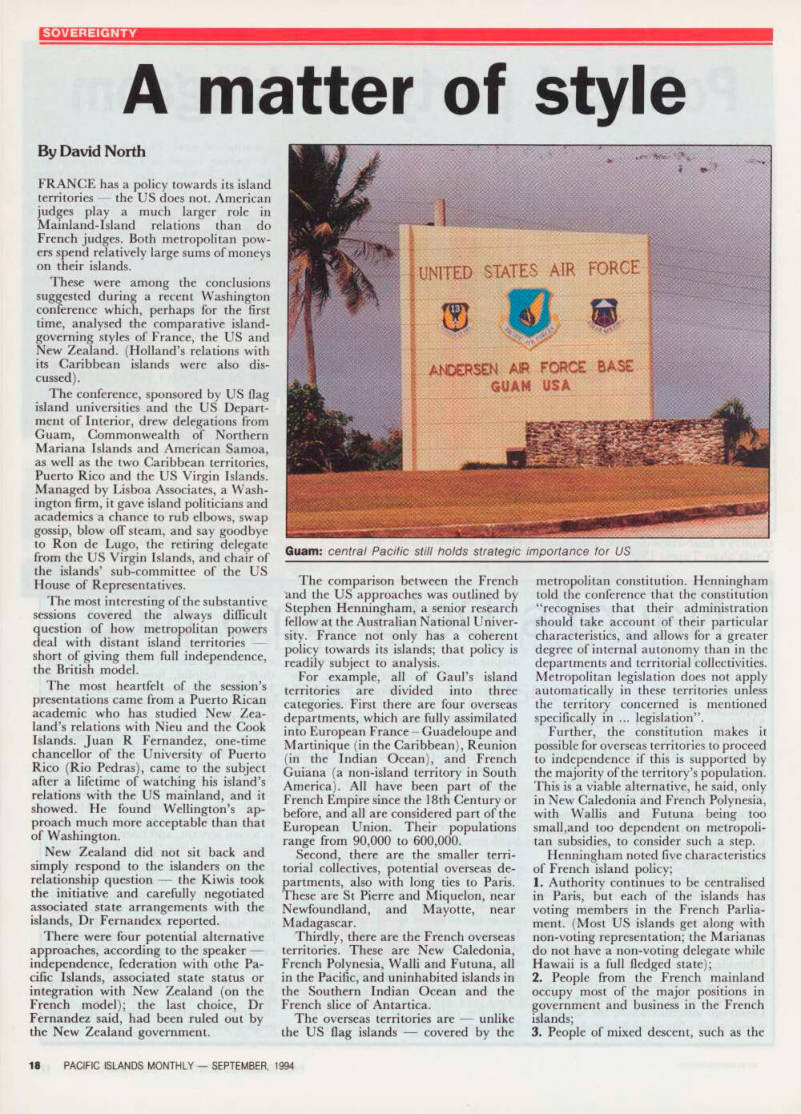
Guam: central Pacific still holds strategic importance for US
dermis of French Polynesia, play major political, cultural,and intellectual roles in the French islands although they are less prominent in business. (This gener alisation does not hold for New Cale donia); 4. French culture and the French language have tended to challenge local identities in the islands; 5. Successive French governments and local elite have “choked off or contained nationalist pressures ... where they have arisen”.
In contrast to the neat categories of French policy, the speaker dealing with America’s relations with its islands spoke of “ a continum of mutuality” and of a series of ad hoc relationships between the islands and the Mainland.
Making these points was Washington (and international lawyer) Howard Hills, who worked on associated states issues for several federal agencies over the last two decades before going into private practice.
Hills opened by saying that choosing him to discuss the subject of Free Assocation reflected that absence of the Republic of the Marshall Islands and the Federated States of Micronesia from the meeting. These states have effectively secured the end of the once colonial relationship with the U.S., and thus felt no need to attend the session.
Hills characterised Micronesia and the Marshalls at one extreme in the “con tinuum of mutuality”, and, in response
The difference between the US and French governing systems is in voting for the presidency
to PlM’s question placed American Samoa and the US Virgin Islands at the other end of the spectrum, on the grounds that the leaders of both of these entities have shown no strong interest in re-defining the basic relationships with
Washington.
In the middle of Hill’s spectrum are Palau, which is about to secure associ ated state status, and Guam, the Mari anas and Puerto Rico, all three of whom are seeking to redefine their relationship with the Mainland. (The Puerto Rican situation was subject to much discussion; and with Washington part-way between New York, where most Mainland Puerto Ricans live, and the island, there were many Puerto Ricans at the session. That many Puerto Ricans want to retain US citizenship, and move toward more independence, was cited as a problem
that had been eliminated in the US negotiatiations with FSM and the Mar shalls the Pacific Islanders did not seek US citizenship, which eased the process).
Hill said that the relationship of FSM and the Marshalls had evolved, within the framework of Associated State status, close to that of political independence.
He recounted the steps along the way: the upgrading of diplomatic status among the two states and Washington from the consular to the ambassdorial level; the admission of the two states to the United Nations and other interna tional organisations; and the recognition of the two island states by other nations.
The major question about the future relationship between the US and the associated states is economic. What will happen when the regular flow of funds under the Compact of Free Association comes to an end, he asked. “Will the US just say ‘adios’?”
He pointed out that the Cold War was ended, and with it much of the stragetegic value of the islands in the Central Pacific. He suggested, however, that the US will remain interested in these islands, pointing out the continuing utility of Kwajalein as a missile test site, and a continuing “moral obligation” of the US to the island nations.
Throughout the conference one other comparison between the US and the French governing systems was men tioned repeatedly and vigorously; that was the fact that while residents of the US flag islands are US citizens (or nationals), none of them can vote for the President of the United States.
This is not the case for residents of French island territories, all of whom are French citizens, and they can and do vote for the President of France. (In fact, Dr. Henningham pointed out later, candidates for the French Presidency have a tradition of making at least one campaign visit to a French island early in their campaigns).
The US constitution, however, has made island voting for the President difficult, because rather than voting directly for President, as the French do, Americans choose their President through the filter of the archaic, state based Electoral College. Were Puerto Ricans to opt for statehood (which they voted against in a recent referendum) and Puerto Rico admitted as a state, that would take care of that problem for that island. But the other territories are too small to be considered as potential states, and some other mechanism (as well as a constitutional amendment) would be needed to give residents votes for President. □
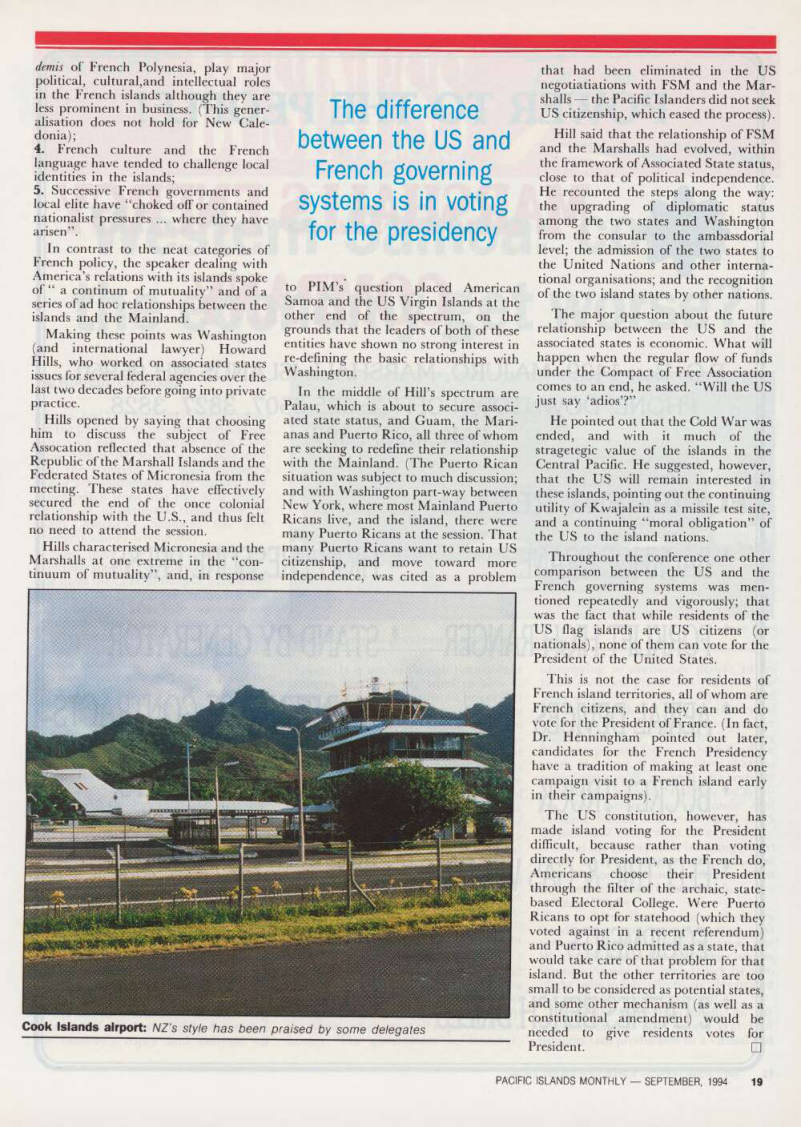
Cook Islands airport: NZ's style has been praised by some delegates