Ministers endorse action
p. 19 · Read in the full issue
Women
By Debbie Singh
REGIONAL government ministers from some of the world’s smallest nations met in Noumea, New Caledonia, in May and proved that they think big when it comes to ensuring that women’s role in the region’s development is not ignored.
The ministers met to review the Pacific Platform for Action highlighting areas of critical concern to island women during a two-day ministerial meeting, following the Sixth Triennial Regional Conference of Pacific Women. The conference, called Rethinking Sustainable Development for Pacific Women Towards the Year 2000,
was organised by the South Pacific Com mission (SPC) as part of the region’s preparatory activi ties leading to the Asia-Pacific Minis terial Meeting, which was held in Jakarta, Indonesia, in June. The plat form will form part of the Asia-Pacific sub mission for the United Nations Fourth World Con ference on Women, in Beijing, China, in September 1995.
The platform was adopted by women delegates during the triennial conference at the close of an intense three days of debate. Chairperson of the women’s conference, Western Samoa’s Foisaga’asina Eteuati-Shon said amidst applause from the tired but elated women “There were times when feelings ran high and the chair almost lost control, but we held together, and in the truly Pacific way we have achieved our goal to formulate and adopt a Pacific Platform for Action.”
The platform identifies 13 areas of concern to Pacific women health, education, economic empowerment, agriculture and fishing, legal and human rights, decision-making, environment, culture and the family, mechanisms to promote the advancement of women, violence, peace, poverty and the rights of indigenous peoples.
“The (platform) aims to accelerate full and equal partnership of women and men in all spheres of life, including
economic and political decision-making,
to protect human rights and address critical areas of concern so that Pacific women and men can work together for
equality, development and peace,” ex
plained Bernadette Pereira-Xulue, con
ference co-ordinator and women’s pro gramme adviser at the SPC’s Pacific Women’s Resource Bureau (PWRB), based in Noumea. But she stressed that the topics discussed at the conference were “community and not just women related, as issues which affect women in turn affect society due to women’s integral role in the community”. In opening the conference, secretary general of the SPC, Ati George Sokomanu urged the women delegates to produce a Platform for Action which addressed the need to achieve more balance in the roles and relations of men and women, rather than focussing on women as a separate group.
In light of 1994 being declared the International Year of the Family, Sokomanu said “Attitudes are shaped
largely through education taking place
during the child’s formative years within the family. The values of respect for life and the dignity of others could only be effectively instilled in our children where they experience such respect from parents in the home. When the child becomes an adult, respect and under standing would become part of the personality and gender differences would make little difference.”
The ministerial session of the confer ence heard that progress in the im plementation of the Nairobi Forward- Looking Strategies for the Advancement of Women, which emerged after the UN Decade for Women ended in 1985, had been uneven in the Pacific, and despite the region’s diversity, the hold of tra ditional, family and customary values had proved resilient.
“Many values and practices have ascribed a subordinate position to women in social hierarchies, leading to the persistence of gender discrimination in many spheres. The differences be tween women and men have persisted in terms of such critical factors as health
and nutrition, levels of literacy and training, access to education and econ
omic opportunity, satisfactory conditions
of work, equal representation before the law, and in participation in decision making at all levels,” said Fiji’s minis terial representative and chairperson of the ministerial meeting, Ratu Mesake
(Jo) Nacola.
Papua New Guinea’s Minister for Religion, Home Affairs and Youth Andrew Posai urged Pacific governments
to give women’s issues priority, particu
larly after the Beijing World Conference on Women in 1995.
“Women and the environment are issues that have often been left out even
though they are di
rectly linked to the health and economic survival of women.
“Environment and sustainable de velopment are vital for our nation’s sur vival, as we have already seen the ad verse effects of envir
onmental exploi
tation within some countries in the re gion,” Posai said.
Island countries were urged to protect their fragile environ ments and the prob
lems of nuclear testing and dumping in Pacific states were highlighted during the conference. Also under debate at the conference were the rights of indigenous peoples and its proposed inclusion as a 13th critical area of concern in the platform. Delegates discussed the Con vention on the Elimination of All Forms of Discrimination Against Women (CEDAW). They reviewed and evalu ated the implementation of the Nairobi Forward-Looking Strategies for the Ad vancement of Women in the Pacific, as well as the work of the SPC Women’s Bureau since the last South Pacific Conference in Guam in 1991.
More than 150 women delegates, most of them government and non
governmental organisation officials from
22 Pacific countries, attended the confer ence. Ministerial representatives from PNG, Samoa, Tonga, Niue, Guam, Tuvalu, the Federated States of Micro nesia, French Polynesia, Vanuatu, the Solomon Islands and Fiji participated in the ministerial meeting which followed the three-day triennial women’s confer ence. The ministerial meeting adopted the platform in its entirety on the final day of deliberations. Australia, New Zealand, the United Kingdom and New Caledonia funded the conference. □
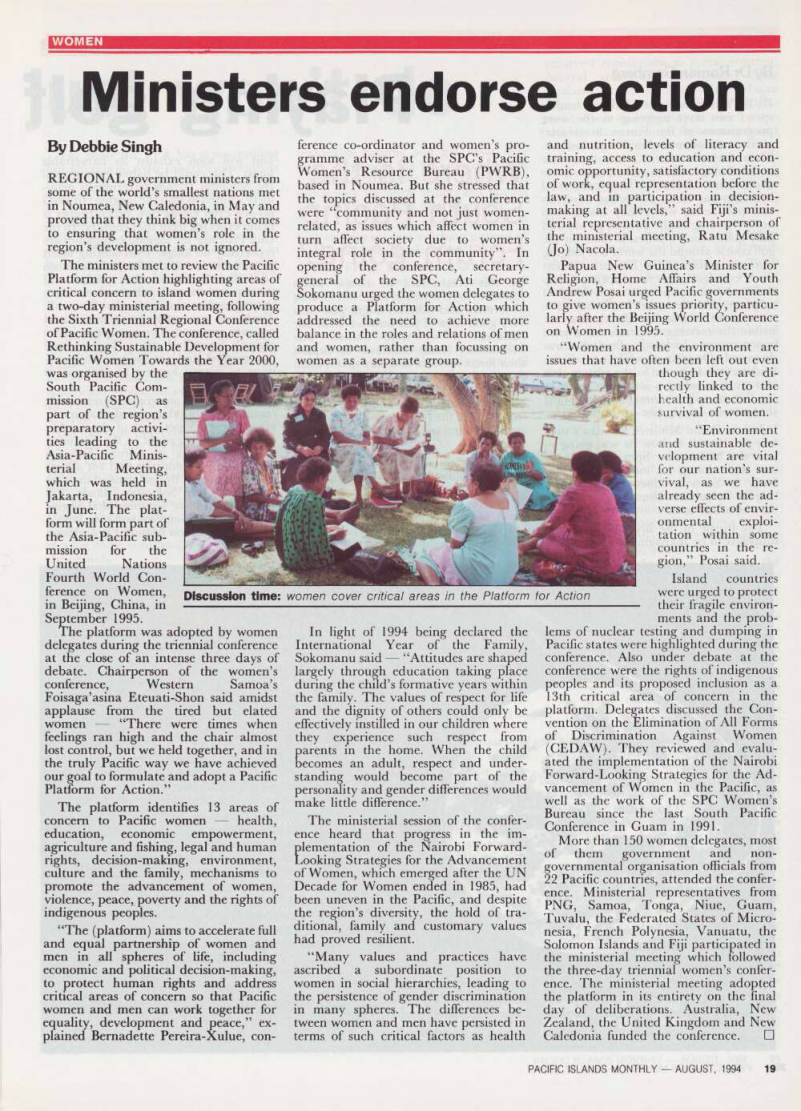
Discussion time: women cover critical areas in the Platform for Action