Logging dilemma
pp. 17-18 · Read in the full issue

Vanuatu
By Patrick Decloitre
THE timber-rich Erromango tropical forest (South Vanuatu) has been logged by a Malaysian company for only two months and eight thousand cubic meters
have already been harvested.
Company officials on Erromango say 60 to 80 trees (the equivalent of 450 cubic meters) are felled everyday. But on June 20, the minister of agriculture signed an order banning the export of whole logs.
The ship Esmelmlda, which was then already in the island state’s capital, could not load the first shipment, estimated to be worth about US$BOO,OOO dollars.
A few days later, the Esmelralda left Vanuatu, I but it was empty.
Following the announce ment, Malaysian companies licensed to operate on Erromango have put the pressure on the government threatening to bring the case to court for breach of the contract initially granted to them.
Under the previous terms, four com
panics (two Malaysian, Parklane and
Pacific Veneers, one Chinese, Kingwood, and a Malaysia-Vanuatu joint venture, Erro Lumber) were licensed to operate on Erromango, with annual logging
quotas well above the amount recom
mended by a recent Forestry Depart
ment study. The final straw came on July 8 when the Vanuatu government in
formed in writing all four logging companies on Erromango that their logging licences granted last year were rescinded due to a “mutual mistake” as to the sustainable level of harvesting on the island. It followed recommendations
made earlier the same week to the agriculture and for estry minister by the Vanu
atu attorney-general, Eng
lishman Patrick Ellum.
Ellum said that some com panies had been invited to renegotiate, and that the terms vary from one com pany to another. “The general terms under which
they can renegotiate have
already been indicated to them,” he said. Earlier last month, Vanuatu prime minister Maxime Carlot Korman indicated the new logging quotas would be a maximum of 25,000 cubic
metres for the timber-rich island, includ ing 15,000 for Parklane and for Erro Lumber and Pacific Veneers, 5000 each.
“Any proceedings taken against the
Patrick Decloitre
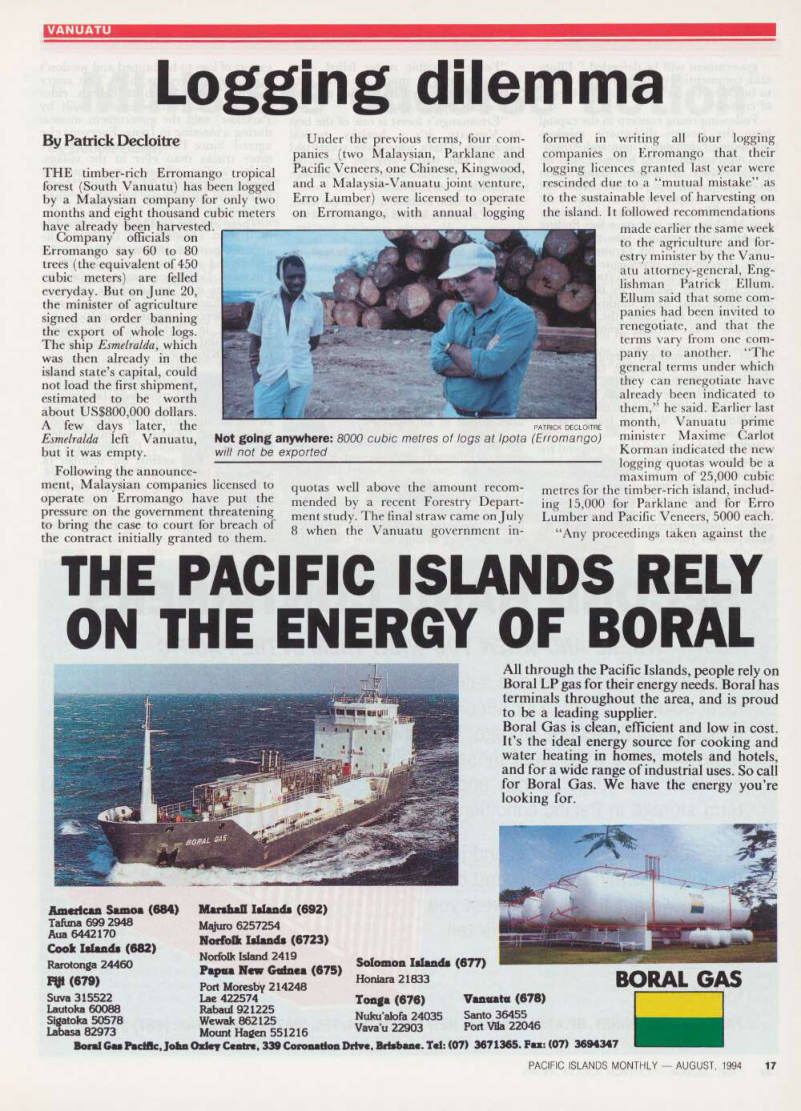
Not going anywhere: 8000 cubic metres of logs at lpota (Erromango) will not be exported
government will be defended,” Ellum
said, commenting on possible legal action
to be taken by the companies for breach of contract.
Following rising concern in the capital from the foreign diplomatic missions (including European Union and Australia) represented here, Korman said he would reduce the logged quantities on Erromango, as well as the number of authorised companies there. On June 22 and 23, Ellum and director of forestry Aru Mathias were sent on a fact finding mission. Their mission was twofold assess the situation on Erromango, but more specifically investigate on allegations that some sacred (taboo) sites there had been violated by the logging companies, that some landowners had hrihpd and that the Parklane comoanv was from sam to company was working Irom Sam to But' on Erromaneo foreien loreine P 1? Erromango, loreign logging spells riches to the custom landowners and various leaders roads, churches, football fields, have been built in the past two months by the Malaysian company Parklane in the area of Ipota (West Erromango).
When Parklane decided to suspend its operations following the government ban on logs export last June 20, landowners began to worry Their concern increased when they saw nine Parklane Malaysian workmen (including chainsaw operators and bulldozer drivers) leave back to
Malaysia on June 25.
“For each cubic meter felled, they sometimes get as much as 1000 vatu
(over USSB),” says Parklane log grading
manager Chung Lung Ling.
“Erromango’s forest is one of the best in Vanuatu, it’s a healthy, typical rainforest. That’s why we’re concerned abut it and that’s why we want the logging to be done with as less damage as possible,” says Mathias.
“If we hadn’t made a quick decision, they (Parklane) would have reached the
Deep in the lush tropical forest of Erromango (South Vanuatu), intensive logging and road construction by Malaysian company Parklane, has started to scar the landscape. The company has suspended its operations after a ban was ordered on June 20 on the export of unprocessed logs.
annual quota in three months,” Korman later added in an interview.
For most of the Erromango land owners, however, environment is not a matter for concern some 18 land owners, have signed leases with Parklane, but some also signed with one or two other companies for the same block of land. “We want development, we don’t want the work to stop, we don’t want the
export of logs to be banned and we don t want the Malaysians to go, an angry Seventh Day Adventist church e der (who has had a new church built by Parklane) told the government mission during a meeting m pota. veryone ese agreed. Since Parklane came, there are ™°f e truc ks than ever in the vi age.
Q. ul^ e a ew Vl Bagers ev T n P rou Y disp^lay expensive Mont anc pens, said they were o ere y eir Malaysian tnends .
There are also problems not related to the ban chief Charlie Tor asked the attorney-general what to do, because he had signed with two companies. JNow I m stuck. I d like someone to explain t e contract to me, he asked the attorney general. Each area of Erromango sup port a dmerent company in Ipota, it s £ arkl in Port .fr a ™in, it’s* Pacific Veeners E|to Lumbe ’. DiHon , s
Bay, it’s Kingwood.
“Thpv want to sell their want to sen inei wood, Korman told PIM last month.
Only a few Erromango landowners like Simon Yaviong in Dillon s Bay are aware of the threat on their island s environment. “There’s too much mter ference from politics ... I’m not agaist the companies, I’m against the number of companies here, it s too much, he says.
Energetic Yaviong promotes the idea of logging by locals only “There was a chainsaw workshop last May here, which I organised. It was the first time ever.