Playing golf
pp. 20-21 · Read in the full issue
OPINION - South Pacific Forum
Where is the South Pacific Forum going?
By Dr Roman Grynberg
EVERY year they meet. First our leaders spend two days agreeing to the work programmes of the Forum Secretariat and several other regional organisations.
Then they discuss the issues that their senior foreign affairs officials see fit to allow them to discuss. Then once total boredom has set in our prime ministers and presidents, when they could even bother coming to the Forum, go out and play golf. Much business is done on the golf course around the world but judging from the results of the Forum in recent years even golf does not appear to help
their ability to produce anything of
substance. At the end of it all they have to say something so the officials who met before the meeting will iron out a joint communique which will reflect what was discussed. Once in a while one of the leaders, just to prove to the editors that it is worth sending a journalist to cover the Forum, will say something untoward that sounds faintly like an initiative.
It was Prime Minister Rabuka’s turn last year to tell us how he was going to
join the Melanesian Spearhead Group
and then change his mind once he got back to Suva to discover that Fiji’s largely Polynesian elite didn’t care for that idea one iota.
The theme of the Brisbane Forum is supposed to be managing our resources.
By this Australians of course mean resources in its broadest sense but looking at forestry and fisheries might give us a very good idea of just how we treat our resources if we were honest. The Melanesian states continue to exploit their forest resource in a way that is often described as rape. Rape of course assumes that the victim was unwilling but in this case it is by no means evident that some of the region’s political leaders
are not voluntarily assisting the logging
companies.
It is also equally fair to say that the region’s political leaders are not the
victims of forestry practice they are
themselves frequently the perpetrators of some of the worst abuses. Solomon Islands is exporting timber at some three times their maximum sustainable yield
and will soon exhaust its harvestable forest. This could be halted tomorrow if the Solomon Islands government genu inely wanted to stop the logging. In PNG no-one even knows how much timber is being exported from that country. In the Gulf Province the logging companies are reportedly no longer even seeking forest permits but are clear felling whole stands of forest for what they claim will subsequently be oil palm estates “once they generate enough cash flow ...”.
Timber is reportedly being stolen and not even reported. The corruption in the region’s forest industry is known, well documented and yet governments con tinue to permit logging to continue in this manner.
We have only one common renewable resource in abundance and that is our tuna. Some 55 per cent of the world’s canning tuna is caught in the Exclusive Economic Zones of Forum Fisheries Agency (FFA) countries and yet almost all of it is caught by and canned in other countries. Only Solomon Islands, Fiji and Kiribati have anything that begins to look like a fishing fleet and tuna is only canned in Solomon Islands, Fiji and soon
Png.
For years the FFA has done nothing but attempt to write fisheries agreements that would but help other nationals get our fish. Their work programme, which is set by their member countries, had virtually no orientation and certainly no mandate to develop the fisheries in the region. Fortunately there now appears to be some political will to actually develop the region’s tuna fisheries and the FFA will one day evolve into an organisation that will help Pacific Islanders develop their fisheries capacity.
Almost immediately after the Forum Secretariat’s Secretary-General leremia Tabai and Father Walter Lini let the Soviet tuna boats fish in our waters the Americans began to negotiate the US FFA multilateral treaty. Since its signing
in 1989 we have been receiving nine per cent of the value of the US purse seiner catch in the Pacific.
However, we have bilateral treaties with the Taiwan ese, Koreans and Japanese.
Under these treaties, we receive five per cent or less of what these countries say
they catch.
The Japanese pay 11 per cent of the value of their catch to Australia in tuna fishing grounds that are far worse than ours. As a result of the fact that the Forum nations refuse to try to impose a multilateral treaty on the Asian Distant
Water Fishing Nations and continue with the present bilateral ap-
proach whereby each country negotiates
with the much more powerful fishing nation we are losings millions in access fees each year. I once asked out-going director of the FFA Sir Peter Kenilorea why we tolerated such a miserably low rate of return from the Asians when we had shown such political resolve in the face of much more powerful American pressure.
Sir Peter trotted out the standard reply that we are unwilling to challenge the region’s major aid donors. While this made some sense in explaining Forum behaviour towards Japan the explanation makes no sense with regard to Taiwan and South Korea which are not
major donors. If they co-operated FFA
countries could threaten to throw the Taiwanese and Koreans out of the Pacific and ban their pole and line fleets until such time as they begin to pay
reasonable returns and get what they want. At present the FFA is negotiating a multilateral treaty with Taiwan but this is only for purse seiners but not for pole and line vessels and longliners.
Have we lost our resolve in dealing with the distant water fishing nations or is there another explanation?
The FFA, like all South Pacific organisations, works on consensus; you cannot even begin to work towards developing a multilateral fisheries access agreement unless everyone wants it so if one minister in one country is corrupt, and there may be more than one, then they will get up at FFA meetings and tell the staff that his country does not want multilateral agreements because it would interfere with the internal affairs of
members states and that would end it.
While it is not possible to prove conclus ively that corruption is an explanation of why the Forum countries refuse to push for a multilateral fisheries access agree ment with the Asian countries it is at least as good an explanation as aid depen dence.
Our forests are being destroyed, we are being cheated our fisheries resources. So what should our leaders do? Sign a declaration of course. At the Nauru Forum last year PNG brought a declar ation on the Co-operation in the Natural Resources. Basically the idea is that Forum countries would co-operate to halt the rapacious behaviour of their
resource developers.
It is time for our leaders to actually lead and not produce vacuous press statements and meaningless declarations that will be forgotten until the next Forum meeting. It is time to once again
resurrect regionalism as a real concept.
Several years ago the former New Zealand Prime Minister Mike Moore suggested the idea of a Pacific parlia ment. Such an organisation which over sees the many regional organisations and assures that they do not become vehicles of one or other aid donor would be a way to develop a sense of one political region.
It could also be a forum for discussion on how we can develop our potential as a
region.
The South Pacific is not taken seriously on the world stage. We remain
objects to be manipulated by much
larger powers. That is because we are individually small but as a region stretching from Apia to Port Moresby we would cover a substantial portion of the earth. We have accepted the political realities that our colonial masters created and have accepted smallness as an excuse for our poverty. Our officials trot it out just before they beg for more aid funds.
This is a poor excuse for poverty because
we are small only because our leaders have a vested interest in maintaining a political structure based on small nations that can never be viable. As a region we are neither small nor should we really be poor. It is only the region’s leaders who choose to leave us poor and small.
At the moment the whole world is breaking up
into regional groupings for
trade and political pur poses and yet we sit here
becoming more
marginalised all the time and our leaders fail to
respond to the changing
realities of the end of this
-- century. , Over 20 years ago the island states made a commitment to develop a regional trade group under the original SPEC agreement which established the precursor to the forum. V\ ith the exception of the Melanesian Spearhead Trade Agreement we have not moved at all m that direction. It is time t at we seriously moved towards esta is mg a trade area * n the legion an ocusing
bave\r o ur dts osal"
P It is time that we started using our resources because time is running out for the region. Aid is s owing own, lations are expanding rapidly and the opportunities for employment are m creasing y limited. If we do not focus upon what will give emp oyment an growth to the region an mat tic necessary adjustments then our c i dren have a bleak future to 100 orwar to.
I laying goll will not do.
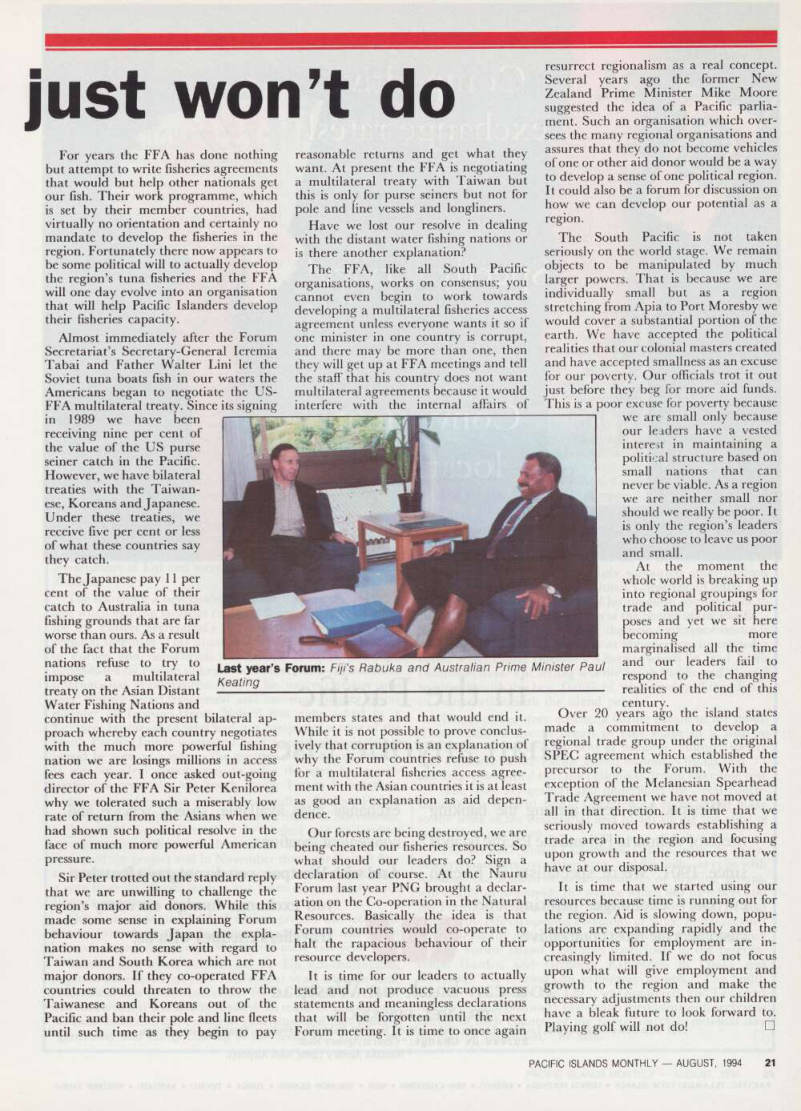
Last year’s Forum: Fiji’s Rabuka and Australian Prime Minister Paul Keating