Pearls
p. 24 · Read in the full issue
Business
Pearls ’94
By Ed Rampell
“PEARLS ’94” marked the 100-year milestone of a gem stone that represents a viable and sustainable from of alterna tive economic development for the Pa cific Islands. The largest “International Pearl Conference and Exposition” ever took place in Hawaii from May 14 to 19.
Five hundred participants from around Oceania and the world participated in the International Pearl Association spon sored event at the Sheraton Waikiki Hotel hosted by the State of Hawaii’s Aquaculture Department. Dozens of exhibits, displays, and speakers’ forums paid homage to the “Queen of Gems” in an effort to unify and direct the SUS 2
billion-plus per year pearl industry,
which is marking the centennial of pearl cultivation.
Special attention was paid to pearrl noire, poerava the black pearl, nailed as a low-polluting, alternative form of economic development for small South Pacific isles with the potential to alter island economies. French Polynesia, the Cook Islands, and Australia played leading roles in Pearls ’94. As befits a jewellery convention, booths in the ballroom and foyer of the Sheraton Waikiki were highly decorated and colourful. The stand from the French Polynesia volcanic island of Tahaa was composed of bamboo and palm thatch.
Tahiti Pearls had a spacious area with stunning photo murals and a video room.
Cook Island stands exhibited wood carvings of Tangaroa, the Polynesian god of the sea, with his prominently exposed fertile phallus. Australian Netmakers exhibited samples of their gearl nets clasping oysters at the Paragon earling booth.
Tahiti’s Minister of Sea Resources Edouard Fritch said French Polynesia has 26 atolls under cultivation and is only second behind Australia in supplying pearls to Japan, the top importer. Tahiti earns SUS 77 million annually from the gems, the territory’s top export product.
White pearls have become a SUSIOI million a year industry in Australia. And with only about three atolls farmed, black pearls are the Cooks’ top export, earning SUS4.S million a year. But as Pearls ’94 forums revealed, along with the industry’s potential, there could also be trouble in the pearl paradises.
The Cooks played a leading role in Pearls ’94 with a sizeable contingent that included several private, as well as government, booths. Prime Minister Sir
Geoffrey Henry delivered a poetic key
note address, noting that 200 years ago, children of Manihiki Atoll played marbles with black pearls, which are today, a mainstay of the Cooks economy, employing 600 people out of a popu lation of 18,000. But despite an excellent speech and thousands of taxpayer dollars to send Sir Geoffrey and his courtiers on their junket to an expensive Waikiki Beach suite, the prime minister proved to
This boom industry
provides a viable
economic alternative
be a poor spokesman for the Cooks.
Despite repeat interview requests, he failed to find a few minutes to talk with the media and present the Cooks’ case.
Cook Islander Raymond Newham spoke on the social and political impact of black pearling at Manihiki, in the Northern Cooks. He said — “Two government institutions, including the Manihiki Island Council, failed to adapt to the new realities of pearl farming and actually hindered its development.”
During the same technical forum, Manihikian Peter Williams told a strange tale of atoll greed and jealousy.
The gruff, 20-year veteran of the New Zealand military began with a Manihikian welcoming chant and then said — “But my father didn’t get this chant when he went to Manihiki.” The Manihiki millionaire stated that the development of his family’s highly lucra tive pearl farm led to great social conflict at the very traditional, remote atoll. At one point, the Williams had to resort to “firearms” to protect their pearl farm from theft, etc. And a flight from distant Rarotonga to Manihiki carrying tech nicians to the atoll was blocked and refused permission to land.
Perhaps it’s no mystery why an interview opportunity with Sir Geoffrey is as rare as a perfectly formed, natural black pearl. On the other hand, French Polynesia’s Fritch was very available to the press and gave an overview of Tahiti’s black pearl industry. “Black pearls are our number one export and account for 70 per cent of Tahiti’s import/export balance although the tourism industry generates SUS2OO mil lion a year compared to $77 million for f)earls ... Three thousand Tahitian amilies are involved in pearle noire.”
Fritch said that in its effort to keep pearling Polynesian, French Polynesia has established a black pearl school at Polynesia’s biggest atoll, Rangiroa. He said that 80 per cent of the buyers of Tahiti’s black pearls are Japanese. Aus tralia is the world’s top exporter of pearls to Japan. According to Pearls ’94 chairman Richard Fassler of Hawaii’s Aquaculture Department “In 1988, Australia supplied Japan with 1071 kilogrammes of pearls. The following year, Japan the world’s largest pearl importer - imported pearls worth SUSIS6 million a SUSI2I million increase over 1988.”
As a long time pearl producer, Austra lian expertise is assisting Oceania’s de veloping economies. James Uan, of Kiribati’s Ministry of the Environment and Natural Resources, says that two of his nation’s atolls are experimenting in pearl farming with the assistance of the Australian Centre for International Agriculture Research and the Forum Fisheries Agency (ACIAR).
Gideon Tiroba, of the Solomon Islands’ Ministry of Agriculture and Fisheries, works with Dr Johann Bell, senior scientist of the ICLARM Coastal Aquaculture Centre. Dr John Benzie, of the Townsville-based Australian Insti tute of Marine Science (AIMS), gave a presentation on the genetics of black lipped oysters, which produce the black pearls that are farmed in French Poly nesia and the Cook Islands.
Torres Strait Islander Richard Bowie attended Pearls’ 94 because his company Northern Star Seafood “uses compressed air to collect up to 5000 pinctada pearl shells a day in the Torres Strait to sell to pearl farms, which cultivate them”.
Neil Sims, who received a MSc from the University of New South Wales, chaired the conference’s technical com mittee which presented the more scientific-oriented seminars. Although an Australian, Sims is a principal in Black Pearls, Inc., the first pearl farm located in Hawaii. Dr Benzie of AIMS said that pearl farming is “pretty benign” vis-a-vis atoll ecology, a sentiment echoed by Sims “Pearl farming if done properly is benign, beneficial. It removes pressure from wild stocks. It’s an alternative industry there’s no longer pressure for destructive fishing. It increases awareness for the long term health of the marine environment.” □
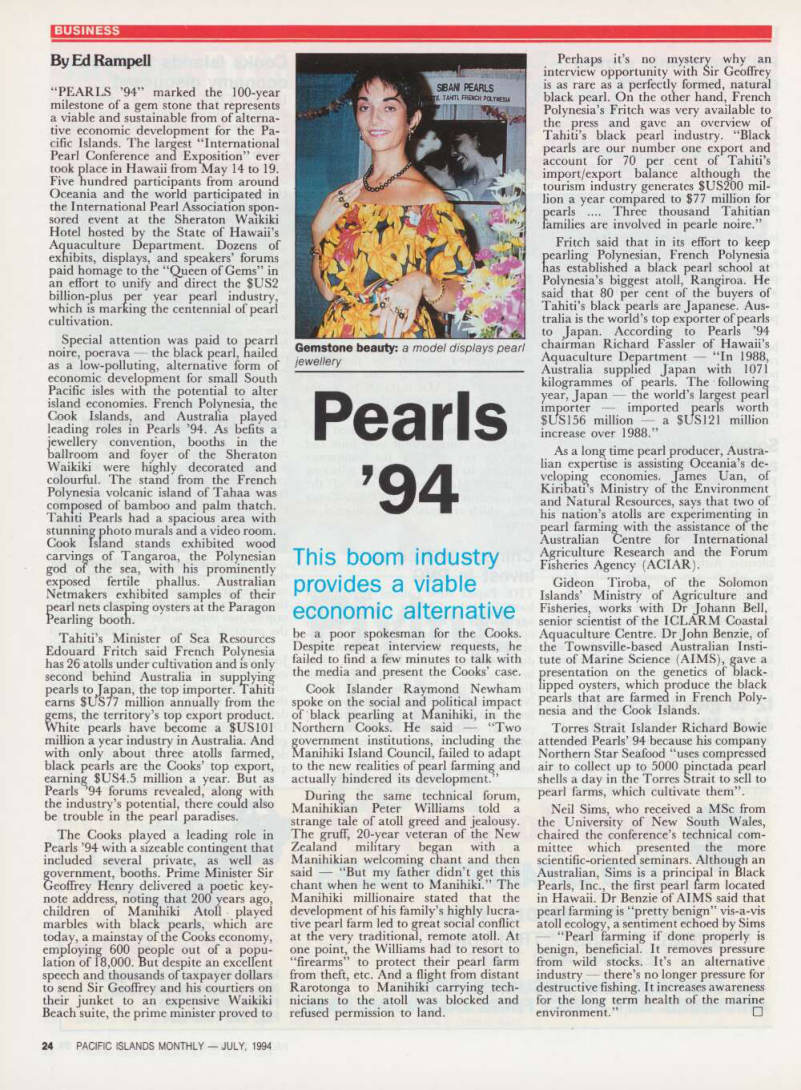
Gemstone beauty: a model displays pearl jewellery