Pacific
pp. 22-23 · Read in the full issue
Business
Flying into debt
HEAVILY indebted state-owned Polynesmn Airlines (PAL) may threaten Vvestern Samoa’s economic stability, financial secretary Sala Epa Tuioti was quoted as saying in a report in May.
Epa said in an analysis written for Finance Minister Tuilaepa Sailele, which was obtained by the Sunday edition of the Samoa Observer, that the airline’s debt amounted to 45.2 million tala ($A48.87 million), of which the ?«AOT 1 cQ ent 'M' .®US2O million (SA2 /.53 million). 1 his is equivalent to about 26 per cent of the total budgeted for the government for fiscal year 1993-94, he said, noting that the airline has been trying to raise 5A8.54 million dollars offshore.
“It is highly unlikely that any commercial lender would offer to make PAL a loan of this magnitude even with a government guarantee. Treasury is of the view that the Samoan economy is simply not large enough to support thts levet of offshore debt, Epa wrote.
Fie attributed the debt to “poor decisions and commented that it was beyond the ability of Polynesia to repay and seriously impacts the country’s foreign currency reserves . Epa s report was written in response to a request by PAL for additional guarantees of 16.5 million tala for a debt to Air Canada and for leasing a Kuwait Air 767. But Epa
said that if the guarantees were granted, the total debt and guarantees would be equivalent “to nearly half of the present total foreign exchange reserves of the country The Air Canada debt relates to a Boeing 767 leased by PAL. It had to return the aircraft in May. Air Canada has requested the repayment of 16.5 million tala, but indicated it would accept the conversion of the debt into a long-term loan guaranteed by the gov ernment, and Epa said that if this is not done, it may sue the airline, forcing it into liquidation. Australia’s Ansett Air
lines managed PAL up until 1992 and for a brief period after this PAL made a small profit, but Epa said the airline was now losing about 300,000 tala to 350,000 tala a week. “Consequently Treasury believes the company is unable to generate funds to repay the 37.3 million tala of existing non-operating debt, and the operating deficit is continuing to grow/’ he said.
He advised the minister not to believe financial forecasts submitted by PAL to back up its latest applications for guaran tees. “(PAL) appear to be no more reliable than previously submitted fore casts which promised no further need for government support,” Epa said. He called on the government to change PAL’s management and board to run the airline on a “profit basis” and “not treat it as a public service provided for the common good”.
“Profits are always promised at some elusive points in the future, but no practical steps are taken to ensure those profits are achieved,” he said. He suggested that the airline give up its 767 service and an all-freighter Boeing 737 service, as well as cut its thrice-weekly service between Western Samoa and the United States to once a week. Services to Melbourne, Wellington and Tahiti
should be scrapped as unprofitable.
Afp
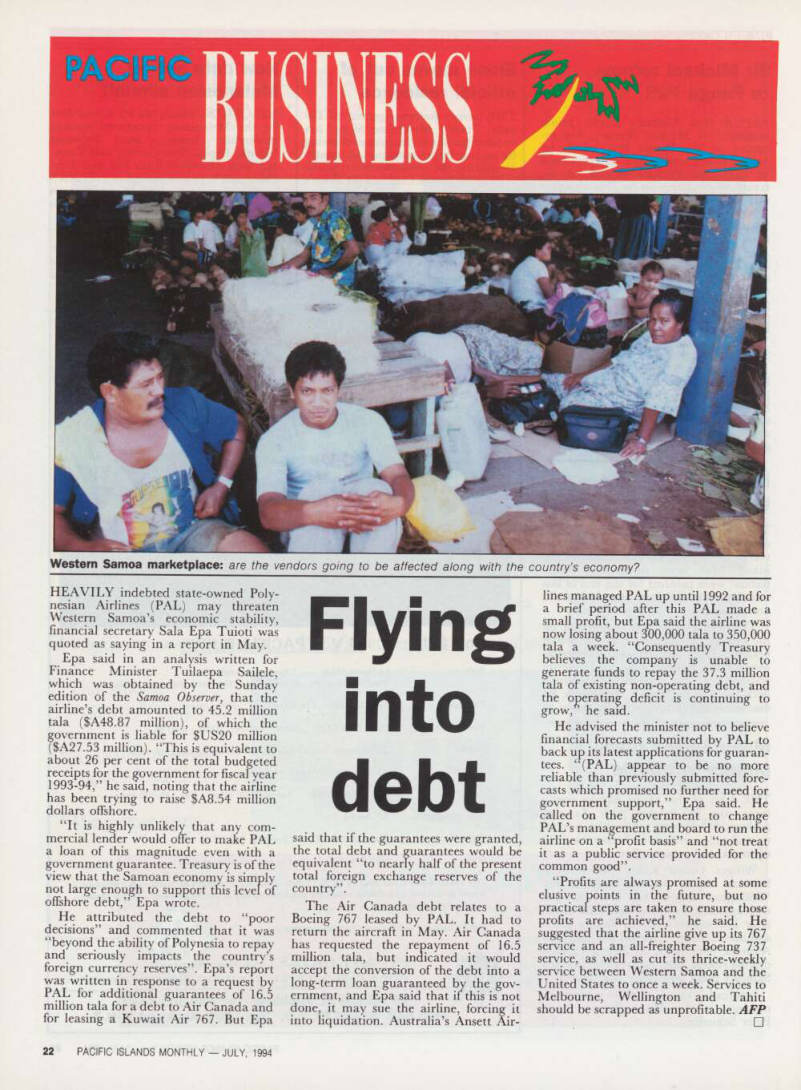
Western Samoa marketplace: are the vendors going to be affected along with the country's economy?
Fiji’s economic growth
down, says report
FIJI’S Reserve Bank says the country’s economy remained weak throughout last year as economic growth dropped from 3.1 per cent to 1.7 per cent. The bank’s annual report for last year attributed the weak economy to the slow recovery of the agricultural and subsistence sectors caused by Cyclone Kina at the beginning of the year.
Economic growth dropped despite
increased demand for Fiji’s exports and a domestic stimulus through lower inter est rates., the report said. The consumer price index increased by three per cent while the average annual inflation rate increased from 4.9 per cent in 1992 to 5.2 per cent last year.
The rate of money supply dropped because real income decreased, deposit rates dropped and expenditure on im ports increased. The overall net budget deficit was equal to 3.7 per cent of the gross domestic product at current factor cost.
Solomon Airlines
announces changes
FINANCIALLY troubled Solomon Air lines is giving up the lease on its Boeing 737-400 jet to Qantas. In return, Qantas will lease a smaller Boeing 737-300 to Solomon Airlines for 3'/z days a week.
The deal will mean major changes to Solomon Airlines’ international sched ules which now operate only from
Saturdays to Tuesdays from June 18.
The airline will stop its weekly Cairns service and one of its two Fiji services.
Acting general manager Wilson Gina said the new arrangement would see an improvement in the airline’s financial
position.
NZ to give USs3.sm in
aid to Niue next year
NEW Zealand is to contribute a total of US$3.5 million to Niue next year.
Australia is likely to give around
US$4OO,OOO in the form of technical
assistance and training scholarships.
Niue officials say most of the New Zealand aid will go toward the recurrent budget, and a special US$l.5 million grant will go towards lengthening the
airport runway.
A Radio New Zealand International report said although next year’s aid levels were about the same as previously, Niue faced a budget deficit of around US$3OO,OOO. However, cutbacks in the public service and income from offshore banking and insurance trusts are likely to boost the island’s income.
PNG govt warns
business sector
COMPANIES in Papua New Guinea that fail to adhere to the Companies Act face higher fines and other tough penal
ties approved recently by the PNG
parliament. Commerce and industry
minister David Mai successfully sought the house’s approval on the changes to the act.
He told parliament that outdated laws had proved cumbersome over time and only 25 per cent of the companies operating in the country were adhering to them. Mai said the aim of the amendments was to get the other 75 per cent, which are usually big businesses, to
comply.
Chinese invited to
invest in PNG
THE Papua New Guinea government has invited Chinese investors to aggressively seek out investment opportunities in the country. The mess age was relayed by PNG’s new ambassa dor to China, Maimu Raka-Nou, when he presented his credentials to President Jian Zemin in Beijing last month. Raka- Nou expressed PNG’s gratitude to China for its contributions to the economic and political development of the country, adding that although Chinese invest ment in PNG was growing, there was room for expansion.
Cooks Islands troubled
economy discussed
IN the Cook Islands, a roundtable
meeting is being organised between the
government, the banks and the private sector to discuss the current state of the country’s economy. The summit plan follows concerns from the private sector to the prime minister, Sir Geoffrey Henry, over what they call a credit squeeze.
They complained that the immediate effects of the credit squeeze was less activity, fewer jobs, less income and less turnover in shops which is reported to be down by 25 per cent. Cook Islands News says the recent freeze on most bank loans is one of the first public indications there would be a credit squeeze. Sir Geoffrey says the problems needs to be worked out from a national point of view and not from the specific interest of just one of the groups.
Fiji govt seeks to
raise USsl6om locally
THE Fiji government has proposed to raise US$l6O million loan locally to service its debts due this year and fund
expenditures approved by parliament.
But political leaders have expressed concern that the government should seek such a sum in loans locally within two months of passing the revised 1994
budget.
Opposition leader Jai Ram Reddy said
the proposal was “very unusual”. He said the government should provide for
these things through the budget. Reddy
said he was wary of the repercussions of
the proposal if passed by parliament.
Fijian Association Party leader
Josevata Kamikamica, a former finance minister, said the proposal was contrary to what the government had said about the deficit in the budget. He said the deficit stood at US$93 million and the US$l6O million loan being sought by the government was much higher than the deficit. He warned of the grave conse quences to the private sector. □