Queen of pearls
p. 25 · Read in the full issue
By Christine Hatcher
TO ask Cook Islander Joan Rolls about black pearls is like inviting a doting mother to describe her favourite child. As owner of Rarotonga’s most exclusive jewellery and art retail business, she readily shares her knowledge about a favourite subject. Time slips away un noticed as you begin to understand the intricacies of pearl seeding. As if suddenly gifted with special sight, the pearls’ delicate lustre, colours and sheens be come apparent in the pieces she gives you to hold. Each piece individualises. You appreciate the differences in size, shape, type and quality. If questioned further she will expand by telling you how, where and why they are grown in the Cook Islands.
Joan is a discerning business woman and knows her subject well. The 15 years experience she has in the pearl retailing business have sharpened her ‘fine tuning’ mechanisms. She has the essential gift for successful retailing that of being able to identify and anticipate trends while staying one step ahead of the changes. It is fitting this resourceful woman is involved with what the new Minister of Marine Resources, Tepure Tapaitau, has predicted will equal tourism as the Cook Islands present major income earner. This gently spoken woman was born into and has matured with the industry. Over the years she has contrib uted greatly to the dignified image it now enjoys. The growth of her enterprise is in fact a reflection of the industry as a whole; a barometer that registers expan sion. Her most recent continuing educa tion programme included attending the Ist International Pearl Conference and Exposition in Hawaii in May with
partner David Cragg. Aptly, Cook
Island’s Prime Minister Sir Geoffrey Henry was the key-note speaker. In an interview on his return home he stated his government’s intention to expand pearl production to Penrhyn and Suwarrow, the Cook Island’s marine reserve. Presently earning approximately SUS 6 million for the country, pearls are a valuable natural resource. Joan’s business could be a major contributor to that figure.
She says concentration on quality is now important. “The black-lip pearl shells occur naturally in Manihiki, and that is half the battle. They simply grow without forcing or feeding. There are only two places in the world where this happens Tahiti and here.”
The pearl industry is “in my blood, a family heritage”, says Joan. Father, Ron Powell, was instrumental in the tech nique of farming shell in the 1950’s when the lagoon was almost depleted by
collecting the wild shells. “As a pioneer for the industry he was often busy,” she says. Consequently, Joan grew up ex pecting to help out in the family business.
Opened in the early 19405, Island Craft was one of the first shops on the island geared towards tourism. In the small white coral walled, thatched kikau roofed hut in the centre of Avarua town, Joan learned business attitudes, discipline and
co-operation. Never thinking to question
the chores she shared or fought over with
her six siblings, she accepted responsibil
ity early. However, as often as possible, she would peek into the small workshop, attached to the back of the shop.
Fascinated, she watched pearls and shells being transformed into pieces of jewellery. And so the love affair that was to shape her business life began.
In 1979 she opened her first shop.
“Although we wanted to do something really different, it was located just out of town and in those days tourism wasn’t developed sufficiently to sustain that location so we moved to Cooks Corner near the centre of town a couple of years later,” she says.
Success followed and over 12 years Beachcomber became the “in” place to
buy quality pearls and other interesting
craft. Then, the growing demand and awareness of black pearl jewellery forced expansion. A serious hunt for larger E remises to accommodate the stock, egan. For many years, the weed choked shell of the London Missionary Society Sunday School built in 1845 sat neglected at the edge of town, practically next door to the site of the original Beachcomber. The only willing inhabi
tants, within the crumbling structure that somehow still managed to display an air of elegance, were the birds. The arched windows and 3000 square feet of space fired Joan’s imagination and a dream began to take shape. Confident tourism was sufficiently developed and business perimeters were expanding, the risk to move away from town was made.
She would restore the building but retain and enhance as much of the original structure as possible.
It took a year to secure the lease for this landmark. Joan lays much of the credit for the dream into reality transfor mation at partner David Gragg’s feet.
Before opening the completed building in 1992, she said “He was so inspi rational, had wonderful ideas and did much of the manual work. I used to look at him and think what a brave man!
Everyone thought we were crazy. I had
always wanted somewhere big enough to
have an arts and craft gallery, a workshop to design jewellery. A home for my pearls. This building has a historical connection with the pearl industry. It’s construction coincided with a thriving export industry in pearl shell buttons to Peru and Europe. It just seems right.”
In her office at the ‘Sunday School’
Joan does most of the designing from which New Zealand and Australian jewellers create unique one off pieces. She allows the eight to 20mm diameter shapes that can range from round, pear shaped semi baroque to circles that have markings similar to having been turned on a lathe and baroque’s that can have any unusual shape, dictate the design. “I see enormous export potential in the Pacific region for our designs. I know our own distinctive and individual pieces, hand crafted with simple classical lines, will become synonymous with the Cook Islands,” says Joan.
Now she has expanded again put a connection back into town. Her new “baby” is a simple, small, thatched, ethnic style hut m the centre of the business area. In this attractive setting a
working jeweller, trained by Joan, crafts
pieces while you wait or just watch.
David says they sell “pearls at reasonable prices value for money nothing over NZ$100”.
This new venture may be the con nection that completes the symbolic circle in the form of a hut similar to the one that housed her father’s business.
Perhaps it ties back to a special child hood and so the beginning of Joan’s dream. Similarly, the Cook Islands has looked ahead by linking back to an ecologically purer era, that without wisdom and foresight may well have been lost forever. For Joan it ensures the survival of a love that will surely last a lifetime. □
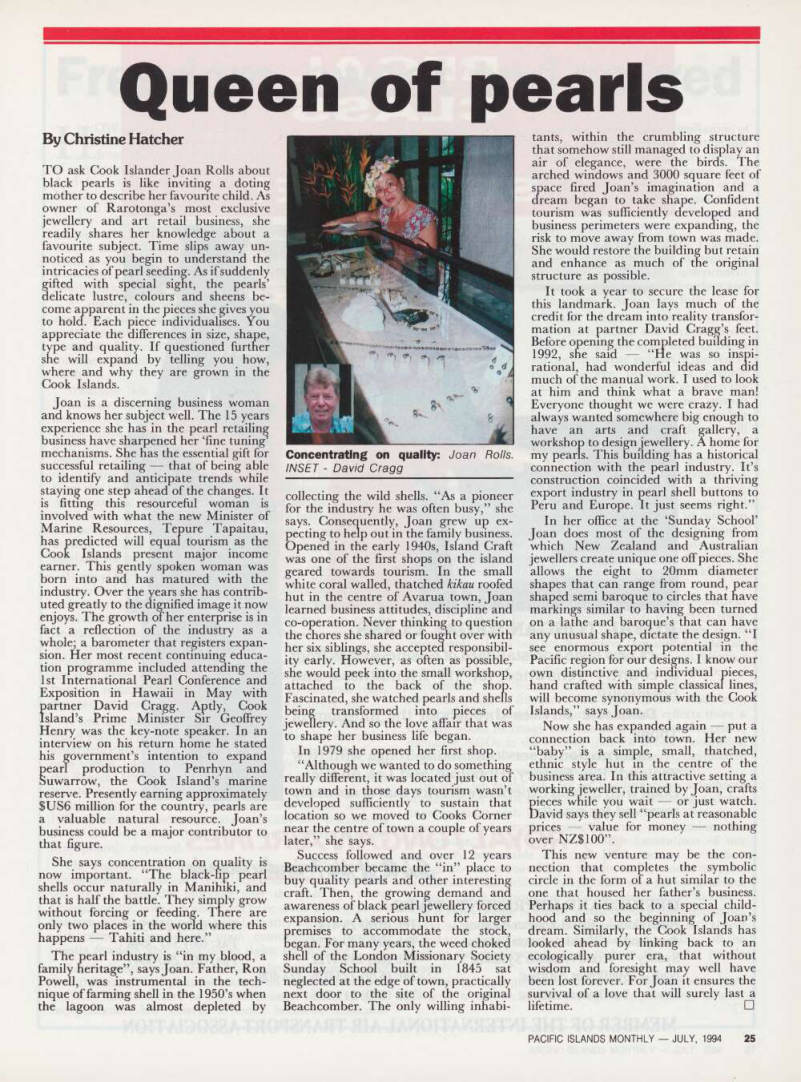
Concentrating on quality: Joan Rolls.
INSET - David Cragg