Elvis. Marshalls
pp. 14-15 · Read in the full issue
By David North
HAVING made a small contribution to the Marshall Islands Treasury, I re ceived an Elvis Presley coin; a steady flow of junk mail, seeking to sell stamps, coins and assorted low-brow memorabilia; and a lesson in how direct-mail businesses seek to lure First World consumers.
It all started when I saw, among the food coupons in the Sunday newspaper, yet another pitch to buy a coin
honouring Elvis Presley. I was more intrigued by the Marshall Islands con nection than the image of “The King”, America’s rock-and-roll singer of 20 years ago.
So I called the toll-free phone number (a 1-800 number in the US) and checked out the offer. Was I talking to someone in the Republic of the Marshall Islands (RMI)? No. Was I talking to someone with the sales agent in Cheyenne, Wyoming (a small city in the American West)? No. The person on the other end of the phone was a representative of the agent, and thus a represen tative of the representative of the Marshalls, and she was talking with me from Houston, Taxes.
Following that conver sation I mailed a check for US$6.5O to buy the $5 Elvis coin. There was small print in the advertisements telling me that I would have to wait eight to 12 weeks for delivery (even
though the coin merchants had either my credit card number, or my cheque in hand.) Why was this? The leaders in the mail order business, like LL Bean, the Maine clothing people, send your (much more bulky) stuff much more quickly. Maybe the RMI agent simply wanted to make use of my $6.50 for a couple of months before parting with the Presley coin. (I later learned that commemorative coins are manufactured only after they have been sold no point minting them if you cannot sell them.) About four weeks after mailing the cheque I received the first of (so far) 21 mailings from Unicover, the stamp and-coin agents used by RMI (and FSM, too) in Cheyenne. The letter said
that they had my order, and in due time they would send me the coin. Mean while, they tried to sell me other Presley coins, of greater value. The Marshalls also issued them at $lO (brass) and $5O (silver); Unicover prefers to sell you the whole set in a little presentation case, for $65 plus $6 for shipping and handling.
Then another two weeks later I got the actual coin in the mail. The
packaging was thoroughly professional.
The outer envelope was made of thick cardboard and bore the warning “Do not bend” as if you could bend a coin.
Inside was another brightly coloured
and smoothly written brochure, seeking to sell me all three of the Elvis coins and some Elvis stamps as well, a little questionnaire designed to tell Unicover about my collecting habits, and a serious little envelope with “Instructions for Protecting and Displaying Your Coin”.
Inside that paper envelope was a plastic container, and, there within the clear plastic was my Elvis. There were, before Unicover gave up on me, 19 more mailings, all trying to sell me something; all smoothly presented in bright colours and cheerful, cleanly written copy.
Although there is some question as to whether Elvis and the other RMI coins are, in fact, really legal tender as the brochures claimed
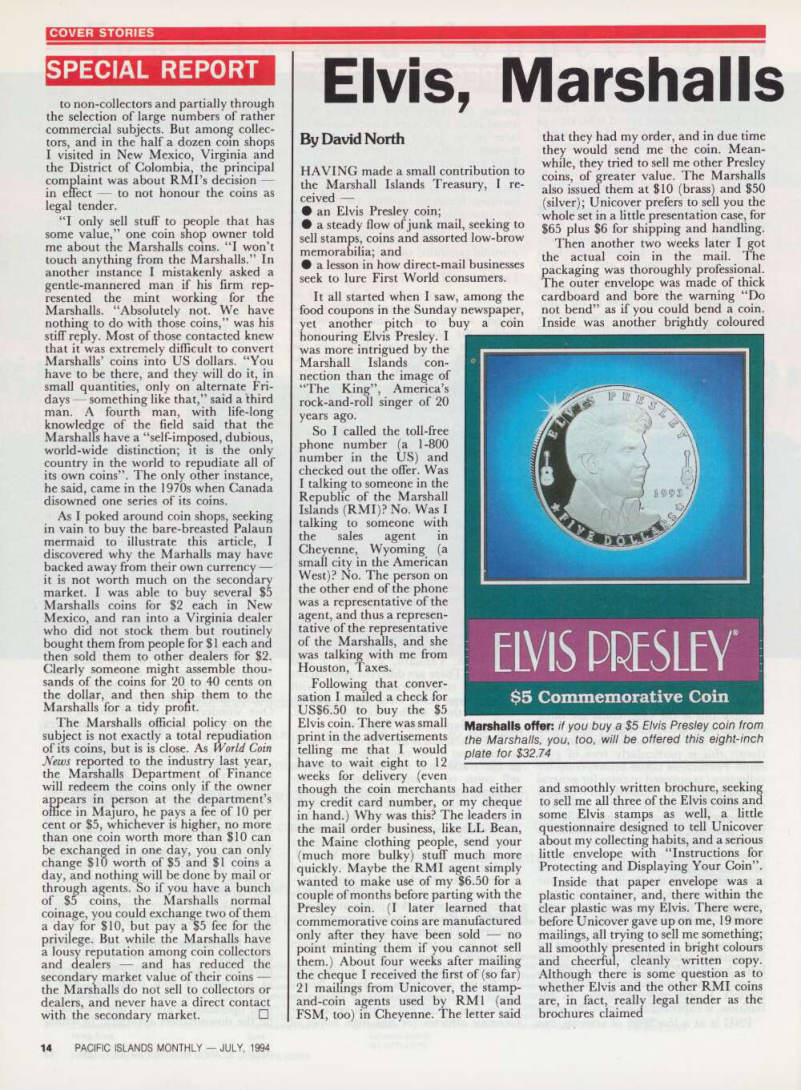
Marshalls offer: if you buy a $5 Elvis Presley coin from the Marshalls, you, too, will be offered this eight-inch plate for $32.74
there never was an editorial mistake or a printing error in these mailings. They dealt with a multitude of subjects. First, there were mailings that assumed that I was a big fan of Elvis. Twice more I got reminders of the whole series of RMI Elvis coins, one suggesting the set of three coins would make an excellent Christmas present.
There also was the offer of an Elvis coin from another set of tropical islands, the former Portuguese colony of St Thomas and Prince in the Atlantic. Then I was told that I could buy a plate (like a dinner plate) of the singer for $32.74, and it was noted that for me, the brokerage fee would be waived. This offer, which came in an “Urgent mess age” from the Bradford Exchange, in formed me that previous rounds of these plates, which had sold for $24.75, were now trading at $124.00. So I should buy quickly, to make money later. While Unicover often stated that its issues were limited, and spoke of them as collectors’ items, the organisation never explicitly claimed that the commemorative coins would increase in value.
Then there were six more mailing dealing with non-Elvis RMI products; there were offers of attractive RMI stamps, a $5 Desert Storm coin selling for $lO plus $2 for handling, and a $5 space coin, selling for $5 and $ 1.50. But the big push was, understandably, for the RMI series of 12 coins honouring whales and dolphins. (Americans are crazy about dolphins). Unicover and RMI wanted to sell me one $5O coin a month for the next year, each a “Silver Proof’ (i.e. uncirculated and shiny) “numismatically important” disc. The handling fee was $6 each, and I was invited to charge them to the credit card of my choice. The brochure was, as always, slickly produced in blue and silver, with a sheet of parchment-like paper within, as well as two pro environment quotations from Jacques Cousteau. There were to be no more than 25,000 in this series.
I then did a little math, and found that if all 25,000 of each of the 12 coins were sold, at $5O + $6 it would bring someone $16,800,000. Since the Marshalls best year for coin income produced only about $650,000, and Unicover’s most recent total volume, for everything it does, was $17,000,000 a year, it is unlikely that the $16,000,000 target was reached. The whales and dolphins coins also are available at the $lO level. Much of Unicover’s mail to me dealt neither with Elvis nor the Marshalls. It included promotions of plates, and stamps; with themes varying from Christmas to the Old West. The coin mailings were often
about the Isle of Man, which has a very old and strong commemorative coin tradition, as well as Gibraltar. There were coins for cat and dog fanciers, such as one for the Maine Coon Cat, which grows to 30 pounds (and is said to have
some charming, dog-like characteristics.)
The one crown Isle of Man coin was made of “one full troy ounce of .999 pure silver”, and “to assure fair distribution, there is a limit of one coin per order”.
Priced at $5O + $6, the Coon Cat coin is made of silver worth about $5.50.
Then there was Gibraltar’s silver coin, also for $56, with the Queen on one side, and a long-haired dachshund on the other. The advertising gave more prominence to the dog than to the monarch. But, by January Unicover gave up on me. Figuring that if I had not purchased anything after the first coin seven months earlier, I should be struck from the list. I am sure that they lost money on me by that time.
So, to keep the process rolling I
telephoned Unicover, this time reaching
them in Cheyenne, to order some stamps.
The stamps came quickly, and, as with the Elvis coin, they were handsomely packaged, and in this case bearing pictures of Marshall Islands birds with their names in both English and in Marshallese. Nice stamps.
But I blew my connection with Unicover when the lady at the other end of the phone asked me if she could ask me some questions about my collecting preferences. “Yes,” I said, “but for every question you ask me, I want to ask one of you. Is that OK?” She sound surprised, but agreed. I did not say I was a reporter. My first question was innocu ous enough “Where are you working
today?”
“Cheyenne,” she said. She asked her first question, and I replied. Then having heard that Unicover’s operation had moved to the West from New York to reduce its labour costs, I asked “How much do you earn an hour?” College
students conducting telephone opinion
polls sometimes will answer that question it is usually $4.25 an hour (the minimum wage) or $5 but not
Unicover’s lady.
“I do not think that has anything to do with stamps,” she said. We were at a standoff, and no more information was exchanged. But she was in the driver’s seat; she probably told her computer to have nothing more to do with me. And that’s why the interesting flow of junk mail has ceased. □