The sovereignty
pp. 8-14 · Read in the full issue
Cover Stories
Special Report
By David North
So who makes most money out of it?
PALAU’S bare-breasted mermaid coins are apparently a smash hit in the market, but tnat does not mean much financially to the islands. The Swiss-minted discs are said to be the world’s first multi-coloured coins. Though carrying a nominal value of only $1 (Palau uses the US dollar) they were originally sold to collectors, largely in Japan for $l7, and now the promoter is charging $25. How much of the $25 gets to Palau? Ten dollars, $5, or just $1?
Palau gets exactly half a dollar, 50 US cents, for each coin. The other $24.50 (98 per cent of the gross) goes to the E remoter, Japan’s Ben Corporation, en, presumably, pays for the minting, the small royalty to Palau, and the major cost promoting and selling the coins.
Is the Palau coin deal par for the course?
Or do some of the other islands do better in the coin-and-stamp business? We suspect that the answer to the second question is sometimes “yes”.
Virtually everyone in the business traditionally hides the financial aspects of their transactions. But there is just enough of the open-books influence of the US in Palau (the last of the US Trust Territories) for PIM to be able to secure fairly complete financial information.
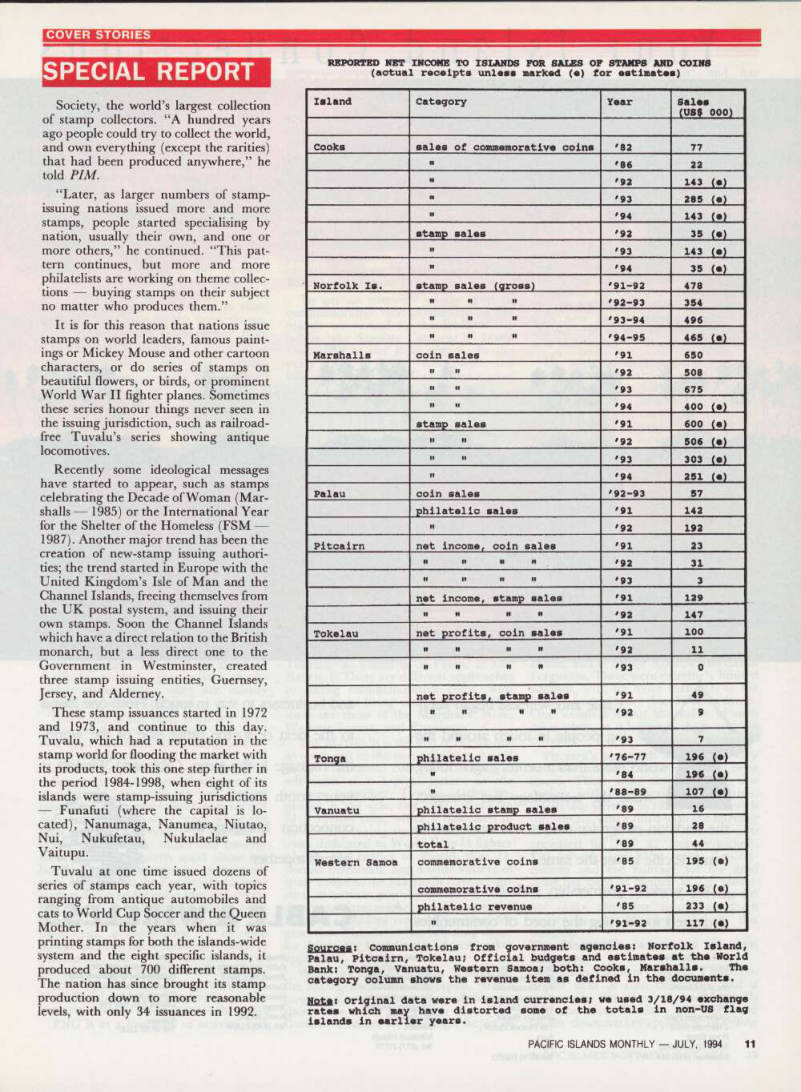
And when we told senior people in the US coin business the details of the Palau mermaid deal, we got the impression that Palau was doing particularly badly in a field where island governments often do not do well. The big picture is this no island is paid much in this business, and recent years have been worse than earlier ones. The best net income in recent years has apparently gone to the Republic of the Marshall Islands. RMI received a peak net income of about $1,250,000 for both its stamps and its coins in 1991, but expects only $651,000 from these sources in 1994. The long-term trend appears to be downwards for other governments as well, as the accompanying table indi cates. For example, to take two islands with totally different promotional approaches, staid Britain’s Pitcairn and the hang-loose Tonga we find Pitcairn’s income down between 1992 and 1993, and Tonga’s down from the mid-70s to the late eighties. As a matter of fact, back in 1976-77 fully three per cent of Tonga’s governmental income, from all sources, came from the sale of stamps. By 1988-89 the percentage had fallen to one half of one per cent. In the light of this depressing trend, it is useful to look more carefully at the Palau deal.
As is usually the case, the promoter and the island nation are engaged in the sale of a series of coins, not just one. This series celebrates protection of the marine environment. While the dollar coin in the series is made of copper and nickel, like most of the world’s low-value coins, the $5 version is made of silver. For the latter coins, Palau gets $4, while Ben sells them
lat do the following transactions have in mmon? • The Cooks sell commemorative coins. • Vanuatu and the Marshalls license (flag) merchant ships. • Tonga sells passports to the Hong Kong Chinese. • Niue decides to become the latest off shore banking centre. • FIJI rents part of Its army to the United Nations. • All the Islands sell postage stamps to the collectors.
In each case the Island government Is engaging In what we call the Sovereignty Business economic activities that can only be engaged In by nations (or quasi nations), but not by Individuals, corpor ations, or units of local government.
This month PIM covers stamps and coins; a future article will deal with off shore banking, bank notes, flagging ships, Issuing passports and divorces, and work ing with satellites.
in Japan for $BO having raised the Erice from the earlier level, $69. (At the igher price, Palau receives four per cent of the gross). Palau’s government-owned National Development Bank signed the deal for the islands. In return for giving Ben (presumably) a monopoly on Palau’s commemorative coins, Ben made an advance payment of $lOO,OOO to the bank and a loan of $900,000, at a rate of 3.5 per cent a year. (The rate would be favorable in US markets, less so in Japan with its low interest rates).
The royalties from coin sales are supposed to insure the repayment of the loan. They also will assure Ben that no one else for a long time will ever distribute coins for Palau. This is the case because at the current rate of royalty payments Palau will be perpetually in nock to the Japanese firm. The Palau deal also has upper limits on the numbers of coins to be minted; this is a standard procedure, and is designed to assure collectors that there is a limited supply.
Here are the numbers for the marine environment series Palau will receive 50 cents for each of the 50,000 $1 mermaids, and $4 for each of the 6000 $5 coins, or a maximum of $49,000 ($25,000 + $24,000). PIM has a Development Bank document showing that at the end of December, 1993, Ben had chalked up $45,050 to Palau’s account for all of the $5 coins and most of the $1 ones. The document covered payments between June 1992, when the coins went on sale, and the end of December, 1993, a period of 18 months. Unless Ben, or Palau, breaks their word to the coin trade, and mints more of the coins, the marine life protection series is just about over. So, one and a half years have passed, and it looks as if Palau is ahead by $45,000 plus
another $12,000 in retail sales (presum ably within Palau) for $57,000. Not bad for a nation of 15,000. But wait, Palau’s Development Bank must pay $31,500 a year in interest to Ben, or $47,250 in the 18 months; that leaves Palau less than $lO,OOO on the plus side of the ledger.
Meanwhile, Ben apparently grossed somewhere between $1,204,000 and $1,730,000 depending on the price Ben received for the coins we do not know when during the 18 months the prices were increased. In summary Palau received a net of $lO,OOO from one of the more successful coin promotions in recent years, and the promoters’ gross was about $1.5 million. There is the theoreti cal possibility that Palau could simply repay the loan and negotiate with anotner promoter; but development banks in the islands tend to make loans to small businesses that often fail. So Palau probably will be doing business with Ben for a long time to come.
Meanwhile, Palau has apparently se cured a much better deal for its stamps than its coins. (Whether it is a good deal for Palau is another question).
The Palau government agency hand ling off-shore sales of postage stamps is the post office, and the promoter is Inter- Governmental Philatelic Corporation (IGPC) of New York, an organisation active with other (non-Pacific) small nations as well.
Palau’s postal system, according to the US Trust Territory office in Palau, had philatelic sales worth $142,000 in 1991, and $192,000 in 1992. PIM was informed that the New York firm prints, sells and promotes the stamp issues, and sends 40 per cent of all gross revenues to the islands. (All of this is in happy contrast to the $lO,OOO or so actual profit we calculate for Palau’s coins, and a gross of what appears to be two to four per cent.
It was not clear to us whether the Palauans selling coins and those selling stamps ever compared notes on their off shore deals). Palau’s deal may be a little better in the future, as in a new agreement signed in May 1993, IGPC promised a minimum level of royalties of $200,000, which would be a hair above the 1992 actuals. Palau’s postmaster, in a telephone conversation, said he could not divulge actual sales in 1993.
IGPC, which pays 40 per cent of the ?ross, sells Palau s stamps from its New ork office to collectors for their face value, and presumably sells the same stamps to dealers for less. At one point in the past the Cooks were reported to be getting 50 per cent of the gross from its overseas agent, but whether the Cooks stamps were being sold at, or above, face value was not then reported.
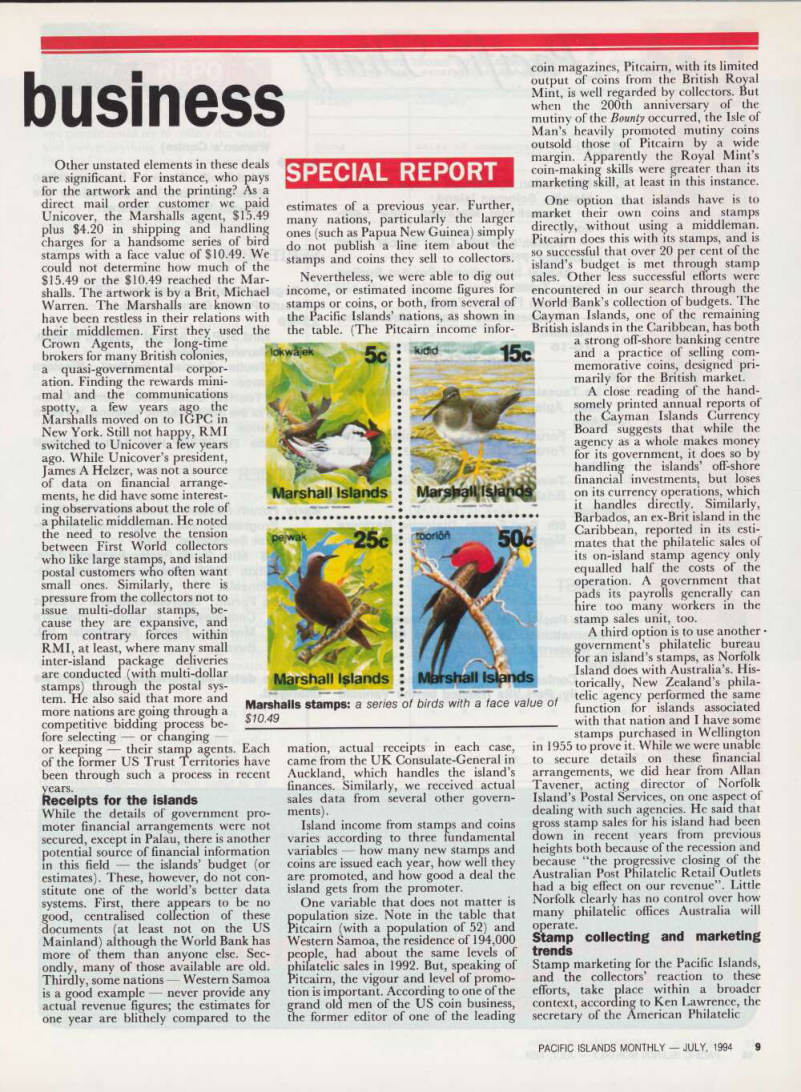
Other unstated elements in these deals are significant. For instance, who pays for the artwork and the printing? As a direct mail order customer we paid Unicover, the Marshalls agent, 515.49 plus 54.20 in shipping and handling charges for a handsome series of bird stamps with a face value of 510.49. We could not determine how much of the 515.49 or the 510.49 reached the Mar shalls. The artwork is by a Brit, Michael Warren. The Marshalls are known to have been restless in their relations with their middlemen. First they used the
Crown Agents, the long-time brokers for many British colonies, a quasi-governmental corpor ation. Finding the rewards mini mal and the communications spotty, a few years ago the Marshalls moved on to IGPC in New York. Still not happy, RMI switched to Unicover a few years ago. While Unicover’s president, James A Helzer, was not a source of data on financial arrange ments, he did have some interest ing observations about the role of a philatelic middleman. He noted the need to resolve the tension between First World collectors who like large stamps, and island postal customers who often want small ones. Similarly, there is pressure from the collectors not to issue multi-dollar stamps, be cause they are expansive, and from contrary forces within RMI, at least, where many small inter-island package deliveries are conducted (with multi-dollar stamps) through the postal sys tem. He also said that more and more nations are going through a competitive bidding process be fore selecting or changing
or keeping their stamp agents. Each of the former US Trust Territories have been through such a process in recent years.
Receipts for the islands While the details of government pro moter financial arrangements were not secured, except in Palau, there is another potential source of financial information m this field the islands’ budget (or estimates). These, however, do not con stitute one of the world’s better data systems. First, there appears to be no good, centralised collection of these documents (at least not on the US Mainland) although the World Bank has more of them than anyone else. Sec ondly, many of those available are old.
Thirdly, some nations Western Samoa is a good example never provide any actual revenue figures; the estimates for one year are blithely compared to the
estimates of a previous year. Further, many nations, particularly the larger ones (such as Papua New Guinea) simply do not publish a line item about the stamps and coins they sell to collectors.
Nevertheless, we were able to dig out income, or estimated income figures for stamps or coins, or both, from several of the Pacific Islands’ nations, as shown in the table. (The Pitcairn income infor-
mation, actual receipts in each case, came from the UK Consulate-General in Auckland, which handles the island’s finances. Similarly, we received actual sales data from several other govern ments).
Island income from stamps and coins varies according to three fundamental variables how many new stamps and coins are issued each year, how well they are promoted, and how good a deal the island gets from the promoter.
One variable that does not matter is population size. Note in the table that Pitcairn (with a population of 52) and Western Samoa, the residence of 194,000 people, had about the same levels of philatelic sales in 1992. But, speaking of Pitcairn, the vigour and level of promo tion is important. According to one of the grand old men of the US coin business, the former editor of one of the leading
coin magazines, Pitcairn, with its limited output of coins from the British Royal Mint, is well regarded by collectors. But when the 200th anniversary of the mutiny of the Bounty occurred, the Isle of Man’s heavily promoted mutiny coins outsold those of Pitcairn by a wide margin. Apparently the Royal Mint’s coin-making skills were greater than its marketing skill, at least in this instance.
One option that islands have is to market their own coins and stamps directly, without using a middleman.
Pitcairn does this with its stamps, and is so successful that over 20 per cent of the island’s budget is met through stamp sales. Other less successful efforts were encountered in our search through the World Bank’s collection of budgets. The Cayman Islands, one of the remaining British islands in the Caribbean, has both
a strong off-shore banking centre and a practice of selling com memorative coins, designed pri marily for the British market.
A close reading of the hand somely printed annual reports of the Cayman Islands Currency Board suggests that while the agency as a whole makes money for its government, it does so by handling the islands’ off-shore financial investments, but loses on its currency operations, which it handles directly. Similarly, Barbados, an ex-Brit island in the Caribbean, reported in its esti mates that the philatelic sales of its on-island stamp agency only equalled half the costs of the operation. A government that pads its payrolls generally can hire too many workers in the stamp sales unit, too.
A third option is to use another
government’s philatelic bureau
for an island’s stamps, as Norfolk Island does with Australia’s. His torically, New Zealand’s phila telic agency performed the same function for islands associated with that nation and I have some stamps purchased in Wellington
in 1955 to prove it. While we were unable to secure details on these financial arrangements, we did hear from Allan Tavener, acting director of Norfolk Island’s Postal Services, on one aspect of dealing with such agencies. He said that gross stamp sales for his island had been down in recent years from previous heights both because of the recession and because “the progressive closing of the Australian Post Philatelic Retail Outlets had a big effect on our revenue”. Little Norfolk clearly has no control over how many philatelic offices Australia will operate.
Stamp collecting and marketing trends Stamp marketing for the Pacific Islands, and the collectors’ reaction to these efforts, take place within a broader context, according to Ken Lawrence, the secretary of the American Philatelic
Marshalls stamps: a series of birds with a face value of $10.49
Society, the world’s largest collection of stamp collectors. “A hundred years ago people could try to collect the world, and own everything (except the rarities) that had been produced anywhere,” he told PIM.
“Later, as larger numbers of stamp issuing nations issued more and more stamps, people started specialising by nation, usually their own, and one or more others,” he continued. “This pat tern continues, but more and more philatelists are working on theme collec tions buying stamps on their subject no matter who produces them.”
It is for this reason that nations issue stamps on world leaders, famous paint ings or Mickey Mouse and other cartoon characters, or do series of stamps on beautiful flowers, or birds, or prominent World War II fighter planes. Sometimes these series honour things never seen in the issuing jurisdiction, such as railroad free Tuvalu’s series showing antique locomotives.
Recently some ideological messages have started to appear, such as stamps celebrating the Decade of Woman (Mar shalls 1985) or the International Year for the Shelter of the Homeless (FSM 1987). Another major trend has been the creation of new-stamp issuing authori ties; the trend started in Europe with the United Kingdom’s Isle of Man and the Channel Islands, freeing themselves from the UK postal system, and issuing their own stamps. Soon the Channel Islands which have a direct relation to the British monarch, but a less direct one to the Government in Westminster, created three stamp issuing entities, Guernsey, Jersey, and Alderney.
These stamp issuances started in 1972 and 1973, and continue to this day.
Tuvalu, which had a reputation in the stamp world for flooding the market with its products, took this one step further in the period 1984-1998, when eight of its islands were stamp-issuing jurisdictions Funafuti (where the capital is lo cated), Nanumaga, Nanumea, Niutao, Nui, Nukufetau, Nukulaelae and
Vaitupu.
Tuvalu at one time issued dozens of series of stamps each year, with topics ranging from antique automobiles and cats to World Cup Soccer and the Queen Mother. In the years when it was printing stamps for both the islands-wide system and the eight specific islands, it produced about 700 different stamps.
The nation has since brought its stamp production down to more reasonable levels, with only 34 issuances in 1992.
REPORTED NET INCOME TO ISLANDS FOR SALES OF STAMPS AND COINS (actual receipts unless marked (e) for estimates)
Sources: Communications from government agencies: Norfolk Island, Palau, Pitcairn, Tokelau; Official budgets and estimates at the World Bank: Tonga, Vanuatu, Western Samoa; both: Cooks, Marshalls. The category column shows the revenue item as defined in the documents.
Note; Original data were in island currencies; we used 3/18/94 exchange rates which may have distorted some of the totals in non-US flag Islands in earlier years.
Island Category Year Sales (US$ 000) Cooks sales of commemorative coins '82 77 H '86 22 N '92 143 (e) n '93 285 (a) II '94 143 (e) stamp sales '92 35 (e) II '93 143 (e) If '94 35 (e) Norfolk Is. stamp sales (gross) '91-92 478
H Ii It
'92-93 354
Ii Ii It
'93-94 496
Ii Ii It
'94-95 465 (e) Marshalls coin sales '91 650
Ii Ii
'92 506
Ii Ii
'93 675
Ii Ii
'94 400 (e) stamp sales '91 600 (•)
Ii Ii
'92 506 (•)
Ii Ii
'93 303 (•) It '94 251 (e) Palau coin sales '92-93 57
philatelic sales
'91 142 It '92 192 Pitcairn net Income, coin sales '91 23 it ti iin '92 31 ii it n ii '93 3 net Income, stamp sales '91 129
Ii Ii Ii Ii
'92 147 Tokelau net profits, coin sales '91 100
N H Un
'92 11
H Ii Un
'93 0 net profits, stamp sales '91 49 It H II »l '92 9 N It It tl '93 7 Tonga
philatelic sales
'76-77 196 (•) II '84 196 C) N '88-89 107 (•) Vanuatu philatelic stamp sales '89 16 philatelic product sales '89 28 total '89 44 Western Samoa commemorative coins '85 195 (e) commemorative coins '91-92 196 (e)
philatelic revenue
'85 233 (e) tl '91-92 117 (•)
“Tuvalu should not be singled out for excessive stamp production,” according to Ken Lawrence. “Its record cannot be compared to ’Ajman, one of the Trucial Sheikdoms, that once issued 4000 stamps in a period of 10 years.” ’Ajman, one of seven small states along the southern shore of the Arabian Gulf, had none of the oil riches of its neighbours, such as Abu Dhabi, and tried to make up for it by way of stamp sales.
Coin collecting and marketing trends Commemorative coins, on a major scale, are a more recent phenomenon than commemorative stamps, and typically involve higher unit costs for collectors and promoters, and higher unit returns for the island nations. (Note in the table that the Marshalls, in the years shown, have always made more money from coins than from stamps).
Stamps, even elaborate, multi coloured ones, can be printed
inexpensively on gummed paper; if they do not sell im mediately, they can, at little cost to the promoters, sit in the vault for years.
Further, out the def erence to children collectors, many of the commemorative stamps carry face values of a few pen nies. Commemorat ive coins are differ ent. First, they are routinely valued in dollars, usually mul
tiple dollars, not pennies. Second, they are legal tender, and are more likely than postage stamps to arrive in the islands in tourists’ pockets. Thirdly, they are more costly to produce, particularly at the higher values where they are usually made from silver and gold.
Since this is the case, coins are often minted only after they have been sold (via mail and other advertising promo tions); this is particularly true of gold coins. Further, as noted before, coins for collectors (as opposed to coins for general circulation) are minted in limited quantities; the upper limit is generally announced in advance, and while the limit may not be reached (if demand is below expectations) mints and govern ments have been pretty good about not breaching the maximum announced runs. Whereas all the Pacific Islands issue stamps designed for collectors, not every one is in the commemorative coins business. Nauru has issued exactly one such coin, a celebration of its own independence; the Federated States of Micronesia, where US currency circu lates, has issued none, nor has Kiribati, Tuvalu or any of the French territories.
Norfolk Island, not previously in the business, is expected to enter it this year.
PNG is at a low level of activity, but
among the dozen gold 100 kina coins issued since 1975 were those bearing the faces of Sir Julius Chan and Michael Somare, both PNG prime ministers.
They are thus two of the few, or perhaps the only two, living Pacific Islands’ politicians to be so honored during their lifetimes. Kings and queens are different, they routinely appear on coinage (and on stamps) while alive. Queen Elizabeth II has appeared (usually in relatively youthful portraits) over the last 40 years, as has, for close to 30, Tonga’s King Taufa’ahau Tupou IV.
To get an overview of the level of commemorative coin production in the islands we turned to the Bible of the hobby, the Standard Catalogue of World Coins, 1994 at our local library. In the years 1986 to 1992, there were the following mintings of commemorative
coins by nation Cooks, 119; Marshalls, 107; Western Samoa, 68; Niue, 48; Tonga, 21; Fiji, 13; Pitcairn, 9; PNG, 8; Tokelau, 8; Vanuatu, 5; Palau, 2; and Nauru, 1. There are different approaches to selling commemorative coins, with four patterns being clear in the Pacific; these are those of the Marshalls, Niue, Western Samoa, and Pitcairn.
The Marshalls is the first of the islands to reach out to the non-collectors as well as the traditional collectors, seeking to sell coins of a topical nature to the average consumer. Typical of this ap proach is the sale, last year, of the $5 Elvis Presley coin, which is described in an accompanying story. With series of coins dedicated to World War II fighter planes, the battles of World War 11, marine mammals, and a wide variety of space subjects, the Marshalls have adver tised in various popular media, such as American supermarket publications and booklets including cents-off coupons for groceries. The somewhat belittling name for this in the trade is the “downmarket approach”.
While the Marshalls have focussed on the States, and Palau on Japan, Niue’s target is Europe, particularly European sports fans. Niue has a high regard for German athletes (or has high hopes of
selling coins to Germans) and has honoured Boris Becker and Steffi Graf, both tennis players, with copper, silver and gold coins valued at (NZ) $5, $5O, $2OO and $250. The $2OO silver coins for Graf is so large (nearly three inches across) and so heavy (more than half a Cound) that if you dropped it on your are foot you might break a toe. More valuable (if lighter) is the $250 gold coin honouring a German soccer player, previously unknown to me, named Franz Beckenbauer. In sharp contrast to the commercial themes celebrated by Niue and the Marshalls are a line of Western Samoa coins whose designs relate more closely to life in those islands. This distinction was called to my attention by the one American who spends more time with new commemorative coins than anyone else; he is Fred Borgmann, the new issue editor of World Coin News.
He told me in approving terms of recent Western Samoa coins made of
palladium (a valu able metal only re cently used in mint age). There was, for example, a 50 tala coin honoring Kon tiki, a 100 tala one regarding the death of Captain Cook and several in honor of the longest-serving of the German governors, Wilhelm Solf, who held the office between 1900 and 1910. Western Samoa, being a member of the
British Commonwealth, could not resist issuing 1000 tala gold coins in honour of the weddings of Prince Charles and Lady Diana, and of Prince Andrew and Sarah Fergusson. These were extremely limited editions, with no more than 100 of the former, and no more than 50 of the latter.
One wonders about the value of such coins when, as it happens, the marriages collapse.
Pitcairn’s approach to coins is very conservative. Only nine coins have been issued. These were three designs, one dealing with the Pitcairn Constitution, which was written in 1838, another with the mutiny, and a third with the burning of the Bounty (at Pitcairn). Each design appeared in (NZ) SI (copper/nickel), $5O (silver), and $250 (gold) denomi nations and the mintage for the gold coins has been as limited as 250 pieces.
But, as the table indicates, Pitcairn did not make anywhere nearly as much money as the Marshalls did in this business.
The Marshalls renounces its own currency Borgmann, and every one else I talked to in the field of coin collection, had a universally dim view of the Marshalls coin operation. Partially this was based on the downmarket approach, of selling
A Tongan bank note: the islands have not yet started issuing commemorative bills
to non-collectors and partially through the selection of large numbers of rather commercial subjects. But among collec tors, and in the half a dozen com shops I visited in New Mexico, Virginia and the District of Colombia, the principal complaint was about RMl’s decision in effect to not honour the coins as
legal tender.
“I only sell stuff to people that has some value,” one coin shop owner told me about the Marshalls coins. “I won’t touch anything from the Marshalls.” In another instance I mistakenly asked a gentle-mannered man if his firm rep resented the mint working for tne Marshalls. “Absolutely not. We have nothing to do with those coins,” was his stiff reply. Most of those contacted knew that it was extremely difficult to convert Marshalls’ coins into US dollars. “You have to be there, and they will do it, in small quantities, only on alternate Fri days something like that,” said a third man. A fourth man, with life-long knowledge of the field said that the Marshalls have a “self-imposed, dubious, world-wide distinction; it is the only country in the world to repudiate all of its own coins”. The only other instance, he said, came in the 1970 s when Canada disowned one series of its coins.
As I poked around coin shops, seeking in vain to buy the bare-breasted Palaun mermaid to illustrate this article, I discovered why the Marhalls may have backed away from their own currency it is not worth much on the secondary market. I was able to buy several $5 Marshalls coins for $2 each in New Mexico, and ran into a Virginia dealer who did not stock them but routinely bought them from people for $ 1 each and then sold them to other dealers for $2.
Clearly someone might assemble thou sands of the coins for 20 to 40 cents on the dollar, and then ship them to the Marshalls for a tidy profit.
The Marshalls official policy on the subject is not exactly a total repudiation of its coins, but is is close. As World Coin News reported to the industry last year, the Marshalls Department of Finance will redeem the coins only if the owner appears in person at the department’s office in Majuro, he pays a fee of 10 per cent or $5, whichever is higher, no more than one coin worth more than $lO can be exchanged in one day, you can only change $lO worth of $5 and $1 coins a day, and nothing will be done by mail or through agents. So if you have a bunch of $5 coins, the Marshalls normal coinage, you could exchange two of them a day for $lO, but pay a $5 fee for the privilege. But while the Marshalls have a lousy reputation among coin collectors and dealers and has reduced the secondary market value of their coins the Marshalls do not sell to collectors or dealers, and never have a direct contact with the secondary market. □