Good times for Korman
p. 16 · Read in the full issue
Vanuatu
An opposition more divided than ever since Maxime Carlot Korman’s government came to power late 1991, defectors Joining his majority: things have not been too bad for the Vanuatu prime minister in the last four months.
“DIVIDE and rule” seems to have been a fruit-bearing strategy for Vanuatu prime minister Maxime Carlot Korman, especially in the last four months. The first trick was the presidential election.
The Vanuatu electoral college consisting of all 46 members of parliament and presidents of the local government coun cils, twice failed last February to elect a head of state, due to insufficient number of votes from any party to meet the required two-third majority of the 56-seat electoral college.
The third meeting of the college on March 2 finally saw the election of the ruling Union of Moderate Parties (UMP) candidate, Jean-Marie Leye, with the support of Vanuaaku Pad (VP) and two other isolated votes from opposition (Tan Union and Nagriamel).
After the vote, prime minister Korman lured VP, saying it would offer Kalpoka’s party “at least two” ministerial port folios. But after the president was elected, the offer eventually consisted of only one ministry to be created, training and labour, and the parliamentary positions of leader of government business and first deputy speaker.
Kalpokas’ VP rejected the offer made by UMP to enter the Vanuatu govern ment, because it said this was not in line with initial negotiations between the two parties. The VP/UMP negotiations trig gered a hostile reaction from the oppo sition, which saw this as a betrayal and started making moves to dismiss Kalpokas as their official leader. Soon after the negotiations had started, the three remaining opposition parties, Barak Sqpe’s Melanesian Progressive Party (MPP), Vincent Boulekone’s Tan Union (TU) and Franky Steven’s Nagriamel decided they no longer con sidered Kalpokas as being the leader of opposition. Instead, they resolved the new opposition leader was Sope, the deputy leader Boulekone and opposition whip Stevens.
One week later, Korman’s majority welcomed the first crumb from the divided opposition bread late Jimmy Stevens’ son, Franky, the only MP for once secessionist Nagriamel party, crossed the floor to join the government majority in parliament. In return, on March 15, he was offered the position of leader of government business in the House. VP, MPP and Tan Union
opposition parties finally accepted the return of disappointed and repentant Kalpokas as their leader, and made it up with VP during of one these frequent traditional-political “custom” ceremon ies, where pigs, mats and kava are offered in sign of reconciliation.
This left the opposition partly re united, but weakened by the defection of Stevens. The “opposition front” (formed after an agreement signed by VP, MPP, TU and Nagriamel early in 1992) was reconstituted, but was now consisting of 14 MPs. Halfway between the majority and the opposition also stood former prime minister Walter Lini’s National United Party (NUP), which had decided
to break its coalition agreement with UMP last August. Lini could rely on a group of seven out of ten NUP MPs in what he now calls an “independent opposition group”, but his party was now split, with three other NUP members still remaining in the Korman cabinet as deputy prime minister and minister for justice, culture and women’s affairs (Sethy Regenvanu), telecommunications minister (Cecil Sinker) and minister of health (Edward Tabisari).
Attempts of reconciliation between Kalpokas’ VP and Lini’s NUP also failed, after it was announced early in April that a traditional peace-making ceremony would take place for the two parties to reconcile. The move would have ended over two years of bad blood between Lini and Kalpokas, after Lini was expelled in August 1991 from VP presidency and replaced by Kalpokas, then ousted from his prime minister’s seat after a motion of no confidence was voted
against him on September 6, 1991 again by Kalpokas’ VP. After negotiations took Elace last April between the two parties, ini proved too demanding, as he then said he would agree to a closening of ties between his party and VP, but only if all VP members joined his party, a con dition to which VP did not agree.
Lini’s NUP congress, which was held from May 9 to 12 in Panganisu (North Efate, the island where the capital Port Vila is located), made a final decision regarding the three NUP ministers claiming themselves the “NUP govern ment faction” since NUP’s decision to leave UMP in coalition.
A total of 16 NUP members, including the three ministers (Regenvanu, Sinker, and Tabisari) were expelled by the party’s congress. Regenvanu’s reply was not long to come one week later, on May 18, on the eve of the opening of the island state’s first ordinary session of parliament, he announced the creation of a new party, the People’s Democratic Party (rDP), mainly consisting of former NUP members (including those sacked by NUP’s congress). But in the process, he also gained the support of a once repentant former NUP minister, Onneyn Tahi, who, to the observer’s surprise turned up on the day of the signing of the PDP’s constitution. Tahi had resigned in November from his telecommunication ministerial position, in a move of re newed allegiance to Lini. The NUP congress had taken this into account, by not excluding Tahi, but instead putting him on a three-year “probation period” in the party. Now Tahi had finally chosen to join Regenvanu’s party in its ruling body, the so-called PDP Presiden tial Council.
This blow left Lini’s NUP with only six MPs, and further weakened the oppo sition, now reduced to a mere 20 against 26 for Korman’s majority (21 UMP, four PDP and one Nagriamel).
Logically enough, six days later, on May 24, the newly-formed PDP signed a new coalition agreement to jointly rule in the Korman-led government, with eight UMP ministers and three PDP ministers, a “formality”, according to both sides. It was the third coalition agreement signed by UMP since Korman’s election on December 16, 1991. The first agreement was struck with a 10-seat Lini’s NUP on December 10, 1991, the second one with Regenvanu’s four-member “NUP gov ernment faction” in September last year.
The last one definitely excludes Lini’s NUP from power and replaced it by the new PDP. As a result, Korman’s major ity of 26 out of 46 is still narrow but more comfortable during the last ordinary session of parliament, the government easily passed its bills and withstood a motion of no confidence, which was easily defeated. □
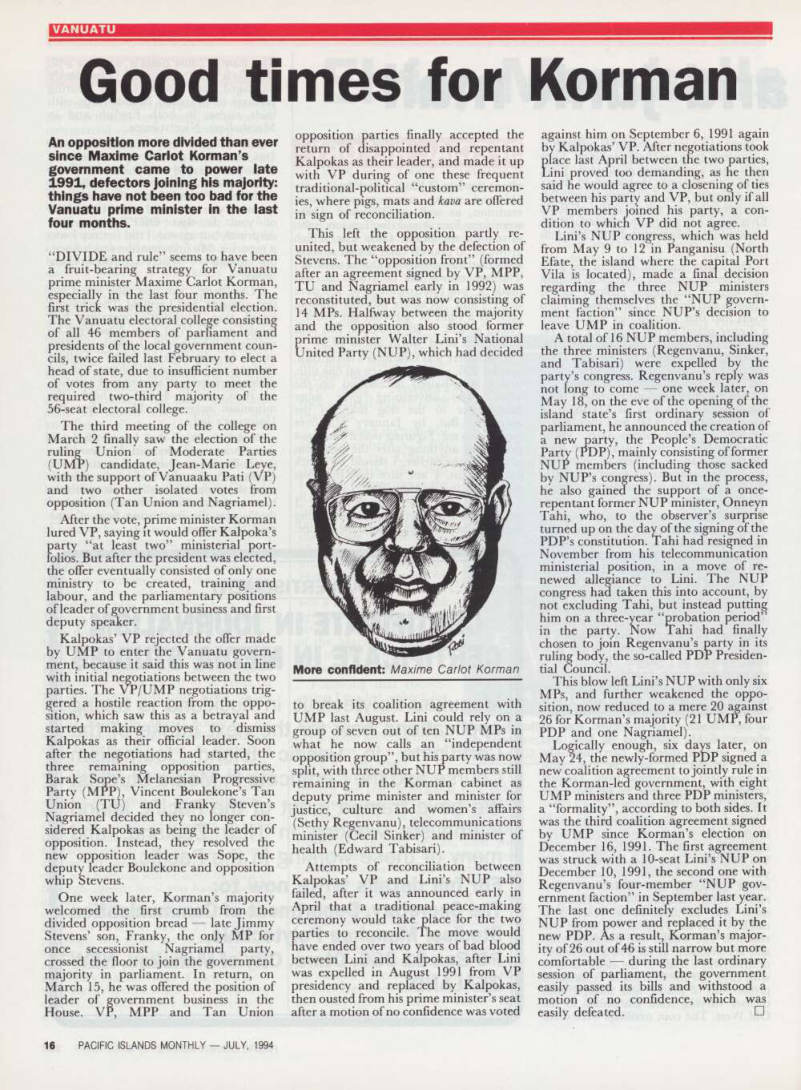
More confident: Maxime Carlot Korman