Islanders turn to Field
p. 25 · Read in the full issue
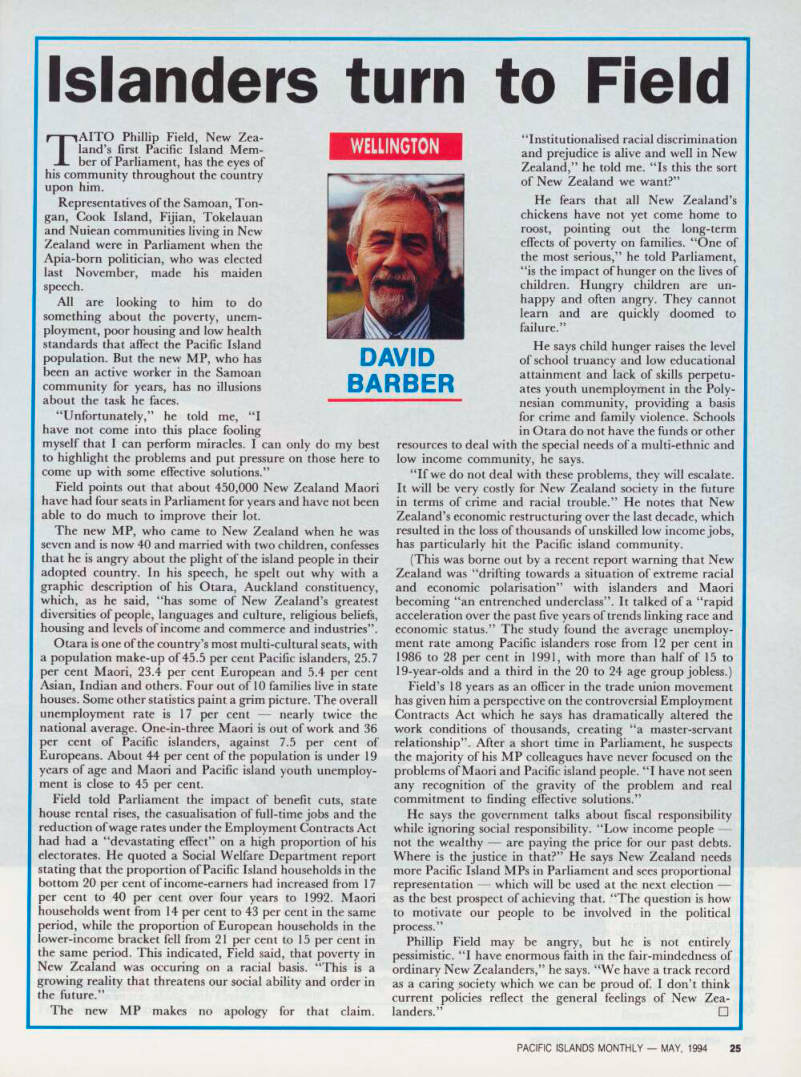
TAITO Phillip Field, New Zea land’s first Pacific Island Mem ber of Parliament, has the eyes of his community throughout the country upon him.
Representatives of the Samoan, Ton gan, Cook Island, Fijian, Tokelauan and Nuiean communities living in New Zealand were in Parliament when the Apia-born politician, who was elected last November, made his maiden speech.
All are looking to him to do something about the poverty, unem ployment, poor housing and low health standards that affect the Pacific Island population. But the new MP, who has been an active worker in the Samoan community for years, has no illusions about the task he faces.
“Unfortunately,” he told me, “I have not come into this place fooling
myself that I can perform miracles. I can only do my best to highlight the problems and put pressure on those here to come up with some effective solutions.”
Field points out that about 450,000 New Zealand Maori have had four seats in Parliament for years and have not been able to do much to improve their lot.
The new MP, who came to New Zealand when he was seven and is now 40 and married with two children, confesses that he is angry about the plight of the island people in their adopted country. In his speech, he spelt out why with a graphic description of his Otara, Auckland constituency, which, as he said, “has some of New Zealand’s greatest diversities of people, languages and culture, religious beliefs, housing and levels of income and commerce and industries”.
Otara is one of the country’s most multi-cultural seats, with a population make-up of 45.5 per cent Pacific islanders, 25.7 per cent Maori, 23.4 per cent European and 5.4 per cent Asian, Indian and others. Four out of 10 families live in state houses. Some other statistics paint a grim picture. The overall unemployment rate is 17 per cent nearly twice the national average. One-in-three Maori is out of work and 36 per cent of Pacific islanders, against 7.5 per cent of Europeans. About 44 per cent of the population is under 19 years of age and Maori and Pacific island youth unemploy ment is close to 45 per cent.
Field told Parliament the impact of benefit cuts, state house rental rises, the casualisation of full-time jobs and the reduction of wage rates under the Employment Contracts Act had had a “devastating effect” on a high proportion of his electorates. He quoted a Social Welfare Department report stating that the proportion of Pacific Island households in the bottom 20 per cent of income-earners had increased from 17 per cent to 40 per cent over four years to 1992. Maori households went from 14 per cent to 43 per cent in the same period, while the proportion of European households in the lower-income bracket fell from 21 per cent to 15 per cent in the same period. This indicated, Field said, that poverty in New Zealand was occuring on a racial basis. “This is a growing reality that threatens our social ability and order in the future.”
The new MP makes no apology for that claim.
“Institutionalised racial discrimination and prejudice is alive and well in New Zealand,” he told me. “Is this the sort of New Zealand we want?”
He fears that all New Zealand’s chickens have not yet come home to roost, pointing out the long-term effects of poverty on families. “One of the most serious,” he told Parliament, “is the impact of hunger on the lives of children. Hungry children are un happy and often angry. They cannot learn and are quickly doomed to failure.”
He says child hunger raises the level of school truancy and low educational attainment and lack of skills perpetu ates youth unemployment in the Poly nesian community, providing a basis for crime and family violence. Schools in Otara do not have the funds or other
resources to deal with the special needs of a multi-ethnic and low income community, he says.
“If we do not deal with these problems, they will escalate.
It will be very costly for New Zealand society in the future in terms of crime and racial trouble.” He notes that New Zealand’s economic restructuring over the last decade, which resulted in the loss of thousands of unskilled low income jobs, has particularly hit the Pacific island community. (This was borne out by a recent report warning that New Zealand was “drifting towards a situation of extreme racial and economic polarisation” with islanders and Maori becoming “an entrenched underclass”. It talked of a “rapid acceleration over the past five years of trends linking race and economic status.” The study found the average unemploy ment rate among Pacific islanders rose from 12 per cent in 1986 to 28 per cent in 1991, with more than half of 15 to 19-year-olds and a third in the 20 to 24 age group jobless.) Field’s 18 years as an officer in the trade union movement has given him a perspective on the controversial Employment Contracts Act which he says has dramatically altered the work conditions of thousands, creating “a master-servant relationship”. After a short time in Parliament, he suspects the majority of his MP colleagues have never focused on the problems of Maori and Pacific island people. “I have not seen any recognition of the gravity of the problem and real commitment to finding effective solutions.”
He says the government talks about fiscal responsibility while ignoring social responsibility. “Low income people not the wealthy are paying the price for our past debts.
Where is the justice in that?” He says New Zealand needs more Pacific Island MPs in Parliament and sees proportional representation which will be used at the next election as the best prospect of achieving that. “The question is how to motivate our people to be involved in the political
process.”
Phillip Field may be angry, but he is not entirely pessimistic. “I have enormous faith in the fair-mindedness of ordinary New Zealanders,” he says. “We have a track record as a caring society which we can be proud of. I don’t think current policies reflect the general feelings of New Zea landers.” □