Pacific
Islands
Monthly
May 1994
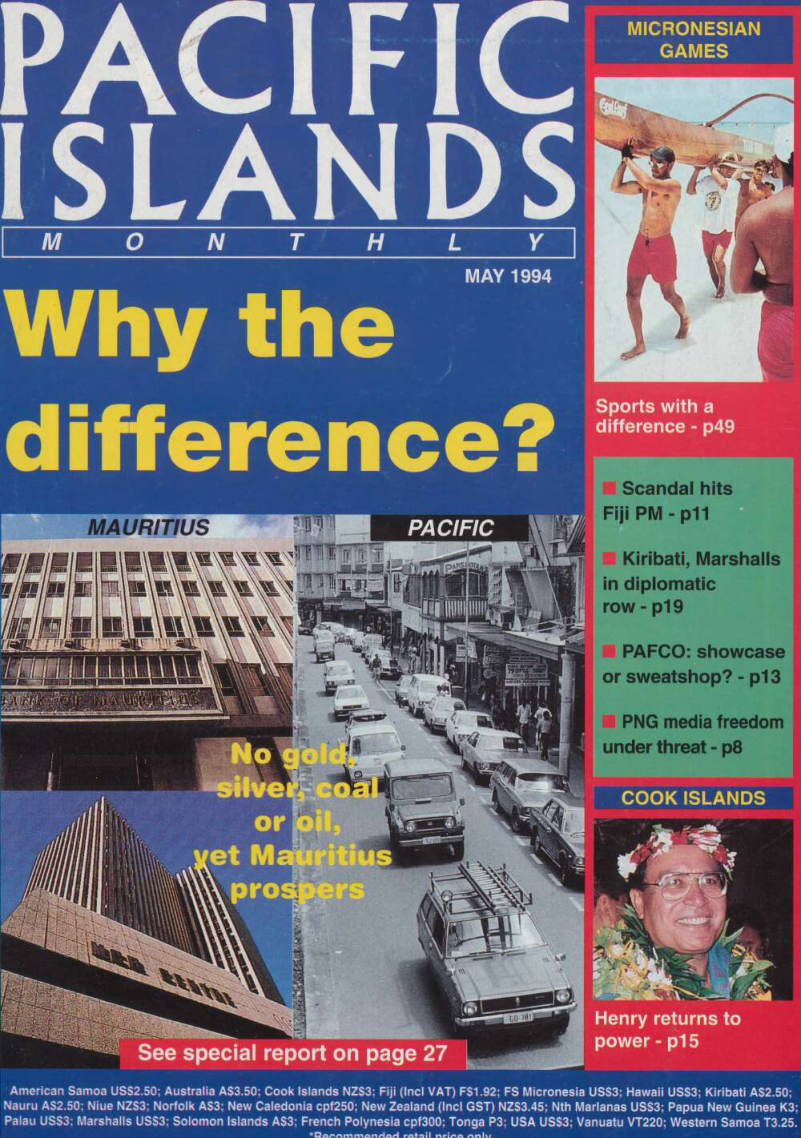
Why the difference?
Mauritius
Pacific
m: m & I \:V^\ I 1
See special report on page 27
t
Sports with a difference - p 49
Scandal hits Fiji PM-pll Kiribati, Marshalls in diplomatic row - pl 9 PAFCO: showcase or sweatshop? - pl 3 PNG media freedom under threat - p 8
T?|»>;a
Henry returns to power - pl 5
American Samoa USS2.SO: Australia A 53.50: Cook Islands NZS3; Fiji (Incl VAT) F 51.92; FS Micronesia US$3; Hawaii USS 3; Kiribati A 52.50; Nauru A 52.50: Niue NZS3: Norfolk AS3: New Caledonia cpf2so; New Zealand (Incl GST) NZ53.45; Nth Marianas US$3; Papua New Guinea K 3; Palau USS 3: Marshalls USS 3: Solomon Islands ASS; French Polynesia cpf3oo; Tonga P 3; USA USS 3; Vanuatu VT22O; Western Samoa T 3.25. roteil nrirfi nnl\/
Advertisements & other items, p. 2 (1 item)
Taste Of
THE SOUTH PACIFIC...
SOUTH PACIFIC
. V
SOUTH PACIFIC
lAGEK
IBIS
iiliiiiS ■i ;: : : Si w •*' * - * ’A #T*~ Bif¥ . -i o . .’l'. -i -5 iv.' v »
SP NQI BEER
Pacific
Islands
Monthly
Vol 64 No. 5
The News Magazine
May 1994
Letters 4
Aid
Budget cuts to blame for US pullout 5 Tiffany moves on 5
Headlines 6
Papua New Guinea
Media freedom under threat 8 Haiveta wants Wingti out 9
Pacific Diary 10
Politics
The Fiji scene 11
Women
PAFCO: showcase or sweatshop? 13
Cook Islands
Henry wins big in election 15
Culture
Excessive kava drinking causes concern in Fiji 17
Aviation
Row brews over closure of Kiribati airport 19
Issue
Serving the disabled in the Pacific 20
The United Nations
Pacific diplomats at sea 23
Environment
Saving the coral from destruction 24
Cover Story
Why Mauritius is so successful 27
Business
Aborigines want slice of economic pie 33 Black pearl industry 35 Business bulletin 36
Building Feature
Industry grows 39 Building a bright future 43
Sport
Surprises at the Hong Kong sevens 53
Yachting
Celebration of rain and royalty 54
Shipping
Shipping schedules 57
Columnists
Jemima Garrett 18 Bill McCabe 22 David Barber 25 ’Atu Emberson-Bain 32 Alfred Sasako 47
Publisher: Brian O’Flaherty Acting Editor: Martin Tiffany Associate Editor: Arvind Kumar Correspondents: Christine Hatcher, David North, Ed Rampell, lan Williams, Johnson Honimae, Karen Mangnall, Liz Thompson, Nicholas Rothwell, Pesi Fonua, Wally Hiambohn.
Columnists; David Barber (Wellington), Futa Helu (Tonga, covering the Pacific Islands), Jemima Garrett (Sydney).
Julian Moti (Pacific Law), Alfred Sasako (The Forum).
Advertising Sales: • Regional Sales (South Pacific; Salendra Narayan, Tel (679) 304111, 303244, Fx (679) 303809. • Sydney, Canberra Bob Hill Media Represen tations. Tel (61-2) 4164245, Fx (61-2) 4165064 • Brisbane: Robert Walker, Media House, Tel (61-7) 3710533, Fx (61-7) 371-8904 • Adelaide: Hastwell Williamsons Representatives, Tel (61-8) 3799522, Fx (61-8) 3799735. • Melbourne: Brown Orr Fletcher Burrows (Aust).
Pty. Ltd. Tel (3) 696 5188 Fx (03) 696 5131. • Auckland: McKay & Bowman, International Media Representatives Ltd, Tel (64-9) 4190561, Fx (64-9) 4192243.
• Japan: Universal Media Corrporation, Tokyo, Tel (3) 32626741, Cable: UNIMEDIA Tokyo, Fx (3) 32626742.
Founded 1930 (USPS 952480). A Fiji Times Limited production.
Cover prices are recommended retail only. Regis tered by Australia Post, Publication No. NBP 1210.
C) Copyright Fiji Times Limited. 177 Victoria Parade. Suva. Fiji. Tel (679) 304111. Fx (679)
303809. Tx Fj2124.
Pacific Islands Monthly is published monthly by The Fiji Times Limited, a division of Nationwide News, 2 Holt Street, Surry Hills. Sydney. NSW 2010.
Send address changes to: • Pacific Islands Monthly, PO Box 1167. Suva, Fiji.
Typeset and printed by The Fiji Times Limited. 177 Victoria Parade, Suva. Fiji.
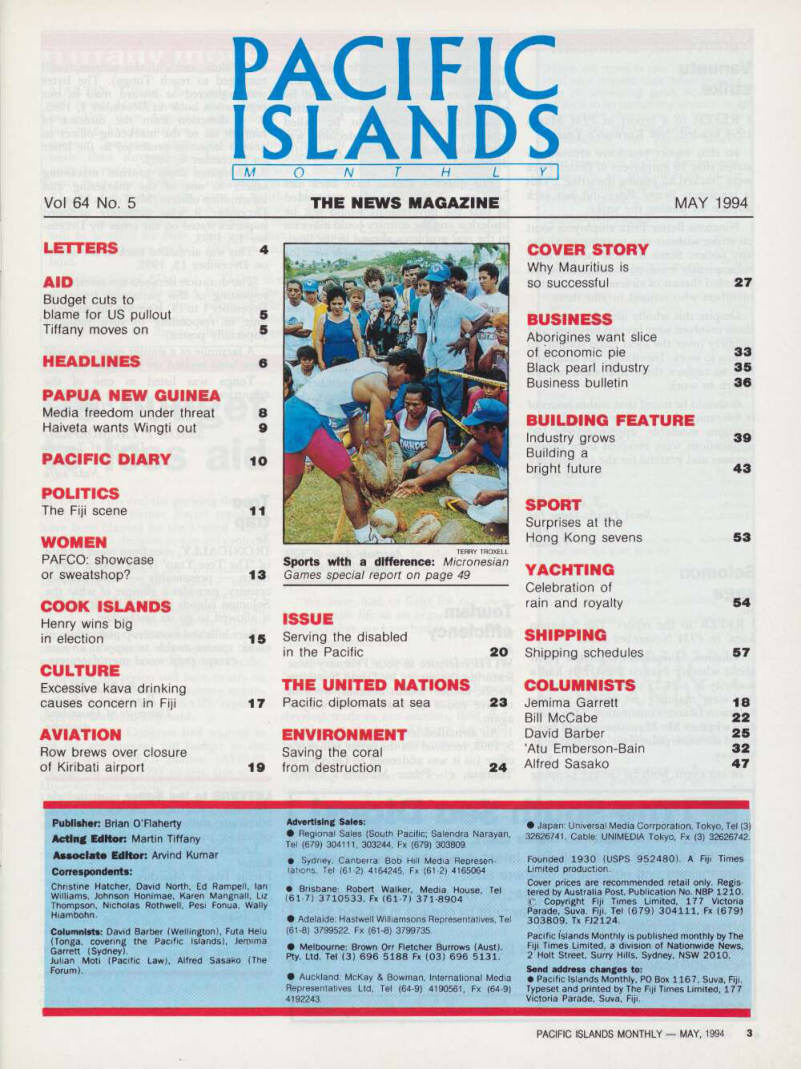
Terry Troxell
Sports with a difference: Micronesian Games special report on page 49
efficiency
Letters
Vanuatu
strike
Sir, I REFER to a report in PIM March 1994 headed ‘Not Korman’s Year’.
In that report you have erroneously stated that 19 employees of Better Price were “sacked for joining the strike”. This is incorrect. Better Price did not sack anyone for joining the strike.
Nineteen Better Price employees went on strike without any warning or giving any notice. Some of these people were subsequently involved in activities which included threats of violence to other staff members who refused to join them.
Despite this wholly illegal conduct all those involved were invited privately and publicly (over the local radio station) to return to work. Inevitably, the company had to replace those that chose not to return to work.
It should be noted that within hours of it becoming known that we had .some positions available, approximately 100 applications were received from people anxious and grateful for the opportunity to find work.
T L Leahy
South Pacific Stores Ltd Port Vila Vanuatu
Solomon
saga
Sir, I REFER to the report ‘The Solomon Saga’ in PIM November 1993.
Solomon Mamaloni raised the point about whether Francis Billy Hilly had a majority in a 24-23 vote split because of the way majority is defined in the Solomon Islands constitution. One won ders whether Mr Mamaloni would have raised the same point if the vote had gone his way.
In any event, both Sir George Lepping
and Justice Palmer made the right decisions though the decisions, especially Mr Justice Palmer’s, were justified by unnecessary, twisted, unsophisticated logic too crude even to be called sophistry. Obviously, the decision was made first by each and then a logic (?) developed to justify it.
The question should have been met head-on 1. that a decision was needed so that the government would not be leaderless and the country could move on to the real problems abroad in the land, 2. that the only options available were for the one with 24 votes to be prime minister or the one with 23 votes and, 3. of those two options, that the one who received 24 votes should be prime minister made more sense.
A third option, if one would want to call it a third option, would be to argue endlessly back and forth with appeal after appeal whether a member of parliament can be cut in half, meanwhile the country dithers.
To prevent future arguments about how many angels can dance on the top of a thumb tack, amend the Solomon Islands constitution to define a majority as “‘/z the number of members plus '/z, or more”. (Or just say majority and be done with it.)
Robert Silberstorf
Apartado Aereo 065629 Medellin, Antioquia Colombia
Tourism
efficiency
Sir, WITH reference to your February issue featuring the survey by David North on Pacific islands’ tourist bureaus, we wish to give you a rundown on this subject
again.
1. An airmailed letter, dated November 5, 1993, received via the prime minister’s office (as it was addressed to Director of Tourism, c/- Prime Minister’s Office,
Nuku’alofa, and with this address, it still managed to reach Tonga). The letter was registered as inward mail in our registration book on December 1, 1993. 2. A direction from the director of tourism on to the marketing officer to answer inquiries presented in the letter on December 6, 1993. 3. Delegated from tourism marketing officer to one of the marketing and information officers (Mr Tu’ula Moa) on December 9 who promptly actioned inquiries stated on the letter by Decem ber 10, 1993. 4. This was airmailed back to the sender on December 13, 1993.
The duration between the receipt and re-posting of this particular letter (ie.
December 1 to 13) is within the accepted time in. responding to such inquiries
(especially posted).
A facsimile of a similar manner would have been replied on the same day.
Tonga was listed as one of the countries that didn’t reply to the survey according to the FIM survey.
Semisi P Taumoepeau
Director of Tourism Tonga Visitors Bureau Nukualofa
Tree
trap
Sir, IRONICALLY, your front cover picture of‘The Tree Trap’ {PIM March 1994), taken presumably from another country, provides a glimpse of what the Solomon Islands will look like if logging is allowed to go on unchecked.
Bare hills and monocrop plantations of exotic species unable to support anyone except pulp wood manufacturers.
Barry Evans
Department of Botany University of Queensland Australia
LETTERS to the Editor must include the writer’s full name, address and home telephone number. All letters may be edited for purposes of clarity and space.
Letters should be addressed to: Editor Pacific Islands Monthly P O Box 1167 Suva
Fiji Islands
OR Fax: (679) 303809
Advertisements & other items, p. 4 (1 item)
The South Sea Digest
The Newsletter on Islands affairs. Every Other Friday.
South Sea Digest has all the latest business news, expectly streamlined and obtainable nowhere else.
Subscriptions: 25 issues SAISO for Australian subscriber; SAI7S overseas, all airmailed. Payment by cheque in $A and SUS, otherwise by bank draft.
Send payment to: The South Sea Digest, GPO Box 4245, Sydney, NSW 2001, Australia.
Name Address
Tiffany moves on
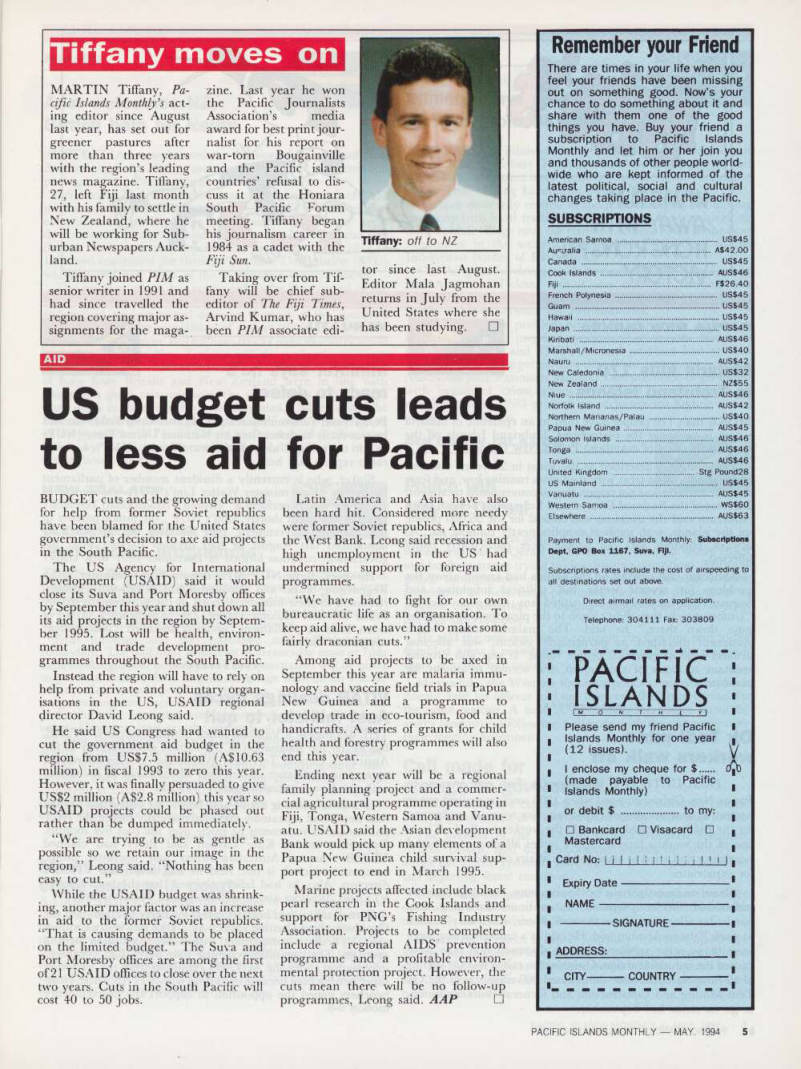
MARTIN Tiffany, Pa cific Islands Monthly’s act ing editor since August last year, has set out for greener pastures after more than three years with the region’s leading news magazine. Tiffany, 27, left Fiji last month with his family to settle in New Zealand, where he will be working for Sub urban Newspapers Auck land.
Tiffany joined PIM as
senior writer in 1991 and had since travelled the region covering major as signments for the maga
zine. Last year he won the Pacific Journalists Association’s media award for best print jour nalist for his report on
war-torn Bougainville
and the Pacific island countries’ refusal to dis cuss it at the Honiara South Pacific Forum
meeting. Tiffany began
his journalism career in 1984 as a cadet with the
Fiji Sun.
Taking over from Tif fany will be chief sub editor of The Fiji Times, Arvind Kumar, who has been PIM associate edi-
tor since last August.
Editor Mala Jagmohan returns in July from the United States where she has been studying. □
Tiffany: off to NZ
US budget cuts leads
Aid
US budget cuts leads to less aid for Pacific
BUDGET cuts and the growing demand for help from former Soviet republics have been blamed for the United States government’s decision to axe aid projects in the South Pacific.
The US Agency for International Development (USAID) said it would close its Suva and Port Moresby offices , o 1 * . iii n by September this year and shut down all •■ 1 • r . , c its aid projects m the region by September 1995. Lost will be health entire.,ment and trade development programmes throughout the South Pacific.
Instead the region will have to rely on
help from private and voluntary organ-
isations in the US, USAID regional director David Leong said.
He said US Congress had wanted to cut the government aid budget in the
region from US$7.5 million (A 510.63
million) in fiscal 1993 to zero this year.
However jt Wa * L nally P ersuaded to S lve US$2 million (As2.B million) this year so USAID projects could be phased out rather than be dumped immediately. r - We are trying to be as gentle as possible so we retain our image in the region, Leong said. Nothing has been easy to cut.
While the USAID budget was shrinking, another major factor was an increase in aid to the former Soviet republics.
“That is causing demands to be placed on the limited budget.” The Suva and Port Moresby offices are among the first of2l USAID offices to close over the next two years. Cuts in the South Pacific will cost 40 to 50 jobs.
Latin America and Asia have also been hard hit. Considered more needy were former Soviet republics, Africa and the West Bank. Leong said recession and high unemployment in the US had undermined support for foreign aid programmes.
“We have had to fight for our own bureaucratic life as an organisation. To keep aid alive, we have had to make some fairly draconian cuts.”
Among aid projects to be axed in September this year are malaria immu nology and vaccine field trials in Papua New Guinea and a programme to develop trade in eco-tourism, food and handicrafts. A series of grants for child health and forestry programmes will also end this year.
Ending next year will be a regional
family planning project and a commer
cial agricultural programme operating in Fiji, Tonga, Western Samoa and Vanu atu. USAID said the Asian development Bank would pick up many elements of a Papua New Guinea child survival sup port project to end in March 1995.
Marine projects affected include black pearl research in the Cook Islands and support for PNG’s Fishing Industry Association. Projects to be completed include a regional AIDS prevention programme and a profitable environ
mental protection project. However, the
cuts mean there will be no follow-up programmes, Leong said. AAP □
Advertisements & other items, p. 5 (1 item)
"Pacific
Remember your Friend
There are times in your life when you feel your friends have been missing out on something good. Now's your chance to do something about it and share with them one of the good things you have. Buy your friend a subscription to Pacific Islands Monthly and let him or her join you and thousands of other people worldwide who are kept informed of the latest political, social and cultural
changes taking place in the Pacific.
SUBSCRIPTIONS
American Samoa US$45 Australia A 542.00 Canada US$45 Cook Islands AUSS46 Fiji F 526.40 French Polynesia US$45 Guam US$45 Hawaii US$45 Japan US$45 Kiribati AUSS46 Marshall/Micronesia US$4O Nauru AUSS42 New Caledonia US$32 New Zealand NZ$55 Niue AUSS46 Norfolk Island AUSS42 Northern Marianas/Palau US$4O Papua New Guinea AUSS4S Solomon Islands AUSS46 Tonga AUSS46 Tuvalu AUSS46 United Kingdom Stg Pound2B US Mainland US$45 Vanuatu AUSS4S Western Samoa WS$6O Elsewhere AUSS63 Payment to Pacific Islands Monthly: Subscriptions Dept, GPO Box 1167, Suva, FIJI.
Subscriptions rates include the cost of airspeeding to all destinations set out above.
Direct airmail rates on application.
Telephone: 304111 Fax: 303809
"PACIFIC
SLANDS
I mouth l r~l Please send my friend Pacific Islands Monthly for one year (12 issues).
I enclose my cheque for $ (made payable to Pacific
Islands Monthly)
or debit $ to my: □ Bankcard □ Visacard □ Mastercard Card No; I i I i ! : i ! i ! : i M Expiry Date
NAME
SIGNATURE
ADDRESS:
CITY COUNTRY
V
oCt>
Ok Tedi mine
Headlines
Papua New Guinea
Malaria kills 170 in Trobriand Islands
MORE than 170 people have died in an epidemic of malaria which is sweeping the picturesque Trobriand Islands off the south west coast of mainland Papua New Guinea.
The epidemic, described as the worst in 20 years, was also proving difficult to treat with medicines running low, and fears that the malaria was not responding to conventional treatment.
Director of the National Disaster and Emergency Service Leith Anderson said the situation was critical for the 36,000 people on the islands, with medical supplies nearly running out. As always, children and old people were particularly badly affected.
Anderson said officials on the islands had known about the problem for several weeks but political infighting and bureaucratic inefficiency had stifled any emergency action.
“Unfortunately they didn’t listen to the pleas for help from the guys down there,” he said. The malarial strain, which Anderson described as particularly vicious, was affecting around nine in every 10 people tested. It was also proving resistant to doses of chloroquin, the normal treatment for malaria. ***
Ok Tedi mine
workers walk off
PRODUCTION at the giant Ok Tedi copper mine in Papua New Guinea stopped when 1000 workers walked out in protest against an alleged expatriate visa scam. A spokesman for the BHP-controlled mine said the workers walked off from one of the world’s largest copper mines alleging a personnel supervisor had tried to bribe foreign affairs officials to get visas
for expatriates.
“Based on investigations by the company, the allegations are unfounded. We’re prepared to continue discussing that particular allegation about the staff officer, when they’re back at work,” the spokesman said. He said at a union meeting there were many other substantial issues discussed that may have caused the industrial action. One concern raised was the regime of 12-hour shifts, an issue that caused 900 members of the Ok Tedi Mining and Construction and General Worker’s union, to go on strike last September.
ready to defect
Vanuatu
Minister says he’s ready to defect
POSTS and Telecommunication Minister Cecil Sinker has said he was ready to defect from his National United Party (NUP) to join the ruling Union of Moderate Parties (UMP), national radio reports said here.
Sinker, who is currently a dissident member of parliament for former prime minister Walter Lini’s NUP, was quoted as saying he would perform a “custom” (traditional) ceremony to mark the event shortly. Lini’s NUP , the junior partner in the Vanuatu Government, split into two factions when he announced last August he had decided to split from the government coalition formed in December 1991 with UMP.
However, three NUP MPs, deputy Prime Minister Sethy Regenvanu, Sinker and Minister of Health Edward Tabisari, remained in their ministerial posts in the government led by Prime Minister Maxime Carlot. Lini now heads a group of seven MPs in parliament, under a so-called “independent
opposition” label.
VITAB dealings forces
Aust minister to quit
THE dealings of a Vanuatu-based betting company, VITAB, has forced the resignation of the deputy chief minister of the Australian Capital Territory, Wayne Berry. This followed a vote of no-confidence in him over his handling of a contract with the Vanuatu-based agency VITAB.
In a debate lasting about nine hours, the opposition argued that Berry had repeatedly and systematically misled the ACT parliament in statements he made over the past five months.
Opposition leader Kate Garnell said Berry had claimed VITAB was an Australian-owned and operated public company, which it is not. And he had mis-stated VITAB’s directors. Also, he had falsely claimed that the bona fides of VITAB’s directors and shareholders had been checked.
Carnell said it had been incorrect for Berry to claim that the Cannberra-based betting agency ACTTAB had won a contract with VITAB in competition with other Australian betting agencies. The opposition claimed that Berry had concealed information about the ACTAB’s expulsion from the Victorian super betting pool because of its links with VITAB.Three cross benchers joined the opposition to support the no-confidence motion 9-8.
British help for Nauru
Nauru
Aust welcomes NZ, . «■■■
AUSTRALIA has welcomed the decision of Britain and New Zealand to help pay a multi-million dollar compensation package to the Pacific island country of Nauru.
Britain and New Zealand have announced payments of SAI2 million each as a contribution to Australia’s $lO7 million compensation package to help Nauru rehabilitate areas devastated by phosphate mining. Australia, New Zealand and Britain shared colonial responsibility for Nauru from 1914 to 1968 and controlled the British Phosphate Commission (BPC) which mined vast areas of the 21-square-kilometre island.
The mining, which has continued under the control of the Nauru government since independence in 1968, caused widespread environmental damage to most of the country’s interior and left the population of almost 10,000 living on the narrow coastal region. Britain has already paid its contribution to Australia, while New Zealand will do so shortly.
Pacific Islands Affairs Minister Gordon Bilney said the offers of help from Britain and New Zealand were in line with Australia’s good relations with the two nations. “We accept these offers in the spirit they were intended,” Bilney said. The Australian compensation package of $lO7 million was agreed at last year’s South Pacific Forum and prevented further legal action by Nauru, which was seeking compensation in the international courts.
Maori campaign
New Zealand
Concern at plans to HIIK9
drop Pacific programme
THE New Zealand Public Service Association is concerned at Rians to drop Pacific Island language news programmes from iational Radio, Staff at Te Reo o Aotearoa, Radio New Zealand’s Maori and Pacific Islands unit, were told of the plan by National Radio manager Sharon Crosbie.
Four full-time and two part-time staff will be made redundant. The half hour broadcast of vernacular news at 7pm each weeknight will be dropped. Three journalists will be hired to produce a short daily English language bulletin on Pacific affairs. Crosby told staff the changes were to make the programming more accessible to a greater number of listeners, and to increase awareness and understanding of Pacific Island issues. However, staff say the strength of their programme is the close links they have with their communities, and their ability to provide news of importance to the communities.
There is nothing in the proposal which would continue that service. They say Pacific Island news programmes aimed fmmarily at Palagi (European) audiences will not win support fom Pacific Island communities, and the proposals amount to ethnic cleaning of National Radio. ***
Maori campaign
could end up in court
A CAMPAIGN to increase the number of Maori parliamen tary seats by boosting the Maori electoral roll is likely to end up in court. Maori voters have the choice of being listed on the general roll or on the Maori roll, whose size will determine the number of Maori seats under the new proportional electoral system to be introduced for the next election. The Maori Congress believes a legal challenge is their last hope for boosting Maori electoral representation.
Minister says much HKI
Australia
to learn from Ok Tedi
AUSTRALIA’S minister for Aboriginal and Torres Strait Island Affairs, Robert Tickner, says Aboriginal people and Australian companies have much to learn from the experience of Ok Tedi Mining Limited in Papua New Guinea.
Tickner especially refered to the relationship of the mining company with local traditional landowners. He was speaking from a small village near the remote Ok Tedi Mine in the Star Mountains in the western province of PNG, close to the Indonesian border of Irian Jaya.
On the guns-for-drugs trade between Papua New Guinea and Australia, Tickner said it was not only thriving but increasing. He said this was largely due to poor or non-existent border security between the two countries.
Tickner said the problem needed to be urgently addressed.
He said the lack of proper surveillance between the islands in the Torres Strait and PNG’s western province had created what he called forgotten frontier. Two years ago, former Australian justice minister Michael Tate promised to get tough with organised crime gangs who were buying crates of marijuana from PNG growers in exchange for high-powered automatic weapons.
stay at Qerasi
Solomon Islands
Police will
SOLOMON Islands police say they’ll continue to deploy field force personnel at Qerasi on north New Georgia where chiefs and landowners are trying to close logging operations. Assistant police commissioner operations John Homelo said a fresh contingent of field force personnel had been dispatched to monitor the situation at logging camps owned by Golden
Springs International.
He said the new contingent replaced the first one sent to the troubled areas a month ago. Homelo described the situation there as quiet but unpredictable.
Meanwhile, the Western Province police commander, Dick Alenia, said his officers had not been recalled from Qerasi for the same reasons. A total of eight bulldozers were burnt by angry landowners following a dispute with the company over their logging agreement.
Call made for
change to government
THERE has been a call for a change to the Solomon Islands form of government as a way forward for the country’s future.
The premier of the Solomon Islands’ Western Province, Arthur Unusu, said his government wanted the country to adopt the federal system of government as a way to control its fast depleting forest resources.
Unusu said his province was fed up with requesting more devolution of powers to enable it to have more control over its natural resources without any success.
He said the Western Province had only been paid lip service for the exploitation of its resources for the last 10 years. Unusu said the federal system of government had been agreed to by the Premiers’ Conference in 1992 but no further progress had been made to date.
PNG media freedom comes under threat
Papua New Guinea
EARLY last month Papua New Guinea faced threats to two key principles of its constitution unity and media freedom.
In the face of a likely abolition by parliament of the expansive and expens ive provincial government, premiers of the five island provinces got together to discuss their governments’ future with secession being a possibility. Like Bou gainville, which is one of the five island provinces, the others had already openly threatened secession if the national government did not back down on its moves for which legislation had already been drafted. In Rabaul, the Islands Regional Secretariat had drawn up a draft plan of action for the new Feder ated Melanesian Republic to comprise the provinces of Manus, New Ireland, and East and West New Britain, with an option for Bougainville to join if it wanted to.
The premiers are opposed to any change of the decentralisation process, at least for them, because they believe the system had worked for them in so far as achieving development aspiration was concerned. The national government’s main reason for proposing the change was that provincial governments (there are 19 of them) had been a failure, and were a complete waste of public money, absorbing a third of the annual budget but showing little for their existence for the past 18 years. Many provinces had been suspended for mismanagement and misuse of public monies and several leaders jailed as a result. Said Islands Premiers’ Conference chairman Bernard Voage on West New Britain: “To abolish the provincial government system is similar to breaking the power-sharing arrangements that had been established between the national government and the people of this country.
“The Islands people therefore see the proposed Bill to abolish provincial gov ernments and replace them with provin cial authorities with limited legislative powers as a breach of the power-sharing contract.
“I call on the government to be more cautious and sensitive when dealing with issues that can make or break our great country, PNG.”
Whether the Islands premiers were serious about secession and had the support of their population or not, or were merely using the threat to hold onto ?ower is an issue that remains to be seen, he national government’s reaction to this was to consider laying charges of sedition against those leaders concerned, and in a surprise move banned the state funded but independent National Broad casting Commission from reporting any discussions out of the premiers’ confer-
ence. The Broadcasting Act, while call ing for the NBC to provide “balanced,
objective and impartial broadcasting
services”, also authorises the minister to prohibit the commission from broadcast ing matters specified by him or request the commission to refrain from broad casting certain matters.
In his order to the NBC, Communica tions and Information Minister Martin Thompson said: “Let me remind the commission that whilst it is our duty to
provide a balanced, objective and impar
tial broadcasting service, it is paramount that such services should reflect our drive for national unity and that we should take extreme care in broadcasting ma terial that could inflame racial or
sectional feeling.”
NBC chairman Sir Alkan Tololo said it was it was an order they had to comply with. The whole media fraternity, the parliamentary opposition and the prem iers concerned went to town the next day
denouncing the ban. The biggest daily,
the Post-Courier , dedicated its first three news pages, and the main features page to stories on the ban. Thompson ex plained that next day that his actions were intended to “protect” NBC journal ists. He said in the case of the Islands premiers, there was a “fine line” separat ing politics and criminals acts, and these leaders were treading closer to that fine line. Thompson said if the police were to move in and arrest any of the leaders, it was his “duty to protect my journalists”.
He admitted that the ban conflicted with the Journalists Code of Ethics. In its criticism, the opposition said the ban was a government move to “muzzle” the media. Leader Chris Haiveta said the ban was “childish, unconstitutional and unprecedented”. “We cannot kill se cession by banning any discussion on it,” he said.
Haiveta said it was silly of the government to all of a sudden resort to censorship when it came to secession
when right throughout the Bougainville
crisis another secessionist issue all media had covered it extensively.
“If Mr Thomson is concerned about the secessionist overtones of the Kimbe
meeting, what does he imagine Bougain
ville is all about?” Haiveta asked.
There was a certain amount of irony in Thompson’s order on the NBC. It was a complete about-turn to his National Policy on Information and Communica
tion, a 79-page document presented by
him and adopted by parliament only 37 days earlier on March 1. The policy, which covers all aspects of communica tions, is also graced with continuous proclamation of the rights of the people to information and the freedom of the media. In fact, the very second sentence of the preamble states clearly: “The people of Papua New Guinea past, present and to come acknowledge that communication in all its modes and forms is a basic right through which men, women and children share life, experi ence, ideas, values, hopes, and aspir ations to build community.
“We acknowledge that communica tion is a right equal with all others. It includes the right to inform and to be informed, the right to freedom of ex pression, the right to freedom of infor mation and assembly, and the right to communication opportunities. It is sub ject only to the rights of others under the National Constitution.”
On access to information, the policy states that all media providers, whether public or private, must base their policies and strategies on a commitment to provide increased levels of access to information and communication services to the entire population.
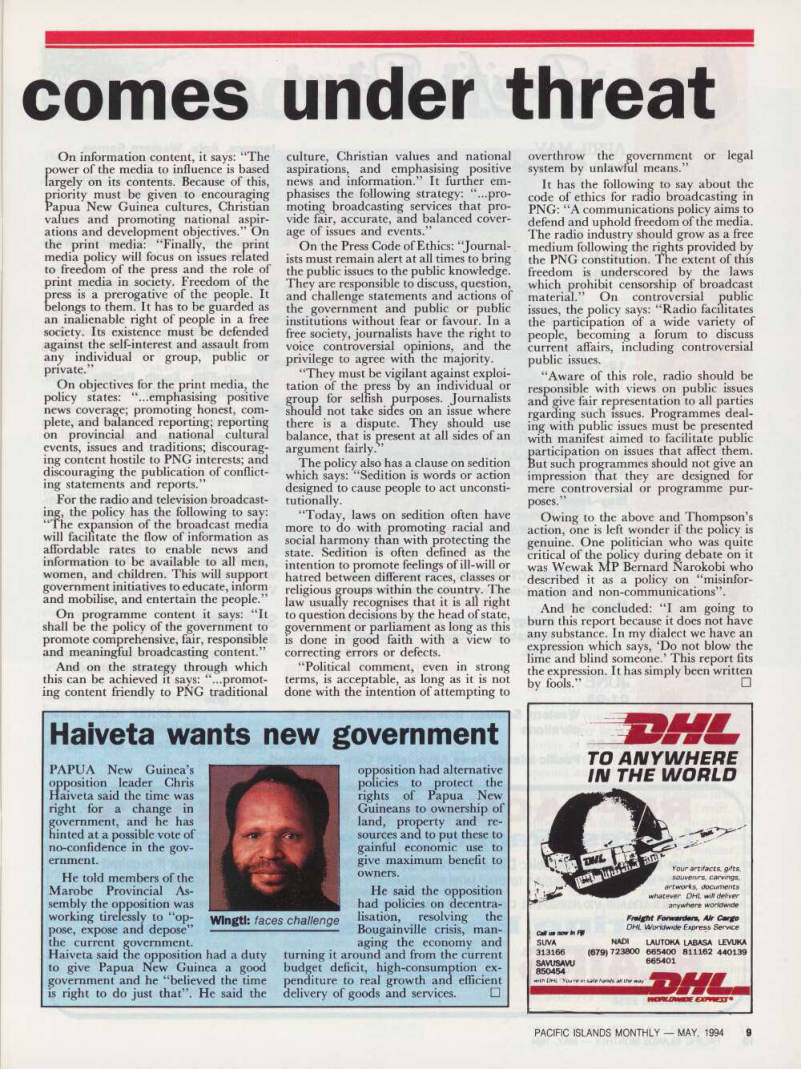
Downtown Port Moresby: ban angered the media fraternity, the parliamentary oppostion and the premiers concerned
On information content, it says: “The {lower of the media to influence is based argely on its contents. Because of this, priority must be given to encouraging Papua New Guinea cultures, Christian values and promoting national aspir ations and development objectives.” On the print media: “Finally, the print media policy will focus on issues related to freedom of the press and the role of print media in society. Freedom of the Eress is a prerogative of the people. It elongs to them. It has to be guarded as an inalienable right of people in a free society. Its existence must be defended against the self-interest and assault from any individual or group, public or
private.”
On objectives for the print media, the
policy states: “...emphasising positive
news coverage; promoting honest, com plete, and balanced reporting; reporting on provincial and national cultural events, issues and traditions; discourag ing content hostile to PNG interests; and discouraging the publication of conflict ing statements and reports.”
For the radio and television broadcast ing, the policy has the following to say: “The expansion of the broadcast media will facilitate the flow of information as affordable rates to enable news and information to be available to all men, women, and children. This will support government initiatives to educate, inform and mobilise, and entertain the people.”
On programme content it says: “It shall be the policy of the government to promote comprehensive, fair, responsible
and meaningful broadcasting content.”
And on the strategy through which this can be achieved it says: “...promot ing content friendly to PNG traditional
culture, Christian values and national
aspirations, and emphasising positive
news and information.” It further em
phasises the following strategy: “...pro
moting broadcasting services that pro vide fair, accurate, and balanced cover age of issues and events.”
On the Press Code of Ethics: “Journal ists must remain alert at all times to bring the public issues to the public knowledge.
They are responsible to discuss, question,
and challenge statements and actions of the government and public or public institutions without fear or favour. In a free society, journalists have the right to voice controversial opinions, and the privilege to agree with the majority.
“They must be vigilant against exploi
tation of the press by an individual or group for selfish purposes. Journalists should not take sides on an issue where there is a dispute. They should use balance, that is present at all sides of an argument fairly. ’
The policy also has a clause on sedition which says: “Sedition is words or action designed to cause people to act unconsti
tutionally.
“Today, laws on sedition often have more to do with promoting racial and social harmony than with protecting the state. Sedition is often defined as the intention to promote feelings of ill-will or hatred between different races, classes or religious groups within the country. The law usually recognises that it is all right to question decisions by the head of state, government or parliament as long as this is done in good faith with a view to correcting errors or defects.
“Political comment, even in strong terms, is acceptable, as long as it is not done with the intention of attempting to
overthrow the government or legal system by unlawful means.”
It has the following to say about the code of ethics for radio broadcasting in PNG: “A communications policy aims to defend and uphold freedom of the media.
The radio industry should grow as a free medium following the rights provided by the PNG constitution. The extent of this freedom is underscored by the laws which prohibit censorship of broadcast material.” On controversial public issues, the policy says: “Radio facilitates the participation of a wide variety of people, becoming a forum to discuss current affairs, including controversial public issues.
“Aware of this role, radio should be responsible with views on public issues and give fair representation to all parties rgarding such issues. Programmes deal ing with public issues must be presented with manifest aimed to facilitate public participation on issues that affect them.
But such programmes should not give an impression that they are designed for mere controversial or programme pur
poses.”
Owing to the above and Thompson’s action, one is left wonder if the policy is genuine. One politician who was quite critical of the policy during debate on it was Wewak MP Bernard Narokobi who described it as a policy on “misinfor mation and non-communications”.
And he concluded: “I am going to burn this report because it does not have any substance. In my dialect we have an expression which says, ‘Do not blow the lime and blind someone.’ This report fits the expression. It has simply been written by fools.” □
Haiveta wants new government
PAPUA New Guinea’s opposition leader Chris Haiveta said the time was right for a change in government, and he has hinted at a possible vote of no-confidence in the gov ernment.
He told members of the Marobe Provincial As sembly the opposition was
working tirelessly to “op
pose, expose and depose”
the current government.
Haiveta said the opposition had a duty to give Papua New Guinea a good government and he “believed the time is right to do just that”. He said the
opposition had alternative policies to protect the rights of Papua New Guineans to ownership of land, property and re sources and to put these to gainful economic use to give maximum benefit to owners.
He said the opposition had policies on decentra lisation, resolving the Bougainville crisis, man
aging the economy and turning it around and from the current budget deficit, high-consumption ex penditure to real growth and efficient delivery of goods and services. □
Wingti: faces challenge
Advertisements & other items, pp. 9-10 (1 item)
To Anywhere
IN THE WORLD
•out.
l J Your artifacts, gifts, souvenirs, carvings, artworks, documents whatever. DHL will deliver anywhere worldwide f might Forwarder % Air Cargo DHL Worldwide Express Service Cat utnowln F 9
SUVA NADI LAUTOKA LABASA LEVUKA
313166 (679)723800 665400 811162 440139
SAVUSAVU 665401
850454 DHL "You're m sate hands
i i /// 'jy
r Dmra
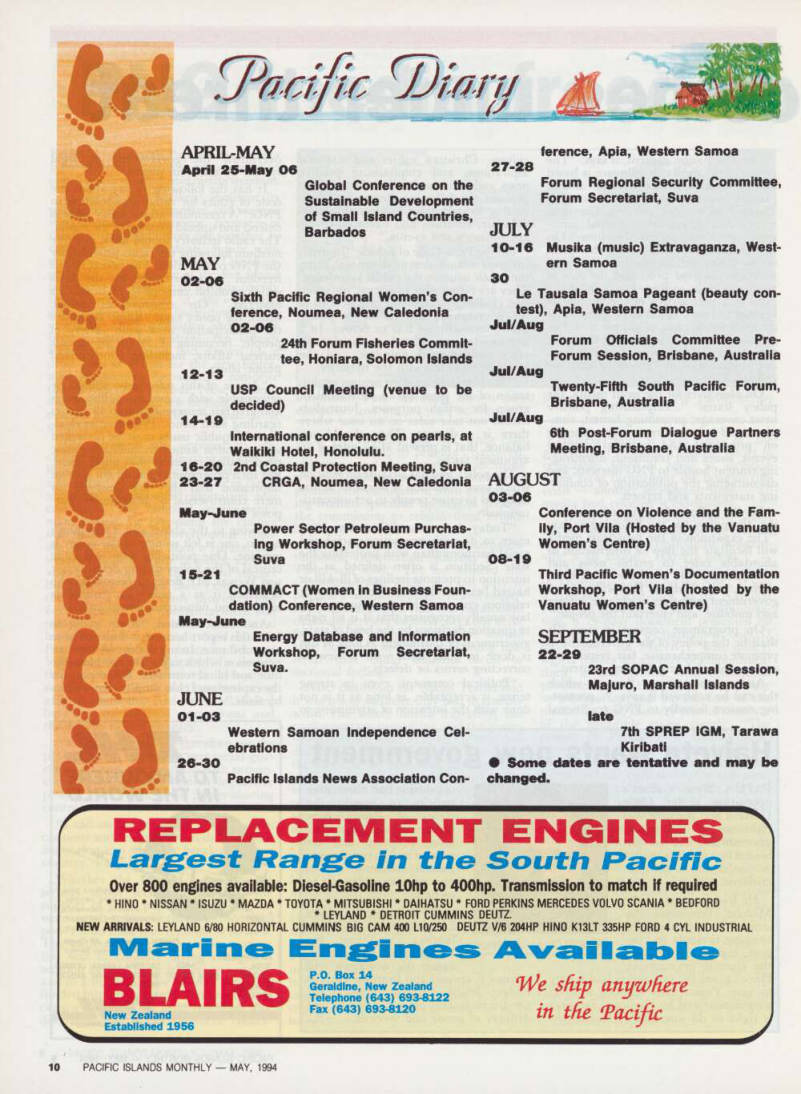
APRIL-MAY
April 25-May 06 Global Conference on the Sustainable Development of Small Island Countries, Barbados
MAY
02-06 Sixth Pacific Regional Women’s Conference, Noumea, New Caledonia 02-06 n n n 24th Forum Fisheries Committee, Honiara, Solomon Islands 12-13 USP Council Meeting (venue to be decided) 14- International conference on pearls, at Waikiki Hotel, Honolulu. 16-20 2nd Coastal Protection Meeting, Suva 23-27 CRGA, Noumea, New Caledonia May-June Power Sector Petroleum Purchasing Workshop, Forum Secretariat, Suva 15- COMMACT (Women in Business Foundation) Conference, Western Samoa May-June Energy Database and Information Workshop, Forum Secretariat, Suva.
JUNE
01-03 Western Samoan Independence Celebrations 26-30 Pacific Islands News Association Conference, Apia, Western Samoa 27-28 Forum Regional Security Committee, Forum Secretariat, Suva
JULY
10-16 Musika (music) Extravaganza, Western Samoa 30 Le Tausala Samoa Pageant (beauty contest), Apia, Western Samoa Jul/Aug Forum Officials Committee Pre- Forum Session, Brisbane, Australia Jul/Aug Twenty-Fifth South Pacific Forum, Brisbane, Australia Jul/Aug 6th Post-Forum Dialogue Partners Meeting, Brisbane, Australia
AUGUST
03-06 Conference on Violence and the Family, Port Vila (Hosted by the Vanuatu Women’s Centre) 08-19 Third Pacific Women’s Documentation Workshop, Port Vila (hosted by the Vanuatu Women’s Centre)
SEPTEMBER
22-29 23rd SOPAC Annual Session, Majuro, Marshall Islands late 7th SPREP IGM, Tarawa Kiribati • Some dates are tentative and may be changed.
REPLACEMENT ENGINES >
Largest Range in the South Pacific
Over 800 engines available: Diesel-Gasoline lOhp to 400 hp. Transmission to match if required * HINO * NISSAN * ISUZU * MAZDA * TOYOTA * MITSUBISHI * DAIHATSU * FORD PERKINS MERCEDES VOLVO SCANIA * BEDFORD
* LEYLAND * DETROIT CUMMINS DEUTZ.
NEW ARRIVALS: LEYLAND 6/80 HORIZONTAL CUMMINS BIG CAM 400 LlO/250 DEUTZ V/6 204 HP HINO KI3LT 335 HP FORD 4 CYL INDUSTRIAL
Marine Engines Available
BLAIRS
New Zealand Established 1956 P.O. Box 14 Geraldine, New Zealand Telephone (643) 693-8122 Fax (643) 693-8120
We ship anywhere
in the Pacific
Scandal hits govt
Politics - Fiji
By Fiona Phillips
PRIME Minister Sitiveni Ra buka’s government was rocked by a scandal last month when alle gations of adultery surfaced. The Suva-based local news magazine, The Review, published a report
containing allegations of Rabuka
having had sex with a female journalist last year, while attend
ing a provincial council meeting on
the island of Taveuni.
The issue was first raised during a caucus meeting of the ruling Soqosoqo ni Vakavulewa ni Taukei Party by a dissident group of five backbenchers, led by former cabinet minister and once staunch Rabuka supporter, Ratu Inoke Kubuabola.
This was followed by a letter to the prime minister by the group, which was leaked to The Fiji Times , newspaper just days before the tabling of the revised 1994 Budget.
In the letter, the dissident group asked Rabuka to resign immedi ately. They raised two issues which they said would have serious impli cations on government’s account ability in running the affairs of the
nation. They questioned Rabuka’s pro moting of Fiji as a Christian country in light of his adulterous encounter, and his promoting a government of national unity without seeking the blessing of the Great Council of Chiefs.
However, members of the government coalition the SVT, the General Voters Party and independents rallied be hind the prime minister and confirmed their support for him despite the alle gations. A government statement issued by Information Minister Ratu Josefa Dimuri said the allegations against the prime minister had been fully resolved “within the context in which it was raised”.
“For the SVT and GVP caucus, it is a closed matter,” the statement said.
“Their attention is now focused on the 1994 Budget Bill which they will support with total unity and solidarity.”
Ratu Josefa said the prime minister had again referred the matter to the SVT parliamentary caucus and had been “unequivocally open and candid in explaining his position to his parliamen tary caucus colleagues”. He later said that government ministers had denied
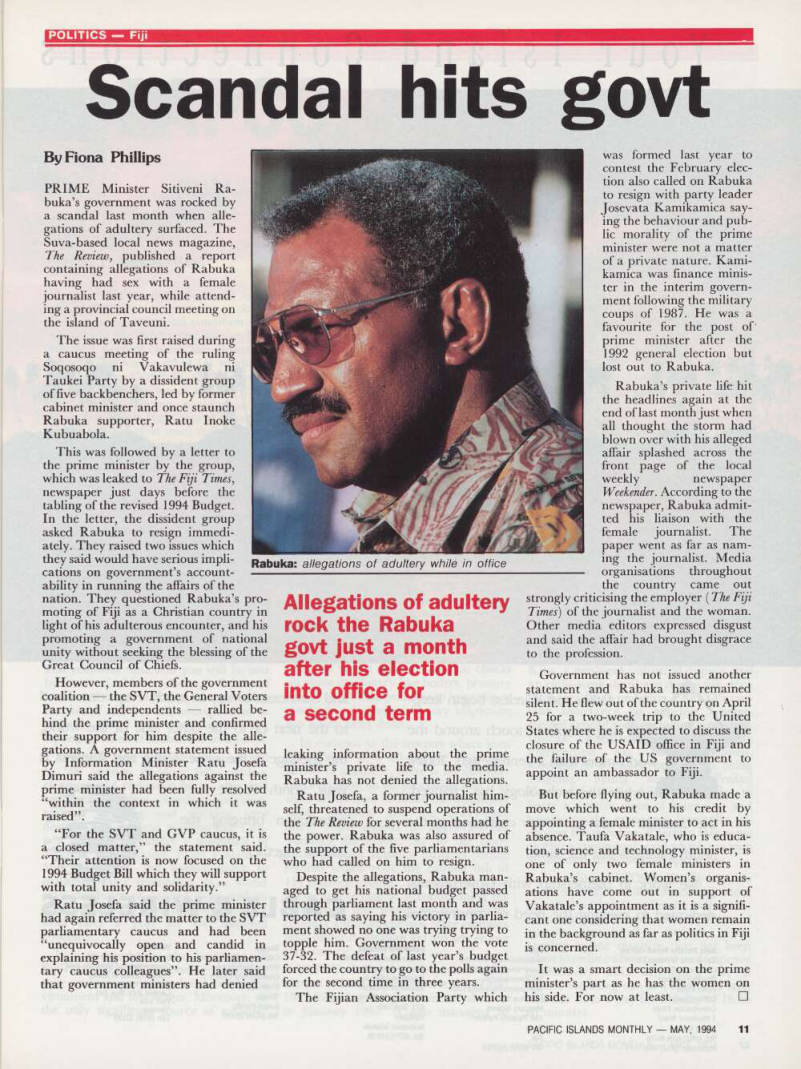
Allegations of adultery rock the Rabuka govt Just a month after his election into office for a second term
leaking information about the prime minister’s private life to the media.
Rabuka has not denied the allegations.
Ratu Josefa, a former journalist him self, threatened to suspend operations of the The Review for several months had he the power. Rabuka was also assured of the support of the five parliamentarians who had called on him to resign.
Despite the allegations, Rabuka man aged to get his national budget passed through parliament last month and was reported as saying his victory in parlia ment showed no one was trying trying to topple him. Government won the vote 37-32. The defeat of last year’s budget forced the country to go to the polls again for the second time in three years.
The Fijian Association Party which
was formed last year to contest the February elec tion also called on Rabuka to resign with party leader Josevata Kamikamica say ing the behaviour and pub lic morality of the prime minister were not a matter of a private nature. Kami kamica was finance minis ter in the interim govern
ment following the military
coups of 1987. He was a favourite for the post of prime minister after the 1992 general election but lost out to Rabuka.
Rabuka’s private life hit the headlines again at the end of last month just when all thought the storm had blown over with his alleged affair splashed across the front page of the local
weekly newspaper
Weekender. According to the newspaper, Rabuka admit ted his liaison with the female journalist. The paper went as far as nam
ing the journalist. Media
organisations throughout
the country came out
strongly criticising the employer (The Fiji
Times) of the journalist and the woman.
Other media editors expressed disgust and said the affair had brought disgrace to the profession.
Government has not issued another statement and Rabuka has remained silent. He flew out of the country on April 25 for a two-week trip to the United States where he is expected to discuss the closure of the USAID office in Fiji and the failure of the US government to appoint an ambassador to Fiji.
But before flying out, Rabuka made a move which went to his credit by appointing a female minister to act in his absence. Taufa Vakatale, who is educa tion, science and technology minister, is one of only two female ministers in Rabuka’s cabinet. Women’s organis ations have come out in support of Vakatale’s appointment as it is a signifi cant one considering that women remain in the background as far as politics in Fiji is concerned.
It was a smart decision on the prime minister’s part as he has the women on his side. For now at least. □
Rabuka: allegations of adultery while in office
Advertisements & other items, p. 12 (1 item)
Your Island Connections
I f *■
Cable and Wireless began keep-
r ing people in touch around the world more than a century ago. Today
while the technology has changed,
the tradition of service to our customers in the
South Pacific is just the same.
We work in partnership with Governments,
dedicated to meeting the need of communities and businesses to stay in touch. From one island to the next or to the other side of the world, the message is the same: Cable and Wireless is
your South Pacific
connection bringing the
islands together.
CABLE & WIRELESS
Asia Pacific Head Office Cable and Wireless pic Cable and Wireless (Pacific) Limited 22nd Floor Office Tower Convention Plaza 1 Harbour Road Hong Kong Tel: (852) 848 8620 Facsimile: (852) 868 5195 Fiji In association with the Government of Fiji Fiji International Telecommunications Ltd.
PO. Box 59 Mercury House 158 Victoria Parade Suva Fiji Tel: (679) 312933 Solomon Islands In association with the Government of the Solomon Islands Solomon Telekom Company Limited PO. Box 148 Honiara Solomon Islands Tel: (677) 21576 Tbnga Cable and Wireless pic Private Mail Bag 4 General Post Office Nuku Alofa Tonga South Pacific Tel: (676) 23499 Vanuatu In association with the Government of Vanuatu and France Cdbles el Radio Telecom Vanuatu Limited P.O. Box 146 Port Vila Vanuatu Tel: (678) 22185
or sweatshop?
Women
PAFCO: showcase or sweatshop?
By’ Atu Emberson-Bain
IF you’re feeling that advancing age is taking its toll on your senses and I don’t mean your mental condition a walk down the production line at Fiji’s premier tax-free tuna fish plant in Levuka (known as PAFCO) might be just the tonic. Certainly, the experience reactivated all my senses and the mem ory remains sharply evocative. The mountain range that rises majestically over the single street town that once was the country’s capital has a haunting beauty. What goes on behind the scenes at the government-owned cannery is equally haunting, though in rather different ways.
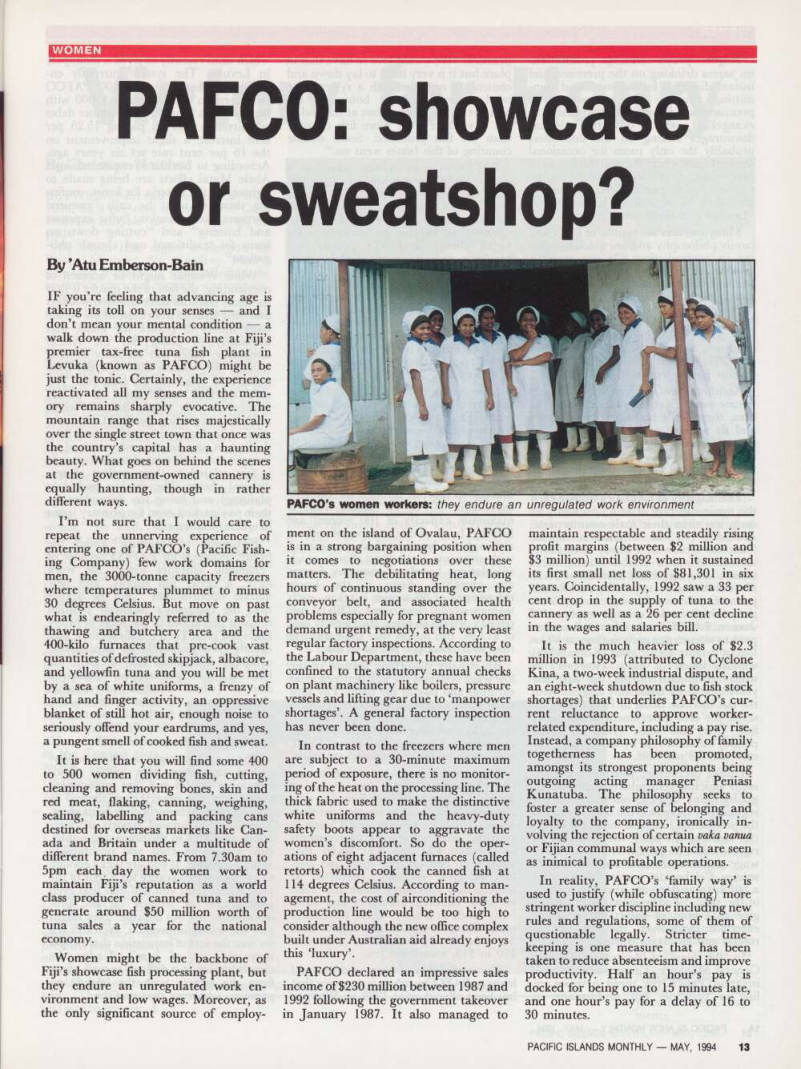
I’m not sure that I would care to repeat the unnerving experience of entering one of PAFCO’s (Pacific Fish ing Company) few work domains for men, the 3000-tonne capacity freezers where temperatures plummet to minus 30 degrees Celsius. But move on past what is endearingly referred to as the thawing and butchery area and the 400-kilo furnaces that pre-cook vast quantities of defrosted skipjack, albacore, and yellowfin tuna and you will be met by a sea of white uniforms, a frenzy of hand and finger activity, an oppressive blanket of still hot air, enough noise to seriously offend your eardrums, and yes, a pungent smell of cooked fish and sweat.
It is here that you will find some 400 to 500 women dividing fish, cutting, cleaning and removing bones, skin and red meat, flaking, canning, weighing, sealing, labelling and packing cans destined for overseas markets like Can ada and Britain under a multitude of different brand names. From 7.30 am to spm each day the women work to maintain Fiji’s reputation as a world class producer of canned tuna and to generate around $5O million worth of tuna sales a year for the national economy.
Women might be the backbone of
Fiji’s showcase fish processing plant, but
they endure an unregulated work en vironment and low wages. Moreover, as the only significant source of employ-
ment on the island of Ovalau, PAFCO is in a strong bargaining position when it comes to negotiations over these matters. The debilitating heat, long hours of continuous standing over the conveyor belt, and associated health problems especially for pregnant women demand urgent remedy, at the very least regular factory inspections. According to the Labour Department, these have been confined to the statutory annual checks on plant machinery like boilers, pressure vessels and lifting gear due to ‘manpower
shortages’. A general factory inspection
has never been done.
In contrast to the freezers where men are subject to a 30-minute maximum period of exposure, there is no monitor ing of the heat on the processing line. The thick fabric used to make the distinctive white uniforms and the heavy-duty safety boots appear to aggravate the women’s discomfort. So do the oper
ations of eight adjacent furnaces (called
retorts) which cook the canned fish at 114 degrees Celsius. According to man agement, the cost of airconditioning the production line would be too high to consider although the new office complex built under Australian aid already enjoys this ‘luxury’.
PAFCO declared an impressive sales income of $230 million between 1987 and 1992 following the government takeover in January 1987. It also managed to
maintain respectable and steadily rising profit margins (between $2 million and S 3 million) until 1992 when it sustained its first small net loss of 581,301 in six years. Coincidentally, 1992 saw a 33 per cent drop in the supply of tuna to the cannery as well as a 26 per cent decline in the wages and salaries bill.
It is the much heavier loss of 52.3 million in 1993 (attributed to Cyclone Kina, a two-week industrial dispute, and an eight-week shutdown due to fish stock shortages) that underlies PAFCO’s cur rent reluctance to approve worker related expenditure, including a pay rise.
Instead, a company philosophy of family togetherness has been promoted, amongst its strongest proponents being outgoing acting manager Peniasi Kunatuba. The philosophy seeks to foster a greater sense of belonging and loyalty to the company, ironically in volving the rejection of certain vaka vanua or Fijian communal ways which are seen as inimical to profitable operations.
In reality, PAFCO’s ‘family way’ is used to justify (while obfuscating) more
stringent worker discipline including new
rules and regulations, some of them of questionable legally. Stricter time keeping is one measure that has been taken to reduce absenteeism and improve productivity. Half an hour’s pay is docked for being one to 15 minutes late, and one hour’s pay for a delay of 16 to 30 minutes.
PAFCO’s women workers: they endure an unregulated work environment
Regular prayer meetings, prohibitions on yaqona drinking on the premises, and instant dismissal for anyone found com mitting adultery (off as well as on premises) are administered with similar evangelical zeal. The unwritten rule that discourages talking on the line offers probably the only room for occasional disobedience when the watchful eyes of supervisors are averted. As for the ban on adultery, it is not difficult to enforce according to a smiling Kunatuba “Levuka is a small town!”
Many workers are cynical of PAFCO’s family philosophy and are quick to point out its contradictions. As one working mother of four put it: “the Acting Manager told us that they are concerned mostly with our family welfare. But if they are concerned with our family welfare they should look into our needs, that are concerning our wages, the condition of the work and our working place. How could they say that they are for our family welfare?”
Another view expressed by a male freezer worker is equally blunt. “Now the boss, they don’t bother to come down and sit with us and have one bowl of grog. If you drink, you are chased out from the company, you go home. Now we just like the cat and the rat they stay on that side, we stay on this side”.
The majority of PAFCO’s women earn the minimum rate of $1.65 an hour, 12 cents less than their male counterparts.
According to the submission of the National Union of Factory and Com mercial Workers Union during arbi tration last year, this is as much as $1.17 short of the base rate paid by the tobacco
processing Central Manufacturing Com
pany which is also a large employer of women. PAFCO’s rate is better than that paid to women cannery workers at Voko Ltd, a private sector joint (Korean-Fiji) venture based in Suva. However, its wage movements during the past few years have been noticeably sluggish with the last increase being in 1990 under the seven per cent government wage guide line. Over the same (1990 to 1993) period, inflation rose by between 17 per cent and 18 per cent.
Unlike the former Japanese manage ment which is remembered with nostal gia by many PAFCO old hands for the regular pay increases, the bosses’ visits to the production line, and the sharp knives (for cleaning the fish!), the current local regime offers no productivity bonuses or wage adjustments after long periods of service. Celebratory parties thrown after a big job was done are also now a thing of the past. “Today management don’t give that kind of entertainment, they entertain themselves, they go out to resorts and entertain themselves.”
In the view of Australian Deputy General Manager (Finance and Admin istration) Paul Kirby, merit increases are fine in principle but problematic in
practice. “We would love to have that in place but it is very hard to lay down and control, to organise such a system. We tried to implement a bonus on the number of fish cleaned but at the end of the day, there were more fish counted than the fish processed. Some double counting of fish bones went on.”
PAFCO’s wage system takes on a special significance when one considers that the work performed by women requires skill, precision and efficiency (all qualities readily acknowledged by man agement to explain its preference for hiring them). PAFCO’s promotional brochure indeed describes the contri bution of “hundreds of skilled women [who] methodically divide the fish, remove skin and bones, and clean and prepare the meat for canning.” Com pany employment data also reveals that about 45 per cent of women employees have a minimum seven years experience with 20 per cent between 16 and 23 years of experience.
Moreover, although total numbers on the payroll can swell to as many as 1000 with the bulk of the extras being temporary shift workers, there is a ceiling of just 300 women workers (six lines of 50 working back to back) in the pre-canning cleaning area. The crude implication of this is that any increases in the daily tonnage of fish put through the cannery (averaging 50 to 75 tonnes with a maximum capacity of 100 tonnes) are handled by the same number of women although the hours worked may extend with overtime until Bpm. Some quick calculations based on company figures are revealing. Even if the lower throughput of 50 tonnes is taken, each woman would clean some 3731 b of fish per day or 471 b an hour. Paid a daily rate of $13.94, this means that she earns less than four cents per pound of fish.
An equally disturbing feature of the low wage system is the gulf between gross earnings and pay in the hand. Pay slips show weekly earnings of nearly $7O for a 42 and a half hour week with net pay for the lucky ones hovering close to $4O after deductions for tax, Provident Fund, insurance and the credit union are made.
But actual disposable income is even less than this because just about all women workers have been forced to take out hefty bank loans to supplement their wages. The loans have proved a ‘curse in disguise’, demanding weekly repayments of between $2O and $3O, levies that amount to between one-third and one half of gross earnings. Deducted at source, they effectively mean that cash for food, children, transport and other basic needs in a town where the cost of many things is significantly higher than Suva, habitually dwindles to as little as $lO to $l5, sometimes less.
The availability of unsecured personal loans to PAFCO workers is a service that has been offered since 1988 by Westpac
which until recently enjoyed a monopoly in Levuka. The system currently en snares between 400 and 500 PAFCO employees in debts of up to $3OOO with some women running two or more debts concurrently and all paying 15.25 per cent interest, a slight improvement on the 16 per cent rate set six years ago.
According to Levuka Westpac manager Abele Matai efforts are being made to tighten up the criteria for loans, confin ing them to what he calls “essential purposes like education, living expenses and housing” and “cutting down on loans for traditional and church obli gations”.
While Westpac might be accused of overlending, the fact of the matter is that its credit facilities have shielded workers and their families from destitution. As the bank moves to reduce the loans, and ultimately to phase out the system altogether, times will certainly become tougher for workers although the debt noose may loosen in the long run. The only reprieve would seem to be an improvement in wages. But this seems unlikely. According to PAFCO’s sub mission to last year’s arbitration, “the decline in the employees’ standard of living is not at all related to their pay. It is fact related to their neglect of tra ditional chores (like cassava and dalo planting) and being too dependent on their pay packets even for primary items like bele, rourou etc”.
Kunatuba is optimistic about the future prospects for PAFCO because of “changing attitudes within the work force, a better fish supply, and new market opportunities”. But he argues that the company’s financial position remains precarious in the wake of heavy losses last year. Yet it is difficult to be sure exactly how profitable or unprofitable company operations are. Despite the howling publicity of last year’s industrial dispute (which resulted in criminal charges against 12 union members, five of them women, for involvement in an allegedly illegal strike), PAFCO remains an enigma to the general public.
The company might be a fully locally owned enterprise with public funds sustaining the 98 per cent government equity but it is nevertheless allowed to play its cards extremely close to its chest.
There are no annual reports of oper ations available to the taxpaying public.
Nor is data on costs and profitability easily accessible. If you are lucky enough to get security clearance for a tour of the production plant you will find that even photographs of women on the pro duction line are out because “they might give the wrong impression. We can’t tell for sure the sort of impression that people may get out of here”. Under the circumstances, it is difficult to walk away from the factory with the ‘right’ im pression, whatever that may be. □
Victory for Henry
POLITICS Cook Islands
By Christine Hatcher
BETWEEN 9am and 6pm on March 24, 1994, 85.9 per cent of the 11,750 Cook Islanders eligible to vote, went to the polls.
By 10pm that night, re-election for Prime Minister Sir Geoffrey Henry, following a landslide unequalled in the country’s electoral history, was certain.
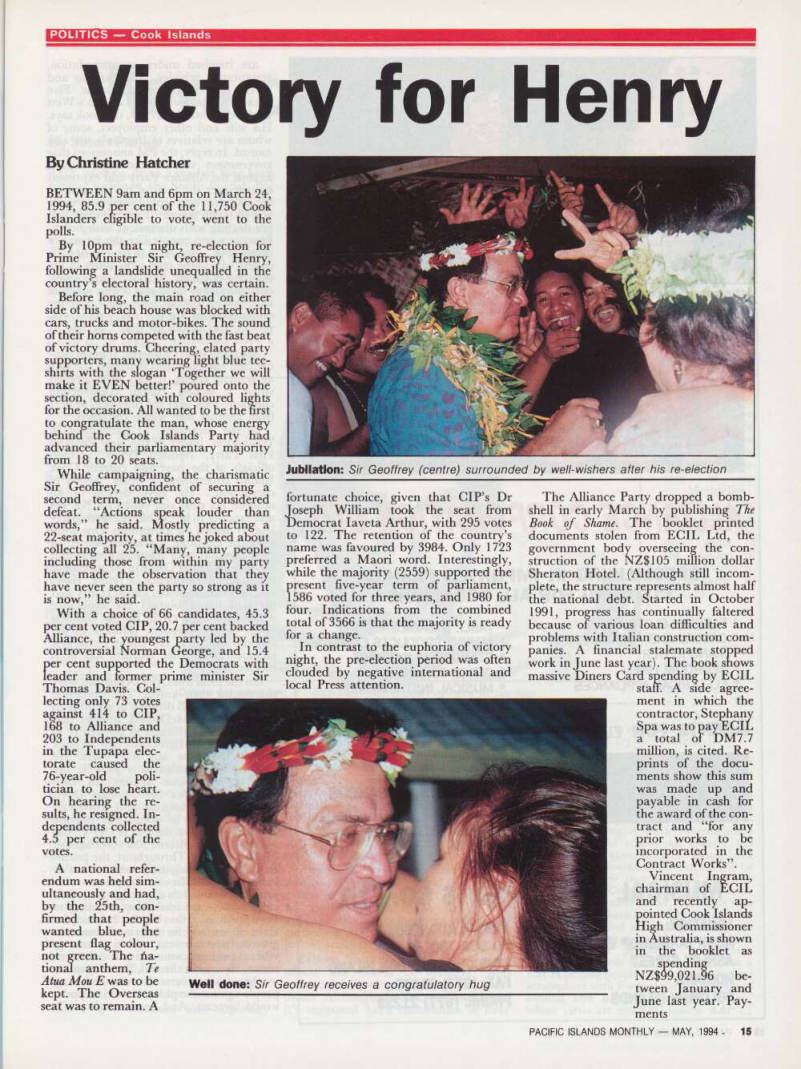
Before long, the main road on either side of his beach house was blocked with cars, trucks and motor-bikes. The sound of their horns competed with the fast beat of victory drums. Cheering, elated party supporters, many wearing light blue tee shirts with the slogan ‘Together we will make it EVEN better!’ poured onto the section, decorated with coloured lights for the occasion. All wanted to be the first to congratulate the man, whose energy behind the Cook Islands Party had advanced their parliamentary majority from 18 to 20 seats.
While campaigning, the charismatic Sir Geoffrey, confident of securing a second term, never once considered defeat. “Actions speak louder than words,” he said. Mostly predicting a 22-seat majority, at times he joked about collecting all 25. “Many, many people including those from within my party have made the observation that they have never seen the party so strong as it is now,” he said.
With a choice of 66 candidates, 45.3 per cent voted CIP, 20.7 per cent backed Alliance, the youngest party led by the controversial Norman George, and 15.4 {ier cent supported the Democrats with eader and former prime minister Sir Thomas Davis. Col
lecting only 73 votes
against 414 to CIP, 168 to Alliance and 203 to Independents in the Tupapa elec torate caused the
76-year-old poli
tician to lose heart.
On hearing the re sults, he resigned. In dependents collected 4.5 per cent of the votes.
A national refer endum was held sim ultaneously and had, by the 25th, con firmed that people wanted blue, the present flag colour, not green. The fta tional anthem, Te Atm Mou E was to be kept. The Overseas seat was to remain. A
fortunate choice, given that Cl P’s Dr Joseph William took the seat from Democrat laveta Arthur, with 295 votes to 122. The retention of the country’s name was favoured by 3984. Only 1723 preferred a Maori word. Interestingly, while the majority (2559) supported the present five-year term of parliament, 1586 voted for three years, and 1980 for four. Indications from the combined total of 3566 is that the majority is ready for a change.
In contrast to the euphoria of victory
night, the pre-election period was often
clouded by negative international and local Press attention.
The Alliance Party dropped a bomb shell in early March by publishing The Book of Shame. The booklet printed documents stolen from ECIL Ltd, the government body overseeing the con struction of the NZ$lO5 million dollar Sheraton Hotel. (Although still incom plete, the structure represents almost half the national debt. Started in October 1991, progress has continually faltered because of various loan difficulties and problems with Italian construction com panies. A financial stalemate stopped work in June last year). The book shows massive Diners Card spending by ECIL staff. A side agree
ment in which the
contractor, Stephany
Spa was to pay ECIL a total of DM7.7 million, is cited. Re prints of the docu ments show this sum was made up and payable in cash for the award of the con tract and “for any prior works to be incorporated in the Contract Works”.
Vincent Ingram, chairman of ECIL and recently ap pointed Cook Islands High Commissioner in Australia, is shown in the booklet as spending NZ599,021.96 be tween January and June last year. Pay ments
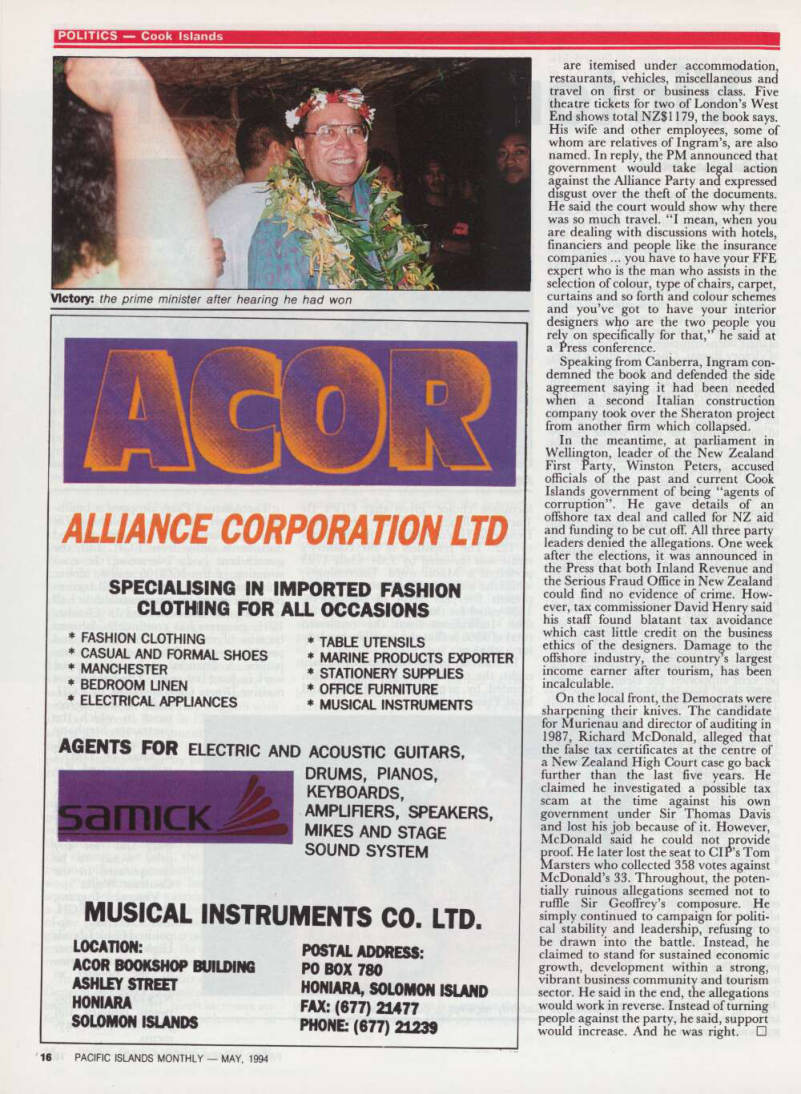
Well done: Sir Geoffrey receives a congratulatory hug
Jubilation: Sir Geoffrey (centre) surrounded by well-wishers after his re-election
are itemised under accommodation, restaurants, vehicles, miscellaneous and travel on first or business class. Five theatre tickets for two of London’s West End shows total NZ$ll79, the book says.
His wife and other employees, some of whom are relatives of Ingram’s, are also named. In reply, the PM announced that government would take legal action against the Alliance Party and expressed disgust over the theft of the documents.
He said the court would show why there was so much travel. “I mean, when you are dealing with discussions with hotels, financiers and people like the insurance companies ... you have to have your FFE expert who is the man who assists in the selection of colour, type of chairs, carpet, curtains and so forth and colour schemes and you’ve got to have your interior designers who are the two people you rely on specifically for that, he said at a Press conference.
Speaking from Canberra, Ingram con demned the book and defended the side agreement saying it had been needed when a second Italian construction company took over the Sheraton project from another firm which collapsed.
In the meantime, at parliament in Wellington, leader of the New Zealand First Party, Winston Peters, accused officials of the past and current Cook Islands government of being “agents of corruption”. He gave details of an offshore tax deal and called for NZ aid and funding to be cut off. All three party leaders denied the allegations. One week after the elections, it was announced in the Press that both Inland Revenue and the Serious Fraud Office in New Zealand could find no evidence of crime. How ever, tax commissioner David Henry said his staff found blatant tax avoidance which cast little credit on the business ethics of the designers. Damage to the offshore industry, the country’s largest income earner after tourism, has been incalculable.
On the local front, the Democrats were sharpening their knives. The candidate for Murienau and director of auditing in 1987, Richard McDonald, alleged that the false tax certificates at the centre of a New Zealand High Court case go back further than the last five years. He claimed he investigated a possible tax scam at the time against his own government under Sir Thomas Davis and lost his job because of it. However, McDonald said he could not provide proof. He later lost the seat to Cl P’s Tom Marsters who collected 358 votes against McDonald’s 33. Throughout, the poten tially ruinous allegations seemed not to rufile Sir Geoffrey’s composure. He
simply continued to campaign for politi
cal stability and leadership, refusing to
be drawn into the battle. Instead, he claimed to stand for sustained economic growth, development within a strong, vibrant business community and tourism sector. He said in the end, the allegations would work in reverse. Instead of turning people against the party, he said, support would increase. And he was right. □
Victory: the prime minister after hearing he had won
Advertisements & other items, p. 16 (1 item)
Alliance Corporation Ltd
SPECIALISING IN IMPORTED FASHION
CLOTHING FOR ALL OCCASIONS
* FASHION CLOTHING * TABLE UTENSILS
* CASUAL AND FORMAL SHOES * MARINE PRODUCTS EXPORTER
* MANCHESTER * STATIONERY SUPPLIES
* BEDROOM UNEN * OFFICE FURNITURE
* ELECTRICAL APPLIANCES ♦ MUSICAL INSTRUMENTS
AGENTS FOR ELECTRIC AND ACOUSTIC GUITARS,
drums, pianos,
KEYBOARDS,
gamine amplifiers, speakers,
MIKES AND STAGE
SOUND SYSTEM
MUSICAL INSTRUMENTS CO. LTD.
LOCATION:
ACOR BOOKSHOP BUILDING
ASHLEY STREET
HONIARA
SOLOMON ISLANDS
POSTAL ADDRESS:
PO BOX 780
HONIARA, SOLOMON ISLAND
FAX: (677) 2U77
PHONE: (677)
Kava concern hits Fiji
Culture
By Stuart Parker THE narcotic drink kava has long been central to life in the South Pacific, but not all islanders are happy about the widespread use of the regional “grog”.
A growing number of influential Fijians believe excessive use of the intoxicant is posing a threat to families, village life and to Fiji’s economic health.
Many church leaders, politicians, health workers and government officials in Fiji
are becoming increasingly concerned
about the heavy consumption of kava, which once was restricted to men of senior social rank.
Excessive drinking is being linked to
health and nu tritional problems, a drop in production of food crops and pres sures on family life.
“It’s one of the biggest downfalls of Fiji today,” said Savenaca Kamika mica, administrative officer with the Min
istry of Fijian Affairs,
which is charged with safeguarding the interests of Fiji’s indigenous popu lation.
As authorities and politicians ponder ways to limit the problem, church ministers preach ser mons against excess ive drinking. Known in Fiji as yaqona, kava is a muddy, mouth numbing drink made
from the crushed roots and stems of the piper methysticum plant, a member of the pepper family.
Its use and significance varies from culture to culture, but throughout the South Pacific its history is one of a drink with sacred powers, used in ceremonies and rituals. In virtually every society in which kava is drunk, its use was once restricted in terms of either sex, rank or age.
Westernisation and democracy mean it’s now often freely available to all, including women. It’s also cheap. In Fiji, small bags of powdered kava are sold for the equivalent of Asl each. Two or three are enough for a small party. Its strength depends on its age and the method of preparation. For instance, kava in Vanu atu is traditionally much stronger than in Fiji, where the use of more water produces a much milder mix.
Kava is a relaxant and soporific,
inducing a sense of peaceful well-being.
Its use is actively promoted in Tonga, for instance, because unlike alcohol it does not provoke aggression. However it does have addictive qualities and when drunk to excess causes lethargy and a loss of appetite. In Fiji, villagers and city office workers often gather to talk and share cups from a communal kava bowl. A ceremony would not be complete with out it. Indeed, it’s impossible to imagine Fiji without yaqona. But according to critics, the problems begin when even ings around the kava bowl turn into long “grog sessions” that can continue for hours or even days.
“Sometimes there is no limit it goes on for hours and hours,” said backbench
government MP Apaitia Seru, whose island of Kadavu is one of the main kava growing centres in Fiji.
“People become lazy the body doesn’t function as it should,” said one senior agriculture official. Seru appealed recently in parliament for more discipline in villages, where he said excessive kava drinking among the young was contribu ting to a downturn in the growing of traditional food crops.
Australian researcher Ron Brunton said in a study on kava “While excessive kava drinking is believed to adversely affect a man’s health and appearance, the consequent neglect of gardening and other responsibilities is just as serious.”
Experts say excessive consumption affects the health of drinkers, who commonly develop a scaly skin con dition. Although the links are unproven, it’s suggested Kava contributes to liver
and heart problems and to duodenal ulcers. Native healers also use it for a range of ailments. Some nutritionists believe yaqom use has contributed to a general decline in public health in Fiji through a drop in the production and consumption of traditional root crops.
Susan Parkinson, of the National Food and Nutrition Committee, said “There is a link because people haven’t got the energy and don’t eat properly.
They just lie around in the villages and get up late.” Because it’s lucrative, farmers often plant kava instead of food crops. The Methodist Church in Fiji believes excessive kava drinking is one of the biggest problems facing family life.
“It separates the wife and children
from the hus band and wastes a lot of time and, of course, money,” said the Reverend Isireli Caucau, general secre tary of the Methodist Church. The men’s long grog sessions also place more of the burden of work on women, particularly in villages.
“It’s time something was done,” said Caucau. “This needs to be dis cussed from vil lage to provin cial level. The church should
also discuss it. It’s difficult to control it but we should try to minimise it.”
Ministry of Fijian Affairs officials believe recent moves to restore village and provin cial laws may provide a way of tackling the problem. Before abolition of the system in the 19605, village heads ensured crops were planted and projects completed, and lim ited kava drinking. A rise in lawlessness and a breakdown of communal systems has persuaded the government to bring back the old ways. Provinces and districts will be able to set their own by-laws. However South Pacific Commission (SPC) health manager Dr Sitaleki Finau, a Tongan who has researched kava use, believes those who want it controlled are wrong. In fact, he said, kava drinking should be encouraged, particularly in preference to alcohol.
“Everybody needs something. Kava has a way of getting people to interact in a social atmosphere with fewer of the health risks of alcohol and smoking,” said Dr Finau, whose views are not SPC policy. AAP □
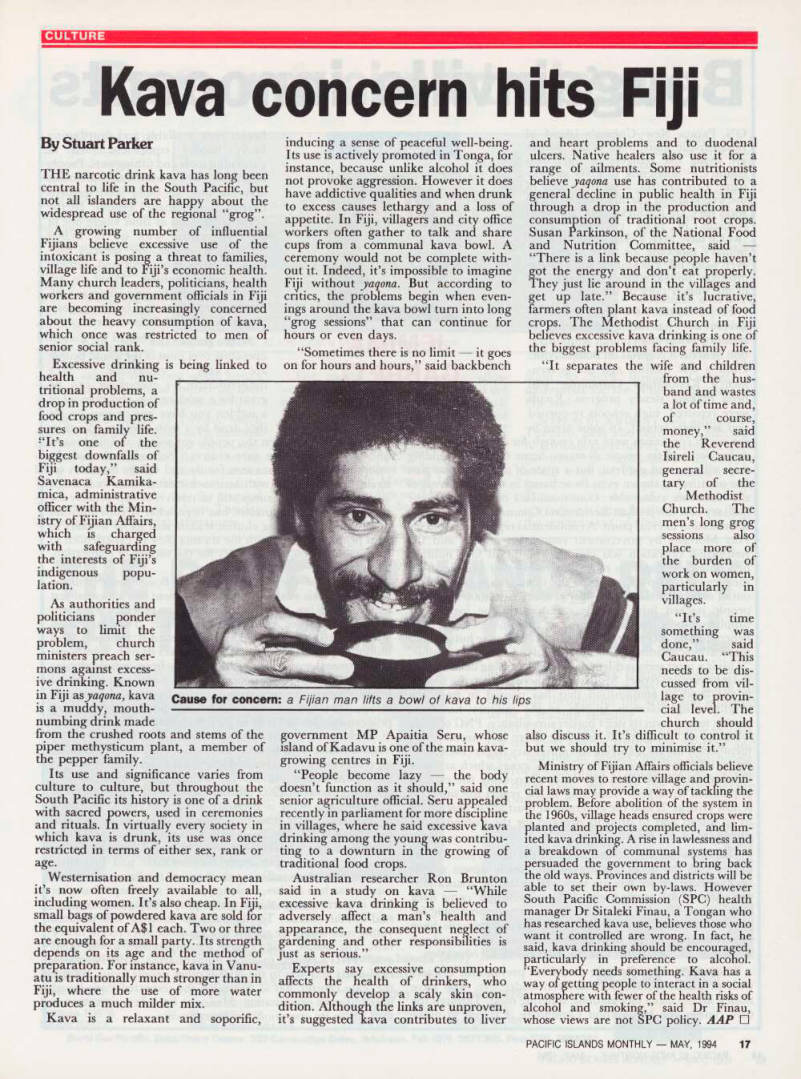
Cause for concern: a Fijian man lifts a bowl of kava to his lips
Bougainville innocents
ON Papua New Guinea’s island of Bougainville more than 44,000 people are living like refugees in their own country sheltering in PNG govern ment ‘care centres’ from the effects of the five-year-old guerilla war. In many ways they are the lucky ones. Innocent civilians in rebel controlled areas (which have been locked behind a PNG military blockade for three years) are even worse off. The story of daily life for ordinary Bougainvilleans remains one of the untold tales of the war.
For the past three years the PNG government has been attempting to restore services and civilian administra tion in areas it controls on Bougainville.
Until a few months ago the govern ment’s Restoration Committee had been making steady progress. Roads were repaired, high schools re-opened and aid posts rebuilt. In some areas in
the north conditions were safe enough for care centres to be disbanded and for people to return home to start rebuilding their villages and gardens. But a spate of attacks in the past few months has shown even those living in the safest areas of the island are vulnerable. Continued lack of funding for the military and the civilian Restoration Committee has brought the situation to crisis point. A confidential report prepared for Port Moresby by government restoration officers said the restoration operation was close to chaos. All four military helicopters necessary to move food and other supplies from their coastal drop-off points to the inland ‘care centres’ are out of action. In the south, with as many as 10,000 to 15,000 people packed into a single care centre, the logistics of supplying people’s needs are a nightmare. Since the helicopters have been grounded people have gone hungry and medical evacuations have been delayed or become impossible.
“This is a most serious dilemma actually causing deaths” said the government report. More serious, according to the report, is the flood of ammunition that has poured in from the neighbouring Solomon Islands as the military has been unable to maintain its strict border surveillance. PNG officials working on Bougainville estimate there are around 500 members of the Bougainville Revolutionary Army (BRA) and up to 1000 young men in break-away gangs which are now fighting each other for supremacy, often using the civilian population as targets. According to the report the situation is now critical. It said the government must allow peace talks to go ahead and to drop its demand for the unconditional surrender of the BRA.
Gus Schweinforth, co-ordinator of the Restoration Com mittee said the flood of ammunition “really upsets people because here we are moving very well (with the restoration) and some of the young hotheads have been told ‘come back and join us we’ve got guns.’ This is very demoralising for people.” Since the war began people on Bougainville have gone without even the most basic necessities. There has been no petrol, no electricity and no health care or education.
Thousands of people have died from preventable diseases with pregnant women and children under five, who have missed all the usual inoculations, suffering most. Through the care centres the Restoration Committee is trying to make
health care available and distributing badly needed equipment such as
gardening tools and fishing nets. People
build their own traditional style houses and are able to build food gardens nearby in the smaller centres. In the other areas, such as Buin where one of the two centres with up to 15,000 residents is located, the security situ ation is more precarious and gardens more institutionalised. “What we are doing is virtually fencing off areas with the local resistance and building mass ive gardens,” said Schweinforth.
With gangs and the BRA still operating over most of the island people are very vulnerable. “It’s indiscriminate everything can be great for a week or two and then all of a sudden you have one or two people shot dead by a mob of idiots who then
run away again. Then the people get scared and frightened and go back into the care centres,” Schweinforth said. In many cases the war has seen family and village members set against one another with serious incidents such as killings, assaults or house burnings still to resolve. A top priority for the Restoration Committee has been what it calls spiritual rehabilitation using church leaders and social workers to help people work through the trauma they’ve experienced so the peace process, so necessary for the success of restoration, can get under way.
The cost of the rehabilitation of Bougainville will be enormous. This year the PNG government has allocated just five million Kina, three and a half million of which was spent in the first three months of the year. The Australian government has put in As 4 and promised another Aslo million on the condition that PNG makes its own ‘significant commitment’ to match. All the money from outside donors has gone to provide basic services like water supply, school books, communications equipment, aid posts and immunis ations. Because of the continuing poor security most programmes are still only in their early stages. The difficulties of working in a war zone are not the only problem for humanitarian organisations. In fact for most, PNG’s blockade on rebel controlled areas and its refusal to recognise the right of civilians to unconditional humanitarian assistance has been the main obstacle. PNG officials estimate there are 20,000 to 25,000 people living in BRA areas. They have had no access to assistance other than tiny amounts smuggled in through the Solomon Islands. Brother Brian Leake, from the Marist Mission, keeps in touch with those in sealed areas by radio.
He said many people inside the blockade had fled their villages and were suffering shortage of medicine and basic supplies such as clothes, cooking pots, salt and soap. “Imagine how important these things are for people living in the open,” said Brother Leake. To illustrate his point he tells of three young men who were caught in a landslide after recent heavy rain. The people “didn’t have the implements to dig them out.” PNG’s refusal to allow humanitarian access to rebel held areas and also to the 40,000 other people living outside the ‘care centres’ has so frustrated the respected Paris-based humanitarian organisation, Medecins Sans Frontiers, that it shut down its operations on Bougainville. □
Australia
Jemima
Garrett
Row over airport closure
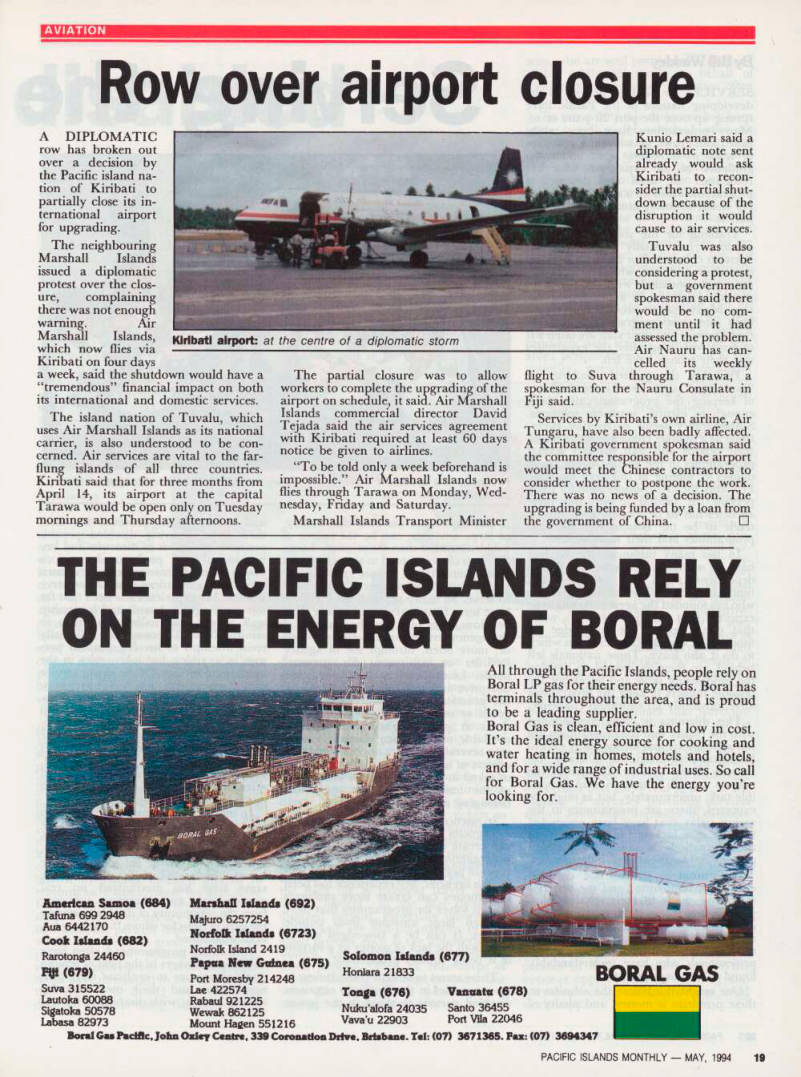
Aviation
A Diplomatic
row has broken out over a decision by the Pacific island na tion of Kiribati to partially close its in
ternational airport
for upgrading.
The neighbouring
Marshall Islands issued a diplomatic protest over the clos ure, complaining there was not enough
warning. Air
Marshall Islands, which now flies via Kiribati on four days
a week, said the shutdown would have a “tremendous” financial impact on both its international and domestic services.
The island nation of Tuvalu, which uses Air Marshall Islands as its national carrier, is also understood to be concerned. Air services are vital to the farflung islands of all three countries.
Kiribati said that for three months from April 14, its airport at the capital Tarawa would be open only on Tuesday mornings and Thursday afternoons.
The partial closure was to allow workers to complete the upgrading of the airport on schedule, it said. Air Marshall commercial director David Tejada said the air services agreement Wl ‘!' K ‘ nba " r «! uiret J. at least 60 da V s notlce De given to airlines. To be told only a w eek beforehand is impossible. Air Marshall Islands now hi es through Tarawa on Monday, Wednesday, Friday and Saturday.
Marshall Islands Transport Minister
Kunio Lemari said a diplomatic note sent already would ask Kiribati to recon sider the partial shut down because of the disruption it would cause to air services.
Tuvalu was also understood to be considering a protest, but a government spokesman said there would be no com ment until it had assessed the problem.
Air Nauru has can celled its weekly
flight to Suva through Tarawa, a spokesman for the Nauru Consulate in
Fiji said.
Services by Kiribati’s own airline, Air Tungaru, have also been badly affected, A Kiribati government spokesman said t h e committee responsible for the airport would meet the Chinese contractors to consider whether to postpone the work.
There was no news of a decision. The upgrading is being funded by a loan from the government of China. □
Kiribati airport: at the centre of a diplomatic storm
Advertisements & other items, p. 19 (1 item)
The Pacific Islands Rely
ON THE ENERGY OF BORAL
,'Jf **33 American Samoa (684) Marshal! Islands (692) Tafuna 699 2948 Aua 6442170 Cook Islands (682) Rarotonga 24460 FW (679) Suva 315522 Lautoka 60088 Sigatoka 50578 Labasa 82973 Majuro 6257254 Norfolk Islands (6723) Norfolk Island 2419 Papna New Guinea (675) Port Moresby 214248 Lae 422574 Rabaul 921225 Wewak 862125 Mount Hagen 551216 Solomon Islands (677) Honiara 21833 All through the Pacific Islands, people rely on Boral LP gas for their energy needs. Boral has terminals throughout the area, and is proud to be a leading supplier.
Boral Gas is clean, efficient and low in cost.
It’s the ideal energy source for cooking and water heating in homes, motels and hotels, and for a wide range of industrial uses. So call for Boral Gas. We have the energy you’re
looking for.
BORAL GAS
Tonga (676) Nuku’alofa 24035 Vava’u 22903 Vanuatu (678) Santo 36455 Port Vila 22046 Boral Gas Pacific. John Oxley Centro. 339 Coronation Drive. Brisbane. Tel: (07) 3671365. Fax: (07) 3694347
Serving the disabled
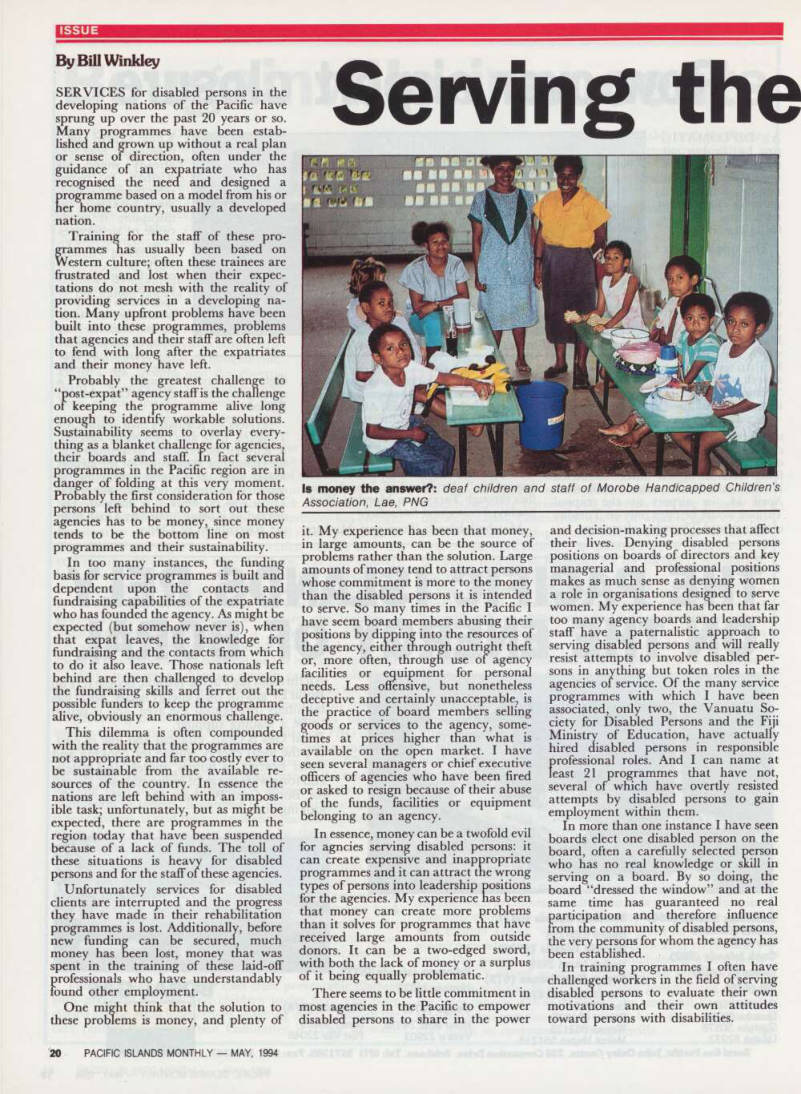
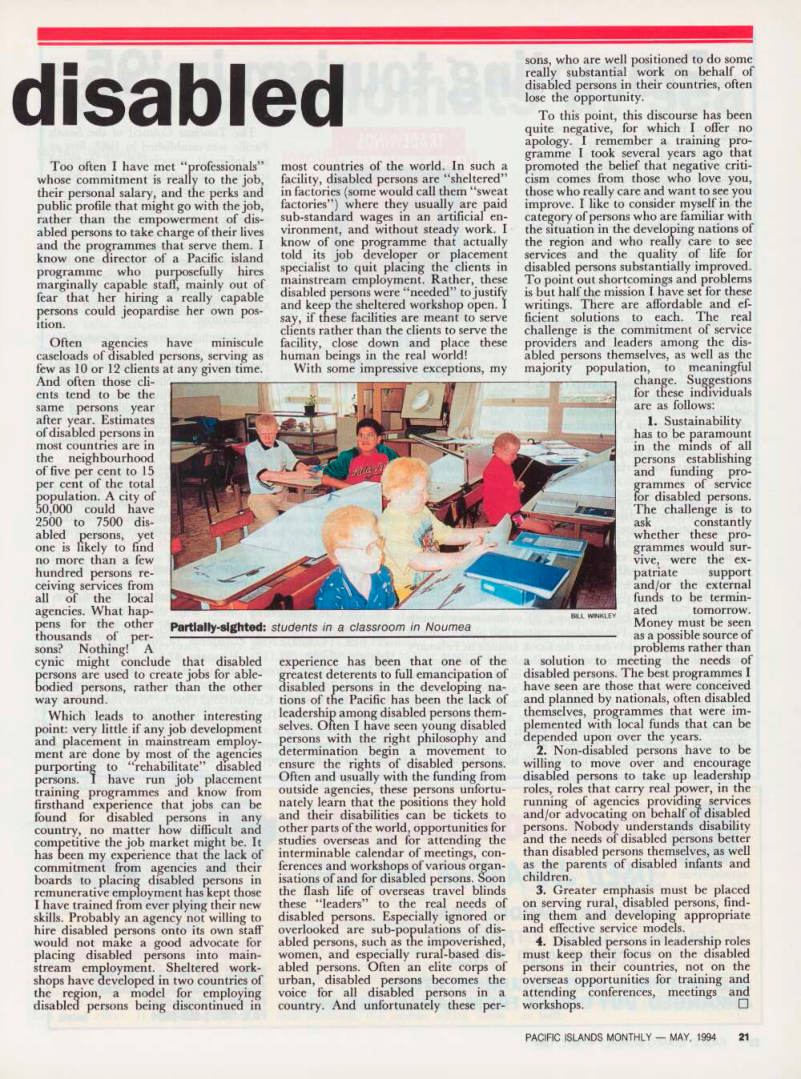
Issue
By Bill Winkley
SERVICES for disabled persons in the developing nations of the Pacific have sprung up over the past 20 years or so.
Many programmes have been estab lished and grown up without a real plan or sense of direction, often under the guidance of an expatriate who has recognised the need and designed a Erogramme based on a model from his or er home country, usually a developed nation.
Training for the staff of these pro grammes has usually been based on Western culture; often these trainees are frustrated and lost when their expec tations do not mesh with the reality of providing services in a developing na tion. Many upfront problems have been built into these programmes, problems that agencies and their staff are often left to fend with long after the expatriates and their money have left.
Probably the greatest challenge to “post-expat” agency staff is the challenge of keeping the programme alive long enough to identify workable solutions.
Sustainability seems to overlay every thing as a blanket challenge for agencies, their boards and staff. In fact several programmes in the Pacific region are in danger of folding at this very moment.
Probably the first consideration for those persons left behind to sort out these agencies has to be money, since money tends to be the bottom line on most programmes and their sustainability.
In too many instances, the funding basis for service programmes is built and dependent upon the contacts and fundraising capabilities of the expatriate who has founded the agency. As might be expected (but somehow never is), when that expat leaves, the knowledge for fundraising and the contacts from which to do it also leave. Those nationals left behind are then challenged to develop the fundraising skills and ferret out the possible funders to keep the programme alive, obviously an enormous challenge.
This dilemma is often compounded with the reality that the programmes are not appropriate and far too costly ever to be sustainable from the available re sources of the country. In essence the nations are left behind with an imposs ible task; unfortunately, but as might be expected, there are programmes m the region today that have been suspended because of a lack of funds. The toll of these situations is heavy for disabled persons and for the staff of these agencies.
Unfortunately services for disabled clients are interrupted and the progress they have made in their rehabilitation programmes is lost. Additionally, before new funding can be securea, much money has been lost, money that was spent in the training of these laid-off {irofessionals who have understandably bund other employment.
One might think that the solution to these problems is money, and plenty of
it. My experience has been that money, in large amounts, can be the source of problems rather than the solution. Large amounts of money tend to attract persons whose commitment is more to the money than the disabled persons it is intended to serve. So many times in the Pacific I have seem board members abusing their positions by dipping into the resources of the agency, either through outright theft or, more often, through use of agency facilities or equipment for personal needs. Less offensive, but nonetheless deceptive and certainly unacceptable, is the practice of board members selling gooas or services to the agency, some times at prices higher than what is available on the open market. I have seen several managers or chief executive officers of agencies who have been fired or asked to resign because of their abuse of the funds, facilities or equipment belonging to an agency.
In essence, money can be a twofold evil for agncies serving disabled persons: it can create expensive and inappropriate programmes and it can attract the wrong types of persons into leadership positions for the agencies. My experience has been that money can create more problems than it solves for programmes that have received large amounts from outside donors. It can be a two-edged sword, with both the lack of money or a surplus
of it being equally problematic.
There seems to be little commitment in most agencies in the Pacific to empower disabled persons to share in the power
and decision-making processes that affect their lives. Denying disabled persons positions on boards of directors and key
managerial and professional positions
makes as much sense as denying women a role in organisations designed to serve women. My experience has been that far too many agency boards and leadership staff have a paternalistic approach to serving disabled persons and will really resist attempts to involve disabled per sons in anything but token roles in the agencies of service. Of the many service programmes with which I have been associated, only two, the Vanuatu So ciety for Disabled Persons and the Fiji Ministry of Education, have actually hired disabled persons in responsible professional roles. And I can name at least 21 programmes that have not, several of which have overtly resisted attempts by disabled persons to gain employment within them.
In more than one instance I have seen boards elect one disabled person on the board, often a carefully selected person who has no real knowledge or skill in serving on a board. By so doing, the board “dressed the window” and at the same time has guaranteed no real participation and therefore influence from the community of disabled persons, the very persons for whom the agency has been established.
In training programmes I often have challenged workers in the field of serving disabled persons to evaluate their own motivations and their own attitudes toward persons with disabilities.
Is money the answer?: deaf children and staff of Morobe Handicapped Children’s Association, Lae, PNG
Too often I have met “professionals” whose commitment is really to the job, their personal salary, and the perks and public profile that might go with the job, rather than the empowerment of dis abled persons to take charge of their lives and the programmes that serve them. I know one director of a Pacific island programme who purposefully hires
marginally capable staff, mainly out of
fear that her hiring a really capable persons could jeopardise her own pos ition.
Often agencies have miniscule caseloads of disabled persons, serving as few as 10 or 12 clients at any given time.
And often those cli ents tend to be the same persons year after year. Estimates of disabled persons in most countries are in the neighbourhood of five per cent to 15 per cent of the total population. A city of 50,000 could have 2500 to 7500 dis abled persons, yet one is likely to find no more than a few hundred persons re ceiving services from all of the local agencies. What hap pens for the other thousands of per sons? Nothing! A
cynic might conclude that disabled Cersons are used to create jobs for able odied persons, rather than the other way around.
Which leads to another interesting point: very little if any job development and placement in mainstream employ ment are done by most of the agencies purporting to “rehabilitate” disabled persons. I have run job placement training programmes and know from firsthand experience that jobs can be found for disabled persons in any country, no matter how difficult and competitive the job market might be. It has been my experience that the lack of commitment from agencies and their boards to placing disabled persons in remunerative employment has kept those I have trained from ever plying their new skills. Probably an agency not willing to hire disabled persons onto its own staff would not make a good advocate for placing disabled persons into main stream employment. Sheltered work shops have developed in two countries of the region, a model for employing disabled persons being discontinued in
most countries of the world. In such a facility, disabled persons are “sheltered” in factories (some would call them “sweat factories”) where they usually are paid sub-standard wages in an artificial en vironment, and without steady work. I know of one programme that actually told its job developer or placement specialist to quit placing the clients in mainstream employment. Rather, these disabled persons were “needed” to justify and keep the sheltered workshop open. I say, if these facilities are meant to serve clients rather than the clients to serve the facility, close down and place these human beings in the real world!
With some impressive exceptions, my
experience has been that one of the greatest deterents to full emancipation of disabled persons in the developing na tions of the Pacific has been the lack of leadership among disabled persons them selves. Often I have seen young disabled persons with the right philosophy and determination begin a movement to ensure the rights of disabled persons.
Often and usually with the funding from outside agencies, these persons unfortu nately learn that the positions they hold and their disabilities can be tickets to other parts of the world, opportunities for studies overseas and for attending the interminable calendar of meetings, con ferences and workshops of various organ isations of and for disabled persons. Soon the flash life of overseas travel blinds these “leaders” to the real needs of disabled persons. Especially ignored or overlooked are sub-populations of dis abled persons, such as the impoverished, women, and especially rural-based dis abled persons. Often an elite corps of urban, disabled persons becomes the voice for all disabled persons in a country. And unfortunately these per
sons, who are well positioned to do some really substantial work on behalf of disabled persons in their countries, often lose the opportunity.
To this point, this discourse has been quite negative, for which I offer no apology. I remember a training pro gramme I took several years ago that promoted the belief that negative criti cism comes from those who love you, those who really care and want to see you improve. I like to consider myself in the category of persons who are familiar with the situation in the developing nations of the region and who really care to see services and the quality of life for disabled persons substantially improved.
To point out shortcomings and problems is but half the mission I have set for these writings. There are affordable and ef ficient solutions to each. The real challenge is the commitment of service providers and leaders among the dis abled persons themselves, as well as the majority population, to meaningful
change. Suggestions
for these individuals are as follows: I. Sustainability has to be paramount in the minds of all persons establishing and funding pro grammes of service for disabled persons.
The challenge is to ask constantly whether these pro grammes would sur vive, were the ex
patriate support
and/or the external funds to be termin ated tomorrow.
Money must be seen as a possible source of problems rather than
a solution to meeting the needs of disabled persons. The best programmes I have seen are those that were conceived and planned by nationals, often disabled themselves, programmes that were im plemented with local funds that can be depended upon over the years. 2. Non-disabled persons have to be willing to move over and encourage disabled persons to take up leadership roles, roles that carry real power, in the running of agencies providing services and/or advocating on behalf of disabled persons. Nobody understands disability and the needs of disabled persons better than disabled persons themselves, as well as the parents of disabled infants and children. 3. Greater emphasis must be placed on serving rural, disabled persons, find ing them and developing appropriate and effective service models. 4. Disabled persons in leadership roles must keep their focus on the disabled persons in their countries, not on the overseas opportunities for training and attending conferences, meetings and workshops. □
Bill Winkley
Partially-sighted: students in a classroom in Noumea
Promoting tourism in ’95
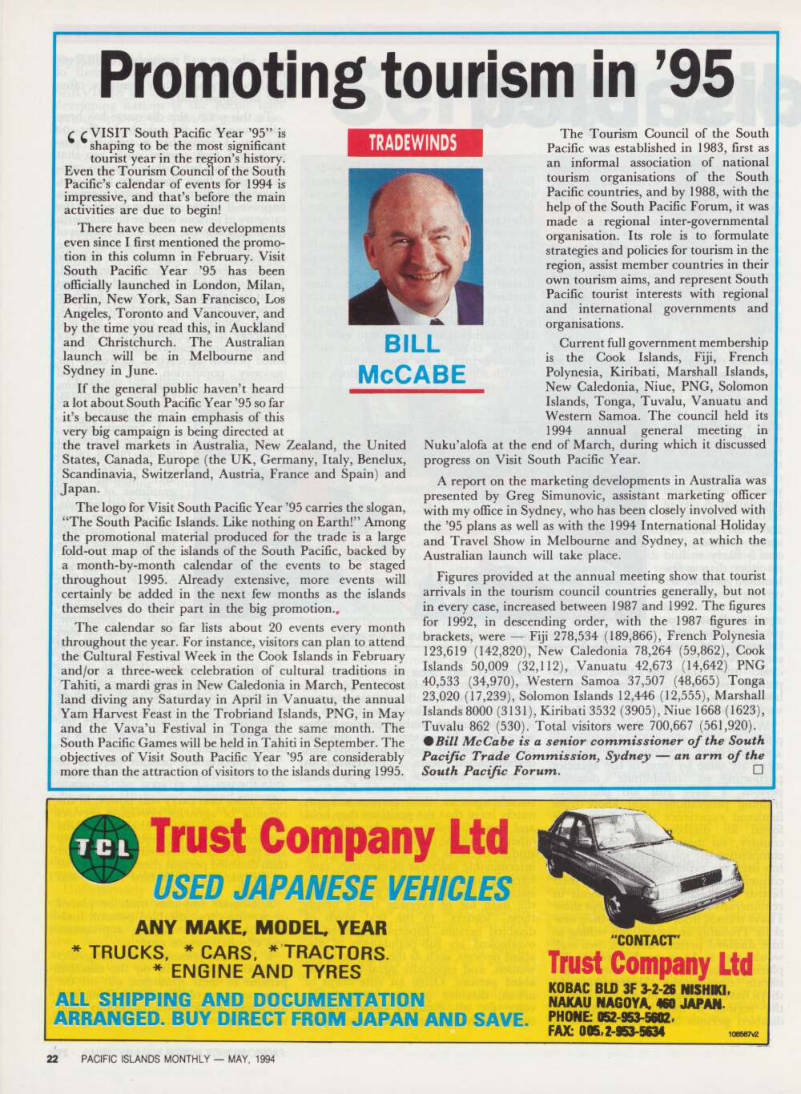
£ £ VISIT South Pacific Year ’95” is shaping to be the most significant tourist year in the region’s history.
Even the Tourism Council of the South Pacific’s calendar of events for 1994 is impressive, and that’s before the main activities are due to begin!
There have been new developments even since I first mentioned the promo tion in this column in February. Visit South Pacific Year ’95 has been officially launched in London, Milan, Berlin, New York, San Francisco, Los Angeles, Toronto and Vancouver, and by the time you read this, in Auckland and Christchurch. The Australian launch will be in Melbourne and Sydney in June.
If the general public haven’t heard a lot about South Pacific Year ’95 so far it’s because the main emphasis of this very big campaign is being directed at
the travel markets in Australia, New Zealand, the United States, Canada, Europe (the UK, Germany, Italy, Benelux, Scandinavia, Switzerland, Austria, France and Spain) and Japan.
The logo for Visit South Pacific Year ’95 carries the slogan, “The South Pacific Islands. Like nothing on Earth!” Among the promotional material produced for the trade is a large fold-out map of the islands of the South Pacific, backed by a month-by-month calendar of the events to be staged throughout 1995. Already extensive, more events will certainly be added in the next few months as the islands themselves do their part in the big promotion..
The calendar so far lists about 20 events every month throughout the year. For instance, visitors can plan to attend the Cultural Festival Week in the Cook Islands in February and/or a three-week celebration of cultural traditions in Tahiti, a mardi gras in New Caledonia in March, Pentecost land diving any Saturday in April in Vanuatu, the annual Yam Harvest Feast in the Trobriand Islands, PNG, in May and the Vava’u Festival in Tonga the same month. The South Pacific Games will be held in Tahiti in September. The objectives of Visit South Pacific Year ’95 are considerably more than the attraction of visitors to the islands during 1995.
The Tourism Council of the South Pacific was established in 1983, first as an informal association of national tourism organisations of the South Pacific countries, and by 1988, with the help of the South Pacific Forum, it was made a regional inter-governmental organisation. Its role is to formulate strategies and policies for tourism in the region, assist member countries in their own tourism aims, and represent South Pacific tourist interests with regional and international governments and
organisations.
Current full government membership is the Cook Islands, Fiji, French Polynesia, Kiribati, Marshall Islands, New Caledonia, Niue, PNG, Solomon Islands, Tonga, Tuvalu, Vanuatu and Western Samoa. The council held its 1994 annual general meeting in
Nuku’alofa at the end of March, during which it discussed progress on Visit South Pacific Year.
A report on the marketing developments in Australia was presented by Greg Simunovic, assistant marketing officer with my office in Sydney, who has been closely involved with the ’95 plans as well as with the 1994 International Holiday and Travel Show in Melbourne and Sydney, at which the Australian launch will take place.
Figures provided at the annual meeting show that tourist arrivals in the tourism council countries generally, but not in every case, increased between 1987 and 1992. The figures for 1992, in descending order, with the 1987 figures in brackets, were Fiji 278,534 (189,866), French Polynesia 123,619 (142,820), New Caledonia 78,264 (59,862), Cook Islands 50,009 (32,112), Vanuatu 42,673 (14,642) PNG 40,533 (34,970), Western Samoa 37,507 (48,665) Tonga 23,020 (17,239), Solomon Islands 12,446 (12,555), Marshall Islands 8000 (3131), Kiribati 3532 (3905), Niue 1668 (1623), Tuvalu 862 (530). Total visitors were 700,667 (561,920). %Bill McCabe is a senior commissioner of the South Pacific Trade Commission, Sydney an arm of the South Pacific Forum. □
Tradewinds
Bill
Mccabe
Advertisements & other items, p. 22 (1 item)
Trust Company Ltd
USED JAPANESE VEHICLES
ANY MAKE, MODEL, YEAR
* TRUCKS, * CARS, * TRACTORS.
* ENGINE AND TYRES
ALL SHIPPING AND DOCUMENTATION
ARRANGED. BUY DIRECT FROM JAPAN AND SAVE.
CONTACT'
Trust Company Ltd
KOBAC BID 3F 3-2-26 NISHUCI.
NAKAU NAGOYA, 460 JAPAN.
PHONE: 062-953-5602.
FAX: 005.2-953-5634 106567V5
Pacific diplomats at sea
The United Nations
By Ian Williams
IN March, the Pacific was fighting a rearguard action in one of the UN’s more exotically named conferences. The UN conference on Straddling Fish Stocks and on Highly Migratory Fish is a life and death matter, not just for the fish, but the island nations whose main economic resource is their EEZs, exclusive econ omic zones. The talks are chaired by Fiji’s Satya Nandan, but at times that seems the closest the islands get to power in the talks designed to protect the world’s rapidly disappearing marine fish stocks.
Off the record, Pacific diplomats are
complaining bitterly about the Japanese
and Korean negotiators, who want to have their sushi and eat it. “They are citing International Law, the Law of the Sea, the Ten Commandments, the Bible anything to avoid giving an inch,” one diplomat told PIM. The South Korean delegate claims that 50,000 families were affected by the ban in drift netting, but seems to show little aware ness that unlike the two Asian tigers, the Pacific islands do not have car and computer factories to absorb their people when the fish stocks are gone.
The weak position of the islands is demonstrated m the drafts of the text so far. It provides much stronger protection for the “straddling” fish stocks, the cod and similar species whose habitat covers several nations’ territorial waters. It is much weaker on protecting the highly migratory species like tuna, where at present the Japanese and Koreans are, in the words of another diplomat, “poach ing the stocks on the nigh seas. The Japanese and Koreans are, he complains, offering a compromise that offers noth ing. They would “look at” measures to protect fish stocks, but only if they are admitted to the South Pacific Forum Fisheries Agency. It would allow them to make a “sea grab” giving them access to the islands EEZs but offering no commit ment in return. Slightly more tangible but only just is language in the draft offering “new and additional” but un specified aid to developing countries to maintain surveillance and protection of the stocks. The result is that “we are not happy with the draft so far, but we can live with it,” Pacific diplomats say, hoping that they can improve it before the final sessions in September.
The talks are, in some ways, a precursor of the Small Islands Confer ence. International waters, like the atmosphere, belong to nobody, and the opportunities bring out the most selfish aspects of national behaviours. However, collective action by the small islands has had some effect. It would have much
Pacific in for a fight with big nations in protecting fish stocks
more if all South Pacific Applied Geoscience Commission (SOPAC) countries took the conferences seriously.
From being the guiding genius behind AOSIS, Vanuatu was initially unable to have its delegate, Dorosti Esrom admit ted to the fisheries conference because the new UN ambassador, Jean Ravou Akii, a close friend of PM Maxim Carlot, had not presented his letters of accreditation to the UN. Indeed for three months, he had not presented himself, either at the Vanuatu Mission, the Forum, or the UN itself, until he finally presented his credentials to Boutros Boutros Ghali, the UN Secretary General on March 25.
While welcoming the progress, his col leagues point out that his new office has yet to be connected to a telephone.
Although he was the most outstanding example, there are other strange and undiplomatic absences. His Pacific col leagues have also been wondering at the absence of Marshalls Ambassador Carl Heine, who, they allege has not been seen in the United Nations or at the Forum meetings. Originally this began as a protest at the absence of Australian Ambassador Richard Butler, but while the latter has now begun to attend, Heine’s continuing absence has caused such ribald commentary that the SOAPC Chair Samoan Ambassador Neroni Slade refused to take apologies at the last meeting of the group.
At least he has been in New York, while Niue, Cook Islands, Tonga and even Palau have been attending the various meets. Tuvalu has been con spicuous by its absence from these events, and organisers of the Small Islands Conference in Barbados were scathing when they heard that Tuvalu PM Bikenibeu Paeniu, who has toured the world for Greenpeace, will not be attending. In contrast, it is lucky that the rest of the world seems to be treating the small island states more seriously than some of their representatives. UN Secre tary General Boutros Boutros Ghali in opening the final Barbados Preparatory Committee Meeting in New York called on the world to recognise the needs of small islands for “special assistance because of their economic and ecological vulnerability, their size, geographical isolation and limited resources.”
The committee secured a consensus on the first 14 parts of the conference document. Unfortunately, the most sub stantial areas of disagreement are in the final fifteenth, the section which deals
with the mechanism and financing for the development and protection of the islands in the face of climate change.
Trinidadian Ambassador Annette Des Isles and the new president of AOSIS, lamented that the meeting had done little to ensure the availability of funds.
AOSIS members were “disappointed but no discouraged,” she said, looking for ward to more positive results in Barbados itself.
The industrialised nations promised in Rio, in the euphoria of the ‘Earth Summit’ that they would be putting, in the now traditional phrase “new and additional resources” into the environ mental protection of the small islands, but they now seem to be backtracking and saying that such funds would come from existing overseas development funds. Within AOSIS as well there are divisions between the Pacific and Carib bean. The latter are much pushier and radical over funding questions.
At least the $2 billion dollar Global Environment Facility was finally off the ground, as 87 countries approved its final form in Geneva in March after months of wrangling between North and South.
While the headquarters of the fund will be in the World Bank in Washington, and its Chief Executive Office, Moham med El-Ashry, is the bank’s environment officer, the GEF is officially jointly run by the bank and the UN Development Programme. The 32-member governing council will be split between 16 develop ing “recipient’’ countries, 14 donor countries, and two from the former Eastern bloc. The islands will have to fight for seats from the Asian quota of six and the Latin American and Caribbean quota of four.
The compromise proposal in effect ensures that decisions need to compro mise between donors and recipients, since proposals need to win majorities of 60 per cent in two ways, the first on a vote depending on the size of financial contribution and the second by the council.
But once again, if the islands want to be taken seriously then they have to behave seriously and send serious rep resentatives rather than friends or rela tives with a liking for metropolitan pastimes. As we reported last month, the Pacific has deprived itself of experienced voices at the UN in the last few months at a time when they are needed more than ever before. Our next report comes from the Barbados conference itself, where we will observe with interest the attendance record of some large del egations of politicians from the Pacific who will be bringing their families along as well. □
Saving the coral
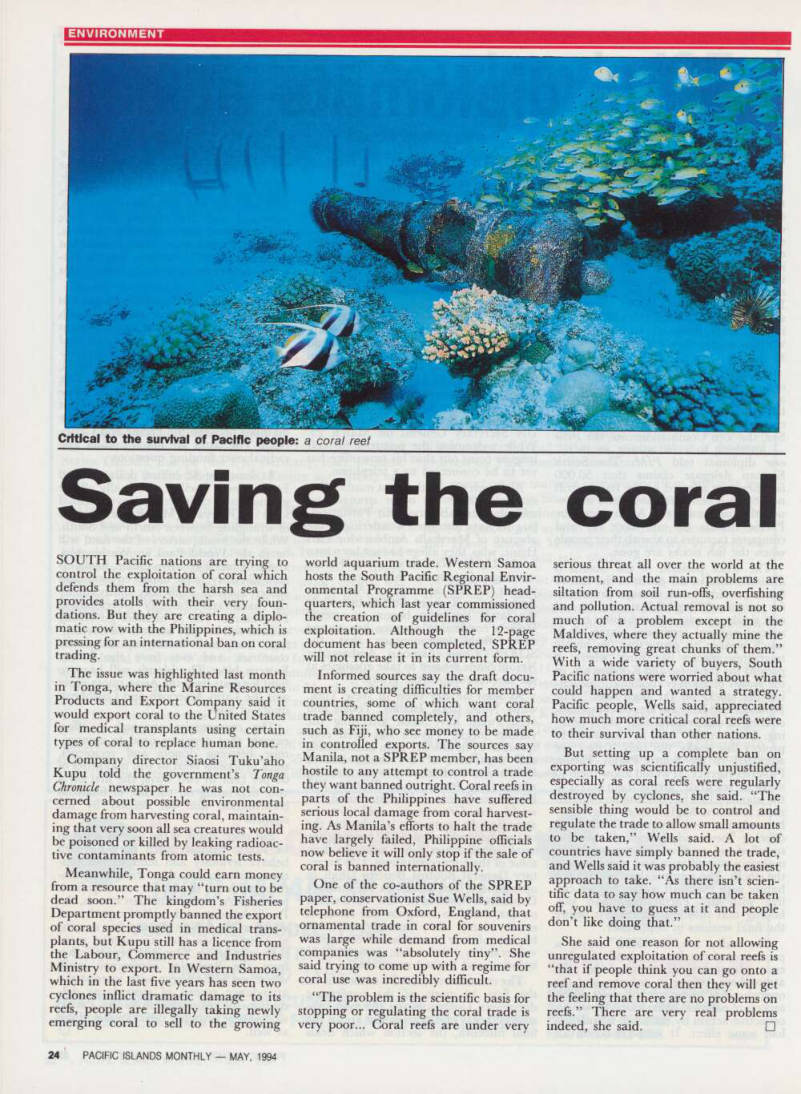
Environment
SOUTH Pacific nations are trying to control the exploitation of coral which defends them from the harsh sea and provides atolls with their very foundations. But they are creating a diplomatic row with the Philippines, which is pressing for an international ban on coral Fa 1 he issue was highlighted last month in Tonga, where the Marine Resources Products and Export Company said it would export coral to the United States or medical transplants using certain types of coral to replace human bone.
Company director Siaosi Tuku’aho Kupu told the government’s Tonga Chronicle newspaper he was not concerned about possible environmental damage from harvesting coral, maintaining that very soon all sea creatures would be poisoned or killed by leaking radioactive contaminants from atomic tests. » k Meanwhile, 1 onga could earn money from a resource that may “turn out to be dead soon.” The kingdom’s Fisheries Department promptly banned the export of coral species used in medical transplants, but Kupu still has a licence from the Labour, Commerce and Industries Ministry to export. In Western Samoa, which in the last five years has seen two cyclones inflict dramatic damage to its
reefs, people are illegally taking newly
emerging coral to sell to the growing
world aquarium trade. Western Samoa hosts the South Pacific Regional Environmental Programme (SPREP) headquarters, which last year commissioned the creation of guidelines for coral exploitation. Although the 12-page document has been completed, SPREP W 1 not re^ease 11 i n i ts current form.
Informed sources say the draft document is creating difficulties for member countries, some of which want coral trade banned completely, and others, such as Fiji, who see money to be made in controlled exports. The sources say Manila, not a SPREP member, has been hostile to any attempt to control a trade they want banned outright. Coral reefs in Pof the Philippines have suffered serious local damage from coral harvest- As Manila s efforts to halt the trade have largely failed, Philippine officials now believe it will only stop if the sale of coral is banned internationally. 7 ° ne of the co-authors of the SPREP paper, conservationist Sue Wells, said by telephone from Oxford, England, that ornamental trade m coral for souvenirs was large while demand from medical companies was absolutely tiny”. She sa * d trying to come up with a regime for coral use was incredibly difficult.
“The problem is the scientific basis for stopping or regulating the coral trade is very p00r... Coral reefs are under very
serious threat all over the world at the moment, and the main problems are siltation from soil run-offs, overfishing and pollution. Actual removal is not so muc h of a problem except in the Maldives, where they actually mine the ree f s , removing great chunks of them.”
With a wide variety of buyers, South Pacific nations were worried about what could happen and wanted a strategy.
Pacific people, Wells said, appreciated how much more critical coral reefs were to their survival than other nations, ut settmg U P a complete ban on exporting was scientifically unjustified, especially as coral reefs were regularly destroyed by cyclones she said. The sensible thing would be to control and regulate the trade to allow small amounts t° he taken, Wells said. A lot of countries have simply banned the trade, and Wells said it was probably the easiest . . . lt f PP ° ach to tak J" As th^ re lsn 1 scl^ n " tific data to say how much can be taken / ouhave to gues *, at it and people don t llke domg that - She said one reason for not allowing unregulated exploitation of coral reefs is “that if people think you can go onto a reef and remove coral then they will get the feeling that there are no problems on reefs.” There are very real problems indeed, she said. □
Critical to the survival of Pacific people: a coral reef
Islanders turn to Field
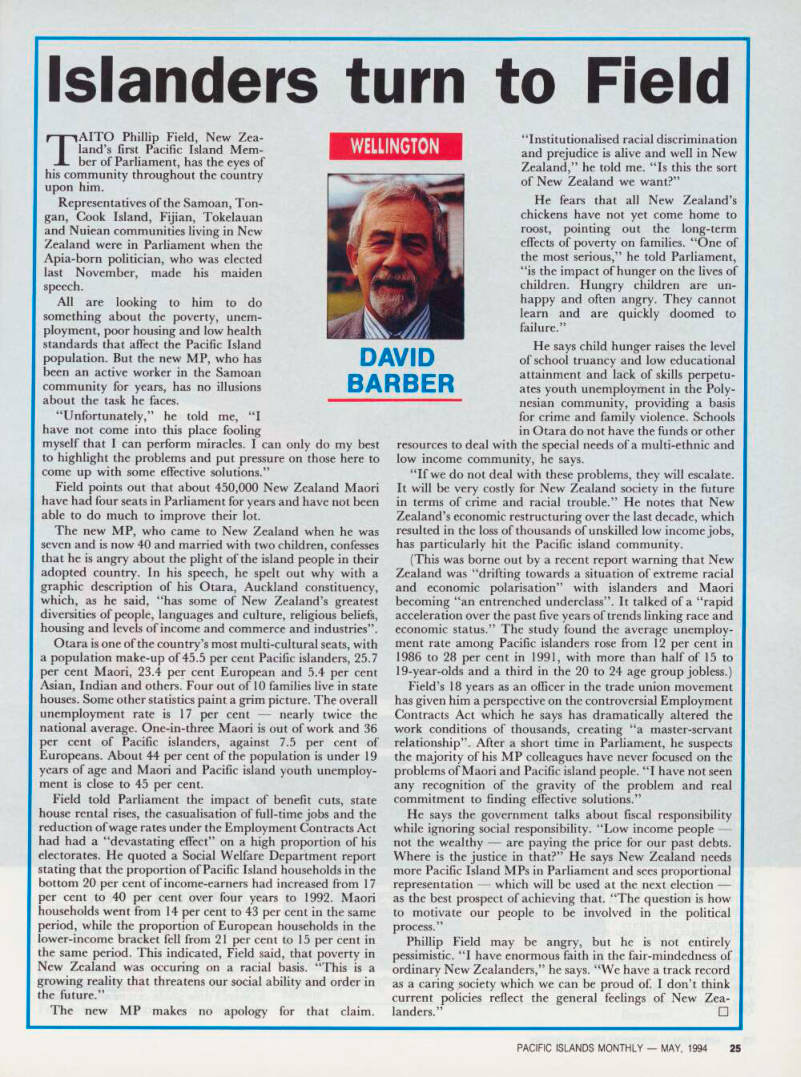
TAITO Phillip Field, New Zea land’s first Pacific Island Mem ber of Parliament, has the eyes of his community throughout the country upon him.
Representatives of the Samoan, Ton gan, Cook Island, Fijian, Tokelauan and Nuiean communities living in New Zealand were in Parliament when the Apia-born politician, who was elected last November, made his maiden speech.
All are looking to him to do something about the poverty, unem ployment, poor housing and low health standards that affect the Pacific Island population. But the new MP, who has been an active worker in the Samoan community for years, has no illusions about the task he faces.
“Unfortunately,” he told me, “I have not come into this place fooling
myself that I can perform miracles. I can only do my best to highlight the problems and put pressure on those here to come up with some effective solutions.”
Field points out that about 450,000 New Zealand Maori have had four seats in Parliament for years and have not been able to do much to improve their lot.
The new MP, who came to New Zealand when he was seven and is now 40 and married with two children, confesses that he is angry about the plight of the island people in their adopted country. In his speech, he spelt out why with a graphic description of his Otara, Auckland constituency, which, as he said, “has some of New Zealand’s greatest diversities of people, languages and culture, religious beliefs, housing and levels of income and commerce and industries”.
Otara is one of the country’s most multi-cultural seats, with a population make-up of 45.5 per cent Pacific islanders, 25.7 per cent Maori, 23.4 per cent European and 5.4 per cent Asian, Indian and others. Four out of 10 families live in state houses. Some other statistics paint a grim picture. The overall unemployment rate is 17 per cent nearly twice the national average. One-in-three Maori is out of work and 36 per cent of Pacific islanders, against 7.5 per cent of Europeans. About 44 per cent of the population is under 19 years of age and Maori and Pacific island youth unemploy ment is close to 45 per cent.
Field told Parliament the impact of benefit cuts, state house rental rises, the casualisation of full-time jobs and the reduction of wage rates under the Employment Contracts Act had had a “devastating effect” on a high proportion of his electorates. He quoted a Social Welfare Department report stating that the proportion of Pacific Island households in the bottom 20 per cent of income-earners had increased from 17 per cent to 40 per cent over four years to 1992. Maori households went from 14 per cent to 43 per cent in the same period, while the proportion of European households in the lower-income bracket fell from 21 per cent to 15 per cent in the same period. This indicated, Field said, that poverty in New Zealand was occuring on a racial basis. “This is a growing reality that threatens our social ability and order in the future.”
The new MP makes no apology for that claim.
“Institutionalised racial discrimination and prejudice is alive and well in New Zealand,” he told me. “Is this the sort of New Zealand we want?”
He fears that all New Zealand’s chickens have not yet come home to roost, pointing out the long-term effects of poverty on families. “One of the most serious,” he told Parliament, “is the impact of hunger on the lives of children. Hungry children are un happy and often angry. They cannot learn and are quickly doomed to failure.”
He says child hunger raises the level of school truancy and low educational attainment and lack of skills perpetu ates youth unemployment in the Poly nesian community, providing a basis for crime and family violence. Schools in Otara do not have the funds or other
resources to deal with the special needs of a multi-ethnic and low income community, he says.
“If we do not deal with these problems, they will escalate.
It will be very costly for New Zealand society in the future in terms of crime and racial trouble.” He notes that New Zealand’s economic restructuring over the last decade, which resulted in the loss of thousands of unskilled low income jobs, has particularly hit the Pacific island community. (This was borne out by a recent report warning that New Zealand was “drifting towards a situation of extreme racial and economic polarisation” with islanders and Maori becoming “an entrenched underclass”. It talked of a “rapid acceleration over the past five years of trends linking race and economic status.” The study found the average unemploy ment rate among Pacific islanders rose from 12 per cent in 1986 to 28 per cent in 1991, with more than half of 15 to 19-year-olds and a third in the 20 to 24 age group jobless.) Field’s 18 years as an officer in the trade union movement has given him a perspective on the controversial Employment Contracts Act which he says has dramatically altered the work conditions of thousands, creating “a master-servant relationship”. After a short time in Parliament, he suspects the majority of his MP colleagues have never focused on the problems of Maori and Pacific island people. “I have not seen any recognition of the gravity of the problem and real commitment to finding effective solutions.”
He says the government talks about fiscal responsibility while ignoring social responsibility. “Low income people not the wealthy are paying the price for our past debts.
Where is the justice in that?” He says New Zealand needs more Pacific Island MPs in Parliament and sees proportional representation which will be used at the next election as the best prospect of achieving that. “The question is how to motivate our people to be involved in the political
process.”
Phillip Field may be angry, but he is not entirely pessimistic. “I have enormous faith in the fair-mindedness of ordinary New Zealanders,” he says. “We have a track record as a caring society which we can be proud of. I don’t think current policies reflect the general feelings of New Zea landers.” □
Wellington
David
Barber
Advertisements & other items, p. 26 (1 item)
Only Qantas flies you non-stop to L.A. twice a week.
IS* siiiis iai if ■M m Jk m* am Only Qantas flies you non-stop to L.A. twice a week.
Only Qantas can fly you direct to Los Angeles from Fiji, twice and Business class. So you’ll arrive in Los Angeles refreshed and a week. And only Qantas can fly you in comfort and style in ready to go. For more information or bookings contact Qantas our modern 747-400 B’s, featuring personal videos in both First or see your nearest lATA Travel Agent. OAiirras
QUF 0587
THE AUSTRALIAN AIRLINE
so successful
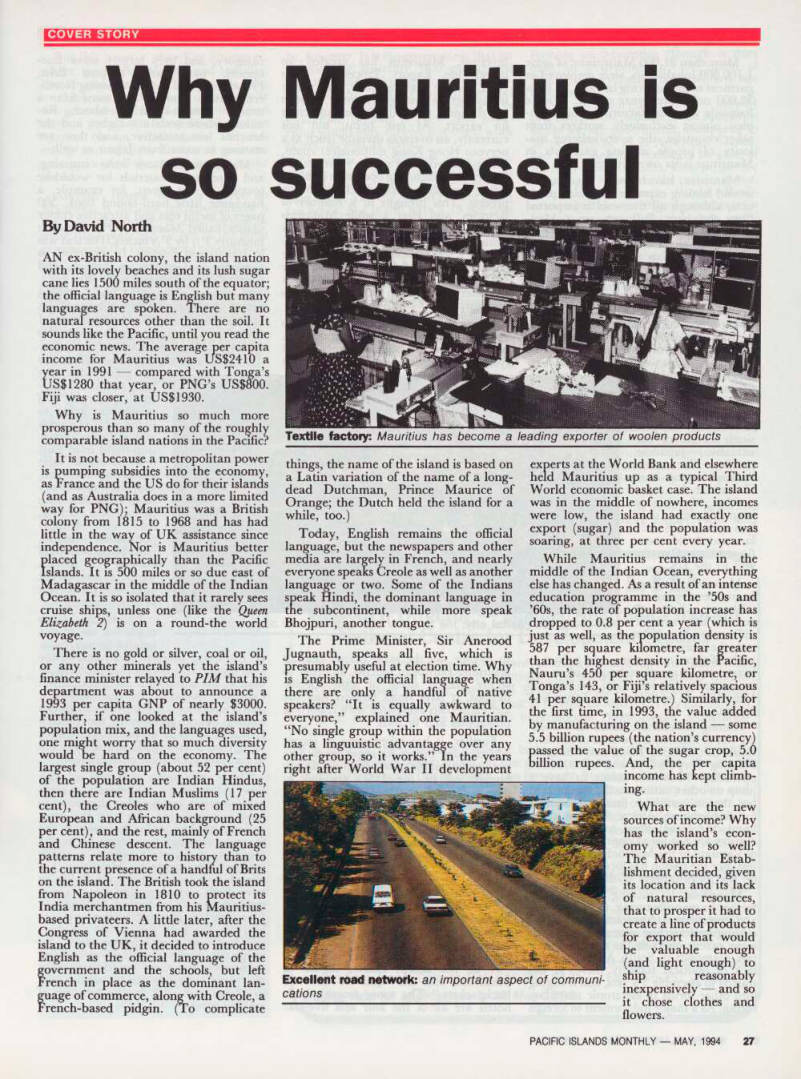
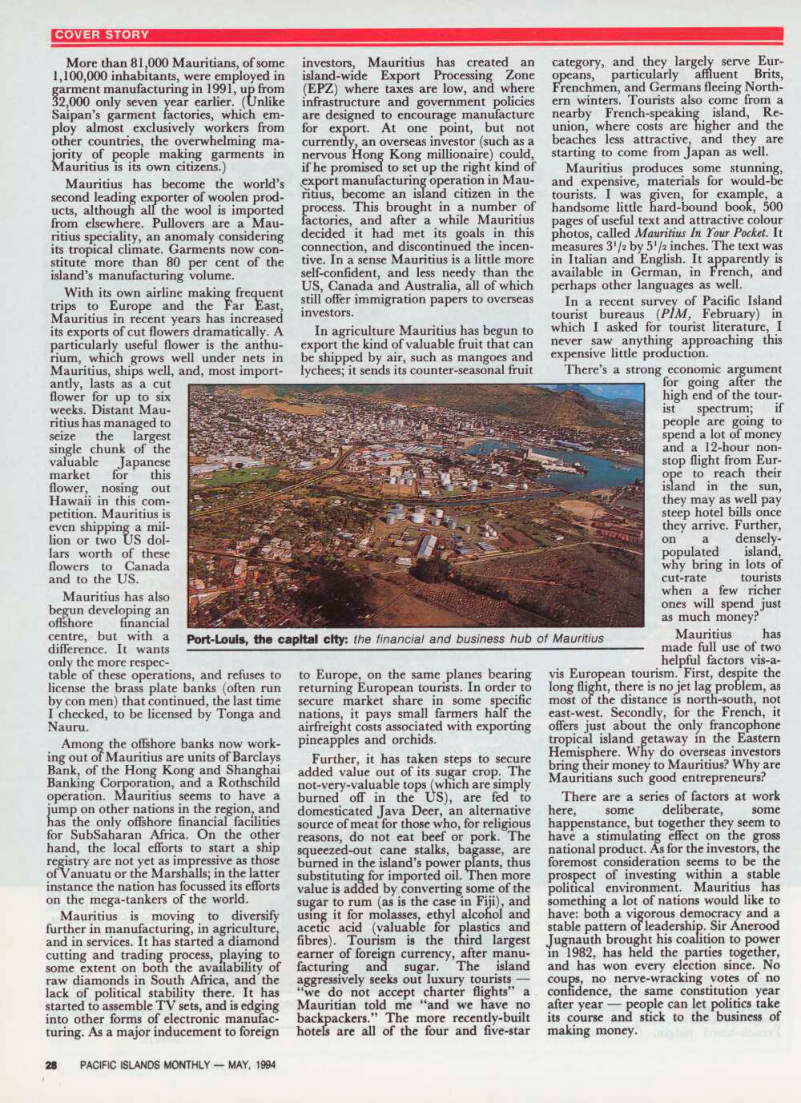
Cover Story
Why Mauritius is so successful
By David North
AN ex-British colony, the island nation with its lovely beaches and its lush sugar cane lies 1500 miles south of the equator; the official language is English but many languages are spoken. There are no natural resources other than the soil. It sounds like the Pacific, until you read the economic news. The average per capita income for Mauritius was US$24lO a year in 1991 compared with Tonga’s US$l2BO that year, or PNG’s US$BOO.
Fiji was closer, at US$l93O.
Why is Mauritius so much more prosperous than so many of the roughly comparable island nations in the Pacific?
It is not because a metropolitan power is pumping subsidies into the economy, as France and the US do for their islands (and as Australia does in a more limited way for PNG); Mauritius was a British colony from 1815 to 1968 and has had little in the way of UK assistance since independence. Nor is Mauritius better placed geographically than the Pacific Islands. It is 500 miles or so due east of Madagascar in the middle of the Indian Ocean. It is so isolated that it rarely sees cruise ships, unless one (like the Queen Elizabeth 2) is on a round-the world voyage.
There is no gold or silver, coal or oil, or any other minerals yet the island’s finance minister relayed to PIM that his department was about to announce a 1993 per capita GNP of nearly $3OOO.
Further, if one looked at the island’s population mix, and the languages used, one might worry that so much diversity would be hard on the economy. The largest single group (about 52 per cent) of the population are Indian Hindus, then there are Indian Muslims (17 per cent), the Creoles who are of mixed European and African background (25 per cent), and the rest, mainly of French and Chinese descent. The language patterns relate more to history than to the current presence of a handful of Brits on the island. The British took the island from Napoleon in 1810 to protect its India merchantmen from his Mauritius based privateers. A little later, after the Congress of Vienna had awarded the island to the UK, it decided to introduce English as the official language of the government and the schools, but left fench in place as the dominant lan fuage of commerce, alongwith Creole, a rench-based pidgin. (To complicate
things, the name of the island is based on a Latin variation of the name of a long dead Dutchman, Prince Maurice of Orange; the Dutch held the island for a
while, too.)
Today, English remains the official language, but the newspapers and other media are largely in French, and nearly everyone speaks Creole as well as another language or two. Some of the Indians speak Hindi, the dominant language in the subcontinent, while more speak Bhojpuri, another tongue.
The Prime Minister, Sir Anerood Jugnauth, speaks all five, which is presumably useful at election time. Why is English the official language when there are only a handful of native speakers? “It is equally awkward to
everyone,” explained one Mauritian.
“No single group within the population has a linguuistic advantagge over any other group, so it works.” In the years right after World War II development
experts at the World Bank and elsewhere held Mauritius up as a typical Third World economic basket case. The island was in the middle of nowhere, incomes were low, the island had exactly one export (sugar) and the population was soaring, at three per cent every year.
While Mauritius remains in the middle of the Indian Ocean, everything else has changed. As a result of an intense education programme in the ’sos and ’6os, the rate of population increase has dropped to 0.8 per cent a year (which is just as well, as the population density is 587 per square kilometre, far greater than the highest density in the Pacific, Nauru’s 450 per square kilometre, or
Tonga’s 143, or Fiji’s relatively spacious
41 per square kilometre.) Similarly, for the first time, in 1993, the value added by manufacturing on the island some 5.5 billion rupees (the nation’s currency) Eassed the value of the sugar crop, 5.0 illion rupees. And, the per capita
income has kept climb ing.
What are the new sources of income? Why has the island’s econ omy worked so well?
The Mauritian Estab lishment decided, given its location and its lack of natural resources, that to prosper it had to create a line of products for export that would be valuable enough
(and light enough) to
ship reasonably
inexpensively and so it chose clothes and flowers.
Excellent road network: an important aspect of communi cations
Textile factory: Mauritius has become a leading exporter of woolen products
More than 81,000 Mauritians, of some 1,100,000 inhabitants, were employed in farment manufacturing in 1991, up from 2,000 only seven year earlier. (Unlike Saipan’s garment factories, which em ploy almost exclusively workers from other countries, the overwhelming ma jority of people making garments in Mauritius is its own citizens.) Mauritius has become the world’s second leading exporter of woolen prod ucts, although all the wool is imported from elsewhere. Pullovers are a Mau ritius speciality, an anomaly considering its tropical climate. Garments now con stitute more than 80 per cent of the island’s manufacturing volume.
With its own airline making frequent trips to Europe and the Far East, Mauritius in recent years has increased its exports of cut flowers dramatically. A particularly useful flower is the anthu rium, which grows well under nets in Mauritius, ships well, and, most import
antly, lasts as a cut flower for up to six weeks. Distant Mau ritius has managed to seize the largest single chunk of the valuable Japanese market for this flower, nosing out Hawaii in this com petition. Mauritius is even shipping a mil lion or two US dol lars worth of these flowers to Canada and to the US.
Mauritius has also begun developing an offshore financial centre, but with a difference. It wants only the more respec
table of these operations, and refuses to license the brass plate banks (often run by con men) that continued, the last time I checked, to be licensed by Tonga and Nauru.
Among the offshore banks now work ing out of Mauritius are units of Barclays Bank, of the Hong Kong and Shanghai Banking Corporation, and a Rothschild operation. Mauritius seems to have a jump on other nations in the region, and has the only offshore financial facilities for Sub Saharan Africa. On the other hand, the local efforts to start a ship registry are not yet as impressive as those of Vanuatu or the Marshalls; in the latter instance the nation has focussed its efforts on the mega-tankers of the world.
Mauritius is moving to diversify further in manufacturing, in agriculture, and in services. It has started a diamond
cutting and trading process, playing to
some extent on both the availability of raw diamonds in South Africa, and the lack of political stability there. It has started to assemble TV sets, and is edging into other forms of electronic manufac turing. As a major inducement to foreign
investors, Mauritius has created an island-wide Export Processing Zone (EPZ) where taxes are low, and where infrastructure and government policies are designed to encourage manufacture for export. At one point, but not currently, an overseas investor (such as a nervous Hong Kong millionaire) could, if he promised to set up the right kind of export manufacturing operation in Mau ritius, become an island citizen in the Jirocess. This brought in a number of actories, and after a while Mauritius decided it had met its goals in this connection, and discontinued the incen tive. In a sense Mauritius is a little more self-confident, and less needy than the US, Canada and Australia, all of which still offer immigration papers to overseas investors.
In agriculture Mauritius has begun to export the kind of valuable fruit that can be shipped by air, such as mangoes and lychees; it sends its counter-seasonal fruit
to Europe, on the same planes bearing returning European tourists. In order to secure market share in some specific nations, it pays small farmers half the airfreight costs associated with exporting pineapples and orchids.
Further, it has taken steps to secure added value out of its sugar crop. The not-very-valuable tops (which are simply burned off in the US), are fed to domesticated Java Deer, an alternative source of meat for those who, for religious reasons, do not eat beef or pork. The squeezed-out cane stalks, bagasse, are burned in the island’s power plants, thus substituting for imported oil. Then more value is added by converting some of the sugar to rum (as is the case in Fiji), and using it for molasses, ethyl alcohol and acetic acid (valuable for plastics and fibres). Tourism is the third largest earner of foreign currency, after manu facturing and sugar. The island aggressively seeks out luxury tourists “we do not accept charter flights” a Mauritian told me “and we have no backpackers,” The more recently-built hotels are all of the four and five-star
category, and they largely serve Eur opeans, particularly affluent Brits, Frenchmen, and Germans fleeing North ern winters. Tourists also come from a nearby French-speaking island, Re union, where costs are higher and the beaches less attractive, and they are starting to come from Japan as well.
Mauritius produces some stunning, and expensive, materials for would-be tourists. I was given, for example, a handsome little hard-bound book, 500 pages of useful text and attractive colour photos, called Mauritius In Tour Pocket. It measures 3 1 / 2 by 5 1 / 2 inches. The text was in Italian and English. It apparently is available in German, in French, and perhaps other languages as well.
In a recent survey of Pacific Island tourist bureaus ( PIM, February) in which I asked for tourist literature, I never saw anything approaching this
expensive little production.
There’s a strong economic argument
for going after the high end of the tour ist spectrum; if people are going to spend a lot of money and a 12-hour non stop flight from Eur ope to reach their island in the sun, they may as well pay steep hotel bills once they arrive. Further, on a densely
populated island,
why bring in lots of cut-rate tourists when a few richer
ones will spend just
as much money?
Mauritius has made full use of two helpful factors vis-a
vis European tourism. First, despite the long flight, there is no jet lag problem, as most of the distance is north-south, not east-west. Secondly, for the French, it offers just about the only francophone tropical island getaway in the Eastern Hemisphere. Why do overseas investors bring their money to Mauritius? Why are Mauritians such good entrepreneurs?
There are a series of factors at work here, some deliberate, some happenstance, but together they seem to have a stimulating effect on the gross national product. As for the investors, the foremost consideration seems to be the prospect of investing within a stable political environment. Mauritius has something a lot of nations would like to have; both a vigorous democracy and a stable pattern of leadership. Sir Anerood Jugnauth brought his coalition to power in 1982, has held the parties together, and has won every election since. No coups, no nerve-wracking votes of no confidence, the same constitution year after year people can let politics take its course and stick to the business of
making money.
Port-Louls, the capital city: the financial and business hub of Mauritius
But this is not a place like Singapore, where there are elections and stability, but no real freedom. The vigorous press there are six dailies often criticise the government. Further, another good omen, none of the political parties operate on an ethnic basis, all cross ethnic and religious lines, and most are amalgams of all the major groups on the island.
Another reason business works on Mauritius is because the government is not only supportive, it also engages in some basic planning not to the point of annoying the commercial powers-that
be, however. It is the government that set up the EPZ structure, that encouraged the exporting of flowers, and the import ing of tourists. It is the government that decided to make a major investment in education, because it knew that Mau ritius would only survive if it could work smart, as well as hard.
Mauritius does not give away every thing in sight to incoming factories, as some desperate South Pacific countries have done. Yes, the export factory gets a tax break, but it still pays a 15 per cent tax on its profits.
Yes, the cost of labor in Mauritius is relatively low, and the norm is the 45-hour not the 40-hour week, but the country has a reasonably sturdy set of labour standards. These include a mini mum wage, mandatory overtime pay ments starting at time-and-a-half after the 45-hour week, workers compensation for people hurt on the Job, and unem ployment insurance. Further, labour unions are alive and well and play a major role on the island.
On one level, these labour standards exceed those of the United States. If you have worked for an employer for three years, and he decides to shut the factory and lay you off, by law, he must give you 15 days pay for each year of service.
These factors noted above are all useful, and all positive. There are some negative factors as well, which have helped build the economy in Mauritius: • No subsistence agriculture there is not enough spare land for subsistence
farming on Mauritius (though it does exist on a dependency, the island of Rodrigues), everyone has to work in the economy; Not too much government only 24 per cent of the workforce in Mauritius works for the government, compared to 50 per cent or so in American Samoa, and even higher percentages in some of the Micronesian entities. Thus people are encouraged to work in the private sector.
Mauritius did some World Bank encouraged downsizing of government a few years ago, a painful, but useful process; • No Sugar Daddy unlike American Samoa, Palau and the French islands in the Pacific, Mauritius has no massive, initiative-dulling flow of assistance dol lars coming into its treasury. If it wants something, it has to earn it.
Finally, there is virtually no military and no nobility in Mauritius to compli cate politics and economics.
As a matter of fact there is no indigenous population to make historic claims on the land. While America likes to think of itself as the “land of immigrants” there was an American Indian population on the ground long before the Europeans noticed the place.
Not so in Mauritius everyone is an immigrant or a descendent of one. There were only the dodo birds on Mauritius before the Europeans arrived.
But whatever the reasons, Mauritius keeps making more money, year after year. D
Advertisements & other items, pp. 29-31 (1 item)
‘Best losers’
get 8 seats
ISLANDS are often innovative about their electoral arrangements and Mauritius is no exception. In an effort to make sure that minority voices are heard in the Westminster-style parliament, arrangements are made to to award eight of the 70 seats to the ‘best losers’.
It works like this. First, there is the usual road of elections, using the firstpast-the-post system to choose three members for each of the main island’s 20 districts. The party slates are chosen before the election, so that the governing coalition, for instance, has only three candidates per district.
Once the election is over, and it is clear which party or coalition won, the eight extra seats are distributed to the government and to the opposition in such a way as to preserve the balance chosen by the voters.
Currently five of these seats belong to government members, and three to the opposition. (Two other seats are filled by the voters of a smaller island, Rodriques, where the ‘best loser’ system does not exist.) Then the Electoral Commission looks over the results and decides, within the partisan distribution just described, which ethnic groups will be under-
represented in the parliament.
It then decides which ethnic groups, within the government, and within the opposition, are to be allocated the eight seats. The final step is to review polling results, and to award the eight seats to the losing candidates with the most votes who fit the pattern described above.
Once, in 1982, the winning coalition won all the seats in the chamber, so there were no losing government candidates for the ‘best losers’ seats. That year the leading four defeated opposition candidates were seated, ana the other four seats left vacant until the next election. □
ANUTECH PTY LTD
Research Director Islands/Australia Program
National Centre for Development Studies
Applications are invited for appointment, on contract, to a full-time position as Research Director of the Islands/Australia Program within the National Centre for Development Studies, Research School of Pacific and Asian Studies, Australian National University. The post is funded by ANUTECH Pty Ltd through a grant provided by the Australian International Development Assistance Bureau.
The task of the Research Director is to initiate, coordinate and manage research projects which focus on the growth and development of the island states of the Pacific Ocean region. The Research Director will also be expected to liaise and co-operate with government departments, statutory bodies and the private sector in the promotion of an understanding of the region both in Australia and elsewhere. Duties will include, in addition to original research, the organisation of conferences and seminars, coordination of Centre publications of the Pacific states and, if appropriate, technical supervision of the South Pacific Economic and Social Database.
The Research Director would be expected to have post-graduate qualifications and a deep understanding of the issues affecting the development of small states.
The appointment will be for two years in the first instance and is available within the next three months. Secondments from other institutions will be considered.
A contract will be negotiated within the range $45,000-$55,000 pa.
Enquiries: intending applicants may obtain further information and selection criteria from Jennie Colman (Tel: 616-249 0131 Fax: 616-257 2886).
Closing date for applications is 18 May 1994.
'I.--* ‘ SMf&r/; . ■ i?vi
Toyota Land Cruiser offers you more
rugged reliability, elegant luxury...
and long-lasting durability.
Land Cruiser’s reputation is second to none. No one doubts its rugged constitution. Yet here is a vehicle that rivals the finest limousines where comfort is concerned. And its fit and finish, the attention to detail, and the graceful lines and fine trim are reminiscent of exquisite luxury cars.
Nevertheless, hidden beneath its elegance, Land Cruisers still offer tough ladder frames and suspension engineered to go wherever you wish... in total comfort powered by your choice of 4.5-litre petrol or 4.2-litre diesel engines. And everything is carefully protected from rust and corrosion so it lasts longer.
Toyota Land Cruiser. The best for your world.
Now and forever.
SE?"
J
DISTRIBUTORS/DEALERS
AMERICAN SAMOA,...
GUAM & MICRONESIA
NORFOLK ISLAND
SOLOMON ISLAND
VANUATU
BURNS PHILP MOTORS PH 633-4281
ATKINS KROLL, INC. PH 646-1876/9
BORRYSPTYLTD. PH 22114
ELA MOTORS PH 30746
ASCO MOTORS PH 22341
COOK ISLANDS
KIRIBATI
PAPUA NEW GUINEA
TAHITI
WESTERN SAMOA...
PACIFIC MOTORS LTD PH 20796
TARAWA MOTORS PH 21090
ELA MOTORS PH 229400
NIPPON AUTOMOTO PH 429819
ASCO MOTORS PH 23664
FIJI ASCO MOTORS
NEW CALEDONIA S.I.A.P.
SAIPAN MICROL CORPORATIOI
TONGA ASCO MOTORS
* i
OTA
o \
djC WINCH
B
LAND CRUISER
Exact features and specifications may vary depending on country of purchase. Please check with your nearest TOYOTA distributor/dealer for details.
PH312666 PH 275562 PH 234-5911 PH 23500
®TOYOTA
The status of Fiji women
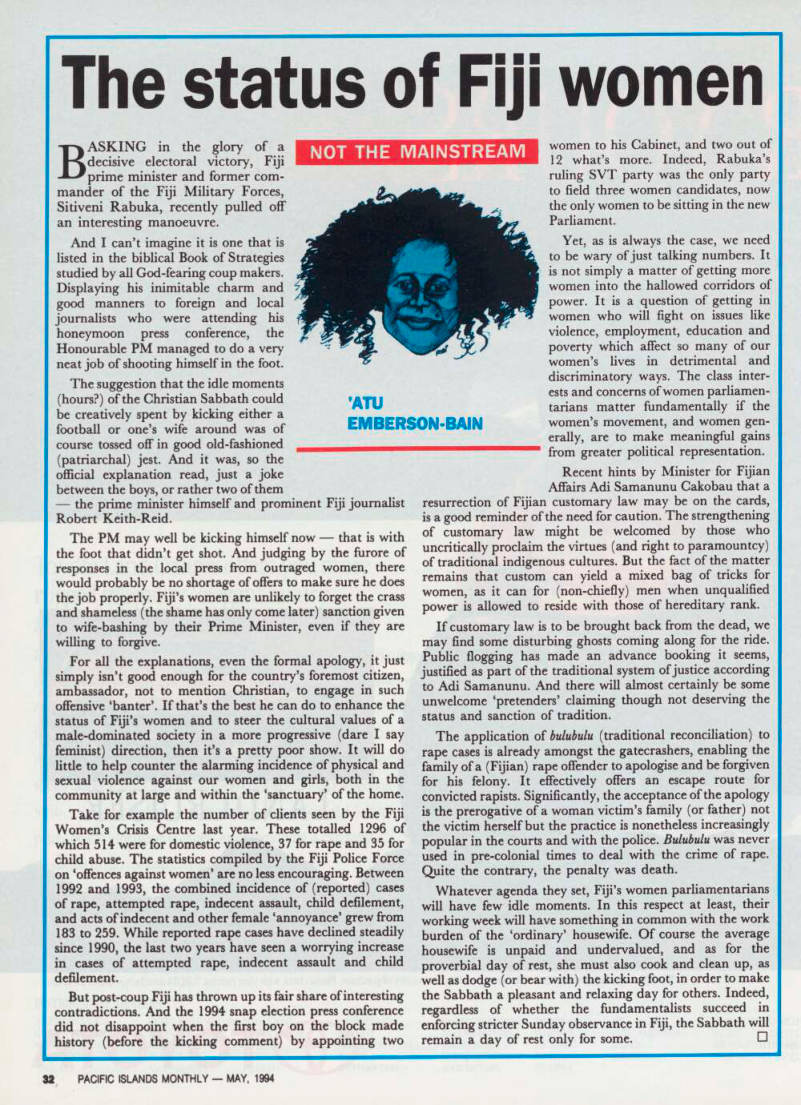
BASKING in the glory of a
decisive electoral victory, Fiji
prime minister and former com mander of the Fiji Military Forces, Sitiveni Rabuka, recently pulled off an interesting manoeuvre.
And I can’t imagine it is one that is listed in the biblical Book of Strategies studied by all God-fearing coup makers.
Displaying his inimitable charm and good manners to foreign and local journalists who were attending his honeymoon press conference, the Honourable PM managed to do a very neat job of shooting himself in the foot.
The suggestion that the idle moments (hours?) of the Christian Sabbath could be creatively spent by kicking either a football or one’s wife around was of course tossed off in good old-fashioned (patriarchal) jest. And it was, so the official explanation read, just a joke between the boys, or rather two of them
the prime minister himself and prominent Fiji journalist Robert Keith-Reid.
The PM may well be kicking himself now that is with the foot that didn’t get shot. And judging by the furore of responses in the local press from outraged women, there would probably be no shortage of olfers to make sure he does the job properly. Fiji’s women are unlikely to forget the crass and shameless (the shame has only come later) sanction given to wife-bashing by their Prime Minister, even if they are willing to forgive.
For all the explanations, even the formal apology, it just simply isn’t good enough for the country’s foremost citizen, ambassador, not to mention Christian, to engage in such offensive ‘banter’. If that’s the best he can do to enhance the status of Fiji’s women and to steer the cultural values of a male-dominated society in a more progressive (dare I say feminist) direction, then it’s a pretty poor show. It will do little to help counter the alarming incidence of physical and sexual violence against our women and girls, both in the community at large and within the ‘sanctuary’ of the home.
Take for example the number of clients seen by the Fiji Women’s Crisis Centre last year. These totalled 1296 of which 514 were for domestic violence, 37 for rape and 35 for child abuse. The statistics compiled by the Fiji Police Force on ‘offences against women’ are no less encouraging. Between 1992 and 1993, the combined incidence of (reported) cases of rape, attempted rape, indecent assault, child defilement, and acts of indecent and other female ‘annoyance’ grew from 183 to 259. While reported rape cases have declined steadily since 1990, the last two years have seen a worrying increase in cases of attempted rape, indecent assault and child defilement.
But post-coup Fiji has thrown up its fair share of interesting contradictions. And the 1994 snap election press conference did not disappoint when the first boy on the block made history (before the kicking comment) by appointing two
women to his Cabinet, and two out of 12 what’s more. Indeed, Rabuka’s ruling SVT party was the only party to field three women candidates, now the only women to be sitting in the new Parliament.
Yet, as is always the case, we need to be wary of just talking numbers. It is not simply a matter of getting more women into the hallowed corridors of power. It is a question of getting in women who will fight on issues like violence, employment, education and poverty which affect so many of our women’s lives in detrimental and discriminatory ways. The class inter ests and concerns of women parliamen tarians matter fundamentally if the women’s movement, and women gen erally, are to make meaningful gains
from greater political representation.
Recent hints by Minister for Fijian Affairs Adi Samanunu Cakobau that a
resurrection of Fijian customary law may be on the cards, is a good reminder of the need for caution. The strengthening of customary law might be welcomed by those who uncritically proclaim the virtues (and right to paramountcy) of traditional indigenous cultures. But the fact of the matter remains that custom can yield a mixed bag of tricks for women, as it can for (non-chiefly) men when unqualified power is allowed to reside with those of hereditary rank.
If customary law is to be brought back from the dead, we may find some disturbing ghosts coming along for the ride.
Public flogging has made an advance booking it seems, justified as part of the traditional system of justice according to Adi Samanunu. And there will almost certainly be some unwelcome ‘pretenders’ claiming though not deserving the status and sanction of tradition.
The application of bulubulu (traditional reconciliation) to rape cases is already amongst the gatecrashers, enabling the family of a (Fijian) rape offender to apologise and be forgiven for his felony. It effectively offers an escape route for convicted rapists. Significantly, the acceptance of the apology is the prerogative of a woman victim’s family (or father) not the victim herself but the practice is nonetheless increasingly popular in the courts and with the police. Bulubulu was never used in pre-colonial times to deal with the crime of rape.
Quite the contrary, the penalty was death.
Whatever agenda they set, Fiji’s women parliamentarians will have few idle moments. In this respect at least, their working week will have something in common with the work burden of the ‘ordinary’ housewife. Of course the average housewife is unpaid and undervalued, and as for the proverbial day of rest, she must also cook and clean up, as well as dodge (or bear with) the kicking foot, in order to make the Sabbath a pleasant and relaxing day for others. Indeed, regardless of whether the fundamentalists succeed in enforcing stricter Sunday observance in Fiji, the Sabbath will remain a day of rest only for some. D
Not The Mainstream
'Atu
Emberson-Bain
Aborigines move to get
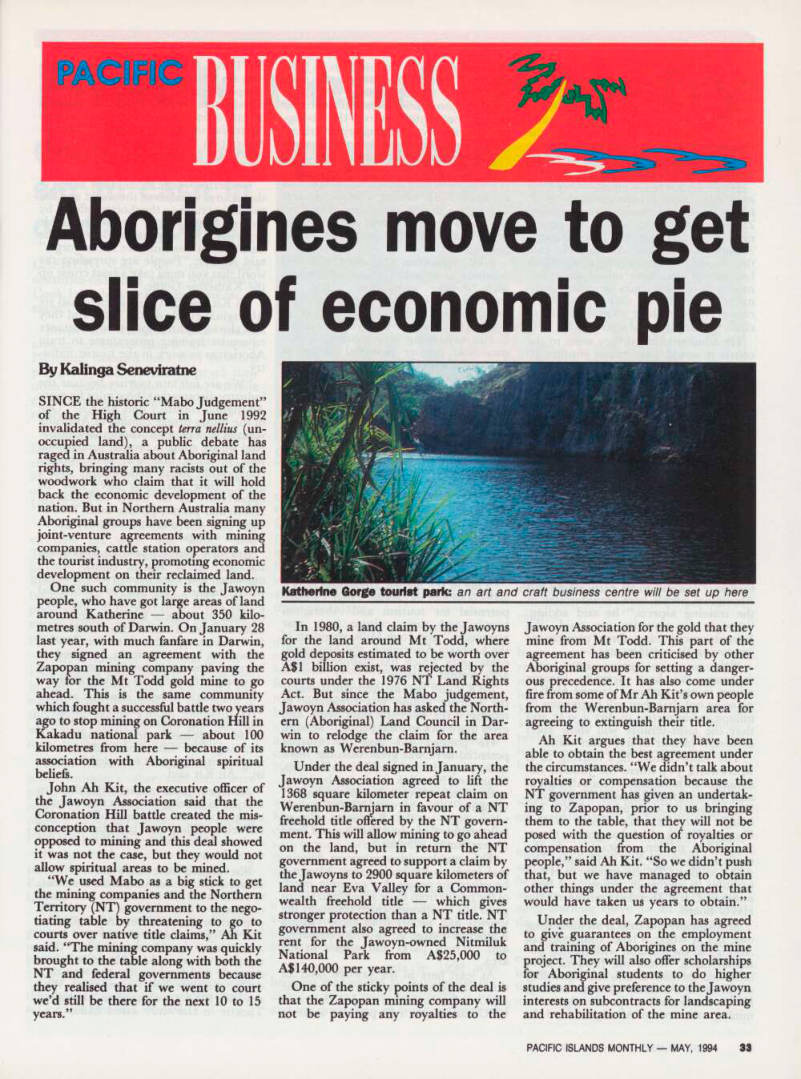
Pacific
Aborigines move to get slice of economic pie
By Kalinga Seneviratne
SINCE the historic “Mabo Judgement” of the High Court in June 1992 invalidated the concept terra nellius (un occupied land), a public debate has raged in Australia about Aboriginal land rights, bringing many racists out of the woodwork who claim that it will hold back the economic development of the nation. But in Northern Australia many Aboriginal groups have been signing up joint-venture agreements with mining companies, cattle station operators and the tourist industry, promoting economic development on their reclaimed land.
One such community is the Jawoyn people, who have got large areas of land around Katherine about 350 kilo metres south of Darwin. On January 28 last year, with much fanfare in Darwin, they signed an agreement with the Zapopan mining company paving the way for the Mt Todd gold mine to go ahead. This is the same community which fought a successful battle two years ago to stop mining on Coronation Hill in Kakadu national park about 100 kilometres from here because of its association with Aboriginal spiritual beliefs.
John Ah Kit, the executive officer of the Jawoyn Association said that the Coronation Hill battle created the mis conception that Jawoyn people were opposed to mining and this deal showed it was not the case, but they would not allow spiritual areas to be mined.
“We used Mabo as a big stick to get the mining companies and the Northern Territory (NT) government to the nego tiating table by threatening to go to courts over native title claims,” Ah Kit said. “The mining company was quickly brought to the table along with both the NT and federal governments because they realised that if we went to court we’d still be there for the next 10 to 15 years.”
In 1980, a land claim by the Jawoyns for the land around Mt Todd, where gold deposits estimated to be worth over Asl billion exist, was rejected by the courts under the 1976 NT Land Rights Act. But since the Mabo judgement, Jawoyn Association has asked the Northern (Aboriginal) Land Council in Darwin to relodge the claim for the area known as Werenbun-Bamjam, Under the deal signed in January, the Jawoyn Association agreed to lift the 1368 square kilometer repeat claim on Werenbun-Bamjam in favour of a NT freehold title offered by the NT government. This will allow mining to go ahead on the land, but in return the NT government agreed to support a claim by the Jawoyns to 2900 square kilometers of land near Eva Valley for a Commonwealth freehold title which gives stronger protection than a NT title, NT government also agreed to increase the rent for the Jawoyn-owned Nitmduk Park from A 525,000 to AH 140,000 per year.
One of the sticky points of the deal is that the Zapopan mining company will not be paying any royalties to the
Jawoyn Association for the gold that they mine from Mt Todd, This part of the agreement has been criticised by other Aboriginal groups for setting a danger ous precedence. It has also come under fire from some of Mr Ah Kit’s own people from the Werenbun-Barnjarn area for agreeing to extinguish their title, Ah Kit es that th have been able to obtain the best agreement under the circumstances, “We didn’t talk about royalties or compensation because the NT government has given an undertak ing to Zapopan, prior to us bringing them to the table, that they will not be posed with the question of royalties or compensation from the Aboriginal people,” said Ah Kit. “So we didn’t push that, but we have managed to obtain other things under the agreement that would have taken us years to obtain.”
Under the deal Zapopan has agreed to ivi . guarantees onthe employment and traini c f Aborigines on fhe mine pro ject. Thly will also offer scholarships for Aboriginal students to do higher studies and give preference to the Jawoyn interests on subcontracts for landscaping and rehabilitation of the mine area.
Katherine Gorge tourist park: an art and craft business centre will be set up here
panies.”
Business
The NT government will in turn support a five-year Asl million develop ment project to provide the Jawoyn community in the area power, water, roads, houses, etc. They will also hand over a $600,000 building at the Katherine Gorge tourist park for the Jawoyn Association to set up an arts and crafts business centre.
While Ah Kit has come under fire from some Aboriginal groups about the deal, fellow mining companies have criticised Zapopan for “selling out” to Aboriginal interests, according to Terry Strapp, Zapopan’s executive director. He told the resource industry magazine Miner last month that after initial scepticism most mining companies were now com ing to the realisation that it was not the case of always rushing off to the courts to challenge any type of native title.
He admitted that if they went to the courts it would have taken another 10 years. “We wouldn’t have tried to fight it out in the courts,” said Mr Strapp. “I think most mining companies have now come to that realisation as well it is going to be in a lot of cases a negotiated settlement.”
The construction of the Mt Todd mine, about 50km from here, has already begun with most of the operations plant completed and earth moving from the mountain already begun. The mining of gold was due to begin last month.
Marcus Rosas, the Aboriginal Liaison Officer said that 16 of the 61 staff at the mine were Aboriginal and they had plans to train five to six Jawoyn people on a three-month course as operators like loaders. “It’s still in its early stages but Aboriginal people here are interested in the training aspects,” he said adding, “though no royalties are paid, the Jawoyn people see these projects as improving their self-esteem.”
“We are now going into joint ventures. We have actually become miners in partnership,” claimed Ah Kit, pointing out that they will be moving 10 million cubic metres of dirt a year and that the joint-venture will show good dividends in four to five years time.
The joint-venture he’s refering to is Mirrkworlk JV, where the Jawoyn As sociation with the help of the Aboriginal and Torres Strait Islander Commercial
Development Corporation (GDC) has
bought into Darwin’s Henry Walker Group (HWG) which has got the three year As 23 million contract to do the earth works at the Mt Todd mine. The A 53.5 million GDC investment in HWG includes its chairman, Aboriginal busi nessman Gatjil Djerrkura sitting on the HWG board.
Strategically this deal is an interesting one. NT is where a large component of Aboriginal-owned land with mining po tential exists. While the Jawoyns have launched themselves into the expanding world of international contract mining, HWG has gained a special edge as a mining contractor of Aboriginal land. In
its prospectus to its shareholders in July, the HWG directors said that in the post- Mabo era, if the mining operations became more likely to be influenced by the opinion or preferences of the Aborig inal community, the company’s relation ship with GDC would be crucial to its expansion and profitability.
Ah Kit said “We have set a precedence in that Aboriginal people can sit down with mining companies and negotiate a decent agreement. The days are over when Aboriginal interests were continually bulldozed by mining com
panies.”
While questions are asked and will continue to be asked about agreements with mining companies where no royalties are included, especially in a project which is expected to reap in at least Asl billion, the Jawoyn Association is also expanding into tourism, which may hold greater potential as far as economic self-reliance and sustainable development is concerned.
The Nitmiluk National Park, which includes the Katherine Gorge, was given back to the Jawoyn people in 1989 following a land claim lodged in the late 19705. It has been leased back to the NT Conservation Land Corporation under a 99-year lease for the day-to-day manage ment of the park. But there’s a Jawoyn majority in the park’s board of manage ment.
In the late ’Bos and early ’9os tourism has become one of Australia’s biggest foreign exchange earners and the NT has become one of the star attractions for tourists.
“One of the biggest attractions of NT is the land and its people. There’s a huge potential for tourism and Aboriginal people and their culture is a star attraction,” said June Mills, president of the Larrakia Association, the Aboriginal community which has claimed a large area around Darwin.
Ah Kit said that for Aboriginal people the tourism option was preferable to mining. “It’s more pleasant work and gives more jobs to local people,” he said.
He pointed out that the tourism potential here was great with the three national parks in the NT Kakadu, Oluru and Nitmiluk all on Aboriginal native land. “Nitmiluk had the highest visitation last year with 300,000 people who came to the Katherine Gorge, followed by Kakadu 230,000 and Uluru (Ayers Rock) 225,000.”
The trouble with tourism on Aborig inal lands so far is that they have not benefited the people. For example, much of the profits from those who climb Uluru go to bus companies which transport the tourists and profits from those visiting Katherine Gorge go to boat companies and caravan parks and motels m the area.
At least here in the Jawoyn land all this is changing. From May last year, the Jawoyn Association in conjunction with GDC has bought a 50 per cent stake in
the Travel North boat company which runs the Katherine Gorge cruises and the camping ground in the Nitmiluk Na tional Park. It is the biggest investment by an Aboriginal group in northern Australian in seven years and the Jawoyn Association hopes to pay back the AsBoo,ooo commercial loan from the GDC within five years.
Katherine Gorge should rank as one of the natural wonders of the world and the two-hour cruise the shortest offered by Travel North is an unforgettable experience for any nature lover. “The backbone of tourism here is the gorge,” said Ah Kit. “People are spreading the word that you must take a boat cruise up the Katherine Gorge.”
Ah Kit said that they already had six Aboriginal guides on the boats and they had also set up ap employment assistance enterprise training programme to train Aborigines to work in the tourist indus try.
“We are full into tourism because the industry dictates that there must be more Aboriginal culture,” said Ah Kit. “One of the things people coming to Australia want to experience is Aboriginal culture.
And we are going to provide professional tour products that will make people comfortable, happy and go awav with a good feeling that they have had the opportunity to sit down and talk to Aboriginal people, go into bush, look at their rock arts sites and talk to them as
human beings.”
At Eva Valley, the Jawoyn Association has set up a tourist centre where organised tours are taken twice a week, where tourists can talk to Aboriginal people about their culture, see how they do bark paintings or knit mats, go to the bush and learn about their traditional food, have a typical bush tucker (lunch), as well as have a swim in the pond or learn traditional games like boomerang throwing. It’s a full days programme.
“We don’t provide dancing at Eva Valley because in a proper Aboriginal sense dancing is for sorrow like funerals, or for happiness and dancing has a meaning. The Corroboree (dance and singing ritual) wasn’t invented for tour ist,” Ah Kit said.
Mills sees joint-ventures like those in tourism as proving the point that Aborig inal people want to be self-sufficient and self-reliant. They want to do business and do it well because they don’t want to be
dependent.
She argued that since surveys have shown that the main reason for tourists to come to the NT is to see the Aboriginal culture one third of the 155,000 population of the NT are Aboriginal the NT government should pay more attention to the Aboriginal arts. “Gov ernment must take Aboriginal arts seriously and fund it, like the way they do for the state ballet companies. Why not have the equivalent of an Aboriginal Theatre in Darwin?” asked Mills. □
Black pearl industry
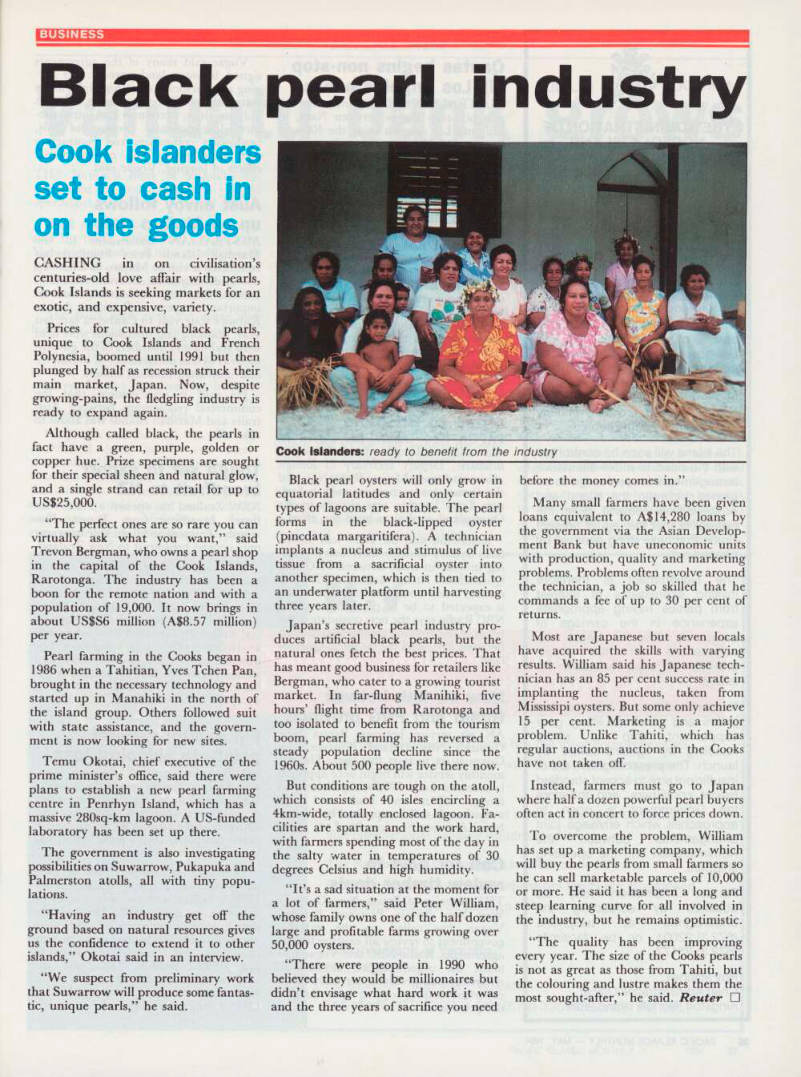
Cook islanders set to cash in on the goods
CASHING in on civilisation’s centuries-old love affair with pearls, Cook Islands is seeking markets for an
exotic, and expensive, variety.
Prices for cultured black pearls, unique to Cook Islands and French Polynesia, boomed until 1991 but then plunged by half as recession struck their main market, Japan. Now, despite growing-pains, the fledgling industry is ready to expand again.
Although called black, the pearls in fact have a green, purple, golden or copper hue. Prize specimens are sought for their special sheen and natural glow, and a single strand can retail for up to U 5525,000.
“The perfect ones are so rare you can virtually ask what you want,” said Trevon Bergman, who owns a pearl shop in the capital of the Cook Islands, Rarotonga. The industry has been a boon for the remote nation and with a population of 19,000. It now brings in about USSS6 million (A 58.57 million) per year.
Pearl farming in the Cooks began in 1986 when a Tahitian, Yves Tchen Pan, brought in the necessary technology and started up in Manahiki in the north of the island group. Others followed suit with state assistance, and the govern ment is now looking for new sites.
Temu Okotai, chief executive of the prime minister’s office, said there were plans to establish a new pearl farming centre in Penrhyn Island, which has a massive 280 sq-km lagoon. A US-funded laboratory has been set up there.
The government is also investigating possibilities on Suwarrow, Pukapuka and Palmerston atolls, all with tiny popu lations.
“Having an industry get off the ground based on natural resources gives us the confidence to extend it to other islands,” Okotai said in an interview.
“We suspect from preliminary work that Suwarrow will produce some fantas tic, unique pearls,” he said.
Black pearl oysters will only grow in equatorial latitudes and only certain types of lagoons are suitable. The pearl forms in the black-lipped oyster (pincdata margaritifera). A technician implants a nucleus and stimulus of live tissue from a sacrificial oyster into another specimen, which is then tied to an underwater platform until harvesting three years later.
Japan’s secretive pearl industry pro duces artificial black pearls, but the natural ones fetch the best prices. That has meant good business for retailers like Bergman, who cater to a growing tourist market. In far-flung Manihiki, five hours’ flight time from Rarotonga and too isolated to benefit from the tourism boom, pearl farming has reversed a steady population decline since the 19605. About 500 people live there now.
But conditions are tough on the atoll, which consists of 40 isles encircling a 4km-wide, totally enclosed lagoon. Fa cilities are spartan and the work hard, with farmers spending most of the day in the salty water in temperatures of 30 degrees Celsius and high humidity.
“It’s a sad situation at the moment for a lot of farmers,” said Peter William, whose family owns one of the half dozen large and profitable farms growing over 50,000 oysters.
“There were people in 1990 who believed they would be millionaires but didn’t envisage what hard work it was and the three years of sacrifice you need
before the money comes in.”
Many small farmers have been given loans equivalent to A$ 14,280 loans by the government via the Asian Develop ment Bank but have uneconomic units
with production, quality and marketing
problems. Problems often revolve around the technician, a job so skilled that he commands a fee of up to 30 per cent of returns.
Most are Japanese but seven locals have acquired the skills with varying results. William said his Japanese tech nician has an 85 per cent success rate in implanting the nucleus, taken from Mississipi oysters. But some only achieve 15 per cent. Marketing is a major problem. Unlike Tahiti, which has regular auctions, auctions in the Cooks have not taken off.
Instead, farmers must go to Japan where half a dozen powerful pearl buyers often act in concert to force prices down.
To overcome the problem, William has set up a marketing company, which will buy the pearls from small farmers so he can sell marketable parcels of 10,000 or more. He said it has been a long and steep learning curve for all involved in the industry, but he remains optimistic.
“The quality has been improving every year. The size of the Cooks pearls is not as great as those from Tahiti, but the colouring and lustre makes them the most sought-after,” he said. Reuter □
Cook Islanders: ready to benefit from the industry
Advertisements & other items, p. 35 (1 item)
I Business
Fiji auditor-general
Business Bulletin
Qantas begins non-stop
Fiji-Los Angeles service
AUSTRALIAN airline Qantas has be gun non-stop flights between Nadi, in Fiji, and Los Angeles using the 406-seat Boeing 747-400 jet. The twice weekly service, which was inaugurated on March 30, replaces four 235-seat Boeing 747 Combi flights which passed through Hawaii.
Qantas’ manageress for Fiji and Pa cific Islands Katy Weekes said the new route would make Fiji an even more attractive destination for Americans who would have a chance to fly direct without having to pass through Hawaii. As part of changes to its Pacific services, Qantas will stop direct flights from Australia to San Francisco. But it will continue to provide services to San Francisco by a code-share arrangement with US Air via Los Angeles.
PNG moves trade
office to Brisbane
PAPUA New Guinea has moved its Australian trade office from Sydney to Brisbane. Deputy secretary of foreign affairs and trade Maimu Raka-Nou said the former trade commissioner in Syd ney, Legu Leaghy, was already in the Queensland capital to head the office.
Raka-Nou said the office was moved from Sydney because there was a grow ing interest in trade between PNG and Queensland. At the same time PNG has created a new consulate in Cairns which is expected to be in place this month.
NBC Radio says the new consulate is the result of the growing commercial interest between PNG and the far north Queens land.
New air link betwen
Guam and PNG province
AN air service between Papua New Guinea’s New Ireland Province and Guam is set to start this year. The tri monthly service will begin once approval is received from PNG’s department of foreign affairs and trade and civil avaiation. It will be operated by Guam based Aviation Services Pty Ltd.
Call for govt to
review timber deals
THE premier of Papua New Guinea’s West New Britain Province, Bernard Vogae, has called on the national government to review all existing timber agreements. Radio NBC said Vogae had made the urgent appeal because of environmental problems currently being
experienced from logging operations in
the province.
Vogae said many of the agreements signed between landowwners and log ging contractors do not highlight forest sustainability. The agreements mention only royalties, premiums and infrastruc ture developments. Because of this, landowner companies and contractors care little about the environmental effects of logging, Vogae said.
Aust envoy follows
up on Majuro visit
AUSTRALIAN ambassador to the Marshall Islands Peter Stanford has completed a visit to Majuro to follow up on the development of commercial links between the two countries which were an important element of President Amata Kabua’s state visit to Canberra late last year. Stanford said discussions were held with Kabua and members of the govern ment as well as the chamber of commerce and individual business leaders.
He said it was evident that the commercial relationship between Aus tralia and Marshall Islands was about to take off.
Tonga set to export
breadfruit to NZ
NEW Zealand has opened a market for frozen breadfruit from Tonga. Pre viously, Tongans had been able to export only cooked breadfruit to New Zealand.
The head of Tonga’s quarantine and quality management division of the agriculture ministry, Konrad Engelberger, said peeled and frozen breadfruit could be accepted as commer cial shipments provided they are frozen at -18 degrees Celsius for seven days. The quarantine division has to verify and issue a certificate that the shipment has been frozen as required before it is accepted in New Zealand.
Fiji auditor-general
points to shipping loss
FIJI’S auditor-general, Ramesh Dutt,
says the government will suffer a loss of US$6.4 million by the time the marine
department’s shipyard completes the
73-metre Reef Endeavour for an Australian cruise company. Dutt’s audit report has been tabled in parliament.
Dutt said the agreed price in 1989 when the contract was signed was for US$6.2 million and the ship was to be delivered in April 1991. He said the shipyard’s own estimates of costs were approximately $lO million but the pur chaser was able to negotiate it down to just US$6.2 million. Dutt said the various delays meant the government would now make a massive loss of US$6.4 million on the deal. □
Advertisements & other items, pp. 36-38 (2 items)
Carriage
NORFOLK
ISLAND
THE ADMINISTRATION OF
NORFOLK ISLAND
EXPRESSIONS
OF INTEREST
CARRIAGE
OF GOODS
BY SEA
Norfolk Island, located 1800 kms east of Australia, is a self-governing external Territory under the authority of Australia. It has a population of 1600 persons and services to the Island community are provided entirely from its own revenue sources.
The Island will soon be confronted with the need to make alternative arrangements for sea cargo to be carried between the Island and Australia/New Zealand, given the possibility that the use of present Union Purchase lifting gear will be phased out.
The Government is therefore inviting expressions of interest from parties having appropriate experience in the carriage of cargo by sea, to enter into negotiations for the future provision of freight services to the Island.
No port facilities are in place. Two jetties and on-shore lifting gear supplement ship to shore handling by lighters towed by launch. The present lighters are of insufficient size to accept standard freight containers, and therefore the Government is open to approaches which envisage joint arrangements between the Administration and the operating shippers.
Further information may be obtained by contacting the undersigned at telephone (672 3) 22001 or by facsimile (672 3) 23177.
Roy Mitchell, Chief Administrative Officer.
Kingston, Norfolk Island 2899.
Vanuatu bank grows
Advertisement
Second year of operations ends with
report of growth amid competition
THE National Bank of Vanuatu has completed its second financial year of operations.
Bank general manager Kerry Jowett said the bank, which was 100 per cent Vanuatu-owned, was on a steady growth path. Total assets now exceed Vatu 1,400,000,000 and all depositors’ balances are guaranteed by the government.
The bank took over the assets and liabilities of the Vanuatu Co-operative Savings Bank Ltd (VCSB) in August 1991, and is responsible for providing services at 23 points throughout the country. It also competes for business with three well established
internationally-based banks.
Mr Jowett said the bank was now well established both locally and internationally. He said with its network of branches throughout Vanuatu, it had the infrastructure and ability to assist draw more people into the cash economy and act as a stimulus to local entrepreneurship throughout the economy.
The bank, Mr Jowett said, had a modern computer system which provided a full retail foreign currency-based information system and with such a system it had been able to be a banking leader in off site computer linked services in Vanuatu. He said staff training received high priority.
Bank chairman Nicholson Worek said in providing capital of Vatu 128,000,000 to start the new bank, the government was aware of the deficit and the continuing loss situation that existed within the VCSB and wanted the new bank to be capitalised sufficiently.
In his 1992 report, he said this was because they wanted to safeguard the interests of depositors with the VCSB and to let the operations of the new bank be conducted on a firm financial basis.
He said the bank directors had decided to write off major costs associated with the take-over of the VCSB. Mr Worek said the bank had set up an international business department with relationships with 12 overseas correspondent banks and had been through a busy and costly establishment period.
Mr Worek reports to Finance Minister Willie Jimmy who has said that national objectives had for many years focused on the need for an indigenous commercial bank and in 1989 an Act of parliament was passed to provide for the establishment of such a bank.
Mr Jimmy said that while he acknowledged the role of internationally-based commercial banks operating in Vanuatu, they had not been set up with a network to cater for all the banking requirements of the widely scattered agriculturalbased sector of Vanuatu’s economy. □ ft* |i National Bank of Vanuatu . . .
Linking Vanuatu with the Pacific
The National Bank of Vanuatu has the most comprehensive banking network in Vanuatu, with 23 branches throughout the islands.
We offer an extensive range of services for both domestic and international banking requirements.
The National Bank of Vanuatu is 100% owned by the Government of Vanuatu. All depositors funds are guaranteed by the Government of Vanuatu.
National Bank of Vanuatu Head Office: PO Box 249 Port Vila Vanuatu Telephone: (678) 22201 Fax: (678) 22671 Telex: (771) 1017
The "can do"
constructors
’ am
Partners in progress
throughout the Pacific
saying "can do"
to your construction needs
TP® 6 ®®?* r-'L —•* ■HR fist ■*■ 9k
M c CONNELL
DOWELL
ALL ENQUIRIES CONTACT MIKE SHEFFIELD PHONE (649)-524-1350 FAX (649) 522 0634 • Building • Civil • Electrical • Mechanical • Pipelining • Engineering • Construction • Management Head Office: New Zealand and Pacific Island Division McConnell Dowell House, 45 O'Rorke Rd, Penrose, Auckland, New Zealand. P.O. Box 2758 Auckland. Phone: (649) 524 1350 Fax: (649) 522 0634 Fiji McConnell Dowell (Fiji) Ltd, Wailada Estate, Lami, Suva, Fiji Islands. P.O. Box 889, Suva, Fiji. Phone: (679) 362666 Fax; (679) 361172 American Samoa McConnel Dowell Constructors Ltd, P.O. Box 4664, Pago Pago, American Samoa. Phone; (684) 699 2239 Fax: (684) 699 2552 Marshall Islands PIl/McConnell Dowell (J.V.), P.O. Box 239, Majuro, Marshall Islands, 96960. Phone: (692625) 3430 Fax; (692625) 3166 Western Samoa OTT/McConnell Dowell J.V., P.O. Box 3442, Apia, Western Samoa. Phone: (685) 21608 Fax: (685) 21746 Papua New Guinea McConnell Dowell Constructors (PNG) Pty Ltd, P.O. Box 507, Port Moresby, P.N.G. Phone; (675) 212 022 Fax: (675) 212780 All enquiries contact Mike Sheffield Phone: (649) 579 5844 Fax: (649) 525 2090
Industry grows

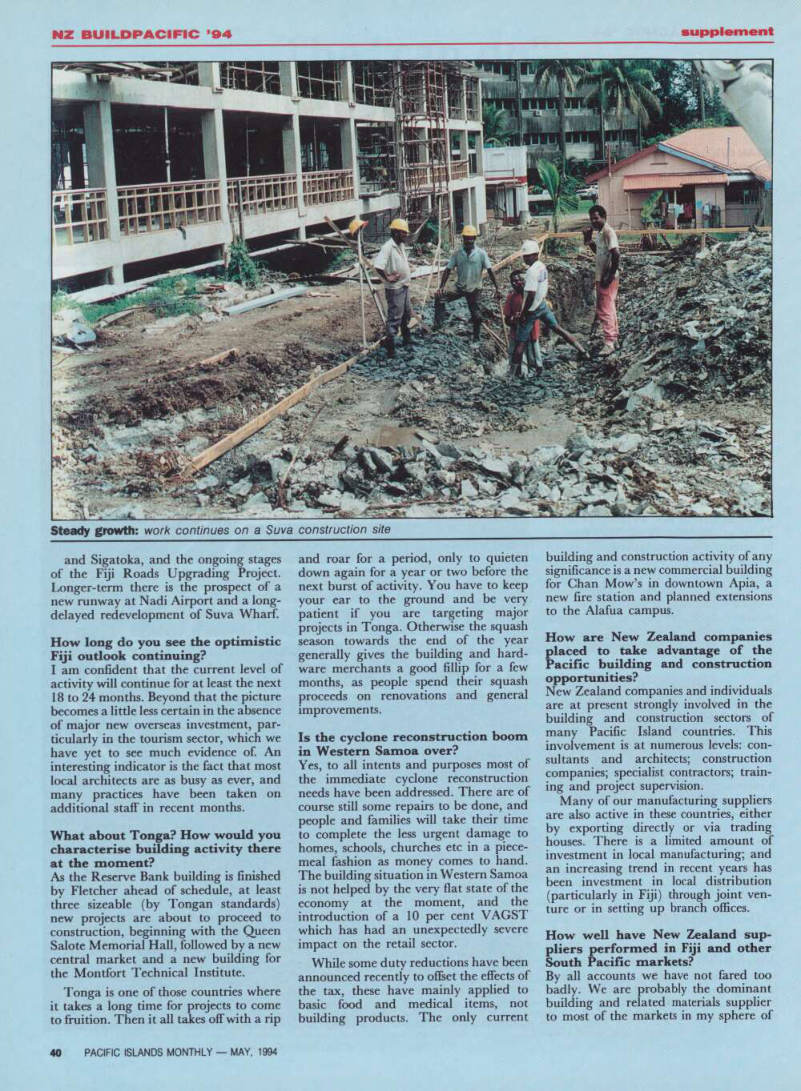

Nz Buildpacific >94
STAN GREGEC is New Zealand’s trade commissioner based in Suva. From Suva he also covers the Samoas, the Cook Islands, Tonga, Kiribati, Tuvalu and Nauru markets which collectively take around 54 per cent of New Zealand’s total exports to the South Pacific region. Here he gives his views on building and construction opportunities for New Zealand in the region.
What is the current outlook for building and construction activity in the South Pacific?
Overall there is a good level of current
activity throughout the region in my
view steady rather than spectacular growth, with a continuous ebb and flow effect, so that there is always something happening somewhere but not necess arily everywhere at once. In my neck of the woods the buoyant markets at the moment are Fiji, American Samoa and Tonga, the first two in particular show ing a good stream of civil construction works as w'ell as new building projects.
These are not huge-scale developments by international standards but they do represent sizeable opportunities in South Pacific terms. Elsewhere, my perception is that New Caledonia and Papua New Guinea will always be significant centres of construction activity, and I am aware of other pockets of activity in Vanuatu, Western Samoa, the Cooks and the Marshall Islands.
You say that Fiji is currently a buoyant market. What is the basis of this assessment?
I think it's no secret that Fiji is in the middle of something of a building recovery. It might be an exaggeration to call it a boom of any kind. Most of this is catch-up from the period after the coup when construction work died off com pletely for a few years. You have only got to drive around the centre of Suva and the area between Nadi and the interna tional airport to observe the large number of new commercial and indus trial developments which have sprung up in the last two years.
There has also been a healthy ex plosion of residential building in and around Suva and Nadi again, to some
degree fuelled by the Housing Author
ity’s land development and low-cost housing programmes but also at the higher-priced levels as housing invest ment has become profitable again. In
Suva there are around half a dozen large buildings either going up or about to proceed, with a host of smaller commer cial two to three-storey buildings in the
pipeline.
And of course the Grand Pacific Hotel is sitting in splendid anticipation of a major overhaul. The civil construction outlook is dominated by plans to build new permanent bridges at Ba
Stan Gregec: optimistic
and Sigatoka, and the ongoing stages of the Fiji Roads Upgrading Project.
Longer-term there is the prospect of a new runway at Nadi Airport and a longdelayed redevelopment of Suva Wharf.
How long do you see the optimistic Fiji outlook continuing?
I am confident that the current level of activity will continue for at least the next 18 to 24 months. Beyond that the picture becomes a little less certain in the absence c ■ ■ of maior new overseas investment, particularly in the tourism sector, which we have yet to see much evidence of. An interesting indicator is the fact that most local architects are as busy as ever, and many practices have been taken on additional staff in recent months.
What about Tonga? How would you characterise budding activity there at the moment?
As the Reserve Bank building is finished by Fletcher ahead of schedule, at least three sizeable (by Tongan standards) new projects are about to proceed to construction, beginning with the Queen Salote Memorial Hall, followed by a new central market and a new building for the Montfort Technical Institute.
Tonga is one of those countries where it takes a long time for projects to come to fruition. Then it all takes off with a rip
and roar for a period, only to quieten down again for a year or two before the next burst of activity. You have to keep your ear to the ground and be very patient if you are targeting major projects in Tonga. Otherwise the squash season towards the end of the year generally gives the building and hardware merchants a good fillip for a few months, as people spend their squash proceeds on renovations and general
improvements.
Is the cyclone reconstruction boom in Western Samoa over?
Yes, to all intents and purposes most of the immediate cyclone reconstruction needs have been addressed. There are of course still some repairs to be done, and people and families will take their time to complete the less urgent damage to homes schools, churches etc in a piecemeal fashion as money comes to hand.
The buildmg situation m Western Samoa is not helped by the very flat state of the economy at the moment, and the introduction of a 11) per cent VAOM which has had an unexpectedly severe impact on the retail sector.
While some duty reductions have been announced recently to offset the effects of the tax, these have mainly applied to basic food and medical items, not building products. The only current
building and construction activity of any significance is a new commercial building for Chan Mow’s in downtown Apia, a new fire station and planned extensions to the Alafua campus.
How are New Zealand companies placed to take advantage of the Pacific buildmg and construction opportunities.
New Zealand companies and individuals a .' P"*'"* scrongly involved m the buildinsr and construction sectors of -r T , j a • ynany aci ic san coun nes. is involvement is at numerous levels, con- J"“!J ist contractors; train r’T • • § P J P f .’ M^ n Y of our manu acturmg supp iers are also actlve * n th f, se countries either u “ P °There isT hmited Tmount'o® ; in )oca manufacturing; and ; nrrpa<! i n{ y trPn d in recent vears has
invest^ent in local attribution
, particularly in Fiji) through joint ven or in setting up branch offices, Hqw weU have New Zealand sup pliers performed in Fiji and other South Pacific markets?
By all accounts we have not fared too badly. We are probably the dominant building and related materials supplier to most of the markets in my sphere of
Steady growth: work continues on a Suva construction site
coverage, including Fiji. In Fiji our export sales of these products have shown steady growth in recent years to reach an estimated NZ$5O million in 1993. That represents a little over a quarter of our total merchandise exports to Fiji, and probably amounts to about a 25 per cent share of Fiji’s total import market for these products. In addition there is the sizeable contribution made by our con sultants and contractors, particularly with companies like Fletcher Construc tion and McConnell Dowell.
Are there signs that this growth is starting to plateau?
Yes, I think that is a fair question. While our sales have been increasing there are indications that we have probably reached a plateau in terms of market share, and we will have to lift our game plan if we are to aspire to win new business particularly against newer and more aggressive competition from South East Asia, and from our tra ditional main competitor Australia.
How will New Zealand achieve this?
One of the main ways is by adopting a much stronger marketing approach. This means our companies maximising the advantages New Zealand has in this part of the world. It also means a recognition that the South Pacific is becoming an increasingly sophisticated and competi tive marketplace, and consequently less
forgiving of sloppy or second-rate service.
How Will Nz Buildpacific ’94
help to boost the efforts of NZ building and construction com fanies in the South Pacific? ssentially by reinforcing New Zealand’s strong capability in the building sector; and by positioning us as the primary and preferred supplier of materials and ser vices to the region.
The trade show will not only be a chance to get a strong message across about New Zealand’s reliability and commitment to the South Pacific region, but will obviously give individual partici fiants an opportunity to show off their atest products and to obtain direct feedback from their customers and cli ents. This is the first dedicated building and construction trade show to be held in Fiji since before the coup, which should say a lot about the confidence New Zealand has in the opportunities of the region, and our ability to contribute.
Who is the trade show aimed at?
We are deliberately keeping a trade focus only. This will not be an event for the general public. Anybody with a profes sional or business involvement m the building industry is welcome to attend.
We have also invited key contacts and buyers from neighbouring Pacific Island countries to attend, so that the event will have a maximum regional perspective. □
Advertisements & other items, pp. 39-41 (2 items)
Z Build
of m
md ea c ociati
New Zealand
Construction Services,
Building Products
and Services,
Fit-out,
Training
Presented by the Building Industry Export Group
17, 18 & 19 MAY 1994
TRADEWINDS, SUVA
Development Board 31 ■ tradenz New Zealand Trade Commissioner New Zealand Trade Development Board PO Box 1378 Suva, FIJI Tel (679) 311422 Fax (679) 305675 ",,, Executive Director Building Industry Export Group PO Box 1756 Auckland, Now Zealand Tel (649) 358 5405 Fax (849) 358 3366
LAMINATED TIMBER BEAMS
BEAMS 22 METRES LONG
the SOLUTION
for the structural and architectural requirements of Jaimi Associates Architects for the Lomary Catholic Church sited on the sea front near Pacific Harbour Fiji.
M c INTOSH provided the Engineering design of the laminated timber beams, purlins & connections then manufactured and supplied these components.
Jaimi Associates selected Laminated Timber for its architectural structural and durability qualities plus the economics and simple site erection.
McENTOSH TIMBER
LAMINATES LIMITED
P.O. Box 14604 Panmure Auckland N.Z.
Phone 649 5730550 Fax 649 5731541 Specialists for 54 inquiries YOetcome
t
What it is
all about
FIJI’S first major building and con struction trade show since 1987 is to be held at the Tradewinds Convention Centre in Suva from May 17 to 19, featuring New Zealand-only products and services.
NZ BUILDPACIFIC ’94 is a joint venture between the newly-formed Building Industry Export Group of New Zealand and Tradenz.
Up to 25 companies from New Zealand, in association with their Fiji representatives and importers, will be
participating.
The trade show will not only show case new and innovative building concepts from New Zealand but will also be a forum to observe latest overseas trends and developments in the building industry. Together with the fair a programme of seminars and workshops has been set up in consulta tion with industry groups in Fiji to address issues where New Zealand has particular expertise or can provide specific information or technology. □
Advertisements & other items, p. 42 (1 item)
advantages:
Stan Hite’s Cel/switch
delivers cellular capacity
with a number of unique
advantages:
♦ economical installation
and operation
♦ quick rollout capability
♦ design flexibility
Because of these design features, Cellswitch is ideally suited for providing cellular service in a variety of key areas.
Through its modularity and scalable architecture, Cellswitch is equally effective in the city or in lower population density areas. Designed for expansion, Cellswitch provides a costcompetitive solution with as few as 50 subscribers, with enough expansion capacity to support many thousands more.
Cellswitch has achieved an installation base in a wide variety of settings around the world, ranging from conventional urban cellular systems to temporary public service support situations.
Cellswitch is based on proven technology and supports either the AMPS or ETACS cellular standards.
These standards are used by the majority of cellular systems (including Australia, New Zealand and the U.S.) and are renowned for their reliability and robustness.
In contrast with emerging standards such as GSM, the AMPS and ETACS terminal equipment is relatively inexpensive, easy to obtain in quantity, and proven to be safe. * * For further information call: Robert Tomlinson Sales Manager Stanilite Electronics (NZ) Ltd Ph: (649)4156370 Fax: (649)4156371
AAA t
AAAA
STAN
Building a bright future




NEW Zealand is a source of building products and services to the worldwide construction industry. A wide range of these products and services, of all levels of sophistication, is exported every year from New Zealand to world markets.
These products either end up in build ings in more than 150 countries and include traditional building products such as cement-based products, carpet and furnishings and processed and often specialised or elaborately transformed manufactured products of timber, metal, glass and plastic. Along with these products go many skills and technical expertise which make up the service side of the industry.
The strength of the industry is in the skills of its people and the ability of its companies to adapt to market needs. The domestic industry in New Zealand oper ates in a relatively small but demandingly competitive environment.
Products need to be sophisticated and produced in the most cost-effective man ner.
Success in the local markets provide companies with a springboard to inter national opportunities. In many in stances, technology developed or adapted in New Zealand offers solutions to building opportunities in a range of markets. The introduction of a performance-based building code and the constant updating and alignment of New Zealand standards to international requirements ensures that products and services constantly meet the overseas market.
The Building Industry Group
of New Zealand
The Building Industry Export Group of
New Zealand (BIEG) was incorporated in June 1993, dedicated to exporting the produces and services of New Zealand construction and building industries.
This group is one of a number of Joint Action Groups formed in recent years by partnership between industry groups and the New Zealand Trade Development Board (TRADENZ). Membership is open to any individual company or organisation which shares the groups aims. Already the group has brought together a strong cross section of com panies, both major as well as smaller specialized companies giving good rep resentation to the industry as a whole.
The vision of the BIEG is for New Zealand suppliers to be recognised and sought as suppliers of modern products and services wherever quality buildings are required.
Aluminium City Limited
Rylock has been a premier brand of aluminium joinery in New Zealand for over 40 years. Extrusions are sourced and surface finished by suppliers accredited to international quality standards. Alu minium City is a key distributor, manu facturer and installer of Rylock Alu minium Joinery.
Athena Products Ltd
Athena manufactures a range of bath room vanities, showers and acrylic baths/ spa baths from its 50,000 sq ft factory in Auckland. Athena vanity tops can be either back filled acrylic or high quality cultured marble tops and solid colour tops. The vanity cabinets have a high impact resistant surface that won’t chip, crack or peel.
Athena shower enclosures have an acrylic tray with solid framed base, two or three sided DR/ADS walls and a toughened safety glass pivot door and return, with soft magnetic closing. A variety of uniquely designed baths, all with spa options, complete the range.
Boral Acrow Limited
Boral Acrow has been established for more than 50 years and has gained wide renown with its Acrow construction equipment. Manufacturing a wide range of its products the company has substan tial interests in scaffolding, building equipment, materials handling, spaceframes and interior products. The Auckland manufacturing facility is equipped with robotic welding and powder coating facilities. The company has branches throughout New Zealand.
Bremca Industries Ltd
Established in 1972, Bremca specialises in the design, engineering and construc tion of low voltage switchgear for applications including the automation of industrial processes, the distribution and control of electricity for all manner of industrial commercial and domestic buildings. Bremca has accreditation by Telarc to ISO 9002 for Quality Assur ance.
Building Technology Ltd
Building Technology Ltd (BTL) is wholly owned by the Building Research Association of New Zealand (Inc*) (BRANZ). The company assists the manufacturer of building products and systems in gaining marketplace accept ance by providing consultance, testing and research in fire and structural
engineering, and product appraisals.
The company drawns on extensive world-wide experience in building prod uct performance covering the last 25 years.
Carter Holt Harvey Roofing
International Ltd
CHH Roofing produces a range of pressed steel roof panels coated with proprietary coatings which include natu ral stone chip. The product range includes a full range of accessories including skylights, venting and gutter ing systems.
The brands/profiles include Decrabond, Colortiles, Gerard Superroof, Tuffcoat and Corona Shake.
CHH Roofing products are sold in over 70 countries and are produced under licence in nine countries. All products are tested to international standards, and meet a range of climatic and architec
tural challenges.
Clearlite Industries Ltd
Clearlite manufactures and markets a full range of products for the bathroom,
kitchen and laundry. The product range includes baths (acrylic and enamelled pressed steel), spa baths, shower enclos ures, stainless steel kitchen sinks and laundry tubs, vanity tops (cultured marble and plain) vanity cabinets, and roof lights. The company exports to Pacific Rim countries, Asia and Europe.
Clearlite is the first NZ bathroom manufacturer to achieve ISO 9002 quality standards accreditation.
Comalco-CHH Aluminium
Comalco CHH Aluminium manufac tures aluminium extrusions in mill finish, anodised and powder-coated surface finishes. International markets are ser viced with Rylock and Oakley brand window and door systems, together with Eclipse brand fences and balustrading and Nu-Wall brand aluminium clad ding, as well as aluminium extrusion profiles for customers own designs. All facilities are accredited to ISO 9002.
Crystal Glass Industries
Manufacturer and supplier of most types of plain and processed flat glass products.
The company exports a range of prod ucts to Australia, the Pacific Islands, SE Asia, the Gulf and UK markets.
These products include a unique patented process for decorative ceramic glass, curved glass, electronically heated glass and security glazing. Overseas installations are completed with on-site administration in collaboration with local agents.
De Geest Prebuilt Bath
rooms De Geest was established in 1955 and since 1983 has supplied over 3500 prebuilt bathroom units to hotels, motels and hospitals in New Zealand, the Pacific and Australia. The de Geest Prebuilt Bathroom System speeds up construction programmes, increases quality and saves the cost of organising and providing facilities for tradespeople on site. Com plete bathrooms are delivered to site where they are placed in final position.
Durold Ltd
Duroid manufactures aluminium foil thermal insulation products, building papers and other moisture control prod ucts designed for use in roofs, floors and ceilings of industrial commercial and residential buildings where temperature and vapour control and fire retardation are required. Duroid actively exports in four distinct markets: Australasia, the Pacific Islands, South East Asia, and Latin America. Duroid is a Telarc certified ISO 9002 and standards Austra
lia Quality Endorsed Company.
Fletcher Homes Ltd
Fletcher Homes is New Zealand’s largest residential builder. The company build
homes in all marrket areas low, medium and high cost operations. In the medium and high cost areas, Fletcher Homes is a leader in the design of houses.
While in the modest income, first buyer market, Fletcher Homes is uniquely placed to provide housing packages to meet the needs and requirement of customers.
Fletcher Construction New
Zealand and South Pacific
Ltd
Fletcher Construction New Zealand and South Pacific Ltd is a major general contractor with extensive experience in civil, commercial, high density residen tial, industrial and marine construction, and refurbishments and interior fitouts.
Fletcher Construction has operated in the South Pacific Islands since 1946. The Fletcher Construction Group is a sub stantial construction company through out the Pacific Rim.
Fletcher Wood Panels Ltd
Producer of reconstituted wood-based Eanels for residential and commercial uildings, agricultural, furniture and
joinery markets.
Products include Lakepine fibreboard, superfine and Pynefloore particle board flooring, Melteca low pressure melamine decorative wood panels, hardboard, soft board, Panel tile, Michelangelo ceil ing tiles and decorative panels.
Forging and Casting New
Zealand
Forging and Casting New Zealand is the export division of H.M.C. and Metheven Tapware New Zealand. The company specialises in copper-based and unleaded alloys with a vast capacity and expertise in forging and casting of specific cus tomer requirements and finished chrome and void plated products. A “No Obli gation Quotation Service” is available for estimates.
Greens Industries Ltd
The company has its own foundry casting facilities and machining centres, and specialises in the manufacture of a wide range of single level mixers, shower systems, traditional tapware and pres sure equalising valves suitable for dom estic or commercial use. The company is accredited to ISO 9002 International Quality Standard.
Golden Bay Cement
Golden Bay Cement operates a modern cement plant supplying cement in its own bulk vessels to storage terminals.
The plants annual production capacity is 500,u00 tonnes, and this is marketed throughout the Pacific region.
The company has the ability to export cement in paper bags, oil pallets, and cement clinker in bulk shipments up to 27,000 tonnes.
Product quality meets and exceeds international standards.
Henry Brown and Co Ltd
Henry Brown and Co, established for more than 130 years, specialises in the supply of timber products and services to the building industry from domestic builders to large corporate construction companies. Timber can be supplied, dressed and finished to joinery grade.
The company is proud to add value to construction for single exercises or mass production runs. The company’s product range includes radiata pine and NZ native timbers; pre-cut/nail frames; trusses, posistruts and ganglam beams; prehung doors; and stairs.
James Hardie and Coy Pty
Limited
The Building Products division of James Hardie Ltd is a leading supplier of internal ironing boards, external clad dings, fibre cement roofing, fencing and flooring products. There is also a growing range of lightweight fascia/facade and architectural systems for commercial construction applications.
Lockwood Buildings Ltd
Lockwood Buildings is a private com pany which manufactures a solid timber building system interlocked with ex truded aluminium profiles. This system is suitable for domestic and light commer cial buildings. It is supplied in precut/ kitset form. The company has operated for more than 40 years and exports worldwide with an emphasis on Asia and the Pacific Rim areas.
McConnell Dowell Con
structors Limited
Since 1960, McConnel Dowell has been dedicated to meeting the construction challenges of South Pacific Island nations in the development of essential infra structure and community facilities; mar ine engineering and construction; wastewater, freshwater supply and treat ment; commercial and industrial build ing; and earthworks, roads, bridges, runways and pipelines.
Microscan A Division of
T.L. Jones Ltd
T.L. Jones Ltd are the innovators and world leaders in electronic elevator door protection equipment which prevents people being crushed in elevator doors.
Microscan equipment is exported exten sively throughout Asia, the Pacific basin, North and South America, Europe and Africa.
Milburn Cement
The Milburn Group of Companies supply cement, lime aggregates and concrete to the domestic market, and export cement and lime. The company has a 450,000-tonne annual capacity
cement plant, two lime plants, seven marine terminals and a number of ready mix concrete and quarry operations.
MM Cables New Zealand
Limited
MM Cables has been manufacturing energy cables in New Zealand since 1954 and telecommunication cables since 1961. The company has a Quality System accreditation to ISO 9001. MM Cables is a wholly owned division of the Metal Manufacturers Ltd Group, an Australian Stock Exchange top 100 listed companies. MML has as its majority shareholder BICC Pic of the UK, one of the most foremost cable and construction companies in the world.
Pacific Steel Ltd
Wiremaker Pacific Steel is New Zea land’s sole manufacturer of long steel products producing wire and reinforcing steel and merchant bar products.
Wiremakers is New Zealands only inte grated wire mill/wire products manufac turer with a huge range of products for the farming and construction industries.
All products are manufactured to inter national quality standards.
Parex Industries Ltd
Parex is a privately owned company involved in the manufacture of specialist building and construction products. The main export product is the unique Insapipe, a factory-manufactured pre insulated piping system which is used extensively in schools, hotels, and indus try and for oil exploration and refining.
Other products include heat trade sys tems and instantaneous electric hot water systems. The company is committed to providing full design and technical support.
Plaster Systems Ltd
A surface coating manufacturing com pany specialising in cost effective, thin coat cement and gypsum-based products and systems. Plaster products are avail
able for leveling, insulating, texturing
and decorating masonry and concrete surfaces, and for jointing and decorating fibre-cement sheeting. The company also distributes and licenses proprietary Ex terior Insulation and Finishing Systems (ETFS) and a fully engineered thin coat structural upgrading system for the conservation and strengthening of masonry buildings.
Plumbers Limited
Established for more than 75 years, Plumbers Ltd has been supplying the plumbing trade in New Zealand, Austra lia and the Pacific basin with a wide range of products. Notably the Dux products include cisterns, toilet seats, waste trape and accessories. Other brands cover drainage control systems, heaters, pipe and plumbing systems, storage tanks, flush control valves, grat
ings, drainage systems, pipe clipping systems, valves, corrosion protection products and rainwater pits.
Plyco Doors Limited
Plyco Doors is a market leader in the manufacture and supply of interior and entrance timber doors for the residential market. Located in Penrose, Auckland, Plyco Doors has been manufacturing doors for over 50 years. There are a variety of doors for interior use, namely moulded panel doors and point quality and veneer flush panel doors. Two timber entrance door ranges are avail able solid timber or composite construction. In addition, Plyco Doors is distributing a range of steel entrance doors, a recent initiative for the com pany.
Scott Panel and Hardware
Ltd
Specialist suppliers of panel products, hardware and timber to the furniture and joinery industry. Customers include kitchen manufacturers, commercial and domestic furniture manufacturers, shop fitters, joiners and laminate fabricators.
The company is closely involved with the development of exports and provides business advice and networking opportunities in addition to the supply of all materials required in manufacturing processes.
Southern Cross Paints Ltd
A privately owned New Zealand manu facturer of highly quality decorative (house) and industrial maintenance coatings. The company specialises in the food industry as well as concrete and metal protection coatings. Regional toll manufacturer for Benjamin Moore and Co of New Jersey, USA, as well as distributor of products from Croda- Mebon, UK and Desowag, Germany.
Particularly skilled in the area of product design to meet specific project require ments.
Tetral Industries Ltd
This private company manufactures and markets a wide range of building and hardware products which are sold throughout the South Pacific and South East Asia. These include Matrac curtain and cubicle track systems, safety and hand rail systems, bathroom accessories, Sressed metal vents and Tetralfoam a exible bituminised foam. Tetral also holds an exclusive agency for a leading Australian hardware brand which in cludes garden tools, striking tools, insect screens, wire mesh and cutting tools.
Window Treatments NZ Ltd
Window Treatments NZ Ltd designs and manufactures blinds vertical, Venetian, micro, roller, holland, pleated, and wooden 25mm.
Quality blinds direct from our factory are available from 24 branches through out New Zealand. A founding member of the Building Industry Export Group, Window Treatments (NZ) Ltd is owned and operated by the Rose family.
Winstone Wallboards Ltd
Winstone Wallboards is New Zealand’s largest manufacturer and marketer of gypsum plasterboard, drywall systems and associated products and services under the Gib Board brand name.
Winstone Wallboards leads in the devel opment, design and production of lead ing edge material and interior systems for the building industry.
W Stevenson and Sons Ltd
This privately owned New Zealand company manufactures concrete masonry products including grey blocks, bricks, interlocking pavers and the key stone retaining wall system. Made to very high New Zealand standards, these products are available in a wide range of colours, shapes and sizes.
Yunca Heating
Yunca Heating, renown for its advanced technology in wood heating design, has now introduced the Yunca Wegj. The radical design of the Wegj incorporates a
circular double skinned firebox along with its unique angled drop down door among its many features. The Wegj meets the high standards set for safety and emission levels worldwide along with an outstanding performance level. The styling compliments both contemporary and traditional interiors.
What NZ exported
New Zealand exported over NZ$2OO million worth of manufactured building products and products used in construc tion into the Pacific Region in the year ended June 1993. The value for the most recent period is expected to be higher.
The 1993 figure was 75 per cent more than in the same period in 1991 reflecting not only the increased effort of New Zealand companies, but the overall increase in construction activity and building and refurbishment which has been taking place in the region. The main markets Western Samoa, Fiji and Papua New Guinea together account for over 50 per cent of this value.
The range of products exported from New Zealand to Fiji is one of the broadest of all New Zealand’s markets covering probably the most varied after that to Australia which is New Zealand’s biggest market with over 30 types of materials and products both traditional and non traditional and some 150 different tariff items. The 1993 total of $45 million worth of products is only part of the story. The market is also significant in terms of the involvement of major New Zealand construction and service com panies, specialist contractors, architects, engineers and other professional services.
The Pacific regional figure represents about 13 per cent of the total exports of building products. The global 1993 figure was over $1.5 billion in 1993.
Almost half of this went to Australia.
What Tradenz does
The New Zealand Trade Development Board (Tradenz) is the New Zealand government agency charged with the role of developing and expanding New Zealand’s foreign exchange earnings. It is in the unique position between govern ment and industry to work with export ers on production and marketing.
Tradenz does this by identifying opportunities, and then working with industry groups and individual exporters to fully develop their capabilities so that they may achieve export growth in the international trading environment. This co-operative industry/Tradenz approach to business, enables competitive com panies to find neutral ground on which they can develop long term joint market ing programmes which position them in export markets and result in export growth. □
Advertisements & other items, pp. 43-46 (1 item)
A
LUXURY IN
SPA BATHS
LUXURY IN
SHOWER
SYSTEMS
B
UNCOURT
HARDWAR
•s Bfc REGISTERED OFFICE 3 MILES NABUA SAMABULA SUVA FIJI DISTRIBUTION CENTRE NABUA PHONE: 382 199 (5 LINES) SUVA
BRANCH - LAUTOKA 12 NAMOLI AVENUE
P.O. BOX 4425 LAUTOKA PHONE: 663 933, 662 522 BRANCH - NADI P.O. BOX 9799 NADI AIRPORT PHONE: 700 322, 710 971
A new concept
in low cost, easy
to erect homes .
Maddren's Pacific Panel homes are possibly the perfect solution to Pacific Island residential housing needs. Constructed from fibre cement and lightweight concrete panels , with special cyclone fastened trussesthese homes combine ease of construction with unprecedented strength.
For a comprehensive brochure, complete ond mail the coupon below.
Maddren Homes
PO Box 244, Kumeu, Newleatand, Pb 0-9-412 9070. Fax 0-9-412 7251.
Please mail me your free catalogue.
Name.
Saying 'no’ to waste
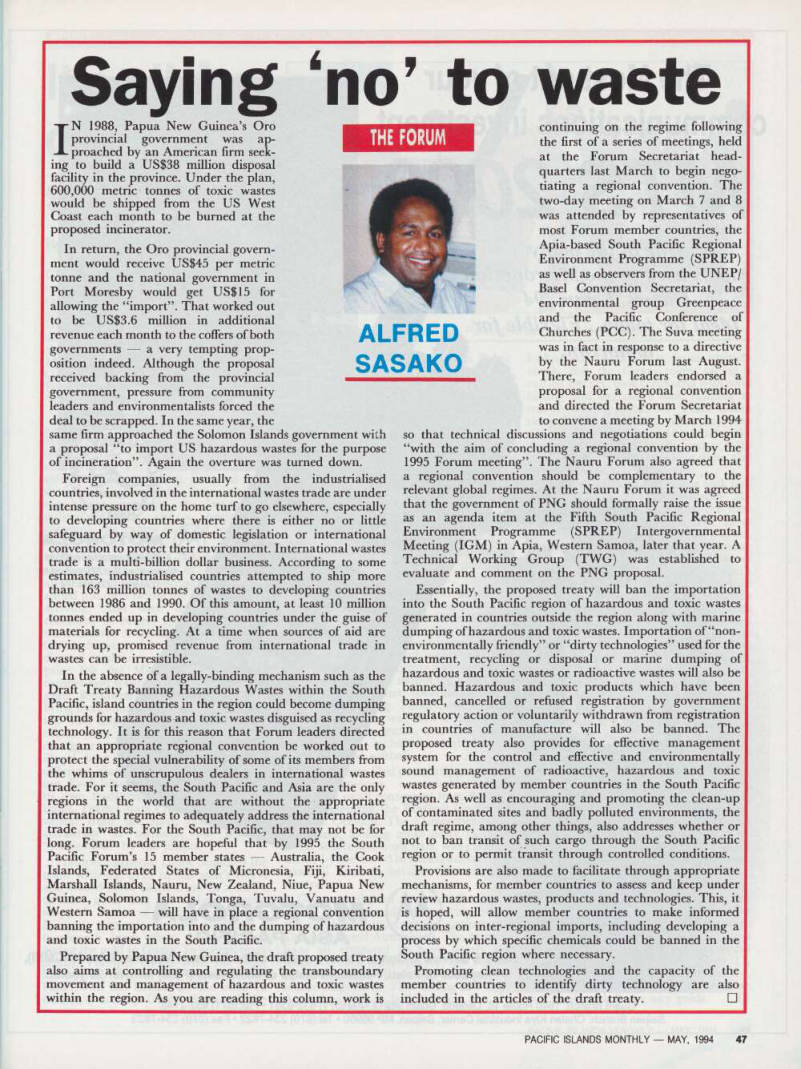
IN 1988, Papua New Guinea’s Oro provincial government was ap proached by an American firm seek ing to build a USS3B million disposal facility in the province. Under the plan, 600,000 metric tonnes of toxic wastes would be shipped from the US West Coast each month to be burned at the proposed incinerator.
In return, the Oro provincial govern ment would receive US$45 per metric tonne and the national government in Port Moresby would get USsls for allowing the “import”. That worked out to be US$3.6 million in additional revenue each month to the coffers of both governments a very tempting prop osition indeed. Although the proposal received backing from the provincial government, pressure from community leaders and environmentalists forced the deal to be scrapped. In the same year, the
same firm approached the Solomon Islands government with a proposal “to import US hazardous wastes for the purpose of incineration”. Again the overture was turned down.
Foreign companies, usually from the industrialised countries, involved in the international wastes trade are under intense pressure on the home turf to go elsewhere, especially to developing countries where there is either no or little safeguard by way of domestic legislation or international convention to protect their environment. International wastes trade is a multi-billion dollar business. According to some estimates, industrialised countries attempted to ship more than 163 million tonnes of wastes to developing countries between 1986 and 1990. Of this amount, at least 10 million tonnes ended up in developing countries under the guise of materials for recycling. At a time when sources of aid are drying up, promised revenue from international trade in wastes can be irresistible.
In the absence of a legally-binding mechanism such as the Draft Treaty Banning Hazardous Wastes within the South Pacific, island countries in the region could become dumping grounds for hazardous and toxic wastes disguised as recycling technology. It is for this reason that Forum leaders directed that an appropriate regional convention be worked out to protect the special vulnerability of some of its members from the whims of unscrupulous dealers in international wastes trade. For it seems, the South Pacific and Asia are the only regions in the world that are without the appropriate international regimes to adequately address the international trade in wastes. For the South Pacific, that may not be for long. Forum leaders are hopeful that by 1995 the South Pacific Forum’s 15 member states Australia, the Cook Islands, Federated States of Micronesia, Fiji, Kiribati, Marshall Islands, Nauru, New Zealand, Niue, Papua New Guinea, Solomon Islands, Tonga, Tuvalu, Vanuatu and Western Samoa will have in place a regional convention banning the importation into and the dumping of hazardous and toxic wastes in the South Pacific.
Prepared by Papua New Guinea, the draft proposed treaty also aims at controlling and regulating the transboundary movement and management of hazardous and toxic wastes within the region. As you are reading this column, work is
continuing on the regime following the first of a series of meetings, held at the Forum Secretariat head quarters last March to begin nego tiating a regional convention. The two-day meeting on March 7 and 8 was attended by representatives of most Forum member countries, the Apia-based South Pacific Regional Environment Programme (SPREP) as well as observers from the UNEP/ Basel Convention Secretariat, the environmental group Greenpeace and the Pacific Conference of Churches (PCC). The Suva meeting was in fact in response to a directive by the Nauru Forum last August.
There, Forum leaders endorsed a proposal for a regional convention and directed the Forum Secretariat to convene a meeting by March 1994
so that technical discussions and negotiations could begin “with the aim of concluding a regional convention by the 1995 Forum meeting”. The Nauru Forum also agreed that a regional convention should be complementary to the relevant global regimes. At the Nauru Forum it was agreed that the government of PNG should formally raise the issue as an agenda item at the Fifth South Pacific Regional Environment Programme (SPREP) Intergovernmental Meeting (IGM) in Apia, Western Samoa, later that year. A Technical Working Group (TWG) was established to evaluate and comment on the PNG proposal.
Essentially, the proposed treaty will ban the importation into the South Pacific region of hazardous and toxic wastes generated in countries outside the region along with marine dumping of hazardous and toxic wastes. Importation of “non environmentally friendly” or “dirty technologies” used for the treatment, recycling or disposal or marine dumping of hazardous and toxic wastes or radioactive wastes will also be banned. Hazardous and toxic products which have been banned, cancelled or refused registration by government regulatory action or voluntarily withdrawn from registration in countries of manufacture will also be banned. The proposed treaty also provides for effective management system for the control and effective and environmentally sound management of radioactive, hazardous and toxic wastes generated by member countries in the South Pacific region. As well as encouraging and promoting the clean-up of contaminated sites and badly polluted environments, the draft regime, among other things, also addresses whether or not to ban transit of such cargo through the South Pacific region or to permit transit through controlled conditions.
Provisions are also made to facilitate through appropriate mechanisms, for member countries to assess and keep under review hazardous wastes, products and technologies. This, it is hoped, will allow member countries to make informed decisions on inter-regional imports, including developing a process by which specific chemicals could be banned in the South Pacific region where necessary.
Promoting clean technologies and the capacity of the member countries to identify dirty technology are also included in the articles of the draft treaty. □
The Forum
Alfred
Sasako
Advertisements & other items, p. 48 (1 item)
communications investment
The Most outof your
MTS 2
One of the many
radios used in the Micronesian
Games, Guam f 94
Ideal for today... Flexible for
tomorrow. 0
fvi
& m : i : o
Isa
mm %49*: ®seH illi &<*>*■ « m A m M H h
MOTOROLA
Official communications sponsor of the Micronesian Games - Guam '94
MOTOROLA
ASIA PACIFIC
Sales & Service in Guam, Commonwealth of the Northern Marianas Islands (CMNI), Republic of Palau, Federated States of Micronesia (FSM) for over 20 years.
Guam Branch: 1640 Route 16, Dededo, Guam 96912 • Tel:(671) 632-9351 • Fax:(67l) 632-2148 Saipan Branch: Chalan Kiya Industrial Center, Saipan, MR 96950 • Tel:(670) 234-7622 • Fax:(67o) 234-7823
despite the
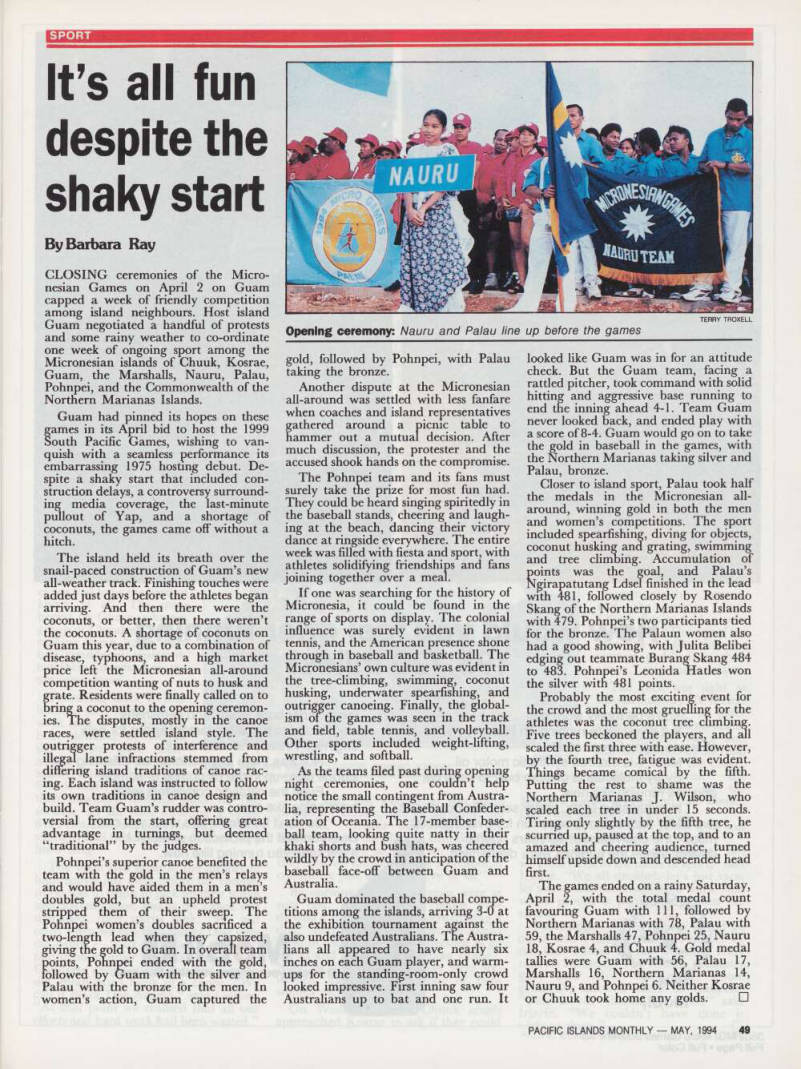
Sport
It’s all fun despite the shaky start
By Barbara Ray
CLOSING ceremonies of the Micro nesian Games on April 2 on Guam capped a week of friendly competition among island neighbours. Host island Guam negotiated a handful of protests and some rainy weather to co-ordinate one week of ongoing sport among the Micronesian islands of Chuuk, Kosrae, Guam, the Marshalls, Nauru, Palau, Pohnpei, and the Commonwealth of the Northern Marianas Islands.
Guam had pinned its hopes on these fames in its April bid to host the 1999 outh Pacific Games, wishing to van quish with a seamless performance its embarrassing 1975 hosting debut. De spite a shaky start that included con struction delays, a controversy surround ing media coverage, the last-minute pullout of Yap, and a shortage of coconuts, the games came off without a hitch.
The island held its breath over the snail-paced construction of Guam’s new all-weather track. Finishing touches were added just days before the athletes began arriving. And then there were the coconuts, or better, then there weren’t the coconuts. A shortage of coconuts on Guam this year, due to a combination of disease, typhoons, and a high market price left the Micronesian all-around competition wanting of nuts to husk and grate. Residents were finally called on to bring a coconut to the opening ceremon ies. The disputes, mostly in the canoe races, were settled island style. The outrigger protests of interference and illegal lane infractions stemmed from differing island traditions of canoe rac ing. Each island was instructed to follow its own traditions in canoe design and build. Team Guam’s rudder was contro versial from the start, offering great advantage in turnings, but deemed “traditional” by the judges.
Pohnpei’s superior canoe benefited the team with the gold in the men’s relays and would have aided them in a men’s doubles gold, but an upheld protest stripped them of their sweep. The Pohnpei women’s doubles sacrificed a two-length lead when they capsized, giving the gold to Guam. In overall team J joints, Pohnpei ended with the gold, bllowed by Guam with the silver and Palau with the bronze for the men. In women’s action, Guam captured the
gold, followed by Pohnpei, with Palau taking the bronze.
Another dispute at the Micronesian all-around was settled with less fanfare when coaches and island representatives gathered around a picnic table to hammer out a mutual decision. After much discussion, the protester and the accused shook hands on the compromise.
The Pohnpei team and its fans must surely take the prize for most fun had.
They could be heard singing spiritedly in the baseball stands, cheering and laugh ing at the beach, dancing their victory dance at ringside everywhere. The entire week was filled with fiesta and sport, with athletes solidifying friendships and fans joining together over a meal.
If one was searching for the history of Micronesia, it could be found in the range of sports on display. The colonial influence was surely evident in lawn tennis, and the American presence shone through in baseball and basketball. The Micronesians’ own culture was evident in the tree-climbing, swimming, coconut husking, underwater spearfishing, and outrigger canoeing. Finally, the global ism of the games was seen in the track and field, table tennis, and volleyball.
Other sports included weight-lifting, wrestling, and softball.
As the teams filed past during opening night ceremonies, one couldn’t help notice the small contingent from Austra lia, representing the Baseball Confeder ation of Oceania. The 17-member base ball team, looking auite natty in their khaki shorts and bush hats, was cheered wildly by the crowd in anticipation of the baseball face-off between Guam and Australia.
Guam dominated the baseball compe titions among the islands, arriving 3-0 at the exhibition tournament against the also undefeated Australians. The Austra lians all appeared to have nearly six inches on each Guam player, and warm ups for the standing-room-only crowd looked impressive. First inning saw four Australians up to bat and one run. It
looked like Guam was in for an attitude check. But the Guam team, facing a rattled pitcher, took command with solid hitting and aggressive base running to end the inning ahead 4-1. Team Guam never looked back, and ended play with a score of 8-4. Guam would go on to take the gold in baseball in the games, with the Northern Marianas taking silver and Palau, bronze.
Closer to island sport, Palau took half the medals in the Micronesian all around, winning gold in both the men and women’s competitions. The sport included spearfishing, diving for objects, coconut husking and grating, swimming and tree climbing. Accumulation of Roints was the goal, and Palau’s Igirapatutang Ldsel finished in the lead with 481, followed closely by Rosendo Skang of the Northern Marianas Islands with 479. Pohnpei’s two participants tied for the bronze. The Palaun women also had a good showing, with Julita Belibei edging out teammate Burang Skang 484 to 483. Pohnpei’s Leonida Hades won the silver with 481 points.
Probably the most exciting event for the crowd and the most gruelling for the athletes was the coconut tree climbing.
Five trees beckoned the players, and all scaled the first three with ease. However, by the fourth tree, fatigue was evident.
Things became comical by the fifth.
Putting the rest to shame was the Northern Marianas J. Wilson, who scaled each tree in under 15 seconds.
Tiring only slightly by the fifth tree, he scurried up, paused at the top, and to an amazed and cheering audience, turned himself upside down and descended head first.
The games ended on a rainy Saturday, April 2, with the total medal count favouring Guam with 111, followed by Northern Marianas with 78, Palau with 59, the Marshalls 47, Pohnpei 25, Nauru 18, Kosrae 4, and Chuuk 4. Gold medal tallies were Guam with 56, Palau 17, Marshalls 16, Northern Marianas 14, Nauru 9, and Pohnpei 6. Neither Kosrae or Chuuk took home any golds. □
Terry Troxell
Opening ceremony: Nauru and Palau line up before the games
Advertisements & other items, p. 50 (1 item)
Mobil
II RS m mb ■ % a. £ * *».»■> ■ - . * •
mgm
**omm
» % > -tv • *Sr% “ * %
How would you feel after running
198,720 miles?
You'd be totally worn out!
But if you were running on Mobil 1, you'd show no sign of wear at all.
Mobil 1 is the true synthetic motor oil.
Every molecule is custom built to keep car engines running like new.
In exhaustive tests, under scientific conditions, two BMW 325 i saloons were run for over 186,300 miles - the equivalent of 15 years normal driving. When the engines were dismantled, Mobil
Mobil
the cylinder bore, crank and camshafts were found to be within factory specs for new engines. Virtually no wear at all.
Nor was there any perfomance-affecting sludge build-up in the oil pumps or sumps.
Even the catalytic converters were functioning like new.
So don't let inferior oils wear you out.
Give yourself the protection of Mobil 1.
It will keep you running like new.
Mobil
It keeps your engine running like new. 3502 MG I Micro Games Souvenir Ad Full Page • Full Color
Chuuk’s champ
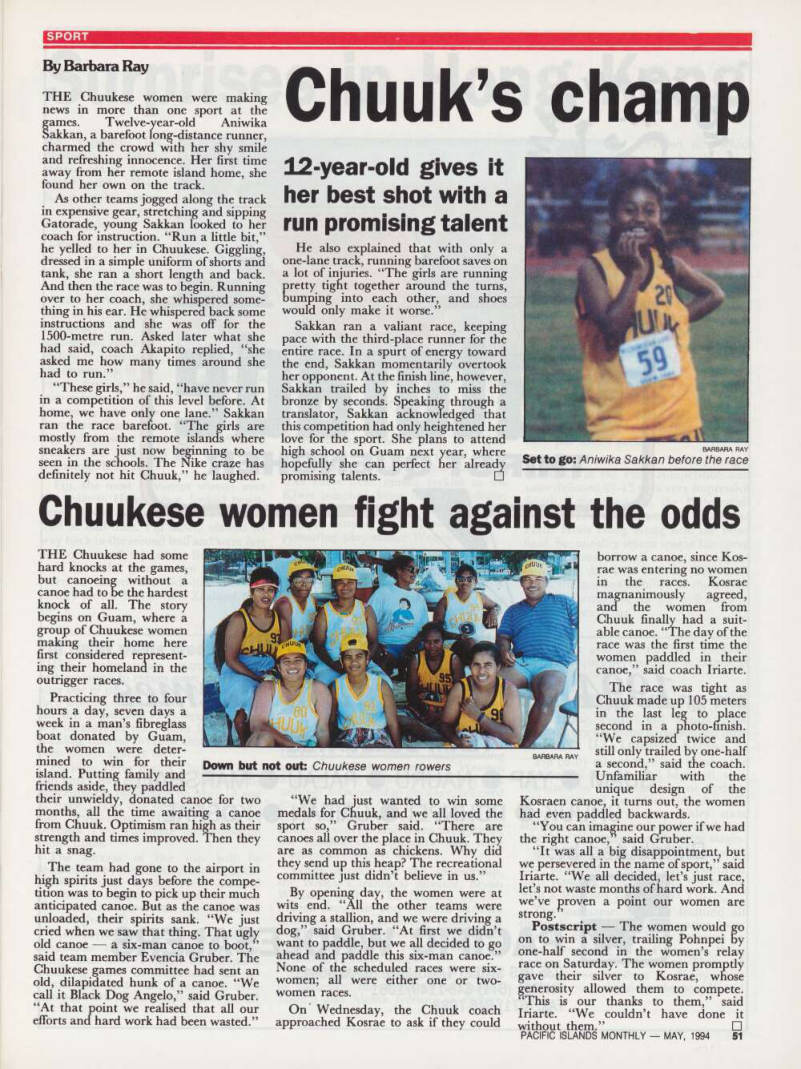
By Barbara Ray
THE Chuukese women were making news in more than one sport at the games. Twelve-year-old Aniwika Sakkan, a barefoot long-distance runner, charmed the crowd with her shy smile and refreshing innocence. Her first time away from her remote island home, she found her own on the track.
As other teams jogged along the track in expensive gear, stretching and sipping Gatorade, young Sakkan looked to her coach for instruction. “Run a little bit,” he yelled to her in Chuukese. Giggling, dressed in a simple uniform of shorts and tank, she ran a short length and back.
And then the race was to begin. Running over to her coach, she whispered some thing in his ear. He whispered back some instructions and she was off for the 1500-metre run. Asked later what she had said, coach Akapito replied, “she asked me how many times around she had to run.”
“These girls,” he said, “have never run in a competition of this level before. At home, we have only one lane.” Sakkan ran the race barefoot. “The girls are mostly from the remote islands where sneakers are just now beginning to be seen in the schools. The Nike craze has definitely not hit Chuuk,” he laughed.
12-year-old gives it
her best shot with a
run promising talent
He also explained that with only a one-lane track, running barefoot saves on a lot of injuries. “The girls are running pretty tight together around the turns, bumping into each other, and shoes would only make it worse.”
Sakkan ran a valiant race, keeping pace with the third-place runner for the entire race. In a spurt of energy toward the end, Sakkan momentarily overtook her opponent. At the finish line, however, Sakkan trailed by inches to miss the bronze by seconds. Speaking through a translator, Sakkan acknowledged that this competition had only heightened her love for the sport. She plans to attend high school on Guam next year, where hopefully she can perfect her already promising talents. □
Barbara Ray
Set to go: Aniwika Sakkan before the race
Chuukese women fight against the odds

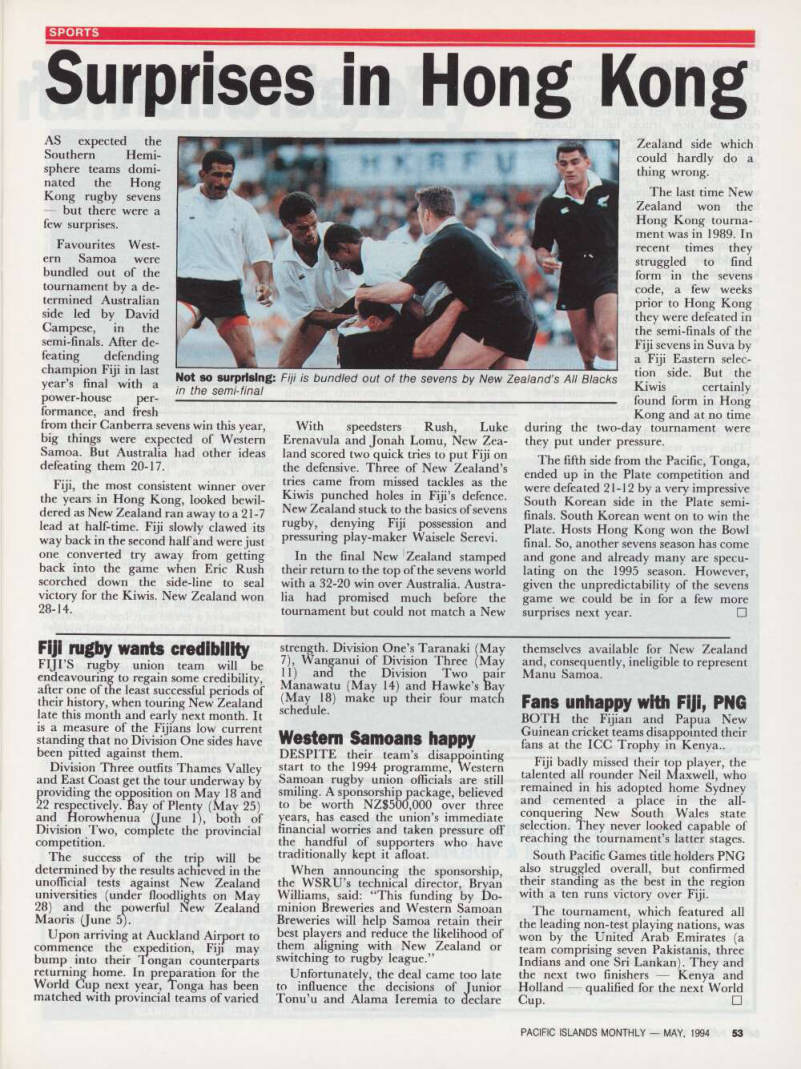
THE Chuukese had some hard knocks at the games, but canoeing without a canoe had to be the hardest knock of all. The story begins on Guam, where a group of Chuukese women making their home here first considered represent ing their homeland in the outrigger races.
Practicing three to four hours a day, seven days a week in a man’s fibreglass boat donated by Guam, the women were deter mined to win for their
island. Putting family and
friends aside, they paddled
their unwieldy, donated canoe for two months, all the time awaiting a canoe from Chuuk. Optimism ran high as their strength and times improved. Then they hit a snag.
The team had gone to the airport in high spirits just days before the compe tition was to begin to pick up their much anticipated canoe. But as the canoe was unloaded, their spirits sank. “We just cried when we saw that thing. That ugly old canoe a six-man canoe to boot,” said team member Evencia Gruber. The Chuukese games committee had sent an old, dilapidated hunk of a canoe. “We call it Black Dog Angelo,” said Gruber.
“At that point we realised that all our efforts and hard work had been wasted.”
“We had just wanted to win some medals for Chuuk, and we all loved the sport so,” Gruber said. “There are canoes all over the place in Chuuk. They are as common as chickens. Why did they send up this heap? The recreational committee just didn’t believe in us.”
By opening day, the women were at wits end. “All the other teams were driving a stallion, and we were driving a dog,” said Gruber. “At first we didn’t want to paddle, but we all decided to go ahead and paddle this six-man canoe.”
None of the scheduled races were six women; all were either one or two women races.
On Wednesday, the Chuuk coach approached Kosrae to ask if they could
borrow a canoe, since Kos rae was entering no women in the races. Kosrae
magnanimously agreed,
and the women from Chuuk finally had a suit able canoe. “The day of the race was the first time the women paddled in their canoe,” said coach Iriarte.
The race was tight as Chuuk made up 105 meters in the last leg to place second in a photo-finish.
“We capsized twice and still only trailed by one-half a second,” said the coach.
Unfamiliar with the unique design of the
Kosraen canoe, it turns out, the women had even paddled backwards.
“You can imagine our power if we had the right canoe, said Gruber.
“It was all a big disappointment, but we persevered in the name of sport,” said Iriarte. “We all decided, let’s just race, let’s not waste months of hard work. And we’ve proven a point our women are strong. ’
Postscript The women would go on to win a silver, trailing Pohnpei by one-half second in the women’s relay race on Saturday. The women promptly gave their silver to Kosrae, whose generosity allowed them to compete.
“This is our thanks to them,” said Iriarte. “We couldn’t have done it without them.” □
Pacific Islands Monthly May, 1994 51
Barbara Ray
Down but not out: Chuukese women rowers
Fiji rugby wants credibility
Fiji’S rugby union team will be endeavouring to regain some credibility, after one of the least successful periods of their history, when touring New Zealand late this month and early next month. It is a measure of the Fijians low current standing that no Division One sides have been pitted against them.
Division Three outfits Thames Valley and East Coast get the tour underway by providing the opposition on May 18 and 22 respectively. Bay of Plenty (May 25) and Horowhenua (June 1), both of Division Two, complete the provincial competition.
The success of the trip will be determined by the results achieved in the unofficial tests against New Zealand universities (under floodlights on May 28) and the powerful New Zealand Maoris (June 5).
Upon arriving at Auckland Airport to
commence the expedition, Fiji may bump into their Tongan counterparts returning home. In preparation for the World Cup next year, Tonga has been matched with provincial teams of varied
strength. Division One’s Taranaki (May 7), Wanganui of Division Three (May 11) and the Division Two pair Manawatu (May 14) and Hawke’s Bay (May 18) make up their four matcn schedule.
Western Samoans happy
DESPITE their team’s disappointing start to the 1994 programme, Western Samoan rugby union officials are still smiling. A sponsorship package, believed to be worth NZ$5OO,OOO over three years, has eased the union’s immediate financial worries and taken pressure off the handful of supporters who have traditionally kept it afloat.
When announcing the sponsorship, the WSRU’s technical director, Bryan Williams, said: “This funding by Do minion Breweries and Western Samoan Breweries will help Samoa retain their best players and reduce the likelihood of them aligning with New Zealand or switching to rugby league.”
Unfortunately, the deal came too late to influence the decisions of Junior Tonu’u and Alama leremia to declare
themselves available for New Zealand and, consequently, ineligible to represent Manu Samoa.
Fans unhappy with Fiji, PNG
BOTH the Fijian and Papua New Guinean cricket teams disappointed their fans at the ICC Trophy in Kenya..
Fiji badly missed their top player, the talented all rounder Neil Maxwell, who remained in his adopted home Sydney and cemented a place in the all conquering New South Wales state selection. They never looked capable of reaching the tournament’s latter stages.
South Pacific Games title holders PNG also struggled overall, but confirmed their standing as the best in the region with a ten runs victory over Fiji.
The tournament, which featured all the leading non-test playing nations, was won by the United Arab Emirates (a team comprising seven Pakistanis, three Indians and one Sri Lankan). They and the next two finishers Kenya and Holland qualified for the next World
Cup. □
Advertisements & other items, pp. 51-52 (2 items)
[Sport
Gatorade
V. M@bil
/T
THIRST QUENCHER ®
OFFICIAL SPORTS DRINK
1994 Micronesian Games
TEAM DELEGATES
GUAM • YAP • NAURU • PALAU • MARSHALL CHUUK • POHNPEI • SAIPAN • KOSRAE Distributed by:
PACIFIC WHOLESALERS
235 PAS STREET TAMUNING, GUAM 96911
PHONE: (671) 646-1149/1081
FAX; (671) 646-7088
Surprises in Hong Kong
AS expected the Southern Hemi sphere teams domi nated the Hong Kong rugby sevens but there were a few surprises.
Favourites West ern Samoa were bundled out of the tournament by a de termined Australian side led by David Campese, in the semi-finals. After de
feating defending
champion Fiji in last
year’s final with a power-house per formance, and fresh
from their Canberra sevens win this year, big things were expected of Western Samoa. But Australia had other ideas defeating them 20-17.
Fiji, the most consistent winner over the years in Hong Kong, looked bewil dered as New Zealand ran away to a 21-7 lead at half-time. Fiji slowly clawed its way back in the second half and were just one converted try away from getting back into the game when Eric Rush scorched down the side-line to seal victory for the Kiwis. New Zealand won 28-14.
With speedsters Rush, Luke Erenavula and Jonah Lomu, New Zea land scored two quick tries to put Fiji on the defensive. Three of New Zealand’s tries came from missed tackles as the Kiwis punched holes in Fiji’s defence.
New Zealand stuck to the basics of sevens rugby, denying Fiji possession and pressuring play-maker Waisele Serevi.
In the final New Zealand stamped their return to the top of the sevens world with a 32-20 win over Australia. Austra lia had promised much before the tournament but could not match a New
Zealand side which could hardly do a
thing wrong.
The last time New Zealand won the Hong Kong tourna ment was in 1989. In recent times they struggled to find form in the sevens code, a few weeks prior to Hong Kong they were defeated in the semi-finals of the Fiji sevens in Suva by a Fiji Eastern selec tion side. But the Kiwis certainly found form in Hong Kong and at no time
during the two-day tournament were they put under pressure.
The fifth side from the Pacific, Tonga, ended up in the Plate competition and were defeated 21-12 by a very impressive South Korean side in the Plate semi finals. South Korean went on to win the Plate. Hosts Hong Kong won the Bowl final. So, another sevens season has come and gone and already many are specu lating on the 1995 season. However, given the unpredictability of the sevens game we could be in for a few more surprises next year. □
Not so surprising: Fiji is bundled out of the sevens by New Zealand’s All Blacks in the semi-final
Celebration of rain and royalty
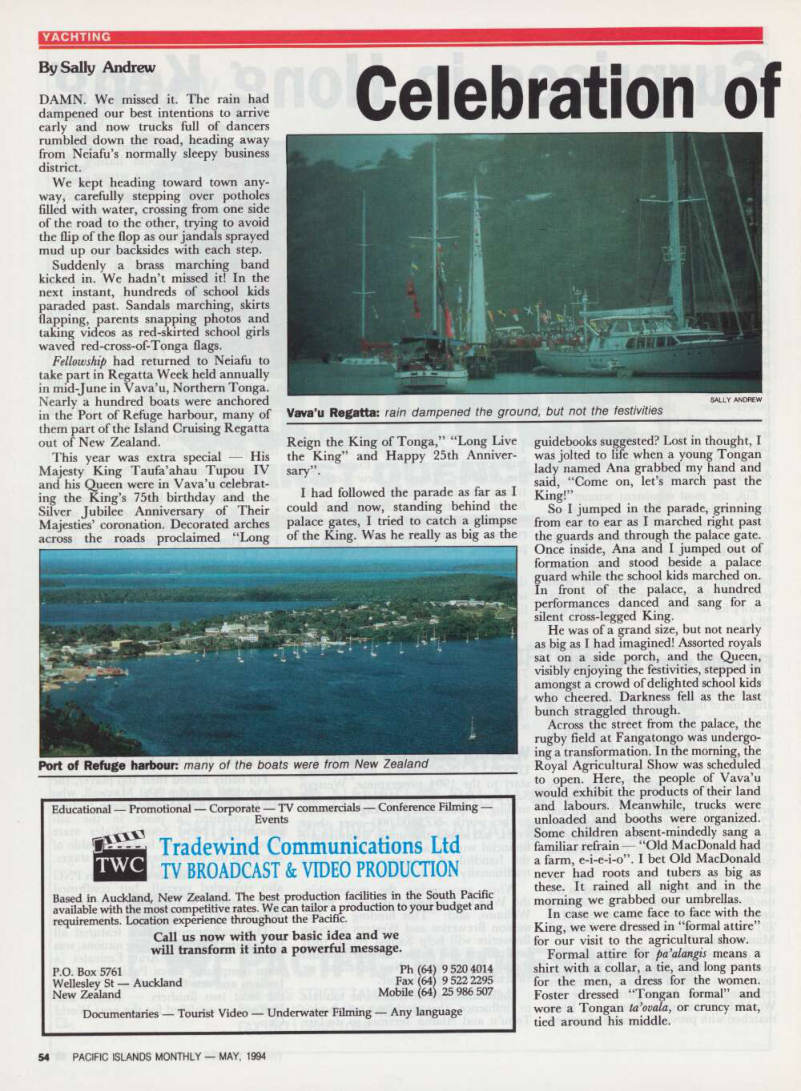
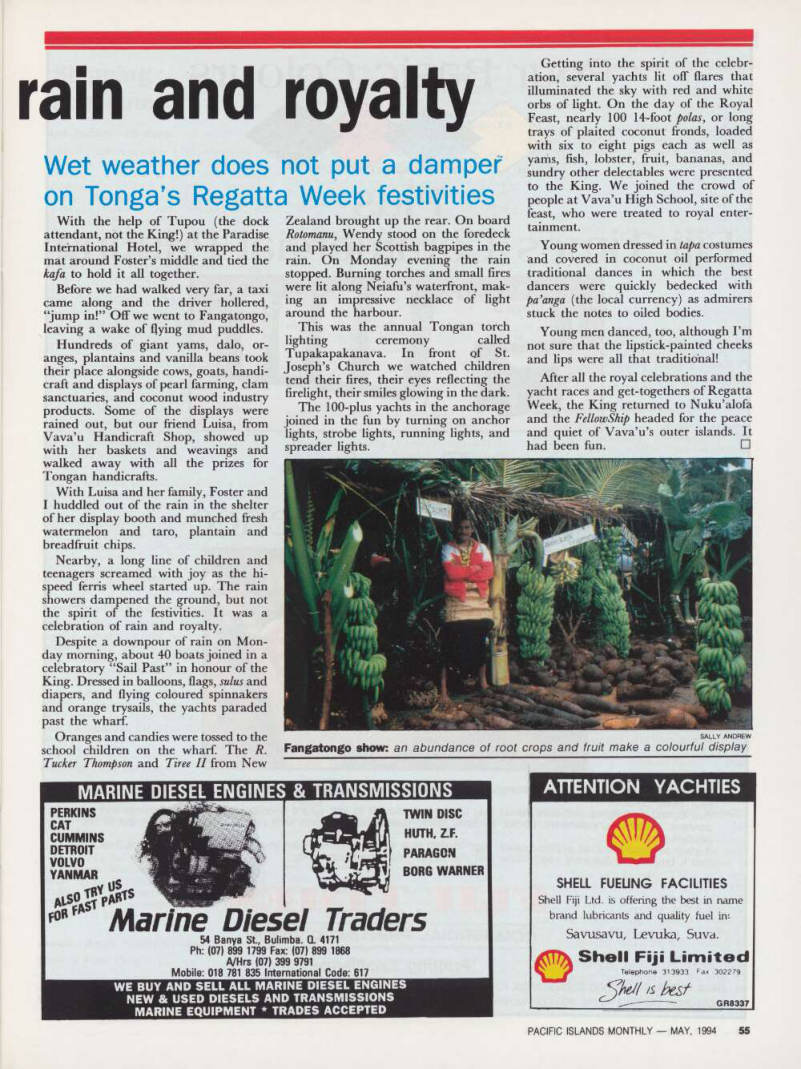
Yachting
By Sally Andrew
DAMN. We missed it. The rain had dampened our best intentions to arrive early and now trucks full of dancers rumbled down the road, heading away from Neiafu’s normally sleepy business district.
We kept heading toward town any way, carefully stepping over potholes filled with water, crossing from one side of the road to the other, trying to avoid the flip of the flop as our jandals sprayed mud up our backsides with each step.
Suddenly a brass marching band kicked in. We hadn’t missed it! In the next instant, hundreds of school kids paraded past. Sandals marching, skirts flapping, parents snapping photos and taking videos as red-skirted school girls waved red-cross-of-Tonga flags.
Fellowship had returned to Neiafu to take part in Regatta Week held annually in mid-June in Vava’u, Northern Tonga.
Nearly a hundred boats were anchored in the Port of Refuge harbour, many of them part of the Island Cruising Regatta out of New Zealand.
This year was extra special His Majesty King Taufa’ahau Tupou IV and his Queen were in Vava’u celebrat ing the King’s 75th birthday and the Silver Jubilee Anniversary of Their Majesties’ coronation. Decorated arches across the roads proclaimed “Long
Reign the King of Tonga,” “Long Live the King” and Happy 25th Anniversary”. T 1 had followed the parade as far as I could and now > standing behind the palace gates, I tried to catch a glimpse of the King. Was he really as big as the
guidebooks suggested? Lost in thought, I was jolted to life when a young Tongan lady named Ana grabbed my hand and said, “Come on, let’s march past the King!”
So I jumped in the parade, grinning from ear to ear as I marched right past the guards and through the palace gate.
Once inside, Ana and I jumped out of formation and stood beside a palace guard while the school kids marched on.
In front of the palace, a hundred performances danced and sang for a silent cross-legged King.
He was of a grand size, but not nearly as big as I had imagined! Assorted royals sat on a side porch, and the Queen, visibly enjoying the festivities, stepped in amongst a crowd of delighted school kids who cheered. Darkness fell as the last bunch straggled through.
Across the street from the palace, the rugby field at Fangatongo was undergo ing a transformation. In the morning, the Royal Agricultural Show was scheduled to open. Here, the people of Vava’u would exhibit the products of their land and labours. Meanwhile, trucks were unloaded and booths were organized.
Some children absent-mindedly sang a familiar refrain “Old MacDonald had a farm, e-i-e-i-o”. I bet Old MacDonald never had roots and tubers as big as these. It rained all night and in the morning we grabbed our umbrellas.
In case we came face to face with the King, we were dressed in “formal attire” for our visit to the agricultural show.
Formal attire for pa’alangis means a shirt with a collar, a tie, and long pants for the men, a dress for the women.
Foster dressed “Tongan formal” and wore a Tongan ta’ovala, or cruncy mat, tied around his middle.
Port of Refuge harbour: many of the boats were from New Zealand
Sally Andrew
Vava’u Regatta: rain dampened the ground, but not the festivities
Wet weather does not put a damper on Tonga’s Regatta Week festivities
With the help of Tupou (the dock attendant, not the King!) at the Paradise International Hotel, we wrapped the mat around Foster’s middle and tied the kafa to hold it all together.
Before we had walked very far, a taxi came along and the driver hollered, “jump in!” Off we went to Fangatongo, leaving a wake of flying mud puddles.
Hundreds of giant yams, dalo, or anges, plantains and vanilla beans took their place alongside cows, goats, handi craft and displays of pearl farming, clam sanctuaries, and coconut wood industry products. Some of the displays were rained out, but our friend Luisa, from Vava’u Handicraft Shop, showed up with her baskets and weavings and walked away with all the prizes for
Tongan handicrafts.
With Luisa and her family, Foster and I huddled out of the rain in the shelter of her display booth and munched fresh watermelon and taro, plantain and
breadfruit chips.
Nearby, a long line of children and teenagers screamed with joy as the hi speed ferris wheel started up. The rain showers dampened the ground, but not the spirit of the festivities. It was a celebration of rain and royalty.
Despite a downpour of rain on Mon day morning, about 40 boats joined in a celebratory “Sail Past” in honour of the King. Dressed in balloons, flags, stilus and
diapers, and flying coloured spinnakers
and orange trysails, the yachts paraded
past the wharf.
Oranges and candies were tossed to the school children on the wharf. The R.
Tucker Thompson and Tiree II from New
ry , , , , /"kuj Zealand brought up the rear. On board Rotomanu, Wendy stood on the foredeck and played her Scottish bagpipes in the rain. On Monday evening the rain stopped. Burning torches and small fires were lit along Neiafu’s waterfront, mak
ing an impressive necklace of light
around the harbour.
This was the annual Tongan torch lighting ceremony ca e Tupakapakanava. In front w Joseph s Church we watched children tend their fires ’ their e y es reflecting the firelight, their smiles glowing in the dark.
The 100-plus yachts m the anchorage
j° ined m the fun h Y turning on anchor h g hts > str obe lights, running lights, and
spreader lights.
Getting into the spirit of the celebr ation, several yachts lit off flares that illuminated the sky with red and white orbs of light. On the day of the Royal Feast, nearly 100 14-foot polas, or long trays of plaited coconut fronds, loaded with six to eight pigs each as well as yams, fish, lobster, fruit, bananas, and sundry other delectables were presented to the King. We joined the crowd of people at Vava’u High School, site of the feast, who were treated to royal enter tainment.
Young women dressed in tapa costumes and covered in coconut oil performed traditional dances in which the best dancers were quickly bedecked with pa’anga (the local currency) as admirers stuck the notes to oiled bodies.
Young men danced, too, although I’m not sure that the lipstick-painted cheeks and lips were all that traditional!
After all the royal celebrations and the
yacht races and get-togethers of Regatta
Week, the King returned to Nuku’alofa and the Fellowship headed for the peace and quiet of Vava’u’s outer islands. It had been fun. □
Sally Andrew
Fangatongo show: an abundance of root crops and fruit make a colourful display
Advertisements & other items, pp. 54-56 (2 items)
Tradewind Communications Ltd
Educational Promotional Corporate TV commercials Conference Filming Events
TV BROADCAST & VIDEO PRODUCTION
Based in Auckland, New Zealand. The best production facilities in the South Pacific available with the most competitive rates. We can tailor a production to your budget and requirements. Location experience throughout the Pacific.
Call us now with your basic idea and we will transform it into a powerful message.
P.O. Box 5761 Wellesley St Auckland New Zealand Ph (64) 9 520 4014 Fax (64) 9 522 2295 Mobile (64) 25 986 507 Documentaries Tourist Video Underwater Filming Any language
ATTENTION YACHTIES
SHELL FUEUNG FACILITIES
Shell Fiji Ltd. is offering the best in name brand lubricants and quality fuel in; Savusavu, Levuka, Suva. © Shell Fiji Limited Telephone 313933 Fax 302279
& best
— GR8337
MARINE DIESEL ENGINES & TRANSMISSIONS
PERKINS
CAT
CUMMINS
DETROIT
VOLVO
YANMAR
AIS»^ TS
Marine Diesel Traders
fOB
TWIN DISC
RUTH, Z.F.
PARAGON
BORG WARNER
54 Banya St, Bulimba. Q. 4171 Ph: (07) 899 1799 Fax: (07) 899 1868 A/Hrs (07) 399 9791 Mobile: 018 781 835 International Code: 617 WE BUY AND SELL ALL MARINE DIESEL ENGINES
NEW & USED DIESELS AND TRANSMISSIONS
MARINE EQUIPMENT * TRADES ACCEPTED
Four Basic Colours
YELLOW CYAN BLACK
Plus
Fiji Times Commercial Printing
m * liil
Equals
Printing Excellence
3 </• It is quite amazing what our experienced master printers, with the latest in printing technology, can produce from Sjif colour C packaging and food labels that look good enough to eat; award winning full colour brochures and posters: magazines, calendars, books, stickers, fabric labels and billboards with pictures that leap right out of the fTvour product requires export-quality, high impact four colour printing, then you should be talking to us first.
You’ll find our prices very competitive and our paper stock quite extensive.
FIJI TIMES
COMMERCIAL PRINTING DIVISION
Printing Excellence
HEAD OFFICE: 20 GORDON STREET, SUVA, FIJI. PHONE: (679) 304111, FAX: 305935 BRANCHES' LAUTOKA Phone; 660422 Fax: 660-352 LABASA Phone: 811644 Fax: 812649 NADI Phone: 702702 Fax. 702 1 05
rain and royalty
Shipping
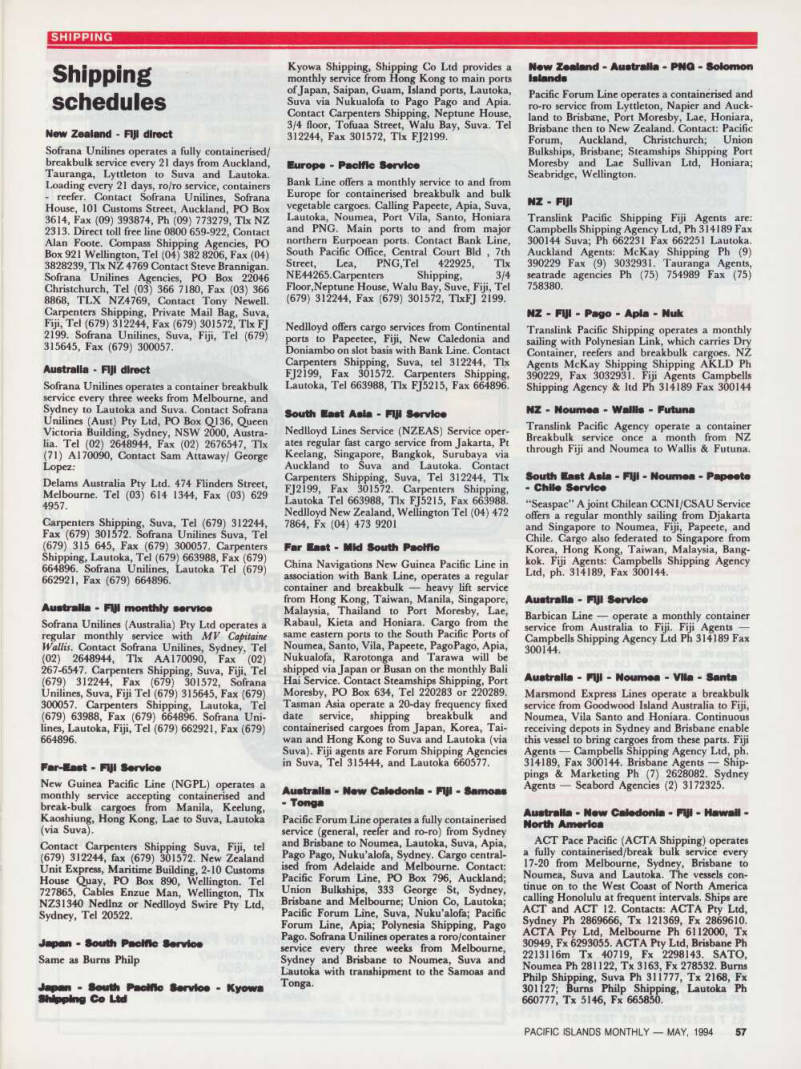
schedules
New Zealand - FIJI direct Sofrana Unilines operates a fully containerised/ breakbulk service every 21 days from Auckland, Tauranga, Lyttleton to Suva and Lautoka.
Loading every 21 days, ro/ro service, containers - reefer. Contact Sofrana Unilines, Sofrana House, 101 Customs Street, Auckland, PO Box 3614, Fax (09) 393874, Ph (09) 773279, Tlx NZ 2313. Direct toll free line 0800 659-922, Contact Alan Foote. Compass Shipping Agencies, PO Box 921 Wellington, Tel (04) 382 8206, Fax (04) 3828239, Tlx NZ 4769 Contact Steve Brannigan.
Sofrana Unilines Agencies, PO Box 22046 Christchurch, Tel (03) 366 7180, Fax (03) 366 8868, TLX NZ4769, Contact Tony Newell.
Carpenters Shipping, Private Mail Bag, Suva, Fiji, Tel (679) 312244, Fax (679) 301572, Tlx FJ 2199. Sofrana Unilines, Suva, Fiji, Tel (679) 315645, Fax (679) 300057.
Australia - FIJI direct Sofrana Unilines operates a container breakbulk service every three weeks from Melbourne, and Sydney to Lautoka and Suva. Contact Sofrana Unilines (Aust) Pty Ltd, PO Box Q 136, Queen Victoria Building, Sydney, NSW 2000, Austra lia. Tel (02) 2648944, Fax (02) 2676547, Tlx (71) A 170090, Contact Sam Attaway/ George Lopez: Delams Australia Pty Ltd. 474 Flinders Street, Melbourne. Tel (03) 614 1344, Fax (03) 629 4957.
Carpenters Shipping, Suva, Tel (679) 312244, Fax (679) 301572. Sofrana Unilines Suva, Tel (679) 315 645, Fax (679) 300057. Carpenters Shipping, Lautoka, Tel (679) 663988, Fax (679) 664896. Sofrana Unilines, Lautoka Tel (679) 662921, Fax (679) 664896.
Australia - FIJI monthly sarvica Sofrana Unilines (Australia) Pty Ltd operates a regular monthly service with MV Capitaine Wallis. Contact Sofrana Unilines, Sydney, Tel (02) 2648944, Tlx AA170090, Fax (02) 267-6547. Carpenters Shipping, Suva, Fiji, Tel (679) 312244, Fax (679) 301572, Sofrana Unilines, Suva, Fiji Tel (679) 315645, Fax (679) 300057. Carpenters Shipping, Lautoka, Tel (679) 63988, Fax (679) 664896. Sofrana Uni lines, Lautoka, Fiji, Tel (679) 662921, Fax (679) 664896.
Far-East - FIJI Sorvlcs New Guinea Pacific Line (NGPL) operates a monthly service accepting containerised and break-bulk cargoes from Manila, Keelung, Kaoshiung, Hong Kong, Lae to Suva, Lautoka (via Suva).
Contact Carpenters Shipping Suva, Fiji, tel (679) 312244, fax (679) 301572. New Zealand Unit Express, Maritime Building, 2-10 Customs House Quay, PO Box 890, Wellington. Tel 727865, Cables Enzue Man, Wellington, Tlx NZ31340 Nedlnz or Nedlloyd Swire Pty Ltd, Sydney, Tel 20522.
Japan - South Pacific Sondes Same as Burns Philp Japan - South Pacific Sondos - Kyowa Shipping Cos Ltd
Kyowa Shipping, Shipping Cos Ltd provides a monthly service from Hong Kong to main ports of Japan, Saipan, Guam, Island ports, Lautoka, Suva via Nukualofa to Pago Pago and Apia.
Contact Carpenters Shipping, Neptune House, 3/4 floor, Tofuaa Street, Walu Bay, Suva. Tel 312244, Fax 301572, Tlx FJ2199.
Europe - Pacific Service Bank Line offers a monthly service to and from Europe for containerised breakbulk and bulk vegetable cargoes. Calling Papeete, Apia, Suva, Lautoka, Noumea, Port Vila, Santo, Honiara and PNG. Main ports to and from major northern Eurpoean ports. Contact Bank Line, South Pacific Office, Central Court Bid , 7th Street, Lea, PNG,TeI 422925, Tlx NE44265. Carpenters Shipping, 3/4 Floor,Neptune House, Walu Bay, Suve, Fiji, Tel (679) 312244, Fax (679) 301572, TIxFJ 2199.
Nedlloyd offers cargo services from Continental ports to Papeetee, Fiji, New Caledonia and Doniambo on slot basis with Bank Line. Contact Carpenters Shipping, Suva, tel 312244, Tlx FJ2199, Fax 301572. Carpenters Shipping, Lautoka, Tel 663988, Tlx FJ5215, Fax 664896.
South East Asia - FIJI Service Nedlloyd Lines Service (NZEAS) Service oper ates regular fast cargo service from Jakarta, Pt Keelang, Singapore, Bangkok, Surubaya via Auckland to Suva and Lautoka. Contact Carpenters Shipping, Suva, Tel 312244, Tlx FJ2199, Fax 301572. Carpenters Shipping, Lautoka Tel 663988, Tlx FJ5215, Fax 663988.
Nedlloyd New Zealand, Wellington Tel (04) 472 7864, Fx (04) 473 9201 Far East - Mid South Pacific China Navigations New Guinea Pacific Line in association with Bank Line, operates a regular container and breakbulk heavy lift service from Hong Kong, Taiwan, Manila, Singapore, Malaysia, Thailand to Port Moresby, Lae, Rabaul, Kieta and Honiara. Cargo from the same eastern ports to the South Pacific Ports of Noumea, Santo, Vila, Papeete, PagoPago, Apia, Nukualofa, Rarotonga and Tarawa will be shipped via Japan or Busan on the monthly Bali Hai Service. Contact Steamships Shipping, Port Moresby, PO Box 634, Tel 220283 or 220289.
Tasman Asia operate a 20-day frequency fixed date service, shipping breakbulk and containerised cargoes from Japan, Korea, Tai wan and Hong Kong to Suva and Lautoka (via Suva). Fiji agents are Forum Shipping Agencies in Suva, Tel 315444, and Lautoka 660577.
Australia - Naw Caledonia - FIJI - Samoas - Tonga Pacific Forum Line operates a fully containerised service (general, reefer and ro-ro) from Sydney and Brisbane to Noumea, Lautoka, Suva, Apia, Pago Pago, Nuku’alofa, Sydney. Cargo central ised from Adelaide and Melbourne. Contact: Pacific Forum Line, PO Box 796, Auckland; Union Bulkships, 333 George St, Sydney, Brisbane and Melbourne; Union Cos, Lautoka; Pacific Forum Line, Suva, Nuku’alofa; Pacific Forum Line, Apia; Polynesia Shipping, Pago Pago. Sofrana Unilines operates a roro/containcr service every three weeks from Melbourne, Sydney and Brisbane to Noumea, Suva and Lautoka with transhipment to the Samoas and Tonga.
Naw Zealand - Australia - PNG - Solomon Islands Pacific Forum Line operates a containerised and ro-ro service from Lyttleton, Napier and Auck land to Brisbane, Port Moresby, Lae, Honiara, Brisbane then to New Zealand. Contact: Pacific Forum, Auckland, Christchurch; Union Bulkships, Brisbane; Steamships Shipping Port Moresby and Lae Sullivan Ltd, Honiara; Seabridge, Wellington.
Nz - F||I
Translink Pacific Shipping Fiji Agents are: Campbells Shipping Agency Ltd, Ph 314189 Fax 300144 Suva; Ph 662231 Fax 662251 Lautoka.
Auckland Agents: McKay Shipping Ph (9) 390229 Fax (9) 3032931. Tauranga Agents, sea trade agencies Ph (75) 754989 Fax (75) 758380.
NZ - Fiji - Pago - Apia - Nuk Translink Pacific Shipping operates a monthly sailing with Polynesian Link, which carries Dry Container, reefers and breakbulk cargoes. NZ Agents McKay Shipping Shipping AKLD Ph 390229, Fax 3032931. Fiji Agents Campbells Shipping Agency & ltd Ph 314189 Fax 300144 NZ - Noumea - Wallis - Futuna Translink Pacific Agency operate a container Breakbulk service once a month from NZ through Fiji and Noumea to Wallis & Futuna.
South East Asia - FIJI - Noumea - Papeete - Chile Service “Seaspac” A joint Chilean CCNI/CSAU Service offers a regular monthly sailing from Djakarta and Singapore to Noumea, Fiji, Papeete, and Chile. Cargo also federated to Singapore from Koreaj Hong Kong, Taiwan, Malaysia, Bang kok. Fiji Agents: Campbells Shipping Agency Ltd, ph. 314189, Fax 300144.
Australia - FIJI Service Barbican Line — operate a monthly container service from Australia to Fiji. Fiji Agents — Campbells Shipping Agency Ltd Ph 314189 Fax 300144.
Australia - FIJI - Noumea - Vila - Santa Marsmond Express Lines operate a breakbulk service from Goodwood Island Australia to Fiji, Noumea, Vila Santo and Honiara. Continuous receiving depots in Sydney and Brisbane enable this vessel to bring cargoes from these parts. Fiji Agents — Campbells Shipping Agency Ltd, ph. 314189, Fax 300144. Brisbane Agents — Ship pings & Marketing Ph (7) 2628082. Sydney Agents — Seabord Agencies (2) 3172325.
Australia - Now Caledonia - FIJI - Hawaii - North America ACT Pace Pacific (ACTA Shipping) operates a fully containerised/break bulk service every 17-20 from Melbourne, Sydney, Brisbane to Noumea, Suva and Lautoka. The vessels con tinue on to the West Coast of North America calling Honolulu at frequent intervals. Ships are ACT and ACT 12. Contacts: ACTA Pty Ltd, Sydney Ph 2869666, Tx 121369, Fx 2869610.
ACTA Pty Ltd, Melbourne Ph 6112000, Tx 30949, Fx 6293055. ACTA Pty Ltd, Brisbane Ph 2213116m Tx 40719, Fx 2298143. SATO, Noumea Ph 281122, Tx 3163, Fx 278532. Bums Philp Shipping, Suva Ph 311777, Tx 2168, Fx 301127; Bums Philp Shipping, Lautoka Ph 660777, Tx 5146, Fx 665850.
Advertisements & other items, pp. 58-60 (1 item)
Mfirk€T Plrc€
MRRK€T PLRCC CRN WORK
WONDERS FOR VOU ...
Promote your business, or ser-
vice, sell your household
items, cars or heavy machinery
etc.
ONLY AUSSI PER WORD.
NO COMPANY LOGO. NO
DISPLAY. NO BOLD TYPE.
Just forward your Advertisement together with payment to: PACIFIC ISLANDS MONTHLY “Market Place ", P.O. Box 1167, Suva, Fiji.
PORTABLE SAWMILLS
Easy to use, range from 4 cu m 50 cu m/d Price FOB NZ$l4,OOO $79,000 (no NZ if exported).
Fax NZ (64 7) 883 3060.
FUNDRAISERS WANTED
N.Z. based charitable trust that carries out humanitarian aid for Pacific Basin countries seeks fundraisers. Commission paid for efforts. Details: PBT, Box 1090, Preston 3072, Australia.
STUDENTS/NETWORKERS
New international MLM opportunity magazine of students marked essays, other benefits. Excellent commission structure. Free booklet: ISB, Box 727, Moonee Ponds 3039, Australia.
BUILDING CONTROL SYSTEMS
Attention Resort Developers and Telecommunication Companies. Intelligent Computer Systems for large building complexes. Specialising in Security Monitor and Energy Control systems (SMEC) for resorts. Monitor and Control security, fire alarms, airconditioners, lights, pumps etc. all from central computer systems.
Rompac Systems Pty Ltd Phone Australia 6179511422 Fax 6179577124.
SHIP AND YACHT BROKERS
Asia-Pacific Marine Services international marine brokers Yachts, Ferries, Charter Vessels, Fishing Boats, Commercial and Private. Charters & Deliveries. Looking at buying or selling a boat, ph/fax 6170 993 246 marine business or real estate?
DIESEL ENGINES AND PARTS
Supplier of genuine GARDNER and LISTER engine parts. Prompt service and repair of fuel pumps, water pumps, lift pumps etc. New, reconditioned, service exchange parts available from Queensland Distributor: M.D.E., 69
BYRON ST, BULIMBA, QLD 4171 Tel:
617 899 0722 Fax: 617 899 0733. All needs catered for.
SCRAP METAL
Tall ingots operate from Brisbane, Australia and make frequent visits to the Pacific Islands which they have done for twenty-five years. We are buyers of Copper, Brass, Aluminium, Lead, Cable etc. Inspection no problems. Telephone 61 7 8922033. Fax 61 78922077.
HEALTH AND NUTRITION
“You can earn $1 million P.A. MLM ground floor opportunity specialising in Health and Nutrition products. In 16 countries and expanding rapidly. Top products and company support.
Send Sase to AGM 96 Sugaloaf Road Geilston Bay, Australia, 7016 or Fax 61-02-471026.
Marketing
I am Rev. Thomas Scarborough, one of the Globe’s best known Christian programmers. I am seeking retail marketing agreements I program, you market, I take a standard royalty.
Write to: 6 St. Patrick’s Road, 8001 Fresnaye, South Africa.
South Pacific Regional
Environment Programme
We are in the process of compiling a database containing information on environmental consultants in the South Pacific. This database is intended to assist SPREP in finding consultants as required.
Any person wanting to be included on this database should contact SPREP, asking for a ‘environmental consultants form’ that can* be filled, outand returned to us.
The Director
SPREP
P.O. Box 240 Apia Western Samoa Fax (685) 20231 'i sfyt
MAY
929 Ph
MACMILLAN BROWN CENTRE
FOR
PACIFIC STUDIES
University of Canterbury
SCHOLARS PROGRAMME FOR 1995
The Centre invites applications for positions as Research and Visiting Scholars in 1995. Successful applicants will be selected on their research record. Applicants without formal qualifications will be considered on the basis of experience and research interest.
Applications close on 30 June 1994. For more information please write to the Director, Macmillan Brown Centre for Pacific Studies University of Canterbury Private Bag 4800 Christchurch 1 New Zealand
3 1508 00241152 15 20 25 30 35 40 45
Grand Pacific Life Insurance, Ltd.
3 A member of the Finance Factors Family © 50 55
FEDERATED STATES
OF MICRONESIA
Actouka Executive Insurance Underwriters P.O. Box 55, Kolonia, Pohnpei, Federated States of Micronesia 96941 Pacific Basin Insurance & General Services, Inc P.O. Box 494, Chuuk State, Federated States of Micronesia 96942
TONGA
Peseti Ma'afu Ins. & Finance, Ltd.
Private Bag 2, Taumoepeau Bldg.
Nukualofa, Tonga
GUAM
Great National Insurance Undenvriters, Inc.
P.O. Box GA, Agana, Guam 96910
AMERICAN SAMOA
Mark Solofa Pacific Insurance & Finance, Inc.
P.O. Box 3149 Pago Pago, American Samoa 96799 Pacific Financial Corporation P.O. Box AT, Agana, Guam 96910 Takagi & Associates, Inc.
GCIC Bldg, Suite 100 414 W. Soledad Ave.
Agana, Guam 96910
MARSHALL ISLANDS
Marshalls Insurance Agency P.O. Box 113, Majuro, Marshall Islands 96960
WESTERN SAMOA
Mark Solofa Pacific Insurance & Finance, Inc.
P.O. Box 3149 Pago Pago, American Samoa 96799
NORTHERN MARIANAS
Pacific Basin Insurance Undenvriters, Inc.
P.O. Box 710 Saipan, Mariana Islands 96950 Pacifica Insurance Undenvriters, Inc.
P.O. Box 168, Saipan, Mariana Islands 96950 Grand Pacific Life Insurance, Ltd. • 1164 Bishop Street, sth Floor, Honolulu, HI 96813 Phone: (808) 548-3363 • FAX: (808) 548-5122
WITH THE
CROWD?
The All New Mitsubishi Galant —
The Freedom to Drive as You Choose Imagine... you’re on a long ride home from a long day’s work. You want to get home as soon as possible, but you want to do so effortlessly... or maybe you’re on a winding road, and you have the urge to experience truly sporty driving.
Typically, you would need two different cars to enjoy these two experiences fully. But with the new Mitsubishi Galant, it’s all possible.
The new Galant features an innovative approach to engine efficiency that dramatically expands driving potential. Compared to cars with conventional engines, the Galant has far better combustion efficiency and reduced friction losses.
This allows smoother, more powerful operation with almost no noise or vibration. So whether you want to relax and cruise, or drive more sportily, the Galant gives you exactly what you want — when you need it.
Each of the Galant’s new multi-valve engines gives you the unparalleled freedom to drive as you choose. They are an integral part of All Wheel Control, Mitsubishi’s unique approach to car design that gives you total control over the driving experience. With true communication between you and the road, the new Galant ensures total control with quicker, safer and more responsive performance than ever before imaginable.
Discover the meaning of driving freedom with the new Mitsubishi Galant —and feel how All Wheel Control sets you apart from the crowd.
The All New
MITSUBISHI GRLRNT
AMERICAN SAMOA; PACIFIC MARKETING INC. RO. Box 698, Pago Pago, Tel. 699 9140 1 AUSTRALIA: MITSUBISHI MOTORS AUSTRALIA LTD. 1284 South Road, Clovelly Park, South Australia, lei. (08) 2757297 1 FUI: NIVIS MOTOR & MACHINERY CO. LTD. G.RO. Box 150, Suva, lei. 383411/ GUAM: TRIPPLE J ENTERPRISES INC. RO. Box 6066, lamuning, Tel. 6469126 / NEW CALEDONIA: SOCIETE OTMPORTATION D'AUTO DU PACIFIQUE SUD S.A. RO. Box 2548, Noumea, lei 274144 /NEW ZEALAND: MITSUBISHI MOTORS NEW ZEALAND LTD. Private Bag Porirua, lei. 2370109 /NORFOLK ISLAND: BORRY’S PTY LTD. RO. Box 169, Tel. 2114 /PAPUA NEW GUINEA: TOBA PTY LTD. RO. Box 503, Port Moresby, Tel. 217-874 /SAIPAN: AUTO MOTION INC. P.O, Box 569, SKV Dist. 4, Tel, 2343332/ SOLOMON ISLANDS: HARVEST PACIFIC LTD. G.RO. Box 823 Honiara, lei. 30407/ TAHITI (FRENCH POLYNESIA): SOPADEP S.A. RO, Box 1617, Papeete, Tel. 427393/ TONGA: SITANI MAPI CO., LTD. RO. Box 83, Nuku'Alofa, lei 24044 1 VANUATU: SOCOMETRA VANUATU LTD. B.R 06 Route de Lagon, Port Vila, Tel. 2314 /WESTERN SAMOA: MOTOR DISTRIBUTORS (SAMOA) LTD. RO. Box 576 Apia, Tel. 20957 A
MITSUBISHI
MOTORS
GREYING TOGETHER