Pacific

Islands
Monthly
April 1994
■ 0 I ■ 4K JHH I • I • ] I 11«^ ■SI BEm HI K
Super Sevens
Fiji kicks off sevens fever - p6l
The new Rabuka - p 8 Tonga on the move - pl 7 Hereniko comes of age - p 37 Guam's landmark resolution - p5B
Western Samoa
Protest in Apia - p 9
American Samoa US$2.5O; Australia A 53.50; Cook Islands NZ$3; FIJI (Incl VAT) F 51.92; FS Micronesia US$3; Hawaii US$3; Kiribati A 52.50; Nauru A 52.50; Niue NZ$3; Norfolk As 3; New Caledonia cpf2so; New Zealand (incl GST) NZ53.45; Nth Marianas US$3; Papua New Guinea K 3; Palau US$3; Marshalls US$3; Solomon Islands As 3; French Polynesia cpfSOO; Tonga P 3; USA US$3; Vanuatu VT22O; Western Samoa T 3.25. * Recommended retail price only
Advertisements & other items, p. 2 (1 item)
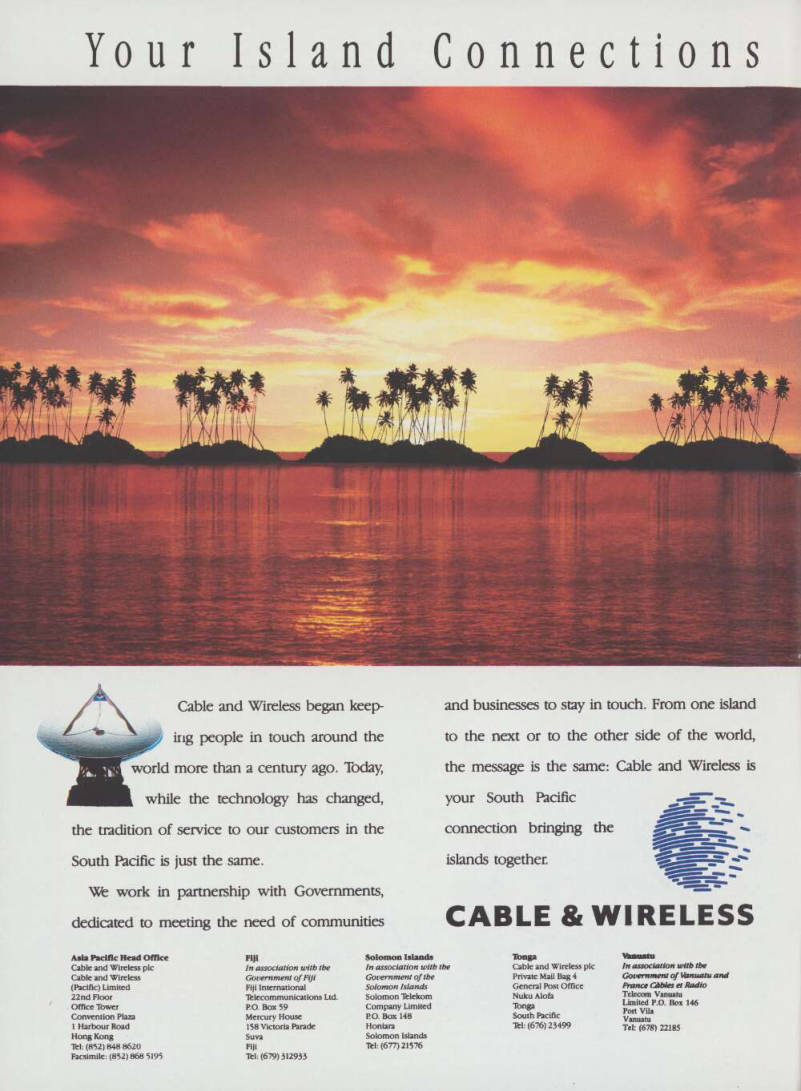
Your Island Connections
m *
Cable and Wireless began keep-
ing people in touch around the
world more than a century ago. Today,
while the technology has changed,
the tradition of service to our customers in the
South Pacific is just the same.
We work in partnership with Governments,
dedicated to meeting the need of communities and businesses to stay in touch. From one island to the next or to the other side of the world, the message is the same: Cable and Wireless is
your South Pacific
connection bringing the
islands together.
CABLE & WIRELESS
Asia Pacific Head Office Cable and Wireless pic Cable and Wireless (Pacific) Limited 22nd Floor Office Tower Convention Plaza 1 Harbour Road Hong Kong Tfcl: (852) 848 8620 Facsimile: (852) 868 5195 Fiji In association with the Government of Fiji Fiji International Telecommunications Ltd.
P.O. Box 59 Mercury House 158 Victoria Parade Suva Fiji Tel; (679) 312933 Solomon Islands In association with the Government of the Solomon Islands Solomon Telekom Company Limited P.O. Box 148 Honiara Solomon Islands Tel; (677) 21576 Tonga Cable and Wireless pic Private Mail Bag 4 General Post Office Nuku Alofa Tonga South Pacific Tel: (676) 23499 In association with the Government of Vanuatu and France GMes et Radio Telecom Vanuatu Limited P.O. Box 146 Port Vila Vanuatu Tel: (678) 22185
Pacific
Islands
Monthly
Vol 64 No. 4
The News Magazine
April 1994
Letters 5
Headlines 6
Politics
The new Rabuka 8
Western Samoa
Protestors hit govt 9
Pacific Diary 10
Cover Story
America’s painful atomic secrets 11
Women
Law and the Fiji woman 14
The United Nations
Diplomacy Pacific style 16
Business
Tonga on the move 17 Garment trouble in Saipan 20 Business bulletin 21
New Caledonia
The healing visit 22 The healing convention 23 Arms seized 25
Britain
Special feature 27
Tourism
The last word? 36
People
Flereniko comes of age 37
Guam
Landmark resolution 58
Sport
Super sevens 61
On the right track 62
Yachting
Fabulous Funafuti 63
Shipping
Shipping schedules 65
Columnists
David Barber 26 Bill McCabe 38 Futa Helu 60
Publisher: Brian O’Flaherty
Acting Editor: Martin Tiffany
Associate Editor: Arvind Kumar
Correspondents:
Christine Hatcher, David North, Ed Rampell, lan Williams, Johnson Honimae, Karen Mangnall, Liz Thompson. Nicholas Rothwell, Pesi Fonua, Wally Hiambohn.
Columnists: David Barber (Wellington), Futa Helu (Tonga, covering the Pacific Islands), Jemima Garrett (Sydney).
Julian Moti (Pacific Law), Alfred Sasako (The Forum).
Advertising Sales: • Regional Sales (South Pacific; Salendra Narayan, Tel (679) 304111, 303244, Fx (679) 303809. • Sydney. Canberra Bob Hill Media Reoresen tations. Tel (61-2) 4164245. Fx (61-2) 4165064 • Brisbane: Robert Walker. Media House Tel (61-7) 3710533. Fx (61-7) 371-8904 • Adelaide: Hastwell Williamsons Representatives, Tel (61-8) 3799522, Fx (61-8) 3799735. • Melbourne: Brown Orr Fletcher Burrows (Aust).
Pty. Ltd. Tel (3) 696 5188 Fx (03) 696 5131. • Auckland: McKay & Bowman, International Media Representatives Ltd, Tel (64-9) 4190561, Fx (64-9) 4192243.
• Japan: Universal Media Corporation, Tokyo, Tel (3) 32626741, Cable: UNIMEDIA Tokyo, Fx (3) 32626742.
Founded 1930 (USPS 952480). A Fiji Times Limited production.
Cover prices are recommended retail only. Regis tered by Australia Post, Publication No. NBP 1210.
C Copyright Fiji Times Limited, 177 Victoria Parade, Suva. Fiji. Tel (679) 304111, Fx (679)
303809. Tx Fj2124.
Pacific Islands Monthly is published monthly by The Fiji Times Limited, a division of Nationwide News, 2 Holt Street. Surry Hills, Sydney. NSW 2010.
Send address changes to: • Pacific Islands Monthly, PO Box 1167, Suva, Fiji.
Typeset and printed by The Fiji Times Limited, 177 Victoria Parade. Suva. Fiji.
Martin Tiffany
Apia: special feature on Western Samoa starts on page 39
waste treaty
Base for waste treaty formed
PACIFIC Forum countries at a meeting in Suva last month reached broad agreement on a proposed treaty banning the importation of hazardous and toxic wastes into the South Pacific, as well as, the control trans boundry movement of these wastes.
The proposal was prepared by Papua New Guinea in response to a Forum directive. The Forum has directed that a possible regional convention be ready for signing by the 1995 South Pacific Forum meeting.
The chairman of the meeting, Federated States of Micronesia Exter nal Affairs Secretary, Resio Moses, said he was happy with the proceed ings of the two-day meeting.
He said despite the technical details of the draft treaty, broad agreements have been reached on many of the substantive issues covered in the document.
He said progress had been made in many difficult areas and the ground work for a regional convention is now in place. Moses said further meetings will be held between now and the Forum meeting next year.
The Suva meeting was attended by delegates from Australia, the Cook Islands, FSM, Fiji, Nauru, New Zealand, PNG, Marshall Islands, Tuvalu and Western Samoa. The South Pacific Regional Environment Programme also attended.
The environment group Green peace and the Pacific Conference of Churches attended as observers. □
Advertisements & other items, p. 4 (1 item)
Alliance Corporation Ltd
* AimcmsMOfin
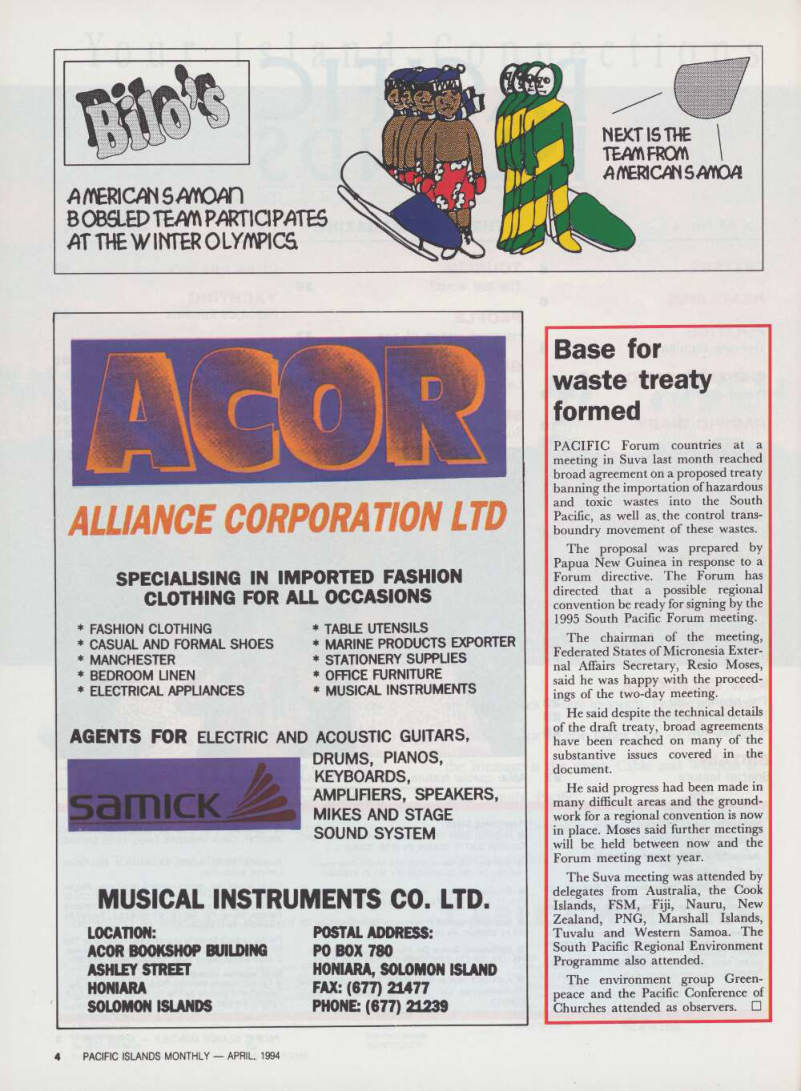
B OBSLED TE/VA PARTICIPATES
AT THE WINTER OLY/WPICS.
NEXT IS THE \
TEXTRON \
AFRICAN S/WDfl
ALLIANCE CORPORATION LTD
SPECIALISING IN IMPORTED FASHION
CLOTHING FOR ALL OCCASIONS
♦ FASHION CLOTHING
♦ CASUAL AND FORMAL SHOES
♦ MANCHESTER
♦ BEDROOM UNEN
♦ ELECTRICAL APPLIANCES
* TABLE UTENSILS
* MARINE PRODUCTS EXPORTER
* STATIONERY SUPPLIES
* OFFICE FURNITURE
* MUSICAL INSTRUMENTS
AGENTS FOR ELECTRIC AND ACOUSTIC GUITARS,
DRUMS, PIANOS,
KEYBOARDS,
AMPLIFIERS, SPEAKERS,
MIKES AND STAGE
SOUND SYSTEM
MUSICAL INSTRUMENTS CO. LTD.
LOCATION:
ACOR BOOKSHOP BUILDING
ASHLEY STREET
HONIARA
SOLOMON ISLANDS
POSTAL ADDRESS:
PO BOX 780
HONIARA, SOLOMON ISLAND
FAX: (677) 21477
PHONE: (677) 21239
interests
Letters
Marshall interests
Sir, WHILE I appreciate the investment of time Arthur King made in responding to my letter ( PIM December ’93), his analytical nitpicking of phrases that hit his hot button then fabricating illusions of atoll-grabbing “Hawaii-based Trusts” (have you heard of one?) places him in the same boat as the likes of Mr Miller whose “creative” intrusion in the Mar shalls cost him more than just the loss of his dream castle.
Mr King’s fame as a professional tourist hardly gives him license to presume that the Trust (created by
perhaps the now highest-ranking
Marshallese chief out of his love and for the benefit of all Marshallese people, the “beneficiaries”) would follow in the steps of Mr Miller’s company (“throw out their destructive inhabitants”), who were on a course bent on displacing native Marshallese citizens from their land and birthrights for profit. Have a little respect.
Mr Miller was stopped, yes, not by the Trust manager, but by Marshallese interests as we forewarned. Stay tuned for the sequel.
I also appreciate Mr King’s worry for my personal happiness, which, I admit, would be mildly enhanced by the eradication of the type of inflammatory, ignorant, presumptive and quasi slanderous “gibberish” he penned.
I suggest that if Mr King has any real interest in “their urgent need for con structive investment” or has one wit of constructive counsel that would help a “sovereign nation sorely in need of imaginative investment”, that he put his money where his pen is and join the efforts of the Iroijlaplap Murjel Hermios Eleemosynary Trust to remedy the dependence of the Marshallese economy on the almighty US welfare dollar.
Thank you for your continued sup port.
Yokwe
Executive director Iroijlaplap Murjel Hermios Eleemosynary Trust Honolulu Hawaii
LETTERS to the Editor must include the writer’s full name, address and home telephone number. All letters may be edited for purposes of clarity and space.
Letters should be addressed to: Editor Pacific Islands Monthly P O Box 1167 Suva Fiji Islands OR Fax: (679) 303809
Advertisements & other items, p. 5 (1 item)
Remember your Friend
flic 111 11 tire
4 tmii (BEers
K;,i|»Ukv<i imo I U-iivoii. or i nsthewi io<>o!ha'oii Liu-ih? * m &
Remember your Friend
There are times in your life when you feel your friends have been missing out on something good. Now’s your chance to do something about it and share with them one of the good things you have. Buy your friend a subscription to Pacific Islands Monthly and let him or her join you and the thousands of other people worldwide who are kept informed of the latest political, social and cultural changes taking place in the Pacific.
SUBSCRIPTIONS
r
PACIFIC
ISLANDS
American Samoa US$45 Australia A 542.00 Canada US$45 Cook Islands AUSS46 Fiji F 526.40 French Polynesia US$45 Guam US$45 I ° 2 1 1 O usl4s ease sen d my friend Pacific Islands Monthly for one year (12 issues) Kiribati AUSS46 Marshall/Micronesia US$4O Nauru AUSS42 New Caledonia US$32 New Zealand NZ$55 Niue AUSS46 Norfolk Island AUSS42 Northern Marianas/Palau US$4O Papua New Guinea AUSS4S Solomon Islands AUSS46 Tonga AUSS46 Tuvalu AUSS46 United Kingdom Stg Pound2B US Mainland US$45 Vanuatu AUSS4S Western Samoa WS$6O Elsewhere AUSS63 1 I enclose my cheque for $ (made payable to Pacific Islands Monthly) . or debit $ to my: □ Bankcard □ Visacard □ Mastercard I Card No; Expiry Date.
NAME.
.SIGNATURE.
MY FRIEND'S NAME.
Payment to Pacific Islands Monthly: Subscriptions Dept, GPO Box 1167, Suva, Fiji.
MY FRIEND'S ADDRESS.
Subscriptions rates include the cost of airspeeding to all destinations set out above.
Direct airmail rates on application.
Telephone: 304111 Fax: 303809 L£l
CITY
.COUNTRY
export tax
Headlines
Papua New Guinea
New log export tax
Papua New Guinea has abandoned the most contentious of its tough, new forestry guidelines in favour of a new log export tax. Reports say tat the government of Paias Wingti appears to have given in to a concerted campaign waged by the foreign logging companies and their associated resource owner groups.
In early March, tree felling on 14 logging projects in PNG came to a halt in protest at the new guidelines which the forest minister said were needed to control PNG’s logging industry.
Wingti set-up a ministerial committee to review the guidelines and, after a meeting with industry groups, he announced the guidelines will be deferred indefinitely in favour of a new log export tax. Wingti said the timber industry was very happy with what his office described as a major
breakthrough following months of dispute.
Australia accused of sabotaging Bougainville peace moves
The self-styled Bougainville interim-government has accused the Australian government of moves to torpedo a human rights resolution on Bougainville. A four-man delegation from Bougainville at the Commission on Human Rights in Geneva
says in the absence of PNG, the Australian government has called in all favours in an attempt to sink an African-sponsored resolution calling for a Special Representative of the United Nations to investigate the human rights situation on
Bougainville.
Spokesman Mike Forster said from Geneva that the call for a Special Representative is vital to an early peace on Bougainville. He said someone needs to bring about the reality of negotiations. Forster says the text being proposed by Australia to replace the African text means that Australia and PNG will have another year to murder the people on Bougainville. He says ther is an obvious conflict on Bougainville, but it’s a conflict of interest, and no amount of warfare will solve this.
The Commission which meets once a year, passed two resolution in 193 to which PNG has made no replay.
A Rainbow Warrior
France
A Rainbow Warrior reminder
The French continue to thumb their noses at New Zealand and the environmental movement in the islands. The French intelligence officer implicated in blowing up the Rainbow Warrior, in Auckland in 1985 has been promoted again by the French government
Advertisements & other items, p. 6 (1 item)
The Pacific Islands Rely
ON THE ENERGY OF BORAL
American Samoa (684) Marshall Islands (692) Tafuna 699 2948 Aua 6442170 Cook Islands (682) Rarotonga 24460 Ftf (679) Suva 315522 Lautoka 60088 Sigatoka 50578 Labasa 82973 Majuro 6257254 Norfolk Islands (6723) Norfolk Island 2419 Papna New Gtdnea (675) Port Moresby 214248 Lae 422574 Rabaul 921225 Wewak 862125 Mount Hagen 551216 Solomon Islands (677) Honiara 21833 All through the Pacific Islands, people rely on Boral LP gas for their energy needs. Boral has terminals throughout the area, and is proud to be a leading supplier.
Boral Gas is clean, efficient and low in cost.
It’s the ideal energy source for cooking and water heating in homes, motels and hotels, and for a wide range of industrial uses. So call for Boral Gas. We have the energy you’re
looking for.
BORAL GAS
Tonga (676) Nuku'alofa 24035 Vava’u 22903 Vanuatu (678) Santo 36455 Port Vila 22046 Boral Gas Pacific, John Osier Centre, 339 Coronation Drive, Brisbane. Tel: (07) 3671365. Fas: (07) 3694347
by permit blunder
New Zealand
Maoris hunt endangered birds
As thousands of dollars are spent in New Zealand trying to save threatened bird species, some of the country’s native Maori people argue they have the right to hunt and eat the
endangered birds.
In parts of New Zealand the native wood pigeon, or kereru , is rapidly disappearing as Maori armed with rifles engage in what is being called “cultural harvest.” Also on their menu are godwits, royal albatross and sooty shearwaters, known here as “mutton birds.” Conservationists and the Department of Conservation (DOC), say pigeon eating should stop.
Historian Michael King, writing in the latest issue of Mana, a monthly news magazine for Maori, said cultural harvesting involved “spiritual nourishment” rather than just bodily nourishment. It is used by Maori to assert their identity, and to link modern Maori with their ancestors.
Even traditional control, defining which tribe can hunt where and when, has broken down and DOC has found a number of different tribes were hunting the same small population of birds. Although it is an offence to hunt the birds, King said few judges convict people because Maori claim that under the 1840 Treaty of Waitangi, in which British sovereignty was extended over New Zealand, the Maori were guaranteed the right of chiefly rule. This has been interpreted as a guarantee of their right to harvest species of cultural
significance.
Fisheries officials em harassed
by permit blunder
A claim by a fishing group that Samoans were given a traditional Maori right to gather seafood has embarassed fisheries officials. The error by a Wellington fisheries officer in giving a permit to Samoans has upset the minister of fisheries Mr Kidd.
The Recreational Fishing Council released a copy of a permit found on the roadside. It allowed the Tawa Samoan Assembly of God to take two bags of paua and 10 bags of kina from Pukerua Bay, near Wellington, at the end of last November.
The council’s secretary, Max Hetherington, has written to Kidd questioning Maori rights being given to the Samoan
community.
A statement from the minister bluntly referred to the issues of the permit as a “cock-up”.
Alliance welcomes
Bougainville visit suggestion
New Zealand’s Alliance of smaller parties has welcomed Prime Minister Jim Bolger’s suggestions that a New Zealand parliamentary delegation may visit the war-torn island of Bougainville in Papua New Guinea. Alliance associate defence spokesperson Keith Locke said a serious war is raging on an island not far from New Zealand’s shores. A parliamentary visit would help bring home this fact.
Locke said hopefully the visit will motivate New Zealand MPs and the government to do more to promote peace talks on Bougainville. He said New Zealand may be able to do this in coordination with the Australian parliament, which recently decided to send its own fact-finding team to Bougainville.
Jimmy Steven
Vanuatu
New President elected at last
Jean-Marie Leye has been elected Vanuatu’s third president.
Leye is a former vice-president of the ruling Union of Moderate Parties and a former member of parliament.
His selection by the electoral college comes after two previous attempts to select a new head of state failed. The first time, the opposition boycotted the election and then no candidate won a sufficient number of votes to become president.
Jimmy Steven
dies
The leader of Vanuatu’s Nagriamel movement, Jimmy Stevens, has died in his home village on Santo island following a long illness. Stevens was in his 70s as is believed to have had over 15 wives and numerous children.
He rose to prominence for masterminding the so-called Santo rebellion in 1980 which was quelled following the arrival of Papua New Guinea troops. The troops were called in by Father Walter Lini who had just formed Vanuatu’s first government at the territory’s independence from France and Britain.
Three months earlier, Stevens had proclaimed a provisional secessionist government of Vemarana, becoming its self appointed chief minister. Released in 1991, he claimed to have been one of the world’s longest-serving political prisoners.
Kalpokas rejects
Kerman’s offer
Vanuatu’s Prime Minister, Maxime Carlot Korman, has rejected the opposition Vanuaaku Pati’s demand for three ministerial portfolio’s in his government. Korman said he will stick to his offer of a new ministry of labour and training and two parliamentary positions of leader of government business
and first deputy speaker.
VP president Donald Kalpokas said his party had a general agreement with the government for three ministerial posts in the government in return for its backing in the election of the country’s new president. The three ministries included lands and finance, but Korman said in any democracy, the ruling party always retains the finance portfolio.
Kalpokas has written to Korman rejecting the government’s offer, saying his party feels cheated. Kalpokas says the prime minister had offered VP three existing ministries one from the Union of Moderate parties and the other from the National United Party, with the third to come later. Kalpokas says the offer of a new ministerial post was unconstitutional as only 11 ministries are allowed.
The VP executive council says Kalpokas is still leader of the opposition in parliament because he hasn’t yet resigned from the post. The three other opposition parties elected Melanesian Progressive Party leader Barak Sope to be leader of the opposition when the Vanuaaku Party was negotiating a deal with the government to join the coalition.
The new Rabuka
Politics- Fiji
Fiji PIVI plays a shrewd hand in his return to office for a second term
By Wainikiti Waqa
FIJI Prime Minister Sitiveni Rabuka, found to be inconsistent at times during his first term in office in 1992, has returned a shrewder politician follow ing a snap general election in Febru ary. Criticised for accommodating an “over-sized” cabinet after the 1992 poll, Rabuka last month announced a greatly reduced cabinet.
From his initial 18, Rabuka has reduced his cabinet by six, removing four senior ministers while two were not re elected in the snap election brought about by the defeat of the 1994 budget in parliament in November last year.
Out were political warhorses from the “old school” Militoni Leweniqila and Koresi Matatolu. Staunch Rabuka loy alist Ratu Inoke Kubuabola is also warming the government backbenches.
When dumping the three, Rabuka must have been sure of their loyalty to him as all four hail from the same island of Vanua Levu. But as records show, the ruling Soqosoqo ni Vakavulewa ni Taukei Party politicians do not take kindly to being dropped from cabinet.
Naitasiri politician Ilai Kuli and Lauan Viliame Saulekaleka became hostile to wards Rabuka after the prime minister dropped them from his ministerial line up one year after enjoying ministerial salaries and perks.
The two were later instrumental in voting against the budget which saw the sudden end of Rabuka’s first term, 18 months after being sworn in as Fiji’s first prime minister under the racially-biased 1990 constitution. Announcing his cabi net for his second term, Rabuka said he chose them on “merit”. Leweniqila, a minister who knew what he wanted and got it, was one of the few effective government members in defending gov ernment policies when they came under heavy criticism from the opposition.
His axing came as a surprise to those who knew him but as Rabuka’s uncle he may have been an easy target for he would have stood by his nephew through thick and thin. The same could not be said of Matatolu; he was the target of the newly-formed Fijian Association Party’s ridicule for claiming allowances “for 360 days” in one year alone.
Government issued a statement later saying he was one of the “most
hardworking ministers” judging by his claims. But his “deeds” were not recognised when Rabuka announced his line up. Retaining nine, Rabuka included newcomers Berenado Vunibobo and a high chief, Adi Samanunu Cakobau.
Vunibobo is a former administrator, diplomat and interim-government minister, who had lost in his first bid in 1992.
An experienced all-rounder, he is per-
ceived by some to be a better choice for prime minister than Rabuka.
Vunibobo is a definite asset to Rabuka and is widely viewed to become Rabuka’s deputy, as no body has been appointed yet.
This appointment may not be forthcoming as Rabuka may consider him a threat. Adi Samanunu, on the other hand, is a newcomer and has spent most of her life being a British Army offi cer’s wife in Germany, Brunei and England. She is the eldest daughter of Fiji’s first local governor general, Ratu Sir George Cakobau, who was also the last installed Vunivalu, paramount chief of one Fiji’s biggest provinces, Tailevu.
The Vunivalu is per ceived to be paramount of the country’s chiefly heirachy. Her appoint ment to cabinet as Minis ter of Fijian Affairs marks
Rabuka’s respect for the chiefs, especially its august body the Great Council of Chiefs. As Fijian Affairs Minister Adi Samanunu will chair all council meet ings.
After the cabinet changes Rabuka also announced a reduction in the number of permanent secretaries. Dropped is the Mara administration “headboy” Poseci Bune. At one stage during the interim administration, Bune held the top three civil service jobs being permanent secre tary to cabinet, government and public services.
Soon after Rabuka took charge in 1992, Bune was sidelined to the tourism ministry. Later he was transferred to health, before being removed from the list altogether and now sidelined to special duties with the Public Services Commission. Again when reshuffling the permanent secretaries, Rabuka said he was looking into their performance and was trying to streamline government expenses.
Rabuka’s new cabinet lineup is also historic in the sense that for the first time two women have been appointed minis ters of the three women in the govern ment team. Adi Samanunu is minister for Fijian Affairs and Taufa Vakatale is minister for women, culture, science and technology. □
PM Rabuka: learning the game fast
Vunibobo: asset to Rabuka
Protestors hit govt
Western Samoa
By Alan Ah Mu
A THREE-WEEK protest last month, aimed at removing the controversial Value-Added Goods and Services Tax (VAGST) and potentially, the govern ment, achieved neither, but the
protestors dispersed claiming that cuts to
import duty were the result of the their action.
But the government announced that the reduction or the complete removal of duty on 32 imports it regarded as “basic commodities” during the March 15 tabling of the 1993/94 second sup
plementary budget had been planned all
along. At the time, hundreds of protestors were into their third week camped in front of Prime Minister Tofilau Eti Alesana’s office under a
24-hour police guard.
The cuts were “relief measures” the government had always planned when the 10 per cent VAGST was first being considered, along with reductions to income tax that had already been
introduced, Finance Minister Tuilaepa
Malielegaoi said. Indeed the prime minister had reminded the country on government TV and radio in the first weekend of the protest, that cuts were due to be announced on March 15 as stated late last year when parliament last met.
This was apparently news to the estimated 10,000 protestors who
marched through Apia, causing the
shops to be closed on March 2 angered by the high cost of living created by VAGST and price increases which were introduced at the same time on January
1, Tofilau was prompted to announce prematurely, cuts of duty rates of Sharmaceuticals, cooking gas, rice and our as examples of reductions that would be in the supplementary budget, in an attempt to deflate anti-government
feeling.
“Many of these reductions will more than offset the price of increases brought about by the VAGST,” he said. His statement came after a meeting of the executive council consisting of cabi net, the prime minister and the head of state Malietoa Tanumafili II had been forced on the government by the protestors who intended to camp in front of his office until their aim of abolishing the tax was agreed to.
Tofilau also reminded the country of
VAGST exemptions already in place
covering school fees, bus and taxi fares and unprocessed goods, fisheries and
agriculture produce.
The executive council, which meets during times of crisis, decided that VAGST would remain, that duty cuts on “essential electricity, water supply, boat fares and airport departure will be exempted”. And finally that the call for a change of government couldn’t be accepted as the “conditions for such a change provided in the constitution have not been compiled with”. The protestors’ caff for the removal of the VAGST and the government was damaged by the selection of Tofilau’s main political opponent, Tuiatua Tupua Tamasese Eli, as their spokesperson.
The government argued that the protest, backed by only a “few” in the country and only part of the country’s
most powerful orators, collectively called Tumua and Pule, was politically motiv ated, especially as the outcry of wide spread poverty wasn’t true.
Indeed, while objecting to food and school supplies and uniforms being subjected to VAGST, Cardinal Pio Taolinau, advised Catholics not to take Cart in the protest march because those ehind who seem “willing to do any thing” to bring down the government.
“Do they lust for raw power, regardless of the consequences to the country?” the leader of the country’s second largest religion asked in a pre-march press release.
“Are there ... people behind this who are simply fanning the fire of other people’s suffering for their own selfish motives?” The Cardinal pre-empted the anti-VAGST announcement of the National Council of Churches of which he is a member. This made Tuiatua, the leader of the main opposition, the Samoa National Develop ment Party (SNDP) and a Catholic, vulnerable to the accusations that came his way.
It was a vulnerability that he realised could damage theprotestors’ cause and he stated this to Tumua and Pule, but according to Tuiatua the orators had challenged him thus “Tupua (Tuiatua) are you afraid?” “I’m not afraid of anything,” Tuiatua told reporters the day he announced that he’d been elected the protest spokesperson. The VAGST has split districts and villages therein with pro and anti factions threatening each other with expulsion. A leading family in Tofilau’s district will now not be recognised at social gatherings because of its support of the marchers and it’s likely several such punishments will be repeated elsewhere. □
Protest march: protestors marching against the introduction of VAGST in Apia
Advertisements & other items, p. 10 (1 item)
Blairs
l'J C»»* r Cf ••• J *^»fe (< *•• I I n *1)1
wru
(J
APRIL
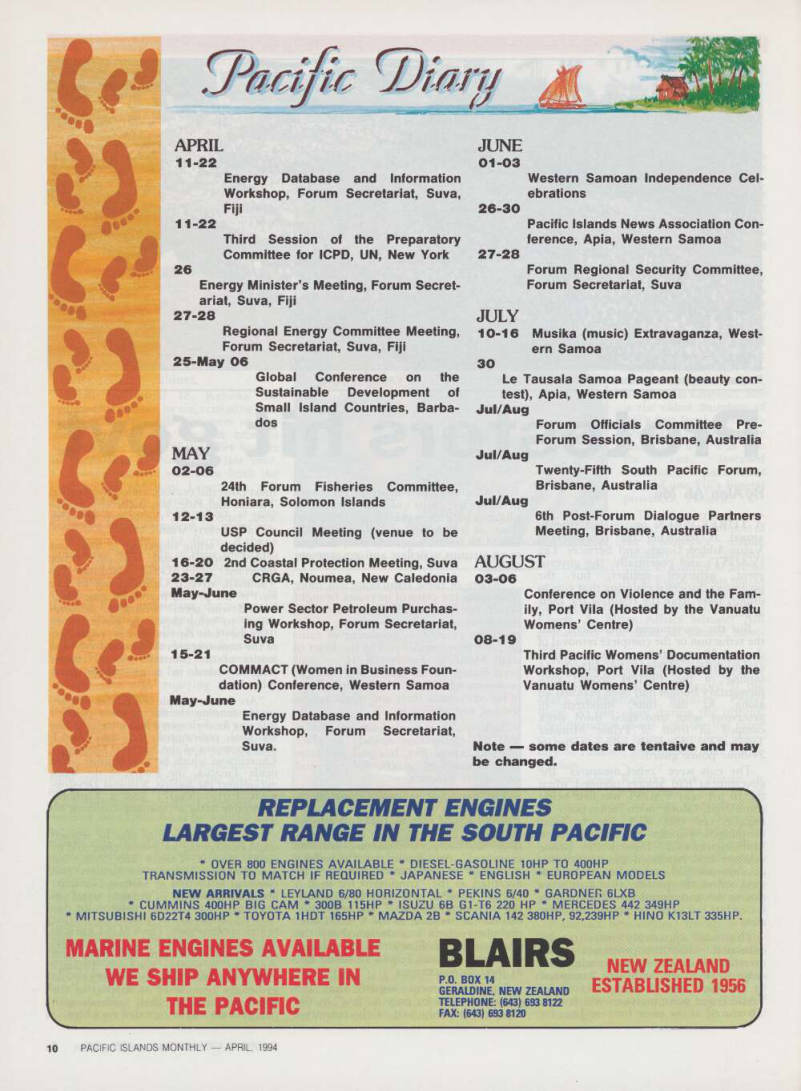
11-22 Energy Database and Information Workshop, Forum Secretariat, Suva, Fiji 11-22 Third Session of the Preparatory Committee for ICPD, UN, New York 26 Energy Minister’s Meeting, Forum Secretariat, Suva, Fiji 27-28 Regional Energy Committee Meeting, Forum Secretariat, Suva, Fiji 25-May 06 Global Conference on the Sustainable Development of Small Island Countries, Barbados
MAY
02-06 24th Forum Fisheries Committee, Honiara, Solomon Islands 12-13 USP Council Meeting (venue to be decided) 16-20 2nd Coastal Protection Meeting, Suva 23-27 CRGA, Noumea, New Caledonia May-June Power Sector Petroleum Purchasing Workshop, Forum Secretariat, Suva 15-21 COMMACT (Women in Business Foundation) Conference, Western Samoa May-June Energy Database and Information Workshop, Forum Secretariat, Suva.
JUNE
01-03 Western Samoan Independence Celebrations 26- Pacific Islands News Association Conference, Apia, Western Samoa 27- Forum Regional Security Committee, Forum Secretariat, Suva
JULY
10-16 Musika (music) Extravaganza, Western Samoa 30 Le Tausala Samoa Pageant (beauty contest), Apia, Western Samoa Jul/Aug Forum Officials Committee Pre- Forum Session, Brisbane, Australia Jul/Aug Twenty-Fifth South Pacific Forum, Brisbane, Australia Jul/Aug 6th Post-Forum Dialogue Partners Meeting, Brisbane, Australia
AUGUST
03-06 Conference on Violence and the Family, Port Vila (Hosted by the Vanuatu Womens’ Centre) 08-19 Third Pacific Womens’ Documentation Workshop, Port Vila (Hosted by the Vanuatu Womens’ Centre) Note some dates are tentaive and may be changed.
( REPLACEMENT ENGINE
LARGEST RANGE IN THE SOUTH PACIFIC
* OVER 800 ENGINES AVAILABLE * DIESEL-GASOLINE 10HP TO 400 HP TRANSMISSION TO MATCH IF REQUIRED * JAPANESE * ENGLISH * EUROPEAN MODELS NEW ARRIVALS * LEYLAND 6/80 HORIZONTAL * PEKINS 6/40 * GARDNER 6LXB * CUMMINS 400 HP BIG CAM * 3008 115 HP * ISUZU 6B Gl-T6 220 HP * MERCEDES 442 349 HP * MITSUBISHI 6D22T4 300 HP * TOYOTA IHDT 165 HP * MAZDA 2B * SCANIA 142 380 HP, 92,239 HP * HINO KI3LT 335 HP.
MARINE ENGINES AVAILABLE
WE SHIP ANYWHERE IN
THE PACIFIC
BLAIRS
P.O. BOX 14
GERALDINE, NEW ZEALAND
TELEPHONE: (643) 693 8122
FAX: (643) 693 8120
NEW ZEALAND
ESTABLISHED 1956
J
America’s painful
Cover Story
Atomic Secrets
By David North
THE United States is disclosing some of its own painful atomic secrets and this process may ultimately benefit the Marshall Islands.
Although the initial focus was not on the islands, the Clinton administration’s De partment of Energy has been revealing long-suppressed information on medical ex periments conducted more than 40 years ago. Prisoners and retarded men (on the mainland) were exposed to radiation, without their knowledge or consent, to see what would happen to them.
Little if anything was learned in the process.
It was in this tell-all set ting that the strong-minded chair of the House of Rep resentatives’ Natural Re sources Committee, George Miller (D Cal), called a hearing to learn more about what happened during the
atomic and nuclear bomb testing in the Marshalls. rp, . • i *i , , 1 he testimony was detailed and grim. t. t ' 4 , ttc l i It suggested that the US bomb testers . . . . * were, at the very least, insensitive about .i ■ . r C. ■ . ~, , „ the impact of radiation on the Marshall •iii i • • islanders and on their own servicemen. p , , ■ T A7 , ■ ven t e ultra-conservative Washington Times, always a staunch supporter of the Defense Establishment, was moved to write - Documents found m the archives of federal atomic agencies reveal a callous attitude hj US scunl,sis toward using Pacific islanders as test subjects after atomic blasts in Hu 19505.
Congressman Eni Faleomavaega (D
- Am. Samoa) was even more outraged - “Marshall Island leaders ... believe their people were used as guinea pigs ... for US radiation experiments. I share that belief. Miller s hearing was different from most such events. Usually a
ranking government spokesman and,
such as a cabinet member or Under Secretary, opens the meeting, testifying , rf l r =” 7 ° alone. 1 hen the interest groups and .•, N , experts appear m groups panels) later r . r / . ° r , ■ —often alter most ot the audience is gone >, , ■ • , r , ° to tdi tiiui* siOu oi leic story» 7 The first witness in Miller’s hearing, a pp ear ing all alone, was Jonathan M Weisgall; he has been the Washingtonbased , aw for the Bikinians since 1975.
He to|d how the us government in the 1940 s and 1950 s had botched safety precau ,i ons during the test explosions, and how had ke » man ofits d F ecisions .rj i i, • i secret for decades. It was only later in the
hearing that the Department of Energy
>™s given a chance to say its piece.
Weisgall’s detailed (and footnoted)
testimony set the tone for the day. Most G f the other witnesses, and the Committee members, seemed to agree that the
islanders and the on-duty US servicemen had suffered an historic injustice.
J . , ...
Ihe committee seemed willing to . , , , , ® consider what many resrard as the next ~7 r r step, the reopening of the Compact of t-i * • • « i t t t free Association between the United States and the Republic of the Marshall Islands, to consider the question of an additional flow of funds ( and perhaps medical services) to the islanders to try to compensate for past events. „ But ‘'e"' 11 n ,°‘ 'T’ eVen "“c 3 nCW sense of guilt on the part of some mainland leaders. Even though the c|inton administration may el an obMgation to prov i d e some additional assi “ ance , a nU mber of obstacles remain, First, as Weisgall pointed out from the witness table, many, many atomic testing documents remain classified. Second, reopening a Compact (or a Treaty) is
Arvind Kumar
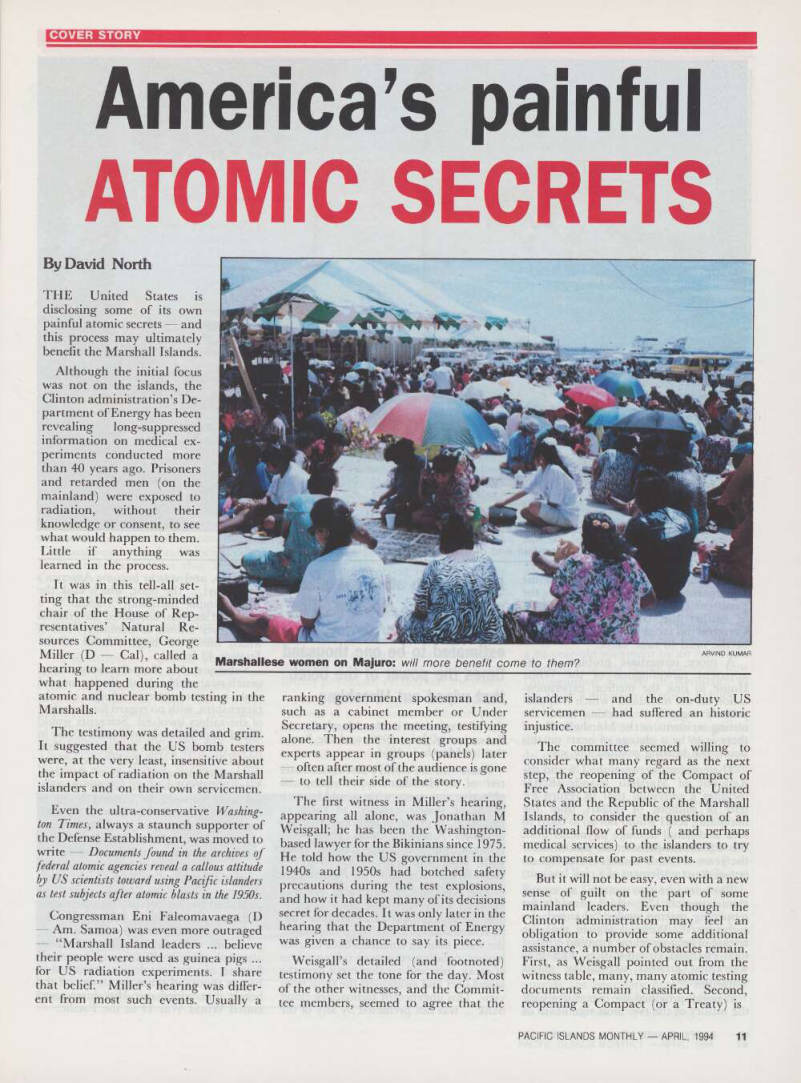
Marshallese women on Majuro: will more benefit come to them?
Cover Story
always regarded as troublesome by the diplomats. And finally, there is the persistent cash shortage in Washington as neither the White House nor the Congress has faced what many believe to be the need to raise taxes.
A more immediate problem is the apparent unwillingness of the White House to link the medical experimentation on the mainland (which it appropriately regards as shocking) with the testing incidents in the Marshalls. But if there is to be a change of heart on this point, the hearing pointed the way. m , i r TP .I The compact between the US and the Republic of Marshall Islands (RMI) mcludes a provision that m return for tens of millions of dollars from the mainland, RMI would not go to court to seek addmona! damage payments from tile US to compensate the islanders for the years ofbombtestmg.lt was hke an out-of-court settlement of a civil law suit.
The compact also contains an escape clause, section 177, which provides for reopening matters under changed circumstances . Weisgall argued that the release of long-secret information created such changed circumstances, and thus warranted another negotiation about compensation.
Weisgall provided the committee with the history of the two most significant of
Drawn uihinh alcn tnnlr nlarn WlHvll dI9U IUUK piduc nn RjLjnj W3S AIHGNCd’S flfSt ’ , t6St Of 3 RUCIGdr dGVICG, .. . . . . .. estimated tO be 0116 thOUSaild tifTIGS tll6 DOWGf Of tll6 bODlb ... . . . ... .. 1031 Wiped OUt HirOStlimd
the 67 explosions in the Marshalls, the Baker test of July, 1946, and the Bravo shot of March 1, 1954. „ . . , „ „ , Baker was the world s first underwater test of a Hiroshima-type bomb; the objective was to see what would happen to naval vessels exposed to such an explosion. A group of still operative but outdated American Navy ships were
brought into the Bikini Lagoon along
with some raptured World War II German vessels, such as the Pnntz Eugen.
The explosion, according to Weisgall
“pushed a one-mile wide dome of water into tbe s ky j t looked like Niagara Falls i n reverse. Then a full 10 seconds later, the wa ter column collapsed back into the
lagoon, creating enormous rolling waves
G f S p ra y ) m i s t an d a j r that crept over the target fleet and swallowed the ships from view. This unexpected radioactive cloud bank ... was not predicted by any of the
scientists, and was to become America’s Chernobyl ... the blast, which sank the 26,000 tonne battleship Arkansas in a matter of seconds, unleashed the greatest waves ever known to humanity, one of which lifted the huge aircraft carrier Saratoga 43 feet.”
Subsequently, the observing naval vessels swarmed back into the lagoon and took geiger-counter readings on the target ships, with no regard for the safety °f sailors involved. Scientists would board ships covered from head to toe m safety clothing, goggle and gloves, to find sailors in shorts and T-shirts scrubbing the ra diation-soaked decks of the ship.
Some 200,000 American military person nel were exposed to varying levels of radiation at one time or another through the years of testing in the Marshalls, We i sg all obtained much of the infer maHon he used at the hearine in the course Q h f wri l g a book ab g out ,h e sub j ect Operation Crossroads the Atomic Tests at Bikini Atoll has just been published by the Naval Institute press, Eight years later, in 1954, when the Bravo test took place, the victims were primarily the islanders. Bravo, which also took place on Bikini, was America’s first test of a nuclear device, estimated to be one thousand times the power off the bomb that wiped out Hiroshima, and ended World War II in the Pacific.
Arvind Kumar
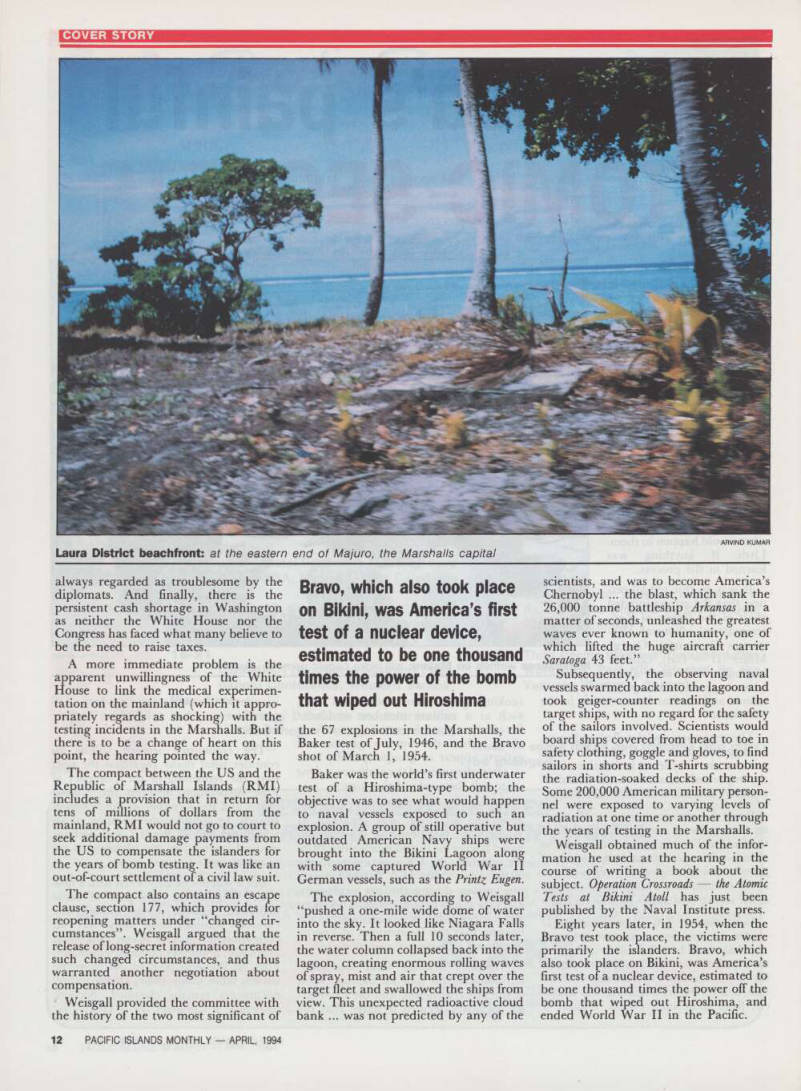
Laura District beachfront: at the eastern end of Majuro, the Marshalls capital
This time the Navy was a little more careful about its people, and when it learned about what it reported as a change in the wind patterns just before Bravo, it ordered its ships to steam out of
danger, according to Weisgall. The
winds has been expected to blow north from the blast site, carrying the radiation away from the Navy vessels and the populated part of the Marshallese, tragic decision. Although it was clear that the radioactive fallout would hit many of the islands in the Marshalls, the blast went off as scheduled. Weisgall reported it this way “Ever since March 1, 1954, the US government has explained that there was an unexpected ‘shift of the winds occur ing after the detonation’ which carried the radioactive fallout from Bravo east ward over Bikini ... as well as Rogelap, Utrik and other atolls in the Marshall Islands.
“We now know that this is not true.
The shot was deliberately set off despite the fact that AEG (Atomic Energy
Commission) officials knew exactly
which way the winds were headed.
According to a now-declassified docu ment, the weather briefing at 7am the day before the shot predicted ‘no signifi cant fallout ... for populated Marshall Islands, but later in the day the trend was toward an unfavourable ... condition ...
The final weather and radiological safety check at 4.30 am shows that the AEG knew there was a problem.’
“Was the shot postponed? No. Were precautions taken for the Marshallese downwind? No. Were precautions taken for the US personnel downwind? Yes.
“This attitude getting the Ameri cans out of harm’s way but taking no action to protect the Marshallese is perfectly consistent with the attitude displayed in some of the radiation
experiments (on the Mainland) that
were conducted in the 1940 s and 19505.
These experiments weren’t conducted on Harvard Law School students. They were conducted on the handicapped, the
uninformed, people with no political
power.”
Weisgall did not present any evidence about harm done to the US servicemen exposed to the radiation but later in the hearing there was evidence about ad verse effects on the Marshallese, people who not only were in the area the time of the blasts, but who subsequently ate fruit, vegetables and fish grown in contaminated environments.
The committee was informed of the impact of automatic radiation on the people of Ebeye, an atoll at first thought outside the danger zone. The incidence of thyroid cancer, which is known to relate to radiation exposure, is 100 per cent higher among the islanders than it
is among people generally. Japanese and
British physicians carried out the study.
Peter Oliver, a senior RMI official, and one of the witnesses at the hearing, carried these results to chairmain Miller late last year. Other RMI witnesses included Ambassador Wilfried I Kendall; Johnsay Riklon, Senator from Rongelap; and five other island leaders
from Bikini, Utrik and Enewetak.
Senator Riklon said “The people of Rongelap were exposed to risks far greater, and we sustained injuries far more severe, than any other population except .. at Hiroshima and Nagasaki ... (we) fall into a small and highly unique class of Cold War casualties. We were not drawn into the arms race out of national ism, self-interest or for profit. We gained nothing and lost almost everything that gave our lives meaning. We had no legal
standing or political rights except those
granted unilaterally by the United
States.”
One of the verbal instances of callousness discussed at the hearing was a 40-year-old statement by an American scientist, Professor Merril Eisenbud, now Distinguished Scholar in Residence at the Duke University Medical School.
He was quoted as saying at the time “While it is true that these people do not live, I would say, the way Westerners do, civilised people, it is nevertheless true that these people are more like us than the mice.”
Eisenbud, a witness at the hearing, said that he had been quoted out of context.
Both Congressmen Faleomavaega and
Congressman Robert Underwood (D
Guam) are members of the Natural Resources Committee, and both partici pated in the hearing. Underwood later released a statement saying “Let’s open up the files, let’s find out what really happened, what went wrong, and let’s fulfill our moral responsibility to the people of the Marshall Islands, and provide the necessary health assistance for the radioactive rain that we showered on their islands 40 years ago.” □
Lifestyle: a Marshallese home on Majuro
Arvind Kumar
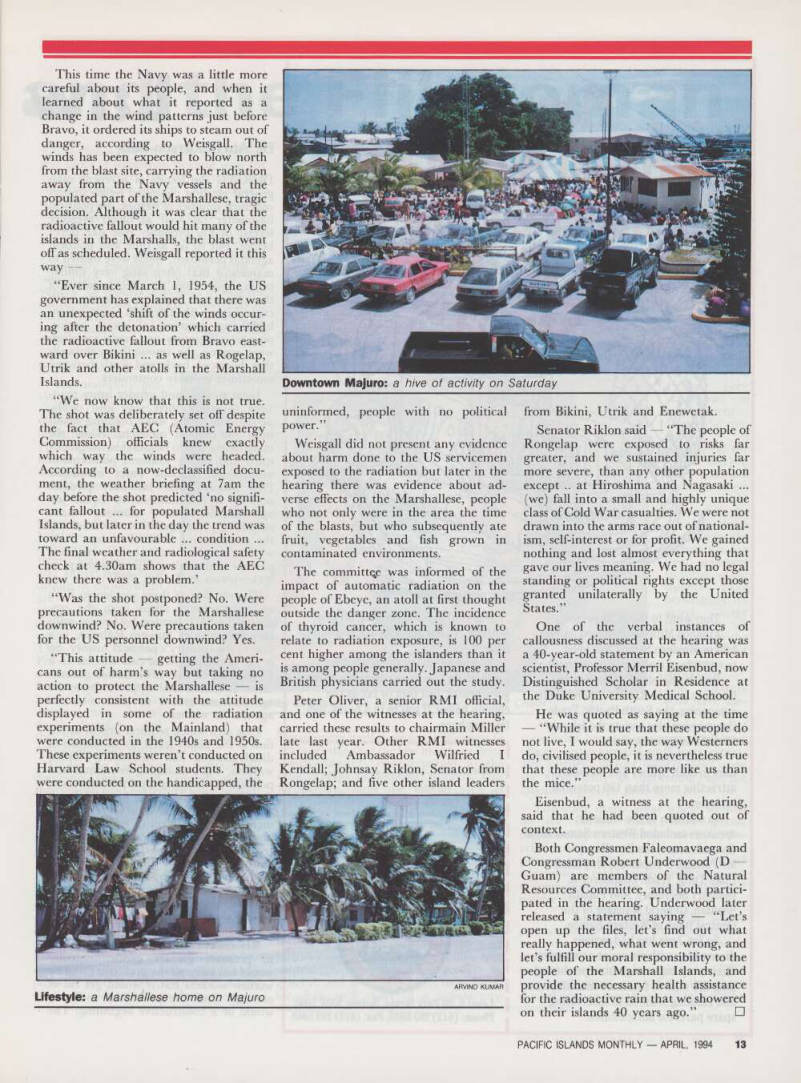
Downtown Majuro: a hive of activity on Saturday
Law and the Fiji woman
Women
By ’Atu Emberson-Bain
DURING the frenzy of a recent snap general election contested by an unpre cedented number of parties, the political barometer (as well as blood pressure levels) in Fiji probably rose like never before. But so far as time and political agendas permitted, voters were treated to manifestos that often sang very similar tunes. Apart from the preoccupation of the two main opposition parties with critical issues like the 1990 Constitution, highflying promises of social justice, poverty alleviation and multi-racialism were among the resounding catchcalls that bounced back and forth between sometimes unlikely contenders.
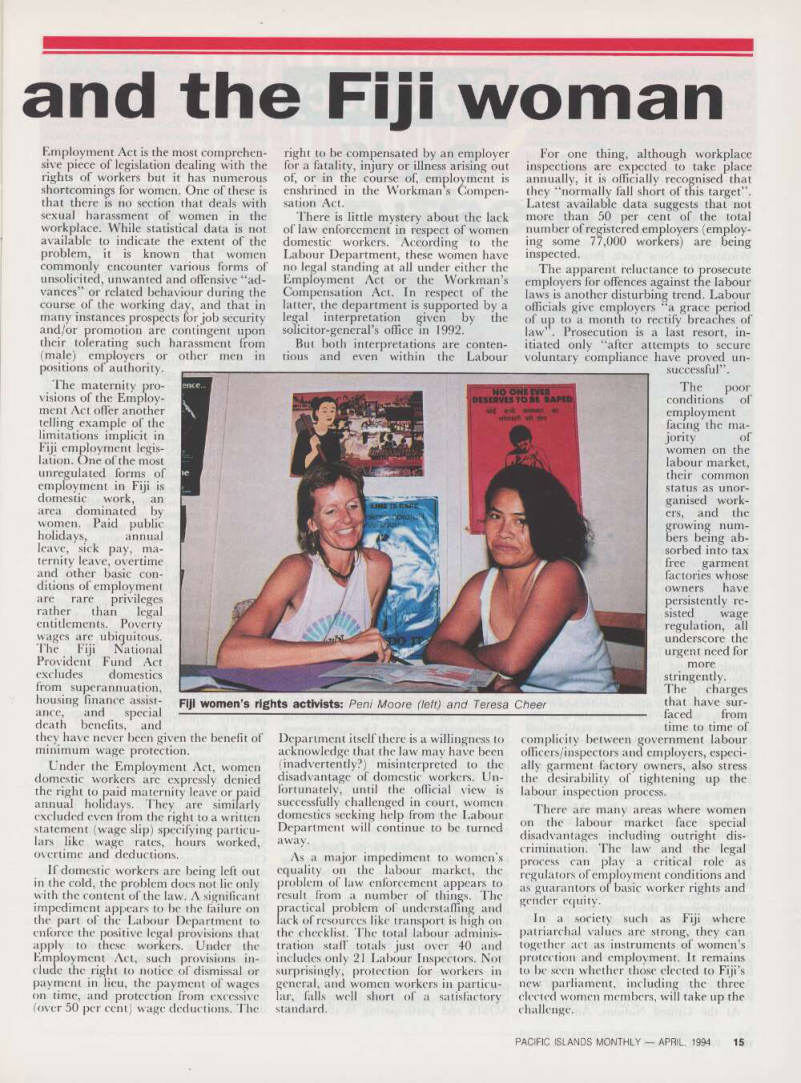
Even women and gender issues man aged to sneak their way into public debate and bring some nodding heads from unexpected quarters. While the main motor was to be found in the plucky spirit and strong women’s platforms of unsuccessful Labour Party candidate Peni Moore, some latterday pledges, notably a commitment to equal job opportunities for women, have surprisingly emerged from the ranks of the conservative General Voters Party which resumes its role as coalition partner of the ruling Fijian Soqosoqo ni Vakavulewa ni Taukei (SVT).
The election of three women to Fiji’s new parliament, albeit from the tra ditionalist SVT headed by former mili tary commander Sitiveni Rabuka, is a first in the country’s political history. So is the appointment of two women to a 12-member cabinet of an elected govern ment. It offers a fresh opportunity to the women’s movement to push a broad agenda for women.
One area which requires urgent atten tion is the plight faced by thousands of disadvantaged and vulnerable women workers. Fiji’s changing economic and political environment, particularly since the 1987 military coups, has had harsh consequences of women on wage employ ment, the rising level of female-headed households (both numerically and in respect of the proportion of destitute families), women’s higher unemploy ment levels and the erosion of living standards resulting from World Bank sponsored structural adjustment policies like Value-Added Tax (VAT) and labour market deregulation.
Reform of Fiji’s employment laws so as to promote greater gender equality would not solve all the problems faced by women workers but it would get rid of one nail from the proverbial coffin. It would be a constructive beginning. The
Employment Act is the most comprehen sive piece of legislation dealing with the rights of workers but it has numerous shortcomings for women. One of these is that there is no section that deals with sexual harassment of women in the workplace. While statistical data is not available to indicate the extent of the problem, it is known that women commonly encounter various forms of unsolicited, unwanted and offensive “ad vances” or related behaviour during the course of the working day, and that in many instances prospects for job security
and/or promotion are contingent upon
their tolerating such harassment from (male) employers or other men in
positions of authority.
The maternity pro visions of the Employ ment Act offer another telling example of the limitations implicit in Fiji employment legis lation. One of the most unregulated forms of employment in Fiji is domestic work, an area dominated by women. Paid public holidays, annual leave, sick pay, ma ternity leave, overtime and other basic con ditions of employment are rare privileges rather than legal entitlements. Poverty wages are übiquitous.
The Fiji National Provident Fund Act excludes domestics from superannuation, housing finance assist ance, and special death benefits, and
they have never been given the benefit of minimum wage protection.
Under the Employment Act, women domestic workers arc expressly denied the right to paid maternity leave or paid
statement (wage slip) spe ,lying parpen-
lars like wage rates, hours worked, J„ J .
. Iuc 10I1S ‘ .
domestic workers arc being left out in the cold, the prob cm does not lie only with the content ol the law. A significant impediment appears to be the failure on the part of the Labour Department to
enforce the positive legal provisions that
apply to these workers. Under the Employment Act, such provisions inelude the right to notice of dismissal or payment in lieu, the payment of wages on time, and protection from excessive (over 50 per cent) wage deductions. The
right to be compensated by an employer for a fatality, injury or illness arising out of, or in the course of, employment is enshrined in the Workman’s Compen sation Act.
There is little mystery about the lack of law enforcement in respect of women domestic workers. According to the Labour Department, these women have no legal standing at all under either the Employment Act or the Workman’s Compensation Act. In respect of the latter, the department is supported by a
legal interpretation given by the
solicitor-general’s office in 1992.
But both interpretations are conten tious and even within the Labour
Department itself there is a willingness to acknowledge that the law may have been
(inadvertently?) misinterpreted to the
disadvantage ol domestic workers. Unfortunately, until the official view is
Ml £3T,
Department wil, continue to be turned away. ... , a ma J Ol impediment to women s equality on the labour maiket, the problem ol law enforcement appears to result horn a number ol things. Ihe
practical problem of understaffing and
lack of resources like transport is high on the checklist. The total labour administration stall' totals just over 40 and includes only 21 Labour Inspectors. Not surprisingly, protection for workers in general, and women workers in particular, falls well short of a satisfactory standard.
For one thing, although workplace inspections are expected to take place annually, it is officially recognised that they “normally fall short of this target”.
Latest available data suggests that not more than 50 per cent of the total number of registered employers (employ ing some 77,000 workers) are being inspected.
The apparent reluctance to prosecute employers for offences against the labour laws is another disturbing trend. Labour officials give employers “a grace period of up to a month to rectify breaches of law”. Prosecution is a last resort, in itiated only “after attempts to secure voluntary compliance have proved unsuccessful”.
The poor conditions of
employment
facing the ma
jority of
women on the labour market, their common status as unor
ganised work
ers, and the
growing num
bers being ab sorbed into tax free garment factories whose owners have
persistently re
sisted wage
regulation, all
underscore the urgent need for more
stringently.
The charges
that have sur faced from time to time of
complicity between government labour
officers/inspectors and employers, especi
ally garment factory owners, also stress the desirability of tightening up the labour inspection process.
There are many areas where women on the labour market face special
disadvantages including outright dis
crimination. The law and the legal process can play a critical role as regulators of employment conditions and as guarantors of basic worker rights and
gender equity.
In a society such as Fiji where patriarchal values arc strong, they can together act as instruments of women’s protection and employment. It remains to be seen whether those elected to Fiji’s new parliament, including the three elected women members, will take up the
challenge.
Fiji women’s rights activists: Peni Moore (left) and Teresa Cheer
Advertisements & other items, p. 14 (1 item)
How Apia
Found A Host Of
Potential New Investors
r Wester
Samoa
2 They went to the right people.
Finance Minister Tuilaepa Sailele told us Western Samoa was keen to encourage major new investment.
Besides helping Pacific Forum business people start or expand their companies, the South Pacific Trade Commission also assists the islands’ 15 different governments.
In this instance, we arranged seminars in both Sydney and Melbourne, attracting more than 130 potential investors.
In addition to the Minister, speakers included Western Samoa High Commissioner, His Excellency Mr Feesago S Fepulea’i, Mr Falani Chan Tung, Trade Commerce & Industry Secretary. And Papalii Scanlan, General Manager of the Central Bank of Western Samoa.
So far, Apia has had serious discussions with six major companies.
Their proposals range from producing long-life milk to furniture manufacture and canning seafood to assembling spare parts for automobiles.
Our charge for organising all this?
Nothing. All our services are absolutely free.
To find out more about what we could do for you, your company or your government, just post or fax us the coupon below. If you’re in a hurry, feel free to phone.
Name Company.
Address m & 2 Level 6,50 Park Street, Sydney NSW 2000.
Phone: (612)2835933, Fax: (612)2835948
Diplomacy
The United Nations
Pacific style
By Ian Williams
DIPLOMACY has never been a strong card for the Pacific states. Understaffed, inexperienced, and at the whim of home governments which will often sacrifice international gains to score political points at home, even the best of Pacific envoys can have a hard time. That was
graphically demonstrated in February
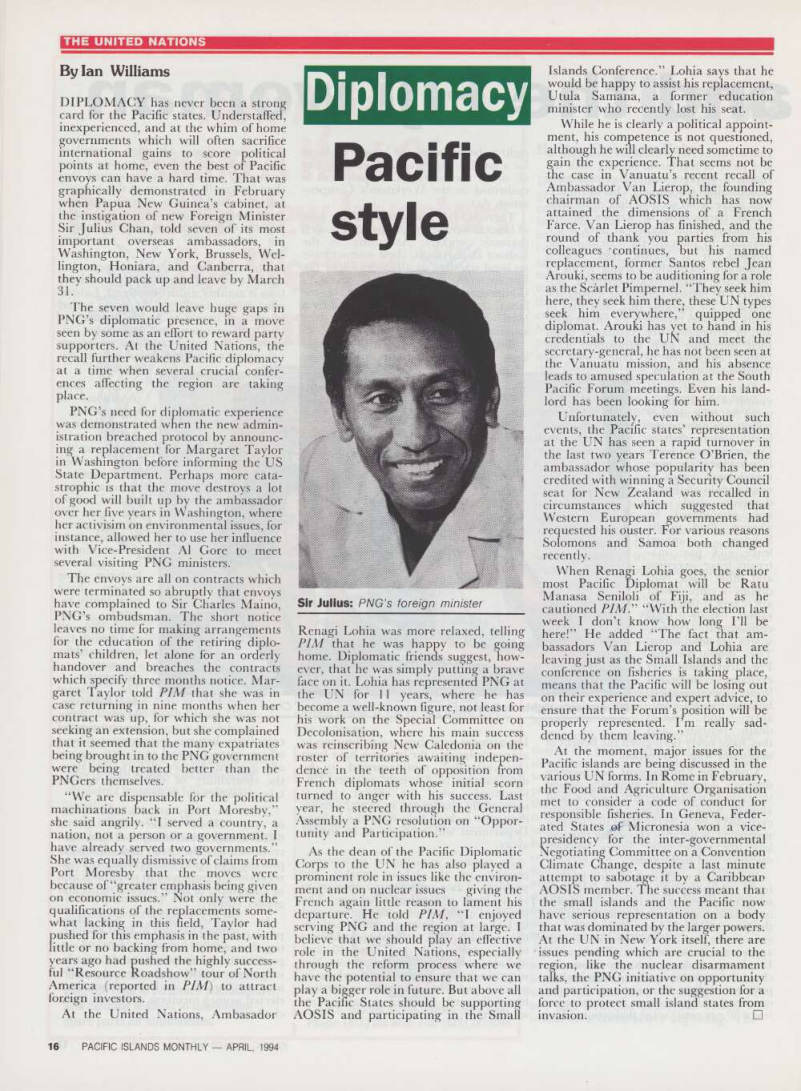
when Papua New Guinea’s cabinet, at the instigation of new Foreign Minister Sir Julius Chan, told seven of its most important overseas ambassadors, in Washington, New York, Brussels, Wel lington, Honiara, and Canberra, that they should pack up and leave by March 31.
The seven would leave huge gaps in PNG’s diplomatic presence, in a move seen by some as an effort to reward party supporters. At the United Nations, the recall further weakens Pacific diplomacy at a time when several crucial confer
ences affecting the region are taking
place.
PNG’s need for diplomatic experience was demonstrated when the new admin istration breached protocol by announc
ing a replacement for Margaret Taylor
in Washington before informing the US State Department. Perhaps more cata strophic is that the move destroys a lot of good will built up by the ambassador over her five years in Washington, where her activisim on environmental issues, for instance, allowed her to use her influence with Vice-President A 1 Gore to meet several visiting PNG ministers.
The envoys are all on contracts which were terminated so abruptly that envoys have complained to Sir Charles Maino, PNG’s ombudsman. The short notice leaves no time for making arrangements for the education of the retiring diplo mats’ children, let alone for an orderly handover and breaches the contracts which specify three months notice. Mar garet Taylor told PIM that she was in case returning in nine months when her contract was up, for which she was not seeking an extension, but she complained that it seemed that the many expatriates being brought in to the PNG government were being treated better than the PNGers themselves.
“We are dispensable for the political machinations back in Port Moresby,” she said angrily. “I served a country, a nation, not a person or a government. I have already served two governments.”
She was equally dismissive of claims from Port Moresby that the moves were
because of “greater emphasis being given
on economic issues.” Not only were the qualifications of the replacements some what lacking in this field, Taylor had pushed for this emphasis in the past, with little or no backing from home, and two years ago had pushed the highly success ful “Resource Roadshow” tour of North America (reported in PIM) to attract
foreign investors.
At the United Nations, Ambasador
Renagi Lohia was more relaxed, telling PIM that he was happy to be going home. Diplomatic friends suggest, how ever, that he was simply putting a brave face on it. Lohia has represented PNG at the UN for 11 years, where he has become a well-known figure, not least for his work on the Special Committee on Decolonisation, where his main success was reinscribing New Caledonia on the roster of territories awaiting indepen dence in the teeth of opposition from French diplomats whose initial scorn turned to anger with his success. Last year, he steered through the General Assembly a PNG resolution on “Oppor
tunity and Participation.”
As the dean of the Pacific Diplomatic Corps to the UN he has also played a prominent role in issues like the environ ment and on nuclear issues giving the French again little reason to lament his departure. He told PIM, “I enjoyed serving PNG and the region at large. I believe that we should play an effective role in the United Nations, especially through the reform process where we have the potential to ensure that we can play a bigger role in future. But above all the Pacific States should be supporting AOSIS and participating in the Small
Islands Conference.” Lohia says that he would be happy to assist his replacement, Utula Samana, a former education minister who recently lost his seat.
While he is clearly a political appoint ment, his competence is not questioned, although he will clearly need sometime to gain the experience. That seems not be the case in Vanuatu’s recent recall of Ambassador Van Lierop, the founding chairman of AOSIS which has now attained the dimensions of a French Farce. Van Lierop has finished, and the round of thank you parties from his colleagues continues, but his named replacement, former Santos rebel Jean Arouki, seems to be auditioning for a role as the Scarlet Pimpernel. “They seek him here, they seek him there, these UN types seek him everywhere,” quipped one diplomat. Arouki has yet to hand in his credentials to the UN and meet the secretary-general, he has not been seen at the Vanuatu mission, and his absence leads to amused speculation at the South Pacific Forum meetings. Even his land lord has been looking for him.
Unfortunately, even without such events, the Pacific states’ representation at the UN has seen a rapid turnover in the last two years Terence O’Brien, the ambassador whose popularity has been credited with winning a Security Council seat for New Zealand was recalled in circumstances which suggested that Western European governments had requested his ouster. For various reasons Solomons and Samoa both changed recently.
When Renagi Lohia goes, the senior most Pacific Diplomat will be Ratu Manasa Seniloli of Fiji, and as he cautioned PIMP “With the election last week I don’t know how long I’ll be here!” He added “The fact that am bassadors Van Lierop and Lohia are leaving just as the Small Islands and the conference on fisheries is taking place, means that the Pacific will be losing out on their experience and expert advice, to ensure that the Forum’s position will be
properly represented. I’m really sad
dened by them leaving.”
At the moment, major issues for the Pacific islands are being discussed in the various UN forms. In Rome in February, the Food and Agriculture Organisation met to consider a code of conduct for responsible fisheries. In Geneva, Feder ated States of Micronesia won a vice
presidency for the inter-governmental
Negotiating Committee on a Convention Climate Change, despite a last minute attempt to sabotage it by a Caribbean AOSIS member. The success meant that the small islands and the Pacific now have serious representation on a body that was dominated by the larger powers.
At the UN in New York itself, there are issues pending which are crucial to the region, like the nuclear disarmament talks, the PNG initiative on opportunity and participation, or the suggestion for a force to protect small island states from invasion. □
Sir Julius: PNG’s foreign minister
Tonga on the move
Pacific Business
Island kingdom on the track to an economic boom
By Christine Hatcher
IN the Kingdom of Tonga, a banner called optimism is being carried into the new decade. “We’re sick, but not fatally sick,” says Kalafi Moala, editor of Taimi’o Tonga, Tonga’s weekly news paper. Inspired by what he saw as a growing need in the expanding business com munity “to inform Tongans about Tonga”, he began publishing Lali, a glossy magazine, in January.
“I believe business is more active and lively. For five years my stance has been negative and critical, especi ally of the passport exchange but it’s good for the exchange reserve, it’s our
second line of defence. We can go a whole
year spending, with nothing coming in,
and survive! We are a centre of force to be contend with nationally.”
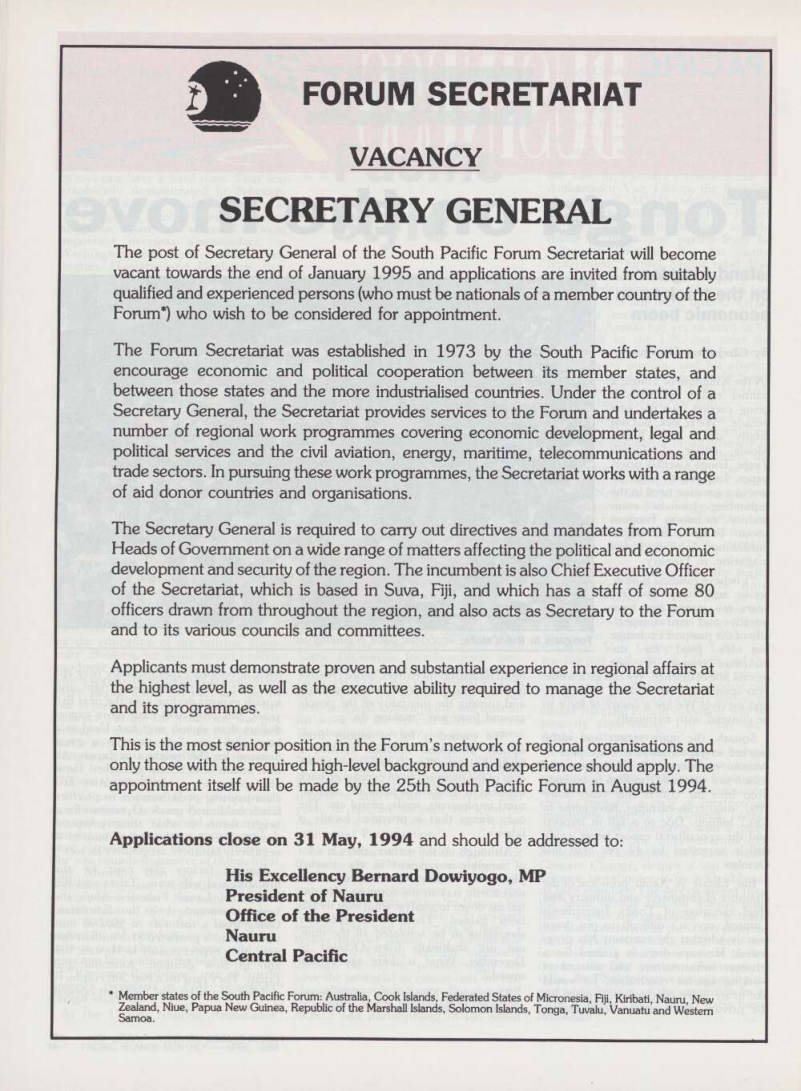
Squash, the main export and niche market to Japan plays a large part in present confidence. A third successful season saw about $l7 million in revenue drop into the coffers this year. Since 1991, total cross-earnings, have come to $50.1 million. Due to a fall in imports and the agricultural export boost, trade , r ■ b ’ deficit narrowed by 42 per cent last October. „ T . . c A ~. , . , „ But, Lisiate A Akolo, president of the chamber of commerce and industry and chief executive of Tonga Investments Limited, says it’s difficult to pin down exactly whether the economy has progressed. He says there is a need for a stronger infrastructure and instead of
working against constraints, he would
like to see more government support for the private sector, more deregulation,
more industrial incentives, more creative inventiveness on overall review of policies and turning the mentality of the people around from just “making do”.
“We earned a lot of money from squash. Increased inflation created a bigger balance off trade deficit but 40 per cent of the proceeds from exports go back overseas in the form of pesticide, agricultural implements, seeds, petrol etc. The only things that is provided locally is labour.”
Although on the surface, there is a lot of tangible movement in the market , °, place, the money he says, does not necessarily stay m the country, No one has sat down to analyse what exactly has been gamed There is a need lor something to be activated all the time, not just seasonally from October to December. What is there apart from s( l uas • The answer, Moala says, is yam-beans a new, highly successful crop that has
been developed experimentally over the past year. If his predictions are right, and squash exports decline over the next five years, this crop, will earn more export dollars than squash evei has. Used as a , asc wltb raw hsh, there is a great demand foi this product m Japan All 1 at awaits 1S to secure a market. He is aBO settm S U P a h J g hl .V lucrative first f lass , P" ntl . n S P[ ess business to produce for tinned goods. Optimism lor a fl V ure 18 ™ hat . bieBe Respects provide, he says. 1 tried to look at it negatively but there are positive factors.” n ■ • r , , Positive factors also exist for the husband and wi f c team, Tricia and Bill Ho|den of Latini Fishcrics . Shc - s lhc busi „ he - s thc fisherman.
Going from a turllovcr ol 590 ,000 four s to a pred i ctcd 51.5 million this cxp J rt mail ,| to Hawaii, but also , Q Ncw K Zcaland Austra ia and Japan. They now own two 38ft commcr cial fishing vessels and have just opened their own processing
Tongans in Nuku’alofa: economic pace is picking up
factory. “We have a formula that works,” she says, “Hard work, hard work, hard work!” Putting in 14-hour days, self-reliance, profit sharing with good staff who choose their own crew, provide the incentive to meet targets, which Tricia says are limited only by flight schedules. As more destinations become available, the business will expand. “Government has not realised the fishing potential here and we are quite happy to leave it that way. They think only of squash and forget about fishing.” She says that a relatively stable government, non-existent bureaucracy and persistence all help to make for a lifestyle, impossible elsewhere.
Expansion equals an increasing need for expertise in financial management and Christine Uta’atu of Uta’atu Financial & Accounting Services provide it. She says “It is clear to us new businesses are starting up and existing ones are doing better. “To accommodate
the upturn she is in
creasing her space by
50 per cent, doubling her computer capacity
and has just employed
an economics and ac counting graduate and a certified public ac countant who is work ing towards his Mas ters in Economics.
“The lean is to wards economics.
People are no longer
shoe-box clients. Ton gans are realising more and more what is hap pening in their busi ness. There is more awareness and they don’t just want an annual return at the end of the year. If something’s wrong,
they want to fix it, get it back on track, make business plans.”
Falekava Kupu, deputy secretary of the industries division of the ministry of labour, commerce and industries, says the seeds for this thinking were sewn when the United Nations Development Program-approved five-year scheme, with a focus on manufacturing, engineer ing and technical skills, started in 1987 to provide training in small business promotion and development. Applica tions for expansion and developmental licences have been increasing since, he says, with 63 being granted last year. In January alone, this year, nine new business licences were issued. In the past seven years intensive entrepreneurial training has been active. Last year, a deliberate reach-out exercise took place overseas. Now there is a pattern emerg ing Tongans are returning home.
Some of them with 20 years of technical expertise behind them are setting up in business, encouraged by the fact that certain sectors are reserved for local
development. A technical learning insti tution is in the pipeline catering for school leavers interested in developing skills for use in the private sector.
An industrial trade and development
corporation plus an export processing
zone has been established. “The move from government,” he says “is to set up statutory bodies to more or less facilitate private sector development and to do away with government bureaucracy.”
The intention is to attract foreign investment into the country and promote Tongan made products. “To encourage an economic boom,” he says “deliberate
plans have been made subjecting squash
to a quota restriction to stabilise the market demand and ensure a consistent return. There is also a tendency to get into commercial marine activity, exports are escalating, infrastructure and air connections are improving. People’s atti tudes need to go along with the changes they need to be mentally clear about
development. Public skills at production level are lacking. Government has ap
f>roved incentive schemes, exemption
fom tax and the right financial insti tutions.”
Tonga’s commercial and competitive banking history began in April 1992 when the Financial Institutions Act received Royal Assent. In October 1993 the MBF Bank (Tonga) with Crown Prince Tupouto’a holding 25 per cent of the shares as chairman, opened. The ANZ Bank began limited operations in temporary premises in January, adding to the breakdown of a monopoly pre viously held by the Bank of Tonga, thus further sharpening a competitiveness advantageous to the customer. Their aim is to “ring the Pacific” according to general manager Bob De Courteney and opening in Tonga provided the last remaining link in the region.
Concurrently, the Tongan Development
Bank announced the ability to take on more commercial loans.
Deputy manager of operations with
TDB, Simione Sefanaia says “Tonga has had a late entry into the trade market.
There is still a lot of constraint in the manufacturing/export sector due to
many comparative disadvantages that
are hard for Tonga to penetrate. “Fiji is established for instance and freight costs
are high.”
He says that has been a significant increase in borrowing. “Agriculture and
industry borrow equally, 50/50, but
fishing is still low although a UNCDF project has allowed for 60 additional fishing boats to be built since 1988.” He talks of a need to upgrade infrastructure, particularly the recreational facilities that support the tourism sector. Even though tourism increased by 21 per cent last year, hotels still warrant upgrading and improvements is needed in the service industry, he admits.
Sefania sees growth potential in joint
ventures, with help from technical exper tise from overseas helping to establish
marketing links.
Lisiate ’A ’Akolo says the choices pro vided by the banks are already show ing psychologi cal benefits.
Although deep
down, there is not much dif ference be tween them, the options are there.
“More con fidence gives good expec tations to in vestors and
that’s import
ant. We need
to scrutinise ourselves regarding foreign investment, look at what we can offer.
Stronger investments equal a stronger economy. I’d like to see more efficiency in how we treat those investors. Bureau cratic delays need to be reduced. We have to be more serious says some thing and follow it up. Quite a few leave here disappointed. We are not the same as we advertise ourselves. We need a
bigger commitment, proper policy guide
lines. We need to followed up and gain their confidence and have a more solid outlook than we have at present. It entails getting everyone behind the banks, different bodies, strong networks so we can work towards one centred
objective.”
Despite an economy that has been described as flat; complaints about the lack of infrastructure and what some in the private sector call insufficient active support from government; Kalafi Moala makes the final judgment “We are a little nation with a prosperous future.”□
Christine Hatcher
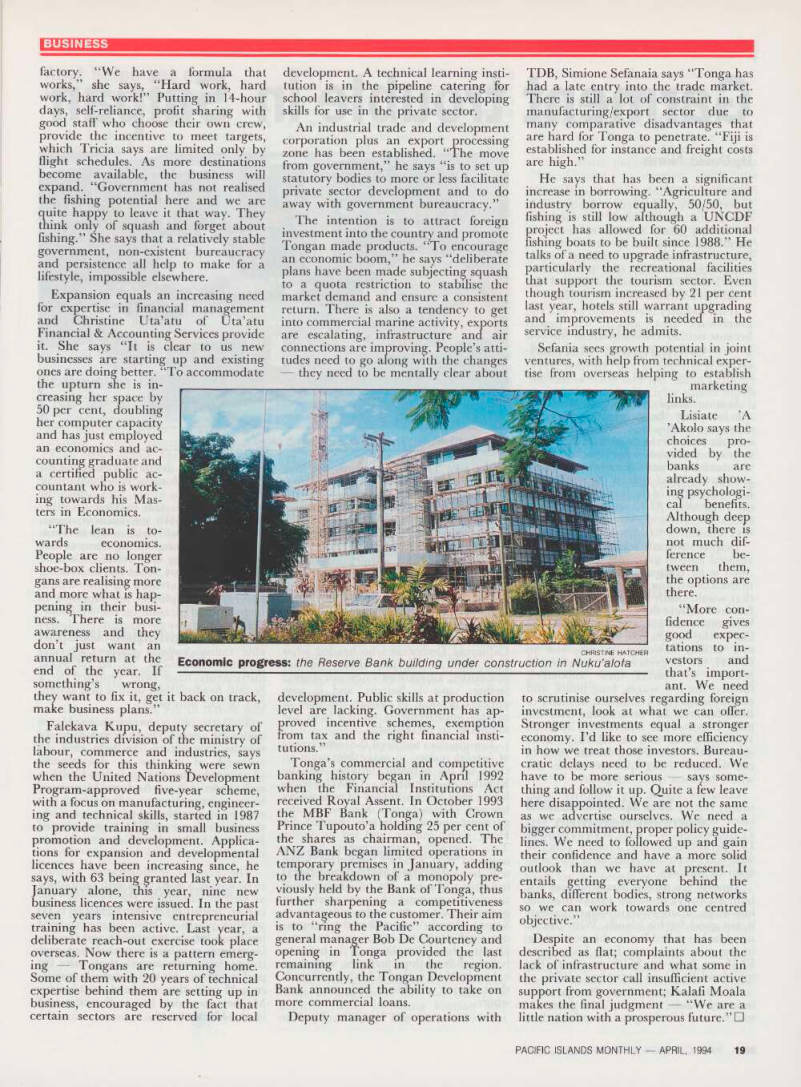
Economic progress: the Reserve Bank building under construction in Nuku'alofa
Advertisements & other items, p. 18 (1 item)
Secretary General
m FORUM SECRETARIAT
VACANCY
The post of Secretary General of the South Pacific Forum Secretariat will become vacant towards the end of January 1995 and applications are invited from suitably qualified and experienced persons (who must be nationals of a member country of the Forum*) who wish to be considered for appointment.
The Forum Secretariat was established in 1973 by the South Pacific Forum to encourage economic and political cooperation between its member states, and between those states and the more industrialised countries. Under the control of a Secretary General, the Secretariat provides services to the Forum and undertakes a number of regional work programmes covering economic development, legal and political services and the civil aviation, energy, maritime, telecommunications and trade sectors. In pursuing these work programmes, the Secretariat works with a range of aid donor countries and organisations.
The Secretary General is required to carry out directives and mandates from Forum Heads of Government on a wide range of matters affecting the political and economic development and security of the region. The incumbent is also Chief Executive Officer of the Secretariat, which is based in Suva, Fiji, and which has a staff of some 80 officers drawn from throughout the region, and also acts as Secretary to the Forum and to its various councils and committees.
Applicants must demonstrate proven and substantial experience in regional affairs at the highest level, as well as the executive ability required to manage the Secretariat and its programmes.
This is the most senior position in the Forum’s network of regional organisations and only those with the required high-level background and experience should apply. The appointment itself will be made by the 25th South Pacific Forum in August 1994.
Applications close on 31 May, 1994 and should be addressed to: His Excellency Bernard Dowiyogo, MP President of Nauru Office of the President Nauru Central Pacific * Member states of the South Pacific Forum: Australia, Cook Islands, Federated States of Micronesia, Fiji, Kiribati, Nauru New Zealand, Niue, Papua New Guinea, Republic of the Marshall Islands, Solomon Islands, Tonga, Tuvalu, Vanuatu’and Western Samoa.
Garment trouble in Saipan
Business
By David North
DOES your island want an experienced, if controversial garment industry? Sub stantial, but a little soiled? If it does, look no further than Saipan, as both the garment industry and the new Governor, Froilan Tenorio, are talking openly about the possibility that the industry may leave the Commonwealth of the Northern Mariana Islands (CNMI).
If the industry leaves it will go to a still lower-wage area, and it will depart because neither Washington nor the new governor will accept the level of exploi tation that much of the Saipan garment industry has thrust on its off-shore workers.
It is not simply that official Washing ton is telling the garment industry to shape up or ship out, it is rather more complicated. At the moment, Saipan sets its own minimum-wage levels, labour standards, and immigration rules. These are heavily tilted against the workers little regulation of the labour market and until recently a $2.15 an hour minimum wage. The guest workers cannot vote, so they are ripe for ill-treatment.
Despite this situation, congress has allowed Saipan garments to be labelled Made in the USA and they are admitted to the US without the payment of tariffs that would result had they been manu factured outside the US Customs system.
With mainland garment factories object ing to the low Saipan minimum wage, and unions objecting to jobs lost to CNMI, the congress has been under real pressure to correct these anomalies; further, the low wages, long hours, and prison camp type conditions in many of these factories has been spread over the front pages of the New York Times, the Washington Post and on television news shows. The barbed wire around some of the workers’ living quarters makes the
whole business quite telegenic.
Congress could, by majority vote,
simply restore its own power to make the labor and immigration conditions, and 2) the arrival of a new, reform-minded Democratic Governor, Froilan Tenorio, who was sworn into office for a four-year term in January.
Tenorio is a serious man who does not hide his convictions; he thinks that the
low-wage, many-foreign worker pattern
is not good for his islands. With this in mind he has called for an abrupt increase in the minimum wage from his current $2.45 an hour to $4.25 an hour (the mainland level) on January 1, 1995.
“If that means that the garment industry leaves, so be it,” the governor told me at a Washington reception a few
weeks ago. The old governor, the man Tenorio defeated, had tried to spin out an increase in the minimum wage to the mainland level until the next century.
Larry Guerrero had sought to calm critics of the garment industry with sweet talk, but few actions.
Tenorio’s call for a quick increase in the minimum wage was welcomed on Capitol Hill, and has broken the previous deadlock that existed between the chair man of the House of Representatives Natural Resources Committee, and the CNMI government. George Miller, the California Democrat who headed what had used to be the House interior committee, announced a new era of good feelings vis-a-vis Saipan, and it now appears possible to restore the flow of capital improvements money from the mainland to the islands.
Tenorio does not need the inducement of federal money to make him want to clean up the garment industry, but the
Republican-dominated CNMI legis
lature may be encouraged to raise wages because of this factor. Meanwhile, the
garment industry, largely funded by
Hong Kong money, and led by Willie Tan, a scratchy entrepreneur, has an nounced that a $4.25 minimum wage will be a “death knell” to the local
industry. Maybe. Or maybe it will
simply stop growing (the guest workers in garments and in the service industries in
Saipan already outnumber the indigen
ous work force by about two to one.) Despite their complaints it is hard to believe that all those factories, with their valuable Made in the USA label will pack their sewing machines and move else where.
But whatever else happens, Tenorio
has broken the mould and changed the dialogue; the workers will have to be paid better in the future. Meanwhile, the new governor is also shaking up other aspects of CNMI’s government, hand ling out decisions right and left. First, there is to be a tough hiring freeze to save money, no filling of government’s work day is 7.30 am to 4.30 pm and everyone is expected to be at work on time. Third, government employees are supposed to be polite and pleasant on the telephone.
Fourth, too many government employees had been using government-owned port able radios (cellular phones) as their personal possessions, so all of these instruments have been returned to a central headquarters until a new system can be put into place.
Similarly, all government employees
under the age of 25 have been told to get measles inoculations, to help slow an outbreak of measles in the islands. (Apparently the disease is less likely to strike older people.) And new plans have been set in motion to collect the 2 per cent fee on development more vigorously than in the past. (CNMI’s government has never had a reputation as a demon
tax collector).
The Tenorio administration appears to be having a good time with symbolism as well as substance. For example, the earlier tradition of setting aside VIP parking places in front of government buildings for the governor’s and the Lt- Governor’s cars has been abolished, and it has been announced that rules on
parking places for the physically handi
capped will be enforced vigorously.
Maybe a new day has, in fact, dawned in the Marianas. □
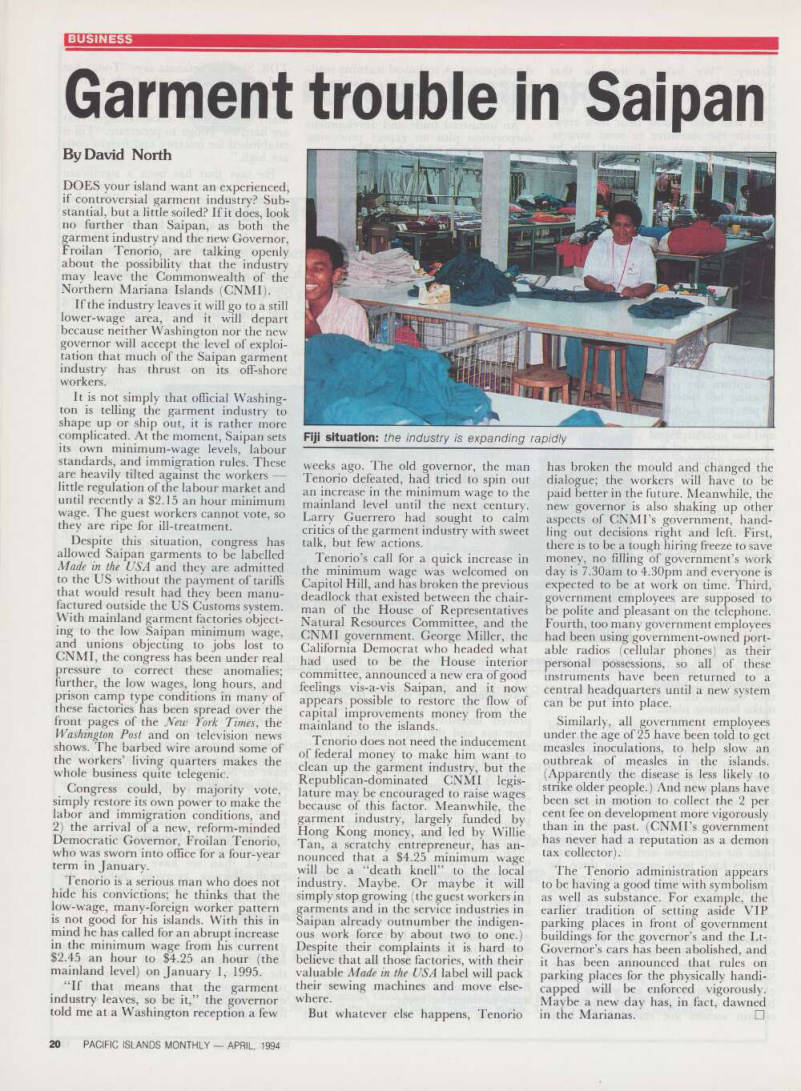
Fiji situation: the industry is expanding rapidly
Kiribati Shipping
Business Bulletin
Aust helps set up
PNG stock exchange
AUSTRALIAN firms interested in the establishment of Papua New Guinea’s Stock Exchange were invited to a conference in Port Moresby on March 14-15. The stock exchange is expected to be operating in Port Moresby towards the end of the year.
PNG Prime Minister Paias Wingti had talks about the stock exchange with business communities in Australia and New Zealand during his recent visit to the two countries. Meanwhile, A PNG based hotel group is preparing the final touches for a US$4 million float on the Australian Stock Exchange. Islands Ho tel Ltd is due to list on the ASX on April 27 offering six million $1 shares to raise funds to buy two hotels in Solomon Islands the Hibiscus in Honiara and the Gizo in Western Province.
Malaysian bank gets
PNG go-ahead
A LEADING Malaysian finance com pany has been given the go-ahead to establish a new commercial bank in
Papua New Guinea. Malaysian Banking
Berhard was granted the licence in February by Finance Minister Masket
langalio.
One condition of the licence was the company must sell 30 per cent of the shares in the bank to PNG investors. The first branch will be established in Port Moresby with four other branches planned around the country by 1998.
The bank will not be granted foreign currency dealer status like other com mercial banks.
Kiribati Shipping
begins new service
KIRIBATI Shipping Services Ltd, which operates a service from Fiji to Funafuti and Tarawa, commenced a monthly service from Fiji to Nauru and the Marshall Islands on March 2. The 50-container capacity vessel Arktis Sun has been chartered by the company for this service.
The company, formerly known as Shipping Corporation of Kiribati, has also established a trans-shipment service via Tarawa to the Line Islands. The Line Islands consist of Fanning, Washington and Christmas islands and are owned and administered by the Kiribati govern ment.
Abandoned gold mine
to reopen in Fiji
AN abandoned gold mine on Fiji’s second largest island, Vanua Levu, is set to reopen this year generating more than 100 jobs. Pacific Island Gold Company, registered and based in Sydney, has applied for a mining lease for the Mount Kasi gold mine.
Pacific Island Gold chief executive
Christopher Adsett said the operation would begin as soon as the government approved the lease and landowners agreed to the use of their land. According
to statistics provided by geologists, Pa
cific Islands Gold would be aiming to produce 20,000 ounces of gold a year.
Economist predicts
Hawaii tourism boom
A LEADING economist says the outlook for Hawaiian tourism is bright. Bank of Hawaii’s chief economist David Ramsour says Hawaii’s troubled tourism industry won’t slide any further and may even pick up by the end of the year.
Ramsour says if the economic rebound in other parts of the United States continues, an improvement in tourism should offset what will be weakness in other parts of the Hawaiian economy. He says construction will remain down for the remainder of the year, but the main danger to the economy would be from any trade war with Japan, which could send interest rates up, cutting off any economic recovery.
Air Vanuatu buys
Boeing 737-400
VANUATU’S national carrier, Air
Vanuatu, is now operating its Boeing
737-400 aircraft to neighbouring New Caledonia. Airline chairman Kalpokor Kalsakau said the new aircraft was a result of increased demand on the sector.
Air Vanuatu already operates seven weekly flights to New Caledonia using a 21-seat Bandeirante aircraft.
Panguna copper mine
cost about USssoom
THE cost of returning the defunct Panguna copper mine on Bougainville to full production is expected to be about US$5OO million. At a board meeting of
Bougainville Copper, the CRA
controlled company posted a net loss of just over $3 million for 1993 against a $1.5 million loss in 1992.
In 1989, a secessionist uprising forced the huge PNG mine to close. Company secretary Brian Batholomaeus says al though PNG security forces are now reported to be patrolling the area of the mine, access remains impossible and the exact extent of damage was unknown.
Taiwan group seeks
trade opportunities
A TRADE delegation from Taiwan was recently in Vanuatu looking at invest ment opportunities. The seven-member delegation was led by Vanuatu’s trade commissioner in Taiwan, John Yu, and included a Taiwanese shipping company
supervisor and logging specialists.
They visited industries in the northern town of Luganville on the island of
Espirito Santo including logging and
milling activities. The team also met
government and business leaders.
ADB approves tuna
development grant
THE Asian Development Bank says it has approved a U 55495,000 grant to 12 Pacific island nations, including Papua New Guinea, to develop their tuna industries. A bank spokesman says the grant will go towards evaluating possible tuna processing industries.
All 12 countries have large tuna resources in their territorial waters. But they do not have the facilities and infrastructure to process the tuna, and most of their catch is harvested by ships from developed countries and processed outside the region.
Niue cautious of
tourism programme
THE Tourism, Marketing and Research Bureau of Niue says the island’s culture and environment is under threat unless the development of the visitor industry is planned and controlled. The privately funded bureau says the government has indicated that it plans to spend millions of dollars on tourism but has no long or short term plans for the expansion.
The bureau claims occupancy rates in the existing properties have been low over the past year. It says with the reduction in direct air services from Fiji and New Zealand, it is unlikely the figures will increase dramatically.
Penrhyn Atoll set
for pearl farming
PENRHYN Atoll, in the northern Cook Islands, looks set to become the centre of
the country’s research into pearl farming
with the construction of the Tongareva Marine Research Station. Construction is expected to be completed in around four months.
The station is part of a 3 1 /z year project for the development of commercial pearl
farming in Penrhyn lagoon and else
where in the Cooks. The US$2.4 million project began in 1990 and is funded by the US Agency for International Devel opment.
Marshalls to set
up commercial bank
MARSHALL Islands’ president Amata Kabua has announced the government is on the verge of establishing a commercial bank for the people of the country. The said people often experienced difficulties in getting loans from the existing banks and their high interest rate is one of the reasons for setting up the commercial bank.
Kabua said all growing nations needed their own bank. All three com mercial banks in the Marshalls Bank of Hawaii, Bank of Guam and Bank of Marshall islands are foreign controlled.
healing
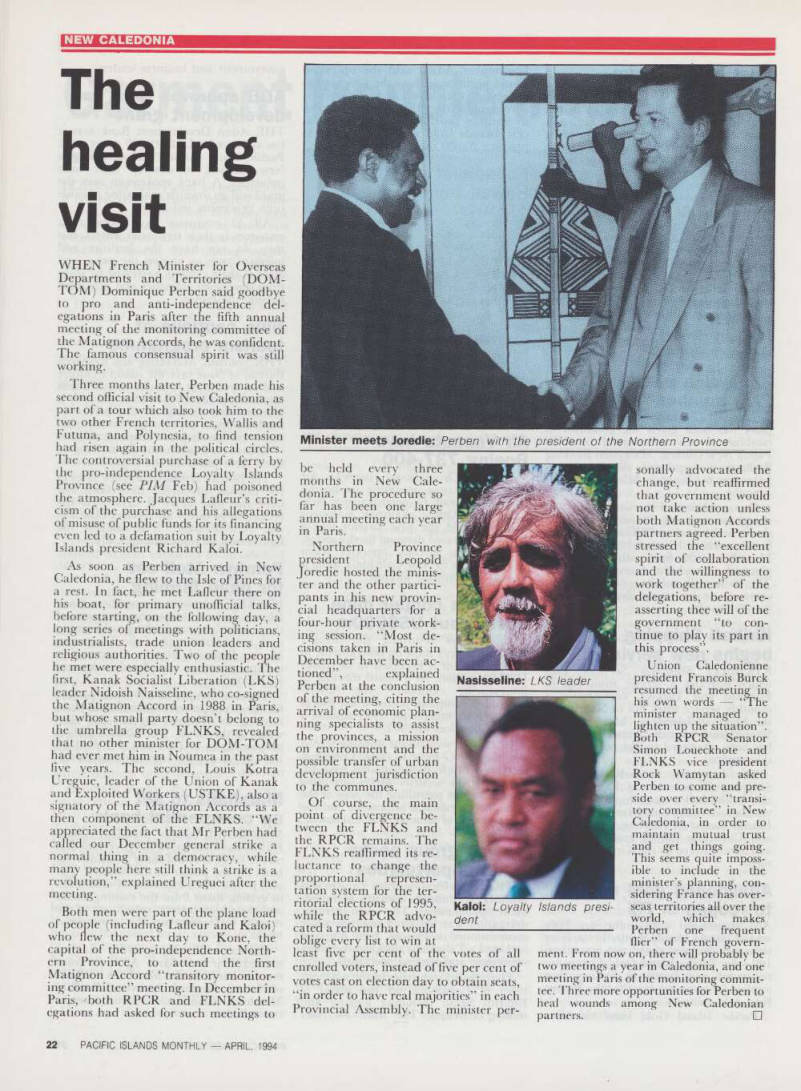
New Caledonia
The healing visit
WHEN French Minister for Overseas
Departments and Territories (DOM
TOM) Dominique Perben said goodbye
to pro and anti-independence del egations in Paris after the fifth annual meeting of the monitoring committee of the Matignon Accords, he was confident.
The famous consensual spirit was still
working.
Three months later, Perben made his second official visit to New Caledonia, as part of a tour which also took him to the two other French territories, Wallis and Futuna, and Polynesia, to find tension had risen again in the political circles.
The controversial purchase of a ferry by
the pro-independence Loyalty Islands
Province (see PIM Feb) had poisoned
the atmosphere. Jacques Lafleur’s criti cism of the purchase and his allegations of misuse of public funds for its financing even led to a defamation suit by Loyalty Islands president Richard Kaloi.
As soon as Perben arrived in New Caledonia, he flew to the Isle of Pines for a rest. In fact, he met Lafleur there on his boat, for primary unofficial talks, before starting, on the following day, a
long series of meetings with politicians,
industrialists, trade union leaders and religious authorities. Two of the people he met were especially enthusiastic. The first, Kanak Socialist Liberation (LKS) leader Nidoish Naisseline, who co-signed the Matignon Accord in 1988 in Paris, but whose small party doesn’t belong to the umbrella group FLNKS, revealed that no other minister for DOM-TOM had ever met him in Noumea in the past five years. The second, Louis Kotra Ureguie, leader of the Union of Kanak and Exploited Workers (USTKE), also a signatory of the Matignon Accords as a then component of the FLNKS. “We appreciated the fact that Mr Perben had called our December general strike a normal thing in a democracy, while many people here still think a strike is a revolution,” explained Ureguei after the
meeting.
Both men were part of the plane load
of people (including Lafleur and Kaloi)
who flew the next day to Kone, the capital of the pro-independence North ern Province, to attend the first
Matignon Accord “transitory monitor
ing committee” meeting. In December in Paris, 'both RPCR and FLNKS del egations had asked for such meetings to
be held every three months in New Cale donia. The procedure so far has been one large annual meeting each year in Paris.
Northern Province
president Leopold
Joredie hosted the minis ter and the other partici pants in his new provin cial headquarters for a four-hour private work ing session. “Most de cisions taken in Paris in December have been ac
tioned”, explained
Perben at the conclusion of the meeting, citing the arrival of economic plan
ning specialists to assist
the provinces, a mission on environment and the possible transfer of urban
development jurisdiction
to the communes.
Of course, the main
point of divergence be
tween the FLNKS and the RPCR remains. The FLNKS reaffirmed its re luctance to change the
proportional represen
tation system for the ter ritorial elections of 1995, while the RPCR advo cated a reform that would oblige every list to win at
least five per cent of the votes of all enrolled voters, instead of five per cent of votes cast on election day to obtain seats, “in order to have real majorities” in each Provincial Assembly. The minister per-
sonally advocated the change, but reaffirmed that government would not take action unless both Matignon Accords partners agreed. Perben stressed the “excellent spirit of collaboration and the willingness to work together” of the delegations, before re asserting thee will of the government “to con tinue to play its part in
this process”.
Union Caledonienne president Francois Burck resumed the meeting in his own words “The minister managed to lighten up the situation”.
Both RPCR Senator Simon Loueckhote and FLNKS vice president Rock Wamytan asked Perben to come and pre side over every “transi tory committee” in New Caledonia, in order to maintain mutual trust and get things going.
This seems quite imposs ible to include in the minister's planning, con sidering France has over seas territories all over the world, which makes Perben one frequent flier” of French govern
ment. From now on, there will probably be two meetings a year in Caledonia, and one meeting in Paris of the monitoring commit tee. Three more opportunities for Perben to heal wounds among New Caledonian partners. □
Minister meets Joredie: Perben with the president of the Northern Province
Nasisseline: LKS leader
Kaloi: Loyalty Islands presi dent
The healing convention
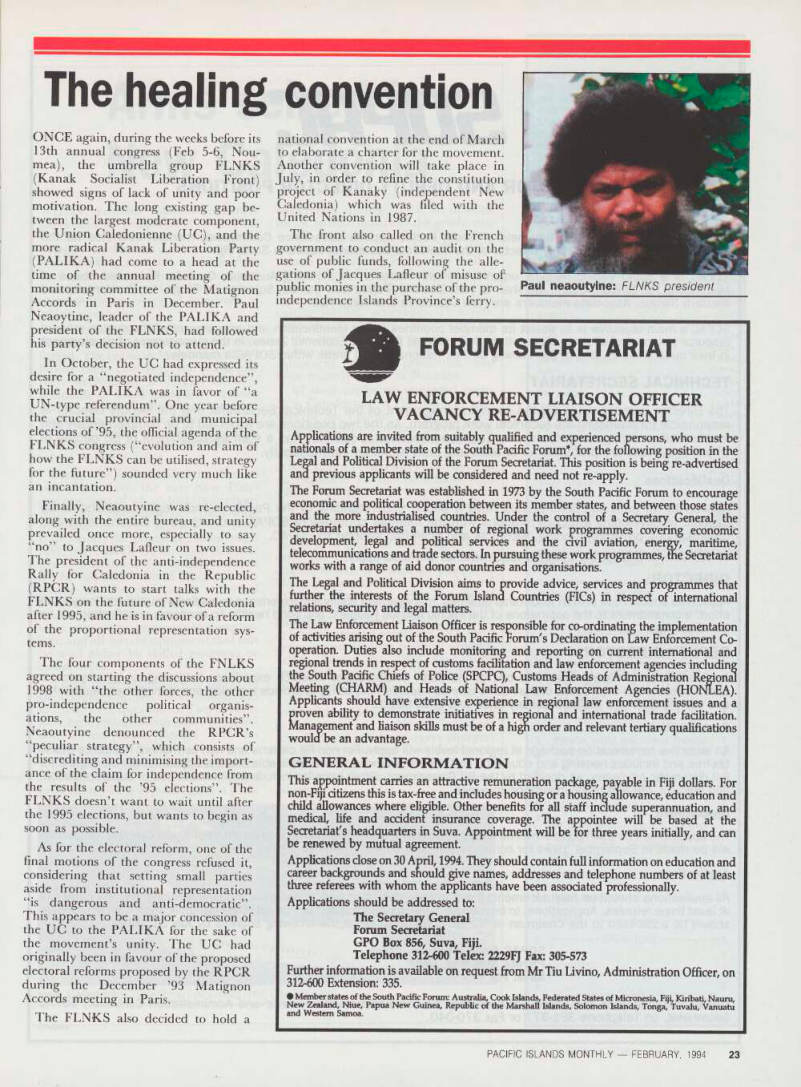
ONCE again, during the weeks before its 13th annual congress (Feb 5-6, Nou mea), the umbrella group FLNKS
(Kanak Socialist Liberation Front)
showed signs of lack of unity and poor motivation. The long existing gap be tween the largest moderate component, the Union Caledonienne (UC), and the more radical Kanak Liberation Party (PALIKA) had come to a head at the time of the annual meeting of the monitoring committee of the Matignon Accords in Paris in December. Paul Neaoytine, leader of the PALIKA and president of the FLNKS, had followed his party’s decision not to attend.
In October, the UC had expressed its desire for a “negotiated independence”, while the PALIKA was in favor of “a UN-type referendum”. One year before the crucial provincial and municipal elections of’9s, the official agenda of the FLNKS congress (“evolution and aim of how the FLNKS can be utilised, strategy for the future”) sounded very much like an incantation.
Finally, Neaoutyine was re-elected,
along with the entire bureau, and unity prevailed once more, especially to say “no” to Jacques Lafleur on two issues.
The president of the anti-independence Rally for Caledonia in the Republic (RPCR) wants to start talks with the FLNKS on the future of New Caledonia after 1995, and he is in favour of a reform of the proportional representation sys tems.
The four components of the FNLKS agreed on starting the discussions about 1998 with “the other forces, the other
pro-independence political organis
ations, the other communities”.
Neaoutyine denounced the RPCR’s “peculiar strategy”, which consists of
“discrediting and minimising the import
ance of the claim for independence from the results of the ’95 elections”. The FLNKS doesn’t want to wait until after the 1995 elections, but wants to begin as soon as possible.
As for the electoral reform, one of the final motions of the congress refused it,
considering that setting small parties
aside from institutional representation “is dangerous and anti-democratic”.
This appears to be a major concession of the UC to the PALIKA for the sake of the movement’s unity. The UC had originally been in favour of the proposed electoral reforms proposed by the RPCR during the December ’93 Matignon Accords meeting in Paris.
The FLNKS also decided to hold a
national convention at the end of March to elaborate a charter for the movement.
Another convention will take place in July, in order to refine the constitution
project of Kanaky (independent New
Caledonia) which was filed with the United Nations in 1987.
The front also called on the French government to conduct an audit on the use of public funds, following the alle gations of Jacques Lafleur of misuse of public monies in the purchase of the pro
independence Islands Province’s ferry.
Paul neaoutyine: FLNKS president
Advertisements & other items, pp. 23-24 (1 item)
Forum Secretariat
LAW ENFORCEMENT LIAISON OFFICER
VACANCY RE-ADVERTISEMENT
Applications are invited from suitably qualified and experienced persons, who must be nationals of a member state of the South Pacific Forum*, for the following position in the Legal and Political Division of the Forum Secretariat. This position is being re-advertised and previous applicants will be considered and need not re-apply.
The Forum Secretariat was established in 1973 by the South Pacific Forum to encourage economic and political cooperation between its member states, and between those states and the more industrialised countries. Under the control of a Secretary General, the Secretariat undertakes a number of regional work programmes covering economic development, legal and political services and the civil aviation, energy, maritime, telecommunications and trade sectors. In pursuing these work programmes, the Secretariat works with a range of aid donor countries and organisations.
The Legal and Political Division aims to provide advice, services and programmes that further the interests of the Forum Island Countries (FICs) in respect of international relations, security and legal matters.
The Law Enforcement Liaison Officer is responsible for co-ordinating the implementation of activities arising out of the South Pacific Forum's Declaration on Law Enforcement Cooperation. Duties also include monitoring and reporting on current international and regional trends in respect of customs facilitation and law enforcement agencies including the South Pacific Chiefs of Police (SPCPC), Customs Heads of Administration Regional Meeting (CHARM) and Heads of National Law Enforcement Agencies (HONLEA).
Applicants should have extensive experience in regional law enforcement issues and a Croven ability to demonstrate initiatives in regional and international trade facilitation, lanagement and liaison skills must be of a high order and relevant tertiary qualifications would be an advantage.
GENERAL INFORMATION
This appointment carries an attractive remuneration package, payable in Fiji dollars. For non-Fiji citizens this is tax-free and includes housing or a housing allowance, education and child allowances where eligible. Other benefits for all staff include superannuation, and medical, life and accident insurance coverage. The appointee will be based at the Secretariat's headquarters in Suva. Appointment will be for three years initially, and can be renewed by mutual agreement.
Applications close on 30 April, 1994. They should contain full information on education and career backgrounds and should give names, addresses and telephone numbers of at least three referees with whom the applicants have been associated professionally.
Applications should be addressed to: The Secretaiy General Forum Secretariat GPO Box 856, Suva, Fiji.
Telephone 312-600 Telex: 2229FJ Fax: 305-573 Further information is available on request from Mr Tiu Livino, Administration Officer, on 312-600 Extension: 335. • Member states of the South Pacific Forum: Australia, Cook Islands, Federated States of Micronesia, Fiji, Kiribati, Nauru, New Zealand, Niue, Papua New Guinea, Republic of the Marshall Islands, Solomon Islands, Tonga, Tuvalu, Vanuatu and Western Samoa.
same
DIRECTOR AND DEPUTY DIRECTOR POSITIONS
Applications are invited from nationals of South Pacific Applied Geoscience Commission member countries for the positions of Director and Deputy Director of the Technical Secretariat based in Suva, Fiji.
SOPAC is a South Pacific regional organisation with membership including Australia, Cook Is, Federated States of Micronesia, Fiji, Kiribati, Guam, Marshall Is, New Zealand, Papua New Guinea, Solomon Is, Tonga, Tuvalu, Vanuatu and Western Samoa. Associate members are New Caledonia and Tahiti Nui.
SOPAC’s main objective is to assist its member countries in the identification and assessment of the marine mineral resource potential of offshore areas within their national Exclusive Economic Zones, in the management of development in their coastal areas, and in the training of their nationals in all areas within SOPAC's mandate.
TECHNICAL SECRETARIAT
The Director is responsible for the overall management of the Technical Secretariat and the Deputy Director is responsible for managing the technical work program. As the two positions are expected to be complementary and function as a management team. The Technical Secretariat currently has a staff establishment of 50 people of whom about half are professional or technical staff recruited internationally.
Qualifications Applicants for both positions should have a sound understanding of the Pacific Islands region and should be capable of developing effective relations with the member countries of SOPAC and with other Governments and organisations providing funding, technical and scientific support to SOPAC.
In addition, the following specific requirements will also apply:
DIRECTOR:
Applicants should have proven leadership qualities; management ability and experience in leading a multidisciplinary team effort; a commitment to the aspirations of the Pacific Islands Peoples; and good health. An academic qualification will be an advantage.
DEPUTY DIRECTOR:
Applicants should have a degree in one of the earth sciences and research experience in geology or geophysics; a commitment to the aspirations of the Pacific Islands Peoples’; the ability to provide technical and management leadership and coordination of a multidisciplinary team and good health.
Remuneration An attractive remuneration package at regional levels will apply. For non-Fiji citizens and non permanent residents this is tax-free and includes housing and education and child allowances where applicable and the appointee will be eligible for full diplomatic privileges, as decided by the Fiji Government. Other benefits include payments in lieu of superannuation, and medical, life and travel insurance coverage.
Appointment The appointment for each position will be for 3 years initially, and may be renewable for a further 3-year contract. Selections will be made in September 1994 for commencement of duties in January 1995.
Applications All applications should be fully documented and include details of work experience and qualifications and the names of at least three referees. Applications, to be marked “Director Application” or “Deputy Director Application”, as appropriate should be addressed to the Chairman of SOPAC and should reach the following address by July 31, 1994: SOPAC Secretariat Private Mail Bag, GPO Suva, FIJI Further information on the above positions may be obtained from the Finance and Administration Controller, SOPAC Secretariat, on Telephone 381-377 or Fax 370-040. 123300V10
Arms seized in
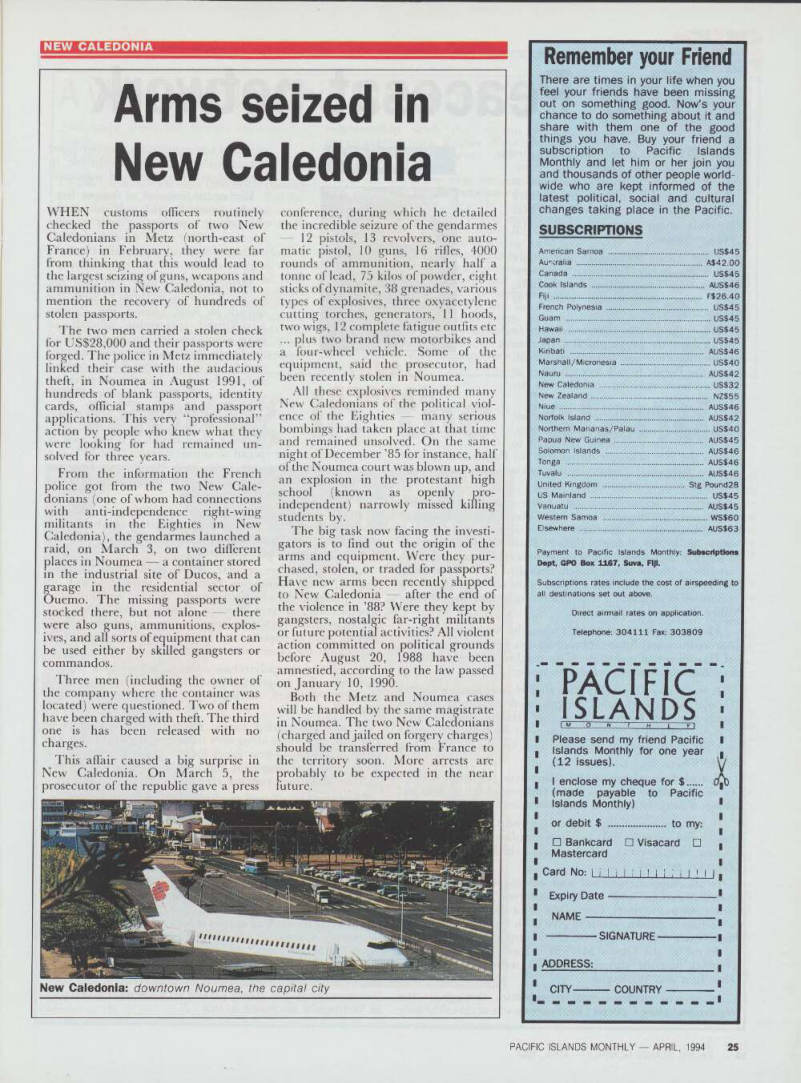
New Caledonia
Arms seized in New Caledonia
WHEN customs officers routinely checked the passports of two New Caledonians in Metz (north-east of
France) in February, they were far
from thinking that this would lead to the largest seizing of guns, weapons and ammunition in New Caledonia, not to mention the recovery of hundreds of stolen passports.
The two men carried a stolen check for US$2B,OOO and their passports were
forged. The police in Metz immediately
linked their case with the audacious theft, in Noumea in August 1991, of hundreds of blank passports, identity cards, official stamps and passport
applications. This very “professional”
action by people who knew what they were looking for had remained un solved for three years.
From the information the French police got from the two New Cale donians (one of whom had connections
with anti-independence right-wing
militants in the Eighties in New Caledonia), the gendarmes launched a raid, on March 3, on two different places in Noumea a container stored in the industrial site of Ducos, and a garage in the residential sector of Ouemo. The missing passports were stocked there, but not alone there were also guns, ammunitions, explos ives, and all sorts of equipment that can be used either by skilled gangsters or commandos.
Three men (including the owner of the company where the container was located) were questioned. Two of them have been charged with theft. The third one is has been released with no
charges.
This affair caused a big surprise in New Caledonia. On March 5, the prosecutor of the republic gave a press
conference, during which he detailed the incredible seizure of the gendarmes 12 pistols, 13 revolvers, one auto matic pistol, 10 guns, 16 rifles, 4000 rounds of ammunition, nearly half a tonne of lead, 75 kilos of powder, eight sticks of dynamite, 38 grenades, various types of explosives, three oxyacetylene cutting torches, generators, 11 hoods, two wigs, 12 complete fatigue outfits etc ... plus two brand new motorbikes and a four-wheel vehicle. Some of the equipment, said the prosecutor, had been recently stolen in Noumea.
All these explosives reminded many New Caledonians of the political viol ence of the Eighties many serious bombings had taken place at that time and remained unsolved. On the same night of December ’B5 for instance, half of the Noumea court was blown up, and an explosion in the protestant high school (known as openly pro
independent) narrowly missed killing
students by.
The big task now facing the investi gators is to find out the origin of the arms and equipment. Were they pur chased, stolen, or traded for passports?
Have new arms been recently shipped to New Caledonia after the end of the violence in ’88? Were they kept by
gangsters, nostalgic far-right militants
or future potential activities? All violent action committed on political grounds before August 20, 1988 have been amnestied, according to the law passed on January 10, 1990.
Both the Metz and Noumea cases will be handled by the same magistrate in Noumea. The two New Caledonians (charged and jailed on forgery charges) should be transferred from France to the territory soon. More arrests are probably to be expected in the near future.
New Caledonia: downtown Noumea, the capital city
Advertisements & other items, p. 25 (1 item)
' Pacific
Remember your Friend
There are times in your life when you feel your friends have been missing out on something good. Now’s your chance to do something about it and share with them one of the good things you have. Buy your friend a subscription to Pacific Islands Monthly and let him or her join you and thousands of other people worldwide who are kept informed of the latest political, social and cultural
changes taking place in the Pacific.
SUBSCRIPTIONS
American Samoa US$45 Australia A 542,00 Canada US$45 Cook Islands AUSS46 Fiji F 526.40 French Polynesia US$45 Guam US$45 Hawaii US$45 Japan US$45 Kiribati AUSS46 Marshall/Micronesia US$4O Nauru AUSS42 New Caledonia US$32 New Zealand NZ$55 Niue AUSS46 Norfolk Island AUSS42 Northern Marianas/Palau US$4O Papua New Guinea AUSS4S Solomon Islands AUSS46 Tonga AUSS46 Tuvalu AUSS46 United Kingdom Stg Pound2B US Mainland US$45 Vanuatu AUSS4S Western Samoa WS$6O Elsewhere AUSS63 Payment to Pacific Islands Monthly: Subscriptions Dept, GPO Box 1167, Suva, FIJI.
Subscriptions rates include the cost of airspeeding to all destinations set out above.
Direct airmail rates on application.
Telephone: 304111 Fax; 303809
' PACIFIC
ISLANDS ■
IMP N r"" H L n Please send my friend Pacific I Islands Monthly for one year ■
(12 issues). y
I enclose my cheque for $ djb
(made payable to Pacific
Islands Monthly) • or debit $ to my: □ Bankcard □ Visacard □ ( Mastercard I Card No: I i i i ! ! i ! j j : i ! 1 i I , Expiry Date -*
NAME
SIGNATURE 1
ADDRESS:
CITY COUNTRY
The Peacesat network
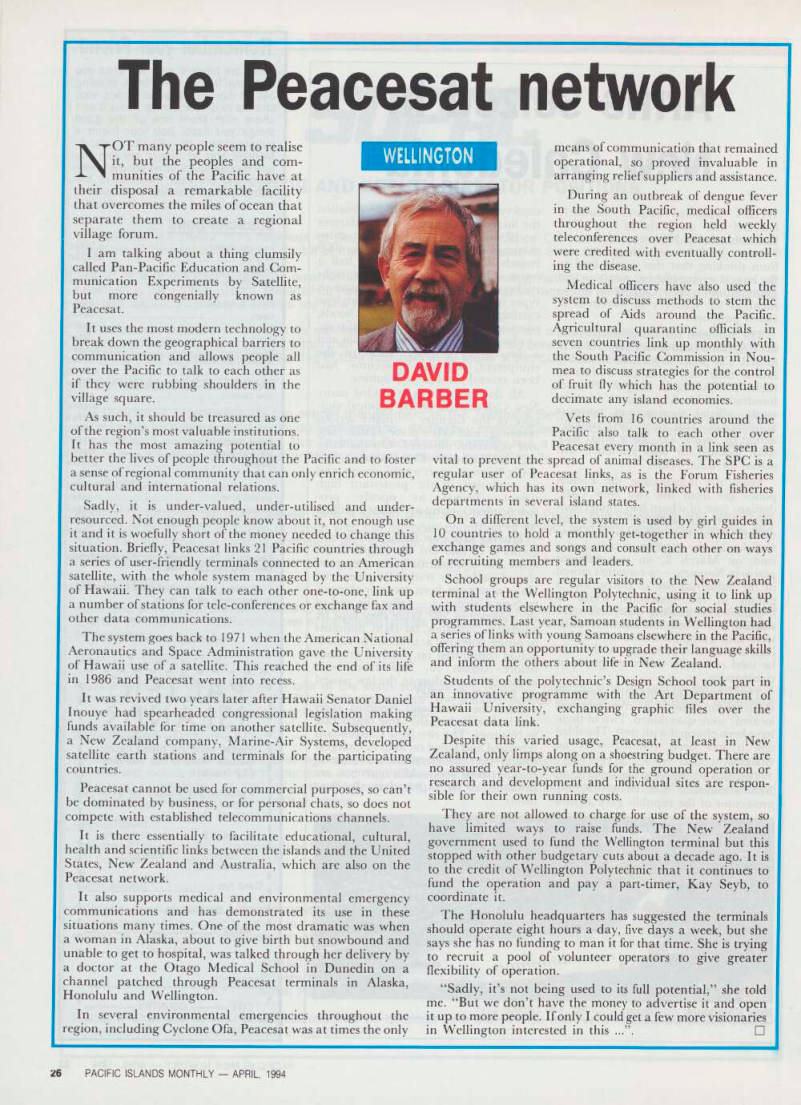
NOT many people seem to realise it, but the peoples and com munities of the Pacific have at their disposal a remarkable facility that overcomes the miles of ocean that separate them to create a regional
village forum.
I am talking about a thing clumsily called Pan-Pacific Education and Com munication Experiments by Satellite, but more congenially known as Peacesat.
It uses the most modern technology to break down the geographical barriers to communication and allows people all over the Pacific to talk to each other as if they were rubbing shoulders in the village square.
As such, it should be treasured as one of the region’s most valuable institutions.
It has the most amazing potential to better the lives of people throughout the Pacific and to foster a sense of regional community that can only enrich economic, cultural and international relations.
Sadly, it is under-valued, under-utilised and under resourced. Not enough people know about it, not enough use it and it is woefully short of the money needed to change this situation. Briefly, Peacesat links 21 Pacific countries through a series of user-friendly terminals connected to an American satellite, with the whole system managed by the University of Hawaii. They can talk to each other one-to-one, link up a number of stations for tele-conferences or exchange fax and other data communications.
The system goes back to 1971 when the American National Aeronautics and Space Administration gave the University of Hawaii use of a satellite. This reached the end of its life in 1986 and Peacesat went into recess.
It was revived two years later after Hawaii Senator Daniel
Inouye had spearheaded congressional legislation making
funds available for time on another satellite. Subsequently, a New Zealand company, Marine-Air Systems, developed satellite earth stations and terminals for the participating countries.
Peacesat cannot be used for commercial purposes, so can’t be dominated by business, or for personal chats, so does not compete with established telecommunications channels.
It is there essentially to facilitate educational, cultural, health and scientific links between the islands and the United States, New Zealand and Australia, which are also on the Peacesat network.
It also supports medical and environmental emergency communications and has demonstrated its use in these situations many times. One of the most dramatic was when a woman in Alaska, about to give birth but snowbound and unable to get to hospital, was talked through her delivery by a doctor at the Otago Medical School in Dunedin on a channel patched through Peacesat terminals in Alaska, Honolulu and Wellington.
In several environmental emergencies throughout the region, including Cyclone Ofa, Peacesat was at times the only
means of communication that remained operational, so proved invaluable in arranging relief suppliers and assistance.
During an outbreak of dengue fever in the South Pacific, medical officers
throughout the region held weekly
teleconferences over Peacesat which were credited with eventually controll ing the disease.
Medical officers have also used the system to discuss methods to stem the spread of Aids around the Pacific.
Agricultural quarantine officials in
seven countries link up monthly with the South Pacific Commission in Nou mea to discuss strategies for the control of fruit fly which has the potential to decimate any island economies.
Vets from 16 countries around the Pacific also talk to each other over Peacesat every month in a link seen as
vital to prevent the spread of animal diseases. The SPC is a regular user of Peacesat links, as is the Forum Fisheries Agency, which has its own network, linked with fisheries departments in several island states.
On a different level, the system is used by girl guides in 10 countries to hold a monthly get-together in which they exchange games and songs and consult each other on ways of recruiting members and leaders.
School groups are regular visitors to the New Zealand terminal at the Wellington Polytechnic, using it to link up with students elsewhere in the Pacific for social studies programmes. Last year, Samoan students in Wellington had a series of links with young Samoans elsewhere in the Pacific, offering them an opportunity to upgrade their language skills and inform the others about life in New Zealand.
Students of the polytechnic’s Design School took part in an innovative programme with the Art Department of Hawaii University, exchanging graphic files over the Peacesat data link.
Despite this varied usage, Peacesat, at least in New Zealand, only limps along on a shoestring budget. There are no assured year-to-year funds for the ground operation or research and development and individual sites are respon sible for their own running costs.
They are not allowed to charge for use of the system, so have limited ways to raise funds. The New Zealand government used to fund the Wellington terminal but this stopped with other budgetary cuts about a decade ago. It is to the credit of Wellington Polytechnic that it continues to fund the operation and pay a part-timer, Kay Seyb, to coordinate it.
The Honolulu headquarters has suggested the terminals should operate eight hours a day, five days a week, but she says she has no funding to man it for that time. She is trying to recruit a pool of volunteer operators to give greater
flexibility of operation.
“Sadly, it’s not being used to its full potential,” she told me. “But we don’t have the money to advertise it and open it up to more people. If only I could get a few more visionaries in Wellington interested in this ...”. □
Wellington
David
Barber
A vital relationship, says minister
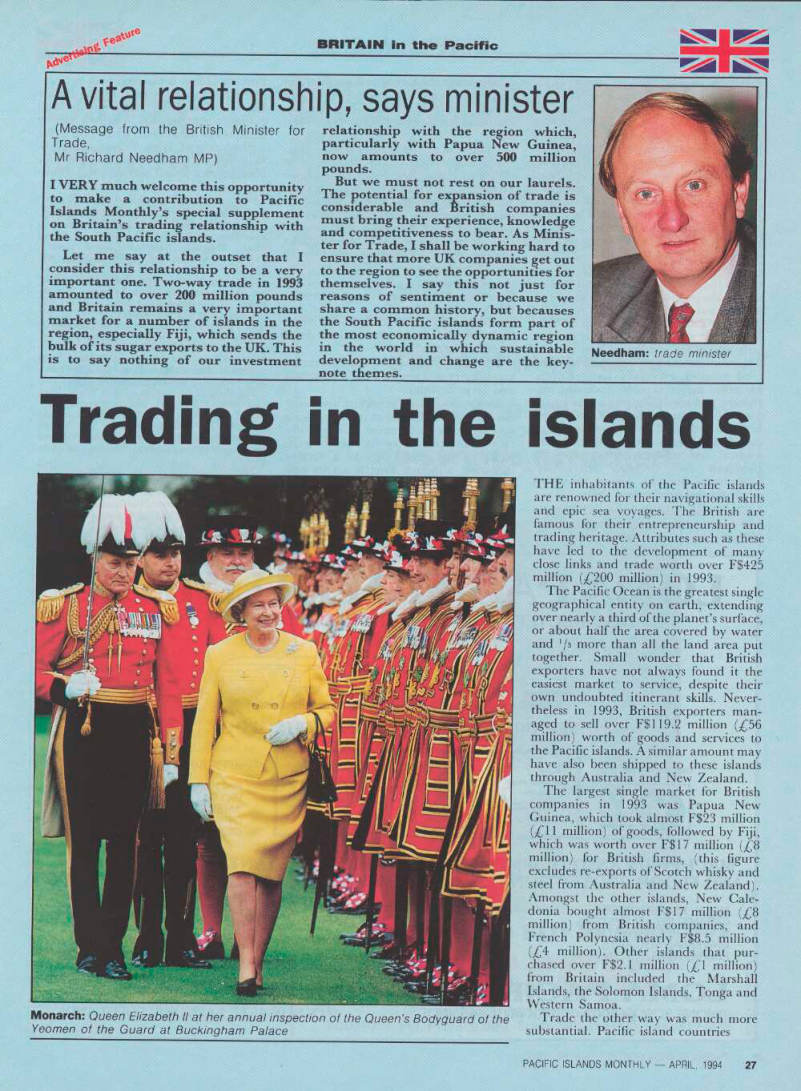
BRITAIN in the Pacific
(Message from the British Minister for Trade, Mr Richard Needham MR) I VERY much welcome this opportunity to make a contribution to Pacific Islands Monthly’s special supplement on Britain’s trading relationship with the South Pacific islands.
Let me say at the outset that I consider this relationship to be a very important one. Two-way trade in 1993 amounted to over 200 million pounds and Britain remains a very important market for a number of islands in the region, especially Fiji, which sends the bulk of its sugar exports to the UK. This is to say nothing of our investment
relationship with the region which, particularly with Papua New Guinea, now amounts to over 500 million pounds.
But we must not rest on our laurels.
The potential for expansion of trade is considerable and British companies must bring their experience, knowledge and competitiveness to bear. As Minis ter for Trade, I shall be working hard to ensure that more UK companies get out to the region to see the opportunities for themselves. I say this not just for reasons of sentiment or because we share a common history, but becauses the South Pacific islands form part of the most economically dynamic region in the world in which sustainable development and change are the key note themes.
Needham: trade minister
Trading in the islands
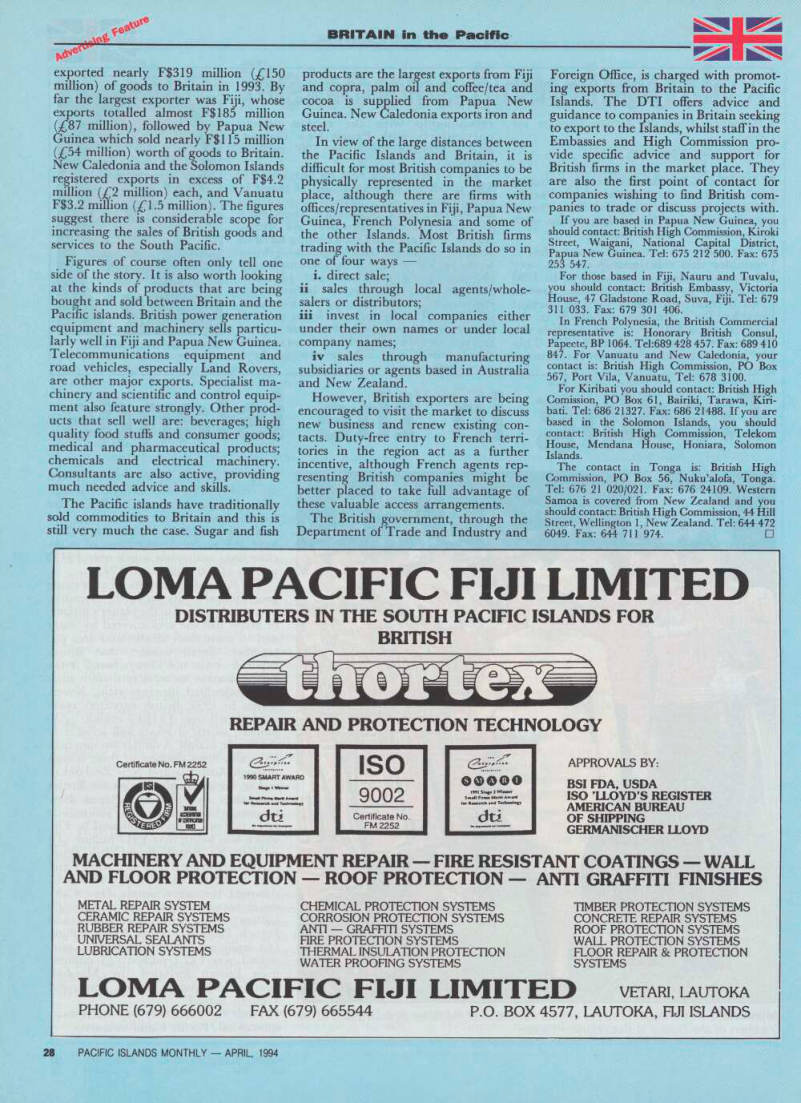
THE inhabitants of the Pacific islands are renowned for their navigational skills and epic sea voyages. The British are famous for their entrepreneurship and trading heritage. Attributes such as these have led to the development of many close links and trade worth over F 5425 million (£2OO million) in 1993.
The Pacific Ocean is the greatest single
geographical entity on earth, extending
over nearly a third of the planet’s surface, or about half the area covered by water and '/ 5 more than all the land area put together. Small wonder that British exporters have not always found it the easiest market to service, despite their own undoubted itinerant skills. Never theless in 1993, British exporters man aged to sell over FS 119.2 million (£56 million) worth of goods and services to the Pacific islands. A similar amount may have also been shipped to these islands through Australia and New Zealand.
The largest single market for British companies in 1993 was Papua New Guinea, which took almost Fs23 million (£ll million) of goods, followed by Fiji, which was worth over FS 17 million (£8
million) for British firms, (this figure
excludes re-exports of Scotch whisky and steel from Australia and New Zealand).
Amongst the other islands, New Cale donia bought almost FS 17 million (£8 million) from British companies, and French Polynesia nearly FsB.s million (£4 million). Other islands that pur chased over Fs2.l million (£1 million) from Britain included the Marshall Islands, the Solomon Islands, Tonga and Western Samoa.
Trade the other way was much more substantial. Pacific island countries
Monarch: Queen Elizabeth II at her annual inspection of the Queen's Bodyguard of the Yeomen of the Guard at Buckingham Palace
exported nearly Fs3l9 million (£l5O million) of goods to Britain in 1993. By far the largest exporter was Fiji, whose exports totalled almost FSIBS million (£B7 million), followed by Papua New Guinea which sold nearly FSIIS million (£54 million) worth of goods to Britain.
New Caledonia and the Solomon Islands registered exports in excess of F 54.2 million (£2 million) each, and Vanuatu F 53.2 million (£1.5 million). The figures suggest there is considerable scope for increasing the sales of British goods and services to the South Pacific.
Figures of course often only tell one side of the story. It is also worth looking at the kinds of products that are being bought and sold between Britain and the Pacific islands. British power generation equipment and machinery sells particu larly well in Fiji and Papua New Guinea.
Telecommunications equipment and road vehicles, especially Land Rovers, are other major exports. Specialist ma chinery and scientific and control equip ment also feature strongly. Other prod ucts that sell well are: beverages; high quality food stuffs and consumer goods; medical and pharmaceutical products; chemicals and electrical machinery.
Consultants are also active, providing much needed advice and skills.
The Pacific islands have traditionally sold commodities to Britain and this is still very much the case. Sugar and fish
products are the largest exports from Fiji and copra, palm oil and coffee/tea and cocoa is supplied from Papua New Guinea. New Caledonia exports iron and steel.
In view of the large distances between the Pacific Islands and Britain, it is difficult for most British companies to be physically represented in the market place, although there are firms with offices/representatives in Fiji, Papua New Guinea, French Polynesia and some of the other Islands. Most British firms trading with the Pacific Islands do so in one of four ways i. direct sale; ii sales through local agents/whole salers or distributors; iii invest in local companies either under their own names or under local company names; iv sales through manufacturing subsidiaries or agents based in Australia and New Zealand.
However, British exporters are being encouraged to visit the market to discuss new business and renew existing con tacts. Duty-free entry to French terri tories in the region act as a further incentive, although French agents rep resenting British companies might be better placed to take full advantage of these valuable access arrangements.
The British government, through the Department of Trade and Industry and
Foreign Office, is charged with promot
ing exports from Britain to the Pacific Islands. The DTI offers advice and
guidance to companies in Britain seeking
to export to the Islands, whilst staff in the Embassies and High Commission pro vide specific advice and support for British firms in the market place. They are also the first point of contact for companies wishing to find British com panies to trade or discuss projects with.
If you are based in Papua New Guinea, you should contact: British High Commission, Kiroki Street, Waigani, National Capital District, Papua New Guinea. Tel: 675 212 500. Fax: 675 253 547.
For those based in Fiji, Nauru and Tuvalu, you should contact: British Embassy, Victoria House, 47 Gladstone Road, Suva, Fiji. Tel: 679 311 033. Fax: 679 301 406.
In French Polynesia, the British Commercial representative is: Honorary British Consul, Papeete, BP 1064. Te1:689 428 457. Fax: 689 410 847. For Vanuatu and New Caledonia, your contact is: British High Commission, PO Box 567, Port Vila, Vanuatu, Tel: 678 3100.
For Kiribati you should contact: British High Comission, PO Box 61, Bairiki, Tarawa, Kiri bati. Tel: 686 21327. Fax: 686 21488. If you are based in the Solomon Islands, you should contact; British High Commission, Telekom House, Mendana House, Honiara, Solomon Islands.
The contact in Tonga is: British High Commission, PO Box 56, Nuku’alofa, Tonga.
Tel: 676 21 020/021. Fax; 676 24109. Western Samoa is covered from New Zealand and you should contact: British High Commission, 44 Hill Street, Wellington 1, New Zealand. Tel; 644 472 6049. Fax: 644 711 974. □
Advertisements & other items, pp. 27-28 (2 items)
27
lc 6 fe *' , ' e
PACIFIC ISLANDS MONTHLY APRIL, 1994
Loma Pacific Fiji Limited
DISTRIBUTERS IN THE SOUTH PACIFIC ISLANDS FOR
BRITISH
REPAIR AND PROTECTION TECHNOLOGY
APPROVALS BY:
BSI FDA, USDA
ISO LLOYD S REGISTER
AMERICAN BUREAU
OF SHIPPING
GERMANISCHER LLOYD
MACHINERY AND EQUIPMENT REPAIR FIRE RESISTANT COATINGS WALL AND FLOOR PROTECTION ROOF PROTECTION ANTI GRAFFITI FINISHES
METAL REPAIR SYSTEM
CERAMIC REPAIR SYSTEMS
RUBBER REPAIR SYSTEMS
UNIVERSAL SEALANTS
LUBRICATION SYSTEMS
CHEMICAL PROTECTION SYSTEMS
CORROSION PROTECTION SYSTEMS
ANTI GRAFFITI SYSTEMS
FIRE PROTECTION SYSTEMS
THERMAL INSULATION PROTECTION
WATER PROOHNG SYSTEMS
TIMBER PROTECTION SYSTEMS
CONCRETE REPAIR SYSTEMS
ROOF PROTECTION SYSTEMS
WALL PROTECTION SYSTEMS
FLOOR REPAIR & PROTECTION
SYSTEMS
LOMA PACIFIC FIJI LIMITED VETARI, LAUTOKA
PHONE (679) 666002 FAX (679) 665544 P.O. BOX 4577, LAUTOKA, HJI ISLANDS
Growing
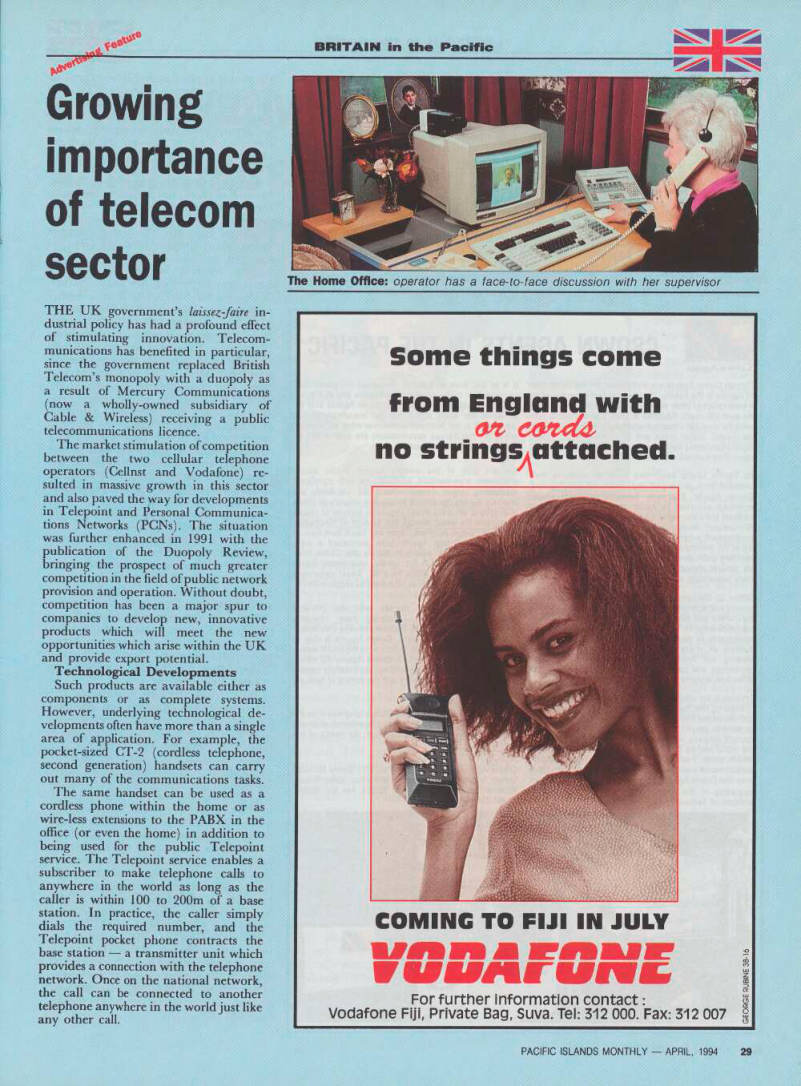
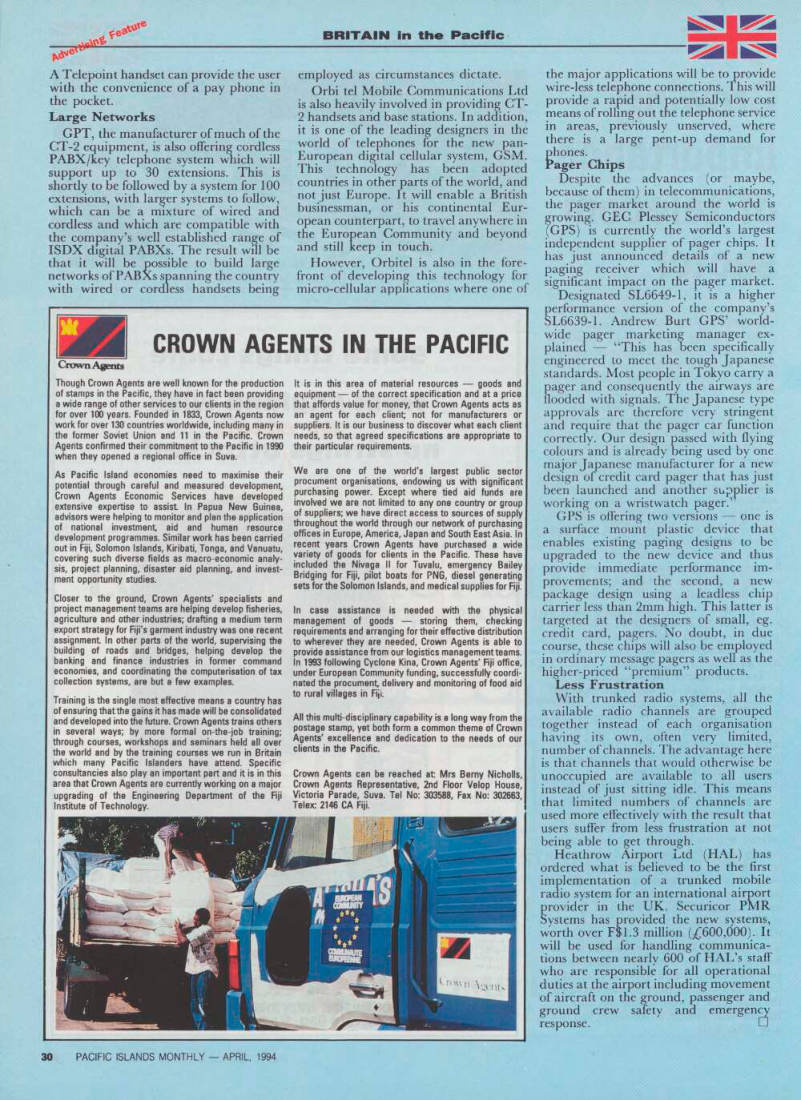
importance of telecom sector
THE UK government’s laissez-faire in dustrial policy has had a profound effect of stimulating innovation. Telecom munications has benefited in particular, since the government replaced British Telecom’s monopoly with a duopoly as a result of Mercury Communications (now a wholly-owned subsidiary of Cable & Wireless) receiving a public telecommunications licence.
The market stimulation of competition between the two cellular telephone operators (Cellnst and Vodafone) re sulted in massive growth in this sector and also paved the way for developments in Telepoint and Personal Communica tions Networks (PCNs). The situation was further enhanced in 1991 with the publication of the Duopoly Review, bringing the prospect of much greater competition in the field of public network provision and operation. Without doubt, competition has been a major spur to companies to develop new, innovative products which will meet the new opportunities which arise within the UK and provide export potential.
Technological Developments
Such products are available either as components or as complete systems.
However, underlying technological de velopments often have more than a single area of application. For example, the pocket-sized CT-2 (cordless telephone, second generation) handsets can carry out many of the communications tasks.
The same handset can be used as a cordless phone within the home or as wire-less extensions to the PABX in the office (or even the home) in addition to being used for the public Telepoint service. The Telepoint service enables a subscriber to make telephone calls to anywhere in the world as long as the caller is within 100 to 200 m of a base station. In practice, the caller simply dials the required number, and the Telepoint pocket phone contracts the base station a transmitter unit which provides a connection with the telephone network. Once on the national network, the call can be connected to another telephone anywhere in the world just like any other call.
The Home Office: operator has a face-to-face discussion with her supervisor
A Telepoint handset can provide the user with the convenience of a pay phone in the pocket.
Large Networks GPT, the manufacturer of much of the CT-2 equipment, is also offering cordless PABX/key telephone system which will support up to 30 extensions. This is shortly to be followed by a system for 100 extensions, with larger systems to follow, which can be a mixture of wired and cordless and which are compatible with the company’s well established range of ISDX digital PABXs. The result will be that it will be possible to build large networks of PABXs spanning the country with wired or cordless handsets being
employed as circumstances dictate.
Orbi tel Mobile Communications Ltd is also heavily involved in providing CT -2 handsets and base stations. In addition, it is one of the leading designers in the world of telephones for the new pan- European digital cellular system, GSM.
This technology has been adopted countries in other parts of the world, and not just Europe. It will enable a British businessman, or his continental Eur opean counterpart, to travel anywhere in
the European Community and beyond
and still keep in touch.
However, Orbitel is also in the fore front of developing this technology for micro-cellular applications where one of
the major applications will be to provide wire-less telephone connections. This will provide a rapid and potentially low cost means of rolling out the telephone service in areas, previously unserved, where there is a large pent-up demand for
phones.
Pager Chips
Despite the advances (or maybe,
because of them) in telecommunications, the pager market around the world is
growing. GEC Plessey Semiconductors
(GPS) is currently the world’s largest
independent supplier of pager chips. It
has just announced details of a new paging receiver which will have a significant impact on the pager market.
Designated 5L6649-1, it is a higher performance version of the company’s 5L6639-1. Andrew Burt GPS’ world wide pager marketing manager ex plained “This has been specifically
engineered to meet the tough Japanese
standards. Most people in Tokyo carry a pager and consequently the airways are flooded with signals. The Japanese type approvals are therefore very stringent and require that the pager car function
correctly. Our design passed with flying
colours and is already being used by one major Japanese manufacturer for a new design of credit card pager that has just been launched and another supplier is working on a wristwatch pager.”
GPS is offering two versions one is a surface mount plastic device that
enables existing paging designs to be
upgraded to the new device and thus
provide immediate performance im
provements; and the second, a new
package design using a leadless chip
carrier less than 2mm high. This latter is targeted at the designers of small, eg. credit card, pagers. No doubt, in due course, these chips will also be employed in ordinary message pagers as well as the
higher-priced “premium” products.
Less Frustration With trunked radio systems, all the available radio channels are grouped together instead of each organisation having its own, often very limited, number of channels. The advantage here is that channels that would otherwise be unoccupied are available to all users instead of just sitting idle. This means that limited numbers of channels are used more effectively with the result that users suffer from less frustration at not being able to get through.
Heathrow Airport Ltd (HAL) has ordered what is believed to be the first implementation of a trunked mobile radio system for an international airport provider in the UK. Securicor PMR Systems has provided the new systems, worth over FSI.3 million (-£600,000). It will be used for handling communica tions between nearly 600 of HAL’s staff who are responsible for all operational duties at the airport including movement of aircraft on the ground, passenger and ground crew safety and emergency response. □
Advertisements & other items, pp. 29-30 (3 items)
29
ce^ e
BRITAIN in the Pacific
PACIFIC ISLANDS MONTHLY APRIL, 1994
from England with
Some things come
no strings attached.
m m m
COMING TO FIJI IN JULY
For further information contact: Vodafone Fiji, Private Bag, Suva. Tel: 312 000. Fax: 312 007
Crown Agents
CROWN AGENTS IN THE PACIFIC
Though Crown Agonts are well known for the production of stamps in the Pacific, they have in fact been providing a wide range of other services to our clients in the region for over 100 years. Founded in 1833, Crown Agents now work for over 130 countries worldwide, including many in the former Soviet Union and 11 in the Pacific. Crown Agents confirmed their commitment to the Pacific in 1990 when they opened a regional office in Suva.
As Pacific Island economies need to maximise their potential through careful and measured development.
Crown Agents Economic Services have developed extensive expertise to assist In Papua New Guinea, advisors were helping to monitor and plan the application of national investment aid and human resource development programmes. Similar work has been carried out in Fiji, Solomon Islands, Kiribati, Tonga, and Vanuatu, covering such diverse fields as macro-economic analysis, project planning, disaster aid planning, and investment opportunity studies.
Closer to the ground. Crown Agents' specialists and project management teams are helping develop fisheries, agriculture and other industries; drafting a medium term export strategy for Fiji's garment industry was one recent assignment In other parts of the world, supervising the building of roads and bridges, helping develop the banking and finance industries in former command economies, and coordinating the computerisation of tax collection systems, are but a few examples.
Training is the single most effective means a country has of ensuring thatthe gains it has made will be consolidated and developed into the future. Crown Agents trains others in several ways; by more formal on-the-job training; through courses, workshops and seminars held all over the world and by the training courses we run in Britain which many Pacific Islanders have attend. Specific consultancies also play an important part and it is in this area that Crown Agents are currently working on a major upgrading of the Engineering Department of the Fiji Institute of Technology.
It is in this area of material resources goods and equipment of the correct specification and at a price that affords value for money, that Crown Agents acts as an agent for each client; not for manufacturers or suppliers. It is our business to discover what each client needs, so that agreed specifications are appropriate to their particular requirements.
We are one of the world's largest public sector procument organisations, endowing us with significant purchasing power. Except where tied aid funds are involved we are not limited to any one country or group of suppliers; we have direct access to sources of supply throughout the world through our network of purchasing offices in Europe, America, Japan and South East Asia. In recent years Crown Agents have purchased a wide variety of goods for clients in the Pacific. These have included the Nivaga II for Tuvalu, emergency Bailey Bridging for Fiji, pilot boats for PNG, diesel generating sets for the Solomon Islands, and medical supplies for Fiji.
In case assistance is needed with the physical management of goods storing them, checking requirements and arranging for their effective distribution to wherever they are needed, Crown Agents is able to provide assistance from our logistics management teams.
In 1993 following Cyclone Kina, Crown Agents' Fiji office, under European Community funding, successfully coordinated the procument, delivery and monitoring of food aid to rural villages in Fiji.
All this multi-disciplinary capability is a long way from the postage stamp, yet both form a common theme of Crown Agents' excellence and dedication to the needs of our clients in the Pacific.
Crown Agents can be reached at Mrs Berny Nicholls, Crown Agents Representative, 2nd Floor Velop House, Victoria Parade, Suva. Tel No: 303588, Fax No; 302663, Telex: 2146 CA Fiji. •4*
30
M*®'
BRITAIN in the Pacific
PACIFIC ISLANDS MONTHLY APRIL, 1994
pharmaceutical intermediates
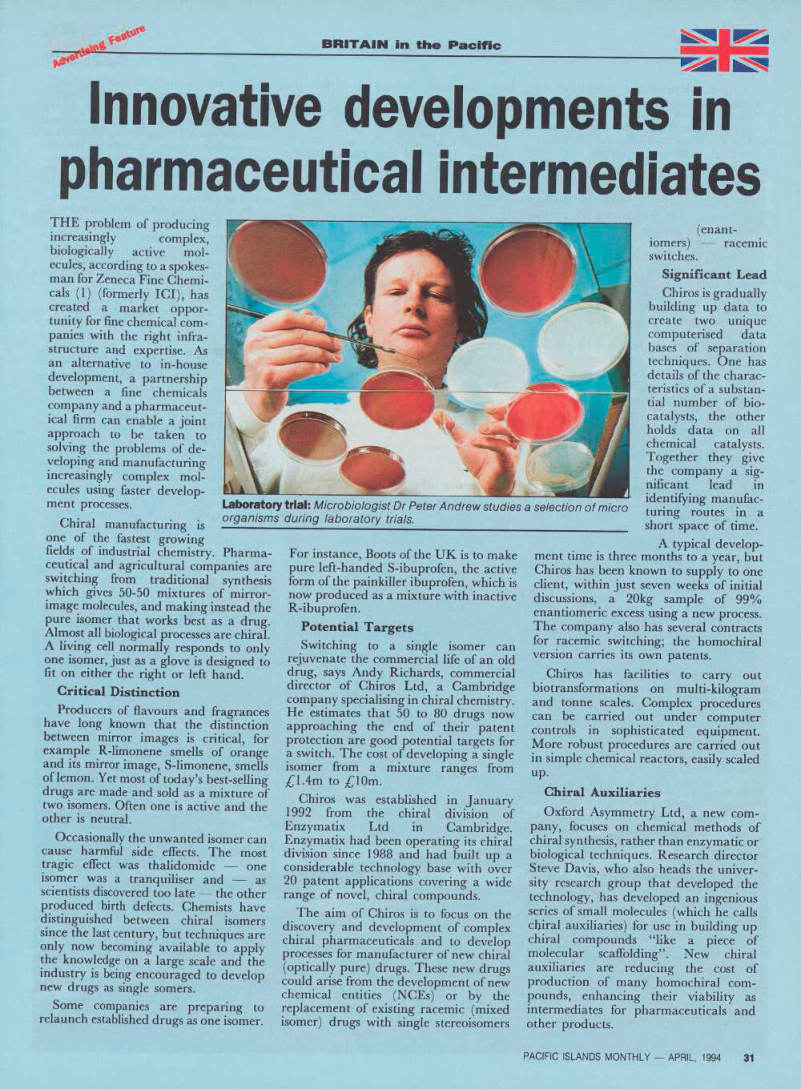
innovative developments in pharmaceutical intermediates
THE problem of producing
increasingly complex,
biologically active mol ecules, according to a spokes man for Zeneca Fine Chemi
cals (1) (formerly ICI), has
created a market oppor tunity for fine chemical com panies with the right infra structure and expertise. As an alternative to in-house
development, a partnership
between a fine chemicals company and a pharmaceut ical firm can enable a joint approach to be taken to solving the problems of de
veloping and manufacturing
increasingly complex mol
ecules using faster develop
ment processes.
Chiral manufacturing is one of the fastest growing
fields of industrial chemistry. Pharma ceutical and agricultural companies are switching from traditional synthesis which gives 50-50 mixtures of mirror image molecules, and making instead the pure isomer that works best as a drug.
Almost all biological processes are chiral.
A living cell normally responds to only one isomer, just as a glove is designed to fit on either the right or left hand.
Critical Distinction Producers of flavours and fragrances have long known that the distinction between mirror images is critical, for example R-limonene smells of orange and its mirror image, S-limonene, smells of lemon. Yet most of today’s best-selling drugs are made and sold as a mixture of two isomers. Often one is active and the other is neutral.
Occasionally the unwanted isomer can cause harmful side effects. The most tragic effect was thalidomide one isomer was a tranquiliser and as scientists discovered too late the other produced birth defects. Chemists have distinguished between chiral isomers since the last century, but techniques are only now becoming available to apply the knowledge on a large scale and the
industry is being encouraged to develop
new drugs as single somers.
Some companies are preparing to relaunch established drugs as one isomer.
For instance, Boots of the UK is to make pure left-handed S-ibuprofen, the active form of the painkiller ibuprofen, which is now produced as a mixture with inactive
R-ibuprofen.
Potential Targets
Switching to a single isomer can rejuvenate the commercial life of an old drug, says Andy Richards, commercial director of Chiros Ltd, a Cambridge company specialising in chiral chemistry.
He estimates that 50 to 80 drugs now approaching the end of their patent protection are good potential targets for a switch. The cost of developing a single isomer from a mixture ranges from £l.4m to /(10m.
Chiros was established in January 1992 from the chiral division of Enzymatix Ltd in Cambridge.
Enzymatix had been operating its chiral division since 1988 and had built up a considerable technology base with over 20 patent applications covering a wide range of novel, chiral compounds.
The aim of Chiros is to focus on the discovery and development of complex chiral pharmaceuticals and to develop processes for manufacturer of new chiral
(optically pure) drugs. These new drugs
could arise from the development of new chemical entities (NCEs) or by the replacement of existing racemic (mixed isomer) drugs with single stereoisomers
(enant iomers) racemic switches.
Significant Lead
Chiros is gradually building up data to create two unique computerised data bases of separation techniques. One has details of the charac teristics of a substan tial number of bio catalysts, the other holds data on all chemical catalysts.
Together they give the company a sig nificant lead in
identifying manufac
turing routes in a short space of time.
A typical develop
ment time is three months to a year, but Chiros has been known to supply to one client, within just seven weeks of initial discussions, a 20kg sample of 99% enantiomeric excess using a new process.
The company also has several contracts for racemic switching; the homochiral version carries its own patents.
Chiros has facilities to carry out biotransformations on multi-kilogram and tonne scales. Complex procedures can be carried out under computer controls in sophisticated equipment.
More robust procedures are carried out in simple chemical reactors, easily scaled up.
Chiral Auxiliaries Oxford Asymmetry Ltd, a new com pany, focuses on chemical methods of chiral synthesis, rather than enzymatic or biological techniques. Research director Steve Davis, who also heads the univer sity research group that developed the technology, has developed an ingenious series of small molecules (which he calls chiral auxiliaries) for use in building up chiral compounds “like a piece of molecular scaffolding”. New chiral auxiliaries are reducing the cost of production of many homochiral com pounds, enhancing their viability as intermediates for pharmaceuticals and other products.
Laboratory trial: Microbiologist Dr Peter Andrew studies a selection of micro organisms during laboratory trials.
Chiral intermediates, auxiliaries (eg Evans Oxazoldinone and Oppolzer’s Sultans) and reagents (eg Davis Oxaziridines) are available in quantities from grammes to kilograms, often from stock. A catalogue detailing over 200 homochiral compounds is available. The company says that its unique combin ation of asymmetric synthesis expertise and continuing links with the leading academic and industrial research centres enables it to provide rapid development and enhancement of synthesis routes.
The Zeneca Fine Chemicals move into chiral intermediates is founded on the integration of its core business of fermentation technology and chemical synthesis. This provides the company with the capability to scale up a number of core processes such as stereo-selective dehalogenation, ketone reductions, bio expoxidations and ester resolutions to provide a wide range of chiral intermedi ates.
Development Pipeline Natural enzymes are a favourite tool of chiral synthesis because they distinguish between mirror images. For example, the company has identified 20 to 30 enzymes that could be used to reduce ketones to chiral alcohols an important step in pharmaceutical synthesis. The ability of fine chemical companies to operate at all levels, from laboratory to full-scale pro duction is essential for organisations operating at the high resource end of the
fine chemicals market and for the pharmaceutical industry searching for '‘fast track” products through the devel
opment pipeline.
Zeneca Fine Chemicals was formed to develop the chiral and fluoroaromatic sectors of Zeneca within a small respon sive organisation culture that has a big organisation resource pool with the essential ability to operate from labora tory through development to full scale operation. Its synthesis services were completed by the acquisition of Cam bridge Research Biochemicals in 1991, providing the ability to produce small scale radiolabelled chiral and fluoromatic compounds and bulk pep tides, all increasingly important chiral products for new life science products.
The addition of a world-scale plant at
Grangemouth, Scotland, producing
fluorobenzene and its derivatives by a process based on continuous HF diazotisation and the operation of KF exchange processes, enables Zeneca to produce a range of commercial fluoromatic products including fluorobenzene, 1,3-difluorobenzene, o and p-fluoroaniline, o- and
p-fluoropnenol, 3-chloro-4-fluoroaniline
and 2,4-difluoroaniline.
Raw Materials An outstanding example of innovation is the development by Allied Colloids Ltd of a Fine Chemicals Division from what was originally a business established in
1935 to service the local textile industry.
Now a business with a Fs63B million per year (£3oom) turnover and employing 2500 people worldwide, Allied Colloids has developed a range of pharmaceutical intermediates using expertise in Michael addition reactions and Hofmann degra dations, manufacturing the key raw materials, acrylamide and acrylic acid,
from acrylonitrile.
In 1992 Allied Colloids opened at Bradford, northern England, a £3. 5m fine-Chemicals facility, the first stage of a ESIO.6m (£sm) facility to be com pleted in April 1993, built to state-of-the art design incorporating Best Available
Technique (BATO.
Migraine Treatment
These are intermediates for the syn thesis of the antibiotics Cefbuperazone, Piperacillin; for the synthesis of Ambenonium chloride, Procainamide and Metocopramide, the last named product being widely used an an anti emetic and in the treatment of migraine; and in the synthesis of the psychotropic, antidepressant drug Minaprine.
The diversity of reactions reported for the substituted enthylene diamines indi cates the scope for using this family of products for the synthesis of novel compounds. In addition, the synthesis of
nitrogen-containing heterocycles from
the substituted ethylene diamines is widely reported in the literature and thus opens up many significant possibilities to develop the product range. □
Advertisements & other items, pp. 31-32 (3 items)
31
fg
BRITAIN in the Pacific
PACIFIC ISLANDS MONTHLY APRIL, 1994
32
fgf
BRITAIN in the Pacific
PACIFIC ISLANDS MONTHLY APRIL, 1994
The Bank Line
YOUR EXPERTS IN THE SOUTH PACIFIC
itsJSs
SHIPPING
A vz*£'’
The p^mm is i Contact us on PH: (675) 422988 FAX: (675) 422925
TLX: 44265 NE
The Bank Line P O Box 2225, Lae. Moiobe Province Papua New Guinea
The commercial arm
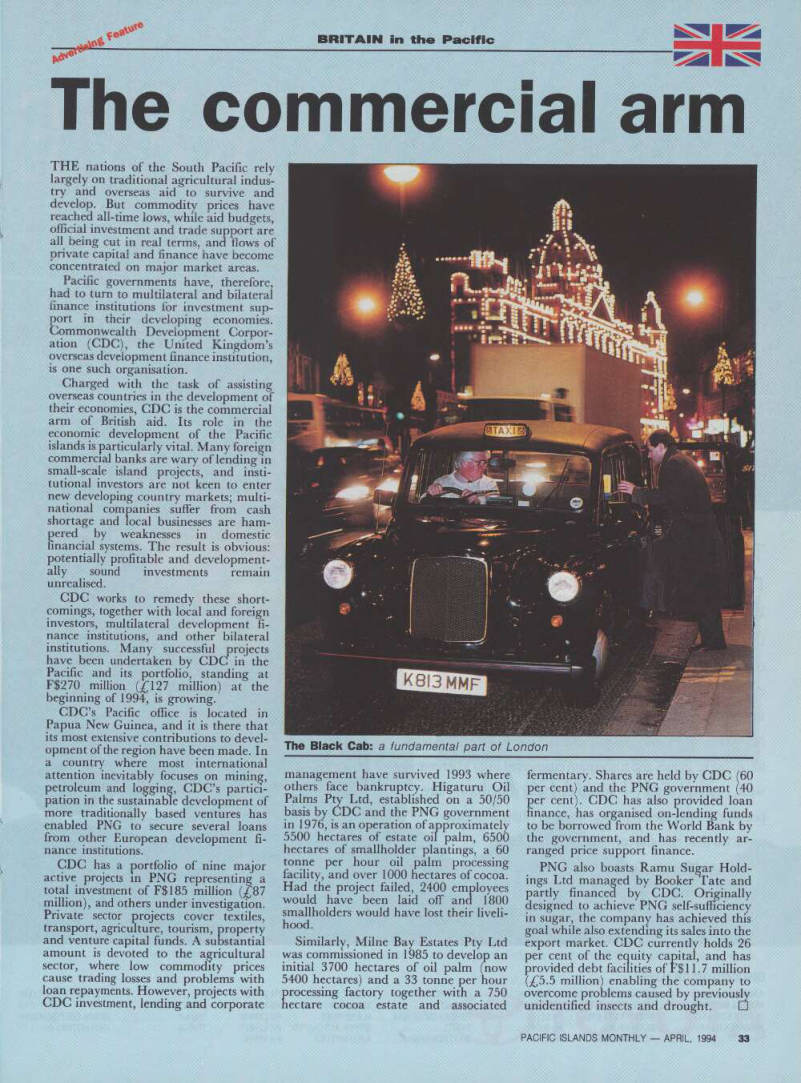
THE nations of the South Pacific rely largely on traditional agricultural indus try and overseas aid to survive and develop. But commodity prices have reached all-time lows, while aid budgets, official investment and trade support are all being cut in real terms, and flows of private capital and finance have become concentrated on major market areas.
Pacific governments have, therefore, had to turn to multilateral and bilateral finance institutions for investment sup port in their developing economies.
Commonwealth Development Corpor
ation (CDC), the United Kingdom’s overseas development finance institution, is one such organisation.
Charged with the task of assisting overseas countries in the development of their economies, CDC is the commercial arm of British aid. Its role in the economic development of the Pacific islands is particularly vital. Many foreign commercial banks are wary of lending in small-scale island projects, and insti tutional investors are not keen to enter new developing country markets; multi national companies suffer from cash shortage and local businesses are ham pered by weaknesses in domestic financial systems. The result is obvious:
potentially profitable and development
ally sound investments remain unrealised.
CDC works to remedy these short comings, together with local and foreign investors, multilateral development fi nance institutions, and other bilateral institutions. Many successful projects have been undertaken by CDC in the Pacific and its portfolio, standing at Fs27o million (£127 million) at the beginning of 1994, is growing.
CDC’s Pacific office is located in Papua New Guinea, and it is there that its most extensive contributions to devel opment of the region have been made. In a country where most international attention inevitably focuses on mining, petroleum and logging, CDC’s partici pation in the sustainable development of more traditionally based ventures has enabled PNG to secure several loans from other European development fi nance institutions.
CDC has a portfolio of nine major active projects m PNG representing a total investment of FslBs million (£B7 million), and others under investigation.
Private sector projects cover textiles, transport, agriculture, tourism, property and venture capital funds. A substantial amount is devoted to the agricultural sector, where low commodity prices cause trading losses and problems with loan repayments. However, projects with CDC investment, lending and corporate
management have survived 1993 where others face bankruptcy. Higaturu Oil Palms Pty Ltd, established on a 50/50 basis by CDC and the PNG government in 1976, is an operation of approximately 5500 hectares of estate oil palm, 6500 hectares of smallholder plantings, a 60 tonne per hour oil palm processing facility, and over 1000 hectares of cocoa.
Had the project failed, 2400 employees would have been laid off ana 1800 smallholders would have lost their liveli hood.
Similarly, Milne Bay Estates Pty Ltd was commissioned in 1985 to develop an initial 3700 hectares of oil palm (now 5400 hectares) and a 33 tonne per hour processing factory together with a 750 hectare cocoa estate and associated
fermentary. Shares are held by CDC (60 per cent) and the PNG government (40 per cent). CDC has also provided loan finance, has organised on-lending funds to be borrowed from the World Bank by the government, and has recently ar ranged price support finance.
PNG also boasts Ramu Sugar Hold ings Ltd managed by Booker Tate and partly financed by CDC. Originally designed to achieve PNG self-sufficiency in sugar, the company has achieved this goal while also extending its sales into the export market. CDC currently holds 26 per cent of the equity capital, and has provided debt facilities of F 511.7 million (£5.5 million) enabling the company to overcome problems caused by previously unidentified insects and drought. □
The Black Cab: a fundamental part of London
Advertisements & other items, pp. 33-35 (2 items)
33
ec ,v* e
BRITAIN in the Pacific
PACIFIC ISLANDS MONTHLY APRIL, 1994
and long-lasting durability.
«6|5
Toyota Land Cruiser offers you more
rugged reliability, elegant luxury...
and long-lasting durability.
Land Cruiser’s reputation is second to none. No one doubts its rugged constitution. Yet here is a vehicle that rivals the finest limousines where comfort is concerned. And its fit and finish, the attention to detail, and the graceful lines and fine trim are reminiscent of exquisite luxury cars.
Nevertheless, hidden beneath its elegance, Land Cruisers still offer tough ladder frames and suspension engineered to go wherever you wish,,, in total comfort powered by your choice of 4,5-litre petrol or 4.2-litre diesel engines. And everything is carefully protected from rust and corrosion so it lasts longer.
Toyota Land Cruiser. The best for your world.
Now and forever.
rtii
DISTRffiUTORS/DEALERS
AMERICAN SAMOA...
GUAM & MICRONESIA
NORFOLK ISLAND
SOLOMON ISLAND
VANUATU
BURNS PHILP MOTORS PH 633-4281
ATKINS KROLL, INC, PH 646-1876/9
BORRY’SPTYLTD. PH 22114
ELA MOTORS PH 30746
ASCO MOTORS PH 22341
COOK ISLANDS
KIRIBATI
PAPUA NEW GUINEA
TAHITI
WESTERN SAMOA ...
PACIFIC MOTORS LTD PH 20796
TARAWA MOTORS PH 21090
ELA MOTORS PH 229400
NIPPON AUTOMOTO PH 429819
ASCO MOTORS PH 23664
FIJI ASCO MOTORS
NEW CALEDONIA S.I.A.P,
SAIPAN MICROL CORPORATION
TONGA ASCO MOTORS
i s P||p|| i.r ■ c VifWCH
LAND CRUISER
r ■ •."■:■ - Exact features and specifications may vary depending on country of purchase. Please check with your nearest TOYOTA distributor/dealer for details.
PH312666 PH 275562 PH 234-5911 PH 23500
® TOYOTA
The last word?
Tourism
IN what we hope is the very last report on PlM’s survey on tourist bureaus, we must tell you about the latest responses from island tourist bureaus, those of Kiribati and Palau.
Back on November 5, 1993, we mailed tourist inquiries to 27 government tourist bureaus in the islands. By January 15, 1994, 17 of the islands had answered.
Some swiftly, more slowly. Some with inaccurate information. ''See articles in February and March issues of PIM.) Then, in the week of February 14, 1994 two more replies arrived, more than 100 days after the inquiry was mailed.
The oversized (14 3 /4” x 9 3 /4”) khaki colored envelope from Kiribati looked tired and careworn. It should have. It left Tarawa on December 2, 1993, and spent most of the next two months knocking around the British postal system.
The Kiribati Visitors Bureau air mailed its letter to David S North, 3113 N Kensington St., Arlington, Va., 22207, England but I live in the US, as the postage stamp and the return address on the envelope indicated.
An Assistant Tourism Officer for
Kiribati, missing the stamp and the envelop’s return address, assumed that I must be a Brit and so addressed his letter.
I am at least partially at fault because my name, and street and town address sound British, and, more importantly, my stationery does not carry a notation of the United States.
The British postal service, instead of sending it directly on to the States, tried to forward it to “Wl4”, a neighborhood in London, before marking it “USA.”
In his letter, the Kiribati official said that his letter was a followup to a fax that he had sent earlier, presumably to a British phone number I never saw it.
This made me feel badly because my letterhead unfortunately like all US letterheads I have ever seen does not include a country code for either the fax or the phone. That is arrogant of us.
Enclosed in the tired envelope were three brochures on the tourist attractions
of Kiribati, one dealing quite specifically
with Christmas Island, and the bonefish sport there. All the needed information was included, but the organisation of one of the brochures was a bit unusual it
was like a formal, European government report, rather than a sales pitch. Each of the paragraphs was numbered, such as
the following:
“4.06 Cruise. There are no regular visits by cruise boats but a few cruise calls carrying up to 600 passengers . . .
“5.01. National and Maritime Parks.
Kiribati does not have national forests or maritime parks, but does have a wild life sanctuary on Christmas Island . . .
“5.02 Museums. Kiribati does not have a museum at present. A new cultural centre at Bikenibeau housing artifacts ... is now in operation ...”
You have to love any tourism bureau that is as honest as Kiribati’s, even if they do lost track of an occasional address.
In comparison, Palau’s response was unremarkable except it did not answer my question about the side of the road used by automobiles. The Palau Visitors Authority, however, uses up-to date material. The brochures had Janu ary, 1994 dates on them. □
Tonga scores badly
Freedom
Tonga scores badly in freedom survey
SURE to be controversial are the latest set of ratings applied to Pacific entities - those of the Survey of Freedom made by Freedom House, an American think-tank.
While, as one might expect, Indonesia’s rule of Irian Jaya drew the worst rating available - equal to those of Haiti, Iraq, and North Korea - some of the middling ratings of Pacific entities might draw sharp com ments.
Generally the islands did well; 21 nations or territories were placed in the “Free Nations” or “Free Related Territories” categories, only three were in the “Partly Free” category, and only Irian Jaya was in the “Not Free” class.
But the Freedom House evaluators used a focus that is certain not to be accepted by some island leaders - the level of individual freedoms, in terms of political rights and civil liberties, not the degree with which decisions are made in Washington or Paris, as opposed
to locally.
So Fiji and PNG, where there is no interference from colonial powers, got ratings worse than those in French Polynesia and Guam, which are still struggling with metro
politan rulers.
The least desirable overall-rating for a Pacific nation went to Tonga, the only island territory whose voters do not elect a majority
of at least one house of the legislature. (While some Tongan legislators are elected by the voters, the majority are either chosen by a handful of nobles, or appointed by the King.) The broad sweep of the ratings, however, was not surprising. Most island jurisdictions did much better than the world average. Of the independent nations of the Pacific, Kiribati and Tuvalu secured perfect ratings of 1.0; most territories secured either a 1.0 or 1.5, while Tonga scored 4.0, and Irian Jaya was awarded a 7.0, the worst score available world-wide.
The most recent round of Freedom House ratings were based on an analysis of two factors —1) the politician rights of individ uals in a jurisdiction, such as strength of internal democratic institutions; and 2) the extent to which civil liberties are present.
The latter category included such question as media freedom, freedom of debate and assembly, and the presence of a free, nondiscriminatory judicial system. A total of
nine political rights questions, and thirteen
civil liberties questions were assessed by the evaluators, and then total scores of 1.0 to 7.0 were awarded for the political rights category, and for the civil liberties rating. The average scores for these two categories are shown in the table.
A score of 1.5, for example, meant that the
jurisdiction had a score of 1.0 on one variable, and 2.0 on the other. With a single exception, the entities scoring 1.5 in the table had perfect scores on political rights, and less than perfect (2.0) marks for civil liberties. The exception is Austalia’s Norfolk Island, where, appar ently, political rights are limited but Aussie style civil liberties prevail.
The ratings for Nauru (1.0 for political rights (PR) and 3.0 for civil liberties (CL) and for PNG (PR = 2.0 and CL -4.0) fall into this same category.
On the other hand both Fiji and Tonga secured 3.0 CL ratings, with less attractive PR ratings (4.0 for Fiji and 5.0 for Tonga). The coups in Fiji and the continuing, well publicized autocratic structure in Tonga
presumable causing the latter ratings.
There are some anomalies in these ratings, partially due to the fact the Freedom House did not conduct any field visits to the Pacific.
For example, the Cooks are regarded as a “Related Territory” while FSM and the Marshalls are treated as “Nations.” All three are associated states, and one might expect all three to wind up in the same category.
More significantly, American Samoa is now the only major island jurisdiction, other than Tonga, with a limited franchise (matai votina) for a powerful legislative body, the Senate. Odd that an American institution, such as Freedom House, gives American Samoa high marks for political rights when voting for one house of the legislature. (There is chiefly voting for upper houses of legis latures in some other islands, but none of these bodies have full legislative powers.) Maybe Freedom House does not know everything it should about American Samoa, and perhaps other places as well. □
Hereniko comes of age
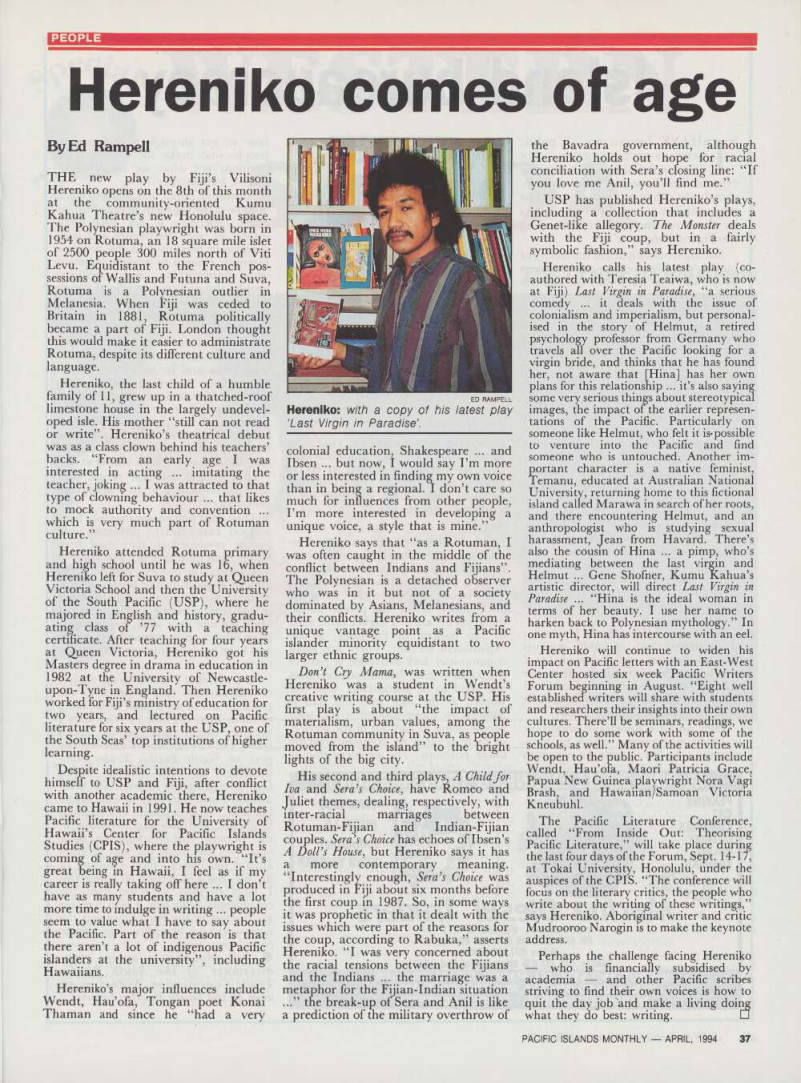
People
By Ed Rampell
THE new play by Fiji’s Vilisoni
Hereniko opens on the Bth of this month at the community-oriented Kumu Kahua Theatre’s new Honolulu space.
The Polynesian playwright was born in 1954 on Rotuma, an 18 square mile islet of 2500 people 300 miles north of Viti Levu. Equidistant to the French pos sessions of Wallis and Futuna and Suva, Rotuma is a Polynesian outlier in Melanesia. When Fiji was ceded to Britain in 1881, Rotuma politically became a part of Fiji. London thought this would make it easier to administrate Rotuma, despite its different culture and
language.
Hereniko, the last child of a humble family of 11, grew up in a thatched-roof limestone house in the largely undevel oped isle. His mother “still can not read or write”. Hereniko’s theatrical debut was as a class clown behind his teachers’ backs. “From an early age I was interested in acting ... imitating the teacher, joking ... I was attracted to that type of clowning behaviour ... that likes to mock authority and convention ... which is very much part of Rotuman culture.”
Hereniko attended Rotuma primary and high school until he was 16, when Hereniko left for Suva to study at Queen Victoria School and then the University of the South Pacific (USP), where he
majored in English and history, gradu
ating class of ’77 with a teaching certificate. After teaching for four years at Queen Victoria, Hereniko got his Masters degree in drama in education in 1982 at the University of Newcastle upon-Tyne in England. Then Hereniko worked for Fiji’s ministry of education for two years, and lectured on Pacific literature for six years at the USP, one of the South Seas’ top institutions of higher
learning.
Despite idealistic intentions to devote himself to USP and Fiji, after conflict with another academic there, Hereniko came to Hawaii in 1991. He now teaches Pacific literature for the University of Hawaii’s Center for Pacific Islands Studies (CPIS), where the playwright is coming of age and into his own. “It’s great being in Hawaii, I feel as if my career is really taking off here ... I don’t have as many students and have a lot more time to indulge in writing ... people seem to value what I have to say about the Pacific. Part of the reason is that there aren’t a lot of indigenous Pacific islanders at the university”, including Hawaiians.
Hereniko’s major influences include Wendt, Hau’ofa, Tongan poet Konai Thaman and since he “had a very
colonial education, Shakespeare ... and Ibsen ... but now, I would say I’m more or less interested in finding my own voice than in being a regional. I don’t care so much for influences from other people, I’m more interested in developing a unique voice, a style that is mine.”
Hereniko says that “as a Rotuman, I was often caught in the middle of the conflict between Indians and Fijians”.
The Polynesian is a detached observer who was in it but not of a society dominated by Asians, Melanesians, and their conflicts. Hereniko writes from a unique vantage point as a Pacific islander minority equidistant to two larger ethnic groups.
Don’t Cry Mama, was written when Hereniko was a student in Wendt’s creative writing course at the USP. His first play is about “the impact of materialism, urban values, among the Rotuman community in Suva, as people moved from the island” to the bright
lights of the big city.
His second and third plays, A Child for Iva and Sera’s Choice, have Romeo and Juliet themes, dealing, respectively, with inter-racial marriages between Rotuman-Fijian and Indian-Fijian couples. Sera’s Choice has echoes of Ibsen’s A Doll’s House, but Hereniko says it has a more contemporary meaning.
“Interestingly enough, Sera’s Choice was produced in Fiji about six months before the first coup in 1987. So, in some ways it was prophetic in that it dealt with the issues which were part of the reasons for the coup, according to Rabuka,” asserts Hereniko. “I was very concerned about the racial tensions between the Fijians and the Indians ... the marriage was a metaphor for the Fijian-Indian situation ...” the break-up of Sera and Anil is like a prediction of the military overthrow of
the Bavadra government, although Hereniko holds out hope for racial conciliation with Sera’s closing line: “If you love me Anil, you’ll find me.”
USP has published Hereniko’s plays, including a collection that includes a Genet-like allegory. The Monster deals with the Fiji coup, but in a fairly symbolic fashion,” says Hereniko.
Hereniko calls his latest play (co authored with Teresia Teaiwa, who is now at Fiji) Last Virgin in Paradise, “a serious comedy ... it deals with the issue of colonialism and imperialism, but personal ised in the story of Helmut, a retired psychology professor from Germany who travels all over the Pacific looking for a virgin bride, and thinks that he has found her, not aware that [Hina] has her own plans for this relationship ... it’s also saying some very serious things about stereotypical images, the impact of the earlier represen tations of the Pacific. Particularly on someone like Helmut, who felt it is* possible to venture into the Pacific and find someone who is untouched. Another im portant character is a native feminist, Temanu, educated at Australian National University, returning home to this fictional island called Marawa in search of her roots, and there encountering Helmut, and an anthropologist who is studying sexual harassment, Jean from Havard. There’s also the cousin of Hina ... a pimp, who’s mediating between the last virgin and Helmut ... Gene Shofner, Kumu Kahua’s artistic director, will direct Last Virgin in Paradise ... “Hina is the ideal woman in terms of her beauty. I use her name to harken back to Polynesian mythology.” In one myth, Hina has intercourse with an eel.
Hereniko will continue to widen his impact on Pacific letters with an East-West Center hosted six week Pacific Writers Forum beginning in August. “Eight well established writers will share with students and researchers their insights into their own cultures. There’ll be seminars, readings, we hope to do some work with some of the schools, as well.” Many of the activities will be open to the public. Participants include Wendt, Hau’ofa, Maori Patricia Grace, Papua New Guinea playwright Nora Vagi Brash, and Hawaiian/Samoan Victoria Kneubuhl.
The Pacific Literature Conference, called “From Inside Out: Theorising Pacific Literature,” will take place during the last four days of the Forum, Sept. 14-17, at Tokai University, Honolulu, under the auspices of the CPIS. “The conference will focus on the literary critics, the people who write about the writing of these writings,” says Hereniko. Aboriginal writer and critic Mudrooroo Narogin is to make the keynote address.
Perhaps the challenge facing Hereniko
who is financially subsidised by academia and other Pacific scribes striving to find their own voices is how to quit the day job and make a living doing what they do best: writing. □
Ed Rampell
Hereniko: with a copy of his latest play ‘Last Virgin in Paradise’.
Island bureaucracy
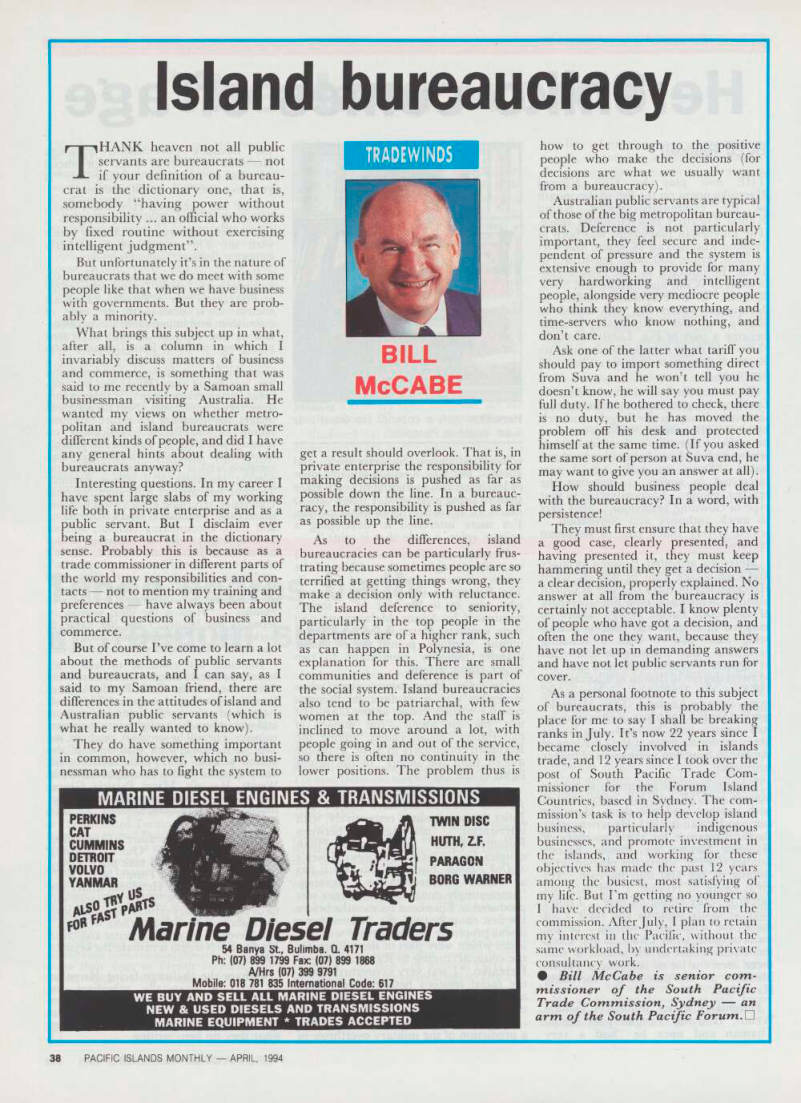
THANK heaven not all public servants are bureaucrats not if your definition of a bureau crat is the dictionary one, that is,
somebody “having power without
responsibility ... an official who works by fixed routine without exercising
intelligent judgment”.
But unfortunately it’s in the nature of bureaucrats that we do meet with some people like that when we have business with governments. But they are prob
ably a minority.
What brings this subject up in what, after all, is a column in which I invariably discuss matters of business and commerce, is something that was said to me recently by a Samoan small businessman visiting Australia. He wanted my views on whether metro politan and island bureaucrats were different kinds of people, and did I have any general hints about dealing with
bureaucrats anyway?
Interesting questions. In my career I have spent large slabs of my working life both in private enterprise and as a public servant. But I disclaim ever being a bureaucrat in the dictionary sense. Probably this is because as a trade commissioner in different parts of the world my responsibilities and con tacts not to mention my training and preferences have always been about practical questions of business and commerce.
But of course I’ve come to learn a lot about the methods of public servants and bureaucrats, and I can say, as I said to my Samoan friend, there are differences in the attitudes of island and Australian public servants (which is what he really wanted to know).
They do have something important
in common, however, which no busi nessman who has to fight the system to
get a result should overlook. That is, in
private enterprise the responsibility for
making decisions is pushed as far as possible down the line. In a bureauc racy, the responsibility is pushed as far as possible up the line.
As to the differences, island bureaucracies can be particularly frus trating because sometimes people are so
terrified at getting things wrong, they
make a decision only with reluctance.
The island deference to seniority, particularly in the top people in the departments are of a higher rank, such as can happen in Polynesia, is one explanation for this. There are small communities and deference is part of the social system. Island bureaucracies also tend to be patriarchal, with few women at the top. And the staff is inclined to move around a lot, with people going in and out of the service, so there is often no continuity in the lower positions. The problem thus is
how to get through to the positive people who make the decisions (for decisions are what we usually want from a bureaucracy).
Australian public servants are typical of those of the big metropolitan bureau crats. Deference is not particularly important, they feel secure and inde pendent of pressure and the system is extensive enough to provide for many
very hardworking and intelligent
people, alongside very mediocre people
who think they know everything, and time-servers who know nothing, and don’t care.
Ask one of the latter what tariff you should pay to import something direct from Suva and he won’t tell you he doesn’t know, he will say you must pay full duty. If he bothered to check, there is no duty, but he has moved the problem off his desk and protected himself at the same time. (If you asked the same sort of person at Suva end, he may want to give you an answer at all).
How should business people deal with the bureaucracy? In a word, with
persistence!
They must first ensure that they have
a good case, clearly presented, and
having presented it, they must keep
hammering until they get a decision a clear decision, properly explained. No answer at all from the bureaucracy is
certainly not acceptable. I know plenty
of people who have got a decision, and often the one they want, because they have not let up in demanding answers and have not let public servants run for cover.
As a personal footnote to this subject of bureaucrats, this is probably the place for me to say I shall be breaking ranks in July. It’s now 22 years since I became closely involved in islands trade, and 12 years since I took over the post of South Pacific Trade Com missioner for the Forum Island Countries, based in Sydney. The com mission’s task is to help develop island
business, particularly indigenous
businesses, and promote investment in the islands, and working for these objectives has made the past 12 years among the busiest, most satisfying of my life. But I’m getting no younger so I have decided to retire from the commission. After July, I plan to retain my interest in the Pacific, without the
same workload, by undertaking private
consultancy work.
• Bill McCabe is senior com missioner of the South Pacific Trade Commission, Sydney an arm of the South Pacific Forum. □
Tradewinds
Bill
Mccabe
Advertisements & other items, p. 38 (1 item)
Marine Diesel Traders
MARINE DIESEL ENGINES & TRANSMISSIONS
PERKINS
CAT
CUMMINS
DETROIT
VOLVO
YANMAR
Marine Diesel Traders
FOB
TWIN DISC
HUTH, Z.F.
PARAGON
BORG WARNER
54 Banya St, Bulimba. QL 4171 Ph: (07) 899 1799 Fax: (07) 899 1868 A/Hrs (07) 399 9791 Mobile; 018 781 835 International Code: 617 WE BUY AND SELL ALL MARINE DIESEL ENGINES
NEW & USED DIESELS AND TRANSMISSIONS
MARINE EQUIPMENT * TRADES ACCEPTED
Western
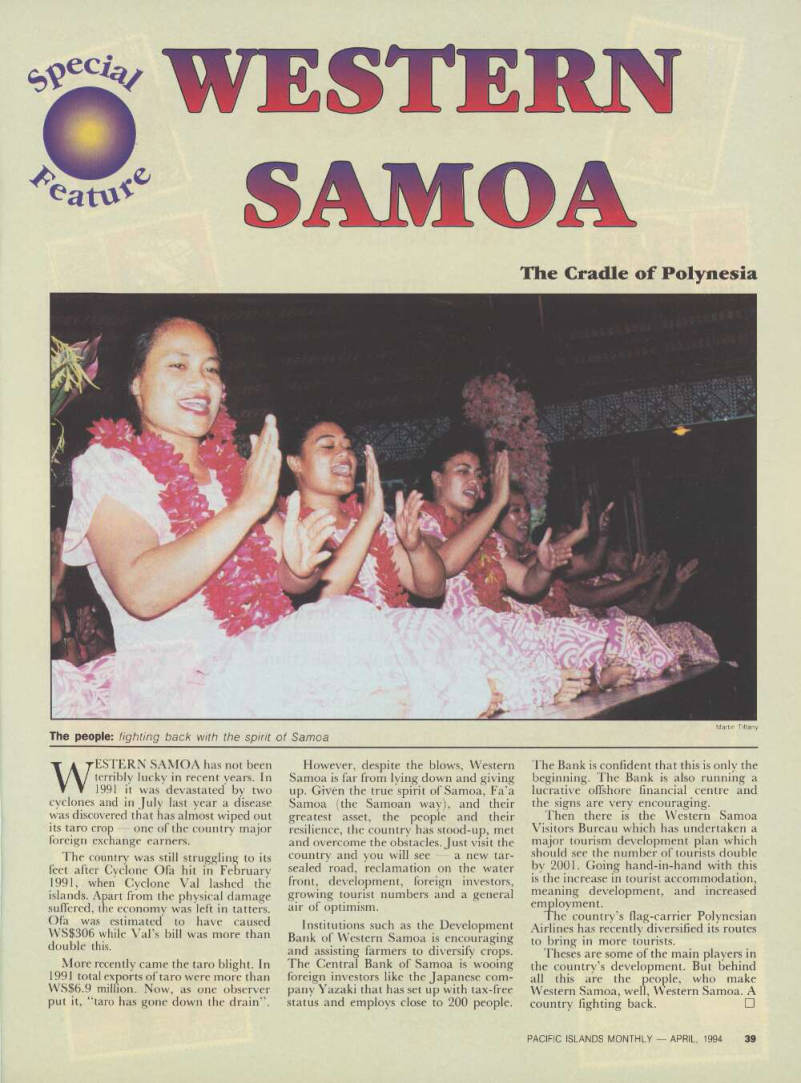
Samoa
WESTERN SAMOA has not been terribly lucky in recent years. In 1991 it was devastated by two cyclones and in July last year a disease was discovered that has almost wiped out its taro crop one of the country major
foreign exchange earners.
The country was still struggling to its feet after Cyclone Ofa hit in February 1991, when Cyclone Val lashed the
islands. Apart from the physical damage
suffered, the economy was left in tatters.
Ofa was estimated to have caused WSS3O6 while Val’s bill was more than double this.
More recently came the taro blight. In 1991 total exports of taro were more than WS$6.9 million. Now, as one observer put it, “taro has gone down the drain”.
However, despite the blows, Western Samoa is far from lying down and giving up. Given the true spirit of Samoa, Fa’a Samoa (the Samoan way), and their greatest asset, the people and their resilience, the country has stood-up, met and overcome the obstacles. Just visit the country and you will see a new tar sealed road, reclamation on the water
front, development, foreign investors,
growing tourist numbers and a general air of optimism.
Institutions such as the Development Bank of Western Samoa is encouraging and assisting farmers to diversify crops.
The Central Bank of Samoa is wooing foreign investors like the Japanese com pany Yazaki that has set up with tax-free status and employs close to 200 people.
The Bank is confident that this is only the beginning. The Bank is also running a lucrative offshore financial centre and the signs are very encouraging.
Then there is the Western Samoa Visitors Bureau which has undertaken a
major tourism development plan which
should see the number of tourists double by 2001. Going hand-in-hand with this is the increase in tourist accommodation,
meaning development, and increased
employment.
The country’s flag-carrier Polynesian
Airlines has recently diversified its routes to bring in more tourists.
Theses are some of the main players in the country’s development. But behind all this are the people, who make Western Samoa, well, Western Samoa. A country fighting back. □
The Cradle of Polynesia
Martin Tiffany
The people: fighting back with the spirit of Samoa
Advertisements & other items, p. 40 (1 item)
Samoa
Exotic Stamps of
The Heart of Polynesian
Your Treasure Chest
from
SOUTH PACIFIC
K 3 umv Etfl flaw
SAMOA
Even if you do not collect stamps, please come and look at our postage stamps. They are as beautiful as our island nation and are sure to tempt you to start
collecting stamps.
If you do collect stamps then we
definitely have that something
extra that will add a touch of class to your thematic collection.
Any why not send some of these beautiful stamps to your friend and dear ones?
They make a great Gift!
For details Write or Visit
PHILATELIC BUREAU
POSTS & TELECOMMUNICATIONS DEPT
CHIEF POST OFFICE
APIA WESTERN SAMOA
(South Pacific) Fax 0685 24000 Phone 0685 20720 <6 m mm Sarr> Oen
s 4MO/{
mre Acon,h “ros, ineof
UNED SURGEON?!
J9P3
SAMOA
y s with ( Jjhldiiess men of M... 60, „ S£ V£jv t'GB y % % **l & Jl Wm.
Investment guide
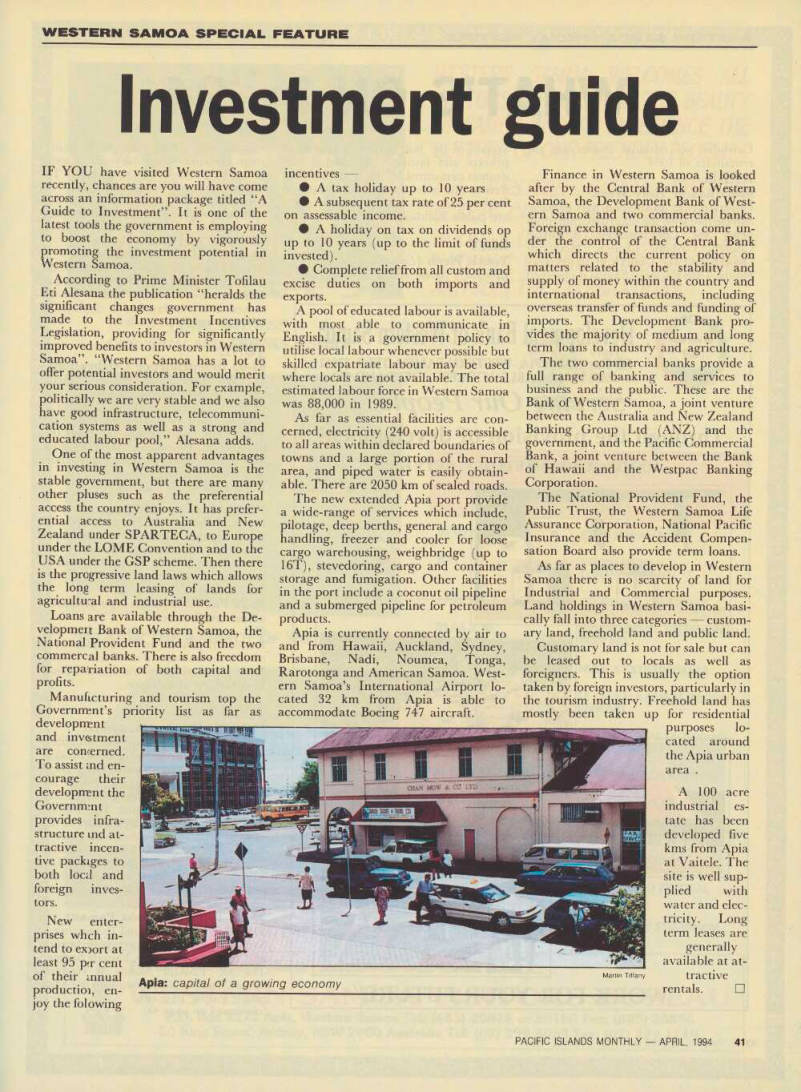
Western Samoa Special Feature
IF YOU have visited Western Samoa recently, chances are you will have come across an information package titled “A Guide to Investment”. It is one of the latest tools the government is employing to boost the economy by vigorously promoting the investment potential in Western Samoa.
According to Prime Minister Tofilau Eti Alesana the publication “heralds the significant changes government has made to the Investment Incentives
Legislation, providing for significantly
improved benefits to investors in Western Samoa”. “Western Samoa has a lot to offer potential investors and would merit your serious consideration. For example, politically we are very stable and we also have good infrastructure, telecommuni cation systems as well as a strong and educated labour pool,” Alesana adds.
One of the most apparent advantages in investing in Western Samoa is the stable government, but there are many other pluses such as the preferential access the country enjoys. It has prefer ential access to Australia and New Zealand under SPARTECA, to Europe under the LOME Convention and to the USA under the GSP scheme. Then there is the progressive land laws which allows the long term leasing of lands for agricultural and industrial use.
Loans are available through the De velopmert Bank of Western Samoa, the National Provident Fund and the two commercal banks. There is also freedom for reparation of both capital and profits.
Manuhcturing and tourism top the Governrrent’s priority list as far as
development and investment are concerned.
To assist ;nd en courage their development the Government
provides infra
structure md at tractive incen tive packiges to both loed and foreign inves tors.
New enter prises whch in tend to export at least 95 per cent of their mnual productioi, en joy the folowing
incentives • A tax holiday up to 10 years • A subsequent tax rate of 25 per cent on assessable income. • A holiday on tax on dividends op up to 10 years (up to the limit of funds
invested).
• Complete relief from all custom and excise duties on both imports and exports.
A pool of educated labour is available, with most able to communicate in English. It is a government policy to utilise local labour whenever possible but skilled expatriate labour may be used where locals are not available. The total estimated labour force in Western Samoa was 88,000 in 1989.
As far as essential facilities are con
cerned, electricity (240 volt) is accessible
to all areas within declared boundaries of towns and a large portion of the rural area, and piped water is easily obtain able. There are 2050 km of sealed roads.
The new extended Apia port provide a wide-range of services which include,
pilotage, deep berths, general and cargo
handling, freezer and cooler for loose
cargo warehousing, weighbridge (up to
16T), stevedoring, cargo and container storage and fumigation. Other facilities in the port include a coconut oil pipeline
and a submerged pipeline for petroleum
products.
Apia is currently connected by air to and from Hawaii, Auckland, Sydney, Brisbane, Nadi, Noumea, Tonga, Rarotonga and American Samoa. West ern Samoa’s International Airport lo cated 32 km from Apia is able to accommodate Boeing 747 aircraft.
Finance in Western Samoa is looked after by the Central Bank of Western Samoa, the Development Bank of West ern Samoa and two commercial banks.
Foreign exchange transaction come un der the control of the Central Bank which directs the current policy on matters related to the stability and supply of money within the country and international transactions, including overseas transfer of funds and funding of imports. The Development Bank pro vides the majority of medium and long term loans to industry and agriculture.
The two commercial banks provide a full range of banking and services to business and the public. These are the Bank of Western Samoa, a joint venture between the Australia and New Zealand Banking Group Ltd (ANZ) and the government, and the Pacific Commercial Bank, a joint venture between the Bank of Hawaii and the Westpac Banking
Corporation.
The National Provident Fund, the Public Trust, the Western Samoa Life Assurance Corporation, National Pacific Insurance and the Accident Compen sation Board also provide term loans.
As far as places to develop in Western Samoa there is no scarcity of land for Industrial and Commercial purposes.
Land holdings in Western Samoa basi cally fall into three categories custom ary land, freehold land and public land.
Customary land is not for sale but can be leased out to locals as well as foreigners. This is usually the option taken by foreign investors, particularly in the tourism industry. Freehold land has mostly been taken up for residential
purposes lo cated around the Apia urban area .
A 100 acre industrial es tate has been
developed five
kms from Apia at Vaitele. The site is well sup
plied with
water and elec
tricity. Long
term leases are
generally
available at at tractive rentals. □
Apia: capital of a growing economy
Marlin Tiffany
What’S On In ‘94
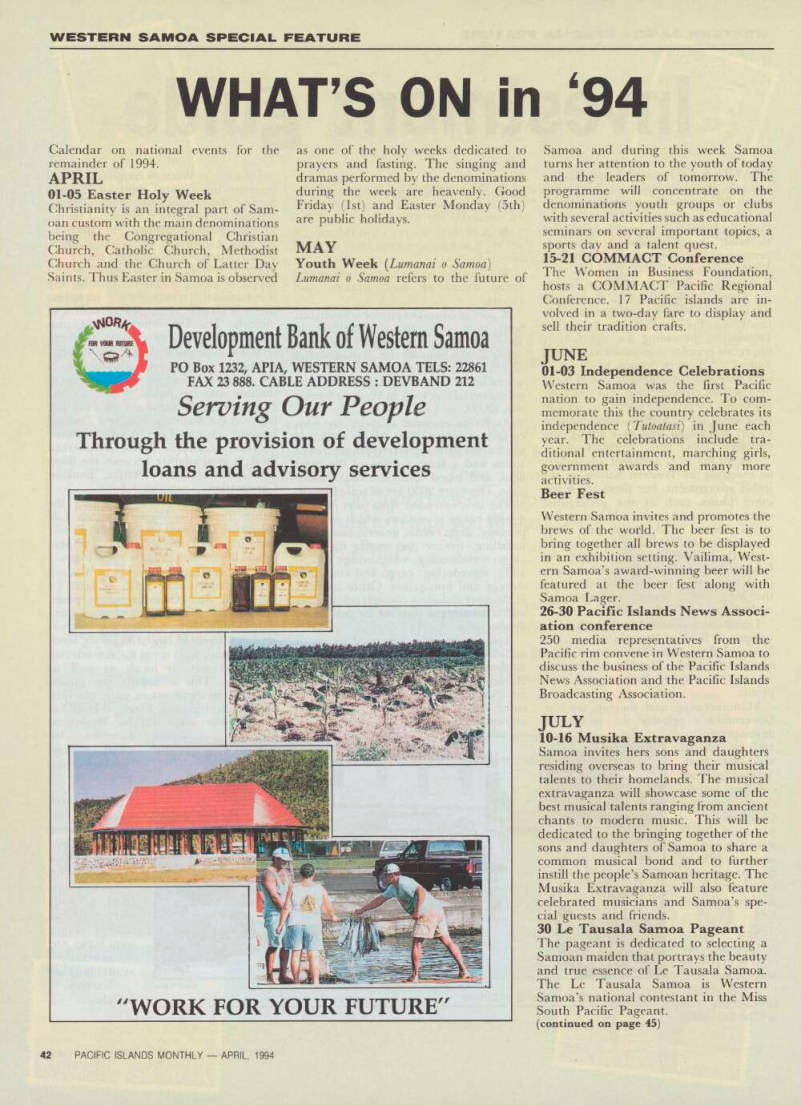

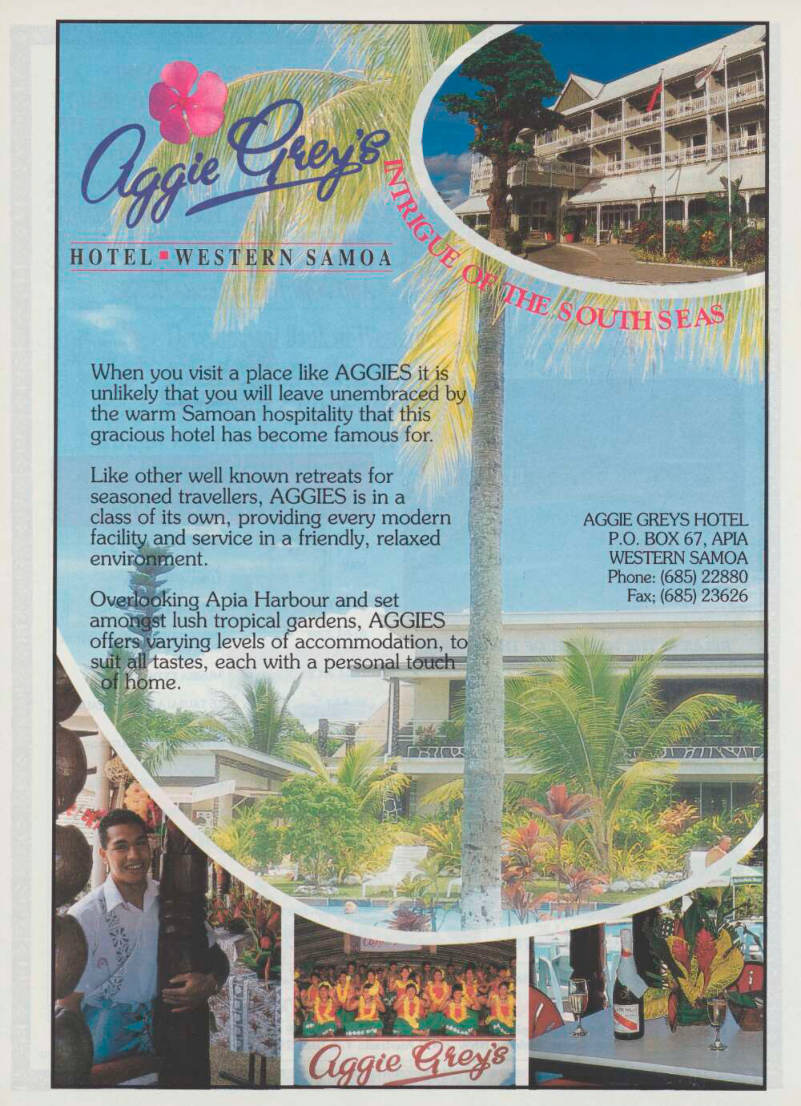
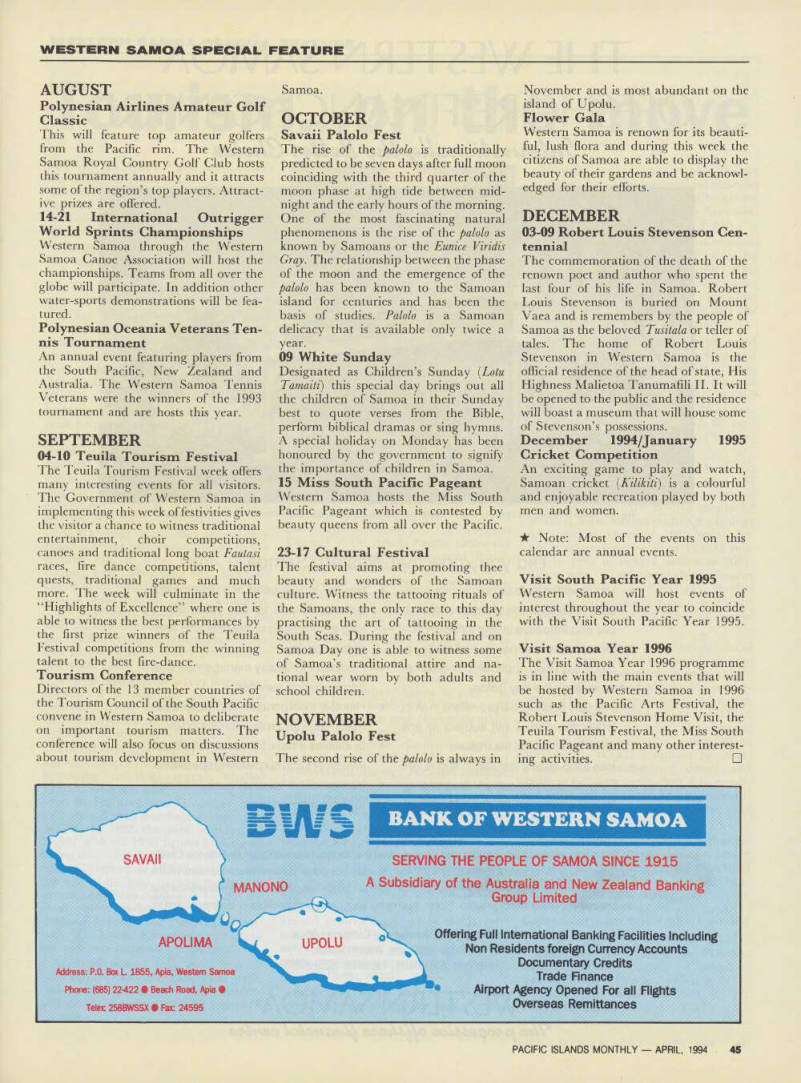
Calendar on national events for the remainder of 1994.
April
01-05 Easter Holy Week Christianity is an integral part of Sam oan custom with the main denominations being the Congregational Christian Church, Catholic Church, Methodist Church and the Church of Latter Day Saints. Thus Easter in Samoa is observed
as one of the holy weeks dedicated to prayers and fasting. The singing and dramas performed by the denominations during the week are heavenly. Good Friday (Ist) and Easter Monday (sth) are public holidays.
May
Youth Week (Lumanai o Samoa) Lumanai o Samoa refers to the future of
Samoa and during this week Samoa turns her attention to the youth of today and the leaders of tomorrow. The programme will concentrate on the denominations youth groups or clubs with several activities such as educational seminars on several important topics, a sports day and a talent quest. 15-21 COMMACT Conference The Women in Business Foundation, hosts a COMMACT Pacific Regional Conference. 17 Pacific islands are in volved in a two-day fare to display and sell their tradition crafts.
June
01-03 Independence Celebrations Western Samoa was the first Pacific nation to gain independence. To com memorate this the country celebrates its independence ( Tutoatasi ) in June each year. The celebrations include tra
ditional entertainment, marching girls,
government awards and many more activities.
Beer Fest Western Samoa invites and promotes the brews of the world. The beer fest is to bring together all brews to be displayed in an exhibition setting. Vailima, West ern Samoa’s award-winning beer will be featured at the beer fest along with Samoa Lager. 26-30 Pacific Islands News Associ ation conference 250 media representatives from the Pacific rim convene in Western Samoa to discuss the business of the Pacific Islands News Association and the Pacific Islands
Broadcasting Association.
July
10-16 Musika Extravaganza Samoa invites hers sons and daughters residing overseas to bring their musical talents to their homelands. The musical extravaganza will showcase some of the best musical talents ranging from ancient chants to modern music. This will be dedicated to the bringing together of the sons and daughters of Samoa to share a common musical bond and to further instill the people’s Samoan heritage. The Musika Extravaganza will also feature celebrated musicians and Samoa’s spe cial guests and friends. 30 Le Tausala Samoa Pageant The pageant is dedicated to selecting a Samoan maiden that portrays the beauty and true essence of Le Tausala Samoa.
The Le Tausala Samoa is Western Samoa’s national contestant in the Miss South Pacific Pageant. (continued on page 45)
August
Polynesian Airlines Amateur Golf Classic This will feature top amateur golfers from the Pacific rim. The Western Samoa Royal Country Golf Club hosts this tournament annually and it attracts some of the region’s top players. Attract ive prizes are offered. 14-21 International Outrigger
World Sprints Championships
Western Samoa through the Western Samoa Canoe Association will host the championships. Teams from all over the globe will participate. In addition other water-sports demonstrations will be fea tured.
Polynesian Oceania Veterans Ten nis Tournament An annual event featuring players from the South Pacific, New Zealand and Australia. The Western Samoa Tennis Veterans were the winners of the 1993 tournament and are hosts this year.
September
04-10 Teuila Tourism Festival The Teuila Tourism Festival week offers many interesting events for all visitors.
The Government of Western Samoa in implementing this week of festivities gives the visitor a chance to witness traditional entertainment, choir competitions, canoes and traditional long boat Fautasi races, fire dance competitions, talent quests, traditional games and much more. The week will culminate in the ‘‘Highlights of Excellence” where one is able to witness the best performances by the first prize winners of the Teuila Festival competitions from the winning talent to the best fire-dance.
Tourism Conference Directors of the 13 member countries of the Tourism Council of the South Pacific convene in Western Samoa to deliberate on important tourism matters. The conference will also focus on discussions about tourism development in Western
Samoa.
October
Savaii Palolo Fest The rise of the palolo is traditionally predicted to be seven days after full moon coinciding with the third quarter of the moon phase at high tide between mid night and the early hours of the morning.
One of the most fascinating natural phenomenons is the rise of the palolo as known by Samoans or the Eunice Viridis
Gray. The relationship between the phase
of the moon and the emergence of the palolo has been known to the Samoan island for centuries and has been the basis of studies. Palolo is a Samoan delicacy that is available only twice a year. 09 White Sunday
Designated as Children’s Sunday (. Lotu
Tamaiti ) this special day brings out all the children of Samoa in their Sunday best to quote verses from the Bible,
perform biblical dramas or sing hymns.
A special holiday on Monday has been honoured by the government to signify the importance of children in Samoa. 15 Miss South Pacific Pageant Western Samoa hosts the Miss South Pacific Pageant which is contested by beauty queens from all over the Pacific. 23-17 Cultural Festival The festival aims at promoting thee beauty and wonders of the Samoan culture. Witness the tattooing rituals of the Samoans, the only race to this day practising the art of tattooing in the South Seas. During the festival and on Samoa Day one is able to witness some of Samoa’s traditional attire and na tional wear worn by both adults and school children.
November
Upolu Palolo Fest The second rise of the palolo is always in
November and is most abundant on the island of Upolu.
Flower Gala Western Samoa is renown for its beauti ful, lush flora and during this week the citizens of Samoa are able to display the beauty of their gardens and be acknowl edged for their efforts.
December
03-09 Robert Louis Stevenson Cen tennial The commemoration of the death of the renown poet and author who spent the last four of his life in Samoa. Robert Louis Stevenson is buried on Mount Vaea and is remembers by the people of Samoa as the beloved Tusitala or teller of tales. The home of Robert Louis Stevenson in Western Samoa is the official residence of the head of state, His Highness Malietoa Tanumalili 11. It will be opened to the public and the residence will boast a museum that will house some of Stevenson’s possessions.
December 1994/January 1995
Cricket Competition
An exciting game to play and watch, Samoan cricket ( Kilikiti ) is a colourful
and enjoyable recreation played by both
men and women. ★ Note: Most of the events on this calendar are annual events.
Visit South Pacific Year 1995 Western Samoa will host events of interest throughout the year to coincide with the Visit South Pacific Year 1995.
Visit Samoa Year 1996 The Visit Samoa Year 1996 programme is in line with the main events that will be hosted by Western Samoa in 1996 such as the Pacific Arts Festival, the Robert Louis Stevenson Home Visit, the Teuila Tourism Festival, the Miss South Pacific Pageant and many other interest ing activities. □
Advertisements & other items, pp. 42-46 (1 item)
Serving Our People
I N I
Development Bank of Western Samoa
PO Box 1232, APIA, WESTERN SAMOA TEES: 22861 FAX 23 888. CABLE ADDRESS : DEVBAND 212
Serving Our People
Through the provision of development
loans and advisory services
. -I * w Si
•f-IS.,
Wi -=i mm;-- •* I ? i i A . .
WORK FOR YOUR FUTURE'
w
COME , WITNESS
OUR ‘SIVA’ AND FRIENDLY SMILE
ISisiiliii - RELAX IN THE WARMTH OF THE PACIFIC MtS- .WtSTERH S&Hui' »I IMS Hunt.
f WESTERN SAMOA
VISITORS BUREAU
( /f- **
SAMOA IS WAITING
WESTERN SAMOA WELCOMES ALL
VISITORS TO DISCOVER THE BEAUTY
OF SAMOA AND TO EXPERIENCE THE
CULTURE OF OUR FRIENDLY PEOPLE.
THE WESTERN SAMOA VISITORS
BUREAU OFFERS YOU A MEMORABLE
HOLIDAY COINCIDING WITH SPECIAL
NATIONAL EVENTS. COME TO SAMOA
AND JOIN THE CELEBRATIONS.
For more information please contact:
WESTERN SAMOA VISITORS BUREAU
P.O. Box 2272 Apia, Western Samoa Tel: (685) 20878 or 20180 Fax: (685) 20886 50 King Street, Sydney, NSW 2000 Australia Tel: (02) 299 3039 Fax: (02) 299 1119
u mm 0/ IF-.. |J#S u*? , , . ■ it * Q.
HOTEL-WESTERN SAMOA
When you visit a place like AGGIES it is unlikely that you will leave unembraced by the warm Samoan hospitality that this gracious hotel has become famous for.
Like other well known retreats for seasoned travellers, AGGIES is in a class of its own, providing every modern facility and service in a friendly, relaxed environment.
TO
south
yap Apia Harbour and set amongst lush tropical gardens, AGGIES offers varying levels of accommodation, to suit all tastes, each with a personal toielf® ibf home. -a* d
AGGIE GREYS HOTEL
P.O. BOX 67, APIA
WESTERN SAMOA
Phone: (685) 22880 Fax; (685) 23626 wsasrv f,. 111 J.V IS 111 mm wmM
Ik w'
in/ \
Bwii«WEga^H@9B
c ETi ;».k • r . m IB
NTS
K£ r*~ m mi U- * 8 a*
SAVAI!
MANONO
APOLIMA
UPOLU
Address: P.O. Box L 1855, Apia, Western Samoa Phone: (685) 22422 • Beach Road, Apia • Telex; 258BWSSX • Fax: 24595
BANK OF WESTERN SAMOA
SERVING THE PEOPLE OF SAMOA SINCE 1915 A Subsidiary of the Australia and New Zealand Banking Group Limited Offering Full International Banking Facilities Including Non Residents foreign Currency Accounts Documentary Credits Trade Finance Airport Agency Opened For all Rights Overseas Remittances
THE WESTERN SAMOA
OFFSHORE FINANCE CENTRE
9M<teSMxit4<mcdUf, the Qettesi Choice
m
CENTRAL
BANK
SAMOA
■ - ‘ ■rPl i I * The new Central Bank Building, opened in February 1993, provides the registered office of the International Companies Registry.
Did you know that
• Has recently made its international company legislation one of the most innovative and attractive in any jurisdiction. • Incorporates companies and trusts immediately upon application and sometimes even the day before. • Has very confidential provisions in all its legislation and is not subject to any other international tax treaties. • Has a top quality reputation and is free from all suggestions of drug money laundering and othercriminal activities.
Western Samoa:
• Has the total support of a government recently elected for five years with a long background of political and economic stability. • Provides top quality management and administration services. • Has low incorporation and post-registration fees and management costs. • Is ideal as a base for your international investment and tax planning operations. • Has excellent telecommunication and airline connections To find out more about the benefits and services that the Western Samoa Offshore Finance Centre can offer you or to receive a free 3.5" or 5.25" high density computer diskette which contains all the updated consolidated offshore legislation for international companies, trusts, banking, insurance and trustee companies in Word Perfect 5.1 form, mail or fax your name and address or business card to: The Registrar, International Companies Office PO Box 3265, Apia, Western Samoa.
Telephone: (685) 24071. Facsimile: (685) 20880
WESTERN SAMOA
*7/te pSuujsAAiue pMOitclcd centre
Tourism...on the move
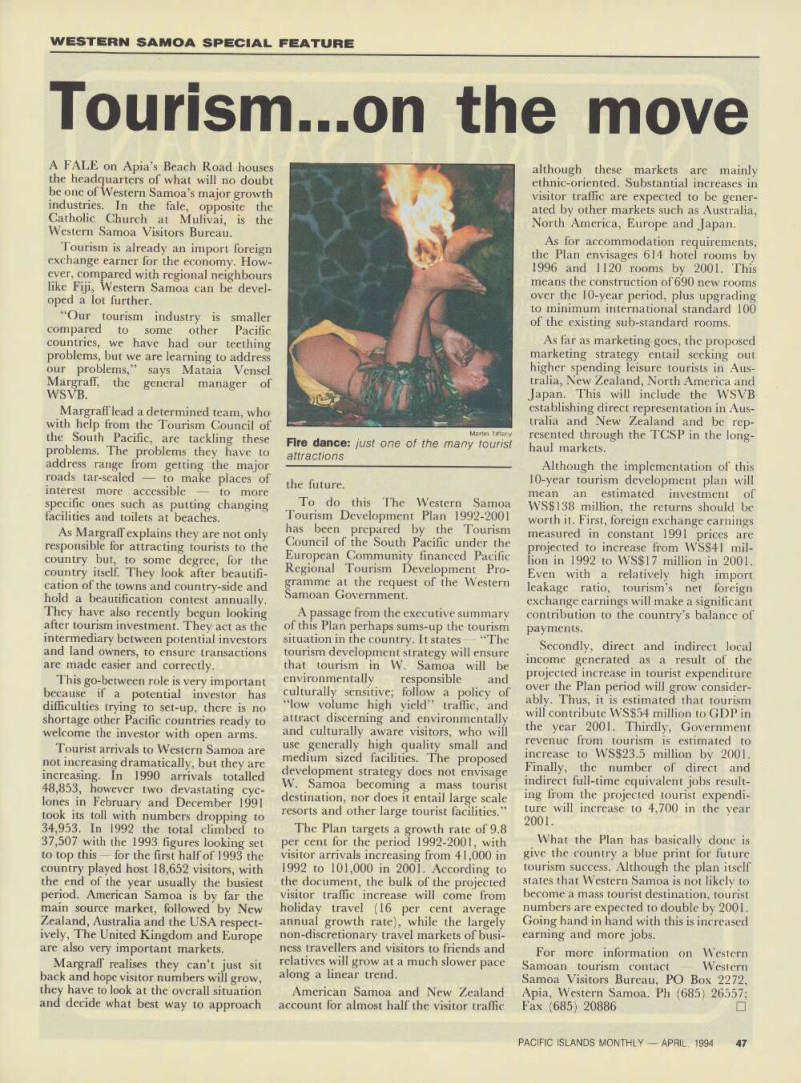
A FAFF on Apia’s Beach Road houses the headquarters of what will no doubt be one of Western Samoa’s major growth industries. In the fale, opposite the Catholic Church at Mulivai, is the Western Samoa Visitors Bureau.
Tourism is already an import foreign exchange earner for the economy. How ever, compared with regional neighbours like Fiji, Western Samoa can be devel oped a lot further.
“Our tourism industry is smaller compared to some other Pacific countries, we have had our teething problems, but we are learning to address our problems,” says Mataia Vensel Margraff, the general manager of
Wsvb.
Margraff lead a determined team, who with help from the Tourism Council of the South Pacific, are tackling these problems. The problems they have to address range from getting the major roads tar-sealed to make places of interest more accessible to more specific ones such as putting changing facilities and toilets at beaches.
As Margraff explains they are not only responsible for attracting tourists to the country but, to some degree, for the country itself. They look after beautifi cation of the towns and country-side and hold a beautification contest annually.
They have also recently begun looking after tourism investment. They act as the intermediary between potential investors and land owners, to ensure transactions are made easier and correctly.
This go-between role is very important because if a potential investor has difficulties trying to set-up, there is no shortage other Pacific countries ready to welcome the investor with open arms.
Tourist arrivals to Western Samoa are not increasing dramatically, but they are increasing. In 1990 arrivals totalled 48,853, however two devastating cyc lones in February and December 1991 took its toll with numbers dropping to 34,953. In 1992 the total climbed to 37,507 with the 1993 figures looking set to top this for the first half of 1993 the country played host 18,652 visitors, with the end of the year usually the busiest period. American Samoa is by far the main source market, followed by New Zealand, Australia and the USA respect ively, The United Kingdom and Europe are also very important markets.
Margraff realises they can’t just sit back and hope visitor numbers will grow, they have to look at the overall situation and decide what best way to approach
the future, To do this The Western Samoa Tourism Development Plan 1992-2001 j^ as been prepared by the Tourism Gouncil ol the South Pacific under the Euro P ean Community financed Pacific Re g lonal Tourism Development Pro gramme at the request of the Western Samoan Government.
A passage from the executive summary of this Plan perhaps sums-up the tourism situation in the country. It states “The tourism development strategy will ensure that tourism in W. Samoa will be
environmentally responsible and
culturally sensitive; follow a policy of “ low volume high yield” traffic, and
attract discerning and environmentally
and culturally aware visitors, who will
use generally high quality small and
medium sized facilities. The proposed development strategy does not envisage , Samoa becoming a mass tourist destinatloI h nor does it entail large scale resorts and other lar § e tounst facillties -”
The Plan targets a growth rate of 9.8 per cent for the period 1992-2001, with visitor arrivals increasing from 41,000 in 1992 to 101,000 in 2001. According to the document, the bulk of the projected visitor traffic increase will come from holiday travel (16 per cent average
annual growth rate), while the largely
non-discretionary travel markets of busi ness travellers and visitors to friends and relatives will grow at a much slower pace along a linear trend, American Samoa and New Zealand account for almost half the visitor traffic
although these markets are mainly ethnic-oriented. Substantial increases in visitor traffic are expected to be gener ated by other markets such as Australia, North America, Europe and Japan.
As for accommodation requirements, the Plan envisages 614 hotel rooms by 1996 and 1120 rooms by 2001. This means the construction of 690 new rooms
over the 10-year period, plus upgrading
to minimum international standard 100 of the existing sub-standard rooms.
As far as marketing goes, the proposed marketing strategy entail seeking out higher spending leisure tourists in Aus tralia, New Zealand, North America and Japan. This will include the WSVB establishing direct representation in Aus tralia and New Zealand and be rep resented through the TCSP in the long haul markets.
Although the implementation of this
10-year tourism development plan will
mean an estimated investment of WS$l3B million, the returns should be
worth it. First, foreign exchange earnings
measured in constant 1991 prices are projected to increase from WS$4l mil lion in 1992 to WS$l7 million in 2001.
Even with a relatively high import
leakage ratio, tourism’s net foreign
exchange earnings will make a significant
contribution to the country’s balance of payments.
Secondly, direct and indirect local income generated as a result of the projected increase in tourist expenditure over the Plan period will grow consider ably. Thus, it is estimated that tourism will contribute WS$54 million to GDP in the year 2001. Thirdly, Government revenue from tourism is estimated to increase to W 5523.5 million by 2001.
Finally, the number of direct and indirect full-time equivalent jobs result
ing from the projected tourist expendi
ture will increase to 4,700 in the year 2001.
What the Plan has basically done is give the country a blue print for future tourism success. Although the plan itself states that Western Samoa is not likely to become a mass tourist destination, tourist numbers are expected to double by 2001.
Going hand in hand with this is increased
earning and more jobs.
For more information on Western Samoan tourism contact Western Samoa Visitors Bureau, PO Box 2272, Apia, Western Samoa. Ph (685) 26557; Fax (685) 20886 □
Martin Tiffany Fire dance: just one of the many tourist attractions
Advertisements & other items, p. 48 (1 item)
Naturally Samoan
From deep within the
heart of the Vaitele
earth comes a taste
that is purely
Samoan.
Pure Vaitele
Spring Water.
■* • ** „. • * 1 fcii %K £ £ ■ r 1
GUARANTEED PURE
GUARANTEED REFRESHING
GUARANTEED SAMOAN
Thirst-quenching Goodness. VAITELE Spring WATERS - Samoan naturally.
OIL
THE SHIELD OF DEFENCE
• • • AEGIS OIL produces a wide range of quality lubricants that can be tailored to your specifications.
AEGIS OIL offers a quality refined oil that is kind to its surroundings.
Because AEGIS takes waste oil, refines it and produces quality lubricants,it rids the environment of a waste product that would normally be dumped.
P.O. BOX 6038, APIA, WESTERN SAMOA. PHONE: (685) 23 642,20 551. FAX: (685) 22 623.
Offshore centre
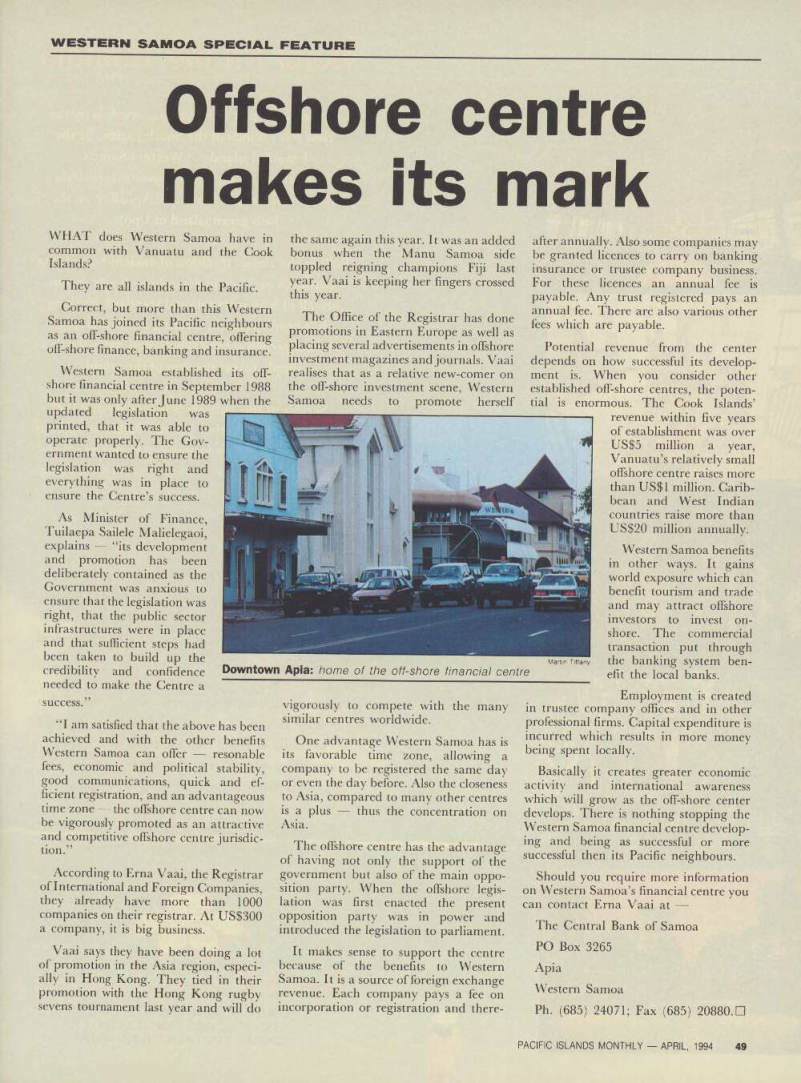
makes its mark
WHAT does Western Samoa have in common with Vanuatu and the Cook Islands?
They are all islands in the Pacific.
Correct, but more than this Western Samoa has joined its Pacific neighbours as an off-shore financial centre, offering off-shore finance, banking and insurance.
Western Samoa established its off shore financial centre in September 1988 but it was only after June 1989 when the
updated legislation was printed, that it was able to operate properly. The Gov ernment wanted to ensure the legislation was right and everything was in place to ensure the Centre’s success.
As Minister of Finance, Tuilaepa Sailele Malielegaoi, explains “its development and promotion has been deliberately contained as the Government was anxious to ensure that the legislation was right, that the public sector infrastructures were in place and that sufficient steps had been taken to build up the credibility and confidence needed to make the Centre a success.”
“I am satisfied that the above has been achieved and with the other benefits Western Samoa can offer resonable fees, economic and political stability, good communications, quick and ef ficient registration, and an advantageous time zone the offshore centre can now be vigorously promoted as an attractive and competitive offshore centre jurisdic tion.”
According to Erna Vaai, the Registrar of International and Foreign Companies, they already have more than 1000 companies on their registrar. At US$3OO a company, it is big business.
Vaai says they have been doing a lot of promotion in the Asia region, especi ally in Hong Kong. They tied in their promotion with the Hong Kong rugby sevens tournament last year and will do
the same again this year. It was an added bonus when the Manu Samoa side
toppled reigning champions Fiji last
year. Vaai is keeping her fingers crossed this year.
The Office of the Registrar has done promotions in Eastern Europe as well as placing several advertisements in offshore investment magazines and journals. Vaai realises that as a relative new-comer on the off-shore investment scene, Western Samoa needs to promote herself
vigorously to compete with the many similar centres worldwide.
One advantage Western Samoa has is its favorable time zone, allowing a company to be registered the same day or even the day before. Also the closeness to Asia, compared to many other centres is a plus thus the concentration on Asia.
The offshore centre has the advantage of having not only the support of the government but also of the main oppo sition party. When the offshore legis lation was first enacted the present opposition party was in power and introduced the legislation to parliament.
It makes sense to support the centre because of the benefits to Western Samoa. It is a source of foreign exchange revenue. Each company pays a fee on incorporation or registration and there
after annually. Also some companies may be granted licences to carry on banking insurance or trustee company business.
For these licences an annual fee is payable. Any trust registered pays an annual fee. There are also various other fees which are payable.
Potential revenue from the center depends on how successful its develop ment is. When you consider other established off-shore centres, the poten tial is enormous. The Cook Islands’
revenue within five years of establishment was over US$5 million a year, Vanuatu’s relatively small offshore centre raises more than US$l million. Carib bean and West Indian countries raise more than US$2O million annually.
Western Samoa benefits in other ways. It gains world exposure which can benefit tourism and trade and may attract offshore investors to invest on shore. The commercial transaction put through the banking system ben efit the local banks.
Employment is created in trustee company offices and in other professional firms. Capital expenditure is incurred which results in more money being spent locally.
Basically it creates greater economic activity and international awareness which will grow as the off-shore center
develops. There is nothing stopping the
Western Samoa financial centre develop ing and being as successful or more successful then its Pacific neighbours.
Should you require more information on Western Samoa’s financial centre you can contact Erna Vaai at The Central Bank of Samoa PO Box 3265 Apia Western Samoa Ph. (685) 24071; Fax (685) 20880. □
Martin Tiffany Downtown Apia: home of the off-shore financial centre
Advertisements & other items, p. 50 (1 item)
Hold Kilarjc Tusitala
t-:'. . . ** ,■ ' ... i\l s v ~;—: tJSt&L. i ~x~ 9 WiSPr-M, ,- - mm \ 'L m M
% Wmsk^ i r : fp
i hr . rf ■ '.' .; ‘' it
|iNW< 7/-* an i
Trls* t / e ,- * ■ •* • ;,i ■ ; - y,^>
-■:*>.:'>■■ l-lf
In the very heart of Polynesia, brushed by the cool trade winds of the South Pacific, lie the beautiful islands of Western Samoa.
It is here that you will discover the Tusitala Hotel at the edge of tranquil Apia Bay on the lush green island of Upolu.
Built in the classic tradition of ancient Samoa, the Tusitala's architecture is unique. Guest rooms are all of high international standard. Nothing has been spared in creating a breathtaking tropical garden setting where you can relax and simply forget the rest of the world.
Service at the Tusitala is legendary and the cuisine superb whether you are dining at night in the elegance of Stevensons restaurant or enjoying breakfast on the Apaula terrace overlooking the swimming pool. you'll see why Western Samoa has been paradise. Everywhere fragrant blooms abound.
White sand beaches, fringed by coconut palms, are unspoiled and uncrowded. The tourqoise waters of lagoons sparkle under a warm tropical A gentle climate has blessed these islands with a bounty of natural beauty reaching from the cool summits of green clad mountains with their cascading waterfalls to the dancing necklace of surf breaking on protective coral reefs.
V; ¥±ZS*
mm All this and a are among the frien m -V-'* i * ;.®V- IS:
PO BOX 101, APIA, WESTERN SAMOA.
TEL: (685) 21122. FAX: (68S) 23652
CABLES: TUSITALA. TELEX: 2265 X
Targeting growth
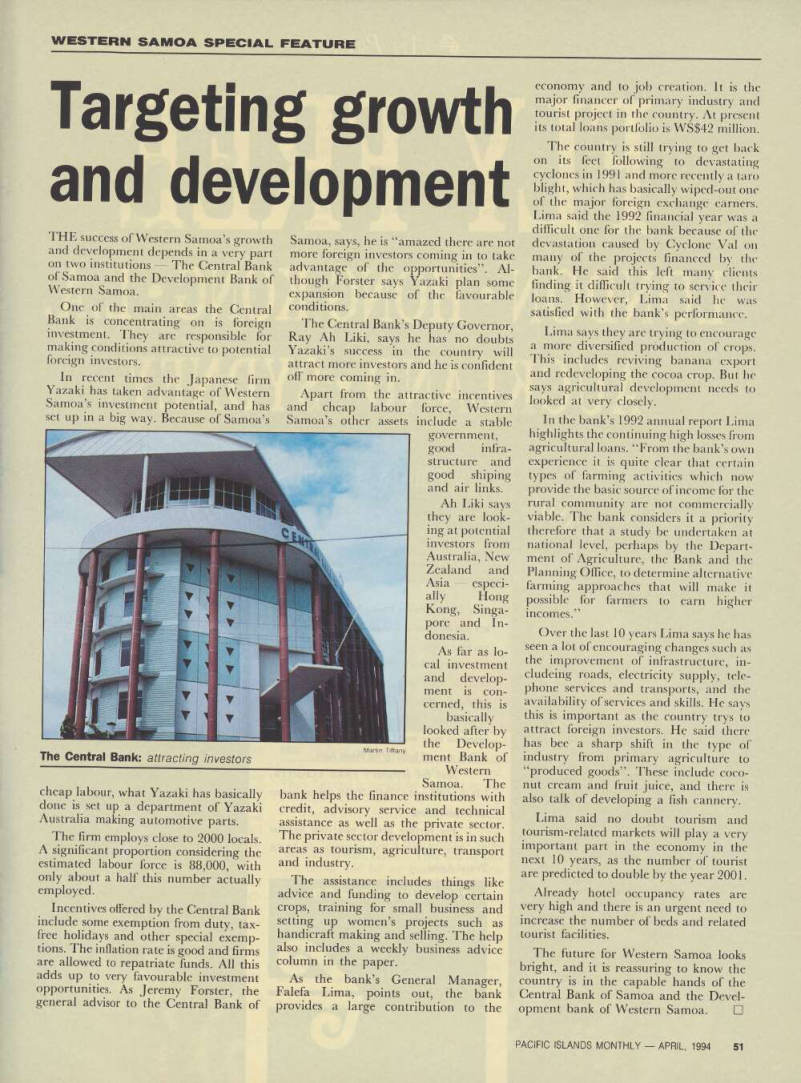
and development
THE success of Western Samoa’s growth and development depends in a very part on two institutions The Central Bank of Samoa and the Development Bank of Western Samoa.
One of the main areas the Central Bank is concentrating on is foreign investment. They are responsible for making conditions attractive to potential
foreign investors.
In recent times the Japanese firm Yazaki has taken advantage of Western Samoa’s investment potential, and has set up in a big way. Because of Samoa’s
cheap labour, what Yazaki has basically done is set up a department of Yazaki Australia making automotive parts.
The firm employs close to 2000 locals.
A significant proportion considering the estimated labour force is 88,000, with only about a half this number actually employed.
Incentives offered by the Central Bank include some exemption from duty, tax free holidays and other special exemp tions. The inflation rate is good and firms are allowed to repatriate funds. All this adds up to very favourable investment opportunities. As Jeremy Forster, the general advisor to the Central Bank of
Samoa, says, he is “amazed there are not more foreign investors coming in to take advantage of the opportunities”. Al though Forster says Yazaki plan some expansion because of the favourable conditions.
The Central Bank’s Deputy Governor, Ray Ah Liki, says he has no doubts Yazaki’s success in the country will attract more investors and he is confident off more coming in.
Apart from the attractive incentives and cheap labour force, Western Samoa’s other assets include a stable
government, good infra structure and good shaping and air links.
Ah Liki says they are look ing at potential investors from Australia, New Zealand and Asia especi ally Hong
Kong, Singa
pore and In donesia.
As far as lo cal investment
and develop
ment is con cerned, this is
basically
looked after by
the Develop
ment Bank of Western
Samoa. The bank helps the finance institutions with credit, advisory service and technical assistance as well as the private sector.
The private sector development is in such areas as tourism, agriculture, transport
and industry.
The assistance includes things like advice and funding to develop certain crops, training for small business and setting up women’s projects such as handicraft making and selling. The help also includes a weekly business advice column in the paper.
As the bank’s General Manager, Falefa Lima, points out, the bank provides a large contribution to the
economy and to job creation. It is t
major financer of primary industry ai
tourist project in the country. At prcsc its total loans portfolio is WS$42 millio The country is still trying to get bac on its feet following to devastatii cyclones in 1991 and more recently a ta
blight, which has basically wipcd-out 01
of the major foreign exchange earner
Lima said the 1992 financial year was di Hi cult one for the bank because of tl devastation caused by Cyclone Val o many of the projects financed by tl bank. He said this left many clien finding it difficult trying to service the loans. However, Lima said he w; satisfied with the bank’s performance.
Lima says they are trying to cncourag a more diversified production of crop This includes reviving banana expor and redeveloping the cocoa crop. But h says agricultural development needs t looked at very closely.
In the bank’s 1992 annual report Lim
highlights the continuing high losses from
agricultural loans. “From the bank’s owi experience it is quite clear that ccrtaii types of farming activities which now provide the basic source of income for th rural community are not commercially viable. The bank considers it a priority therefore that a study be undertaken a
national level, perhaps by the Depart
ment of Agriculture, the Bank and the Planning Office, to determine alternative farming approaches that will make i possible for farmers to earn higher incomes.”
Over the last 10 years Lima says he has seen a lot of encouraging changes such as the improvement of infrastructure, in
dudeing roads, electricity supply, tele
phone services and transports, and the availability of services and skills. He says this is important as the country trys to attract foreign investors. He said there has bee a sharp shift in the type ol
industry from primary agriculture to
“produced goods”. These include coco nut cream and fruit juice, and there is also talk of developing a fish cannery.
Lima said no doubt tourism and tourism-related markets will play a very important part in the economy in the next 10 years, as the number of tourist are predicted to double by the year 2001.
Already hotel occupancy rates are very high and there is an urgent need to increase the number of beds and related tourist facilities.
The future for Western Samoa looks bright, and it is reassuring to know the country is in the capable hands of the Central Bank of Samoa and the Devel opment bank of Western Samoa. □
The Central Bank: attracting investors
Martin Tiffany
Advertisements & other items, p. 52 (1 item)
Fly Free
Air Points
LONDON-HONG KONG-LA.
AUCKLAND•SYDNEY
v# & Only our Air Points Frequent Flyer programme lets you fly from the South Pacific to the places you want to fly.
Read the fine print and you’ll find it really is pointless joining any Frequent Flyer programme other than one that’s based in your part of the world. We fly more often from the Pacific Islands to more world destinations than any other Airline, so you’ll build up Air Points faster.
And the rewards - FREE FLIGHTS,
MATTINGLY AIR 0757
UPGRADES and COMPANION tickets - come much quicker too.
For further details call your nearest Air New Zealand Travelcentre or lATA
Travel Agent.
WWW&Z' jJ-
I WJ*
air new zeaiano
the pride of the pacific - H r » S i « ■*.V. » , an ■ mi
Mixing
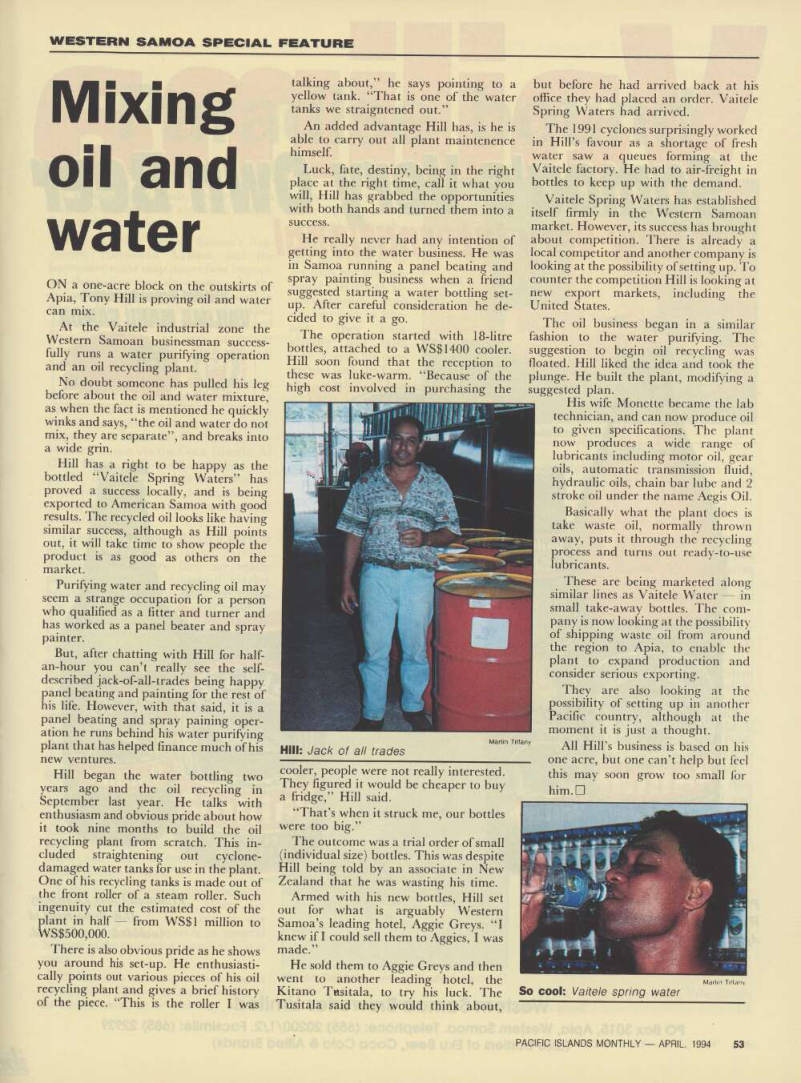
oil and water
ON a one-acre block on the outskirts of Apia, Tony Hill is proving oil and water can mix.
At the Vaitele industrial zone the Western Samoan businessman success fully runs a water purifying operation and an oil recycling plant.
No doubt someone has pulled his leg before about the oil and water mixture, as when the fact is mentioned he quickly winks and says, “the oil and water do not mix, they are separate”, and breaks into a wide grin.
Hill has a right to be happy as the bottled “Vaitele Spring Waters” has proved a success locally, and is being exported to American Samoa with good results. The recycled oil looks like having similar success, although as Hill points out, it will take time to show people the product is as good as others on the market.
Purifying water and recycling oil may seem a strange occupation for a person who qualified as a fitter and turner and has worked as a panel beater and spray painter.
But, after chatting with Hill for half an-hour you can’t really see the self described jack-of-all-trades being happy panel beating and painting for the rest of his life. However, with that said, it is a panel beating and spray paining oper ation he runs behind his water purifying plant that has helped finance much of his new ventures.
Hill began the water bottling two years ago and the oil recycling in September last year. He talks with enthusiasm and obvious pride about how it took nine months to build the oil recycling plant from scratch. This in cluded straightening out cyclone damaged water tanks for use in the plant.
One of his recycling tanks is made out of the front roller of a steam roller. Such ingenuity cut the estimated cost of the plant in half from WSSI million to
Wsssoo,Ooo.
There is also obvious pride as he shows you around his set-up. He enthusiasti cally points out various pieces of his oil recycling plant and gives a brief history of the piece. “This is the roller I was
talking about,” he says pointing to a yellow tank. “That is one of the water tanks we straigntened out.”
An added advantage Hill has, is he is able to carry out all plant maintenence himself.
Luck, fate, destiny, being in the right place at the right time, call it what you will, Hill has grabbed the opportunities with both hands and turned them into a success.
He really never had any intention of getting into the water business. He was in Samoa running a panel beating and spray painting business when a friend
suggested starting a water bottling set
up. After careful consideration he de cided to give it a go.
The operation started with 18-litre bottles, attached to a WSSI4OO cooler.
Hill soon found that the reception to these was luke-warm. “Because of the high cost involved in purchasing the
cooler, people were not really interested.
They figured it would be cheaper to buy a fridge,” Hill said.
“That’s when it struck me, our bottles were too big.”
The outcome was a trial order of small (individual size) bottles. This was despite Hill being told by an associate in New Zealand that he was wasting his time.
Armed with his new bottles, Hill set out for what is arguably Western Samoa’s leading hotel, Aggie Greys. “I knew if I could sell them to Aggies, I was made.”
He sold them to Aggie Greys and then went to another leading hotel, the Kitano Tusitala, to try his luck. The Tusitala said they would think about,
but before he had arrived back at his office they had placed an order. Vaitele Spring Waters had arrived.
The 1991 cyclones surprisingly worked in Hill’s favour as a shortage of fresh water saw a queues forming at the Vaitele factory. He had to air-freight in bottles to keep up with the demand.
Vaitele Spring Waters has established itself firmly in the Western Samoan market. However, its success has brought about competition. There is already a local competitor and another company is looking at the possibility of setting up. To counter the competition Hill is looking at new export markets, including the United States.
The oil business began in a similar fashion to the water purifying. The suggestion to begin oil recycling was floated. Hill liked the idea and took the plunge. He built the plant, modifying a suggested plan.
His wife Monette became the lab technician, and can now produce oil to given specifications. The plant now produces a wide range of lubricants including motor oil, gear oils, automatic transmission fluid, hydraulic oils, chain bar lube and 2 stroke oil under the name Aegis Oil.
Basically what the plant does is take waste oil, normally thrown away, puts it through the recycling process and turns out ready-to-use lubricants.
These are being marketed along similar lines as Vaitele Water in small take-away bottles. The com pany is now looking at the possibility of shipping waste oil from around the region to Apia, to enable the plant to expand production and consider serious exporting.
They are also looking at the possibility of setting up in another Pacific country, although at the moment it is just a thought.
All Hill’s business is based on his one acre, but one can’t help but feel this may soon grow too small for him.D
Martin Tiffany
Hill: Jack of all trades
Martin Tiffany
So cool: Vaitele spring water
Advertisements & other items, p. 54 (1 item)
is How very international
Jr m
r Official Major Sponsors
IM/l/AM MAHU SAMOA
& 4- « 1 J Produced By Western Samoa Breweries Apia, Western Samoa Produced Under License by D.B. Breweries Ltd Auckland, New Zealand.
Western Samoa Breweries Limited PO Box 3015, Apia, Western Samoa. Telephone: (685) 20200/1/2. Facsimile: (686) 22929 (also bottlers of Eku Beer, Coca Cola & Allied Brands)
Paradise bound
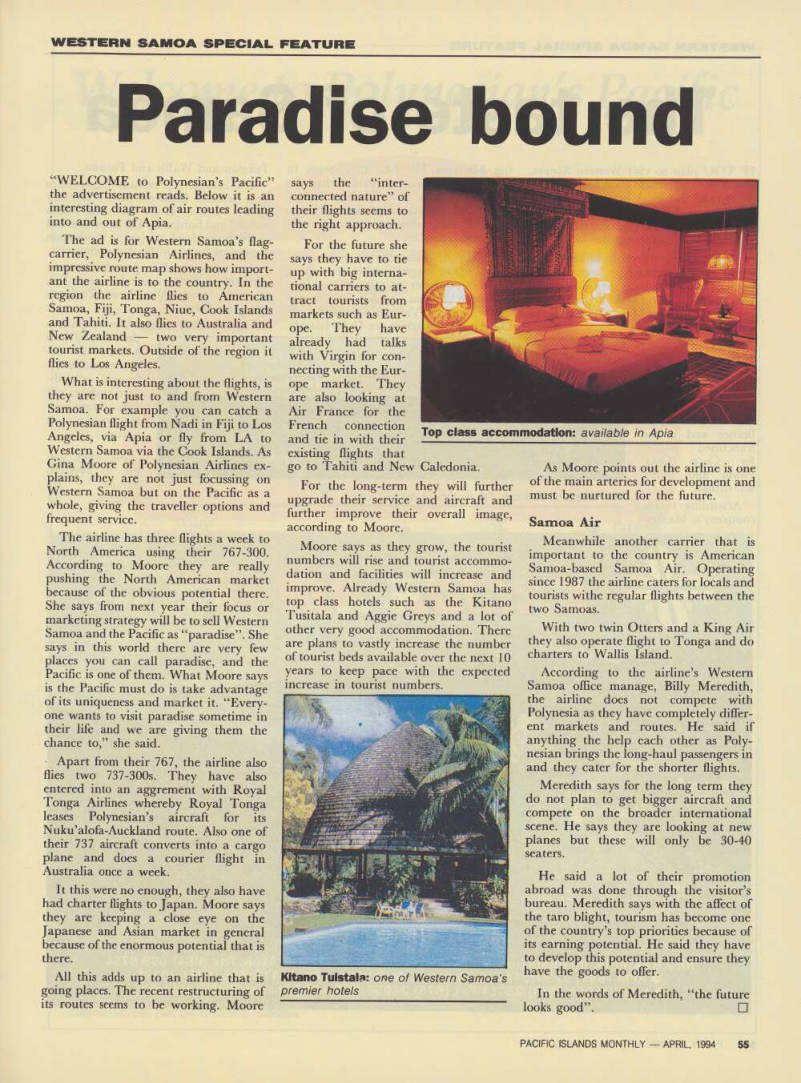
“WELCOME to Polynesian’s Pacific” the advertisement reads. Below it is an interesting diagram of air routes leading into and out of Apia.
The ad is for Western Samoa’s flag carrier, Polynesian Airlines, and the impressive route map shows how import ant the airline is to the country. In the region the airline flies to American Samoa, Fiji, Tonga, Niue, Cook Islands and Tahiti. It also flies to Australia and New Zealand two very important tourist markets. Outside of the region it flies to Los Angeles.
What is interesting about the flights, is they are not just to and from Western Samoa. For example you can catch a Polynesian flight from Nadi in Fiji to Los Angeles, via Apia or fly from LA to Western Samoa via the Cook Islands. As Gina Moore of Polynesian Airlines ex plains, they are not just focussing on Western Samoa but on the Pacific as a whole, giving the traveller options and
frequent service.
The airline has three flights a week to North America using their 767-300.
According to Moore they are really pushing the North American market because of the obvious potential there.
She says from next year their focus or marketing strategy will be to sell Western Samoa and the Pacific as “paradise”. She says in this world there are very few places you can call paradise, and the Pacific is one of them. What Moore says is the Pacific must do is take advantage of its uniqueness and market it. “Every one wants to visit paradise sometime in their life and we are giving them the chance to,” she said. • Apart from their 767, the airline also flies two 737-300 s. They have also entered into an aggrement with Royal
Tonga Airlines whereby Royal Tonga
leases Polynesian’s aircraft for its Nuku’alofa-Auckland route. Also one of their 737 aircraft converts into a cargo plane and does a courier flight in Australia once a week.
It this were no enough, they also have had charter flights to Japan. Moore says they are keeping a close eye on the Japanese and Asian market in general because of the enormous potential that is there.
All this adds up to an airline that is going places. The recent restructuring of its routes seems to be working. Moore
says the “inter connected nature” of their flights seems to the right approach.
For the future she says they have to tie up with big interna tional carriers to at tract tourists from markets such as Eur ope. They have already had talks with Virgin for con necting with the Eur ope market. They are also looking at Air France for the French connection and tie in with their existing flights that
go to Tahiti and New Caledonia.
For the long-term they will further upgrade their service and aircraft and further improve their overall image, according to Moore.
Moore says as they grow, the tourist numbers will rise and tourist accommo dation and facilities will increase and improve. Already Western Samoa has top class hotels such as the Kitano Tusitala and Aggie Greys and a lot of other very good accommodation. There are plans to vastly increase the number of tourist beds available over the next 10 years to keep pace with the expected increase in tourist numbers.
As Moore points out the airline is one of the main arteries for development and must be nurtured for the future.
Samoa Air Meanwhile another carrier that is important to the country is American Samoa-based Samoa Air. Operating since 1987 the airline caters for locals and tourists withe regular flights between the two Samoas.
With two twin Otters and a King Air they also operate flight to Tonga and do charters to Wallis Island.
According to the airline’s Western Samoa office manage, Billy Meredith, the airline does not compete with Polynesia as they have completely differ ent markets and routes. He said if anything the help each other as Poly nesian brings the long-haul passengers in and they cater for the shorter flights.
Meredith says for the long term they do not plan to get bigger aircraft and compete on the broader international scene. He says they are looking at new planes but these will only be 30-40 sealers.
He said a lot of their promotion abroad was done through the visitor’s bureau. Meredith says with the affect of the taro blight, tourism has become one of the country’s top priorities because of its earning potential. He said they have to develop this potential and ensure they have the goods to offer.
In the words of Meredith, “the future looks good”. □
Kitano Tuistala: one of Western Samoa’s premier hotels
Top class accommodation: available in Apia
The taste of Samoa
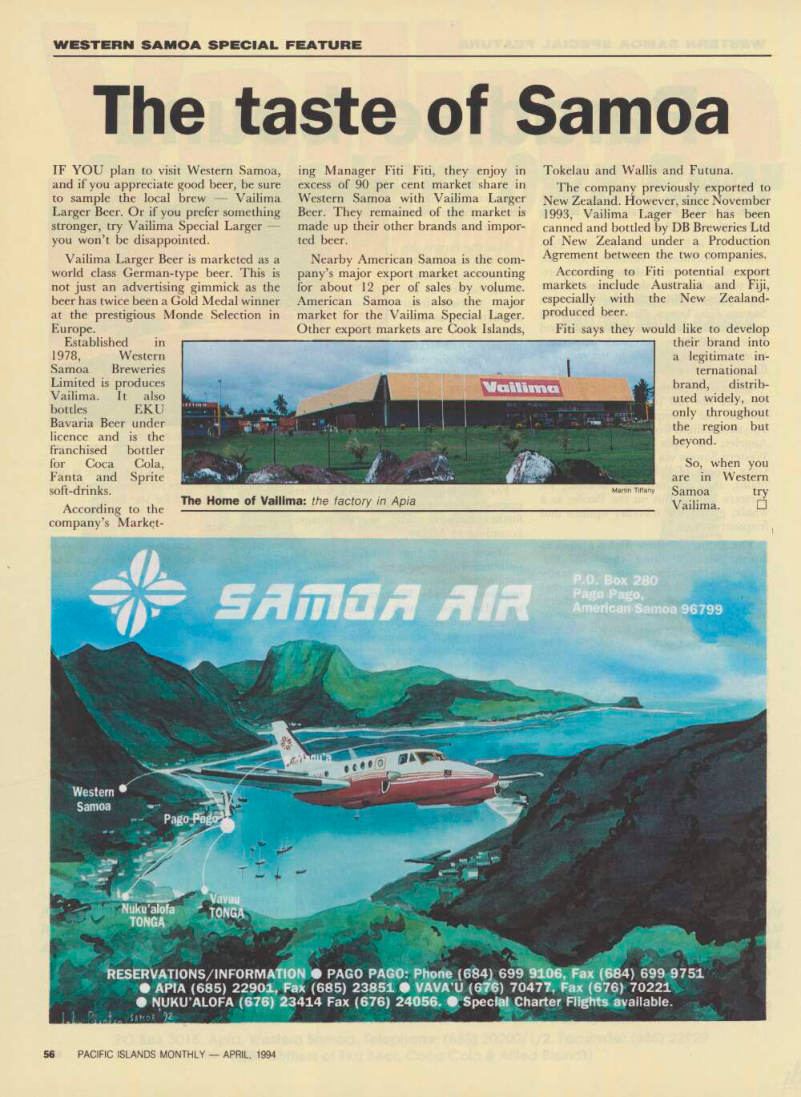
IF YOU plan to visit Western Samoa, and if you appreciate good beer, be sure to sample the local brew Vailima Larger Beer. Or if you prefer something stronger, try Vailima Special Larger you won’t be disappointed.
Vailima Larger Beer is marketed as a world class German-type beer. This is not just an advertising gimmick as the beer has twice been a Gold Medal winner at the prestigious Monde Selection in
Europe.
Established in 1978, Western Samoa Breweries Limited is produces Vailima. It also bottles EKU Bavaria Beer under licence and is the franchised bottler for Coca Cola, Fanta and Sprite soft-drinks.
According to the company’s Market
ing Manager Fiti Fiti, they enjoy in excess of 90 per cent market share in Western Samoa with Vailima Larger Beer. They remained of the market is made up their other brands and impor ted beer.
Nearby American Samoa is the com
pany’s major export market accounting
for about 12 per of sales by volume.
American Samoa is also the major market for the Vailima Special Lager.
Other export markets are Cook Islands,
Tokelau and Wallis and Futuna.
The company previously exported to New Zealand. However, since November 1993, Vailima Lager Beer has been canned and bottled by DB Breweries Ltd of New Zealand under a Production Agrement between the two companies.
According to Fiti potential export markets include Australia and Fiji, especially with the New Zealand produced beer.
Fiti says they would like to develop
their brand into a legitimate in ternational brand, distrib uted widely, not only throughout the region but
beyond.
So, when you are in Western Samoa try Vailima. □
Martin Tiffany
The Home of Vailima: the factory in Apia
Advertisements & other items, pp. 56-57 (2 items)
Western Samoa Special Feature
A
m II 6799 *e .
J * ■■ rj&v mm —* nmsr— Western Samoa Pago * -r wJ.’Elt? 5 ST - Nuku’alofa
TONGA
TONG
s RESERVATIONS/INFORMATION • PAGO PAGO: Phone (684) 699 9106, Fax (684) 699 9751 • APIA (685) 22901, Fax (685) 23851 • VAVA’U (676) 70477, Fax (676) 70221 • NUKU’ALOFA (676) 23414 Fax (676) 24056. • Special Charter Flights available. „r UHot %
Welcome to Polynesian's Pacific
Aloha!
Honolulu
fewail
Talofa!
Pago Pago
AMERICANSA
Talofa!
Apia
WESTE
Alo aoeete lei 'alof
NGA
G'da Melbourn *vl
POLYNESIAN AIRLINES
We call it home. You'll call it Paradise
OFFICES & AGENTS;
21675. AMERIfcAN Reservations: (684) 7 8. Fax: (684) 6992109. AUSTRALIA: SYDNEY: Reservations: (61-2) 2991744.
Ticket Office: (61-2) 299 1855. Fax: (61-2) 2991119. Toll Free (61) 008633737. MELBOURNE: (61-3) 6004400. FAX: (61-3) 6004848. FIJI NADI: Tel (679) 701470 Fax: 721511 Airport 721466. Reservations: 721466. KINGDOM OF TONGA: Reservations: (676) 21565. Airport 32204. Fax: 24225. NEW ZEALAND: Reservations: (64-9) 3095396. Ticket Office: 3794824. Fax: 3073819. AUCKLAND AIRPORT: Tel 2750972. Fax: 275 3890. HENDERSON: Tel: (64-9) 8366141. Fax: 8366143. MANUKAU: Tel (649) 2624197. Fax: 2624203. WELLINGTON Reservations: (64-4) 4722544, Fax: 4711489. CHRISTCHURCH: Tel: (64-3) 3791504/3791970. Fax: 3791270. USA LOS ANGELES: Admin: Tel: (1) 310 6463226 Fax; (1) 310 6463239. Ticket Office: AMR SERVICES: (1) 310 6462675. Fax: 6462668. RESERVATIONS TOLL FREE (IN USA): (1) 800 592 7100. HONOLULU, HAWAII: Reservations: Tel: (1) 808 8367659. Fax 836 8010. JAPAN: PACIFIC INTERNATIONAL LTD: Tel: (81) 3 56879731. Fax; 56879734. TAHITI: Admin: (689) 839650/839581. Fax: 821675. AIR FRANCE: (689) 429263. FAX: 410522. NIUE: PELENTS TRAVEL: Tel: (683) 4317, Fax: 4322 COOK ISLANDS: Reservations & Ticketing: Tel: (682) 20845 Fax: 20979 or ISLAND HOPPER VACATIONS: Tel: (682) 22026 Fax: 22036. UNITED KINGDOM. Travel 2 Travel 4 (GSA) Tel- (44) 71-2638414, Fax (44) 712727540 EUROPE: EESTREISEN (GSA) Tel: (49) 821 151066. Fax: (49) 82130207. SOUTH AMERICA: Tel; (54-1) 3250701/3257840, Fax: (54-1) 3259701/3250864. K
Landmark
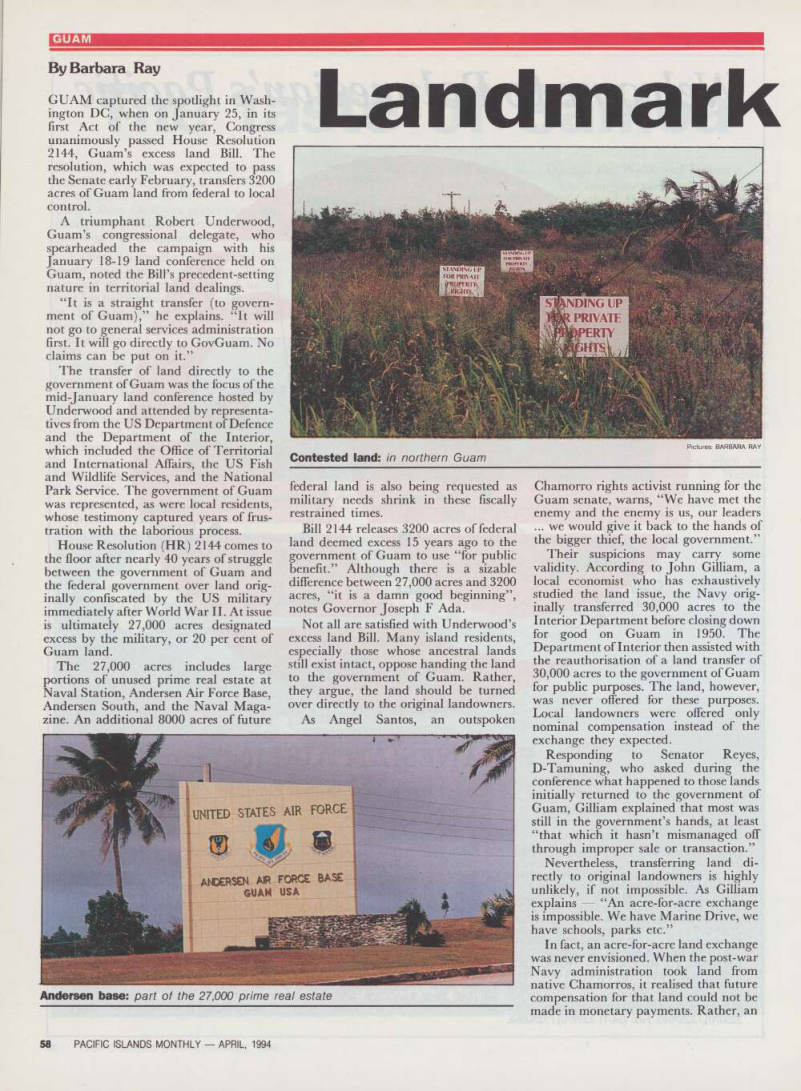
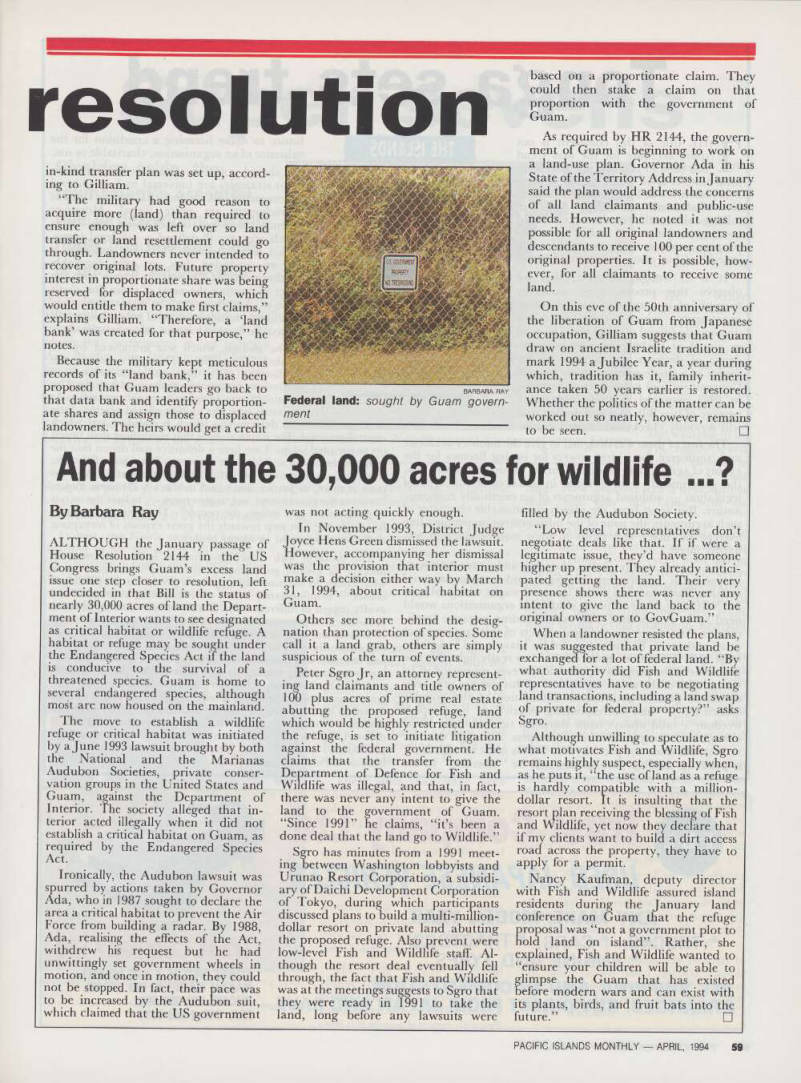
Guam
By Barbara Ray
GUAM captured the spotlight in Wash ington DC, when on January 25, in its first Act of the new year, Congress
unanimously passed House Resolution
2144, Guam’s excess land Bill. The resolution, which was expected to pass the Senate early February, transfers 3200 acres of Guam land from federal to local control.
A triumphant Robert Underwood,
Guam’s congressional delegate, who
spearheaded the campaign with his January 18-19 land conference held on Guam, noted the Bill’s precedent-setting nature in territorial land dealings.
“It is a straight transfer (to govern ment of Guam),” he explains. “It will not go to general services administration first. It will go directly to Gov Guam. No claims can be put on it.”
The transfer of land directly to the government of Guam was the focus of the mid-January land conference hosted by Underwood and attended by representa tives from the US Department of Defence and the Department of the Interior, which included the Office of Territorial and International Affairs, the US Fish and Wildlife Services, and the National Park Service. The government of Guam was represented, as were local residents, whose testimony captured years of frus tration with the laborious process.
House Resolution (HR) 2144 comes to the floor after nearly 40 years of struggle between the government of Guam and the federal government over land orig
inally confiscated by the US military
immediately after World War 11. At issue is ultimately 27,000 acres designated excess by the military, or 20 per cent of Guam land.
The 27,000 acres includes large portions of unused prime real estate at Naval Station, Andersen Air Force Base, Andersen South, and the Naval Maga zine. An additional 8000 acres of future
federal land is also being requested as military needs shrink in these fiscally restrained times.
Bill 2144 releases 3200 acres of federal land deemed excess 15 years ago to the government of Guam to use “for public benefit.” Although there is a sizable difference between 27,000 acres and 3200 acres, “it is a damn good beginning”, notes Governor Joseph F Ada.
Not all are satisfied with Underwood’s excess land Bill. Many island residents, especially those whose ancestral lands still exist intact, oppose handing the land to the government of Guam. Rather, they argue, the land should be turned over directly to the original landowners.
A . i c . , As Angel bantos, an outspoken ° r
Chamorro rights activist running for the Guam senate, warns, “We have met the enemy and the enemy is us, our leaders ... we would give it back to the hands of the bigger thief, the local government.”
Their suspicions may carry some validity. According to John Gilliam, a local economist who has exhaustively studied the land issue, the Navy orig inally transferred 30,000 acres to the Interior Department before closing down for good on Guam in 1950. The Department of Interior then assisted with the reauthorisation of a land transfer of 30,000 acres to the government of Guam for public purposes. The land, however, was never offered for these purposes.
Local landowners were offered only nominal compensation instead of the exchange they expected.
Responding to Senator Reyes, D-Tamuning, who asked during the conference what happened to those lands initially returned to the government of Guam, Gilliam explained that most was still in the government’s hands, at least “that which it hasn’t mismanaged off through improper sale or transaction.”
Nevertheless, transferring land di rectly to original landowners is highly unlikely, if not impossible. As Gilliam explains “An acre-for-acre exchange is impossible. We have Marine Drive, we have schools, parks etc.”
In fact, an acre-for-acre land exchange was never envisioned. When the post-war Navy administration took land from native Chamorros, it realised that future compensation for that land could not be made in monetary payments. Rather, an
Andersen base: part of the 27,000 prime real estate
Contested land: in northern Guam
Pictures: BARBARA RAY
in-kind transfer plan was set up, accord ing to Gilliam.
“The military had good reason to
acquire more (land) than required to
ensure enough was left over so land transfer or land resettlement could go through. Landowners never intended to recover original lots. Future property interest in proportionate share was being reserved for displaced owners, which would entitle them to make first claims,” explains Gilliam. “Therefore, a ‘land bank’ was created for that purpose,” he notes.
Because the military kept meticulous records of its “land bank,” it has been proposed that Guam leaders go back to that data bank and identify proportion ate shares and assign those to displaced landowners. The heirs would get a credit
based on a proportionate claim. They could then stake a claim on that proportion with the government of Guam.
As required by HR 2144, the govern ment of Guam is beginning to work on a land-use plan. Governor Ada in his State of the Territory Address in January said the plan would address the concerns of all land claimants and public-use needs. However, he noted it was not possible for all original landowners and descendants to receive 100 per cent of the
original properties. It is possible, how
ever, for all claimants to receive some land.
On this eve of the 50th anniversary of the liberation of Guam from Japanese occupation, Gilliam suggests that Guam draw on ancient Israelite tradition and mark 1994 a Jubilee Year, a year during which, tradition has it, family inherit ance taken 50 years earlier is restored.
Whether the politics of the matter can be worked out so neatly, however, remains to be seen. □
Barbara Ray
Federal land: sought by Guam govern ment
And about the 30,000 acres for wildlife...?
By Barbara Ray
ALTHOUGH the January passage of House Resolution 2144 in the US Congress brings Guam’s excess land issue one step closer to resolution, left undecided in that Bill is the status of nearly 30,000 acres of land the Depart ment of Interior wants to see designated as critical habitat or wildlife refuge. A habitat or refuge may be sought under the Endangered Species Act if the land is conducive to the survival of a threatened species. Guam is home to several endangered species, although most are now housed on the mainland.
The move to establish a wildlife refuge or critical habitat was initiated by a June 1993 lawsuit brought by both the National and the Marianas Audubon Societies, private conser vation groups in the United States and Guam, against the Department of Interior. The society alleged that in terior acted illegally when it did not establish a critical habitat on Guam, as required by the Endangered Species Act.
Ironically, the Audubon lawsuit was spurred by actions taken by Governor Ada, who in 1987 sought to declare the area a critical habitat to prevent the Air Force from building a radar. By 1988, Ada, realising the effects of the Act, withdrew his request but he had unwittingly set government wheels in motion, and once in motion, they could not be stopped. In fact, their pace was to be increased by the Audubon suit, which claimed that the US government
was not acting quickly enough.
In November 1993, District Judge Joyce Hens Green dismissed the lawsuit.
However, accompanying her dismissal was the provision that interior must make a decision either way by March 31, 1994, about critical habitat on Guam.
Others see more behind the desig nation than protection of species. Some call it a land grab, others are simply suspicious of the turn of events.
Peter Sgro Jr, an attorney represent ing land claimants and title owners of 100 plus acres of prime real estate abutting the proposed refuge, land which would be highly restricted under the refuge, is set to initiate litigation against the federal government. He claims that the transfer from the Department of Defence for Fish and Wildlife was illegal, and that, in fact, there was never any intent to give the land to the government of Guam.
“Since 1991” he claims, “it’s been a done deal that the land go to Wildlife.”
Sgro has minutes from a 1991 meet ing between Washington lobbyists and Urunao Resort Corporation, a subsidi ary ofDaichi Development Corporation of Tokyo, during which participants discussed plans to build a multi-million dollar resort on private land abutting the proposed refuge. Also prevent were low-level Fish and Wildlife staff. Al though the resort deal eventually fell through, the fact that Fish and Wildlife was at the meetings suggests to Sgro that they were ready in 1991 to take the land, long before any lawsuits were
filled by the Audubon Society.
“Low level representatives don’t negotiate deals like that. If if were a legitimate issue, they’d have someone higher up present. They already antici pated getting the land. Their very presence shows there was never any intent to give the land back to the original owners or to Gov Guam.”
When a landowner resisted the plans, it was suggested that private land be exchanged for a lot of federal land. “By what authority did Fish and Wildlife representatives have to be negotiating land transactions, including a land swap of private for federal property?” asks Sgro.
Although unwilling to speculate as to what motivates Fish and Wildlife, Sgro remains highly suspect, especially when, as he puts it, “the use of land as a refuge is hardly compatible with a million dollar resort. It is insulting that the resort plan receiving the blessing of Fish and Wildlife, yet now they declare that if my clients want to build a dirt access road across the property, they have to apply for a permit.
Nancy Kaufman, deputy director with Fish and Wildlife assured island residents during the January land conference on Guam that the refuge proposal was “not a government plot to hold land on island”. Rather, she explained, Fish and Wildlife wanted to “ensure your children will be able to glimpse the Guam that has existed before modern wars and can exist with its plants, birds, and fruit bats into the future.” □
Tonga sets trend
THE title of this comment is not quite accurate for the said trend has been in place in the islands for sometime. It is an unmistakable process
everywhere in Fiji, Samoa, Vanuatu,
New Caledonia and PNG. And I’m talking about the readiness of island governments to act in such a way as to suppress, reduce, nay destroy not only individual but also institutional liberty.
It is in Tonga, however, that we observe this process most assuredly exemplified in a spate of parliamentary enactments which can, from a democratic-liberal point of view, be read
as aimed at curbing popular indepen
dence of decision and action. In the course of a single parliamentary session.
Government and nobles’ representatives in 1993 managed to table and secure passage of two Bills and one motion that
will seriously check and imperil public freedom.
The first of these was designed to give the minister of labour and commerce the widest powers for issuing licenses for the export of agricultural produce. During the debate on this law, the government as is usual in defences of this type of legislation adduced arguments of an essentially economic nature. But apart from the utterly questionable character of such arguments, the issue of the infringement on people’s free exercise of choice and rights to their own production was
hardly faced.
The second statute invites churches and other NGOs to license with government as legal and semi-commercial entitles. The provisions of this law are fraught with problems for NGOs, eg. their status as charitable organisations would need to be reappraised with corresponding negative impli cations. And again the political aspects of this law were not at all addressed. Except a few, led by Liava’s and Fukofuka, most MPs did not recognise the need to really fight this law and some of the people’s representatives even supported it! In the opinion of the writer legislations of this sort are primarily aimed at greater government domination of the popular conscience and corresponding restrictions on people’s freedom and always come during a time of rapid social change and rising political consciousness. Although this law as it stands does not provide that NGOs must so register, it is perfectly possible that the law will be “amended” in the
future to make licensing a condition for the existence of an organisation, charitable or not.
I should point out also that, first, amend ment strategies are universal tools of illiberal governments and, second, that certain types of amendments are quite illegal. Moreover amendment is just one of those legal terms which are very ill-defined all legal terms, in fact, are ill-defined. The other possibility is for an amended law to offer favorable conditions to NGOs that do license with the effect of twisting the arms of those that don’t to do so. And there shall be many other ways, for illiberal minds in illiberal governments will always be busy whatever other peoples do.
The motion, which was introduced by the speaker of the parliament himself, was one for the legalisation of a ban on press releases of parliament proceedings that would be judged by certain officers as defamatory or scandalous. At the same time the motion offered precious little
as to guidelines for determining which is classified and which neutral material. The implication is that everything shall be left up to personal whim. I see here a definitive nail driven into the coffin of the media and freedom of speech. The whole affair then is an invitation to more prejudice and discrimination. And the press is there, as Justice Black said in the US Pentagon Papers “to serve the government, not to governors —, to bare the secrets of government and inform the people”. The press, be it noted, has made the first step towards the great exposes of corruption and mismanagement in recent history.
The problem with island governments is that any measure making for greater government control and interference or what comes to the same thing, greater power for the privileged classes is immediately hailed as contributing to progress and avidly copied in different ways. I truly believe that the freedom of the media is being attacked in all the Pacific islands right, now witness the various attempts in Tonga, Samoa, Fiji, Vanuatu etc, etc. in the past two years or so to muzzle the free media and churches and other NGOs are being reined in as the Tongan law not too subtly implies. It is of course from private citizens and NGOs that sharp criticism can always be directed onto government policies and so it is only natural that laws and other measures be developed to monitor and control but ideally to destroy the growth of criticism and protest. Never mind if it destroys the very basis of liberty. This is the trend that is so pronounced in Pacific civic life now and in this matter Tonga has not been dragging its feet. □
The Islands
Futa
Helu
Advertisements & other items, p. 60 (1 item)
Trust Company Ltd
USED JAPANESE VEHICLES
ANY MAKE, MODEL, YEAR
* TRUCKS, * CARS, * TRACTORS.
* ENGINE AND TYRES
ALL SHIPPING AND DOCUMENTATION
ARRANGED. BUY DIRECT FROM JAPAN AND SAVE.
CONTACT'
Trust Company Ltd
KOBAC BLD 3F 3-2 26 NISHIKI.
NAKAU NAGOYA, 460 JAPAN.
PHONE: 062-953-5602.
FAX: 005.2-953-5634
Super sevens
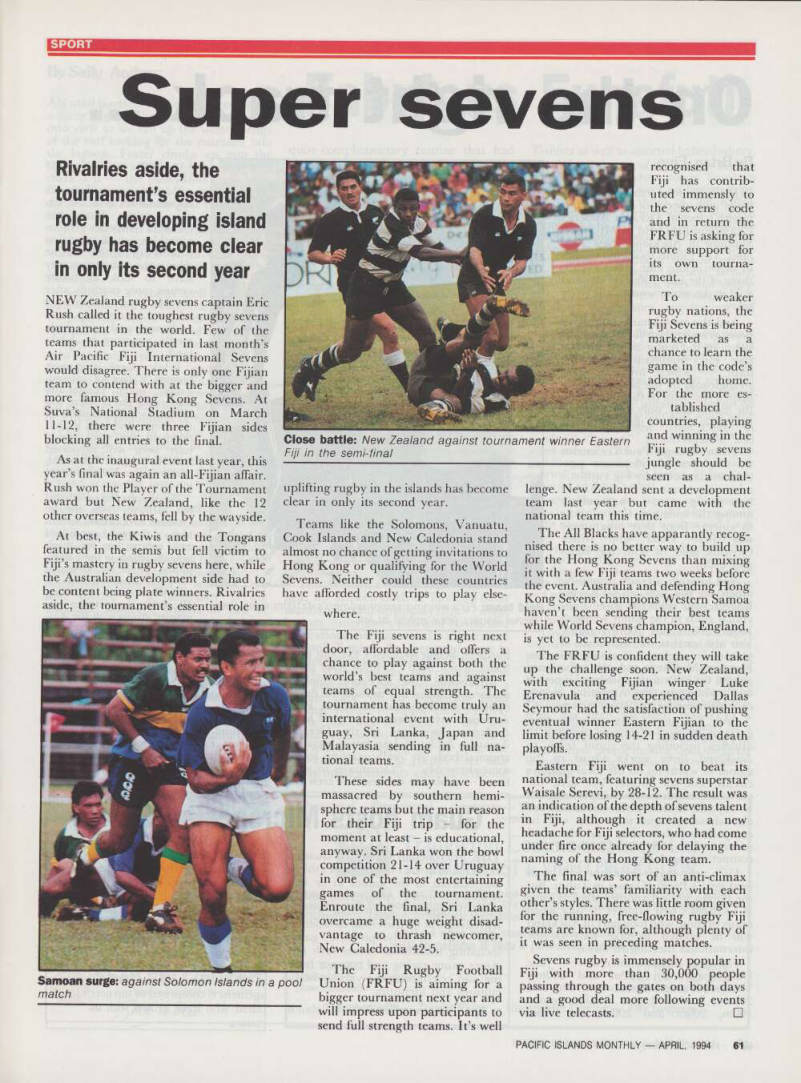
Sport
Rivalries aside, the
tournament’s essential
role in developing island
rugby has become clear
in only its second year
NEW Zealand rugby sevens captain Eric Rush called it the toughest rugby sevens tournament in the world. Few of the teams that participated in last month’s Air Pacific Fiji International Sevens would disagree. There is only one Fijian team to contend with at the bigger and more famous Hong Kong Sevens. At Suva’s National Stadium on March 11-12, there were three Fijian sides blocking all entries to the final.
As at the inaugural event last year, this year’s final was again an all-Fijian affair.
Rush won the Player of the Tournament award but New Zealand, like the 12 other overseas teams, fell by the wayside.
At best, the Kiwis and the Tongans featured in the semis but fell victim to Fiji’s mastery in rugby sevens here, while the Australian development side had to be content being plate winners. Rivalries aside, the tournament’s essential role in
uplifting rugby in the islands has become clear in only its second year.
Teams like the Solomons, Vanuatu, Cook Islands and New Caledonia stand almost no chance of getting invitations to Hong Kong or qualifying for the World Sevens. Neither could these countries have afforded costly trips to play else where.
The Fiji sevens is right next door, affordable and offers a chance to play against both the world’s best teams and against teams of equal strength. The tournament has become truly an international event with Uru guay, Sri Lanka, Japan and Malayasia sending in full na tional teams.
These sides may have been massacred by southern hemi sphere teams but the main reason for their Fiji trip - for the moment at least - is educational, anyway. Sri Lanka won the bowl competition 21-14 over Uruguay in one of the most entertaining games of the tournament.
Enroute the final, Sri Lanka overcame a huge weight disad vantage to thrash newcomer, New Caledonia 42-5.
The Fiji Rugby Football Union (FRFU) is aiming for a bigger tournament next year and will impress upon participants to send full strength teams. It’s well
recognised that
Fiji has contrib uted immensly to the sevens code and in return the FRFU is asking for more support for its own tourna ment.
To weaker rugby nations, the
Fiji Sevens is being
marketed as a chance to learn the game in the code’s
adopted home.
For the more es tablished
countries, playing
and winning in the
Fiji rugby sevens
jungle should be seen as a chal
lenge. New Zealand sent a development team last year but came with the national team this time.
The All Blacks have apparantly recog nised there is no better way to build up for the Hong Kong Sevens than mixing it with a few Fiji teams two weeks before the event. Australia and defending Hong Kong Sevens champions Western Samoa haven’t been sending their best teams while World Sevens champion, England, is yet to be represented.
The FRFU is confident they will take up the challenge soon. New Zealand, with exciting Fijian winger Luke Erenavula and experienced Dallas Seymour had the satisfaction of pushing eventual winner Eastern Fijian to the limit before losing 14-21 in sudden death playoffs.
Eastern Fiji went on to beat its national team, featuring sevens superstar Waisale Serevi, by 28-12. The result was an indication of the depth of sevens talent in Fiji, although it created a new headache for Fiji selectors, who had come under fire once already for delaying the naming of the Hong Kong team.
The final was sort of an anti-climax given the teams’ familiarity with each other’s styles. There was little room given for the running, free-flowing rugby Fiji teams are known for, although plenty of it was seen in preceding matches.
Sevens rugby is immensely popular in
Fiji with more than 30,000 people passing through the gates on both days and a good deal more following events via live telecasts. □
Samoan surge: against Solomon Islands in a pool match
Close battle: New Zealand against tournament winner Eastern Fiji in the semi-final
On the right track...
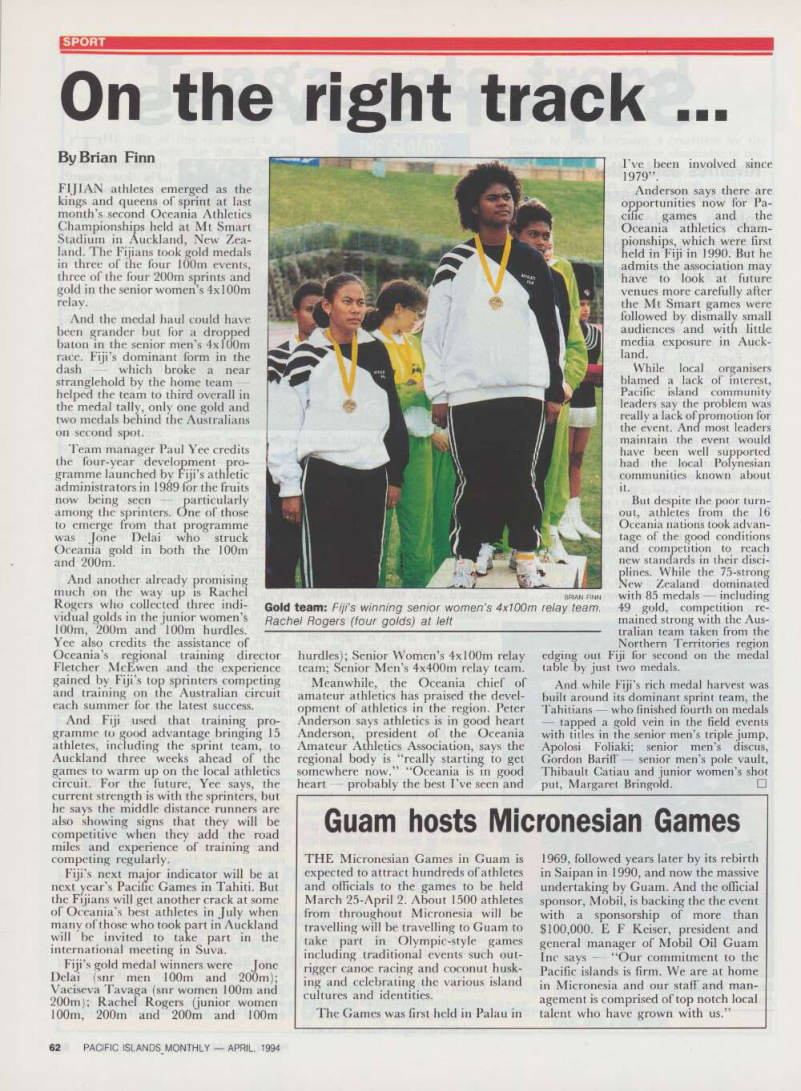
Sport
By Brian Finn
FIJIAN athletes emerged as the kings and queens of sprint at last month’s second Oceania Athletics Championships held at Mt Smart Stadium in Auckland, New Zea land. The Fijians took gold medals in three of the four 100 m events, three of the four 200 m sprints and gold in the senior women’s 4xloom
relay.
And the medal haul could have been grander but for a dropped baton in the senior men’s 4xloom race. Fiji’s dominant form in the dash which broke a near stranglehold by the home team helped the team to third overall in the medal tally, only one gold and two medals behind the Australians on second spot.
Team manager Paul Yee credits
the four-year development pro
gramme launched by Fiji’s athletic administrators in 1989 for the fruits
now being seen particularly
among the sprinters. One of those to emerge from that programme was Jone Delai who struck Oceania gold in both the 100 m and 200 m.
And another already promising
much on the way up is Rachel Rogers who collected three indi vidual golds in the junior women’s 100 m, 200 m and 100 m hurdles.
Yee also credits the assistance of
Oceania’s regional training director Fletcher McEwen and the experience gained by Fiji’s top sprinters competing and training on the Australian circuit each summer for the latest success.
And Fiji used that training pro gramme to good advantage bringing 15 athletes, including the sprint team, to Auckland three weeks ahead of the games to warm up on the local athletics circuit. For the future, Yee says, the current strength is with the sprinters, but he says the middle distance runners are also showing signs that they will be competitive when they add the road miles and experience of training and competing regularly.
Fiji’s next major indicator will be at next year’s Pacific Games in Tahiti. But the Fijians will get another crack at some of Oceania’s best athletes in July when many of those who took part in Auckland will be invited to take part in the international meeting in Suva.
Fiji’s gold medal winners were Jone Delai (snr men 100 m and 200 m); Vaciseva Tavaga (snr women 100 m and 200 m); Rachel Rogers (junior women 100 m, 200 m and 200 m and 100 m
hurdles); Senior Women’s 4xloom relay team; Senior Men’s 4x400m relay team.
Meanwhile, the Oceania chief of amateur athletics has praised the devel opment of athletics in the region. Peter Anderson says athletics is in good heart Anderson, president of the Oceania Amateur Athletics Association, says the regional body is “really starting to get somewhere now.” “Oceania is in good heart probably the best I’ve seen and
I’ve been involved since 1979”.
Anderson says there are opportunities now for Pa cific games and the Oceania athletics cham pionships, which were first held in Fiji in 1990. But he admits the association may have to look at future venues more carefully after the Mt Smart games were
followed by dismally small
audiences and with little media exposure in Auck land.
While local organisers blamed a lack of interest, Pacific island community leaders say the problem was really a lack of promotion for the event. And most leaders maintain the event would have been well supported had the local Polynesian communities known about it.
But despite the poor turn out, athletes from the 16 Oceania nations took advan tage of the good conditions and competition to reach new standards in their disci- R lines. While the 75-strong 'ew Zealand dominated with 85 medals including
49 gold, competition re
mained strong with the Aus tralian team taken from the Northern Territories region
edging out Fiji for second on the medal table by just two medals.
And while Fiji’s rich medal harvest was built around its dominant sprint team, the Tahitians who finished fourth on medals tapped a gold vein in the field events with titles in the senior men’s triple jump, Apolosi Foliaki; senior men’s discus, Gordon Banff senior men’s pole vault, Thibault Catiau and junior women’s shot put, Margaret Bringold. □
Brian Finn
Gold team: Fiji’s winning senior women’s 4xloom relay team.
Rachel Rogers (four golds) at left
Guam hosts Micronesian Games
THE Micronesian Games in Guam is expected to attract hundreds of athletes and officials to the games to be held March 25-April 2. About 1500 athletes from throughout Micronesia will be travelling will be travelling to Guam to take part in Olympic-style games including traditional events such out rigger canoe racing and coconut husk ing and celebrating the various island cultures and identities.
The Games was first held in Palau in
1969, followed years later by its rebirth in Saipan in 1990, and now the massive undertaking by Guam. And the official sponsor, Mobil, is backing the the event with a sponsorship of more than SIOO,OOO. E F Keiser, president and general manager of Mobil Oil Guam Inc says “Our commitment to the Pacific islands is firm. We are at home in Micronesia and our staff and man agement is comprised of top notch local talent who have grown with us.”
Fabulous Funafuti
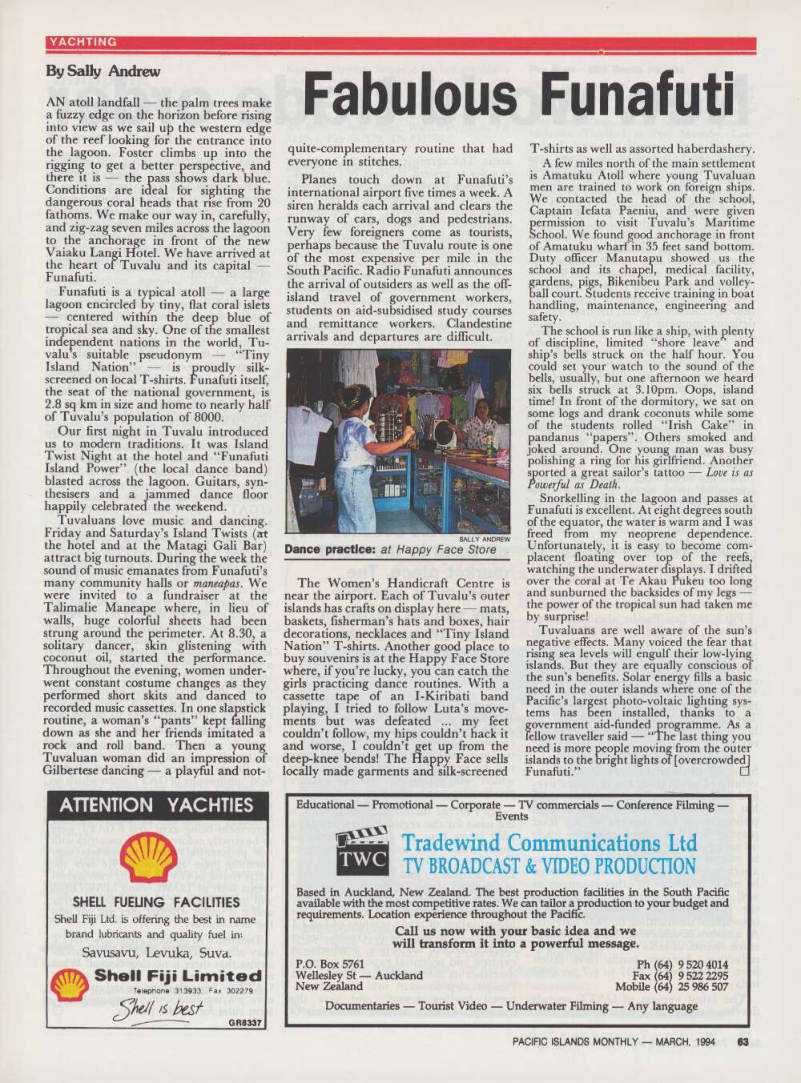
Yachting
By Sally Andrew
AN atoll landfall the palm trees make a fuzzy edge on the horizon before rising into view as we sail up the western edge of the reef looking for the entrance into the lagoon. Foster climbs up into the rigging to get a better perspective, and there it is the pass snows dark blue.
Conditions are ideal for sighting the dangerous coral heads that rise from 20 fathoms. We make our way in, carefully, and zig-zag seven miles across the lagoon to the anchorage in front of the new Vaiaku Langi Hotel. We have arrived at the heart of Tuvalu and its capital Funafuti.
Funafuti is a typical atoll a large lagoon encircled by tiny, flat coral islets centered within the deep blue of tropical sea and sky. One of the smallest independent nations in the world, Tu valu’s suitable pseudonym “Tiny Island Nation” is proudly silk screened on local T-shirts. Funafuti itself, the seat of the national government, is 2.8 sq km in size and home to nearly half of Tuvalu’s population of 8000.
Our first night in Tuvalu introduced us to modern traditions. It was Island Twist Night at the hotel and “Funafuti Island Power” (the local dance band) blasted across the lagoon. Guitars, syn thesisers and a Jammed dance floor happily celebrated the weekend.
Tuvaluans love music and dancing.
Friday and Saturday’s Island Twists (at the hotel and at the Matagi Cali Bar) attract big turnouts. During the week the sound of music emanates from Funafuti’s many community halls or maneapas. We were invited to a fundraiser at the Talimalie Maneape where, in lieu of walls, huge colorful sheets had been strung around the perimeter. At 8.30, a solitary dancer, skin glistening with coconut oil, started the performance.
Throughout the evening, women under went constant costume changes as they performed short skits and danced to recorded music cassettes. In one slapstick
routine, a woman’s “pants” kept falling
down as she and her friends imitated a rock and roll band. Then a young Tuvaluan woman did an impression of Gilbertese dancing a playful and not
quite-complementary routine that had everyone in stitches.
Planes touch down at Funafuti’s international airport five times a week. A siren heralds each arrival and clears the runway of cars, dogs and pedestrians.
Very few foreigners come as tourists, perhaps because the Tuvalu route is one of the most expensive per mile in the South Pacific. Radio Funafuti announces the arrival of outsiders as well as the off island travel of government workers, students on aid-subsidised study courses and remittance workers. Clandestine arrivals and departures are difficult.
The Women’s Handicraft Centre is near the airport. Each of Tuvalu’s outer islands has crafts on display here mats, baskets, fisherman’s hats and boxes, hair decorations, necklaces and “Tiny Island Nation” T-shirts. Another good place to buy souvenirs is at the Happy Face Store where, if you’re lucky, you can catch the girls practicing dance routines. With a cassette tape of an I-Kiribati band playing, I tried to follow Luta’s move ments but was defeated ... my feet couldn’t follow, my hips couldn’t hack it and worse, I couldn’t get up from the deep-knee bends! The Happy Face sells locally made garments and silk-screened
T-shirts as well as assorted haberdashery.
A few miles north of the main settlement is Amatuku Atoll where young Tuvaluan men are trained to work on foreign ships.
We contacted the head of the school, Captain lefata Paeniu, and were given Permission to visit Tuvalu’s Maritime chool. We found good anchorage in front of Amatuku wharf in 35 feet sand bottom.
Duty officer Manutapu showed us the school and its chapel, medical facility, gardens, pigs, Bikembeu Park and volley ball court. Students receive training in boat
handling, maintenance, engineering and
safety.
The school is run like a ship, with plenty of discipline, limited “shore leave” and ship’s bells struck on the half hour. You could set your watch to the sound of the bells, usually, but one afternoon we heard six bells struck at 3.10 pm. Oops, island time! In front of the dormitory, we sat on some logs and drank coconuts while some of the students rolled “Irish Cake” in pandanus “papers”. Others smoked and joked around. One young man was busy polishing a ring for his girlfriend. Another sported a great sailor’s tattoo Love is as Powerful as Death.
Snorkelling in the lagoon and passes at Funafuti is excellent. At eight degrees south of the equator, the water is warm and I was freed from my neoprene dependence.
Unfortunately, it is easy to become com placent floating over top of the reefs, watching the underwater displays. I drifted over the coral at Te Akau Pukeu too long and sunburned the backsides of my legs the power of the tropical sun had taken me
by surprise!
Tuvaluans are well aware of the sun’s negative effects. Many voiced the fear that rising sea levels will engulf their low-lying islands. But they are equally conscious of the sun’s benefits. Solar energy fills a basic need in the outer islands where one of the Pacific’s largest photo-voltaic lighting sys tems has been installed, thanks to a government aid-funded programme. As a fellow traveller said “The last thing you need is more people moving from the outer islands to the bright lights of [overcrowded] Funafuti.” □
Sally Andrew
Dance practice: at Happy Face Store
Advertisements & other items, p. 63 (1 item)
Tradewind Communications Ltd
ATTENTION YACHTIES
SHELL FUEUNG FACILITIES
Shell Fiji Ltd. is offering the best in name brand lubricants and quality fuel in; Savusavu, Levuka, Suva. © Shell Fiji Limited Telephone 313933, Fax 302279
is best
GR8337
Educational Promotional Corporate TV commercials Conference Filming Events
Tradewind Communications Ltd
TV BROADCAST & VIDEO PRODUCTION
Based in Auckland, New Zealand. The best production facilities in the South Pacific available with the most competitive rates. We can tailor a production to your budget and
requirements. Location experience throughout the Pacific.
Call us now with your basic idea and we will transform it into a powerful message.
P.O. Box 5761 Ph (64) 9 520 4014 Wellesley St Auckland Fax (64) 9 522 2295 New Zealand Mobile (64) 25 986 507 Documentaries Tourist Video Underwater Filming Any language
New world trade order
Issue
IT was the biggest news in world trade in years. Hours before the December 15, 1993 deadline, 116 countries finally reached agreement on the Uruguay round of GATT (the General Agreement on Tariff and Trade), which had com menced in the city of its name back in 1986. European Union trade com missioner Sir Leon Britain hailed the agreement as “a milestone in the history of world trade”. GATT director general Peter Sutherland seemed equally en thused, commenting that the deal was “a defining moment in modern economic and political history.”
Some people were less enthusiastic about the prospect of a new world order of trade. Prior to the conclusion of the round, French and Belgian farmers staged stormy protests against proposed changes to their subsided agriculture industries. Japanese rice growers also took to the streets to demonstrate against their government’s decision to open up the country’s rice market.
In the end the protesters only amounted to a vocal minority. The general consensus, expressed immedi ately after the talks ended and still current, is that the GATT agreement heralds a bright new age of world prosperity. The World Bank and the OECD back up this view, claiming that GATT will result in an extra US$2l3 billion of world trade every year. Not exactly peanuts in anyone’s language.
Fiji is the first Pacific island nation to become a member of GATT, having joined just last November. This does not mean it will be the only country in the region to feel the reverberations from the conclusion of the Uruguay round. All Pacific countries will be affected because they all trade in the world market place.
The question is whether they will be better or worse off under the new GATT
regime.
The power of GATT is undeniable.
Since its birth in Geneva in 1947 the volume of world trade has increased five fold and the size of the world economy has doubled. Embedded in the GATT philosphy is the concept of a “level playing field” in which countries trade on an equal basis. If one country wishes to extend special conditions of trade to another country, these conditions must be made available to other countries as well. Another central theme of GATT is the “freeing up” of trade and the consequent dismantling of trade barriers.
As a means of achieving this the previous seven rounds of talks have targeted tariff reduction. Average tariffs have fallen from 40 per cent in 1947 to 4.7 per cent today.
The latest version of GATT reveals developments in a number of important
areas. The agreement includes a new set of rules to govern markets in “services” in areas such as law, finance business and insurance. It creates new rules for intellectual property. It specifies a phasing-out of the multi-fibre arrange ment which previously set quotas on how much textiles and clothing countries could export. It outlines further cuts to tariffs of at least a third and singles out
tropical products for special reduction. It
calls for improvements in the way trade disputes are settled and for new measures to address the misuse of anti-dumping laws.
Just how these developments will affect Pacific islands is extremely hard to predict. There are signs that they may add up to good economic news. Further cuts in tariffs should make access to market easier, and the special attention to tariff reduction for tropical products may mean new opportunities. Some analysts also argue that developing countries will benefit from improved
All island countries will be affected because they all trade In the world market place. The. question is whether they will be better or worse off under the new GATT regime
mechanisms for dispute settlement and increased “transparency” of trade. There is also the argument that if Pacific island countries follow the lead of GATT countries and cut their own tariffs, they will be exposed to greater competition which will ultimately lead to greater productivity and efficiency.
Fiji’s recent membership of GATT is big news for the region and represents a bold move into the cut and thrust of world trade. The country’s Ministry of Commerce, Industry and Tourism says Fiji’s decision to join GATT “was made in the light of the anticipated long-term benefits to the Fiji economy from full GATT membership”. It believes the liberalisation of trade regimes of GATT member countries will create better market access for Fiji’s products in existing and potential export markets. It describes its membership of GATT as a “major step forward into the interna tional trading arena” and says the country will only achieve the levels of
growth required to bring full employ
ment and improved living standards
“through full and equal participation in
the global trade market.” Such partici pation includes a trade liberalisation process of its own which has involved a decrease in import licence controls and a reduction in tariffs from around 50% in 1989 to a current general maximum rate of 25 per cent.
While Fiji is confident that its entry into GATT will pay dividends, it also appears possible that GATT may harm Pacific countries. Matthew Powell, of the National Centre, for Development Studies at the Australian National Uni versity, believes there is general agree ment that the results of the Uruguay round will benefit the world as a whole and that this benefit will extend to developing countries as a whole.
He warns, however, that it may benefit some countries more than others and that some countries may end up worse off. He fears Pacific nations may fall into the latter category. “If any region in the world is going to be worse off as a result of GATT”, says Powell, “it is more likely to be the Pacific islands.”
Powell says the reason for this gloomy outlooks is the threat GATT poses to the trade agreements which govern much of the export trade of Pacific nations. These agreements give Pacific countries prefer ential access to overseas markets and are vital to export earnings. The “LOME” agreement, for instance, provides access to European Union markets. The best known example of its benefits is Fiji’s ability to sell its sugar to Europe at EU internal prices (normally more than double the world price). Another trade
agreement, SPARTECA, gives Pacific
countries duty free access to Australian and New Zealand markets.
While such agreements provide import ant benefits to Pacific Island countries they are clearly contrary to the “level playing field” philosophy of GATT under which no
country or region should enjoy privileges
ahead of another. Powell believes there is no immediate danger of Pacific island trade agreement being axed, but if GATT were to be strictly enforced, other countries with less preferential access to markets may question these agreements. He says the latest round of GATT means trade agree ments such as LOME annd SPARTECA will increasingly be placed under scrutiny and-it is under whether they will last into the next century.
Difference in opinion about how GATT may affect Pacific nations simply demon strates that there is no clear answer. What is clear, however, is the inevitable path of GATT towards trade on and ever more even playing field under increasingly uni form rules for all the players. □
Shipping
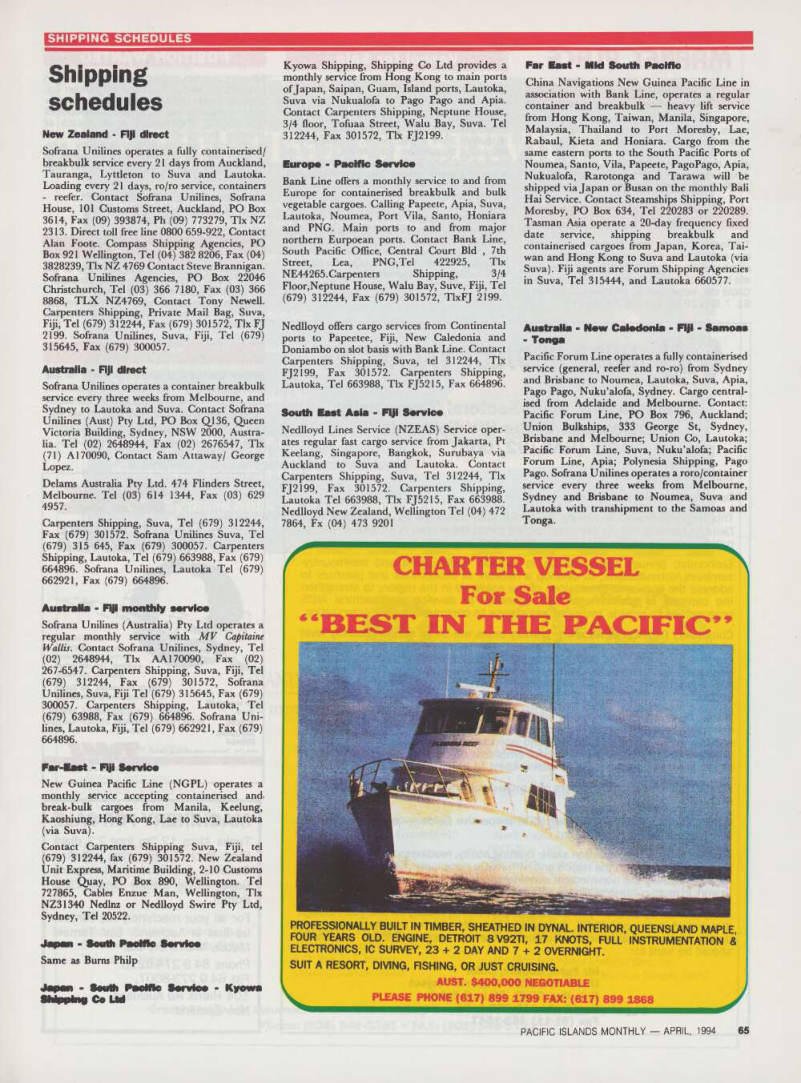
Schedules
Shipping schedules
New Zealand - FIJI direct Sofrana Unilines operates a fully containerised/ breakbulk service every 21 days from Auckland, Tauranga, Lyttleton to Suva and Lautoka.
Loading every 21 days, ro/ro service, containers - reefer. Contact Sofrana Unilines, Sofrana House, 101 Customs Street, Auckland, PO Box 3614, Fax (09) 393874, Ph (09) 773279, Tlx NZ 2313. Direct toll free line 0800 659-922, Contact Alan Foote. Compass Shipping Agencies, PO Box 921 Wellington, Tel (04) 382 8206, Fax (04) 3828239, Tlx NZ 4769 Contact Steve Brannigan.
Sofrana Unilines Agencies, PO Box 22046 Christchurch, Tel (03) 366 7180, Fax (03) 366 8868, TLX NZ4769, Contact Tony Newell.
Carpenters Shipping, Private Mail Bag, Suva, Fiji, Tel (679) 312244, Fax (679) 301572, Tlx FJ 2199. Sofrana Unilines, Suva, Fiji, Tel (679) 315645, Fax (679) 300057.
Australia - FIJI direct Sofrana Unilines operates a container breakbulk service every three weeks from Melbourne, and Sydney to Lautoka and Suva. Contact Sofrana Unilines (Aust) Pty Ltd, PO Box Q 136, Queen Victoria Building, Sydney, NSW 2000, Austra lia. Tel (02) 2648944, Fax (02) 2676547, Tlx (71) A 170090, Contact Sam Attaway/ George Lopez.
Delams Australia Pty Ltd. 474 Flinders Street, Melbourne. Tel (03) 614 1344, Fax (03) 629 4957.
Carpenters Shipping, Suva, Tel (679) 312244, Fax (679) 301572. Sofrana Unilines Suva, Tel (679) 315 645, Fax (679) 300057. Carpenters Shipping, Lautoka, Tel (679) 663988, Fax (679) 664896. Sofrana Unilines, Lautoka Tel (679) 662921, Fax (679) 664896.
Australia - FIJI monthly service Sofrana Unilines (Australia) Pty Ltd operates a regular monthly service with MV Capilaine Wallis. Contact Sofrana Unilines, Sydney, Tel (02) 2648944, Tlx AA170090, Fax (02) 267-6547. Carpenters Shipping, Suva, Fiji, Tel (679) 312244, Fax (679) 301572, Sofrana Unilines, Suva, Fiji Tel (679) 315645, Fax (679) 300057. Carpenters Shipping, Lautoka, Tel (679) 63988, Fax (679) 664896. Sofrana Uni lines, Lautoka, Fiji, Tel (679) 662921, Fax (679) 664896.
Far-East - Fiji Service New Guinea Pacific Line (NGPL) operates a monthly service accepting containerised and break-bulk cargoes from Manila, Keelung, Kaoshiung, Hong Kong, Lae to Suva, Lautoka (via Suva).
Contact Carpenters Shipping Suva, Fiji, tel (679) 312244, fax (679) 301572. New Zealand Unit Express, Maritime Building, 2-10 Customs House Quay, PO Box 890, Wellington. Tel 727865, Cables Enzue Man, Wellington, Tlx NZ31340 Nedlnz or Nedlloyd Swire Pty Ltd, Sydney, Tel 20522. ■ fm.ili i|a nlfln ■ gPS|Mn * 901101 l ' i l - OfiYlCt Same as Bums Philp japan - South Pacific Sarvica * Kyowa Skipping Co Ltd
Kyowa Shipping, Shipping Co Ltd provides a monthly service from Hong Kong to main ports of Japan, Saipan, Guam, Island ports, Lautoka, Suva via Nukualofa to Pago Pago and Apia.
Contact Carpenters Shipping, Neptune House, 3/4 floor, Tofuaa Street, Walu Bay, Suva. Tel 312244, Fax 301572, Tlx FJ2199.
Europe - Pacific Service Bank Line offers a monthly service to and from Europe for containerised breakbulk and bulk vegetable cargoes. Calling Papeete, Apia, Suva, Lautoka, Noumea, Port Vila, Santo, Honiara and PNG. Main ports to and from major northern Eurpoean ports. Contact Bank Line, South Pacific Office, Central Court Bid , 7th Street, Lea, PNG,TeI 422925, Tlx NE4426s.Carpenters Shipping, 3/4 Floor,Neptune House, Walu Bay, Suve, Fiji, Tel (679) 312244, Fax (679) 301572, TIxFJ 2199.
Nedlloyd offers cargo services from Continental ports to Papeetee, Fiji, New Caledonia and Doniambo on slot basis with Bank Line. Contact Carpenters Shipping, Suva, tel 312244, Tlx FJ2199, Fax 301572. Carpenters Shipping, Lautoka, Tel 663988, Tlx FJ5215, Fax 664896.
South East Asia - Fiji Service Nedlloyd Lines Service (NZEAS) Service oper ates regular fast cargo service from Jakarta, Pt Keelang, Singapore, Bangkok, Surubaya via Auckland to Suva and Lautoka. Contact Carpenters Shipping, Suva, Tel 312244, Tlx FJ2199, Fax 301572. Carpenters Shipping, Lautoka Tel 663988, Tlx FJ5215, Fax 663988.
Nedlloyd New Zealand, Wellington Tel (04) 472 7864, Fx (04) 473 9201
Far East - Mid South Pacific China Navigations New Guinea Pacific Line in association with Bank Line, operates a regular container and breakbulk heavy lift service
from Hong Kong, Taiwan, Manila, Singapore,
Malaysia, Thailand to Port Moresby, Lae, Rabaul, Kieta and Honiara. Cargo from the same eastern ports to the South Pacific Ports of
Noumea, Santo, Vila, Papeete, PagoPago, Apia,
Nukualofa, Rarotonga and Tarawa will be shipped via Japan or Busan on the monthly Bali Hai Service. Contact Steamships Shipping, Port Moresby, PO Box 634, Tel 220283 or 220289.
Tasman Asia operate a 20-day frequency fixed date service, shipping breakbulk and containerised cargoes from Japan, Korea, Tai wan and Hong Kong to Suva and Lautoka (via Suva). Fiji agents are Forum Shipping Agencies in Suva, Tel 315444, and Lautoka 660577.
Australia - New Caledonia - FIJI - Samoas - Tonga Pacific Forum Line operates a fully containerised service (general, reefer and ro-ro) from Sydney and Brisbane to Noumea, Lautoka, Suva, Apia,
Pago Pago, Nuku’alofa, Sydney. Cargo central
ised from Adelaide and Melbourne. Contact; Pacific Forum Line, PO Box 796, Auckland;
Union Bulkships, 333 George St, Sydney,
Brisbane and Melbourne; Union Co, Lautoka; Pacific Forum Line, Suva, Nuku’alofa; Pacific
Forum Line, Apia; Polynesia Shipping, Pago
Pago. Sofrana Unilines operates a roro/container service every three weeks from Melbourne, Sydney and Brisbane to Noumea, Suva and Lautoka with transhipment to the Samoas and
Tonga.
Advertisements & other items, pp. 65-68 (1 item)
Charter Vessel
For Sale
IN THE PACIFIC”
■ m m as ■M * ■ m ms* r ■ .
PROFESSIONALLY BUILT IN TIMBER, SHEATHED IN DYNAL. INTERIOR, QUEENSLAND MAPLE, FOUR YEARS OLD. ENGINE, DETROIT 8V92T1, 17 KNOTS, FULL INSTRUMENTATION & ELECTRONICS, 1C SURVEY, 23 + 2 DAY AND 7 + 2 OVERNIGHT.
SUIT A RESORT, DIVING, FISHING, OR JUST CRUISING.
AUST. $400,000 NEGOTIABLE
PLEASE PHONE (617) 899 1799 FAX: (617) 899 1868
MRRKCT PLfiC€
Members Wanted
International Market Research (Dataßank) seeks members in all Pacific countries (and worldwide). Ground floor opportunity. Up to 4 short simple consumer surveys a year. Earn good bonuses for little effort. Obligation free details and application form; Manager, PO Box 1090, Preston 3072, Australia.
SCRAP METAL
Tall ingots operate from Brisbane, Australia and make frequent visits to the Pacific Islands which they have done for twenty-five years. We are buyers of Copper, Brass, Aluminium, Lead, Cable etc. Inspection no problems. Telephone 61 7 8922033. Fax 61 78922077.
Vessel for Sale
Auxiliary ketch. Built 1985. 54 x 17.0 x 4.6. Twin drop keels, Ferro Construction: N.Z. Design, F.A.O Supervised construction: 120 H.P Ford Lehman diesel; 3:1 reduction 24 x 28 propeller, engine reconditioned, September 93. About 5 hours running: 240 volt 3 kva diesel generator (new): 12 volt system: vessel has just completed extensive refit between decks new pilot house. Six permanent berths in 2 single cabins and Ix 4 berth compartment forward; 2 showers/toilets: gas stove in galley, pressurised water system; HF and VHF sets; EPIRB; sounder: soiar panel: fridge, deep freeze; wash machine and dryer: spares include shaft and propeller: vessel ideally situated for charter work Sale due to owners failing health: U.S. $BO,OOO. Contact ADAMS P.B. 34
SANTO VANUATU. FAX 678 366 30.
POSITION WANTED
16 years resident and proven record working in Melanesian, Micronesian and Polynesian cultures in highly responsible position. Familiar with company operation, project development and training. Experienced in all facets of shipping including operation, technical and mechanical, also hospitality industry automotive, teaching experience broad range of tertiary and technical qualifications. No challenge too large.
Write to R.T.C. 27 Endeavour St., CAPALABA 4157, Queensland
AUSTRALIA.
Marketing
I am Rev. Thomas Scarborough, one of the Globe’s best known Christian programmers. I am seeking retail marketing agreements I program, you market, I take a standard royalty.
Write to: 6 St. Patrick’s Road, 8001 Fresnaye, South Africa.
BOOKS
Sydney secondhand bookshop wants to buy quality books on the Pacific and Southeast Asia. Also now available current catalogue "Pacific and Southeast Asia” free on request.
BIBLIOPHILE, 24 Glenmore Road, Paddington, NSW 2021, Australia. Tel. 61.2.331.1411.
Fax. 61.2.361.3371.
UNDP PROJECT VACANCIES
Strengthening Multi-Sectoral/Community
Responses in the HIV Epidemic
(RAS/92/008)
Duration: years.
Duty Station: New Delhi, India This Regional Project is looking for senior staff members for its office in New Delhi. In keeping with its capacity building thrust the project is anxious to recruit nationals of the region. Specifically the project requires: Economist: primary tasks will be to support country-level and intercountryseminars/consultations; to develop a network of economists and planners to address the economic dimensions of the epidemic in the region; to strengthen the capacity of governments and agencies to develop multisectoral AIDS programmes to provide technical assistance to community-based organization.
Community DevelopmentQExjtert: primary tasks will be to support country level and intercountry serhinars/cpnSultations; develop a network of NGOs/CBOs capable of synthesizing and* sharing strategies for community involvement in prevention and behaviours change; to strengthen the capacity of countries/subregions and multisectoral AIDS programmes/strategies; to support community based pilot/demonstration projects.
Trainer/Evaluator: primary tasks will be to support country-level and inter-country seminars/consultations; to develop regional training networks; to strengthen the capacity of countries/sub-regions and agencies to develop multisectoral AIDS programmes strategies with particular emphasis on training aspects: to support community based pilot projects with respect to training and evaluation.
All staff will function as members of a multi-disciplinary team under the direction of the Project Chief.
Qualifications: post-graduate degree in respective fields economics, social sciences; education/evaluation.
Experience; good organization skills, drafting ability, readiness to travel in region.
Experience working in the region and with NGOs necessary. Familiarity with HIV/ AIDS, especially the non-medical considerations would be an advantage. Ability to work in multi-cultural settings, written and spoken fluency in English, essential.
The posts will be on UNDP/OPS foreign expert terms, initially for one year; though the project runs until 1997. Salary and benefits will be commensurate with qualifications and experience. Curricula vitae and names of three references should be sent to: Mr Peter Godwin, Chief UNDP HIV/AIDS Regional Project P.O. Box 3059, 55 Lodi Estate New Delhi 110 003 India Fax (91-11) 463-1647
TO ANYWHERE
IN THE WORLD
Your artifacts, gifts, souvenirs, carvings, artworks, documents whatever. DHL will deliver anywhere worldwide Freight Forwarder*, Ak Cargo DHL Worldwide Express Service
SUVA NADI LAUTOKA LABASA LEVUKA
313166 (679)723800 665400 811162 440139
SAVUSAVU 665401
850454 m rw nwr niwrr*
MACHINERY FOR SALE
Tanks Alum 12.2 m long 2.3 diam Bmm thick. Ex Beverage Industry.
Suitable for food or transport.
Boiler Hoval 590 kw Diesel Elec.
Burner.
For all your machinery req contact us first in Auckland, East Tamaki Metals Machinery Ltd.
Phone 64 9 274-6216.
Fax 64 9 273-8007, 104 Harris Rd Auckland New Zealand.
10 1 5 20 25 30 35 40 45 50
I A LIFETIME OF SERVICES
Grand Pacific Life Insurance offers you a lifetime of safe/ secure products at very competitive rates. • 0 Choose from a full range of products such as • Super Ordinary Life • Super Universal • Non-Participating Whole Life • 10-Year Level Term • Flexible Premium Annuities • Group Life Insurance
• IRAs
• Graded Premium Whole Life A I We've been dedicated to providing fast, personalized service for more than 35 years through local ownership and management. j VP 40 45 That's v/hy Grand Pacific Life is your Family for ••• throughout the Pacific, Grand Pacific i aft- Insurance, \ Ad. 40 45 30 35 40 45 50 55
Grand Pacific Life Insurance, Ltd.
A member of the Finance Factors Family
ÜBft Aftp
jnV.
O/f * 23
may
o W 94 A. -i A, *
FE)ERATED STATES
OFMICRONESIA
Acmka Executive Imrance Underwriters P.C Box 55, Kolonia, Pohnpei, Feerated States of Micronesia 96941 Paific Basin Insurance & Geeral Services, Inc P.C Box 494, Chuuk State, Feerated States of Micronesia 96942
TOGA
Petti Ma‘afu Ins. & Finance, Ltd.
Prate Bag 2, Taumoepeau Bldg.
Nuu‘alofa, Tonga
GUAM
Great National Insurance Underwriters, Inc.
P.O. Box GA, Agana, Guam 96910
AMERICAN SAMOA
Mark Solofa Pacific Insurance & Finance, Inc.
P.O. Box 3149 Pago Pago, American Samoa 96799 Pacific Financial Corporation P.O. Box AT, Agana, Guam 96910 Takagi & Associates, Inc.
GCIC Bldg., Suite 100 414 W. Soledad Ave.
Agana, Guam 96910
MARSHALL ISLANDS
Marshalls Insurance Agency P.O. Box 113, Majuro, Marshall Islands 96960
WESTERN SAMOA
Mark Solofa Pacific Insurance & Finance, Inc.
P.O. Box 3149 Pago Pago, American Samoa 96799
NORTHERN MARIANAS
Pacific Basin Insurance Underwriters, Inc.
P.O. Box 710 Saipan, Mariana Islands 96950 Pacifica Insurance Underwriters, Inc.
P.O. Box 168, Saipan, Mariana Islands 96950 Grand Pacific Life Insurance/ Ltd. *1164 Bishop Street/ sth Floor/ Honolulu/ HI 96813 Phone: (808) 548-3363 • FAX: (808) 548-5122
WITH THE
CROWD?
MITSUBISHI
The All New Mitsubishi Galant —
The Freedom to Drive as You Choose Imagine... you’re on a long ride home from a long day’s work. You want to get home as soon as possible, but you want to do so effortlessly... or maybe you’re on a winding road, and you have the urge to experience truly sporty driving.
Typically, you would need two different cars to enjoy these two experiences fully. But with the new Mitsubishi Galant, it’s all possible.
The new Galant features an innovative approach to engine efficiency that dramatically expands driving potential. Compared to cars with conventional engines, the Galant has far better combustion efficiency and reduced friction losses.
This allows smoother, more powerful operation with almost no noise or vibration. So whether you want to relax and cruise, or drive more sportily, the Galant gives you exactly what you want — when you need it.
Each of the Galant’s new multi-valve engines gives you the unparalleled freedom to drive as you choose. They are an integral part of All Wheel Control, Mitsubishi’s unique approach to car design that gives you total control over the driving experience. With true communication between you and the road, the new Galant ensures total control with quicker, safer and more responsive performance than ever before imaginable.
Discover the meaning of driving freedom with the new Mitsubishi Galant —and feel how All Wheel Control sets you apart from the crowd.
The All New
MITSUBISHI GRLRNT
A • PACIFIC MARKETING INC. RO. Box 698, Pago Pago, Tel. 699-9140 / AUSTRALIA: MITSUBISHI MOTORS AUSTRALIA LTD. 1284 South Road, Clovelly Park, South Australia, Tel. (08) 2757297 / PUT NIVIS MOTOR & MACHINERY CO. LTD. G.RO. Box 150, Suva, tel. 383411/ GUAM: TRIPPLE J ENTERPRISES INC, RO, Box 6066, Tamuning, Tel. 6469126/ NEW CALEDONIA: SOCIETE DTMPORTATION D'AUTO DU PACI PIQUE SUD S.A. RO Box 254 ft Noumea, let. 274-144 /NEW ZEALAND: MITSUBISHI MOTORS NEW ZEALAND LTD. Private Bag. Porirua, Tel. 2370109 1 NORFOLK ISLAND: BORRY S PTY LTD RO Box 169 Tel 2114 /PAPUA NEW GUINEA: TOBA PTY LTD. RQ Box 501 Port Moresby, Tel. 217874 /SAIPAN: AUTO MOTION INC. PO. Box 569, SKV Dist. 4, Tel. 234 3332/ SOLOMON ISLANDS: HARVEST PACIFIC LTD. G.RQ Box 821 Honiara, Tel. 30407/ TAHITI (FRENCH POLYNESIA): SOPAOEP S.A. RO. Box 1617, Papeete, Tel, 427393/ TONGA: SITANI MAPI CO., LTD. RO. Box Nuku'Alola lei 24044/ VANUATU: SOCOMETRA VANUATU LTD. BP. 06, Route de Lagon, Port-Vila, Tel. 2314 /WESTERN SAMOA: MOTOR DISTRIBUTORS (SAMOA) LTD. RO. Box 576, Apia, Tel. 20957
MITSUBISHI
MOTORS
CREATING TOGETHER