Pacific

Islands
Monthly
PNG’s mineral boom: where has it gone?
Fiji
Election
Special;
page 20
March 1994
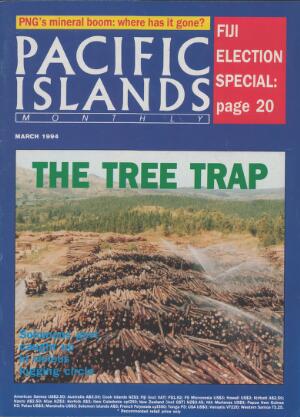
The Tree Trap
<« ■ » **'' ■•-. -i, > ■ ■ -
jWLkftmsMMS
w*'' h\* C |[’ ji p .’' t ; ij|- *Jj r / f jr* t?¥BM* lp il r 4 I ItjT|7r3| j
American Samoa US$2.5O; Australia A 53.50; Cook Islands NZ$3; FIJI (Incl VAT) F 51.92; FS Micronesia US$3; Hawaii US$3; Kiribati A 52.50; Nauru A 52.50; Niue NZ$3; Norfolk As 3; New Caledonia cpf2so; New Zealand (Incl GST) NZ53.45; Nth Marianas US$3; Papua New Guinea K 3; Palau US$3; Marshalls US$3; Solomon islands As 3; French Polynesia cpf3oo; Tonga P 3; USA US$3; Vanuatu VT22O; Western Samoa T 3.25. * Recommended retail price only
Advertisements & other items, pp. 2-4 (1 item)
even ordinary driving requires an extraordinary car.
H) OJVDA The legendary engines behind 71 Grand Prix victories and six consecutive Constructors' Championships -
Sometimes,
While every driver might wish for perfect driving conditions of clear, blue sky and dry roads, the reality is often quite different. Rain. Wind. Slick and slippery streets and highways. These are conditions that make even careful drivers a little nervous.
But not when driving the all-new, fifth generation Honda Accord. Because this car creates confidence.
Its monocoque body was created with the help of advanced computer-aided design and real-world testing to be extremely strong and rigid. By minimizing flexing, it improves handling response, keeping the driver in control at all times. This control is further enhanced under all possible driving conditions by Honda’s race-bred 4-wheel double wishbone suspension and new rotary valve power steering system.
The New Accord was extensively tested to help protect occupants from accidents that occur from any direction, including offset collisions the most common serious accident. To guard against side impact, the Accord employs shock absorbing material and strong side beams inside each door.
Under excellent driving conditions, you will enjoy driving the extraordinary new Accord to the utmost. Honda’s latest technology balances seemingly contradictory issues, like an engine that is both powerful and extremely fuel efficient. And a dedication to safety as well as driving pleasure.
Under bad conditions, you will perhaps appreciate it even more.
HONDA ACCORD
THE JAPANESE
CAR
OF THE,
WEAR/
A '93-94/y “JAPANESE CAR OF THE YEAR ’93-’94” / “IMPORT CAR OF THE YEAR ’94” Motor Trend Magazine (U.S.A.) AUSTRALIA: HONDA AUSTRALIA PTY. LTD.. TEL. (61) 3-2855555 COOK ISLANDS: COOK ISLAND MOTOR CENTRE LIMITED, TEL. (682) 22055
FIJI: CARPENTERS MOTORS, TEL, (679) 313644
NEW CALEDONIA: 5.G.1.A., S.A., TEL. (687) 281787 NEW ZEALAND: HONDA NEW ZEALAND LTD., TEL. (64) 9-2623141 NORFOLK ISLANDS: DUNCOMBE BAY GARAGE, TEL. (672) 322097 PAPUA NEW GUINEA; TOBA MOTORS, TEL. (675) 217874 SAIPAN: TRANS-MICRONESIA MOTORS, INC., TEL. (670) 234-8333/4 SOLOMON ISLANDS; LEE KWOK KUEN & CO., LTD, TEL. (677) 22446 TAHITI; HONDA GENERATION S.A.R.L, TEL. (689) 420516
srr*; 1 m ?■ iff? »ss &f\pegt‘ |s «r £ ,r •■- ■’■•"s rv*v:. -5» w&ata. s n K Jm wn :-. m i-m rm% 9MJ i-. **■- 4 . '‘tw - . *•■ m %A‘ „ V i 'rJxtfJ* «<• .4 A tm wm It. ■ li ’ , ,-. : ■■■•■ ■* ■ .3 «L I 1 - 7', PK
BES^WtiiiiihP
Bl ■*■•&; II i m < 1 Ml Gold Meda! Winner Lager BeerCompetiii° n '
The Beer of Paradise...
South Pacific Export Lager
10 15 20 25 30 35 45 50 55 60
I A LIFETIME OF SERVICES
40 45 Grand Pacific Life Insurance offers you a lifetime of safe, secure products at very competitive rates. • r Choose from a full range of products such as
• Super Ordinary Life
• Super Universal • Non-Participating Whole Life • 10-Year Level Term • Flexible Premium Annuities • Group Life Insurance
• IRAs
• Graded Premium Whole Life We've been dedicated to providing fast, personalized service for more than 35 years through local ownership and management.
Grand Pacific Lift* Insurance, Ltd That's why Grand Pacific Life is your Family for ...throughout the Pacific. 40 45 20 30 40 45
Grand Pacific Life Insurance, Ltd.
A member of the Finance Factors Family
FEDERATED STATES
OF MICRONESIA
Actouka Executive Insurance Underwriters P.O. Box 55, Kolonia, Pohnpei, Federated States of Micronesia 96941 Pacific Basin Insurance & General Services, Inc P.O. Box 494, Chuuk State, Federated States of Micronesia 96942
TONGA
Peseti Ma ‘afu Ins. & Finance, Ltd.
Private Bag 2, Taumoepeau Bldg.
Nukualofa, Tonga
GUAM
Great National Insurance Undenvriters, Inc.
P.O. Box GA, Agana, Guam 96910
AMERICAN SAMOA
Mark Solofa Pacific Insurance & Finance, Inc.
P.O. Box 3149 Pago Pago, American Samoa 96799 Pacific Financial Corporation P.O. Box AT, Agana, Guam 96910 Takagi & Associates, Inc.
GCIC Bldg., Suite 100 414 W. Soledad Ave.
Agana, Guam 96910
MARSHALL ISLANDS
Marshalls Insurance Agency P.O. Box 113, Majuro, Marshall Islands 96960
WESTERN SAMOA
Mark Solofa Pacific Insurance & Finance, Inc.
P.O. Box 3149 Pago Pago, American Samoa 96799
NORTHERN MARIANAS
Pacific Basin Insurance Underwriters, Inc.
P.O. Box 710 Saipan, Mariana Islands 96950 Pacifica Insurance Undenvriters, Inc.
P.O. Box 168, Saipan, Mariana Islands 96950 Grand Pacific Life Insurance, Ltd. *1164 Bishop Street, sth Floor, Honolulu, HI 96813 Phone: (808) 548-3363 • FAX: (808) 548-5122
Pacific
Islands
Monthly
Vol 64 No. 3
The News Magazine
March 1994
Forum 6
Letters 7
Headlines 8
Pacific Diary 10
Cover Story
Solomon Islands logging dilemma 11
Tourism
Laggards respond to tourism survey 14
Industrial Relations
Not Korman's year 16
The United Nations
Gearing up for Barbados 17
Hawaii
101st anniversary of overthrow observed 18
Politics
Fiji election 20
New Caledonia
Stormy sea for new ferry 22
People
Fakafanua’s balancing act 25
Business
Now where did that minerals boom go? 27 Radisson sale could affect hotel prices 29
Telecom Feature 37
Marshall Islands
Special feature on the Marshall Islands 43
Yachting
So what’s a junk rig? 58
Sport
Unions to unite 59 Tongans to do it tough 59 Burning Bunce 60 Winter Olympians 61 Jone wins again 61
Shipping
Shipping schedules 63
Columnists
Jemima Garrett 19
David Barber 42 Bill McCabe 57
Publisher; Brian O’Flaherty Acting Editor: Martin Tiffany Associate Editor: Arvind Kumar Correspondents: Christine Hatcher, David North, Ed Rampell, lan Williams, Johnson Honimae, Karen Mangnall, Liz Thompson. Nicholas Rothwell, Pesi Fonua, Wally Hiambohn.
Columnists; David Barber (Wellington), Futa Helu (Tonga, covering the Pacific Islands), Jemima Garrett (Sydney).
Julian Moti (Pacific Law), Alfred Sasako (The Forum).
Advertising Sales: • Regional Sales (South Pacific; Salendra Narayan, Tel (679) 304111, 303244, Fx (679) 303809. • Sydney, Canberra Bob Hill Media Reoresen tations, Tel (61-2) 4164245. Fx (61-2) 4165064 • Brisbane; Robert Walker. Media House, Tel (61-7) 3710533. Fx (61-7) 371-8904 • Adelaide: Hastwell Williamsons Representatives, Tel (61-8) 3799522, Fx (61-8) 3799735. • Melbourne: Brown Orr Fletcher Burrows (Aust).
Pty. Ltd. Tel (3) 696 5188 Fx (03) 696 5131. • Auckland: McKay & Bowman, International Media Representatives Ltd, Tel (64-9) 4190561, Fx (64-9) 4192243.
• Japan: Universal Media Corrporation, Tokyo, Tel (3) 32626741, Cable: UNIMEDIA Tokyo, Fx (3) 32626742.
Founded 1930 (USPS 952480). A Fiji Times Limited production.
Cover prices are recommended retail only. Regis tered by Australia Post, Publication No. NBP 1210. © Copyright Fiji Times Limited, 177 Victoria Parade, Suva. Fiji. Tel (679) 304111, Fx (679)
303809, Tx Fj2124.
Pacific Islands Monthly is published monthly by The Fiji Times Limited, a division of Nationwide News, 2 Holt Street, Surry Hills. Sydney, NSW 2010.
Send address changes to: • Pacific Islands Monthly. PO Box 1167, Suva, Fiji.
Typeset and printed by The Fiji Times Limited, 177 Victoria Parade, Suva. Fiji.
Arvind Kumar
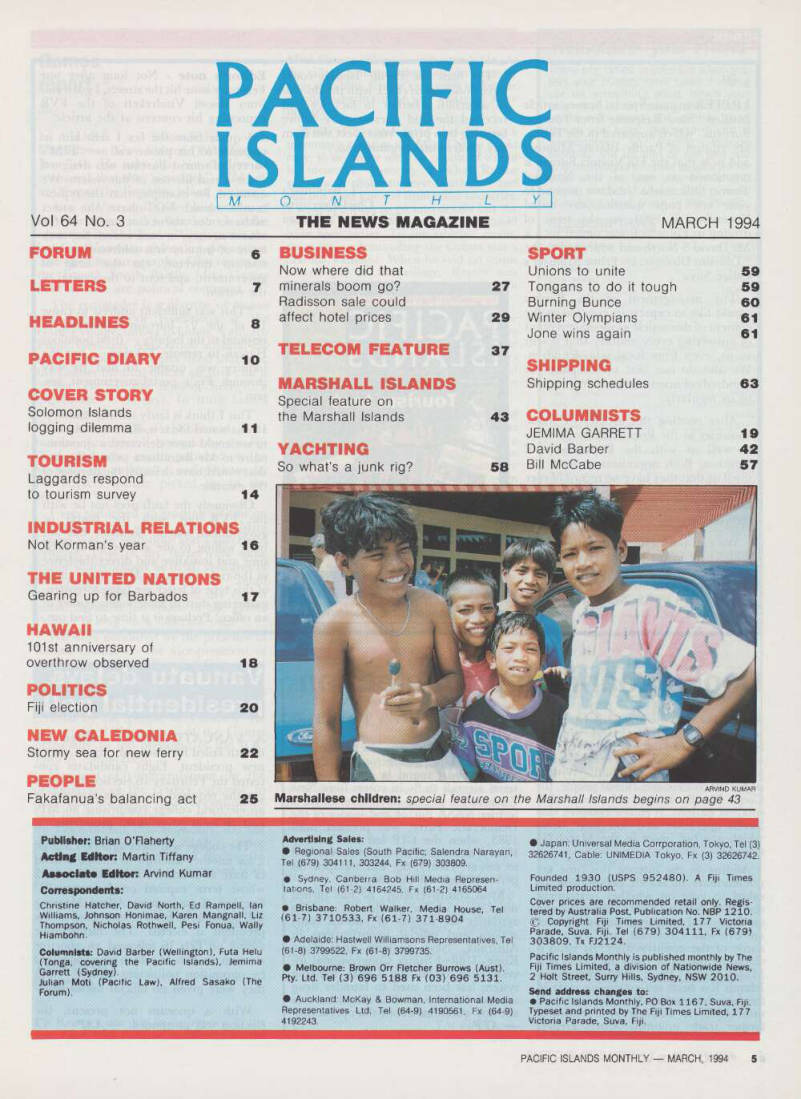
Marshallese children: special feature on the Marshall Islands begins on page 43
Forum
Sir I REFER to your Special Survey article entitled “Slow Response from Tourism Bureaus” which appeared in the Febru ary edition of Pacific Islands Monthly and note that the Fiji Visitors Bureau is mentioned as one of the National Tourist Offices which did not respond to your one page questionnaire dated November 5, 1993, on the topic of driving in Fiji which was signed by a a Mr David S North and addressed to the “Tourism Director, c/- Prime Minister’s Office Suva”.
The management of the Bureau would like to express its concern at the content of this article as we make a point of answering every enquiry that is sent to us, even from local schoolchildren.
We also do our best to complete the hundreds of questionnaires that are sent to us regularly.
After reading this article, we made enquiries at the Prime Minister’s office as well as with the Department of Tourism. Both organisations have ad vised us that they have no record of ever having received the questionnaire re ferred to nor has tbe Bureau ever received it.
We can only assume that it is lying somewhere in the postal department of the Fiji Post and Telecommunications Department due to the fact that the address given by Mr North was incom
plete.
The least the Pacific Islands could have done was to check with the Bureau to ascertain whether in fact we had received the said questionnaire before bursting into print. We expect this from
any professional organisation.
I. Bainimara
Chief Executive Fiji Visitor’s Bureau
Editor’s note - Not long after our February issue hit the streets, I got a call from Ilisoni Vuidreketi of the FVB expressing his concern at the article.
I quote from the fax I sent him in response to his phone call “PlM’s survey of tourist bureaus was designed to be a real life test of the system. We assumed, for example, that the typical tourist would NOT have the street address, nor the exact name of the tourist agency, in each island. So, each letter of inquiry was addressed to the tourism director, c/o the head of government, and sent to the capital of the nation.
“This was sufficient address to cause 17 of the 27 bureaus concerned to
respond to the inquiry from populous
Hawaii to remote Tokelau but the inquiry was unable to find its way
through Fiji’s postal/government sys
tem.”
This I think is fairly self-explanatory.
It was a real-life test, if we had wanted to we could have delivered a question naire to Mr Bainimara personally, but that would have defeated the purpose of the exercise.
Obviously the fault does not lie with the FVB but with the postal or government system. Someone has not been willing to use a little bit of their time and initiative and direct the letter in the right direction. How many more of this type of letter are lying forgotten, gathering dust in some lonely corner of an office? Perhaps it is time to find out.
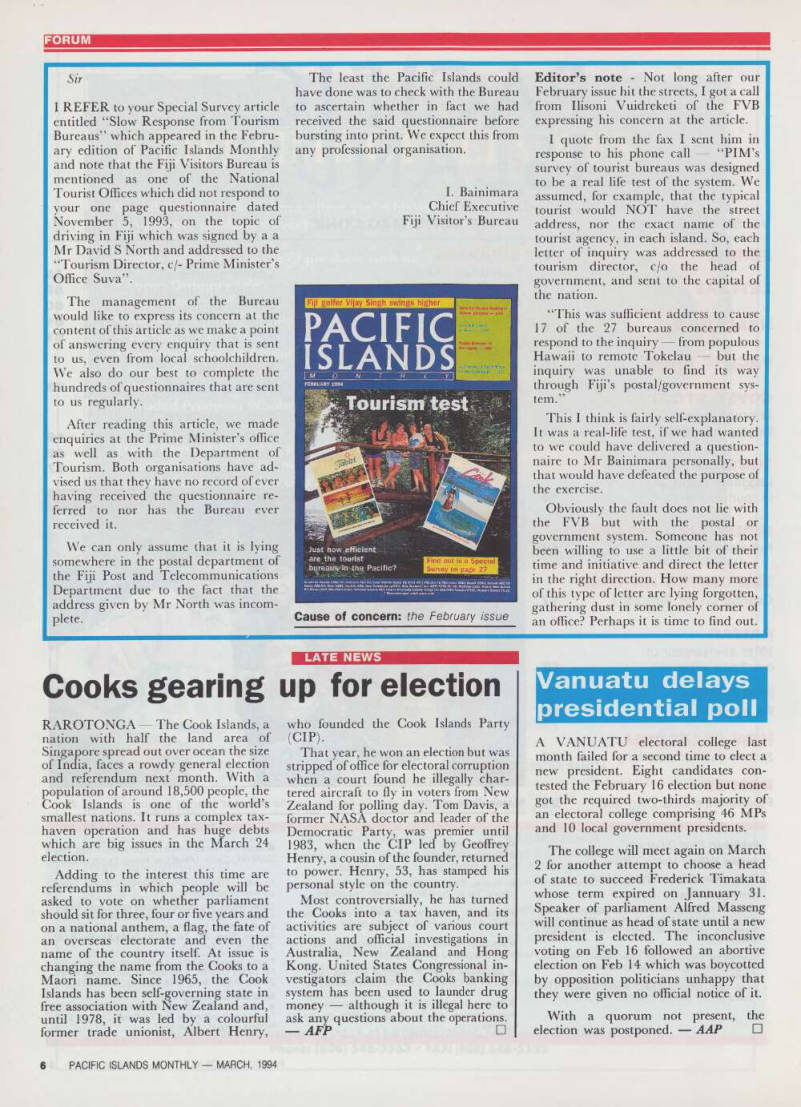
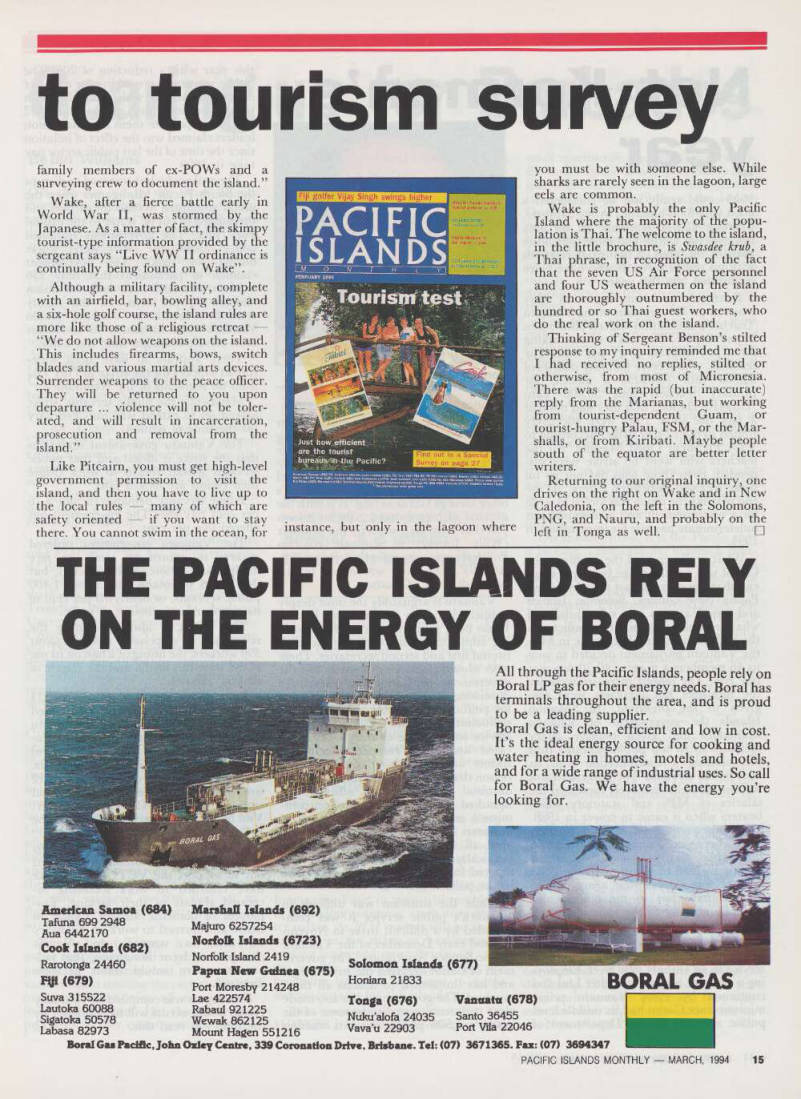
Cause of concern: the February issue
Cooks gearing up for election
Late News
RAROTONGA The Cook Islands, a nation with half the land area of Singapore spread out over ocean the size of India, faces a rowdy general election and referendum next month. With a population of around 18,500 people, the Cook Islands is one of the world’s smallest nations. It runs a complex tax haven operation and has huge debts which are big issues in the March 24 election.
Adding to the interest this time are referendums in which people will be asked to vote on whether parliament should sit for three, four or five years and on a national anthem, a flag, the fate of an overseas electorate and even the name of the country itself. At issue is changing the name from the Cooks to a Maori name. Since 1965, the Cook Islands has been self-governing state in free association with New Zealand and, until 1978, it was led by a colourful former trade unionist, Albert Henry,
who founded the Cook Islands Party
(Cip).
That year, he won an election but was stripped of office for electoral corruption when a court found he illegally char tered aircraft to fly in voters from New Zealand for polling day. Tom Davis, a former NASA doctor and leader of the Democratic Party, was premier until 1983, when the CIP led by Geoffrey Henry, a cousin of the founder, returned to power. Henry, 53, has stamped his personal style on the country.
Most controversially, he has turned the Cooks into a tax haven, and its activities are subject of various court actions and official investigations in Australia, New Zealand and Hong Kong. United States Congressional in vestigators claim the Cooks banking system has been used to launder drug money although it is illegal here to ask any questions about the operations.
Afp
Vanuatu delays
presidential poll
A VANUATU electoral college last month failed for a second time to elect a new president. Eight candidates con tested the February 16 election but none got the required two-thirds majority of an electoral college comprising 46 MPs and 10 local government presidents.
The college will meet again on March 2 for another attempt to choose a head of state to succeed Frederick Timakata whose term expired on Jannuary 31.
Speaker of parliament Alfred Masseng will continue as head of state until a new president is elected. The inconclusive voting on Feb 16 followed an abortive election on Feb 14 which was boycotted by opposition politicians unhappy that they were given no official notice of it.
With a quorum not present, the
election was postponed.
Aap
report
Letters
Games
Sir, I SHARE a fellow-feeling with Cornishman Guy Slatter (PIM Letters Jan ’94). He asks that we readers be reassured that the “new look” PIM will not forget the “smaller island nations”.
As a ni-Vanuatu citizen and reader of PIM for 44 years, I suffered shock at the
reporting by Shailendra Singh under the
heading Vanuatu takes on pressure.
The opening paragraphs of this report on the Fourth South Pacific Mini Games held at Vila are political comment.
The remainder is a diatribe of moans and groans, poor conditions at the Games village, moves to hotels, Vanuatu Public Servants Association strikers, di arrhoea, poisonous water, food shortage, the Games medical officer on strike for a 16 per cent pay rise, missing chefs etc. a nightmare he says. In truth biased
reporting.
Singh has sullied the record in a morass of rumour sourced by the Fiji Times and other media pounced on (he says) by the strikers and perhaps by the strikers leaflets picked up in the streets of Vila.
I was saddened on reading all this on the sports pages of my PIM. Our Mini Games was an ambitious and a successful venture. True to say there were some minor shortcomings as in all ventures of this magnitude hosted by a “small country”. Snide castigations are out of order. Sport is the name of the game.
Politics belong on a different page.
We were honoured by the presence of Kevan Gosper the vice-president of the International Olympic Committee who spoke on the success of the Games, the excellent standard of competition and the friendly atmosphere of Port Vila created by the people of Vanuatu. He has reported the success of the Games personally to the president of the lOC Juan A Samaranch.
Messages of congratulations on the organisation of the Games continue to come from countries, sports organisations and individuals. Finally to say what the Cornishman, diplomatically, did not say I feel that my PIM since takeover and a move from Sydney to Suva appears to be preoccupied with
Fiji.
Walter O’Shea
Luganville Santo Vanuatu Vanuatu Games Sir, I S Rector’s reaction to my reports in the Fiji Times and PIM on conditions at the
Mini Games village is understandable. As
the village manager, they wouldn’t exactly
appeal to him. Rector’s response makes me wonder whether if he was aware of some
problems.
While it is appreciated that hosting a mammoth event as the Mini Games is not easy, to say there were no problems would be incorrect. Contrary to what Rector suggests, I spoke to several athletes and officials from Fiji and from other countries.
I wouldn’t want to go into details but the common perception was that things could have been better. To the athletes’ credit, there was understanding the Games was a first for Vanuatu. When he said no teams moved out of the village, Rector was perhaps unaware of a women’s tennis team which stayed at Olympic Hotel.
He talks of false rumours of “extensive outbreaks of diarrhoea”. I reported there were scores of cases. Of the 15 countries, the Fiji contingent alone had 20 sufferers. Cases began to ease after athletes were supplied with bottled water midway through the Games.
Rector first says my report on food problems was incorrect. In the very next line, he says just what I reported: that a container load of food specifically for the Games was delayed but arrangements were made with local suppliers. The Fiji team management did put out a carefully worded statement in response to my report.
Quite understandably, just as in Rector’s
case, some issues raised in my reports were not mentioned in the statement at all.
Can Rector deny drinking water sup plied to athletes contained mosquito lar vae? Luckily the larvae were spotted before any water was consumed. Rector says team managers agreed unanimously that con ditions within the Games village were “very
good”.
I wonder if the Fiji management raised any questions about conditions after their athlete, Tevita Bola, fell ill. He clearly picked up the virus from the village and was sick enough to warrant concern. The hospital wanted to admit him. In four days, he lost four kilos.
Following that, Bole’s relatives in Port Vila prepared his food, and that of several of his teammates upon their request. Bole did compete in his event later although he hadn’t recovered fully and it affected his
performance.
My job as a journalist was to report the above. I wasn’t in Port Vila as a public relations officer for Rector or the Games organisers. Contrary to what Rector says, attempts were made to seek clarification from officials. Dr Husnoor Ali of Fiji, PNG’s Dr Gideon Kendino, organising committee member Peter Barrat and head chef Graham Underwood were interviewed and quoted extensively in the Fiji Times.
Shailendra Singh
Chief Sports Reporter The Fiji Times Suva
Advertisements & other items, p. 7 (1 item)
'Pacific
Remember your Friend
There are times in your life when you feel your friends have been missing out on something good. Now’s your chance to do something about it and share with them one of the good things you have. Buy your friend a subscription to Pacific Islands Monthly and let him or her join you and thousands of other people worldwide who are kept informed of the latest political, social and cultural
changes taking place in the Pacific.
SUBSCRIPTIONS
American Samoa US$45 Australia A 542.00 Canada US$45 Cook Islands AUSS46 Fiji F 526.40 French Polynesia US$45 Guam US$45 Hawaii US$45 Japan US$45 Kiribati AUSS46 Marshall/Micronesia US$4O Nauru AUSS42 New Caledonia US$32 New Zealand NZ$55 Niue AUSS46 Norfolk Island AUSS42 Northern Marianas/Palau US$4O Papua New Guinea AUSS4S Solomon Islands AUSS46 Tonga AUSS46 Tuvalu AUSS46 United Kingdom Stg Pound2B US Mainland US$45 Vanuatu AUSS4S Western Samoa WS$6O Elsewhere AUSS63 Payment to Pacific Islands Monthly: Subscriptions Dept, GPO Box 1167, Suva, FIJI.
Subscriptions rates include the cost of airspeeding to all destinations set out above.
Direct airmail rates on application.
Telephone: 304111 Fax: 303809
'PACIFIC
SLANDS
IV o V r H L I- I Please send my friend Pacific Islands Monthly for one year (12 issues).
I enclose my cheque for $ (made payable to Pacific
Islands Monthly)
or debit $ to my: □ Bankcard □ Visacard □ Mastercard Card No: i i I i ! ! I ! i I : i I 1 Expiry Date
NAME
SIGNATURE
ADDRESS:
CITY COUNTRY
Diplomat charged with
[Headlines
Marshall Islands
Kabua has it all
Now it is official, Amata Kabua has it all. Long regarded as the most powerful, and the richest person in the Marshalls, Amata Kabua, is (like Bill Clinton) both the head of state, and the head of government in his role as President of the Republic of the Marshall Islands.
Kabua is the only President in the history of the Marshalls, having held the position for 25 years. The President is elected by the members of the one-house parliament, the Nitijela, a body where there is no organised opposition. President Kabua exercises the powers of prime ministers in other island nations.
But, until recently, there was a distinction that Kabua lacked, and that was a clear, legal title to the traditional leadership in his islands. Now a Honolulu judge, Samuel King, has ruled that Amata Kabua, and not his uncle, Kabua Kabua, is the legally-recognised paramount chief.
It is not just a family squabble over an old title - millions of dollars rode on the decision, because the traditional chiefship in question included jurisdiction over the Kwajaleni atoll, which is where US missiles plop down after their long voyages from the Mainland. And the US pays millions of dollars in rent annually to the Kwajalein landowners, including the Kabuas.
The dispute wound up in a Honolulu court because of the Mainland moneys. The judge ruled that the Marshalls parliament (which Amata Kabua has dominated for decades) had decided earlier that Amata Kabua was the paramount chief, and he, the judge, was in no position to second guess the parliament. It is reported that millions were spent in attorney’s fees during the ten-year-long battle. The dispute itself, according to Washington Pacific Report, date back more than 90 years to an inter-family dispute about which of two sons should be the paramount chief - a dispute started long before missiles and atom bombs and the flow of funds from
Washington, D.C.
All of this, a fairly new seat in the United Nations for his country, and a strong margin in the last election for Amata Kabua.
One could say that Amata Kabua is doing well.
Diplomat charged with
fraud and misconduct
A FORMER Marshall Islands diplomat has been charged with 78 counts of fraud and misconduct allegedly committed during
a posting to Fiji.
A criminal indictment was filed in the Marshall Islands High Court last month against Bruce Kijiner, former first secretary of the Marshall Islands embassy in Suva.
He is charged with 58 counts of embezzlement, 13 counts of misconduct in public office and seven counts of forgery resulting from the unlawful use of $F66,000 ($A63,000) from bank accounts in Suva between October 1991 and September 1993, court documents said.
The charges follow an audit investigation carried out by the
Attorney-General’s department.
Missing Millions
Nauru
Missing Millions Melbourne talks
Talks took place in Melbourne in January about the millions of dollars missing from the Nauru Phosphate Royalties Trust.
The talks involving trustees, normally based in Nauru, and four London lawyers took place at Nauru House where the trusfs office is located.
Aicording to Pacnews Canberra burea some US$B.5 million is sad to be missing as a result of the trust’s involvement in inve.tment schemes in 1992.
Tie trust is also seeking a further US$5 million paid out in fees o various advisers. The schemes are the subject of civil proceedings launched by both the trust and the law firm Allen Allei and Hemsley.
According to the Australian Financial Review, the Victorian Corporate Crime Group confirmed that it wanted to interview former trustees about the schemes. However, the newspaper said alks between the police and former trustees broke down.
Tlree of the four current trustees, taking part in the Mellourne talks, were trustees at the time of the 1992 inveiment program when US$6O million was placed in bank accomts in London and elsewhere.
Bougainvillean woman
Australia
Bougainvillean woman granted refugee status
Australia’s decision to grant refugee status to a 23-year-old Boganville woman is expected to lead to more applications from Bougainvilleans who have fled the fighting on the copper rich island.
In Melbourne in late January, the Refugee Reviews Tribunal granted refugee status to Lillian Crofts, who arrived in Australia as a student in 1984.
Three other Bougainvilleans have applications for refugee status pending, and it’s expected there will be more applications from the estimated 100 —200 Bougainviilens now living in Australia.
In Croft’s case, she applied for refugee status about three years ago after being detained for two and a half weeks at the Maribyrnong Detention Centre in Melbourne.
“I went to the immigration offices for help when my student visa expired . Instead of helping me they locked me up. I was treated okay but I was made to feel like a criminal,” she said.
With the helps of civil rights lawyer, Rosemary Gillespie, an application was made seeking refugee status. Croft said she feared persecution by the Papua New Guinea government if she tried to return home, because she supported independence
for Bougainville.
Vanuascope
Vanuatu
Vanuascope closes
Vanuatu’s only privately owned newspaper, Vanuascope, closed down in late January 11 month’s after it began in March last year. Editor Patrick Decloitre said in his front page editorial in the 48th and last issue that the closure was due to financial reasons.
He said Vanuascope was a “quality paper” and its production cost was high but its advertising revenue was not enough to support it. Decloitre said the market in Port Vila wasn’t enough to support the number of newspapers and the government owned commercial radio. He denied reports that the closure was due to government pressure.
Henry
Cook Islands
Henry dies
Campaigning for the Cook Islands elections on March 24 has been thrown into turmoil by the sudden death of the ruling Cook Islands Party’s campaign manager, Hugh fjenry. Henry died suddenly from a heart attack in late He was a cousin of the Prime Minister Henry, and a son of the Cooks founding Prime Minister, Albert Henry.
over diplomatic posting
Niue
Row brewing over diplomatic posting
A row is brewing on Niue over the appointment to the island’s only overseas diplomatic post Consul General in Auckland.
Until the end of January, the post had always been filled by a career public servant. But in a radical departure from accepted practice, a Niuean living permanently in Auckland was appointed over local applicants Opposition parliamentarian and former cabinet minister Fisa Pihigia has accused Premier Frank Lui of giving the post to a crony. Another parliamentarian Michael Jackson says it is an insult to the many capable people on Niue both in the public service and outside. Jackson says it is wrong as well as inappropriate to appoint a permanent resident of another country to Niue’s top diplomatic post. However, the appointment was not totally unexpected as Lui had previously floated the idea.
Getting their
Papua New Guinea
Getting their priorities right
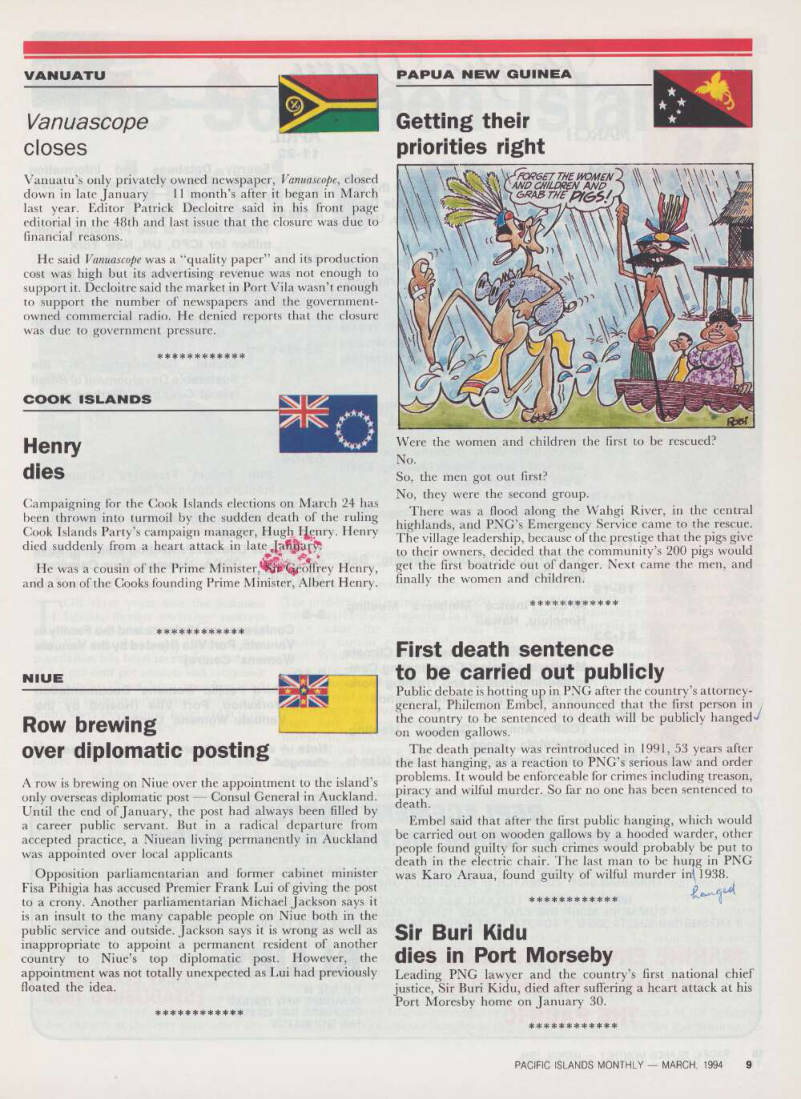
Were the women and children the first to be rescued?
No.
So, the men got out first?
No, they were the second group.
There was a flood along the Wahgi River, in the central highlands, and PNG’s Emergency Service came to the rescue.
The village leadership, because of the prestige that the pigs give to their owners, decided that the community’s 200 pigs would get the first boatride out of danger. Next came the men, and finally the women and children.
First death sentence
to be carried out publicly
Public debate is hotting up in PNG after the country’s attorney general, Philemon Embel, announced that the first person in the country to be sentenced to death will be publicly on wooden gallows.
The death penalty was reintroduced in 1991, 53 years after the last hanging, as a reaction to PNG’s serious law and order problems. It would be enforceable for crimes including treason, piracy and wilful murder. So far no one has been sentenced to death.
Embel said that after the first public hanging, which would be carried out on wooden gallows by a hooded warder, other people found guilty for such crimes would probably be put to death in the electric chair. The last man to be hupg in PNG was Karo Araua, found guilty of wilful murder inf 1938. ***
Sir Buri Kidu
dies in Port Morseby
Leading PNG lawyer and the country’s first national chief justice, Sir Buri Kidu, died after suffering a heart attack at his Port Moresby home on January 30.
Advertisements & other items, p. 10 (1 item)
iJiaru M
•*« n $ i s t' wr#' •»* it J C< J t n W A«r
J - s
IKS
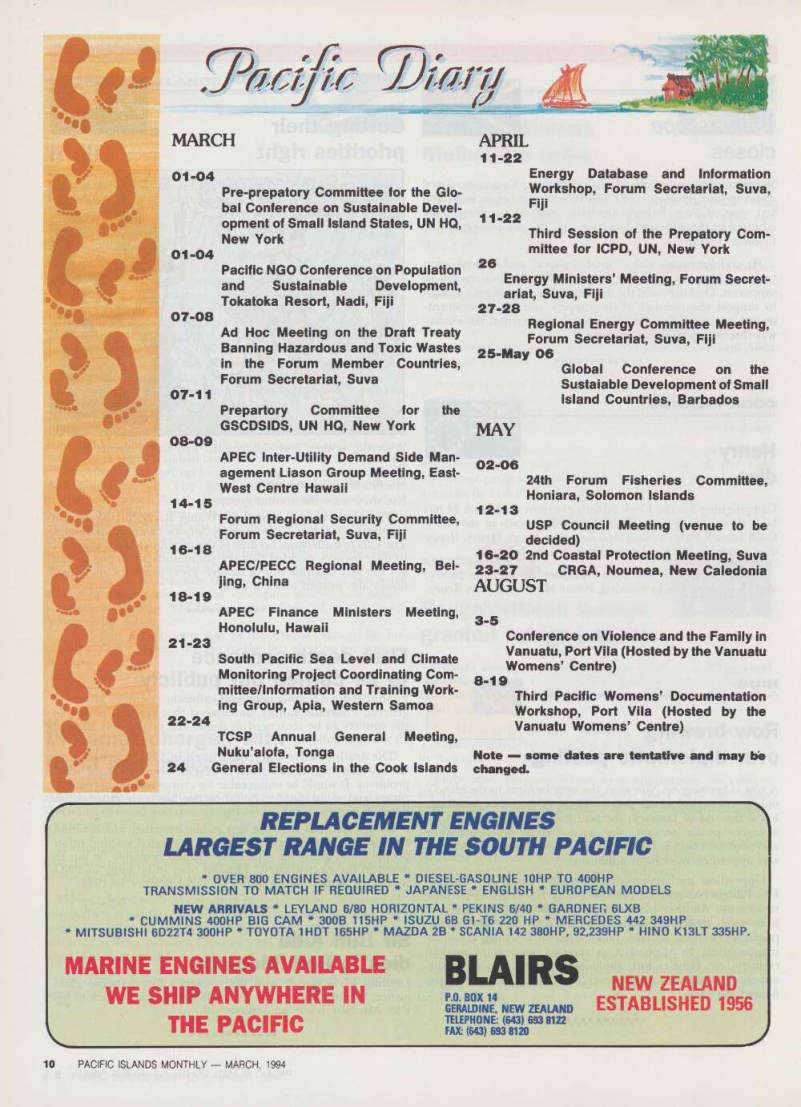
APRIL
MARCH
01-04 Pre-prepatory Committee for the Global Conference on Sustainable Development of Small Island States, UN HQ, New York 01-04 Pacific NGO Conference on Population and Sustainable Development, Tokatoka Resort, Nadi, Fiji 07-08 Ad Hoc Meeting on the Draft Treaty Banning Hazardous and Toxic Wastes in the Forum Member Countries, Forum Secretariat, Suva 07- Prepartory Committee for the
GSCDSIDS, UN HQ, New York
08- APEC Inter-Utility Demand Side Management Liason Group Meeting, East- West Centre Hawaii 14-15 Forum Regional Security Committee, Forum Secretariat, Suva, Fiji 16-18 APEC/PECC Regional Meeting, Beijing, China 18-19 APEC Finance Ministers Meeting, Honolulu, Hawaii 21- South Pacific Sea Level and Climate Monitoring Project Coordinating Committee/lnformation and Training Working Group, Apia, Western Samoa 22- TCSP Annual General Meeting, Nuku’aiofa, Tonga 24 General Elections in the Cook islands 11-22 Energy Database and Information Workshop, Forum Secretariat, Suva, Fiji 11-22 Third Session of the Prepatory Committee for ICPD, UN, New York 26 Energy Ministers’ Meeting, Forum Secretariat, Suva, Fiji 27-28 Regional Energy Committee Meeting, Forum Secretariat, Suva, Fiji 25-May 06 Global Conference on the Sustaiable Development of Small Island Countries, Barbados
MAY
02-06 24th Forum Fisheries Committee, Honiara, Solomon Islands 12-13 USP Council Meeting (venue to be decided) 16-20 2nd Coastal Protection Meeting, Suva 23-27 CRGA, Noumea, New Caledonia
AUGUST
3-5 Conference on Violence and the Family in Vanuatu, Port Vila (Hosted by the Vanuatu Womens’ Centre) 8-19 Third Pacific Womens’ Documentation Workshop, Port Vila (Hosted by the Vanuatu Womens’ Centre) Note some dates are tentative and may be changed.
REPLACEMENT ENGINES
LARGEST RANGE IN THE SOUTH PACIFIC
* OVER 800 ENGINES AVAILABLE * DIESEL-GASOLINE 10HP TO 400 HP TRANSMISSION TO MATCH IF REQUIRED * JAPANESE * ENGLISH * EUROPEAN MODELS NEW ARRIVALS * LEYLAND 6/80 HORIZONTAL * PEKINS 6/40 * GARDNER 6LXB * CUMMINS 400 HP BIG CAM * 3008 115 HP * ISUZU 6B Gl-T6 220 HP * MERCEDES 442 349 HP * MITSUBISHI 6D22T4 300 HP * TOYOTA IHDT 165 HP * MAZDA 2B * SCANIA 142 380 HP, 92,239 HP * HINO KI3LT 335 HP.
MARINE ENGINES AVAILABLE
WE SHIP ANYWHERE IN
THE PACIFIC
BLAIRS
P.O. BOX 14
GERALDINE, NEW ZEALAND
TELEPHONE: (643) 693 8122
FAX: (643) 693 8120
NEW ZEALAND
ESTABLISHED 1956
J
logging dilemma
Cover Story
The Solomon Islands logging dilemma
By Roman Grynberg
FOR three years now the Solomon
Islands foreign exchange reserves
have hovered between two weeks and 1.5 months import cover. The population has been increasing at a rate of 3.5 per cent per annum and successive governments have been spending and creating massive government deficits. In many ways the country looks like it is on the verge of bankruptcy.
However, if one looks at the 1992 growth figures then you would think that what we were looking is one of the newly emerging economic giants of Asia. In 1992 the growth rate of the Solomon Islands real GDP was an astounding 8.2 per cent. This is among the highest and most surprising rate of growth of any economy in the Pacific and only trailed the growth rate in Papua New Guinea which was booming from the massive increase in oil exports. However the growth figure is illusionary and is a perfect illustration of everything that is wrong with the way some economists use GDP as a measure of country’s wealth and national success. The principle reason the Solomon Islands was able to achieve so dramatic a rate of growth was because in that year it virtually doubled its log exports at the very time when the
log prices were going through the roof.
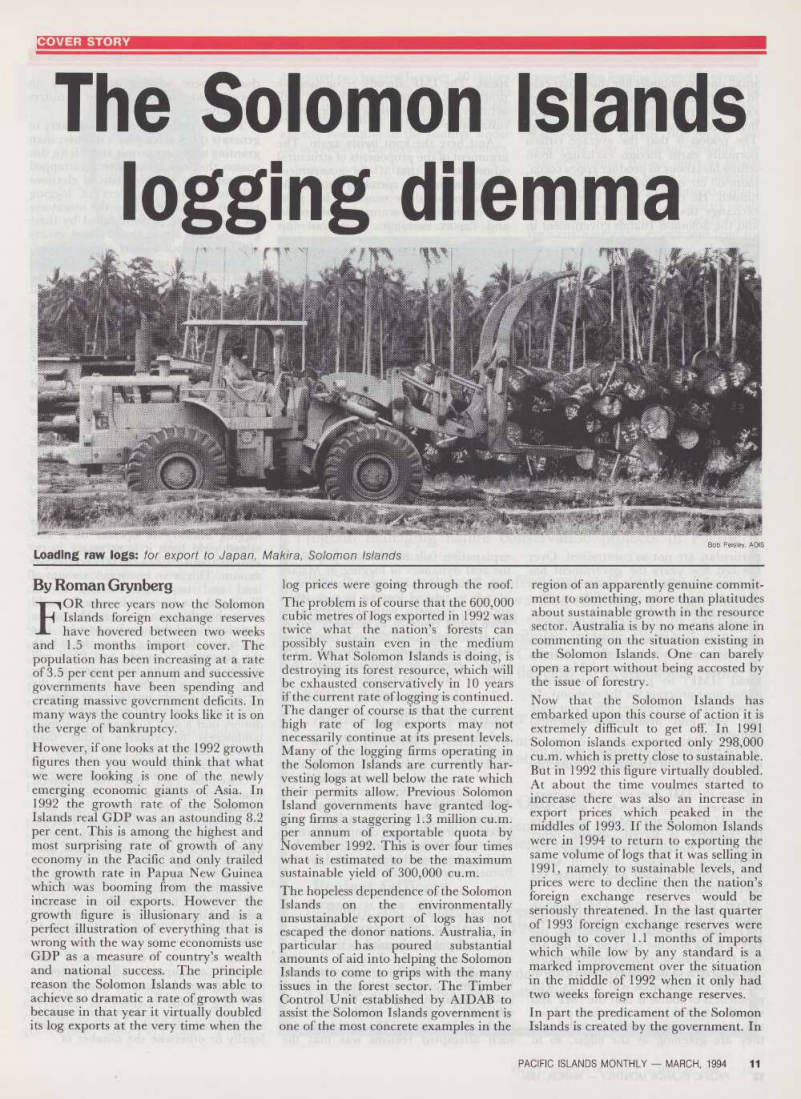
The problem is of course that the 600,000 cubic metres of logs exported in 1992 was twice what the nation’s forests can possibly sustain even in the medium term. What Solomon Islands is doing, is destroying its forest resource, which will be exhausted conservatively in 10 years if the current rate of logging is continued.
The danger of course is that the current high rate of log exports may not necessarily continue at its present levels.
Many of the logging firms operating in the Solomon Islands are currently har vesting logs at well below the rate which their permits allow. Previous Solomon Island governments have granted log ging firms a staggering 1.3 million cu.m, per annum of exportable quota by November 1992. This is over four times what is estimated to be the maximum sustainable yield of 300,000 cu.m.
The hopeless dependence of the Solomon Islands on the environmentally unsustainable export of logs has not escaped the donor nations. Australia, in
particular has poured substantial
amounts of aid into helping the Solomon Islands to come to grips with the many issues in the forest sector. The Timber Control Unit established by AIDAB to assist the Solomon Islands government is one of the most concrete examples in the
region of an apparently genuine commit
ment to something, more than platitudes about sustainable growth in the resource sector. Australia is by no means alone in commenting on the situation existing in the Solomon Islands. One can barely open a report without being accosted by the issue of forestry.
Now that the Solomon Islands has embarked upon this course of action it is extremely difficult to get off. In 1991 Solomon islands exported only 298,000 cu.m, which is pretty close to sustainable.
But in 1992 this figure virtually doubled.
At about the time voulmes started to increase there was also an increase in export prices which peaked in the middles of 1993. If the Solomon Islands were in 1994 to return to exporting the same volume of logs that it was selling in 1991, namely to sustainable levels, and prices were to decline then the nation’s foreign exchange reserves would be seriously threatened. In the last quarter of 1993 foreign exchange reserves were enough to cover 1.1 months of imports which while low by any standard is a marked improvement over the situation in the middle of 1992 when it only had two weeks foreign exchange reserves.
In part the predicament of the Solomon Islands is created by the government. In
Bob Peisley. AOIS
Loading raw logs: for export to Japan, Makira, Solomon Islands
small open economies like those that exist in the South Pacific the source of foreign exchange reserve depletion is almost invariably government over-spending.
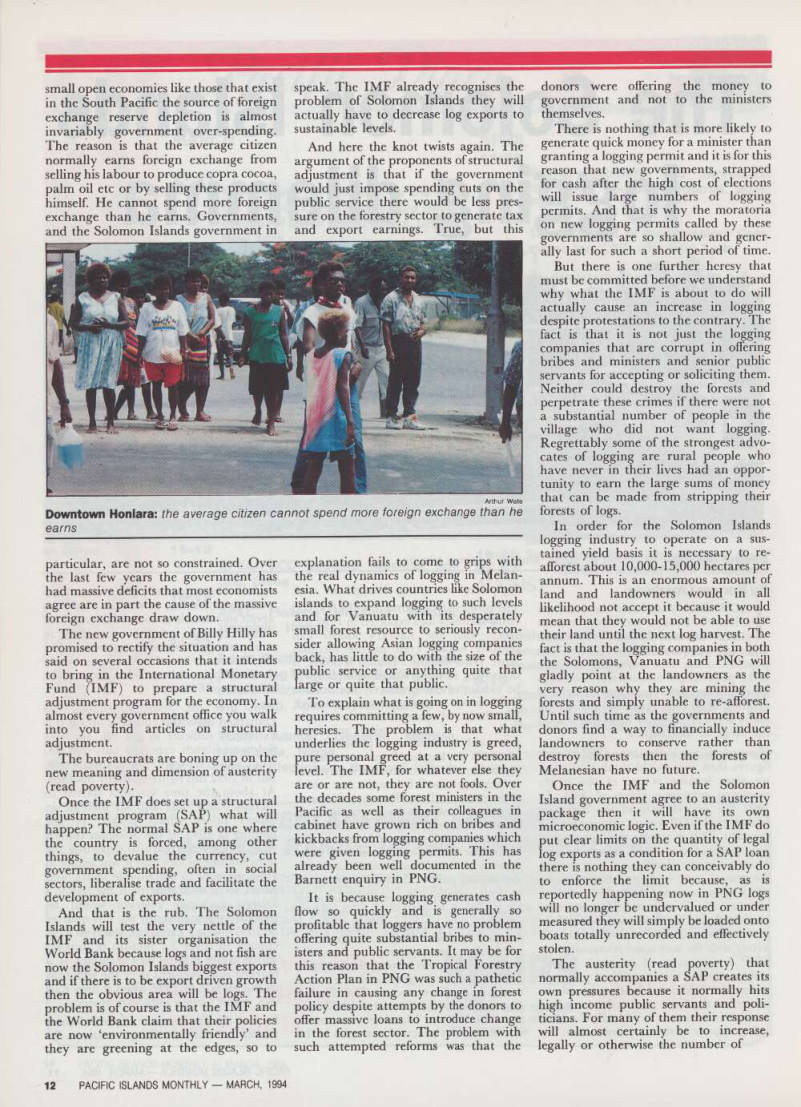
The reason is that the average citizen normally earns foreign exchange from selling his labour to produce copra cocoa, palm oil etc or by selling these products himself. He cannot spend more foreign exchange than he earns. Governments, and the Solomon Islands government in
speak. The IMF already recognises the problem of Solomon Islands they will actually have to decrease log exports to sustainable levels.
And here the knot twists again. The argument of the proponents of structural adjustment is that if the government would just impose spending cuts on the public service there would be less pres sure on the forestry sector to generate tax and export earnings. True, but this
particular, are not so constrained. Over the last few years the government has had massive deficits that most economists agree are in part the cause of the massive foreign exchange draw down.
The new government of Billy Hilly has promised to rectify the situation and has said on several occasions that it intends to bring in the International Monetary Fund (IMF) to prepare a structural adjustment program for the economy. In almost every government office you walk into you find articles on structural adjustment.
The bureaucrats are boning up on the new meaning and dimension of austerity
(read poverty).
Once the IMF does set up a structural adjustment program (SAP) what will happen? The normal SAP is one where the country is forced, among other things, to devalue the currency, cut government spending, often in social sectors, liberalise trade and facilitate the development of exports.
And that is the rub. The Solomon Islands will test the very nettle of the IMF and its sister organisation the World Bank because logs and not fish are now the Solomon Islands biggest exports and if there is to be export driven growth then the obvious area will be logs. The problem is of course is that the IMF and the World Bank claim that their policies are now ‘environmentally friendly’ and they are greening at the edges, so to
explanation fails to come to grips with the real dynamics of logging in Melan esia. What drives countries like Solomon islands to expand logging to such levels and for Vanuatu with its desperately small forest resource to seriously recon sider allowing Asian logging companies back, has little to do with the size of the public service or anything quite that large or quite that public.
To explain what is going on in logging requires committing a few, by now small, heresies. The problem is that what underlies the logging industry is greed, pure personal greed at a very personal level. The IMF, for whatever else they are or are not, they are not fools. Over the decades some forest ministers in the Pacific as well as their colleagues in cabinet have grown rich on bribes and kickbacks from logging companies which were given logging permits. This has already been well documented in the Barnett enquiry in PNG.
It is because logging generates cash flow so quickly and is generally so profitable that loggers have no problem offering quite substantial bribes to min isters and public servants. It may be for this reason that the Tropical Forestry Action Plan in PNG was such a pathetic failure in causing any change in forest policy despite attempts by the donors to offer massive loans to introduce change in the forest sector. The problem with such attempted reforms was that the
donors were offering the money to government and not to the ministers themselves.
There is nothing that is more likely to generate quick money for a minister than granting a logging permit and it is for this reason that new governments, strapped for cash after the high cost of elections will issue large numbers of logging permits. And that is why the moratoria on new logging permits called by these governments are so shallow and gener ally last for such a short period of time.
But there is one further heresy that must be committed before we understand why what the IMF is about to do will actually cause an increase in logging despite protestations to the contrary. The fact is that it is not just the logging companies that are corrupt in offering bribes and ministers and senior public servants for accepting or soliciting them.
Neither could destroy the forests and perpetrate these crimes if there were not a substantial number of people in the village who did not want logging.
Regrettably some of the strongest advo cates of logging are rural people who have never in their lives had an oppor tunity to earn the large sums of money that can be made from stripping their forests of logs.
In order for the Solomon Islands logging industry to operate on a sus tained yield basis it is necessary to re afforest about 10,000-15,000 hectares per annum. This is an enormous amount of land and landowners would in all likelihood not accept it because it would mean that they would not be able to use their land until the next log harvest. The fact is that the logging companies in both the Solomons, Vanuatu and PNG will gladly point at the landowners as the very reason why they are mining the forests and simply unable to re-afforest.
Until such time as the governments and donors find a way to financially induce landowners to conserve rather than destroy forests then the forests of Melanesian have no future.
Once the IMF and the Solomon Island government agree to an austerity package then it will have its own microeconomic logic. Even if the IMF do put clear limits on the quantity of legal log exports as a condition for a SAP loan there is nothing they can conceivably do to enforce the limit because, as is
reportedly happening now in PNG logs
will no longer be undervalued or under measured they will simply be loaded onto boats totally unrecorded and effectively stolen.
The austerity (read poverty) that
normally accompanies a SAP creates its own pressures because it normally hits
high income public servants and poli
ticians. For many of them their response will almost certainly be to increase, legally or otherwise the number of
Downtown Honiara: the average citizen cannot spend more foreign exchange than he earns
logging permits in order to increase their personal income. While the IMF can impose structural adjustment on the government it cannot change the struc ture and nature of Melanesian society where landowners have enormous power and where political power must be used with a great deal of financial largesse.
It would appear that there is only one way in which the rape of the forests will cease but this requires giving up of national sovereignty in the area of forests.
In a newly independent developing
country this is the greatest heresy of all but it is not one without precedent.
Almost without comment, PNG recently signed an agreement with the famous Swiss firm Societe General de Surveil lance to takeover the regulation and control of PNG log exports and the collection of revenues. The company is justifiably famous because what it sells is Swiss administration. Its takeover of the monstrously corrupt Indonesian customs service is well known. But what it is is an admission that Wingti, like the biblical Lot was unable to find ten honest men to run his forestry service. What Wingti has effectively said is that a part of the government is so corrupt that it must be run by foreigners. This is surely heresy but also remarkable honesty in a newly
independent developing country. Billy
Hilly may not be far behind Wingti.
On January 21 in the Solomon Islands’ parliament, the Minister of Natural Resources Ezekiel Alebua as sured members that a ban on log export was being implemented. He said the Solomon Islands government is sure to experience a substantial loss on revenue collected from log export. He said that the loss would be around 50 to 70 per cent of the country’s log export earnings
annually.
Alebua revealed that between June and December this year major logging operations in Solomon Islands will be expected to stop. He said since the Hilly government came to office, it had
approved two logging licences, 40 timber milling licences and 15 saw milling and export licences. However, he could not reveal the number of logging companies already operating in the country under the approval of the previous government.
Alebua added that the industry is being restructured, saying companies have been very co-operative. He said although the restructuring exercise is quite expensive, aid donors are willing to financially assist in the transition process.
The economic crisis in the Solomon Islands, and irrespective of the apparent outward signs of prosperity in Honiara
caused by the logging boom it is precisely that. The crisis in the Solomons will be one of the most important tests of the
IMF’s newly supposed environmental
consciousness. Within the region few
appreciate how important globally the
case of Solomon Islands must be to the IMF’s credibility as being in the slightest concerned with the environmental impli cations of its policies. If its policies result in further environmental degradation then environmental groups will hold up the case for the next decade. It will be difficult for the IMF to live down even though the nature of society is the culprit rather than its economic policemen. □
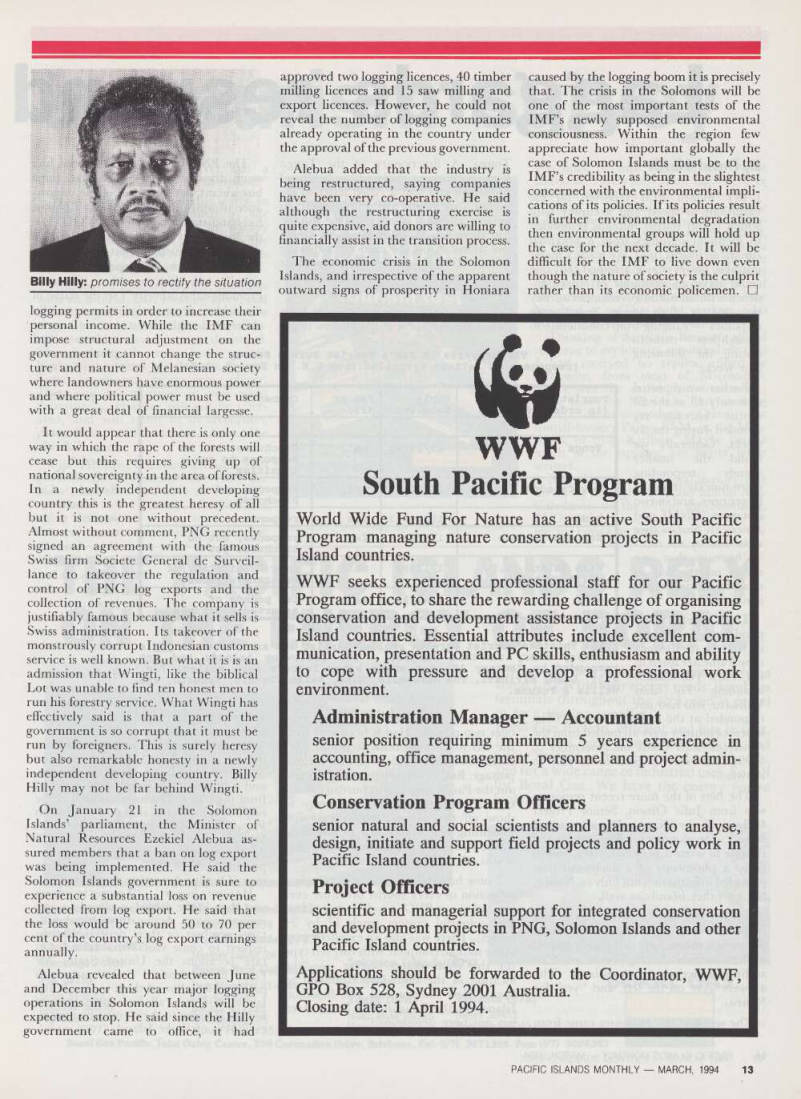
Billy Hilly: promises to rectify the situation
Advertisements & other items, p. 13 (1 item)
South Pacific Program
WWF
World Wide Fund For Nature has an active South Pacific Program managing nature conservation projects in Pacific Island countries.
WWF seeks experienced professional staff for our Pacific Program office, to share the rewarding challenge of organising conservation and development assistance projects in Pacific Island countries. Essential attributes include excellent communication, presentation and PC skills, enthusiasm and ability to cope with pressure and develop a professional work environment.
Administration Manager Accountant senior position requiring minimum 5 years experience in accounting, office management, personnel and project administration.
Conservation Program Officers senior natural and social scientists and planners to analyse, design, initiate and support field projects and policy work in Pacific Island countries.
Project Officers
scientific and managerial support for integrated conservation and development projects in PNG, Solomon Islands and other Pacific Island countries.
Applications should be forwarded to the Coordinator, WWF, GPO Box 528, Sydney 2001 Australia, Closing date: 1 April 1994.
Laggards respond
Tourism
By David North
LAST month PIM reported on the variations in speed and accuracy with which island tourist bureaus responded to identical inquiries from a potential American tourist (me). We made a major mistake, however; we assumed that one could have an exchange of correspon dence with an island government agency in a matter of six weeks. Seven more responses ranging from considerate to
thoughtless came in
during the following
four weeks.
Earlier we reported that only 13 of the 27 tourist bureaus re
sponded during the six
weeks. Generally we found the smaller
islands responding
more quickly than the larger ones, and in two instances (CNMI and American Samoa) we were told by the tour ist bureaus that one drives on the left in those territories, which is not correct.
The bureaus res
ponding to our inquiry
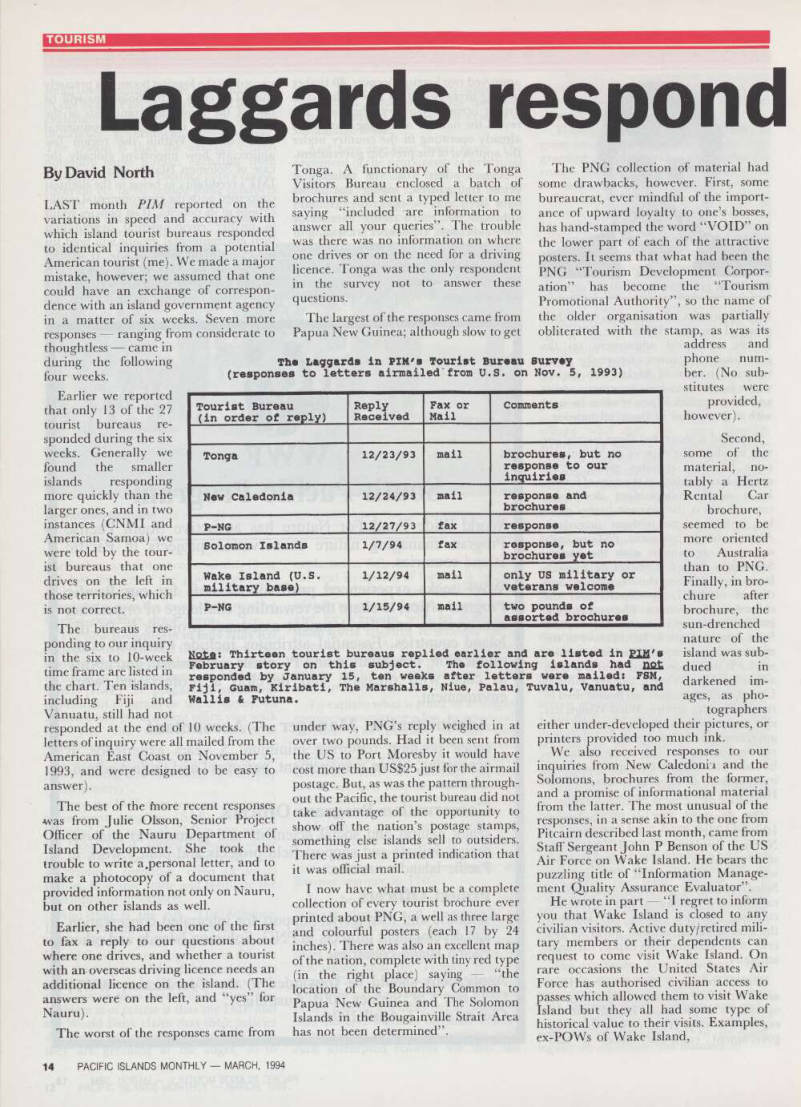
in the six to 10-week time frame are listed in the chart. Ten islands,
including Fiji and
Vanuatu, still had not
responded at the end of 10 weeks. (The letters of inquiry were all mailed from the American East Coast on November 5, 1993, and were designed to be easy to
answer).
The best of the more recent responses was from Julie Olsson, Senior Project Officer of the Nauru Department of Island Development. She took the trouble to write a.personal letter, and to make a photocopy of a document that provided information not only on Nauru, but on other islands as well.
Earlier, she had been one of the first to fax a reply to our questions about where one drives, and whether a tourist with an overseas driving licence needs an additional licence on the island. (The answers were on the left, and “yes” for
Nauru).
The worst of the responses came from
Tonga. A functionary of the Tonga
Visitors Bureau enclosed a batch of brochures and sent a typed letter to me saying “included are information to answer all your queries”. The trouble was there was no information on where one drives or on the need for a driving
licence. Tonga was the only respondent
in the survey not to answer these
questions.
The largest of the responses came from Papua New Guinea; although slow to get
The Laggards in PlM's Tourist Bureau survey (responses to letters airmailed from U.S. on Nov. 5, 1993)
Note; Thirteen tourist bureaus replied earlier and are listed in £lH's February story on this subject. The following islands had nat responded by January 15, ten weeks after letters were mailed: FSM, Fiji, Guam, Kiribati, The Marshalls, Niue, Palau, Tuvalu, Vanuatu, and Wallis & Futuna.
under way, PNG’s reply weighed in at over two pounds. Had it been sent from the US to Port Moresby it would have cost more than USS2S just for the airmail postage. But, as was the pattern through out the Pacific, the tourist bureau did not take advantage of the opportunity to show off the nation’s postage stamps, something else islands sell to outsiders.
There was just a printed indication that it was official mail.
I now have what must be a complete collection of every tourist brochure ever printed about PNG, a well as three large and colourful posters (each 17 by 24 inches). There was also an excellent map of the nation, complete with tiny red type
(in the right place) saying “the
location of the Boundary Common to Papua New Guinea and The Solomon Islands in the Bougainville Strait Area has not been determined”.
The PNG collection of material had some drawbacks, however. First, some bureaucrat, ever mindful of the import ance of upward loyalty to one’s bosses, has hand-stamped the word “VOID” on the lower part of each of the attractive posters. It seems that what had been the
PNG “Tourism Development Corpor
ation” has become the “Tourism Promotional Authority”, so the name of the older organisation was partially obliterated with the stamp, as was its
address and
phone num
ber. (No sub stitutes were
provided,
however).
Second, some of the material, no tably a Hertz Rental Car brochure, seemed to be more oriented to Australia than to PNG.
Finally, in bro chure after brochure, the sun-drenched nature of the island was sub dued in darkened im ages, as pho tographers
either under-developed their pictures, or printers provided too much ink.
We also received responses to our inquiries from New Caledonia and the Solomons, brochures from the former, and a promise of informational material from the latter. The most unusual of the responses, in a sense akin to the one from Pitcairn described last month, came from Staff Sergeant John P Benson of the US Air Force on Wake Island. He bears the puzzling title of “Information Manage ment Quality Assurance Evaluator”.
He wrote in part -“I regret to inform you that Wake Island is closed to any civilian visitors. Active duty/retired mili tary members or their dependents can request to come visit Wake Island. On rare occasions the United States Air Force has authorised civilian access to passes which allowed them to visit Wake Island but they all had some type of historical value to their visits. Examples, ex-POWs of Wake Island,
Tourist Bureau (in order of reply) Reply Received Fax or Mail Comments Tonga 12/23/93 mail brochures, but no response to our Inquiries New Caledonia 12/24/93 mall response and brochures
P-Ng
12/27/93 fax response Solomon Islands 1/7/94 fax response, but no brochures yet Wake Island (U.S. military base) 1/12/94 mail only US military or veterans welcome
P-Ng
1/15/94 mail two pounds of assorted brochures
family members of ex-POWs and a surveying crew to document the island.”
Wake, after a fierce battle early in World War 11, was stormed by the Japanese. As a matter of fact, the skimpy
tourist-type information provided by the
sergeant says “Live WW II ordinance is continually being found on Wake”.
Although a military facility, complete
with an airfield, bar, bowling alley, and a six-hole golf course, the island rules are more like those of a religious retreat “We do not allow weapons on the island.
This includes firearms, bows, switch blades and various martial arts devices.
Surrender weapons to the peace officer.
They will be returned to you upon departure ... violence will not be toler ated, and will result in incarceration, prosecution and removal from the island.”
Like Pitcairn, you must get high-level government permission to visit the island, and then you have to live up to the local rules many of which are safety oriented if you want to stay there. You cannot swim in the ocean, for
you must be with someone else. While sharks are rarely seen in the lagoon, large eels are common.
Wake is probably the only Pacific Island where the majority of the popu lation is Thai. The welcome to the island, in the little brochure, is Swasdee krub, a Thai phrase, in recognition of the fact that the seven US Air Force personnel and four US weathermen on the island are thoroughly outnumbered by the hundred or so Thai guest workers, who do the real work on the island.
Thinking of Sergeant Benson’s stilted response to my inquiry reminded me that I had received no replies, stilted or otherwise, from most of Micronesia.
There was the rapid (but inaccurate) reply from the Marianas, but working from tourist-dependent Guam, or tourist-hungry Palau, FSM, or the Mar shalls, or from Kiribati. Maybe people south of the equator are better letter writers.
Returning to our original inquiry, one
drives on the right on Wake and in New Caledonia, on the left in the Solomons, PNG, and Nauru, and probably on the left in Tonga as well. □
instance, but only in the lagoon where
Advertisements & other items, p. 15 (2 items)
to tourism survey
The Pacific Islands Rely
ON THE ENERGY OF BORAL
mmm K ■ * American Samoa (684) Marshall Islands (692) Tafuna 699 2948 Aua 6442170 Cook Islands (682) Rarotonga 24460 Ffl! (679) Suva 315522 Lautoka 60088 Sigatoka 50578 Labasa 82973 Majuro 6257254 Norfolk Islands (6723) Norfolk Island 2419 Papua New Guinea (675) Port Moresby 214248 Lae 422574 Rabaul 921225 Wewak 862125 Mount Hagen 551216 Solomon Islands (677) Honiara 21833 All through the Pacific Islands, people rely on Boral LP gas for their energy needs. Boral has terminals throughout the area, and is proud to be a leading supplier.
Boral Gas is clean, efficient and low in cost.
It’s the ideal energy source for cooking and water heating in homes, motels and hotels, and for a wide range of industrial uses. So call for Boral Gas. We have the energy you’re
looking for.
BORAL GAS
Tonga (676) Nuku’alofa 24035 Vava’u 22903 Vanuatu (678) Santo 36455 Port Vila 22046 Boral Gas Pacific, John Oxley Centre, 339 Coronation Drive, Brisbane. Tel: (07) 3671365. Fax: (07) 3694347
Not Korman’s
Industrial Relations
year
1993 could really not be considered a good year for Vanuatu’s Prime Minister, Maxime Carlot Korman. In no area however has Carlot had more difficulties than in the area of industrial relations with his public servants who have twice confronted him this year.
Korman’s problems began in May
when some 700 members of the Vanuatu Teacher’s association walked off the jobs in pay dispute. The teachers were asking for a pay increase of 25 per cent. The teachers, who receive monthly salaries of 32,000 vatu (US$25O a month) for primary teachers and 50,000 vatu (US$4lO) claimed that they had not had a pay rise since 1987 were effectively routed in the 12-day strike. According to VTA President Oped Massing ‘All the teachers who went on strike were sus pended, even those who did not go on strike received suspension letters.’ At the end of strike the union was forced to settle for a reinstatement and a promised but indeterminate pay rise for its members in 1994.
What really created the problems for Carlot was not the strike but a phenom ena that has over the last decade pushed Papua New Guinea, Solomon Islands and now Vanuatu into substantial and what are quite destabilising conflicts. In the middle of the teachers strike in May the Vanuatu parliament decided to vote its 46 members a massive 40-70 per cent pay rise. The largest increases were for the ministers but increases were also given to the president. In Solomon Islands the government of Solomon Mamaloni had given massive salary increases to its top public servants thus precipitating a confrontation with its own public servants. The government of Rabbie Namaliu massively increased the salaries of MPs and statutory office bearers when it came to power in 1988.
The consequences were again predict able. There were a succession of strikes in the public and private sectors which eventually lead to a mutiny in the PNG defence forces when the army offered massive pay rises to the officers and virtually nothing to the enlisted men.
Carlot’s problems with industrial rela tions were compounded in June when he extended the politicisation of the public service to an entirely new level. Employ ing a practice begun by Walter Lini and continued by every Vanuatu prime minister since Carlot had six middle level public servants in the Department of
Finance dismissed for political reasons.
In a most extraordinary official letter dated 30th June 1993 from the Acting director of Finance, Terry Fisher wrote in a manner very reminiscent of the Stalinist era to one of the middle level officials in the Vanuatu paymaster’s office George Garae saying ‘lt is with the greatest of regret that I have to inform you that I am instructed by the Minister
(Willy Jimmy) to suspend you on
Political grounds, effective from 30th June 93’. The letter was signed by the acting director of finance.
Vanuatu is arguabbly the most deeply politicised country in the South Pacific.
It has been common practice for incom ing administrations to remove the min isterial first and second secretaries. These
were always political appointees but the
government of Carlot has moved to dismissing middle level public servants for political reasons. As a result of the politicisation of the Vanuatu public service some of the country’s best edu cated and most competent adminis trators are unemployed for no other reason than their political affiliation. The dismissal of the finance officials was
squashed by the public service com
mission in Vanuatu but the council of ministers (cabinet) upheld the decision and all have been sacked. Similar politically motivated sacking have been mooted for the health service as well as in the police.
While the situation was difficult in Vanuatu’s public service it was com pounded by a difficult strike in Novem ber and early December of the Vanuatu Public Service Association. The govern ment of Carlot declared the strike illegal and has threatened to dismiss all those involved. The government has also made clear its intention to dismiss some of the nation’s 5,500 public servants starting
this year with a reduction of 200. The public servants were asking for a 16 per cent wage increase which, together with the 4 per cent they received in 1992 would compensate them for what union leaders claimed was the effect of inflation since the time of the last public sector pay raise in 1990.
The strike which threatened to disrupt the South Pacific Mini-games when the union attempted to close the airport and threatened to cut off water to the capital Port Vila. The government stationed police outside the city’s water works during the strike. The government claimed in parliament that only 150 workers were off work and the union claimed 80 per cent. In the rigidly controlled media in Vanuatu Radio Vanuatu were forbidden to broadcast even service messages from the union.
There appears to have been wide spread support for the strike in Port Vila from all segments of the community.
Menawhile the public servants’ strike looked set to extend well into February (at the time of writing).
The Vanuatu government maintains that the strike is illegal and that public servants should return to work before their claims are looked into.
Public servants’ demands include a 16 per cent pay rise. The government has offered five per cent.
The Vanuatu government ordered strikers to return to work or face disciplinary action. A few obeyed, but the VPSA maintains that about 1,400 public servants, or nearly 70 per cent of its membership, remains on strike.
The VPSA is also demanding the revocation of suspension orders against 390 workers, the lifting of a ban on its use of the state-run media and the release of strikers’ salaries.
In a more recent development 34
private company employees who joined
the general strike called by the Vanuatu Council of trade unions in early Febru ary have lost their jobs. The general strike was in support of the civil servants.
Nineteen employees of Better Price, 12 from Au Bon Marche supermarkets and three from Thrifty Car rentals in Port Vila have all been sacked for joining the strike.
Meanwhile, most of the 116 members of the private sector unions who turned out to support the VCTU-called strike have returned to work following in creased threats of their sacking. Em ployees of domestic airlines Vanair in Santo all returned to work on February 14 after a warning by Vanair chairperson, Irene Bongnaim, that fail ure to return would result in their dismissal.
This report was compiled on February 16, no doubt events will have altered by the time you read this. □
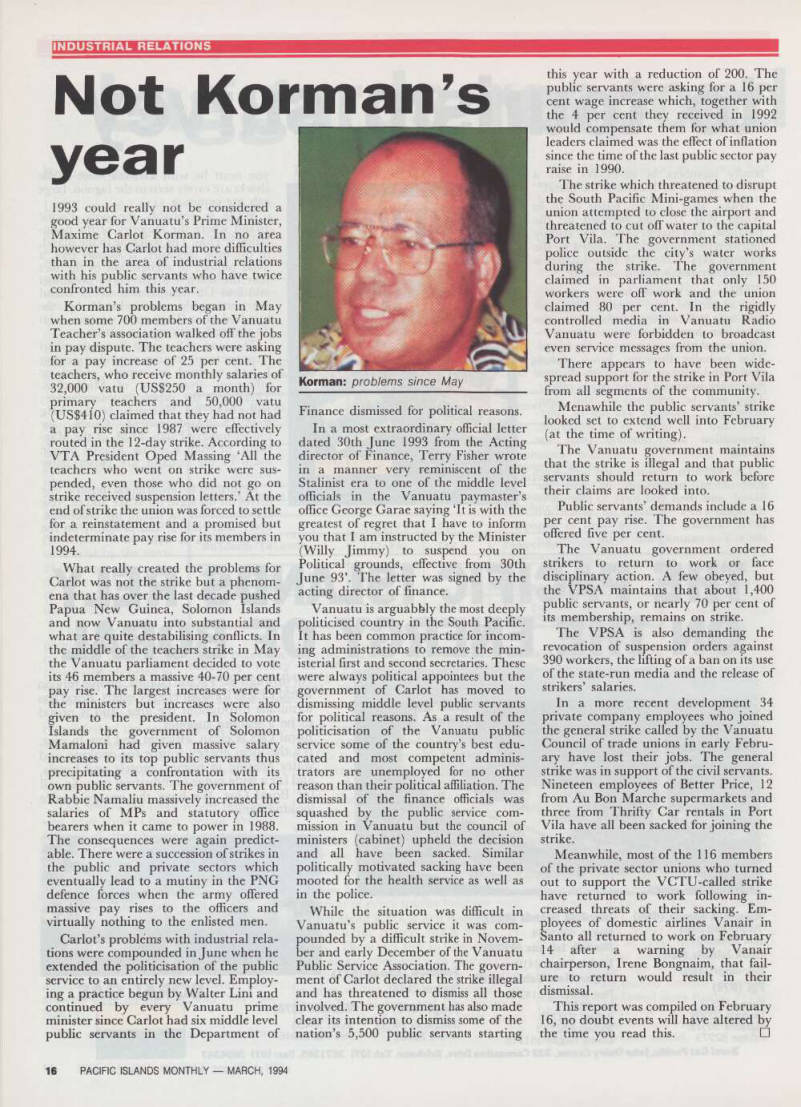
Korman: problems since May
Gearing up for Barbados
By lan Williams
ON the run up to the Small Islands Summit in Barbados next month, the centre of gravity of the Alliance of Small Islands States has shifted from the Pacific to the Caribbean. Vanuatu’s Robert Van Lierop relinquished the chair of the organisation when he was removed from his UN ambassadorship by Prime Min ister Maxime Carlot Korman. After several weeks of consultations, on Janu ary 19, AOSIS accepted the CARICOM nominee, the appropriately named Annette des Isles as its new chairperson.
CARICOM the organisation of Commonwealth Caribbean countries, has, along with SPREP, been one of the twin pillars of the organisation.
Van Lierop praised his successor.
“She’s very very good. A very experi enced diplomat, who certainly has the appropriate background. I think AOSIS will do even better under her leadership you know, I happen to think that I’m not such a good administrator,” he
confessed modestly.
Equally modest, Ambassador des Isles told PIM that “We are full of talent in AOSIS so there were many potential candidates but I’m pleased to say that there was no opposition.” After school in Trinidad she studied at St Andrews University in Scotland and Columbia University in New York before joining the Trinidadian foreign service. For the decade of the 1970 s she served at the United Nations. In 1992 she returned as
permanent representative enabling her
to take up her present position.
Did the shift from the Pacific to the Caribbean betoken any change of em phasis? “Not at all” she says, “I would like to maintain the same priority areas that it has before in fact you could say, to continue the work begun by Ambassa dor Van Lierop. So climate change will be major item, as will negotiating the Global Environment Fund. In fact the plan of action for AOSIS was formulated
following regional meetings in Vanuatu,
and Trinidad, so there is a precedent for the shift.” She adds, “And of course, we are now engaged in the run up to Barbados conference, so there is plenty of work to be done.”
Trinidad and Tobago is of course a major oil-exporter, and in general the oil producing countries had many reser vations about limiting the carbon dioxide omissions, which, after all, came mostly from their product. Did this cause any problems for her country with AOSIS?
She replies, diplomatically of course, “No, we are a signatory to the climate change convention, so the formulation arrived at was obviously acceptable.”
She added particularly that “The recognition that AOSIS has gained is largely due to Van Lierop’s chairman ship and leadership. I’d like to pay a very special tribute to his work in getting the voice of the small islands heard and
recognised.”
She said New York, the place with representation from the largest number of small islands states, was the best place for them to exercise what leverage they
This conference and its outcome will be one of the first practical demonstrations of commitment or not as the case may be.
However, it is unlikely to be totally unsuccessful
had on the world community. Her experience should be invaluable in ensur ing AOSIS continues to be heard.
Meanwhile, the arrangements for the Small Islands Summit continue. There is nothing small about the name the UN has given it the United Nations Global Conference on the Sustainable Development of Small Island Developing State. Even when shortened to its initials, the resulting acronym is cumbersome even by UN standards
Ungcsdsids.
During January the preparatory com mittee for the conference met in King ston, Jamaica, and developed several practical and useful ideas. Barbados’
Environment Minister Harcourt Lewis announced plans for four “tools” for the islands. The first was a Regional Disaster Emergency Fund to assist with problems in rebuilding economic assets after disas ter strikes. As PIM readers will be aware disaster, in the shape of hurricanes, is striking more and more frequently, and the world’s reinsurance companies are becoming less and less eager to quote insurance rates for the islands.
The second suggestion is for SIDSNET, a telecommunication net
work specifically controlled and run by the Small Island Developing States with four nodes for the Mediterranean/Atlan tic regions, the Caribbean, the Indian Ocean, and of course the Pacific. The network would also carry a data base of information useful for the participants.
In parallel, would be centres to exchange technical assistance of expertise between islands, and for “regional sustainable development centres” in each of the four
regions.
The plans are ambitious, but some concern has been expressed at the commitment of governments to the concepts. Dr Mark Griffith, technical coordinator of the conference warned that Caribbean governments may not be ready to go beyond lip service. He stresses the need for the involvement of civic societies and civic groups which would erode the power base of poli ticians, as one of the reasons for their reticence to go into action, and why, he accused, the Caribbean governments were so parochial in their approach at the last regional technical meeting in the summer.
On another front, it is the Pacific that is lacking, Lelei Lelaulu, outreach coor dinator for the conference (who pleads not guilty to the length of its name) told PIM “Organisers of the Sustainable Technology Exhibition SUSTECH ’94, are concerned that while Caribbean companies are well represented among the almost 200 exhibits booked so far, up to now, Pacific companies have been slow to join in. Since the Pacific has pioneered so many technologies appro priate for small islands, this represents a big loss, both to the Pacific and to
potential purchasers.” Non-
Governmental Organisations or com panies interested can call Lelei in New York at 2129637074, or fax 2129635935, or the organisers of SUSTECH 94, the Barbados Manufacturers Association, on 8094264474 or by fax 8094365182.
For once, the Small Islands are ahead of the rest of world, since the conference and its outcome will be watched by many as a test of just how serious the industrialised world was with all the hot air released at the Rio Global Environ ment Summit in 1992. This conference and its outcome will be one of the first practical demonstrations of commitment or not as the case may be.
However, it is unlikely to be totally unsuccessful. AOSIS has the backing of the Group 77 developing countries at the UN, and between them all, they still exercise some diplomatic clout even in the New World Order. □
101st anniversary
Hawaii
101st anniversary of overthrow
observed
By Ed Rampell
HAWAIIANS have commemorated the 101st anniversary of the January 17, 1893 US-backed overthrow of the independent kingdom of Hawaii with
a march, rallies, participation by
America’s most outspoken black mili tant, a declaration of independence, and more. Meanwhile, the Hawaii state government “observed” the anni
versary by once again evicting and
arresting homeless Hawaiians. And divisions in the sovereignty movement depend as the cause for native self determination intensified.
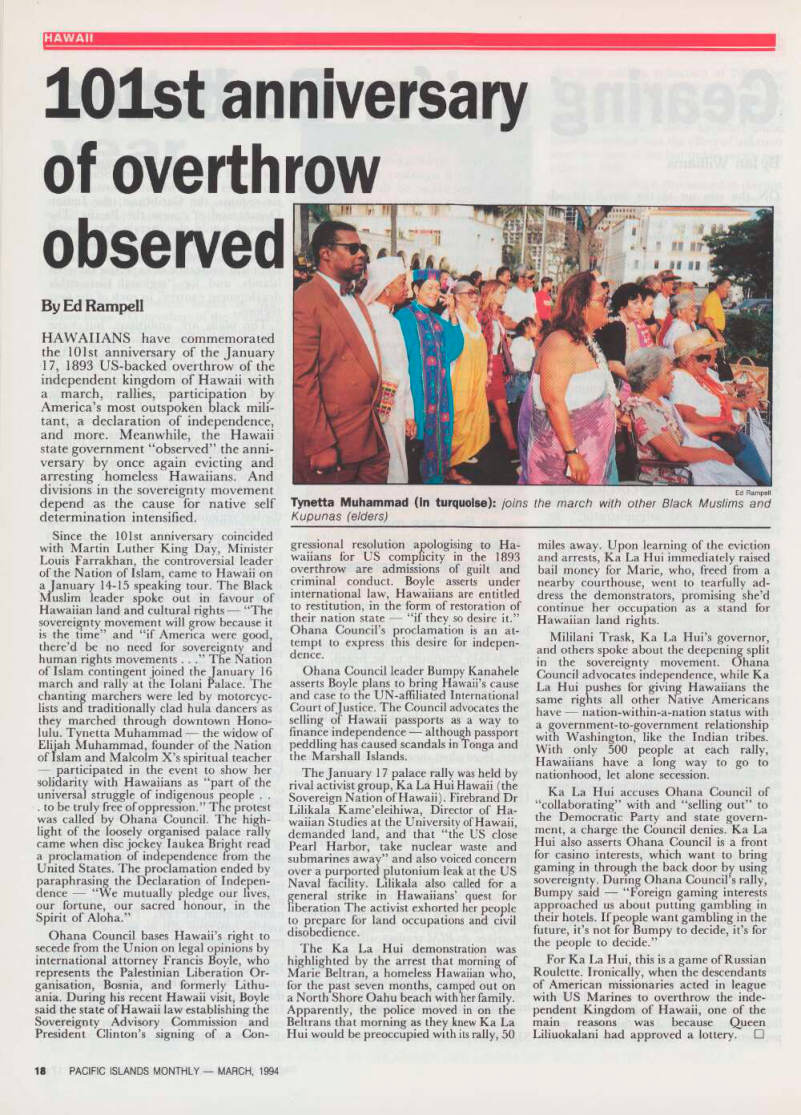
Since the 101st anniversary coincided with Martin Luther King Day, Minister Louis Farrakhan, the controversial leader of the Nation of Islam, came to Hawaii on a January 14-15 speaking tour. The Black Muslim leader spoke out in favour of Hawaiian land and cultural rights “The sovereignty movement will grow because it is the time” and “if America were good, there’d be no need for sovereignty and human rights movements . . .” The Nation of Islam contingent joined the January 16 march and rally at the lolani Palace. The chanting marchers were led by motorcyc lists and traditionally clad hula dancers as they marched through downtown Hono lulu. Tynetta Muhammad the widow of Elijah Muhammad, founder of the Nation of Islam and Malcolm X’s spiritual teacher participated in the event to show her solidarity with Hawaiians as “part of the universal struggle of indigenous people . . . to be truly free of oppression.” The protest was called by Ghana Council. The high light of the loosely organised palace rally came when disc jockey laukea Bright read a proclamation of independence from the United States. The proclamation ended by paraphrasing the Declaration of Indepen dence “We mutually pledge our lives, our fortune, our sacred honour, in the Spirit of Aloha.”
Ghana Council bases Hawaii’s right to secede from the Union on legal opinions by international attorney Francis Boyle, who represents the Palestinian Liberation Or ganisation, Bosnia, and formerly Lithu ania. During his recent Hawaii visit, Boyle said the state of Hawaii law establishing the Sovereignty Advisory Commission and President Clinton’s signing of a Con-
gressional resolution apologising to Ha waiians for US complicity in the 1893 overthrow are admissions of guilt and criminal conduct. Boyle asserts under international law, Hawaiians are entitled to restitution, in the form of restoration of their nation state “if they so desire it.”
Ghana Council’s proclamation is an at tempt to express this desire for indepen dence.
Ghana Council leader Bumpy Kanahele asserts Boyle plans to bring Hawaii’s cause and case to the UN-affiliated International Court ofjustice. The Council advocates the selling of Hawaii passports as a way to
finance independence although passport
peddling has caused scandals in Tonga and the Marshall Islands.
The January 17 palace rally was held by rival activist group, Ka La Hui Hawaii (the Sovereign Nation of Hawaii). Firebrand Dr Lilikala Kame’eleihiwa, Director of Ha waiian Studies at the University of Hawaii, demanded land, and that “the US close Pearl Harbor, take nuclear waste and submarines away” and also voiced concern over a purported plutonium leak at the US Naval facility. Lilikala also called for a general strike in Hawaiians’ quest for liberation The activist exhorted her people to prepare for land occupations and civil disobedience.
The Ka La Hui demonstration was highlighted by the arrest that morning of Marie Beltran, a homeless Hawaiian who, for the past seven months, camped out on a North Shore Oahu beach with her family.
Apparently, the police moved in on the Beltrans that morning as they knew Ka La Hui would be preoccupied with its rally, 50
miles away. Upon learning of the eviction and arrests, Ka La Hui immediately raised bail money for Marie, who, freed from a nearby courthouse, went to tearfully ad dress the demonstrators, promising she’d continue her occupation as a stand for Hawaiian land rights.
Mililani Trask, Ka La Hui’s governor, and others spoke about the deepening split in the sovereignty movement. Ghana Council advocates independence, while Ka La Hui pushes for giving Hawaiians the same rights all other Native Americans have nation-within-a-nation status with a government-to-government relationship with Washington, like the Indian tribes.
With only 500 people at each rally, Hawaiians have a long way to go to nationhood, let alone secession.
Ka La Hui accuses Ghana Council of “collaborating” with and “selling out” to the Democratic Party and state govern ment, a charge the Council denies. Ka La Hui also asserts Ghana Council is a front for casino interests, which want to bring gaming in through the back door by using
sovereignty. During Ghana Council’s rally,
Bumpy said “Foreign gaming interests
approached us about putting gambling in
their hotels. If people want gambling in the future, it’s not for Bumpy to decide, it’s for the people to decide.”
For Ka La Hui, this is a game of Russian Roulette. Ironically, when the descendants of American missionaries acted in league with US Marines to overthrow the inde pendent Kingdom of Hawaii, one of the main reasons was because Queen Liliuokalani had approved a lottery. □
Ed Rampell Tynetta Muhammad (In turquoise): joins the march with other Black Muslims and Kupunas (elders)
Knight in shining armour
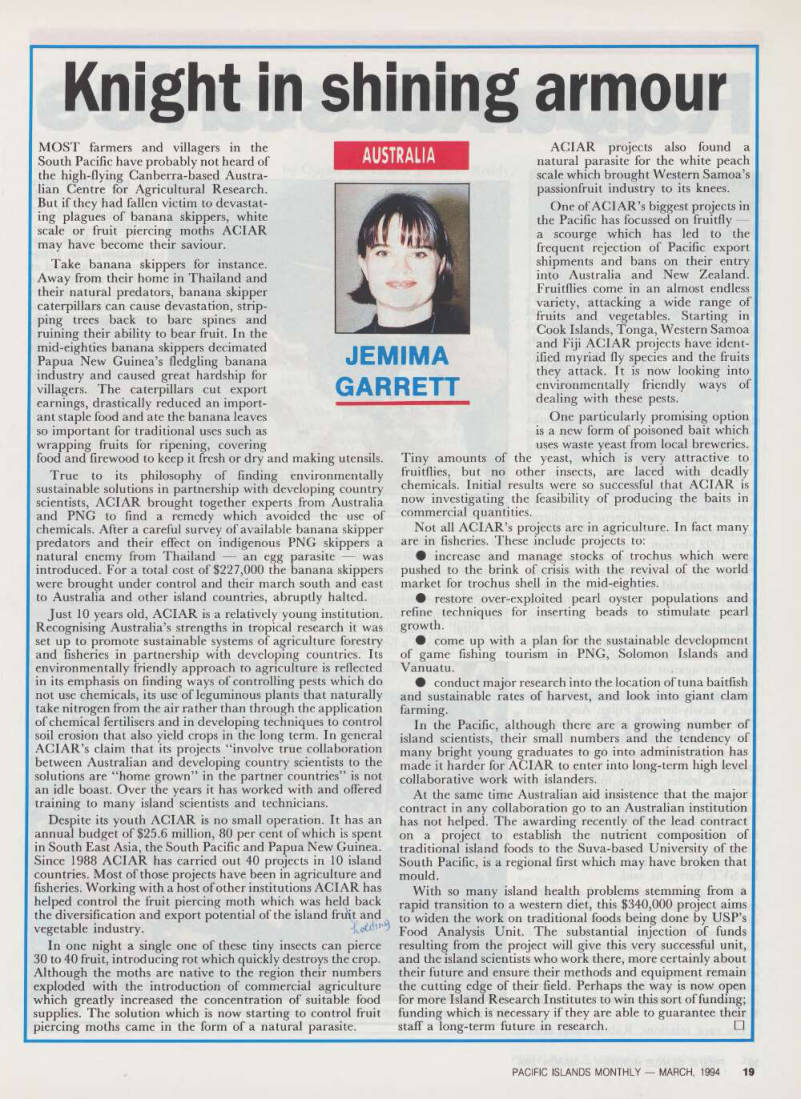
MOST farmers and villagers in the South Pacific have probably not heard of the high-flying Canberra-based Austra lian Centre for Agricultural Research.
But if they had fallen victim to devastat ing plagues of banana skippers, white scale or fruit piercing moths ACIAR may have become their saviour.
Take banana skippers for instance.
Away from their home in Thailand and their natural predators, banana skipper caterpillars can cause devastation, strip ping trees back to bare spines and ruining their ability to bear fruit. In the mid-eighties banana skippers decimated Papua New Guinea’s fledgling banana industry and caused great hardship for villagers. The caterpillars cut export earnings, drastically reduced an import ant staple food and ate the banana leaves so important for traditional uses such as wrapping fruits for ripening, covering
food and firewood to keep it fresh or dry and making utensils.
True to its philosophy of finding environmentally sustainable solutions in partnership with developing country scientists, ACIAR brought together experts from Australia and PNG to find a remedy which avoided the use of chemicals. After a careful survey of available banana skipper predators and their effect on indigenous PNG skippers a natural enemy from Thailand an egg parasite was introduced. For a total cost of $227,000 the banana skippers were brought under control and their march south and east to Australia and other island countries, abruptly halted.
Just 10 years old, ACIAR is a relatively young institution.
Recognising Australia’s strengths in tropical research it was set up to promote sustainable systems of agriculture forestry and fisheries in partnership with developing countries. Its environmentally friendly approach to agriculture is reflected in its emphasis on finding ways of controlling pests which do not use chemicals, its use of leguminous plants that naturally take nitrogen from the air rather than through the application of chemical fertilisers and in developing techniques to control soil erosion that also yield crops in the long term. In general ACIAR’s claim that its projects “involve true collaboration between Australian and developing country scientists to the solutions are “home grown” in the partner countries” is not an idle boast. Over the years it has worked with and offered training to many island scientists and technicians.
Despite its youth ACIAR is no small operation. It has an annual budget of $25.6 million, 80 per cent of which is spent in South East Asia, the South Pacific and Papua New Guinea.
Since 1988 ACIAR has carried out 40 projects in 10 island countries. Most of those projects have been in agriculture and fisheries. Working with a host of other institutions ACIAR has helped control the fruit piercing moth which was held back the diversification and export potential of the island fru'it and
vegetable industry.
In one night a single one of these tiny insects can pierce 30 to 40 fruit, introducing rot which quickly destroys the crop.
Although the moths are native to the region their numbers exploded with the introduction of commercial agriculture which greatly increased the concentration of suitable food supplies. The solution which is now starting to control fruit piercing moths came in the form of a natural parasite.
ACIAR projects also found a natural parasite for the white peach scale which brought Western Samoa’s passionfruit industry to its knees.
One of ACIAR’s biggest projects in the Pacific has focussed on fruitfly a scourge which has led to the frequent rejection of Pacific export shipments and bans on their entry into Australia and New Zealand.
Fruitflies come in an almost endless variety, attacking a wide range of fruits and vegetables. Starting in Cook Islands, Tonga, Western Samoa and Fiji ACIAR projects have ident ified myriad fly species and the fruits they attack. It is now looking into environmentally friendly ways of dealing with these pests.
One particularly promising option is a new form of poisoned bait which uses waste yeast from local breweries.
Tiny amounts of the yeast, which is very attractive to fruitflies, but no other insects, are laced with deadly chemicals. Initial results were so successful that ACIAR is now investigating the feasibility of producing the baits in
commercial quantities.
Not all ACIAR’s projects are in agriculture. In fact many are in fisheries. These include projects to: • increase and manage stocks of trochus which were pushed to the brink of crisis with the revival of the world market for trochus shell in the mid-eighties. • restore over-exploited pearl oyster populations and refine techniques for inserting beads to stimulate pearl
growth.
• come up with a plan for the sustainable development of game fishing tourism in PNG, Solomon Islands and Vanuatu. • conduct major research into the location of tuna baitfish and sustainable rates of harvest, and look into giant clam
farming.
In the Pacific, although there are a growing number of island scientists, their small numbers and the tendency of many bright young graduates to go into administration has made it harder for ACIAR to enter into long-term high level collaborative work with islanders.
At the same time Australian aid insistence that the major contract in any collaboration go to an Australian institution has not helped. The awarding recently of the lead contract on a project to establish the nutrient composition of traditional island foods to the Suva-based University of the South Pacific, is a regional first which may have broken that mould.
With so many island health problems stemming from a rapid transition to a western diet, this $340,000 project aims to widen the work on traditional foods being done by USP’s Food Analysis Unit. The substantial injection of funds resulting from the project will give this very successful unit, and the island scientists who work there, more certainly about their future and ensure their methods and equipment remain the cutting edge of their field. Perhaps the way is now open for more Island Research Institutes to win this sort of funding; funding which is necessary if they are able to guarantee their staff a long-term future in research. □
Australia
Jemima
Garrett
Rabuka staves off chslenge
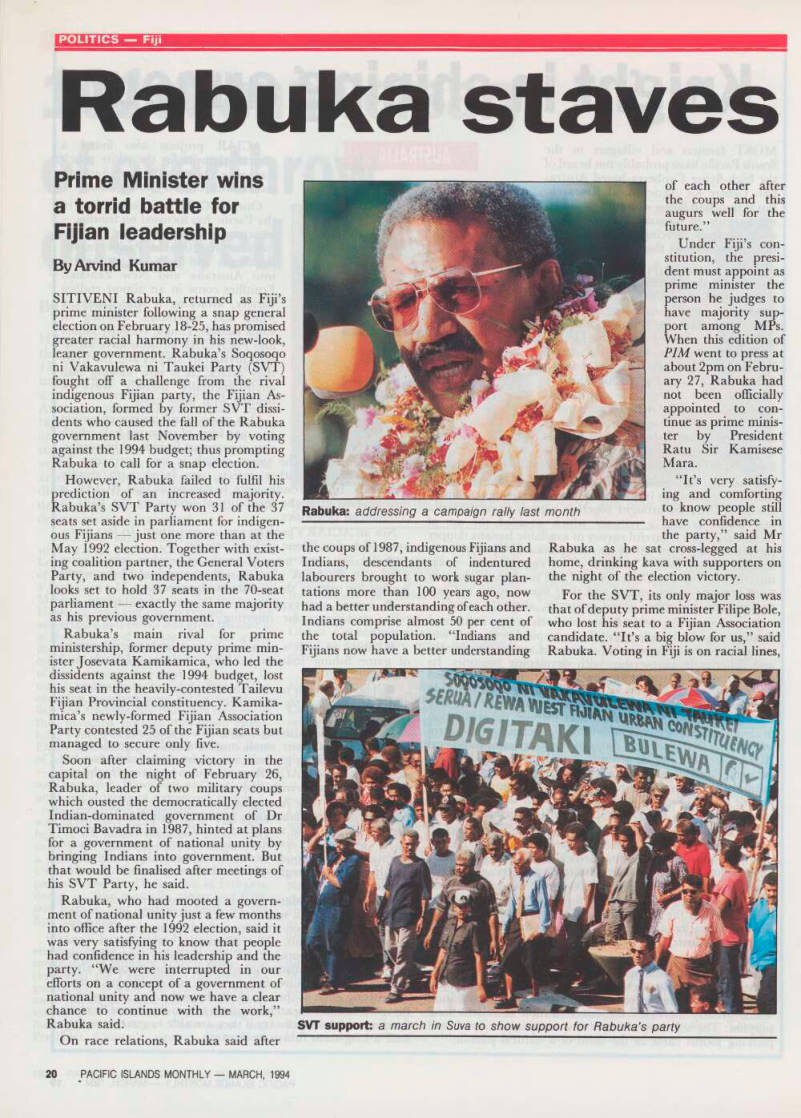
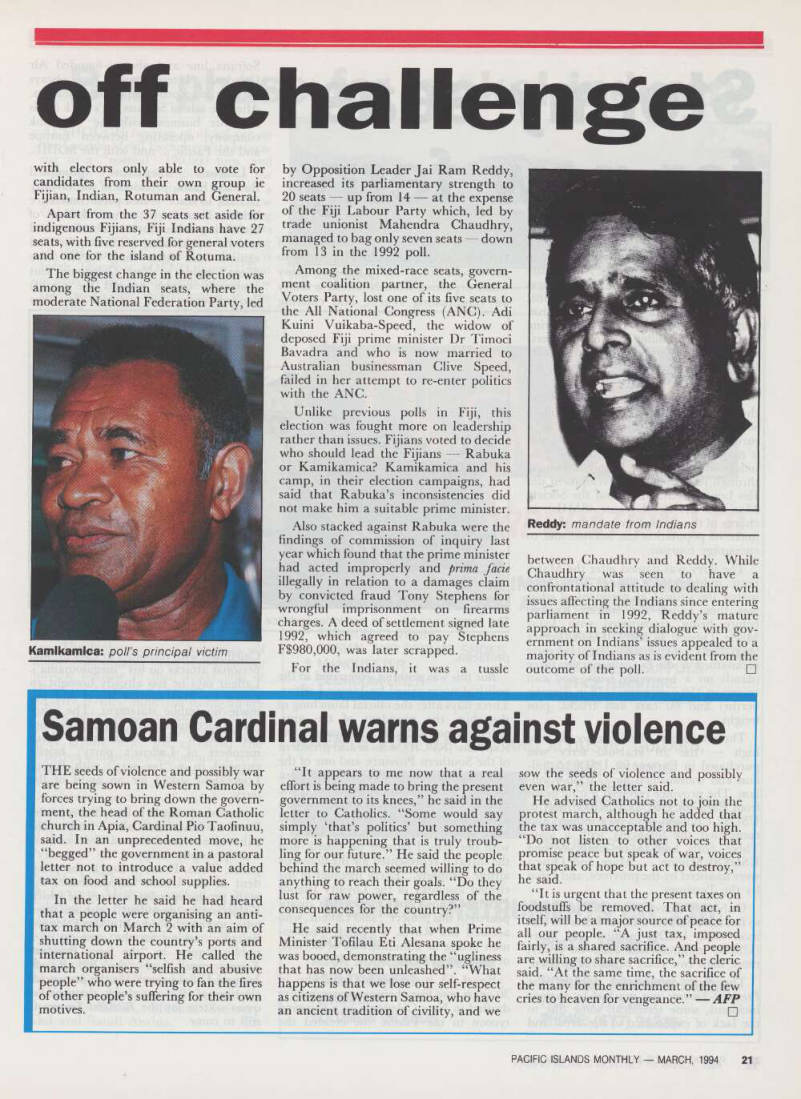
Politics — Fiji
Politics Fiji
Prime Minister wins a torrid battle for Fijian leadership
By Arvind Kumar
SITIVENI Rabuka, returned as Fiji’s prime minister following a snap general election on February 18-25, has promised greater racial harmony in his new-look, leaner government. Rabuka’s Soqosoqo ni Vakavulewa ni Taukei Party (SVT) fought off a challenge from the rival indigenous Fijian party, the Fijian As sociation, formed by former SVT dissi dents who caused the fall of the Rabuka government last November by voting against the 1994 budget; thus prompting Rabuka to call for a snap election.
However, Rabuka failed to fulfil his prediction of an increased majority.
Rabuka’s SVT Party won 31 of the 37 seats set aside in parliament for indigen ous Fijians just one more than at the May 1992 election. Together with exist ing coalition partner, the General Voters Party, and two independents, Rabuka looks set to hold 37 seats in the 70-seat parliament exactly the same majority as his previous government.
Rabuka’s main rival for prime ministership, former deputy prime min ister Josevata Kamikamica, who led the dissidents against the 1994 budget, lost his seat in the heavily-contested Tailevu Fijian Provincial constituency. Kamika mica’s newly-formed Fijian Association Party contested 25 of the Fijian seats but managed to secure only five.
Soon after claiming victory in the capital on the night of February 26, Rabuka, leader of two military coups which ousted the democratically elected Indian-dominated government of Dr Timoci Bavadra in 1987, hinted at plans for a government of national unity by bringing Indians into government. But that would be finalised after meetings of his SVT Party, he said.
Rabuka, who had mooted a govern ment of national unity just a few months into office after the 1992 election, said it was very satisfying to know that people had confidence in his leadership and the party. “We were interrupted in our efforts on a concept of a government of national unity and now we have a clear chance to continue with the work,”
Rabuka said.
On race relations, Rabuka said after
the coups of 1987, indigenous Fijians and Indians, descendants of indentured labourers brought to work sugar plantations more than 100 years ago, now had a better understanding of each other.
Indians comprise almost 50 per cent of the total population. “Indians and Fijians now have a better understanding
of each other after the coups and this augurs well for the future.”
Under Fiji’s con stitution, the presi dent must appoint as prime minister the person he judges to have majority sup port among MPs.
When this edition of PIM went to press at about 2pm on Febru ary 27, Rabuka had not been officially appointed to con tinue as prime minis ter by President Ratu Sir Kamisese Mara.
“It’s very satisfy
ing and comforting
to know people still have confidence in the party,” said Mr
Rabuka as he sat cross-legged at his home, drinking kava with supporters on the night of the election victory.
For the SVT, its only major loss was that of deputy prime minister Filipe Bole, who lost his seat to a Fijian Association candidate. “It’s a big blow for us,” said Rabuka. Voting in Fiji is on racial lines,
Rabuka: addressing a campaign rally last month
SVT support: a march in Suva to show support for Rabuka’s party
with electors only able to vote for candidates from their own group ie Fijian, Indian, Rotuman and General.
Apart from the 37 seats set aside for indigenous Fijians, Fiji Indians have 27 seats, with five reserved for general voters and one for the island of Rotuma.
The biggest change in the election was among the Indian seats, where the moderate National Federation Party, led
by Opposition Leader Jai Ram Reddy, increased its parliamentary strength to 20 seats up from 14 at the expense of the Fiji Labour Party which, led by trade unionist Mahendra Chaudhry, managed to bag only seven seats down from 13 in the 1992 poll.
Among the mixed-race seats, govern ment coalition partner, the General Voters Party, lost one of its five seats to the All National Congress (ANC). Adi Kuini Vuikaba-Speed, the widow of deposed Fiji prime minister Dr Timoci Bavadra and who is now married to Australian businessman Clive Speed, failed in her attempt to re-enter politics with the ANC.
Unlike previous polls in Fiji, this election was fought more on leadership rather than issues. Fijians voted to decide who should lead the Fijians Rabuka or Kamikamica? Kamikamica and his camp, in their election campaigns, had said that Rabuka’s inconsistencies did not make him a suitable prime minister.
Also stacked against Rabuka were the findings of commission of inquiry last year which found that the prime minister had acted improperly and prima facie illegally in relation to a damages claim by convicted fraud Tony Stephens for wrongful imprisonment on firearms charges. A deed of settlement signed late 1992, which agreed to pay Stephens F 5980,000, was later scrapped.
For the Indians, it was a tussle
between Chaudhry and Reddy. While Chaudhry was seen to have a confrontational attitude to dealing with issues affecting the Indians since entering parliament in 1992, Reddy’s mature
approach in seeking dialogue with gov
ernment on Indians’ issues appealed to a majority of Indians as is evident from the outcome of the poll. □
Kamlkamlca: poll's principal victim
Reddy: mandate from Indians
Samoan Cardinal warns against violence
THE seeds of violence and possibly war are being sown in Western Samoa by forces trying to bring down the government, the head of the Roman Catholic church in Apia, Cardinal Pio Taofinuu, said. In an unprecedented move, he “begged” the government in a pastoral letter not to introduce a value added tax on food and school supplies.
In the letter he said he had heard ,i . i • • . hat a people were organising an ant.tax march on March 2 with an aim of s utting down the country s ports and international airport. He called the march organisers selfish and abusive people who were trying to fan the fires of other people s suffering for their own motives.
“It appears to me now that a real effort is being made to bring the present government to its knees,” he said in the letter to Catholics. “Some would say simply ‘that’s politics’ but something more is happening that is truly troubling for our future.” He said the people behind the march seemed willing to do anything to reach their goals. “Do they lust for raw P owe , r ’ re g ar dless of the conseouences for the q 6 Ces 0 county.
He said recently that when Prime Minister Tofilau Eti Alesana spoke he was booed, demonstrating the “ugliness that has now been unleashed . What happens is that we lose our self-respect as citizens of Western Samoa, who have an ancient tradition of civility, and we
sow the seeds of violence and possibly even war,” the letter said, He advised Catholics not to join the protest march, although he added that the tax was unacceptable and too high, “Do not listen to other voices that promise peace but speak of war, voices that speak of hope but act to destroy,” be said.
“It is urgent that the present taxes on toodstutis be removed. 1 hat act, in itself, will be a major source of peace for all our people J A just tax *; mposed fairly, is a shared sacrifice. And people are willing to share sacrifice,” the cleric said. “At the same time the sacrifice of the many for the enrichment of the few
cries to heaven for vengeance.”
Afp
Stormy seas
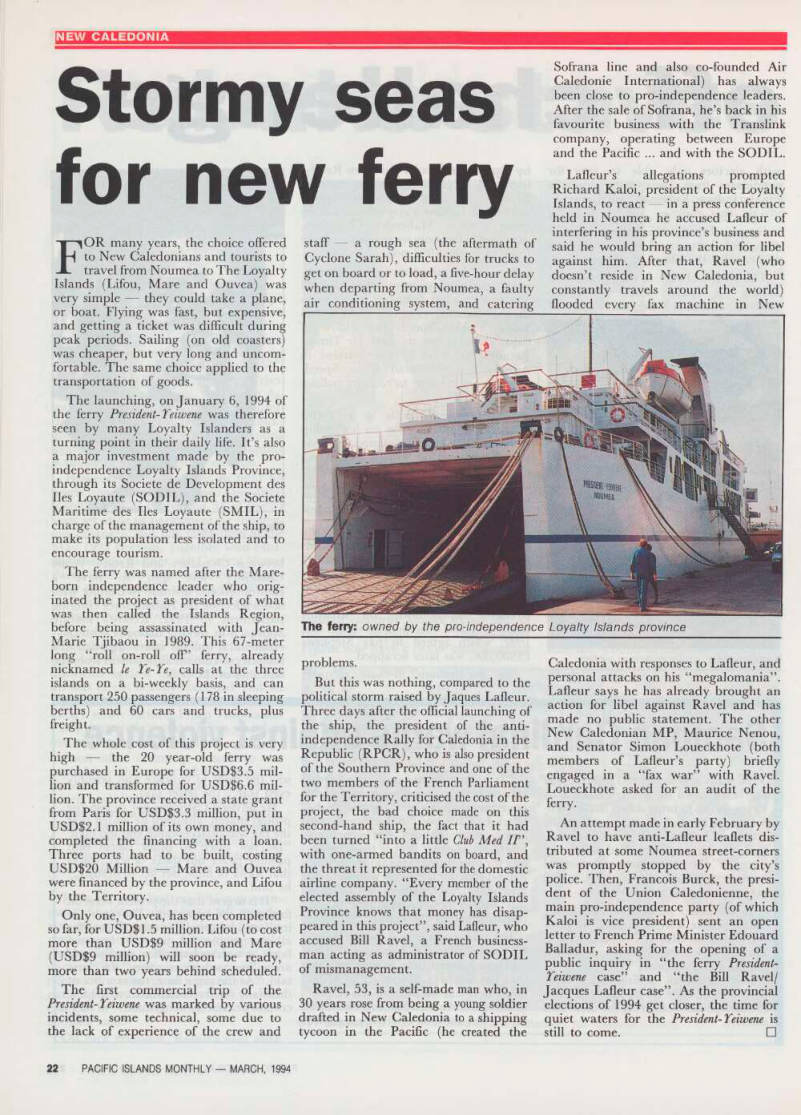
New Caledonia
Stormy seas for new ferry
FOR many years, the choice offered to New Caledonians and tourists to travel from Noumea to The Loyalty Islands (Lifou, Mare and Ouvea) was very simple they could take a plane, or boat. Flying was fast, but expensive, and getting a ticket was difficult during peak periods. Sailing (on old coasters) was cheaper, but very long and uncom fortable. The same choice applied to the transportation of goods.
The launching, on January 6, 1994 of the ferry President-Teiwene was therefore seen by many Loyalty Islanders as a turning point in their daily life. It’s also a major investment made by the pro independence Loyalty Islands Province, through its Societe de Development des lies Loyaute (SODIL), and the Societe Maritime des lies Loyaute (SMIL), in charge of the management of the ship, to make its population less isolated and to encourage tourism.
The ferry was named after the Mare born independence leader who orig inated the project as president of what was then called the Islands Region, before being assassinated with Jean- Marie Tjibaou in 1989. This 67-meter long “roll on-roll off’ ferry, already nicknamed le Ye-Ye, calls at the three islands on a bi-weekly basis, and can transport 250 passengers (178 in sleeping berths) and 60 cars and trucks, plus freight.
The whole cost of this project is very high the 20 year-old ferry was purchased in Europe for USDS3.S mil lion and transformed for USDS6.6 mil lion. The province received a state grant from Paris for USDS3.3 million, put in USDS2.I million of its own money, and completed the financing with a loan.
Three ports had to be built, costing USDS2O Million Mare and Ouvea were financed by the province, and Lifou by the Territory.
Only one, Ouvea, has been completed so far, for USDS 1.5 million. Lifou (to cost more than USDS9 million and Mare (USDS9 million) will soon be ready, more than two years behind scheduled.
The first commercial trip of the President- Yeiwene was marked by various incidents, some technical, some due to the lack of experience of the crew and
staff a rough sea (the aftermath of Cyclone Sarah), difficulties for trucks to get on board or to load, a five-hour delay when departing from Noumea, a faulty air conditioning system, and catering
Sofrana line and also co-founded Air
Caledonie International) has always
been close to pro-independence leaders.
After the sale of Sofrana, he’s back in his favourite business with the Translink
company, operating between Europe
and the Pacific ... and with the SODIL.
Lafleur’s allegations prompted
Richard Kaloi, president of the Loyalty Islands, to react in a press conference held in Noumea he accused Lafleur of interfering in his province’s business and said he would bring an action for libel against him. After that, Ravel (who doesn’t reside in New Caledonia, but constantly travels around the world) flooded every fax machine in New
problems.
But this was nothing, compared to the
political storm raised by Jaques Lafleur.
Three days after the official launching of the ship, the president of the anti independence Rally for Caledonia in the
Republic (RPCR), who is also president
of the Southern Province and one of the two members of the French Parliament for the Territory, criticised the cost of the project, the bad choice made on this second-hand ship, the fact that it had been turned “into a little Club Med 77”, with one-armed bandits on board, and the threat it represented for the domestic airline company. “Every member of the elected assembly of the Loyalty Islands Province knows that money has disap peared in this project”, said Lafleur, who accused Bill Ravel, a French business man acting as administrator of SODIL
of mismanagement.
Ravel, 53, is a self-made man who, in 30 years rose from being a young soldier drafted in New Caledonia to a shipping tycoon in the Pacific (he created the
Caledonia with responses to Lafleur, and personal attacks on his “megalomania”.
Lafleur says he has already brought an action for libel against Ravel and has made no public statement. The other New Caledonian MP, Maurice Nenou, and Senator Simon Loueckhote (both members of Lafleur’s party) briefly engaged in a “fax war” with Ravel.
Loueckhote asked for an audit of the
ferry.
An attempt made in early February by Ravel to have anti-Lafleur leaflets dis tributed at some Noumea street-corners
was promptly stopped by the city’s
police. Then, Francois Burck, the presi dent of the Union Caledonienne, the main pro-independence party (of which Kaloi is vice president) sent an open letter to French Prime Minister Edouard Bahadur, asking for the opening of a
public inquiry in “the ferry President-
Teiwene case” and “the Bill Ravel/ Jacques Lafleur case”. As the provincial elections of 1994 get closer, the time for quiet waters for the President- Teiwene is still to come. □
The ferry: owned by the pro-independence Loyalty Islands province
Bad phase for nickel industry

ALTHOUGH reserves of nickel ore on the London Metal Exchanges are return ing to a “normal” 120,000 tons, and although an upward movement in the American economy could lead to a greater demand for nickel, the New Caledonians employed on extracting sites are concerned the employers announced 200 layoffs for the beginning of 1994, and the immediate future is bleak. Therefore, SOENC mines (Union of Mine Workers and Employees of New Caledonia), the largest union in the business, launched a 24-hour general strike on all mining sites on January 19, which almost totally paralysed extrac tion.
Backed by the Transport Union (small contractors who transport the ore in their own trucks), they also blocked the main road of New Caledonia, 30 km north of Noumea for more than 30 hours with their excavators and giant mining trucks.
Not coincidentally, this action took place during the seven-day mission of a team of mining experts from Paris. They had come to examine the possible increase by five or 10 hundredths of the maximum nickel content in the exported ore in 1994 (actually - 2.55 per cent).
This issue is dividing the New Cale donian producers. For Raphael Pidjot, the manager of SMSP, (sold by Jacques Lafleur to the pro-independence North ern Province in 1990, and turned into the largest nickel exporter of New Cale donia), “it’s a matter of survival”.
“Our only asset is the high grade of our ore. The Philippines and Indonesia sell 20 per cent cheaper than us to Japanese buyers, because of their lower cost of labor”, he explains. The other producers disagree they think that selling an ore with a higher nickle content will “skim” the best veins for good, and will lead to more layoffs, since the extracted and exported quantities will diminish. Every body agrees that 1994 will be a “difficult year” one or two of the four New Caledonian exporters of nickel ore to Japan could well disappear. A terrible blow in what is by far the main activity of the territory.
People In The News • Jacques Michaut arrived in New Caledonia to become the new deputy general secretary of the territory. The position has remained vacant for six months.
• Tegoeh Wahyono Notoprayitno is
the new Consul General for Indonesia in Noumea. He previously served in Denmark, USSR, Mexico, Switzer land and Saudi Arabia. □
The road block: on January 20
Advertisements & other items, pp. 23-24 (1 item)
Alliance Corpora Tion Ltd
SPECIALISING IN IMPORTED FASHION
CLOTHING FOR ALL OCCASIONS
* FASHION CLOTHING
* CASUAL AND FORMAL SHOES
* MANCHESTER
* BEDROOM LINEN
* ELECTRICAL APPLIANCES
* TABLE UTENSILS
* MARINE PRODUCTS EXPORTER
* STATIONERY SUPPLIES
* OFFICE FURNITURE
* MUSICAL INSTRUMENTS
AGENTS FOR ELECTRIC AND ACOUSTIC GUITARS,
DRUMS, PIANOS,
KEYBOARDS,
AMPLIFIERS, SPEAKERS,
MIKES AND STAGE
SOUND SYSTEM
MUSICAL INSTRUMENTS CO. LTD.
LOCATION:
ACOR BOOKSHOP BUILDING
ASHLEY STREET
HONIARA
SOLOMON ISLANDS
POSTAL ADDRESS:
PO BOX 780
HONIARA, SOLOMON ISLAND
FAX: (677) 21477
PHONE: (677) 21239
ADVANCE ALARM TECHNOLOGY LTD.
L©P©°©©
©©PD© ©L©©H i¥i¥l
FEATURING:
1. INSTANT ALARMING
2. TRANSMITS ALARM CODE
• a) Fire & Burglary • b) Low Battery • c) Technical Faulty • d) Tamper 3. MAINTAINS AND RECORDS 24 HRS. SURVEILLANCE
4. LOCATION OF TRANSMISSION (ADDRESS)
5. AREA OF TRANSMISSION (KITCHEN)
6. OPERATIONAL THROUGHOUT ALL TYPES OF NATURAL
DISASTERS
7. EXTRA IMMUNITY BUILT-IN FROM FALSE ALARMS 8. AUTOMATIC BATTERY BACK-UP BUILT WITHIN THE
SYSTEM
9. DISPLAYS VISUAL ALARM OCCURRING AND PRINTS
(RECORDS) ALARM STATUS
PREMISES AT REMOTE SITE
..O'
RECEPTION
AREA
M.D’S OFFICE
KITCHEN
iiliiil
mmm
sK«i;«e
ii|| numm m
MANUFACTURER:
K.P. ELECTRONIC SYSTEMS LTD.
P.O. Box 42, Tefen Industrial Park, 24959, Israel Tel: 972 873066, Telex: 471439 TEFEN IL, Fax: 972-873692
CONTROL CENTRE
SOUTH PACIFIC DISTIBUTOR:
ADVANCE ALARM TECHNOLOGY LTD,.
280 Toorak Road, P.O. Box 2243, Government Buildings, Suva, Fiji.
Telephone: (679) 312357,315506,304976. Fax: (679) 303175.
Fakafanua’s balancing
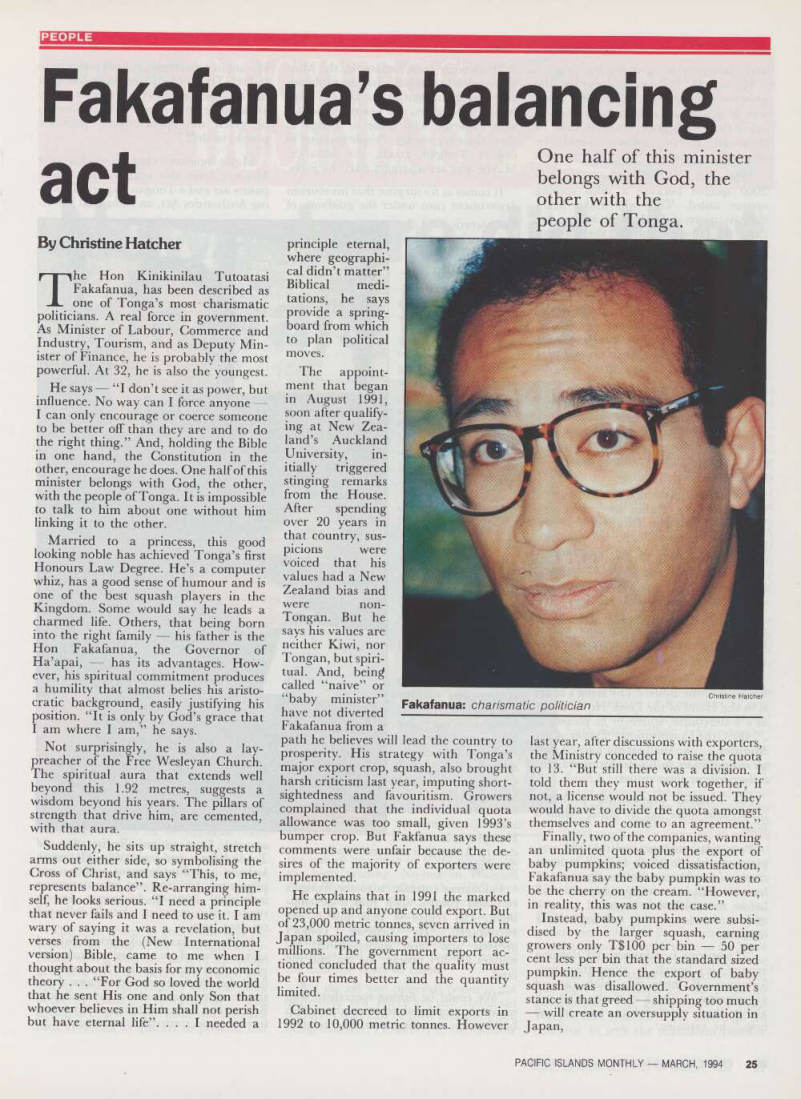
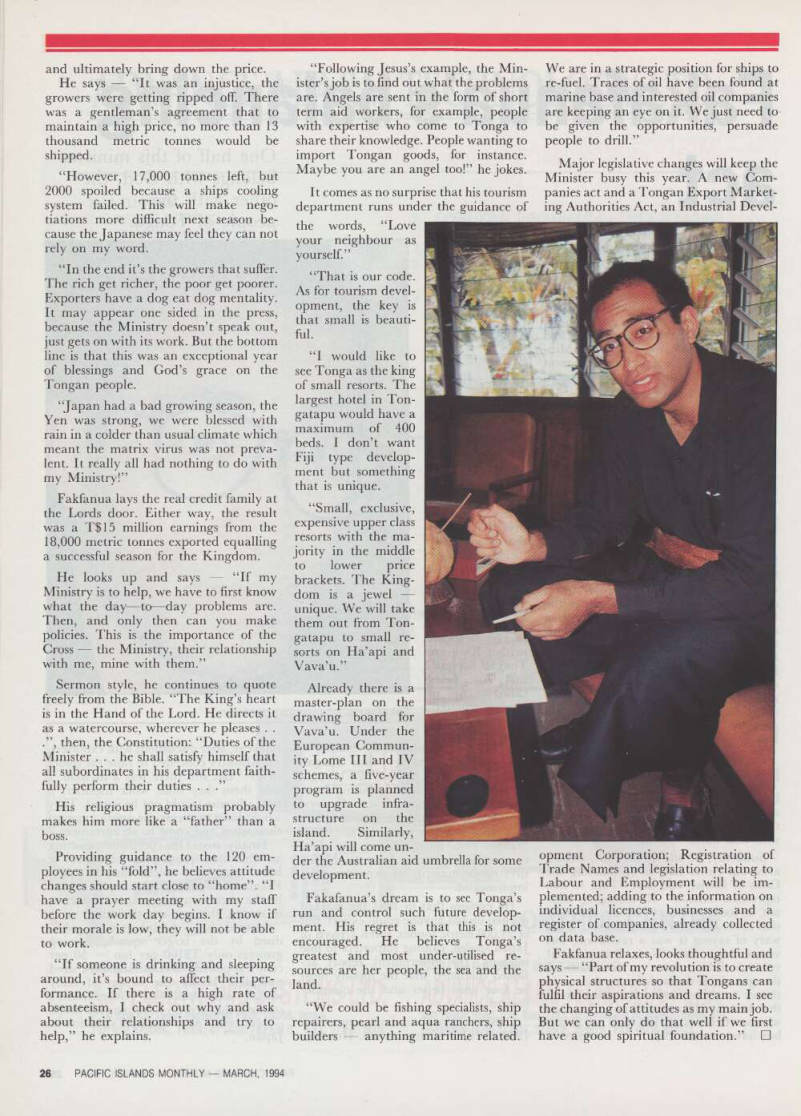
People
act
By Christine Hatcher
One half of this minister belongs with God, the other with the people of Tonga.
The Hon Kinikinilau Tutoatasi Fakafanua, has been described as one of Tonga’s most charismatic politicians. A real force in government.
As Minister of Labour, Commerce and Industry, Tourism, and as Deputy Min ister of Finance, he is probably the most powerful. At 32, he is also the youngest.
He says “I don’t see it as power, but influence. No way can I force anyone I can only encourage or coerce someone to be better off than they are and to do the right thing.” And, holding the Bible in one hand, the Constitution in the other, encourage he does. One half of this minister belongs with God, the other, with the people of Tonga. It is impossible to talk to him about one without him linking it to the other.
Married to a princess, this good looking noble has achieved Tonga’s first Honours Law Degree. He’s a computer whiz, has a good sense of humour and is one of the best squash players in the Kingdom. Some would say he leads a charmed life. Others, that being born into the right family his father is the Hon Fakafanua, the Governor of Ha’apai, has its advantages. How ever, his spiritual commitment produces a humility that almost belies his aristo cratic background, easily justifying his position. “It is only by God’s grace that I am where I am,” he says.
Not surprisingly, he is also a lay preacher of the Free Wesleyan Church.
The spiritual aura that extends well beyond this 1.92 metres, suggests a wisdom beyond his years. The pillars of strength that drive him, are cemented, with that aura.
Suddenly, he sits up straight, stretch arms out either side, so symbolising the Cross of Christ, and says “This, to me, represents balance”. Re-arranging him self, he looks serious. “I need a principle that never fails and I need to use it. I am wary of saying it was a revelation, but verses from the (New International version) Bible, came to me when I thought about the basis for my economic theory . . . “For God so loved the world that he sent His one and only Son that whoever believes in Him shall not perish but have eternal life”. ... I needed a
principle eternal,
where geographi cal didn’t matter”
Biblical medi tations, he says provide a spring board from which to plan political moves.
The appoint ment that began in August 1991, soon after qualify ing at New Zea land’s Auckland University, in itially triggered stinging remarks from the House.
After spending over 20 years in that country, sus picions were voiced that his values had a New Zealand bias and were non- Tongan. But he says his values are neither Kiwi, nor Tongan, but spiri tual. And, being called “naive” or
“baby minister”
have not diverted Fakafanua from a
path he believes will lead the country to prosperity. His strategy with Tonga’s major export crop, squash, also brought harsh criticism last year, imputing short sightedness and favouritism. Growers complained that the individual quota allowance was too small, given 1993’s bumper crop. But Fakfanua says these comments were unfair because the de sires of the majority of exporters were implemented.
He explains that in 1991 the marked opened up and anyone could export. But of 23,000 metric tonnes, seven arrived in Japan spoiled, causing importers to lose millions. The government report ac tioned concluded that the quality must be four times better and the quantity limited.
Cabinet decreed to limit exports in 1992 to 10,000 metric tonnes. However
last year, after discussions with exporters, the Ministry conceded to raise the quota to 13. “But still there was a division. I told them they must work together, if not, a license would not be issued. They would have to divide the quota amongst themselves and come to an agreement.”
Finally, two of the companies, wanting an unlimited quota plus the export of baby pumpkins; voiced dissatisfaction, Fakafanua say the baby pumpkin was to be the cherry on the cream. “However, in reality, this was not the case.”
Instead, baby pumpkins were subsi dised by the larger squash, earning growers only Tsloo per bin 50 per cent less per bin that the standard sized pumpkin. Hence the export of baby squash was disallowed. Government’s stance is that greed shipping too much will create an oversupply situation in Japan,
Fakafanua: charismatic politician
and ultimately bring down the price.
He says “It was an injustice, the growers were getting ripped off. There was a gentleman’s agreement that to maintain a high price, no more than 13 thousand metric tonnes would be
shipped.
“However, 17,000 tonnes left, but
2000 spoiled because a ships cooling
system failed. This will make nego tiations more difficult next season be cause the Japanese may feel they can not rely on my word.
“In the end it’s the growers that suffer.
The rich get richer, the poor get poorer.
Exporters have a dog eat dog mentality.
It may appear one sided in the press, because the Ministry doesn’t speak out, just gets on with its work. But the bottom line is that this was an exceptional year of blessings and God’s grace on the
Tongan people.
“Japan had a bad growing season, the Yen was strong, we were blessed with rain in a colder than usual climate which meant the matrix virus was not preva lent. It really all had nothing to do with my Ministry!”
Fakfanua lays the real credit family at the Lords door. Either way, the result was a TSIS million earnings from the 18,000 metric tonnes exported equalling a successful season for the Kingdom.
He looks up and says “If my Ministry is to help, we have to first know
what the day—to —day problems are.
Then, and only then can you make policies. This is the importance of the Cross the Ministry, their relationship with me, mine with them.”
Sermon style, he continues to quote freely from the Bible. “The King’s heart is in the Hand of the Lord. He directs it as a watercourse, wherever he pleases . . .”, then, the Constitution; “Duties of the Minister ... he shall satisfy himself that all subordinates in his department faith fully perform their duties . . .”
His religious pragmatism probably
makes him more like a “father” than a boss.
Providing guidance to the 120 em ployees in his “fold”, he believes attitude changes should start close to “home”. “I have a prayer meeting with my staff before the work day begins. I know if their morale is low, they will not be able to work.
“If someone is drinking and sleeping around, it’s bound to affect their per formance. If there is a high rate of absenteeism, I check out why and ask about their relationships and try to
help,” he explains.
“Following Jesus’s example, the Min ister’s job is to find out what the problems are. Angels are sent in the form of short term aid workers, for example, people with expertise who come to Tonga to share their knowledge. People wanting to import Tongan goods, for instance.
Maybe you are an angel too!” he jokes.
It comes as no surprise that his tourism department runs under the guidance of
the words, “Love your neighbour as
yourself.”
“That is our code.
As for tourism devel opment, the key is that small is beauti ful.
“I would like to see Tonga as the king of small resorts. The largest hotel in Ton gatapu would have a maximum of 400 beds. I don’t want
Fiji type develop
ment but something that is unique.
“Small, exclusive, expensive upper class resorts with the ma jority in the middle to lower price brackets. The King dom is a jewel unique. We will take them out from Ton gatapu to small re sorts on Ha’api and Vava’u.”
Already there is a master-plan on the drawing board for Vava’u. Under the
European Commun
ity Lome HI and IV schemes, a five-year program is planned to upgrade infra structure on the
island. Similarly,
Ha’api will come un
der the Australian aid umbrella for some development.
Fakafanua’s dream is to see Tonga’s run and control such future develop ment. His regret is that this is not encouraged. He believes Tonga’s greatest and most under-utilised re sources are her people, the sea and the land.
“We could be fishing specialists, ship repairers, pearl and aqua ranchers, ship builders anything maritime related.
We are in a strategic position for ships to re-fuel. Traces of oil have been found at marine base and interested oil companies are keeping an eye on it. We just need to
be given the opportunities, persuade
people to drill.”
Major legislative changes will keep the
Minister busy this year. A new Com panies act and a Tongan Export Market ing Authorities Act, an Industrial Devel-
opment Corporation; Registration of Trade Names and legislation relating to Labour and Employment will be im plemented; adding to the information on individual licences, businesses and a register of companies, already collected on data base.
Fakfanua relaxes, looks thoughtful and says “Part of my revolution is to create physical structures so that Tongans can fulfil their aspirations and dreams. I see the changing of attitudes as my main job.
But we can only do that well if we first have a good spiritual foundation.” □
Pacific Business

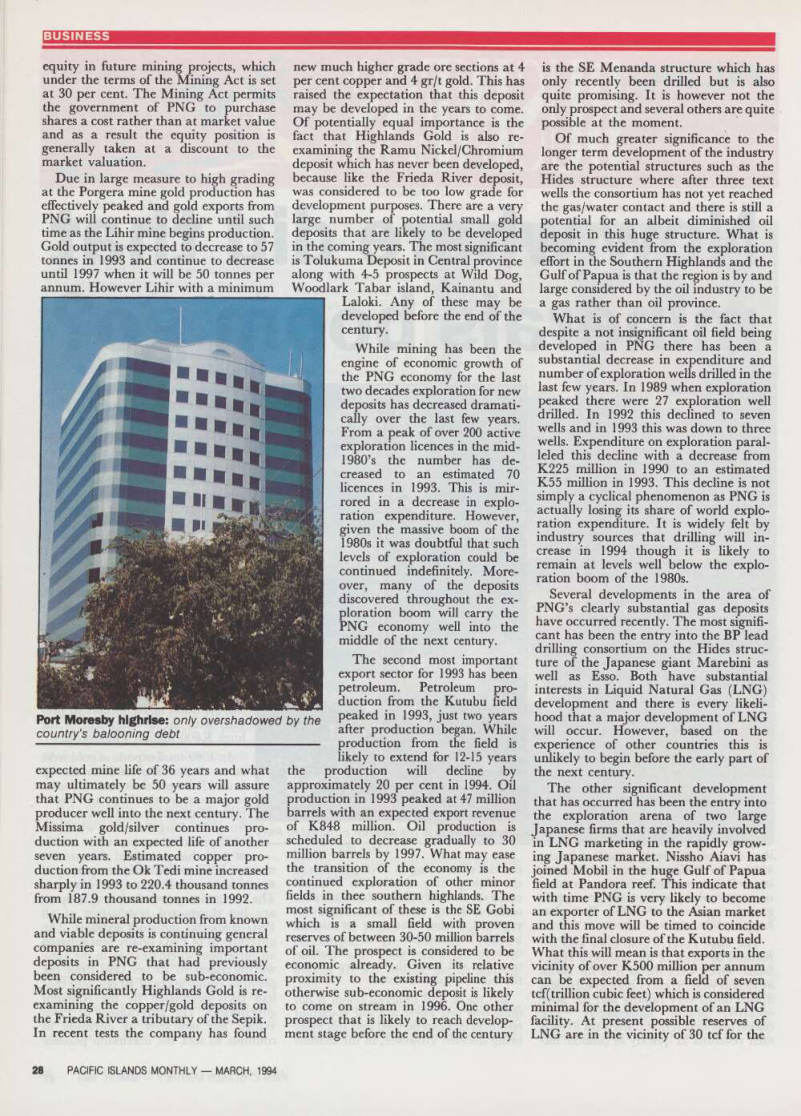
Now where did that minerals boom go?
IT Went Bang!
In 1994, if we are to believe govern ment projections, and they are
usually more optimistic than realistic, the
PNG economy will contract an expected 42 million barrels of oil. It is exporting over 50 tonnes of gold and yet it has foreign exchange reserves in the third quarter of 1993 to cover only 1.8 months of non-mineral imports. This is down from 9 months of non-oil import cover in the mid 1980’s before the minerals and exploration boom had never begun.
While this decline in foreign exchange reserves is in large part a result of massive debt repayments by the mining and oil companies so dramatic a decline remains disturbing despite the fact that it will
probably recover.
PNG has become a victim of its own success. IN 1992 the growth rate was an astounding 11.8 per cent and in 1993 an even more astounding 14 per cent. The boom however is already over and it will be downhill form now on. You should not have blinked because if you did you probably missed what everyone was talking about in PGN for the last ten years. And if you leave aside the shining high rises in Port Moresby, which are only overshadowed in stature by the country’s ballooning debt then there is very little to show for the minerals boom that all and sundry dreamed of in the 1980 s. The PNG economy will, accord ing to the government’s own projections, not again see positive real per capita growth again until 1997. So what
happened?
The huge Porgera gold mine and the Kutubu oil fields of the Southern High lands, which were the as is of the boom in 1992-3 were in effect high graded and drawn down very rapidly and the peak occurred almost immediately. The reason of course is that firms want to earn their revenues as quickly as possible but
the risk of investing in PNG accelerates the high grading. No-one in Waigani could say that they did not have advance notice and they all behaved exactly as expected. Rather than save its mineral wealth Waigani has spent it in the massive orgy of government consump tion that will leave the country paying the bills for years to come.
But the oil and minerals boom is not quite over yet. There are still abundant resources that can be used and still more being discover. However, in the shadow
of Bougainville the exploration that is fuel of oil and gold mining booms has all but stopped.
While oil production and exports have grown to be of major import ant to PNG it still takes second place in terms of exports to minerals which even in 1993, the peak year of oil production was below the value of mineral exports. However, oil and minerals now constitute 79 per cent of total PNG exports. If PNG was before dependent upon the whims of the gold copper market it has now added black gold to its economic addiction.
The developments in mining are
relatively encouraging despite a
year in which a major confrontation occurred between the mining com panies and the government of PNG.
The most important development is the intention of Kennecott to pro ceed with the development of the huge K6OO million Lihir project.
In 1992 total exports of gold were at an all time high of 67 tonnes up from 57 the previous year. It was a large measure the huge and unex pected increase in gold production from the Porgera mine which in 1992 produced a reported 46 tonnes of gold that prompted the govern
ment of PNG to demand a reopening of negotiations with Porgera Joint Venture.
The renegotiation resulted in a tempor ary but downward revaluation of all PNG stocks on the stock markets. The government of PNG finally renegotiated an agreement where its stake in the mine was increased to 25 per cent from the previous equity stake of 10 per cent that had been negotiated by the Namaliu government. The government of Paias Wingti has indicated its intention to continue to seek the maximum possible
Exploration well: in the western province of PNG
equity in future mining projects, which under the terms of the Mining Act is set at 30 per cent. The Mining Act permits the government of PNG to purchase shares a cost rather than at market value and as a result the equity position is generally taken at a discount to the market valuation.
Due in large measure to high grading at the Porgera mine gold production has effectively peaked and gold exports from PNG will continue to decline until such time as the Lihir mine begins production, Gold output is expected to decrease to 57 tonnes in 1993 and continue to decrease until 1997 when it will be 50 tonnes per annum. However Lihir with a minimum
expected mine life of 36 years and what may ultimately be 50 years will assure that PNG continues to be a major gold producer well into the next century. The Missima gold/silver continues production with an expected life of another seven years. Estimated copper production from the Ok Tedi mine increased sharply in 1993 to 220.4 thousand tonnes from 187.9 thousand tonnes in 1992. ... . .
While mineral production from known and viable deposits is continuing general companies are re-examining important deposits in PNG that had previously been considered to be sub-economic, Most significantly Highlands Gold is reexamining the copper/gold deposits on the Frieda River a tributary of the Sepik.
In recent tests the company has found
new much higher grade ore sections at 4 per cent copper and 4 gr/t gold. This has raised the expectation that this deposit may be developed in the years to come, Of potentially equal importance is the fact that Highlands Gold is also re examining the Ramu Nickel/Chromium deposit which has never been developed, because like the Frieda River deposit, was considered to be too low grade for development purposes. There are a very large number of potential small gold deposits that are likely to be developed in the coming years. The most significant is Tolukuma Deposit in Central province along with 4-5 prospects at Wild Dog, Woodlark Tabar island, Kainantu and
Laloki. Any of these may be developed before the end of the century.
While mining has been the engine of economic growth of the PNG economy for the last two decades exploration for new deposits has decreased dramati cally over the last few years.
From a peak of over 200 active exploration licences in the mid 1980’s the number has de creased to an estimated 70 licences in 1993. This is mir rored in a decrease in explo ration expenditure. However, given the massive boom of the 1980 s it was doubtful that such levels of exploration could be continued indefinitely. More over, many of the deposits discovered throughout the ex ploration boom will carry the PNG economy well into the middle of the next century.
The second most important export sector for 1993 has been petroleum. Petroleum pro duction from the Kutubu field peaked in 1993, just two years
after production began. While
production from the field is likely to extend for 12-15 years
the production will decline by approximately 20 per cent in 1994. Oil production in 1993 peaked at 47 million barrels with an expected export revenue of KB4B million. Oil production is scheduled to decrease gradually to 30 million barrels by 1997. What may ease the transition of the economy is the continued exploration of other minor fields j n thee southern highlands. The most significant of these is the SE Gobi which is a small field with proven reserves of between 30-50 million barrels G f oil. The prospect is considered to be economic already. Given its relative
proximity to the existing pipeline this
otherwise sub-economic deposit is likely to come on stream in 1996. One other prospect that is likely to reach develop ment stage before the end of the century
is the SE Menanda structure which has only recently been drilled but is also quite promising. It is however not the only prospect and several others are quite possible at the moment.
Of much greater significance to the longer term development of the industry are the potential structures such as the Hides structure where after three text wells the consortium has not yet reached the gas/water contact and there is still a potential for an albeit diminished oil deposit in this huge structure. What is becoming evident from the exploration effort in the Southern Highlands and the Gulf of Papua is that the region is by and large considered by the oil industry to be a gas rather than oil province.
What is of concern is the fact that despite a not insignificant oil field being developed in PNG there has been a substantial decrease in expenditure and number of exploration wells drilled in the last few years. In 1989 when exploration peaked there were 27 exploration well drilled. In 1992 this declined to seven wells and in 1993 this was down to three wells. Expenditure on exploration paral leled this decline with a decrease from K 225 million in 1990 to an estimated K 55 million in 1993. This decline is not simply a cyclical phenomenon as PNG is actually losing its share of world explo ration expenditure. It is widely felt by industry sources that drilling will in crease in 1994 though it is likely to remain at levels well below the explo ration boom of the 1980 s.
Several developments in the area of PNG’s clearly substantial gas deposits have occurred recently. The most signifi cant has been the entry into the BP lead drilling consortium on the Hides struc ture of the Japanese giant Marebini as well as Esso. Both have substantial interests in Liquid Natural Gas (LNG) development and there is every likeli hood that a major development of LNG will occur. However, based on the experience of other countries this is unlikely to begin before the early part of the next century.
The other significant development that has occurred has been the entry into the exploration arena of two large Japanese firms that are heavily involved in LNG marketing in the rapidly grow ing Japanese market. Nissho Aiavi has joined Mobil in the huge Gulf of Papua field at Pandora reef. This indicate that with time PNG is very likely to become an exporter of LNG to the Asian market and this move will be timed to coincide with the final closure of the Kutubu field.
What this will mean is that exports in the vicinity of over K5OO million per annum can be expected from a field of seven tcf(trillion cubic feet) which is considered minimal for the development of an LNG facility. At present possible reserves of LNG are in the vicinity of 30 tcf for the
Port Moresby highrlse: only overshadowed by the country’s balooning debt
country as a whole. The most promising structure for development is Pandora.
Total known reserves are 2 tcf but this is expected to increase dramatically with further exploration of the various reef structures in the area. Nissho, Japan’s largest importer of LNG is interested in the Pandora field. This gas field has the ‘advantage’ of being offshore. In most countries this is viewed as a disadvantage as it substantially raises costs. However, in the case of PNG this lowers the risk attendant to such developments from disruption by landowners.
It will be necessary for the government of PNG to enact new legislation to deal with gas development as the existing taxation system is considered to be inappropriate to give necessary incen tives to develop a project will recquire an investment in the vicinity of US$lO billion to develop. However, should the project proceed then it will give PNG the long term financial stability it requires as such projects are normally of 20-25 year duration. The government has engaged consultants to prepare legislation for the gas industry in 1994. □
PNG confidence
Major resource companies from Aus tralia have reaffirmed their commit ment to increase their investments in PNG in future. Prime Minister Paias Wingti confirmed this after talks with resource companies in Melbourne last month.
Company executives who met with Winti included those from the mining, petroleum, finance, accounting and legal firms who have been operating in
Png.
Wingti said the confidence by the Australian companies was due to the stable political climate and to PNG’s institutions, legal syatem and parliamentry system of government. □
affect hotel prices
Radisson sale could affect hotel prices
VANUATU’S top casino, the Radisson has been sold to a Singaporean group for what is considered to be well below the government’s earlier reserve price of US$B million. Valuers expect tnat the recent sale could set a new benchmark for hotel property in the region. The value of hotels has been falling in the last two years throughout the world.
On December 1 the hotel was taken over by a Singaporean group which will hand over management to tne Meridien group. The Radisson hotel/casino was owned by John Abel and Trammel Crow interests. The property went into receivership in 1992 and had been on sale for over a year. The debts of the company included a first mortgage of US$2 million to Regent Limited and a second mortgage of US$l.5 million to Westpac. There were also substantial unsecured debts led by local interests in Vanuatu amounting to some US$4 million plus. It was because of these unsecured interests that the Vanuatu government appears to have taken such a keen interest in the sale.
The government felt that an appro- Eriate price for the Radisson was one illion vatu or US$B million which would have effectively recouped debts of both secured and unsecured credi tors.
In August it is understood that the receiver, A R Tuttle of KPMG in Brisbane came to an agreement on a sale price of A 55.4 million with a Hong Kong group. It is understood that the offer of the Hong Kong Group was a virtually identical offer to that of the
Singaporean Group, Hotel Properties
Limited and included a commitment to refurbish the Radisson and an agree
ment to add an extra 100 rooms beginning within three years. It was this extension of hotel beds that was particu larly important to the Vanuatu govern ment as the number of hotel beds is considered to be a major block to the development of Vanuatu’s all
important tourism industry.
Lawyers close to the transaction indicate that just before the scheduled meeting in Port Vila between Westpac, the Prime Minister of Vanuatu and the receiver on October 9 a further bid of US$B million was received from a subsidiary of the Japanese brewing conglomerate Konishi. Apparently it was the failure of Konishi to provide a deposit plus the 60-day delay that caused the receiver to reject the offer. As one accountant put it, “For over a year there have been bids-some as high $l6 million but once they took a good look they realised that it was not viable at that sort of price.“ However, according to local sources, Konishi had by late November set aside the US$BOO,OOO deposit for the hotel.
Needless to say the unsecured creditors were very displeased with the decision of the receiver to reject the Japanese bid, without giving it due consider ation. If either of the Hong Kong or Singaporean bids were accepted then the unsecured creditors would receive
nothing.
The sale of the Radisson contrasts sharply with the sale of the much smaller Solaise hotel in 1990. The 32 room hotel sold for US$l.4 million in comparison to the 167 room Radisson which has the country’s only casino. It is widely felt that the sale will decrease hotel values around the Pacific. □
Advertisements & other items, p. 29 (1 item)
Trust Company Ltd
USED JAPANESE VEHICLES
ANY MAKE. MODEL, YEAR
* TRUCKS. * CARS, * TRACTORS.
* ENGINE AND TYRES
ALL SHIPPING AND DOCUMENTATION
ARRANGED. BUY DIRECT FROM JAPAN AND SAVE.
CONTACT
Trust Company Ltd
KOBAC BLD 3F 3-2-26 NISHNCI.
NAKAU NAGOYA. 460 JAPAN.
PHONE: 052-953-5602.
FAX: 005.2-953-5634 106567v2
Bank nets $76,000 profit
Business Bulletin
Asian bank to review
lending policies
THE Asian Development Bank has announced plans to overhaul its lending
policies and organisation. Bank president
Mitsuo Sato said the organisation, based in Manila, had suffered from what he termed an “approval culture”. He said because of this the bank had granted loans liberally without sufficiently check
ing the quality of projects.
Besides paying more attention to the benefits of project, the bank would change its corporate culture and organ isation, and increase the expertise of staff.
A report drawn up by a task force last year called for a weeding out of inactive and slow-moving projects, in co ordination with developing countries.
The United States, which holds equal power with Japan in the bank, has questioned a plan to double its author ised capital of $23 billion and has demanded more quality control.
Solomons Development
Bank nets $76,000 profit
THE Development Bank of Solomon Islands has recorded a net profit of about U 5576,000 for 1992. The bank’s 1992 annual report says the profit was an increase of 19 per cent over the previous year.
It says at the end of 1992, loans stood at US$7 million, an increase of 26 per cent over the previous year. Total loans approved for 1992 were $2.7 million, compared with just over $1.6 million in 1991.
The bank says more than 73 per cent of loans approved were to projects outside Honiara. The report also reveals that there has been a shift in lending from agriculture to commerce, industry and services.
TVNZ, bank discuss
Fiji television proposal
OFFICIALS representing Television New Zealand and the Fiji Development Bank were scheduled to meet in Suva towards the end of last month to discuss outstanding issues relat’.ng to the estab lishment of a permanent television ser vice for Fiji. The meeting was confirmed last month by the managing director of the FDB, Laisenia Qarase.
The FDB has been asked by the government to take the lead role in the establishment of the national television service. Shareholding in the proposed Fiji TV company would consist of the FDB (51 per cent), TVNZ (15 per cent), the corporate sector (14 per cent) and the general public of Fiji (20 per cent).
Once a business plan is finalised it is expected to be submitted to government
for approval. The business plan will contain all technical and operational aspects of the proposed television service, including a time schedule for implement ation.
Air NZ’s the best, says
British travel industry
THE British travel industry has voted Air New Zealand the best carrier to the Pacific. The airline won the accolade ahead of fellow nominees British Air ways, Cathy Pacific and Qantas in an annual contest run by the London-based
magazine Travel Weekly.
It is the first time Air New Zealand has taken one of the publication’s “Globe” awards, which recognises excellence in service, customer satisfaction and indus try support. The winners are chosen by the 28,000 readers of Travel Weekly, which caters for all levels of the industry from travel agents to airport authorities.
PNG’s Misima boosts
gold production
GOLD production for the fourth quarter and for 1993 from Papua New Guinea’s
Misima gold project was higher than
anticipated. Placer Pacific PNG, a major partner in the project, in a statement containing final figures for the year, said this was mainly because of higher grade and recoveries even though the Decem ber part was marginally lower than the
September quarter.
The statement said favourable weather and the availability of right equipment and short distances helped maintain the production rate of the
previous quarter.
Fuel prices go up
in Solomon Islands
FUEL prices in the Solomon Islands went up last month. The increase is the result of a fuel tax being imposed on refueling station in the country. The tax will earn the government U 52.5 cents per litre of diesel and 1.5 cents per litre
of petrol.
Commissioner for Income Tax Alfred Pohe says the increases were to have been effected on February 1 but were delayed a week because of administrative reasons.
Cooks import tax
becomes campaign issue
THE Cook Islands Private Import Tax
(PIT), already condemned by the busi
ness community, has become a campaign issue for the country’s March 24 general election. Democratic Party leader Sir Thomas Davis and Alliance Party leader Norman George have both said their respective parties as government would abolish PIT.
Sir Thomas said the Democratic Party position was to abolish PIT, and instead get money from stimulating the economy and the increased business that would result from this. But Prime Minister Sir Geoffrey Henry has asid his government would continue PIT. Sir Geoffrey said the PIT was introduced to cover the situation where goods were brought in for personal use or for use in an area where there was no turnover tax paid.
Northwest to suspend
Sydney-LA flights
NORTHWEST Airlines, the American carrier at the centre of a lengthy bilateral air dispute between Australia and the United States last year, has all but abandoned flights between the two countries. The airline said in a statement it would suspend its thrice-weekly Sydney-Los Angeles services from next month and retain only one of its
contentious Detroit-Osaka-Sydney
flights.
Northwest executive vice-president in ternational William Slattery said the airline, which came close to financial collapse last year, had decided to expand its profitable routes between Japan and the US. He said the airline had not been able to generate the results it had projected when the service was launched in 1991.
Recession plagues
tourism in Hawaii
HAWAII’S tourist industry is reported to be still plagued by the recesssion.
Hotels had a 72 per cent occupancy rate for 1993, one per centage point lower than in 1992.
The only island to show an increase was Maui which lowered its room rates, but all other islands, including Oahu, where Waikiki is located, saw declines of between three to five per cent. The president of the Hawaii Hotel Associ ation, Murray Towill, said although last year was the third bad year in a row, the
industry was now cautiously optimistic.
Tourism programme gets
European Union sl6m
THE Pacific Regional Tourism Develop ment Programme has received further funding from the European Union. Over US$l6 million was handed over to the Tourism Council of the South Pacific by the head of the European Commission for the Pacific Gerd Jarchow.
The funding is expected to result in over 260,000 additional tourists arriving in the South Pacific in the next four years. The programme’s main aims have focused on tourism planning, marketing, education and training and the establish ment of the tourism council. □
The South Pacific Alliance for Family Health or SPAFH is a Regional non-
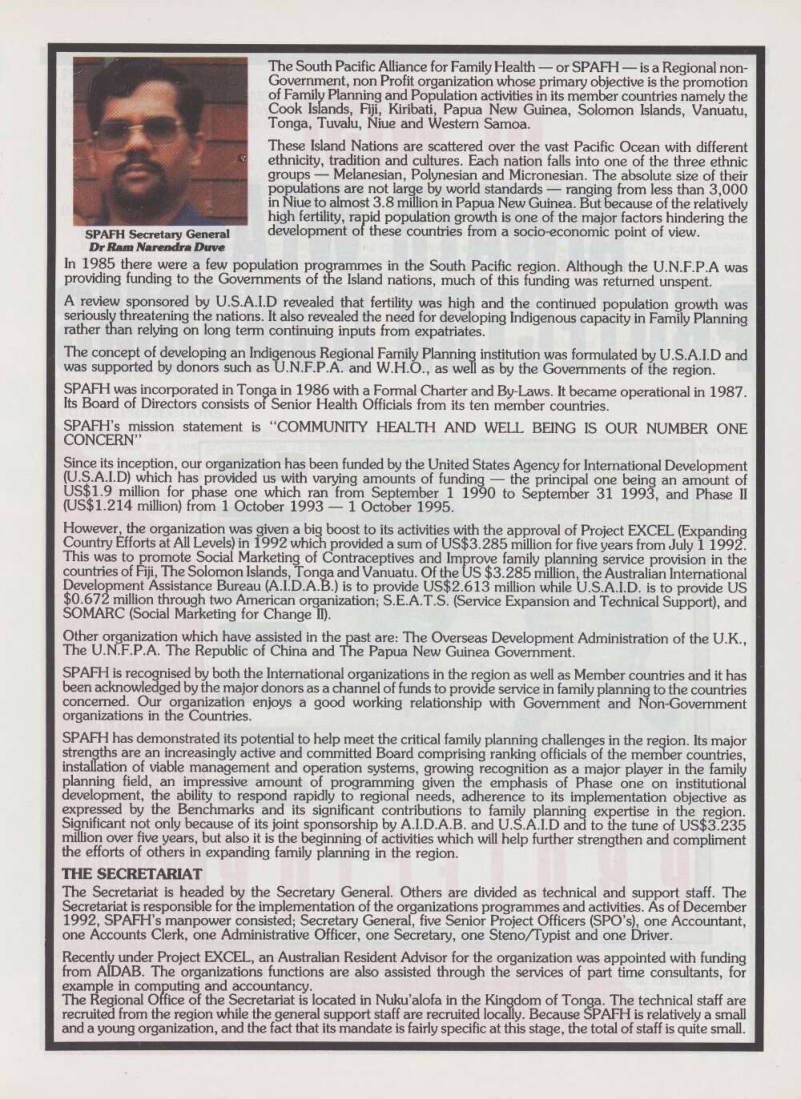

Govemment, non Profit organization whose primary objective is the promotion of Family Planning and Population activities in its member countries namely the Cook Islands, Fiji, Kiribati, Papua New Guinea, Solomon Islands, Vanuatu, Tonga, Tuvalu, Niue and Western Samoa.
These Island Nations are scattered over the vast Pacific Ocean with different ethnicity, tradition and cultures. Each nation falls into one of the three ethnic groups Melanesian, Polynesian and Micronesian. The absolute size of their populations are not large by world standards ranging from less than 3,000 in Niue to almost 3.8 million in Papua New Guinea. But because of the relatively high fertility, rapid population growth is one of the major factors hindering the development or these countries from a socio-economic point of view.
In 1985 there were a few population programmes in the South Pacific region. Although the U.N.F.P.A was providing funding to the Governments of the Island nations, much of this funding was returned unspent.
A review sponsored by U.S.A.I.D revealed that fertility was high and the continued population growth was seriously threatening the nations. It also revealed the need for developing Indigenous capacity in Family Planning rather than relying on long term continuing inputs from expatriates.
The concept of developing an Indigenous Regional Family Planning institution was formulated by U.S.A.I.D and was supported by donors such as U.N.F.P.A. and W.H.0., as well as by the Governments of the region.
SPAFH was incorporated in Tonga in 1986 with a Formal Charter and By-Laws. It became operational in 1987.
Its Board of Directors consists of Senior Health Officials from its ten member countries.
SPAFH’s mission statement is “COMMUNITY HEALTH AND WELL BEING IS OUR NUMBER ONE
Concern”
Since its inception, our organization has been funded by the United States Agency for International Development (U.S.A.I.D) which has provided us with varying amounts of funding the principal one being an amount of US$l.9 million for phase one which ran from September 1 1990 to September 31 1993, and Phase II (U 551,214 million) from 1 October 1993 1 October 1995.
However, the organization was given a big boost to its activities with the approval of Project EXCEL (Expanding Country Efforts at All Levels) in 1992 which provided a sum of U 553,285 million for five years from July 1 1992.
This was to promote Social Marketing of Contraceptives and Improve family planning service provision in the countries of Fiji, The Solomon Islands, Tonga and Vanuatu. Of the US $3,285 million, the Australian International Development Assistance Bureau (A.1.D.A.8.) is to provide U 552,613 million while U.S.A.I.D. is to provide US $0,672 million through two American organization; S.E.A.T.S. (Service Expansion and Technical Support), and SOMARC (Social Marketing for Change II).
Other organization which have assisted in the past are: The Overseas Development Administration of the U.K., The U.N.F.P.A. The Republic of China and The Papua New Guinea Government.
SPAFH is recognised by both the International organizations in the region as well as Member countries and it has been acknowledged by the major donors as a channel of funds to provide service in family planning to the countries concerned. Our organization enjoys a good working relationship with Government and Non-Government organizations in the Countries.
SPAFH has demonstrated its potential to help meet the critical family planning challenges in the region. Its major strengths are an increasingly active and committed Board comprising ranking officials of the member countries, installation of viable management and operation systems, growing recognition as a major player in the family planning field, an impressive amount of programming given the emphasis of Phase one on institutional development, the ability to respond rapidly to regional needs, adherence to its implementation objective as expressed by the Benchmarks and its significant contributions to family planning expertise in the region.
Significant not only because of its joint sponsorship by A.1.D.A.8. and U.S.A.I.D and to the tune of U 553,235 million over five years, but also it is the beginning of activities which will help further strengthen and compliment the efforts of others in expanding family planning in the region.
The Secretariat
The Secretariat is headed by the Secretary General. Others are divided as technical and support staff. The Secretariat is responsible for the implementation of the organizations programmes and activities. As of December 1992, SPAFH’s manpower consisted; Secretary General, five Senior Project Officers (SPO’s), one Accountant, one Accounts Clerk, one Administrative Officer, one Secretary, one Steno/Typist and one Driver.
Recently under Project EXCEL, an Australian Resident Advisor for the organization was appointed with funding from AIDAB. The organizations functions are also assisted through the services of part time consultants, for example in computing and accountancy.
The Regional Office of the Secretariat is located in Nuku’alofa in the Kingdom of Tonga. The technical staff are recruited from the region while the general support staff are recruited locally. Because SPAFH is relatively a small and a young organization, and the fact that its mandate is fairly specific at this stage, the total of staff is quite small.
SPAFH Secretary General Dr Ram Narendra Duve
Project Activities:
During the first phase of the USAID Cooperative Agreement, the focus in the organization has primarily been one of Institution building. In addition, SPAFH over the years, has been involved in the implementation of both in country and regional activities. These activities are summarized below: A. National Population Policies With SPAFH’s assistance, the following countries have now adopted official population policies; Solomon Islands (1.9.88) and Papua New Guinea (1991). Vanuatu and Western Samoa are currently formulating their policies. In Kiribati activities of a National Population Policy Committee is being reactivated through SPAFH’s assistance.
B. Family Planning Service Delivery Contraceptive Supply Management and lEC Activities. A number of in country and regional projects have been implemented in the area of service delivery and the contraceptive supply management activities. The total number of in country grants made so far is 32 and distributed as follows: Cook Islands (2), Fiji (4), Kiribati (2), PNG (4), Solomon Islands (6), Tonga (3), Tuvalu (1), Vanuatu (5), and Western Samoa (4). Of the 32 grants, 26 were to Governments and 6 to Non Government Organizations. The distribution of grants by activities were: Traininq/ Workshops (63.1%) lEC (15.12%), Population Policy (20.12%) KAP Survey (1.7%).
C. Regional Activities A total of 14 regional activities, mainly regional workshops have been either conducted or supported by SPAFH during the period 1988 92 giving an average of 2.4 per year.
D. Non USAID Projects Non USAID Projects implemented came from UNFPA, ODA (UK), AIDAB (Aust) and the Norman Kirk Fund (NZ).
Future Projections:
With the achievements in the organization to-date, SPAFH’s future appears promising. However to further strengthen its capabilities as a non governmental regional organization in family health and population sector, the following strategies are listed:— A. 1993: 1993 was the last year of phase one (1/9/90 31/9/93) of the USAID Co-operative Agreement Project. As per per Agreement, the main emphasis should continue to be one of further strengthening SPAFH’s management capabilities as a regional Institution. 1993 has also seen this primary focus shifting more towards greater efforts in the implementation of more family planning activities in the member countries. Project implementation, subject to availability of funding, will continue to be the main emphasis of the second phase of the USAID Cooperative Agreement Project.
The approval of Project EXCEL (1992 1997) by AIDAB and USAID, will not only provide more funds and resources to SPAFH, but will also provide the necessary impetus in the further development of project strategies outlined in the joint agreement with this two important funding bodies.
B. 1994 and Beyond 1. Phase II of USAID Cooperative Agreement Project would become operational.
Project EXCEL activities will become the major focus of activities of the organization. Most of the regional training activities planned under the USAID Cooperative Agreement Phase 1 will be completed by 1993, hence there would be greater emphasis on in country projects in family planning service delivery, contraceptive social marketinq and lEC activities between 1994 1997. a 3. It is also essential that SPAFH continues to build on its present footing and continues to strengthen relationship with other international and regional organizations and donors. This is necessary in that it would not only become more effective in delivering the goods it is mandated to deliver, but it will enjoy the international and regional recognition it duly deserves. 4. There were mixed responses to the formation of SPAFH. Some saw it as a competitor while others welcomed it on the grounds that it would lead to the building up of indigenous capabilities in population and family planning sectors in the South Pacific region. However, with the adoption of an open-policy attitude and its willingness and interest to welcome close collaboration with other regional and international agencies in the disciplines of family health and population issues, SPAFH is presently recognised as an important regional organization in population and family planning activities in the South Pacific.
Collaboration The organisation collaborates with other regional/intemational organizations in the promotion of family planning/ population activities in the South Pacific. These agencies include: UNFPA, SPC and IPPF.
Social Marketing of Contraceptive One of the major components of Project EXCEL is the Social Marketing of contraceptive programme designed to make Condom and pills more readily available, accessible and affordable in Fiji, Tonga, Vanuatu and Solomon Islands.
The target for sale of PROTECTOR condoms in the first year is 525,000 in the four countries while its target in Fiji is 367,000/year which is about 30,625 condoms/months. The Protector condom was launched in Fiji in July 1993 and so far the sales have averaged about 34,000/month (above target), and very encouraging. Protector condoms are expected to be launched in SI, Vanuatu and Tonga early in 1994.
Advertisements & other items, pp. 32-36 (1 item)
Protector
BE WISE.
ALWAYS WEAR
PROTECTOR CONDOMS
ELECTRONICALLY TESTED CONDOMS
mm.K «V r •*...! 11l s si' ini
PROTECTOR
ANOTHER QUALITY PRODUCT FROM C J PATEL, SUVA
ARE
STRONG,
DEPENDABLE
AND
REASONABLY
PRICED.
A South Pacific Alliance for Family Health (SPAFH), sponsored project.
Funded by AIDAB and USAID.
Creating a highly efficient, dynamic-looking car won • be simple if it weren’t for one complicating detail; tl passengers that must ride in it. Accommodating people comfortably in a pleasant, roon interior usually means a certain amount of aerodynamic potential has to be sacrifice mam m * . i . : ■ ■■ Exact features and specifications may vary depending on country of purchase. Please check with your nearest TOYOTA distributor/dealer for details. i
DISTRBUTORS/DEALERS
AMERICAN SAMOA BURNS PHILP (S.S.) CO. LTD. PH 633-4281 GUAM & MICRONESIA... .ATKINS KROLL. INC. PH 646-1876/9 NORFOLK ISLANDS BORRY’S PTY LTD. PH 2114
SOLOMON ISLANDS MENDANA MOTORS PH 30314
VANUATU VANUATU MOTORS PH 22341
COOK ISLANDS PACIFIC MOTORS LTD.
KIRIBATI TARAWA MOTORS
PAPUA NEW GUINEA .. .ELA MOTORS
TAHITI NIPPON AUTOMOTO
WESTERN SAMOA BURNS PHILP (S.S.) CO. LTD.
PH 20796 PH 21090 PH 217036 PH 429819 PH 20800
FIJI ASCO MOTORS
NEW CALEDONIA .. .S.I.A.P.
SAIPAN MICROL CORPORATION
TONGA BURNS PHILP (TONGA) LTE
Until now. Using a concept called total airflow management, Toyota engineers were able to realize an efficient, wedge-shaped design while at the same time perfecting the alignment between body panels and components.
Of course our own innovative style of civilized engineering makes sure that none of this comes at the expense of the luxurious, leg-stretching size interior. Because we realize that even a 0.33 Cd is useless if no one wants to drive the car.
® TOYOTA
♦ economical installation
and operation
♦ quick rollout capability
♦ design flexibility
Because of these design features, Cellswitch is ideally suited for providing cellular service in a variety of key areas.
Through its modularity and scalable architecture, Cellswitch is equally effective in the city or in lower population density areas. Designed for expansion, Cellswitch provides a costcompetitive solution with as few as 50 subscribers, with enough expansion capacity to support many thousands more.
Cellswitch has achieved an installation base in a wide variety of settings around the world, ranging from conventional urban cellular systems to temporary public service support situations.
Cellswitch is based on proven technology and supports either the AMPS or ETACS cellular standards.
These standards are used by the majority of cellular systems (including Australia, New Zealand and the U.S.) and are renowned for their reliability and robustness.
In contrast with emerging standards such as GSM, the AMPS and ETACS terminal equipment is relatively inexpensive, easy to obtain in quantity, and proven to be safe.
Stan Hite’s Cellswitch
delivers cellular capacity
with a number of unique
advantages:
• mow *■ - V For further information call: Robert Tomlinson Sales Manager Stanilite Electronics (NZ) Ltd Ph: (649)4156370 Fax: (649)4156371
AAA
AA
STJXN
Better customer services


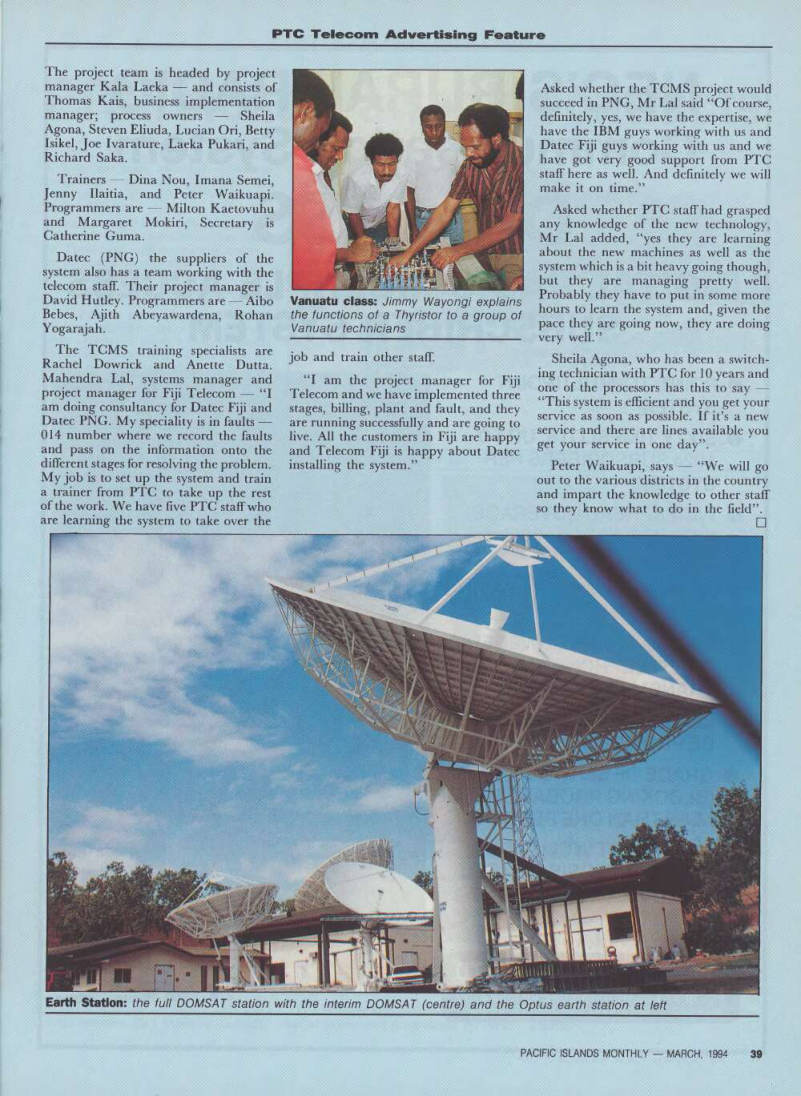
PTC Telecom Advertising Feature
TELEKOM Papua New Guinea is ex pected to introduce a new Telecom Customer Management System in April to improve services to its 45,000 customers using its Telekom Network.
JOHN SAMAR explains how the new system will operate — What is TCMS? TCMS means Telekom Customer Management System and is a computer system specifically written for telecom companies, TCMS contains the service order, call processing, rating, billing, accounts receivable, service area master, number management, cable re cords, and exchange functions. It has been designed to help Telekom provide a better level of customer service and enable you to better manage your part of the telecom business.
TCMS is an on-line service order based system which enables you to electronically and automatically send service orders to the next service stage.
This speeds the flow of service orders thereby providing an improved customer service. It also has its own Accounts Receivables module so that all service charges are automatically transferred from the service order and these, com-
bined with call char g es an <J receipts make up the customer’s statement.
There are a number of Telekom staff working full time on the implementation of TCMS. So far they have been given training on TCMS and they are currently working through the Telekom Business procedures to determine how these need to be changed to make best
use of the system.
Although the system is installed in New Zealand, Fiji and several telecom companies in the United States. There are some differences between these sysf ems an d the way it will be used here. It 18 nec cssary, therefore, to make some changes to the software programmes and j cban S es are . a^so being defined in detail by the project team.
Kerewa project: the setup on Mount Kerewa, PNG
John Samar
Gerehu satellite station: technicians discussing a technical problem with station manager Ticker Hayka
The project team is headed by project manager Kala Laeka and consists of Thomas Kais, business implementation manager; process owners Sheila Agona, Steven Eliuda, Lucian Ori, Betty Isikel, Joe Ivarature, Laeka Pukari, and Richard Saka.
Trainers Dina Nou, Imana Semei, Jenny Ilaitia, and Peter Waikuapi.
Programmers are Milton Kaetovuhu and Margaret Mokiri, Secretary is Catherine Guma.
Datec (PNG) the suppliers of the system also has a team working with the telecom staff. Their project manager is David Hutley. Programmers are Aibo
Bebes, Ajith Abeyawardena, Rohan
Yogarajah.
The TCMS training specialists are Rachel Dowrick and Anette Dutta.
Mahendra Lai, systems manager and project manager for Fiji Telecom “I am doing consultancy for Datec Fiji and Datec PNG. My speciality is in faults 014 number where we record the faults and pass on the information onto the different stages for resolving the problem.
My job is to set up the system and train a trainer from PTC to take up the rest of the work. We have five PTC staff who are learning the system to take over the
job and train other staff.
“I am the project manager for Fiji Telecom and we have implemented three stages, billing, plant and fault, and they are running successfully and are going to live. All the customers in Fiji are happy and Telecom Fiji is happy about Datec installing the system.”
Asked whether the TCMS project would succeed in PNG, Mr Lai said “Of course, definitely, yes, we have the expertise, we have the IBM guys working with us and Datec Fiji guys working with us and we have got very good support from PTC staff here as well. And definitely we will make it on time.”
Asked whether PTC staff had grasped any knowledge of the new technology, Mr Lai added, “yes they are learning about the new machines as well as the system which is a bit heavy going though, but they are managing pretty well.
Probably they have to put in some more hours to learn the system and, given the pace they are going now, they are doing very well.”
Sheila Agona, who has been a switch ing technician with PTC for 10 years and one of the processors has this to say “This system is efficient and you get your service as soon as possible. If it’s a new service and there are lines available you get your service in one day”.
Peter Waikuapi, says “We will go out to the various districts in the country and impart the knowledge to other staff so they know what to do in the field”.
Vanuatu class: Jimmy Wayongi explains the functions of a Thyristor to a group of Vanuatu technicians
Earth Station: the full DOMSAT station with the interim DOMSAT (centre) and the Optus earth station at left
Advertisements & other items, pp. 38-40 (1 item)
fjVjtto'Wtn-ir*™'
nruiniis
m
.1 1E rtlflnus digital ppEmne 6/ . V; m •s •* .-;-r i \ ■ v „. ■■ yr %m \ ■ ,1 s
. Jtsefi
1 „ o s. ,f V . . J»’'. • ;|| . \ .■ ip
Your communication!
m as -.K I ... r „ mm ■ ' /' iV !*• ' * . * • ! »*4 ' t 4 s .. .. . 7 . >. * P m w ■4O % i* <p" / f -■.. /* / v %w fe *■* .#■
pyaS
j. -* i... ■ m f 4 ff ■wr
NICATION CORPO
t v ' 3 ■i *s v. m k
NEC’S RURAL RADIO
Communication System
DRMASS
DIGITAL RADIO MULTIPLE ACCESS
SUBSCRIBER SYSTEM
POINT-TO-MULTIPOINT
SYSTEM
SIXTY TIMESLOTS, UP TO
1024 SUBSCRIBERS PER
SYSTEM
WIDESPREAD COVERAGE
(SERVICE AREA —600 km
RADIUS)
FEATURES BATTERY SAVING
OPERATION
CAN BE SOLAR POWERED
FOR TELEPHONE AND DATA
TRANSMISSION
LEASED PRIORITY LINES CAN
BE PROVIDED
GRADE OF SERVICE
(BLOCKING PROBABILITY) OF
LESS THAN ONE PERCENT
EQUIPMENT INCLUDES
SELF-DIAGNOSIS REMOTE
CONTROL & MONITORING
FACILITIES
mm :V ' BmmM mm Hi 1 ■ ll mgr ■ -• m n m m ;
NEC AUSTRALIA PTY LTD
P.O. Box 1111, Glen Waverley, Victoria 3150 Phone: 61-3-2621076 Fax: 613-2621332 Australia
NEC
PTC Telekom awards contracts
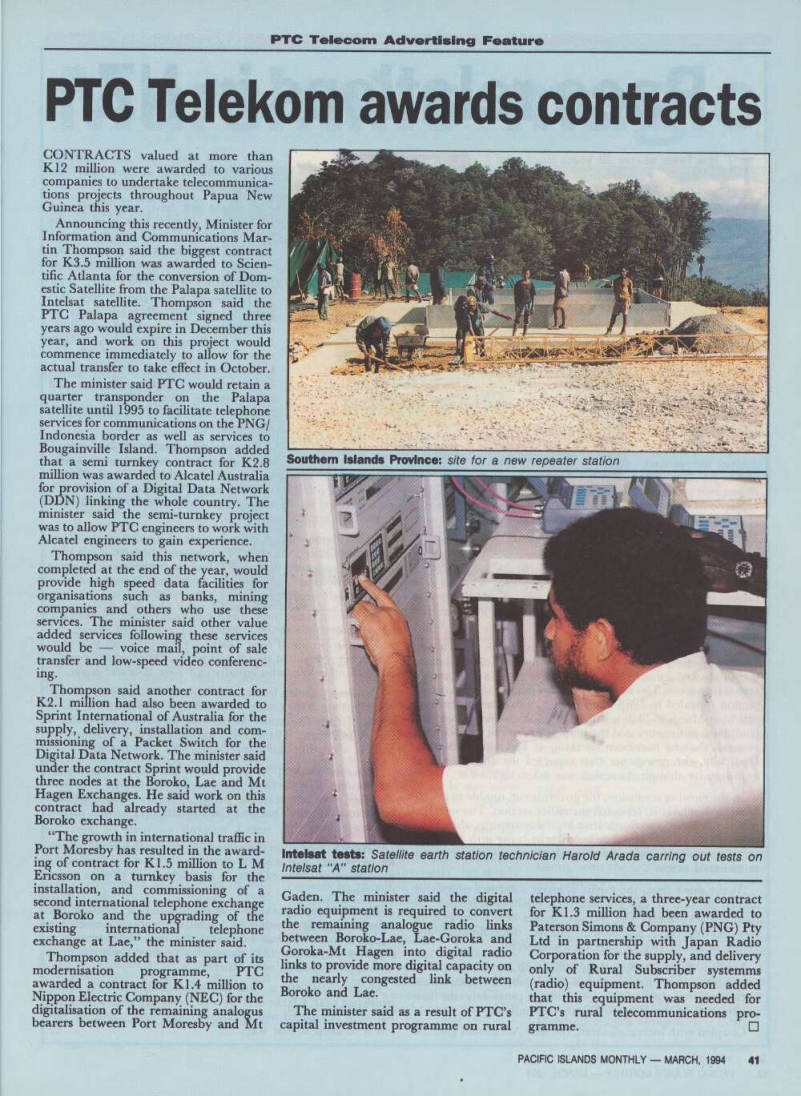
CONTRACTS valued at more than Kl 2 million were awarded to various companies to undertake telecommunica tions projects throughout Papua New Guinea this year.
Announcing this recently, Minister for Information and Communications Mar tin Thompson said the biggest contract for K 3.5 million was awarded to Scien tific Atlanta for the conversion of Dom estic Satellite from the Palapa satellite to Intelsat satellite. Thompson said the PTC Palapa agreement signed three years ago would expire in December this year, and work on this project would commence immediately to allow for the actual transfer to take effect in October.
The minister said PTC would retain a quarter transponder on the Palapa satellite until 1995 to facilitate telephone services for communications on the PNG/ Indonesia border as well as services to
Bougainville Island. Thompson added
that a semi turnkey contract for K 2.8 million was awarded to Alcatel Australia for provision of a Digital Data Network (DDN) linking the whole country. The minister said the semi-turnkey project was to allow PTC engineers to work with Alcatel engineers to gain experience.
Thompson said this network, when completed at the end of the year, would provide high speed data facilities for organisations such as banks, mining companies and others who use these services. The minister said other value added services following these services would be voice mail, point of sale transfer and low-speed video conferenc ing.
Thompson said another contract for K 2.1 million had also been awarded to Sprint International of Australia for the supply, delivery, installation and com missioning of a Packet Switch for the Digital Data Network, The minister said under the contract Sprint would provide three nodes at the Boroko, Lae and Mt Hagen Exchanges. He said work on this contract had already started at the Boroko exchange.
“The growth in international traffic in Port Moresby has resulted in the award ing of contract for K 1.5 million to L M Ericsson on a turnkey basis for the installation, and commissioning of a second international telephone exchange at Boroko and the upgrading of the existing international telephone exchange at Lae,” the minister said.
Thompson added that as part of its modernisation programme, PTC awarded a contract for K 1.4 million to Nippon Electric Company (NEC) for the digitalisation of the remaining analogus bearers between Port Moresby and Mt
Gaden. The minister said the digital radio equipment is required to convert the remaining analogue radio links between Boroko-Lae, Lae-Goroka and Goroka-Mt Hagen into digital radio links to provide more digital capacity on t e nearly congested link between Boroko and Lae.
The minister said as a result of PTC’s capital investment programme on rural
telephone services, a three-year contract for K 1.3 million had been awarded to Paterson Simons & Company (PNG) Pty Ltd in partnership with Japan Radio Corporation for the supply, and delivery on ly of Rural Subscriber systemms (radio) equipment. Thompson added that this equipment was needed for PTC’s rural telecommunications pro gramme. □
Southern Islands Province: site for a new repeater station
Intelsat tests: Satellite earth station technician Harold Arada carring out tests on Intelsat "A” station
Race relations in NZ
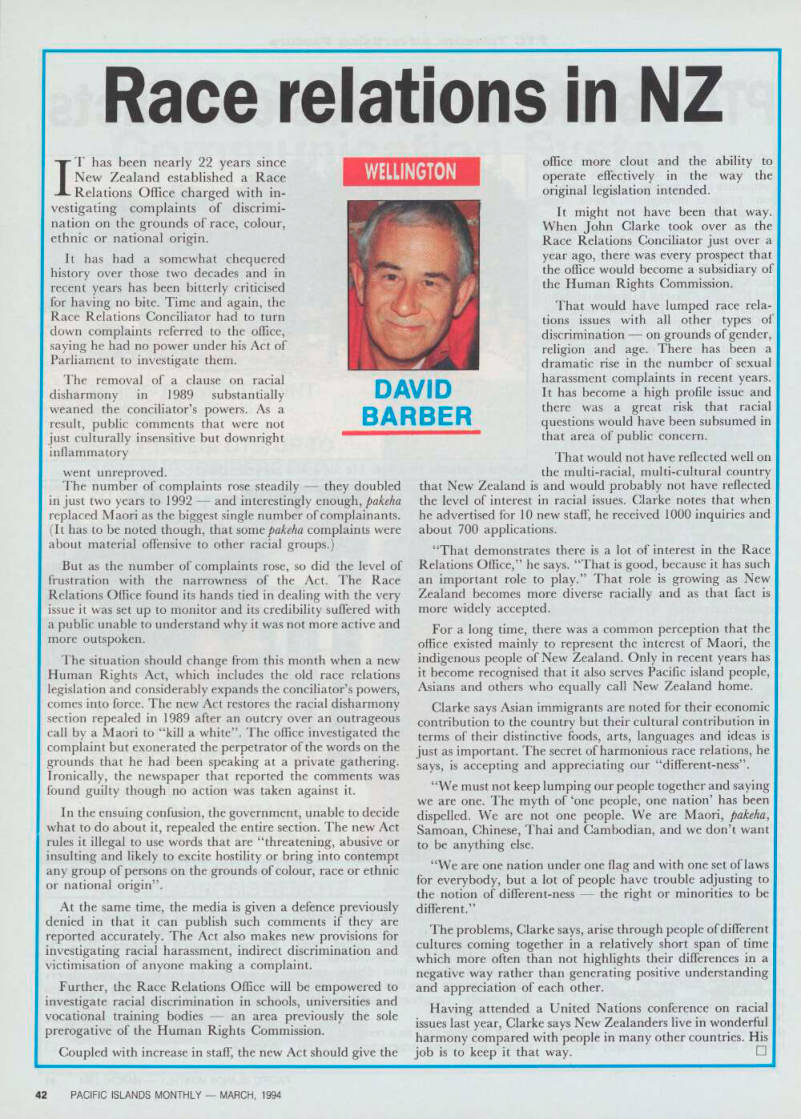
IT has been nearly 22 years since New Zealand established a Race Relations Office charged with in
vestigating complaints of discrimi
nation on the grounds of race, colour, ethnic or national origin.
It has had a somewhat chequered history over those two decades and in recent years has been bitterly criticised for having no bite. Time and again, the Race Relations Conciliator had to turn down complaints referred to the office, saying he had no power under his Act of Parliament to investigate them.
The removal of a clause on racial disharmony in 1989 substantially weaned the conciliator’s powers. As a result, public comments that were not just culturally insensitive but downright inflammatory went unreproved.
The number of complaints rose steadily they doubled in just two years to 1992 and interestingly enough, pakeha replaced Maori as the biggest single number of complainants. (It has to be noted though, that som t pakeha complaints were about material offensive to other racial groups.) But as the number of complaints rose, so did the level of frustration with the narrowness of the Act. The Race Relations Office found its hands tied in dealing with the very issue it was set up to monitor and its credibility suffered with a public unable to understand why it was not more active and
more outspoken.
The situation should change from this month when a new Human Rights Act, which includes the old race relations legislation and considerably expands the conciliator’s powers, comes into force. The new Act restores the racial disharmony section repealed in 1989 after an outcry over an outrageous call by a Maori to “kill a white”. The office investigated the complaint but exonerated the perpetrator of the words on the grounds that he had been speaking at a private gathering.
Ironically, the newspaper that reported the comments was found guilty though no action was taken against it.
In the ensuing confusion, the government, unable to decide what to do about it, repealed the entire section. The new Act rules it illegal to use words that are “threatening, abusive or insulting and likely to excite hostility or bring into contempt any group of persons on the grounds of colour, race or ethnic or national origin”.
At the same time, the media is given a defence previously denied in that it can publish such comments if they are reported accurately. The Act also makes new provisions for investigating racial harassment, indirect discrimination and victimisation of anyone making a complaint.
Further, the Race Relations Office will be empowered to investigate racial discrimination in schools, universities and vocational training bodies an area previously the sole prerogative of the Human Rights Commission.
Coupled with increase in staff, the new Act should give the
office more clout and the ability to operate effectively in the way the
original legislation intended.
It might not have been that way.
When John Clarke took over as the Race Relations Conciliator just over a year ago, there was every prospect that the office would become a subsidiary of the Human Rights Commission.
That would have lumped race rela tions issues with all other types of discrimination on grounds of gender, religion and age. There has been a dramatic rise in the number of sexual harassment complaints in recent years.
It has become a high profile issue and there was a great risk that racial questions would have been subsumed in that area of public concern.
That would not have reflected well on the multi-racial, multi-cultural country
that New Zealand is and would probably not have reflected the level of interest in racial issues. Clarke notes that when he advertised for 10 new staff, he received 1000 inquiries and about 700 applications.
“That demonstrates there is a lot of interest in the Race Relations Office,” he says. “That is good, because it has such an important role to play.” That role is growing as New Zealand becomes more diverse racially and as that fact is
more widely accepted.
For a long time, there was a common perception that the office existed mainly to represent the interest of Maori, the indigenous people of New Zealand. Only in recent years has it become recognised that it also serves Pacific island people, Asians and others who equally call New Zealand home.
Clarke says Asian immigrants are noted for their economic contribution to the country but their cultural contribution in terms of their distinctive foods, arts, languages and ideas is just as important. The secret of harmonious race relations, he says, is accepting and appreciating our “different-ness”.
“We must not keep lumping our people together and saying we are one. The myth of ‘one people, one nation’ has been dispelled. We are not one people. We are Maori, pakeha, Samoan, Chinese, Thai and Cambodian, and we don’t want to be anything else.
“We are one nation under one flag and with one set of laws for everybody, but a lot of people have trouble adjusting to the notion of different-ness the right or minorities to be different.”
The problems, Clarke says, arise through people of different cultures coming together in a relatively short span of time which more often than not highlights their differences in a negative way rather than generating positive understanding and appreciation of each other.
Having attended a United Nations conference on racial issues last year, Clarke says New Zealanders live in wonderful harmony compared with people in many other countries. His job is to keep it that way. □
Wellington
David
Barber
Marshalls magic
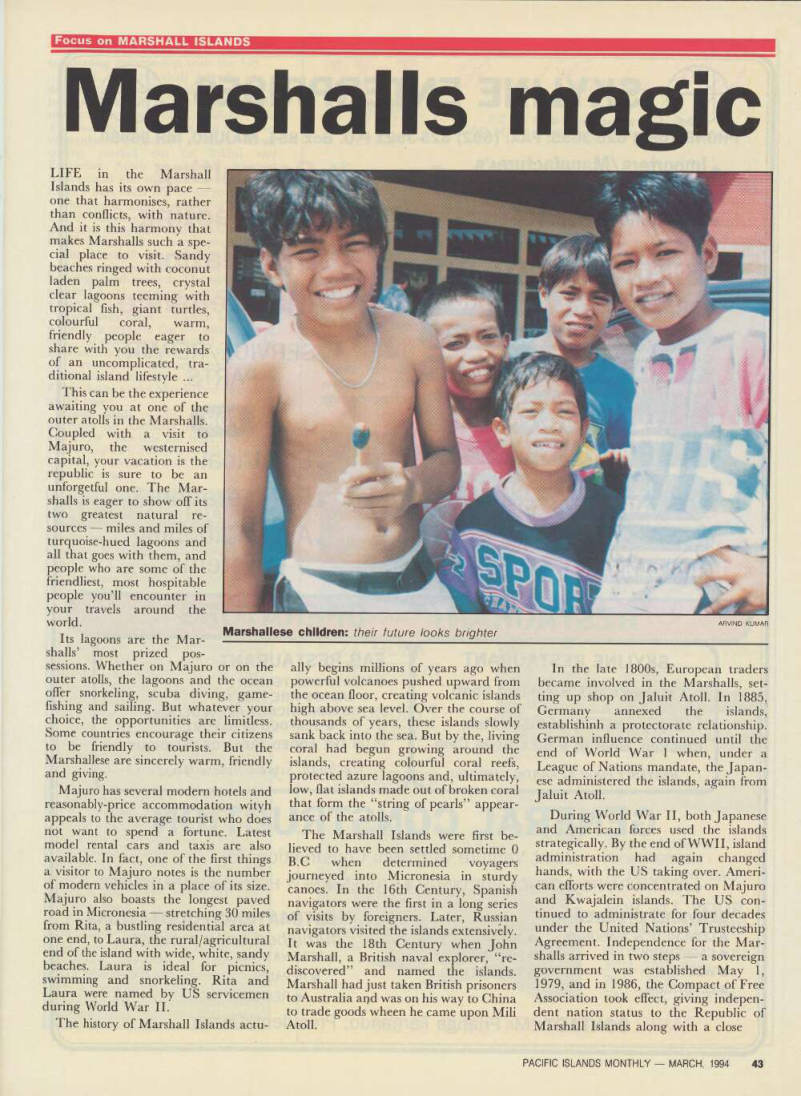


Focus On Marshall Islands
LIFE in the Marshall Islands has its own pace one that harmonises, rather than conflicts, with nature.
And it is this harmony that makes Marshalls such a spe cial place to visit. Sandy beaches ringed with coconut
laden palm trees, crystal
clear lagoons teeming with
tropical fish, giant turtles,
colourful coral, warm,
friendly people eager to
share with you the rewards of an uncomplicated, tra ditional island lifestyle ...
This can be the experience awaiting you at one of the outer atolls in the Marshalls.
Coupled with a visit to Majuro, the westernised capital, your vacation is the republic is sure to be an unforgetful one. The Mar shalls is eager to show off its two greatest natural re sources miles and miles of
turquoise-hued lagoons and
all that goes with them, and people who are some of the
friendliest, most hospitable
people you’ll encounter in
your travels around the world.
Its lagoons are the Mar shalls’ most prized pos
sessions. Whether on Majuro or on the outer atolls, the lagoons and the ocean offer snorkeling, scuba diving, gamefishing and sailing. But whatever your choice, the opportunities are limitless. ome countries encourage their citizens to be friendly to tourists. But the Marshallese are sincerely warm, friendly an giving.
Majuro has several modern hotels and
reasonably-price accommodation wityh
appeals to the average tourist who does not want to spend a fortune. Latest model rental cars and taxis are also available. In fact, one of the first things a visitor to Majuro notes is the number of modem vehicles in a place of its size.
Majuro also boasts the longest paved
road in Micronesia — stretching 30 miles from Rita, a bustling residential area at one end, to Laura, the rural/agricultural end of the island with wide, white, sandy beaches. Laura is ideal for picnics, swimming and snorkeling. Rita and Laura named by US servicemen urmg Wor d War 11.
The history of Marshall Islands actu-
ally begins millions of years ago when
powerful volcanoes pushed upward from
the ocean floor, creating volcanic islands high above sea level. Over the course of thousands of years, these islands slowly sank back into the sea. But by the, living coral had begun growing around the islands, creating colourful coral reefs,
protected azure lagoons and, ultimately,
low, hat islands made out of broken coral that form the “string of pearls” appear ance of the atolls.
The Marshall Islands were first be ii ev ed to have been settled somet^L 0 B .C when determined Voyagers journeyed into Micronesia in sturdy canoes. In the 16th Century Spanish navigators were the first in a long series Q f visits by foreigners. Later, Russian navigators visited the islands extensivelv It w S as the 18th Century when John Marshall, a British naval explorer, “rediscovered” and named the islands.
Marshall had just taken British prisoners to Australia and was on his way to China to trade goods wheen he came upon Mili Atoll.
In the late 1800 s, European traders became involved in the Marshalls, set ting up shop on Jaluit Atoll. In 1885, Germany annexed the islands, establishinh a protectorate relationship.
German influence continued until the e nd of World War 1 when, under a League of Nations mandate, the Japan, ese administered the islands, again from T a J u i t Atoll During World War 11, both Japanese and American forces used the islands strategically. By the end of WWII, island
administration had again changed
hands, with the US taking over. Ameri can efforts were concentrated on Majuro and Kwajalein islands. The US con tinued to administrate for four decades under the United Nations Trusteeship Agreement. Independence for the Mar shalls arrived in two steps a sovereign government was established May 1, 1979, and in 1986, the Compact of Free Association took effect, giving indepen dent nation status to the Republic of Marshall Islands along with a close
Arvind Kumar
Marshallese children: their future looks brighter
continuing relationship with the US.
Today, the Marshall Islands has a
unique peacetime significance due to
both its strategic location and the US missile testing base on Kwajalein Atoll.
The country also bears painful memories of mankind’s propensity to war. Nuclear testing carried out on Bikini and Enewetak Atolls unwittingly harmed both people and islands. It is a lesson in history that must not be forgotten.
The people of the Republic of Marshall Islands today are proud be be a stable, self governing democracy that is moving into a bright future with economic potential.
The Marshall Islands consists of two parallel chains of atolls, roughly 800 miles long from north to south. The eastern chain is called Ratak, meaning sunrise, and the western one is Ralik, or sunset.
Kwajalein Atoll - Largest atoll in the world, it is home to the US missile testing base. Missiles are launched into the Kwajalein lagoon from the US West Coast and tracked by military engineers on Kwajalein Island. Two islands away is Ebeye, home to the Marshallese employed at the base.
Bikini Atoll Site of atomic and hydrogen test bombings in the late 1940 s and 19505. Bikinians still hope to resettle their atoll with US assistance. Bikini lagoon has many American and Japanese target ships still intact. □
Advertisements & other items, pp. 44-46 (1 item)
(G) Skyline Enterprises (G)
PHONE: (692) 625-3695: FAX: (692) 625-3921 P.O. Box 854, MAJURO, MH 96960.
• Importers/Manufacturer’s
Representative
• Experienced Honest Service
FOR
CONSTRUCTION MATERIALS
ELECTRICAL/LIGHTING
LUMBER/PLYWOOD
PLUMBING SUPPLIES
RESTAURANT
EQUIPMENT/PARTS
POWER TOOLS
REFRIGERATORS &
AIRCONDITIONERS
TV’s & VCR’s
ICE CUBE/FLAKE MACHINES
•Consulting
•Contracting
• Installation
• Maintenance
SERVICE/REPAIR
PARTS
• Electrical
• Refrigeration &
•Airconditioning
Systems
m
RESTAURANT OPERATORS
SKYUNE RESTAURANT
“Majuro’s 1 Breakfast Spot!”
Enjoy a variety of Fresh Fish, Chicken, Beef In a 60’s Style Cafe.
HEAVENLY FOOD AT EARTHLY PRICES!
FAB RESTAURANT
• MEATS ARE TENDER
• SALADS ARE TASTY
• SANDWICHES ARE A DELIGHT
• SEAFOOD IS SAVORY
PLUS THE ADDED TREAT OF DELICIOUS
Szechuan Style Chinese food
GENERAL CONSTRUCTION
Joint Venture with Mini Construction Co • RESTAURANTS • OFFICE BUILDINGS • STORES • NEW HOMES •WAREHOUSES
SERVICES OFFERED
• CONCRETE & MASONRY • AIRCONDITIONING
• CARPENTRY • PIPE WORK
• WELDING • TILE SETTING
• ELECTRICAL
ESTIMATIONS/QUOTATIONS
furnished upon request
• RENOVATIONS
• REPAIRS
• REMODELLING
CONTACT: Mr Prianga Fernando, President/Owner
P.O. Box 735 • Majuro, Marshall Islands 96960 Tel: (692) 247-3701/3702/3703/3704/3706 • Fax: (692) 247-3705
Newest And Most Modem Hotel in
Marshall Islands
FEATURES
& AMENITIES
* 24 Rooms, each room is fully air conditioned, fully carpeted, phone, colour T.V., refrigerator, hot & cold water and private bath.
Wm I I j »?' niRM ■Vfrc *ss
HAPPY HOUR
SPM 7PM
LUNCH. DINNER
& BREAKFAST
* 24 HOUR
RECEPTION
* LAUNDRY
FACILITIES
* CAR RENTALS
- J
FREE TRANSPORT
FROM AIRPORT
TO HOTEL AND BACK.
FOR ALL YOUR
RESERVATIONS
PHONE (692) 247-3701,
3702. 3703, 7604 7605. 7606.
FAX: (692) 247-3705.
WELL MAKE YOU FEEL AT HOME
At M©U wmmmmmrnm m
Care
For 43 years, Mobil has made major commitments to the people of Guam and Micronesia.
For customers in both the private and public sector, Mobil stands firm on offering high quality products at affordable prices while providing reliable and dependable service. Always.
For the community, Mobil sponsors the Mobil Games, the Guam Symphony, and the Guam Olympic Team, and makes substantial contributions to scholarship funds and other community and cultural programs.
For the environment, Mobil is proactive in complying with and exceeding strict environmental protection 4 &
SAIPAN
ROTA
GUAM
0
YAP
Q
PALAU
policies and develops programs designed to preserve the beauty and natural resources of our islands.
Wherever you see the familiar red and blue logo, you can be sure Mobil is there working toward a better future for you. <2
CHUUK
Q° POHNPEI
KOSRAE
MAJURO
At a glance
Location: Central Pacific, between 4° and 14° N latitude and between 160° and 173° E longitude.
Number of atolls: 29. Number of islands: 1225.
Ocean area: 750,000 square miles.
Land area: 70 square miles.
Population: 45,335.
Language: Marshallese and Eng
lish. The languages spoken in the Marshalls are branches of the great Malayo-Polynesian languagge family.
Dialects vary from island to island.
Marshallese is the official language but English, encouraged by the US ad ministration, is widely spoken.
Currency: official currency is,the US dollar. Credit cards are also
accepted.
Climate: average temperature: 81°F. Average rainfall: 12-15” per month. The predominant influence is that of the north-east trade winds and temperature variations are slight, al though the northern islands are slightly cooler than the northen ones.
Rainfall also varies somewhat from north to south.
Religion: the Marshallese are over
whelmingly Christian, having been
missioned by both Germans and Americans. Majority are Protestant but Catholicism is also represented, as are a number of lesser Christian denominations — Mormons, Seventh day Adventists, Assembly of God, etc.
The President says ...
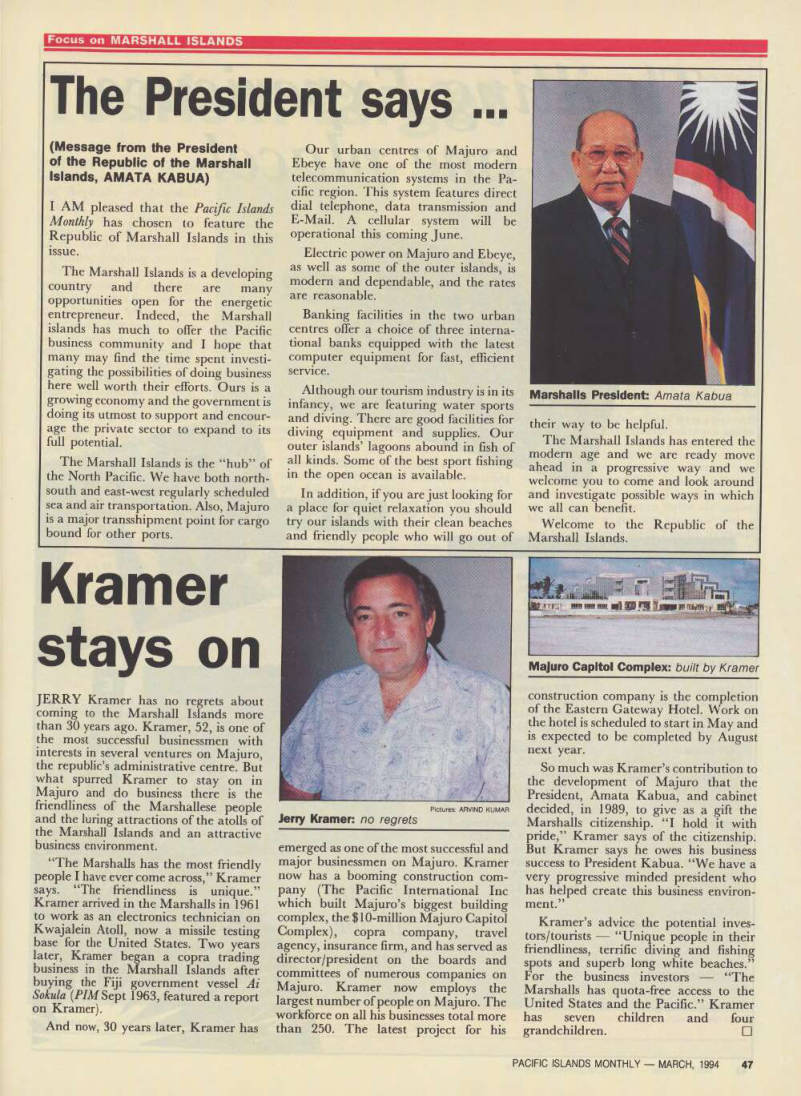
(Message from the President of the Republic of the Marshall Islands, AMATA KABUA) I AM pleased that the Pacific Islands Monthly has chosen to feature the Republic of Marshall Islands in this issue.
The Marshall Islands is a developing country and there are many opportunities open for the energetic entrepreneur. Indeed, the Marshall islands has much to offer the Pacific business community and I hope that many may find the time spent investi gating the possibilities of doing business here well worth their efforts. Ours is a growing economy and the government is doing its utmost to support and encour age the private sector to expand to its full potential.
The Marshall Islands is the “hub” of the North Pacific. We have both north south and east-west regularly scheduled sea and air transportation. Also, Majuro is a major transshipment point for cargo bound for other ports.
Our urban centres of Majuro and Ebeye have one of the most modern telecommunication systems in the Pa cific region. This system features direct dial telephone, data transmission and E-Mail. A cellular system will be operational this coming June.
Electric power on Majuro and Ebeye, as well as some of the outer islands, is modern and dependable, and the rates are reasonable.
Banking facilities in the two urban centres offer a choice of three interna tional banks equipped with the latest computer equipment for fast, efficient service.
Although our tourism industry is in its infancy, we are featuring water sports and diving. There are good facilities for diving equipment and supplies. Our outer islands’ lagoons abound in fish of all kinds. Some of the best sport fishing in the open ocean is available.
In addition, if you are just looking for a place for quiet relaxation you should try our islands with their clean beaches and friendly people who will go out of
their way to be helpful.
The Marshall Islands has entered the modern age and we are ready move ahead in a progressive way and we welcome you to come and look around and investigate possible ways in which we all can benefit.
Welcome to the Republic of the Marshall Islands.
Marshalls President: Amata Kabua
stays on
Kramer stays on
JERRY Kramer has no regrets about coming to the Marshall Islands more than 30 years ago. Kramer, 52, is one of the most successful businessmen with interests in several ventures on Majuro, the republic’s administrative centre. But what spurred Kramer to stay on in Majuro and do business there is the friendliness of the Marshallese people and the luring attractions of the atolls of the Marshall Islands and an attractive business environment.
“The Marshalls has the most friendly people I have ever come across,” Kramer says. “The friendliness is unique.”
Kramer arrived in the Marshalls in 1961 to work as an electronics technician on Kwajalein Atoll, now a missile testing base for the United States. Two years later, Kramer began a copra trading business in the Marshall Islands after buying the Fiji government vessel Ai Sokula ( PIM Sept 1963, featured a report
on Kramer).
And now, 30 years later, Kramer has
emerged as one of the most successful and major businessmen on Majuro. Kramer now has a booming construction com pany (The Pacific International Inc which built Majuro’s biggest building complex, the $ 10-million Majuro Capitol Complex), copra company, travel agency, insurance firm, and has served as director/president on the boards and committees of numerous companies on Majuro. Kramer now employs the largest number of people on Majuro. The workforce on all his businesses total more than 250. The latest project for his
construction company is the completion of the Eastern Gateway Hotel. Work on the hotel is scheduled to start in May and is expected to be completed by August next year.
So much was Kramer’s contribution to the development of Majuro that the President, Amata Kabua, and cabinet decided, in 1989, to give as a gift the Marshalls citizenship. “I hold it with pride,” Kramer says of the citizenship.
But Kramer says he owes his business success to President Kabua. “We have a very progressive minded president who has helped create this business environ ment.”
Kramer’s advice the potential inves tors/tourists “Unique people in their friendliness, terrific diving and fishing spots and superb long white beaches.”
For the business investors “The Marshalls has quota-free access to the United States and the Pacific.” Kramer has seven children and four grandchildren. □
Pictures: ARVIND KUMAR Jerry Kramer: no regrets
Majuro Capitol Complex: built by Kramer
Advertisements & other items, p. 48 (1 item)
Thrilling Experience
all in one place!
RMI Ministry of R 6c D Tourist Authority P.O. Box 1727 Majuro, MH 96960 692-625-3206 or 3203 fax 692-625-3218 Riii u.n. mission, mr 220 E. 42nd St. 31st n.
New York, NY 10017 (212)983-3040 fax (212) 983-3202 RMI Embassy 2433 Massachusetts Ave. NW Washington, D.C. 20008 (202) 234-5414 fax (202) 232-3236 RMI Embassy 1-12-2 Tayuan Diplomatic Bldg.
Beijing, PRC 100600 86-1-5325778 or 5325819 fax 86-1-5325693 - 1 C m RMI Embassy 12-1 13 Chomc, Motoazabu PF Minato, KU Tokyo 106, Japan 81-3-54110972 or 73 or 74 fax 81-3-54110978 RMI Embassy PO Box 2038 Borron Road Suva, Fiji 679-387899 or 387094 or 387821, fax 679-387115 RMI Consulate 1357 Kapiolani Blvd. #1240 Honolulu, HI 96514 (808) 942-4422 fax (808) 942-2009 RMI Consulate General 1500 Quail St. Ste. 210 Newport Beach, CA 92660 (714) 474-0331 fax (714) 474-1632 U.S. Tourist Representative Hilary Kaye & Associates 4000 Westerly PI. #2lO Newport Beach, CA 92660 (714) 851-5150 fax (714) 851-3111
It Can
ACC <Be
[Tours
In
Tourism target
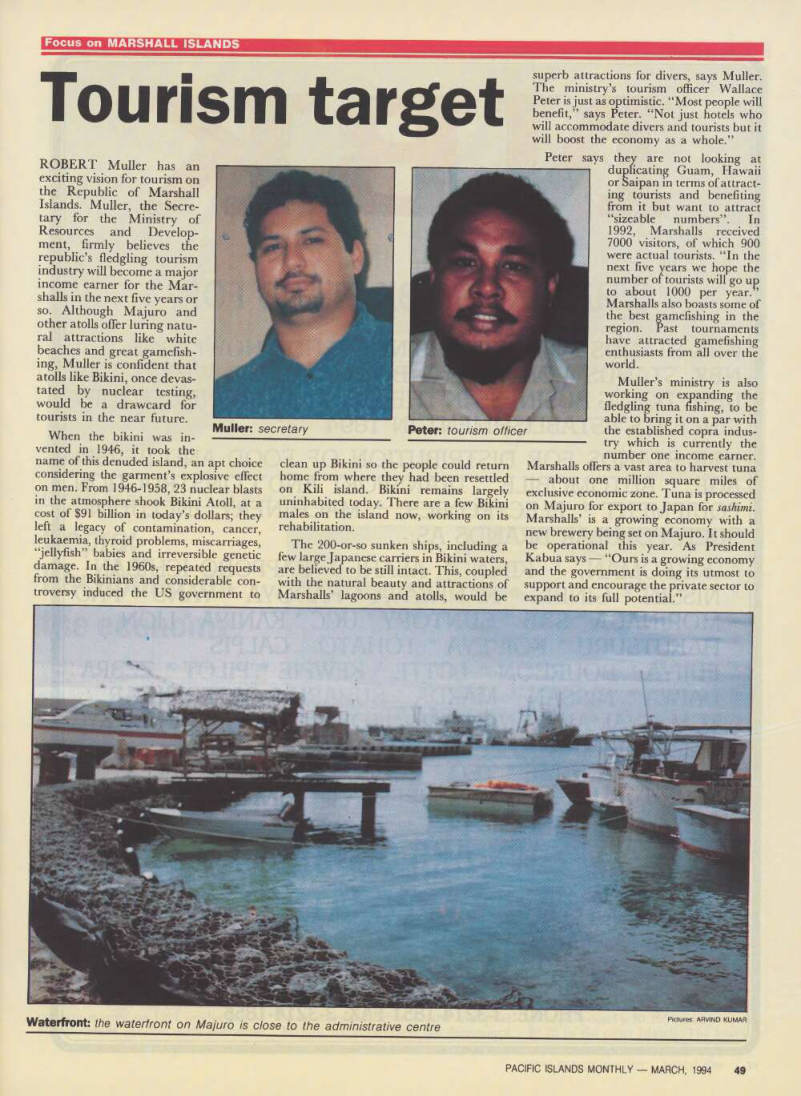

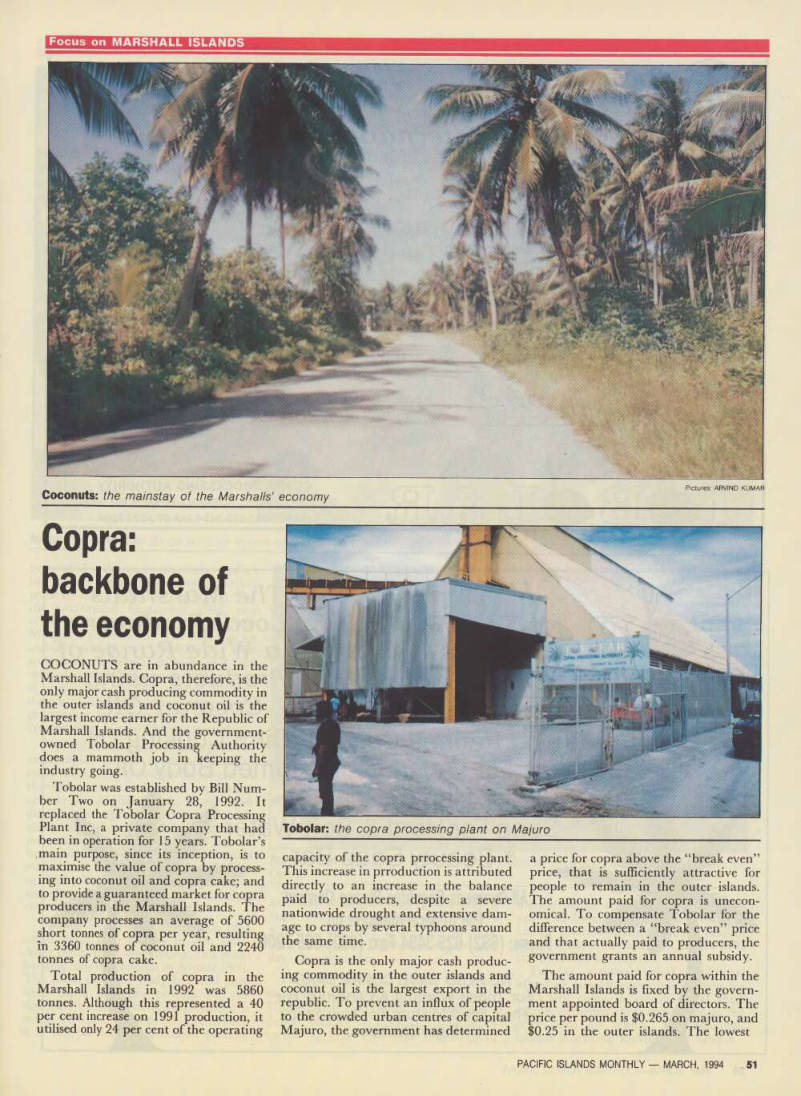
ROBERT Muller has an exciting vision for tourism on the Republic of Marshall Islands. Muller, the Secre tary for the Ministry of Resources and Develop ment, firmly believes the republic’s fledgling tourism industry will become a major income earner for the Mar shalls in the next five years or so. Although Majuro and other atolls offer luring natu ral attractions like white beaches and great gamefish ing, Muller is confident that atolls like Bikini, once devas
tated by nuclear testing,
would be a drawcard for tourists in the near future.
When the bikini was in vented in 1946, it took the
name of this denuded island, an apt choice considering the garment’s explosive effect on men. From 1946-1958, 23 nuclear blasts in the atmosphere shook Bikini Atoll, at a cost of $9l billion in today’s dollars; they left a legacy of contamination, cancer, leukaemia, thyroid problems, miscarriages, “jellyfish” babies and irreversible genetic damage. In the 19605, repeated requests from the Bikinians and considerable con troversy induced the US government to
clean up Bikini so the people could return home from where they had been resettled on Kili island. Bikini remains largely uninhabited today. There are a few Bikini males on the island now, working on its rehabilitation.
The 200-or-so sunken ships, including a few large Japanese carriers in Bikini waters, are believed to be still intact. This, coupled with the natural beauty and attractions of Marshalls’ lagoons and atolls, would be
superb attractions for divers, says Muller.
The ministry’s tourism officer Wallace Peter is just as optimistic. “Most people will benefit,” says Peter. “Not just hotels who will accommodate divers and tourists but it will boost the economy as a whole.”
Peter says they are not looking at
duplicating Guam, Hawaii or Saipan in terms of attract
ing tourists and benefiting
from it but want to attract “sizeable numbers”. In 1992, Marshalls received 7000 visitors, of which 900 were actual tourists. “In the next five years we hope the number of tourists will go up to about 1000 per year.”
Marshalls also boasts some of the best gamefishing in the region. Past tournaments have attracted gamefishing enthusiasts from all over the world.
Muller’s ministry is also
working on expanding the
fledgling tuna fishing, to be able to bring it on a par with the established copra indus try which is currently the
number one income earner.
Marshalls offers a vast area to harvest tuna about one million square miles of exclusive economic zone. Tuna is processed on Majuro for export to Japan for sashimi.
Marshalls’ is a growing economy with a new brewery being set on Majuro. It should be operational this year. As President Kabua says “Ours is a growing economy and the government is doing its utmost to support and encourage the private sector to expand to its full potential.”
Muller: secretary
Peter: tourism officer
Waterfront: the waterfront on Majuro is close to the administrative centre
Pictures: ARVIND KUMAR
Pictures: ARVIND KUMAR
Coconuts: the mainstay of the Marshalls’ economy
Advertisements & other items, pp. 49-50 (2 items)
49
I Focus on MARSHALL ISLANDS
PACIFIC ISLANDS MONTHLY MARCH, 1994
Nbk Corporation
WHAT DOES NBK STAND FOR?
NBK STANDS FOR NEW BUSINESS AND KNOWLEDGE.
NBK STANDS FOR NANYO BOEK3 KAISHA, WHICH HAS BEEN DOING BUSINESS IN THE PACIFIC FOR ONE CENTURY
SINCE ITS ESTABLISHMENT IN 1894
NBK STANDS FOR DISTRIBUTION OF FOOD AND BEVER- AGE, * AUTOMOBILE * TRANSPORT AND CONSTRUCTION
EQUIPMENT * ELECTRONICS, * MACHINERY, INCLUDING
SUCH POPULAR BRANDS AS:-
* KIKKOMAN, * KIRIN * ASAHI * SAPPORO ICHIBAN * NISSIN * GINBIS * NANIWAYA * KADOYA * YANS * KAO * MORINAGA * S&B * SUNTORY * UCC * KANIYA * LION * HAKUTSURU * KOIKEYA * TOHATO * CALPIS * FUJIYA * BOURBON * LOTTE * KEWPIE * PILOT * ZEBRA * DAIWA * NISSAN * MAZDA * SUBARU * CATERPILLAR * TCM * YAMAHA * YANMAR * TOYO * FB * MIKASA * KYC * NGK * AIRMAN * ALPINE * BROTHER * CANON * CASIO * JANOME * TEC * ECHO * TOSHIBA * SELEX * MITSUBISHI * ROBIN * SUPERFAX * RINNAI * ETC.
WE ME GLOBAL
NBK CORPORATION
TOKYO, OSAKA, SINGAPORE, SEOUL. LOS ANGELES POHNPEI (FSM)
CONTACT: NBK CORP. (TOKYO OFFICE)
PHONE: 3-3214-1851 FAX: 3-3214-1856
Copra:

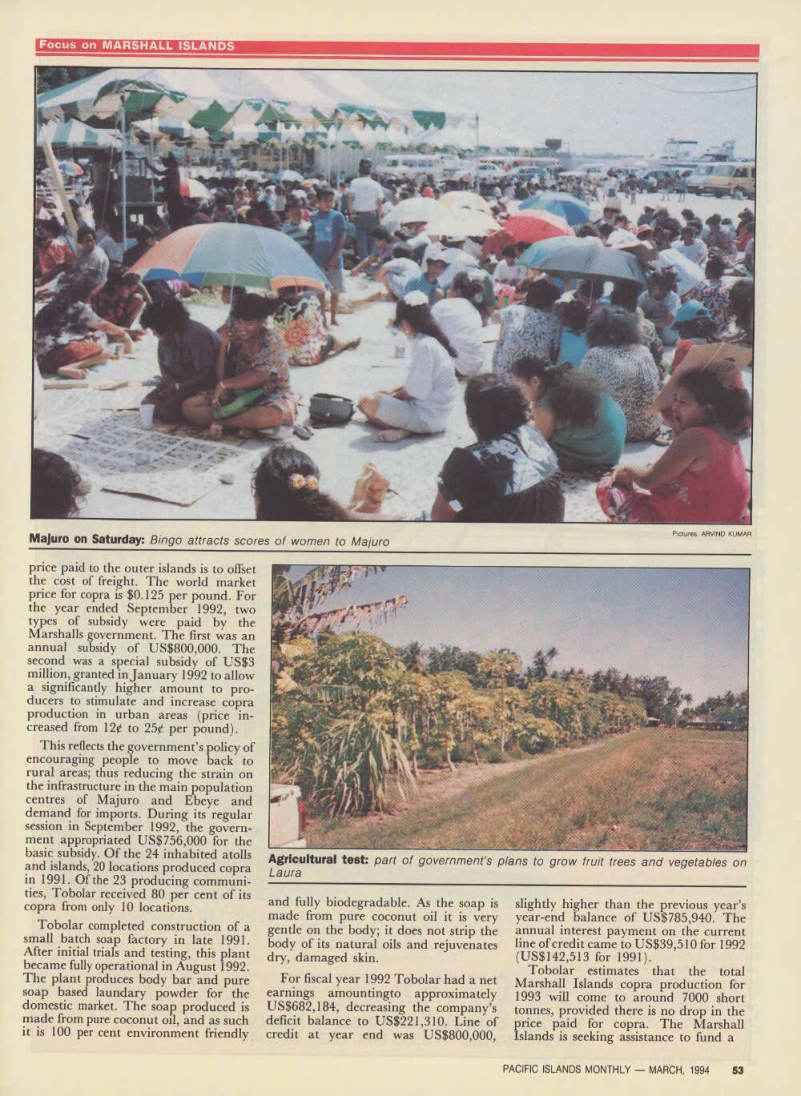

backbone of the economy
COCONUTS are in abundance in the Marshall Islands. Copra, therefore, is the only major cash producing commodity in the outer islands and coconut oil is the largest income earner for the Republic of Marshall Islands. And the government owned Tobolar Processing Authority does a mammoth job in keeping the
industry going.
Tobolar was established by Bill Num ber Two on January 28, 1992. It replaced the Tobolar Copra Processing Plant Inc, a private company that had been in operation for 15 years. Tobolar’s main purpose, since its inception, is to maximise the value of copra by process ing into coconut oil and copra cake; and to provide a guaranteed market for copra producers in the Marshall Islands. The company processes an average of 5600 short tonnes of copra per year, resulting in 3360 tonnes of coconut oil and 2240 tonnes of copra cake.
Total production of copra in the Marshall Islands in 1992 was 5860 tonnes. Although this represented a 40 per cent increase on 1991 production, it utilised only 24 per cent of the operating
capacity of the copra processing plant.
This increase in production is attributed directly to an increase in the balance P a id to producers, despite a severe •, r , >., r . • , nat ‘° nwlde drou g ht a " d extensive damage to cro P s several W 1100 " 8 a r°und ,he same tlmc ' Copra is the only major cash produci n g commodity in the outer islands and coconut oil is the largest export in the republic. To prevent an influx of people to the crowded urban centres of capital Majuro, the government has determined
a price for copra above the “break even” price, that is sufficiently attractive for people to remain in the outer islands.
The amount paid for copra is unecon -i-r . 4* , , c > omical. To compensate Tobolar for the difference between a “break even” price and that actual| y P Md to producers, the government grants an annual subsidy.
The amount paid for copra within the Marshall Islands is fixed by the govern ment appointed board of directors. The price per pound is 50.265 on majuro, and 50.25 in the outer islands. The lowest
Tobolar: the copra processing plant on Majuro
price paid to the outer islands is to offset the cost of freight. The world market price for copra is $0,125 per pound. For the year ended September 1992, two types of subsidy were paid by the Marshalls government. The first was an annual subsidy of US$BOO,OOO. The second was a special subsidy of US$3 million, granted in January 1992 to allow a significantly higher amount to pro ducers to stimulate and increase copra production in urban areas (price in creased from to 25£ per pound).
This reflects the government’s policy of encouraging people to move back to rural areas; thus reducing the strain on the infrastructure in the main population centres of Majuro and Ebeye and demand for imports. During its regular session in September 1992, the govern ment appropriated U 55756,000 for the basic subsidy. Of the 24 inhabited atolls and islands, 20 locations produced copra in 1991. Of the 23 producing communi ties, Tobolar received 80 per cent of its copra from only 10 locations.
Tobolar completed construction of a small batch soap factory in late 1991.
After initial trials and testing, this plant became fully operational in August 1992.
The plant produces body bar and pure soap based laundary powder for the domestic market. The soap produced is made from pure coconut oil, and as such it is 100 per cent environment friendly
and fully biodegradable. As the soap is made from pure coconut oil it is very gentle on the body; it does not strip the body of its natural oils and rejuvenates dry, damaged skin.
For fiscal year 1992 Tobolar had a net
earnings amountingto approximately
U 55682,184, decreasing the company’s deficit balance to U 55221,310. Line of credit at year end was US$BOO,OOO,
slightly higher than the previous year’s year-end balance of U 55785,940. The annual interest payment on the current line of credit came to U 5539,510 for 1992 (U 55142,513 for 1991).
Tobolar estimates that the total Marshall Islands copra production for 1993 will come to around 7000 short tonnes, provided there is no drop in the price paid for copra. The Marshall Islands is seeking assistance to fund a
Pictures: ARVIND KUMAR
Majuro on Saturday: Bingo attracts scores of women to Majuro
Agricultural test: part of government’s plans to grow fruit trees and vegetables on Laura
massive rehabilitation of the republic’s copra industry. Equipment assistance (such as a landing craft, bulldozers,
chipping machinery, and other heavy
machinery) is needed to clear old, senile trees, plant new coconut trees and clear uncontrolled undergrowth.
Rehabilitation of plantations is not only required to improve copra pro duction but is essential to allow inter cropping of food crops to decrease reliance on imported foods. Assistance is also required to improve harvesting and drying techniques to make the pro duction of copra easier and more efficient. Coconut oil sales make up over 90 per cent of the revenue from process ing of copra in the Marshalls.
Coconut oil prices in early 1992 were at 33 j per pound but current price is per pound, representing a drop of over 42 per cent. The Marshalls produces and exports less than 0.002 per cent of the world’s demand for coconut oil; therefore Tqbolar is subjected to market fluctu ations with limited market for its crude oil. To insulate the copra industry from world market fluctuations alternative uses and markets for oil and other products must be found, says a report on Tobolar.
The Tobolar pilot soap plant in operation was designed to target this need to find value added alternative uses for the oil. The existing pilot plant is designed to service the local market, with target production of 200 tonnes of soap
annually but utilises only about six per cent of annual oil production. Based on the performance of the existing plant, a feasibility study has been conducted into installing a soap plant that would utilise all of the oil produced, producing a product for the export market.
The study shows that such a plant would be feasible; being self supporting and providing sufficient income to guarantee a stable price to copra producers without the need for government subsidies. The next
stage of the study will be to conduct market research in the United States and japan being principal markets so far identified, for which financial assistance will be required.
The results of this research will deter mine whether to proceed and at what level of activity. In addition to soap, other oil based products are being researched in an attempt to find other markets for oil
{moduced, together with other products
fom the coconut tree (ie. canned coconut milk), often described as “The Tree of Life”. □
Pictures: ARVIND KUMAR Eastern Gateway Hotel: one of the biggest hotels on Majuro expected to be completed by August next year
Poultry: another project by the government
Advertisements & other items, pp. 52-56 (2 items)
International, Inc.
Pacific
" WAFFLE-CRETE ”® International, Inc.
PO BOX 6, MAJURO, MARSHALL ISLANDS
M.H. 96960 PHONE: 011-692-625 3122/35 60
FAX 011-692-625 3348/3476
AGENTS FOR *
P.O. BOX 1008 HAYS, KANSAS, 67601, U.S.A. rjgc'irvi \v
°World 'Travel.
PHONE/FAX (011-692-87) 3456
P.O. BOX 5849, EBEYE, KWAJALEIN, MARSHALL ISLANDS, MH, 96970.
Marshalls Insurance Agency qp
P.O. BOX 113 MAJURO
REPUBLIC OF THE MARSHALL ISLANDS 96960
PHONE: 692-625 - 3366 FAX 692-625-3189
GRAND
PACIFIC
LIFE
INSURANCE
The Travellers' Choice
Pacific Unique Travel
P.O. BOX 726 MAJURO
MARSHALL ISLANDS MH 96960 PHONE: 625:3409. FAX 625:3868 99 ft D D A D P.O. BOX 726 MAJURO, MARSHALL ISLANDS, MH 96960
PHONE: 692-625-7497 FAX 692-625-3348
COPRA PROCESSING AUTHORITY
PO BOX G-MAJURO, MARSHALL ISLANDS MH 96960
PHONE: 692-625-3494 FAX 692-625-7206
■J D D
COPRA PROCESSING AUTHORITY
P. 0. BOX G - MAJURO, MARSHALL ISLANDS. MH96960 The Marshalls Local Producer of a Wide Range of Products using Coconut Oil * Bulk Crude and Refined Coconut Oil * Cooking Oil * Soap Flakes For Laundry * Perfumed Body Oil
* Liquid Soap
* Soap For Hard & Soft Water
* Beauty Soap Bar
All Overseas Enquiries Please Contact The General Manager on Phone; (692) 625-3494 Fax; (692) 625-7206
WE ALSO HAVE COPRA CAKE
For Those Wanting An Additive For Their Feed Mixture For Live Stock (Pigs/Chickens)
“WAFFLE
rPFTF.
»f
STRUCTURAL PRECAST CONCRETE BUILDING
SYSTEM BUILD BETTER, BUILD FASTER,
BUILD FOR LESS
■P m* Hi -i.
Jt taa«o2ssßt 'H, ■ '.if "• ■
CONSTRUCTION ON A
24 UNIT APARTMENT
RAPID CONSTRUCTION
DURABLE
AND
ECONOMICAL
1.
CONSTRUCTION STRUCTURE WAS
COMPLETED IN 6 DAYS
PACIFIC INTERNATIONAL INC
P.O. BOX 6 MAJURO, MARSHALL ISLANDS 96 960
PHONE 692/625 3560 FAX; 692-625-3348
As a family we know ... and we bring only top
quality merchandise. “Yes, quality merchandise
at the right price.”
•> / w v: Clothing, footwears * Office supplies, Office machines Fragrances, watches/docks * Audio/Video supplies & equipments
Photographic
supplies & equipments
JOHNSON outboard
engines & parts Many other items
MinrriffN SHOP
a Grant L. Labaun (Gen. Manager/Owner) and family p .0. Box 957, Majuro, Marshall Islands MH 96960-0957 Phone: Oil (692) 625-3133 Oil (692) 625-3965 Fax: Oil (692) 625-3164 Res: Oil (692) 625-3170
DBA:
Midtown Gary's Marine Supplies Bam Bam Bus Service Hair Priority Barber & Beauty Salon Makkije Housings/Apartments
Focms On Marshall Islands
Banking with
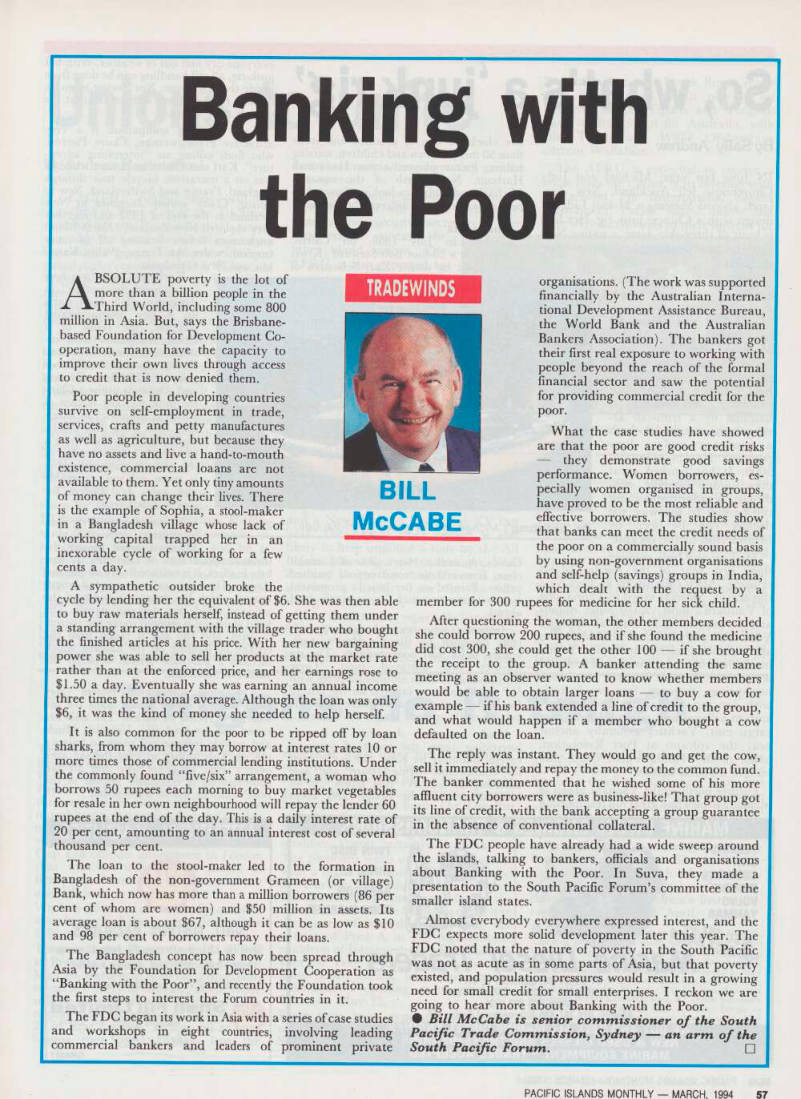
the Poor
ABSOLUTE poverty is the lot of more than a billion people in the Third World, including some 800 million in Asia. But, says the Brisbane based Foundation for Development Co operation, many have the capacity to improve their own lives through access to credit that is now denied them.
Poor people in developing countries survive on self-employment in trade, services, crafts and petty manufactures as well as agriculture, but because they have no assets and live a hand-to-mouth existence, commercial loaans are not available to them. Yet only tiny amounts of money can change their lives. There is the example of Sophia, a stool-maker in a Bangladesh village whose lack of working capital trapped her in an inexorable cycle of working for a few cents a day.
A sympathetic outsider broke the
cycle by lending her the equivalent of $6. She was then able to buy raw materials herself, instead of getting them under a standing arrangement with the village trader who bought the finished articles at his price. With her new bargaining power she was able to sell her products at the market rate rather than at the enforced price, and her earnings rose to $1.50 a day. Eventually she was earning an annual income three times the national average. Although the loan was only $6, it was the kind of money she needed to help herself.
It is also common for the poor to be ripped off by loan sharks, from whom they may borrow at interest rates 10 or more times those of commercial lending institutions. Under the commonly found “five/six” arrangement, a woman who borrows 50 rupees each morning to buy market vegetables for resale in her own neighbourhood will repay the lender 60 rupees at the end of the day. This is a daily interest rate of 20 per cent, amounting to an annual interest cost of several thousand per cent.
The loan to the stool-maker led to the formation in Bangladesh of the non-government Grameen (or village) Bank, which now has more than a million borrowers (86 per cent of whom are women) and $5O million in assets. Its average loan is about $67, although it can be as low as $lO and 98 per cent of borrowers repay their loans.
The Bangladesh concept has now been spread through Asia by the Foundation for Development Cooperation as “Banking with the Poor”, and recently the Foundation took the first steps to interest the Forum countries in it.
The FDC began its work in Asia with a series of case studies and workshops in eight countries, involving leading commercial bankers and leaders of prominent private
organisations. (The work was supported financially by the Australian Interna tional Development Assistance Bureau, the World Bank and the Australian Bankers Association). The bankers got their first real exposure to working with people beyond the reach of the formal financial sector and saw the potential for providing commercial credit for the poor.
What the case studies have showed are that the poor are good credit risks they demonstrate good savings performance. Women borrowers, es pecially women organised in groups, have proved to be the most reliable and effective borrowers. The studies show that banks can meet the credit needs of the poor on a commercially sound basis by using non-government organisations and self-help (savings) groups in India, which dealt with the request by a
member for 300 rupees for medicine for her sick child.
After questioning the woman, the other members decided she could borrow 200 rupees, and if she found the medicine did cost 300, she could get the other 100 if she brought the receipt to the group. A banker attending the same meeting as an observer wanted to know whether members would be able to obtain larger loans to buy a cow for example if his bank extended a line of credit to the group, and what would happen if a member who bought a cow defaulted on the loan.
The reply was instant. They would go and get the cow, sell it immediately and repay the money to the common fund.
The banker commented that he wished some of his more affluent city borrowers were as business-like! That group got its line of credit, with the bank accepting a group guarantee in the absence of conventional collateral.
The FDC people have already had a wide sweep around the islands, talking to bankers, officials and organisations about Banking with the Poor. In Suva, they made a presentation to the South Pacific Forum’s committee of the smaller island states.
Almost everybody everywhere expressed interest, and the FDC expects more solid development later this year. The FDC noted that the nature of poverty in the South Pacific was not as acute as in some parts of Asia, but that poverty existed, and population pressures would result in a growing need for small credit for small enterprises. I reckon we are going to hear more about Banking with the Poor. • Bill McCabe is senior commissioner of the South Pacific Trade Commission, Sydney an arm of the South Pacific Forum. □
Tradewinds
Bill
Mccabe
So, what’s a ‘junk rig’
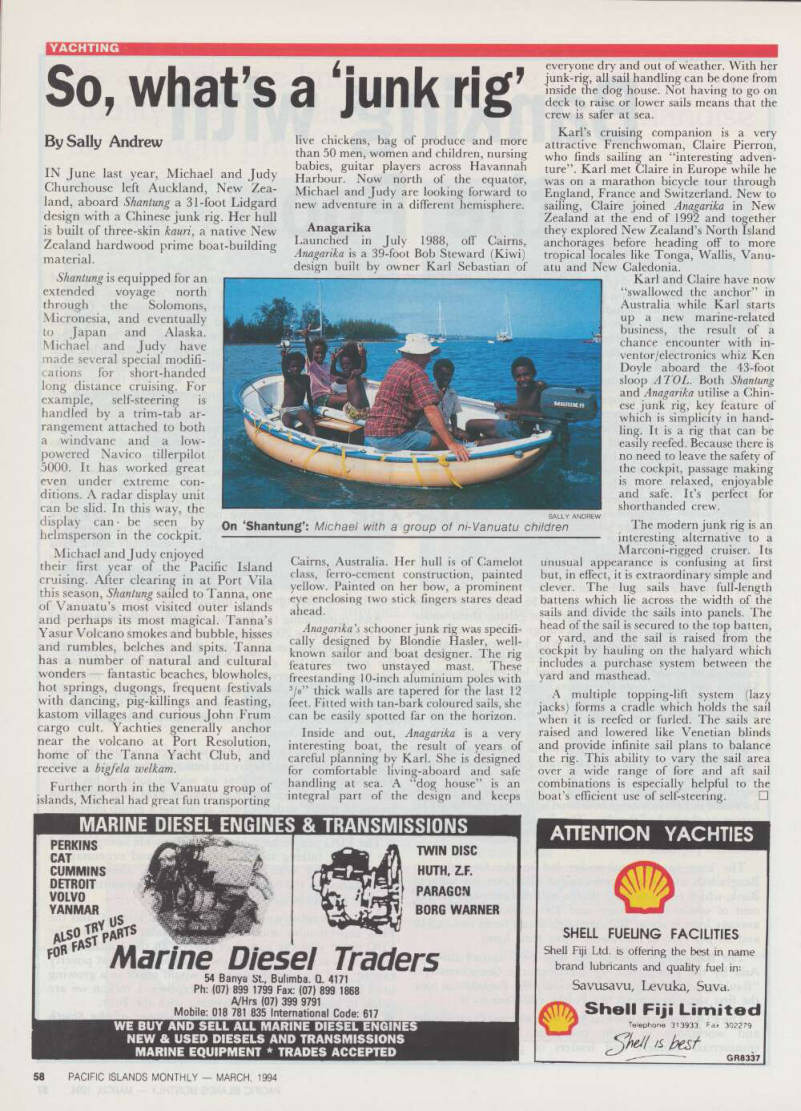
Yachting
By Sally Andrew
IN June last year, Michael and Judy Churchouse left Auckland, New Zea land, aboard Shantung a 31-foot Lidgard design with a Chinese junk rig. Her hull is built of three-skin kauri, a native New Zealand hardwood prime boat-building
material.
Shantung is equipped for an extended voyage north through the Solomons, Micronesia, and eventually to Japan and Alaska.
Michael and Judy have made several special modifi cations for short-handed long distance cruising. For example, self-steering is handled by a trim-tab ar rangement attached to both a windvane and a low powered Navico tillerpilot 5000. It has worked great even under extreme con ditions. A radar display unit can be slid. In this way, the display can - be seen by helmsperson in the cockpit.
Michael and Judy enjoyed
their first year of the Pacific Island cruising. After clearing in at Port Vila this season, Shantung sailed to Tanna, one of Vanuatu’s most visited outer islands and perhaps its most magical. Tanna’s Yasur Volcano smokes and bubble, hisses and rumbles, belches and spits. Tanna has a number of natural and cultural wonders fantastic beaches, blowholes,
hot springs, dugongs, frequent festivals
with dancing, pig-killings and feasting,
kastom villages and curious John Frum cargo cult. Yachties generally anchor near the volcano at Port Resolution, home of the Tanna Yacht Club, and receive a bigfela welkam.
Further north in the Vanuatu group of islands, Micheal had great fun transporting
live chickens, bag of produce and more than 50 men, women and children, nursing babies, guitar players across Havannah Harbour. Now north of the equator, Michael and Judy are looking forward to new adventure in a different hemisphere.
Anagarika
Launched in July 1988, off Cairns, Anagarika is a 39-foot Bob Steward (Kiwi) design built by owner Karl Sebastian of
Cairns, Australia. Her hull is of Camelot class, ferro-cement construction, painted yellow. Painted on her bow, a prominent eye enclosing two stick fingers stares dead ahead.
Anaganka’s schooner junk rig was specifi
cally designed by Blondie Hasler, well known sailor and boat designer. The rig features two unstayed mast. These freestanding 10-inch aluminium poles with 3 1 s” thick walls are tapered for the last 12 feet. Fitted with tan-bark coloured sails, she can be easily spotted far on the horizon.
Inside and out, Anagarika is a very interesting boat, the result of years of careful planning by Karl. She is designed for comfortable living-aboard and safe handling at sea. A “dog house” is an integral part of the design and keeps
everyone dry and out of weather. With her junk-rig, all sail handling can be done from inside the dog house. Not having to go on deck to raise or lower sails means that the crew is safer at sea.
Karl’s cruising companion is a very attractive Frenchwoman, Claire Pierron, who finds sailing an “interesting adven ture”. Karl met Claire in Europe while he was on a marathon bicycle tour through England, France and Switzerland. New to
sailing, Claire joined Anagarika in New
Zealand at the end of 1992 and together they explored New Zealand’s North Island anchorages before heading off to more tropical locales like Tonga, Wallis, Vanu atu and New Caledonia.
Karl and Claire have now “swallowed the anchor” in Australia while Karl starts up a new marine-related business, the result of a chance encounter with in ventor/electronics whiz Ken Doyle aboard the 43-foot sloop ATOL. Both Shantung and Anagarika utilise a Chin
ese junk rig, key feature of
which is simplicity in hand ling. It is a rig that can be easily reefed. Because there is no need to leave the safety of the cockpit, passage making is more relaxed, enjoyable and safe. It’s perfect for shorthanded crew.
The modern junk rig is an interesting alternative to a Marconi-rigged cruiser. Its
unusual appearance is confusing at first but, in effect, it is extraordinary simple and clever. The lug sails have full-length battens which lie across the width of the sails and divide the sails into panels. The head of the sail is secured to the top batten, or yard, and the sail is raised from the cockpit by hauling on the halyard which includes a purchase system between the yard and masthead.
A multiple topping-lift system (lazy
jacks) forms a cradle which holds the sail when it is reefed or furled. The sails are raised and lowered like Venetian blinds and provide infinite sail plans to balance the rig. This ability to vary the sail area over a wide range of fore and aft sail combinations is especially helpful to the boat’s efficient use of self-steering. □
Sally Andrew
On ‘Shantung’: Michael with a group of ni-Vanuatu children
Advertisements & other items, p. 58 (1 item)
F 0 Marine Diesel Traders
MARINE DIESEL ENGINES & TRANSMISSIONS
PERKINS
CAT
CUMMINS
DETROIT
VOLVO
YANMAR
AlSOt? Y pA« TS
F 0 Marine Diesel Traders
TWIN DISC
HUTH, Z.F.
PARAGON
BORG WARNER
54 Banya St, Bulimba. Q. 4171 Ph: (07) 899 1799 Fax: (07) 899 1868
A/Hrs (071 Q7QI
Mobile: 018 781 835 International Code: 617 WE BUY AND SELL ALL MARINE DIESEL ENGINES
NEW & USED DIESELS AND TRANSMISSIONS
MARINE EQUIPMENT * TRADES ACCEPTED
ATTENTION YACHTIES
SHELL FUEUNG FACILITIES
Shell Fiji Ltd. is offering the best in name brand lubricants and quality fuel in; Savusavu, Levuka, Suva.
/JT7\ Shell Fiji Limited
Telephone 313933 Fa, 302279
is hest
GR8337
Unions to unite
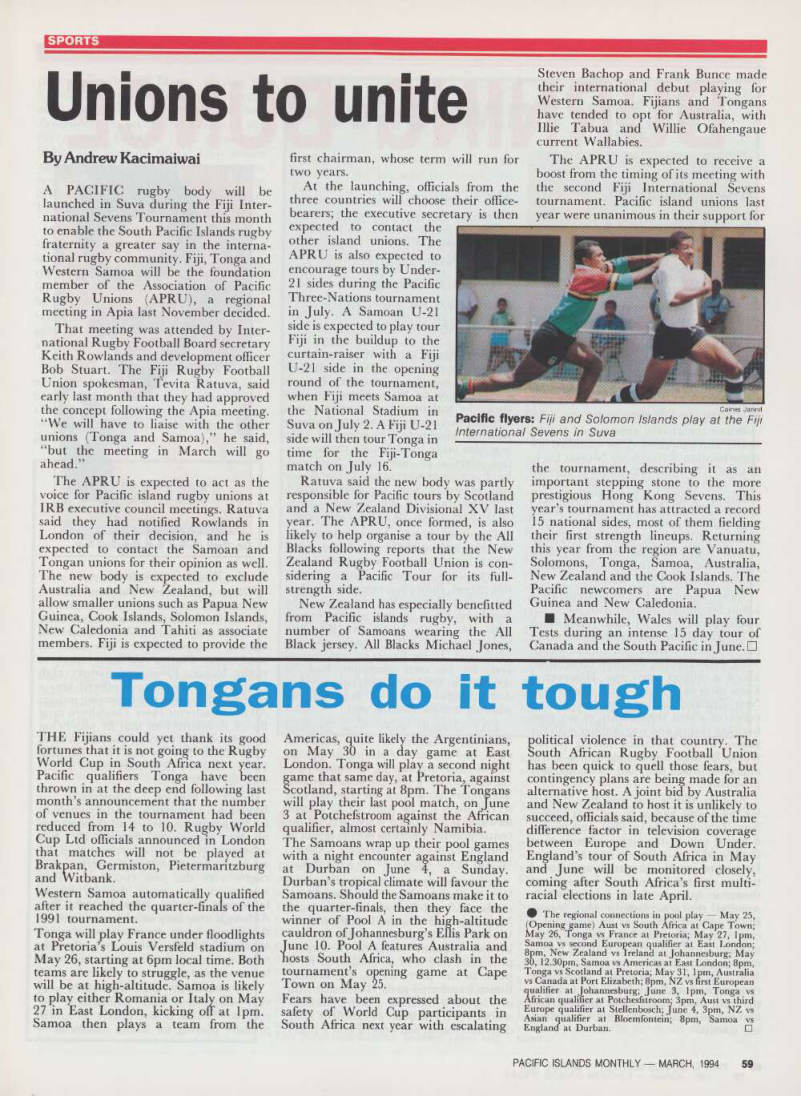
Sports
By Andrew Kacimaiwai
A PACIFIC rugby body will be launched in Suva during the Fiji Inter national Sevens Tournament this month to enable the South Pacific Islands rugby fraternity a greater say in the interna tional rugby community. Fiji, Tonga and Western Samoa will be the foundation member of the Association of Pacific Rugby Unions (APRU), a regional meeting in Apia last November decided.
That meeting was attended by Inter national Rugby Football Board secretary Keith Rowlands and development officer Bob Stuart. The Fiji Rugby Football Union spokesman, Tevita Ratuva, said early last month that they had approved the concept following the Apia meeting.
“We will have to liaise with the other unions (Tonga and Samoa),” he said, “but the meeting in March will go ahead.”
The APRU is expected to act as the voice for Pacific island rugby unions at IRB executive council meetings. Ratuva said they had notified Rowlands in London of their decision, and he is expected to contact the Samoan and Tongan unions for their opinion as well.
The new body is expected to exclude Australia and New Zealand, but will allow smaller unions such as Papua New Guinea, Cook Islands, Solomon Islands, New Caledonia and Tfahiti as associate members. Fiji is expected to provide the
first chairman, whose term will run for two years.
At the launching, officials from the three countries will choose their office bearers; the executive secretary is then
expected to contact the other island unions. The APRU is also expected to encourage tours by Under -21 sides during the Pacific Three-Nations tournament in July. A Samoan U-21 side is expected to play tour Fiji in the buildup to the curtain-raiser with a Fiji U-21 side in the opening round of the tournament, when Fiji meets Samoa at the National Stadium in Suva on July 2. A Fiji U-21 side will then tour Tonga in time for the Fiji-Tonga match on July 16.
Ratuva said the new body was partly responsible for Pacific tours by Scotland and a New Zealand Divisional XV last year. The APRU, once formed, is also likely to help organise a tour by the All Blacks following reports that the New Zealand Rugby Football Union is con sidering a Pacific Tour for its full strength side.
New Zealand has especially benefitted from Pacific islands rugby, with a number of Samoans wearing the All Black jersey. All Blacks Michael Jones,
Steven Bachop and Frank Bunce made their international debut playing for Western Samoa. Fijians and Tongans have tended to opt for Australia, with Illie Tabua and Willie Ofahengaue current Wallabies.
The APRU is expected to receive a boost from the timing of its meeting with the second Fiji International Sevens tournament. Pacific island unions last year were unanimous in their support for
the tournament, describing it as an important stepping stone to the more
prestigious Hong Kong Sevens. This
year’s tournament has attracted a record 15 national sides, most of them fielding
their first strength lineups. Returning
this year from the region are Vanuatu,
Solomons, Tonga, Samoa, Australia,
New Zealand and the Cook Islands. The Pacific newcomers are Papua New Guinea and New Caledonia.
I Meanwhile, Wales will play four Tests during an intense 15 day tour of Canada and the South Pacific in June. □
Caines Jannit Pacific flyers: Fiji and Solomon Islands play at the Fiji International Sevens in Suva
Tongans do it tough
THE Fijians could yet thank its good fortunes that it is not going to the Rugby World Cup in South Africa next year.
Pacific qualifiers Tonga have been thrown in at the deep end following last month’s announcement that the number of venues in the tournament had been reduced from 14 to 10. Rugby World Cup Ltd officials announced in London that matches will not be played at
Brakpan, Germiston, Pietermaritzburg
and Witbank.
Western Samoa automatically qualified after it reached the quarter-finals of the 1991 tournament.
Tonga will play France under floodlights at Pretoria’s Louis Versfeld stadium on May 26, starting at 6pm local time. Both teams are likely to struggle, as the venue will be at high-altitude. Samoa is likely to play either Romania or Italy on May 27 in East London, kicking off at Ipm.
Samoa then plays a team from the
Americas, quite likely the Argentinians, on May 30 in a day game at East London. Tonga will play a second night game that same day, at Pretoria, against Scotland, starting at Bpm. The Tongans will play their last pool match, on June 3 at Potchefstroom against the African qualifier, almost certainly Namibia.
The Samoans wrap up their pool games with a night encounter against England at Durban on June 4, a Sunday.
Durban’s tropical climate will favour the Samoans. Should the Samoans make it to the quarter-finals, then they face the winner of Pool A in the high-altitude cauldron of Johannesburg’s Ellis Park on June 10. Pool A features Australia and hosts South Africa, who clash in the tournament’s opening game at Cape Town on May 25.
Fears have been expressed about the
safety of World Cup participants in
South Africa next year with escalating
political violence in that country. The South African Rugby Football Union has been quick to quell those fears, but contingency plans are being made for an alternative host. A joint bid by Australia and New Zealand to host it is unlikely to succeed, officials said, because of the time difference factor in television coverage between Europe and Down Under.
England’s tour of South Africa in May and June will be monitored closely, coming after South Africa’s first multi racial elections in late April. 9 The regional connections in pool play May 25, (Opening game) Aust vs South Africa at Cape Town; May 26, Tonga vs France at Pretoria; May 27, Ipm, Samoa vs second European qualifier at East London; Bpm, New Zealand vs Ireland at Johannesburg; May 30, 12.30 pm, Samoa vs Americas at East London; Bpm, Tonga vs Scotland at Pretoria; May 31, Ipm, Australia vs Canada at Port Elizabeth; Bpm, NZ vs first European qualifier at Johannesburg; June 3, Ipm, Tonga vs African qualifier at Potchesfstroom; 3pm, Aust vs third Europe qualifier at Stellenbosch; June 4,3 pm, NZ vs Asian qualifier at Bloemfontein; Bpm, Samoa vs England at Durban. □
Burning Bunge
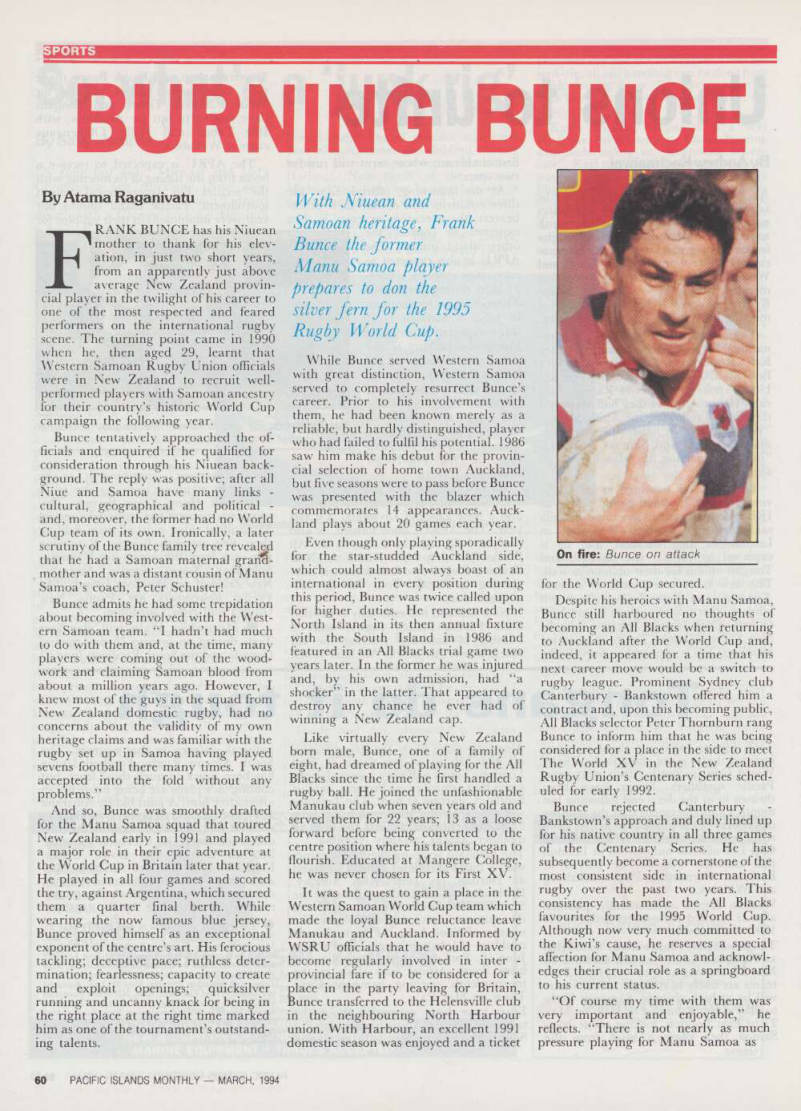
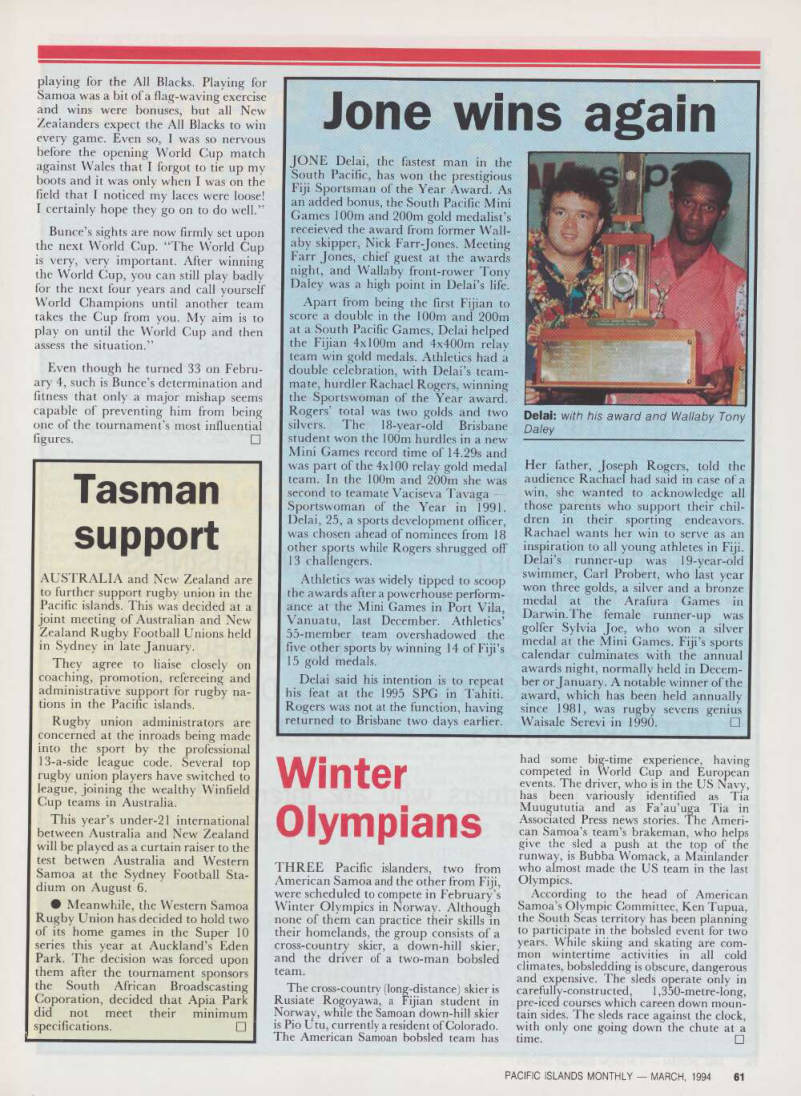
By Atama Raganivatu
FRANK BUNCE has his Niuean mother to thank for his elev ation, in just two short years, from an apparently just above average New Zealand provin cial player in the twilight of his career to one of the most respected and feared performers on the international rugby scene. The turning point came in 1990 when he, then aged 29, learnt that Western Samoan Rugby Union officials were in New Zealand to recruit well performed players with Samoan ancestry for their country’s historic World Cup
campaign the following year.
Bunce tentatively approached the of ficials and enquired if he qualified for consideration through his Niuean back ground. The reply was positive; after all Niue and Samoa have many finks cultural, geographical and political and, moreover, the former had no World Cup team of its own. Ironically, a later scrutiny of the Bunce family tree revealed that he had a Samoan maternal grand mother and was a distant cousin of Manu Samoa’s coach, Peter Schuster!
Bunce admits he had some trepidation about becoming involved with the West ern Samoan team. “I hadn’t had much to do with them and, at the time, many players were coming out of the wood work and claiming Samoan blood from about a million years ago. However, I knew most of the guys in the squad from New Zealand domestic rugby, had no concerns about the validity of my own heritage claims and was familiar with the rugby set up in Samoa having played sevens football there many times. I was accepted into the fold without any
problems.”
And so, Bunce was smoothly drafted for the Manu Samoa squad that toured New Zealand early in 1991 and played a major role in their epic adventure at the World Cup in Britain later that year.
He played in all four games and scored the try, against Argentina, which secured them a quarter final berth. While wearing the now famous blue jersey, Bunce proved himself as an exceptional exponent of the centre’s art. His ferocious tackling; deceptive pace; ruthless deter mination; fearlessness; capacity to create
and exploit openings; quicksilver
running and uncanny knack for being in the right place at the right time marked him as one of the tournament’s outstand
ing talents.
With Niuean and Samoan heritage, Frank Bunce the former Mam Samoa player prepares to don the silver fern for the 1995
Rugby World Cup.
While Bunce served Western Samoa with great distinction, Western Samoa served to completely resurrect Bunce’s career. Prior to his involvement with them, he had been known merely as a
reliable, but hardly distinguished, player
who had failed to fulfil his potential. 1986 saw him make his debut for the provin cial selection of home town Auckland, but five seasons were to pass before Bunce was presented with the blazer which commemorates 14 appearances. Auck land plays about 20 games each year.
Even though only playing sporadically
for the star-studded Auckland side, which could almost always boast of an international in every position during this period, Bunce was twice called upon for higher duties. He represented the North Island in its then annual fixture with the South Island in 1986 and featured in an All Blacks trial game two years later. In the former he was injured and, by his own admission, had “a shocker” in the latter. That appeared to destroy any chance he ever had of winning a New Zealand cap.
Like virtually every New Zealand born male, Bunce, one of a family of eight, had dreamed of playing for the All Blacks since the time he first handled a rugby ball. He joined the unfashionable Manukau club when seven years old and served them for 22 years; 13 as a loose forward before being converted to the centre position where his talents began to flourish. Educated at Mangere College, he was never chosen for its First XV.
It was the quest to gain a place in the Western Samoan World Cup team which made the loyal Bunce reluctance leave Manukau and Auckland. Informed by WSRU officials that he would have to become regularly involved in inter provincial fare if to be considered for a place in the party leaving for Britain, Bunce transferred to the Helensville club in the neighbouring North Harbour union. With Harbour, an excellent 1991 domestic season was enjoyed and a ticket
for the World Cup secured.
Despite his heroics with Manu Samoa, Bunce still harboured no thoughts of becoming an All Blacks when returning to Auckland after the World Cup and, indeed, it appeared for a time that his next career move would be a switch to
rugby league. Prominent Sydney club
Canterbury - Bankstown offered him a contract and, upon this becoming public, All Blacks selector Peter Thornburn rang Bunce to inform him that he was being considered for a place in the side to meet The World XV in the New Zealand Rugby Union’s Centenary Series sched uled for early 1992.
Bunce rejected Canterbury
Bankstown’s approach and duly lined up for his native country in all three games of the Centenary Series. He has subsequently become a cornerstone of the most consistent side in international rugby over the past two years. This consistency has made the All Blacks favourites for the 1995 World Cup.
Although now very much committed to the Kiwi’s cause, he reserves a special affection for Manu Samoa and acknowl edges their crucial role as a springboard to his current status.
“Of course my time with them was very important and enjoyable,” he reflects. “There is not nearly as much pressure playing for Manu Samoa as
On fire: Bunce on attack
playing for the All Blacks. Playing for Samoa was a bit of a flag-waving exercise and wins were bonuses, but all New Zealanders expect the All Blacks to win every game. Even so, I was so nervous before the opening World Cup match against Wales that I forgot to tie up my boots and it was only when I was on the field that I noticed my laces were loose!
I certainly hope they go on to do well.”
Bunce’s sights are now firmly set upon the next World Cup. “The World Cup is very, very important. After winning the World Cup, you can still play badly for the next four years and call yourself World Champions until another team takes the Cup from you. My aim is to play on until the World Cup and then assess the situation.”
Even though he turned 33 on Febru ary 4, such is Bunce’s determination and fitness that only a major mishap seems
capable of preventing him from being
one of the tournament’s most influential
figures. □
support
Tasman support
AUSTRAFIA and New Zealand are to further support rugby union in the Pacific islands. This was decided at a joint meeting of Australian and New Zealand Rugby Football Unions held in Sydney in late January.
They agree to liaise closely on coaching, promotion, refereeing and administrative support for rugby na tions in the Pacific islands.
Rugby union administrators are concerned at the inroads being made into the sport by the professional 13-a-side league code. Several top rugby union players have switched to league, joining the wealthy Winfield Cup teams in Australia.
This year’s under-21 international between Australia and New Zealand will be played as a curtain raiser to the test betwen Australia and Western Samoa at the Sydney Football Sta dium on August 6. • Meanwhile, the Western Samoa Rugby Union has decided to hold two of its home games in the Super 10 series this year at Auckland’s Eden Park. The decision was forced upon them after the tournament sponsors the South African Broadscasting Coporation, decided that Apia Park did not meet their minimum specifications. □
Jone wins again
JONE Delai, the fastest man in the South Pacific, has won the prestigious Fiji Sportsman of the Year Award. As an added bonus, the South Pacific Mini Games 100 m and 200 m gold medalist’s receieved the award from former Wall aby skipper, Nick Farr-Jones. Meeting Farr Jones, chief guest at the awards night, and Wallaby front-rower Tony Daley was a high point in Delai’s life.
Apart from being the first Fijian to score a double in the 100 m and 200 m at a South Pacific Games, Delai helped the Fijian 4xloom and 4x400m relay team win gold medals. Athletics had a double celebration, with Delai’s team mate, hurdler Rachael Rogers, winning the Sportswoman of the Year award.
Rogers’ total was two golds and two silvers. The 18-year-old Brisbane student won the 100 m hurdles in a new Mini Games record time of 14.29 s and was part of the 4xloo relay gold medal team. In the 100 m and 200 m she was second to teamate Vaciseva Tavaga - Sportswoman of the Year in 1991.
Delai, 25, a sports development officer, was chosen ahead of nominees from 18 other sports while Rogers shrugged off
13 challengers.
Athletics was widely tipped to scoop the awards after a powerhouse perform ance at the Mini Games in Port Vila, Vanuatu, last December. Athletics’ 55-member team overshadowed the five other sports by winning 14 of Fiji’s 15 gold medals.
Delai said his intention is to repeat his feat at the 1995 SPG in Tahiti.
Rogers was not at the function, having returned to Brisbane two days earlier.
Her father, Joseph Rogers, told the audience Rachael had said in case of a win, she wanted to acknowledge all those parents who support their chil dren in their sporting endeavors.
Rachael wants her win to serve as an inspiration to all young athletes in Fiji.
Delai’s runner-up was 19-year-old swimmer, Carl Probert, who last year won three golds, a silver and a bronze medal at the Arafura Games in Darwin. The female runner-up was golfer Sylvia Joe, who won a silver medal at the Mini Games. Fiji’s sports calendar culminates with the annual awards night, normally held in Decem ber or January. A notable winner of the award, which has been held annually since 1981, was rugby sevens genius Waisale Serevi in 1990. □
Delai: with his award and Wallaby Tony Daley
Olympians
Winter Olympians
THREE Pacific islanders, two from American Samoa and the other from Fiji, were scheduled to compete in February’s
Winter Olympics in Norway. Although
none of them can practice their skills in their homelands, the group consists of a cross-country skier, a down-hill skier, and the driver of a two-man bobsled team.
The cross-country (long-distance) skier is Rusiate Rogoyawa, a Fijian student in Norway, while the Samoan down-hill skier is Pio U tu, currently a resident of Colorado.
The American Samoan bobsled team has
had some big-time experience, having
competed in World Cup and European
events. The driver, who is in the US Navy, has been variously identified as Tia Muugututia and as Fa’au’uga Tia in Associated Press news stories. The Ameri can Samoa’s team’s brakeman, who helps give the sled a push at the top of the runway, is Bubba Womack, a Mainlander who almost made the US team in the last
Olympics.
According to the head of American Samoa’s Olympic Committee, Ken Tupua, the South Seas territory has been planning to participate in the bobsled event for two years. While skiing and skating are com mon wintertime activities in all cold climates, bobsledding is obscure, dangerous and expensive. The sleds operate only in
carefully-constructed, 1,350-metre-long,
pre-iced courses which careen down moun tain sides. The sleds race against the dock, with only one going down the chute at a time. □
Advertisements & other items, p. 62 (1 item)
IBDN Inc. is a Korean company based in Seoul,
Korea specialising in travel, leisure and entertainment business.
With good relationship with South Pacific Island Countries, were looking for our business to be set up in the South Pacific for following business. * IMPORT & EXPORT * CASINO BUSINESS * HOTEL DEVELOPMENT * SECOND HAND CARS * CLUBS, BARS, ETC * TOURISM BUSINESS
* RESORT DEVELOPMENT * GOLF DEVELOPMENT
* DUTY FREE SHOPS * OTHER DEVELOPMENT We look for partners who are interested in these businesses please send inquiry or proposal to:
IBDN INC
KANGNAM P.O. BOX 1313
SEOUL 135-613 KOREA
TEL: (82-2) 515-5000
FAX: (82-2) 514-4957
Shipping
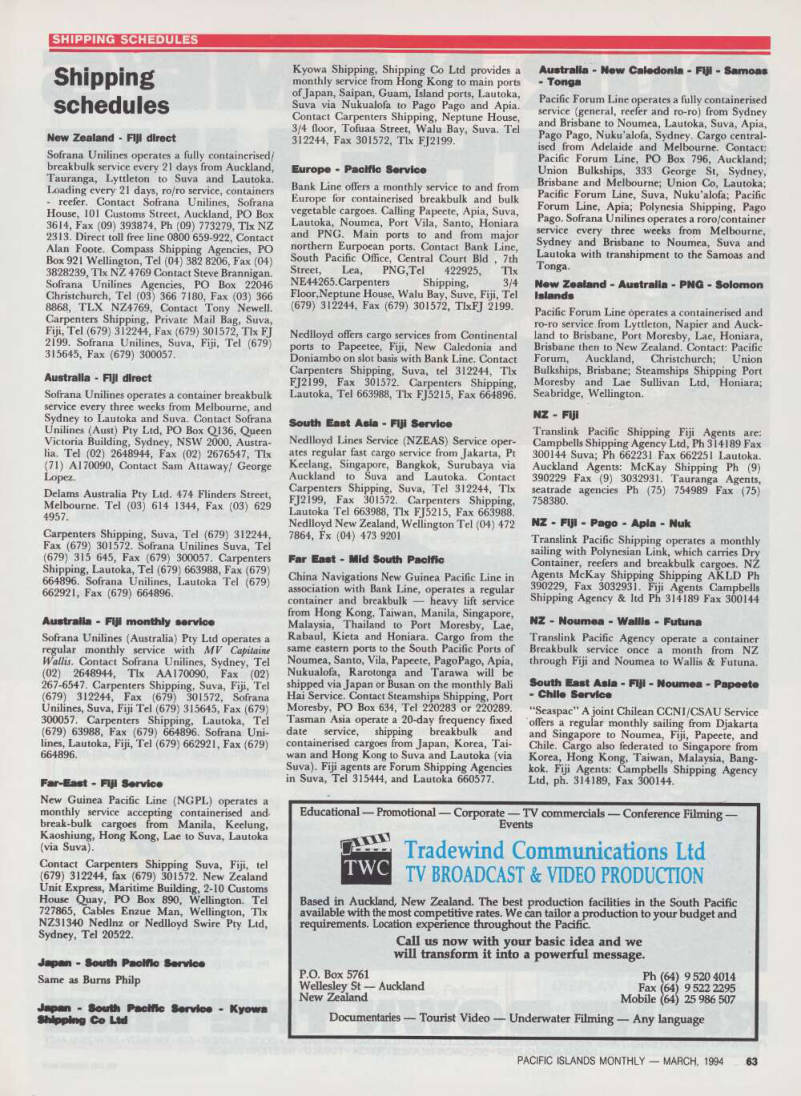
Schedules
Shipping schedules
New Zealand - FIJI direct Sofrana Unilines operates a fully containerised/ breakbulk service every 21 days from Auckland, Tauranga, Lyttleton to Suva and Lautoka.
Loading every 21 days, ro/ro service, containers - reefer. Contact Sofrana Unilines, Sofrana House, 101 Customs Street, Auckland, PO Box 3614, Fax (09) 393874, Ph (09) 773279, Tlx NZ 2313. Direct toll free line 0800 659-922, Contact Alan Foote. Compass Shipping Agencies, PO Box 921 Wellington, Tel (04) 382 8206, Fax (04) 3828239, Tlx NZ 4769 Contact Steve Brannigan.
Sofrana Unilines Agencies, PO Box 22046 Christchurch, Tel (03) 366 7180, Fax (03) 366 8868, TLX NZ4769, Contact Tony Newell.
Carpenters Shipping, Private Mail Bag, Suva, Fiji, Tel (679) 312244, Fax (679) 301572, Tlx FJ 2199. Sofrana Unilines, Suva, Fiji, Tel (679) 315645, Fax (679) 300057.
Australia • FIJI direct Sofrana Unilines operates a container breakbulk service every three weeks from Melbourne, and Sydney to Lautoka and Suva. Contact Sofrana Unilines (Aust) Pty Ltd, PO Box Q 136, Queen Victoria Building, Sydney, NSW 2000, Austra lia. Tel (02) 2648944, Fax (02) 2676547, Tlx (71) A 170090, Contact Sam Attaway/ George Lopez.
Delams Australia Pty Ltd. 474 Flinders Street, Melbourne. Tel (03) 614 1344, Fax (03) 629 4957.
Carpenters Shipping, Suva, Tel (679) 312244, Fax (679) 301572. Sofrana Unilines Suva, Tel (679) 315 645, Fax (679) 300057. Carpenters Shipping, Lautoka, Tel (679) 663988, Fax (679) 664896. Sofrana Unilines, Lautoka Tel (679) 662921, Fax (679) 664896.
Australia - Fiji monthly service Sofrana Unilines (Australia) Pty Ltd operates a regular monthly service with MV Capitaine Wallis. Contact Sofrana Unilines, Sydney, Tel (02) 2648944, Tlx AA170090, Fax (02) 267-6547. Carpenters Shipping, Suva, Fiji, Tel (679) 312244, Fax (679) 301572, Sofrana Unilines, Suva, Fiji Tel (679) 315645, Fax (679) 300057. Carpenters Shipping, Lautoka, Tel (679) 63988, Fax (679) 664896. Sofrana Uni lines, Lautoka, Fiji, Tel (679) 662921, Fax (679) 664896.
Far-East - Fiji Service New Guinea Pacific Line (NGPL) operates a monthly service accepting containerised and, break-bulk cargoes from Manila, Keelung, Kaoshiung, Hong Kong, Lae to Suva, Lautoka (via Suva).
Contact Carpenters Shipping Suva, Fiji, tel (679) 312244, fax (679) 301572. New Zealand Unit Express, Maritime Building, 2-10 Customs House Quay, PO Box 890, Wellington. Tel 727865, Cables Enzue Man, Wellington, Tlx NZ31340 Nedlnz or Nedlloyd Swire Pty Ltd, Sydney, Tel 20522.
Japan - South Pacific Sorvlco Same as Burns Philp Japan - South Pacific Sorvtcs - Kyowa Shipping Co Ltd
Kyowa Shipping, Shipping Co Ltd provides a monthly service from Hong Kong to main ports of Japan, Saipan, Guam, Island ports, Lautoka, Suva via Nukualofa to Pago Pago and Apia.
Contact Carpenters Shipping, Neptune House, 3/4 floor, Tofuaa Street, Walu Bay, Suva. Tel 312244, Fax 301572, Tlx FJ2199.
Europe - Pacific Service Bank Line offers a monthly service to and from Europe for containerised breakbulk and bulk vegetable cargoes. Calling Papeete, Apia, Suva, Lautoka, Noumea, Port Vila, Santo, Honiara and PNG. Main ports to and from major northern Eurpoean ports. Contact Bank Line, South Pacific Office, Central Court Bid , 7th Street, Lea, PNG,TeI 422925, Tlx NE4426s.Carpenters Shipping, 3/4 Floor,Neptune House, Walu Bay, Suve, Fiji, Tel (679) 312244, Fax (679) 301572, TIxFJ 2199.
Nedlloyd offers cargo services from Continental ports to Papeetee, Fiji, New Caledonia and Doniambo on slot basis with Bank Line. Contact Carpenters Shipping, Suva, tel 312244, Tlx FJ2199, Fax 301572. Carpenters Shipping, Lautoka, Tel 663988, Tlx FJ5215, Fax 664896.
South East Asia - Fiji Service Nedlloyd Lines Service (NZEAS) Service oper ates regular fast cargo service from Jakarta, Pt Keelang, Singapore, Bangkok, Surubaya via Auckland to Suva and Lautoka. Contact Carpenters Shipping, Suva, Tel 312244, Tlx FJ2199, Fax 301572. Carpenters Shipping, Lautoka Tel 663988, Tlx FJ5215, Fax 663988.
Nedlloyd New Zealand, Wellington Tel (04) 472 7864, Fx (04) 473 9201 Far East - Mid South Pacific China Navigations New Guinea Pacific Line in association with Bank Line, operates a regular container and breakbulk heavy lift service from Hong Kong, Taiwan, Manila, Singapore, Malaysia, Thailand to Port Moresby, Lae, Rabaul, Kieta and Honiara. Cargo from the same eastern ports to the South Pacific Ports of Noumea, Santo, Vila, Papeete, PagoPago, Apia, Nukualofa, Rarotonga and Tarawa will be shipped via Japan or Busan on the monthly Bali Hai Service. Contact Steamships Shipping, Port Moresby, PO Box 634, Tel 220283 or 220289.
Tasman Asia operate a 20-day frequency fixed date service, shipping breakbulk and containerised cargoes from Japan, Korea, Tai wan and Hong Kong to Suva and Lautoka (via Suva). Fiji agents are Forum Shipping Agencies in Suva, Tel 315444, and Lautoka 660577.
Australia - New Caledonia - Fiji - Samoa* - Tonga Pacific Forum Line operates a fully containerised service (general, reefer and ro-ro) from Sydney and Brisbane to Noumea, Lautoka, Suva, Apia, Pago Pago, Nuku’alofa, Sydney. Cargo central ised from Adelaide and Melbourne. Contact: Pacific Forum Line, PO Box 796, Auckland; Union Bulkships, 333 George St, Sydney, Brisbane and Melbourne; Union Co, Lautoka; Pacific Forum Line, Suva, Nuku’alofa; Pacific Forum Line, Apia; Polynesia Shipping, Pago Pago. Sofrana Unilines operates a roro/container service every three weeks from Melbourne, Sydney and Brisbane to Noumea, Suva and Lautoka with transhipment to the Samoas and Tonga.
New Zealand - Australia - PNG - Solomon Islands Pacific Forum Line operates a containerised and ro-ro service from Lyttleton, Napier and Auck land to Brisbane, Port Moresby, Lae, Honiara, Brisbane then to New Zealand. Contact; Pacific Forum, Auckland, Christchurch; Union Bulkships, Brisbane; Steamships Shipping Port Moresby and Lae Sullivan Ltd, Honiara; Seabridge, Wellington.
NZ - Fiji Translink Pacific Shipping Fiji Agents are: Campbells Shipping Agency Ltd, Ph 314189 Fax 300144 Suva; Ph 662231 Fax 662251 Lautoka.
Auckland Agents: McKay Shipping Ph (9) 390229 Fax (9) 3032931. Tauranga Agents, seatrade agencies Ph (75) 754989 Fax (75) 758380.
NZ - Fiji - Pago - Apia - Nuk Translink Pacific Shipping operates a monthly sailing with Polynesian Link, which carries Dry Container, reefers and breakbulk cargoes. NZ Agents McKay Shipping Shipping AKLD Ph 390229, Fax 3032931. Fiji Agents Campbells Shipping Agency & ltd Ph 314189 Fax 300144 NZ - Noumea - Wallis - Futuna Translink Pacific Agency operate a container Breakbulk service once a month from NZ through Fiji and Noumea to Wallis & Futuna.
South East Asia - Fiji - Noumea - Papeete - Chile Service “Seaspac” A joint Chilean CCNI/CSAU Service offers a regular monthly sailing from Djakarta and Singapore to Noumea, Fiji, Papeete, and Chile. Cargo also federated to Singapore from Korea, Hong Kong, Taiwan, Malaysia, Bang kok. Fiji Agents: Campbells Shipping Agency Ltd, ph. 314189, Fax 300144.
Advertisements & other items, pp. 63-68 (1 item)
Wmm Tradewind Communications Ltd
Educational Promotional Corporate TV commercials Conference Filming Events
1119 TV BROADCAST & VIDEO PRODUCTION
Based in Auckland, New Zealand. The best production facilities in the South Pacific available with the most competitive rates. We can tailor a production to your budget and requirements. Location experience throughout the Pacific.
Call us now with your basic idea and we will transform it into a powerful message.
P.O. Box 5761 Ph (64) 9 520 4014 Wellesley St Auckland Fax (64) 9 522 2295 New Zealand Mobile (64) 25 986 507 Documentaries Tourist Video Underwater Filming Any language
ON TH
f 'H i *» 3 ■■ n rl In 1978, when the Pacific Forum Line came into being, its charter was to not only establish a viable locally owned service for the region, it was also charged with the responsibility for encouraging economic growth through increased trade.
Today, we act as a vital trade link for Forum Island countries. Our network of services covers the South West Pacific to every point of the compass and we offer a versatile fleet of vessels that can carry everything from containerised to break bulk and roll on/off cargo as well as handling specialised requirements like bulk liquid and refrigerated cargoes.
Next time you see the familiar yellow PFL flag flying proudly, spare a thought for the contribution the Line has made to this part of the world over the past seventeen years.
And, if that’s not enough reason to ‘put it on the Line’, take a look at our competitive rates, convenient schedules and the years of accumulated shipping experience our people offer. Because you know that when you ship with Pacific Forum, it’s our name (and yours) on the Line, right down the Line.
Pacific Forum Line
For more information on Pacific Forum Line's services and offices throughout the South Pacific contact our Auckland office on:- Ph: (09) 3096 700. Fax: (09) 3092 683. Telex: 60460.
RIGHT DOWN THE LINE
PROVIDING REGULAR DIRECT AND TRANSSHIPMENT SERVICES TO AUSTRALIA • AMERICAN SAMOAISLANDS • FIJI • KIRIBATI • NEW ZEALAND • PAPUA NEW GUINEA • SOLOMON ISLANDS • TONGA • TUVALU • WESTERN SAMOA
WILSON ADDISON 88.0 S
PACIFIC
SLANDS
imp r h l y~l
MRRK€T PLRC6
SCRAP METAL
Tall ingots operate from Brisbane, Australia and make frequent visits to the Pacific Islands which they have done for twenty-five years. We are buyers of Copper, Brass, Aluminium, Lead, Cable etc. Inspection no problems. Telephone 61 7 8922033. Fax 61 78922077.
REAL ESTATE
“Fiji Islands Beach Front Lots, For Sale U 5515,000.00 with easy terms adjacent to Tourist Resort for Free Brochure Phone: (679) 311075, Fax (679) 303160 or Write C/ PO Box 228, Suva, Fiji Islands.
EDUCATION
COMMUNITY DEVELOPMENT COURSE
Victoria University Of Technology (Melbourne, Australia) Offers a Bachelor of Arts, Community Development Course yvith a focus on the Pacific and Asia suitable for community based workers. Scholarships may be available. Further information, Dr.
Michael Hamel Green or Heather Wallace, Faculty of Arts, Vut, P.O. Box 14428 MMC, 3000 Australia Fax 613 3652242 Tel. 613 3652139.
COMPUTER PARTS
Epson, Panasonic, Hewlet-Packard, Oki, IBM, NEC, Cannon, Olivetti, 3M, Verbatim Disk, Data Cartridge, Stationery, Electricals, Fax Paper, MF-Adapters
JEDI ELECTRONICS
301276, 315360
AGENT
"Quality Aluminium Shower Screens & Wardrobes are now available at competitive prices.
Please contact us now for free Brochures and Details. PFP INDUSTRIES, Sydney, Australia, Phone 612 4827470, Fax: 612 4827472 (Agents required).”
MftftKCT PLRC€ CAN WORK
UIONDCRS FOR VOU ...
Promote your business, or service. sell your household items, cars or heavy machinery etc.
ONLY AUSSI PER WORD.
NO COMPANY LOGO. NO
DISPLAY. NO BOLD TYPE.
Just forward your Advartisamant together with paymant to: PACIFIC ISLANDS MONTHLY -Market Place ", P.O. Box 1167, Suva, FIJI.
FORUM SECRETARIAT
VACANCIES
Applications are invited from suitably qualified and experienced persons, who must be nationals of a member State of the South Pacific Forum *, for the following positions in the Forum Secretariat, based in Suva, Fiji.
DIRECTOR, ADMINISTRATION DIVISION
The Administration Division provides support services to the organisation in the following areas Personnel, Purchasing, Conference/Travel/Secretarial, Office and Property maintenance, Registry, Groundskeeping, Driver/Messenger services, Cleaning and Security.
The successful applicant will exercise broad supervision over the work of all staff of the Administration Division and carry out on-going monitoring of systems and procedures in all the above areas to ensure that timely and efficient services are provided to all Secretariat Divisions. He/she will also provide managerial and logistical support to Conferences and Meetings as required, including the preparation of meeting papers, briefs, and production of meeting records a major responsibility in this area is the co-ordination of the Secretariat’s preparations for the annual South Pacific Forum meetings; assist management on a case-by-case basis with policy development, implementation and review; monitor divisional expenditure and prepare annual budget estimates for the Division; draft letters, speeches, briefings, etc. for Management as required. The Director, Administration is also responsible for special projects that fall within the Division’s mandate such as the Secretariat’s infrastructure development programme.
Applicants should have relevant tertiary qualifications in administration/personnel management and a considerable depth of experience at senior level in these areas. He/she should demonstrate proven managerial and organisational abilities and excellent interpersonal and communication skills with a strong commitment to service, teamwork and fostering staff development. In addition, computer skills, particularly in word-processing and database functions, will be highly regarded.
LIBRARIAN
The Secretariat’s Library is a small, specialised library catering primarily for the research and information needs of Forum Secretariat staff and consultants. The Librarian will be responsible for the management of all aspects of the Library and its staff.
The Librarian will be required to develop and manage the library’s collections i.e. formulate and administer policies relating to acquisition, arrangement and description, reference and access and perservation; continue the implementation of CDS/ISIS cataloguing and information retrieval system and participate in networking arrangements involving resource sharing and training to support regional information systems. The Librarian will also be required to take a leading role in information management issues including preparing initiatives and proposals for strengthening the Secretariat’s information management capabilities.
Applicants should have graduate training in library/information science with at least 10 years’ progressively responsible technical supervisory and managerial experience in a special or academic library setting. Experience or training in the provision of automated information services, including CD-ROM, LANs, is desirable as well as familiarity with the construction and use of databases, networks and telecommunications systems and a thorough understanding of the international environment for assessing and disseminating development information.
GENERAL INFORMATION
Applications close on 31 March 1994. They should contain full information on education and career backgrounds, includinng the names, addresses and telephone numbers of at least three referees with whom the applicant has been associated professionally.
Applications should be addressed to; The Secretary General Forum Secretariat GPO Box 856, Suva, Fiji.
Telephone 312-600 Fax: 305-573 Further information is available on request from the Personnel Officer on 312-600 Extension: 334. * Member states of the South Pacific Forum: Australia, Cook Islands, Federated States of Micronesia, Fiji, Kiribati, Nauru, New Zealand, Niue, Papua New Guinea, Republic of the Marshall Islands, Solomon Islands, Tonga, Tuvalu, Vanuatu and Western Samoa.
Your Island Connections
■ ■ f '
Cable and Wireless began keep-
ing people in touch around the
"world more than a century ago. Today,
while the technology has changed,
the tradition of service to our customers in the
South Pacific is just the same.
We work in partnership with Governments,
dedicated to meeting the need of communities and businesses to stay in touch. From one island to the next or to the other side of the world, the message is the same: Cable and Wireless is
your South Pacific
connection bringing the
islands together.
CABLE &
Asia Pacific Head Office Cable and Wireless pic Cable and Wireless (Pacific) Limited 22nd Floor Office Tower Convention Plaza 1 Harbour Road Hong Kong Tbl: (852) 848 8620 Facsimile; (852) 868 5195 Fiji In association with the Government of Fiji Fiji International Telecommunications Ltd.
P.O. Box 59 Mercury House 158 Victoria Parade Suva Fiji Tfel: (679) 312933 Solomon Islands In association with the Government of the Solomon Islands Solomon Telekom Company Limited P.O. Box 148 Honiara Solomon Islands Tfel: (677) 21576 Tonga Cable and Wireless pit Private Mail Bag 4 General Post Office Nuku Alofa Tonga South Pacific Tfel: (676) 23499 3 1508 00243598 5
The world’s
new reference standard
Just a few short years ago, automobiles were bought purely for personal pleasure. Performance, comfort, and design were the motives for choosing a car.
Today, Honda understands that times have changed. Social concerns, including safety and the environment, have become increasingly important to many drivers throughout the world.
By combining these standards of personal driving pleasure and environmental responsibility at the very highest level through Honda’s technology, the new Civic was created. A car designed to meet the nineties on its own terms.
All Civic engines represent a high-level engineering and design balance between effective power output and fuel efficiency. The new Civic has an aerodynamic design that flows smoothly through the air, further increasing fuel economy. Honda’s unique packaging concepts allow for a roomy, comfortable interior for passengers. Handling is sure and responsive while still maintaining comfort, by means of its 4-wheel double wishbone suspension and highly rigid body.
From the very first Honda Civic, each Civic generation has led the way in innovation for its times. This, the fifth generation, is part of this rich heritage. And as such, it is destined to become the reference standard for cars in its class.
HONDA CIVIC
P AUSTRALIA: HONDA AUSTRALIA PTY LTD, TEL. (61) 3-2855555 COOK ISLANDS: COOK ISLAND MOTOR CENTRE LIMITED, TEL. (682) 22055
FIJI: CARPENTERS MOTORS, TEL. (679) 313644
NEW CALEDONIA: 5.G.1.A., S.A., TEL. (687) 281787 NEW ZEALAND: HONDA NEW ZEALAND LTD, TEL. (64) 9-2623141 NORFOLK ISLANDS: DUNCOMBE BAY GARAGE, TEL. (672) 322097 PAPUA NEW GUINEA: TOBA MOTORS, TEL. (675) 217874 SAIPAN: TRANS-MICRONESIA MOTORS, INC., TEL. (670) 234-8333/4 SOLOMON ISLANDS: LEE KWOK KUEN & CO., LTD, TEL. (677) 22446 TAHITI: HONDA GENERATION S.A.R.L., TEL. (689) 420516
WITH THE
CROWD?
The-All New Mitsubishi Galant —
The Freedom to Drive as You Choose ImaginS?'"'. long ride home from a long day’s work. You want to get home as soon as possible, but you want to do so effortlessly... or maybe you’re on a winding road, and you have the urge to experience truly sporty driving.
Typically, you would need two different cars to enjoy these two experiences fully. But with the new Mitsubishi Galant, it’s all possible.
The new Galant features an innovative approach to engine efficiency that dramatically expands driving potential. Compared to cars with conventional engines, the Galant has far better combustion efficiency and reduced friction losses.
This allows smoother, more powerful operation with almost no noise or vibration. So whether you want to relax and cruise, or drive more sportily, the Galant gives you exactly what you want — when you need it.
Each of the Galant’s new multi-valve engines gives you the unparalleled freedom to drive as you choose. They are an integral part of All Wheel Control, Mitsubishi’s unique approach to car design that gives you total control over the driving experience. With true communication between you and the road, the new Galant ensures total control with quicker, safer and more responsive performance than ever before imaginable.
Discover the meaning of driving freedom with the new Mitsubishi Galant—and feel how All Wheel Control sets you apart from the crowd.
The All New
MITSUBISHI GRLRNT
AMERICAN SAMOA; PACIFIC MARKETING INC. P.O. Box 698, Pago Pago, Tel. 699 9140 / AUSTRALIA: MITSUBISHI MOTORS AUSTRALIA LTD. 1284 »tod;Cloyelly South Audralia Tel- (08)2757297 1 pi it- kjivir mnin ß a MACHINERY TO LTD GPO Box 150 Suva Tel 383411 1 GUAM - TRIPPLE J ENTERPRISES INC. PO. Box 6066, Tamumng, Tel. 6469126 / NEW CALEDONIA. SOCIETE D IMPORTATION DAUTODU PACIFIQUE SUD SA PO Box 2548 Noumea' Tel 274144 1 NEW ZEALAND: MITSUBISHI MOTORS NEW ZEALAND LTD. Private Bag. Porirua, Tel. 2370109 1 NORFOLK ISUND:BORRYS PO Box 169 / PAPUA NEW GUINEA' LTD PO Box 503, Pori Moresby, Tel. 217874 /SAIPAN: AUTO MOTION INC. PO. Box 569, SKV Dist. 4, Tel 2343332 /SOUIMON Sands- HARVEST PACIFIC LTD GRO Box 823 Honiara, TW/ TAHITI (FRENCH POLYNESIA): SOPADEP S.A. RO. Box 1617, Papeete Tel. 427393 / TONGA. SITANI MAPI CO LTD. RQ Box 83 NukuAlofa, Tel, 24044 /VANUATU: SOCOMETRA VANUATU LTD. B.P. 06, Route de Lagon, Port Vila, Tel. 2314 /WESTERN SAMOA: MOTOR DISTRIBUTORS (SAMOA) LTD. RO. Box 576, Apia, Tel. 20957 A
MITSUBISHI
MOTORS
CREATING TOGETHER