Pacific

Islands
Monthly
Fiji golfer Vijay Singh swings higher
February 1994
To uris vn test I ' >, ■ ... &£ a',. .■>
Just how efficient \ -;.' ~Cfcv ■•'■■ -v '"' x ■I ■ are the tourist bureaus in the Pacific?
t
American Samoa US$2.5O; Australia A 53.50; Cook Islands NZ$3; FIJI (incl VAT) F 51.92; FS Micronesia US$3; Hawaii US$3; Kiribati A 52.50; Nauru A 52.50; Niue NZ$3; Norfolk As 3; New Caledonia cpf2so; New Zealand (incl GST) NZ53.45; Nth Marianas US$3; Papua New Guinea K 3; Palau US$3; Marshalls US$3; Solomon Islands As 3; French Polynesia cpfSOO; Tonga P 3; USA US$3; Vanuatu VT22O; Western Samoa T 3.25. * Recommended retail price only
Advertisements & other items, pp. 2-4 (1 item)
even ordinary driving requires an extraordinary car.
Ohonda
powered by Honda The legendary engines behind 71 Grand Prix victories and six consecutive Constructors' Championnships.
Sometimes,
even ordinary driving requires an extraordinary car.
While every driver might wish for perfect driving conditions of clear, blue sky and dry roads, the reality is often quite different. Rain. Wind. Slick and slippery streets and highways. These are conditions that make even careful drivers a little nervous.
But not when driving the all-new, fifth generation Honda Accord. Because this car creates confidence.
Its monocoque body was created with the help of advanced computer-aided design and real-world testing to be extremely strong and rigid. By minimizing flexing, it improves handling response, keeping the driver in control at all times. This control is further enhanced under all possible driving conditions by Honda’s race-bred 4-wheel double wishbone suspension and new rotary valve power steering system.
The New Accord was extensively tested to help protect occupants from accidents that occur from any direction, including offset collisions the most common serious accident. To guard against side impact, the Accord employs shock absorbing material and strong side beams inside each door.
Under excellent driving conditions, you will enjoy driving the extraordinary new Accord to the utmost. Honda’s latest technology balances seemingly contradictory issues, like an engine that is both powerful and extremely fuel efficient. And a dedication to safety as well as driving pleasure.
Under bad conditions, you will perhaps appreciate it even more.
HONDA ACCORD
AUSTRALIA: HONDA AUSTRALIA PTY. LTD., TEL. (61) 3-2855555 COOK ISLANDS: COOK ISLAND MOTOR CENTRE LIMITED, TEL. (682) 22055
FIJI: CARPENTERS MOTORS, TEL. (679) 313644
NEW CALEDONIA: 5.G.1.A., S.A., TEL. (687) 281787 NEW ZEALAND: HONDA NEW ZEALAND LTD., TEL. (64) 9-2623141 NORFOLK ISLANDS: DUNCOMBE BAY GARAGE, TEL. (672) 322097 PAPUA NEW GUINEA: TOBA MOTORS, TEL. (675) 217874 SAIPAN: TRANS-MICRONESIA MOTORS, INC., TEL. (670) 234-8333/4 SOLOMON ISLANDS: LEE KWOK KUEN & CO., LTD., TEL. (677) 22446 TAHITI: HONDA GENERATION S.A.R.L, TEL. (689) 420516
«r--
JBWf WO ]
JHk ,
Cable and Wireless began keep-
ing people in touch around the
world more than a century ago. Today,
while the technology has changed,
the tradition of service to our customers in the
South Pacific is just the same.
We work in partnership with Governments,
dedicated to meeting the need of communities and businesses to stay in touch. From one island to the next or to the other side of the world, the message is the same: Cable and Wireless is
your South Pacific
connection bringing the
islands together.
CABLE & WIRELESS
Asia Pacific Head Office Cable and Wireless pic Cable and Wireless (Pacific) Limited 22nd Floor Office Tower Convention Plaza 1 Harbour Road Hong Kong TH: (852) 848 8620 Facsimile: (852) 868 5195 Fiji In association with the Government of Fiji Fiji International Telecommunications Ltd.
RO. Box 59 Mercury House 158 Victoria Parade Suva Fiji Tel: (679) 312933 Solomon Islands In association with the Government of the Solomon Islands Solomon Telekom Company Limited P.O, Box 148 Honiara Solomon Islands Tel: (677) 21576 Tonga Cable and Wireless pic Private Mail Bag 4 General Post Office Nuku Alofa Tonga South Pacific Tel: (676) 23499 Vanuatu In association with the Government of Vanuatu and France Cdbles et Radio Telecom Vanuatu Limited P.O. Box 146 Port Vila Vanuatu Tel: (678) 22185
m >v 9 W
clarion
JST High-Tech High-Touch
cut mm
m mimn
BlUSI! ■
% m 5- iO : Your car’s great, but what about your car audio system? You know what Clarion stands lor: -~ r < Hi-tech. User-friendly. Sound that gives you a blast from the past. Present and future.
Whether you want a standard car radio or a multi-component stereo system, Clarion’s the answer. Why settle for less than the best?
Install a Clarion in your car and break through the sound barrier. CRX227AM/FM RADIO CASSETTE COMBINATION and CDC96OO CD CHANGER FOR FURTHER INFORMATION Australia: Clarion Australia Pty. Ltd. Unit 17, 50 Keys Road Moorabbin, Vic 3189 / New Zealand: AWA New Zealand Limited, P.O, box 50-248, Porirua / Fiji Islands: Brijial & Co., Ltd., G.PO. Box 362, Suva / Tahiti: Comimpex S.A., BP 200, Papeete, Tahiti / New Caledonia: Caldis, B.PM 1, Noumea Cedex / Guam: Micropac Audio Inc., PO. Box 3478, Agana, Guam 96910, U.S.A. Tel: 472-8091, Cable Code: HIFI AUDIO AGANA
Pacific
Islands
Monthly
Vol 64 No. 2
The News Magazine
February 1994
From The
Editor’S Desk 6
Letters 7
Pacific Diary 10
Headlines 11
Business Bulletin 12
Business
Solbrew sets up niche in Solomons 13 Z not just the end of the alphabet 15 Levers ready to pull out 16
Money
Debts decreasing 17
People
Sandra Lee creates history 18
Hawaii
Hawaiian lands Hawaiian hands 20
Religion
Cross and the gospel 23
New Caledonia
Matignon monitor 24
Computers 25
Cover Stories
Slow response from tourism bureaus 27 Roadside confusion 29
Guam
Political hope lingers on 32 An uphill battle 33
The United Nations
Environmental questions 34
Telecom Expo 37
Books
Melanesia 2010 42
Focus On Air Pacific 45
Sport
‘Singh the Swing' 52 Faaa zooms ahead 54 Rugby dilemma 55
Yachting
Cruising on Blind Faith 56
Shipping 57
Columnists
Jemima Carrett 35 Bill McCabe 43
Publisher: Brian O’Flaherty Acting Editor: Martin Tiffany Associate Editor: Arvind Kumar Correspondents: Christine Hatcher, David North, Ed Rampell, lan Williams, Johnson Honimae, Karen Mangnall, Liz Thompson, Nicholas Rothwell, Pesi Fonua, Wally Hiambohn.
Columnists: David Barber (Wellington), Futa Helu (Tonga, covering the Pacific Islands), Jemima Garrett (Sydney).
Julian Moti (Pacific Law). Alfred Sasako (The Forum).
Advertising Sales: • Regional Sales (South Pacific); Salendra Narayan, Tel (679) 304111, Fx (679) 303809 • Sydney. Canberra Bob Hill Media Ftepresen lations. Tel (61-2) 4164245, Fx (61-2) 4165064 • Brisbane: Robert Walker. Media House, Tel (61 7) 3710533, Fx (61-7) 371-8904 • Adelaide: Hastwell Williamsons Representations, Tel (61-8) 799522, Fx (61-8) 799735 • Melbourne: Brown Orr Fletcher Burrows (Aust).
Pty. Ltd. Tel (3) 696 5188 Fx (03) 696 5131.
Media Representatives Ltd, Tel (64-9) 4190561, Fax (64-9) 4192243.
• Japan: Universal Media Corporation. Tokyo. Tel (3) 6663036, 6663094, Cable; UNIMEDIA Tokyo, Tx 2524665.
Founded 1930 (USPS 952480). A Fiji Times Limited production.
Cover prices are recommended retail only. Regis tered by Australia Post. Publication No. NBP 1210. © Copyright Fiji Times Limited. 177 Victoria Parade. Suva. Fiji. Tel (679) 304111, Fx (679)
303809, Tx Fj2124.
Pacific Islands Monthly is published monthly by The Fiji Times Limited, a division of Nationwide News, 2 Holt Street, Surry Hills. Sydney, NSW 2010.
Send address changes to: • Pacific Islands Monthly, PO Box 1167, Suva. Fiji.
Typeset and printed by The Fiji Times Limited. 17 7 Victoria Parade. Suva, Fiji.
Asaeli Lave
FIJI funeral: President Ratu Sir Penaia Ganilau’s casket at Somosomo, Taveuni, for final rites last month. More pictures on page 19.
Division among Fijians
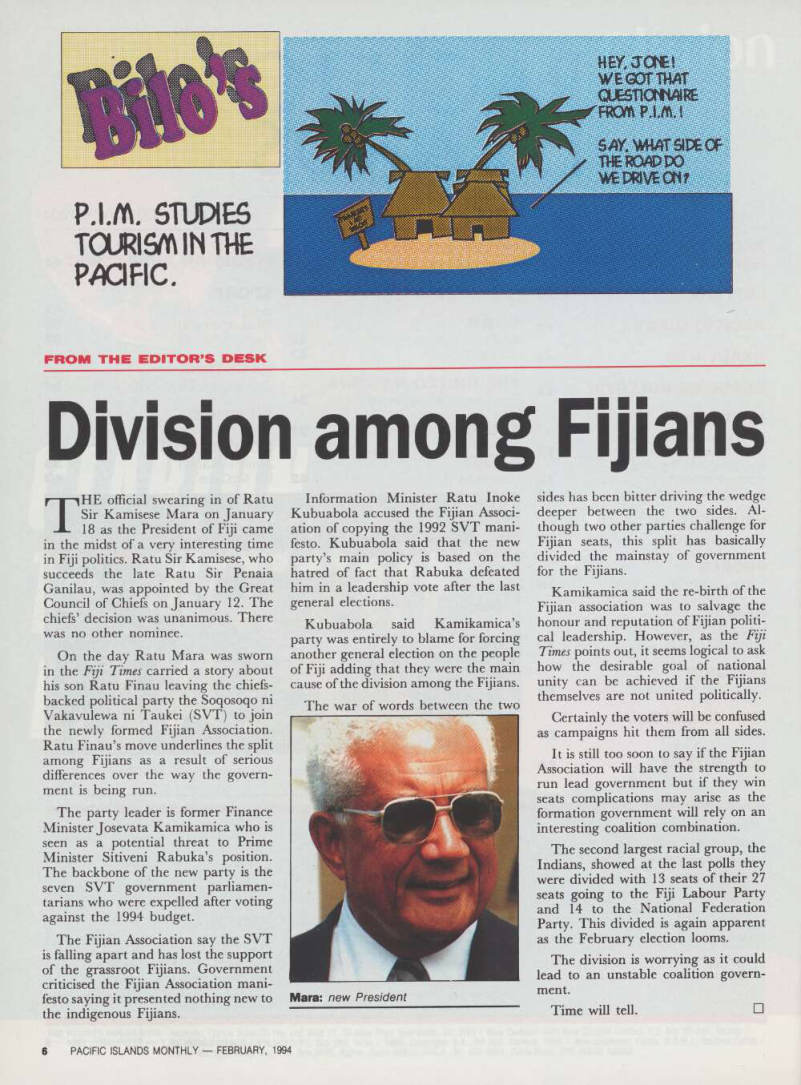
THE official swearing in of Ratu Sir Kamisese Mara on January 18 as the President of Fiji came in the midst of a very interesting time in Fiji politics. Ratu Sir Kamisese, who succeeds the late Ratu Sir Penaia Ganilau, was appointed by the Great Council of Chiefs on January 12. The chiefs’ decision was unanimous. There was no other nominee.
On the day Ratu Mara was sworn in the Fiji Times carried a story about his son Ratu Finau leaving the chiefs backed political party the Soqosoqo ni Vakavulewa ni Taukei (SVT) to join the newly formed Fijian Association.
Ratu Finau’s move underlines the split among Fijians as a result of serious differences over the way the govern ment is being run.
The party leader is former Finance Minister Josevata Kamikamica who is seen as a potential threat to Prime Minister Sitiveni Rabuka’s position.
The backbone of the new party is the seven SVT government parliamen tarians who were expelled after voting
against the 1994 budget.
The Fijian Association say the SVT is falling apart and has lost the support of the grassroot Fijians. Government criticised the Fijian Association mani festo saying it presented nothing new to
the indigenous Fijians.
Information Minister Ratu Inoke Kubuabola accused the Fijian Associ ation of copying the 1992 SVT mani festo. Kubuabola said that the new party’s main policy is based on the hatred of fact that Rabuka defeated him in a leadership vote after the last
general elections.
Kubuabola said Kamikamica’s party was entirely to blame for forcing another general election on the people of Fiji adding that they were the main cause of the division among the Fijians.
The war of words between the two
sides has been bitter driving the wedge deeper between the two sides. Al
though two other parties challenge for
Fijian seats, this split has basically
divided the mainstay of government for the Fijians.
Kamikamica said the re-birth of the Fijian association was to salvage the
honour and reputation of Fijian politi
cal leadership. However, as the Fiji Times points out, it seems logical to ask how the desirable goal of national unity can be achieved if the Fijians themselves are not united politically.
Certainly the voters will be confused as campaigns hit them from all sides.
It is still too soon to say if the Fijian Association will have the strength to run lead government but if they win seats complications may arise as the formation government will rely on an interesting coalition combination.
The second largest racial group, the Indians, showed at the last polls they were divided with 13 seats of their 27 seats going to the Fiji Labour Party and 14 to the National Federation Party. This divided is again apparent as the February election looms.
The division is worrying as it could lead to an unstable coalition govern ment.
Time will tell. D
Mara: new President
Advertisements & other items, p. 6 (1 item)
P.I.M. Studies
TOURISM IN THE
P4C1EIC.
FROM THE EDITOR’S DESK
HEV, CTONE!
WEQOTWT
QUEsnamre ftOffiWJU.! ;
THE ROW DO
VMEDHVECMf
South Pacific
Letters
South Pacific Conference
Sir, MARTIN Tiffany’s report on the South Pacific Conference if(PIM December 1993) raised the key question “are South Pacific countries and territories ef
ficiently served by the existing regional
institutional arrangements?” That ques tion does not appear to be on the agenda of the Forum Secretariat, the Conference or any of the member countries of these or other organisations that are members of the, apparently ineffective, South
Pacific Organisations Coordinating
Committee (SPOCC).
Tiffany reports that the SPC secretary general’s report to the Conference warned of the contracting financial support base for our existing regional institutions. This is a real situation and one that is likely to get a lot worse before it gets better. The region is finding it increasingly difficult to compete for aid from traditional donors whose attention is focused on Africa and Eastern Europe, let alone attract new donors.
In any case, how long can donors be expected to support the activities of these institutions? SPC boasts at being the
region’s longest serving institution. Yet it
still can only identify 30 per cent of the
budget it requires to implement its
planned 1994 work programme. It is irresponsible that member countries and territories can see fit to approve a work programme for an organisation when 70 per cent of the funding to support it, is unidentified.
Surely, it will not be long before pressure is applied for programmes in our regional institutions to demonstrate they either have the potential to become sustainable using non-donor sources of 'support, or close down. If programmes are to continue, the only alternative funding sources lie with the member countries themselves. We all know how difficult it is for countries in the region to secure funding to support essential public
services domestically, let alone signifi cantly increase their support to a pleth ora of regional institutions.
Some regional organisations do in fact generate economic and social benefits for the region in a cost-efficient way. I think it is time that they were clearly identified.
Following that relatively simple exercise,
it is time for a system of rationalisation to be introduced to the regional organ isations. As Tiffany implies, this will involve a rational and planned transfer of activities from the Conference and the SPC to the Forum and other regional
organisations.
I’m sure that providing a medium to
long-term approach is adopted, the
interests of the territories can be ad
equately catered for. Any organisation
that needs to go on bended knees looking for new members because of its funding difficulties, is a dying organisation. As the diversification of political long term interests expands, new membership is reluctant to act, maybe it is time for some
professional investigative journalism? In
the interest of those of us who have little say in these issues, I encourage PIM make it the subject of a feature article?
Peter Apakama,
Port Moresby
Environmental values
Sir, AS a tourist, spending a year or more visiting Pacific islands, I have had the
opportunity to experience the lifestyles of
many peoples and to appreciate their urgent need for constructive investment.
And when Hawaii-based Trusts “own” vast numbers of atolls and seek to stop such investment by trotting out PC gibberish about “defending the tra ditional rights and mores” of these
people by maintaining a “very fragile
uninhabited ecosystem and refuge for wildlife,” I see red.
“The American Miller,” as Kermit
Rydell labels him (is Hawaii not “Am erican”?) of Islander Investments, Ltd. (not “Inc.” as he states) is hardly likely to damage the “lands, lagoon and seabed” of an atoll which he seeks to turn into a permanent top-rank resort in collaboration with the government of the Republic of the Marshall Islands, a sovereign nation sorely in need of imaginative investment.
Presumably Mr Rydell and his “Trust” will not be happy until they “own” the whole of the North Pacific, and can throw out their destructive inhabitants and turn every atoll into a refuge for wildlife. After all, we have all read reports of the “native rights and natural environment” of overpopulated Ebeye Island and Majuro.
Arthur King
London, UK.
Games
report
Sir, I REFER to the report by Shailendra Singh (Vanuatu takes on pressure) in PIM January and find it necessary to clarify some matters in relation to comments raised on supposed problems within the Mini Games Village.
The report made mention of poor conditions within the village and states that “some teams moved out of the Games Village into hotels”. Firstly, let me assure your readers, that the unani mous verdict of all team managers was that conditions within the village were very good. Some minor teething prob lems occured in the early stages of the teams arriving; however immediate ac tion was always taken to ensure that the comfort of the competitors was main tained.
Two women’s teams which were scheduled to stay in the village remained
at alternate private venues (not hotels).
This involved approximately 25 women, and the decision not to be accommo dated in the village was based on the team’s financial reasons, and not as has been insinuated, because of conditions within the village.
The report which appeared in The Fiji Times was unfortunate, and has been strongly condemned by the management of the Fiji team. Rumours of extensive outbreaks of diarrhoea were false, with a number of cases reported being described by the medical teams at the village as “no greater than could normally be ex pected”. Additionally, care should al ways be taken with drinking water whenever and where ever one travels around the region or world.
The report on food problems was also incorrect. There is no denying that a container with food especially for the
Games was late in arriving. However interim arrangements were put in place to have food purchased from local markets. The standard of food through out the Games received the highest praise from athletes and all team officials.
The comments regarding the non attendance of chefs is also quite false.
Four chefs from Australia arrived in Port Vila as planned on November 28, 1993, that is eight days before the official start of the Games, and finished their duty on December 18. In addition, one local chef and several kitchen hands worked with the chefs for the duration.
Rules governing the movement of media within the village were set after considerable discussion with the general managers of all teams. This was the procedure that was adopted for all matters within the village complex, with the team managers becoming the regu lators, whilst the village management assumed the role of enforcer. This ensured that the well being and privacy of athletes were always first and foremost.
The media will always have a very important role to play in promoting and
reporting major regional sporting activi
ties such as the Mini Games and South Pacific Games. It is important for all parties, that such reporting remains impartial and factual for the good of sport. Unfortunately, in the case of reports relating to the village complex, these qualities were lacking in some instances.
It should be noted that despite being available at all times during the games, only one journalist made the effort to seek clarification on the issues raised herein.
To the officials and athletes of the South Pacific, we thank you for your attendance, support and words of en couragement during your stay in Vanu atu.
Is Rector
Village Manager
Fourth South Pacific Mini Games
Png’S
Security Act
Sir I READ with interest the editorial comment in PIM October 1993) edition of your magazine headlined Security or Humanity? in which you put forward your view of the Internal Security Act passed by the Papua New Guinea parliament last year.
You set out in the article your opinion of the Act and forecast some reper cussions of it in what I am inclined to believe is an attempt on your part not only to again portray a bad imagine of this beautiful country but also to smear this, as well as other initiatives taken by
the PNG government, to address the social and economic problems that have been prevalent in our society for quite some time.
I am writing this not as an advocate of the current government but as a supporter of any initiative that is bold, controversial, and draws adverse pub licity, yet practical and suited to the changes in society.
In this respect, and with regard to the Act, you quite wrongly stated in your first paragraph that “the Act, unveiled by this government, is aimed at prevent ing terrorism”.
In fact, the mechanism of the Act was actually put together and discussed by the Namaliu government some years back but shelved because of largely to heated debated and division in cabinet during discussions on whether to intro duce it in parliament for debate or not.
Furthermore, the Act, at the outset, is worded to seem it is aimed at preventing terrorism but it is actually intended to contain possible armed uprisings against the state or between provinces and tribes, and widespread civil and industrial unrests instituted outside of provisions of the labour law, all of which have contributed to the general breakdown of order in society in the urban areas, and have cost the government huge public money in its efforts to contain them.
In your fifth paragraph, you “under standably” confused the Act with a proposed changed to the provisions of the criminal code which deals with the onus
of proof.
The proposal to shift the burden of proof was not contained in the Act but was a separate proposal on its own designed to enhance the prosecution of offenders of serious crimes such as rape, armed robbery, etc in a Melanesian society where the community is known
for staunchly protecting the identity of
and defending “wantok” offenders no matter what crime they commit. It may seem that contrary to the practise adopted from the English criminal laws, any accused may now be presumed guilty until proven innocent but if that is the way justice is done, or is seen to be done more effectively, then so be it.
In all, you offered a poorly researched criticism in the strongest possible way, but you failed terribly to propose to us any constructive remedies that we readers in PNG could not only appreci ate but also view your magazine as balanced and purposeful in its reporting.
Daniel Korimbao
University of Papua New Guinea Waigani.
National Capital District.
Population
programmes
JEMIMA Garrett “Population de
bacle,” article (PIM December 1993) is a victim of the propaganda of the population control bureaucracies.
In an article laden with errors, Ms Garrett prefers to misrepresent me and engage me in sectarianism than examine my arguments against the anti-child Population control programmes to our acific neighbours who have a great love for children. If Ms Garrett thinks she is champing the plight of Third World women, she should listen to what many of them are saying about these pro grammes.
Where is her evidence for “a major change in the thinking behind these programmes”? The 70 women activists who attended the international sym
fiosium “People’s Perspective on Popu
ation” in Bangladesh in December, didn’t seem to think there had been any
change they condemned population
control programmes in a resolution which will be delivered to the Interna tional Conference on population and development in Cairo in September.
The symposium heard the grassroots experiences of many developing world women on the devastating effects of these programmes about women bleeding uncontrollably from IUDs or Norplant which doctors refuse to remove; of women offered food and money if they submitted to sterilisation; of women who had to agreed to contraception to be admitted to development programmes and of poor women being used in
experiments of long acting abortifacient
injections such as the anti-HCG vaccine, without informed consent.
Australia’s 1993/94 budget for over seas aid is miserly apart from one year, it is the lowest Official Development Aid/ GNP ratio for 20 years. From this, S3om is earmarked for population control programmes and Sl3om over four years a five-fold increase. Main countries targeted are Vietnam S2sm; China s7m; Indonesia S2om; Philippines S2om; PNG SIS; South Pacific Population and Fam
ily Planning Project Sl5M.2m. More
than Slom goes to international popu lation control bureaucracies, primarily United Nations Population Fund (UNFPA) —57.25 m increase of 97.5 per cent) and International Planned Parenthood Federation (IPPF) Sl.6m (an increase of 77.8 per cent).
Ms Garrett says that in the South Pacific “forced contraception has not been a problem”. But we can see in the renewed push for contraceptive inun dation of this region the seeds of target driven and more forceful practices. Just ask Indonesian women how it all started there.
The fact that a number ofprogrammes are to be run by the UNFPA is cause enough for concern it applauds China for its great achievements in reducing
population, totally ignoring the brutality
of a one-child policy which uses forced abortion and sterilisation, and severe punishments, to achieve its goals. Besides its involvement with coercive pro grammes, UNFPA’s role is one of
strengthening”, funding
complaint government agencies and aca demic institutions. This creates a long gravy train going its merry way and doing all it can to avoid the scrutiny of members of parliament.
Family Planning Australia (FPA), a
member of IPPF which promotes abortion in under-developed countries, has also been given money to carry out its plans for the South Pacific, with Australian Interna tional Development Assistance Bureau (AIDAB) funding, FPA conducted the first family planning feasibility tour of the South Pacific in 1984 when it met opposition from the then prime minister of the Solomon Islands who described the introduction of contraception by foreign donors as “con trolled genocide” and against the traditions of the Solomon Islands.
Australia’s then Foreign Minister Bill
Hayden was pushing heavily for population
control and in expressing his views on a join submission from the Department of Foreign Affairs and AIDAB on the future of Kiribati and Tuvalu wrote “(I) don’t care for budget aid or even project aid if no disciplines implemented faithfully and per sistently followed by “K” and “T”.
Question is how do we get those sorts of guidelines in place without being intrusive/ offensive ie. avoid impression of playing role of a localised “mini-imperialist” power?”
This persistent neo colonialist attitude can be seen in a 1990 pre-feasibility study commissioned by AIDAB “It is time, then, that leading citizens and foreigners seek to influence attitudes to and trends in
PNG population growth.”
The report is critical of the PNG government’s approach which “shows a strong preference for an indirect influence on fertility, thus limiting the scope for donors who have an interest in family planning and contraception as part of development policy and action.”
Even more disturbing is a recommenda tion for what really amounts to aid blackmail “Overall efficiency of donor assistance would dictate against the allo cation of resources to ameliorating living conditions in ‘stressed’ and ‘peri-urban’ regions until capacity to improve and sustain improvements is released (sic) by declining fertility.”
This is a classic example of aid with strings attached don’t give PNG money unless it is willing to insist upon its people accepting a population control policy under whatever guise, to reduce the fertility rate. At the Department of Foreign Affairs and Trade Estimates Committee, March 31, 1992, Australian Senator Chris Schacht asked “By switching money from budget aid to programme aid in PNG, that would be a real chance that we could make a major contribution to the funding of that
(World Bank population) programme?”
Mr Engel of AIDAB agreed, “It is quite a possibility.”
Considerale pressure continues to be brought to bear on the PNG government
to ensure that the emerging population policy in PNG moves in a direction pre determined by foreign creditors and do nors. Official documentation shows UNFPA has set targets in PNG for
“acceptance” of oral contraceptives,
condoms, and Depo-Provera from an estimated six per cent in 1989 to 35 per cent
by 1995. The injectible drug Depo-Provera
accounts for 63.3 per cent of the total funds to be spent on contraceptive purchases by UNFPA for the PNG project Pneumonia and malaria are big killers in PNG. At a medical conference in the PNG Highlands in 1992, I was told of people dying from pneumonia for want of effective antibiotic treatment. They haven’t got basic medicines but there’s no shortage of the Pill and Dep Provera. Why does Australia fund this controversial drug in PNG when it is not officially approved for use as a contraceptive here?
The PNG government will have to find USs9m for its share and later has to repay nearly USsl4m borrowed from the World Bank and Asian Development Bank. Ms Garret implies that my opposition to population control programmes will con tribute to maternal mortality. The question must be asked, what is the real reason for these deaths?
A study titled ‘Too Far to Walk Maternal Mortality in Context’, cites hospital-based studies which find that the large majority of deaths are preventable.
According to the Women’s Information Network, maternal mortality figures in Africa “exactly correlate” with female genital mutilation. Unvaccinated and anaemic women are also more likely to die in childbirth. The fertility of poor women is not to blame for these appalling conditions. Surely alleviating these con ditions would be a better use of our aid money.
Ms Garrett says the population inquiry would “re-invent the wheel”. But empirical evidence documenting the supposed nega tive net impact of population growth on economic development is either fragile or non-existent. There is no scientific consen sus. There is a solid body of evidence opposing conventional wisdom about the
effects of population growth.
Should Australia’s precious aid money be diverted from development cooperation and poverty-alleviation programmes to Copulation control programmes on the asis of an untested assumption? Inaccur ate to the last, Ms Garrett’s final words are that the person appointed to conduct the review required my endorsement. Far from
receiving my approval, Minister Bilney has
appointed Professor Dennis Ahlburg, of the University of Minnesota, a long-time consultant with the World Bank who has expressed views in support of population programmes of the type proposed by
Aidab.
Senator Brian Harradine
Parliament House, Canberra ACT 2600 Australia Senator Harradine is vice-president of the Australian Parliamentary Am nesty Group, and a member of the Australian parliament’s joint com mittee on Foreign Affairs Defence and Trade and its Human Rights Sub Committee.
Advertisements & other items, pp. 7-10 (1 item)
Pacific
Remember your Friend
There are times in your life when you feel your friends have been missing out on something good. Now’s your chance to do something about it and share with them one of the good things you have. Buy your friend a subscription to Pacific Islands Monthly and let him or her join you and thousands of other people worldwide who are kept informed of the latest political, social and cultural
changes taking place in the Pacific.
SUBSCRIPTIONS
American Samoa US$45 Australia A$42.00 Canada US$45 Cook Islands AUS$46 Fiji F$26,40 French Polynesia US$45 Guam US$45 Hawaii US$45 Japan US$45 Kiribati AUS$46 Marshall/Micronesia US$40 Nauru AUS$42 New Caledonia US$32 New Zealand NZ$55 Niue AUS$46 Norfolk Island AUS$42 Northern Marianas/Palau US$40 Papua New Guinea AUS$45 Solomon Islands AUS$46 Tonga AUS$46 Tuvalu AUS$46 United Kingdom Stg Pound28 US Mainland US$45 Vanuatu AUS$45 Western Samoa WS$60 Elsewhere AUS$63 Payment to Pacific Islands Monthly: Subscriptions Dept, GPO Box 1167, Suva, Fiji.
Subscriptions rates include the cost of airspeeding to all destinations set out above.
Direct airmail rates on application.
Telephone: 304111 Fax; 303809
PACIFIC
ISLANDS
[~M"~ O /V T H L VI Please send my friend Pacific Islands Monthly for one year (12 issues).
I enclose my cheque for $ (made payable to Pacific
Islands Monthly)
or debit $ to my: □ Bankcard □ Visacard □ Mastercard Card No: i S j i !; Fi "T1 T I i s I 1. i Expiry Date ———
NAME
SIGNATURE
ADDRESS:
CITY COUNTRY
V
oCb
Educational Promotional Corporate TV commercials Conference Filming Events
Tradewind Communications Ltd
TV BROADCAST k VIDEO PRODUCTION
Based in Auckland, New Zealand. The best production facilities in the South Pacific available with the most competitive rates. We can tailor a production to your budget and requirements. Location experience throughout the Pacific.
Call us now with your basic idea and we will transform it into a powerful message.
P.O. Box 5761 Ph (64) 9 520 4014 Wellesley St Auckland Fax (64) 9 522 2295 New Zealand Mobile (64) 25 986 507 Documentaries Tourist Video Underwater Filming Any language
I I
< JJwrjj
S|
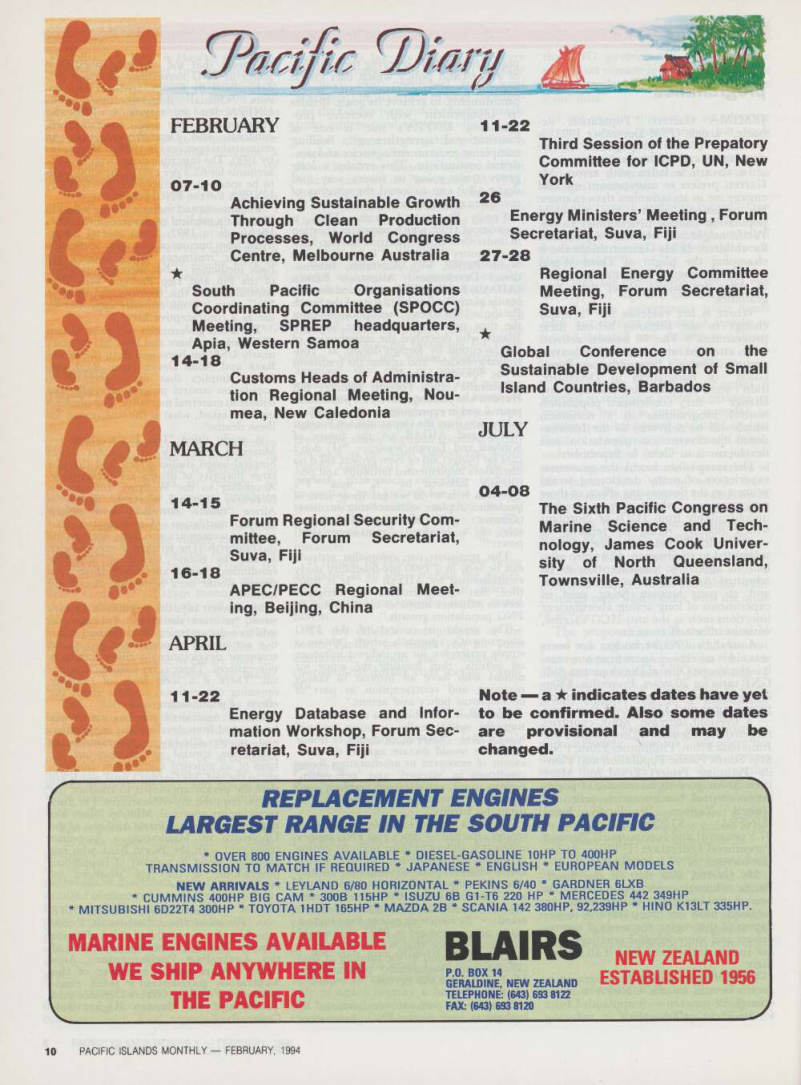
FEBRUARY
11-22 07-10 Third Session of the Prepatory Committee for ICPD, UN, New York I J Achieving Sustainable Growth Through Clean Production Processes, World Congress Centre, Melbourne Australia 26 •••* 3 South Pacific Organisations Coordinating Committee (SPOCC) Meeting, SPREP headquarters, Apia, Western Samoa 14-18 Customs Heads of Administration Regional Meeting, Noumea, New Caledonia Energy Ministers’ Meeting , Forum Secretariat, Suva, Fiji 27-28 Regional Energy Committee Meeting, Forum Secretariat, Suva, Fiji ★ Global Conference on the Sustainable Development of Small Island Countries, Barbados
MARCH
JULY
14-15 04-08 Forum Regional Security Committee, Forum Secretariat, Suva, Fiji 16-18 C< J APEC/PECC Regional Meeting, Beijing, China The Sixth Pacific Congress on Marine Science and Technology, James Cook University of North Queensland, Townsville, Australia
APRIL
11-22 I i** f Note a ★ indicates dates have yet Energy Database and Infor- to be confirmed. Also some dates mation Workshop, Forum Sec- are provisional and may be changed. retariat, Suva, Fiji r
REPLACEMENT ENGINES
LARGEST RANGE IN THE SOUTH PACIFIC
* OVER 800 ENGINES AVAILABLE * DIESEL-GASOLINE 10HP TO 400 HP TRANSMISSION TO MATCH IF REQUIRED * JAPANESE * ENGLISH * EUROPEAN MODELS NEW ARRIVALS * LEYLAND 6/80 HORIZONTAL * PEKINS 6/40 * GARDNER 6LXB * CUMMINS 400 HP BIG CAM * 3008 115 HP * ISUZU 6B Gl-T6 220 HP * MERCEDES 442 349 HP * MITSUBISHI 6D22T4 300 HP * TOYOTA IHDT 165 HP * MAZDA 2B * SCANIA 142 380 HP, 92.239 HP * HINO KI3LT 335 HP.
V.
MARINE ENGINES AVAILABLE
WE SHIP ANYWHERE IN
THE PACIFIC
BLAIRS
NEW ZEALAND
P.O. BOX 14
GERALDINE, NEW ZEALAND
TELEPHONE: (643) 693 8122
FAX: (643) 693 8120
ESTABLISHED 1956
J
again
Headlines
Nauru
Nauru conned again
Nauru’s vulnerability to financial mismanagement was under lined again recently when it became known that a Melbourne based employee of the Republic of Nauru has been charged with swindling the nation of an estimated AS 1,500,000.
Earlier this year Nauru was taken for millions of dollars by conmen dealing in phoney financial instruments, as well as losing other large sums on the Japanese stock market, on the London stage, and in various real estate ventures (PIM August, 1993).
The accused, Corazon Ardern, a Filipina, had been employed as the chief accountant at Nauru’s office in its Melbourne skyscraper, Nauru House. According to Senior Detective Michael Scott Goddard of the Victoria police, the financial records she maintained were a shambles of bits and pieces of paper; he reportedly estimated that it would cost hundreds of thousands of dollars to recreate the financial records of the organisation, and to determine exactly what was done did with the missing funds. Although Ardern has been indicted, no trial date has been set, because she lacks a lawyer.
One of the reasons she does not have a lawyer is because Australian authorities have frozen her bank accounts until the charges are resolved. Police authorities in Victoria say that in circumstances like this inside swindlers can flourish only if the supervision is lax.
Nauru’s chief administrative officer in Melbourne, Edwin McPhail, confirmed to PIM that Ardern had worked for Nauru, but said that he would not respond to written questions, only to faxed ones. He did not respond to those either.
go on holiday
Vanuatu
Timakata allowed to go on holiday
The President of Vanuatu Fred Timakata was forced to go to court in January to win the right to take his annual holiday.
The Vanuatu government on the second weekend in January suddenly cancelled Timakata’s plans for a family holiday to Brisbane and Sydney.
Timakata, who ends his five-year term on January 31, complained he was not being treated with the respect he deserved.
The government was apparently concerned that the country’s Speaker of Parliament, who normally acts as head of state when a president is away, was already overseas.
On January 12 Timakata launched legal action in Vanuatu’s Supreme Court, arguing that the constitution allowed the Deputy Speaker to temporarily assume the job of head of state.
The court was saved from having to make a constitutional ruling when the speaker suddenly returned to Vanuatu last night, the President’s principal private secretary, Pakoa Maraki said.
Lawsuits challenge
Palau
Lawsuits challenge Palau compact
Two lawsuits challenging the legality of Palau s recently ratified Compact of Free Association have been filed.
One suit, filed by Isabella Sumang and Valentina Tmodrang against the Republic of Palau and the US government, contends the Compact’s approval was “procured by coercion”.
The suit also challenges the agreement on the grounds that it was not approved by two-thirds of the Palauan legislature, that the Letter of Assurances from the United States was not a favourable response to requested modifications as required by law, and provisions of the Compact relating to US military use of Palau were unconstitutional.
Residents of the western Pacific archipelago voted in November to approve the Compact, which assures self-rule and endorses a political, economic and defense pact with the United States.
The second lawsuit, filed by Nancy Wong and Lucia Tabelual, claims that since the republic’s Constitution requires a 75 per cent majority to approve the possibility of nuclear material being present in Palau, any amendment to consti tutional provisions should also require 75 per cent approval.
The vote was 5193 in favour, which represents 68.26 per cent of the votes cast.
Despite the lawsuits, which were filed on January 3, Palau President Kuniwo Nakamura said most, if not all of the issues raised in them, have been addressed by the courts.
“These lawsuits may delay the Republic in being able to implement the Compact at the earliest possible date as we had originally hoped,” he said.
“However, this administration is confident that the Compact will be implemented and the door will be opened for a bright new future for all Palauans.”
The pact failed in seven previous plebiscites, always getting more than 56 per cent of the vote, but never the required 75 per cent.
Last year, Palauans approved a constitutional amendment requiring that the pact need only a simple majority for passage.
The Compact allows Palauans self-rule and provides some SUS4SO million (5A658.76 million) in US economic aid.
Under the provisions of the Compact, the US military will be allowed to operate on Palau in a crisis and open two military bases.
The United States would be responsible for Palau’s defence and other countries would be denied military access to the region.
Palau, a series of islands with 15,000 people, is the world’s last remaining UN trust territory.
As the islands’ trustee, the United States has administered Palau’s affairs.
The archipelago is 7,200 km southwest of Hawaii.
Bank of Hawaii
opens in Vanuatu
A BRANCH of the Bank of Hawaii has opened has opened in Vanuatu. Bancorp Hawaii chairman Howard Stephenson announced that the Bank of Hawaii International had acquired 80 per cent interest in Banque Indosuez Vanuatu Limited and will rename it Banque D’Hawaii Vanuatu Limited.
The government of Vanuatu remains a 20 per cent shareholder in the bank which has the main office in Port Vila and a branch in Luganville.
Car prices worry
Solomons govt
IN the Solomon Islands, six used cars imported from Singapore are declared to be worth a total of just US$563. That is less than $94 each and all are in excellent condition.
The Customs department is now carrying out investigations to determine whether the incredibly low prices for the cars was an attempt to defraud the government of import duty.
Air Pacific set for
Los Angeles service
AIR Pacific is to establish services to the United States. The move by the Fiji international carrier to open a once weekly Boeing 747-200 operation be tween Nadi and Los Angles in July is a further indication of improving con ditions across the Pacific. Qantas has indicated that its service from Australia to Nadi and Los Angeles may be scaled down early this year, although nothing official has been announced.
Air Pacific chairman Gerald Barrack said the Fiji government’s decision to review its air transport agreement with New Zealand has proved a key factor in proceeding with the US service. The airline, which is 10 per cent owned by Qantas, hopes to emerge from the impending talks with a deal that will boost its competitive position against Air new Zealand on the route to the US west coast.
However, Barrack stressed that despite encouraging lifts in the Pacific market and the US economy, the proposed service would still be only marginally viable. Los Angeles is one of several so called “missionary routes” being con sidered by Air Pacific, and its develop ment could delay the introduction of another new service to South Korea.
United Airlines plans
flights to Sydney
UNITED Airlines will introduce non stop flights from Sydney to San Francisco in June. The flights will be three times a week, using Boeing 747-400 aircraft, a spokesman for the American company said.
Industry sources said they would help ease a shortage of trans-Pacific seats following the withdrawals of Continental Airlines from the South Pacific last year.
At present United schedules daily flights from Sydney to los Angeles non-stop, and from Melbourne to Los Angeles via Auckland.
Boost for PNG
oil industry
PAPUA New Guinea’s oil industry has been boosted with the success of a “significant” new exploration pro gramme close to the South-east Gobe project, inland from the Gulf of Papua.
In a statement to the Australian Stock Exchange, Oil Search Limited said that, together with its joint venture pertners, it had struck success with the drilling of the Gobe 4X sidetrack hole. This was about 15 kilometres south-west of the South-east Gobe project.
The South-East Gobe project, already identified as a 55 million barrels a day field is expected to be in production by mid-1996. The new Gobe 4X discovery will add a further dimension to the development of the area, especially as it is close to the Kutubu oil pipeline.
Royal Tongan ends
seat purchase deal
A SEAT purchasing agreement between Solomon Airlines and Royal Tongan Airlines was terminated at the end of last month. Royal Tongan has been purchas ing seats on the Solomon Airlines 737-400 jet between Auckalnd and Nuku’alofa since 1991.
Royal Tongan issued a notice six months ago as required that it would not renew its seat purchasing agreement with Solomon Airlines. Royal Tongan Air lines will now use Western Samoa’s Polynesian Airlines for the Auckland- Nuku’alofa route.
The announcement has caused Sol omon Airlines to change its international schedules. It has recently introduced a direct service betwen Honiara and Nadi, in Fiji, and two two direct flights each week between Honiara and Cairns.
Fiji says no to
bilateral agreement
THE Fiji government says it will not sign the present draft of proposals for a new bilateral agricultural agreement with New Zealand. This follows reservations by Fiji’s fruit and vegetable exporters who argue that the proposals are in favour of New Zealand.
The statement comes after talks in Suva between the two sides which discussed new stipulations for produce destined for the Neww Zealand market.
Under the proposal, all fruits and vegetables will be subjected to rigorous treatment procedures.
Last year New Zealand introduced lower residue limits to the use of the fumigant chemical EDB as of the start of this year. Fiji has now asked New Zealand to extend the use of EDB pending further research into ways of containingTruit flies.
Business magazine
launched in Tonga
A business-oriented monthly magazine was launched in Nuku’alofa on January 13. The publication Lali is being put out by Lali Communications Ltd, Nuku’alofa. The publisher is Kalafi Moala publisher/editor of the weekly newspaper Times of Tonga.
Published in English, the first issue features an interview with Minister of Labour, Commerce and Industries, Tutoataki Fakafanua. It includes reports on local banking, computing, agricul ture, aviation, energy, sports, politics and other financial reviews. Lali also contains business news and information from Pacific countries.
Norfolk shopping
complex sold
A SHOPPING arcade on Norfolk Island has been sold for more than US$5OO,OOO.
The Broadwalk Shopping Arcade, which consists of 10 shops, occupies a prime corner site in the centre of Burnt Pine the island’s commercial and retail centre.
Fully-leased, the property is capable of producing an income of US$lO5,OOO per annum.
The sale by Westpac bank attracted several Australian buyers but the success ful bidder was a Norfolk Island investor.
Norfolk Island, with a permanent popu lation of 2000, is only Bkm long and skm wide. Originally, it was a British penal colony but in 1856 became home to Pitcairn islanders, descendants of the Bounty mutiny. □
Solbrew sets up
Business
Solbrew sets up niche in Solomons
By Roman Grynberg
FOR years Nauruans have dreamed of having their own brewery but the economics of such a venture on an island where beer and water sell at about the same price was not obvious. Now finally Nauru has a brewery but it is located in Honiara. The Solomon Breweries is joint venture between Nauru and the German brewing giant Brauhaas. The firm is 70 per cent owned by the Nauru government and 30 per cent owned by rauhaas together with other European interest.
The government of Nauru’s invest ment policy has been under much public scrutiny in the last year because of alleged scandals. However, the underly ing economics of the brewery in Honiara are not likely to give Nauru any serious headaches.
The German company Brauhaas is also involved in the Western Samoan brewery that produces Vailima. The introduction of Solbrew is the last link in the region’s chain of breweries and now all major Melanesian and Polynesian countries have their own breweries. The government of the Solomon Islands did not take an equity position in the brewery as it is undertaking a policy of privatisation of its existing assets.
This also makes Solbrew one of the few breweries in the region without some investment by the government. Gener ally speaking governments have either directly or indirectly through their provi dent funds taken positions in these breweries. This is also preferred by the foreign joint venture partner because it means that governments will have even more incentive to give the company a competitive edge over generally much larger importers of beer from Australia and New Zealand.
The brewery which was opened in April, 1993 25 million German Marks, according to the new incoming general manager Rainer Goldbeck. The com pany was granted an eight year tax holiday by the Solomon Islands govern ment. Goldbeck has just recently re placed the original manager Jerry Hope who has retired to live in Western Samoa. The company has a production capacity of 40,000 hectoliters and cur rently employs 100 workers. Solbrew expects that its year end 1993 sales will be in the vicinity of 23,000 hectoliters.
Clearly the firm has a great deal of room for growth.
According to Goldbeck, Solbrew has
already managed to capture 70 per cent of the Solomon Islands market. Import ers of Carlton and United Breweries products, which before Solbrew had, in 1991 almost 80 per cent of the Solomon islands market did not wish to comment on whether the claim was true.
In Honiara it is difficult to ascertain whether such claims are correct or not but the beer certainly has won the hearts of Solomon Islandenrs who, despite the Nauruan ownership, have taken to it with a nationalist fervour that would certainly be the envy of neighboring Vanuatu Breweries which has not been able to attract as much brand loyalty as Solbrew though it has definitely im proved its position with the introduction of Vanuatu Bitter.
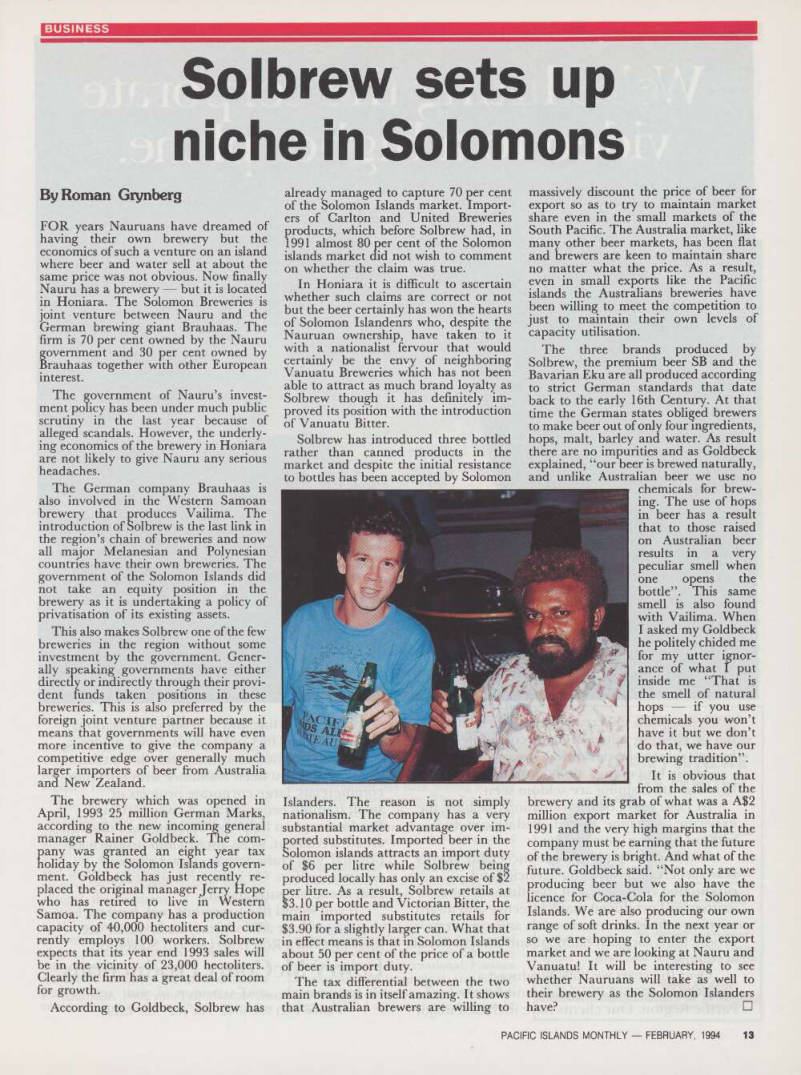
Solbrew has introduced three bottled rather than canned products in the market and despite the initial resistance to bottles has been accepted by Solomon
Islanders. The reason is not simply nationalism. The company has a very substantial market advantage over im gorted substitutes. Imported beer in the olomon islands attracts an import duty of $6 per litre while Solbrew being produced locally has only an excise of $2 per litre. As a result, Solbrew retails at $3.10 per bottle and Victorian Bitter, the main imported substitutes retails for $3.90 for a slightly larger can. What that in effect means is that in Solomon Islands about 50 per cent of the price of a bottle of beer is import duty.
The tax differential between the two main brands is in itself amazing. It shows that Australian brewers are willing to
massively discount the price of beer for export so as to try to maintain market share even in the small markets of the South Pacific. The Australia market, like many other beer markets, has been flat and brewers are keen to maintain share no matter what the price. As a result, even in small exports like the Pacific islands the Australians breweries have been willing to meet the competition to just to maintain their own levels of
capacity utilisation.
The three brands produced by Solbrew, the premium beer SB and the Bavarian Eku are all produced according to strict German standards that date back to the early 16th Century. At that time the German states obliged brewers to make beer out of only four ingredients, hops, malt, barley and water. As result there are no impurities and as Goldbeck explained, “our beer is brewed naturally, and unlike Australian beer we use no
chemicals for brew ing. The use of hops in beer has a result that to those raised on Australian beer results in a very peculiar smell when one opens the bottle”. This same smell is also found with Vailima. When I asked my Goldbeck he politely chided me for my utter ignor ance of what I put inside me “That is the smell of natural hops if you use chemicals you won’t have it but we don’t do that, we have our
brewing tradition”.
It is obvious that from the sales of the
brewery and its grab of what was a As 2 million export market for Australia in 1991 and the very high margins that the company must be earning that the future of the brewery is bright. And what of the future. Goldbeck said. “Not only are we producing beer but we also have the licence for Coca-Cola for the Solomon Islands. We are also producing our own range of soft drinks. In the next year or so we are hoping to enter the export market and we are looking at Nauru and Vanuatu! It will be interesting to see whether Nauruans will take as well to their brewery as the Solomon Islanders have? □
Advertisements & other items, p. 14 (1 item)
We’re lifting the corporate
video to a higher plane.
iSSpf- - ■Blll m In the past, the creativity and particularly the production values of many corporate videos has left a lot to be desired.
Thirty foot cranes, dolly shots and sensitive lighting and framing are seldom seen.
At Lowry McCourt Productions we have the expertise to change all that. And we can do it
without blowing your budget.
Our backgrounds include successful, twenty year careers in advertising agencies and production companies. In that time we have written and produced many effective and award winning television commercials and corporate productions for both national and international accounts.
Over the years we have produced a substantial amount of work in and for the Pacific Region. Our clients have included major commercial, airline and tourism organisations in Fiji, Flawaii, The Cook Islands, New Caledonia, Tahiti and several countries in South East Asia.
Whether you need assistance with television commercials, large corporate projects or small training programmes, Lowry McCourt Productions can help you develop your strategy, create a concept, write a script and produce an original, well crafted and relevant piece of communication. On time, on budget and to your complete satisfaction.
If you would like to see our reel, have a chat or seek our advice at any time, call or fax Rory McCourt, Rob Lowry or lan Stevenson.
Lowry McCourt Productions
101 Blues Point Road, McMahons Point 2060, Australia.
Phone (02) 955 6702 Fax (02) 929 4849.
end of the alphabet
Business
Z-not just the end of the alphabet
By Roman Grynberg
UNLESS you are in the tuna business the letter Z is just the end of the alphabet but to those who know the business, Z Fishing is the largest purse-seining com pany in the US and is responsible for 100,000 tonne catch per annum or about 8 per cent of the world’s tuna. The new cannery about to be opened by the company in Madang Province in PNG represents a major shift in focus for the fishing company into down stream pro cessing and it will mark a very important step in the maturing of the PNG economy as it develops export markets for fully processed raw materials.
For all the talk downstream, process ing the cannery represents a major movement from an industry where the product never even touched the shores of PNG to full integration.
To establish a cannery in a relatively high cost country like PNG is by no means an obvious business venture and so I asked Lawrence Zaunich, the president of Z Fishing and son of the founder of the fishing giant why. “I am in this because I want my own cannery because Thailand was simply controlling the trade. To be quite frank with you PNG was last on my list.” So why PNG?
Zaunich went through the list of potential locations. “FSM no water, Kiribati no water, Western Samoa no fish, Vanuatu wages too high, Solomon Islands had no oil storage.
What PNG has is water and in normal fishing years about 40 per cent of the region’s tuna.”
The Z cannery will be located in Alexishafen and will be paying wages of about K 27 per fortnight. The 1992 minimum wage decision which elimin ated the rural/urban wage differential and thereby effectively cut urban mini mum wages in quarter, would not have effected the company as it is already located in a rural area. The cannery will work on a two-shift basis with 1200 workers and will be moving 100 tonnes of fish per shift. The real problem with the cannery, as Zaunich admits, is whether it achieves the level of labour productivity that he expects. Tuna canneries in the region have not nor-
mally achieved such high levels of output
and productivity.
This is the beginning of one of the largest investments in the manufacturing sector in the South Pacific for many years. The ground breaking ceremony for the Z cannery at Alexishafen in December was considered to be a major breakthrough for PNG because while PNG has been able to attract some foreign investment into the manufactur ing sector it has only been in cases where the government has been willing to offer high levels of protection. The Z cannery tuna is meant for the export high levels of protection. The Z cannery tuna is meant for the export market and beyond the pioneer industry status which grants tax free status for five years and the right to fish in the PNG territorial sea, there will be need for input from the govern ment.
The project is not only an investment by the Z Fishing but has the backing of some very substantial players. The most prestigious is the International Finance Corporation, an investment arm of the International Monetary Fund which has taken a USD 1 million equity position in
the cannery. It has also provided loans for the venture include the Common
wealth Development Corporation which
has provided US$l million in equity as well US$5 million in debt. There will also be investments by a consortium of
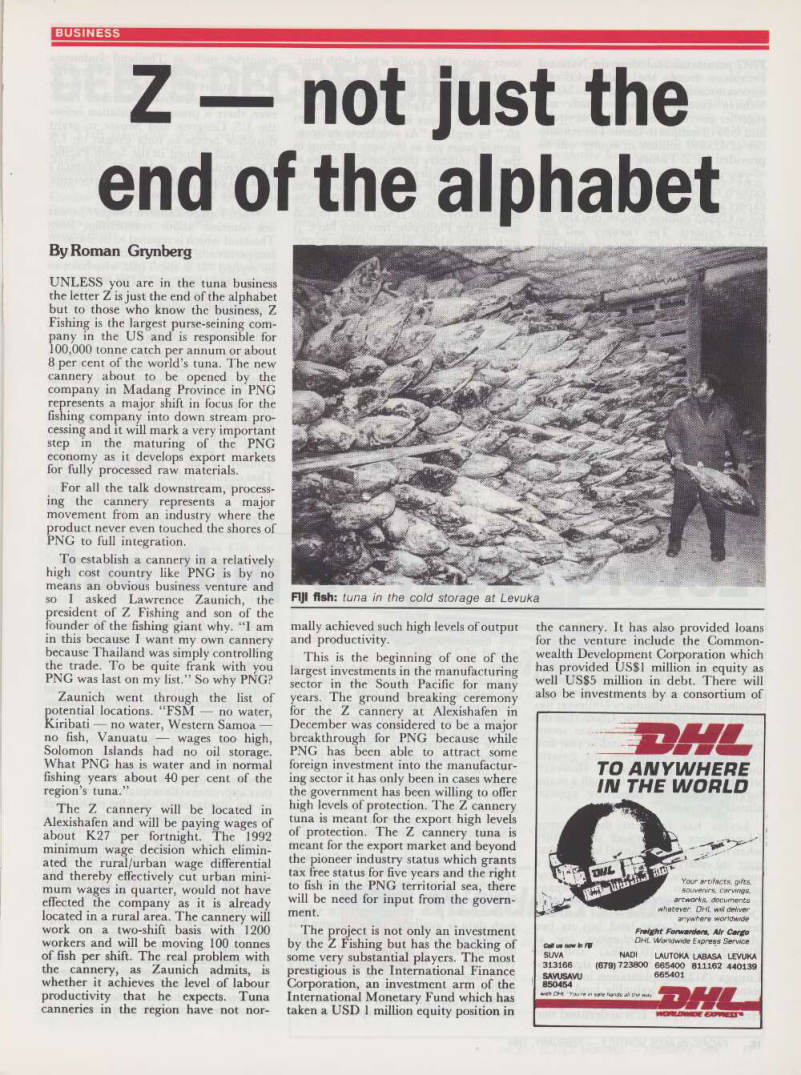
FIJI fish: tuna in the cold storage at Levuka
PNG parastatals including the National Provident Fund, the Public Officers Superannuation fund and the Motor Vehicle Insurance Trust which will together provide US$4 million in equity and US$lO million in loans. The remain der of US$l9 million in equity will be provided by Z Fishing.
The K 55 million project will result in exports of some 3.5 million cases of tuna export at some US$2B per carton making for a US$B5 million shot in the arm for PNG’s exports. The cannery will also have a can making facility attached that will produce cans for James Barnes meat cannery in Madang as well as the Z cannery. John Leahy, of Deloittes in Porrt Moresby which brokered the deal with the government, was delighted and said “This shows that it is possible, despite what is so frequently said to establish a large labour intensive indus tries that uses the country’s natural resources here in PNG and that the government will co-operate”.
The canning of tuna has in the past few years become increasingly associated with environmental pollution as was the case with the canneries in American Samoa. Tuna fishing has also come into its fair share of criticism as it has also become associated with fishing practices that are considered to be dangerous to other species such as dolphins which, in
some parts of the world school with tuna.
PIM asked Zaunich whether we can expect a degradation of the harbour and waters around Madang that are one of PNG’s best hopes for tourism. “Not at all,” he replied. “As you know environ mental issues are at the very forefront in the tuna industry these days. In terms of fishing techniques our companny for example uses 10’ mesh on our nets so as to minimise as much as possible the incidental by-catch. If you have a look at some of the Philippine nets they have '/ 2 inch mesh which drags literally every thing along with the tuna. We moved to the western Pacific in 1981 in part because of the dolphin issue. In the Western Pacific the dolphins do not school with tuna so there is no dolphin issue.”
According to Zaunich the cannery itself will use state of the art technology.
“We will use scrubbers so that as you approach the cannery you will not even be able to smell it. We will be recycling the water through a waste treatment plant which will not result in marine
pollution.”
The canned tuna will be marketed in the UK initially. Under the Lome IV Convention tuna canned in PNG and other African Carribean and Pacific (AGP) states such as the Solomon Islands enters the UK duty free. Tuna from
countries such as Thailand Indonesia and the Philippines attracts a 24 per cent rate of import duty in the EC. As a result this is the most obvious market. How ever, there is presently legislation before the US Congress and Senate to grant duty-free access to tuna caught on US vessels and canned in the South Pacific.
This legislation would give Zaunich’s tuna a 12 per cent margin of preference over tuna that has to pay duty.
When I asked Zaunich whether he was not worried about competition from Thailand which is reputed to be the most competitive of producers in the market he replied “It is the Thais who have to be worried about me”. The boast of an overly confident entrepreneur about to lose his shirt? Not necessarily. One of the main determinants of what makes a canner is how cheaply he gets his fish.
This is the bulk of the cost. Zaunich’s company has one of the most efficient fishing fleets in the world. The fish that the Thais use for canning often comes from PNG waters and often from Z
Fishing Company purseiners. If Zaunich
does not have to pay international prices when the price of tuna is high he may actually be able to put a big dent in the Thai canning industry and in the process propel PNG, formerly just a fee collector in the world tuna market into the big league of tuna canning. □
Advertisements & other items, p. 15 (1 item)
To Anywhere
IN THE WORLD
Your artifacts, gifts, souvenirs, carvings, artworks, documents whatever. DHL will deliver anywhere worldwide Freight Forwarders, Air Cargo . DHL Worldwide Express Service Can us now m rfi
SUVA NADI LAUTOKA LABASA LEVUKA
313166 (679)723800 665400 811162 440139
SAVUSAVU 665401
850454
Levers ready to pull out
IN most countries of the region the departure of the oldest and probably one of the most substantial investors in the country would be a cause of major concern. But in Honiara the proposed sale of Levers 60 per cent holding in its Solomon Island subsidiary Unilevers has barely raised an eyebrow. Given that the company is the biggest private sector employer in the country and at year end 1992 had 1222 employees the government should be concerned. However, with the economy going through a major logging boom the departure appears almost unnoticed.
Levers has been in the Solomon Islands since the turn of the century when it bought a substantial holding that over the years it has developed into a successful copra, coconut oil and cocoa plantation. In 1905, the company bought some 36,000 hectares of land.
Over the years it has divested itself of a large chunk of that land but its two glantations in the Solomons, one at .ussell Island (10,613 ha) and the smaller but much more significant Lungga (3133 ha) plantation located on some of the most valuable land in the Solomons, between Honiara town and Henderson Airport. It is understood that
the land is held under crown lease and not under customary ownership for a period of 75 years.
The official reason that the lawyers in Honiara give for Unlevers pullout from the Solomon Islands is that the parent company which has plantations in eleven countries wishes to concentrate its efforts on growing tea and palm oil, which is where the parent clearly sees that it has a commercial advantage. The fact is that over the past five years the company has recorded substantial losses on its oper ations in the Solomon Islands. In large measure this can be explained by low copra and cocoa prices over the period.
The company has, however, according to normally well informed sources in the legal community, accumulated a sub stantial amount of debt to the parent company, what is believed to be a total of 5158.7 million in 1992.
Over the past three years for which such data is available the company has lost substantially from its operations and has not made a pre-tax profit for five years. At the moment tne company’s fixed assets are valued at some Sls2l million. Is is understood that an offer for the 60 per cent interest in the plantations has been received and accepted from Jim
Boyers and Australian who had substan tial logging interests in the Solomon Islands in the past. His son Peter Boyers is the owner of Concrete Industries in the Solomons.
The significant question is of course what will become of the two plantations.
It is understood that as part of the deal between Unilevers and Boyers will con tinue to operate the Russell Island plantation under the existing manage ment. However the Lunggaplantation is very much up in the air. The reason is that approximately a quarter of the land on the plantation is ideal for tourist and commercial development as much of it faces the beaches the US marines landed on during the Battle of Guadalcanal.
There can be no doubt that the capital will, in the coming years, expand along the road to the airport and as result the value of the plantation will come in its subdivision rather than continuing to operate it as a cocoa plantation. How ever while this makes eminent sense in the longer term this must have very serious consequences in a country which has normally got between two weeks sand month foreign exchange cover for imports. As yet the government has made no comment about the proposed sale. □
Debts Decreasing
Money
BY THE standards of the rest of the developing world, the Pacific Islands have sipped only sparingly from the sometimes intoxicating bottle of external debt with the exception of Papua New Guinea. This conclusion can be drawn from the latest tabulation of debt infor mation released for 1992 by the World Bank.
At the end of that year, the total (long - and short-term) debts of the six nations covered by the Bank were as follows, in millions of US$~ PNG $3736, Fiji $337, Western Samoa $llB, Solomons $9l, Tonga $43, Vanuatu $4O. Given PNG’s landmass and population one would expect a higher absolute debt than those recorded for smaller nations, but PNG’s debt is also the largest proportionally of the six. It displays the ratio between a nation’s total external debt and its gross national product or GNP (the sum total of all goods and services produced during the year). Low ratios, such as those of Fiji and Vanuatu, indicate that these nations have borrowed only modestly, as com pared to their GNP.
Five of the listed nations (but not PNG) had proportionally lower debts in 1992 that they did the previous year.
This means that either GNP increased, as it did in several countries, or that debt levels declined (as they did in Fiji, the Solomons, Tonga and particularly West ern Samoa), or both. In contrast, PNG went more than one billion dollars deeper in debt in 1992, while its GNP increased at a slower rate.
The most dramatic drops in external debt came in Western Samoa (from $l4l million to $llB million) and in Tonga (from $l3O to $9l million). In both cases long-term debt stayed nearly stationary, but short-term debt dropped to almost nothing. PNG’s massive increase in external debt was all in the private sector (presumably largely related to minerals) with the public debt actually dropping between 1991 and 1992. Public and publicly-guaranteed debt declined about $5O million, while private, non government-guaranteed debt declined about $5O million, while private, non government-guaranteed deby rose from $964 million to $1726 million.
But despite the increasing levels of debt in PNG’s private sector, none of the Pacific islands are close to the debt levels of some other island nations. The debts of Madagascar and Jamaica would both be off the accompanying chart— each has external debts at about the 150 per cent of the level of their GNP, about twice the ratio recorded for PNG. But the world champion island borrower of funds is Sao Tome and Principe, an ex-Portuguese colony off the West Coast of Africa.
These islands have managed to persuade someone to lend them more than five
times their GNP.
The World Bank, which loves to categorise things and build mathemat ical models, has divided the developing world into five debt classifications, four of which indicate some degree of World Bank concern. Sao Tome, for example, is in the most worrisome category “severely-indebted low-income nations.”
The lowest level of concern is expressed for “moderately-indebted middle
income countries,” which includes PNG.
The other five island nations tracked by PNG are in the World Bank’s not-to worry category, or, more formally “other developing nations.” Kiribati, Nauru, and Tuvalu are not tracked by the World Bank, nor are any of the less-than completely sovereign entities.
The data described above can be found in World Debt Tables 1993-1994, Volumes 1 and 2; if you want to go in debt yourself, you can buy them from the World Bank, Box 7427-8619, Philadel phia, Pa, 19170, USA. Volume 1, the overview, is (US) $16,95, while Volume 2, the detailed tables (with four pages for each nation) is $125.00. □
Advertisements & other items, p. 17 (1 item)
Designed for
the Pad
unique renditions.
J/3 s a <u: f V/ i m iaramrfTf •ccW Maddren have designed a range of homes, especially to suit Pacific conditions. Built in strength from additional ties and bracing, and a wide choice of designs that we are happy to modify to suit individual needs.
These homes may be purchased, kitset shell or complete with construction arranged as required Delivery is available throughout the Pacific.
M M H
Maddren Homes
P.O. Box 244. Kumeu. New Zealand. Ph (09) 412-9070.
Fax (09) 412-7251. Please mall me your free catalogue.
Name Address
creates history
People
Sandra Lee creates history
IN November’s general election, Sandra Lee became the first Maori woman elected to New Zealand’s parliament on the general roll. The 41 year old beat Labor’s Richard Prebble by 1094 votes in order to represent Auckland Central, T • , L. f.i r> Lee is co-deputy of the Alliance Party, a united front of five leftist parties that includes the New Labor Party, the Green Party, and Mana Motunakc, the Maori self determination party Sandra is president of.
Lee was born at the West Coast of the South Island into a political family, with a Maori mother and an English father who was a trade unionist. Sandra says “being born Maori makes politics imperative” and that “the 60s - Vietnam, French nuclear testing,” politicised her. Elected to the Auckland City Council, Lee represented the Hauraki Gulf ward and was active on environmental issues. Sandra says Mana Motuhake joined the Alliance to “try and make change. For nine years traditional
parties followed New Right policies. It was a tremendous disadvantage against the welfare state, leading to 3007000 New Zealanders out of work. Before NZ was egalitarian, but now there’s a gap between the rich and poor.”
Lee describes her politics as “socialist, leaning to the left. I hold to the socialist tradition. I suppose Maori self direction and advancement. ;< The Alliance’s education spokesperson favors teaching in the “Maori language, learning in the Maori Way. We do far better when driven by Maori educators.” The Alliance’s associate spokesperson on Pacific Island Affairs (in NZ, Maoris are a separate category from Pacific Islanders - Samoans, Tongans, Niueans, and Rarotongans) says, “Polynesians people have a place in the Pacific.”
Sandra is also the Alliance conservation spokesperson, and says there’s “green growing awareness that Earth is our mother.” Alliance’s manifesto declares “New Zealand will remain nuclear free.”
Lee’s heroes include Martin Luther King and Nelson Mandela. She believes in multi racial unity and that Maoris should work with progressive of other ethnic groups. Lee favors a consensus approach and “the politics of inclusion, not exclusion.” Sandra advocates the new Mixed Member Pro portional electoral system New Zealanders voted for in a national referendum. Along with Alliance Party leader Jim Anderton, Sandra is one of two Alliance MPs elected to the 99 seats parliament - despite the fact that under NZ’s old First Past the Post system, the Alliance received almost a fifth of the votes.
Lee says her Auckland Central elector ate, which had a large voter turn out,
includes “working class people, profes
sionals, Pacific islanders, students, artists,” and more, she believes she beat Labor’s Prebble because of his role in selling state assets. Sandra has a granddaughter a few months old, and after her victory, took her first vacation in years, going to Bali in order to rest up for future battles. “One can’t opt out of society, you must be a participant...l’m not naive enough to think that it’s going to be an easy road.”
Before, Maori women were elected to parliament, but only on the Maori roll (four seats are reserved for Maori - only MPs in NZ’s parliament). As for being the first Maori woman elected on the general roll, which includes Maori and non-Maori voters, Sandra Lee declares:“lt’s a very great honor.” □
Advertisements & other items, pp. 18-19 (2 items)
Cd
CD CD .
FUNERAL-Ratu Sir Penaia Ganilau
Traditional warriors: escort the body of Ratu Sir Penaia from his family home
Asaeli Lave
Farewell, Ratu Sir Penaia
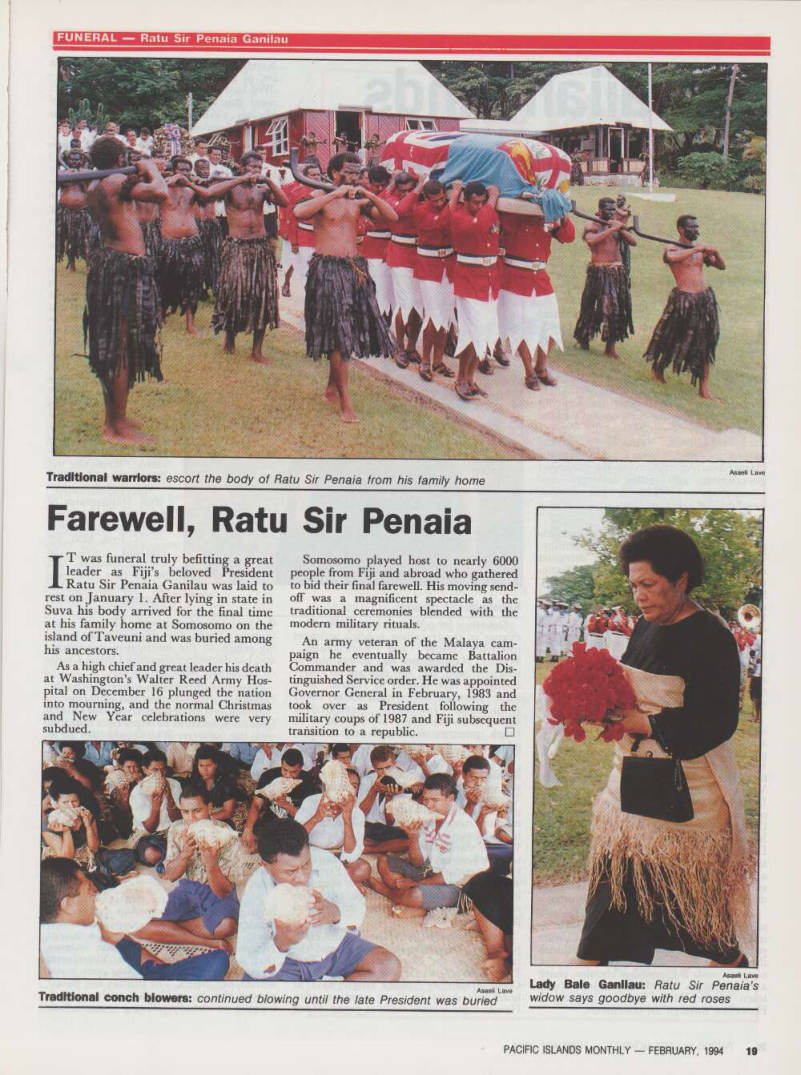
IT was funeral truly befitting a great leader as Fiji’s beloved President Ratu Sir Penaia Ganilau was laid to rest on January 1. After lying in state in Suva his body arrived for the final time at his family home at Somosomo on the island of Taveuni and was buried among ms ancestors.
As a high chief and great leader his death at Washington’s Walter Reed Army Hospital on December 16 plunged the nation into mourning, and the normal Christmas and New Year celebrations were very subdued.
Somosomo played host to nearly 6000 people from Fiji and abroad who gathered to bid their final farewell. His moving send off was a magnificent spectacle as the traditional ceremonies blended with the modern military rituals, An army veteran of the Malaya cam paign he eventually became Battalion Commander and was awarded the Dis tinguished Service order. He was appointed Governor General in February, 1983 and took over as President following the military coups of 1987 and Fiji subsequent transition to a republic. □
Asaeli Lave Traditional conch blowers: continued blowing until the late President was buried
Asaeli Lave Lady Bale Ganilau: Ratu Sir Penaia's widow says goodbye with red roses
Hawaiian lands

Hawaii
Hawaiian lands Hawaiian hands
Hawaii Tourism Congress raises disturbing questions
By Ed Rampell
CARRYING picket signs and
chanting “Keep Hawaiian Lands
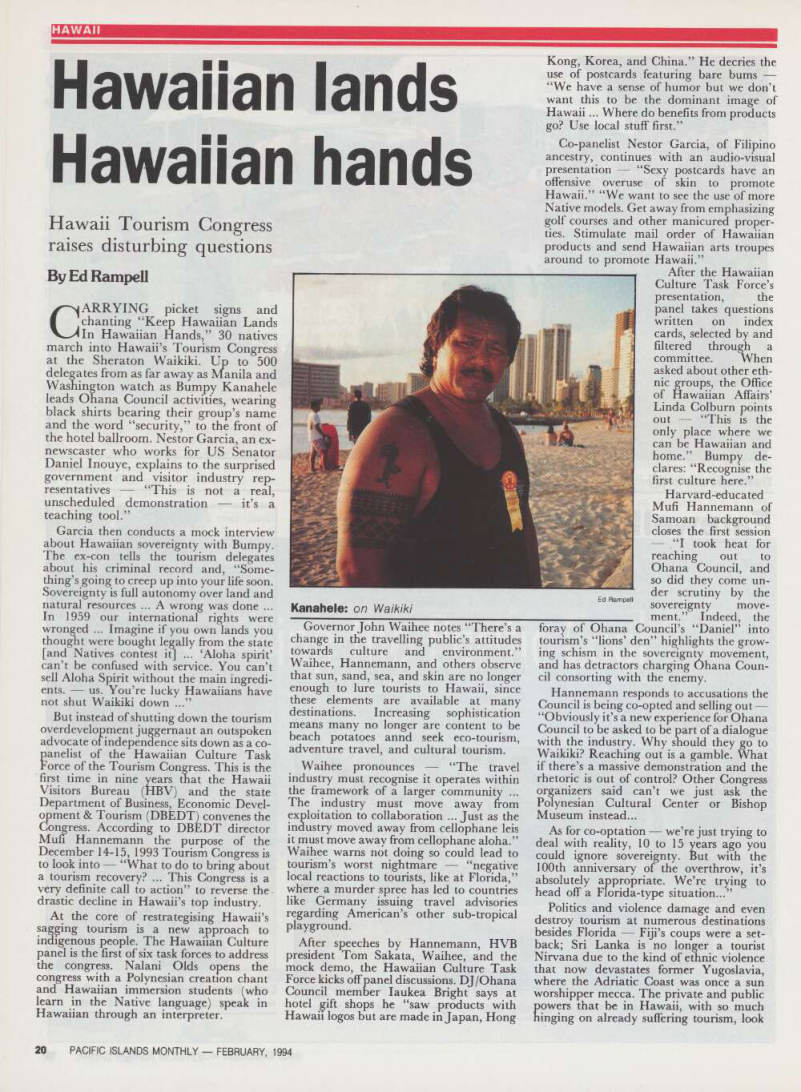
In Hawaiian Hands,” 30 natives march into Hawaii’s Tourism Congress at the Sheraton Waikiki. Up to 500 delegates from as far away as Manila and Washington watch as Bumpy Kanahele leads Ghana Council activities, wearing black shirts bearing their group’s name and the word “security,” to the front of the hotel ballroom. Nestor Garcia, an ex newscaster who works for US Senator
Daniel Inouye, explains to the surprised
government and visitor industry rep resentatives “This is not a real, unscheduled demonstration it’s a
teaching tool.”
Garcia then conducts a mock interview about Hawaiian sovereignty with Bumpy.
The ex-con tells the tourism delegates about his criminal record and, “Some thing’s going to creep up into your life soon.
Sovereignty is full autonomy over land and natural resources ... A wrong was done ...
In 1959 our international rights were wronged ... Imagine if you own lands you thought were bought legally from the state [and Natives contest it] ... ‘Aloha spirit’ can’t be confused with service. You can’t sell Aloha Spirit without the main ingredi ents. us. You’re lucky Hawaiians have not shut Waikiki down ...”
But instead of shutting down the tourism
overdevelopment juggernaut an outspoken
advocate of independence sits down as a co panelist of the Hawaiian Culture Task Force of the Tourism Congress. This is the first time in nine years that the Hawaii Visitors Bureau (HBV) and the state Department of Business, Economic Devel opment & Tourism (DBEDT) convenes the Congress. According to DBEDT director Mufi Hannemann the purpose of the December 14-15, 1993 Tourism Congress is to look into “What to do to bring about a tourism recovery? ... This Congress is a very definite call to action” to reverse the drastic decline in Hawaii’s top industry.
At the core of restrategising Hawaii’s sagging tourism is a new approach to indigenous people. The Hawaiian Culture panel is the first of six task forces to address the congress. Nalani Olds opens the congress with a Polynesian creation chant and Hawaiian immersion students (who learn in the Native language) speak in
Hawaiian through an interpreter.
Governor John Waihee notes “There’s a change in the travelling public’s attitudes towards culture and environment.”
Waihee, Hannemann, and others observe that sun, sand, sea, and skin are no longer enough to lure tourists to Hawaii, since these elements are available at many destinations. Increasing sophistication means many no longer are content to be beach potatoes annd seek eco-tourism, adventure travel, and cultural tourism.
Waihee pronounces “The travel industry must recognise it operates within the framework of a larger community ...
The industry must move away from exploitation to collaboration ...Just as the industry moved away from cellophane leis it must move away from cellophane aloha.”
Waihee warns not doing so could lead to
tourism’s worst nightmare “negative
local reactions to tourists, like at Florida,” where a murder spree has led to countries like Germany issuing travel advisories regarding American’s other sub-tropical
playground.
After speeches by Hannemann, HVB president Tom Sakata, Waihee, and the mock demo, the Hawaiian Culture Task Force kicks off panel discussions. DJ/Ohana Council member laukea Bright says at hotel gift shops he “saw products with Hawaii logos but are made in Japan, Hong
Kong, Korea, and China.” He decries the use of postcards featuring bare bums “We have a sense of humor but we don’t want this to be the dominant image of Hawaii ... Where do benefits from products go? Use local stuff first.”
Co-panelist Nestor Garcia, of Filipino ancestry, continues with an audio-visual presentation “Sexy postcards have an offensive overuse of skin to promote Hawaii.” “We want to see the use of more Native models. Get away from emphasizing golf courses and other manicured proper ties. Stimulate mail order of Hawaiian products and send Hawaiian arts troupes around to promote Hawaii.”
After the Hawaiian Culture Task Force’s presentation, the
panel takes questions
written on index cards, selected by and filtered through a committee. When asked about other eth nic groups, the Office of Hawaiian Affairs’
Linda Colburn points out “This is the
only place where we
can be Hawaiian and home.” Bumpy de clares: “Recognise the first culture here.”
Harvard-educated Mufi Hannemann of
Samoan background
closes the first session ,‘T took heat for reaching out to Ghana Council, and so did they come un
der scrutiny by the
sovereignty move
ment.” Indeed, the
foray of Ghana Council’s “Daniel” into tourism’s “lions’ den” highlights the grow ing schism in the sovereignty movement, and has detractors charging Ghana Coun cil consorting with the enemy.
Hannemann responds to accusations the Council is being co-opted and selling out “Obviously it’s a new experience for Ghana Council to be asked to be part of a dialogue with the industry. Why should they go to Waikiki? Reaching out is a gamble. What if there’s a massive demonstration and the rhetoric is out of control? Other Congress organizers said can’t we just ask the Polynesian Cultural Center or Bishop Museum instead...
As for co-optation we’re just trying to deal with reality, 10 to 15 years ago you could ignore sovereignty. But with the 100th anniversary of the overthrow, it’s absolutely appropriate. We’re trying to head off a Florida-type situation...”
Politics and violence damage and even destroy tourism at numerous destinations besides Florida Fiji’s coups were a set back; Sri Lanka is no longer a tourist Nirvana due to the kind of ethnic violence that now devastates former Yugoslavia, where the Adriatic Coast was once a sun worshipper mecca. The private and public powers that be in Hawaii, with so much
hinging on already suffering tourism, look
Kanahele: on Waikiki
Ed Rampell
at the Hawaiian sovereignty movement apprehensively. What if the wild card of Hawaii politics goes wild? What if the landless, restless natives take their griev ances into the streets and really do shut Waikiki down? Enter Ghana Council, a group with a history of land occupations and about 200 adherents advocating inde pendence. Led by a man who speaks of his '‘criminal background,” the Council says its represented by a PLO attorney and invites Black Muslim Louis Farrakhan to speak. Actions such as participating in the
tourism Congress and possibly providing it
with security, has sovereignty leaders asking, is Ghana Council for real?
Dr Kekuni Blaisdell, head of the Pro-
Hawaiian Sovereignty Working Group -
which led a real demonstration against the Congress, calling for a tourism boycott contends “Ghana Council gets selective treatment by the state. Attorney Mililani Trask, governor of ka LaHui Hawaii, the Sovereign Hawaiian Nation, which claims to be the biggest sovereignty group with more than 18,000 enrolled “citizens,” cites examples of apparent Council collabor ation. “Other sovereignty groups were not invited to the Tourism Congress; Ka LaHui advocates giving Waikiki back to the Hawaiian. Ghana Council has a close working relationship with the state. In late 1992, the Council had a meeting with state representatives, union leaders, Samoan chiefs, and an alleged underworld figure, and cut a deal, Ghana Council will work with the state if they get land.
Ka LaHui refuses to cooperate with the state in any way, like sitting on the
sovereignty advisory commission most
other groups participate with, leading to charges of sectarianism or praise for being principled. Ghana Council sees things differently. Nathan Brown, a Council
international law researcher,says “They
feel we’re compromising. But we’re trying to educate them - the community as a whole, including the tourism industry. If you continue to have separation, nothing will be done.” Council media liaison Rolf Nordahl denies the allegation that they met with the alleged organised crime figure. But Council leader Kawehi Gill responds to the accusation by saying “So?” “No one has approached the hierarchy in the manner we have - they know we’re a danger. Going on the offensive, Gill asserts,“The problem with Mililani and Ka LaHui is they’re history. We’re in a new period, we’re
making history...Ka LaHui’s charges are
fear-based because they’re losing a lot of members.”
For years, tourism devastated Hawaiian culture and ecology. Now that Hawaii’s economy is as endangered a species as natives, the very forces that displaced Hawaiians are turning to them to save tourism. Fearful a sovereign Hawaiian movement and nation could create political upheavals dealing death blows to HVB
promoted “paradise” images and destroy
tourism, is the state trying to take over the cause? Or does the state and industry genuinely want Hawaiians to benefit from tourism? Are Mufi Hannemann and Waihee velvet gloves of colonialism or farsighted enlightened leaders? Is Ghana Council for sovereignty or for sale?
Will the real Hawaiian sovereignty activists please stand up! □
Advertisements & other items, pp. 21-22 (1 item)
In One Night.
How Tahiti
Sold $2 Million
Worth Of Products
In One Night.
3*9~ -< -OC^. y^p: ; 3? <5; -=<^o-53L -^P2 55T sy*''A V The Tahiti Exportation Board wanted to promote French Polynesian products in Sydney.
Everything from chocolates to beer to black pearls.
The Board enlisted participants, arranged shipment of their products and funded the displays.
The Trade Commission, in turn, put together a mailing list of people likely to be interested and sent out invitations to a gala evening in the ballroom of the Regent.
We had displays built. Generated press coverage. And we hired three lovely ladies to move among the guests wearing some of those black pearls. (The most expensive jewels were in a case under armed guard.) When the evening was over, products totalling more than $2 million had been sold.
Needless to say, the Tahiti Exportation Board was quite pleased with the way everything went.
If you’d like to feel the same sort of pleasure, just post or fax us the coupon below. If you’re in a hurry, feel free to phone. i Name Company Address m V £ i 9 Level 6, 50 Park Street, Sydney NSW 2000.
Phone: (612) 2835933, Fax; (612) 2835948
t OUR
YOUR INBOUND SPECIALIST IN THE SOLOM
ISLANDS FOR
* F.I.T GROUP * SPECIAL INTEREST TOURS * HOTEL, DIVE AND CAR HIRE BOOKINGS * LAND, AIR ARRANGEMENTS * SEA ARRANGEMi EXPRESSLINER THE MOST comfortable and air conditioned t sat, . ;Sr i m ■ , r*** ii i iiii WE’LL SHOW YOU SOME OF OUR CULTURE
HERITAGE AND PRIDE IN THE REMOTE
TOUR SOLOMONS LIMITED
P.O. BOX 337, HONIARA SOLOMON ISLANDS
TEL (677) 21630 FAX (677) 21637
The cross & the gospel
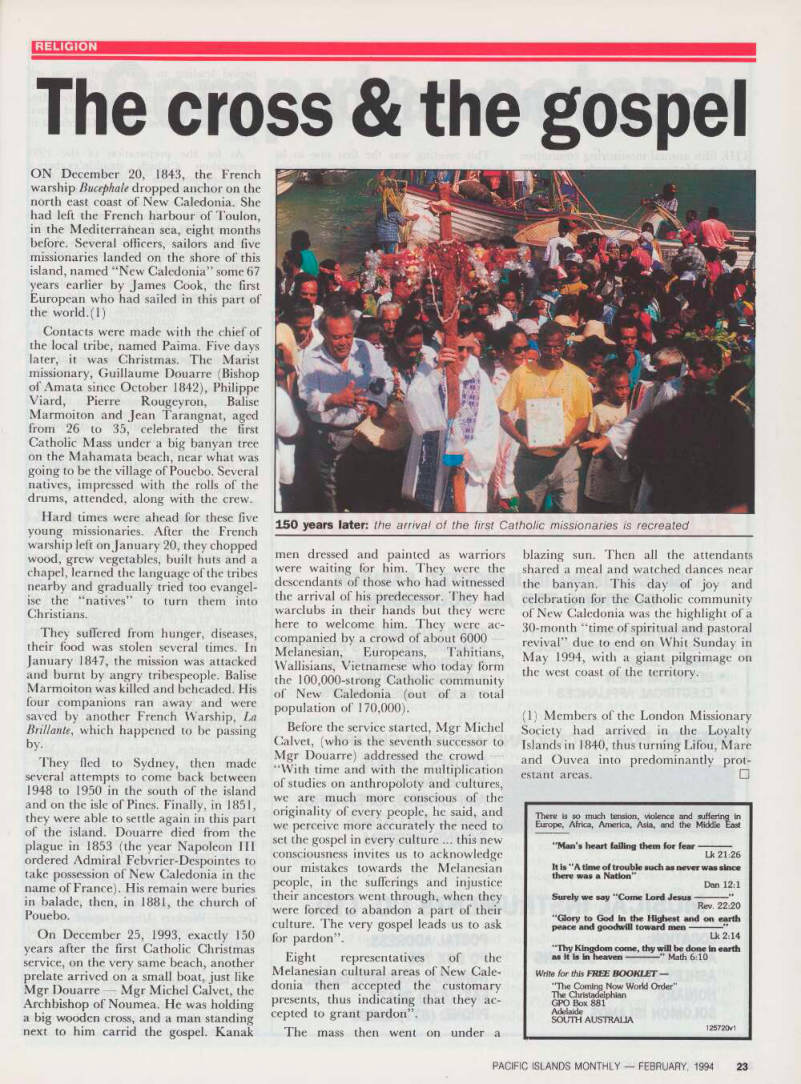
[Religion
ON December 20, 1843, the French
warship Bucephale dropped anchor on the
north east coast of New Caledonia. She had left the French harbour of Toulon, in the Mediterranean sea, eight months before. Several officers, sailors and five missionaries landed on the shore of this island, named “New Caledonia” some 67 years earlier by James Cook, the first European who had sailed in this part of
the world.(l)
Contacts were made with the chief of the local tribe, named Paima. Five days later, it was Christmas. The Marist
missionary, Guillaume Douarre (Bishop
of Amata since October 1842), Philippe Viard, Pierre Rougeyron, Balise
Marmoiton and Jean Tarangnat, aged
from 26 to 35, celebrated the first Catholic Mass under a big banyan tree on the Mahamata beach, near what was going to be the village of Pouebo. Several natives, impressed with the rolls of the drums, attended, along with the crew.
Hard times were ahead for these five young missionaries. After the French warship left on January 20, they chopped wood, grew vegetables, built huts and a chapel, learned the language of the tribes
nearby and gradually tried too evangel
ise the “natives” to turn them into Christians.
They suffered from hunger, diseases, their food was stolen several times. In January 1847, the mission was attacked and burnt by angry tribespeople. Balise Marmoiton was killed and beheaded. His four companions ran away and were saved by another French Warship, La Bri/lante, which happened to be passing by.
They fled to Sydney, then made several attempts to come back between 1948 to 1950 in the south of the island and on the isle of Pines. Finally, in 1851, they were able to settle again in this part of the island. Douarre died from the plague in 1853 (the year Napoleon HI ordered Admiral Febvrier-Despointes to take possession of New Caledonia in the name of France). His remain were buries in balade, then, in 1881, the church of Pouebo.
On December 25, 1993, exactly 150 years after the first Catholic Christmas service, on the very same beach, another prelate arrived on a small boat, just like
Mgr Douarre Mgr Michel Calvet, the
Archbishop of Noumea. He was holding a big wooden cross, and a man standing next to him carrid the gospel. Kanak
men dressed and painted as warriors were waiting for him. They were the descendants of those who had witnessed the arrival of his predecessor. They had warclubs in their hands but they were here to welcome him. They were ac companied by a crowd of about 6000 Melanesian, Europeans, Tahitians, Wallisians, Vietnamese who today form
the 100,000-strong Catholic community
of New Caledonia (out of a total
population of 170,000).
Before the service started, Mgr Michel Calvet, (who is the seventh successor to Mgr Douarre) addressed the crowd - “With time and with the multiplication of studies on anthropoloty and cultures, we are much more conscious of the originality of every people, he said, and we perceive more accurately the need to set the gospel in every culture ... this new consciousness invites us to acknowledge our mistakes towards the Melanesian
people, in the sufferings and injustice
their ancestors went through, when they were forced to abandon a part of their culture. The very gospel leads us to ask
for pardon”.
Eight representatives of the
Melanesian cultural areas of New Cale donia then accepted the customary presents, thus indicating that they ac cepted to grant pardon”.
The mass then went on under a
blazing sun. Then all the attendants shared a meal and watched dances near the banyan. This day of joy and celebration for the Catholic community of New Caledonia was the highlight of a 30-month ‘"time of spiritual and pastoral revival” due to end on Whit Sunday in May 1994, with a giant pilgrimage on the west coast of the territory. (1) Members of the London Missionary Society had arrived in the Loyalty Islands in 1840, thus turning Lifou, Mare and Ouvea into predominantly prot estant areas. □
150 years later: the arrival of the first Catholic missionaries is recreated
Advertisements & other items, p. 23 (1 item)
There is so much tension, violence and suffering in
Europe, Africa, America, Asia, and the Middle East “Man’s heart failing them for fear Lk 21:26 It is “A time of trouble such as never was since there was a Nation’’
Dan 12:1 Surely we say “Come Lord Jesus ”
Rev. 22:20 “Glory to God in the Highest and on earth peace and goodwill toward men ”
Lk 2:14 “Thy Kingdom come, thy will be done in earth as it is in heaven ” Math 6:10 Write for this FREE BOOKLET “Hie Coming Now World Order”
The Christadelphian GPO Box 881 Adelaide
SOUTH AUSTRALIA
125720v1
Matignon monitor
New Caledonia
THE fifth annual monitoring committee of the Matignon Accords for New Caledonia took place in Paris from December 7-9. It was attended by representatives of the French state, the RPCR (Jacques Lafleur’s Rally for Caledonia in the Republic) and the FLNKS (Kanak Socialist National Liberation Front). It concluded with a decision to accelerate economic development in the French territory.
This meeting was the first one to be hosted by the new conservative government of Prime Minister Edouard Bahadur.
Although it took place without the presi dent of the FLNKS leading the pro
independence delegation (he refused to
attend), it went on smoothly, and all
participants praised its “frank and friendly
atmosphere”.
The will of the new government to get
things going along the 10-year transitory
period leading to a referendum on self determination in 1998 had already been affirmed by Dominique Perben, the Min ister for Overseas Departments and Terri tories during his visit to New Caledonia in
June.
As for the preparation of the 1993 referendum, “which shouldn’t be a blade... propositions have been made”, explained Bahadur “If it is asked to do so, the government will take part in this reflexion. But at this moment, it seems to me better that the initiative, the timetable and the organisation of such a debate should be the responsibility of the political partners in New Caledonia”.
In order to avoid the routine of what some observers have called “the yearly mass of the monitoring committee re unions”, the participants decided that preparatory meeting would now take place every three months in New Caledonia.
“One must speed up the implementation of
decisions,” explained Dominique Perben.
An eventual change of the voting conditions has been considered for the 1995 territorial elections, in order to diminish the importance of small parties every party would have to obtain at least 5 per cent of the enrolled voters, instead of 5 per cent of the voters to obtain seats. This has already caused anger among the two small right wing parties opposed to both the FLNKS and the RPCR.
The economical aspect of the future of New Caledonia is becoming the priority. A team of economists and developers will be sent from Paris to provinces, and to help set up investment projects”. The percentage of nickel in nickel ore exported (to Japan mostly) could be increased. A team of experts were coming to New Caledonia in January to see if this would help the nickel
mining industry which is going through
hard times.
During this important political reunion
in Paris, New Caledonia was faced with a
week-long general strike launched by the
USTKE (Trade Union of Kanak and
Exploited Workers), which badly affected
the international airport, the harbour and the tourist industry. The same week, the SOENC-mines (Trade Union of Mine Workers and Employees of New Cale donia) had blocked the main road of the territory during one day in three different places to protest the lay-off of 250 nickel miners.
On December 9, while all participants to the monitoring committee posed in Paris for the traditional picture in front of the Prime Minister’s residence and office, four major Caledonian unions, the USTKE, the Public servants Federation, the Workers Force Union and the New Caledonia General Workers Union signed a joint statement condemning the bad social climate and “the systematic refusal of
dialogue” by local politicians and em
ployers. “Despite the financial stability that
the Territory and businesses has benefited during the years following the signing of the Matignon Accords”, said the statement, “there has been no sign of social progress for wage-earners”. □
Advertisements & other items, pp. 24-26 (1 item)
Alliance Corporation Ltd
/ A
SPECIALISING IN IMPORTED FASHION
CLOTHING FOR ALL OCCASIONS
* FASHION CLOTHING * TABLE UTENSILS
* CASUAL AND FORMAL SHOES ♦ MARINE PRODUCTS EXPORTER
* MANCHESTER * STATIONERY SUPPUES
* BEDROOM LINEN * OFFICE FURNITURE
* ELECTRICAL APPLIANCES ♦ MUSICAL INSTRUMENTS
AGENTS FOR ELECTRIC AND ACOUSTIC GUITARS,
DRUMS, PIANOS,
KEYBOARDS,
AMPLIFIERS, SPEAKERS,
MIKES AND STAGE
SOUND SYSTEM
MUSICAL INSTRUMENTS CO. LTD.
LOCATION:
ACOR BOOKSHOP BUILDING
ASHLEY STREET
HONIARA
SOLOMON ISLANDS
POSTAL ADDRESS:
PO BOX 780
HONIARA, SOLOMON ISLAND
FAX: (677) 21477
PHONE: (677) 21239
Computer notes
By Michael Le Grand
My Big is Bigger than your
Big!!
In the US Word Perfect is suing Microsoft challenging that companies claim to greater market share for MS Word over Word Perfect.
Word Perfect claims independent audit of the WP market shows 60-plus per cent worldwide preference for Word Perfect.
Being heard in the US District Court in New York the case appears to offer few, if any benefits to users of either product.
Economic Upswing and IT Blues Forum Fisheries New Appointment
PACIFIC
Commission’s The Forum Fisheries Agency has announced the appointment of Sam Taufao as the new Agency Information Technology and Communications Manager.
Taufao from Western Samoa is the first Pacific Islander to be appointed to one of the most demanding technical posts in the region. A graduate of the University of the South Pacific from where he holds a BSc he also has a post-graduate diploma in Applied Computing from the University of Central Queensland.
Previously, Taufao was the Senior Technical Analyst Programmer for FFA, he also spent some four years as a research officer on the South Pacific Tuna and Billfish Assessment Program.
The strong economic upswing sweeping the world is not being reflected in the information tecnology (IT) industry.
Worldwide stafflay-offs continue with Microsoft, Amdahl, Unisys, IBM, DEC and Wang reportedly planning to continue pruning already radically smaller workforces and poor earning results being reported by many market leaders.
While the fall in global revenues and profits reflect 1993 performances, firm trends for capital spending in 1994 have not kept pace with consumer and non-capital spending trends.
Inventories are being kept low by both manufacturers and resellers. This is being reflected in longer delivery lead-times for some mid-range and mainframe hardware.
The effects of this shortage in some components especially chips has yet to shake-out. From most perspective’s major vendors while predicting improved sales forecasts for 1994, have yet to post the revenue results promised.
For customers in the Pacific, IT costs in 1994 will either increase slightly or have any decrease in cost offset by higher transport and support costs. The good news is coming generally from the software area with vendor
competition keeping prices down.
In summary, 1994 for IT seems to promise more of the same.
Australian Coalition Admits Policy Errors Tony Staley, National President of the Australian Liberals admitted to this weeks Young Liberal Conference held in Sydney that the Labor Government’s industry policy was working well and that the Coalition Industry Policies in the last Federal Election had not been appropriate. This especially related, he said, to such areas as Communications and Information Technology.
Industry and voters were expected to take Staley’s comments seriously, as not only is he the National President of the Liberals, he is also regarded as an expert in the high technology areas having held Cabinet positions as Minister for Communications in the Frazer Ministry.
What this may mean for Dr Hewson and Coalition Policy generally can only be guessed at, however, sources within senior Coalition ranks suggest a complete rethink of Industry Policy is likely. The experience of long serving former Shadow Technology Spokesman, Peter McGauran is obviously being missed as he concentrates on his new responsibility, Minerals and Energy.
Dr Hewson will be well advised to put in place his post election promised consultative process as the Coalition rethinks its Industry position.
It must be potently clear to even the driest dry that the Coalition cannot develop Industry and especially High Technology Industry Policy remote from industry who must now be consulted. □
IBDN Inc. is a Korean company based in Seoul, Korea specialising in travel, leisure and entertainment business.
With good relationship with South Pacific Island Countries, were looking for our business to be set up in the South Pacific for following business. ij 3 (0 1 : \ 3 3 0;V t :\o 0U Y * IMPORT & EXPORT * CASINO BUSINESS * HOTEL DEVELOPMENT * SECOND HAND CARS * CLUBS, BARS, ETC * TOURISM BUSINESS
* RESORT DEVELOPMENT * GOLF DEVELOPMENT
* DUTY FREE SHOPS * OTHER DEVELOPMENT We look for partners who are interested in these businesses please send inquiry or proposal to:
IBDN INC
KANGNAM P.O. BOX 1313
SEOUL 135-613 KOREA
TEL: (82-2) 515-5000
FAX: (82-2) 514-4957
Slow response from
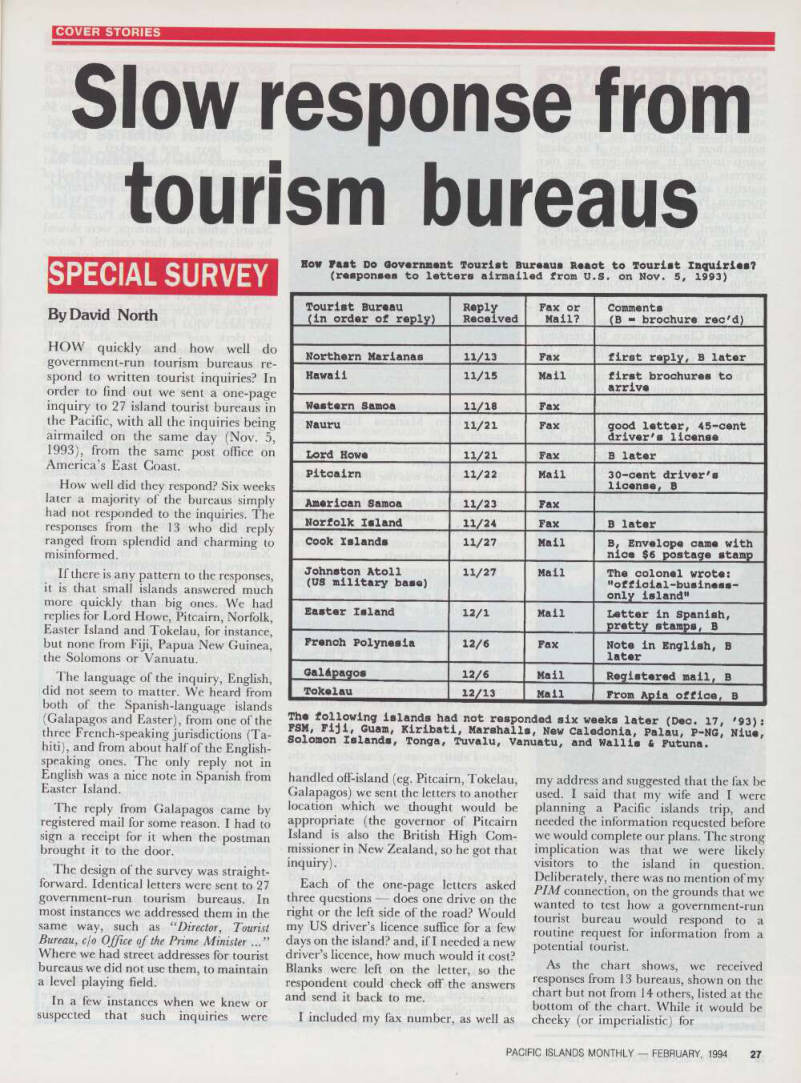
Cover Stories
Slow response from tourism bureaus
Special Survey
By David North
HOW quickly and how well do government-run tourism bureaus re spond to written tourist inquiries? In order to find out we sent a one-page inquiry to 27 island tourist bureaus in the Pacific, with all the inquiries being airmailed on the same day (Nov. 5, 1993), from the same post office on America’s East Coast.
How well did they respond? Six weeks later a majority of the bureaus simply had not responded to the inquiries. The responses from the 13 who did reply ranged from splendid and charming to misinformed.
If there is any pattern to the responses, it is that small islands answered much more quickly than big ones. We had replies for Lord Howe, Pitcairn, Norfolk, Easter Island and Tokelau, for instance, but none from Fiji, Papua New Guinea, the Solomons or Vanuatu.
The language of the inquiry, English, did not seem to matter. We heard from both of the Spanish-language islands (Galapagos and Easter), from one of the three French-speaking jurisdictions (Ta hiti), and from about half of the English speaking ones. The only reply not in English was a nice note in Spanish from Easter Island.
The reply from Galapagos came by registered mail for some reason. I had to sign a receipt for it when the postman brought it to the door.
The design of the survey was straight forward. Identical letters were sent to 27 government-run tourism bureaus. In most instances we addressed them in the same way, such as “Director, Tourist Bureau, c/o Office of the Prime Minister ...”
Where we had street addresses for tourist bureaus we did not use them, to maintain a level playing field.
In a few instances when we knew or suspected that such inquiries were
How Vast Do Government Tourist Bureaus React to Tourist Inquiries? (responses to letters airmailed from u.S. on Nov. 5, 1993)
The following Islands had not responded six weeks later (Dec. 17, '93); FSM, Fiji, Guam, Kiribati, Marshalls, New Caledonia, Palau, P-NG, Niue, Solomon Islands, Tonga, Tuvalu, Vanuatu, and Wallis & Futuna.
handled off-island (eg. Pitcairn, Tokelau,
Galapagos) we sent the letters to another location which we thought would be appropriate (the governor of Pitcairn Island is also the British High Com missioner in New Zealand, so he got that
inquiry).
Each of the one-page letters asked three questions does one drive on the right or the left side of the road? Would my US driver’s licence suffice for a few days on the island? and, if I needed a new driver’s licence, how much would it cost?
Blanks were left on the letter, so the respondent could check off the answers and send it back to me.
I included my fax number, as well as
my address and suggested that the fax be used. I said that my wife and I were planning a Pacific islands trip, and needed the information requested before we would complete our plans. The strong implication was that we were likely visitors to the island in question.
Deliberately, there was no mention of my PIM connection, on the grounds that we wanted to test how a government-run tourist bureau would respond to a routine request for information from a
potential tourist.
As the chart shows, we received responses from 13 bureaus, shown on the chart but not from 14 others, listed at the bottom of the chart. While it would be
cheeky (or imperialistic) for
Tourist Bureau (in order of reply) Reply Received Fax or Mail?
Comments (B - brochure rec'd) Northern Marianas 11/13 Fax first reply, B later Hawaii 11/15 Mall first brochures to arrive Western Samoa 11/18 Fax Nauru 11/21 Fax good letter, 45-cent driver's license Lord Howe 11/21 Fax B later Pitcairn 11/22 Mail 30-cent driver's license, B American Samoa 11/23 Fax Norfolk Island 11/24 Fax B later Cook Islands 11/27 Mall B, Envelope came with nice $6 postage stamp Johnston Atoll (US military base) 11/27 Mall The colonel wrote: "offloial-buslnessonly Island 11 Easter Island 12/1 Mail Letter In Spanish, pretty stamps, B French Polynesia 12/6 Fax Note In English, B later GalApagos 12/6 Mail Registered mall, B Tokelau 12/13 Hall From Apia office, B
Special Survey
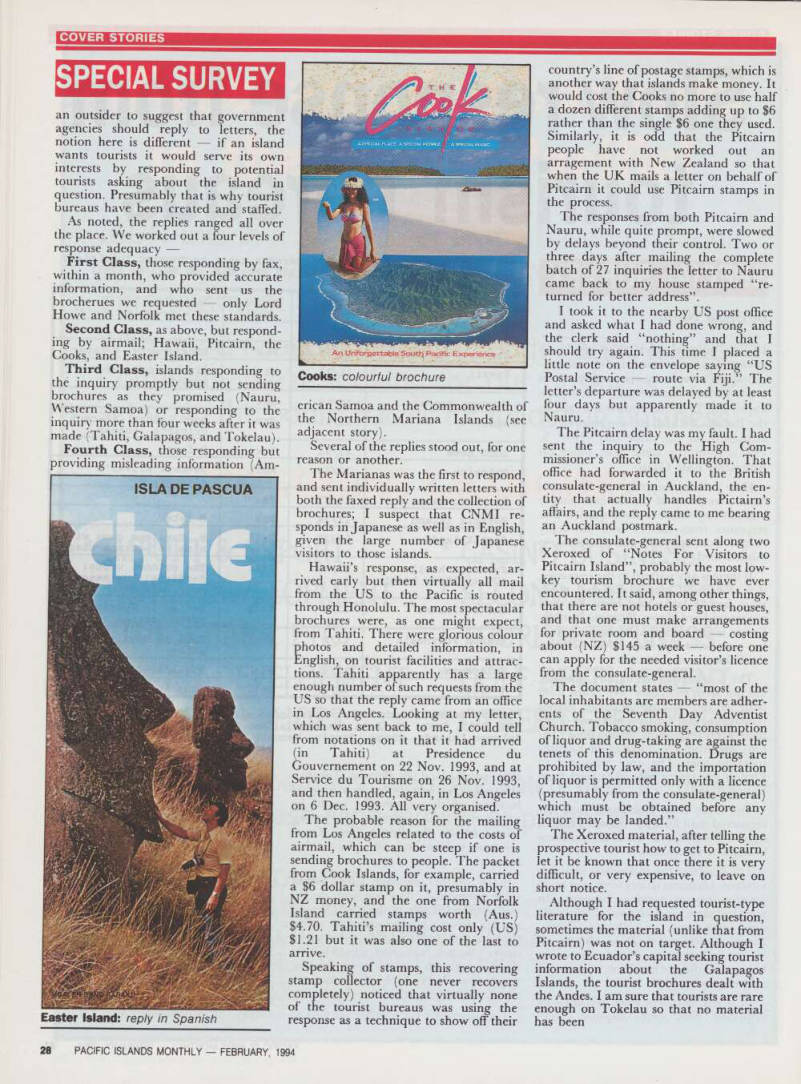
an outsider to suggest that government agencies should reply to letters, the notion here is different if an island wants tourists it would serve its own interests by responding to potential tourists asking about the island in question. Presumably that is why tourist bureaus have been created and staffed.
As noted, the replies ranged all over the place. We worked out a four levels of
response adequacy
First Class, those responding by fax, within a month, who provided accurate information, and who sent us the brocherues we requested only Lord Howe and Norfolk met these standards.
Second Class, as above, but respond ing by airmail; Hawaii, Pitcairn, the Cooks, and Easter Island.
Third Class, islands responding to
the inquiry promptly but not sending
brochures as they promised (Nauru, Western Samoa) or responding to the inquiry more than four weeks after it was made (Tahiti, Galapagos, and Tokelau).
Fourth Class, those responding but
providing misleading information (Am-
erican Samoa and the Commonwealth of the Northern Mariana Islands (see adjacent story).
Several of the replies stood out, for one reason or another.
The Marianas was the first to respond, and sent individually written letters with both the faxed reply and the collection of brochures; I suspect that CNMI re sponds in Japanese as well as in English, given the large number of Japanese visitors to those islands.
Hawaii’s response, as expected, ar rived early but then virtually all mail from the US to the Pacific is routed through Honolulu. The most spectacular brochures were, as one might expect, from Tahiti. There were glorious colour photos and detailed information, in English, on tourist facilities and attrac tions. Tahiti apparently has a large enough number of such requests from the US so that the reply came from an office in Los Angeles. Looking at my letter, which was sent back to me, I could tell from notations on it that it had arrived (in Tahiti) at Presidence du Gouvernement on 22 Nov. 1993, and at Service du Tourisme on 26 Nov. 1993, and then handled, again, in Los Angeles on 6 Dec. 1993. All very organised.
The probable reason for the mailing from Los Angeles related to the costs of airmail, which can be steep if one is sending brochures to people. The packet from Cook Islands, for example, carried a $6 dollar stamp on it, presumably in NZ money, and the one from Norfolk Island carried stamps worth (Aus.) $4.70. Tahiti’s mailing cost only (US) $1.21 but it was also one of the last to arrive.
Speaking of stamps, this recovering stamp collector (one never recovers completely) noticed that virtually none of the tourist bureaus was using the response as a technique to show off their
country’s line of postage stamps, which is another way that islands make money. It would cost the Cooks no more to use half a dozen different stamps adding up to $6 rather than the single $6 one they used.
Similarly, it is odd that the Pitcairn people have not worked out an arragement with New Zealand so that when the UK mails a letter on behalf of Pitcairn it could use Pitcairn stamps in the process.
The responses from both Pitcairn and Nauru, while quite prompt, were slowed by delays beyond their control. Two or three days after mailing the complete batch of 27 inquiries the letter to Nauru came back to my house stamped “re turned for better address”.
I took it to the nearby US post office and asked what I had done wrong, and the clerk said “nothing” and that I should try again. This time I placed a little note on the envelope saying “US Postal Service route via Fiji.” The letter’s departure was delayed by at least four days but apparently made it to Nauru.
The Pitcairn delay was my fault. I had sent the inquiry to the High Com missioner’s office in Wellington. That office had forwarded it to the British consulate-general in Auckland, the en tity that actually handles Pictairn’s affairs, and the reply came to me bearing an Auckland postmark.
The consulate-general sent along two Xeroxed of “Notes For Visitors to Pitcairn Island”, probably the most low key tourism brochure we have ever encountered. It said, among other things, that there are not hotels or guest houses, and that one must make arrangements for private room and board costing about (NZ) 5145 a week before one can apply for the needed visitor’s licence from the consulate-general.
The document states “most of the local inhabitants are members are adher ents of the Seventh Day Adventist
Church. Tobacco smoking, consumption
of liquor and drug-taking are against the tenets of this denomination. Drugs are prohibited by law, and the importation of liquor is permitted only with a licence (presumably from the consulate-general) which must be obtained before any liquor may be landed.”
The Xeroxed material, after telling the prospective tourist how to get to Pitcairn, let it be known that once there it is very difficult, or very expensive, to leave on short notice.
Although I had requested tourist-type literature for the island in question, sometimes the material (unlike that from Pitcairn) was not on target. Although I wrote to Ecuador’s capital seeking tourist information about the Galapagos Islands, the tourist brochures dealt with the Andes. I am sure that tourists are rare enough on Tokelau so that no material has been
Easter Island: reply in Spanish
Cooks: colourful brochure
bigger ones
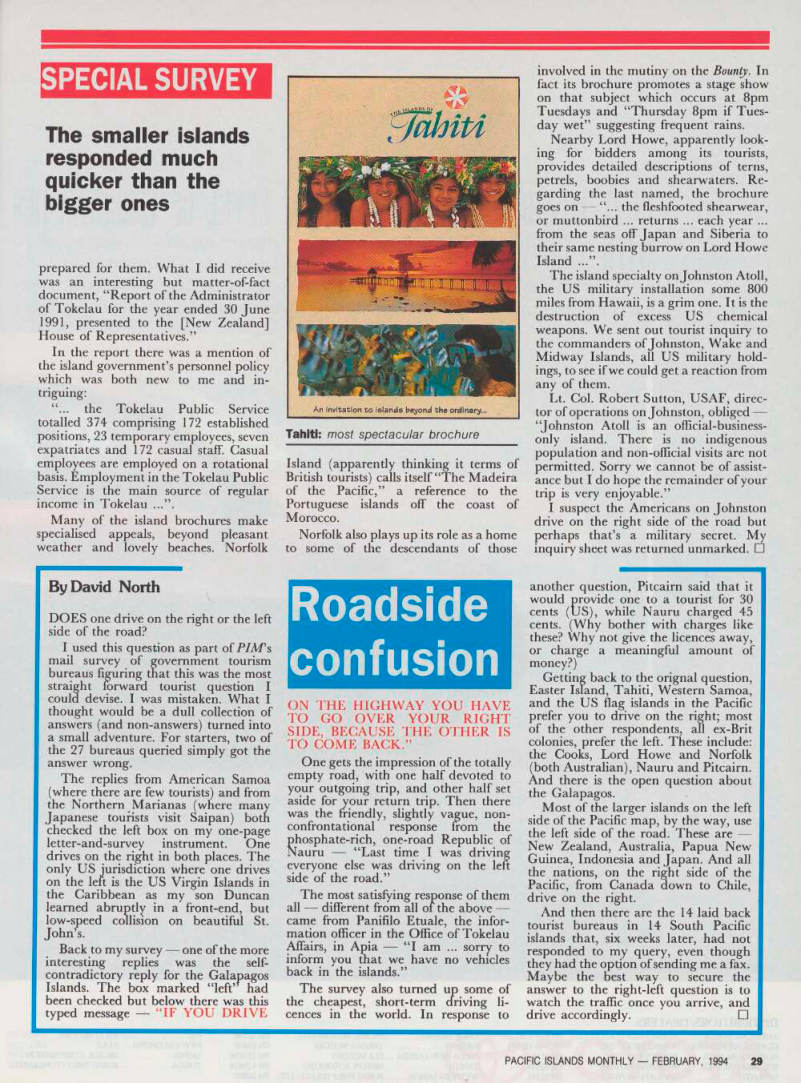
The smaller islands responded much quicker than the bigger ones
prepared for them. What I did receive was an interesting but matter-of-fact document, “Report of the Administrator of Tokelau for the year ended 30 June 1991, presented to the [New Zealand] House of Representatives.”
In the report there was a mention of the island government’s personnel policy which was both new to me and in triguing; “... the Tokelau Public Service totalled 374 comprising 172 established positions, 23 temporary employees, seven expatriates and 172 casual staff. Casual employees are employed on a rotational basis. Employment in the Tokelau Public Service is the main source of regular income in Tokelau ...”.
Many of the island brochures make specialised appeals, beyond pleasant weather and lovely beaches. Norfolk
Island (apparently thinking it terms of British tourists) calls itself “The Madeira of the Pacific,” a reference to the Portuguese islands off the coast of Morocco.
Norfolk also plays up its role as a home to some of the descendants of those
involved in the mutiny on the Bounty. In fact its brochure promotes a stage show on that subject which occurs at Bpm Tuesdays and “Thursday Bpm if Tues day wet” suggesting frequent rains.
Nearby Lord Howe, apparently look ing for bidders among its tourists, provides detailed descriptions of terns, petrels, boobies and shearwaters. Re garding the last named, the brochure goes on “... the fleshfooted shearwear, or muttonbird ... returns ... each year ... from the seas off Japan and Siberia to their same nesting burrow on Lord Howe Island ...”.
The island specialty on Johnston Atoll, the US military installation some 800 miles from Hawaii, is a grim one. It is the destruction of excess US chemical weapons. We sent out tourist inquiry to the commanders of Johnston, Wake and Midway Islands, all US military hold ings, to see if we could get a reaction from any of them.
Lt. Col. Robert Sutton, USAF, direc tor of operations on Johnston, obliged “Johnston Atoll is an official-business only island. There is no indigenous population and non-official visits are not permitted. Sorry we cannot be of assist ance but I do hope the remainder of your trip is very enjoyable.”
I suspect the Americans on Johnston drive on the right side of the road but perhaps that’s a military secret. My inquiry sheet was returned unmarked. □
Tahiti: most spectacular brochure
Roadside
confusion
By David North
DOES one drive on the right or the left side of the road?
I used this question as part of PlM’s mail survey of government tourism bureaus figuring that this was the most straight forward tourist question I could devise. I was mistaken. What I thought would be a dull collection of answers (and non-answers) turned into a small adventure. For starters, two of the 27 bureaus queried simply got the answer wrong.
The replies from American Samoa (where there are few tourists) and from the Northern Marianas (where many Japanese tourists visit Saipan) both checked the left box on my one-page letter-and-survey instrument. One drives on the right in both places. The only US jurisdiction where one drives on the left is the US Virgin Islands in the Caribbean as my son Duncan learned abruptly in a front-end, but low-speed collision on beautiful St.
John’s.
Back to my survey one of the more interesting replies was the self contradictory reply for the Galapagos Islands. The box marked “left’* had been checked but below there was this typed message “IF YOU DRIVE
On The Highway You Have
To Go Over Your Right
Side, Because The Other Is
To Come Back.”
One gets the impression of the totally empty road, with one half devoted to your outgoing trip, and other half set aside for your return trip. Then there was the friendly, slightly vague, non confrontational response from the phosphate-rich, one-road Republic of Nauru “Last time I was driving everyone else was driving on the left side of the road.”
The most satisfying response of them all different from all of the above came from Panifilo Etuale, the infor mation officer in the Office of Tokelau Affairs, in Apia “I am ... sorry to inform you that we have no vehicles back in the islands.”
The survey also turned up some of the cheapest, short-term driving li cences in the world. In response to
another question, Pitcairn said that it would provide one to a tourist for 30 cents (US), while Nauru charged 45 cents. (Why bother with charges like these? Why not give the licences away, or charge a meaningful amount of money?) Getting back to the orignal question, Easter Island, Tahiti, Western Samoa, and the US flag islands in the Pacific prefer you to drive on the right; most of the other respondents, all ex-Brit colonies, prefer the left. These include: the Cooks, Lord Howe and Norfolk (both Australian), Nauru and Pitcairn.
And there is the open question about the Galapagos.
Most of the larger islands on the left side of the Pacific map, by the way, use the left side of the road. These are New Zealand, Australia, Papua New Guinea, Indonesia and Japan. And all the nations, on the right side of the Pacific, from Canada down to Chile, drive on the right.
And then there are the 14 laid back tourist bureaus in 14 South Pacific islands that, six weeks later, had not responded to my query, even though they had the option of sending me a fax.
Maybe the best way to secure the answer to the right-left question is to watch the traffic once you arrive, and drive accordingly. □
Advertisements & other items, pp. 30-31 (1 item)
Creating a highly efficient, dynamic-looking car would
Is Creating a highly efficient, dynamic-looking car would be simple if it weren’t for one complicating detail; the passengers that must ride in it. Accommodating people comfortably in a pleasant, roomy interior usually means a certain amount of aerodynamic potential has to be sacrificed. ■ % * ■ Exact features and specifications may vary depending on country of purchase. Please check with your nearest TOYOTA distributor/dealer for details.
DISTRIBUTORS/DEALERS
AMERICAN SAMOA BURNS PHILP (S.S.) CO. LTD PH 633-4281 GUAM & MICRONESIA... ATKINS KROLL. INC. PH 646-1876/9 NORFOLK ISLANDS BORRY’S PTY LTD. PH 2114
SOLOMON ISLANDS MENDANA MOTORS PH 30314
VANUATU VANUATU MOTORS PH 22341
COOK ISLANDS PACIFIC MOTORS LTD.
KIRIBATI TARAWA MOTORS
PAPUA NEW GUINEA ... ELA MOTORS
TAHITI NIPPON AUTOMOTO
WESTERN SAMOA BURNS PHILP (S.S.) CO. LTD.
PH 20796 PH 21090 PH 217036 PH 429819 PH 20800
FIJI ASCO MOTORS
NEW CALEDONIA .. S.I.A.P,
SAIPAN MICROL CORPORATION
TONGA BURNS PHILP (TONGA) LTD.
Until now. Using a concept called total airflow management, Toyota engineers were able to realize an efficient, wedge-shaped design while at the same time perfecting the alignment between body panels and components.
Of course our own innovative style of civilized engineering makes sure that none of this comes at the expense of the luxurious, leg-stretching size interior. Because we realize that even a 0.33 Cd is useless if no one wants to drive the car.
® TOYOTA
Political hope
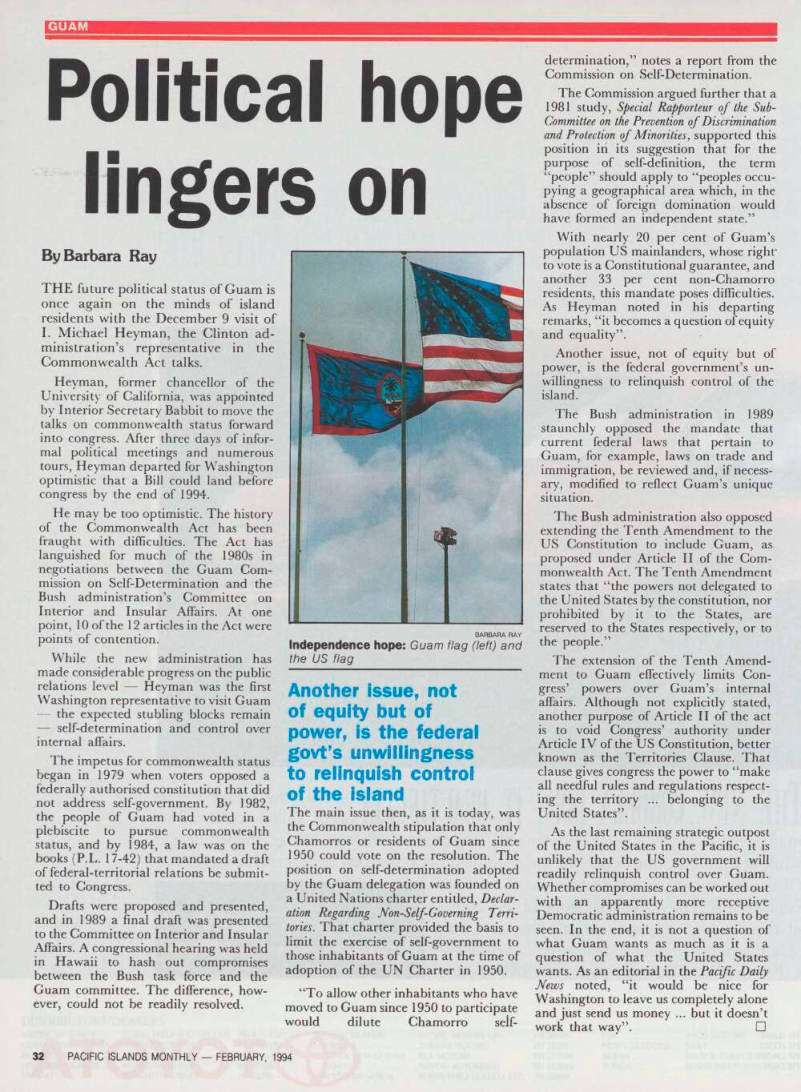
Guam
Political hope lingers on
By Barbara Ray
THE future political status of Guam is once again on the minds of island residents with the December 9 visit of I. Michael Heyman, the Clinton ad ministration’s representative in the Commonwealth Act talks.
Heyman, former chancellor of the University of California, was appointed by Interior Secretary Babbit to move the talks on commonwealth status forward into congress. After three days of infor mal political meetings and numerous tours, Heyman departed for Washington optimistic that a Bill could land before congress by the end of 1994.
He may be too optimistic. The history of the Commonwealth Act has been fraught with difficulties. The Act has languished for much of the 1980 s in negotiations between the Guam Com mission on Self-Determination and the Bush administration’s Committee on Interior and Insular Affairs. At one point, 10 of the 12 articles in the Act were points of contention.
While the new administration has made considerable progress on the public relations level Heyman was the first Washington representative to visit Guam the expected stubling blocks remain self-determination and control over internal affairs.
The impetus for commonwealth status began in 1979 when voters opposed a federally authorised constitution that did not address self-government. By 1982, the people of Guam had voted in a plebiscite to pursue commonwealth status, and by 1984, a law was on the books (P.L. 17-42) that mandated a draft of federal-territorial relations be submit ted to Congress.
Drafts were proposed and presented, and in 1989 a final draft was presented to the Committee on Interior and Insular Affairs. A congressional hearing was held in Hawaii to hash out compromises between the Bush task force and the Guam committee. The difference, how ever, could not be readily resolved.
Another issue, not
of equity but of
power, is the federal
govt’s unwillingness
to relinquish control
of the island
The main issue then, as it is today, was the Commonwealth stipulation that only Chamorros or residents of Guam since 1950 could vote on the resolution. The position on self-determination adopted by the Guam delegation was founded on a United Nations charter entitled, Declar
ation Regarding Non-Self-Governing Terri
tories. That charter provided the basis to limit the exercise of self-government to those inhabitants of Guam at the time of adoption of the UN Charter in 1950.
“To allow other inhabitants who have moved to Guam since 1950 to participate would dilute Chamorro self
determination,” notes a report from the Commission on Self-Determination.
The Commission argued further that a 1981 study, Special Rapporteur of the Sub- Committee on the Prevention of Discrimination and Protection of Minorities, supported this position in its suggestion that for the purpose of self-definition, the term “people” should apply to “peoples occu pying a geographical area which, in the absence of foreign domination would have formed an independent state.”
With nearly 20 per cent of Guam’s population US mainlanders, whose right to vote is a Constitutional guarantee, and another 33 per cent non-Chamorro residents, this mandate poses difficulties.
As Heyman noted in his departing remarks, “it becomes a question of equity and equality”.
Another issue, not of equity but of power, is the federal government’s un willingness to relinquish control of the island.
The Bush administration in 1989 staunchly opposed the mandate that current federal laws that pertain to Guam, for example, laws on trade and immigration, be reviewed and, if necess ary, modified to reflect Guam’s unique situation.
The Bush administration also opposed extending the Tenth Amendment to the US Constitution to include Guam, as proposed under Article II of the Com monwealth Act. The Tenth Amendment states that “the powers not delegated to the United States by the constitution, nor prohibited by it to the States, are reserved to the States respectively, or to the people.”
The extension of the Tenth Amend ment to Guam effectively limits Con gress’ powers over Guam’s internal affairs. Although not explicitly stated, another purpose of Article II of the act is to void Congress’ authority under Article IV of the US Constitution, better known as the Territories Clause. That clause gives congress the power to “make all needful rules and regulations respect ing the territory ... belonging to the United States”.
As the last remaining strategic outpost of the United States in the Pacific, it is unlikely that the US government will readily relinquish control over Guam.
Whether compromises can be worked out with an apparently more receptive Democratic administration remains to be seen. In the end, it is not a question of what Guam wants as much as it is a question of what the United States wants. As an editorial in the Pacific Daily News noted, “it would be nice for Washington to leave us completely alone and just send us money ... but it doesn’t work that way”. □
Barbara Ray
Independence hope: Guam flag (left) and the US flag
An uphill battle
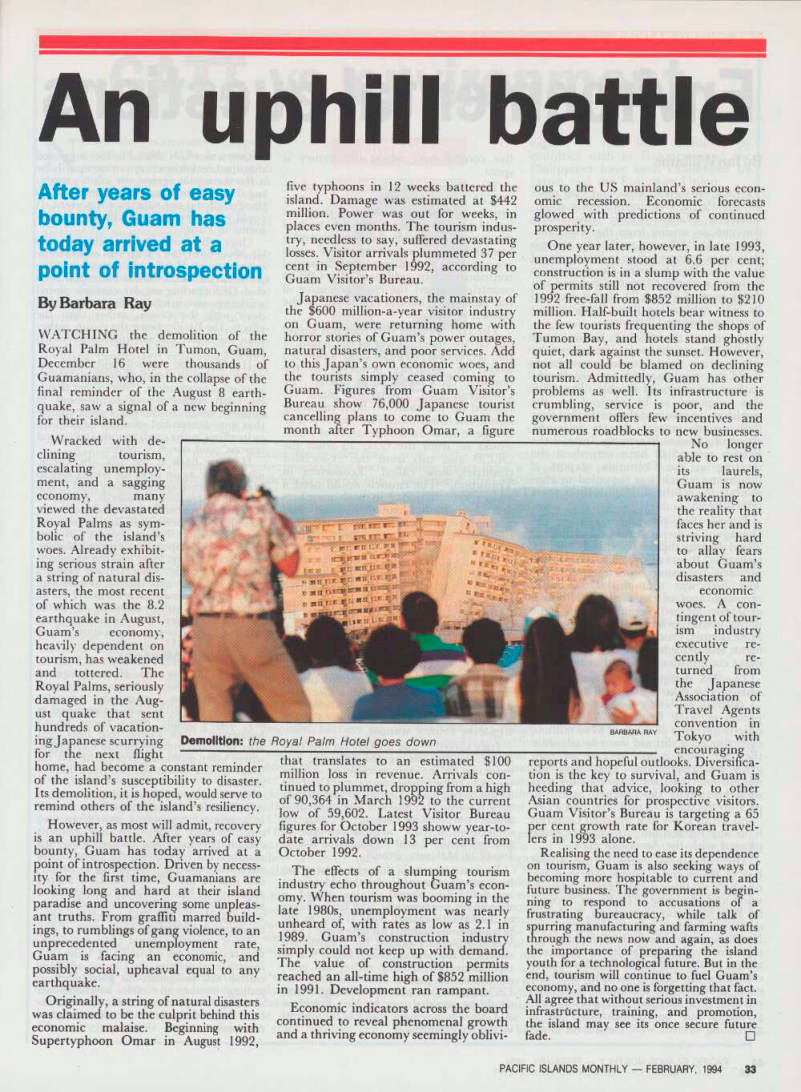
After years of easy
bounty, Guam has
today arrived at a
point of introspection
By Barbara Ray WATCHING the demolition of the Royal Palm Hotel in Turnon, Guam, December 16 were thousands of Guamanians, who, in the collapse of the final reminder of the August 8 earth quake, saw a signal of a new beginning for their island.
Wracked with de clining tourism,
escalating unemploy
ment, and a sagging economy, many viewed the devastated Royal Palms as sym bolic of the island’s woes. Already exhibit ing serious strain after a string of natural dis asters, the most recent of which was the 8.2 earthquake in August, Guam’s economy, heavily dependent on tourism, has weakened and tottered. The Royal Palms, seriously damaged in the Aug ust quake that sent hundreds of vacation ing Japanese scurrying for the next flight
home, had become a constant reminder of the island’s susceptibility to disaster.
Its demolition, it is hoped, would serve to remind others of the island’s resiliency.
However, as most will admit, recovery is an uphill battle. After years of easy bounty, Guam has today arrived at a
point of introspection. Driven by necess
ity for the first time, Guamanians are looking long and hard at their island paradise and uncovering some unpleas ant truths. From graffiti marred build ings, to rumblings of gang violence, to an unprecedented unemployment rate, Guam is facing an economic, and possibly social, upheaval equal to any
earthquake.
Originally, a string of natural disasters was claimed to be the culprit behind this economic malaise. Beginning with Supertyphoon Omar in August 1992,
five typhoons in 12 weeks battered the island. Damage was estimated at $442 million. Power was out for weeks, in places even months. The tourism indus try, needless to say, suffered devastating losses. Visitor arrivals plummeted 37 per cent in September 1992, according to Guam Visitor’s Bureau.
Japanese vacationers, the mainstay of the $6OO million-a-year visitor industry on Guam, were returning home with horror stories of Guam’s power outages, natural disasters, and poor services. Add to this Japan’s own economic woes, and the tourists simply ceased coming to Guam. Figures from Guam Visitor’s Bureau show 76,000 Japanese tourist cancelling plans to come to Guam the month after Typhoon Omar, a figure
that translates to an estimated $lOO million loss in revenue. Arrivals con tinued to plummet, dropping from a high of 90,364 in March 1992 to the current low of 59,602. Latest Visitor Bureau figures for October 1993 showw year-to date arrivals down 13 per cent from October 1992.
The effects of a slumping tourism industry echo throughout Guam’s econ omy. When tourism was booming in the late 1980 s, unemployment was nearly unheard of, with rates as low as 2.1 in 1989. Guam’s construction industry simply could not keep up with demand.
The value of construction permits reached an all-time high of $852 million in 1991. Development ran rampant.
Economic indicators across the board continued to reveal phenomenal growth and a thriving economy seemingly oblivi
ous to the US mainland’s serious econ omic recession. Economic forecasts glowed with predictions of continued prosperity.
One year later, however, in late 1993, unemployment stood at 6.6 per cent; construction is in a slump with the value of permits still not recovered from the 1992 free-fall from $852 million to $2lO million. Half-built hotels bear witness to the few tourists frequenting the shops of Turnon Bay, and hotels stand ghostly quiet, dark against the sunset. However, not all could be blamed on declining tourism. Admittedly, Guam has other problems as well. Its infrastructure is crumbling, service is poor, and the government offers few incentives and numerous roadblocks to new businesses.
No longer able to rest on its laurels, Guam is now awakening to the reality that faces her and is striving hard to allay fears about Guam’s disasters and economic woes. A con tingent of tour ism industry executive re cently re turned from
the Japanese
Association of Travel Agents convention in Tokyo with encouraging
reports and hopeful outlooks. Diversifica tion is the key to survival, and Guam is
heeding that advice, looking to other
Asian countries for prospective visitors.
Guam Visitor’s Bureau is targeting a 65 per cent growth rate for Korean travel lers in 1993 alone.
Realising the need to ease its dependence on tourism, Guam is also seeking ways of becoming more hospitable to current and future business. The government is begin ning to respond to accusations of a frustrating bureaucracy, while talk of
spurring manufacturing and farming wafts
through the news now and again, as does the importance of preparing the island youth for a technological future. But in the end, tourism will continue to fuel Guam’s economy, and no one is forgetting that fact.
All agree that without serious investment in infrastructure, training, and promotion, the island may see its once secure future fade. □
Barbara Ray
Demolition: the Royal Palm Hotel goes down
Environmental questions
The United Nations
By lan Williams
THERE was good news and bad news for the Pacific’s environmentally disad vantaged islands. Firstly two major conventions arising from the Rio Earth Summit in 1992 were ratified by enough nations to become riding in international law. The Bio-Diversity Convention in January and the Climate Change Con ventions as of March 21 after it received its 50th ratification from Portugal just four days before Christmas.
However, the Global Environment Facility, one of the major instruments by which these and similar conventions could be implemented by the Pacific nations is in serious trouble. The GEE was supposed to be pledged by the wealthier countries of the world that they took environmental threats seriously, especially Global Warming. Instead the French seemed to have torpedoed the meeting in the Columbia seaport of Cartagena which was supposed to con solidate the results of the past three years pilot project.
Despite five previous meetings, the Cartagena gathering broke up with what Third World diplomats called “serious setbacks.” It was supposed to consolidate previous discussions on two major items.
The first was a multi-billion dollar replenishment of the facility. This was generally agreed, even though some donor countries had political problems.
For example, Canada had a new govern ment, and so its diplomats were reluctant make commitments without instructions.
The US delegation was much more constructive than it had been in the past perhaps reflecting the environmental profile of Vice President A 1 Gore. It quietly agreed a package of $143 million, even though it did not want to advertise the fact back home in case of con gressional opposition. That was $2O million less than the formula said they should pay but “the Japanese agreed to pick up the slack,” a diplomat told PIM, “and we all know how opposed Congress is to any foreign aid, so we were quite pleased with the American effort.”
The breakdown came in the second half of the agenda, which discussed the question of the control of the organis ation and spending. The Earth Summit in Rio last year agreed on a shared decision making process between the North and the South but the damage came in the details. Despite a rearguard action by the “Group of 77” developing countries, the GEF’s Assembly in which each country has an equal vote, was reduced to a biennial talking shop, and power is to be concentrated in a governing council which will have effec
tive control over where the money is spent.
The affluent industrial countries of the OECD secured a two stage voting process in the council. Binding decisions would need to secure a majority both of the member states on the council, and a second ballot in which members’ votes are weighted according to their financial contribution. In addition, the OECD countries wanted the chief executive of the facility to be the chairman of the council.
The G 77 thought that that this would put far too much power in the hands of the secretariat, which they suspected would be naturally beholden to the donors, the hand that feeds. By Cartagena two alternative plans re mained on the table both involving significant compromises by the G 77. The first gave the council 31 seats, 16 of which would be from the G 77, 13 from the OECD and two from the ex-socialist countries, now called “Economies in Transition.” The council would need a 60 per cent majority in both members and contribution-loaded finance, and would have a co-chairman, elected from the council who would take the chair when discussing the secretariat.
The second proposal had no co-chair, a 2/3 majority requirement and 33 seats, 18 G 77, 13 OECD, and 2 EIT. When the G 77 offered a compromise on the first proposal which would enhance the power of the co-chairman, the French
threw down the gauntlet. Any changes,
their delegation declared and France would be unable to meet the contri bution it had agreed. The reduction it threatened was small but the Germans joined in, since their delegation was seemingly under instructions to back whatever France wanted.
Italy agreed and the G 77 became very angry. Under the agreed formula, any reduction by one country could be used by others to reduce their commitment and the $3 billion originally committed had already sunk towards 51.5 billion. “The concept of global partnership had to be properly understood if GEF negotiations are to firoceed farther” said Ambassador Razali smail of Malaysia, frostily.
In a strange way, however, there has been some progress. Under the old admin istration, the United States played a thoroughly negative role, and led a charge of the OECD against what it saw as the presumptuous South. This time some Third World diplomats praised the constructive American role and expressed hopes that at the reconvened meeting earlier this year, the US would pull its allies into line. The US had offered to host this meeting, which would be presided over by Vice-President A 1 Gore who has made much of his interest in the environment.
One senior UN official in fact suggested that the breakdown may not necessarily be a Northern plot against the south suggest ing that, “I would not be surprised if even the French did not anticipate this event. It could be rivalry between different depart ments in Paris”.
Once the council is established, in whatever form, the Pacific can expect some
improvement. Until now, a major sticking
point for the Small Island States has been that GEF funding on, for example global warming, was intended for projects that dealt with the causes, rather than the effects. The Pacific, being the victim, rather than the cause, did not qualify for much
funding.
However, the council will have the power to alter the terms of the initial three year pilot programme, “We expect that a lot GEF resources will be devoted to climate change, so there is a good chance that some substantial amounts be directed to its effects in the small islands and coastal regions” said one UN insider.
However back at the UN, the Pacific nations once again went the wrong way to make the friends and allies they need to win votes in international councils. Earlier in the General Assembly session several made an implacable enemy of Beijing by support ing a bid to give Taiwan its own UN seat.
In December, Papua New Guinea, Samoa, the Solomons, Fiji, FSM and the Marshalls may have made some serious enemies among the Arab and Islamic nations who make up a significant part of the G 77. The occasion was a vote reaffirming the status of Israeli-occupied East Jerusalem and refusing to recognise its annexation, which was passed by 141 votes to one.
Vanuatu Mystery
There is still no sign of the proposed replacement for former Vanuatu Ambassa dor Robert Van Lierop who was also chairman of AOSIS. “I’m embarrassed to say that I really don’t know what’s
happening.” Van Lierop told PIM, just
after returning from his part in Cartagena, where other diplomats reports he did his usual sterling works for the small islands states.
However, he will be stepping down from AOSIS “I feel that although I was elected in a personal capacity, I should not stay on,” he told PIM, “At the moment consultations are going on among AOSIS member, But I have told the group that I should be replaced.” According to Ameri can sources, the US itself had considered approaching Maxim Carlto’s government to keep Van Lierop on, because of his role with AOSIS in the Climate change dis cussions but he had demurred.
Once mistrusted by the old administra tion because of his advocacy of Vanuatu’s international policies, the Clinton adminis tration now recognises his good work in
pulling together the often inexperienced
and “under-diplomated” islands to articu late their needs from the international conventions. □
GATT vs environment
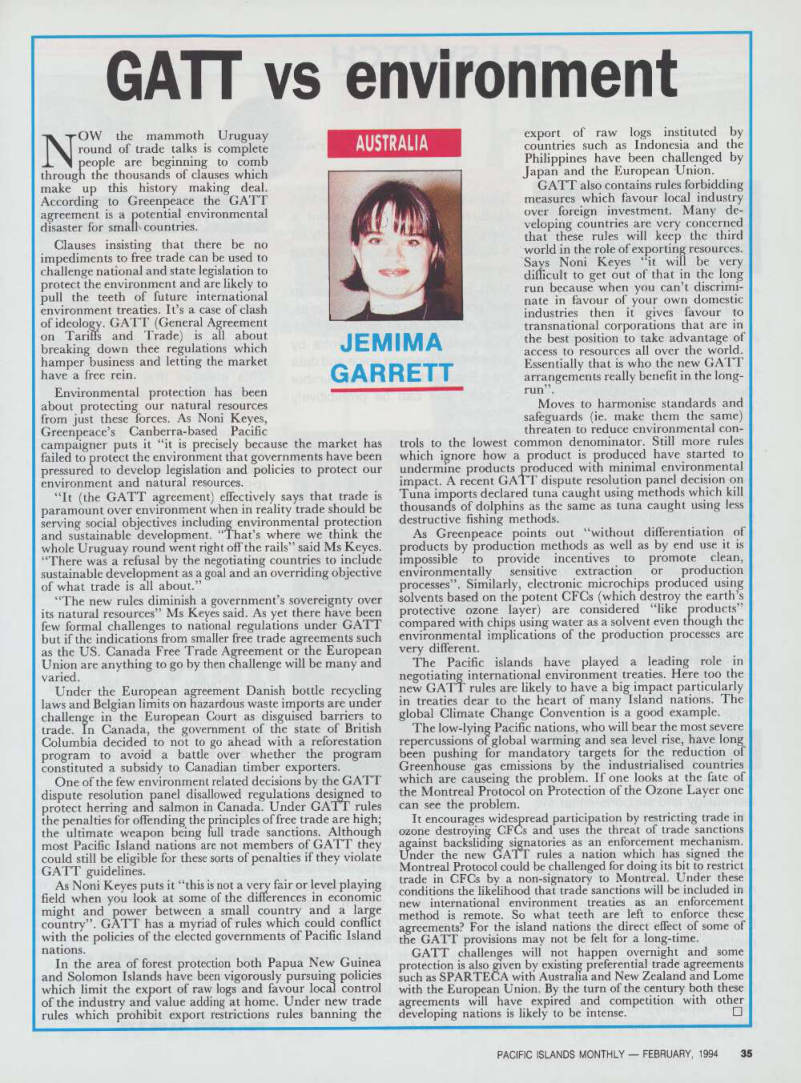
NOW the mammoth Uruguay round of trade talks is complete people are beginning to comb through the thousands of clauses which make up this history making deal.
According to Greenpeace the GATT agreement is a potential environmental disaster for small' countries.
Clauses insisting that there be no impediments to free trade can be used to challenge national and state legislation to protect the environment and are likely to pull the teeth of future international environment treaties. It’s a case of clash of ideology. GATT (General Agreement on Tariffs and Trade) is all about breaking down thee regulations which hamper business and letting the market have a free rein.
Environmental protection has been about protecting our natural resources from just these forces. As Noni Keyes, Greenpeace’s Canberra-based Pacific
campaigner puts it “it is precisely because the market has failed to protect the environment that governments have been pressured to develop legislation and policies to protect our environment and natural resources.
“It (the GATT agreement) effectively says that trade is paramount over environment when in reality trade should be serving social objectives including environmental protection and sustainable development. “That’s where we think the whole Uruguay round went right off the rails” said Ms Keyes.
“There was a refusal by the negotiating countries to include sustainable development as a goal and an overriding objective of what trade is all about.”
“The new rules diminish a government’s sovereignty over its natural resources” Ms Keyes said. As yet there have been few formal challenges to national regulations under GATT but if the indications from smaller free trade agreements such as the US. Canada Free Trade Agreement or the European Union are anything to go by then challenge will be many and varied.
Under the European agreement Danish bottle recycling laws and Belgian limits on hazardous waste imports are under challenge in the European Court as disguised barriers to trade. In Canada, the government of the state of British Columbia decided to not to go ahead with a reforestation program to avoid a battle over whether the program constituted a subsidy to Canadian timber exporters.
One of the few environment related decisions by the GATT dispute resolution panel disallowed regulations designed to protect herring and salmon in Canada. Under GATT rules the penalties for offending the principles of free trade are high; the ultimate weapon being full trade sanctions. Although most Pacific Island nations are not members of GATT they could still be eligible for these sorts of penalties if they violate GATT guidelines.
As Noni Keyes puts it “this is not a very fair or level playing field when you look at some of the differences in economic might and power between a small country and a large country”. GATT has a myriad of rules which could conflict with the policies of the elected governments of Pacific Island nations.
In the area of forest protection both Papua New Guinea and Solomon Islands have been vigorously pursuing policies which limit the export of raw logs and favour local control of the industry and value adding at home. Under new trade rules which prohibit export restrictions rules banning the
export of raw logs instituted by countries such as Indonesia and the
Philippines have been challenged by
Japan and the European Union.
GATT also contains rules forbidding measures which favour local industry over foreign investment. Many de veloping countries are very concerned that these rules will keep the third world in the role of exporting resources.
Says Noni Keyes “it will be very difficult to get out of that in the long run because when you can’t discrimi nate in favour of your own domestic industries then it gives favour to transnational corporations that are in the best position to take advantage of access to resources all over the world.
Essentially that is who the new GATT arrangements really benefit in the long run”.
Moves to harmonise standards and
safeguards (ie. make them the same)
threaten to reduce environmental con
trols to the lowest common denominator. Still more rules which ignore how a product is produced have started to undermine products produced with minimal environmental impact. A recent GATT dispute resolution panel decision on Tuna imports declared tuna caught using methods which kill thousands of dolphins as the same as tuna caught using less destructive fishing methods.
As Greenpeace points out “without differentiation of products by production methods as well as by end use it is impossible to provide incentives to promote clean, environmentally sensitive extraction or production
processes”. Similarly, electronic microchips produced using
solvents based on the potent CFCs (which destroy the earth’s protective ozone layer) are considered “like products” compared with chips using water as a solvent even though the environmental implications of the production processes are very different.
The Pacific islands have played a leading role in negotiating international environment treaties. Here too the new GATT rules are likely to have a big impact particularly in treaties dear to the heart of many Island nations. The global Climate Change Convention is a good example.
The low-lying Pacific nations, who will bear the most severe repercussions of global warming and sea level rise, have long been pushing for mandatory targets for the reduction of Greenhouse gas emissions by the industrialised countries which are causeing the problem. If one looks at the fate of the Montreal Protocol on Protection of the Ozone Layer one can see the problem.
It encourages widespread participation by restricting trade in ozone destroying CFCs and uses the threat of trade sanctions against backsliding signatories as an enforcement mechanism.
Under the new GATT rules a nation which has signed the Montreal Protocol could be challenged for doing its bit to restrict trade in CFCs by a non-signatory to Montreal. Under these conditions the likelihood that trade sanctions will be included in new international environment treaties as an enforcement method is remote. So what teeth are left to enforce these agreements? For the island nations the direct effect of some of the GATT provisions may not be felt for a long-time.
GATT challenges will not happen overnight and some protection is also given by existing preferential trade agreements such as SPARTECA with Australia and New Zealand and Lome with the European Union. By the turn of the century both these agreements will have expired and competition with other developing nations is likely to be intense. □
Australia
Jemima
Garrett
Cellswitch

Stanilite’s Cellswitch delivers cellular capacity with a number of unique advantages:
a economical installation
and operation
a quick rollout capability
a design flexibility.
Because of these design features, Cellswitch is ideally suited for providing cellular service in a variety of key areas.
Through its modularity and scalable architecture, Cellswitch is equally effective in the city or in lower population density areas. Designed for expansion, Cellswitch provides a cost-competitive solution with as few as 50 subscribers, with enough expansion capacity to support many thousands more.
Cellswitch has achieved an installation base in a wide variety of settings around the world, ranging from conventional urban cellular systems to temporary public service support situations.
Why Cellswitch?
Cellswitch is based on proven technology and supports either the AMPS or ETACS cellular standards.
These standards are used by the majority of cellular systems and are renowned for their reliability and robustness. In contrast with emerging standards, AMPS and ETACS terminal equipment is relatively inexpensive, easy to obtain in quantity, and proven to be safe.
Cellswitch automatically enhances your capacity for continued expansion and improved service.
Because of Cellswitch’s design features, you can implement a comprehensive cellular capacity for a fraction of the price of competing systems.
Most cellular systems operate on the principle of “dumb” cell sites, each of which must be linked back to a “master” switching centre by expensive 2 megabit voice and data links. Even with only a small number of cells, this can be prohibitively expensive.
In contrast, Cellswitch relies on intelligent, self-contained cell sites, each containing all the hardware and software necessary to operate as a complete local switch. This approach allows you to substantially reduce costs by networking only the sites you require. Links between Cellswitch sites can be provided by standard or leased telephone lines, optic fibres or microwave, further reducing setup costs.
Design flexibility
The key to your system’s success is its proper planning. Prior to the installation of your system, Stanilite’s expert engineers will assemble a system plan, based on the physical geography of the coverage area and a range of environmental factors.
This ensures that your cellular system delivers peak performance at all times.
Cellswitch has been designed to integrate instantly into your existing public switched telephone network (PSTN). It supports most common telephone signalling protocols, including those used by older style exchanges. Additional lines can be added to Cellswitch at any time by the simple installation of more line interface cards.
Adding capacity to the system is a simple task, so the initial installation can be tailored to suit immediate demand, reducing your “up front” capital outlay. To cater for growing demand, additional modules can be fitted in existing equipment racks.
Entire equipment racks can be added where necessary. Very importantly, upgrading Cellswitch requires very little “off-air” time, minimising service disruptions.
Cellswitch is built to operate remotely, without the need for on site staff. Call charge information is downloaded from the cell site directly, and each cell site can be fully tested from your network control centre.
For further information call: Robert Tomlinson Sales Manager Stanlllte Electronics (NZ) Ltd Ph: (649) 4156370 Fax(649)4156371
Advertisements & other items, p. 37 (1 item)
IPTC Telecom Expo
Community service: the coastal radio service is provided by PTC to ships at sea and the national disaster and emergency service
Providing a vital link
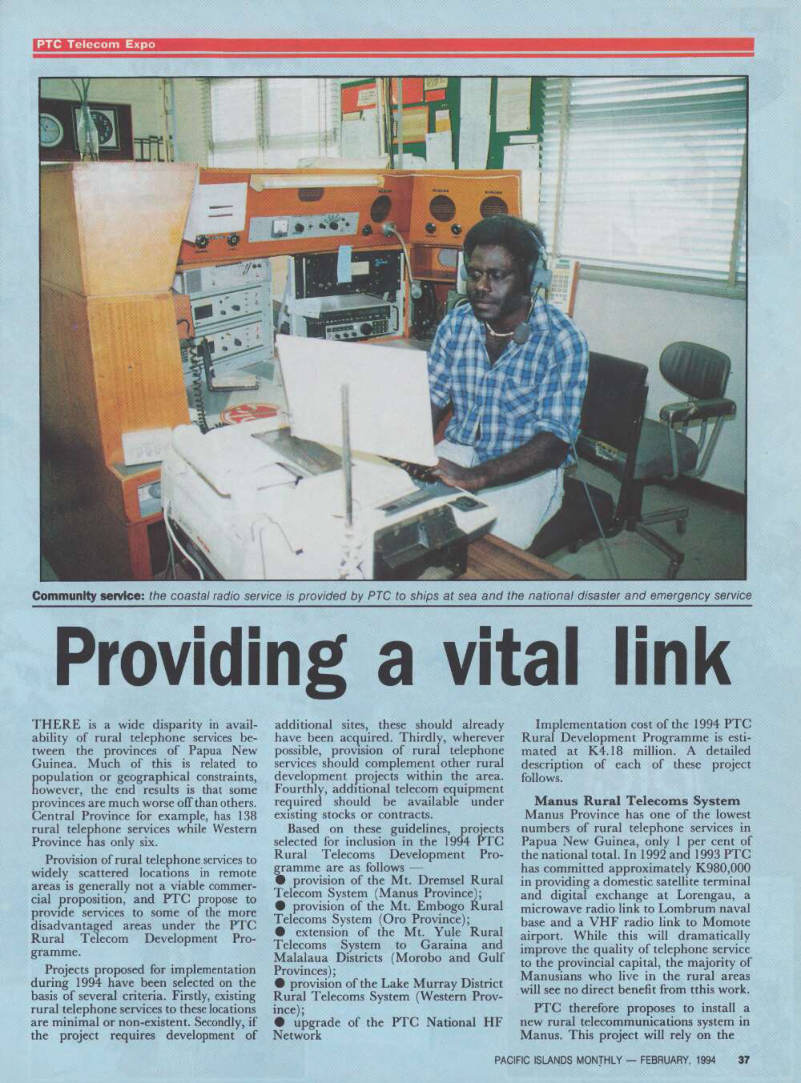

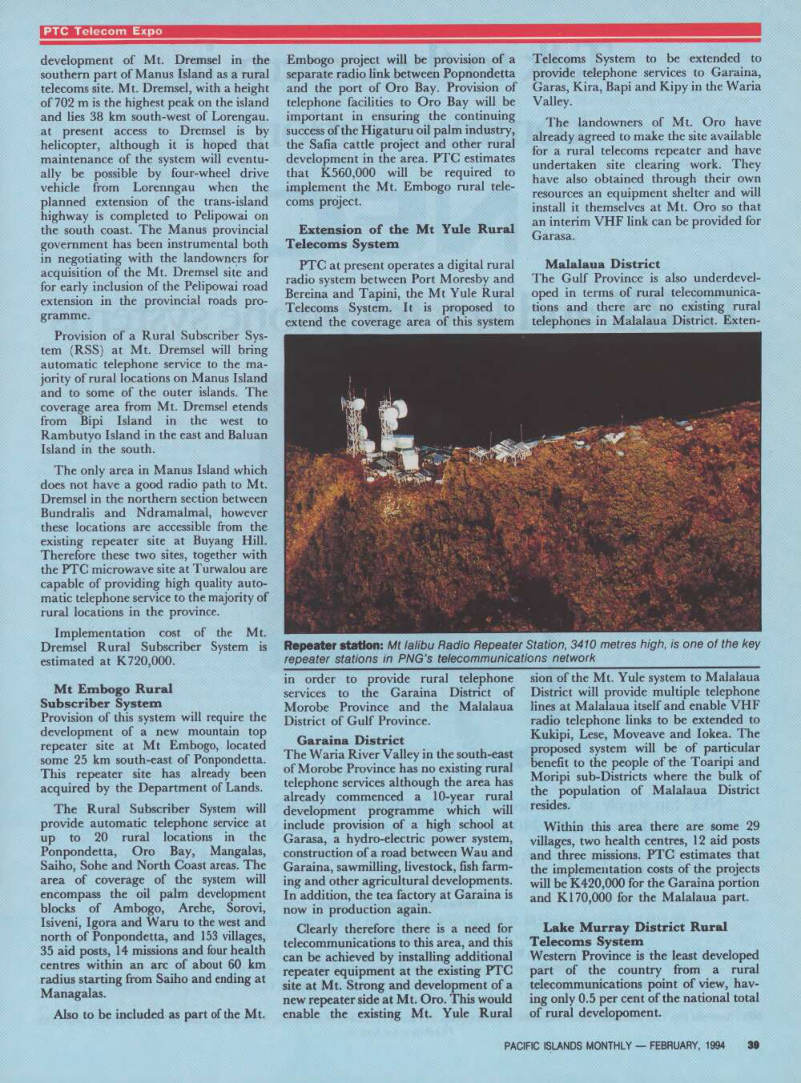

THERE is a wide disparity in availability of rural telephone services between the provinces of Papua New Guinea. Much of this is related to
population or geographical constraints,
however, the end results is that some provinces are much worse off than others.
Central Province for example, has 138 rural telephone services while Western Province has only six.
Provision of rural telephone services to widely scattered locations in remote areas is generally not a viable commerdal proposition, and PTC propose to provide services to some of the more disadvantaged areas under the PTC Rural Telecom Development Programme. t, . , f . , .
Projects proposed for implementation during 1994 have been selected on the basis of several criteria. Firstly, existing rural telephone services to these locations are minimal or non-existent. Secondly, if
the project requires development of
additional sites, these should already have been acquired. Thirdly, wherever possible, provision of rural telephone services should complement other rural development projects within the area, Fourthly, additional telecom equipment required should be available under existing stocks or contracts.
Based on these guidelines, projects selected for inclusion in the 1994 PTC Rural Telecoms Development Programme are as follows - • P rovisl ° n of Mt - Dremsel Rural
Telecom System (Manus Province);
f provision of the Mt. Embogo Rural Telecoms System (Oro Province) f , extensio P °f the Mt - Yu . le R “ ral coms System Garama and Malalaua Districts (Morobo and Gulf
Provinces);
provision of the Lake Murray District Rural Telecoms System (Western Province); upgrade of the PTC National HF Network
Implementation cost of the 1994 PTC Rural Development Programme is esti mated at K 4.18 million. A detailed description of each of these project follows, Manus Rural Telecoms System Manus Province has one of the lowest numbers of rural telephone services in Papua New Guinea, only 1 per cent of the national total. In 1992 and 1993 PTC has committed approximate y K 980,000 m providing a domestic satellite terminal and digital exchange at Lorengau, a microwave radio link to Lombrum naval base and a VHP radio link to Momote airport. While this will dramatically
improve the quality of telephone service
to t b e provincial capital, the majority of whn live in the rural arpas -ij ,• , r .r , ■ , W 1 see no irec ene 1 rom is wor PTC therefore proposes to install a new rural telecommunications system in Manus. This project will rely on the
development of Mt. Dremsel in the southern part of Manus Island as a rural telecoms site. Mt. Dremsel, with a height of 702 m is the highest peak on the island and lies 38 km south-west of Lorengau. at present access to Dremsel is by helicopter, although it is hoped that maintenance of the system will eventu ally be possible by four-wheel drive vehicle from Lorenngau when the planned extension of the trans-island highway is completed to Pelipowai on the south coast. The Manus provincial government has been instrumental both in negotiating with the landowners for acquisition of the Mt. Dremsel site and for early inclusion of the Pelipowai road extension in the provincial roads pro gramme.
Provision of a Rural Subscriber Sys tem (RSS) at Mt. Dremsel will bring automatic telephone service to the ma jority of rural locations on Manus Island and to some of the outer islands. The coverage area from Mt. Dremsel etends from Bipi Island in the west to Rambutyo Island in the east and Baluan Island in the south.
The only area in Manus Island which does not have a good radio path to Mt.
Dremsel in the northern section between Bundralis and Ndramalmal, however these locations are accessible from the existing repeater site at Buyang Hill.
Therefore these two sites, together with the PTC microwave site at Turwalou are
capable of providing high quality auto
matic telephone service to the majority of rural locations in the province.
Implementation cost of the Mt.
Dremsel Rural Subscriber System is estimated at K 720,000.
Mt Embogo Rural
Subscriber System
Provision of this system will require the development of a new mountain top repeater site at Mt Embogo, located some 25 km south-east of Ponpondetta.
This repeater site has already been acquired by the Department of Lands.
The Rural Subscriber System will provide automatic telephone service at up to 20 rural locations in the
Ponpondetta, Oro Bay, Mangalas,
Saiho, Sohe and North Coast areas. The area of coverage of the system will encompass the oil palm development blocks of Ambogo, Arehe, Sorovi, Isiveni, Igora and Waru to the west and north of Ponpondetta, and 153 villages, 35 aid posts, 14 missions and four health centres within an arc of about 60 km radius starting from Saiho and ending at
Managalas.
Also to be included as part of the Mt.
Embogo project will be provision of a separate radio link between Popnondetta and the port of Oro Bay. Provision of telephone facilities to Oro Bay will be important in ensuring the continuing success of the Higaturu oil palm industry, the Safia cattle project and other rural development in the area. PTC estimates that K 560,000 will be required to implement the Mt. Embogo rural tele coms project.
Extension of the Mt Yule Rural Telecoms System PTC at present operates a digital rural radio system between Port Moresby and Bereina and Tapini, the Mt Yule Rural Telecoms System. It is proposed to extend the coverage area of this system
in order to provide rural telephone services to the Garaina District of Morobe Province and the Malalaua District of Gulf Province.
Garaina District The Waria River Valley in the south-east of Morobe Province has no existing rural telephone services although the area has already commenced a 10-year rural development programme which will include provision of a high school at Garasa, a hydro-electric power system, construction of a road between Wau and Garaina, sawmilling, livestock, fish farm ing and other agricultural developments.
In addition, the tea factory at Garaina is now in production again.
Clearly therefore there is a need for telecommunications to this area, and this can be achieved by installing additional repeater equipment at the existing PTC site at Mt. Strong and development of a new repeater side at Mt. Oro. This would enable the existing Mt. Yule Rural
Telecoms System to be extended to provide telephone services to Garaina, Garas, Kira, Bapi and Kipy in the Waria Valley.
The landowners of Mt. Oro have already agreed to make the site available for a rural telecoms repeater and have undertaken site clearing work. They have also obtained through their own resources an equipment shelter and will install it themselves at Mt. Oro so that an interim VHF link can be provided for Garasa.
Malalaua District The Gulf Province is also underdevel oped in terms of rural telecommunica tions and there are no existing rural telephones in Malalaua District. Exten
sion of the Mt. Yule system to Malalaua
District will provide multiple telephone
lines at Malalaua itself and enable VHF radio telephone links to be extended to Kukipi, Lese, Moveave and lokea. The proposed system will be of particular benefit to the people of the Toaripi and Moripi sub-Districts where the bulk of the population of Malalaua District resides.
Within this area there are some 29 villages, two health centres, 12 aid posts and three missions. PTC estimates that the implementation costs of the projects will be K 420,000 for the Garaina portion and K 170,000 for the Malalaua part.
Lake Murray District Rural
Telecoms System
Western Province is the least developed part of the country from a rural telecommunications point of view, hav ing only 0.5 per cent of the national total of rural developoment.
Repeater station: Mt lalibu Radio Repeater Station, 3410 metres high, is one of the key repeater stations in PNG’s telecommunications network
PTC proposes to provide radio bearers from the existing microwave repeater site at Mt Karoma to Lake Murray and Nomad River in the Lake Murray District. The District Office at Lake Murray and sub-District Office at No mad River are the two administrative centres for the Lake Murray District, and are responsible for the administration of 109 villages, seven health centres, 11 aid posts and seven missions.
Upgrade of the PTC National HF Network The PTC HF Outstation Radio Service (ORS) and the HF Coastal Radio Service (CRS) are manual telecommuni cations services to rural subscribers and ships in isolated and island areas which cannot be provided with any other means of automatic telecommunications at a reasonable cost. The ORS is a very important service to the people it serves because they are usually very small communities and it is their only means of seeking medical advice, assistance in times of adversity, organising business, transportation (usually by air or sea) or providing contact with the outside world.
Users of the service comprise govern ment departments such as administra tion centres, health centres, schools and postal agencies (which also provide public telephone facilities for the area), as well as private business, plantations and individuals. Seventy-five per cent of the outstation traffic is generated from government stations.
The coastal shipping industry services the coastal and island rural areas, providing transport for people and produce to and from the urban areas.
Coastal shipping is essential for the rural development of the coastal provinces and coastal vessels depend on an efficient HF Coastal Radio Service for commercial operations and safety of life at sea.
PTC operates ORS base stations in the major centres of Port Moresby, Daru, Alotau, Lae, Goroka, Madang, Wewak and Rabaul and CRS bases at Port Moresby and Rabaul with an additional slave station at Wewak.
In the past PTC has also provided and maintained government outstations but because of the costs involved, this will now become the subscriber’s responsibil ity to purchase the equipment from communication equipment suppliers.
The upgraded service will depend on a reduced number of base centres with Port Moresby being the main centre handling all nationwide ORS and CRS traffic after hours. Coastal ships will use the bases at Port Moresby and Rabaul during business hours with an additional facility at Wewak for emergency traffic The ORS base centres at Wewak, Alotau and Rabaul will handle the high density business hours traffic for their respective areas and Port Moresby will provide the centre for traffic on the southern, central and western areas of the country.
Outstations nationwide will be equipped with suitable Port Moresby frequencies to cater for all their traffic outside
business hours. The after-hours service will be equipped with selective calling to increase the efficiency of the service.
Lae, Goroka, Madang and Daru subscribers will be encouraged to change to the Wewak of Port Moresby base centre. The HF service does not provide profit to PTC and is operated as a Community Service Obligation, it’s vital necessity to the rural sector being well recognised. The service returns minimal revenue which does not meet operating costs and, because of this, the equipment at the base stations has not been renewed for many years. Several of the CRS transmitters still in use date back to the 19505. Today the service quality is very poor and, in some cases, unreliable.
The revenue received in 1992 from the ORS traffic was K 155,000 and from the CRS was K 160,000.
Action Required Port Moresby Transmitters The Port Moresby transmitters are located at the HF transmitting station at five miles in Boroko. The National Capital District Commission have been asking PTC to move the station for many years. Due to the developments in the area over the past 30 years, the site is no longer suitable as an HF transmitting station. The area of land remaining is too small to upgrade to provide the required number of services and the radio inter ference to surrounding residences is unacceptable. The Port Moresby trans mitting station has to be relocated to a new site that has been selected at Mountain View Estate, near Mt Lawes on the Brown River Road. The site will contain the transmitters for both outstation radio and the coastal radio so the building and civil costs are common to both services.
The cost of relocating the HF trans mitting station is estimated at K 1.2 million.
Port Moresby Operators Centre The operators centre for Port Moresby is now located in the old Boroko exchange for outstation radio and at the back of Jackson’s Airport for the coastal radio.
Security problems prevent the staffing of the CRS during the night.
A new combined 24 hour operating centre is required to be provided in the PTC Haus Technology complex at four Mile, near the new Boroko exchange.
The cost of the new operating centre is estimated at K 500,000.
Port Moresby Receiving Station This station requires upgrading of antennae, installation of additional re ceivers and removal of operators con soles. The cost of the work to be carried out is estimated at K 50,000.
Upgrading Rabaul, Wewak and Alotau Minimal upgrading of transmitters, re ceivers, antennae and operators consoles at the three sites needs to be carried out an estimated cost of K 250,000.
Summary PTC believes that provision of rural telecommunications is essential to the overall development of the rural areas.
Without telecommunications, progress in government administration, law and order, health and education services, commerce and agricultural projects will be slow. On the other hand, availability of rural telecommunications will boost the implementation and efficiency of these services, and an improvement in the quality of life in the rural areas will tend to reduce urban drift which will be of overall benefit to Papua New Guinea.
In the cast of outstation HF, its ability to operate anywhere within PNG with low cost subscriber equipment and to be rapidly deployed enables it to be used for emergency restoration of telecommuni cations following natural disasters. In times of trouble, national security may depend on HF radio to provide vital communication links. The effectiveness of HF radio as a communications resource is, however, dependant on replacement of the existing old and unreliable base station equipment with modern transmitters and receivers.
In many years PTC has the solutions for provision of rural telecom systems, however because of the isolation of these areas and the expense of installing and maintaining remote repeater sites with a very low return, these projects do not meet the standard criteria for commer
cial viability.
The PTC Rural Development Pro gramme therefore aims to redress the imbalance in rural telecommunications, and PTC proposes to submit to the NEC an annual programme of non commercially viable rural telecom proj ects, concentrating initially on the most disadvantaged areas. Estimated costs for implementation of the 1994 programme total K 4.18 million. □
Check: Michael Yandit, satellite technician carries out checks on TV equipment on the full DOMSAT system
Advertisements & other items, pp. 38-40 (1 item)
wHmmm
nnnaus
i: IE mnnus digital opemne 6-/t/» . i ”• ■i -• •• ri I!\i \ Jr wv-'JBS Ji • > t
‘Sj.tJ , 7/ ;
i / •• mM r// i
mmunicatio
N * /
limit
* fe - ‘4 s*-. m *.'4* m u ¥ 'W s ■-. x V * ■ , % v ;.. V tg. >7 4 **.* % . %Jf I F j ••*•)» p u S *l if w » I •w B»p*
NICATION CORPO
t ca/ sraon
Talk to the experts in
communication...
NEC
PABX and key telephone systems
I
NERX24BO 1
■LJ..I La..Lj.ilJ —Elilily .■»0».1...a03 L m 1 m cm cm cm cm cm m. cm. : stu j i.kk 1 cfa I era i era I acb I yci l" Jj I I I J I 11. J I I I I « « 11.1 \ • s : iE® LiS): NEC can supply all your needs for PABX equipment and key telephone systems. Our range includes the advanced NEAX 2400 Series PABX System and the RANGER Key Telephone System.
NEC provides rapid sales response, after sales support, deliveries and upgrades for clients through-
out the South Pacific region.
Please contact your NEC supplier: Fiji Post Telecommunications Ltd. Marketing Division, PO Box 40, Suva Fiji. Phone: (679) 210 600 Fax: (679) 210 493.
Distributors for Fiji, Vanuatu, Western Samoa, Tonga, Kiribati, Tuvalu, Niue, Wallis 8c Futuna, New Caledonia.
NEC Papua New Guinea. PO Box 937, Boroko NCD, Port Moresby, Papau New Guinea. Phone: (675) 252 644 Fax: (675) 252 948.
Distributors for Papua New Guinea, Solomon Islands, Micronesia and Naum.
Telecom New Zealand Ltd. Business System Sales, 15 Lady Ruby Drive, East Tamaki, Auckland. Phone: (649) 274 3000 Fax: (649) 274 1999.
Distributors for New Zealand and Cook Islands.
NEC Australia Pty. Ltd. Business Communications Systems Group, PO Box 1111, Glen Waverley Vic, 3150. Phone: (03) 262 1111 Fax: (03) 262 1333.
Distributors for Australia.
Melanesia 2010
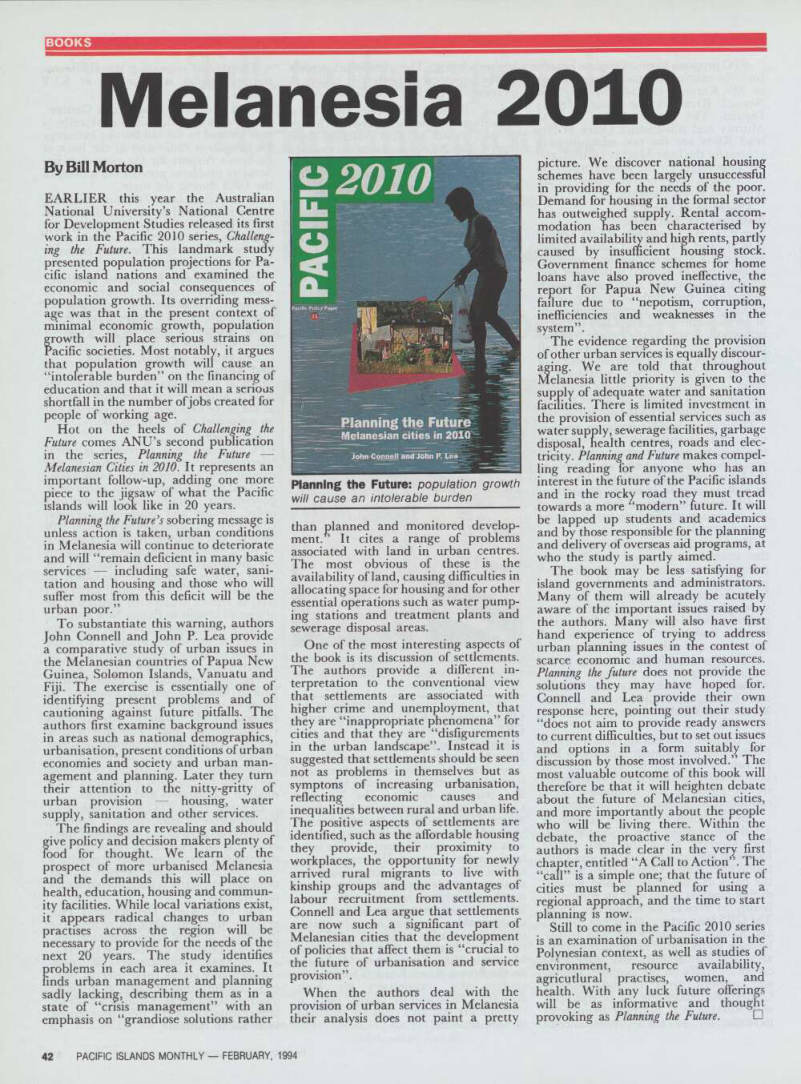
Books
By Bill Morton
EARLIER this year the Australian National University’s National Centre for Development Studies released its first work in the Pacific 2010 series, Challeng ing the Future. This landmark study presented population projections for Pa cific island nations and examined the economic and social consequences of population growth. Its overriding mess age was that in the present context of minimal economic growth, population frowth will place serious strains on acific societies. Most notably, it argues that population growth will cause an “intolerable burden” on the financing of education and that it will mean a serious shortfall in the number of jobs created for
people of working age.
Hot on the heels of Challenging the Future comes ANU’s second publication in the series, Planning the Future Melanesian Cities in 2010. It represents an important follow-up, adding one more piece to the jigsaw of what the Pacific islands will look like in 20 years.
Planning the Future’s sobering message is unless action is taken, urban conditions in Melanesia will continue to deteriorate and will “remain deficient in many basic services including safe water, sani tation and housing and those who will suffer most from this deficit will be the urban poor.”
To substantiate this warning, authors John Connell and John P. Lea provide a comparative study of urban issues in the Melanesian countries of Papua New Guinea, Solomon Islands, Vanuatu and Fiji. The exercise is essentially one of identifying present problems and of cautioning against future pitfalls. The authors first examine background issues in areas such as national demographics, urbanisation, present conditions of urban economies and society and urban man agement and planning. Later they turn their attention to the nitty-gritty of urban provision housing, water supply, sanitation and other services.
The findings are revealing and should give policy and decision makers plenty of food for thought. We learn of the prospect of more urbanised Melanesia and the demands this will place on health, education, housing and commun ity facilities. While local variations exist, it appears radical changes to urban practises across the region will be necessary to provide for the needs of the next 20 years. The study identifies problems in each area it examines. It finds urban management and planning sadly lacking, describing them as in a state of “crisis management” with an emphasis on “grandiose solutions rather
than planned and monitored develop ment.” It cites a range of problems associated with land in urban centres.
The most obvious of these is the availability of land, causing difficulties in allocating space for housing and for other essential operations such as water pump ing stations and treatment plants and sewerage disposal areas.
One of the most interesting aspects of the book is its discussion of settlements.
The authors provide a different in terpretation to the conventional view that settlements are associated with higher crime and unemployment, that they are “inappropriate phenomena” for cities and that they are “disfigurements in the urban landscape”. Instead it is suggested that settlements should be seen not as problems in themselves but as symptons of increasing urbanisation, reflecting economic causes and inequalities between rural and urban life.
The positive aspects of settlements are identified, such as the affordable housing
they provide, their proximity to
workplaces, the opportunity for newly arrived rural migrants to live with kinship groups and the advantages of labour recruitment from settlements.
Connell and Lea argue that settlements are now such a significant part of Melanesian cities that the development of policies that affect them is “crucial to the future of urbanisation and service
provision”.
When the authors deal with the provision of urban services in Melanesia their analysis does not paint a pretty
picture. We discover national housing schemes have been largely unsuccessful in providing for the needs of the poor.
Demand for housing in the formal sector has outweighed supply. Rental accom modation has been characterised by limited availability and high rents, partly caused by insufficient housing stock.
Government finance schemes for home loans have also proved ineffective, the report for Papua New Guinea citing failure due to “nepotism, corruption, inefficiencies and weaknesses in the system”.
The evidence regarding the provision of other urban services is equally discour aging. We are told that throughout Melanesia little priority is given to the supply of adequate water and sanitation facilities. There is limited investment in the provision of essential services such as water supply, sewerage facilities, garbage disposal, health centres, roads and elec tricity. Planning and Future makes compel ling reading for anyone who has an interest in the future of the Pacific islands and in the rocky road they must tread towards a more “modern” future. It will be lapped up students and academics and by those responsible for the planning and delivery of overseas aid programs, at who the study is partly aimed.
The book may be less satisfying for island governments and administrators.
Many of them will already be acutely aware of the important issues raised by the authors. Many will also have first hand experience of trying to address urban planning issues in the contest of scarce economic and human resources.
Planning the future does not provide the solutions they may have hoped for.
Connell and Lea provide their own response here, pointing out their study “does not aim to provide ready answers to current difficulties, but to set out issues and options in a form suitably for discussion by those most involved.” The most valuable outcome of this book will therefore be that it will heighten debate about the future of Melanesian cities, and more importantly about the people who will be living there. Within the debate, the proactive stance of the authors is made clear in the very first chapter, entitled “A Call to Action”. The “call” is a simple one; that the future of cities must be planned for using a regional approach, and the time to start planning is now.
Still to come in the Pacific 2010 series is an examination of urbanisation in the Polynesian context, as well as studies of environment, resource availability,
agricutlural practises, women, and
health. With any luck future offerings will be as informative and thought provoking as Planning the Future. D
Planning the Future: population growth will cause an intolerable burden
Building on trade
ties in Australia
WESTERN Samoa hopes to build on the successful results it achieved from its high-powered trade and investment mission to Austra lia in 1992 by sending a follow-up mission to the commonwealth later this month.
It will visit Melbourne, Sydney and Brisbane and again it will be at ministerial level and include govern ment officials and leading business people. But instead of conducting a series of seminars, as the mission did the first time, this one will host a series of lunches in the capital cities, inviting contacts it made on its earlier visit and others who have indicated interest.
There will be opportunities to discuss specific deals and to develop other propositions in the light of experience over the past 18 months.
The 1992 mission, which, like this one,
was arranged by the South Pacific Trade Commission, was a watershed in that it was the government’s first such mission to Australia in 30 years of Samoan independence. It made its mark by impressing on Australian investors just how far Samoa has gone in its determination to make foreign investment attractive, particularly in the areas of manufac turing and tourism. This latest visit is another new departure it marks the first time we have brought a mission back to consolidate and build on its earlier work. If it’s as successful as we expect, similar opportunities for others may follow.
The building of reliable trade contacts can’t be done overnight, and no matter how good the opportunities, there is always a getting-to-know-you period. Yazaki Australia, which assembles automotive electrical components near Apia, is one company prominent in the earlier mission which as since got to know Samoa very well and has continued to expand amazingly. Nor does it hesitate to pass on the news tp other Australian firms about the opportunities in Samoa and the enthusiastic support they can expect from the government.
Another trade promotion in Sydney this month a major South Pacific philatelic promotion and workshop from February 6-11 - is building on a similar exercise undertaken in 1992. It will promote island stamps and give the Australian philatelic industry and collectors the chance to make personal contacts with the various island philatelic bureaus, buy material and discuss production and other matters.
In attendance will be managers from bureaus in the Cook Islands, Fiji, the Federated States of Micronesia, Kiribati, the Marshall Islands, Nauru, Niue, PNG, Solomon Islands, Tonga, Tuvalu, Vanuatu and Western Samoa, plus other representatives from New Caledonia and French Polynesia.
The displays, open to the public, will promote the wide range of island stamps and the workshops will provide the bureau managers with the opportunity to discuss such common interests as pricing, production, promotion, pack aging, distribution, quality control, customer service, management and training. They should lead to better
coordination and integration and help develop the island bureau’s long-term market strategies.
Philatelic sales are an important source of foreign exchange in the Pacific, particularly among the smaller island nations. So this promotion is being coordinated by the Australian fovernment’s Trade and Investment romotion Service (TIPS) and funded under the terms of SPARTECA by the Australian International Development Assistance Bureau as part of Australia’s overseas aid program.
The trade commission works closely with TIPS on the SPARTECA pro gramme and in the staging of island trade displays and investment seminars like these. Liaison with Australian government offices and South Pacific diplomats credited to Australia is an important part of our brief in further
ing island trade and investment, and one of the reasons we
are Sydney-based.
Meanwhile, for the past few months our assistant marketing officer, Greg oimunovic, has among his many other tasks been working closely with the Tourism Council of the South Pacific on plans for the South Pacific Village at the 1994 International Holiday and Travel Show. The show will be staged in Melbourne Qune 17-19) and Sydney
(June 24-26).
A lot of work is going into it because the travel show has special significance this year. It will mark the official launch in Australia of “Visit the South Pacific Year ’95”. Similar campaigns are being coordinated in New Zealand, the United States, Canada, Europe and Japan, for the big year will market the South Pacific as a distinct regional identity, and a value-for-money tourist destination. The plan is to stimulate permanent tourist growth in the South Pacific.
As a build up, there is an extensive public relations and publicity plan to promote the South Pacific right through this year, with newspaper and magazine features, radio and television programmes, sponsorship of competitions and performances etc. We will use some of our own budget to extend the message in association with this year’s travel show.
The South Pacific Village has been given even more space, and the focal point will be a stage in the form of a giant island outrigger. This replaces the award-winning smoking, roaring ‘volcano’ of recent years.
Meanwhile, as I reported in reviewing the 1993 activities of the Sydney office in last month’s PIM column, the major part of our work is still responding promptly to queries from island business people, preparing information and otherwise offering business advice within the constraints of our resources to everyone who seeks it. If you want to help or to take part in any off our promotion, phone or fax. Our service is free. • Bill McCabe is senior commissioner of the South Pacific Trade Commission, Sydney an arm of the South Pacific Forum.
Tradewinds
Bill
Mccabe
Advertisements & other items, p. 44 (1 item)
The true colours of the Pacific
... j #' SiPil iiS r
pA CIFIC
A**' * • ** imp m fev A m f Am
PACIFIC
Furs INTERNATIONAL AIRLINE
Apia • Auckland • Brisbane • Christchurch • Honiara • Melbourne • Nadi • Port Vila • Suva • Sydney • Tokyo • Tonga
A colourful past
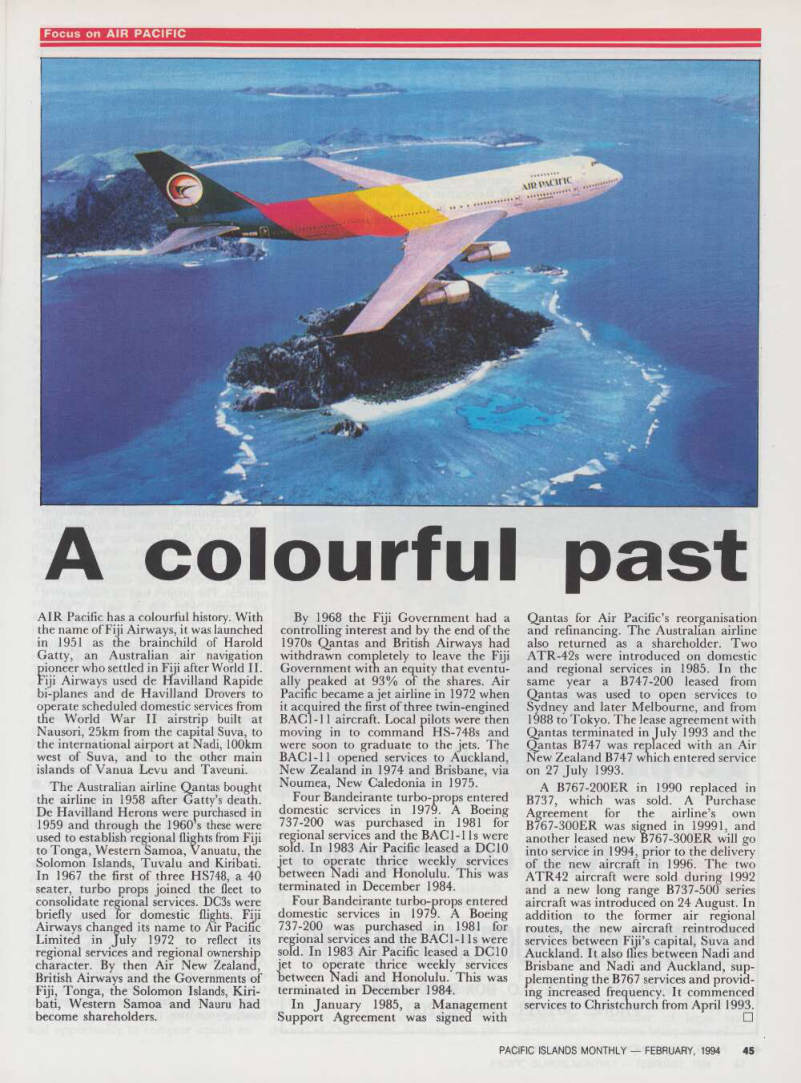
I Focus on AIR PACIFIC
AIR Pacific has a colourful history. With the name of Fiji Airways, it was launched in 1951 as the brainchild of Harold Gatty, an Australian air navigation pioneer who settled in Fiji after World 11.
Fiji Airways used de Havilland Rapide bi-planes and de Havilland Drovers to operate scheduled domestic services from the World War II airstrip built at Nausori, 25km from the capital Suva, to the international airport at Nadi, 100 km west of Suva, and to the other main islands of Vanua Levu and Taveuni.
The Australian airline Qantas bought the airline in 1958 after Gatty’s death.
De Havilland Herons were purchased in 1959 and through the 1960 s these were used to establish regional flights from Fiji to Tonga, Western Samoa, Vanuatu, the Solomon Islands, Tuvalu and Kiribati.
In 1967 the first of three HS74B, a 40 seater, turbo props joined the fleet to consolidate regional services. DC3s were briefly used for domestic flights. Fiji Airways changed its name to Air Pacific Limited in July 1972 to reflect its regional services and regional ownership character. By then Air New Zealand, British Airways and the Governments of Fiji, Tonga, the Solomon Islands, Kiribad, Western Samoa and Nauru had become shareholders.
By 1968 the Fiji Government had a controlling interest and by the end of the 1970 s Qantas and British Airways had withdrawn completely to leave the Fiji Government with an equity that eventually peaked at 93% of the shares. Air Pacific became a jet airline in 1972 when it acquired the first of three twin-engined BACI-11 aircraft. Local pilots were then moving in to command HS-748s and were soon to graduate to the jets. The BACI-11 opened services to Auckland, New Zealand in 1974 and Brisbane, via Noumea, New Caledonia in 1975.
Four Bandeirante turbo-props entered domestic services in 1979. A Boeing 737-200 was purchased in 1981 for regional services and the BAG 1-1 Is were sold. In 1983 Air Pacific leased a DCIO J et to operate thrice weekly services between Nadi and Honolulu. This was terminated in December 1984.
Four Bandeirante turbo-props entered domestic services in 1979. A Boeing 737-200 was purchased in 1981 for regional services and the BAG 1 -11 s were sold. In 1983 Air Pacific leased a DCIO jet to operate thrice weekly services between Nadi and Honolulu. This was terminated in December 1984.
In January 1985, a Management
Support Agreement was signed with
Qantas for Air Pacific’s reorganisation and refinancing. The Australian airline also returned as a shareholder. Two ATR-42s were introduced on domestic and regional services in 1985. In the same year a 8747-200 leased from Qantas was used to open services to Sydney and later Melbourne, and from 1988 to Tokyo. The lease agreement with Qantas terminated in July 1993 and the Qantas 8747 was replaced with an Air New Zealand 8747 wnich entered service on 27 July 1993. a 8767-200 ER in 1990 replaced in 8737, which was sold. A Purchase Agreement for the airline’s own 8767-300 ER was signed in 19991, and another leased new 8767-300 ER will go into service in 1994, prior to the delivery G f the new aircraft in 1996. The two ATR42 aircraft were sold during 1992 and a new long range 8737-500 series aircraft was introduced on 24 August. In addition to the former air regional routes, the new aircraft reintroduced services between Fiji’s capital, Suva and Auckland. It also flies between Nadi and Brisbane and Nadi and Auckland, sup plementing the 8767 services and provid mg increased frequency. It commenced services to Christcnurch from April 1993. □
Highlights

of the year
SUCCESSFUL completion, within budget, of the new $lB million aircraft maintenance and administration facility at Nadi; • Seventh successive year of profitable operations. Air Pacific is now a $2OO million per year turnover company; • Repayment of loan in full on ATR 42 aircraft; • Sale of two ATR 42 aircraft to Guinness Peat Aviation in April 1992 and subsequent short-term leaseback; • The successful introduction, in Aug ust 1992, of new, ex-factory Boeing 737-500 aircraft making Air Pacific and all Boeing jet company; • The reintroduction of a jet service (737-500) on Pacific island routes and
associated introduction of Business Class seating option; • Relocation of the company from the capital city Suva to Nadi, the hub of Air Pacific’s international! operations; • Reintroduction of popular Suva- Auckland direct service from August 1992; • Introduction of new route direct service Nadi-Christchurch (decision
taken November 1992, service intro duced April 1993); • Receipt of second and final tranche of the European Investment Bank loan to partially fund construction of Nadi Aircraft Maintenance and Administra tion facility. All other expenses associ ated with hangar construction funded from own resources; • The successful bilateral negotiation of two services to Osaka, Japan, applicable when new Kansai Airport opens this year; • Resumption of weekly Nadi-Los Angeles service on 8747 aircraft from July this year. Decision announced December 31, 1993.
right direction
A move in the right direction
THE move to Nadi was the final step in the progression of Air Pacific from being Fiji’s domestic airline. The airline’s new $lB million hangar facility at Nadi International Airport is an integral part of that move and is probably the most strategically important decision the air line has ever taken.
A commitment to spend $lB million at a time when the future was so uncertain at the height of the Gulf war and in thhe middle of the worldwide recession dem onstrated Air Pacific’s commitment to being a catalyst for the country’s devel opment. The project had its doomsayers; the people who felt it was a “white elephant”. But the airline was prepared to stand by its conviction.
“We could have opted for a facility that only catered to the ATR and Boeing 737 aircraft but instead we looked to the future and built a hangar which was capable of maintaining the latest tech nology wide-bodied aircraft, including the Boeing 747-400,” says a report in the company’s annual report for 1992-1993.
“The hangar will provide a means of containing future costs by maintaining our own aircraft here in Fiji.” However, the benefits which will finally accrue from the location of such a facility in Fiji are wider reaching and provide Fiji with a new skill base and a resource which will generate additional employment opportunities as well as saving on foreign exchange.
Additionally, Fiji will be able to offer these new skills and resources to other airlines, primarily from within the re gion, but not necessarily restricted to regional airlines. The major advantage Air Pacific has is the ability to offer engineering services and facilities that conform to international standards at rates well below those charged in neigh bouring countries. □
Advertisements & other items, p. 46 (1 item)
Fletcher Construction Co |Fiji| Ltd
The Name You Can Trust
¥ AIR PACIFIC
Vijfe People and Performance
FLETCHER CONSTRUCTION
FLETCHER CONSTRUCTION CO |FIJI| LTD
WAILADA ESTATE, P.O. BOX 3070, LAMI.
PHONE; 361511, FAX: 361200.
On to Los Angeles
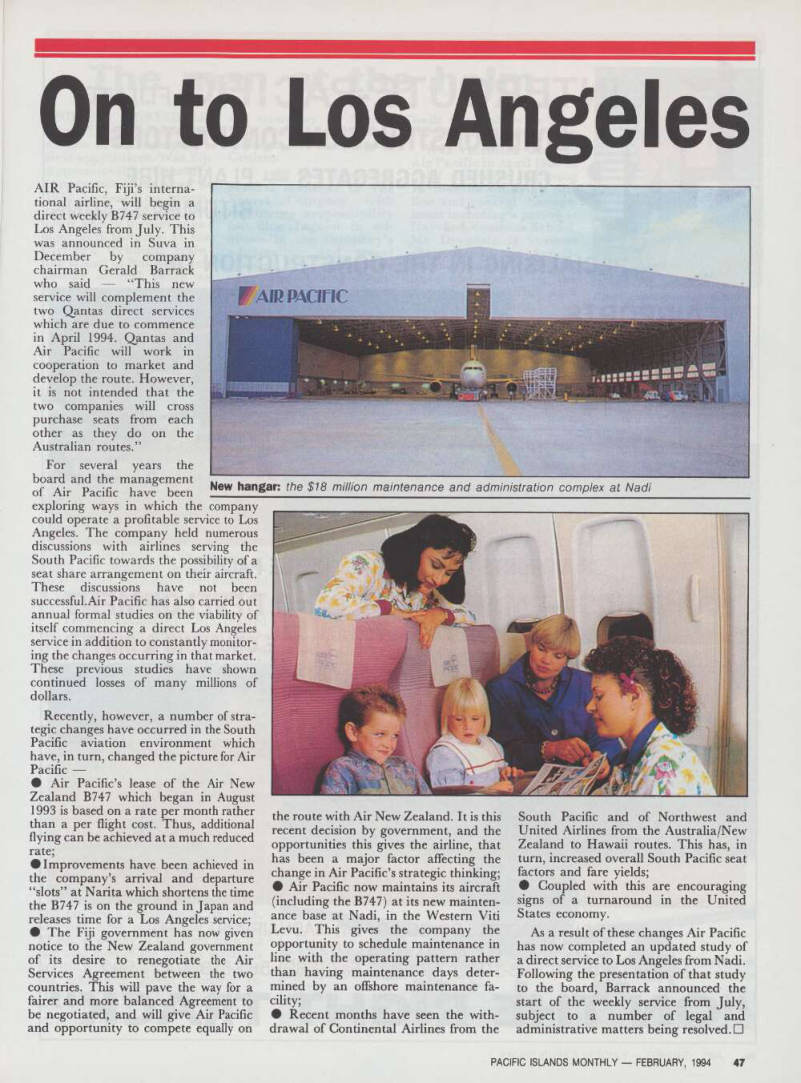
AIR Pacific, Fiji’s interna
tional airline, will begin a direct weekly 8747 service to Los Angeles from July. This was announced in Suva in December by company chairman Gerald Barrack who said “This new service will complement the two Qantas direct services which are due to commence in April 1994. Qantas and Air Pacific will work in cooperation to market and develop the route. However, it is not intended that the two companies will cross purchase seats from each other as they do on the Australian routes.”
For several years the board and the management of Air Pacific have been
exploring ways in which the company could operate a profitable service to Los Angeles. The company held numerous discussions with airlines serving the South Pacific towards the possibility of a seat share arrangement on their aircraft.
These discussions have not been successful. Air Pacific has also carried out annual formal studies on the viability of itself commencing a direct Los Angeles service in addition to constantly monitor ing the changes occurring in that market.
These previous studies have shown continued losses of many millions of dollars.
Recently, however, a number of stra tegic changes have occurred in the South Pacific aviation environment which have, in turn, changed the picture for Air Pacific • Air Pacific’s lease of the Air New Zealand 8747 which began in August 1993 is based on a rate per month rather than a per flight cost. Thus, additional flying can be achieved at a much reduced rate; • Improvements have been achieved in the company’s arrival and departure “slots” at Narita which shortens the time the 8747 is on the ground in Japan and releases time for a Los Angeles service; • The Fiji government has now given notice to the New Zealand government of its desire to renegotiate the Air Services Agreement between the two countries. This will pave the way for a fairer and more balanced Agreement to be negotiated, and will give Air Pacific and opportunity to compete equally on
the route with Air New Zealand. It is this recent decision by government, and the opportunities this gives the airline, that has been a major factor affecting the change in Air Pacific’s strategic thinking; • Air Pacific now maintains its aircraft (including the 8747) at its new mainten ance base at Nadi, in the Western Viti Levu. This gives the company the opportunity to schedule maintenance in line with the operating pattern rather than having maintenance days deter mined by an offshore maintenance fa cility; • Recent months have seen the with drawal of Continental Airlines from the
South Pacific and of Northwest and United Airlines from the Australia/New Zealand to Hawaii routes. This has, in turn, increased overall South Pacific seat factors and fare yields; • Coupled with this are encouraging signs of a turnaround in the United States economy.
As a result of these changes Air Pacific has now completed an updated study of a direct service to Los Angeles from Nadi.
Following the presentation of that study to the board, Barrack announced the start of the weekly service from July, subject to a number of legal and administrative matters being resolved. □
New hangar: the $18 million maintenance and administration complex at Nadi
Advertisements & other items, p. 48 (1 item)
On The Right Track
INTEROUTE-PACIFIC FIJI LTD.
CIVIL CONSTRUCTION CONTRACTORS
CRUSHED AGGREGATES — PLANT HIRE
— BITUMEN SEALING
SPECIALISING IN THE CONSTRUCTION OF:
AIRPORTS
' ) J WmSS
38 AIRPORTS CONSTRUCTED IN THE PACIFIC
HARBOURS — MARINAS — LAND DEVELOPMENT
AGGREGATE CRUSHING & SUPPLY
3* i - -v . Jf 52*. *js.: * ...
W 3 ' -■“V - ■ • ‘V’
U /•->' * f* ■ “• ■' "
'mm ■ • - > SP? 1 ® WBSmmi t a INTEROUTE-PACIFIC, PO BOX 9714, NADI AIRPORT — FIJI
TEL & FAX(679) 702773
TAHITI Tel (689) 583-104 / 424-822 Fax (689) 582-578 / 427-592
ON THE RIGHT TRACK
99
The man at the helm
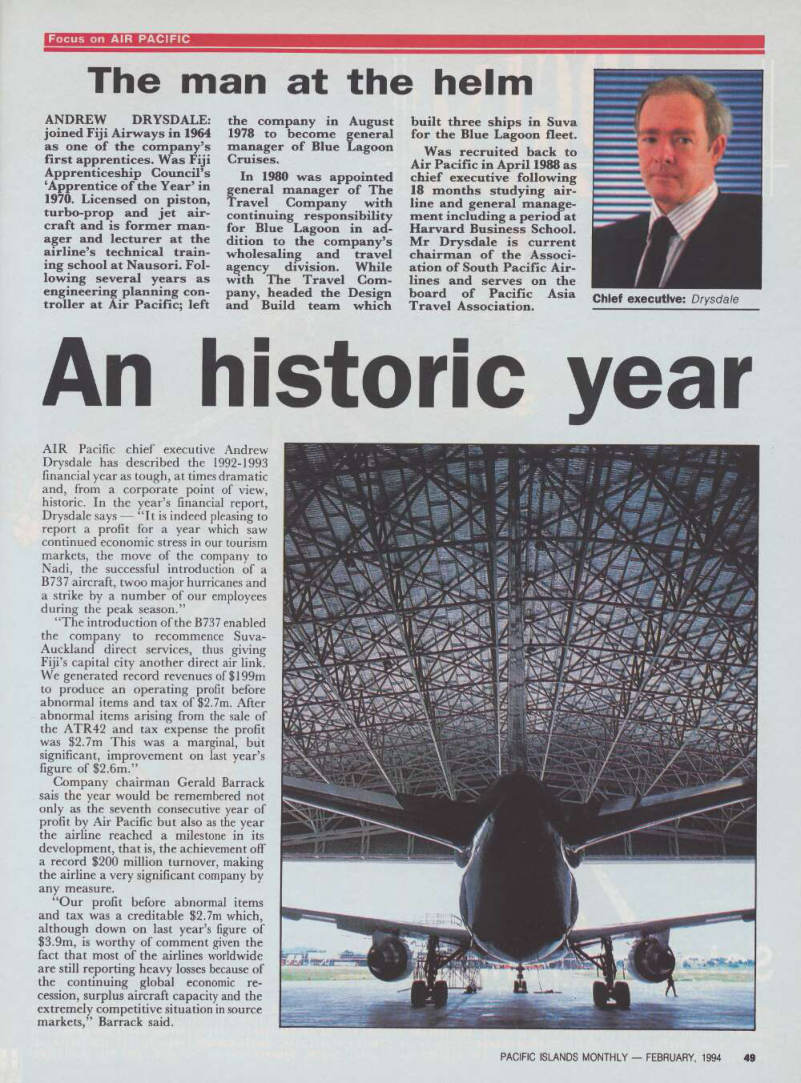
Andrew Drysdale:
joined Fiji Airways in 1964 as one of the company’s first apprentices. Was Fiji Apprenticeship Council s in?A r r” tlCe °* ear in 1970. Licensed on piston, turbo-prop and jet aircraft and is former manager and lecturer at the airline’s technical training school at Nausori. Following several years as engineering planning controller at Air Pacific; left
the company in August 1978 to become general manager of Blue Lagoon Cruises.
In J9BO was appointed general manager of The Travel Company with continuing responsibility for Blue Lagoon in addition to the company’s wholesaling and travel agency division. While with The Travel Company, headed the Design and Build team which
built three ships in Suva for the Blue Lagoon fleet, Was reC ruited back to Air Pacific in April 1988 as chief executive following 18 months studying air line and general manage ment including a period at Harvard Business School, Mr Drysdale is current chairman of the Associ ation of South Pacific Air lines and serves on the board of Pacific Asia Travel Association.
Chief executive: Drysdale
An historic year
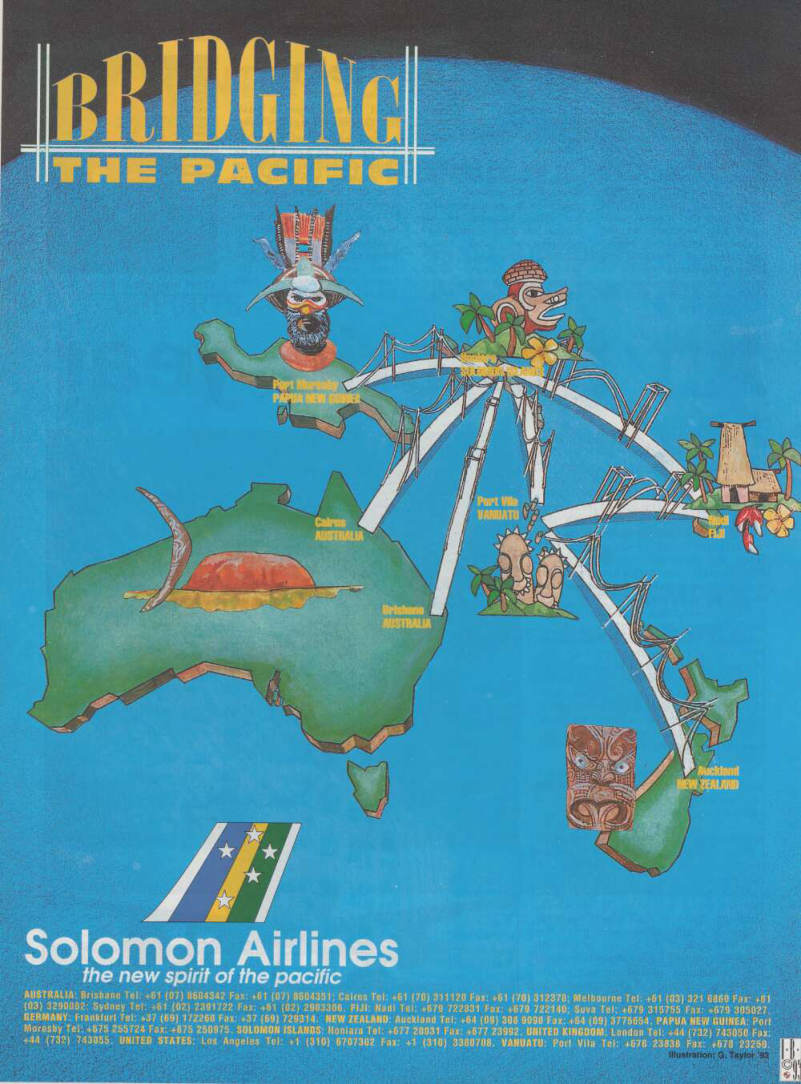
AIR Pacific chief executive Andrew Drysdale has described the 1992-1993 financial year as tough, at times dramatic and, from a corporate point of view, historic. In the year’s financial report, Drysdale says “It is indeed pleasing to report a profit for a year which saw continued economic stress in our tourism markets, the move of the company to Nadi, the successful introduction of a 8737 aircraft, twoo major hurricanes and a strike by a number of our employees during the peak season.”
“The introduction of the 8737 enabled the company to recommence Suva- Auckland direct services, thus giving Fiji’s capital city another direct air link.
We generated record revenues of $ 199 m to produce an operating profit before abnormal items and tax of $2.7m. After abnormal items arising from the sale of the ATR42 and tax expense the profit was $2.7m This was a marginal, blit significant, improvement on last year’s figure of $2.6m.”
Company chairman Gerald Barrack sais the year would be remembered not only as the seventh consecutive year of profit by Air Pacific but also as the year the airline reached a milestone in its development, that is, the achievement off a record $2OO million turnover, making the airline a very significant company by any measure.
“Our profit before abnormal items and tax was a creditable $2.7m which, although down on last year’s figure of $3.9m, is worthy of comment given the fact that most of the airlines worldwide are still reporting heavy losses because of the continuing global economic re cession, surplus aircraft capacity and the extremely competitive situation in source markets,” Barrack said.
“Total expenditure for the year was up 5.6 per cent on the previous year at $197.2m. The airline also made substan tial contribution to government revenue through payment of some $4.6m in income taxes. The continuing rise in costs leads me to raise a note of caution. The company is controlling costs effectively at the moment but unfortunately, with the operating environment we currently find ourselves in, we tread a very fine line between profit and loss. A demonstration of just how fine this line is can be seen from the fact that although we achieved revenues of s2oom for the year, the profit was less than s3m or 1.4 per cent on turnover.
“Traffic levels continue to grow world
wide but yields are down substantially. If we are to expand as an airline and meet the demands of Fiji’s tourism, we will need to achieve much higher profits in the future. The level of profit is not
acceptable from a long-term viewpoint.
Having said that however, I would like to congratulate staff and management on continuing the profit record under what were very arduous conditions.
“We face a number of major chal lenges and hurdles in our immediate future. Air Pacific cannot isolate itself from the impact on ongoing recession and increased competition from other tourist destinations. We can, however, adopt a positive approach to growth and development. I have every confidence in
management’s ability to steer the airline on a successful course over the next five years. Their achievements to date, and for the financial year just ended, vindi cate that confidence.”
After a series of losses which began in 1979 and culminated in the worst loss in Air Pacific’s history of 510,865,000 in 1884/85, the company achieved a small profit in 1985/86, and a record profit of Sl.sm in 1986/87. The record of profit was repeated for the year ending March 31, 1988 at 52.4 m inclusive of abnormal items and in 1989 at s9.lm operating profit. The effects of the Gulf War, extreme fuel price increases and the recession in our major markets resulted in a decline in operating profit for the 1990/91 year to S4m, however, this was supported by the gain on sale of the 8737 to provide a total year end record after tax profit of 517.1 m.
Continued recession and the effects of the Australian aviation deregulation adversely affected the 1991/92 year.
However, a very credible 53.9 m in operating profit was achieved. The company has now fully utilised brought forward tax losses and paid income tax to the Fiji government for the first time in 1990 on the 1989/90 profits. The 1992/93 year saw yet another profit of 52.7 m.
The company’s cash situation is now very positive with in excess of Ssom invested in Fiji, says a background report
prepared by Drysdale. However, the the
cost of the Nadi base (S2om) and the 1996 8767-300 aircraft will require approximately S2l2m in capital invest ment over the next five years. This is a major commitment and the company is currently studying how this can be achieved. This problem of capital needs is one of the two major problems facing the company (the other is the supply of
manpower skills).
At the end of August 1993, Air Pacific had 580 staff in employment (airline operations 377, marketing 109, human resources 12, information systems, chief executive 5, planning and administration 4, corporate administration 11, finance 54.
The management team Drysdale, chief executive; Josephine Yeejoy Bland, acting director of finance and company secretary; Peni Naituku, director of human resources; Ramendra Narayan,
director of marketing; Jesoni
Vitusagavulu, executive director/ re
gional manager New Zealand; Narendra Kumar, general manager commercial;
Tony Wong, general manager oper
ations; Ernie Dutta, director of strategic
planning. □
Advertisements & other items, pp. 49-50 (2 items)
| Focus on AIR PACIFIC
Focus on AIR PACIFIC
Solomon Airlines
THE PACIFIC
-Vi' IS sm m K x I » i // i. v V'. ■ Vila m VI . * H 1 Si S 3 m 1 J 1 ★ ★ .x :S x. -: *
ililia
Solomon Airlines
the new spirit of the pacific
AUSTRALIA; Brisbane Tel: +6l (07) 8604342 Fax: +6l (07) 8604351; Cairns Tel: +6l (70) 311120 Fax; +6l (70) 312378; Melbourne Tel: +6l (03) 321 6860 Fax- +6l (03) 3290082; Sydney Tel: +6l (02) 2391722 Fax: +6l (02) 2903306. FIJI: Uadi Tel; +679 722831 Fax: +679 722140; Suva Tel: +679 315755 Fax: +679 305027.
GERMANY: Frankfurt Tel; +37 (69) 172260 Fax: +37 (69) 729314, NEW ZEALAND; Auckland Tel; +64 (09) 308 9098 Fax: +64 (09) 3775654. PAPUA NEW GUINEA- Port Moresby Tel; +675 255724 Fax: +675 250975. SOLOMON ISLANDS; Honiara Tel: +677 20031 Fax: +677 23992. UNITED KINGDOM: London Tel: +44 (732) 743050 Fax- +44 (732) 743055. UNITED STATES: Los Angeles Tei: +1 (310) 6707302 Fax: +1 (310) 3380708. VANUATU: Port Vila Tel: +678 23838 Fax; +678 23250.
‘Singh The Swing'
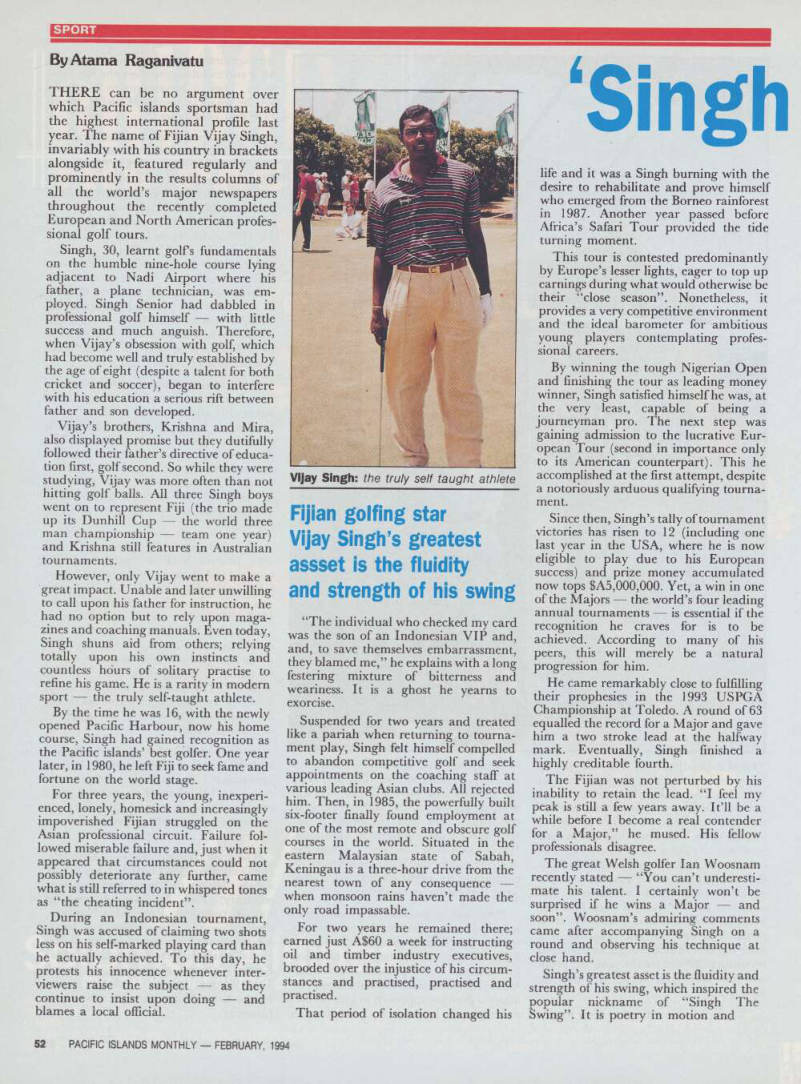
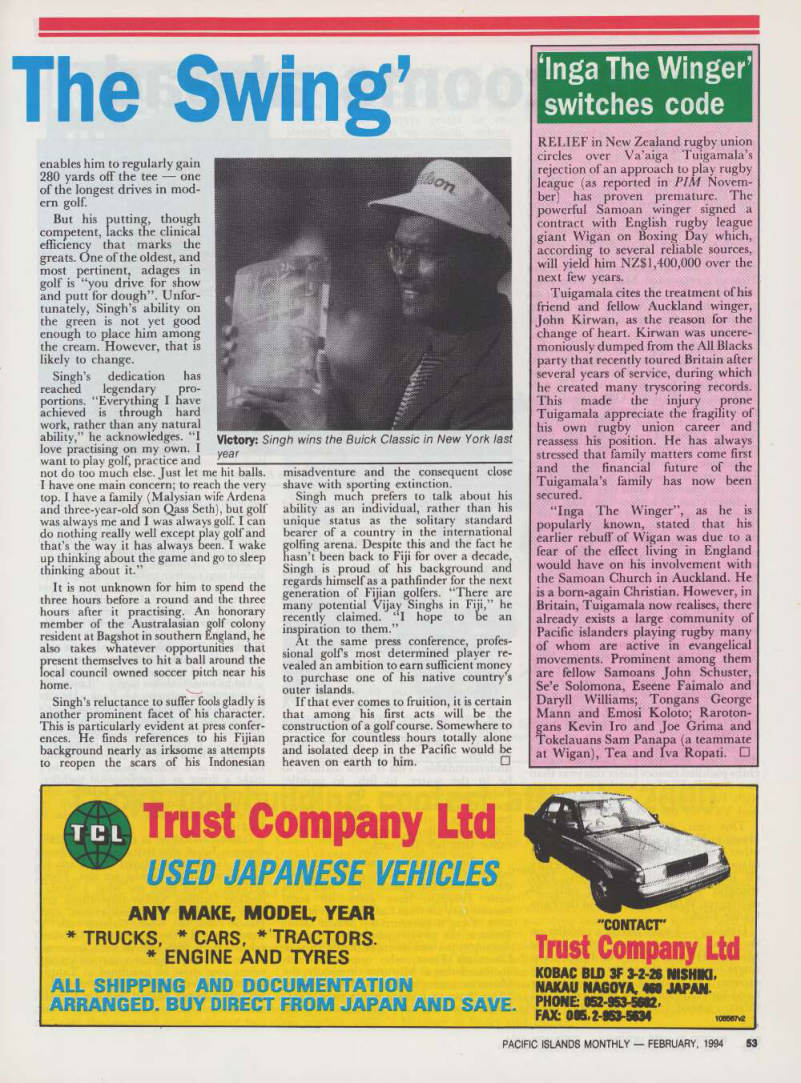
Sport
By Atama Raganivatu
THERE can be no argument over which Pacific islands sportsman had the highest international profile last year. The name of Fijian Vijay Singh, invariably with his country in brackets alongside it, featured regularly and prominently in the results columns of all the world’s major newspapers
throughout the recently completed
European and North American profes sional golf tours.
Singh, 30, learnt golfs fundamentals on the humble nine-hole course lying adjacent to Nadi Airport where his father, a plane technician, was em ployed. Singh Senior had dabbled in professional golf himself with little success and much anguish. Therefore, when Vijay’s obsession with golf, which had become well and truly established by the age of eight (despite a talent for both cricket and soccer), began to interfere with his education a serious rift between father and son developed.
Vijay’s brothers, Krishna and Mira, also displayed promise but they dutifully followed their father’s directive of educa tion first, golf second. So while they were studying, Vijay was more often than not hitting golf balls. All three Singh boys went on to represent Fiji (the trio made up its Dunhill Cup the world three man championship team one year) and Krishna still features in Australian tournaments.
However, only Vijay went to make a great impact. Unable and later unwilling to call upon his father for instruction, he had no option but to rely upon maga zines and coaching manuals. Even today, Singh shuns aid from others; relying totally upon his own instincts and countless hours of solitary practise to refine his game. He is a rarity in modern sport the truly self-taught athlete.
By the time he was 16, with the newly opened Pacific Harbour, now his home course, Singh had gained recognition as the Pacific islands’ best golfer. One year later, in 1980, he left Fiji to seek fame and fortune on the world stage.
For three years, the young, inexperi enced, lonely, homesick and increasingly impoverished Fijian struggled on the Asian professional circuit. Failure fol lowed miserable failure and, just when it appeared that circumstances could not possibly deteriorate any further, came what is still referred to in whispered tones as “the cheating incident”.
During an Indonesian tournament, Singh was accused of claiming two shots less on his self-marked playing card than he actually achieved. To this day, he protests his innocence whenever inter viewers raise the subject as they continue to insist upon doing and blames a local official.
Fijian golfing star Vijay Singh’s greatest assset is the fluidity and strength of his swing
“The individual who checked my card was the son of an Indonesian VIP and, and, to save themselves embarrassment, they blamed me,” he explains with a long festering mixture of bitterness and weariness. It is a ghost he yearns to exorcise.
Suspended for two years and treated like a pariah when returning to tourna ment play, Singh felt himself compelled to abandon competitive golf and seek appointments on the coaching staff at various leading Asian clubs. All rejected him. Then, in 1985, the powerfully built six-footer finally found employment at one of the most remote and obscure golf courses in the world. Situated in the eastern Malaysian state of Sabah, Keningau is a three-hour drive from the nearest town of any consequence when monsoon rains haven’t made the only road impassable.
For two years he remained there; earned just As6o a week for instructing oil and timber industry executives, brooded over the injustice of his circum stances and practised, practised and practised.
That period of isolation changed his
life and it was a Singh burning with the desire to rehabilitate and prove himself who emerged from the Borneo rainforest in 1987. Another year passed before Africa’s Safari Tour provided the tide turning moment.
This tour is contested predominantly by Europe’s lesser lights, eager to top up earnings during what would otherwise be their “close season”. Nonetheless, it provides a very competitive environment and the ideal barometer for ambitious young players contemplating profes sional careers.
By winning the tough Nigerian Open and finishing the tour as leading money winner, Singh satisfied himself he was, at the very least, capable of being a journeyman pro. The next step was gaining admission to the lucrative Eur opean Tour (second in importance only to its American counterpart). This he accomplished at the first attempt, despite a notoriously arduous qualifying tourna ment.
Since then, Singh’s tally of tournament victories has risen to 12 (including one last year in the USA, where he is now eligible to play due to his European success) and prize money accumulated now tops $A5,000,000. Yet, a win in one of the Majors the world’s four leading annual tournaments is essential if the recognition he craves for is to be achieved. According to many of his peers, this will merely be a natural progression for him.
He came remarkably close to fulfilling their prophesies in the 1993 USPGA Championship at Toledo. A round of 63 equalled the record for a Major and gave him a two stroke lead at the halfway mark. Eventually, Singh finished a highly creditable fourth.
The Fijian was not perturbed by his inability to retain the lead. “I feel my peak is still a few years away. It’ll be a while before I become a real contender for a Major,” he mused. His fellow
professionals disagree.
The great Welsh golfer lan Woosnam recently stated “You can’t underesti mate his talent. I certainly won’t be surprised if he wins a Major and soon”. Woosnam’s admiring comments came after accompanying Singh on a round and observing his technique at close hand.
Singh’s greatest asset is the fluidity and strength of his swing, which inspired the popular nickname of “Singh The Swing”. It is poetry in motion and
ViJay Singh: the truly self taught athlete
enables him to regularly gain 280 yards off the tee one of the longest drives in mod ern golf.
But his putting, though competent, lacks the clinical efficiency that marks the greats. One of the oldest, and most pertinent, adages in golf is “you drive for show and putt for dough”. Unfor tunately, Singh’s ability on the green is not yet good enough to place him among the cream. However, that is likely to change.
Singh’s dedication has reached legendary pro portions. “Everything I have achieved is through hard work, rather than any natural ability,” he acknowledges. “I love practising on my own. I want to play golf, practice and
not do too much else. Just let me hit balls.
I have one main concern; to reach the very top. I have a family (Malysian wife Ardena and three-year-old son Qass Seth), but golf was always me and I was always golf. I can do nothing really well except play golf and that’s the way it has always been. I wake up thinking about the game and go to sleep thinking about it.”
It is not unknown for him to spend the three hours before a round and the three hours after it practising. An honorary member of the Australasian golf colony resident at Bagshot in southern England, he also takes whatever opportunities that E;nt themselves to hit a ball around the council owned soccer pitch near his home.
Singh’s reluctance to suffer fools gladly is another prominent facet of his character.
This is particularly evident at press confer ences. He finds references to his Fijian background nearly as irksome as attempts to reopen the scars of his Indonesian
misadventure and the consequent close shave with sporting extinction.
Singh much prefers to talk about his ability as an individual, rather than his unique status as the solitary standard bearer of a country in the international golfing arena. Despite this and the fact he asn’t been back to Fiji for over a decade, Singh is proud of his background and regards himself as a pathfinder for the next
generation of Fijian golfers. “There are
many potential vijay Singhs in Fiji,” he recently claimed. “I hope to be an inspiration to them.”
At the same press conference, profes sional golfs most determined player re vealed an ambition to earn sufficient money to purchase one of his native country’s outer islands.
If that ever comes to fruition, it is certain that among his first acts will be the construction of a golf course. Somewhere to practice for countless hours totally alone and isolated deep in the Pacific would be heaven on earth to him. □
Victory: Singh wins the Buick Classic in New York last year
'Inga The Winger'
switches code
RELIEF in New Zealand rugby union
circles over Va’aiga Tuigamala’s
rejection of an approach to play rugby league (as reported in PIM Novem ber) has proven premature. The powerful Samoan winger signed a contract with English rugby league giant Wigan on Boxing Day which, according to several reliable sources, will yield him NZ51,400,000 over the next few years.
Tuigamala cites the treatment of his friend and fellow Auckland winger, John Kirwan, as the reason for the change of heart. Kirwan was uncere moniously dumped from the All Blacks party that recently toured Britain after several years of service, during which he created many tryscoring records.
This made the injury prone Tuigamala appreciate the fragility of his own rugby union career and reassess his position. He has always stressed that family matters come first and the financial future of the Tuigamala’s family has now been secured.
“Inga The Winger”, as he is popularly known, stated that his earlier rebuff of Wigan was due to a fear of the effect living in England would have on his involvement with the Samoan Church in Auckland. He is a born-again Christian. However, in Britain, Tuigamala now realises, there already exists a large community of Pacific islanders playing rugby many of whom are active in evangelical movements. Prominent among them are fellow Samoans John Schuster, Se’e Solomona, Eseene Faimalo and Daryll Williams; Tongans George Mann and Emosi Koloto; Raroton gans Kevin Iro and Joe Grima and Tokelauans Sam Panapa (a teammate at Wigan), Tea and Iva Ropati. □
Advertisements & other items, p. 53 (1 item)
(HI Trust Company Ltd
“ USED JAPANESE VEHICLES
ANY MAKE, MODEL, YEAR
* TRUCKS, * CARS, * TRACTORS.
* ENGINE AND TYRES
ALL SHIPPING AND DOCUMENTATION
ARRANGED. BUY DIRECT FROM JAPAN AND SAVE.
CONTACT'
Trust Company Ltd
KOBAC BID 3F 3-2-26 NISH NO,
NAKAU NAGOYA. 460 JAPAN.
PHONE 052-953-5602'
FAX: DOS. 2-963-5634 106567V2
Faaa zooms ahead
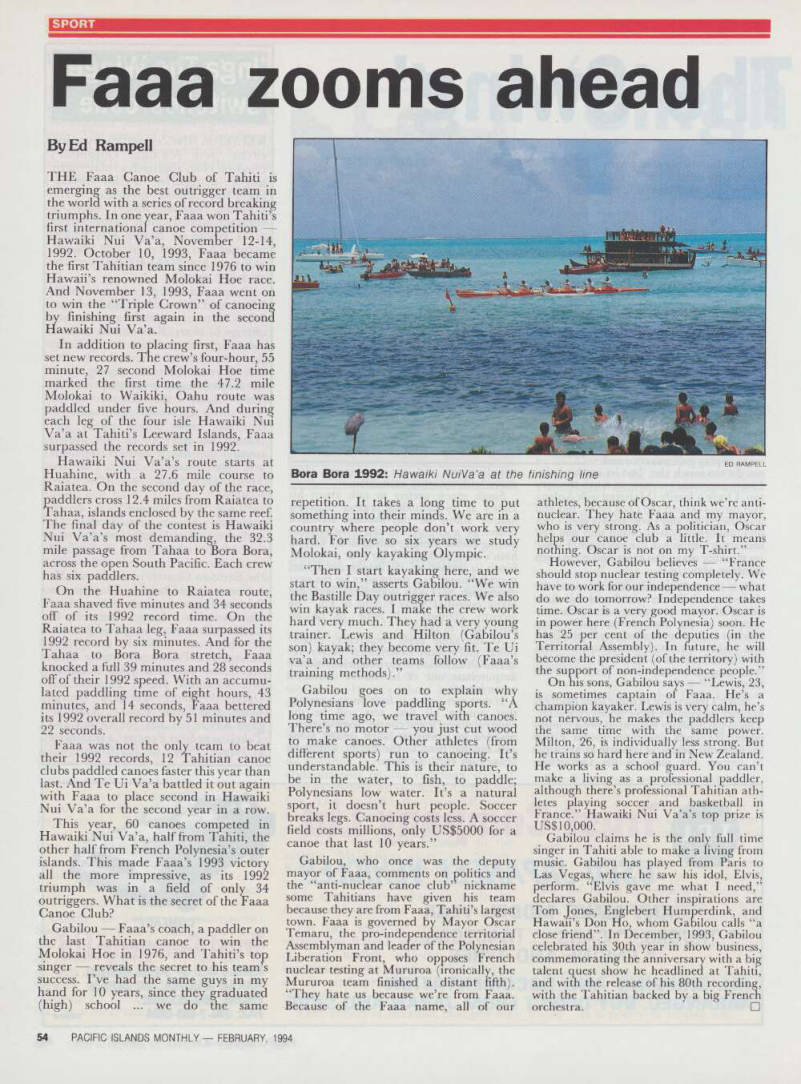
Sport
By Ed Rampell
THE Faaa Canoe Club of Tahiti is emerging as the best outrigger team in the world with a series of record breaking triumphs. In one year, Faaa won Tahiti’s first international canoe competition Hawaiki Nui Va’a, November 12-14, 1992. October 10, 1993, Faaa became the first Tahitian team since 1976 to win Hawaii’s renowned Molokai Hoe race.
And November 13, 1993, Faaa went on to win the “Triple Crown” of canoeing by finishing first again in the second Hawaiki Nui Va’a.
In addition to placing first, Faaa has set new records. The crew’s four-hour, 55 minute, 27 second Molokai Hoe time marked the first time the 47.2 mile Molokai to Waikiki, Oahu route was paddled under five hours. And during each leg of the four isle Hawaiki Nui Va’a at Tahiti’s Feeward Islands, Faaa surpassed the records set in 1992.
Hawaiki Nui Va’a’s route starts at Huahine, with a 27.6 mile course to Raiatea. On the second day of the race, paddlers cross 12.4 miles from Raiatea to Tahaa, islands enclosed by the same reef.
The final day of the contest is Hawaiki Nui Va’a’s most demanding, the 32.3 mile passage from Tahaa to Bora Bora, across the open South Pacific. Each crew has six paddlers.
On the Huahine to Raiatea route, Faaa shaved five minutes and 34 seconds off of its 1992 record time. On the Raiatea to Tahaa leg, Faaa surpassed its 1992 record by six minutes. And for the Tahaa to Bora Bora stretch, Faaa knocked a full 39 minutes and 28 seconds off of their 1992 speed. With an accumu lated paddling time of eight hours, 43 minutes, and 14 seconds, Faaa bettered its 1992 overall record by 51 minutes and 22 seconds.
Faaa was not the only team to beat their 1992 records, 12 Tahitian canoe dubs paddled canoes faster this year than last. And Te Ui Va’a battled it out again with Faaa to place second in Hawaiki Nui Va’a for the second year in a row.
This year, 60 canoes competed in Hawaiki Nui Va’a, half from Tahiti, the other half from French Polynesia’s outer islands. This made Faaa’s 1993 victory all the more impressive, as its 1992 triumph was in a field of only 34 outriggers. What is the secret of the Faaa Canoe Club?
Gabilou Faaa’s coach, a paddler on the last Tahitian canoe to win the Molokai Hoe in 1976, and Tahiti’s top singer reveals the secret to his team’s success. I’ve had the same guys in my hand for 10 years, since they graduated (high) school ... we do the same
repetition. It takes a long time to put something into their minds. We are in a country where people don’t work very hard. For five so six years we study
Molokai, only kayaking Olympic.
t 1 hen 1 start kayaking here, and we start to win, asserts Gabilou. We win the Bastille Day outrigger races. We also win kayak races. I make the crew work hard very much. They had a very young trainer. Fewis and Hilton (Gabilou’s son) kayak; they become very fit. Te Ui va’a and other teams follow (Faaa’s
training methods).”
Gabilou goes on to explain why Polynesians love paddling sports. A long time ago, we travel with canoes.
There’s no motor you just cut wood to make canoes. Other athletes (from different sports) run to canoeing. It’s understandable. This is their nature, to be in the water, to fish, to paddle; Polynesians low water. It’s a natural sport, it doesn’t hurt people. Soccer breaks legs. Canoeing costs less. A soccer field costs millions, only US$5OOO for a canoe that last 10 years.” 1 Gabilou, who once was the deputy mayor of Faaa, comments on politics and the “anti-nuclear canoe nickname some Tahitians have given his team because they are from Faaa, Tahiti’s largest town. Faaa is governed by Mayor Oscar Temaru, the pro-independence territorial Assemblyman and leader of the Polynesian Liberation Front, who opposes French nuclear testing at Mururoa (ironically, the Mururoa team finished a distant fifth).
“They hate us because we’re from Faaa.
Because of the Faaa name, all of our
athletes, because of Oscar, think we’re anti nuclear. They hate Faaa and my mayor, who is very strong. As a politician, Oscar helps our canoe club a little. It means nothing. Oscar is not on my T-shirt.
However, Gabilou believes “France should stop nuclear testing completely. We have to work for our independence what do we do tomorrow? Independence takes time. Oscar is a very good mayor. Oscar is in power here (French Polynesia) soon. He has 25 per cent of the deputies (in the Territorial Assembly). In future, he will become the president (of the territory) with the support of non-independence people.”
On his sons, Gabilou says “Lewis, 23, is sometimes captain of Faaa. He’s a champion kayaker. Lewis is very calm, he’s not nervous, he makes the paddlers keep the same time with the same power, Milton, 26, is individually less strong. But he trains so hard here and in New Zealand, He works as a school guard. You can’t make a living as a professional paddler, although there’s professional Tahitian ath letes P|fy in g soccer basketball in F T r (?^i C n'nnr? aa S to P P r * ze * s
Us$Lo,Ooo. .
. Gabilou claims he is the only full time singer m 1 ahiti able to make a living from music. Gabilou has played from Paris to Las Vegas, where he saw his idol, Elvis, perform. “Elvis gave me what I need,” declares Gabilou. Other inspirations are
Tom Jones, Englebert Humperdink, and
Hawaii’s Don Ho, whom Gabilou calls “a close friend”. In December, 1993, Gabilou celebrated his 30th year in show business,
commemorating the anniversary with a big
talent quest show he headlined at Tahiti, and with the release of his 80th recording, with the Tahitian backed by a big French orchestra. □
Ed Rampell
Bora Bora 1992: Hawaiki NuiVa’a at the finishing line
Rugby
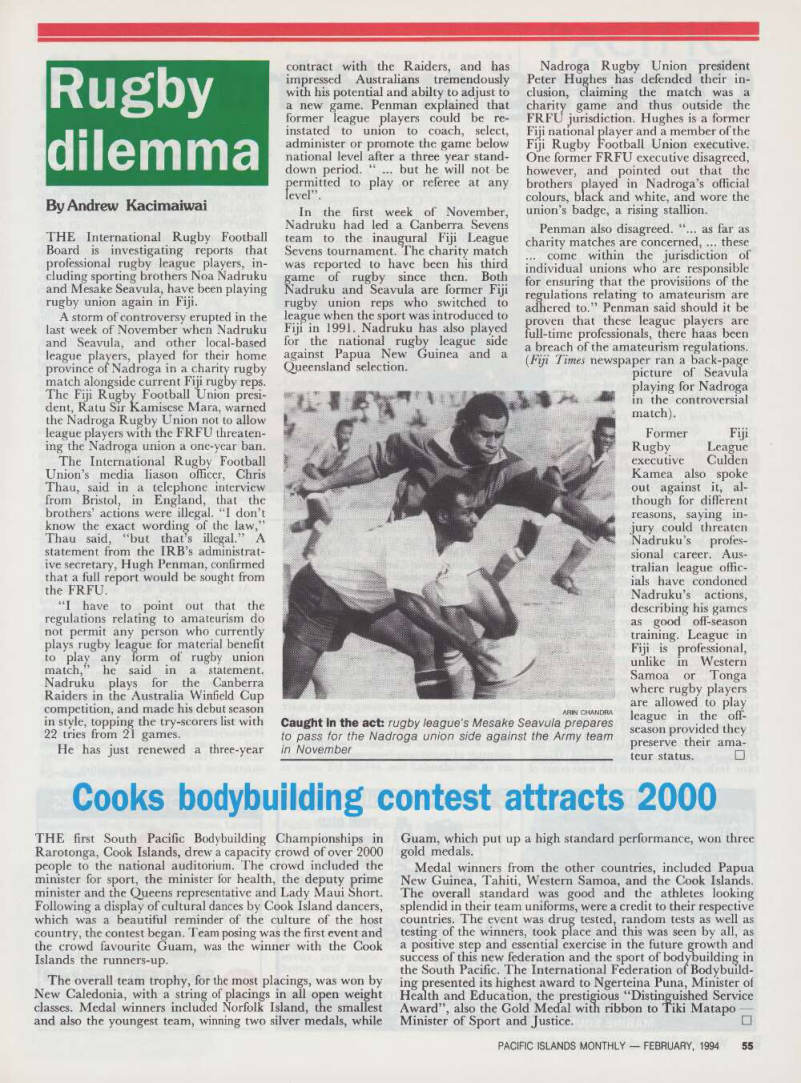
dilemma
By Andrew Kacimaiwai
THE International Rugby Football Board is investigating reports that
professional rugby league players, in
cluding sporting brothers Noa Nadruku and Mesake Seavula, have been playing
rugby union again in Fiji.
A storm of controversy erupted in the last week of November when Nadruku and Seavula, and other local-based
league players, played for their home
province of Nadroga in a charity rugby
match alongside current Fiji rugby reps.
The Fiji Rugby Football Union presi
dent, Ratu Sir Kamisese Mara, warned the Nadroga Rugby Union not to allow league players with the FRFU threaten ing the Nadroga union a one-year ban.
The International Rugby Football Union’s media liason officer, Chris Thau, said in a telephone interview from Bristol, in England, that the brothers’ actions were illegal. “I don’t know the exact wording of the law,”
Thau said, “but that’s illegal.” A statement from the IRB’s administrat ive secretary, Hugh Penman, confirmed that a full report would be sought from the FRFU.
“I have to point out that the regulations relating to amateurism do not permit any person who currently
plays rugby league for material benefit
to play any form of rugby union match,” he said in a statement.
Nadruku plays for the Canberra Raiders in the Australia Winfield Cup competition, and made his debut season in style, topping the try-scorers list with 22 tries from 21 games.
He has just renewed a three-year
contract with the Raiders, and has
impressed Australians tremendously
with his potential and abilty to adjust to a new game. Penman explained that former league players could be re instated to union to coach, select, administer or promote the game below national level after a three year stand down period. “ ... but he will not be permitted to play or referee at any level”.
In the first week of November, Nadruku had led a Canberra Sevens
team to the inaugural Fiji League
Sevens tournament. The charity match was reported to have been his third game of rugby since then. Both Nadruku and Seavula are former Fiji rugby union reps who switched to league when the sport was introduced to Fiji in 1991. Nadruku has also played for the national rugby league side against Papua New Guinea and a
Queensland selection.
Nadroga Rugby Union president Peter Hughes has defended their in clusion, claiming the match was a charity game and thus outside the FRFU jurisdiction. Hughes is a former Fiji national player and a member of the Fiji Rugby Football Union executive.
One former FRFU executive disagreed, however, and pointed out that the brothers played in Nadroga’s official colours, black and white, and wore the union’s badge, a rising stallion.
Penman also disagreed. “... as far as charity matches are concerned, ... these ... come within the jurisdiction of individual unions who are responsible for ensuring that the provisiions of the regulations relating to amateurism are adhered to.” Penman said should it be proven that these league players are full-time professionals, there haas been a breach of the amateurism regulations. {Fiji Times newspaper ran a back-page
picture of Seavula playing for Nadroga in the controversial match).
Former Fiji Rugby League executive Gulden Kamea also spoke out against it, al though for different reasons, saying in jury could threaten
Nadruku’s profes
sional career. Aus tralian league offic ials have condoned Nadruku’s actions, describing his games as good off-season training. League in Fiji is professional, unlike in Western Samoa or Tonga
where rugby players
are allowed to play league in the off season provided they preserve their ama teur status. □
Arin Chandra
Caught in the act: rugby league’s Mesake Seavula prepares to pass for the Nadroga union side against the Army team in November
Cooks bodybuilding contest attracts 2000
THE first South Pacific Bodybuilding Championships in Rarotonga, Cook Islands, drew a capacity crowd of over 2000 people to the national auditorium. The crowd included the minister for sport, the minister for health, the deputy prime minister and the Queens representative and Lady Maui Short.
Following a display of cultural dances by Cook Island dancers, which was a beautiful reminder of the culture of the host country, the contest began. Team posing was the first event and the crowd favourite Guam, was the winner with the Cook Islands the runners-up.
The overall team trophy, for the most placings, was won by New Caledonia, with a string of placings in all open weight classes. Medal winners included Norfolk Island, the smallest and also the youngest team, winning two silver medals, while
Guam, which put up a high standard performance, won three gold medals.
Medal winners from the other countries, included Papua New Guinea, Tahiti, Western Samoa, and the Cook Islands.
The overall standard was good and the athletes looking splendid in their team uniforms, were a credit to their respective countries. The event was drug tested, random tests as well as testing of the winners, took place and this was seen by all, as a positive step and essential exercise in the future growth and success of this new federation and the sport of bodybuilding in the South Pacific. The International Federation of Bodybuild ing presented its highest award to Ngerteina Puna, Minister of Health and Education, the prestigious “Distinguished Service Award”, also the Gold Medal with ribbon to Tiki Matapo Minister of Sport and Justice. □
Cruising on Blind Faith
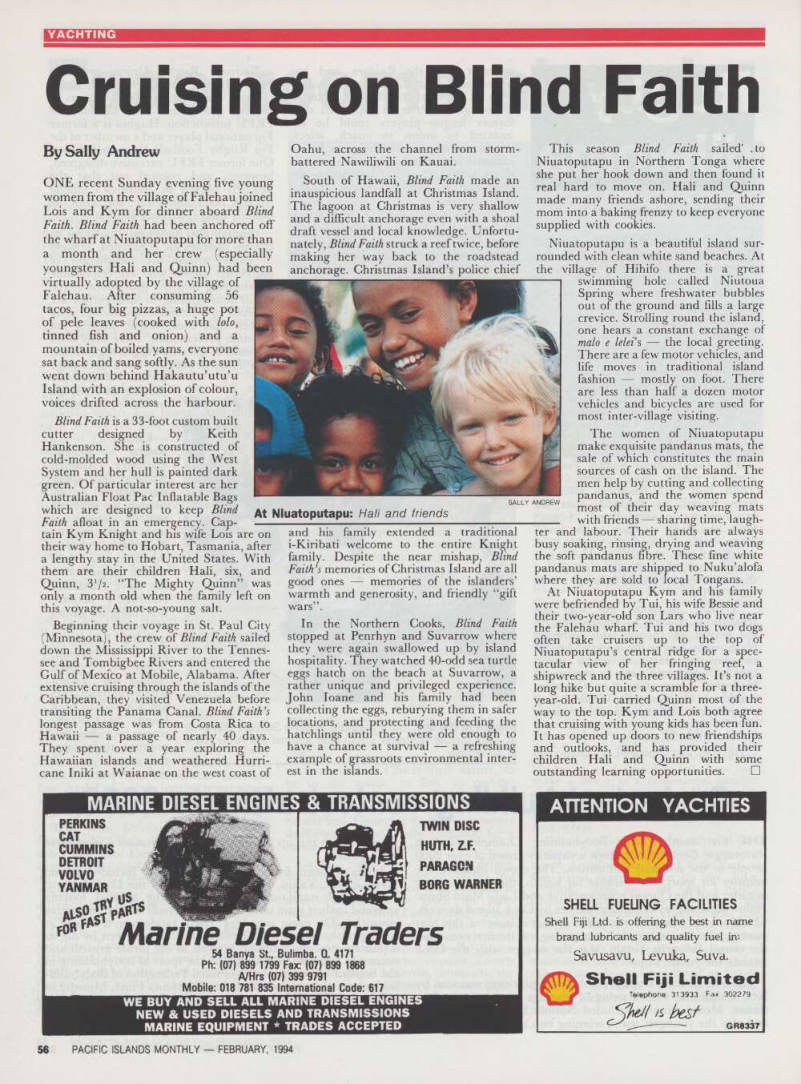
Yachting
By Sally Andrew
ONE recent Sunday evening five young women from the village of Falehau joined Lois and Kym for dinner aboard Blind Faith. Blind Faith had been anchored off the wharf at Niuatoputapu for more than a month and her crew (especially youngsters Hali and Quinn) had been
virtually adopted by the village of
Falehau. After consuming 56 tacos, four big pizzas, a huge pot of pele leaves (cooked with 1010, tinned fish and onion) and a mountain of boiled yams, everyone sat back and sang softly. As the sun went down behind Hakautu’utu’u Island with an explosion of colour, voices drifted across the harbour.
Blind Faith is a 33-foot custom built cutter designed by Keith Hankenson. She is constructed of cold-molded wood using the West System and her hull is painted dark green. Of particular interest are her Australian Float Pac Inflatable Bags which are designed to keep Blind Faith afloat in an emergency. Cap
tain Kym Knight and his wife Lois are on their way home to Hobart, Tasmania, after a lengthy stay in the United States. With them are their children Hali, six, and
Quinn, 3’/2. “The Mighty Quinn” was
only a month old when the family left on this voyage. A not-so-young salt.
Beginning their voyage in St. Paul City (Minnesota), the crew of Blind Faith sailed down the Mississippi River to the Tennes see and Tombigbee Rivers and entered the Gulf of Mexico at Mobile, Alabama. After extensive cruising through the islands of the Caribbean, they visited Venezuela before transiting the Panama Canal. Blind Faith's longest passage was from Costa Rica to Hawaii a passage of nearly 40 days.
They spent over a year exploring the Hawaiian islands and weathered Hurri cane Iniki at Waianae on the west coast of
Oahu, across the channel from storm battered Nawiliwili on Kauai.
South of Hawaii, Blind Faith made an inauspicious landfall at Christmas Island.
The lagoon at Christmas is very shallow and a difficult anchorage even with a shoal draft vessel and local knowledge. Unfortu nately, Blind Faith struck a reef twice, before making her way back to the roadstead anchorage. Christmas Island’s police chief
and his family extended a traditional i-Kiribati welcome to the entire Knight
family. Despite the near mishap, Blind
Faith’s memories of Christmas Island are all good ones memories of the islanders’
warmth and generosity, and friendly “gift
wars”.
In the Northern Cooks, Blind Faith stopped at Penrhyn and Suvarrow where they were again swallowed up by island hospitality. They watched 40-odd sea turtle eggs hatch on the beach at Suvarrow, a
rather unique and privileged experience.
John loane and his family had been collecting the eggs, reburying them in safer locations, and protecting and feeding the hatchlings until they were old enough to have a chance at survival a refreshing example of grassroots environmental inter est in the islands.
This season Blind Faith sailed - .to Niuatoputapu in Northern Tonga where she put her hook down and then found it real hard to move on. Hali and Quinn made many friends ashore, sending their mom into a baking frenzy to keep everyone supplied with cookies.
Niuatoputapu is a beautiful island sur rounded with clean white sand beaches. At the village of Hihifo there is a great
swimming hole called Niutoua Spring where freshwater bubbles out of the ground and fills a large crevice. Strolling round the island, one hears a constant exchange of malo e lelei’ s the local greeting.
There are a few motor vehicles, and life moves in traditional island fashion mostly on foot. There are less than half a dozen motor vehicles and bicycles are used for most inter-village visiting.
The women of Niuatoputapu make exquisite pandanus mats, the sale of which constitutes the main sources of cash on the island. The men help by cutting and collecting pandanus, and the women spend most of their day weaving mats with friends sharing time, laugh
ter and labour. Their hands are always
busy soaking, rinsing, drying and weaving
the soft pandanus fibre. These fine white pandanus mats are shipped to Nuku’alofa where they are sold to local Tongans.
At Niuatoputapu Kym and his family
were befriended by Tui, his wife Bessie and their two-year-old son Lars who live near the Falehau wharf. Tui and his two dogs often take cruisers up to the top of Niuatoputapu’s central ridge for a spec tacular view of her fringing reef, a shipwreck and the three villages. It’s not a long hike but quite a scramble for a three year-old. Tui carried Quinn most of the way to the top. Kym and Lois both agree that cruising with young kids has been fun.
It has opened up doors to new friendships and outlooks, and has provided their children Hali and Quinn with some
outstanding learning opportunities. □
Sally Andrew
At Niuatoputapu: Hali and friends
Advertisements & other items, p. 56 (1 item)
Marine Diesel Traders
MARINE DIESEL ENGINES & TRANSMISSIONS
PERKINS
CAT
CUMMINS
DETROIT
VOLVO
YANMAR
Marine Diesel Traders
fOB
TWIN DISC
HUTH, Z.F.
PARAGON
BORG WARNER
54 Banya St, Bulimba. Q. 4171 Ph: (07) 899 1799 Fax: (07) 899 1868 A/Hrs (07) 399 9791 Mobile: 018 781 835 International Code: 617 WE BUY AND SELL ALL MARINE DIESEL ENGINES
NEW & USED DIESELS AND TRANSMISSIONS
MARINE EQUIPMENT * TRADES ACCEPTED
ATTENTION YACHTIES
SHELL FUEUNG FACILITIES
Shell Fiji Ltd. is offering the best in name brand lubricants and quality fuel in; Savusavu, Levuka, Suva. © Shell Fiji Limited Telephone 313933, 302279
& best
GRB337
Shipping
schedules
New Zealand - FIJI direct Sofrana Unilines operates a fully containerised/ breakbulk service every 21 days from Auckland, Tauranga, Lyttleton to Suva and Lautoka.
Loading every 21 days, ro/ro service, containers - reefer. Contact Sofrana Unilines, Sofrana House, 101 Customs Street, Auckland, PO Box 3614, Fax (09) 393874, Ph (09) 773279, Tlx NZ 2313. Direct toll free line 0800 659-922, Contact Alan Foote. Compass Shipping Agencies, PO Box 921 Wellington, Tel (04) 382 8206, Fax (04) 3828239, Tlx NZ 4769 Contact Steve Brannigan.
Sofrana Unilines Agencies, PO Box 22046 Christchurch, Tel (03) 366 7180, Fax (03) 366 8868, TLX NZ4769, Contact Tony Newell.
Carpenters Shipping, Private Mail Bag, Suva, Fiji, Tel (679) 312244, Fax (679) 301572, Tlx FJ 2199. Sofrana Unilines, Suva, Fiji, Tel (679) 315645, Fax (679) 300057.
Australia • FIJI direct Sofrana Unilines operates a container breakbulk service every three weeks from Melbourne, and Sydney to Lautoka and Suva. Contact Sofrana Unilines (Aust) Pty Ltd, PO Box Q 136, Queen Victoria Building, Sydney, NSW 2000, Austra lia. Tel (02) 2648944, Fax (02) 2676547, Tlx (71) A 170090, Contact Sam Attaway/ George Lopez.
Delams Australia Pty Ltd. 474 Flinders Street, Melbourne. Tel (03) 614 1344, Fax (03) 629 4957.
Carpenters Shipping, Suva, Tel (679) 312244, Fax (679) 301572. Sofrana Unilines Suva, Tel (679) 315 645, Fax (679) 300057, Carpenters Shipping, Lautoka, Tel (679) 663988, Fax (679) 664896. Sofrana Unilines, Lautoka Tel (679) 662921, Fax (679) 664896.
Australia - FIJI monthly sarvica Sofrana Unilines (Australia) Pty Ltd operates a regular monthly service with MV Capitaine Wallis. Contact Sofrana Unilines, Sydney, Tel (02) 2648944, Tlx AA170090, Fax (02) 267-6547. Carpenters Shipping, Suva, Fiji, Tel (679) 312244, Fax (679) 301572, Sofrana Unilines, Suva, Fiji Tel (679) 315645, Fax (679) 300057. Carpenters Shipping, Lautoka, Tel (679) 63988, Fax (679) 664896. Sofrana Uni lines, Lautoka, Fiji, Tel (679) 662921, Fax (679) 664896.
Far-last - FIJI Sarvics New Guinea Pacific Line (NGPL) operates a monthly service accepting containerised and break-bulk cargoes from Manila, Keelung, Kaoshiung, Hong Kong, Lac to Suva, Lautoka (via Suva).
Contact Carpenters Shipping Suva, Fiji, tel (679) 312244, fax (679) 301572. New Zealand Unit Express, Maritime Building, 2-10 Customs House Quay, PO Box 890, Wellington. Tel 727865, Cables Enzue Man, Wellington, Tlx NZ31340 Nedlnz or Nedlloyd Swire Pty Ltd, Sydney, Tel 20522.
Japan - South Pacific Sendee Same as Bums Philp Japan - South Pacific Service - Kyowa Shipping Co Ltd
Kyowa Shipping, Shipping Co Ltd provides a monthly service from Hong Kong to main ports of Japan, Saipan, Guam, Island ports, Lautoka, Suva via Nukualofa to Pago Pago and Apia.
Contact Carpenters Shipping, Neptune House, 3/4 floor, Tofuaa Street, Walu Bay, Suva. Tel 312244, Fax 301572, Tlx FJ2199.
Europe - Pacific Service Bank Line offers a monthly service to and from Europe for containerised breakbulk and bulk vegetable cargoes. Calling Papeete, Apia, Suva, Lautoka, Noumea, Port Vila, Santo, Honiara and PNG. Main ports to and from major northern Eurpoean ports. Contact Bank Line, South Pacific Office, Central Court Bid , 7th Street, Lea, PNG,TeI 422925, Tlx NE4426s.Carpenters Shipping, 3/4 Floor,Neptune House, Walu Bay, Suve, Fiji, Tel (679) 312244, Fax (679) 301572, TIxFJ 2199.
Nedlloyd offers cargo services from Continental ports to Papeetee, Fiji, New Caledonia and Doniambo on slot basis with Bank Line. Contact Carpenters Shipping, Suva, tel 312244, Tlx FJ2199, Fax 301572. Carpenters Shipping, Lautoka, Tel 663988, Tlx FJ5215, Fax 664896.
South East Asia - Fiji Sorvice Nedlloyd Lines Service (NZEAS) Service oper ates regular fast cargo service from Jakarta, Pt Keelang, Singapore, Bangkok, Surubaya via Auckland to Suva and Lautoka. Contact Carpenters Shipping, Suva, Tel 312244, Tlx FJ2199, Fax 301572. Carpenters Shipping, Lautoka Tel 663988, Tlx FJ5215, Fax 663988.
Nedlloyd New Zealand, Wellington Tel (04) 472 7864, Fx (04) 473 9201 Far East - Mid South Pacific China Navigations New Guinea Pacific Line in association with Bank Line, operates a regular container and breakbulk heavy lift service from Hong Kong, Taiwan, Manila, Singapore, Malaysia, Thailand to Port Moresby, Lae, Rabaul, Kieta and Honiara. Cargo from the same eastern ports to the South Pacific Ports of Noumea, Santo, Vila, Papeete, PagoPago, Apia, Nukualofa, Rarotonga and Tarawa will be shipped via Japan or Busan on the monthly Bali Hai Service. Contact Steamships Shipping, Port Moresby, PO Box 634, Tel 220283 or 220289.
Tasman Asia operate a 20-day frequency fixed date service, shipping breakbulk and containerised cargoes from Japan, Korea, Tai wan and Hong Kong to Suva and Lautoka (via Suva). Fiji agents arc Forum Shipping Agencies in Suva, Tel 315444, and Lautoka 660577.
Australia - New Caledonia - F||l - Samoas • Tonga Pacific Forum Line operates a fully containerised service (general, reefer and ro-ro) from Sydney and Brisbane to Noumea, Lautoka, Suva, Apia, Pago Pago, Nuku’alofa, Sydney. Cargo central ised from Adelaide and Melbourne. Contact; Pacific Forum Line, PO Box 796, Auckland; Union Bulkships, 333 George St, Sydney, Brisbane and Melbourne; Union Co, Lautoka; Pacific Forum Line, Suva, Nuku’alofa; Pacific Forum Line, Apia; Polynesia Shipping, Pago Pago. Sofrana Unilines operates a roro/container service every three weeks from Melbourne, Sydney and Brisbane to Noumea, Suva and Lautoka with transhipment to the Samoas and Tonga.
Advertisements & other items, pp. 57-60 (1 item)
Pacific
SLAM PS
UIONT H L Y
MARKET PlfiC€
SCRAP METAL
Tall ingots operate from Brisbane, Australia and make frequent visits to the Pacific Islands which they have done for twenty-five years. We are buyers of Copper, Brass, Aluminium, Lead, Cable etc. Inspection no problems. Telephone 61 7 8922033. Fax 61 78922077.
“REAL ESTATE
"Fiji Islands Beach Front Lots, For Sale U 5515,000.00 with easy terms adjacent to Tourist Resort for Free Brochure Phone: (679) 311075, Fax (679) 303160 or Write C/ PO Box 228, Suva, Fiji Islands.
EDUCATION
COMMUNITY DEVELOPMENT COURSE
Victoria University Of Technology (Melbourne, Australia) Offers a Bachelor of Arts, Community Development Course with a focus on the Pacific and Asia suitable for community based workers. Scholarships may be available. Further information, Dr.
Michael Hamel Green or Heather Wallace, Faculty of Arts, Vut, P.O. Box 14428 MMC, 3000 Australia Fax 613 3652242 Tel. 613 3652139.
SELF ADHESIVE LABELS
FORUM LABELS (FIJI) LTD
P.O. BOX 1167, Suva, Fiji. Phone: 304111, Fax: 305935. We print self-adhesive labels in rolls, multi-coloured labels with hot foil, and die cut to shape, tickets and tags in rolls. We also supply labelling machines and fabric labels.
MAAKCT PIACC CAN UIOAN
WON OCRS FOR VOO ...
Promote your business, or service, sell your household items, cars or heavy machinery etc.
ONLY AUB$l PER WORD.
NO COMPANY LOGO. NO
DISPLAY. NO BOLD TYPE.
Juat forward your Advartlaamont together with payment to: PACIFIC ISLANDS MONTHLY "Market Plaoa n , P.O. Box 1167, Suva, Fiji.
GOVERNMENT OF TONGA
CENTRAL PLANNING DEPARTMENT
DEVELOPMENT ECONOMIST/PROJECT ANALYST
Applications are invited from suitably qualified persons for the post of Development Economist/Project Analyst in Central Planning Department (CPD) of the Prime Minister’s Office based in Nukualofa, Tonga.
The post requires a person with extensive work experience and research background in development economics and project preparation and analysis. The appointment is for a term of 1 year.
The Development Economist/Project Analyst will be responsible tor setting up the public sector investment activities of the CPD. She/he will undertake the following main duties; (a) Establish procedures, organizational arrangements and tasks, and provide guidelines for the preparation of the Public Sector Investment Programme (PISP), to be reviewed and revised every year on a three year basis. (b) Coordinate the preparation of the first PSIP. (c) Improve the Departments capacity in key sectors for detailed preparation and administration of projects and for designing multi-year programmes; provide project design, implementation and evaluation assistance to Departments. (d) Assist Government staff in CPD and sectoral agencies in acquiring practical and theoretical tools and skills for project analysis and investment programming. (e) Prepare manuals and conduct training courses and sensitization missions in critical areas of project analysis and investment programming. (f) Undertake other activities that may be necessary for the successful implementation of the project.
QUALIFICATIONS:
A post-graduate degree from a recognized University, in economics and related fields, including project appraisal and investment programming.
A minimum of five years experience in activities relating to project appraisal and investment programming in developing countries. The candidate should be conversant with the use of computer software and should have good interpersonal skills and will be able to communicate clearly and effectively in English.
The post is funded by UNDP. The person selected for this post will work for the Government of Tonga under a contract drawn up by .the Government. Salary and conditions of service will be discussed during interview.
MACROECONOMIST
Applicants are invited for the position of Macroeconomist at the Central Planning Department (CPD) of the Prime Minister’s Office, Tonga, from suitably qualified persons with relevant qualification, work and research experience in the area of Government macroeconomic policy analysis and advice. The appointment will be for a term of one year.
The Central Planning Department plans to replace the existing comprehensive five-year planning with a strategic planning approach more in line with evolving economic management and policy formulation requirements. The Macro-economist will thus be responsible for organising an economic database and the formulation of a mid-term economic framework (MTEF) to set the priorities and consistent supportive policies and strategies with identified domestic and external resources requirements. She/he will undertake the following duties: (a) Establish procedures and provide practical guide-lines for the preparation of annual development report and the formulation of the mid-term economic framework
(MTEF).
(b) Coordinate the preparation of the first annual report and MTEF. (c) Provide an ongoing review of development performances and analysis of economic policies of the Government of Tonga. (d) Provide advice on general development with economic issues. (e) Conceptualize policies and strategies in line with national objectives. (f) Assist the Director of Planning through the Deputy Director (Macroeconomics Division) in acquiring practical and theoretical tools and skills for macro-economic analysis, policy evaluation and planning, formulate manuals and conduct training courses and sensitization workshops in critical areas of macro-economic analysis, development management and economic planning. (g) Undertake other activities that may be necessary for the successful implementation of the project.
QUALIFICATIONS:
A post graduate degree from a recognized University, in economics and related fields with a good background in macro-economic analysis. A minimum of five years experience in activities relating to macro-economic policy management and policy analysis or planning is required. The candidate should be conversant with the use of computer software in his field of work and should have good interpersonal skills and will be able to communicate clearly and effectively.
This post is funded by UNDP. The person selected for this post will work for the Government of Tonga under contract drawn up by the Government. Salary and conditions of service will be discussed during interview.
Appointment to become effective as soon as possible.
Applications for this post should be forwarded to the following addres; C/- Director of Planning Central Planning Department Prime Minister’s Office Nuku’alofa
TONGA
Fax: (676) 24-260 Telephone: (676) 21-366 Closing date: 15.02.1994 3 1508 00242887 3
I A T TUETTMU C\T* CFDA/irrC
1 A LlrllllM.c Ur MiKVlt£j
Grand Pacific Life insurance offers you a lifetime of safe, secure products at very competitive rates. * Choose from a full range of products such as • • Super Ordinary Life • Super Universal 1 • Non-Participating Whole Life • 10-Year Level Term • Flexible Premium Annuities • Group Life Insurance
• IRAs
• Graded Premium Whole Life We've been dedicated to providing fast, personalized service for more than 35 years through local ownership and management.
I That’s why Grand Pacific Life is your Family for Life ' ...throughout the Pacific, 10 15 20 25 30 35 40 45 50 55 60 ©
Grand Pacific Life Insurance, Ltd.
A member of the Finance Factors Family
FEDERATED STATES
OF MICRONESIA
Actouka Executive Insurance Underwriters P.O. Box 55, Kolonia, Pohnpei, Federated States of Micronesia 96941 Pacific Basin Insurance & General Services, Inc P.O. Box 494, Chuuk State, Federated States of Micronesia 96942
TONGA
Peseti Ma‘afu Ins. & Finance, Ltd.
Private Bag 2, Taumoepeau Bldg.
Nukualofa, Tonga
GUAM
Great National Insurance Underwriters, Inc.
P.O. Box GA, Agana, Guam 96910 Pacific Financial Corporation P.O. Box AT, Agana, Guam 96910 Takagi & Associates, Inc.
GCIC Bldg., Suite 100 414 W. Soledad Ave.
Agana, Guam 96910
MARSHALL ISLANDS
Marshalls Insurance Agency P.O. Box 113, Majuro, Marshall Islands 96960
AMERICAN SAMOA
Mark Solofa Pacific Insurance & Finance, Inc.
P.O. Box 3149 Pago Pago, American Samoa 96799
WESTERN SAMOA
Mark Solofa Pacific Insurance & Finance, Inc.
P.O. Box 3149 Pago Pago, American Samoa 96799
NORTHERN MARIANAS
Pacific Basin Insurance Underwriters, Inc.
P.O. Box 710 Saipan, Mariana Islands 96950 Pacifica Insurance Underwriters, Inc.
P.O. Box 168, Saipan, Mariana Islands 96950 Grand Pacific Life Insurance, Ltd. • 1164 Bishop Street, sth Floor, Honolulu, HI 96813 Phone: (808) 548-3363 • FAX: (808) 548-5122
I
lifllV
w n ■ A/ PC
WITH THE
CROWD?
The All New Mitsubishi Galant —
The Freedom to Drive as \bu Choose Imagine... you’re on a long ride home from a long day’s work. You want to get home as soon as possible, but you want to do so effortlessly... or maybe you’re on a winding road, and you have the urge to experience truly sporty driving.
Typically, you would need two different cars to enjoy these two experiences fully. But with the new Mitsubishi Galant, it’s all possible.
The new Galant features an innovative approach to engine efficiency that dramatically expands driving potential. Compared to cars with conventional engines, the Galant has far better combustion efficiency and reduced friction losses.
This allows smoother, more powerful operation with almost no noise or vibration. So whether you want to relax and cruise, or drive more sportily, the Galant gives you exactly what you want — when you need it.
Each of the Galant’s new multi-valve engines gives you the unparalleled freedom to drive as you choose. They are an integral part of All Wheel Control, Mitsubishi’s unique approach to car design that gives you total control over the driving experience. With true communication between you and the road, the new Galant ensures total control with quicker, safer and more responsive performance than ever before imaginable.
Discover the meaning of driving freedom with the new Mitsubishi Galant—and feel how All Wheel Control sets you apart from the crowd.
The All New
MITSUBISHI GRLRNT
ss=SSSSSHHSs«
A
MITSUBISHI
MOTORS
CREATING TOGETHER