Pacific
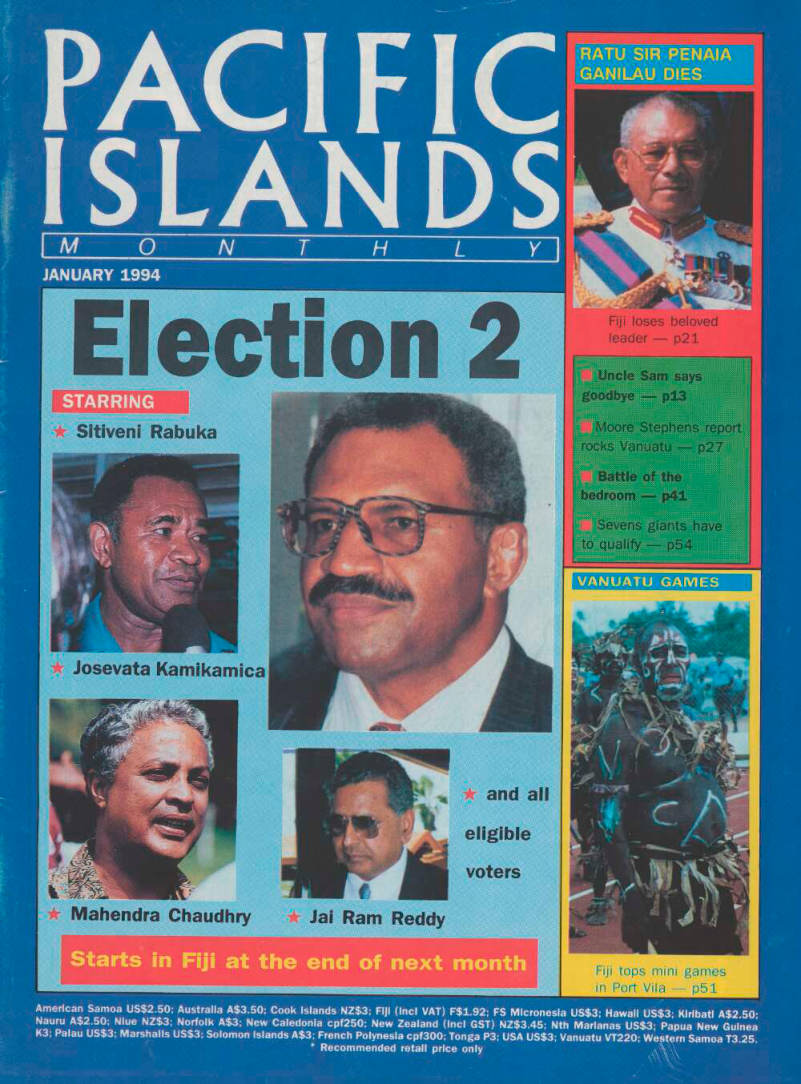
Islands
Month L Y
January 1994
mmm ■ ■ a Election 2
Starring
★ Sitiveni Rabuka
i Josevata Kamikamica
★ Mahendra Chaudhry
★ Jai Ram Reddy
★ and all eligible voters
Starts in Fiji at the end of next month
Ratu Sir Penaia
Ganilau Dies
Fiji loses beloved leader p2l
Uncle Sam says goodbye p!3 Moore Stephens report rocks Vanuatu p 27 Battle of the bedroom p4l Sevens giants have to qualify p 54
Vanuatu Games
Fiji tops mini games in Port Vila p5l
American Samoa US$2.5O; Australia A 53.50; Cook Islands NZ$3; FIJI (incl VAT) F 51.92; FS Micronesia US$3; Hawaii US$3; Kiribati A 52.50- Nauru A 52.50; Niue NZ$3; Norfolk As 3; New Caledonia cpf2so; New Zealand (Incl GST) NZ53.45; Nth Marianas US$3; Papua New Guinea K 3; Palau US$3; Marshalls US$3; Solomon Islands As 3; French Polynesia cpf3oo; Tonga P 3; USA US$3; Vanuatu VT22O; Western Samoa T 3.25. * Recommended retail price only \
Advertisements & other items, pp. 2-4 (1 item)
Taste Of
THE SOUTH PACIFIC...
•• Mk » Wm • ••
SOUTH PACIFIC
SOUTH PACIFIC
lager
Siiii H p i *♦% 5 * & a n * •> va > . % u m BMi sssßilg
SP NQI BEER
ADVANCE ALARM TECHNOLOGY LTD.
L@Kl<a-IRAM(ai IFiSBD® ®UslfiilM] BVSTI
1. INSTANT ALARMING
2. TRANSMITS ALARM CODE
• a) Fire & Burglary ■ b) Low Battery • c) Technical Faulty • d) Tamper 3. MAINTAINS AND RECORDS 24 HRS. SURVEILLANCE
4. LOCATION OF TRANSMISSION (ADDRESS)
5. AREA OF TRANSMISSION (KITCHEN)
PREMISES AT REMOTE SITE
S
GENTS
t a * * Mk* 8 ««« I |P« « « » « m «T« ■
RECEPTION
AREA
m m m » »np • • ».« « • ♦ »* „ * • ■k-irmm. I| (i n <1 if << it. *** /
M.D'S OFFICE
♦ KITCHEN
NCI 3100
• an »!!S
MANUFACTURER:
K.P. ELECTRONIC SYSTEMS LTD.
P.O. Box 42, Tefen Industrial Park, 24959, Israel.
Tel: 972-4-974066, Telex: 471439 TEFEN IL, Fax: 972-4973692. * XX I OJ&jr 'fnttm .ttaaSmsai: \ ‘./i l ‘ i; Igiliifeiiiiii
A.A.T CONTROL CENTRE
SOUTH PACIFIC MSIRnUTOR:
ADVANCE ALARM TECHNOLOGY LTD,
280 Toorak Road, P.O. Box 2243, Government Buildings, Suva, Rji.
Telephone: (679) 312357, 315506, 304976. Fax: (679) 303175.
Your Island Connections
Cable and Wireless began keep-
ing people in touch around the
world more than a century ago. Today,
while the technology has changed,
the tradition of service to our customers in the
South Pacific is just the same.
We work in partnership with Governments,
dedicated to meeting the need of communities and businesses to stay in touch. From one Island to the next or to the other side of the world, the message is the same: Cable and Wireless is
your South Pacific
connection bringing the
islands together.
CABLE & WIRELESS
Asia Pacific Head Office Cable and Wireless pic Cable and Wireless (Pacific) Limited 22nd Floor Office Tower Convention Plaza 1 Harbour Road Hong Kong Tel: (852) 848 8620 Facsimile: (852) 868 5195 Fiji In association with the Government of Fiji Fiji International Telecommunications Ltd.
P.O. Box 59 Mercury House 158 Victoria Parade Suva Fiji Tel: (679) 312933 Solomon Islands In association with the Government of the Solomon Islands Solomon Telekom Company Limited P.O. Box 148 Honiara Solomon Islands Tel: (677) 21576 Tonga Cable and Wireless pic Private Mail Bag 4 General Post Office Nuku Alofa Tonga South Pacific Tel; (676) 23499 Vanuatu In association with the Government of Vanuatu and France Cdbles el Radio Telecom Vanuatu Limited P.O. Box 146 Port Vila Vanuatu Tel: (678) 22185
Pacific
Islands
Monthl Y
Vol 64 No. 1
The News Magazine
January 1994
From The
Editor’S Desk 6
Letters 7
Headlines 9
Pacific Diary 10
Political Round-Up 11
Business Bulletin 12
Business
Goodbye Uncle Sam 13 Flawke’s Vanuatu punt 14 Land of the falling yen 15
Cover Story
Fiji politics 17
Investment
Bikini’s investment strategy 22
Politics
Palauans approve Compact 24 Moore Stephens report rocks Vanuatu 27
Environment
Takaku’s mission 25
Travel
Island hotel costs 28
Books
The remaining French empire 29
Fishing
Fishing tales 32
The United Nations
Van Lierop dismissed 33
New Caledonia
‘We’ll set out together’ 39 An empty seat in Paris 40
Population
Battle of the bedroom 41
Computers
The Trade Match’ pilot 43
Farming
Back to the land 44
Yachting
Santo sightings4s
Sport
Vanuatu Games 51 7s giants have to qualify 54
Columnists
Bill McCabe 35 David Barber 37
Publisher: Brian O’Flaherty Acting Editor: Martin Tiffany Associate Editor: Arvind Kumar Correspondents: Christine Hatcher, David North, Ed Rampell, lan Williams. Johnson Honimae, Karen Mangnall, Liz Thompson, Nicholas Rothwell, Pesi Fonua, Wally Hiambohn.
Columnists: David Barber (Wellington), Futa Helu (Tonga, covering the Pacific Islands), Jemima Garrett (Sydney).
Julian Moti (Pacific Law), Alfred Sasako (The Forum).
Advertising Sales: • Regional Sales (South Pacific): Salendra Narayan, Tel (679) 304111, Fx (679) 303809 • Sydney. Canberra Bob Hill Media Represen tations. Tel (61-2) 4164245, Fx (61-2) 4165064 • Brisbane: Robert Walker, Media House, Tel (61-7) 3710533. Fx (61-7) 371-8904 • Adelaide: Hastwell Williamsons Representations.
Tel (61-8) 799522, Fx (61-8) 799735 • Melbourne: Brown Orr Fletcher Burrows (Aust).
Pty. Ltd. Tel (3) 696 5188 Fx (03) 696 5131. • Auckland: McKay & Bowman, International Media Representatives Ltd, Tel (64-9) 4190561, Fax (64-9) 4192243.
• Japan: Universal Media Corporation, Tokyo, Tel (3) 6663036, 6663094, Cable: UNIMEDIA Tokyo.
Tx 2524665.
Founded 1930 (USPS 952480). A Fiji Times Limited production.
Cover prices are recommended retail only. Regis tered by Australia Post, Publication No. NBP 1210. © Copyright Fiji Times Limited, 177 Victoria Parade, Suva. Fiji. Tel (679) 304111, Fx (679)
303809. Tx Fj2124.
Pacific Islands Monthly is published monthly by The Fiji Times Limited, a division of Nationwide News, 2 Holt Street, Surry Hills. Sydney, NSW 2010.
Send address changes to: • Pacific Islands Monthly, PO Box 1167, Suva, Fiji.
Typeset and printed by The Fiji Times Limited, 177 Victoria Parade, Suva. Fiji.
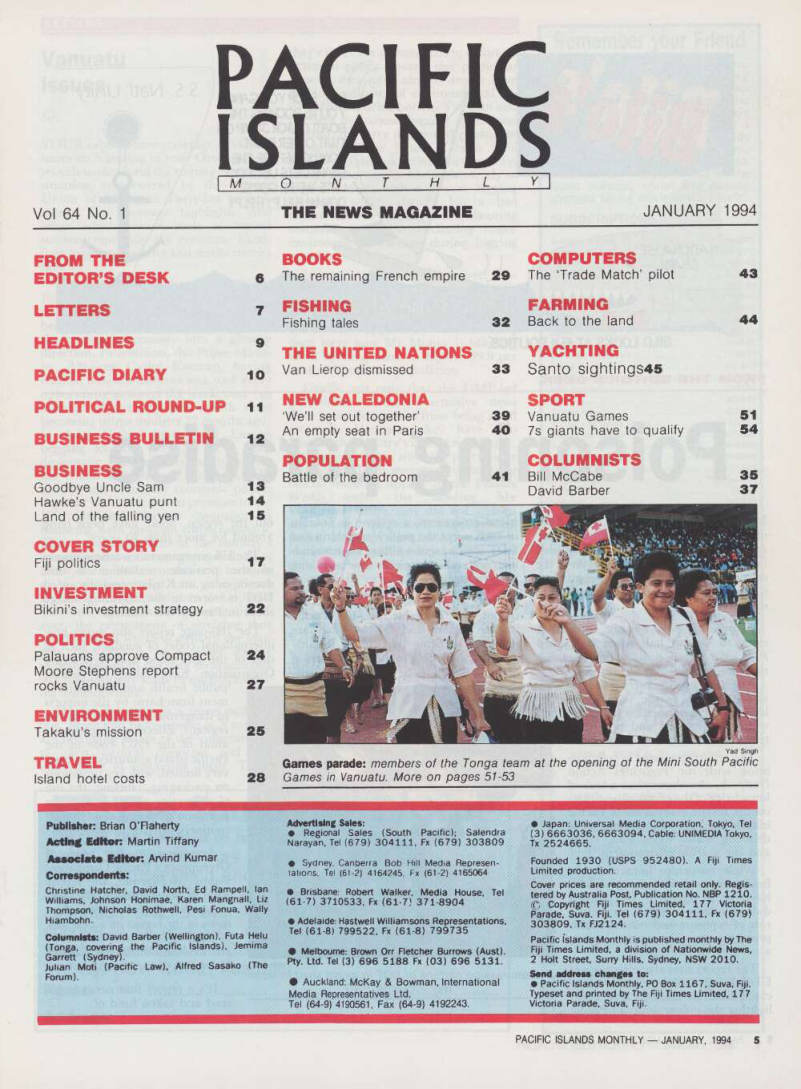
Yad Singh Games parade: members of the Tonga team at the opening of the Mini South Pacific Games in Vanuatu. More on pages 51-53
Poisoning paradise
Many reports filter through PlM’s head office in Suva. After a quick analysis they are either put aside for later reading, filed for reference purposes or passed on to the relevant person. Very few reports are stopped in their tracks for immediate
scrutiny.
Poisons in Paradise was one report that came to a dead halt when it reached PIM. We feel it deals with something that needs to be looked into now.
The Greenpeace report has re vealed South Pacific islands are
being slowly poisoned by pesticides
which are banned and not regis tered in more developed countries.
The report, prepared in collabor ation with the Pesticides Action Network, also shows that a lack of knowledge of the effects of pesticides on the fragile ecosystems of Pacific islands has led to contamination of drinking water wells, soils, rivers and the marine environment.
While numerous human deaths from exposure to toxic pesticides have been reported, the limited data available suggests the actual rate of exposure and related health problems may be much higher,
according to Greenpeace.
The report cites alarming cases of DDT being used in some areas to catch fish. In another case high lighting the vulnerability of Pacific
island ecosystems, a cyclone in Tokelau in 1966 swept the pesticides dieldrin and DDT into a lagoon killing all surround ing coral, which are only now beginning to grow back.
There are at least 286 pesticide active ingredients available in the Pacific islands region and 57 of these are
regarded as being particularly hazard
ous. Yet, according to the report stores of obsolete pesticides lie scattered through-
out the region. Some have been lying around for more than 30 years.
The US government’s wartime supply of the pesticide malathion is still decomposing on Kiribati and discarded DDT is stored in disintegrating village sheds in Papua New Guinea.
The 160-page report also shows how international codes of conduct, such as that of the UN Food and Agriculture Organisation have failed to protect
public health and the environ ment from harm by the imports of dangerous pesticides into the region. Effective implement ation of the FAO code in the Pacific island countries has been very limited, with key provisions on packaging, labeling, the use of protective clothing, and the provision of technical advice all routinely skirted.
According to the head of Greenpeace’s Pacific Campaign, Bunny McDiarmid, the report gives dramatic proof of the need to base all agricultural develop ment in the region on a new mix of traditional systems and mod ern methods enhancing natural biological pest control.
It’s a report that needs to be read and taken heed of. □
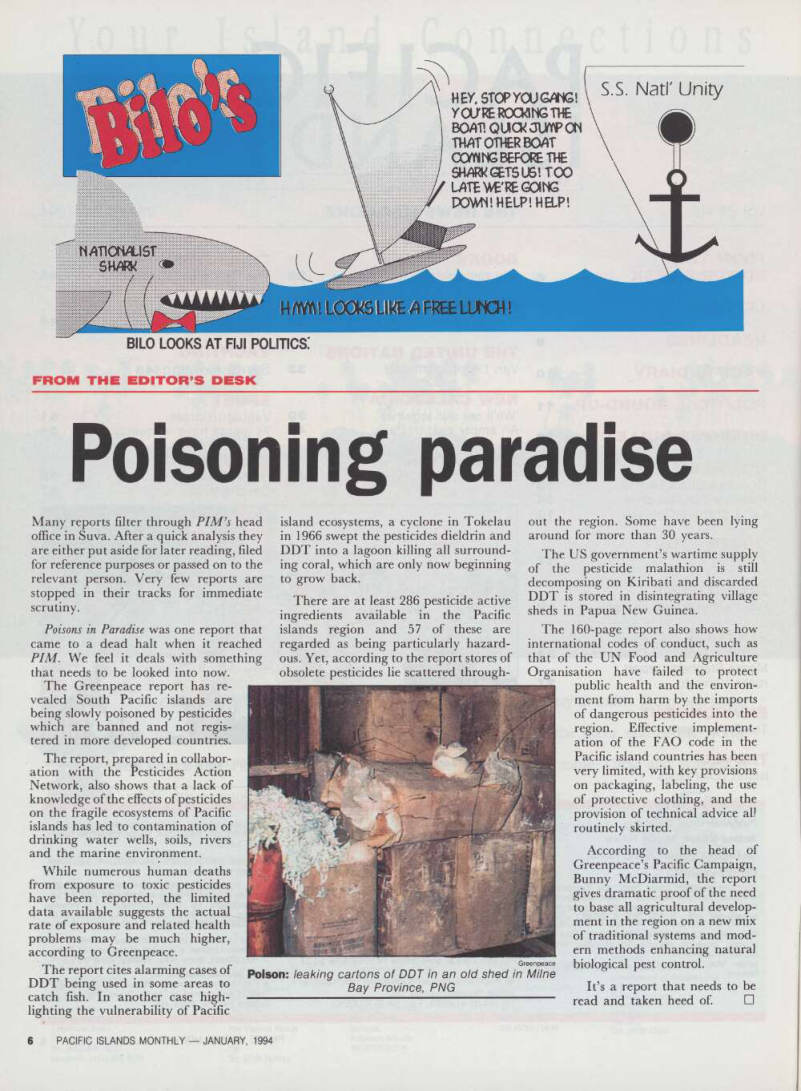
Greenpeace Poison: leaking cartons of DDT in an old shed in Milne Bay Province, PNG
Vanuatu
Letters
Vanuatu issues
Sir, YOUR explicit news coverage of various issues on Vanuatu in your October issue reveals to the world the ruining economic situation manoeuvred by the present Union of Moderate Party-led govern ment. The coverage highlights vital issues which rather leads to topical matters, especially the economic hand ling, fogging mysteries and media restric tion.
It is not surprising though that Willie Jimmy (Minister of Finance) is intending to raise two billion dollars of foreign loan because he is being obsessed with taking the country’s economy into a gloomy direction. In addition, the Prime Minis ter, Maxime Carlot Korman, having realised how hot the issue was, took every opportunity to travel the world over (an average of one trip per month since becoming prime minister 22 months ago) to Asia, United States and Europe begging for aid packages in a non diplomatic manner. The reality is that the Union of Moderate Party’s (UMP) illusive and immature economic policy, together with their dream promises in the 1991 national election campaign, is bouncing back on them embarrassingly.
Their mismanagement of the country’s economy also counts a great deal. As a result, the inflation continues to increase at a disappointing rate, the Gross Domestic Product continues to drop and the economy is barely growing. How ever, the phenomena of servicing that billion dollars worth of debt (if the loan gets through) is to a large extent unrealistic and in the long term scenario will undoubtedly leads to uncompromis
ing consequences.
The logging issue is a more pathetic one. More and more people in Vanuatu are becoming aware of the vulnerability to their natural resources and the importance of sustaining them. Thus,
they expect the government to enforce a practical policy toward this particular area as they have already learnt from previous mistakes of environmental de structions occuring both in Vanuatu and overseas by various logging operations.
Instead, the three mentioned prominent ministers (Willie Jimmy, Ohnen Tahi and Paul Telukluk) contradict by trav elling all the way to Malaysia merely to negotiate deals with a private logging company which already has a bad reputation in other neighbouring countries in terms of causing major
environmental damage during fogging
operations.
It is even more unusual to note that apart from one single minister who should be travelling for such a deal, there were three of them who went to negotiate the deal apparently demonstrating once more how Mr Money is blinding them by using them to deprive 99.9 per cent of Vanuatu’s population.
Finally, not only that the UMP-led government restricted sensitive news from opposition parties from being aired on radio Vanuatu, they have also misused the country’s official newspaper, the Vanuatu Weekly, since the party came into power. Their stereotype of misusing official resources appear in the Vanuatu Weekly under the heading Mr Wanuwei, where they did not address any authentic information to the general public. However, the articles are confus ing and full of bizarre bits and pieces of childish ideas. This downgrades the image of the newspaper and affects the whole official media system in the country.
The euphoria among the citizens of Vanuatu is constantly eroding every day while anxiety and frustration are taking place instead. In fact, the population is witnessing the worst situation in its country since becoming independent 13 years ago.
Warrr Lala
Point Cross, South Pentecost Vanuatu
Tuvalu
election
Sir, I FEEL that I have been let down by an old friend, for which I hold you entirely
responsible.
Regrettably, the only items about the island countries of the Pacific which receive media coverage in the United Kingdom are those like major hurricanes or a military coup. So in order to keep abreast with what is happening in your part of the world I have subscribed to PIM for the past 25 years ever since I had the good fortune to work in the then Gilbert & Ellice Islands colony. Whilst I fully accept that the magazine’s role has had to change over the years as you outlined in your editorial in the last August issue I do feel that you are in danger of devoting too much space to the larger nations at the expense of the smaller ones.
To judge from the coverage or rather the lack of coverage given to the subject in PIM during the past four issues, one could be forgiven for including that you, sir, were unaware that there was a general election in Tuvalu at the beginning of September. Surely in view of the amount of political coverage you are now including, a general election warranted a paragraph or two in the August or September edition but not a word.
Then, at the end of September, there was the extraordinary situation when the 12 newly-elected MPs failed to agree on who should be the new prime minister each of the two candidates, the outgoing prime minister, Bikenibeu Paeniu, and his predecessor, Dr. Tomasi Puapua, apparently receiving six votes each in three ballots, with the result that it was decided to hold a new general election at the end of November. Surely an event like that deserved some mention in PIM?
I appreciate that that extraordinary affair occurred too late to be covered in your October edition but as a journalist myself I expected it to be one of the main stories in the November edition. But again, not a word.
Certainly since the demise of the informative Tuvalu Echoes it has become extremely difficult for people outside the region to have any idea of developments taking place in that country. I had assumed, though, that any major story would still receive a mention in PIM, as it has done in the past. Having just renewed my subscription for a further year I hope that you will be able to
reassure me and other readers that the smaller island groups are not to be forgotten in the “new-look” PIM.
Gur Slatter
Cornwall
United Kingdom
EDITOR’S NOTE: it was not the intention of PIM to ignore the Tuvalu election. It was a genuine oversight that occured basically because of lack of information com ing out of Tuvalu. I wish to assure you and all our readers that the smaller island groups are an im portant part of the Pacific and will not be forgotten.
What’s in
a name
Sir, IN the October issue of PIM you carried a news item, ‘Deals under scrutiny’, by Craig Skehan. The news item mentioned that the funds of a loan to Vanuatu would be delivered by Hannes Lenz Gesmbh and Co. based in the Philip
pines.
It should be pointed out that the term Gesmbh in all probability comes froom “Gesellschaft mit beschrankter Haftung” (German for “Company with limited liability”). This is usually abbreviated in German as GmbH. So, there is some likelihood this Philippine based company represents German and/or European interests.
Robert Silberstorf
Apartado Aereo 065629 Medellin, Antioquia Colombia
LETTERS to the Editor must include the writer’s full name, address and home telephone number. All letters may be edited for purposes of clarity and space.
Letters should be addressed to: Editor Pacific Islands Monthly G P O Box 1167 Suva
Fiji Islands
OR Fax: (679) 303809
Advertisements & other items, p. 7 (1 item)
The South Sea Digest
Remember your Friend
There are times in your life when you feel your friends have been missing out on something good. Now’s your chance to do something about it and share with them one of the good things you have. Buy your friend a subscription to Pacific Islands Monthly and let him or her join you and thousands of other people worldwide who are kept informed of the latest political, social and cultural
changes taking place in the Pacific.
SUBSCRIPTIONS
American Samoa US$45 Australia A 542.00 Canada US$45 Cook Islands AUSS46 Fiji F 526.40 French Polynesia US$45 Guam US$45 Hawaii US$45 Japan US$45 Kiribati AUSS46 Marshall/Micronesia US$4O Nauru AUSS42 New Caledonia US$32 New Zealand NZ$55 Niue AUSS46 Norfolk Island AUSS42 Northern Marianas/Palau US$4O Papua New Guinea AUSS4S Solomon Islands AUSS46 Tonga AUSS46 Tuvalu AUSS46 United Kingdom Stg Pound2B US Mainland US$45 Vanuatu AUSS4S Western Samoa WS$6O Elsewhere AUSS63 Payment to Pacific Islands Monthly: Subscriptions Dept, GPO Box 1167, Suva, FIJI.
Subscriptions rates include the cost of airspeeding to all destinations set out above.
Direct airmail rates on application.
Telephone: 304111 Fax: 303809
PACIFIC ;
ISLANDS ■
IMOHTH L r I I
Please send my friend Pacific I Islands Monthly for one year ,
(12 issues). W
I enclose my cheque for $ C(Jb
(made payable to Pacific
Islands Monthly) 1 or debit $ to my: □ Bankcard □ Visacard □ ( Mastercard I Card No: i I I i I I I! I ! i i I I I I , Expiry Date 1
NAME
SIGNATURE 1
I
ADDRESS: .
CITY COUNTRY
125518v2
2L
The South Sea Digest
The Newsletter on Islands affairs. Eveiy Other Friday.
South Sea Digest has ail the latest business news, expectly streamlined and obtainable nowhere else.
Subcriptlons: 25 issues SAISO for Australian subcriber; SAI7S overseas, all airmailed. Payment by cheque in $A and SUS, otherwise by bank draft.
Send payment to: The South Sea Digest, GPO Box 4245, Sydney, NSW 2001, Australia.
Name Address
Dowiyogo
Nauru
Dowiyogo ... out for a few hours
THE government of Nauru fell for a few hours in September, and promptly bounced back later that day. It all started in a dispute over a small item in Nauru’s AS96,583,000 budget. Despite the island’s phosphate wealth, the budget showed a deficit of about A$34 million.
Kennan Adeang, a member of parliament and the former finance minister, moved to strike the salaries of the three people in Nauru’s New Dehli office (presumably on the grounds that they were not needed now that Nauru had sold its interest in an Indian phosphate mill). He also wanted to eliminate A$ 14,300 for a new automobile. He carried the vote eight to seven in the 18-member House.
President Bernard Dowiyogo promptly resigned. The House then held an election for a new president between Dowiyogo and another
parliamentarian, Buraro
Detudamo. Voting by secret ballot the House chose Dowiyogo 10-6, meaning that at least two members who had voted against the govern ment on the New Dehli issue switched to the government on the presidential ballot. At sundown that day the new cabinet was sworn in by chief secretary Kelley Emiu; there were no changes in the cabinet. D
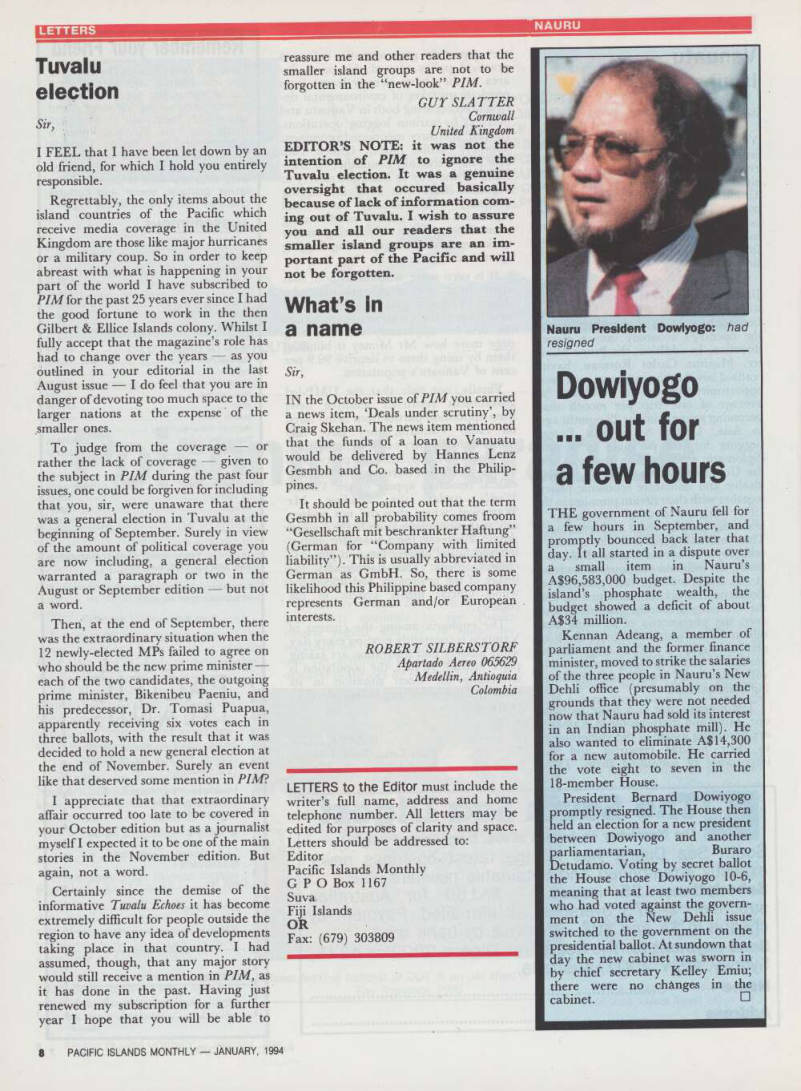
Nauru President Dowlyogo: had resigned
military aid suspension
Headlines
Australia
Democrats call for PNG military aid suspension
There has been a call for the suspension of Australia’s military aid programme-to PNG. The Australian Democrats have called for the complete suspension of the US$2O million military aid programme because of human rights abuses on Bougainville, the scene of a secessionist uprising.
The demand came as Australia’s Pacific Island Affairs Minister Gordon Bilney admitted he had cancelled a planned visit by an aid inspection mission to the island over fears for its safety.
The PNG defence force has been blamed for human rights abuses on the island, although an Amnesty International report also found the rebel Bougainville Revolutionary Army responsible for several incidents.
Democrats foreign affairs spokeswoman Vicki Bourne says the bottom line is that military equipment supplied by the Australian government to PNG has been and continues to be used in human rights abuses. Bourne says the aid should stop.
Foreign minister Gareth Evans says Australia will urge the PNG government to seek a political, rather than a military solution to the Bougainville problem. Evans has also asked the PNG government if a delegation might go to Bougainville as there had been many inquiries from Australian MPs who were concerned about the Bougainville issue.
PNG’s foreign minister John Kaputin said PNG had already issued an invitation to the Joint Assembly of the ACP-EU (African Carribean and Pacific-European Union) so a parliamentary group would be consistent with this. He says an Australian parliamentary delegation can visit Bougainville in the new year, subject to the cabinet’s approval.
Nuku’alofa shooting
Tonga
One killed in Nuku’alofa shooting
A shoot-out in Nuku’alofa on December 7 has left one man dead and another in a critical condition at Vaiola Hospital.
The shoot-out occured at the Tonga Cooperative Society’s head office in the centre of town’
Although police had not released any information about the incident by the time PIM went to press, Radio Tonga said the man hospitalised is understood to have done the shooting. No reasons for the killing have been given and police are
investigating.
Dr Talia’uli Afeaki of Vaiola Hospital reported the person under their care was fighting for his life as his brain was badly damaged from a bullet wound. Reporters were not allowed to view the scene of the shoot-out nor get any information from the police.
Opposition criticises
Papua New Guinea
Opposition criticises 1994 budget
The PNG opposition has branded the 1994 budget of US$l.B billion as one that will continue to bring failed promises to the majority of Papua New Guineans and benefit the well-off urban communities. Opposition leader, Chris Haiveta in his budget reply in parliament in November called on the Wingti-Chan government to apologise for what he called the failed 1993 budget which the new budget will complement.
Haiveta said the government owes the people an apology...claiming the country is now worse off and as a result the 1994 budget must be approached with plenty of suspicion.
The opposition has also predicted that the budget deficit for next year may reach $4OO million if the government does not plan its fiscal policy properly.
Haiveta said the 1994 budget is being diverted to financing deficits and that the country was facing inconsistent economic policies that would effect economic performance and develop ment.
CNMI Governor
Northern Marianas
CNMI Governor names Stillwell
Marianas Governor-elect Froilan C Tenorio has appointed Roger G Stillwell, an old Pacific hand, as his personal representative in Washington. Stillwell, who had worked with Tenorio, a Democrat, when the latter served as the elected Commonwealth of Northern Marianas Islands’ Washington Representative, will also continue to serve as editor of Micronesian Investment Quarterly. Stillwell will handle a series of specific tasks for the Governor,, and will coordinate with Juan Babauta, the Republican who was re-elected CNMFs Washington Representative at the same time that Tenorio was elected Governor.
Stillwell served for many years as the Administrative Assistant to the late Antonio B Won Pat, (D Guam) who was that island’s first delegate to the US House of Representatives.
Maori party
New Zealand
Maori party to be launched
A new Maori political party will be launched early this year.
Maori Council executive member Maanu Paul said the party, to be called the Aotearoa Party, would seek to give disillusioned Maori voters a vehicle to express their desire for self determination.
Advertisements & other items, p. 10 (1 item)
JJwru
4 i n I] ••• i' i ) t* I m * 'IS
CTi'
JANUARY
18-26 19th Session of ICUN General Assembly
FEBRUARY
07-10 Achieving Sustainable Growth Through Clean Production Processes, World Congress Centre, Melbourne, Australia ★ South Pacific Organisations Coordinating Committee (SPOCC) Meeting, SPREP headquarters, Apia, Western Samoa 14-18 Customs Heads of Administration Regional Meeting, Noumea, New Caledonia
MARCH
14-15 Forum Regional Security Committee, Forum Secretariat, Suva, Fiji 16-18 APEC/PECC Regional Energy Meeting, Beijing, China
APRIL
11-22 Energy Database and Information Workshop, Forum Secretariat, Suva, Fiji 11-22 Third Session of the Prepartory Committee for ICPD, UN, New York 26 Energy Ministers Meeting, Forum Secretariat, Suva, Fiji 27-28 Regional Energy Committee Meeting, Forum Secretariat, Suva, Fiji ★ Global Conference on the Sustainable Development of Small Island Countries, Barbados
JULY
04-08 The Sixth Pacific Congress on Marine Science and Technology, James Cook University of North Queensland, Townsville, Australia Note a ★ indicates dates have yet to be confirmed. Also some dates are provisional and may be changed. -
NUMBER ONE
THROUGHOUT THE
SOUTH PACIFIC
wm
Ela Motors
T M
PAPUA NEW GUINEA
PH (675) 229400 PO Box 74 Port Moresby Yamaha Outboard Motors are available in a wide range of models from 2hp up to 200 hp with comprehensive Genuine Parts and Service support Pacific wide.
Asco Motors
FIJI Ph 312666
AM.SAMOA Ph 633-4281
W. SAMOA Ph 23664
VANUATU Ph 22341 I
Laatsi is
Politics Round-Up
Tuvalu
new PM
The 12-member parliament of Tuvalu on December 10 elected Kamuta Laatasi as the new prime minister. Laatasi defeated Bikenibeu Paeniu by seven votes to five.
Paeniu has been prime minister since 1989.
Opposition leader Dr Tomasi Puapua, who has twice challenged Paeniu for leadership, did not contest the prime ministership. Sources said in return for not contesting Puapua was likely to be made speaker of the parliament.
Laatasi was a backbencher in the former Paeniu government and a former private secretary to Tuvalu first prime minister, Sir Toaripi Lauti, and later the country’s first high commissioner to Fiji.
More recently he has been general manager of BP Oil in Tuvalu.
In addition to prime ministership Laatasi will hold the foreign affairs and economic planning portfolios.
Laatasi’s selection follows two national elections in three months. The first was in September but a new poll was called after parliament remained deadlocked on choosing the prime minister. A second election was held on November 25.
Richardson dumped
New Zealand
in new lineup
Prime minister Jim Bolger has dumped Ruth Richardson from the finance port folio. Announcing his new lineup after the November 6 general election Bolger said Richardson had been offered a cabinet position but preferred to go to the backbenchers if she did not get finance. Bill Birch becomes the new finance minister, Don McKinnon re mains deputy prime minister, minister for foreign affairs and Pacific island affairs, Jenny Shipley is the new minister for health and Doug Kidd is minister of labour and minister for fisheries. John Banks has been stripped of his police responsibilities but keeps tourism and sports.
The National team has 20 cabinet ministers, three ministers not in the cabinet and three under-secretaries.
Meanwhile opposition Labour Party leader Mike Moore has been replaced by his deputy Helen Clark.
to rejoin government
Solomon Islands
Former minister wants
A Solomon Islands government minister who resigned and defected to the oppo sition has applied to rejoin the govern ment. Allan Paul who resigned as minister of culture, sports and tourism in November (see PIM December issue) when two other ministers, Dennis Lulei and Eric Seri, also defected in the belief the government would be toppled and the opposition would form the new administration.
In early December the acting parlia mentary leader of the People’s Alliance Party, the health and medical services minister, Nathaiel Waena confirmed Paul had applied to rejoin the party.
According to the regional news service PACNEWS at least one of the other two ministers who defected to the opposition has also made approaches to the govern ment.
The opposition had earlier refuted claims by the government that more opposition MPs are expected to switch sides. The government made the claims after the MP for Small Malaita, William Haomae said claims of more defections were pure speculation. He said Maetia’s decision to defect to the government had been circumstantial and the opposition respects it.
Following the High Court disqualifi cation of the May election of East Honiara MP and opposition member Charles Dausabea in November and the defection of Maetia, it now appears the government has 24 MPs and the oppo sition 22.
Korman sidesteps
Vanuatu
political crisis
Vanuatu’s Prime Minister, Maxime Carlot Korman, averted a political crisis in December and had the 1994 budget passed by bringing into his cabinet one of two supporters who liad earlier resigned.
Cecil Sinker, who resigned as leader of government business was sworn in as minister for posts and telecommunica tions, replacing Onnyn. Tahi who re signed on the same day as Sinker. Tahi had resigned saying Korman’s govern ment was dishonest, disloyal and irres ponsible. Both men were members of former prime minister Walter Lini’s
National United Party and belonged to the faction supporting the Korman government.
Sinker in his resignation letter also accused Korman of Lying, saying the prime minister had offered him the post of minister of agriculture and forestry but did not honour it. However, when offered the posts and communications portfolio Sinker accepted it immediately and was sworn in by the chief justice.
The government also survived a no confidence motion when it went undebated. The motion was filed on November 30 and needed seven clear days notice before it could be put to the floor. When parliament passed the budget and adjourned early on Decem ber 6, the motion lapsed.
The government now has a two seat majority in the 46-member parliament.
Challenge to Wingtl
Papua New Guinea
thrown out of court
On November 25 the National Court threw out the opposition challenge to prime minister Paias Winti’s resignation, re-election and re-appointment as prime minister in September.
National Court Justice Maurice Sheehan ruled that Wingti’s resignation, re-election and re-appointment were constitutional. He dismissed all three declarations sought by Opposition Leader Chris Haiveta in relation to the events of September 24 (see PIM Novem ber 1993). He said that Haiveta had failed to prove that the prime minister resigned on September 24 and not September 23 as Haiveta alleged.
Sheehan said that he was satisfied the time for appointment of a prime minister arises when the vacancy occurs. He said the occasion arose on the evening of September 23 when Wingti handed his letter of resignation to the governor general and that there was nothing in the constitution which shows (as Haiveta contended) that the vacancy arises when parliament is told of the resignation.
Wingti described the court decision as a constitutional landmark which will guarantee long term government stab ility in PNG. “The people of Papua New Guinea are entitled to see properly elected government run their full term,” said Wingti.
Wingti said that a fascination with power plays and dramatic court ma noeuvres orchestrated by inexperienced leaders such as Haiveta could only damage the nation.
special cruise
Business Bulletin
Tonga set to control
shipping company
A SHIPPING company formed jointly by the Tongan government and the Columbus Line 15 years ago is about to pass totally into Tongan control. The
Shipping Corporation of Polynesia held
its last joint annual general meeting in Nuku’alofa on December 1.
Since the company’s incorporation in 1978 the Tongan government has held 60 per cent of the shares in the line.
Columbus Line has decided to sell its shares to the Tongan government and its involvement ended on December 31. The Shipping Corporation of Polynesia man
ages Tonga’s shipping fleet and generally
assists in the development of shipping activities in the kingdom.
Foreign reserves
hit record s3Bm
TONGA’S foreign reserves reached a record US$3B million at the end of June 1993. This was an increase of more than US$4.2 million from the previous quar ter ending March 1993. The Reserve Bank said the increase was due mainly to the build-up of unspent funds received by the government. There was US$l.4 million held for the construction of the Queen Salote Memorial Hall and $750,000 was transferred from trust funds for the repayment of government debt. The June quarter external trans actions rose by $5.3 million over the March quarter to nearly US$24 million.
The Reserve Bank predicts better economic growth in 1993/94 based on improvements in the squash, construc tion and tourism industries.
Fiji becomes
member of GATT
FIJI has been formally accepted as a member of the General Agreement on Tariffs and Trade (GATT). It becomes the 12th member of the agreement. Fiji’s membership became effective on Novem ber 16 after GATT director general Peter Sutherland received an application from Fiji to join GATT. GATT’s objectives of liberalising world trade is consistent with the Fiji government’s present economic policies of creating an open and competi tive economy.
Solomons to revive
livestock Industry
SOLOMON Islands plans to revitalise its livestock industry. During the indus try’s initial stage in the early 19705, there were 25,000 cattle in the country but the cattle population has since been reduced to 8000.
Solomon Islands’ ministry of agricul ture and lands says it’s looking at possible
ways of ensuring self-reliance in the livestock industry, a reduction in prices and an improvemejit in production, marketing and distribution.
In the new cattle development drive, smallholders will not be involved because they have failed previously because of marketing and management problems.
But cattle farmers, who either aban doned or poorly managed their farms can be helped under the proposed livestock rehabilitation programme.
Dome Resources
seeks more funds
DOME Resources will invite Papua New Guinean institutions to take up equity to help fund the small, high-grade Tolukuma project, 100 kilometres north of Port Moresby. Chairman John Boyer says additional funds will be needed to develop Tolukuma which is due to start production in late 1994.
He says as Dome’s main activity is in PNG, they will invite major PNG institutions to take up some equity in the company. The project has an estimated six-year life with an annual production of 50,000 ounces of gold from the current proven resource. Boyer says a landowner agreement was signed in mid-November and the company is confident of being granted a mining lease early in the new year.
Rarotonga resort
up for auction
RAROTONGA’S Pacific Resort is among 36 waterfront properties in the Cook Islands, Fiji and New Zealand with a total estimated value of US$43 million put up for sale by a New Zealand real estate company. The Pacific Resort is up for sale by auction in Auckland on March 16. The New Zealand-based Bayleys Real Estate is marketing the property internationally.
Other properties being auctioned by Bayleys include three in Fiji including the 12-acre Naigani Island Resort. The remainder of the properties are situated in the North Island of New Zealand. The properties are being marketed with advertising in New Zealand, the United States, Asia and Europe.
FSM to expand
fishing industry
THE Federated States of Micronesia is taking steps to develop its fishing indus try. President Bailey Olter has an nounced a visit by a national government delegation throughout the four FSM states to discuss on a range of topics in fisheries development. He said it was hoped that discussions would focus on how best to maximise the total stream of benefits from the country’s 200-mile exclusive economic zone.
Olter said the delegation would be most interested to discuss with the governors in the states of Yap, Pohnpei, Kosrae and Chuuk the ways and means of improving current fishing operations and optimising future returns. He said it was anticipated that long-lining, purse seining and fish processing along with related infrastructure would be the specific topics of discussions.
Call for review
to PNG sales tax
THE Papua New Guinean government has been asked to reconsider its decision on the two per cent sales tax imposed on all provincial governments. Chairman of the islands region premiers council and premier of West New Britain Bernard Vogae says the decision will result in a loss of revenue and negative cash flow effects within the provincial budgets for 1994. He estimated the total loss to be around US$4 million for the islands region.
More seats on
Air New Zealand
AIR New Zealand increased the number of seats on its long haul Pacific routes for the third time in November. Air New Zealand is adding 34 services between Auckland, Honolulu and Los Angeles, providing and additional 6500 seats over the summer months.
General manager Grant Lilley said the increase was necessary to cope with strong demand, as well as filling a void created when Continental Airlines ended its South Pacific services last month. Air New Zealand is also adding another 10 tras-Tasman services, between Auckland and Brisbane and Auckland-Melbourne.
Lilley said the extra trans-Tasman flights would meet Asian demands. Air New Zealand has obtained a Boeing 767 on short-term lease from the northern
hemisphere.
Fiji to launch
special cruise
AUSTRALIAN tourists will be flown into Fiji in three chartered jumbo jets later this year to mark the launching of a special island cruise that will see the liner Fairstar based temporarily at Lau toka in Fiji. The first flight is planned for May when 1250 Australian tourists will fly in to board the Fairstar for a multi island Fiji cruise. The cruise is being
organised by Burns Philp Shipping (Fiji)
Limited and P & O. Burns Philip
Shipping general manager Hari
Narayan said the cruise resulted from research conducted by the company which revealed that tourists were inter ested in eco-tourism rather than the normal sun-and-sand holiday.
Goodbye Uncle Sam
Aid
By Roman Grynberg
THE short announcement that the United States Agency for International Development had given a list to the State department that its Suva office as one of the many that it was intending to close sent shock waves throughout the Pacific in October. While it was not yet whether the US government also In tended to close its aid projects dowfl or at least continue them temporarily was not clear but for many within USAID the announcement meant preparing
their departure from Fiji.
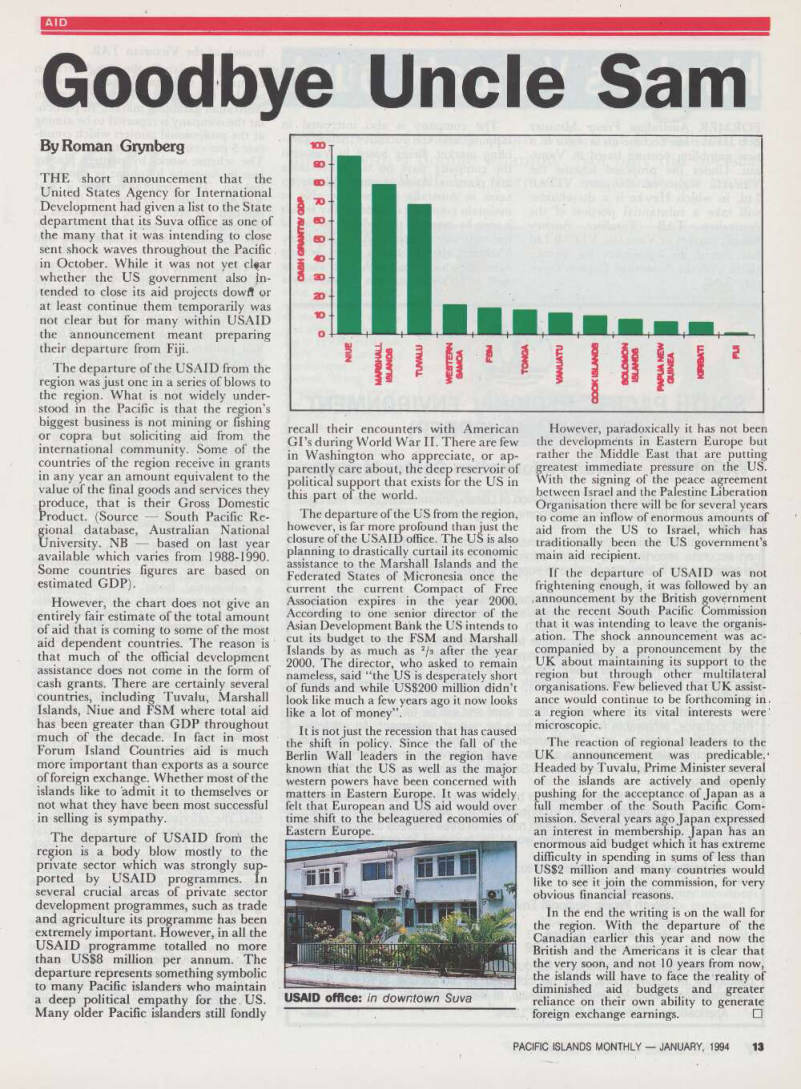
The departure of the USAID from the region was just one in a series of blows to the region. What is not widely under stood in the Pacific is that the region’s biggest business is not mining or fishing or copra but soliciting aid from the international community. Some of the countries of the region receive in grants in any year an amount equivalent to the value of the final goods and services they produce, that is their Gross Domestic Product. (Source South Pacific Re gional database, Australian National University. NB based on last year available which varies from 1988-1990.
Some countries figures are based on
estimated GDP).
However, the chart does not give an entirely fair estimate of the total amount of aid that is coming to some of the most aid dependent countries. The reason is that much of the official development assistance does not come in the form of cash grants. There are certainly several countries, including Tuvalu, Marshall Islands, Niue and FSM where total aid has been greater than GDP throughout much of the decade. In fact in most Forum Island Countries aid is much more important than exports as a source of foreign exchange. Whether most of the islands like to admit it to themselves or not what they have been most successful
in selling is sympathy.
The departure of USAID from the region is a body blow mostly to the private sector which was strongly sup ported by USAID programmes. In several crucial areas of private sector development programmes, such as trade and agriculture its programme has been extremely important. However, in all the USAID programme totalled no more than US$B million per annum. The
departure represents something symbolic
to many Pacific islanders who maintain a deep political empathy for the, US.
Many older Pacific islanders still fondly
recall their encounters with American Gl’s during World War 11. There are few in Washington who appreciate, or ap parently care about, the deep reservoir of political support that exists for the US in this part of the world.
The departure of the US from the region, however, is far more profound than just the closure of the USAID office. The US is also planning to drastically curtail its economic assistance to the Marshall Islands and the Federated States of Micronesia once the current the current Compact of Free Association expires in the year 2000,.
According to one senior director of the Asian Development Bank the US intends to cut its budget to the FSM and Marshall Islands by as much as 2 /s after the year 2000. The director, who asked to remain nameless, said “the US is desperately short of funds and while US$2OO million didn’t look like much a few years ago it now looks like a lot of mpney”.
It is not just the recession that has caused the shift in policy. Since the fall of the Berlin Wall leaders in the region have known that the US as well as the major western powers have been concerned with matters in Eastern Europe. It was widely felt that European and US aid would over time shift to the beleaguered economies of
Eastern Europe.
However, paradoxically it has not been the developments in Eastern Europe but rather the Middle East that are putting greatest immediate pressure on the US.
With the signing of the peace agreement between Israel and the Palestine Liberation Organisation there will be for several years to come an inflow of enormous amounts of aid from the US to Israel, which has traditionally been the US government’s main aid recipient.
If the departure of USAID was not frightening enough, it was followed by an announcement by the British government at the recent South Pacific Commission that it was intending to leave the organis ation. The shock announcement was ac
companied by a pronouncement by the
UK about maintaining its support to the region but through other multilateral organisations. Few believed that UK assist ance would continue to be forthcoming in, a region where its vital interests were
microscopic.
The reaction of regional leaders to the UK announcement was predicable.' Headed by Tuvalu, Prime Minister several of the islands are actively and openly pushing for the acceptance of Japan as a full member of the South Pacific Com mission. Several years ago Japan expressed an interest in membership. Japan has an enormous aid budget which it has extreme difficulty in spending in sums of less than US$2 million and many countries would like to see it join the commission, for very obvious financial reasons.
In the end the writing is on the wall for the region. With the departure of the Canadian earlier this year and now the British and the Americans it is clear that the very soon, and not 10 years from now, the islands will have to face the reality of diminished aid budgets and greater reliance on their own ability to generate
foreign exchange earnings. □
USAID office: in downtown Suva
Hawke’s Vanuatu punt
Business
FORMER Australian Prime Minister Bob Hawke has become an investor in a new gambling venture based in Vanuatu. Under the proposed scheme the Vanuatu registered company VITAB Ltd, in which Hawke is a shareholder will take a substantial portion of the Australian TAB (Totaliser Agency Board) market in Vanuatu. VITAB Ltd has signed an agreement for agency rights with the Australian Capital Territory TAB.
The company is also interested in tapping into the lucrative Asian gam bling market. Being based in Vanuatu the company pays no corporate taxes and potential Asian punters will pay no taxes in Australia and will be able to maintain complete confidentiality which is seen by many in the industry as one of the main advantages for Asian gamblers, Vanuatu already has a three betting agencies which deal both with local as well as off-shore punters. It also has a
branch of the Victorian TAB.
The game plan for the new Australian company is to attempt to capture some of the huge $lO billion per annum Australian gambling market. In particu lar the company is reported to be aiming at the professional punters which consti tute 5 per cent of the Australian market.
The scheme works by punters placing bets in Australia by phone or computer link-up. The great advantage is that VITAB would, because of its links through the ACT TAB, have access to the huge pools of prizes and income in the Victorian, South Australian and Tasmanian TABs.
The company is considered a sufficient threat to the Australian TABs that the state TAB heads in Australia are to meet soon to consider strategy options. The fear of the TABs is that VITAB will offer inducements to capture the large Austra lian punters and thereby decrease the profitability. VITAB chairman Daniel Kolomanski is reported to have said that he would not be offering inducements to Australian punters but he would cer tainly be looking to attract possible punters from the lucrative Asian market.
The company will also be looking to expansion to the emerging Chinese and Vietnamese markets.
In Vanuatu the company pays no corporate tax as the country has no direct taxes but does pay a turnover tax equivalent to 1.08 per cent of sales. The company is expected to have a turnover of $2O million in the first year and this is expected to rise to $5O million by the second year of operations. This will mean a substantial boost for the strapped Vanuatu government which if predic tions of revenues are correct stands to earn in the vicinity of $500,000 at end of the second year operations of the com pany.
The potential loss of revenue from the totalisator business of such concern that the Vanuatu based business arrangement with the ACT TAB was raised recently in the ACT’s Assembly. The ACT Minister for Sports, Wayne Berry, admit ted that the agreement between VITAB and the ACT TAB “is silent on the issue of inducements”.
He went on to say to the ACT Assembly “Members should appreciate that the offering of substantial induce ments to investors is purely a commercial matter an TABs are like any other business, are not precluded from using such methods to attract business.”
Meanwhile, in Vanuatu sources close to government indicate that the investment is by no means entirely complete.
Existing TABs in Vanuatu, which in clude a subsidiary of the Victorian TAB may not be pleased to see further completion. VITAB like other betting shops and totalisators in Vanuatu will not be precluded from taking bets from ni-Vanuatu and will not be restricted from trading on-shore. □
Advertisements & other items, p. 14 (1 item)
Programme (Sprep)
SOUTH PACIFIC REGIONAL ENVIRONMENT
VACANCY Llbrary/lnformation Center Manager
Applications are invited for the position of Library/lnformation Center Manager with the South Pacific Regional Environment Programme (SPREP), based in Apia, Western Samoa.
The South Pacific Regional Environment Programmes (SPREP) depends largely on accurate reporting and reliable information for the success of its working programme. An information service to support the research and information needs of all programme is therefore vital.
The Library/lnformation Centre Manager will be responsible to the Director, through the Deputy Director for organising, developing and administering the SPREP Library/lnformation Centre (SLIC).
Candidates must have appropriate tertiary qualifications from a recognised institution and at least five years’ work experience in a field related to this position.
Other essential requirements are the ability to work as part of a small, interdisciplinary team, to manage the work of consultants, and to meet project deadlines.
Appointment will be at Project Officer level and will be for three years in the first instance, renewable for a further term by mutual agreement. An attractive remuneration package and other employment benefits will be offered, with commencing salary dependant on qualifications, experience and current salary in country of recruitment. For non-Western Samoan citizens, salary will be tax-free in Western Samoa.
Applications must be accompanied by detailed cirricula vitae containing full information on qualifications and experience for the position as well as names, addresses, telephone and/or fax contact numbes of three referees associated with the applicant professionally and who would be prepared to provide necessary references.
Applications should be addressed to: The Director South Pacific Regional Environment Programme PO Box 240 APIA, Western Samoa Telephone: (685) 21929 Fax: (685) 20 231 Further information, including a full duty statement and schedule of terms and conditions of appointment, can be obtained by contacting SPREP’s Senior Administrative Officer,Mr Ueligitone Sasagi, at these numbers.
Applications close on 28 February, 1994 . 120386v4
Land of the falling
yen
When the Japanese boom went bust Hawaii felt the impact with a double whammy. Not only did overseas investment fall off, but there was less money for travel.
HAWAII’S tourism industry has
been troubled since the Gulf War.
Honolulu newspapers routinely print headlines like “June a big bust tor tourism; Arrivals and length of stay plummeted from a year ago.” Of par ticular concern is the dramatic decline of Asian visitors. In June, there were 16.4 per cent less eastbound tourists (originat ing in Asia) in Hawaii than there were
last June. During the same period,
westbound travel to Hawaii (originating in North America) dropped by 8.5 per cent. Lengths of stay are also significantly down.
In particular, the decrease in Asian travellers for more than two and a half years means Hawaii’s number one indus try is in crisis. Why are hundreds of thousand less Asian tourists coming to Hawaii? A Japan expert from Osaka, of the State and private sector funded Hawaii Visitors Bureau, who asked that her name not be used, says “Tokyo’s economy went down... After the bubble burst, people said, ‘Oh, we shouldn’t
spend money.”
By the late 1980 s, Japanese investment in real estate, resorts, golf courses etc, was so extensive that a Honolulu bank claimed 45 per cent of Hawaii’s economy was Japan
fenerated. Tokyo businessmen literally
nocked on the doors of local homes asking owners if they wanted to sell their houses for hefty profits. Hundreds of millions were spent per resort. Honolulu Mayor Frank Fasi asked a $lOO million “impact fee” (tax) per golf course. Japan Inc.’s invest ment was so widespread that Hawaii was called an “economic colony of Japan.” Six million tourists a year visited, many from Japan - which had a yen for Hawaii.
' Inevitably, when the Japanese boom went bust Hawaii felt the impact with a double whammy. Not only did overseas investment radically fall off, but there was less money for travelling. HVB’s Osakan says after the downturn, “Japanese tended to travel shorter distances to closer, cheaper destinations. ‘Why go all the way to Hawaii?’ they asked. Going to Hawaii was a travel trend 10, 20 years ago; it was a major place to go. Now, many places compete with Hawaii.”
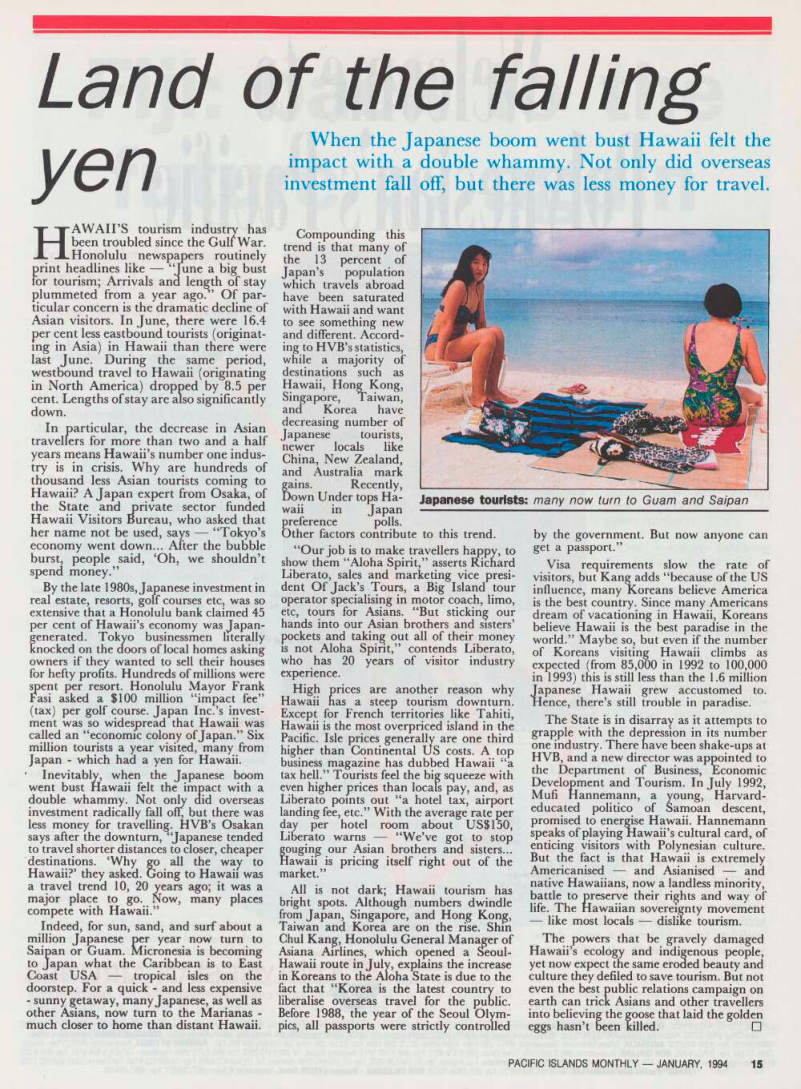
Indeed, for sun, sand, and surf about a million Japanese per year now turn to Saipan or Guam. Micronesia is becoming to Japan what the Caribbean is to East Coast USA tropical isles on the doorstep. For a quick - and less expensive - sunny getaway, many Japanese, as well as other Asians, now turn to the Marianas much closer to home than distant Hawaii.
Compounding this
trend is that many of the 13 percent of
Japan’s population
which travels abroad have been saturated with Hawaii and want to see something new and different. Accord ing to HVB’s statistics, while a majority of destinations such as Hawaii, Hong Kong, Singapore, Taiwan, and Korea have decreasing number of
Japanese tourists,
newer locals like China, New Zealand, and Australia mark
gains. Recently,
Down Under tops Ha waii in Japan
preference polls.
Other factors contribute to this trend.
“Our job is to make travellers happy, to show them “Aloha Spirit,” asserts Richard Liberate, sales and marketing vice president Of Jack’s Tours, a Big Island tour operator specialising in motor coach, limo, etc, tours for Asians. ‘ But sticking our hands into our Asian brothers and sisters pockets and taking out all of their money is not Aloha Spirit, contends Liberate, who has 20 years of visitor industry experience.
High prices are another reason why Hawaii has a steep tourism downturn.
Except for French territories like Tahiti, Hawaii is the most overpriced island in the Pacific. Isle prices generally are one third higher than Continental GS costs. A top business magazine has dubbed Hawaii “a tax hell.” Tourists feel the big squeeze with even higher prices than locals pay, and, as Liberate points out “a hotel tax, airport landing fee, etc.” With the average rate per day per hotel room about US$l5O, Liberate warns “We’ve got to stop gouging our Asian brothers and sisters...
Hawaii is pricing itself right out of the market.”
Al , . 1 1 xy .. . , All is not dark; Hawaii tourism has bright spots. Although numbers dwindle Hs S ‘"S a P° re ’ and Hong Kong, laiwan and Korea are on the rise. Shin Chul Kang, Honolulu General Manager of Asiana Airlines, which opened a Seoul- Hawaii route in July, explains the increase in Koreans to the Aloha State is due to the fact that “Korea is the latest country to liberalise overseas travel for the public.
Before 1988, the year of the Seoul Olympics, all passports were strictly controlled
by the government. But now anyone can get a passport.”
Visa requirements slow the rate of visitors, but Kang adds “because of the US influence, many Koreans believe America is the best country. Since many Americans dream of vacationing in Hawaii, Koreans believe Hawaii is the best paradise in the world.” Maybe so, but even if the number of Koreans visiting Hawaii climbs as expected (from 85,000 in 1992 to 100,000 in 1993) this is still less than the 1.6 million Japanese Hawaii grew accustomed to.
Hence, there’s still trouble in paradise.
The State is in disarray as it attempts to grapple with the depression in its number one industry. There nave been shake-ups at HVB, and a new director was appointed to the Department of Business, Economic Development and Tourism. In July 1992, Mufi Hannemann, a young, Harvard educated politico of Samoan descent, promised to energise Hawaii. Hannemann speaks of playing Hawaii’s cultural card, of enticing visitors with Polynesian culture.
But the fact is that Hawaii is extremely Americanised and Asianised and native Hawaiians, now a landless minority, battle to preserve their rights and way of life. The Hawaiian sovereignty movement like most locals dislike tourism.
The powers that be gravely damaged Hawaii’s ecology and indigenous people, yet now expect the same eroded beauty and culture they defiled to save tourism. But not even the best public relations campaign on earth can trick Asians and other travellers into believing the goose that laid the golden eggs hasn’t been killed. □
Japanese tourists: many now turn to Guam and Saipan
Advertisements & other items, p. 16 (1 item)
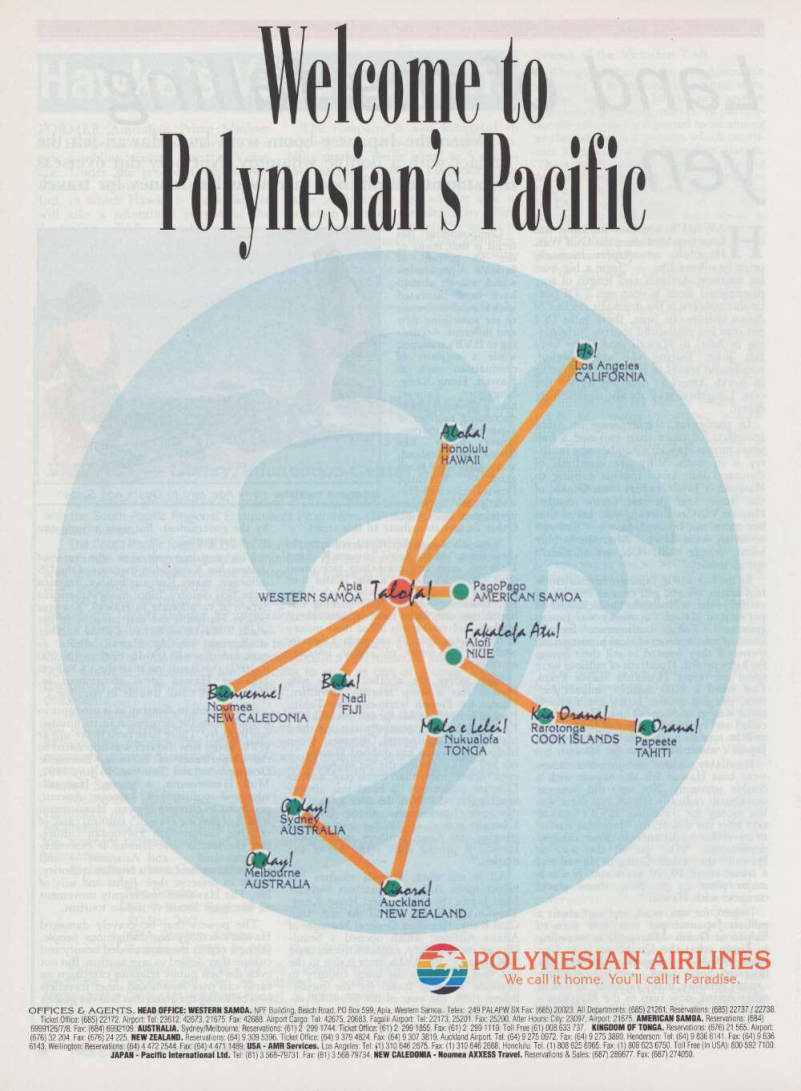
Polynesian’s Pacific
m Los Angeles
CALIFORNIA
f\Ua!
Honolulu
HAWAII
Apia
WESTERN SAMOA
PagoPago
AMERICAN SAMOA
NIUE
B^l Noumea
NEW CALEDONIA
m w Nadi
FIJI
mutuui
Nukualofa
TONGA
% CW*/ Rarotonga
COOK ISLANDS pTeete
TAHITI
Sydne<
AUSTRALIA
Melbourne
AUSTRALIA
Auckland
NEW ZEALAND
POLYNESIAN AIRLINES
We call it home. You’ll call it Paradise.
OFFICES & AGENTS. HEAD OFFICE: WESTERN SAMOA. NPF Building, Beach Road, PO Box 599, Apia, Western Samoa., Telex: 249 PALAPW SX Fax: (685) 20023. All Departments: (685) 21261 . Reservations: (685) 22737 / 22738.
Ticket Office: (685) 22172. Airport: Tel: 23612,42673, 21675. Fax: 42688. Airport Cargo: Tel: 42675, 20683. Fagalii Airport: Tel: 22173, 25201, Fax: 25200. After Hours: City: 23097, Airport: 21675, AMERICAN SAMOA. Reservations: (684) 6999126/7/8. Fax: (684) 6992109, AUSTRALIA. Sydney/Melbourne. Reservations: (61) 2 299 1744, Ticket Office: (61) 2 299 1855. Fax: (61) 2 299 1119. Toll Free (61) 008 633 737. KINGDOM OF TONGA. Reservations: (676) 21 565. Airport: (676) 32 204. Fax: (676) 24 225. NEW ZEALAND. Reservations: (64) 9 309 5396. Ticket Office: (64) 9 379 4824. Fax: (64) 9 307 3819. Auckland Airport. Tel: (64) 9 275 0972. Fax: (64) 9 275 3890. Henderson: Tel: (64) 9 836 6141. Fax: (64) 9 836 6143. Wellington: Reservations: (64) 4 472 2544. Fax: (64) 4 471 1489. USA - AMR Services. Los Angeles: Tel: (1) 310 646 2675. Fax: (1) 310 646 2668. Honolulu: Tel: (1) 808 625 6965. Fax: (1) 808 623 6750. Toll Free (In USA): 800592 7100.
JAPAN - Pacific International Ltd. Tel: (81) 3 568-79731. Fax: (81) 3 56879734. NEW CALEDONIA - Noumea AXXESS Travel. Reservations & Sales: (687) 286677. Fax; (687) 274050.
future ... again
Cover Story
Fiji: back to the future ... again
Govt budget defeated,
PM Rabuka calls for
snap national election
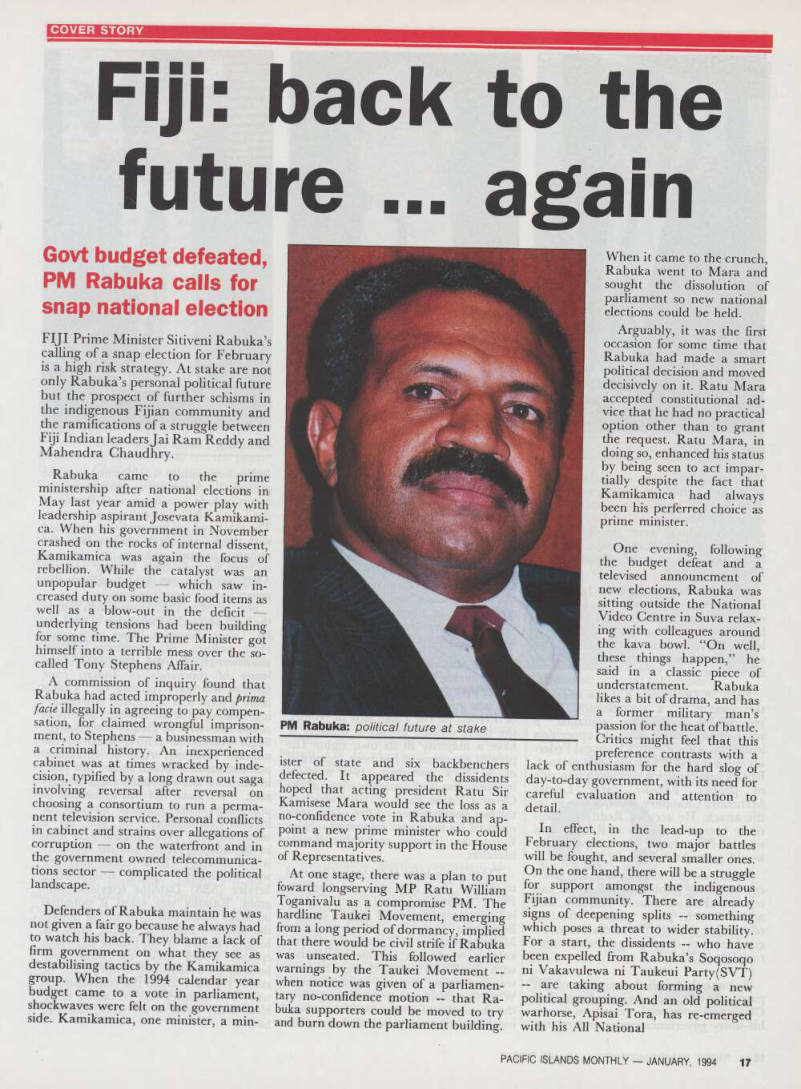
FIJI Prime Minister Sitiveni Rabuka’s calling of a snap election for February is a high risk strategy. At stake are not only Rabuka’s personal political future but the prospect of further schisms in
the indigenous Fijian community and
the ramifications of a struggle between Fiji Indian leaders Jai Ram Reddy and
Mahendra Chaudhry.
Rabuka came to the prime ministership after national elections in May last year amid a power play with leadership aspirant Josevata Kamikami ca. When his government in November crashed on the rocks of internal dissent, Kamikamica was again the focus of rebellion. While the catalyst was an unpopular budget which saw in creased duty on some basic food items as well as a blow-out in the deficit underlying tensions had been building for some time. The Prime Minister got himself into a terrible mess over the so
called Tony Stephens Affair.
A commission of inquiry found that Rabuka had acted improperly and prima facie illegally in agreeing to pay compen sation, for claimed wrongful imprison ment, to Stephens a businessman with a criminal history. An inexperienced cabinet was at times wracked by inde cision, typified by a long drawn out saga involving reversal after reversal on choosing a consortium to run a perma nent television service. Personal conflicts in cabinet and strains over allegations of corruption on the waterfront and in the government owned telecommunica tions sector complicated the political
landscape.
Defenders of Rabuka maintain he was not given a fair go because he always had to watch his back. They blame a lack of firm government on what they see as destabilising tactics by the Kamikamica group. When the 1994 calendar year budget came to a vote in parliament, shockwaves were felt on the government side. Kamikamica, one minister, a min-
ister of state and six backbenchers defected. It appeared the dissidents hoped that acting president Ratu Sir Kamisese Mara would see the loss as a no-confidence vote in Rabuka and ap point a new prime minister who could command majority support in the House
of Representatives.
At one stage, there was a plan to put foward longserving MP Ratu William Toganivalu as a compromise PM. The hardline Taukei Movement, emerging from a long period of dormancy, implied that there would be civil strife if Rabuka was unseated. This followed earlier warnings by the Taukei Movement when notice was given of a parliamen tary no-confidence motion - that Ra buka supporters could be moved to try and burn down the parliament building.
When it came to the crunch, Rabuka went to Mara and sought the dissolution of parliament so new national elections could be held.
Arguably, it was the first occasion for some time that Rabuka had made a smart political decision and moved decisively on it. Ratu Mara accepted constitutional ad vice that he had no practical option other than to grant the request. Ratu Mara, in doing so, enhanced his status by being seen to act impar tially despite the fact that Kamikamica had always been his perferred choice as prime minister.
One evening, following
the budget defeat and a televised announcment of new elections, Rabuka was sitting outside the National Video Centre in Suva relax ing with colleagues around the kava bowl. “On well,
these things happen,” he
said in a classic piece of understatement. Rabuka likes a bit of drama, and has a former military man’s passion for the heat of battle.
Critics might feel that this
preference contrasts with a lack of enthusiasm for the hard slog of day-to-day government, with its need for careful evaluation and attention to detail.
In effect, in the lead-up to the February elections, two major battles will be fought, and several smaller ones.
On the one hand, there will be a struggle for support amongst the indigenous
Fijian community. There are already
signs of deepening splits - something which poses a threat to wider stability.
For a start, the dissidents who have been expelled from Rabuka’s Soqosoqo ni Vakavulewa ni Taukeui Party(SVT) are taking about forming a new political grouping. And an old political warhorse, Apisai Tora, has re-emerged with his All National
PM Rabuka: political future at stake
Congress (ANC) to campaign on a platform of multi-culturalism (despite Tora himself have a very mixed past record on such issues). Before the last elections, which were the first since Rabuka’s 1987 military coups, Rabuka had raised high expectations among the Fijian community.
Now he will be judged on his record in office. While that record has been very much up and down, Rabuka can fairly lay claim to having been a moderate leader. Anti-Indian witchhunts, envis aged by the most pessimistic, did not materialise.
Early in December, Rabuka re-raised the spectre of a post-election unity government. And he signalled a willingness to look towards opposition leader Jai Ram Reddy’s National Feder ation Party (NFP) as a coalition partner.
Reddy’s political foe on the Indian side of politics, Labour Party Leader Mahendra Chaudhry, was quick to go on the attack. He accused Reddy of effec tively becoming an ally of Rabuka and warned that, during the campaign, he would pursue the NFP on this basis.
Reddy sought to neutralise this strat egy by stating publicly that Rabuka had not broached an alliance with him, and added that the prime minister’s floating of the idea through the media was not a good start to developing greater cross racial unity.
Rabuka has called meetings of his party, the traditional Great Council of Chiefs and provincial councils to discuss his unity government plan and related
issues. This comes at a time of doubts over future viabilit of the relationship between the Great Council of Chiefs and the SVT, which the chiefs created with the failed aim of fostering greater indigenous unity. The post coup consti tution’s assigning of a central role in party affairs to provincial councils is also under something of a cloud. The effect of this link has been to encourage regionalism in national politics, some thing which has been a thorn in side of the Rabuka government.
Once the elections are out of way, manoeuvring will instensify. It appears likely, that the SVT will form the core of any new government. But partly because of division on the Fijian side of politics, the party created to rule is unlikely to have a majority in its own right. The present government has been comprised of 30 SVT members* two nominal independents and representatives of the General Voters Party (GVP), which in the last elections won all five of the seats reserved for for ethnic minorities such as Europeans, Chinese and other Pacific islanders.
There are a total of 37 seats allocated to Fijians, but last year the hardline Fijian Nationalist United Front (FNUF) led by veteran firebrand activist Sakeasi Butadroka took five of these seats.
Moderates in the SVT, including Kami kamica, would not tolerate an alliance with the FNUF, even though Rabuka was favourably disposed towards them.
With the dissidents presently expelled, the possibility of a new coalition includ ing Butadroka can’t be ruled out. The
Indian community would grimace at the prospect. Alternative combinations, might include an alliance with Reddy or the Tora’s ANC, if he can win a few seats.
The GVP, which has traditionally sided with the Fijian side of politics, faces the unhappy prospect of losing one of two of its seats because both Labour and the ANC are going to field candidates in general voter constituencies.
So, the May 1987 coup which ousted the Fiji Labour/NFP coalition of the Late Dr Timoci Bavadra failed to simplify
Fiji’s politics. Big questions remain
unanswered. By the mid-1990s land leases of thousands of Indian cane farmers will start running out. Unless there is some sort of realistic powershar ing, dealing with the inherent sensitivies of this issue with be greatly complicated.
Sugar remains a central pillar of the nation’s economy. And as Chaudhry pointed out in a speech earlier this year, investment has remained largely stag nant. "We have not yet succeeded in
providing either political stability or
investor confidence,” he said.“As a result, liquidity levels continue to be high in the banking system and the economy is not moving.” In a recent interview
with Australia’s Special Broadcasting
Service (SBS) Dateline television pro gram, Rabuka was asked if potential investors would still come to Fiji despite
the political upheaval arising from the
budget’s defeat. “Well, I think this whole episode would make me come here because the constitution is workable,” he said. “We have taken the constitutional way. The country has remained' calm.
How many parts of the world can you have a
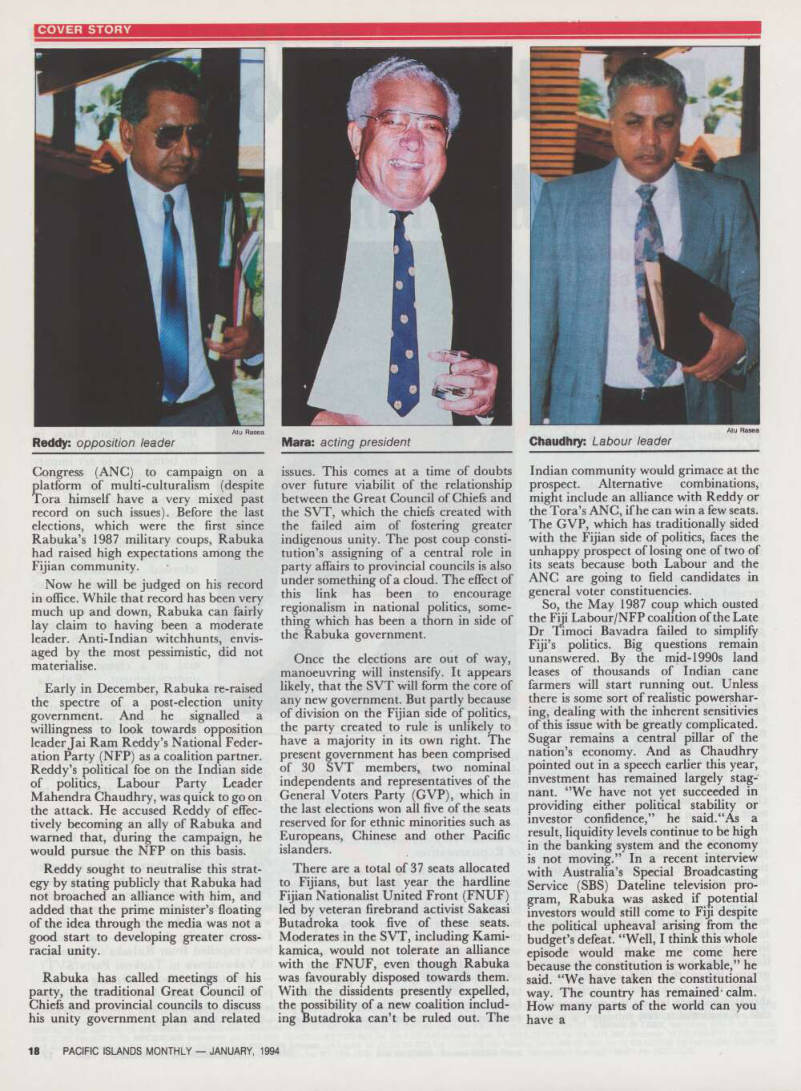
Atu Rasea
Reddy: opposition leader
Mara: acting president
Atu Rasea
Chaudhry: Labour leader
political crisis such as we have had and continue as if nothing had happened.”
Rabuka predicted that the NFP would increase its Indian seats in parliament, currently 14 compared with Labour’s 13.
This followed a period in which Reddy, an urbane lawyer, has apparently ben efited from pursuing a moderate political line. Labour was trounced by the NFP this year in local councils elections as well as in a national by-election. “We must do away with that failed style of politics which is based on destructive and confrontational urges, which seems to thrive on dispute,” Reddy told a lunch eon organised by the GVP. He sought an end to constant verbal warfare and insistence that only one kind of agenda was right.
Ironically, it was Chaudhry who after the last election quickly jumped in to back Rabuka for the prime ministership when Reddy preferred Kamikamica, given that the constitution insists that leadership of government go to an indigenous Fijian. Chaudhry fell out with Rabuka over the slow pace of reviewing the post-coup constitution, which restricts Fijian Indian rights. The forthcoming elections will test the popu larity of Chaudhry’s return to a more confrontational approach. Labour did
it’s likely that the SVT will form the core of any new govt.
But partly because of division on the Fijian side of politics, the party created to rule is unlikely to have a majority in its own right
better than expected in the last elections, winning virtually all the western cane belt seats. There remains a divide between the concerns of rural Indian voters and their urban counterparts, throwing yet another wildcard into the island nation’s political fabric.
There is also a widening gulf between the perceptions of urban and rural Fijians. In hundreds of scattered villages, what goes on Suva political circles often seems remote. Bread and butter issues are what count. Failure to achieve a more workable system of government can only exacerbate the problems of a widening disparity between services available to city dwellers and what is on offer to people in outlying areas. Urban drift, combined with high overall population growth and low economic growth in hibiting the creation of new jobs, leads to social tensions and disillushionment.
Such dynamics in turn challenge preser-
vation of traditional values. These values, including communal problem
sharing and inter-dependence, have
helped Fiji in the past to overcome divisive forces of the kind which had ripped apart other nations. As Reddy noted recently, Fiji in its first year’s of nationhood was a tinderbox, with enough flamable material to engulf people of all races.
Unfortunately, election campaigns al ways produce sparks. A saving grace of what has turned out to be a largely failed post-coup constitution is that it tends to concentrate tensions within ethnic com munities rather than intensify strains between them. This is because voters are restricted to casting ballots for candidates from their own ethnic communities. And the demands of elections can on occasion pressure disparate blocs to regroup. For example, it may yet be that the split in
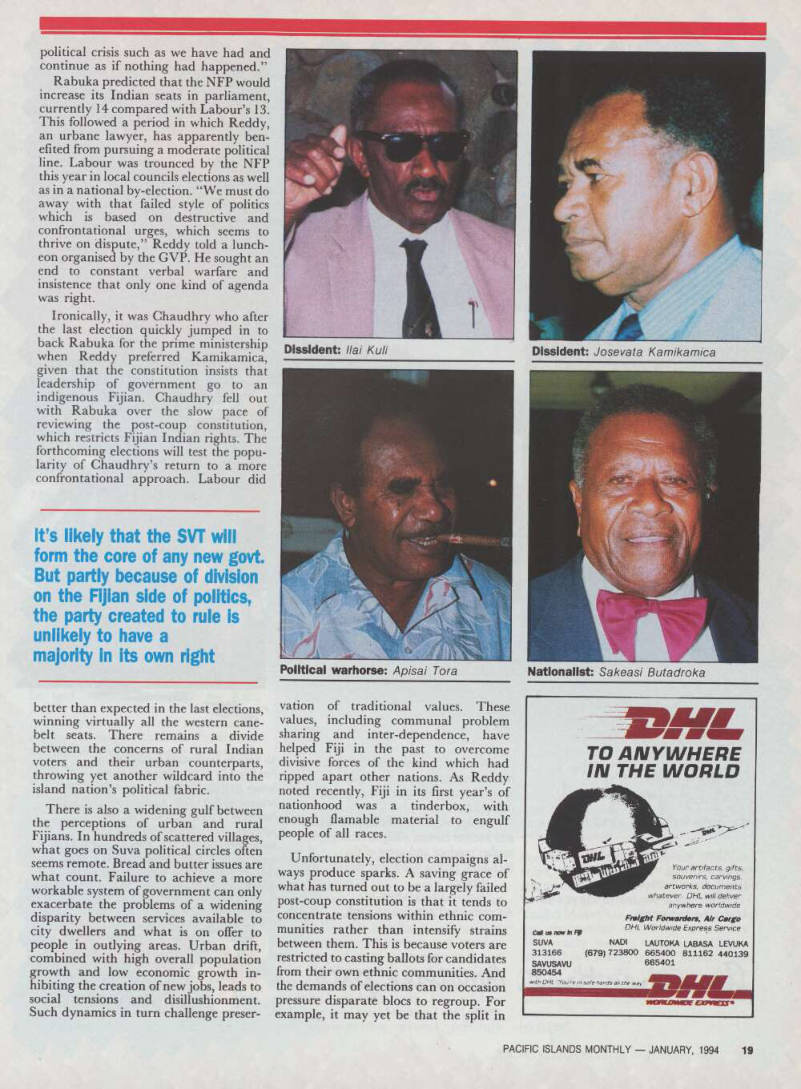
Dissident: llai Kuli
Political warhorse: Apisai Tora
Dissident: Josevata Kamikamica
Nationalist: Sakeasi Butadroka
Rabuka’s SVT will be papered over until after the elections. That would mean a repeat of the situation before the last elections. Then, the question of SVT leadership was put-off until after polling when the numerical situation in parlia ment was clear. In this way, respective public support for Rabuka loyalists and the dissidents, as well as of the competing Indian political parties, would be on the table for all to see.
Rabuka notes that Fiji has been the lowest regional receiver of foreign aid
assistance per head of population. He maintains also that Fiji, in relative terms, has shown the best overall economic performance of Pacific island countries during the past five years. ”We should all be proud of this because it tells us that our success in progressing and moving our country foward in its economic and social development is to a very large degree through our own efforts and resources,” Rabuka said. Fiji, with a large educated workforce and well devel oped administrative network, certainly
does have potential for future advance ment. And at times an underlying reasonableness belies the sort of high blown rhetoric demonstrated in a recent Taukei Movement advertisement brand ing government dissidents as traitors.
The coming election campaign will be a test of Fiji’s maturity as a nation. The country is at the crossroads. Future generations may look back to the 1994 elections as a watershed in a unique South Pacific experiment in multi racialism. □
Advertisements & other items, pp. 19-20 (1 item)
To Anywhere
IN THE WORLD
ft
fjlffc
Your artifacts, gifts, souvenirs, carvings, artworks, documents whatever. DHL will deliver anywhere worldwide Freight Forwarders , Air Cargo .. . DHL Worldwide Express Service Coil os now hi i m
SUVA NADI LAUTOKA LABASA LEVUKA
313166 (679)723800 665400 811162 440139
SAVUSAVU 665401
850454 with DHL "You're m safe hands all the way'
mm •f 1 £- %
4. VANUATU
I Port Vila '" i // \*/
AUSTRALIA iMs
4 / . -/V " Nadi
FIJI I
NEW CALEDONIA
"W m*-,: Auckland ’I. NEW ZEALAND f-V V
icfaiM o~a
ck>l\ |<VV'«
-tVoA alWl m<?re.. •
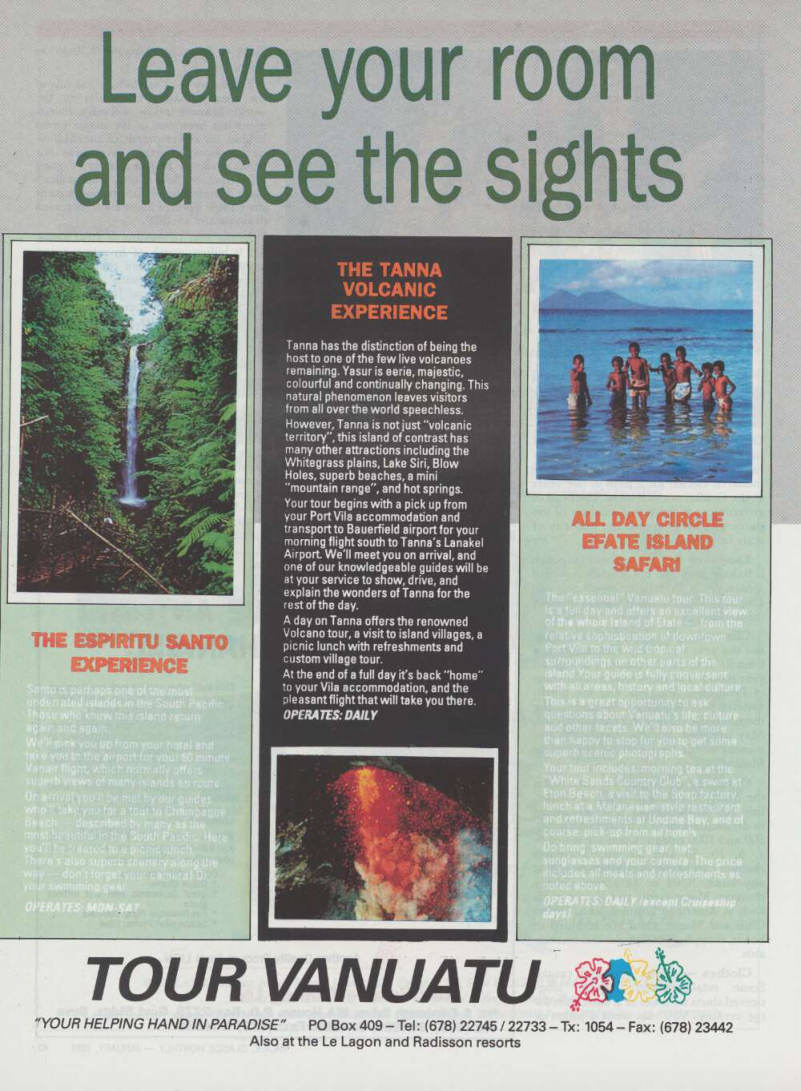
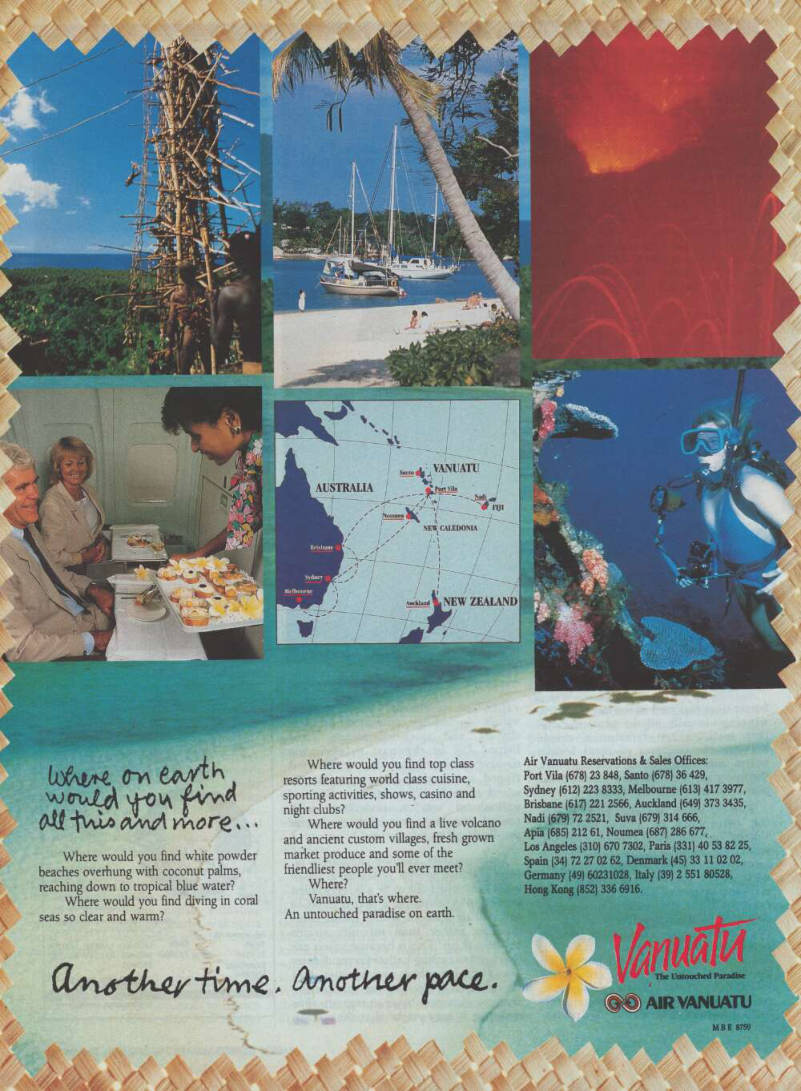
Where would you find white powder beaches overhung with coconut palms, reaching down to tropical blue water?
Where would you find diving in coral seas so clear and warm?
Where would you find top class resorts featuring world class cuisine, sporting activities, shows, casino and night clubs?
Where would you find a live volcano and ancient custom villages, fresh grown market produce and some of the friendliest people you’ll ever meet?
Where?
Vanuatu, that’s where.
An untouched paradise on earth.
Air Vanuatu Reservations & Sales Offices: Port Vila (678) 23 848, Santo (678) 36 429, Sydney (612) 223 8333, Melbourne (613) 417 3977, Brisbane (617) 221 2566, Auckland (649) 373 3435, Nadi (679) 72 2521, Suva (679) 314 666, Apia (685) 212 61, Noumea (687) 286 677,.
Los Angeles (310) 670 7302, Paris (331) 40 53 82 25, Spain (34) 72 27 02 62, Denmark (45) 33 1102 02, Germany (49) 60231028, Italy (39) 2 551 80528, Hong Kong (852) 336 6916.
/XfnaiHtrJPM4,.
rnmm* ' jl
The Untouched Paradise
AIR VANUATU
MBE 8759
% J, / X /%
Ratu Sir
Penaia dies
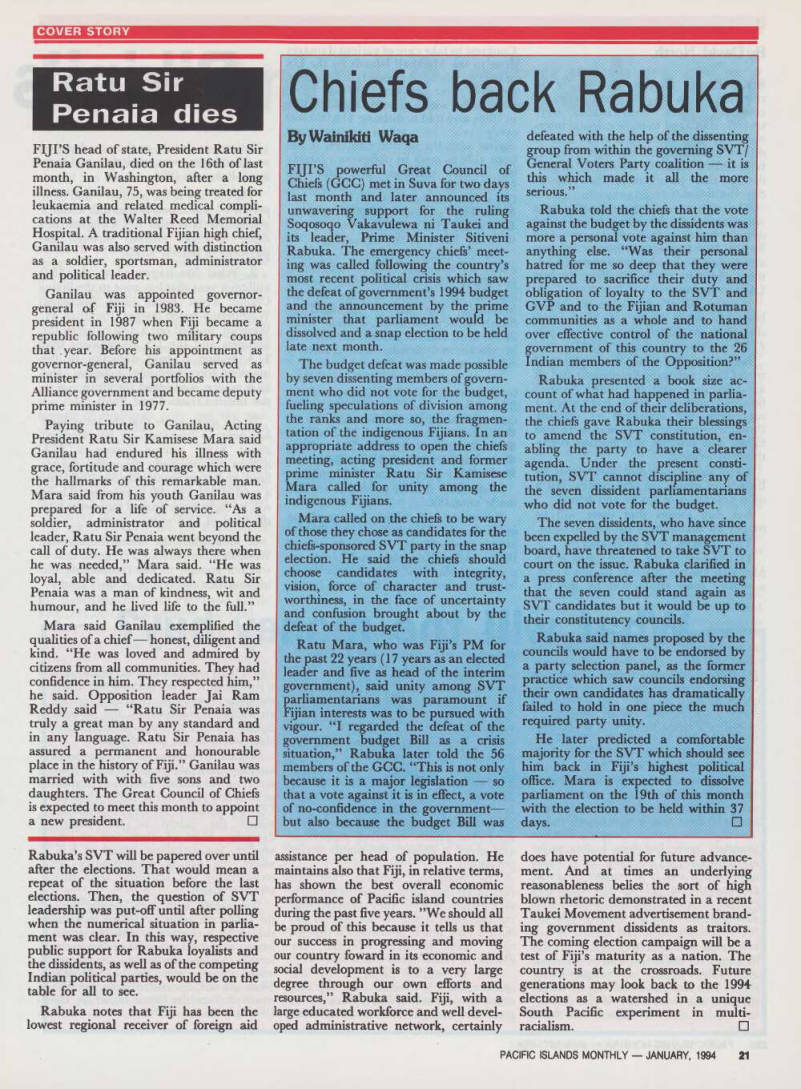
FIJI’S head of state, President Ratu Sir Penaia Ganilau, died on the 16th of last month, in Washington, after a long illness. Ganilau, 75, was being treated for leukaemia and related medical compli cations at the Walter Reed Memorial Hospital. A traditional Fijian high chief, Ganilau was also served with distinction as a soldier, sportsman, administrator and political leader.
Ganilau was appointed governor general of Fiji in 1983. He became president in 1987 when Fiji became a republic following two military coups that .year. Before his appointment as governor-general, Ganilau served as minister in several portfolios with the Alliance government and became deputy prime minister in 1977.
Paying tribute to Ganilau, Acting President Ratu Sir Kamisese Mara said Ganilau had endured his illness with grace, fortitude and courage which were the hallmarks of this remarkable man.
Mara said from his youth Ganilau was prepared for a life of service. “As a soldier, administrator and political leader, Ratu Sir Penaia went beyond the call of duty. He was always there when he was needed,” Mara said. “He was loyal, able and dedicated. Ratu Sir Penaia was a man of kindness, wit and humour, and he lived life to the full.”
Mara said Ganilau exemplified the qualities of a chief — honest, diligent and kind. “He was loved and admired by citizens from all communities. They had confidence in him. They respected him,” he said. Opposition leader Jai Ram Reddy said “Ratu Sir Penaia was truly a great man by any standard and in any language. Ratu Sir Penaia has assured a permanent and honourable place in the history of Fiji.” Ganilau was married with with five sons and two daughters. The Great Council of Chiefs is expected to meet this month to appoint a new president. □
Chiefs back Rabuka
ByWainikiti Waqa
FIJI’S powerful Great Council of Chiefs (GCG) met in Suva for two days last month and later announced its unwavering support for the ruling Soqosoqo Vakavulewa ni Taukei and its leader, Prime Minister Sitiveni Rabuka. The emergency chiefs’ meet ing was called following the country’s most recent political crisis which saw the defeat of government’s 1994 budget and the announcement by the prime minister that parliament would be dissolved and a snap election to be held late next month.
The budget defeat was made possible by seven dissenting members of govern ment who did not vote for the budget, fueling speculations of division among the ranks and more so, the fragmen tation of the indigenous Fijians. In an appropriate address to open the chiefs meeting, acting president and former prime minister Ratu Sir Kamisese Mara called for unity among the
indigenous Fijians.
Mara called on the chiefs to be wary of those they chose as candidates for the chiefs-sponsored SVT party in the snap election. He said the chiefs should choose candidates with integrity, vision, force of character and trust worthiness, in the face of uncertainty and confusion brought about by the defeat of the budget.
Ratu Mara, who was Fiji’s PM for the past 22 years (17 years as an elected leader and five as head of the interim government), said unity among SVT parliamentarians was paramount if Fijian interests was to be pursued with vigour. “I regarded the defeat of the government budget Bill as a crisis situation,” Rabuka later told the 56 members of the GCG. “This is not only because it is a major legislation so that a vote against it is in effect, a vote of no-confidence in the government — but also because the budget Bill was
defeated with the help of the dissenting group from within the governing SVT/ General Voters Party coalition it is this which made it all the more serious.”
Rabuka told the chiefs that the vote against the budget by the dissidents was more a personal vote against him than anything else. “Was their personal hatred for me so deep that they were prepared to sacrifice their duty and obligation of loyalty to the SVT and GVP and to the Fijian and Rotuman communities as a whole and to hand over effective control of the national government of this country to the 26 Indian members of the Opposition?”
Rabuka presented a book size ac count of what had happened in parlia ment. At the end of their deliberations, the chiefs gave Rabuka their blessings to amend the SVT constitution, en abling the party to have a clearer agenda. Under the present consti tution, SVT cannot discipline any of the seven dissident parliamentarians who did not vote for the budget.
The seven dissidents, who have since been expelled by the SVT management board, have threatened to take SVT to court on the issue. Rabuka clarified in a press conference after the meeting that the seven could stand again as SVT candidates but it would be up to their constitutency councils.
Rabuka said names proposed by the councils would have to be endorsed by a party selection panel, as the former practice which saw councils endorsing their own candidates has dramatically failed to hold in one piece the much required party unity.
He later predicted a comfortable majority for the SVT which should see him back in Fiji’s highest political office. Mara is expected to dissolve parliament on the 19th of this month with the election to be held within 37 days. □
Bikini’s
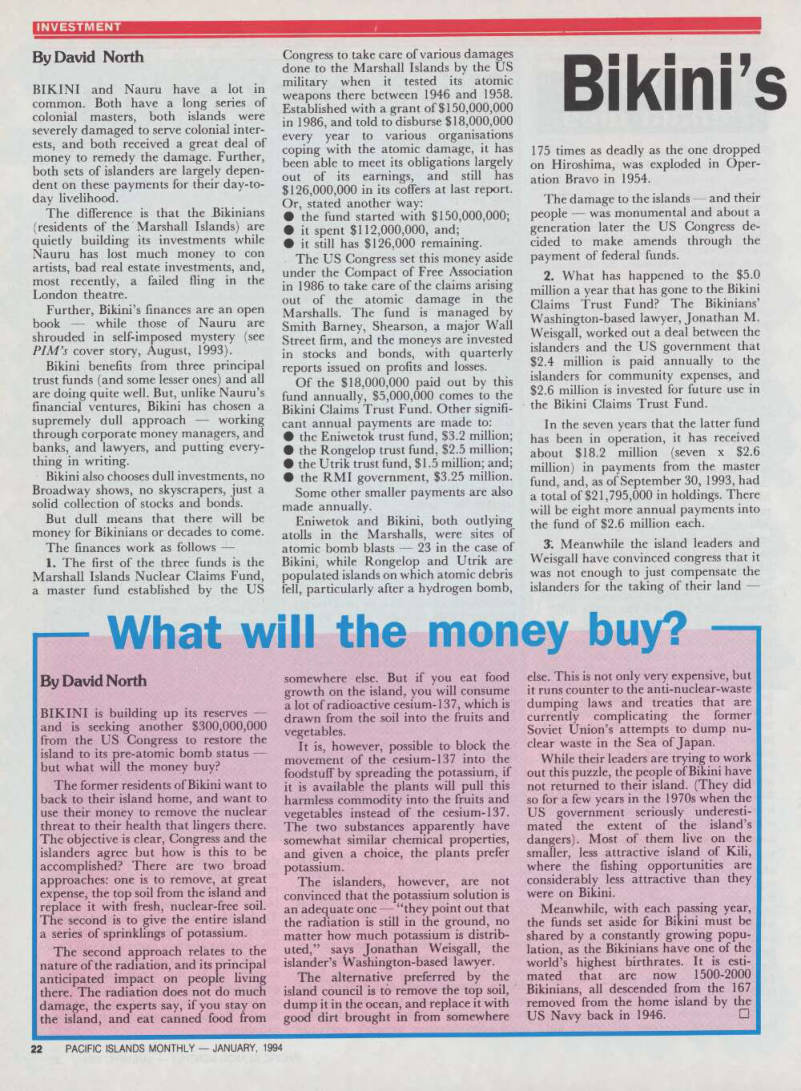
Investment
By David North
BIKINI and Nauru have a lot in common. Both have a long series of colonial masters, both islands were severely damaged to serve colonial inter ests, and both received a great deal of money to remedy the damage. Further, both sets of islanders are largely depen dent on these payments for their day-to day livelihood.
The difference is that the Bikinians (residents of the Marshall Islands) are quietly building its investments while Nauru has lost much money to con artists, bad real estate investments, and, most recently, a failed fling in the London theatre.
Further, Bikini’s finances are an open book while those of Nauru are shrouded in self-imposed mystery (see PI M’s cover story, August, 1993).
Bikini benefits from three principal trust funds (and some lesser ones) and all are doing quite well. But, unlike Nauru’s financial ventures, Bikini has chosen a
supremely dull approach working
through corporate money managers, and banks, and lawyers, and putting every thing in writing.
Bikini also chooses dull investments, no Broadway shows, no skyscrapers, just a solid collection of stocks and bonds.
But dull means that there will be money for Bikinians or decades to come.
The finances work as follows I. The first of the three funds is the Marshall Islands Nuclear Claims Fund, a master fund established by the US
Congress to take care of various damages done to the Marshall Islands by the US military when it tested its atomic weapons there between 1946 and 1958.
Established with a grant of $150,000,000 in 1986, and told to disburse $18,000,000 every year to various organisations coping with the atomic damage, it has been able to meet its obligations largely out of its earnings, and still has $126,000,000 in its coffers at last report.
Or, stated another way; • the fund started with $150,000,000; • it spent $112,000,000, and; • it still has $126,000 remaining.
The US Congress set this money aside under the Compact of Free Association in 1986 to take care of the claims arising out of the atomic damage in the Marshalls. The fund is managed by Smith Barney, Shearson, a major Wall Street firm, and the moneys are invested in stocks and bonds, with quarterly reports issued on profits and losses.
Of the $18,000,000 paid out by this fund annually, $5,000,000 comes to the Bikini Claims Trust Fund. Other signifi cant annual payments are made to: • the Eniwetok trust fund, $3.2 million; • the Rongelop trust fund, $2.5 million; • the Utrik trust fund, $1.5 million; and; • the RMI government, $3.25 million.
Some other smaller payments are also made annually.
Eniwetok and Bikini, both outlying atolls in the Marshalls, were sites of atomic bomb blasts 23 in the case of Bikini, while Rongelop and Utrik are populated islands on which atomic debris fell, particularly after a hydrogen bomb,
175 times as deadly as the one dropped on Hiroshima, was exploded in Oper ation Bravo in 1954.
The damage to the islands and their people was monumental and about a generation later the US Congress de cided to make amends through the payment of federal funds. 2. What has happened to the $5.0 million a year that has gone to the Bikini Claims Trust Fund? The Bikinians’
Washington-based lawyer, Jonathan M.
Weisgall, worked out a deal between the islanders and the US government that $2.4 million is paid annually to the islanders for community expenses, and $2.6 million is invested for future use in the Bikini Claims Trust Fund.
In the seven years that the latter fund has been in operation, it has received about $18.2 million (seven x $2.6 million) in payments from the master fund, and, as of September 30, 1993, had a total of $21,795,000 in holdings. There will be eight more annual payments into the fund of $2.6 million each. 3. Meanwhile the island leaders and Weisgall have convinced congress that it was not enough to just compensate the islanders for the taking of their land
to which they have not returned because of continuing radiation but Congress should pay for the restoration of the land to something like its prior condition.
Bikini Atoll surrounds what had been a large, fish-filled lagoon, which histori cally was the source of most of the residents’ protein; the islands around the fringe were rich in coconut palms and breadfruit trees, allowing the residents a healthy subsistence economy, without the need for cash crops.
Congress made a series of annual payments, in recent years, totalling $100,000,000, to restore the island to its prior condition; this sum was in addition to an earlier fund of $20,000,000 for a total of $120,000,000. Moneys from this, the third fund, are to be used for the benefit of Bikinians only, not the resi dents of the other atomically-effected islands.
This fund, the Resettlement Trust Fund, pays out $8,000,000 a year to meet the current needs of the islanders (it essentially supports the community) and to restore Bikini to its pre-bomb status.
The Bikini Council, not the Republic of Marshall Islands, manages both the Resettlement Trust Fund and the Bikini Claims Trust Fund.
Despite the drain of $8,000,000 a year, the Resettlement Trust Fund was worth $107,771,000 on September 30, 1993.
How do the leaders of the Bikini islanders, notably the mayor, Tomaki Juda, and the members of the council, manage to have so much money left after so much has been spent on their behalf?
The answer is a textbook example of careful management, -and, as suggested, a basic decision to follow the plodding course of sensible investments made through sensible channels. In addition, the US Department of Interior looks at the books from time to time.
“Sure we have suggestions that all the money should be divided among all the residents, and the trusts closed out; sure there’s the guy who says ‘let’s invest in
my brother-in-law’s business’,” Weisgall
told PIM, “but that’s not how it is done.”
Mayor Juda and the council sits atop a complicated mainland financial struc ture which is full of checks and balances.
The peak of this structure is Wm. M.
Mercer & Co., of Denver, the investment adviser. The organisation figures out an appropriate balance between bonds (safe
but usually incapable of growth) and
stocks (less safe, but capable of growth.) Mercer also helps the island leaders
choose its money manager (more on this later) and audits all the books. Mercer handles NO money directly, and make no decisions on specific investments.
Then there are the two trustees, both old established American financial insti tutions, Naitonsßank for the Resettle ment Trust Fund and Signet Trust Company for the Bikini Claims Trust Fund. Their role, when everything is in order, is to write out cheques for investments and disbursements. With Mercer’s help, the island leaders have
The answer is a textbook example of careful management, and, as suggested, a basic decision to follow the plodding course of sensible investments made through sensible channels
chosen seven money managers, each given responsibility for between $6.5 million and $35 million. These are the people skilled at making investment decisions but, to avoid conflict of interest, again, most are not stock dealers, and they do not consummate the stock sales and purchases they recommend and thus they can not generate excessive com missions for themselves at the islanders’ expense.
Mercer keeps track of how well each of the money managers do on a quarterly basis, and compares these track records to standard Wall Street indices, such as the changes in the Dow Jones index or that of the Standard and Poor’s 500.
Every quarter Mercer sends the island leaders and Weisgall a report, showing how everyone is doing. In the most recent report, for example, using two year averages, one of the money man agers (GAMCO) had an average return of 23.8 per cent, while another, at the other end of the spectrum, came in with only a 4.3 per cent return.
On average, for the two years ending September 30, 1993, the Resettlement Trust Fund showed a return of 13.3 per
cent per year, while the Bikini Claims Trust Fund did less well, at 11.0 per cent per year.
If a money manager does badly over a substantial period of time, it can be fired. For example, Morgan Stanley & Co., one of the financial institutions established by America’s ranking tycoon of 100 years ago, J P Morgan, did not perform well for Bikini so it was fired by the mayor and the council. (Unfortu nately no Stateside writers or social critics knew about the decision at the time they would have had a field day with the implicit real estate investments.
Of the 5100,000,000 plus in its various portfolios, there is S 3 70,000 invested in one real estate venture, an apartment complex in the American Middlewest (which has worked out well, according to
Weisgall.)
Given the formal financial structures devised by Bikini’s leaders and Weisgall, and what in money circles is called the “fiduciary relationships,” Bikini not only does not get taken by con artists, or invest in dubious ventures, it virtually can not do so.
This makes life dull for journalists like me, but keeps the money flowing to where it should flow, to the islanders. ■ BIKINI remains largely unin habited. There are a few Bikini males on the island now, working on its rehabilitation. The bulk of the population remains on another Marshalls island, Kili. Bikini was cleared of people in 1946 by the US; there was a movement back to the island in the ’7os (in the wake of inaccurate news about its safety) and then the Bikinians left again shortly afterwards. Bikini’s 36 islands are six times larger than Kili in land area; rat-infested Kili doesn’t even have a protective la goon, and fishing is often imposs ible because of weather conditions.
Other Bikinians live on Ejit Island, near Majuro.
When the bikini was invented in 1946, it took the name of the de nuded island, an apt choice con
sidering the garment’s explosive
effect on men. From 1946-1958, 23 nuclear blasts in the atmosphere shook Bikini Atoll, at a cost of $9l billion in today’s dollars. They'are feared to have left behind a legacy of contamination, cancer, leukaemia, thyroid problems, miscarriages, “jellyfish” babies, and irreversible genetic damage. □
What will the money buy?
By David North
BIKINI is building up its reserves — and is seeking another $300,000,000 from the US Congress to restore the island to its pre-atomic bomb status — but what will the money buy?
The former residents of Bikini want to back to their island home, and want to use their money to remove the nuclear threat to their health that lingers there.
The objective is clear, Congress and the islanders agree but how is this to be accomplished? There are two broad approaches: one is to remove, at great expense, the top soil from the island and replace it with fresh, nuclear-free soil.
The second is to give the entire island a series of sprinklings of potassium.
The second approach relates to the nature of the radiation, and its principal anticipated impact on people living there. The radiation does not do much damage, the experts say, if you stay on the island, and eat canned food from
somewhere else. But if you eat food growth on the island, you will consume a lot of radioactive cesium-137, which is drawn from the soil into the fruits and veget ables.
It • however) possible to block the movement of the cesium-137 into the foodstuff by spreading the potassium, if it is available the plants will pull this harmless commodity into the fruits and vegetables instead of the cesium-137.
The two substances apparently have somewhat similar chemical properties, an d given a choice, the plants prefer
potassium.
T be islanders, however, are not convinced that the potassium solution is an adequate one “they point out that t he rad j a tion is still in the ground, no matter how much potassium is distrib uted,” says Jonathan Weisgall, the islander’s Washington-based lawyer.
The alternative preferred by the island council is to remove the top soil, dump it in the ocean, and replace it with good dirt brought in from somewhere
else. This is not only very expensive, but it runs counter to the anti-nuclear-waste dumping laws and treaties that are currently complicating the former Soviet Union’s attempts to dump nu clear waste in the Sea of Japan, While their leaders are trying to work out this puzzle, the people of Bikini have not returned to their island. (They did so for a few years in the 1970 s when the US government seriously underesti mated the extent of the island’s dangers). Most of them live on the smaller, less attractive island of Kili, where the fishing opportunities are considerably less attractive than they were on Bikini.
Meanwhile, with each passing year, the funds set aside for Bikini must be shared by a constantly growing popu lation, as the Bikinians have one of the world’s highest birthrates. It is esti mated that are now 1500-2000 Bikinians, all descended from the 167 removed from the home island by the US Navy back in 1946. □
Palauans approve Compact
Politics
By David North
VOTING for the eighth time on a controversial and' long stalemated defense and foreign aid treaty with the United States, the voters of the Republic of Palau have approved the Compact of Free Association by more than a two-to one majority.
By a 68 to 32 per cent margin, the Palauan electorate on November 9 voted to end more than a decade of impasse with the United States over the terms of
the agreement. Only a simple majority
was required to approve the pact because a constitution-required 75 per cent majority requirement had been amended last year by a voter initiative. The compact provides about US$450 million in aid in the first year funding.
According to complete returns, 4956 voters opted for the Compact, while 2309 cast ballots against it. There are 11,562 registered Palauan voters, about two thirds in Palau and the others on Guam, Saipan, Hawaii and the US West Coast.
Located about 500 miles east of the southern Philippines, Palau has been administered by the United States since 1947. The island is the last of the UN’s 11 original trust territories and the sole remaining part of the US Trust Territory of the Pacific, which had included the Marshall, Caroline, and Northern Mariana Island. The first two groups became sovereign states in the mid 1980s, through similar Compacts of Free Association.The Northern Marianas opted for US Commonwealth status.
“Palau’s journey to sovereignty has been long, and at times extraordinarily difficult,” said Palau President Kuniwo Nakamura. Though he had opposed the agreement a few years ago, he strongly endorsed it during his campaign for the presidency last year. “As a democratic nation of laws, it is incumbent upon all Palauans to respect this decision made by the overwhelming majority of Palauans.”
Nakamura expects opposition to con tinue and believes there will be further court tests of the vote. “I know many Palauans have had real and serious doubts about what an independent future under the Compact will bring,” he said. “I honestly believe that this was, given the totality of the circumstances, the best decision for Palau.”
The “circumstances” Nakamura was referring to include the end of the Cold War and dissolution of the Soviet Union, as well as the US withdrawal from its Philippines bases. Two decades ago, when Palauan and US leaders began negotiating the pact, the United States
‘Palau’s Journey to sovereignty has been long, and at times extraordinarily difficult’
considered Palau a possible contingency basing site for some of the US defence missions in the Philippines.
With the US military presence and defence spending in the western Pacific dropping steadily and the closing of several US defence facilities on Guam, many Palauan leaders no longer believe the United States has either the means or the desire to use Palauan islands for defence installations.
US budget cutting and “economic revitalisation” left some Palauan leaders fearful that if the Compact was opened to renegotiation, the US Congress would be not be able to significantly increase financial aid to the island. Some even feared that because of the current pressure on the US Congress for spending reductions, compact aid on the US.
If the November 9 results survive expected legal challenges from groups opposed to the Compact the vote will officially close out the era of US trusteeship for the Western Pacific Islands and launch Palau into the international community as a sovereign nation, much as earlier US compacts did for the Federated States of Micronesia and the Republic of the Marshall Islands.
The pact provides that the United States will be responsible for Palau’s external defence and regional security.
That provision had caused the greatest controversy because the Palau consti tution bans all nuclear material in Palauan territory, a prohibition that would even have prevented US nuclear powered ships from transiting the islands’ waters.
The November 9 voting victory was almost anti-climatic for those groups that had successfully fought to lower the
required approval majority to a simple
majority. A voter initiative in the November, 1992 general election placed the amendment to the constitution (to lower the majority) on the ballot and it was approved by a 60 per cent plus
majority.
In the seven previous votes, majorities ranging from 60 per cent to 73 per cent approved the pact but the previously required 75 per cent threshold was never reached. The Nakamura administration also had fought off legal challenges to
those results that could have prevented the November 9 vote.
The opposition, led by 49-year old paramount chief Ibedul Yutaka Gib bons, filed several law suits to block the vote and lobbied the electorate right up to the polls. The Compact could destroy traditional values, Gibbons told voters the day before the election. As traditional head of Koror state, site of the main seaport and interim capital of the islands, Gibbons warned that the United States would continue to dominate Palau’s affairs. “My last appeal to Palauans everywhere is not to sell out our rights, our land and don’t let our dignity and integrity be compromised.”
Ibedul and other opposition leaders lost two major court appeals just days before the vote. On October 29, the Palau Supreme Court Appellate Division upheld an earlier Palau court ruling that said the English language on last year’s initiative was not significantly different enough from the Palauan version to invalidate the vote. The court also ruled that the burden of proof concerning the validity is signatures on the initiative petition was on the those appealing the vote and not on the Palau government.
The Appellate Court agreed that the plaintiffs had failed to establish that any of the signatures were not genuine.
In another court test, filed on behalf of 10 Palauan women, the opposition had charged that the law setting up the November 9 referendum had required that the Palau government to receive a “favourable response” from the US government on Palau’s requested modi fications of the compact. The September 24 suit argued that the Palau govern ment had not received a favourable response. The Palau Supreme Court, just three days before the vote, ruled that it was the responsibility of the Nakamura administration and the Palau National Congress to decide if the response had been favourable. It was not the court’s prerogative to decide such political issues, the court ruled. A related suit filed in US District Court for the Northern Marianas is not expected to be decided until late 1993. The ruling will not alter the November 9 vote, however.
The attorney for the Ibedul and the Palauan harassment. He was released on bail, pending his trial. Palau police said his Filipino maids had charged he was abusing them and told local authorities about the guns. A search of WolfFs residence then turned up the illegal weapons. Palau’s Constitution prohibits the possession of all such weapons and requires a mandatory 15-year jail sen tence for anyone convicted of the crime. □
Takaku’s mission
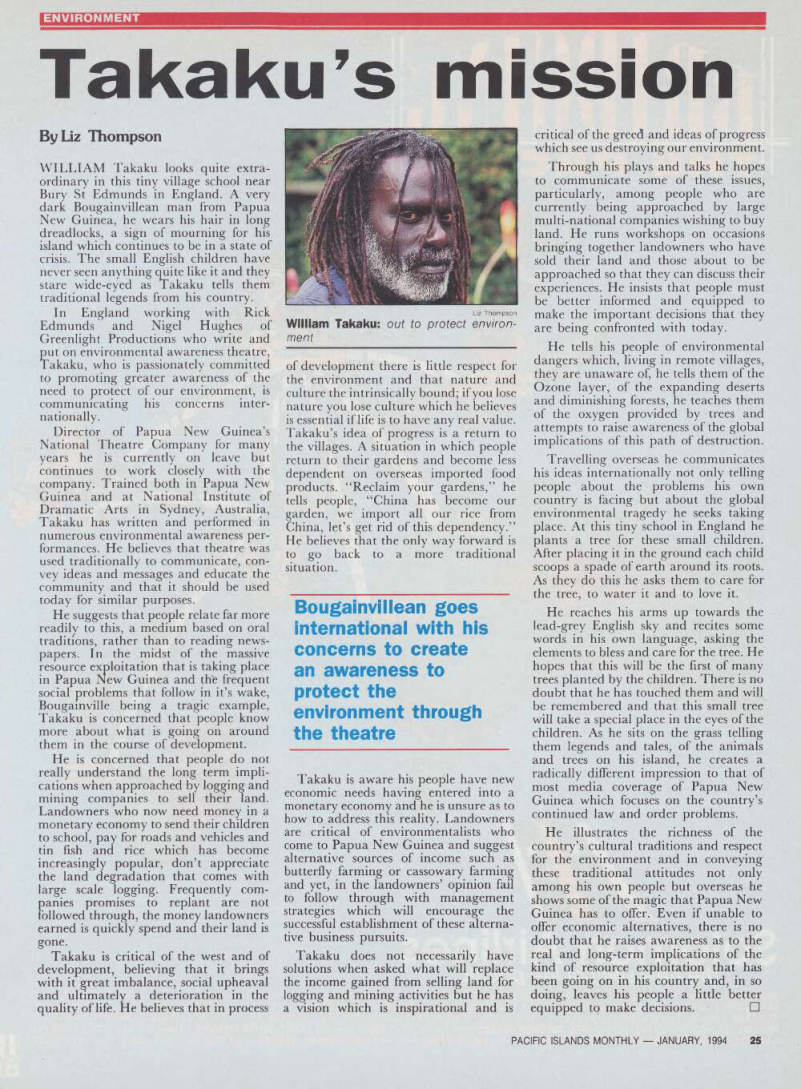
Environment
By Liz Thompson
WILLIAM Takaku looks quite extra ordinary in this tiny village school near Bury St Edmunds in England. A very dark Bougainvillean man from Papua New Guinea, he wears his hair in long dreadlocks, a sign of mourning for his island which continues to be in a state of crisis. The small English children have never seen anything quite like it and they stare wide-eyed as Takaku tells them traditional legends from his country.
In England working with Rick Edmunds and Nigel Hughes of Greenlight Productions who write and put on environmental awareness theatre, Takaku, who is passionately committed to promoting greater awareness of the need to protect of our environment, is communicating his concerns inter
nationally.
Director of Papua New Guinea’s National Theatre Company for many years he is currently on leave but continues to work closely with the company. Trained both in Papua New Guinea and at National Institute of Dramatic Arts in Sydney, Australia, Takaku has written and performed in numerous environmental awareness per formances. He believes that theatre was used traditionally to communicate, con vey ideas and messages and educate the community and that it should be used today for similar purposes.
He suggests that people relate far more readily to this, a medium based on oral traditions, rather than to reading news papers. In the midst of the massive
resource exploitation that is taking place
in Papua New Guinea and the frequent social problems that follow in it’s wake,
Bougainville being a tragic example,
Takaku is concerned that people know more about what is going on around them in the course of development.
He is concerned that people do not
really understand the long term impli
cations when approached by logging and
mining companies to sell their land.
Landowners who now need money in a monetary economy to send their children to school, pay for roads and vehicles and tin fish and rice which has become
increasingly popular, don’t appreciate
the land degradation that comes with
large scale logging. Frequently com
panies promises to replant are not
followed through, the money landowners earned is quickly spend and their land is gone.
Takaku is critical of the west and of
development, believing that it brings
with it great imbalance, social upheaval and ultimately a deterioration in the quality of life. He believes that in process
of development there is little respect for the environment and that nature and culture the intrinsically bound; if you lose nature you lose culture which he believes is essential if life is to have any real value.
Takaku’s idea of progress is a return to the villages. A situation in which people return to their gardens and become less dependent on overseas imported food products. “Reclaim your gardens,” he tells people, “China has become our garden, we import all our rice from China, let’s get rid of this dependency.”
He believes that the only way forward is to go back to a more traditional situation.
Bougainvillean goes international with his concerns to create an awareness to protect the environment through the theatre
Takaku is aware his people have new economic needs having entered into a monetary economy and he is unsure as to how to address this reality. Landowners are critical of environmentalists who come to Papua New Guinea and suggest alternative sources of income such as
butterfly farming or cassowary farming
and yet, in the landowners’ opinion fail to follow through with management strategies which will encourage the successful establishment of these alterna tive business pursuits.
Takaku does not necessarily have solutions when asked what will replace the income gained from selling land for logging and mining activities but he has a vision which is inspirational and is
critical of the greed and ideas of progress which see us destroying our environment.
Through his plays and talks he hopes to communicate some of these issues, particularly, among people who are
currently being approached by large
multi-national companies wishing to buy
land. He runs workshops on occasions bringing together landowners who have sold their land and those about to be approached so that they can discuss their experiences. He insists that people must be better informed and equipped to make the important decisions that they are being confronted with today.
He tells his people of environmental
dangers which, living in remote villages,
they are unaware of, he tells them of the Ozone layer, of the expanding deserts and diminishing forests, he teaches them of the oxygen provided by trees and attempts to raise awareness of the global implications of this path of destruction.
Travelling overseas he communicates
his ideas internationally not only telling
people about the problems his own country is facing but about the global environmental tragedy he seeks taking place. At this tiny school in England he plants a tree for these small children.
After placing it in the ground each child scoops a spade of earth around its roots.
As they do this he asks them to care for the tree, to water it and to love it.
He reaches his arms up towards the
lead-grey English sky and recites some
words in his own language, asking the elements to bless and care for the tree. He hopes that this will be the first of many trees planted by the children. There is no doubt that he has touched them and will be remembered and that this small tree will take a special place in the eyes of the children. As he sits on the grass telling them legends and tales, of the animals and trees on his island, he creates a radically different impression to that of most media coverage of Papua New Guinea which focuses on the country’s continued law and order problems.
He illustrates the richness of the country’s cultural traditions and respect for the environment and in conveying these traditional attitudes not only among his own people but overseas he shows some of the magic that Papua New Guinea has to offer. Even if unable to offer economic alternatives, there is no doubt that he raises awareness as to the real and long-term implications of the kind of resource exploitation that has been going on in his country and, in so doing, leaves his people a little better equipped to make decisions. □
Liz Thompson William Takaku: out to protect environ ment
Advertisements & other items, p. 26 (1 item)
Solomon Airlines
wia
m ■ "s' . lo‘ ;'.-.. ■
mmmmmm
vKvTv:
m m : :i : \ ’ wiiii *sr: ' ■ -■* . • ■ .'■•. •’
Solomon Airlines
the new spirit of the pacific
y- i AUSTRALIA: Brisbane let: +6l (07) 8504342 Fax: +6l (07) 8604351; Cairns Tel: 1031 3290082" Sydney Tel: +§l (02) 2391722 Fax; +6l (82) 2903306. FIJI; Nadi Tel: +679 722831 Fax: +679 722140; Suva Ti GERMANY Frankfurt Tel" +37 (69) 172260 Fax; +37 (69) 729314. NEW ZEALAND: Auckland Tel: +54 (09) 308 9098 Fax; +64 (09) 3775654. PAPUA NEW GUINEA; For Moresby Tel: +675 255724 Fax: +675 258975. SOLOMON ISLANDS: Honiara Tel: +577 20031 Fax: +677 23992. UNITED KINGDOM: London Tel: +44 (732) 74305C1 Fax +44 (732) 743855 UNITED STATES: Los Angeles Tel: +1 (310) 5707302 Fax: +1 (310) 3380708. VANUATU: Port Vila Tel: +678 23838 Fax; +678 23250 ■
Moore Stephens
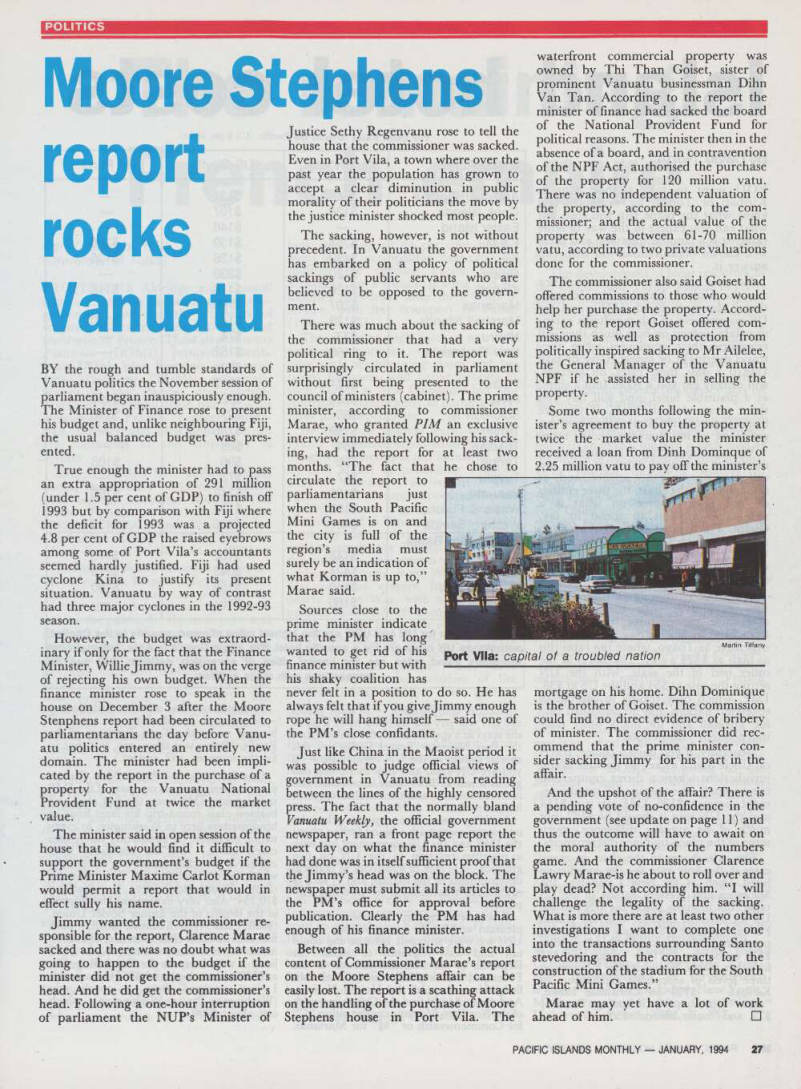
Politics
report rocks Vanuatu
BY the rough and tumble standards of Vanuatu politics the November session of parliament began inauspiciously enough.
The Minister of Finance rose to present his budget and, unlike neighbouring Fiji, the usual balanced budget was pres ented.
True enough the minister had to pass an extra appropriation of 291 million (under 1.5 per cent of GDP) to finish off 1993 but by comparison with Fiji where the deficit for 1993 was a projected 4.8 per cent of GDP the raised eyebrows among some of Port Vila’s accountants seemed hardly justified. Fiji had used cyclone Kina to justify its present situation. Vanuatu by way of contrast had three major cyclones in the 1992-93 season.
However, the budget was extraord inary if only for the fact that the Finance Minister, Willie Jimmy, was on the verge of rejecting his own budget. When the finance minister rose to speak in the house on December 3 after the Moore Stenphens report had been circulated to parliamentarians the day before Vanu atu politics entered an entirely new domain. The minister had been impli cated by the report in the purchase of a property for the Vanuatu National Provident Fund at twice the market value.
The minister said in open session of the house that he would find it difficult to support the government’s budget if the Prime Minister Maxime Carlot Korman would permit a report that would in effect sully his name.
Jimmy wanted the commissioner re sponsible for the report, Clarence Marae sacked and there was no doubt what was going to happen to the budget if the minister did not get the commissioner’s head. And he did get the commissioner’s head. Following a one-hour interruption of parliament the NUP’s Minister of
Justice Sethy Regenvanu rose to tell the house that the commissioner was sacked.
Even in Port Vila, a town where over the past year the population has grown to accept a clear diminution in public morality of their politicians the move by the justice minister shocked most people.
The sacking, however, is not without precedent. In Vanuatu the government has embarked on a policy of political sackings of public servants who are believed to be opposed to the govern ment.
There was much about the sacking of the commissioner that had a very political ring to it. The report was surprisingly circulated in parliament without first being presented to the council of ministers (cabinet). The prime minister, according to commissioner Marae, who granted PIM an exclusive interview immediately following his sack ing, had the report for at least two months. “The fact that he chose to
circulate the report to
parliamentarians just
when the South Pacific Mini Games is on and the city is full of the region’s media must surely be an indication of what Korman is up to,”
Marae said.
Sources close to the prime minister indicate that the PM has long wanted to get rid of his finance minister but with his shaky coalition has
never felt in a position to do so. He has always felt that if you give Jimmy enough rope he will hang himself — said one of the PM’s close confidants.
Just like China in the Maoist period it was possible to judge official views of government in Vanuatu from reading between the lines of the highly censored press. The fact that the normally bland Vanuatu Weekly, the official government newspaper, ran a front page report the next day on what the finance minister had done was in itself sufficient proof that the Jimmy’s head was on the block. The newspaper must submit all its articles to the PM’s office for approval before publication. Clearly the PM has had enough of his finance minister.
Between all the politics the actual content of Commissioner Marae’s report on the Moore Stephens affair can be easily lost. The report is a scathing attack on the handling of the purchase of Moore Stephens house in Port Vila. The
waterfront commercial property was owned by Thi Than Goiset, sister of prominent Vanuatu businessman Dihn Van Tan. According to the report the minister of finance had sacked the board of the National Provident Fund for political reasons. The minister then in the absence of a board, and in contravention of the NPF Act, authorised the purchase of the property for 120 million vatu.
There was no independent valuation of the property, according to the com missioner; and the actual value of the property was between 61-70 million vatu, according to two private valuations done for the commissioner.
The commissioner also said Goiset had offered commissions to those who would help her purchase the property. Accord ing to the report Goiset offered com missions as well as protection from politically inspired sacking to Mr Ailelee, the General Manager of the Vanuatu NPF if he assisted her in selling the property.
Some two months following the min ister’s agreement to buy the property at twice the market value the minister received a loan from Dinh Dominque of 2.25 million vatu to pay off the minister’s
mortgage on his home. Dihn Dominique is the brother of Goiset. The commission could find no direct evidence of bribery of minister. The commissioner did rec ommend that the prime minister con sider sacking Jimmy for his part in the affair.
And the upshot of the affair? There is a pending vote of no-confidence in the government (see update on page 11) and thus the outcome will have to await on the moral authority of the numbers game. And the commissioner Clarence Lawry Marae-is he about to roll over and play dead? Not according him. “I will challenge the legality of the sacking.
What is more there are at least two other investigations I want to complete one into the transactions surrounding Santo stevedoring and the contracts for the construction of the stadium for the South Pacific Mini Games.”
Marae may yet have a lot of work ahead of him. □
Martin Tiffany Port Vila: capital of a troubled nation
Island hotel costs
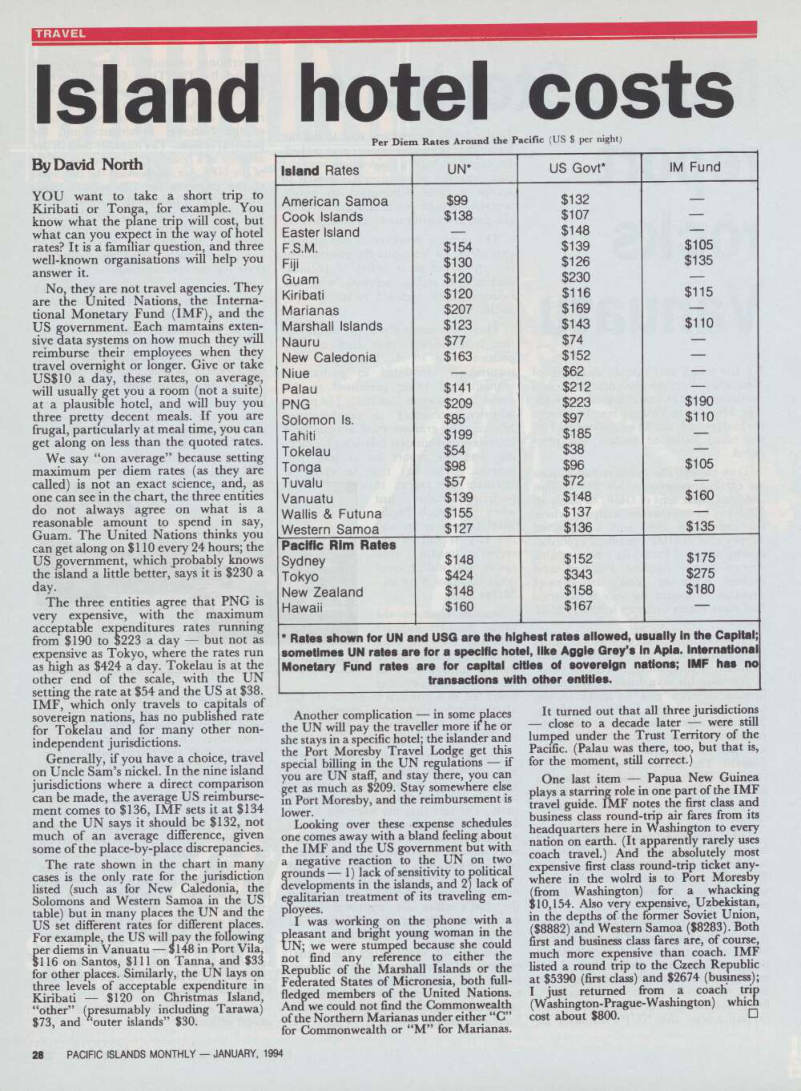
Travel
By David North
YOU want to take a short trip to Kiribati or Tonga, for example. You know what the plane trip will cost, but what can you expect in the way of hotel rates? It is a familiar question, and three well-known organisations will help you answer it.
No, they are not travel agencies. They are the United Nations, the Interna tional Monetary Fund (IMF), and the US government. Each mamtains exten sive data systems on how much they will reimburse their employees when they travel overnight or longer. Give or take US$lO a day, these rates, on average, will usually get you a room (not a suite) at a plausible hotel, and will buy you three pretty decent meals. If you are frugal, particularly at meal time, you can get along on less than the quoted rates.
We say “on average” because setting maximum per diem rates (as they are called) is not an exact science, and, as one can see in the chart, the three entities do not always agree on what is a reasonable amount to spend in say, Guam. The United Nations thinks you can get along on SI 10 every 24 hours; the US government, which probably knows the island a little better, says it is 5230 a day.
The three entities agree that PNG is very expensive, with the maximum acceptable expenditures rates running from SI9O to $223 a day but not as expensive as Tokyo, where the rates run as high as 5424 a day. Tokelau is at the other end of the scale, with the UN setting the rate at $54 and the US at $3B.
IMF, which only travels to capitals of sovereign nations, has no published rate for Tokelau and for many other non
independent jurisdictions.
Generally, if you have a choice, travel on Uncle Sam’s nickel. In the nine island jurisdictions where a direct comparison can be made, the average US reimburse ment comes to $136, IMF sets it at $134 and the UN says it should be $132, not much of an average difference, given some of the place-by-place discrepancies.
The rate shown in the chart in many cases is the only rate for the jurisdiction listed (such as for New Caledonia, the Solomons and Western Samoa in the US table) but in many places the UN and the US set different rates for different places.
For example, the US will pay the following ?er diems in Vanuatu $l4B in Port Vila, 116 on Santos, $lll on Tanna, and $33 for other places. Similarly, the UN lays on three levels of acceptable expenditure in Kiribati $l2O on Christmas Island, “other” (presumably including Tarawa) $73, and “outer islands” $3O.
Per Diem Rates Around the Pacific (US S per night)
Another complication in some places the UN will pay the traveller more ifne or she stays in a specific hotel; the islander and the Port Moresby Travel Lodge get this special billing in the UN regulations if you are UN staff, and stay mere, you can get as much as $209. Stay somewhere else in Port Moresby, and the reimbursement is lower.
Looking over these schedules one comes away with a bland feehng about the IMF and the US government but a negative reaction to the UN on wo egalitarian treatment of 1. trave.ing etn- P 7was working on the phone with a pleasant and bright young woman in the UN; we were stumped because she could not find any reference to either the Republic of the Marshall Islands or the Federated States of Micronesia, both fullfledged members of the United Nations.
And we could not find the Commonwealth of the Northern Marianas under either “C” for Commonwealth or “M” for Marianas.
It turned out that all three jurisdictions close to a decade later were still lumped under the Trust Territory of the Pacific. (Palau was there, too, but that is, for the moment, still correct.) Q ne j ast j tem Papua New Guinea pi a y S a starring role in one part of the IMF [ ravel guide IMF notes t h e first class and business class round-trip air fares from its headquarters here in Washington to every Qn earth (It a pp are ntly rarely uses coach travel.) And the absolutely most siye firs ' dass roU nd-trip ticket any w/ere in. chewojrd is .0 For. Morgby ‘ h 'f ep ‘ hs ,.f ‘ he 'g I™'" 1 ™'" (*8882)i and Western Samoa (#8283). Both first and business class fares are, of course, much more expensive than coach. IMF listed a round tnp to the Czech Republic at $5390 (first class) and $2674 (business); I just returned from a coach trip
(Washington-Prague-Washmgton) which
cost about $BOO. Q
Island Rates UN* US Govt* IM Fund American Samoa $99 $132 — Cook Islands $138 $107 — Easter Island — $148 —
F.S.M.
$154 $139 $105 Fiji $130 $126 $135 Guam $120 $230 — Kiribati $120 $116 $115 Marianas $207 $169 — Marshall Islands $123 $143 $110 Nauru $77 $74 — New Caledonia $163 $152 — Niue — $62 — Palau $141 $212 —
Png
$209 $223 $190 Solomon Is. $85 $97 $110 Tahiti $199 $185 — Tokelau $54 $38 — Tonga $98 $96 $105 Tuvalu $57 $72 — Vanuatu $139 $148 $160 Wallis & Futuna $155 $137 — Western Samoa $127 $136 $135 Pacific Rim Rates Sydney $148 $152 $175 Tokyo $424 $343 $275 New Zealand $148 $158 $180 Hawaii $160 $167 — * Rates shown for UN and USG are the highest rates allowed, usually in the Capital; sometimes UN rates are for a specific hotel, like Aggie Grey’s in Apia. International Monetary Fund rates are for capital cities of sovereign nations; IMF has no transactions with other entities.
French empire
Books
The remaining French empire
By W Marvin Will
(University of Tulsa) PROFESSORS Aldridge and Connell have authored an outstanding and com prehensive study of the “confetti of empire”, the overseas departments and territories of France. These departments
d’outre-mer (DOMs), primarily Carib
bean DOMs plus Reunion, and terri tories d’outre-mer (TOMs), principally islands in the Pacific, are carefully examined regarding their role vis a vis metropolitan France. Economic histo rian Aldridge and geographer Connell are colleagues at the University of Sydney.
Since 1978 they have authored seven books, individually or in collaboration with others, including Aldrich’s The French Presence in the South Pacific, 1842-1940 (1990), and Connell’s New Caledonia or Kanaky? (1987). They co edited France in World Politics (1989).
Findings in France’s Overseas Empire are that it remains French policy to expend considerable treasure to preserve the prestige of maintaining an empire that is among the palms, for the most part; and that “overseas France ... provides a mirror, albeit sometimes grossly dis torted, of the mother country” (6) or, as de Gaulle once said of Martinique, “ Mon Dieu, comme vous etes francais [my God, how French you are]” (247)! The authors also note that being archipelagos or islands except for Guyane and the French section of Antarctica makes insularity a characteristic of the DOM
Toms.
Perhaps the most controversial point for readers of PIM is the relatively high standard of living enjoyed in DOMs and TOMs and the metropolitan funding that makes this lifestyle possible. French funding of each DOM and TOM surged dramatically after 1946, the authors correctly note, with an increase of at least 30 per cent in subsidies of budget since 1945. After 1953 civil servants in DOMs- TOMs saw sharp increases in salary plus extra compensation for distant postings.
Public servants benefit from a salary is 40 per cent greater than that of their metropolitan colleagues and they enjoy various other advantages. In French Polynesia basic public service salaries, already much higher than in the private sector, are swollen by particular load
ings, including an 84 per cent supple ment to the metropolitan base salary, a million CFP (French Pacific francs) allowance for a distant posting and six month’s paid leave after three years of service, with free transport to Parish (144, also 133).
The resultant high income not only produces enormous standard-of-living gaps with neighbouring states and be tween European and native peoples in such TOMs as New Caledonia but also contributes significantly to curbing pres sures for independence.
By 1885, the readers learn, many in France considered colonialism to be the daughter of metropolitan industrial pol ity and aimed at promoting France’s alleged superior race/culture. This “golden age” of empire appeared to peak by 1931 when a large exhibit of empire was organised in Vincennes. This “peak” ironically conincided with the rise of nationalism in the French (and other) dependencies, movements often led by soldiers returning from World War I.
The overseas empire had sacrificed dearly in the War, with more than 60 percent of the 52,000 from the older or vieilles colonies being lost in action.
“If the DOMs before 1946 were (defacto) colonies of France,” one “col onial” critic is quoted, “they have subsequently become colonies of the administration” (145). The authors might have said much the same for the TOMs of the South Pacific. By 1960 all de jure French territories except three Pacific territories plus Mayotte, Aus tral and the French claims in Antarctica had gained independence, albeit inde pendence for Algeria and Indo China emerged only through serious warfare.
The end of World War II had brought an end to second class status of vieilles colonies. This was timely considering that these entities had been French longer than Corsica, Nice, Savoy and Franche-comte; that their citizens had been French citizens for a century and had sacrificed greatly in French wars.
Independence movements had devel oped in almost all DOMS and TOMS.
In most, however, the movements have not had high visibility and, as noted, have been largely defused by French finances. Significant legal status prob lems are presented by Mayotte, which is neither a DOM nor a TOM, and by Clipperton Island off the Pacific coast of
Mexico, which has no permanent popu lation.
The development of local resources in the DOMs and TOMs almost never is aimed toward benefiting native popu lations, the authors conclude. Currently France also experiences problems in providing uniform services throughout its “empire”. In Noumea, New Cale donia, for example, virtually all house holds have piped water, while in other French Pacific Islands this service may be minimal or non-existent.
Tourism also is viewed as an uneven inducer of economic growth. Although not well analysed, tourism is seen both as the source of income and of cultural costs.
With tourism increasing sharply in French Polynesia (where 1472 visitors in 1959 expanded to 78,000 by 1973), in New Caledonia (which has seen tourism expand from 16,000 in 1969 to nearly 100,000 by 1984), and in Fiji and Tahiti (which rank one and two as tourist attractions in the Pacific), perhaps a rule developed by the Maltese government has relevance: if the economic gains are not significantly above the social and cultural costs, tourism should be rationed. Guyane, the home of the European Space Center (Kourou) on the shoulder of South America, for example, is becoming a ghetto of white expatriate technicians guarded by French Legionaires. This is not a future many DOMs-TOMs desire. Without indepen dence, however, tourism policy and the influx of Europeans is very difficult to regulate. And the only conceivable scenario for independence for any of the TOMS or DOMs, according to the authors, would be economic recession and the development of anti-foreign sentiments in metropolitan France. Just possibly an expanding and increasingly viable European Community (EC) could further the development of a new European consciousness and abate France’s sentiments for maintaining a foreign empire. To conclude, this well argued, well-written, and well-edited book is probably the best review in print that deals with the remaining French “empire”. It is highly recommended. Aldridge, Robert and John Connell; France’s Overseas Fron tier: departments et territorires d’outre-mer (Cambridge, New York, Melbourne, and Sydney: Cambridge University Press, 1992, X, 357. □
Advertisements & other items, pp. 30-31 (1 item)
Is 1! Possible To Uieve A Hp Level Of Aerodynamics
WITH 1 DAHMY Creating a highly efficient, dynamic-looking car would Vy 1111 ftUUM 1 ULil/P ‘ ‘'i™ l^l,3 if i f for nnp rnmnliralincr dptail’ the A HUlfl 1 uJjJIAA 5 be simple if it weren’t for one complicating detail; the passengers that must ride in it. Accommodating people comfortably in a pleasant, roomy interior usually means a certain amount of aerodynamic potential has to be sacrificed. o# 4 W "W Exact features and specifications may vary depending on country of purchase. Please check with your nearest TOYOTA distnbutor/dealer for details.
DISTRIBUTORS/DEALERS
AMERICAN SAMOA BURNS PHILP (S.S.) CO. LTD. PH 633-4281 GUAM & MICRONESIA .. .ATKINS KROLL. INC. PH 646-1876/9 NORFOLK ISLANDS BORRY'S PTY LTD. PH 2114
SOLOMON ISLANDS MENDANA MOTORS PH 30314
VANUATU VANUATU MOTORS PH 22341
COOK ISLANDS PACIFIC MOTORS LTD. PH 20796
KIRIBATI TARAWA MOTORS PH 21090
PAPUA NEW GUINEA ... ELA MOTORS PH 217036
TAHITI NIPPON AUTOMOTO PH 429819
WESTERN SAMOA BURNS PHILP (S.S.) CO. LTD. PH 20800
FIJI ASCO MOTORS
NEW CALEDONIA .. .S.I.A.P.
SAIPAN MICROL CORPORATION
TONGA. BURNS PHILP (TONGA) LTD.
Until now. Using a concept called total airflow management, Toyota engineers were able to realize an efficient, wedge-shaped design while at the same time perfecting the alignment between body panels and components.
Of course our own innovative style of civilized engineering makes sure that none of this comes at the expense of the luxurious, leg-stretching size interior. Because we realize that even a 0.33 Cd is useless if no one wants to drive the car.
® TOYOTA
Fishing tales
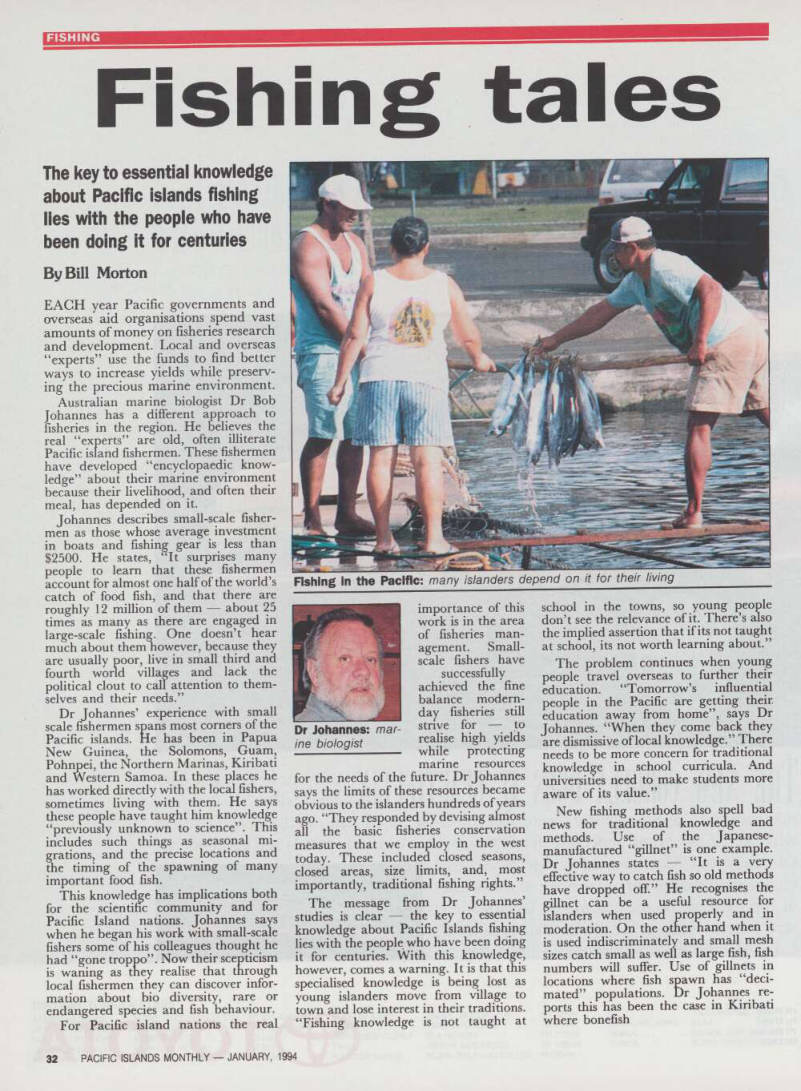
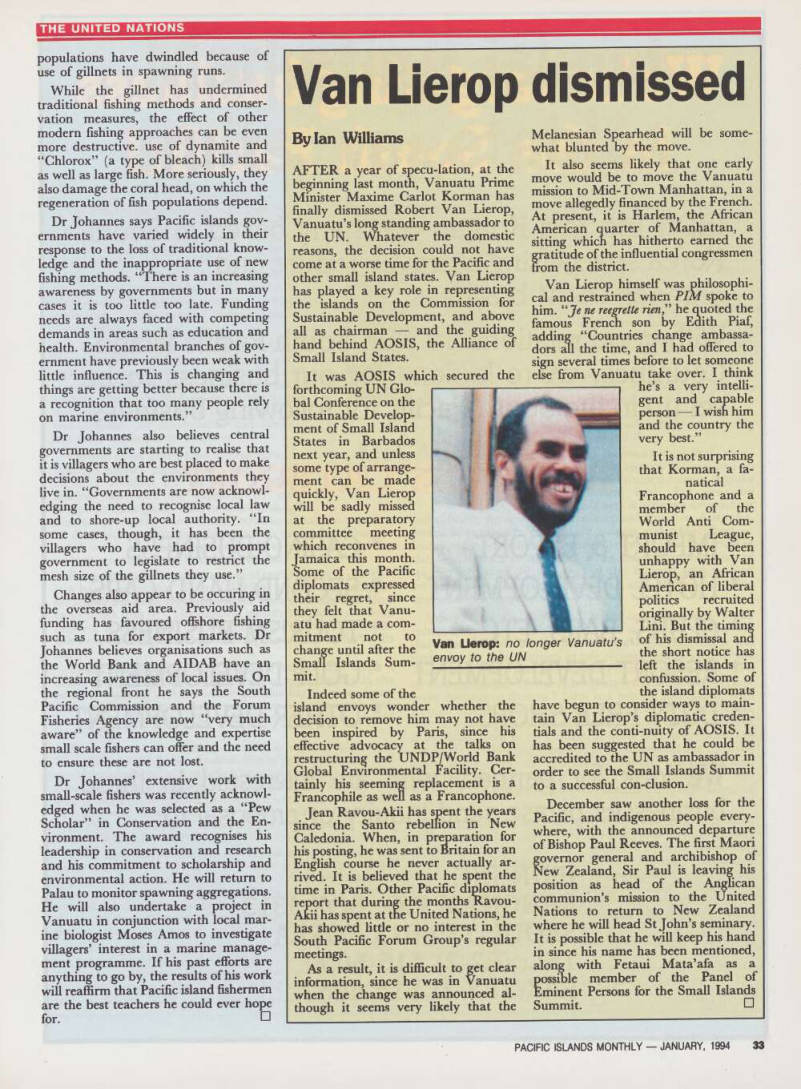
Fishing
The key to essential knowledge about Pacific islands fishing lies with the people who have been doing it for centuries
By Bill Morton
EACH year Pacific governments and overseas aid organisations spend vast amounts of money on fisheries research and development. Local and overseas “experts” use the funds to find better ways to increase yields while preserv ing the precious marine environment.
Australian marine biologist Dr Bob Johannes has a different approach to fisheries in the region. He believes the real “experts” are old, often illiterate Pacific island fishermen. These fishermen
have developed “encyclopaedic know
ledge” about their marine environment because their livelihood, and often their meal, has depended on it.
Johannes describes small-scale fisher men as those whose average investment in boats and fishing gear is less than $2500. He states, “It surprises many people to learn that these fishermen account for almost one half of the world’s catch of food fish, and that there are roughly 12 million of them about 25 times as many as there are engaged in large-scale fishing. One doesn’t hear much about them however, because they are usually poor, live in small third and fourth world villages and lack the political clout to call attention to them selves and their needs.”
Dr Johannes’ experience with small scale fishermen spans most corners of the Pacific islands. He has been in Papua New Guinea, the Solomons, Guam, Pohnpei, the Northern Marinas, Kiribati and Western Samoa. In these places he has worked directly with the local fishers, sometimes living with them. He says these people have taught him knowledge “previously unknown to science”. This includes such things as seasonal mi grations, and the precise locations and the timing of the spawning of many important food fish.
This knowledge has implications both for the scientific community and for Pacific Island nations. Johannes says when he began his work with small-scale fishers some of his colleagues thought he had “gone troppo”. Now their scepticism is waning as they realise that through local fishermen they can discover infor mation about bio diversity, rare or endangered species and fish behaviour.
For Pacific island nations the real
importance of this work is in the area of fisheries man agement. Small scale fishers have successfully achieved the fine balance modern day fisheries still strive for to
realise high yields
while protecting
marine resources
for the needs of the future. Dr Johannes says the limits of these resources became obvious to the islanders hundreds of years ago. “They responded by devising almost all the basic fisheries conservation measures that we employ in the west today. These included closed seasons, closed areas, size limits, and, most
importantly, traditional fishing rights.”
The message from Dr Johannes’ studies is clear the key to essential knowledge about Pacific Islands fishing lies with the people who have been doing it for centuries. With this knowledge, however, comes a warning. It is that this specialised knowledge is being lost as young islanders move from village to town and lose interest in their traditions.
“Fishing knowledge is not taught at
school in the towns, so young people don’t see the relevance of it. There’s also the implied assertion that if its not taugh t at school, its not worth learning about.”
The problem continues when young people travel overseas to further their education. “Tomorrow’s influential people in the Pacific are getting their education away from home”, says Dr Johannes. “When they come back they are dismissive of local knowledge.” There needs to be more concern for traditional knowledge in school curricula. And universities need to make students more aware of its value.”
New fishing methods also spell bad news for traditional knowledge and methods. Use of the Japanese manufactured “gillnet” is one example.
Dr Johannes states “It is a very effective way to catch fish so old methods have dropped off.” He recognises the gillnet can be a useful resource for islanders when used properly and in moderation. On the other hand when it is used indiscriminately and small mesh sizes catch small as well as large fish, fish numbers will suffer. Use of gillnets in locations where fish spawn has “deci mated” populations. Dr Johannes re ports this has been the case in Kiribati where bonefish
Fishing In the Pacific: many islanders depend on it for their living
Dr Johannes: mar ine biologist
The United Nations
populations have dwindled because of use of gillnets in spawning runs.
While the gillnet has undermined traditional fishing methods and conser vation measures, the effect of other modern fishing approaches can be even more destructive, use of dynamite and “Chlorox” (a type of bleach) kills small as well as large fish. More seriously, they also damage the coral head, on which the regeneration of fish populations depend.
Dr Johannes says Pacific islands gov ernments have varied widely in their response to the loss of traditional know ledge and the inappropriate use of new fishing methods. “There is an increasing awareness by governments but in many cases it is too little too late. Funding needs are always faced with competing demands in areas such as education and health. Environmental branches of gov ernment have previously been weak with little influence. This is changing and things are getting better because there is a recognition that too many people rely on marine environments.”
Dr Johannes also believes central governments are starting to realise that it is villagers who are best placed to make decisions about the environments they live in. “Governments are now acknowl edging the need to recognise local law and to shore-up local authority. “In some cases, though, it has been the villagers who have had to prompt government to legislate to restrict the mesh size of the gillnets they use.”
Changes also appear to be occuring in the overseas aid area. Previously aid funding has favoured offshore fishing such as tuna for export markets. Dr Johannes believes organisations such as the World Bank and AIDAB have an increasing awareness of local issues. On the regional front he says the South Pacific Commission and the Forum Fisheries Agency are now “very much aware” of the knowledge and expertise small scale fishers can offer and the need to ensure these are not lost.
Dr Johannes’ extensive work with small-scale fishers was recently acknowl edged when he was selected as a “Pew Scholar” in Conservation and the En vironment. The award recognises his leadership in conservation and research and his commitment to scholarship and environmental action. He will return to Palau to monitor spawning aggregations.
He will also undertake a project in Vanuatu in conjunction with local mar ine biologist Moses Amos to investigate villagers’ interest in a marine manage ment programme. If his past efforts are anything to go by, the results of his work will reaffirm that Pacific island fishermen are the best teachers he could ever hope for. D
Van Lierop dismissed
By Ian Williams
AFTER a year of specu-lation, at the beginning last month, Vanuatu Prime Minister Maxime Carlot Korman has finally dismissed Robert Van Lierop, Vanuatu’s long standing ambassador to the UN. Whatever the domestic reasons, the decision could not have come at a worse time for the Pacific and other small island states. Van Lierop has played a key role in representing the islands on the Commission for Sustainable Development, and above all as chairman — and the guiding hand behind AOSIS, the Alliance of Small Island States.
It was AOSIS which secured the
forthcoming UN Glo bal Conference on the Sustainable Develop ment of Small Island States in Barbados next year, and unless some type of arrange ment can be made quickly, Van Lierop will be sadly missed at the preparatory committee meeting which reconvenes in Jamaica this month.
Some of the Pacific
diplomats expressed
their regret, since they felt that Vanu atu had made a com mitment not to change until after the Small Islands Sum mit.
Indeed some of the
island envoys wonder whether the decision to remove him may not have been inspired by Paris, since his effective advocacy at the talks on restructuring the UNDP/World Bank Global Environmental Facility. Cer tainly his seeming replacement is a Francophile as well as a Francophone.
Jean Ravou-Akii has spent the years since the Santo rebellion in New Caledonia. When, in preparation for his posting, he was sent to Britain for an English course he never actually ar rived. It is believed that he spent the time in Paris. Other Pacific diplomats report that during the months Ravou- Akii has spent at the United Nations, he has showed little or no interest in the South Pacific Forum Group’s regular meetings.
As a result, it is difficult to get clear information, since he was in Vanuatu when the change was announced al though it seems very likely that the
Melanesian Spearhead will be some what blunted by the move.
It also seems likely that one early move would be to move the Vanuatu mission to Mid-Town Manhattan, in a move allegedly financed by the French.
At present, it is Harlem, the African American quarter of Manhattan, a sitting whicn has hitherto earned the gratitude of the influential congressmen from the district.
Van Lierop himself was philosophi cal and restrained when PIM spoke to him. “Je ne reegrette rien he quoted the famous French son by Edith Piaf, adding “Countries change ambassa dors all the time, and I had offered to sign several times before to let someone else from Vanuatu take over. I think
he’s a very intelli gent and capable person — I wish him and the country the very best.”
It is not surprising that Korman, a fa natical Francophone and a member of the World Anti Com munist League, should have been unhappy with Van Lierop, an African Amencan of liberal
politics recruited
originally by Walter Lini. But the timing of his dismissal and the short notice has left the islands in confussion. Some of the island diplomats
have begun to consider ways to main tain Van Lierop’s diplomatic creden tials and the conti-nuity of AOSIS. It has been suggested that he could be accredited to the UN as ambassador in order to see the Small Islands Summit to a successful con-clusion.
December saw another loss for the Pacific, and indigenous people every where, with the announced departure of Bishop Paul Reeves. The first Maori governor general and archibishop of New Zealand, Sir Paul is leaving his position as head of the Anglican communion’s mission to the United Nations to return to New Zealand where he will head St John’s seminary.
It is possible that he will keep his hand in since his name has been mentioned, along with Fetaui Mata’afa as a possible member of the Panel of Eminent Persons for the Small Islands Summit. m
Van Lierop: no longer Vanuatu’s envoy to the UN
Advertisements & other items, p. 34 (1 item)
la ita So>clh Pavlik!
IBDN Inc. is a Korean company based in Seoul, Korea specialising in travel, leisure and entertainment business.
With good relationship with South Pacific Island Countries, were looking for our business to be set up in the South Pacific for following business. * IMPORT & EXPORT * CASINO BUSINESS * HOTEL DEVELOPMENT * SECOND HAND CARS * CLUBS, BARS. ETC * TOURISM BUSINESS
* RESORT DEVELOPMENT * GOLF DEVELOPMENT
* DUTY FREE SHOPS * OTHER DEVELOPMENT We look for partners who are interested in these businesses please send inquiry or proposal to:
IBDN INC
KANGNAM P.O. BOX 1313
SEOUL 135-613 KOREA
TEL: (82-2) 515-5000
FAX: (82-2) 514-4957
fruits, vegetables
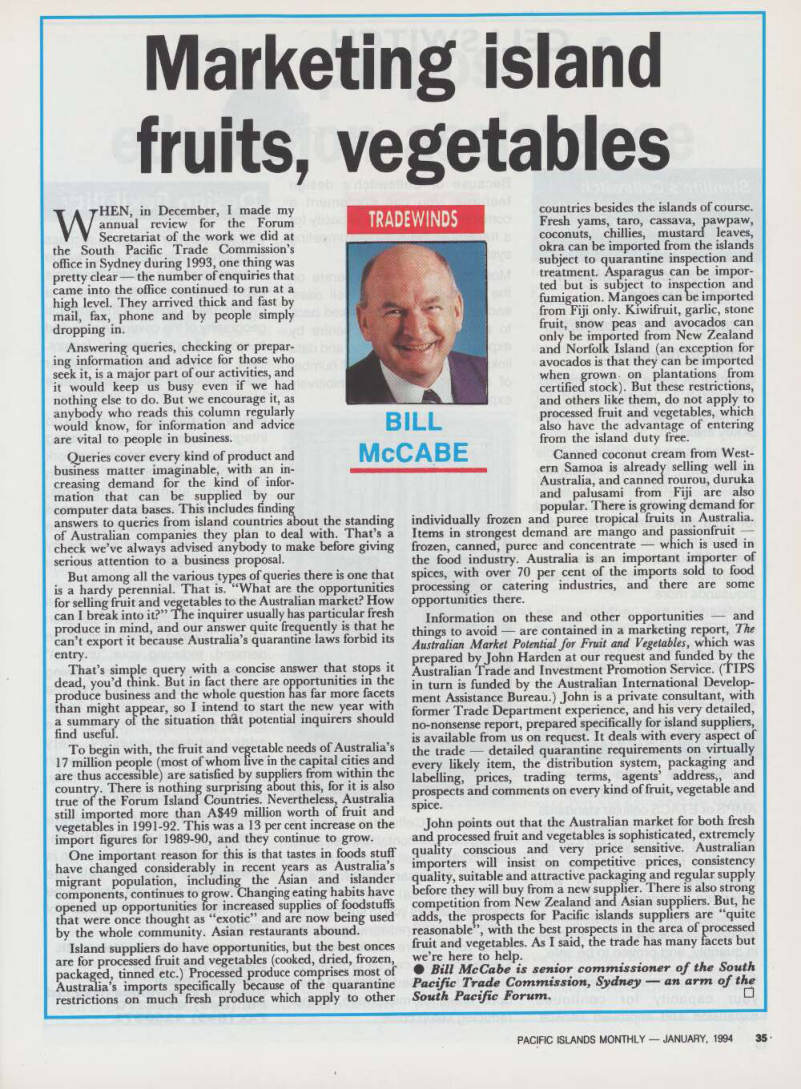
Marketing island fruits, vegetables
WHEN, in December, I made my annual review for the Forum Secretariat of the work we did at the South Pacific Trade Commission’s office in Sydney during 1993, one thing was pretty clear the number of enquiries that came into the office continued to run at a high level. They arrived thick and fast by mail, fax, phone and by people simply
dropping in.
Answering queries, checking or prepar ing information and advice for those who seek it, is a major part of our activities, and it would keep us busy even if we had nothing else to do. But we encourage it, as anybody who reads this column regularly would know, for information and advice are vital to people in business.
Queries cover every kind of product and business matter imaginable, with an in creasing demand for the kind of infor
mation that can be supplied by our computer data bases. This includes finding answers to queries from island countries about the standing of Australian companies they plan to deal with. That’s a check we’ve always advised anybody to make before giving serious attention to a business proposal.
But among all the various types of queries there is one that is a hardy perennial. That is. “What are the opportunities for selling fruit and vegetables to the Australian market? How can I break into it?” The inquirer usually has particular fresh produce in mind, and our answer quite frequently is that he can’t export it because Australia’s quarantine laws forbid its entry.
That’s simple query with a concise answer that stops it dead, you’d think. But in fact there are opportunities in the produce business and the whole question has far more facets than might appear, so I intend to start the new year with a summary of the situation th&t potential inquirers should find useful.
To begin with, the fruit and vegetable needs of Australia’s 17 million people (most of whom live in the capital cities and are thus accessible) are satisfied by suppliers from within the country. There is nothing surprising about this, for it is also true of the Forum Island Countries. Nevertheless, Australia still imported more than As 49 million worth of fruit and vegetables in 1991-92. This was a 13 percent increase on the import figures for 1989-90, and they continue to grow.
One important reason for this is that tastes in foods stuff have changed considerably in recent years as Australia’s migrant population, including the Asian and islander components, continues to grow. Changing eating habits have opened up opportunities for increased supplies of foodstuffs that were once thought as “exotic” and are now being used by the whole community. Asian restaurants abound.
Island suppliers do have opportunities, but the best onces are for processed fruit and vegetables (cooked, dried, frozen, packaged, tinned etc.) Processed produce comprises most of Australia’s imports specifically because of the quarantine restrictions on much fresh produce which apply to other
countries besides the islands of course.
Fresh yams, taro, cassava, pawpaw, coconuts, chillies, mustard leaves, okra can be imported from the islands subject to quarantine inspection and treatment. Asparagus can be impor ted but is subject to inspection and fumigation. Mangoes can oe imported from Fiji only. Kiwifruit, garlic, stone fruit, snow peas and avocados can only be imported from New Zealand and Norfolk Island (an exception for avocados is that they can be imported when grown on plantations from certified stock). But these restrictions, and others like them, do not apply to processed fruit and vegetables, which also have the advantage of entering from the island duty free.
Canned coconut cream from West ern Samoa is already selling well in Australia, and canned rourou, duruka and palusami from Fiji are also popular. There is growing demand for
individually frozen and puree tropical fruits in Australia.
Items in strongest demand are mango and passionfruit frozen, canned, puree and concentrate - which is used in the food industry. Australia is an important importer of spices, with over 70 per cent of the imports sold to food processing or catering industries, and there are some
opportunities there.
Information on these and other opportunities and things to avoid are contained in a marketing report, The Australian Market Potential for Fruit and Vegetables, which was prepared by John Harden at our request and funded by the Australian Trade and Investment Promotion Service. (TIPS in turn is funded by the Australian International Develop ment Assistance Bureau.) John is a private consultant, with former Trade Department experience, and his very detailed, no-nonsense report, prepared specifically for island suppliers, is available from us on request. It deals with every aspect of the trade detailed quarantine requirements on virtually every likely item, the distribution system, packaging and labelling, prices, trading terms, agents’ address,, and prospects and comments on every kind of fruit, vegetable and spice.
John points out that the Australian market for both fresh and processed fruit and vegetables is sophisticated, extremely quality conscious and very price sensitive. Australian importers will insist on competitive prices, consistency quality, suitable and attractive packaging and regular supply before they will buy from a new supplier. There is also strong competition from New Zealand and Asian suppliers. But, he adds, the prospects for Pacific islands suppliers are “quite reasonable”, with the best prospects in the area of processed fruit and vegetables. As I said, the trade has many facets but we’re here to help. Bill McCabe is senior commissioner of the South Pacific Trade Commission, Sydney an arm of the South Pacific Forum. D
Tradewinds
Bill
Mccabe
Cellswitch

Stan Hite's Cellswitch delivers cellular capacity with a number of unique advantages:
a economical installation
and operation
a quick rollout capability
a design flexibility.
Because of these design features, Cellswitch is ideally suited for providing cellular service in a variety of key areas.
Through its modularity and scalable architecture, Cellswitch is equally effective in the city or in lower population density areas. Designed for expansion, Cellswitch provides a cost-competitive solution with as few as 50 subscribers, with enough expansion capacity to support many thousands more.
Cellswitch has achieved an installation base in a wide variety of settings around the world, ranging from conventional urban cellular systems to temporary public service support situations.
Why Cellswitch?
Cellswitch is based on proven technology and supports either the AMPS or ETACS cellular standards.
These standards are used by the majority of cellular systems and are renowned for their reliability and robustness. In contrast with emerging standards, AMPS and ETACS terminal equipment is relatively inexpensive, easy to obtain in quantity, and proven to be safe.
Cellswitch automatically enhances your capacity for continued expansion and improved service.
Because of Cellswitch’s design features, you can implement a comprehensive cellular capacity for a fraction of the price of competing systems.
Most cellular systems operate on the principle of “dumb” cell sites, each of which must be linked back to a “master” switching centre by expensive 2 megabit voice and data links. Even with only a small number of cells, this can be prohibitively expensive.
In contrast, Cellswitch relies on intelligent, self-contained cell sites, each containing all the hardware and software necessary to operate as a complete local switch. This approach allows you to substantially reduce costs by networking only the sites you require. Links between Cellswitch sites can be provided by standard or leased telephone lines, optic fibres or microwave, further reducing setup costs.
Design flexibility
The key to your system’s success is its proper planning. Prior to the installation of your system, Stanilite’s expert engineers will assemble a system plan, based on the physical geography of the coverage area and a range of environmental factors.
This ensures that your cellular system delivers peak performance at all times.
Cellswitch has been designed to integrate instantly into your existing public switched telephone network (PSTN). It supports most common telephone signalling protocols, including those used by older style exchanges. Additional lines can be added to Cellswitch at any time by the simple installation of more line interface cards.
Adding capacity to the system is a simple task, so the initial installation can be tailored to suit immediate demand, reducing your “up front” capital outlay. To cater for growing demand, additional modules can be fitted in existing equipment racks.
Entire equipment racks can be added where necessary. Very importantly, upgrading Cellswitch requires very little “off-air” time, minimising service disruptions.
Cellswitch is built to operate remotely, without the need for on site staff. Call charge information is downloaded from the cell site directly, and each cell site can be fully tested from your network control centre.
For further Information call: Robert Tomlinson Sales Manager Stanlllte Electronics (NZ) Ltd Ph: (649) 4156370 Fax(649)4156371
education assistance
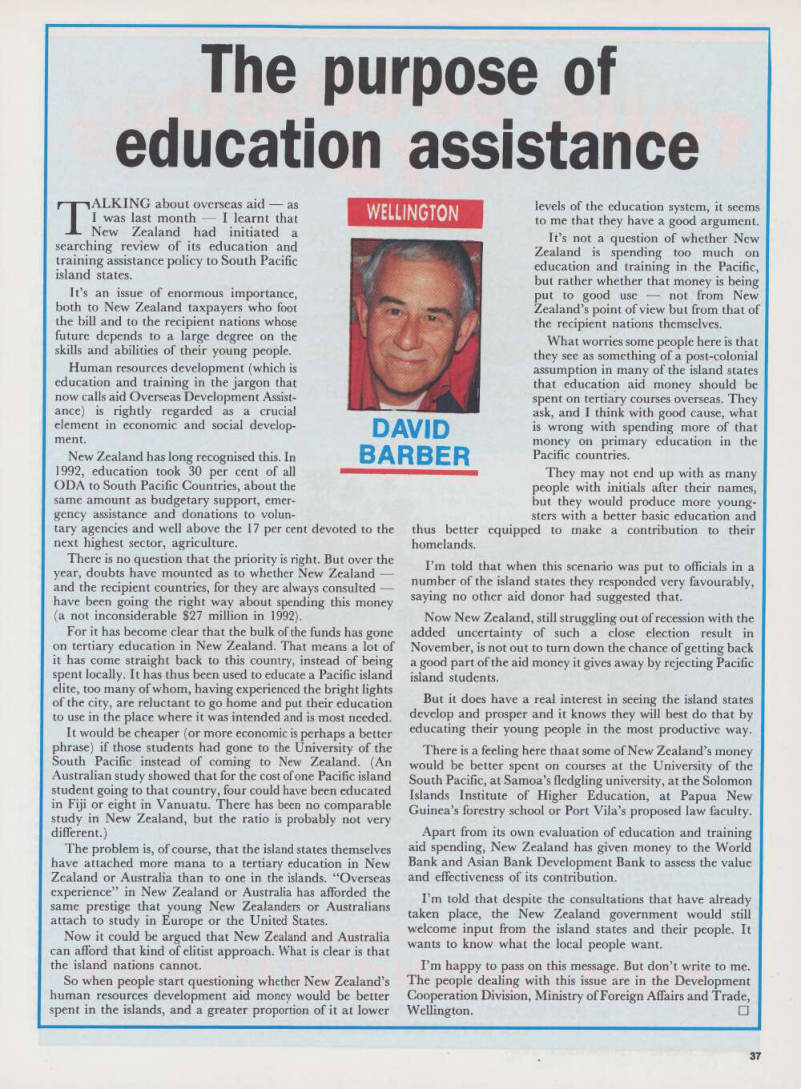
The purpose of education assistance
TALKING about overseas aid as I was last month I learnt that New Zealand had initiated a searching review of its education and training assistance policy to South Pacific island states.
It’s an issue of enormous importance, both to New Zealand taxpayers who foot the bill and to the recipient nations whose future depends to a large degree on the skills and abilities of their young people.
Human resources development (which is education and training in the jargon that now calls aid Overseas Development Assist ance) is rightly regarded as a crucial element in economic and social develop ment.
New Zealand has long recognised this. In 1992, education took 30 per cent of all ODA to South Pacific Countries, about the same amount as budgetary support, emer gency assistance and donations to volun
tary agencies and well above the 17 per cent devoted to the next highest sector, agriculture.
There is no question that the priority is right. But over the year, doubts have mounted as to whether New Zealand and the recipient countries, for they are always consulted have been going the right way about spending this money (a not inconsiderable $27 million in 1992).
For it has become clear that the bulk of the funds has gone on tertiary education in New Zealand. That means a lot of it has come straight back to this country, instead of being spent locally. It has thus been used to educate a Pacific island elite, too many of whom, having experienced the bright lights of the city, are reluctant to go home and put their education to use in the place where it was intended and is most needed.
It would be cheaper (or more economic is perhaps a better phrase) if those students had gone to the University of the South Pacific instead of coming to New Zealand. (An Australian study showed that for the cost of one Pacific island student going to that country, four could have been educated in Fiji or eight in Vanuatu. There has been no comparable study in New Zealand, but the ratio is probably not very different.) The problem is, of course, that the island states themselves have attached more mana to a tertiary education in New Zealand or Australia than to one in the islands. “Overseas experience” in New Zealand or Australia has afforded the same prestige that young New Zealanders or Australians attach to study in Europe or the United States.
Now it could be argued that New Zealand and Australia can afford that kind of elitist approach. What is clear is that the island nations cannot.
So when people start questioning whether New Zealand’s human resources development aid money would be better spent in the islands, and a greater proportion of it at lower
levels of the education system, it seems to me that they have a good argument.
It’s not a question of whether New Zealand is spending too much on education and training in the Pacific, but rather whether that money is being put to good use not from New Zealand’s point of view but from that of the recipient nations themselves.
What worries some people here is that they see as something of a post-colonial assumption in many of the island states that education aid money should be spent on tertiary courses overseas. They ask, and I think with good cause, what is wrong with spending more of that money on primary education in the Pacific countries.
They may not end up with as many people with initials after their names, but they would produce more young sters with a better basic education and
thus better equipped to make a contribution to their homelands.
I’m told that when this scenario was put to officials in a number of the island states they responded very favourably, saying no other aid donor had suggested that.
Now New Zealand, still struggling out of recession with the added uncertainty of such a close election result in November, is not out to turn down the chance of getting back a good part of the aid money it gives away by rejecting Pacific island students.
But it does have a real interest in seeing the island states develop and prosper and it knows they will best do that by educating their young people in the most productive way.
There is a feeling here thaat some of New Zealand’s money would be better spent on courses at the University of the South Pacific, at Samoa’s fledgling university, at the Solomon Islands Institute of Higher Education, at Papua New Guinea’s forestry school or Port Vila’s proposed law faculty.
Apart from its own evaluation of education and training aid spending, New Zealand has given money to the World Bank and Asian Bank Development Bank to assess the value and effectiveness of its contribution.
I’m told that despite the consultations that have already taken place, the New Zealand government would still welcome input from the island states and their people. It wants to know what the local people want.
I’m happy to pass on this message. But don’t write to me.
The people dealing with this issue are in the Development Cooperation Division, Ministry of Foreign Affairs and Trade, Wellington. □
Wellington
David
Barber
Advertisements & other items, p. 38 (1 item)
Foub
fev
YOUR INBOUND SPECIALIST IN THE SOLOMONS
ISLANDS FOR
* F.I.T GROUP * SPECIAL INTEREST TOURS * HOTEL, DIVE AND CAR HIRE BOOKINGS * LAND, AIR ARRANGEMENTS * SEA ARRANGEMENTS TRAVELLING IN THE MOST COMFORTABLE AND AIR CONDITIONED
EXPRESS LINER.
I* f ■& m *0 m I m m v 'v , ■S¥*.
WE’LL SHOW YOU SOME OF OUR CULTURE
HERITAGE AND PRIDE IN THE REMOTE
SOLOMON ISLANDS
TOUR SOLOMONS LIMITED
P.O. BOX 337, HONIARA SOLOMON ISLANDS
TEL (677) 21630 FAX (677) 21637
'We’ll set out together’
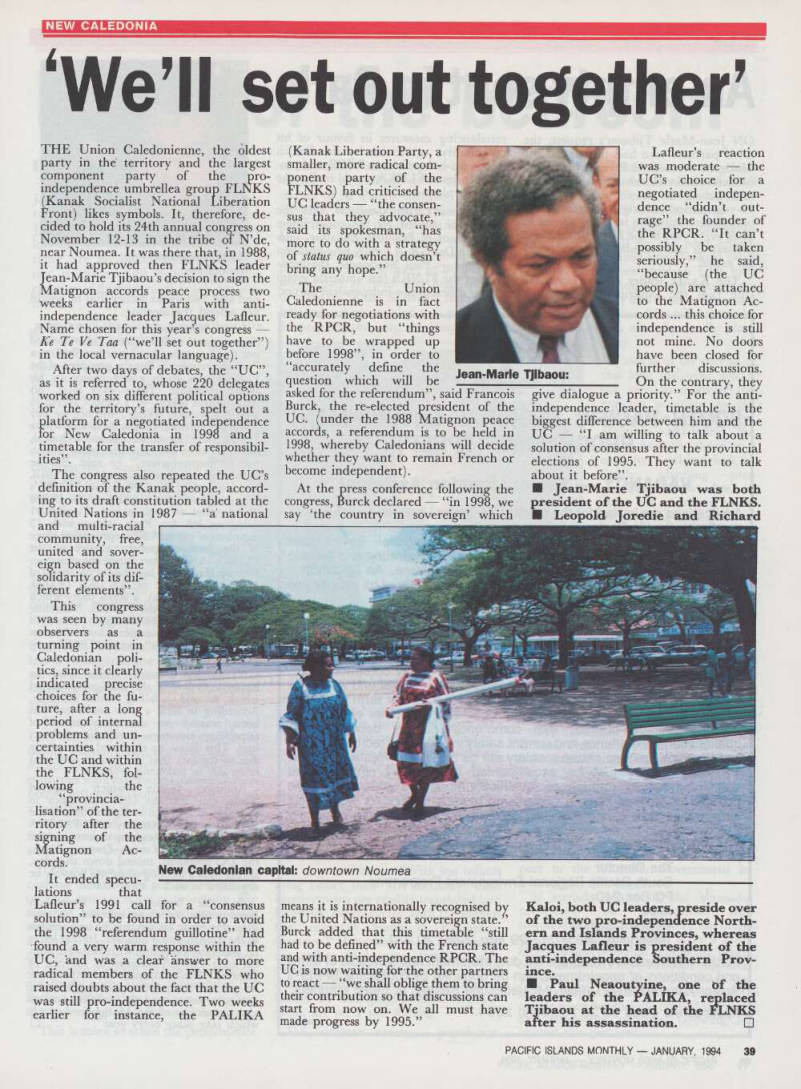
New Caledonia
THE Union Caledonienne, the oldest party in the' territory and the largest component party of the pro independence umbrellea group FLNKS (Kanak Socialist National Liberation Front) likes symbols. It, therefore, de cided to hold its 24th annual congress on November 12-13 in the tribe of N’de, near Noumea. It was there that, in 1988, it had approved then FLNKS leader Jean-Marie Tjibaou’s decision to sign the Matignon accords peace process two weeks earlier in Paris with anti independence leader Jacques Lafleur.
Name chosen for this year’s congress Ke Te Ve Taa (“we’ll set out together”) in the local vernacular language).
After two days of debates, the “UC”, as it is referred to, whose 220 delegates worked on six different political options for the territory’s future, spelt out a f platform for a negotiated independence or New Caledonia in 1998 and a timetable for the transfer of responsibil ities”.
The congress also repeated the UC’s definition of the Kanak people, accord ing to its draft constitution tabled at the United Nations in 1987 “a national
and multi-racial community, free, united and sover eign based on the solidarity of its dif ferent elements”.
This congress was seen by many observers as a turning point in Caledonian poli tics, since it clearly indicated precise choices for the fu ture, after a long period of internal problems and un certainties within the UC and within the FLNKS, fol
lowing the
“provincia lisation” of the ter ritory after the signing of the
Matignon Ac
cords.
It ended specu lations that
Lafleur’s 1991 call for a “consensus solution” to be found in order to avoid the 1998 “referendum guillotine” had found a very warm response within the UC, and was a clear answer to more radical members of the FLNKS who raised doubts about the fact that the UC was still pro-independence. Two weeks earlier for instance, the PALIKA
(Kanak Liberation Party, a smaller, more radical com ponent party of the FLNKS) had criticised the UC leaders “the consen sus that they advocate,” said its spokesman, “has more to do with a strategy of status quo which doesn’t bring any hope.”
The Union Caledonienne is in fact ready for negotiations with the RPCR, but “things have to be wrapped up before 1998”, in order to “accurately define the question which will be
asked for the referendum”, said Francois Burck, the re-elected president of the UC. (under the 1988 Matignon peace accords, a referendum is to be held in 1998, whereby Caledonians will decide whether they want to remain French or
become independent).
At the press conference following the congress, Burck declared “in 1998, we say ‘the country in sovereign’ which
Lafleur’s reaction was moderate the UC’s choice for a negotiated indepen dence “didn’t out rage” the founder of the RPCR. “It can’t possibly be taken seriously,” he said, “because (the UC people) are attached to the Matignon Ac cords ... this choice for independence is still not mine. No doors have been closed for further discussions.
On the contrary, they
give dialogue a priority.” For the anti independence leader, timetable is the biggest difference between him and the UC “I am willing to talk about a solution of consensus after the provincial elections of 1995. They want to talk about it before”. ■ Jean-Marie Tjibaou was both president of the UC and the FLNKS. ■ Leopold Joredie and Richard
means it is internationally recognised by the United Nations as a sovereign state.”
Burck added that this timetable “still had to be defined” with the French state and with anti-independence RPCR. The UC is now waiting forthe other partners to react — “we shall oblige them to bring their contribution so that discussions can start from now on. We all must have made progress by 1995.”
Kaloi, both UC leaders, preside over of the two pro-independence North ern and Islands Provinces, whereas Jacques Lafleur is president of the anti-independence Southern Prov ince. ■ Paul Neaoutyine, one bf the leaders of the PALIKA, replaced Tnbaou at the head of the A.NKS after his assassination. □
New Caledonian capital: downtown Noumea
Jean-Marie Tjibaou:
An empty seat in Paris
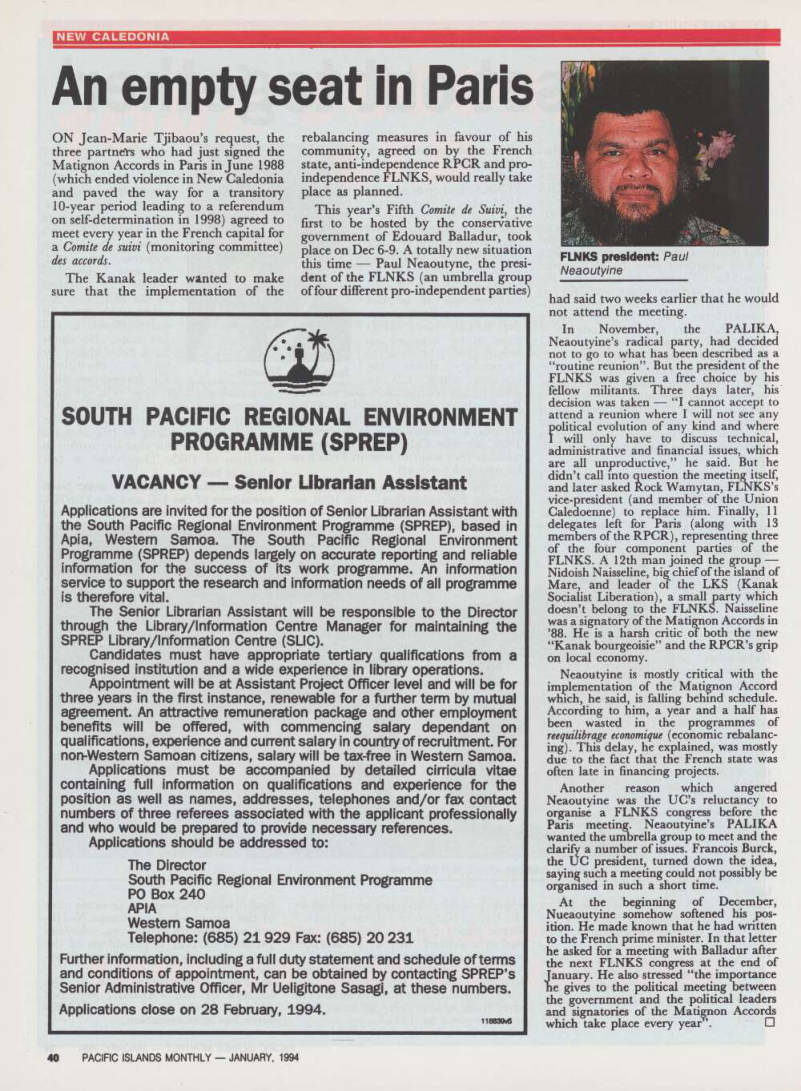
ON Jean-Marie Tjibaou’s request, the three partners who had just signed the Matignon Accords in Paris in June 1988 (which ended violence in New Caledonia and paved the way for a transitory 10-year period leading to a referendum on self-determination m 1998) agreed to meet every year in the French capital for a Comite de sum (monitoring committee) des accords.
The Kanak leader wanted to make sure that the implementation of the
rebalancing measures in favour of his
community, agreed on by the French
state, anti-independence RPCR and pro independence FLNKS, would really take
place as planned.
This year ’ s Fi f th Comite de Suivi, the first to be hosted by the conservative government of Edouard Bahadur, took p i ace on Dec 6-9. A totally new situation this time Paul Neaoutyne, the presi dent of the FLNKS (an umbrella group of four different pro-independent parties)
had said two weeks earlier that he would not attend the meeting.
In November, the PALIKA, Neaoutyine’s radical party, had decided not to go to what has been described as a “routine reunion”. But the president of the FLNKS was given a free choice by his fellow militants. Three days later, his decision was taken “I cannot accept to attend a reunion where I will not see any Folitical evolution of any kind and where will only have to discuss technical, administrative and financial issues, which are all unproductive,” he said. But he didn’t call into question the meeting itself, and later asked Rock Wamytan, FLNKS’s vice-president (and member of the Union
Caledoenne) to replace him. Finally, 11
delegates left for Paris (along with 13 members of the RPCR), representing three of the four component parties of the FLNKS. A 12th man joined the group Nidoish Naisseline, big chief of the island of Mare, and leader of the LKS (Kanak Socialist Liberation), a small party which doesn’t belong to tne FLNKS. Naisseline was a signatory of the Matignon Accords in ’BB. He is a harsh critic of both the new “Kanak bourgeoisie” and the RPCR’s grip on local economy.
Neaoutyine is mostly critical with the implementation of the Matignon Accord which, he said, is falling behind schedule.
According to him, a year and a half has been wasted in the programmes of
reequilibrage economique (economic rebalanc
ing). This delay, he explained, was mostly due to the fact that the French state was often late in financing projects.
Another reason which angered Neaoutyine was the UC’s reluctancy to organise a FLNKS congress before the
Paris meeting. Neaoutyine’s PALIKA
wanted the umbrella group to meet and the clarify a number of issues. Francois Burck, the UC president, turned down the idea, saying such a meeting could not possibly be organised in such a short time.
At the beginning of December, Nueaoutyine somehow softened his pos ition. He made known that he had written to the French prime minister. In that letter he asked for a meeting with Bahadur after the next FLNKS congress at the end of January. He also stressed “the importance he gives to the political meeting between the government and the political leaders and signatories of the Matignon Accords which take place every year”. □
FLNKS president: Paul Neaoutyine
Advertisements & other items, p. 40 (1 item)
Programme (Sprep)
SOUTH PACIFIC REGIONAL ENVIRONMENT
VACANCY Senior Librarian Assistant
Applications are invited for the position of Senior Librarian Assistant with the South Pacific Regional Environment Programme (SPREP), based in Apia, Western Samoa. The South Pacific Regional Environment Programme (SPREP) depends largely on accurate reporting and reliable information for the success of its work programme. An information service to support the research and information needs of all programme is therefore vital.
The Senior Librarian Assistant will be responsible to the Director through the Library/lnformation Centre Manager for maintaining the SPREP Library/lnformation Centre (SLIC).
Candidates must have appropriate tertiary qualifications from a recognised institution and a wide experience in library operations.
Appointment will be at Assistant Project Officer level and will be for three years in the first instance, renewable for a further term by mutual agreement. An attractive remuneration package and other employment benefits will be offered, with commencing salary dependant on qualifications, experience and current salary in country of recruitment. For non-Westem Samoan citizens, salary will be tax-free in Western Samoa.
Applications must be accompanied by detailed cirricuia vitae containing full information on qualifications and experience for the position as well as names, addresses, telephones and/or fax contact numbers of three referees associated with the applicant professionally and who would be prepared to provide necessary references.
Applications should be addressed to: The Director South Pacific Regional Environment Programme PO Box 240
APIA
Wpctpm cSamna Telephone: (685) 21929 Fax: (685) 20 231 Further information, Including a full duty statement and schedule of terms and conditions of appointment, can be obtained by contacting SPREP's Senior Administrative Officer, Mr Ueligitone Sasagi, at these numbers.
Applications close on 28 February, 1994.
Battle of the bedroom
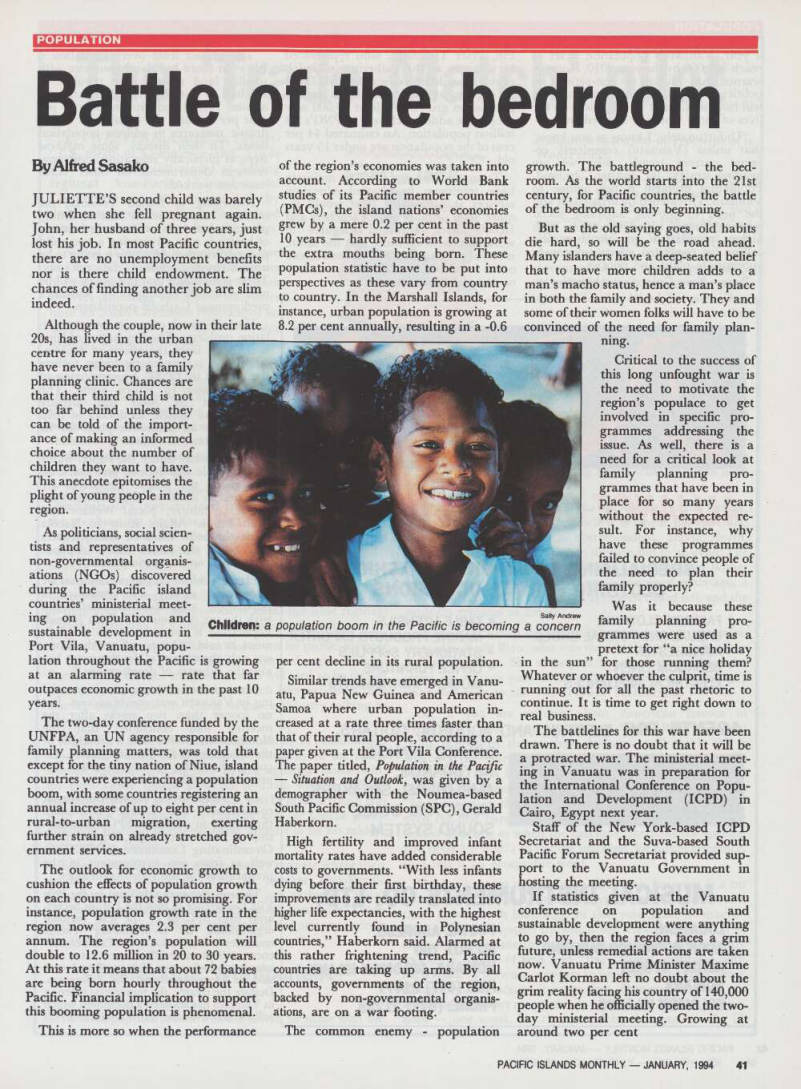

Population
By Alfred Sasako
JULIETTE’S second child was barely two when she fell pregnant again.
John, her husband of three years, just lost his job. In most Pacific countries, there are no unemployment benefits nor is there child endowment. The chances of finding another job are slim indeed.
Although the couple, now in their late
20s, has lived in the urban centre for many years, they have never been to a family planning clinic. Chances are that their third child is not too far behind unless they can be told of the import ance of making an informed choice about the number of children they want to have.
This anecdote epitomises the plight of young people in the region.
As politicians, social scien tists and representatives of
non-governmental organis
ations (NGOs) discovered during the Pacific island countries’ ministerial meet
ing on population and
sustainable development in Port Vila, Vanuatu, popu
lation throughout the Pacific is growing at an alarming rate rate that far outpaces economic growth in the past 10 years.
The two-day conference funded by the UNFPA, an UN agency responsible for family planning matters, was told that except for the tiny nation of Niue, island countries were experiencing a population boom, with some countries registering an annual increase of up to eight per cent in
rural-to-urban migration, exerting
further strain on already stretched gov ernment services.
The outlook for economic growth to cushion the effects of population growth on each country is not so promising. For instance, population growth rate in the region now averages 2.3 per cent per annum. The region’s population will double to 12.6 million in 20 to 30 years.
At this rate it means that about 72 babies are being born hourly throughout the Pacific. Financial implication to support this booming population is phenomenal.
This is more so when the performance
of the region’s economies was taken into account. According to World Bank studies of its Pacific member countries (PMCs), the island nations’ economies grew by a mere 0.2 per cent in the past 10 years hardly sufficient to support the extra mouths being born. These population statistic have to be put into perspectives as these vary from country to country. In the Marshall Islands, for instance, urban population is growing at 8.2 per cent annually, resulting in a -0.6
per cent decline in its rural population.
Similar trends have emerged in Vanu atu, Papua New Guinea and American Samoa where urban population in creased at a rate three times faster than that of their rural people, according to a paper given at the Port Vila Conference.
The paper titled, Population in the Pacific Situation and Outlook, was given by a demographer with the Noumea-based South Pacific Commission (SPC), Gerald Haberkorn, High fertility and improved infant mortality rates have added considerable costs to governments. “With less infants dying before their first birthday, these improvements are readily translated into higher life expectancies, with the highest level currently found in Polynesian countries,” Haberkorn said. Alarmed at this rather frightening trend, Pacific countries are taking up arms. By all accounts, governments of the region, backed by non-governmental organis ations, are on a war footing.
The common enemy - population
growth. The battleground - the bed room. As the world starts into the 21st century, for Pacific countries, the battle of the bedroom is only beginning.
But as the old saying goes, old habits die hard, so will be the road ahead.
Many islanders have a deep-seated belief that to have more children adds to a man’s macho status, hence a man’s place in both the family and society. They and some of their women folks will have to be convinced of the need for family plan
ning.
Critical to the success of this long unfought war is the need to motivate the region’s populace to get involved in specific pro grammes addressing the issue. As well, there is a need for a critical look at
family planning pro
grammes that have been in place for so many years without the expected re sult. For instance, why have these programmes failed to convince people of the need to plan their
family properly?
Was it because these
family planning pro
grammes were used as a pretext for “a nice holiday
in the sun” for those running them?
Whatever or whoever the culprit, time is running out for all the past rhetoric to continue. It is time to get right down to real business.
The batdelines for this war have been drawn. There is no doubt that it will be a protracted war. The ministerial meet ing in Vanuatu was in preparation for the International Conference on Popu lation and Development (ICPD) in Cairo, Egypt next year.
Staff of the New York-based ICPD Secretariat and the Suva-based South Pacific Forum Secretariat provided sup port to the Vanuatu Government in
hosting the meeting.
If statistics given at the Vanuatu conference on population and
sustainable development were anything
to go by, then the region faces a grim future, unless remedial actions are taken now. Vanuatu Prime Minister Maxime Carlot Korman left no doubt about the grim reality facing his country of 140,000 people when he officially opened the two day ministerial meeting. Growing at around two per cent
Sally Andrew Children: a population boom in the Pacific is becoming a concern
a year, Vanuatu’s population is set to reach 300,000 by the year 2010. Korman warned that “action or non-actions by politicians about population problems will have significant repercussions on the lives of those who will succeed us.”
“Unfortunately, I know as you know, that unless (Vanuatu) completely re verses current trends, then we are heading straight for disaster,” he said.
Population problem is not unique to Vanuatu. Threatened by urban drift and the need to provide adequate social services, many island countries with higher population growth rates are calling for concerted efforts to prepare appropriate plans and policies.
Papua New Guinea’s ambassador to
Fiji, Peter Tsiamalili, who represented his country at the gathering, told del egates it would be a mistake if PNG failed to implement bold policies to reduce population growth. At least 97,000 new people are added each year to PNG’s 3.9 million population. An estimated 44 per cent of the population are under 15 years old.
Tsiamalili said for PNG to maintain basic minimum health and education services at sustainable level would re quire 4000 primary school teachers and 18,000 nurses. He urged delegates “to work hard now to ensure that the future is one of our choosing and not one forced on us by circumstances we are too lazy or complacent to control.”
The impact from over population is felt even more by island countries with smaller land masses. The republic of Kiribati is one. With a population of around 70,000 and growing at two per cent per annum, the republic is taking drastic measures to address population issues. To their dismay, some of these steps as physically relocating some gov ernment departments on outer lands have not worked.
According to Inatoa Tebania, the minister responsible for health, family planning and social welfare, the ministry of health is now advocating a two-child per couple policy. How this is going to be implemented, Tebania did not say.
There is no doubt that this policy will be met with stiff oppositon by Kiribati’s predominant Catholic population.
Not all island countries have popu lation problems. The tiny nation of Niue is suffering from the effects of depopu lation and is desperately trying to lure the bulk of its 12,000 Niueans living in New Zealand to return home. The government in Alofi has already launched an appeal to donors to help make Niue an attractive place for its former citizens to return.
Exactly what future the region wants for its people will depend very much on how much the people themselves are prepared to shoulder. Fiji’s Minister for Women, Culture, Social Welfare and Multi-Ethnic Affairs Ratu Jo Nacola made the point when he told delegates that “what the future will be depends very much on our actions today”.
“It is therefore very important that we understand clearly the dynamics of population and its inter-relationship with the use of resources,” Ratu Jo said.
Population is central issue to develop ment, he said. “Our people are therefore, not only the objects of development, but also the subjects of development.”
The outcome of the preparatory meet ing in Vanuatu was one of success. But no sooner than two weeks after the meeting had concluded that the Noumea-based SPC fired a broadside at the Suva-based Forum Secretariat, ac cusing the latter of “dirty tactics and ungentleman-like behaviour.”
In a letter to his Forum Secretariat counterpart, Ati George Sokomanu threatened to withdraw SPC’s member ship of the South Pacific Organisations Co-ordinating Committee (SPOCC) as well as from any involvement in the preparation for the Cairo conference.
The row was over a decision by the Port Vila Conference to pick the Forum Secret ariat over SPC to be the lead regional organisation in co-ordinating Pacific countries’ participation at the Cairo confer ence in September. Both men later met over lunch m Suva on October 8 and were said to have ironed out the differences.
Despite the rivalry, the ministerial meeting in Vanuatu has adopted a document which will be taken to the Cairo conference. □
Advertisements & other items, p. 42 (1 item)
Alliance Corporation Ltd
SPECIALISING IN IMPORTED FASHION
CLOTHING FOR ALL OCCASIONS
* FASHION CLOTHING
* CASUAL AND FORMAL SHOES
* MANCHESTER
* BEDROOM UNEN
* ELECTRICAL APPLIANCES
* TABLE UTENSILS
* MARINE PRODUCTS EXPORTER
* STATIONERY SUPPUES
* OFFICE FURNITURE
* MUSICAL INSTRUMENTS
AGENTS FOR ELECTRIC AND ACOUSTIC GUITARS,
DRUMS, PIANOS,
KEYBOARDS,
AMPLIFIERS, SPEAKERS,
MIKES AND STAGE
SOUND SYSTEM
MUSICAL INSTRUMENTS CO. LTD.
LOCATION:
ACOR BOOKSHOP BUILDING
ASHLEY STREET
HONIARA
SOLOMON ISLANDS
POSTAL ADDRESS:
PO BOX 780
HONIARA, SOLOMON ISLAND
FAX: (677) 2M77
PHONE: (677) 21239
The ‘Trade Match’ pilot
A WESTERN Australian Depart
ment of Commerce and Trade
managed pilot aimed at linking
regional Asia-Pacific Chambers of
Commerce recently announced by
department supremo Bruce Sutherland may bypass many regional chambers.
Aimed at eventually providing a live link between the databases of Chambers of Commerce in the Asia Pacific Region the WA pilot stage will see the databases from six Asian Chambers repackaged on CD-ROM for use by commerce and industry across the region.
In his Hanoi press release Mr Sutherland said the region was experi encing economic growth at a faster rate than world average. The results of a recently conducted study showed chambers processed around one million trade enquiries a month or around 100 per working day minute.
The recent 18 members Conference of Asia Pacific Chambers, of Commerce and Industry held in Hanoi gave the go-ahead for the pilot project. Pacific involvement only encompasses Australia, New Zealand and PNG. No other regional Pacific Chambers will be involved in the “Trade- Match” pilot. Given the very high reliance of regional economies on Tourism and export of primary products and the potential for market and investment opportunity such up to-date information can provide it seems this time regional Pacific Chambers of Commerce have missed the boat.
Now that President Clinton has given his public support to Prime Minister Paul Keating’s proposed regional Asia- Pacific trade alliance small economics will need to be fast off the mark and positioned with as much information as they can lay their hands on. Trade Match is industry talking to
industry.
With the GATT round seemingly nearing its culmination, albeit with France being dragged reluctantly to the table.
Europe with the UK are now having agreed to Maastricht, an even closer union, however a union with a defunct common currency policy, NAFTA maybe in for a rough trip with a new government in Canada and the Cairns group gnashing its collective teeth there appears to be no middle road for the Pacific.
Economies will need to pragmatically evaluate where their markets and futures lie. The 18 member Asia-Pacific Chambers of Commerce Group (if one excludes China) represents around 50 per cent of the worlds consumers. Trade Match offers a cost effective market tool and means to access this market. □
Perfecting Word Perfect
THE most popular software in the world, for those who use
computers as souped-up typewriters, is Word Perfect.
Those writing about the South Pacific on Word Perfect, however, find it unfriendly. This is because if you type “Pago Pago” or “Mali Mali” or “Dora Dora” in Word Perfect and then check the spelling in your document (a nice feature, generally), Word Perfect sends you an error mess age “Double Word,” it says. Then the writer has a choice either disable (kill) the double word check ing mechanism, which is a disadvan tage, or tell the machine to skip the double word in question.
A typist writing about American Samoa may have to use Pago Pago several times on a page, and it is a nuisance to have to convince the machine, each time, that the writer is
right and the machine is wrong about what it thinks is an error.
This is the kind of problem that should be readily fixable, if the software manufacturer feels it is worth the time and money. PlM’s Washington correspondent, David North, called Word Perfect and wrote to the firm but to no avail. The problem was too obscure, apparently, for them to bother with. Since he first wrote to them, a couple of years ago, a new version of Word Perfect has appeared called 6.0, and the problem remains as before.
What PlM’s man initially failed to do was to consult his own wife, Ruth Blau, who was then in the software business for another firm. She subsequently solved the problem by using an obscure part of the software that was apparently unknown even to the Word Perfect Technicians.
So, if you are writing about American Samoa in Word Perfect and want to mention “Pago Pago” without being zapped by the machine during a spell check, this is what you do first type “Pago”, then touch and release the Home key, then hit the space bar, and then type “Pago” jagain.jlnlthejargonjof Word Perfect you have just inserted a “hard space” in the middle of the words. But, “Pago Pago” even the first part of it, will stump the spell check the first time it appears; so when the machine questions the spelling you press 3 (“add”) to tell the machine, for future reference, that this is an acceptable word.
Having to insert a hard space each time, however, is a bit of a nuisance. If you are going to type a double word several times a day, Ruth Blau suggests that you create a “macro” for it. This is a system by which one creates a little bit of computer programming; after doing this one subsequently touches a couple of keys and “Pago Pago”, complete with hard space in between, appears in your text. The spell check mechanism will accept it every time. One could instead, in violation of current usage, simply make Pago Pago or Bora Bora one word, but that would be cheating. □
land
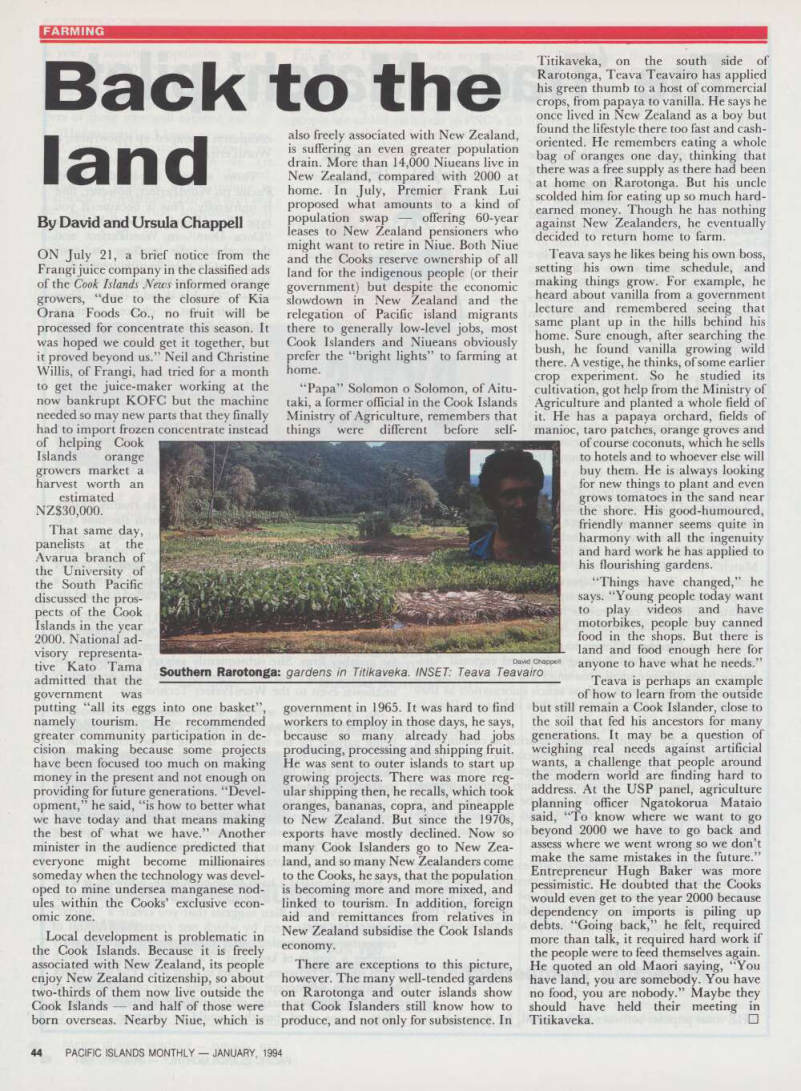
Farming
Back to the
By David and Ursula Chappell
ON July 21, a brief notice from the Frangi juice company in the classified ads of the Cook Islands News informed orange growers, “due to the closure of Kia Orana Foods Co., no fruit will be processed for concentrate this season. It was hoped we could get it together, but it proved beyond us.” Neil and Christine Willis, of Frangi, had tried for a month to get the juice-maker working at the now bankrupt KOFC but the machine needed so may new parts that they finally had to import frozen concentrate instead
of helping Cook Islands orange growers market a harvest worth an estimated
Nzs3O,Ooo.
That same day, panelists at the Avarua branch of the University of the South Pacific discussed the pros pects of the Cook Islands in the year 2000. National ad visory representa tive Kato Tama admitted that the government was
putting “all its eggs into one basket”, namely tourism. He recommended greater community participation in decision making because some projects have been focused too much on making money in the present and not enough on providing for future generations. “Development,” he said, “is how to better what we have today and that means making the best of what we have.” Another minister in the audience predicted that everyone might become millionaires someday when the technology was developed to mine undersea manganese nodules within the Cooks’ exclusive economic zone.
T oral Hpvplnnmpnt k nmhl.matir in Local development is problematic in the Cook Islands. Because it is freely associated with New Zealand, its people enjoy New Zealand citizenship, so about two-thirds of them now live outside the Cook Islands and half of those were born overseas. Nearby Niue, which is
also freely associated with New Zealand, is suffering an even greater population drain. More than 14,000 Niueans live in New Zealand, compared with 2000 at home. In July, Premier Frank Lui proposed what amounts to a kind of population swap offering 60-year leases to New Zealand pensioners who might want to retire in Niue. Both Niue and the Cooks reserve ownership of all land for the indigenous people (or their government) but despite the economic slowdown in New Zealand and the relegation of Pacific island migrants there to generally low-level jobs, most Cook Islanders and Niueans obviously prefer the “bright lights” to farming at home.
“Papa” Solomon o Solomon, of Aitu taki, a former official in the Cook Islands Ministry of Agriculture, remembers that things were different before self-
government in 1965. It was hard to find workers to employ in those days, he says, because so many already had jobs
producing, processing and shipping fruit.
He was sent to outer islands to start up growing projects. There was more reg ular shipping then, he recalls, which took oranges, bananas, copra, and pineapple to New Zealand. But since the 19705, exports have mostly declined. Now so many Cook Islanders go to New Zea land, and so many New Zealanders come to the Cooks, he says, that the population is becoming more and more mixed, and linked to tourism. In addition, foreign aid and remittances from relatives in New Zealand subsidise the Cook Islands economy.
There are exceptions to this picture, however. The many well-tended gardens on Rarotonga and outer islands show that Cook Islanders still know how to produce, and not only for subsistence. In
Titikaveka, on the south side of Rarotonga, Teava Teavairo has applied his green thumb to a host of commercial crops, from papaya to vanilla. He says he once lived in New Zealand as a boy but found the lifestyle there too fast and cash oriented. He remembers eating a whole bag of oranges one day, thinking that there was a free supply as there had been at home on Rarotonga. But his uncle scolded him for eating up so much hard earned money. Though he has nothing against New Zealanders, he eventually decided to return home to farm.
Teava says he likes being his own boss, setting his own time schedule, and
making things grow. For example, he
heard about vanilla from a government lecture and remembered seeing that same plant up in the hills behind his home. Sure enough, after searching the bush, he found vanilla growing wild there. A vestige, he thinks, of some earlier crop experiment. So he studied its cultivation, got help from the Ministry of Agriculture and planted a whole field of it. He has a papaya orchard, fields of manioc, taro patches, orange groves and
of course coconuts, which he sells to hotels and to whoever else will
buy them. He is always looking
for new things to plant and even grows tomatoes in the sand near the shore. His good-humoured, friendly manner seems quite in harmony with all the ingenuity and hard work he has applied to
his flourishing gardens.
“Things have changed,” he
says. “Young people today want
to play videos and have
motorbikes, people buy canned
food in the shops. But there is land and food enough here for anyone to have what he needs.”
Teava is perhaps an example of how to learn from the outside
but still remain a Cook Islander, close to the soil that fed his ancestors for many generations. It may be a question of weighing real needs against artificial wants, a challenge that people around the modern world are finding hard to address. At the USP panel, agriculture planning officer Ngatokorua Mataio said, “To know where we want to go beyond 2000 we have to go back and assess where we went wrong so we don’t make the same mistakes in the future.”
Entrepreneur Hugh Baker was more pessimistic. He doubted that the Cooks would even get to the year 2000 because dependency on imports is piling up debts. “Going back,” he felt, required more than talk, it required hard work if the people were to feed themselves again.
He quoted an old Maori saying, “You have land, you are somebody. You have no food, you are nobody.” Maybe they should have held their meeting in Titikaveka. □
David Chappell Southern Rarotonga: gardens in Titikaveka. INSET: Teava Teavairo
Magnificent Malaysia
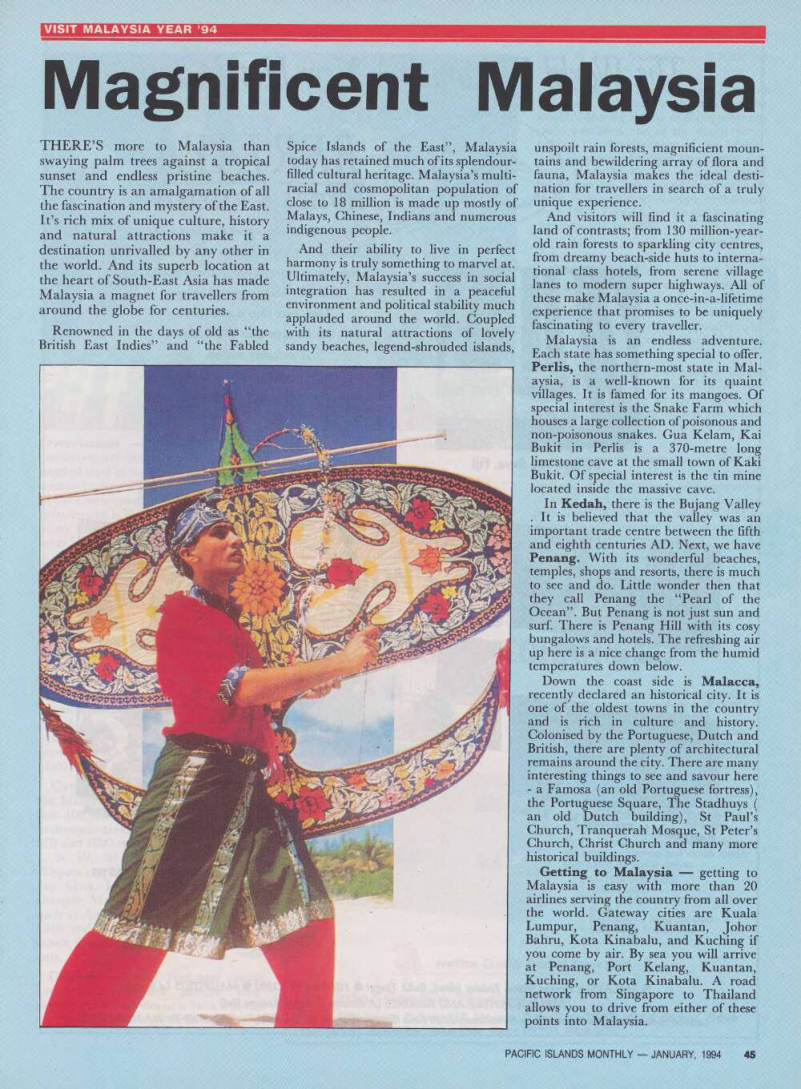


Visit Malaysia Year ’94
THERE’S more to Malaysia than
swaying palm trees against a tropical
sunset and endless pristine beaches.
The country is an amalgamation of all the fascination and mystery of the East.
It’s rich mix of unique culture, history and natural attractions make it a destination unrivalled by any other in the world. And its superb location at the heart of South-East Asia has made Malaysia a magnet for travellers from around the globe for centuries.
Renowned in the days of old as “the British East Indies” and “the Fabled
Spice Islands of the East”, Malaysia today has retained much of its splendour filled cultural heritage. Malaysia’s multi racial and cosmopolitan population of close to 18 million is made up mostly of Malays, Chinese, Indians and numerous indigenous people.
And their ability to live in perfect harmony is truly something to marvel at.
Ultimately, Malaysia’s success in social integration has resulted in a peaceful environment and political stability much applauded around the world. Coupled with its natural attractions of lovely sandy beaches, legend-shrouded islands,
unspoilt rain forests, magnificient moun tains and bewildering array of flora and fauna, Malaysia makes the ideal desti nation for travellers in search of a truly unique experience.
And visitors will find it a fascinating land of contrasts; from 130 million-year old rain forests to sparkling city centres, from dreamy beach-side huts to interna tional class hotels, from serene village lanes to modern super highways. All of these make Malaysia a once-in-a-lifetime experience that promises to be uniquely fascinating to every traveller.
Malaysia is an endless adventure.
Each state has something special to offer.
Perils, the northern-most state in Mal aysia, is a well-known for its quaint villages. It is famed for its mangoes. Of special interest is the Snake Farm which houses a large collection of poisonous and non-poisonous snakes. Gua Kelam, Kai Bukit in Perlis is a 370-metre long limestone cave at the small town of Kaki Bukit. Of special interest is the tin mine located inside the massive cave.
In Kedah, there is the Bujang Valley . It is believed that the valley was an important trade centre between the fifth and eighth centuries AD. Next, we have Penang. With its wonderful beaches, temples, shops and resorts, there is much to see and do. Little wonder then that they call Penang the “Pearl of the Ocean”. But Penang is not just sun and surf. There is Penang Hill with its cosy bungalows and hotels. The refreshing air up here is a nice change from the humid temperatures down below.
Down the coast side is Malacca, recently declared an historical city. It is one of the oldest towns in the country and is rich in culture and history.
Colonised by the Portuguese, Dutch and British, there are plenty of architectural remains around the city. There are many interesting things to see and savour here - a Famosa (an old Portuguese fortress),
the Portuguese Square, The Stadhuys (
an old Dutch building), St Paul’s Church, Tranquerah Mosque, St Peter’s Church, Christ Church and many more
historical buildings.
Getting to Malaysia getting to Malaysia is easy with more than 20 airlines serving the country from all over the world. Gateway cities are Kuala
Lumpur, Penang, Kuantan, Johor
Bahru, Kota Kinabalu, and Kuching if you come by air. By sea you will arrive at Penang, Port Kelang, Kuantan, Kuching, or Kota Kinabalu. A road network from Singapore to Thailand allows you to drive from either of these points into Malaysia.
Government Malaysia enjoys a
parliamentary democracy. The supreme
head of state is the king, a constitutional monarch elected for a term of five years at the Conference of Rulers. The head of government is the prime minister of the party which commands the majority of seats in parliament.
Language The national language is Bahasa Malaysia but English is widely spoken as it is taught in all schools.
English is also commonly used in business transactions.
Climate Generally warm through out the year with temperatures ranging from 21°C to 32°C. Humidity is high all year round. The rainy season of the coast of Peninsular Malaysia and the north eastern part of Sabah is during the months of November to February, April, May and October are usually the wet months of the west coast of Peninsular Malaysia.
Currency The unit of currency is the Malaysian Ringgit which is divided into 100 sen. Currency notes are issued in denominations of 1,5, 10, 20, 50, 100, 500 and 1000 ringgit. Coins are issued in 1,5, 10, 20 and 50 sen. Travellers cheques can be exchanged for ringgit at any bank, hotel or authorised money changer. Major credit and charge cards such as American Express, Visa, Diners Club and Master Card are accepted in hotels, shoppingg complexes and restaur ants.
Clothes Light, cool and casual.
Some establishments require long sleeved shirts with ties or a batik shirt for the evening. You may need a jacket or
cotton sweater for evenings in the
highlands.
Business Hours and Banks Generally shops are open from 9.30 am to 7pm while supermarkets and department stores operate from 10am to 10pm.
Banking hours Monday to Friday
ipam to 3pm; Saturday —9.30 am to 1 lam.
Economy The country has one of the most dynamic economies in the world. Massive inflow of foreign invest ment has been one of the major forces behind the development of the Malay sian economy. Foreign investment has been attracted by the relatively good infrastructure, low wages, and policies more favourable to foreign investment since 1986. Foreign investment increased dramatically in 1990.
In the first 10 months of 1990 alone, $12.9 billion worth of investment was approved; slightly more than half was foreign investment, with investments from Taipei, China and Japan account ing for about 60 per cent. Investment from the United States, particularly in oil exploration and financial services, was also substantial.
High investment and growth in the past provide the country with the resources to address development prob lems such as regional income inequality while the industrialisation process con tinues.
By pursuing pragmatic, growth
oriented policies, including further devel opment of infrastructure and promotion of small and medium sized industries,
post-New Economic Policy (NEP)
strategies will continue to attract private, direct and foreign investment. □ -
Advertisements & other items, pp. 46-48 (1 item)
Berjaya
The World Welcomes A New Hotel Chain i Berjaya Inn, Suva, Fiji Room* vfiA • EL m BlW" Waa Re cm^ ontDS
HOTELS & RESORTS
They travelled distances far and wide Seeking rest, refreshment and relief From the rigours of the journey made And the journey yet to come Then once they’d chanced On the sign that promised A welcome within They knew their hearts could rest For here they would find The warmth of a promise fulfilled To which they would always return.
There’s still a place in the world Where a promise is warmly fulfilled i * m an dTWT.c lounge r You return for the warmth of Berjaya
BERJAYA
HOTELS & RESORTS
• MALAYSIA Tioman Island, Redang Island, Bulat Tinggi • FIJI Suva Ph 312300 MAURITIUS Le Mome BERJAYA HOTELS AND RESORTS (A division of Berjaya Leisure Bhd) Lem 14, Shahzan Prudential Tower, 30 Jalan Sultan Ismail, 50250 Kuala Lumpur, Malaysia. Tel: 03-2423611 Fax: 03-2488249 Ur MA 31548 TIRKLO
LION’S FILING CABINET
WITH EXCLUSIVE ANTI-TILT
LOCK MECHANISM
This exclusive anti-tilt lock mechanism is now a standard feature in all LION’s 3 and 4-drawer filing cabinets.
This mechanism is actually a safety device which allows only one drawer to be opened at a time thus preventing cabinet from accidentally tilting over as with conventional cabinet.
All UON's filing cabinets are also fitted with the latest suspension rail system to ensure smooth and trouble free operation.
With a choice of 3 different colours, you can now choose one which match your office or home decor.
Other UON’s products: * Office Chairs * Steel Cupboards with and without glass * Fire-Resistive Filing Cabinets * Suspension Pocket Files Another Quality Product From LION.
Trading Ltd
No. 6 Edinburgh Drive, SIA House, P.O. Box 2276, Govt Bldgs, Suva Tel: (679) 304889, 304888. Fax: (679) 304886
Leave your room
and see the sights
we espiruu mnto
bwiieiice
THE TANNA
VOLCANIC
EXPERIENCE
Tanna has the distinction of being the host to one of the few live volcanoes remaining. Yasur is eerie, majestic, colourful and continually changing. This natural phenomenon leaves visitors from all over the world speechless.
However, Tanna is not just "volcanic territory", this island of contrast has many other attractions including the Whitegrass plains, Lake Siri, Blow Holes, superb beaches, a mini "mountain range", and hot springs.
Your tour begins with a pick up from your Port Vila accommodation and transport to Bauerfield airport for your morning flight south to Tanna's Lanakel Airport We'll meet you on arrival, and one of our knowledgeable guides will be at your service to show, drive, and explain the wonders of Tanna for the rest of the day.
A day on Tanna offers the renowned Volcano tour, a visit to island villages, a picnic lunch with refreshments and custom village tour.
At the end of a full day it's back "home" to your Vila accommodation, and the pie asant flight that will take you there.
OPERATES: DAILY
WWW**
, * 1
mi day circle
BFATE ISLAND
TOUR VANUATU
'<YOUR HELPING HAND IN PARADISE" PO Box 409 - Tel: (678) 22745 / 22733 - Tx: 1054 - Fax: (678) 23442 Also at the Le Lagon and Radisson resorts
sightings
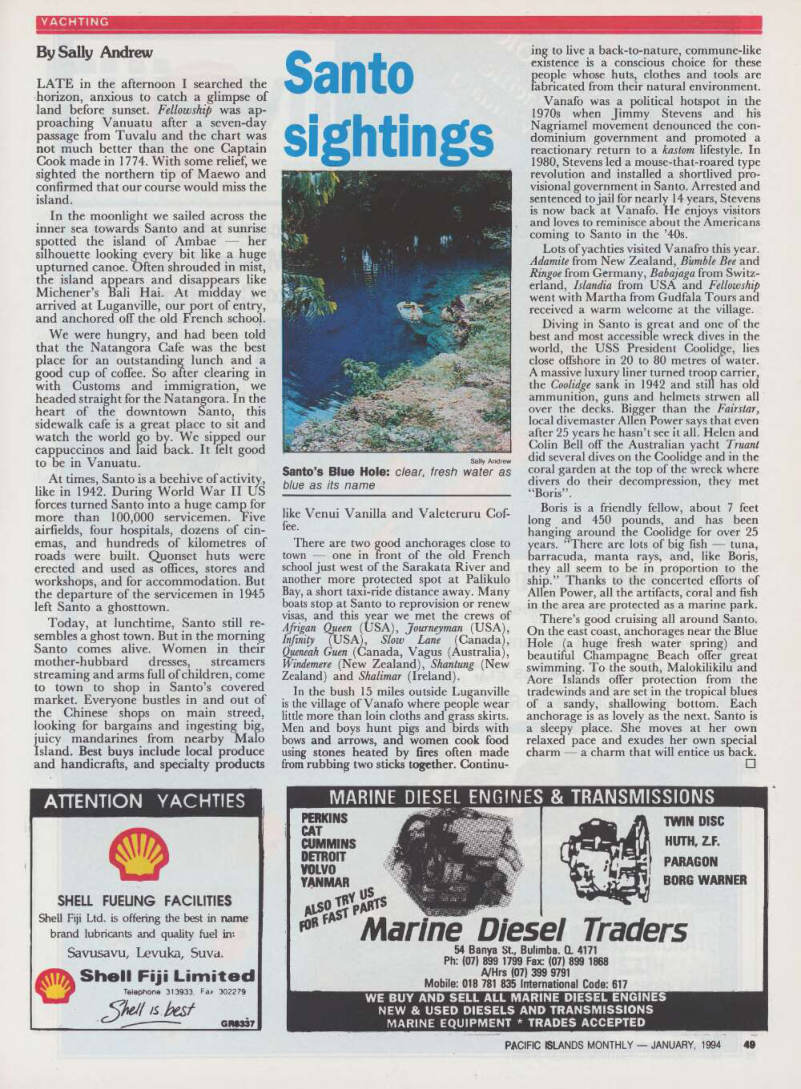
Yachting
Santo sightings
By Sally Andrew
LATE in the afternoon I searched the horizon, anxious to catch a glimpse of land before sunset. Fellowship was ap proaching Vanuatu after a seven-day passage from Tuvalu and the chart was not much better than the one Captain Cook made in 1774. With some relief, we sighted the northern tip of Maewo and confirmed that our course would miss the island.
In the moonlight we sailed across the inner sea towards Santo and at sunrise spotted the island of Ambae her silhouette looking every bit like a huge upturned canoe. Often shrouded in mist, the island appears and disappears like Michener’s Bali Hai. At midday we arrived at Luganville, our port of entry, and anchored off the old French school.
We were hungry, and had been told that the Natangora Cafe was the best place for an outstanding lunch and a good cup of coffee. So after clearing in with Customs and immigration, we headed straight for the Natangora. In the heart of the downtown Santo, this sidewalk cafe is a great place to sit and watch the world go by. We sipped our cappuccinos and laid back. It felt good to be in Vanuatu.
At times, Santo is a beehive of activity, like in 1942. During World War II US forces turned Santo into a huge camp for more than 100,000 servicemen. Five airfields, four hospitals, dozens of cin emas, and hundreds of kilometres of roads were built. Quonset huts were erected and used as offices, stores and workshops, and for accommodation. But the departure of the servicemen in 1945 left Santo a ghosttown.
Today, at lunchtime, Santo still re sembles a ghost town. But in the morning Santo comes alive. Women in their mother-hubbard dresses, streamers streaming and arms full of children, come to town to shop in Santo’s covered market. Everyone bustles in and out of the Chinese shops on main streed, looking for bargains and ingesting big, juicy mandarines from nearby Malo Island. Best buys include local produce and handicrafts, and specialty products
like Venui Vanilla and Valeteruru Cof fee.
There are two good anchorages close to town one in front of the old French school just west of the Sarakata River and another more protected spot at Palikulo Bay, a short taxi-ride distance away. Many boats stop at Santo to reprovision or renew visas, and this year we met the crews of Afrigan Queen (USA), Journeyman (USA),
Infinity (USA), Slow Lane (Canada),
Queneah Guen (Canada, Vagus (Australia), Windemere (New Zealand), Shantung (New Zealand) and Shalimar (Ireland).
In the bush 15 miles outside Luganville is the village of Vanafo where people wear little more than loin cloths and grass skirts.
Men and boys hunt pigs and birds with bows and arrows, and women cook food using stones heated by fires often made from rubbing two sticks together. Continu
ing to live a back-to-nature, commune-like existence is a conscious choice for these people whose huts, clothes and tools are fabricated from their natural environment.
Vanafo was a political hotspot in the 1970 s when Jimmy Stevens and his Nagriamel movement denounced the con dominium government and promoted a reactionary return to a kastom lifestyle. In 1980, Stevens led a mouse-that-roared type revolution and installed a shortlived pro visional government in Santo. Arrested and sentenced to jail for nearly 14 years, Stevens is now back at Vanafo. He enjoys visitors and loves to reminisce about the Americans coming to Santo in the ’4os.
Lots ofyachties visited Vanafro this year.
Adamite from New Zealand, Bumble Bee and
Ringoe from Germany, Babajaga from Switz
erland, Islandia from USA and Fellowship went with Martha from Gudfala Tours and received a warm welcome at the village.
Diving in Santo is great and one of the best and most accessible wreck dives in the world, the USS President Coolidge, lies close offshore in 20 to 80 metres of water.
A massive luxury liner turned troop carrier, the Coolidge sank in 1942 and still has old ammunition, guns and helmets strwen all over the decks. Bigger than the Fairstar, local divemaster Allen Power says that even after 25 years he hasn’t see it all. Helen and Colin Bell off the Australian yacht Truant did several dives on the Coolidge and in the coral garden at the top of the wreck where divers do their decompression, they met “Boris”.
Boris is a friendly fellow, about 7 feet long and 450 pounds, and has been hanging around the Coolidge for over 25 years. “There are lots of big fish tuna, barracuda, manta rays, and, like Boris, they all seem to be in proportion to the ship.” Thanks to the concerted efforts of Allen Power, all the artifacts, coral and fish in the area are protected as a marine park.
There’s good cruising all around Santo.
On the east coast, anchorages near the Blue Hole (a huge fresh water spring) and beautiful Champagne Beach offer great swimming. To tne south, Malokilikilu and Aore Islands offer protection from the tradewinds and are set in the tropical blues of a sandy, shallowing bottom. Each anchorage is as lovely as the next. Santo is a sleepy place. She moves at her own relaxed pace and exudes her own special charm a charm that will entice us back. □
Sally Andrew Santo’s Blue Hole: clear, fresh water as blue as its name
Advertisements & other items, pp. 49-50 (1 item)
10 Marine Diesel Traders
MARINE DIESEL ENGINES & TRANSMISSIONS
PERKINS
CAT
CUMMINS
DETROIT
VOLVO
YANMAR
10 Marine Diesel Traders
TWIN DISC
HUTH, Z.F.
PARAGON
BORG WARNER
54 Banya St, Bulimba. Q. 4171 Ph: (07) 899 1799 Fax: (07) 899 1868 A/Hrs (07) 399 9791 Mobile: 018 781 835 International Code: 617 WE BUY AND SELL ALL MARINE DIESEL ENGINES
NEW & USED DIESELS AND TRANSMISSIONS
MARINE EQUIPMENT * TRADES ACCEPTED
ATTENTION YACHTIES
SHELL FUEUNG FACILITIES
Shell Fiji Ltd. is offering the best in name brand lubricants and quality fuel in: Savusavu, Levuka, Suva. © Shell Fiji Limited Telephone 313933 Fa* 302279
& best
GM337
Telecom Vanuatu
Makes it Easj
to Call Home!
Ltd
T- U' T
TELECOM VAMJATU LTD
a joint venture between Government of Vanuatu Cable and wireless PLC France Cables ET Radio nm mi mu,!
Fiji wins Games
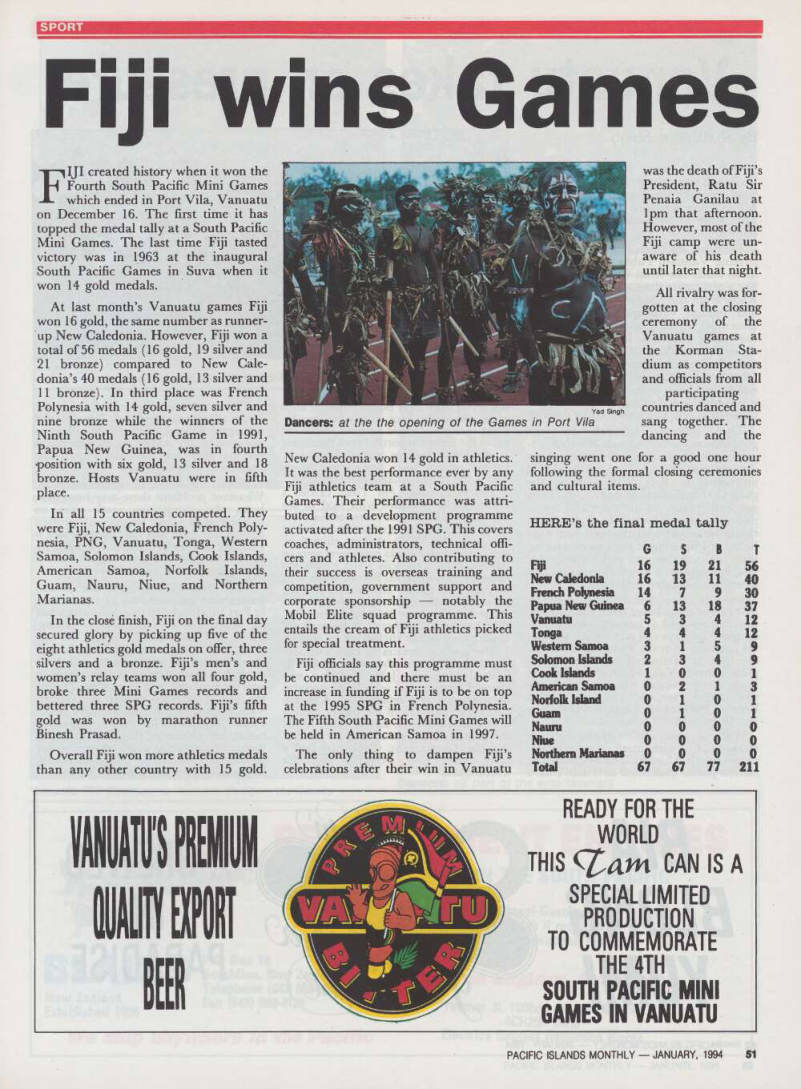
Sport
FIJI created history when it won the Fourth South Pacific Mini Games which ended in Port Vila, Vanuatu on December 16. The first time it has topped the medal tally at a South Pacific Mini Games. The last time Fiji tasted victory was in 1963 at the inaugural South Pacific Games in Suva when it won 14 gold medals.
At last month’s Vanuatu games Fiji won 16 gold, the same number as runner up New Caledonia. However, Fiji won a total of 56 medals (16 gold, 19 silver and 21 bronze) compared to New Cale donia’s 40 medals (16 gold, 13 silver and 11 bronze). In third place was French Polynesia with 14 gold, seven silver and nine bronze while the winners of the Ninth South Pacific Game in 1991, Papua New Guinea, was in fourth •position with six gold, 13 silver and 18 bronze. Hosts Vanuatu were in fifth
place.
In all 15 countries competed. They were Fiji, New Caledonia, French Poly nesia, PNG, Vanuatu, Tonga, Western Samoa, Solomon Islands, Cook Islands, American Samoa, Norfolk Islands, Guam, Nauru, Niue, and Northern Marianas.
In the close finish, Fiji on the final day secured glory by picking up five of the eight athletics gold medals on offer, three silvers and a bronze. Fiji’s men’s and women’s relay teams won all four gold, broke three Mini Games records and bettered three SPG records. Fiji’s fifth gold was won by marathon runner Binesh Prasad.
Overall Fiji won more athletics medals than any other country with 15 gold.
New Caledonia won 14 gold in athletics.
It was the best performance ever by any Fiji athletics team at a South Pacific Games. Their performance was attri buted to a development programme activated after the 1991 SPG. This covers coaches, administrators, technical offi cers and athletes. Also contributing to their success is overseas training and competition, government support and corporate sponsorship notably the Mobil Elite squad programme. This entails the cream of Fiji athletics picked for special treatment.
Fiji officials say this programme must be continued and there must be an increase in funding if Fiji is to be on top at the 1995 SPG in French Polynesia.
The Fifth South Pacific Mini Games will be held in American Samoa in 1997.
The only thing to dampen Fiji’s celebrations after their win in Vanuatu
was the death of Fiji’s President, Ratu Sir Penaia Ganilau at Ipm that afternoon.
However, most of the Fiji camp were un aware of his death until later that night.
All rivalry was for gotten at the closing ceremony of the Vanuatu games at the Korman Sta dium as competitors and officials from all participating countries danced and sang together. The dancing and the
singing went one for a good one hour following the formal closing ceremonies and cultural items.
HERE’s the final medal tally
Yad Singh Dancers: at the the opening of the Games in Port Vila
Fiji G 16 S 19 B 21 T 56 New Caledonia 16 13 11 40 French Polynesia 14 7 9 30 Papua New Guinea 6 13 18 37 Vanuatu 5 3 4 12 Tonga 4 4 4 12 Western Samoa 3 1 5 9 Solomon Islands 2 3 4 9 Cook Islands 1 0 0 1 American Samoa 0 2 1 3 Norfolk Island 0 1 0 1 Guam 0 1 0 1 Nauru 0 0 0 0 Niue 0 0 0 0 Northern Marianas 0 0 0 0 Total 67 67 77 211
Advertisements & other items, p. 51 (1 item)
Ready For The
WORLD
THIS C tarn CAN IS A
SPECIAL LIMITED
PRODUCTION
TO COMMEMORATE
THE 4TH
SOUTH PACIFIC MINI
GAMES IN VANUATU
Vanuatu takes on pressure
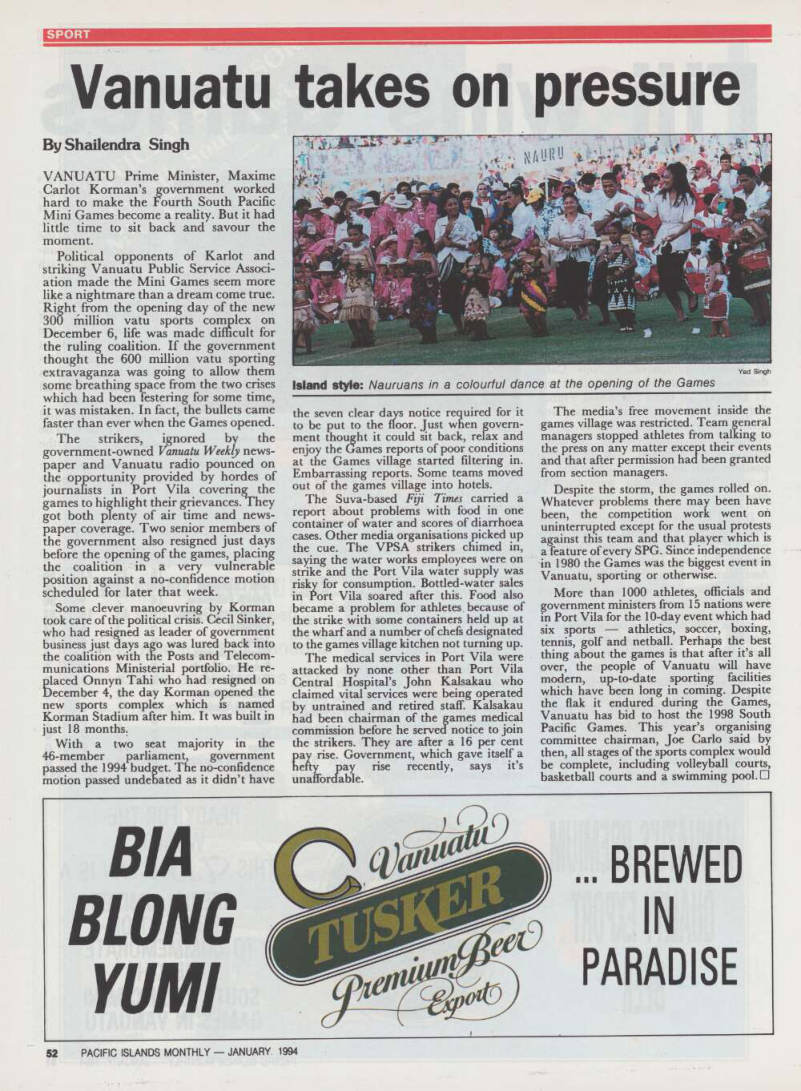
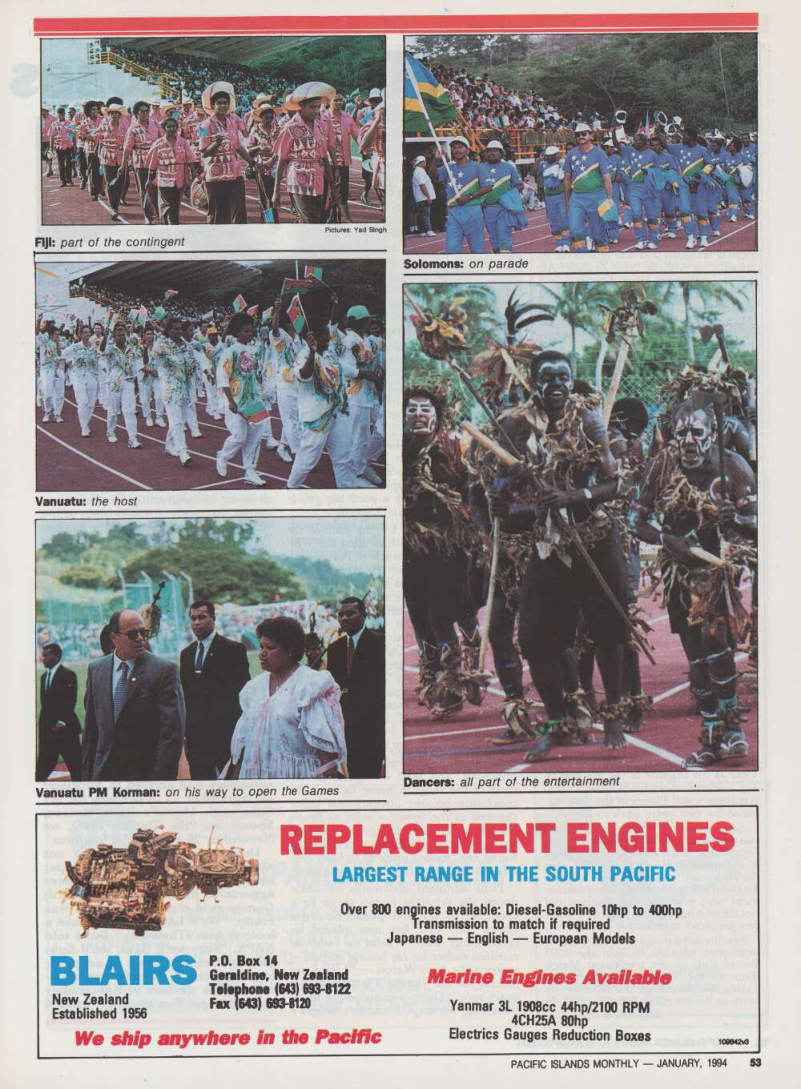
By Shailendra Singh
VANUATU Prime Minister, Maxime Carlot Korman’s government worked hard to make the Fourth South Pacific Mini Games become a reality. But it had little time to sit back and savour the moment.
Political opponents of Karlot and striking Vanuatu Public Service Associ ation made the Mini Games seem more like a nightmare than a dream come true.
Right from the opening day of the new 300 million vatu sports complex on December 6, life was made difficult for the ruling coalition. If the government thought the 600 million vatu sporting extravaganza was going to allow them some breathing space from the two crises which had been festering for some time, it was mistaken. In fact, the bullets came faster than ever when the Games opened.
The strikers, ignored by the government-owned Vanuatu Weekly news paper and Vanuatu radio pounced on the opportunity provided by hordes of journalists in Port Vila covering the games to highlight their grievances. They got both plenty of air time and news paper coverage. Two senior members of the government also resigned just days before the opening of the games, placing the coalition in a very vulnerable position against a no-confidence motion scheduled for later that week.
Some clever manoeuvring by Korman took care of the political crisis. Cecil Sinker, who had resigned as leader of government business just days ago was lured back into the coalition with the Posts and Telecom munications Ministerial portfolio. He re- B laced Onnyn Tahi who had resigned on lecember 4, the day Korman opened the new sports complex which is named Korman Stadium after him. It was built in just 18 months.
With a two seat majority in the 46-member parliament, government passed the 1994 budget. The no-confidence motion passed undebated as it didn’t have
the seven clear days notice required for it to be put to the floor. Just when government thought it could sit back, relax and enjoy the Games reports of poor conditions at the Games village started filtering in.
Embarrassing reports. Some teams moved out of the games village into hotels.
The Suva-based Fiji Times earned a report about problems with food in one container of water and scores of diarrhoea cases. Other media organisations picked up the cue. The VPSA strikers chimed in, saying the water works employees were on strike and the Port Vila water supply was risky for consumption. Bottled-water sales in Port Vila soared after this. Food also became a problem for athletes because of the strike with some containers held up at the wharf and a number of chefs designated to the games village kitchen not turning up.
The medical services in Port Vila were attacked by none other than Port Vila Central Hospital’s John Kalsakau who claimed vital services were being operated by untrained and retired staff. Kalsakau had been chairman of the games medical commission before he served notice to join the strikers. They are after a 16 per cent pay rise. Government, which gave itself a hefty pay rise recently, says it’s unaffordable.
The media’s free movement inside the games village was restricted. Team general managers stopped athletes from talking to the press on any matter except their events and that after permission had been granted from section managers, Despite the storm, the games rolled on.
Whatever problems there may been have been, the competition work went oh uninterrupted except for the usual protests against this team and that player which is a f ea ture of every SPG. Since independence in 1980 the Games was the biggest event in Vanuatu, sporting or otherwise, ~°„ . . , More than 1000 athletes, officials and government ministers from 15 nations were in Port Vila for the 10-day event which had six sports athletics, soccer, boxing, tennis, golf and netball. Perhaps the best thing about the games is that after it s all over, the people of Vanuatu will have modern, up-to-date sporting facilities which have been long in coming. Despite the flak it endured during the Games, Vanuatu has bid to host the 1998 South Pacific Games. This year s organising committee chairman, Joe Carlo said by then, all stages of the sports complex would be complete, including volleyball courts, basketball courts and a swimming pool. □
Yad Singh Island style: Nauruans in a colourful dance at the opening of the Games
Pictures: Yad Singh
FIJI: part of the contingent
Vanuatu: the host
Vanuatu PM Korman: on his way to open the Games
Solomons: on parade
Dancers: all part of the entertainment
Advertisements & other items, pp. 52-53 (1 item)
Bia
BLONG
YUMI
... BREWED
IN
PARADISE
ST;
REPLACEMENT ENGINES
LARGEST RANGE IN THE SOUTH PACIFIC
Over 800 engines available: Diesel-Gasoline lOhp to 400 hp Transmission to match if required Japanese English European Models
BLAIRS
New Zealand Established 1956 P.O. Box 14 Geraldine, New Zealand Telephone (643) 693-8122 Fax (643) 693-8120 We ship anywhere in the Pacific Marine Engines Available Yanmar 3L 1908 cc 44hp/2100 RPM 4CH2SA 80hp Electrics Gauges Reduction Boxes 100642v3
Sevens giants
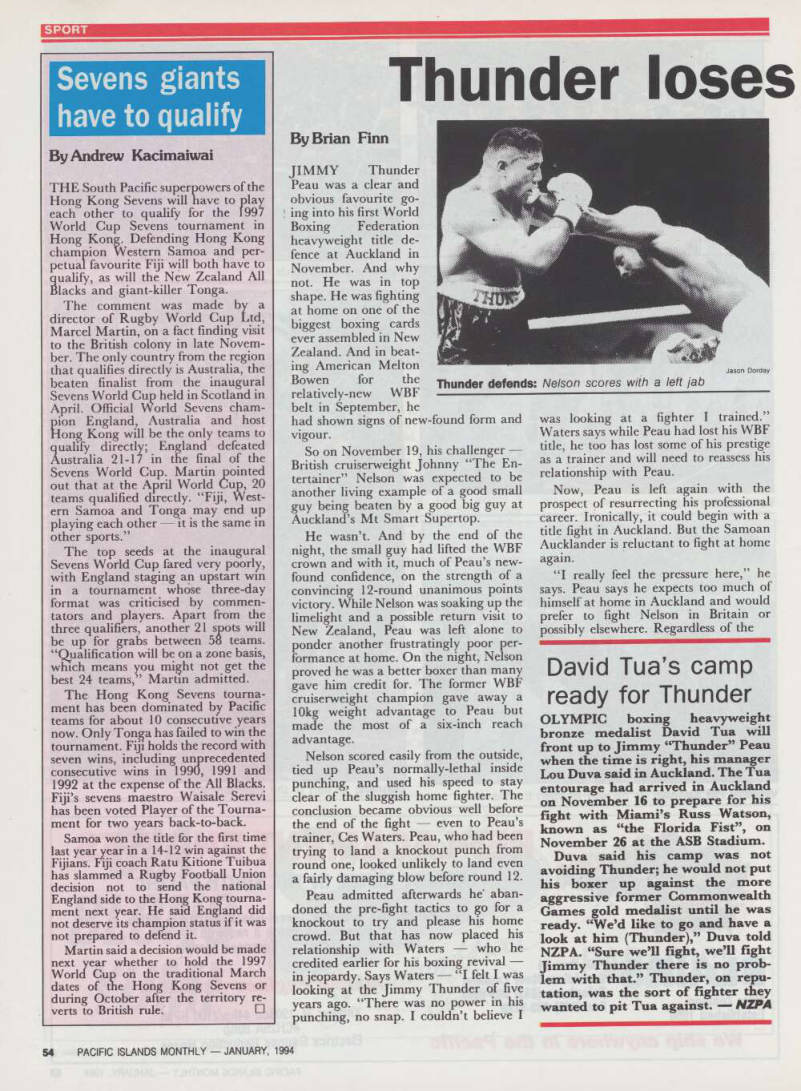
have to qualify
By Andrew Kacimaiwai
THE South Pacific superpowers of the Hong Kong Sevens will have to play each other to qualify for the 1997 World Cup Sevens tournament in Hong Kong. Defending Hong Kong champion Western Samoa and per petual favourite Fiji will both have to qualify, as will the New Zealand All Blacks and giant-killer Tonga.
The comment was made by a director of Rugby World Cup Ltd, Marcel Martin, on a fact finding visit to the British colony in late Novem ber. The only country from the region that qualifies directly is Australia, the beaten finalist from the inaugural Sevens World Cup held in Scotland in April. Official World Sevens cham pion England, Australia and host Hong Kong will be the only teams to qualify directly; England defeated Australia 21-17 in the final of the Sevens World Cup. Martin pointed out that at the April World Cup, 20 teams qualified directly. “Fiji, West ern Samoa and Tonga may end up playing each other it is the same in
other sports.”
The top seeds at the inaugural Sevens World Cup fared very poorly, with England staging an upstart win in a tournament whose three-day format was criticised by commen tators and players. Apart from the three qualifiers, another 21 spots will be up for grabs between 58 teams.
“Qualification will be on a zone basis, which means you might not get the best 24 teams,” Martin admitted.
The Hong Kong Sevens tourna ment has been dominated by Pacific teams for about 10 consecutive years now. Only Tonga has failed to win the tournament. Fiji holds the record with seven wins, including unprecedented consecutive wins in 1990, 1991 and 1992 at the expense of the All Blacks.
Fiji’s sevens maestro Waisale Serevi has been voted Player of the Tourna ment for two years back-to-back.
Samoa won the title for the first time last year year in a 14-12 win against the Fijians. Fiji coach Ratu Kitione Tuibua has slammed a Rugby Football Union decision not to send the national England side to the Hong Kong tourna ment next year. He said England did not deserve its champion status if it was not prepared to defend it.
Martin said a decision would be made next year whether to hold the 1997 World Cup on the traditional March dates of tne Hong Kong Sevens or during October after the territory re verts to British rule. □
Thunder loses
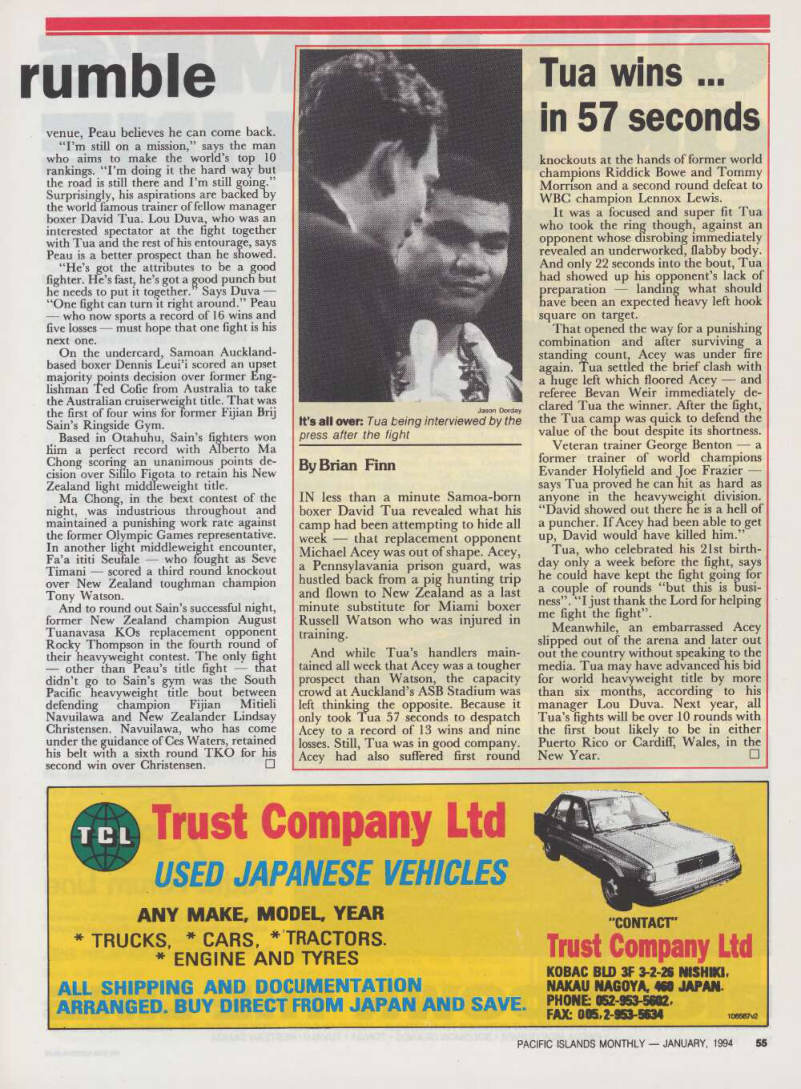
By Brian Finn
JIMMY Thunder Peau was a clear and obvious favourite go ing into his first World Boxing Federation heavyweight title de fence at Auckland in November. And why not. He was in top shape. He was fighting at home on one of the biggest boxing cards ever assembled in New Zealand. And in beat ing American Melton Bowen for the relatively-new WBF
belt in September, he had shown signs of new-found form and vigour.
So on November 19, his challenger British cruiserweight Johnny “The En tertainer” Nelson was expected to be another living example of a good small guy being beaten by a good big guy at Auckland’s Mt Smart Supertop.
He wasn’t. And by the end of the night, the small guy had lifted the WBF crown and with it, much of Peau’s new found confidence, on the strength of a convincing 12-round unanimous points victory. While Nelson was soaking up the limelight and a possible return visit to New Zealand, Peau was left alone to ponder another frustratingly poor per formance at home. On the night, Nelson proved he was a better boxer than many gave him credit for. The former WBF cruiserweight champion gave away a 10kg weight advantage to Peau but made the most of a six-inch reach advantage.
Nelson scored easily from the outside, tied up Peau’s normally-lethal inside punching, and used his speed to stay clear of the sluggish home fighter. The conclusion became obvious well before the end of the fight even to Peau’s trainer, Ces Waters. Peau, who had been trying to land a knockout punch from round one, looked unlikely to land even a fairly damaging blow before round 12.
Peau admitted afterwards he aban doned the pre-fight tactics to go for a knockout to try and please his home crowd. But that has now placed his relationship with Waters who he credited earlier for his boxing revival in jeopardy. Says Waters “I felt I was looking at the Jimmy Thunder of five years ago. “There was no power in his punching, no snap. I couldn’t believe I
was looking at a fighter I trained.”
Waters says while Peau had lost his WBF title, he too has lost some of his prestige as a trainer and will need to reassess his relationship with Peau.
Now, Peau is left again with the prospect of resurrecting his professional career. Ironically, it could begin with a title fight in Auckland. But the Samoan Aucklander is reluctant to fight at home
again.
“I really feel the pressure here,” he says. Peau says he expects too much of himself at home in Auckland and would prefer to fight Nelson in Britain or possibly elsewhere. Regardless of the
Jason Dorday
Thunder defends: Nelson scores with a left jab
venue, Peau believes he can come back.
“I’m still on a mission,” says the man who aims to make the world’s top 10 rankings. “I’m doing it the hard way but the road is still there and I’m still going.”
Surprisingly, his aspirations are backed by the world famous trainer of fellow manager boxer David Tua. Lou Duva, who was an interested spectator at the fight together with Tua and the rest of his entourage, says Peau is a better prospect than he snowed.
“He’s got the attributes to be a good fighter. He’s fast, he’s got a good punch but he needs to put it together.” Says Duva “One fight can turn it right around.” Peau who now sports a record of 16 wins and five losses must hope that one fight is his next one.
On the undercard, Samoan Auckland based boxer Dennis Leui’i scored an upset majority points decision over former Eng lishman Ted Cofie from Australia to take the Australian cruiserweight title. That was the first of four wins for former Fijian Brij Sain’s Ringside Gym.
Based in Otahuhu, Sain’s fighters won Him a perfect record with Alberto Ma Chong scoring an unanimous points de cision over Sililo Figota to retain his New Zealand light middleweight title.
Ma Chong, in the bext contest of the night, was industrious throughout and maintained a punishing work rate against the former Olympic Games representative.
In another light middleweight encounter, Fa’a ititi Seufale who fought as Seve Timani scored a third round knockout over New Zealand toughman champion
Tony Watson.
And to round out Sain’s successful night, former New Zealand champion August Tuanavasa KOs replacement opponent Rocky Thompson in the fourth round of their heavyweight contest. The only fight other than Peau’s title fight that didn’t go to Sain’s gym was the South Pacific heavyweight title bout between
defending champion Fijian Mitieli
Navuilawa and New Zealander Lindsay Christensen. Navuilawa, who has come under the guidance of Ces Waters, retained his belt with a sixth round TKO for his second win over Christensen. □
ready for Thunder
David Tua’s camp ready for Thunder
OLYMPIC boxing heavyweight bronze medalist David Tua will front up to Jimmy “Thunder” Peau when the time is right, his manager Lou Duva said in Auckland. The Tua entourage had arrived in Auckland on November 16 to prepare for his fight with Miami’s Russ Watson, known as “the Florida Fist”, on November 26 at the ASB Stadium.
Duva said his camp was not avoiding Thunder; he would not put his boxer up against the more aggressive former Commonwealth Games gold medalist until he was ready. “We’d like to go and have a look at him (Thunder),” Duva told NZPA. “Sure we’ll fight, we’ll fight Jimmy Thunder there is no prob lem with that.” Thunder, on repu tation, was the sort of fighter they wanted to pit Tua against. NZPA
in 57 seconds
Tua wins ... in 57 seconds
By Brian Finn
IN less than a minute Samoa-born boxer David Tua revealed what his camp had been attempting to hide all week that replacement opponent Michael Acey was out of shape. Acey,
a Pennsylavania prison guard, was
hustled back from a pig hunting trip and flown to New Zealand as a last minute substitute for Miami boxer Russell Watson who was injured in
training.
And while Tua’s handlers main tained all week that Acey was a tougher prospect than Watson, the capacity crowd at Auckland’s ASB Stadium was left thinking the opposite. Because it only took Tua 57 seconds to despatch Acey to a record of 13 wins and nine losses. Still, Tua was in good company.
Acey had also suffered first round
knockouts at the hands of former world champions Riddick Bowe and Tommy Morrison and a second round defeat to WBC champion Lennox Lewis.
It was a focused and super fit Tua who took the ring though, against an opponent whose disrobing immediately revealed an underworked, flabby body.
And only 22 seconds into the bout, Tua had showed up his opponent’s lack of
preparation landing what should
nave been an expected heavy left hook square on target.
That opened the way for a punishing combination and after surviving a standing count, Acey was under fire again. Tua settled the brief clash with a huge left which floored Acey and referee Bevan Weir immediately de clared Tua the winner. After the fight, the Tua camp was quick to defend the value of the bout despite its shortness.
Veteran trainer George Benton a former trainer of world champions Evander Holyfield and Joe Frazier says Tua proved he can hit as hard as anyone in the heavyweight division.
“David showed out there he is a hell of a puncher. If Acey had been able to get up, David would have killed him.”
Tua, who celebrated his 21st birth day only a week before the fight, says he could have kept the fight going for a couple of rounds “but this is busi ness”. “I just thank the Lord for helping me fight the fight”.
Meanwhile, an embarrassed Acey slipped out of the arena and later out out the country without speaking to the media. Tua may have advanced his bid for world heavyweight title by more than six months, according to his manager Lou Duva. Next year, all Tua’s fights will be over 10 rounds with the first bout likely to be in either Puerto Rico or Cardiff, Wales, in the New Year. □
Jason Dorday It’s all over: Tua being interviewed by the press after the fight
Advertisements & other items, pp. 55-56 (1 item)
g||) Trust Company Ltd
USED JAPANESE VEHICLES
ANY MAKE. MODEL. YEAR
* TRUCKS, * CARS. * TRACTORS.
* ENGINE AND TYRES
ALL SHIPPING AND DOCUMENTATION
ARRANGED. BUY DIRECT FROM JAPAN AND SAVE.
CONTACT'
Trust Company Ltd
KOBAC BID 3F 3-2-26 NJSHIKI,
NAKAU NAGOYA. 460 JAPAN-
PHONE: 062-953-5602.
FAX; 005.2-953-5634
inniw7i/>
OUR NAME'S
ON THE LINE
s I ■m m - ' ; 0 ® a it I T wm In 1978, when the Pacific Forum Line came into being, its charter was to not only establish a viable locally owned service for the region, it was also charged with the responsibility for encouraging economic growth through increased trade.
Today, we act as a vital trade link for Forum Island countries. Our network of services covers the South West Pacific to every point of the compass and we offer a versatile fleet of vessels that can carry everything from containerised to break bulk and roll on/off cargo as well as handling specialised requirements like bulk liquid and refrigerated cargoes.
Next time you see the familiar yellow PFL flag flying proudly, spare a thought for the contribution the Line has made to this part of the world over the past seventeen years.
And, if that’s not enough reason to ‘put it on the Line’, take a look at our competitive rates, convenient schedules and the years of accumulated shipping experience our people offer. Because you know that when you ship with Pacific Forum, it’s our name (and yours) on the Line, right down the Line. />7
Pacific Forum Line
For more information on Pacific Forum Line’s services and offices throughout the South Pacific contact our Auckland office on:- Ph: (09) 3096 700. Fax: (09) 3092 683. Telex: 60460.
RIGHT DOWN THE LINE
PROVIDING REGULAR DIRECT AND TRANSSHIPMENT SERVICES TO AUSTRALIA • AMERICAN SAMOA • COOK ISLANDS • FIJI • KIRIBA Tl • NEW ZEALAND • PAPUA NEW GUINEA • SOLOMON ISLANDS • TONGA • TUVALU • WESTERN SAMOA
WILSON ADDISON BSOB
Shipping
schedules
New Zealand - Fiji direct Sofrana Unilines operates a fully containerised/ breakbulk service every 21 days from Auckland, Tauranga, Lyttleton to Suva and Lautoka.
Loading every 21 days, ro/ro service, containers - reefer. Contact Sofrana Unilines, Sofrana House, 101 Customs Street, Auckland, PO Box 3614, Fax (09) 393874, Ph (09) 773279, Tlx NZ 2313. Direct toll free line 0800 659-922, Contact Alan Foote. Compass Shipping Agencies, PO Box 921 Wellington, Tel (04) 382 8206, Fax (04) 3828239, Tlx NZ 4769 Contact Steve Brannigan.
Sofrana Unilines Agencies, PO Box 22046 Christchurch, Tel (03) 366 7180, Fax (03) 366 8868, TLX NZ4769, Contact Tony Newell.
Carpenters Shipping, Private Mail Bag, Suva, Fiji, Tel (679) 312244, Fax (679) 301572, Tlx FJ 2199. Sofrana Unilines, Suva, Fiji, Tel (679) 3156.45, Fax (679) 300057.
Australia - Fiji direct Sofrana Unilines operates a container breakbulk service every three weeks from Melbourne, and Sydney to Lautoka and Suva. Contact Sofrana Unilines (Aust) Pty Ltd, PO Box Q 136, Queen Victoria Building, Sydney, NSW 2000, Austra lia. Tel (02) 2648944, Fax (02) 2676547, Tlx (71) A 170090, Contact Sam Attaway/ George Lopez.
Delams Australia Pty Ltd. 474 Flinders Street, Melbourne. Tel (03 614 1344, Fax (03) 629 4957.
Carpenters Shipping, Suva, Tel (679) 312244, Fax (679) 301572. Sofrana Unilines Suva, Tel (679) 315 645, Fax (679) 300057. Carpenters Shipping, Lautoka, Tel (679) 663988, Fax (679) 664896. Sofrana Unilines, Lautoka Tel 679) 662921, Fax (679) 664896.
Australia - Fiji monthly service Sofrana Unilines (Australia) Pty Ltd operates a regular monthly service with MV Capitaine Wallis. Contact Sofrana Unilines, Sydney, Tel (02) 2648944, Tlx AA170090, Fax (02) 267-6547. Carpenters Shipping, Suva, Fiji, Tel (679) 312244, Fax (679) 301572, Sofrana Unilines, Suva, Fiji Tel (679) 315645, Fax (679) 300057. Carpenters Shipping, Lautoka, Tel (679) 63988, Fax (679) 664896. Sofrana Uni lines, Lautoka, Fiji, Tel (679) 662921, Fax (679) 664896.
Far-East - Fiji Service New Guinea Pacific Line (NGPL) operates a monthly service accepting containerised and break-bulk cargoes from Manila, Keelung Kaoshiung, Hong Kong, Lae to Suva, Lautoka (via Suva).
Contact Carpenters Shipping Suva, Fiji, tel (679) 312244, fax (679) 301572. New Zealand Unit Express, Maritime Building, 2-10 Customs House Quay, PO Box 890, Wellington. Tel 727865, Cables Enzue Man, Wellington, Tlx NZ31340 Nedlnz or Nedlloyd Swire Pty Ltd Sydney, Tel 20522.
Japan - South Pacific Service Same as Burns Philp Japan - South Pacific Service - Kyowa Shipping Co Ltd
Kyowa Shipping, Shipping Co Ltd provides a monthly service from Hong Kong to main ports °f Japan, Saipan, Guam, Island ports, Lautoka, Suva via Nukualofa to Pago Pago and Apia.
Contact Carpenters Shipping, Neptune House, 3/4 floor, Tofuaa Street, Walu Bay, Suva. Tel 312244, Fax 301572, Tlx FJ2199.
Europe - Pacific Service Bank Line offers a monthly service to and from Europe for containerised breakbulk and bulk vegetable cargoes. Calling Papeete, Apia, Suva, Lautoka, Noumea, Port Vila, Santo, Honiara and PNG. Main ports to and from major northern Eurpoean ports. Contact Bank Line, South Pacific Office, Central Court Bid , 7th Street, Lea, PNG,TeI 422925, Tlx NE4426s.Carpenters Shipping, 3/4 Floor,Neptune House, Walu Bay, Suve, Fiji, Tel (679) 312244, Fax (679) 301572, TIxFJ 2199.
Nedlloyd offers cargo services from Continental ports to Papeetee, Fiji, New Caledonia and Doniambo on slot basis with Bank Line. Contact Carpenters Shipping, Suva, tel 312244, Tlx FJ2199, Fax 301572. Carpenters Shipping, Lautoka, Tel 663988, Tlx FJ5215, Fax 664896.
South East Asia - Fiji Service Nedlloyd Lines Service (NZEAS) Service oper ates regular fast cargo service from Jakarta, Pt Keelang, Singapore, Bangkok, Surubaya via Auckland to Suva and Lautoka. Contact Carpenters Shipping, Suva, Tel 312244, Tlx FJ2199, Fax 301572. Carpenters Shipping, Lautoka Tel 663988, Tlx FJ5215, Fax 663988.
Nedlloyd New Zealand, Wellington Tel (04) 472 7864, Fx (04) 473 9201 Far East - Mid South Pacific China Navigations New Guinea Pacific Line in association with Bank Line, operates a regular container and breakbulk heavy lift service from Hong Kong, Taiwan, Manila, Singapore, Malaysia, Thailand to Port Moresby, Lae, Rabaul, Kieta and Honiara. Cargo from the same eastern ports to the South Pacific Ports of Noumea, Santo, Vila, Papeete, PagoPago, Apia, Nukualofa, Rarotonga and Tarawa will be shipped via Japan or Busan on the monthly Bali Hai Service. Contact Steamships Shipping, Port Moresby, PO Box 634, Tel 220283 or 220289.
Tasman Asia operate a 20-day frequency fixed date service, shipping breakbulk and containerised cargoes from Japan, Korea, Tai wan and Hong Kong to Suva and Lautoka (via Suva). Fiji agents are Forum Shipping Agencies in Suva, Tel 315444, and Lautoka 660577.
Australia - New Caledonia - Fiji • Samoas - Tonga Pacific Forum Line operates a fully containerised service (general, reefer and ro-ro) from Sydney and Brisbane to Noumea, Lautoka, Suva, Apia, Pago Pago, Nuku’alofa, Sydney. Cargo central ised from Adelaide and Melbourne. Contact: Pacific Forum Line, PO Box 796, Auckland; Union Bulkships, 333 George St, Sydney, Brisbane and Melbourne; Union Co, Lautoka; Pacific Forum Line, Suva, Nuku’alofa; Pacific Forum Line, Apia; Polynesia Shipping, Pago Pago. Sofrana Unilines operates a roro/container service every three weeks from Melbourne, Sydney and Brisbane to Noumea, Suva and Lautoka with transhipment to the Samoas and Tonga.
Advertisements & other items, pp. 57-60 (1 item)
Pacific
ISLANDS
I M O N T H L Y 1
MARKET PLACE
SCRAP METAL
Tall ingots operate from Brisbane, Australia and make frequent visits to the Pacific Islands which they have done for twenty-five years. We are buyers of Copper, Brass, Aluminium, Lead, Cable etc. Inspection no problems. Telephone 61 7 8922033. Fax 61 78922077.
AGENTS REQUIRED
Fiji s largest wholesaler of Car Accessories, Car Care Products, Woodworking Machinery requires agents in all South Pacific Countries Contact Autobam PO Box 468 Suva, Fiji Islands. Telephone (679) 311151.
Fax (679) 305072
HEALTH & NUTRITION
“You can earn $1 million P.A. MLM ground floor opportunity specialising in Health and Nutrition products. In 16 countries and expanding rapidly. Top Products and Company Support. Send Sase to AGM, 96 Sugarloaf Road, Geilston Bay, Australia, 7016 or Fax 6102 471026.”
Era***-**
“Fiji Islands Beach Front Lqts, For Sale U 5515,000.00 with easy terms adjacent to Tourist Resort for Free Brochure Phone: (679) 311075, Fax (679) 303160 or Write C/ PO Box 228, Suva, Fiji Islands.
ARTS & CRAFTS
Producers of traditional arts, crafts, artifacts sought. Consignment and representative opportunities also available. Gallery of the Pacific, 65 Hardgrave Rd, West End, Brisbane Australia 617 846 7177/ Fax 61 7 846 4709
MARKET PLACE CAN WORK
WONDERS FOR VOU ...
Promote your business, or service, sell your household
items, cars or heavy machinery
etc.
ONLY AUSSI PER WORD.
NO COMPANY LOGO. NO
DISPLAY. NO BOLD TYPE.
Just forward your Advertisement together with payment to: PACIFIC ISLANDS MONTHLY “Market Place".
P.O. Box 1167. Suva, Fiji.
PACIFIC REGIONAL AGRICULTURAL/RURAL
DEVELOPMENT PROGRAMME
VACANCY - PROGRAMME CO-ORDINATOR
The Secretary General, Forum Secretariat, as Regional Authorising Officer for the European Development Fund invites applications from qualified agricultural economists and/or agronomists for the post of Programme Co-ordinator Designate in the EDF Funded Pacific Regional Agricultural/Rural Development Programme, based in Suva, Fiji.
The Programme Co-ordinator will be responsible to the Regional Advisory Board for the coordination of all aspects of the Pacific Regional Agricultural/Rural Development Programme including technical, economic and financial together with the preparation of periodic reports as required by the Regional Authorising Officer and the Donor.
Applicants should have a degree in agriculture, agricultural economics and preferably a post graduate qualification in an appropriate subject with at least 10 years experience post graduation. A knowledge of European Development Fund procedures would be an advantage.
The successful candidate will be expected to take up his duties in April 1994 and to work with the present incumbent for a period of 6 months and thereafter assume full responsibilities for the post. He/she will be expected to live in Suva, Fiji but considerable travel within the region will be expected.
The position is open to citizens of the European Union, and the ACF Countries. However, in case of equal competence, preference will be given to citizens of the 8 Pacific ACP Countries which are:- Fiji, Kiribati, Papua New Guinea, Solomon Islands, Tonga, Tuvalu, Vanuatu and Western Samoa.
Terms and conditions of employment will be commensurate with the post and with the experience of the successful applicant. More detailed terms of reference can be obtained from the Forum Secretariat on application.
Applications will close on Tuesday February 4,1994 and should contain comprehensive information on education and career backgrounds as well as the n referees with whom the applicant has been associated professic Applications should be addressed to:- The Secretary General EDF Regional Authorising Officer Forum Secretariat GPO Box 856 Suva Fiji 3 1508 Further information is available on request from Mr Brian Smith on 300-270.
Fax: (679) 320-794.
!£ 20 25 30 35 40 45 50 55 60
' A LIFETIME OF SERVICES
40 Grand Pacific Life Insurance offers you a lifetime of safe, secure products at very competitive rates.
Choose from a full range of products such as
• Super Ordinary Life
• Super Universal • Non-Participating Whole Life • 10-Year Level Term • Flexible Premium Annuities
• Group Life insurance
• IRAs
• Graded Premium Whole Life We've been dedicated to providing fast, personalized service for more than 35 years through local ownership and management.
That's why Grand Pacific Life is your Family 1 ...throughout the Pacific. 0 5 10 15 20 25 30 ' 1 40 35 40 45 50 55 60 ©
Grand Pacific Life Insurance, Ltd.
A member of the Finance Factors Family
FEDERATED STATES
OF MICRONESIA
Actouka Executive Insurance Underwriters P.O. Box 55, Kolonia, Pohnpei, Federated States of Micronesia 96941 Pacific Basin Insurance & General Services, Inc P.O. Box 494, Chuuk State, Federated States of Micronesia 96942
TONGA
Peseti Ma 'afu Ins. & Finance, Ltd.
Private Bag 2, Taumoepeau Bldg.
Nukualofa, Tonga
GUAM
Great National Insurance Underwriters, Inc.
P.O. Box GA, Agana, Guam 96910
AMERICAN SAMOA
Mark Solofa Pacific Insurance & Finance, Inc.
P.O. Box 3149 Pago Pago, American Samoa 96799 Pacific Financial Corporation P.O. Box AT, Agana, Guam 96910 Takagi & Associates, Inc.
GCIC Bldg., Suite 100 414 W, Soledad Ave.
Agana, Guam 96910
MARSHALL ISLANDS
Marshalls Insurance Agency P.O. Box 113, Majuro, Marshall Islands 96960
WESTERN SAMOA
Mark Solofa Pacific Insurance & Finance, Inc.
P.O. Box 3149 Pago Pago, American Samoa 96799
NORTHERN MARIANAS
Pacific Basin Insurance Underwriters. Inc.
P.O. Box 710 Saipan, Mariana Islands 96950 Pacifica Insurance Underwriters, Inc.
P.O. Box 168, Saipan, Mariana Islands 96950 Grand Pacific Life Insurance, Ltd. *1164 Bishop Street, sth Floor, Honolulu, HI 96813 Phone: (808) 548-3363 • FAX: (808) 548-5122
r : i
The AH New Mitsubishi Galant —
A Car That Won’t Cramp Mmr Sty Imagine... a car dynamic and sporty enough to excite your adrenaline, yet smooth and comfortable for a relaxing drive home at the end of a long day.
A car that lets you drive exactly how you feel. With the new Mitsubishi Galant, it’s finally here.
When you’re driving on winding or hilly roads, the new Galant assures effortless steering and quick response to give you the control you need for lively, enjoyable driving. Yet for relaxed cruising, you can also count on one of the smoothest, quietest rides on the road today. The new Galant literally handles to suit the way you want to drive.
The secret is a revolutionary new four wheel multi-link suspension, which you’ll find on every 2 ; ms. m h it ■l/ n 4 new Galant. Since every move a car maices, from accelerating to cornering to stopping, happens through four tiny patches where the tyres touch the ground, the new Galant’s multi-link suspension makes all four wheels work as effectively as they can to direct, manipulate and control.
It’s part of All Wheel Control, Mitsubishi’s unique new philosophy designed to give you total control over the driving experience. And with that control comes the choice to drive in the style that feels right to you.
Discover the meaning of driving freedom with the new Mitsubishi Galant—and feel how All Wheel Control sets you apart from the crowd.
The All New
MITSUBISHI GRLRNT
FIJLNMS wSfi 1 !* LTD ' 4 ! WBlly Park ' S ° Ulh AuStralia ' M (08) 27572971 D'AUTO DU PACIFIQUE SUD SA. P.O. Box Te11 274W/NEWZEALAND-(WTSMRIRHn EStoPc I M®" 26 ' l NEW tfUDONIA: SOCIETE DTMPORTATION PTY LTD. RO. Box 169, Tel. 2114 /PAPUA NEWGUINM:' TOBAPT7 LTD PO Box 503 / NORFOLK ISU ' HD: BORRY’S ISLANDS: HARVEST PACIFIC LTD G.PO Box 823 Honiara Tel 30407 1 TAHITUFRENCH MivS-t, Box 569 ' SKV olst 4 Tel 234 3332 1 SOLOMON NukuAlofa, Tel. 24044, VANUATU: SOCOMETRA VANUATU LTD B.P. (ffi A
MITSUBISHI
MOTORS
CREATING TOGETHER