Pacific

Islands
Monthly
•Ecember 1993
South Pacific Commission
What now as the United Kingdom plans to pull out?
■kViinrium ■ k y iriTcj[H
Fiji’s league hero makes his mark in Aust p5B
■ Blight hits taro in Western Samoa pl 4 ■ Aloha Fiji: Bank of Hawaii opens in Suva p!3 ■ Guerrero’s out in CNMI election p4l
Eref
Mamaloni claims power in unstable Honiara pl 7
Lm C A$2 S |rNlue S t 2 Z5.?. : Islands NZ$3; FIJI find VAT) F 51.92: FS Micronesia US$3; Hawaii US$3; Kiribati A 52.50; f£l«lMLha^n^S* f** fT j 1 .. 0 ,. CP,2S °: N6W Zea,and (lncl GST > NZ53.45; Nth Marianas US$3; Papua New Guinea Ss3. Marshalls US$3. Solomon Islands As 3; French Polynesia cpf3oo: Tonga P 3: USA US$3; Vanuatu VT22O; Western Samoa T 3.25. * Recommended retail price only
Advertisements & other items, pp. 2-4 (1 item)
Your Island Connections
m f
Cable and Wireless began keep-
ing people in touch around the
world more than a century ago. Today,
while the technology has changed,
the tradition of service to our customers in the
South Pacific is just the same.
We work in partnership with Governments,
dedicated to meeting the need of communities and businesses to stay in touch. From one island to the next or to the other side of the world, the message is the same: Cable and Wireless is
your South Pacific
connection bringing the
islands together.
CABLE & WIRELESS
Asia Pacific Head Office Cable and Wireless pic Cable and Wireless (Pacific) Limited 22 nd Floor Office Tower Convention Plaza 1 Harbour Road Hong Kong Fiji In association with the Government of Fiji Fiji International Telecommunications Ltd.
P.O. Box 59 Mercury House 158 Victoria Parade Suva
/OCl\ O AO
Solomon Islands In association with the Government of the Solomon Islands Solomon Telekom Company Limited P.O. Box 148 Honiara Solomon Islands 1H <677121576 Tonga Cable and Wireless pic Private Mail Bag 4 General Post Office Nuku Alofa Tonga South Pacific Tfel: (676) 23499 In association with the Government of Vanuatu and France Cdbies el Radio Telecom Vanuatu Limited P.O. Box 146 Port Vila Vanuatu Tel: (678) 22185
rou* s f “>* o**
YOUR INBOUND SPECIALIST IN THE SOLOMONS
ISLANDS FOR
* F.I.T GROUP * SPECIAL INTEREST TOURS * HOTEL, DIVE AND CAR HIRE BOOKINGS * LAND, AIR ARRANGEMENTS * SEA ARRANGEMENTS EXPrIsS LINER THE M ° ST COMFORTABLE AND AIR CONDITIONED m I § —>• IV ■: : tv WE’LL SHOW YOU SOME OF OUR CULTURE
HERITAGE AND PRIDE IN THE REMOTE
SOLOMON ISLANDS
TOUR SOLOMONS LIMITED
P.O. BOX 337, HONIARA SOLOMON ISLANDS
TEL (677) 21630 FAX (677) 21637
Four Basic Colours
YELLOW BLACK
Plus
Fiji Times Commercial Printing
UTHROHE
2B HI
Equals
Printing Excellence
u It is quite amazing what our experienced master printers, with the latest in printing technology, can produce from FuM colour°packaging and food labels that look good enough to eat; award winning full colour brochures and posters; mag Lines, calendars, books, stickers, fabric labels and billboards with pictures that leap right out of the iTvour orodtct requires export-quality, high impact four colour printing, then you should be talking to us first.
You’ll find our prices very competitive and our paper stock quite extensive.
FIJI TIMES
COMMERCIAL PRINTING DIVISION
Printing Excellence
HEAD OFFICE: 20 GORDON STREET, SUVA, FUI. PHONE: (679) 304111, FAX: 302011.
HUNCHES; LAUTOKA Phone: 660422 Fax: 660-352 LABASA Phone: 811644 Fax; 812649 NADI Phone: 780700 Fax. 780
Pacific

Islands
Monthly
Vol 63 No. 12
The News Magazine
December 1993
From The
Editor’S Desk 6
Letters 7
Headlines 8
Pacific Diary 10
Business Bulletin Ii
Business
New Air France chief 12 Aloha Fiji 13 Terrible taro blight 14 Fiji’s budget 15 A clash of expectations 16
Politics
Fhe saga continues 17
Dover Stories
South Pacific Conference 18
Population
Growing pains 20
Issue
\buse outrage in NZ 24
/Anuatu
\ troubled govt / Uni’s view 26 Hilda Uni speaks out 27
*Alau
Vill referendum decide Blau’s nuclear stand? 28
United Nations
A voice in New York
Nz Election
Technology
Coconut power
Books
Unhappy natives
Tuvalu
Whither now Tuvalu?
Cnmi Election
Guerrero’s out
Pacific Telecom 44
34
Yachting
35 Fellowship in Fiordland 57
Sport
37 Fiji’s rugby league hero 58 Mini Games in Vanuatu 59
38 Computers
New database boon 60
40 Columnists
David Barber 23 Bill McCabe 31 41 Jemima Garrett 39
Publisher: Brian O’Flaherty Acting Editor; Martin Tiffany Associate Editor: Arvind Kumar Correspondents; Christine Hatcher, David North. Ed Rampell. lan Williams. Johnson Honimae. Karen Mangnall, Liz Thompson. Nicholas Rothwell, Pesi Fonua. Wally Hiambohn.
Columnists: David Barber (Wellington), Futa Helu (Tonga, covering the Pacific Islands). Jemima Garrett (Sydney).
Julian Moti (Pacific Law). Alfred Sasako (The Forum).
Advertising Sales: • Regional Sales (South Pacific); Salendra Narayan. Tel (679) 304111. Fx (679) 303809 • Sydney, Canberra Bob Hill Media Represen tations. Tel (61-2) 4164245, Fx (61-2) 4165064 • Brisbane; Robert Walker. Media House, Tel (61-7) 3710533. Fx (61-7) 371-8904 • Adelaide; Hastwell Williamsons Representations, Tel (61-8) 799522, Fx (61-8) 799735 • Melbourne: Brown Orr Fletcher Burrows (Aust).
Pty. Ltd. Tel (3) 696 5188 Fx (03) 696 5131. • Auckland; McKay & Bowman, International Media Representatives Ltd, Tel (64-9) 4190561, Fax (64-9) 4192243.
• Japan: Universal Media Corporation. Tokyo, Tel (3) 6663036, 6663094. Cable; UNIMEDIA Tokyo.
Tx 2524665.
Founded 1930 (USPS 952480). A Fiji Times Limited production.
Cover prices are recommended retail only. Regis tered by Australia Post, Publication No. NBP 1210. © Copyright Fiji Times Limited, 177 Victoria Parade, Suva. Fiji. Tel (679) 304111, Fx (679)
303809. Tx Fj2124.
Pacific Islands Monthly is published monthly by The Fiji Times Limited, a division of Nationwide News, 2 Holt Street. Surry Hills, Sydney, NSW 2010.
Send address changes to: • Pacific Islands Monthly, PO Box 1167. Suva, Fiji.
Typeset and printed by The Fiji Times Limited, 177 Victoria Parade, Suva. Fiji.
Asaeli Lave
Western Samoan Taro: could devastate the economy (story page 14)
Bougainville peace
From The Editor’S Desk
OUR ‘Headlines’ section on pages eight and nine of this issue make interesting reading as far as Bougainville is con cerned.
The first Bougainville-related story concerns Papua New Guinea and the Solomon Islands and their signing of a six-point good relations agreement in Port Moresby in late September. The agreement was brought about mainly because of the border incursions by PNG forces a direct result of the five-year old Bougainville conflict.
One of the main points in the PNG/ Solomons agreement was their support of a Bougainville peace conference involv ing leaders of all Sides. The PNG government also announced that it had given approval for a European Com
munity monitoring group to make a fact-finding visit to
Bougainville. Some
thing members of the
Bougainville
interim-government
and others have been asking for for a long time. Previously Port Moresby had main tained the Bougain ville issue was an internal matter and
refused permission
for visits by foreign missions.
In the second story on page eight we read of the alle gation that PNG’s foreign minister,
John Kaputin who had earlier signed the agreement in Port Moresby refused to see Mike Forster of the
Bougainville interim-government in
Canberra. The reason because an ? member of the Bougainville interim-administration had been seen in a demonstration organised by the Bou gamville Freedom Movement in Can berra the previous day.
Surely Kaputin’s refusal borders on being childish and does not mirror a genuine committment to finding a sol ution to the Bougainville situation as was supposedly shown by him in Port Moresby.
The interim-administration are push ing for peace talks in Cairns, Australia basically as soon as possible. They are
pushing for a peace process and are waiting for PNG to end their military operations on Bougainville and take up their offer for peace talks. However, PNG says it will not negotiate until the Bougainville guerilla army, the Bougain ville Revolutionary Army, surrenders.
Neither side exactly smells of roses.
The human rights organisation Amnesty International accuses both the PNG government and the BRA of committing! atrocities. Although in a report released in London it was highly critical of the PNG government which it said failed to i investigate and take action against the perpetrators of executions, torture and rape during the campaign against the j Bougainville secessionists.
The aim of this editorial is not to take I
sides or point fingers but to en courage leaders from PNG, the BRA and the
Bougainville
interim-govern = ment to try and find a way to
come together
and hold peace talks.
Surely there has been enough death and suffer ing. Where is the so- called ‘Pacific Way’ we are al ways hearing about? □
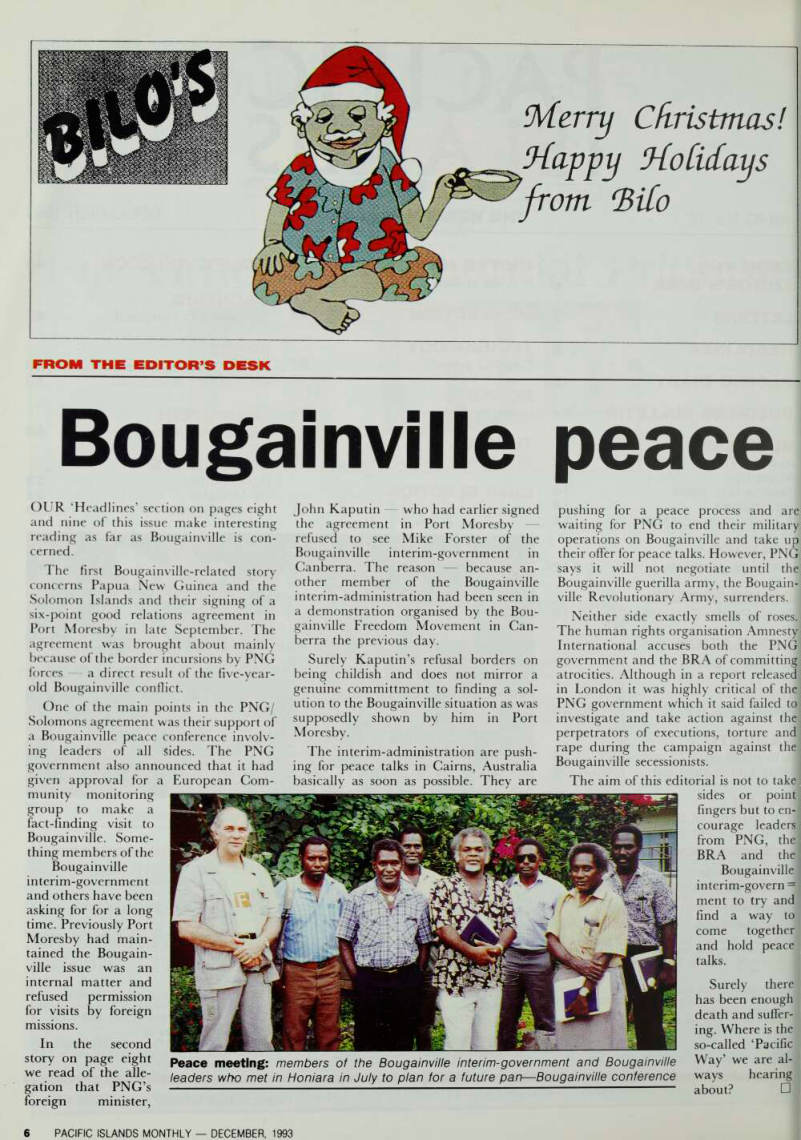
Peace meeting: members of the Bougainville interim-government and Bougainville leaders who met in Honiara in July to plan for a future pan—Bougainville conference
project
Letters
Marshalls project
Sir FACTS are often acquired only after a bilateral investigation and a comment to truth and fairness. Your account of the planned resort development on an unin habited atoll in the Republic of the Marshall Islands [PIM Sept) was incom plete and generally misleading.
Among the realms of domestic issues, economic interests, tourism and preser vation of the environment, the Iroijlaplap Murjel Hermios Eleemosy nary Trust continues to promote and defend the traditional rights and mores of (the Marshallese people) its benefici aries.
In terms of property, the Trust owns about one-third of the atolls and one quarter of the land area of the RMI. At its head is one of the highest ranking paramount chiefs.
Knowing all of these facts, John Miller broke off negotiations for the develop ment at Erikub Atoll with the Trust in favour of trying to strike a deal on his own.
The resulting lease he signed would have stripped the Marshallese natives of all rights to the atoll and could have put off rent payments (as credit against losses) for as much as one or two decades.
It would have also give Islander Invest ments, Inc. almost unlimited powers to build any structure and sublet or modify the lands, lagoon and seabed within a five mile radius of this very fragile uninhabited ecosystem and refuge for wildlife.
Contrary to your account, Mr Miller uas made no attempt to contact that
which he knows is the rightful land owner, the Trust, to reach an out of court settlement. In fact, the court case continues toward a hearing date.
We trust your readership will under stand that the image of the Marshallese (“dissenting landowners”) should not be judged nor influenced by comments made by the American Miller. Details of these dealings and their impact would be voluminous but suffice to say that the Marshallese should not be characterised as being the problem.
We invite your reader’s response and broad support of efforts to preserve native rights and the natural environ
ment. By working together, the peoples
of the Pacific region will ward off the advances of profiteers and continue in
understanding, cooperation and innova
tive approaches to economic develop ment and tourism.
For further information or comments, please write P O Box 8441, Honolulu, Hawaii 96830.
Kermit Rydell
Iroijlaplap Murjel Hermios Eleemosynary Trust Honolulu Hawaii.
LETTERS to the Editor must include the writer’s full name, address and home telephone number. All letters may be edited for purposes of clarity and space.
Letters should be addressed to: G P O Box 1167 Suva
Fiji Islands
OR Fax; (679) 303809.
Advertisements & other items, p. 7 (1 item)
■Pacific
Remember your Friend
There are times in your life when you feel your friends have been missing out on something good. Now’s your chance to do something about it and share with them one of the good things you have. Buy your friend a subscription to Pacific Islands Monthly and let him or her join you and thousands of other people worldwide who are kept informed of the latest political, social and cultural
changes taking place in the Pacific.
SUBSCRIPTIONS
American Samoa US$45 Australia A 542.00 Canada US$45 Cook Islands AUSS46 Fiji F 526.40 French Polynesia US$45 Guam US$45 Hawaii US$45 Japan US$45 Kiribati AUSS46 Marshall/Micronesia US$4O Nauru AUSS42 New Caledonia US$32 New Zealand NZ$55 Niue AUSS46 Norfolk Island AUSS42 Northern Marianas/Palau US$4O Papua New Guinea AUSS4S Solomon Islands AUSS46 Tonga AUSS46 Tuvalu AUSS46 United Kingdom Stg Pound2B US Mainland US$45 Vanuatu AUSS4S Western Samoa WS$6O Elsewhere AUSS63 Payment to Pacific Islands Monthly: Subscriptions Dept. GPO Box 1167, Suva, Fiji.
Subscriptions rates include the cost of airspeeding to all destinations set out above.
Direct airmail rates on application.
Telephone: 304111 Fax; 303809
■PACIFIC
SLANDS ■
I MON T H L T~l I Please send my friend Pacific I Islands Monthly for one year ,
(12 issues). W
I enclose my cheque for $ c£b
(made payable to Pacific
Islands Monthly) 1 or debit $ to my: □ Bankcard □ Visacard □ ( Mastercard I Card No: i i ! i I ' i ! i ! : i I 1 i I Expiry Date 1 I
NAME
SIGNATURE 1
I
ADDRESS: ,
CITY COUNTRY
The
Pacific Islands Monthly
team wishes its readers a Merry Christmas and a prosperous 1994. w
TO ANYWHERE
IN THE WORLD
Your artifacts, gifts, souvenirs, carvings, artworks, documents whatever DHL will deliver anywhere worldwide Freight Forwarders, Air Cargo . . DHL Worldwide Express Service Cmt us now wi rp
SUVA NADI LAUTOKA LABASA LEVUKA
313166 (679)723800 665400 811162 440139
SAVUSAVU 665401
850454 ith DHL You re m sate hands all the way
Security Act
[Headlines
Papua New Guinea
Good relations
agreement signed with Solomons
Papua New Guinea and Solomon Islands have signed a six point agreement aimed at restoring good relations between the two countries in the wake of tensions resulting from border incursions by PNG forces. The agreement was signed by the foreign ministers of the two countries, John Kaputin and Francis Saemala, following two days of talks in Port Moresby.
The ministers also announced their support for a Bougain ville peace conference involving the leaders of all sides in the five-year-old conflict. In addition, Kaputin said the Papua New Guinea government had given approval for a European Community monitoring group to make a fact-finding visit to
Bougainville.
Port Moresby has previously withheld permission for visits by foreign missions on the ground that the Bougainville issue was an internal matter.
The six-point agreement confirmed that Papua New Guinea would pay Solomon Islands up to US$3OO,OOO dollars in compensation for cross-border incursions by PNG forces in which several Solomon Islanders were killed. ***
Security Act
challenged
The full bench of the Papua New Guinea Supreme Court has begun hearing a case challenging the constitutional validity of the country’s Internal Security Act. The case has been brought before the Supreme Court by Papua New Guinea’s chief ombudsman, Charles Maine.
PNG’s chief justice, Arnold Amet, has decided that both he and the deputy chief justive, Sir Mari Kapi, should sit on the case along with three other judges from Papua New Guinea’s National Court.
The chief ombudsman is challenging the Internal Security Act on the grounds that he believes it infringes at least 16 individual and civil rights guaranteed by the PNG constitution.
The government may not be mounting much of a defence.
Prime Minister Wingti has already indicated his willingness to amend the Act while his police minister says he’s prepared to go further and repeal it altogether . ***
Bougainville
refusal
An emissary from the Bougainville interim government says the Papua New Guinea foreign minister, John Kaputin, refused to see him on November 6. Mike Forster, who has a brief on behalf of Bougainville officials to help set up a meeting in Australia to setle the Bougainville crisis, said he had been refused a meeting with Kaputin in Canberra because a member of the Bougainville interim government had been seen in a Canberra demonstration on Friday.
The interim government is trying to pursue a peaceful solution to the Bougainville crisis and PNG has suggested it might meet its representatives. But PNG says it will not negotiate until the Bougainville guerrilla army surrenders.
Forster said because the PNG government did not seem to be pushing hard for the Cairns meeting, the interim government would probably be forced to raise the issue of Bougainville independence at the United Nations next year.
Aidwatch
Australia
Aidwatch launched
A new independent Australian body, AIDWATCH, says more than US$4O million worth of Australian taxpayers’ money is being used by Papua New Guinea police to restrict civil liberties.
Speaking at the official launch of Aidwatch at Sydney’s parliament house, director Carol Sherman criticised an Australia aid program designed to strengthen and provide training to police in PNG. She says the money is instead being used by PNG police to ban political opposition and groups opposed to mining and logging developments.
Sherman says Australian money is going towards a police force that is alienated and totally distrusteed by the public.
Aidwatch has been set up to monitor the impact and effectiveness of Australian foreign aid projects.
Republic
New Zealand
Republic prediction
New Zealand’s foreign minister Don McKinnon is predicting the country will eventually become a republic. McKinnon was in New York to address the UN and other international bodies.
At an Asia Society meeting the minister was asked how New Zealand viewed the Australian republican debate. He says he believes Australia will become a republic before the Olympics in the year 2000. And McKinnon sees New Zealand following suit and becoming a republic just a few years after Australia.
Senate apologises
United States
Senate apologises to Hawaiians
The American Senate has apologised to native Hawaiians for the US backed overthrow of their monarchy 100 years ago. A Senate resolution, passed 65-34, acknowledged the anniversary as a gesture of reconciliation to native Hawaiian but did not provide any compensation or offer to restore independence.
Hawaii was an independent kingdom until January 17, 1893 when a small group of American and European businessman, aided by American sailors and marines, forced Queen Lilivokalani to give up her throne. Hawaii senator Daniel Inouye described the overthrow as an illegal act committed in violation of the constitution of the Kingdom of Hawaii.
The United States annexed Hawaii in 1893 and it was a US territory until 1959, when it became a state.
Twenty eight sentenced
Western Samoa
Twenty eight sentenced on kill charge
A Western Samoan court has sentenced 28 people for their part in the execution-style killing of a chief. Nuutai Mafulu was shot betwen the eyes in front of his wife and children in September, allegedly on the orders of the council of chiefs in Lona village.
The village also destroyed his house, crops, animals, bus and
jeep.
Nuutai was supposed to have offended the village council by refusing to pay village fines, by refusing to allow a curfew bell to be rung from a tree near his house and by helping a neighbouring village win a cricket competition.
Most of the village council, including chiefs aged in their 70s face murder charges. Before magistrate Bill Billion in court in Apia, a group of 12 ranging in age from 36 to 65, were sentenced to twenty months jail 18 months of it suspended on the condidtions that they each pay Muutai’s family USS2O9 dollars and carry out 100 hours of community service.
Five men in a second group were sentenced to 10 months in prison, nine months of it suspended provided they pay USS 42 each and perform 75 hours of community service.
Billion said he based the sentences on the age of the defendants, an indication of their level of responsibility in the decision to burn and stone Nuutai’s property and the extent of the
participation.
The remaining 11 offenders, most of the youngest, got two years probation on conditions they do 350 hours of community service and surrender travel documents.
All had pleaded guilty.
Amnesty accuses
Papua New Guinea
Amnesty accuses PNG and Bougainville
The human rights organisation, Amnesty International, has accused both Papua New Guinea government forces and the Bougainville Revolutionary Army of committing attrocities.
However, in a report issued in London the group was highly :ritical of the PNG government.
It claimed the government had failed to investigate and take iction against the perpetrators of executions, torture and rape luring the campaign against the Bougainville secessionists, \mnesty said military restrictions on access to Bougainville had neant the security forces have been virtually free from outside crutiny creating a climate in which human rights violations lad been almost inevitable. Amnesty said that since the return )f government forces to Bougainville in 1991, there had been >ersistent reports of killings, torture, rape, beatings and larassment of suspected supporters of the Bougainville Revolutionary Army. It alleged at least 60 people were eported to have been illegally executed. Amnesty also said the ecessionists had carried out executions, torture and other tbuses against people accused of betraying the independence novement.
jailed
New Caledonia
Fire-starters jailed
Five men who started a fire at the home of the pro independence president of New Caledonia’s Islands province, Richard Kaloi, have been jailed by a court in Noumea.
The sentences ranged from 18 months to six years. Three of those convicted were also charged with starting two other fires last year in the French Pacific territory.
The accused were said to have agreed to attack Kaloi’s home in March and three of them threw fire bombs into his garage, two vehicles were destroyed. The attack took place at a time when there was a strong political dispute over funds for
economic development projects.
Support for human rights
Solomon Islands
Support for human rights high commissioner
Solomon Islands has expressed strong support for the establishment of a United Nations high commissioner for human rights. Addressing the 48th UN General Assembly in New York in October, Solomon Islands foreign minister, Francis Saemala, said the establishment of such an office is a worthwhile investment.
Saemala also said his government fully supports the Vienna Convention, declaration and programme of action resulting from the World Conference on Human Rights held last June.
He told the world body that imbedded in the Solomon Islands Constitution are fundamental rights and freedoms stipulated in the declaration.
He said Solomon Islands condemns any violation of human rights anywhere in the world.
contempt
Cook Islands
Cartoon contempt
The Cook Islands News newspaper has been found to be in contempt of parliament for publishing a cartoon. Announcing the findings of the privileges committee, prime minister Geoffrey Henry said the cartoon was suggesting that parliament was threatening the freedom of speech of Cook island citizens.
The two opposition members of the committee don’t agree, and say the cartoon didn’t go beyond legitimate criticism. The newspaper will have to publish two front page apologies and apologies from the cartoonist, editor and directors of the paper.
Advertisements & other items, p. 10 (1 item)
U^ncifu
to I wmmr& i f (<* l' !f C* 1 n
[TJwru
i\K'
DECEMBER
01-03 Regional Seminar on Competition Policy and Control of Restrictive Business Practices,Forum Secretariat, Suva, Fiji 05- Pacific Islands Political Studies Association (PIPSA) Conference, Rarotonga and Aitutaki, Cook Islands 06- South Pacific Mini-Games, Port Vila, Vanuatu
JANUARY 1994
18-26 19th Session of ICUN General Assembly
FEBRUARY 1994
07-10 Achieving Sustainable Growth Through Clean Production Processes, World Congress Centre, Melbourne, Australia ★ South Pacific Organisations Coordinating Committee (SPOCC) Meeting, SPREP headquarters, Apia, Western Samoa
APRIL 1994
★ Global Conference on the Sustainable Development of Small Island Countries, Barbados
JULY 1994
04-08 The Sixth Pacific Congress on Marine Science and Technology, James Cook University of North Queensland, Townsville, Australia 1995 Visit the South Pacific Year Note a ★ indicates dates have yet to be confirmed. Also some are provisional and may be changed.
fishing venture
Business Bulletin
Niugini Mining seeks
s3sm to buy gold shares
NIUGINI Mining Ltd plans to raise US$35 million though an institutional placement to help fund its share of the Lihir gold deposit in Papua New Guinea.
Niugini’s commercial manager Jeff Quartermaine says the company needs US$4B million deposit from 20 per cent to 30 per cent. The balance would come from internal sources.
Niugini has $2O million in cash and its two existing gold mines Red Dome in north Queensland and San Cristobal in Chile are cash positive. Mr Quartermaine says a joint venture agree ment between Niugini, RTZ Corp and the Papua New Guinea government is a good deal for Niugini.
Placer Dome pulls
out of Namosi project
PLACER Pacific Ltd says its 50 per cent partner in the Namosi copper prospect in Fiji, Placer Dome Inc, has withdrawn, ending the joint venture. Placer Pacific has been the manager of the joint venture, formed in April 1992, while Placer Dome has been fully funding the exploration program.
Place Pacific says it will apply to have the tenements transferred to its sole name and will continue its investigations through exploration and economic analysis.
More Kiribati govt
companies for sale
KIRIBATI finance minister Taomati luta says eight more government owned rompanies are in the pipeline for sale.
The minister, who’s also the chairman )f the government privatisation commit ee, named the companies as Abamakoro reading, Atoll Motor and Marine Ser ies, Kiribati Shipping Service Limited,
\ir Tungaru, the Government Printery,
he Betio Shipyard, Kiribati Insurance
md the Housing Corporation. The
nmister said the sale of the first four tate-owned companies was still progress ng but the Kiribati Supply Company is xpected to be sold soon.
»wlss firm to monitor
*NG’s log exports
HE Papua New Guinea cabinet has greed to engage a Swiss company to lonitor all PNG’s log exports. The idependent monitoring program is to ost PNG about US$2 million. The PNG overnment is to contract the Swiss
ampany, Society General Surveillance,
GS, to check on every shipment leaving /ery logging operation in the country.
Prime minister Paias Wingti says the im is to check that every log is paid for ad that no logging companies are ansferring profits abroad. The SGS
company would also look at whether PNG was getting a fair price for its timber resources.
Fibre-optic phone
system for Cook Islands
TELECOM Cook Islands customers are being offered better quality telephone through a new fibre-optic transmission system. The Cook Islands is the third Pacific country to install a fibre-optic service following in the footsteps of Fiji and Hawaii.
The US$5OO,OOO, 22-kilometre cable circles most of the island of Rarotonga and has been put in by Telecom New Zealand a 40 per cent shareholder in Telecom Cook Island’s holding com pany.
Digital multiplex equipment has also been installed on the network. Telecom Cook Islands says subscribers have already noticed that there has been a marked improvement in the quality of their telephone service with clearer and more reliable lines.
Fiji Air’s plans
put on hold
FIJI’S main domestic airline Fiji Air has been told to hold off its plans to reduce services from last month. The order has come from the Air Transport Licensing Board (ALTB) in a letter to company chief executive David Young. The airline had planned to cut services to small outer islnds which it says are unprofitable in the face of competition from newly formed airline Pacific Express.
Pacific Express has been given rights to operate on several high density profitable routes which, according to Fiji Air, subsidise outer island routes. The ALTB’s order not to cut services has sent Mr Young to his solicitors. Radio Fiji says Mr Young is angered that it took the ALTB two months to reply to Fiji Air’s proposed withdrawal.
3 olynesian Airlines
flying low
WESTERN Samoa’s international air carrier, Polynesian Airlines, is reported to be in trouble. The airline faces reduced staff members, as a result of what senior management describes as tough times. In the past year, Polynesian Airlines has expanded its route system four-fold to take in Honululu and Los Angeles.
The airline has also maintained its existing services to Australia, New Zea land, Fiji, Tonga, American Samoa, Cook Islands and Tahiti. The state owned carrier was managed until earlier this year by Australia’s Ansett Airlines, but general manager Papalii Grant Percival says Ansett’s withdrawl has left many staff unsure of what they are doing.
Asked about repeated rumours the airline is going broke, he says it is facing tough times. But he says problems have
to be expected with such rapid expan sion, ana the two new routes are doing very well.
New schedules for
Solomon Airlines
SOLOMON Islands flag carrier, Sol omon Airlines has introduced a new international and domestic flight sched ule which it believes will open up the possibility of attracting more Japanese tourists and divers.
An airline spokesperson said the new schedule came into effect on October 31.
It provides better connections at all Eoints on the routes in and out of olomon Islands and will cut out the need to make on oversnight stay in either Brisbane or Nadi. Under the new schedule it would be possible for a Japanese tourists to fly right through from Tokyo to Honiara or a diver to fly from Los Angeles to Gizo in the Western Province with no overnight stops.
Cooks budget
deficit hits USs3m
THE Cook Islands government’s budget deficit has again hit the US$3 million mark. This was revealed in a mini budget tabled in parliament in Avarua last month. The Cook Islands News says this is the second time in less than 12 months that the deficit has been this high.
Air Pacific gears up
for Osaka flights
FIJI’S international airline Air Pacific is to upgrade its Boeing 767-200 ER aircraft. Company chief executive Andrew Drysdale says the plane will be built at Boeing’s factory in Seattle to Air Pacific specifications. It will be used on the new Nadi-Osaka route.
Air Pacific has ordered another 8767 for delivery in 1996. The airline currently has an all jet fleet consisting of a Boeing 747-200, a 8767-200 and a Boeing 737-400.
Meanwhile, the airline has removed the flying marlin from its logo. The marlin will be replaced with the word ‘Fiji’ on the tails of Air Pacific aircraft.
<iribati, Japan in
fishing venture
THE Kiribati government and a Japan ese fishing company have agreed to form a joint purse seining fishing venture. An official from the ministry of natural resources development, Teekabu Tiikai, said the venture was proposed in a meeting between government officials and official of the Otoshiro Gyogyo
Fishing Company from Japan.
He said the two sides would meet again to sign the agreement for the joint venture in which the Japanese company will provide a purse seiner vessel worth US$3.3 million. □
New Air
Business
New Air France chiefa man of the Pacific
THE new president of Air France, Christian Blanc, comes to his job with solid South Pacific creden tials.
Appointed to run the huge, financially-pressed airline after strikers closed down the Paris airports and Air France world wide, Blanc had already shown his negotiating skills in New Cale donia.
A couple of years ago the then socialist premier Michel Rocard sent Blanc to New Caledonia to try to work out a settlement between the pro-independence Kanaks and the rest of the territory’s population.
Blanc was instrumental in reaching the Matignon Accords, which, while not totally pleasing to anyone, eased tensions in the French-controlled territory.
Rocard’s successor as premier, conservative Edouard Bahadur, called for cutbacks in Air France’s expenditures. This led to the strike, and one of its byproducts was the departure of the incumbent presi dent of Air France, and the promo tion of Blanc (who had been running Paris’ massive subway system).
The strike was successful in the sense that Bahadur backed off on his demands, leaving Blanc with a major, messy labour-management relations problem on his hands.
In the Pacific, Air France flies to Papeete, in French Polynesia, and to Noumea in New Caledonia, from such places as Sydney, Auckland and Los Angeles; Air France links with the affiliated Air Caledonie Interna tional in Noumea for regular con necting flights to Port Vila and once a-week service to Wallis.
Advertisements & other items, p. 12 (1 item)
To Serve Pawpaw
Howßatham
Learned The Best Way
To The Australian Market.
V / They asked us.
Batham International of Fyi produces fruit and fruit
juices. In particular, enough
pawpaw to supply a major market like Australia. But they weren’t sure what form to ship it in. Who would be most interested. Or how to get it distributed.
At the South Pacific Trade Commission we used our extensive resources to find out everything Batham needed to set up their rather fruitful new venture.
Just one of the many ways we are able to help businessmen from Pacific Forum countries.
If you’re starting up, improving or expanding a local business, we can help you too. Especially if you want to move into the export market.
And it’s all absolutely free.
To find out more, just post or fax us the coupon below. If you’re in a hurry, feel free to phone.
I Name [ Company I Address & o z Level 6,50 Park Street, Sydney NSW 2000.
Phone: (612) 283 5933, Fax: (612) 283 5948 AUvcntors I2«l
Aloha Fill
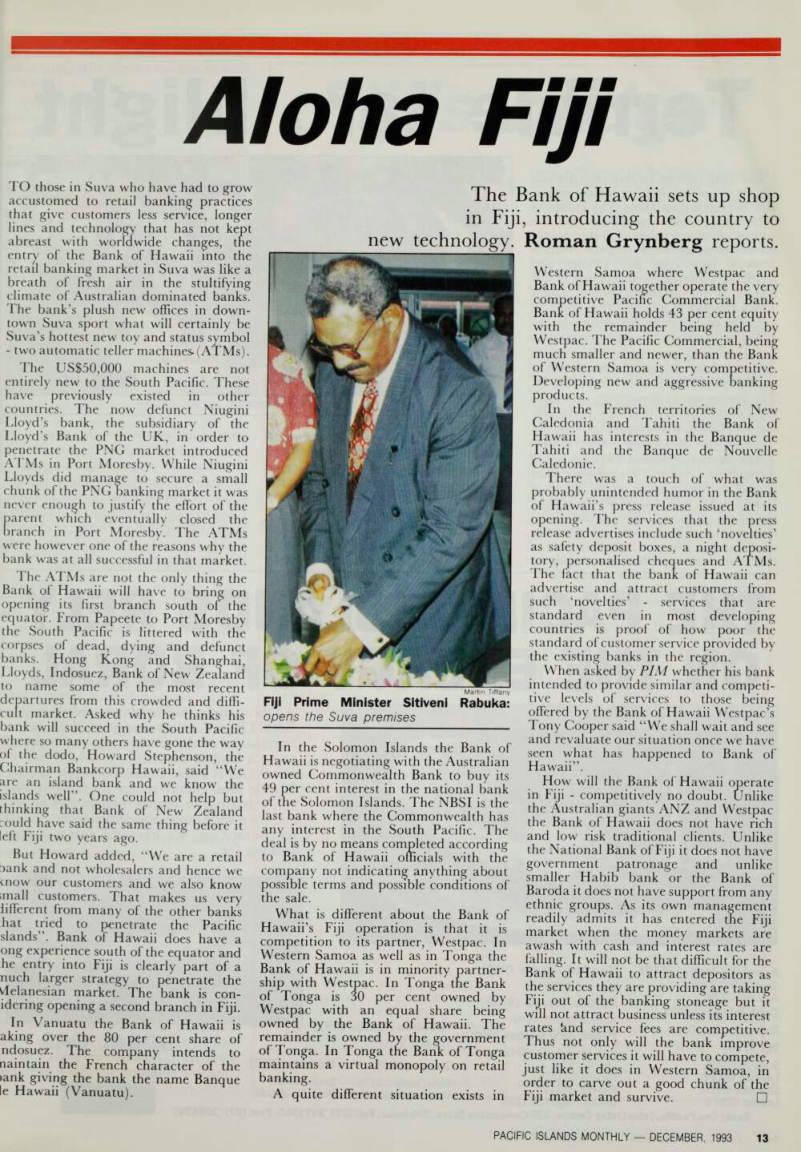
TO those in Suva who have had to grow accustomed to retail banking practices that give customers less service, longer lines and technology that has not kept abreast with worldwide changes, the entry of the Bank of Hawaii into the retail banking market in Suva was like a breath of fresh air in the stultifying climate of Australian dominated banks.
The bank’s plush new offices in down town Suva sport what will certainly be Suva’s hottest new toy and status symbol - two automatic teller machines (ATMs).
The US$5O,OOO machines are not entirely new to the South Pacific. These have previously existed in other countries. The now defunct Niugini Lloyd’s bank, the subsidiary of the Lloyd’s Bank of the UK, in order to penetrate the PNG market introduced ATMs in Port Moresby. While Niugini Lloyds did manage to secure a small chunk of the PNG banking market it was never enough to justify the effort of the parent which eventually closed the branch in Port Moresby. The ATMs were however one of the reasons why the bank was at all successful in that market.
The ATMs are not the only thing the Bank of Hawaii will have to bring on opening its first branch south of the equator. From Papeete to Port Moresby the South Pacific is littered with the corpses of dead, dying and defunct
banks. Hong Kong and Shanghai,
Lloyds, Indosuez, Bank of New Zealand to name some of the most recent departures from this crowded and diffi cult market. Asked why he thinks his bank will succeed in the South Pacific where so many others have gone the way of the dodo, Howard Stephenson, the Chairman Bankcorp Hawaii, said “We are an island bank and we know the islands well”. One could not help but thinking that Bank of New Zealand :ould have said the same thing before it left Fiji two years ago.
But Howard added, “We are a retail aank and not wholesalers and hence we enow our customers and we also know •mall customers. That makes us very different from many of the other banks hat tried to penetrate the Pacific slands”. Bank of Hawaii does have a ong experience south of the equator and he entry into Fiji is clearly part of a nuch larger strategy to penetrate the Helanesian market. The bank is con idering opening a second branch in Fiji.
In Vanuatu the Bank of Hawaii is aking over the 80 per cent share of ndosuez. The company intends to naintain the French character of the >ank giving the bank the name Banque
le Hawaii (Vanuatu).
The Bank of Hawaii sets up shop in Fiji, introducing the country to new technology. Roman Grynberg reports.
In the Solomon Islands the Bank of Hawaii is negotiating with the Australian owned Commonwealth Bank to buy its 49 per cent interest in the national bank of the Solomon Islands. The NBSI is the last bank where the Commonwealth has any interest in the South Pacific. The deal is by no means completed according to Bank of Hawaii officials with the company not indicating anything about possible terms and possible conditions of the sale.
What is different about the Bank of Hawaii’s Fiji operation is that it is competition to its partner, Westpac. In Western Samoa as well as in Tonga the Bank of Hawaii is in minority partner ship with Westpac. In Tonga trie Bank of Tonga is 30 per cent owned by Westpac with an equal share being owned by the Bank of Hawaii. The remainder is owned by the government of Tonga. In Tonga the Bank of Tonga maintains a virtual monopoly on retail
banking.
A quite different situation exists in
Western Samoa where Westpac and Bank of Hawaii together operate the very competitive Pacific Commercial Bank.
Bank of Hawaii holds 43 per cent equity with the remainder being held by Westpac. The Pacific Commercial, being much smaller and newer, than the Bank of Western Samoa is very competitive.
Developing new and aggressive banking products.
In the French territories of New Caledonia and Tahiti the Bank of Hawaii has interests in the Banque de Tahiti and the Banque de Nouvelle Caledonie.
There was a touch of what was probably unintended humor in the Bank of Hawaii’s press release issued at its opening. The services that the press release advertises include such ‘novelties’ as safety deposit boxes, a night deposi tory, personalised cheoues and ATMs.
The fact that the bank of Hawaii can advertise and attract customers from such ‘novelties’ - services that are standard even in most developing countries is proof of how poor the standard of customer service provided by the existing banks in the region.
When asked by PIM whether his bank intended to provide similar and competi tive levels of services to those being offered by the Bank of Hawaii Westpac’s Tony Cooper said “We shall wait and see and revaluate our situation once we have seen what has happened to Bank of Hawaii”, How will the Bank of Hawaii operate in Fiji - competitively no doubt. Unlike the Australian giants ANZ and Westpac the Bank of Hawaii does not have rich and low risk traditional clients. Unlike the National Bank of Fiji it does not have government patronage and unlike smaller Habib bank or the Bank of Baroda it does not have support from any ethnic groups. As its own management readily admits it has entered the Fiji market when the money markets are awash with cash and interest rates are falling. It will not be that difficult for the Bank of Hawaii to attract depositors as the services they are providing are taking Fiji out of the banking stoneage but it will not attract business unless its interest rates hnd service fees are competitive.
Thus not only will the bank improve customer services it will have to compete, just like it does in Western Samoa, in order to carve out a good chunk of the Fiji market and survive. □
Martin Tiffany FIJI Prime Minister Sitiveni Rabuka: opens the Suva premises
Terrible taro blight
IN a region renown for root crop diseases the return of yet another unpronounce able bacterial infestation (Phytophthora colocasiae) would generally not be worthy of comment but most regrettably the one presently destroying the Western Samoan taro crop has a long and terrifying pedigree. A close cousin of this disease is the infamous potato blight which resulted in a famine that killed 30 per cent of Ireland’s population in the 1840 s and forced millions to emigrate.
Closer to home the taro leaf blight devastated the taro crop in large parts of the Solomon Islands after World War 11.
The disease was so devastating that those areas of the country that were previously taro producing areas shifted to other root crops such as sweet potato and cassava.
The Western Samoan Department of Agriculture reports the disease has spread to every district on the island of Upolu and is reported on 60 per cent of the island of Savai’i. The spread of the disease is remarkably rapid as it was only discovered in Western Samoa in July of this year. It is expected that the blight
will wipe out 40 per cent of Samoa’s crop this year and there is every likelihood the effects in the longer term will be to wipe out, at least for one year, virtually the entire crop. In 1991 total exports of taro from Western Samoa was close to WSS6.9 million most of which went to Auckland. However according to World Bank estimates the official export figure
greatly underestimates the amount of taro actually leaving the country because a substantial proportion of exports is leaving the country carried by emigrants and returning residents of New Zealand.
Exporters also have tendency to under report the volume and value of exports.
Total value of exports of taro from Western Samoa may actually be twice
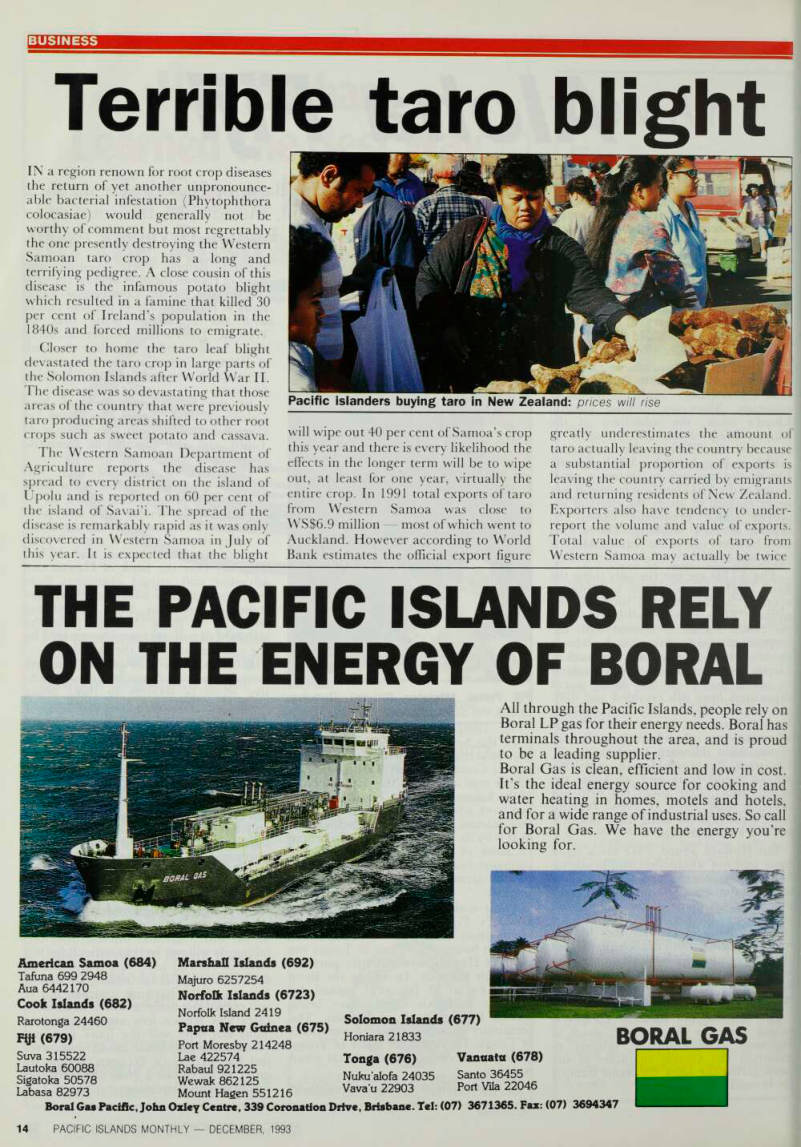
Pacific islanders buying taro in New Zealand: prices will rise
what is officially recorded in government statistics.
The only known way of halting the outbreak of the disease is to undertake a complete field sanitation which basically means halting the production of taro in Western Samoa for one year.
Needless to say this would devastate the Western Samoan economy which is a major exporter of taro the US and New Zealand markets. Moreover, it would mean that the country would have to move temporarily to other food crops as well as bringing in more imported food.
Another alternative would be for Western Samoa to abandon ‘Taro Niue’ the most common and preferred variety and move over to other more disease resistant varieties.
The giant taro is far more resistant to this type of leaf blight than Taro Niue but is for generally good reasons of taste disliked by Samoans. Perhaps just as importantly giant taro does not have a very long shelf life making it a poor export product.
While there had been no major effects af the outbreak on exports to New Zealand exporters are expecting to feel a rapid decline in Western Samoan exports n November and December as demand or taro in New Zealand increases.
Shipments to New Zealand were dready declining in late October. In >rder to meet the short fall in demand mporters will be looking to Fiji to supply he market of Pacific Islanders in New Zealand.
According to Alf Hazelman, a Suva >ased exporter, prices have already been ising and there is already a natural endency for prices of taro to rise towards Christmas time in Fiji. He said “It is very loubtful that Fiji would be able to meet big rise in demand for taro from New Zealand as we produce very little ‘Taro fiue’. It will take us quite some time to e able to expand production.”
Market prices in Suva have already isen sharply in the last few months ecause of drought conditions in the ountry. Prices have risen from Fs6oo er tonne in the middle of the year to $lOOO in November. December prices re expected to rise even further accord ig to Hazelman.
Just like Cyclone Ofa in 1990 in /estern Samoa this disaster will cause icreases in taro prices in Fiji, Western amoa and New Zealand and the ripple feet will be felt throughout the entire acific. As in all commodity trade, one
roducer’s blight is another’s blessing but
essing or blight the consumer will pay. □
Advertisements & other items, p. 14 (1 item)
The Pacific Islands Rely
ON THE ENERGY OF BORAL
- American Samoa (684) Tafuna 699 2948 Aua 6442170 Cook Islands (682) Rarotonga 24460 Ftfi(679) Suva 315522 Lautoka 60088 Sigatoka 50578 Labasa 82973 Marshall Islands (692) Majuro 6257254 Norfolk Islands (6723) Norfolk Island 2419 Papua New Guinea (675) Port Moresby 214248 Lae 422574 Rabaul 921225 Wewak 862125 Mount Hagen 551216 All through the Pacific Islands, people rely on Boral LP gas for their energy needs. Boral has terminals throughout the area, and is proud to be a leading supplier.
Boral Gas is clean, efficient and low in cost.
If s the ideal energy source for cooking and water heating in homes, motels and hotels, and for a wide range of industrial uses. So call for Boral Gas. We have the energy you’re
looking for.
Solomon Islands (677) Honiara 21833 Vanuatu (678) Santo 36455 Port Vila 22046
BORAL GAS
Tonga (676) Nuku’alofa 24035 Vava’u 22903 Boral Gas Pacific, John Oxley Centre. 339 Coronation Drive, Brisbane. Tel: (07) 3671365. Fax: (07) 3694347
Fiji’s budget
By Roman Grynbcrg
FIJI’S 1994 budget will in future almost certainly be seen as a water-shed in the history of the country. It will be seen as the point at which it became clear that Fiji was not going to consolidate gains made towards inter national competitiveness following the military coups of 1987. In the wake of those events Fiji introduced the tax free factory system deregulated the labour market and most importantly devalued the Fiji dollar by what was then effectively 50 per cent. At the same time the government introduced a series of
virtually balanced budgets. Towards
the end of the interim administration, beginning in 1990, the Fiji government lost its zeal for economic reform and the results are beginning to appear.
The budget presented by Finance Minister Paul Manueli to parliament had some very rude shocks for Fiji. The most important was the fact that the deficit had blown out massively from the projected 2.5 per cent of GDP in the 1993 budget speech to an estimated 4.8 per cent of GDP. Even following the increase in tariffs, which are projected to bring in $15.7 million, the 1994 budget was expected to only decrease the deficit to 3.7 per cent of GDP. The 1993 deficit will be the largest by far since the coups in 1987.
Economic growth for 1993 is projected to be 1.8 per cent in real terms, which means the economy is virtually standing still in real per capita terms.
The huge budget deficit was explained by four factors. First the effects of Cyclone Kina effectively increased government emergency and reconstruction spending while it simultaneously decreased rev enues. This was also accompanied by a blow-out of spending, caused in no small measure by lack of control of spending of the Fiji military forces. Manueli an nounced that tne government of Fiji intended to cut size of the army to that existing in 1987 by 1996 and would decrease the army’s staffby 1332 from the current level of 3910. This would bring numbers down precisely to that which existed on May 14, 1987.
The third factor for the deficit blow-out was the failure of Fiji’s recently intro duced 10 per cent VAT to generate revenues as projected. In the total shortfall to September 1993 was $l4 million or some 13 per cent of the projected revenue. The government also promised to review the generally unpopu ar tax in 1994. However, given the predisposition of government officials and the Finance Minister towards the tax it is widely believed that the review will be ‘pro-forma’.
The government also blamed the
budget blow-out on the arbitration award that was made for public servants. This granted them a five per cent pay increase which was one per cent greater than what the 1993 budget was based upon. The minister also announced that the wage increase for public servants would be thre per cent in 1994 and hinted at the introduction of a public service wage system based upon productivity.
Despite widespread speculation the
government did not raise either direct taxes or VAT to finance the budget blow out but rather chose to raise import duties on petrol(2c) and cars ($500) while raising the usual range of ‘sin taxes’ on
beer(up 10c per litre) and cigarettes(s6/
k g)- The government did pursue its policy of eliminating import licensing and changing the licences into tariffs. This is what is called ‘tariffication’ in GATT lexicon. In order to force competition on the fish canning, rice, and dairy industry the government introduced tariffs of 50 per cent on powdered milk and 40 per cent on rice. The government has indi cated that it intends to become a member of GATT and the tariffication of import licences would have been necessary for compliance with GATT rules.
Government did announce measures that liberalised access to foreign exchange including the increase in the travel allowance to $6,000 from $4,000 and permitting exporting firms to retain 10 per cent (ratner than 5 per cent pre
viously) of their foreign exchange earn
ings to pay for imports.
In general the government showed no major new initiatives in the budget though it did announce its intention to create a fund for future generations for revenue from the up-coming copper mine at Namosi. The $2 billion mine is expected to generate substantial revenues and the government intends to take the funds off-shore and utilise earnings from the fund rather than using the funds themselves. The minister prefixed his commitment to the fund with the usual budget rider that started with ‘one possible option’. This means that it will not be difficult for him or his successor to change their minds in future.
The slow pace of economic reform, especially in crucial areas like the Fiji capital market has led many to conclude that Fiji government is no longer commit ted to the process of economic reform begun following the coups. Meanwhile the country’s two main export sectors garments and sugar are facing difficulties resulting in no small part from a loss of competitiveness. The Fiji dollar has appreciated 15 per cent in real terms since the coups and the competitiveness estab lished then is being gradually eroded.
There were no measures announced in this budget to increase competitiveness in either sector. □
quotas,
US lowers sugar quotas, again
THE slowly declining American sugar quotas for Fiji and Papua New Guinea have been reduced yet again.
The quotas allow a foreign govern ment to ship a limited amount of sugar to the States for sale at the protected price level set for American ’ sugar producers, which is about twice the level of the free world price. Recent New York quotations for these two prices were S4lB per metric tonne (2,204 lbs) for the US price as opposed to $237 for the world price.
Fiji and PNG try to avoid selling any sugar at the world price, and typically sell much of their sugar to Europe, at prices which are usually better than those in the US market. Fiji, for example, sold much of its 1990 crop in Europe for $BBO a tonne.
Nevertheless the US quotas are useful to the sugar industry in the two countries, and they were always utilised by the producers. US allocations for the October 1, 1993 —Sept. 30, 1994 period were 8,838 tonnes for Fiji and 6,114 tonnes for PNG, each down about 15 per cent from the prior year, and each less than half of the quotas of ten years ago.
The coming year’s allocations, when worked out in gross US dollars for the product delivered to the States at the quoted prices, come to $4,250,000 for Fiji and $2,940,000 for PNG. The net to island sugar producers* is lower, as there are shipping, insurance and brokerage costs to be absorbed.
As of late October, Fiji had shipped its full 1992 —1993 quota, but none of its 1993 —1994 allocation. Of its two-year allocation, PNG had shipped only an odd 24 tonnes. PNG’s quota is so small that it makes commercial sense to put two-year’s allocation of sugar in a single shipload.
On a longer horizon, there is a possibility that the North American Free Trade Treaty (NAFTA) would elimin ate protected island shipments to both the US and Canada, should NAFTA be approved by the US Congress. This would happen because Mexico would simply crowd out all overseas sugar producers. There is, however, a 15-year status quo arrangement that would protect other sugar-producing nations from NAFTA’s impact. □
of expectations
JCC - 3 clash of expectations
By David North
THE inaugural meeting of the Joint
Commercial Commission (JCC) was billed as the beginning of a new era in commercial relations between the South Pacific and the United States.
But it played out as a clash of expectations, with the Forum states seeking special consideration for access to US markets and investment capital and the US side urging the islands to compete for the US business dollar by restructuring their investment climate and upgrading their agricultural ex ports to meet stringent US import
regulation.
The exchange over labyrinthine US import requirements, for example, prompted Sir Geoffrey Henry, Prime Minister of the Cook Islands, to ask You mean that if we use a U.S. produced pesticide to grow limes, for instance, to U.S. standards, and there is too much pesticide residue on the fruit, you will reject the shipment? The answer, to the islanders’ frustration, was yes.
The JCC was proposed at the 1990 summit of Pacific island leaders with then US president Bush. The October 8, 1993 meeting in Washington formally launched the JCC as a mechanism to expand commercial relations among the islands and the United States. Thirteen Pacific island nations attended.
Cook PM Henry, as spokesman for the islands, told US State and Commerce Department officials that the islands seek a better place in the sun. The JCC is, in their view, one more step toward that ultimate objective. The islands are not asking for an aid handout, Henry reportedly said. They seek an oppor tunity to further develop their economies by tapping into the vast US market, and reservoir of business technology and financial resources, especially private sector investment.
After US Commerce Secretary Ron Brown offered welcoming remarks and stressed the importance the United States places on the JCC, the United States response, carefully enunciated by high ranking State Department and Commerce officials, stressed the need for structuring an attractive investment cli mate. Led by Ambassador Winston Lord, the former US ambassador to Beijing and now Assistant Secretary for East Asia and the Pacific, the US side explained that the United States sees the JCC as part of its overall Pacific
Com
munity
initiat ive and an el ement of its multi lateral coop eration with the Asia- Pacific Econ omic
Cooperation forum.
APEC, founded in 1989, is a 15-member group of East Asian and Pacific economies aimed at liberalising trade in the region and among the region and the United States and Europe. An APEC summit hosted by President Clinton in Seattle, Washington, on November 19-20, is expected to ratify an agreement to develop a comprehensive code to govern private investment in APEC member economies.
US officials at the JCC inaugural meeting stressed that the competition for the US investment dollar had dramati cally sharpened in the past decade. With the end of the Cold War and the dissolution of the Soviet empire, there had been a radical shift in the way governments around the world viewed outside investors. The atmosphere of distrust of foreign capitalists that had permeated the world two decades ago nad now turned to an unprecedented liberalisation in the investment climate.
Eastern and Central Europe, Russia, and other former Soviet states, Latin America, the Newly Industrialized States and many Third World nations, US officials said, now avidly seek foreign investment dollars, creating an interna tional investment climate extremely favorable to US investors. Citing World Bank studies, the US side laid out key principles US investors would look for in evaluating the investment opportunities in the Pacific.
The investment regime should be transparent, either through bi-lateral or multi-lateral trade and tax treaties or a local investment code. The types of investment for which there will be incentives should be clearly spelled out.
The business sectors from which foreign investors will be excluded or in which their role would be restricted should be clearly promulgated, preferable in law, so there is no governmental discretion in
Martin Tiffany Henry: islands’ spokesman
the matter during the application process. In an optimum scenario, there should be unrestricted entry of foreign investment and repatriation of all profits, royalties, etc. Similarly, access to foreign exchange should be unre stricted. Foreign investors should not be favored over local investors. Expro priation of property, if it must take Clace, should be for a public purpose, ased on international law. Compen sation should be prompt. Investors should have assured access to interna tional arbitration for dispute settle ment and legal protection for intellec tual property rights such as trade marks, patents, and copyrights.
US officials also pointed out that investors look primarily at market access and rate of return when evaluating prospects for investment.
The South racitic’s access to Austra lian and New Zealand markets, for example under SPARTECA, as well as access to ASEAN markets would be a plus for manufacturers looking to maximises their market. A clearly enunciated, non-discriminatory, and stable investment climate would en able the investor to calculate a rate of return. The primary sectors US invest ment might be attracted to include tourism, fisheries, specialty agriculture for “niche” markets, and if access to a wider Asian-Pacific market is avail able, light manufacturing and financial service sectors.
All well and good, from the US point of view, Cook PM Henry responded, but the Pacific islands their private sectors are unaccustomed to the competition such a liberal climate could generate. How can the islands protect themselves, their local inves tors, their resources, environment, and cultures under such a free-wheeling business climate, Henry asked? Could the United States assist in setting up safeguards or help mediate between US investors and the host govern ments?
US officials responded that they could assist the islands in evaluating the public “track records” of U§ investors, and that each nation has the right to protect its local industries and resources.
US officials also outlined the trade programs that might interest the islands, including the General Agree ment on Trade and Tariffs, and General System or Preferences, as well as the federal regulations on import ation of agricultural products. The US rules and procedures, especially the complex system of inspection for imported agricultural produce, are aimed at assuring the quality and safety of importers.
The next JCC meeting is scheduled for the Pacific. In the meantime, the islands agreed to prepare reports on their economies and business opportunities which the US Com merce Department will disseminate via its electronic networks to US business communities. □
The saga continues
Politics
By Martin Tiffany
THE political saga continues in the Solomon Islands with three gov ernment ministers joining the op position, an opposition MP switching to government and the opposition leader calling on the government to step down.
Opposition leader Solomon Mamaloni says the opposition has the support of 25 members of parliament in the 47-member house and can form a government at any time. To prove this Mamaloni is displaying a list of the 25 MPs who have pledged loyalty to him in writing. These include the three former minister who joined the opposition in the second week of November. This effec tively increased the opposition numbers from 23 to 26 and decreased the government number from 24 to 21.
However opposition MP Nelson Boso moved to the government camp making it 25 —22 in favour of the government.
The opposition say they have formed a committee to allocate portfolios and take over the government.
Prime Minister Francis Billy Hilly has however rejected Mamaloni’s call for his government to step down saying his government was elected by parliament and only parliament could remove it from office. He said right from the start “the opposition has been out to block the government from carrying out its pro gramme for no good reason at all”.
As this issue of PIM was going to press on November 18 the number crunchers in Mamaloni’s camp were lobbying to confirm their numbers to push through a no-confidence motion when parliament sits on November 29 (this sitting had been postponed twice at press time).
Section 34(1) of the constitution requires the resolution of no-confidence in the prime minister to be passed by parlia ment “by an absolute majority of the voters of members thereof’. With it seems 25 members in his camp, Mamaloni can claim the ball to be firmly in his court.
This current episode basically began on November 9 when the governor general Sir George Lepping revoked the appointment of the minister for educa tion and training Dennis Lulei. This was done following the advice of prime minister Hilly who said it was clear Lulei did not want to remain with his coalition government.
Lulei moved across to the opposition camp followed shortly after by the minister for provincial government and rural development, Eric Seri, and minis ter for culture, sports and tourism, Allan Paul. It was also reported that Lulei was trying to lure Ysabel Province MP, Edmund Andresen, away from the gov ernment. However, Andresen said he would not join the opposition as long as Mamaloni was there. When Mamaloni was prime minister he sacked Andresen from his ministerial position without reason.
Two government backbenchers were sworn in to replace two of the former ministers. Walter Folo Talu took over Lulei’s portfolio of education and train ing while the MP for South Vella La Vella, Oliver Zapo, became the new minister for provincial government and rural development.
Since gaining power on June 18, Hilly has been hounded by Mamaloni, Mamaloni did not agree with the validity of Hilly’s 24-23 victory and submitted a formal dispute to the governor general.
The governor general said he was convinced 24 was an absolute majority and so Hilly was the prime minister under the constitution. Mamaloni was still not convinced and commenced proceedings for judicial review of the governor general’s determination in the High Court.
The result was Justice Albert Palmer saying in his judgement that the governor general had not committed any error of law and was perfectly entitled to say as he did in his determination.
Mamaloni appealed this decision but the Court of Appeal in its judgement on November 5 found in favour of the governor general.
Within days of the Court of Appeal decision the current happening began as the three ministers crossed over, effec tively taking away power from Hilly.
If the numbers remain in the oppo sition’s favour was is likely to happen now is a notice of resolution will be given to the speaker informing him of the vote of no confidence. The governor general is then informed and fresh elections are ordered as provided for in schedule 2 of the constitution.
But the situation in the Solomon Islands is very fluid and there is no telling what may happen. As they say, watch this space. □
The Compere
Cover Stories
By Martin Tiffany
IT started with a prayer. And for the most part the 33rd South Pacific Conference in Noumea proceeded with a quiet reverence as the 27 member countries gave their official thumbs-up after debate and dis cussion to the South Pacific Com mission’s (SPC) work programme and budget for the coming year. And discussed other matters of relevance and concern to the commission.
One of the few issues to break the calm of the October 25-27 meeting was the announcement by the United Kingdom representative, Thorold Masefield, that it may become necessary for his govern ment to consider withdrawal from the SPC. He said while the possible with drawal was a cause for real regret he wished to emphasise that the UK hoped to retain its association with the com mission by continuing from time to time to provide extra-budgetary assistance.
This currently stands as 500,000 pounds.
The UK also intends to maintain its bilateral links with islands countries.
Masefield said for the most part the decision to withdraw was due to “real budgetary constraints”. But he said the watershed came in 1980, when Vanuatu
achieved independence, leaving the
United Kingdom with Pitcairn with less than 80 inhabitants as its sole
responsibility.
While Masefield pointed out the decision was not yet final and any withdrawal would not come into effect until 1995, it looks inevitable that the UK would soon cease to formally be a member of the SPC.
One of the founding members of the SPC, the Netherlands, withdrew in 1962 when it ceased to administer its former colony of Dutch New Guinea (now Irian Jaya) and part of Indonesia and thus ceased to have responsibilty for any regional territories. The UK is basically saying that as it has very little responsi bility in the region now and with its global role changing it has to move away from direct involvement through the SPC. It will retain its aid contributions and diplomatic representation in the various Pacific countries but will leave them to their decisions as far as the SPC is concerned.
This raises very interesting points as far as the future of the commission is concerned. If the French Territories gain their independence should the French pull out of the commission, and what about the United States and its Pacific territories?
With the UK’s pullout these questions will arise especially as the shadow of the South Pacific Forum looms larger over the SPC. In recent years many question
Will the withdrawal of the United Kingdom from the South Pacific Commission mean the beginning of a new era?
the need for two major regional organ isations and the claims of duplication of work also comes up.
According to the SPC the establish ment of the commission was a “response to the desire of the then colonial powers to assure the economic and social stability of the Island countries by creating mechanisms for meaningful relations among governments”. Isn’t that basically what the South Pacific Forum does?
While the SPC is the oldest regional body, it is the Forum which is looked upon as the region’s major decision making body. The Forum is made up of the heads of the Pacific governments while the South Pacific Conference is attended for the most part by govern ment representatives from the Pacific and metropolitan countries. While there is much politics behind having the two major regional organisations, there must be some merit in at least considering having just one in light of countries pulling out and the scarcity of funds as pointed out by Ati George Sokomanu, the SPC’s secretary-general, in his report to the conference.
But there is another possibility to be considered. No sooner had the UK warned that it was considering with drawing from the SPC then Tuvalu’s prime minister Bikenibeu Paeniu was suggesting that Japan in light of the UK pull out be invited in as a full member. The question of Japan and Chile joining has been hanging around for the past few years.
The attraction of Japan joining is obvious they have the money. They contribute technical equipment to the SPC directly and are a major aid donor to the region. But they are not respon sible for any territories. Chile is respon sible for its territory of Easter Island with a population of a little over 2000.
The question of new members and how countries could become members of the SPC was a major discussion point during the Noumea meeting. Basically what was finally agreed was that countries wishing to join should officially notify the secretary general and their membership should receive the support of all existing members.
What the conference has to ask itself now is what direction do they want the commission to take. If Japan comes into the fold then it is a move away from the SPC’s original intention of colonial power-island country administration body. If Japan is admitted then it should be only a matter of time before Korea joins. And then there are other potential members.
For the most part this year’s South Pacific Conference was a dull affair, with only a few issues causing a ripple.
One was the recommended relocation of the Pacific Women’s Resource Bureau and the Youth Development Programme to Fiji. The Committee of Representa tives of Governments and Administra tions (CRGA) in its May meeting recommended the relocation. There was strong opposition by France to this relocation and reservations expressed by
The meeting: the 'Pacific Way’ usually won
Martin Tiffany
New Caledonia and French Polynesia.
They feel that the proposed relocation would isolate the programme from the
SPC headquarters.
The conference was divided on the issue. While the majority favoured the move a number were against it. Two who were against it were Papua New Guinea and the Solomon Islands who felt the move would further disadvantage the Melanesian Kanaks in New Caledonia.
The outcome of this episode was PNG convincing the conference that a review of the situation funded by them was the solution.
Despite some disagreement the ‘Pacific Way’, of trying to reach agreement by consensus, prevailed for the most part of
the meeting.
Next year’s conference will be hosted and chaired by Tuvalu with Niue providing the vice-chairperson. □
Pacific
children
THIS year’s conference theme was ‘The State of Pacific Children’. The conference heard the keynote address from Bikenibeu Paeniu on the theme, watched a video, heard from two children and a few other speakers and then were about to move on to the next order of business. But a timely and courageous objection from PNG representative Gabriel Dusava stopped the meeting in its tracks.
He basically said the conference shouldn’t just get the item out of the way, they should spend a lot more time on it both at the conference and when they return home.
Dusava’s action should be applauded given the problems and special needs of the Pacific children.
For example 12,000 Pacific island children die every year before their first birthday, 7000 more between their first and fifth birthdays a total of nearly 50 per day. They die primarily from causes which are preventable through low cost pri mary health care measures. □
In the black
WHAT a difference a year makes.
Who could forget last year’s fire works at the 32nd South Pacific Conference in Suva? Within hours of his appointment, as SPC secretary general-elect, Ati George Sokomanu hit out at the “colonial club” attitude he said still existed in this region, pointing .the finger especially at Australia. His attack was in response to some SPC member-countries including Australia, the United States, France the Cook Islands and French Polynesia not being happy with his appointment to the South Pacific Commission’s (SPC) top
position. Especially in light of the
financial mess the commission pres ented at last year’s meeting, feeling he was not the man to clean it up.
He had his knuckles rapped in the final report to last year’s conference. Com ments by the representative of French Polynesia, the Cook Islands, France and Tokelau, condemning his ‘colonial club’ media outburst, were endorsed by the conference.
The commission’s financial misman agement also came under fire, especially from the metropolitan members the biggest donors to the SPC. The finger naturally pointed at then incumbent secretary-general, Atanraoi Baiteke. The SPC’s big guns warned the commission to clean up the financial mess or they would reconsider their financial contributions.
The 33rd South Pacific Conference in Noumea couldn’t have been more differ ent. Sokomanu, who took the SPC helm
in January this year, announced a financial surplus at the close of their books at the end of 1992. “The audi tor’s report confirms that the SPC was truly in the black at the end of 1992,”
Sokomanu told the meeting with the hint of a smile on his face. But he was quick to point out that the credit for this good perform ance goes to Baiteke and his team who he said were directly responsible for overcoming the financial deficit.
Australia, the United States, New Zealand and the United Kingdom were among the first to congratulate Sokomanu on the improved financial situation paying
tribute to the secretary-general’s efforts and his lucid report.
However, Sokomanu said the financial outlook for 1994, particularly the contri butions to the Works Programme, was rather disappointing. He said a number of programmes were going to be drastically reduced and staff laid on because of a lack of funding. “Your secretariat’s Work Programme is totally at the mercy of donors. Despite all the noises made about country priorities, corporate plans and industrial democracy, the bottom line is quite simple no money, no service,” said Sokomanu.
“I would therefore request conference to consider very carefully the implications of under-funding some SPC programmes in 1994, in terms of terminating services previously entered into with island countries, high termination costs due to staff contracts’ early curtailment, and also the high cost of resetting up programmes from scratch, when additional funding becomes available. These cutbacks, you would appreciate, arise due to a lack of funding rather than a lack of demand for technical assistance services.”
Sokomanu said while he realised money did not grow on trees, and fully appreciates the difficulties that SPC’s traditional donors face, he felt it was his duty to keep asking the conference for guidance on how he should proceed on securing resources for the Work Pro gramme budget. “This after all is your organisation and if you cannot resource it sufficiently then it would be les than fair to expect it to perform,” said Sokomanu.
It was clear from Sokomanu’s report that work programmes had been rather am bitious in setting their 1993 objec tives. The aver age success rate was approximately 70 per cent with only the Finance Sec tion able to meet its objectives.
Sokomanu said what was clear from his report was in an “over
whelming num
ber of cases, pro grammes failure was due to lack of financial resources”. □
Martin Tiffany Sokomanu: announced financial sur plus
Growing
Population
By David North
NEWLY-RELEASED 1990 Census data shows that nearly two out of three workers on US flag islands were born off islands. And close to half of the residents of these four island groupings were born somewhere else. The US Department of Commerce recently issued its tradition ally thick volumes of census data, with at least 200 pages of stastics for each of the US flag islands.
The reports cover American Samoa, Guam, the Commonwealth of the North ern Mariana Islands, and the Republic of Palau. Given their Associated state status, neither the Marshalls or FSM
were covered by the most recent US census.
Most heavily impacted by labour migration is CNMI, where less than one fifth of the work done in the Common wealth is performed by peopleborn there.
Further, 61 per cent of the population was born elsewhere. Among the four
jurisdictions only lightly-developed Pa
lau had a native-born majority in its work force.
Typically there is a higher precentage of off-island workers than off-island residents; in many cases the off-island workers do not bring family members with them often, at least in CNMI, they are prohibited from doing so.
Of CNMTs work force, 82 per cent were born elsewhere, with the Philip pines contributing 59 per cent of that population. Of American Samoa’s work ers, 62 per cent are off-island-born, and of these 74 per cent came from nearby Western Samoa.
On Guam, 61 per cent of the workers are from other places, but there is a greater variety than in the other jurisdic tions. Of the off-island workers 47 per cent are from the Philippines and 24 per cent, including some servicemen, are from the mainland. Palau, with 34 per cent of its work force from overseas, also depends heavily on Filipinos who consti tute 71 per cent of her foreign work force.
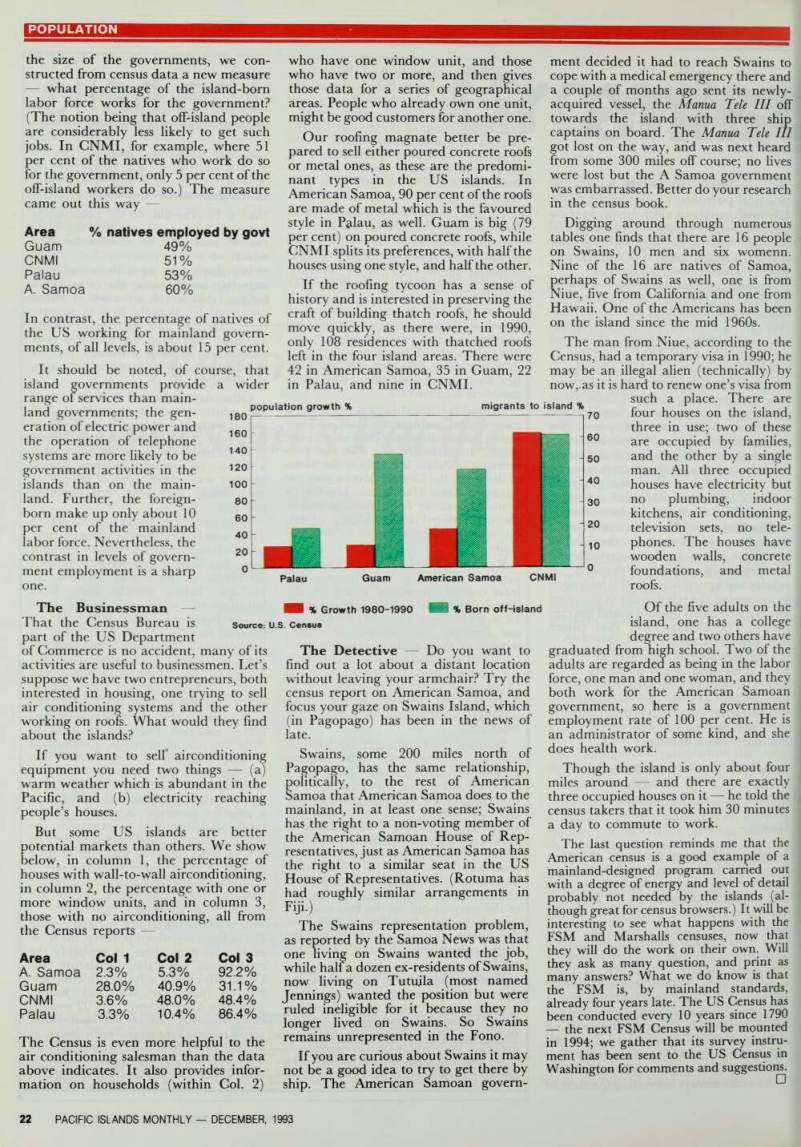
Naturally it is the islands with the greatest influx of foreign workers whose population increased the most; CNMI population increased by more than 15 per cent in the 1980 s.
Although the foreign workers expand the labor force, and thus production, in all of the islands, and presumably have a dampening effect on wages of all similarly placed workers, they play different roles on the different islands, partially because of differing immigra tion schemes. Guam lives under Main land immigration rules, while the other three juridsictions control their own immigration policies.
The starkest contrast between the fate of island-born and foreign-born workers can be seen in CNMI, as illustrated by the ongoing charges of exploitation of Asian Workers in Saipan’s garment factories. (See PIM April, ’92 p2B).
CNMI policies do not permit most foreign workers to become permanent residents, much less citizens, so the citizen minority continues to dominate business and political life.
Matters are less explosive in American Samoa; while immigrant workers from Western Samoa cannot become Ameri can Samoan citizens (the technical term is US National), they speak the same language as the host population, are unlikely to be deported, and their American Samoa-born children will be come citizens of the US territory.
An immigrant to Guam is, for all practical purposes, an immigrant to the US, and mainland rules apply, so some foreign workers stay in Guam and become voters. As a result, Guam’s politics is much more of a melting pot, with Chamorros, Filipinos and mainlanders all sitting in the territorial legislature. These developments are not uniformly welcomed on the island, how ever, and a Chamorro nationalist move ment wants Chamorros only to vote on the political future of the island.
While the 1000 pages or so of census tabulations can appear to be little more than mid-numbing numbers, there are at least three reasons for wading into the reports: as a citizen or a policy nerd (the new mainland term of people interested in government programs) one can secure many insights; as a businessman, one can get sound information on potential markets; and as a statistical detective, one can find fascinating information.
The Citizen Let us assume that our citizen is concerned about the level of education in the islands, is worried about
the remaining people engaged in
subsistence agriculturre, and is interested in measuring the relative size of the labor forces in the often bloated island govern ments. The Census gives that citizen much to think about.
One measure of educational attain ment is the lack of any schooling at all.
The four jurisdiction each have one to two per cent of their 25+ population in this category. A more sensitive measurre is the per cent over 25 with a high school diploma, which shows:
Interestingly these percentages, except in American Samoa are raised, sometimes considerably (as in Palau), by the educational attainments of the Filipinos, which are greater than those of the native-born.
Worried about people in subsistence agriculture? Do your worrying in Ameri can Samoa where 7.7 per cent of those over the age of 16 are so engaged, full or part-time, or better in Palau, where the percentage is 8.9 per cent. Palau with 4.4 per cent of its 16+ population working full time in subsistence activities is the only jurisdiction where this number rises above 2 per cent.
As to the always interesting question of
Area % HS Diploma A. Samoa 55% Palau 58%
Cnmi
66% Guam 73%
the size of the governments, we con structed from census data a new measure what percentage of the island-born labor force works for the government? (The notion being that off-island people are considerably less likely to get such jobs. In CNMI, for example, where 51 per cent of the natives who work do so for the government, only 5 per cent of the off-island workers do so.) The measure came out this way
In contrast, the percentage of natives of the US working for mainland govern ments, of all levels, is about 15 per cent.
It should be noted, of course, that island governments provide a wider
range of services than main land governments; the gen eration of electric power and
the operation of telephone
systems are more likely to be government activities in the islands than on the main land. Further, the foreign born make up only about 10 per cent of the mainland labor force. Nevertheless, the contrast in levels of govern ment employment is a sharp one.
The Businessman That the Census Bureau is part of the US Department
of Commerce is no accident, many of its activities are useful to businessmen. Let’s suppose we have two entrepreneurs, both interested in housing, one trying to sell air conditioning systems and the other working on roofs. What would they find about the islands?
If you want to self airconditioning equipment you need two things (a) warm weather which is abundant in the Pacific, and (b) electricity reaching
people’s houses.
But some US islands are better potential markets than others. We show below, in column 1, the percentage of houses with wall-to-wall airconditioning, in column 2, the percentage with one or more window units, and in column 3, those with no airconditioning, all from the Census reports
The Census is even more helpful to the air conditioning salesman than the data above indicates. It also provides infor mation on households (within Col. 2)
who have one window unit, and those who have two or more, and then gives those data for a series of geographical areas. People who already own one unit, might be good customers for another one.
Our roofing magnate better be pre pared to sell either poured concrete roofs or metal ones, as these are the predomi nant types in the US islands. In American Samoa, 90 per cent of the roofs are made of metal which is the favoured style in Palau, as well. Guam is big (79 per cent) on poured concrete roofs, while CNMI splits its preferences, with half the houses using one style, and half the other.
If the roofing tycoon has a sense of history and is interested in preserving the craft of building thatch roofs, he should move quickly, as there were, in 1990, only 108 residences with thatched roofs left in the four island areas. There were 42 in American Samoa, 35 in Guam, 22 in Palau, and nine in CNMI.
The Detective Do you want to find out a lot about a distant location without leaving your armchair? Try the census report on American Samoa, and focus your gaze on Swains Island, which (in Pagopago) has been in the news of late.
Swains, some 200 miles north of Pagopago, has the same relationship, politically, to the rest of American Samoa that American Samoa does to the mainland, in at least one sense; Swains has the right to a non-voting member of the American Samoan House of Rep resentatives, just as American Samoa has the right to a similar seat in the US House of Representatives. (Rotuma has had roughly similar arrangements in
Fiji.)
The Swains representation problem,
as reported by the Samoa News was that one living on Swains wanted the job, while half a dozen ex-residents of Swains, now living on Tutujla (most named Jennings) wanted the position but were ruled ineligible for it because they no longer lived on Swains. So Swains remains unrepresented in the Fono.
If you are curious about Swains it may not be a good idea to try to get there by ship. The American Samoan govern
ment decided it had to reach Swains to cope with a medical emergency there and a couple of months agp sent its newly acquired vessel, the Mama Tele 111 off towards the island with three ship captains on board. The Mama Tele 111 got lost on the way, and was next heard from some 300 miles off course; no lives were lost but the A Samoa government was embarrassed. Better do your research in the census book.
Digging around through numerous tables one finds that there are 16 people on Swains, 10 men and six womenn.
Nine of the 16 are natives of Samoa, perhaps of Swains as well, one is from Niue, five from California and one from Hawaii. One of the Americans has been on the island since the mid 19605.
The man from Niue, according to the Census, had a temporary visa in 1990; he may be an illegal alien (technically) by now,.as it is hard to renew one’s visa from
such a place. There are four houses on the island, three in use; two of these are occupied by families, and the other by a single man. All three occupied houses have electricity but no plumbing, indoor kitchens, air conditioning, television sets, no tele phones. The houses have wooden walls, concrete foundations, and metal roofs.
Of the five adults on the island, one has a college degree and two others have
graduated from high school. Two of the adults are regarded as being in the labor force, one man and one woman, and they both work for the American Samoan government, so here is a government employment rate of 100 per cent. He is an administrator of some kind, and she does health work.
Though the island is only about four miles around and there are exactly three occupied houses on it he told the census takers that it took him 30 minutes a day to commute to work.
The last question reminds me that the American census is a good example of a mainland-designed program carried out with a degree of energy and level of detail probably not needed by the islands (al though great for census browsers.) It will be interesting to see what happens with the FSM and Marshalls censuses, now that they will do the work on their own. Will they ask as many question, and print as many answers? What we do know is that the FSM is, by mainland standards, already four years late. The US Census has been conducted every 10 years since 1790 the next FSM Census will be mounted in 1994; we gather that its survey instru ment has been sent to the US Census in Washington for comments and suggestions.
Area % natives employed by govt Guam 49%
Cnmi
51% Palau 53% A. Samoa 60%
Area Col 1 Col 2 Col 3 A. Samoa 2.3% 5.3% 92.2% Guam 28.0% 40.9% 31.1%
Cnmi 3.6% 48.0% 48.4%
Palau 3.3% 10.4% 86.4%
Advertisements & other items, p. 20 (1 item)
Polynesian's Pacific
Welcome to
(\U*\ nolulu
WAII
NIUE
CALEDONIA
Nukualofa
TONGA
AUSTRALIA
Los Angeles
CALIFORNIA
Rarotonga * Ia
“ ' ' ' COOK ISLANDS Papeete
TAHITI
NEW ZEALAND
—Polynesian airlines
We call it home. You’ll call it Paradise OFFICES & AGENTS: HEAD OFFICE: WESTERN SAMOA NPF Building, Beach Road, PO Box 599, Apia, Western Samoa. Telex: 249 PALAPW SX Fax; (685) 20 023.
All Departments: (685) 21261. Reservations: (685) 22737, 22738. Ticket Office: (685) 22172. Airport: Tel: 23612, 42673, 21675. Fax: 42688. Airport Cargo: Tel: 42 675, 20 683. Fagalll Airport Tel; 22173, 25201. Fax: 25200. After Hours: City 23097, Airport 21675 AMERICAN SAMOA Reservations: (684) 6999126/7/8 Fax: (684) 6992109. AUSTRALIA, SYDNEY. Reservations: (61) 2 299 1744. Ticket Office: (61) 2 299 1855. Fax: (61) 2 299 1119. Toll Free (61) 008 633 737.
MELBOURNE. (613) 600 4400. Fax; (613) 600 4848. FIS, NADI. Tel: (679) 72 272/73 587. Reservations: 72 499. KINGDOM OF TONGA. Reservations: (676) 21565, Airport (676) 32 204, Fax; (676) 24 225. NEW ZEALAND: Reservations: (64) 9 309 5396. Ticket Office: (64) 9 379 4824. Fax: (64) 9 307 3819.
AUCKLAND AIRPORT. Tel: (64) 9 275 0972. Fax: (64) 9 275 3890 HENDERSON. Tel: (64) 9 836 6141. Fax; (64) 9 836 6143. MANUKAU. Tel: (649) 262 4197, Fax: (649) 262 4203. WELLINGTON: Reservations: (64) 4 472 2544. Fax; (64) 4 471 14890. USA AMR Service*. LOS ANGELES: Tel. (1) 310 646 2675. Fax; (1) 310 646 2668. HONOLULU: Tel. (1) 808 836 7659. Fax; (1) 808 836 8010. Reservations Toll Free (In USA); (1) 800 592 7100. JAPAN PacMc IntemadooN Lt«L Tel: (81) 3 568 79731. Fax; (81) 3 568 79734. ICW CALEDONIA Noumea AXXESS Travel. Reservations & Sales: (687) 286677. Fax; (687) 274050. TAHTTI - AIR FRANCE TEL: (689) 839 650. FAX; (689) 821675. NIUE Petard's Travel: Tel: (683) 4317. Fax: (683) 4322. RAROTONGA: Tel; (682) 20 845. Fax: (682) 20 979. or Wand Hopper Vacation* (682) 22 026, Fax; (682) 22 036.
of Tobi
The belle of Tobi
SHE was obviously the belle of Tobi.
The census of Palau shows the numbers of people by age, by sex, and by state. Pretty drab statistics, usually, but in the case of Tobi, the lightly populated southernmost island of the republic, and a Palau state unto itself, there was only one person who was both female and 17, according to table eight in Single Tears of Age by Sex: 1990.
Further, when the Census was taken, in the spring of 1990, she was the only female on the island between the ages of 2 and 38. And, to add spice, there were eight males between the ages of 15 and 28. She must have been very
popular.
Now the US census is supposed to handle its data in such a way as to avoid any disclosure of personal information, but when the Census people issued numbers about Tobi they started acting like soap opera producers, not close mouthed bureaucrats.
Everything noted here is based on a government publication, not on any inside information, nor on a visit to the island. Incidentally, we, like the gov ernment of Palau, use Tobi as the name of the state; the Census Bureau uses the outdated name Hatobohei. The state’s boundaries cover Tobi Island as well as the uninhabited atoll, Helen’s Island, on which Indonesia has a nominal claim.
Returning to the belle of Tobi, she apparently had won the attention of at least one of the young males on the island (where men outnumber women 17 to 5) because Census Table 6, Age and Fertility: 1990, showed the total fertility of the female population aged 15-19, of which there was one person.
That person had a one child. So the Census was telling us, in effect, that on Tobi the 100 per cent of the young women were sexually active as teenagers.
Further, the Census gave us a strong clue as to when the belle became pregnant. As noted earlier there was a two-year-old girl on the island, and no other children under the age of six. The chances are that the belle was the mother of the baby girl while the other children on the island belonged to one woman, aged 38, with seven children, and another, aged 43, with nine according to the age/fertility table. It is unlikely that the belle was the mother of the six-year-old, so the two-year-old must have been hers. So now we have the Census Bureau telling us that the belle presumably became pregnant while 14.
There’s more. Table 6 indicated that none of the women aged 15-19 who had given birth had been married, so her lack of a husband is established. Futher, there are other data showing that there are four households on the islands three families and a 65+ male living alone each headed by someone other
than a 17-year-old, so she probably is living with her mother (either the 38 or the 43-year-old, we cannot be sure
which).
We also know, by a little statistical detective work among the other tabu lations, that she is a native of Palau (everyone is), that she lives in poverty (everyone but the 65 + male living alone is) and that she was not then enrolled in school (although the six boys between the ages of 6 and 15 were
in school.)
Other data indicated that only one of the adult women was married and living with her spouse, which means that eight of the nine men over the age of 20 on the island were not living with a wife at the time of the census. Stated another way, there were 22 people on the island, and only one working
marriage.
Apparently people do not migrate to
Tobi, which is closer to Indonesia than it is to Koror, Palau’s capital. Perhaps there has been a long-term imbalance in births of men and women, or perhaps, belle’s female peers have outmigrated while the males have stayed home which would be an unusual pattern. There certainly is an indication of emigration; the census of
housing reports four owner-occupied
house, but 16 houses in all, a dozen of which had presumably been aban doned by people who left the island.
But it is not the case that government has abandoned Tobi, far from it, as Tobi has about as much government per capita as any spot on earth. When one compares the census data with the 1991 Annual Report of the Govern ment of Palau one finds that Tobi has a chief, a governor, a speaker of the local legislature, and a delegate to the Palau legislature, and each of these jobs is held by a different man. So at least four of the nine males over the age of 20 hold government positions. And we have no idea how many people are members of the island legislature.
Our suspicion is that the one person not in Census-defined poverty, the 65 T male who lives alone, is probably the member of the Palau legislature, the OEK, who earns a respectable income for his part-time work in Koror.
Although he represents only 22 people,
he gets a full vote in the 16-member lower house of the island parliament. Is he also the belle’s father or grandfather?
That’s one question that even the chatty US Census does not answer. □
Giving a better deal
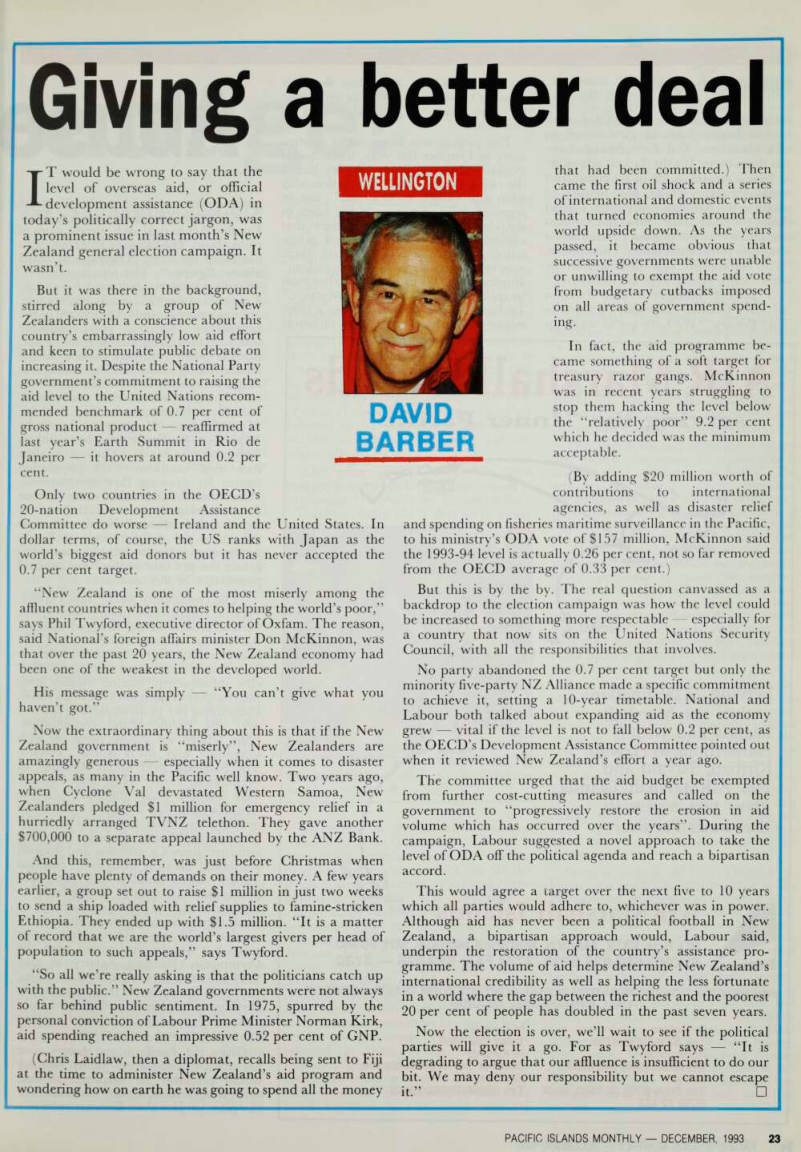
IT would be wrong to say that the level of overseas aid, or official
development assistance (ODA) in
today’s politically correct jargon, was
a prominent issue in last month’s New Zealand general election campaign. It wasn’t.
But it was there in the background, stirred along by a group of New Zealanders with a conscience about this country’s embarrassingly low aid effort and keen to stimulate public debate on increasing it. Despite the National Party government’s commitment to raising the aid level to the United Nations recom mended benchmark of 0.7 per cent of gross national product reaffirmed at last year’s Earth Summit in Rio de Janeiro it hovers at around 0.2 per cent.
Only two countries in the OECD’s 20-nation Development Assistance Committee do worse Ireland and the United States. In dollar terms, of course, the US ranks with Japan as the world’s biggest aid donors but it has never accepted the 0.7 per cent target.
“New Zealand is one of the most miserly among the affluent countries when it comes to helping the world’s poor,” says Phil Twyford, executive director of Oxfam. The reason, said National’s foreign affairs minister Don McKinnon, was that over the past 20 years, the New Zealand economy had been one of the weakest in the developed world.
His message was simply “You can’t give what you haven’t got.”
Now the extraordinary thing about this is that if the New Zealand government is “miserly”, New Zealanders are amazingly generous especially when it comes to disaster appeals, as many in the Pacific well know. Two years ago, when Cyclone Val devastated Western Samoa, New Zealanders pledged $1 million for emergency relief in a hurriedly arranged TVNZ telethon. They gave another $700,000 to a separate appeal launched by the ANZ Bank.
And this, remember, was just before Christmas when people have plenty of demands on their money. A few years earlier, a group set out to raise SI million in just two weeks to send a ship loaded with relief supplies to famine-stricken Ethiopia. They ended up with SLS million. “It is a matter of record that we are the world’s largest givers per head of population to such appeals,” says Twyford.
“So all we’re really asking is that the politicians catch up with the public,” New Zealand governments were not always so far behind public sentiment. In 1975, spurred by the personal conviction of Labour Prime Minister Norman Kirk, aid spending reached an impressive 0.52 per cent of GNP. (Chris Laidlaw, then a diplomat, recalls being sent to Fiji at the time to administer New Zealand’s aid program and wondering how on earth he was going to spend all the money
that had been committed.) Then came the first oil shock and a series of international and domestic events that turned economies around the world upside down. As the years passed, it became obvious that successive governments were unable or unwilling to exempt the aid vote
from budgetary cutbacks imposed
on all areas of government spend
ing.
In fact, the aid programme be came something of a soft target for treasury razor gangs. McKinnon was in recent years struggling to stop them hacking the level below the “relatively poor” 9.2 per cent which he decided was the minimum
acceptable.
(By adding S2O million worth of contributions to international agencies, as well as disaster relief
and spending on fisheries maritime surveillance in the Pacific, to his ministry’s ODA vote of 5157 million, McKinnon said the 1993-94 level is actually 0.26 per cent, not so far removed from the OECD average of 0.33 per cent.) But this is by the by. The real question canvassed as a backdrop to the election campaign was how the level could be increased to something more respectable especially for a country that now sits on the United Nations Security Council, with all the responsibilities that involves.
No party abandoned the 0.7 per cent target but only the minority five-party NZ Alliance made a specific commitment to achieve it, setting a 10-year timetable. National and Labour both talked about expanding aid as the economy grew vital if the level is not to fall below 0.2 per cent, as the OECD’s Development Assistance Committee pointed out when it reviewed New Zealand’s effort a year ago.
The committee urged that the aid budget be exempted from further cost-cutting measures and called on the government to “progressively restore the erosion in aid volume which has occurred over the years”. During the campaign, Labour suggested a novel approach to take the level of ODA off the political agenda and reach a bipartisan accord.
This would agree a target over the next five to 10 years which all parties would adhere to, whichever was in power.
Although aid has never been a political football in New Zealand, a bipartisan approach would, Labour said, underpin the restoration of the country’s assistance pro gramme. The volume of aid helps determine New Zealand’s international credibility as well as helping the less fortunate in a world where the gap between the richest and the poorest 20 per cent of people has doubled in the past seven years.
Now the election is over, we’ll wait to see if the political parties will give it a go. For as Twyford says “It is degrading to argue that our affluence is insufficient to do our bit. We may deny our responsibility but we cannot escape it.” □
Wellington
David
Barber
Abuse
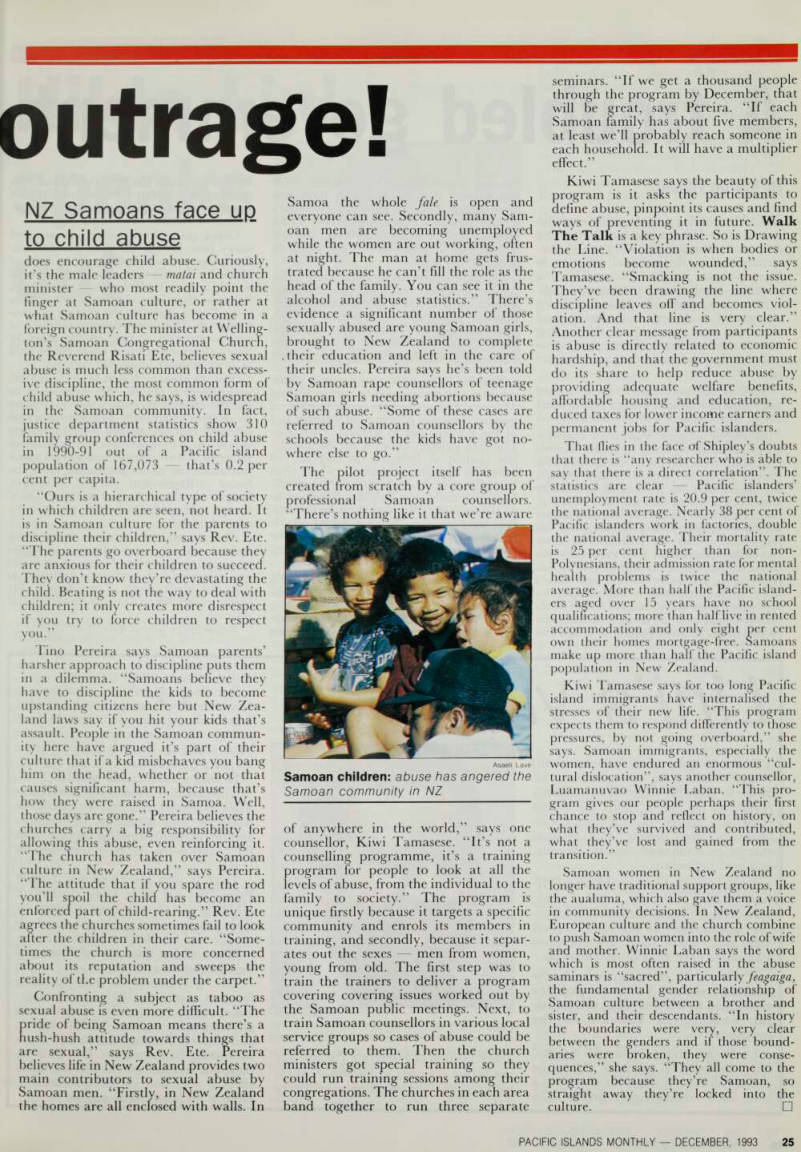
Issue
By Karen Mangnall
SAMOAN children in hospital with broken bones. Samoan girls forced to seek abortions. And their families have put them there. It’s the darkest side of life in New Zealand, a life of economic and social struggle which has helped to produce the Samoan community’s silent shame child abuse. Now, the Samoan community in Wellington has launched a unique project to combat child abuse.
“The community can no longer sit by while many young lives are destroyed,” says project spokesman and Samoan Advisory Council chairman Lualemana Tino Pereira. “We have got to wake up
and see this has gone too far. We shouldn’t ever use culture as an excuse for any abuse physical, sexual or emotional.”
The project was born out of contro versy in October last year, when Social Welfare Minister, Jenny Shipley linked the rising Pacific island population with what she called a “dramatic” rise in reported child abuse 24,861 cases in the year to June 1992. “We know that culturally as the Pacific island popu lation increases in New Zealand, there may be a factor there that is unspoken,”
Shipley said. “But it is an issue that must be spoken about in New Zealand socity.”
To back up her claims, Shipley’s office released an ethnic breakdown of family
group conferences held in 1990-91 under the Children, Young Persons and Their Families Act to deal with specific cases of child abuse. The October 16 Evening Post headlined the story: “Outrage at child abuse figures”. The report stated “Pacific islanders accounted for nearly 8 per cent of the 4972 family conferences, although they are only 3.6 per cent of the population.” Outrage there certainly was, with the talkback radio running hot.
But the greatest outrage came from the Pacific island communities; outrage at Shipley’s insensitivity and at the minis ter’s figures because they were wrong.
Somehow the minister’s office had in flated the June ’9l quarterly figures by 70 per cent for Pacific islanders (and by 79 per cent for Maori). Then, journalists had used outdated 1986 population figures for drawing their comparisons.
When the Children and Young Persons Service belatedly released the correct figures, they showed Pacific islanders accounted for 6.9 per cent of family group conference in 1990-91 and com prised five per cent of the New Zealand population in the same year.
“The community hurt,” says Pereira.
“It’s a fragile community and it’s a painful process beiing dragged through the media as sex abusers when the evidence doesn’t show Pacific islanders or Samoans are the main offenders.” Per eira subsequently hauled Shipley over the coals on Wellington’s Samoan radio, challenging her to do something positive over the Pacific island communities.
“She replied we should come up with something and she’d listen,” Pereira.
The Samoans held public meetings in Wellington, Lower Hutt and Porirua.
“We asked a basic question is the minister right that there is a child abuse problem and what can we do about it?
The overwhelming response was we admitted there’s a problem and decided we should take the initiative.” Samoan leaders visited Shipley with two main demands an apology for the inaccur ate figures and her public comments, and funding for a Samoan run programme to combat child abuse. The apology never came but Shipley intervened with the Community Funding Agency to give $244,000 for a three-month pilot scheme ending in December to train Samoans in Wellington to identify and prevent child abuse and provide professional support for survivors and perpetrators.
Given the Pacific island outcry over her earlier comments, Jenny Shipley would probably be surprised to find general agreement among the leaders of the pilot project that Samoan culture
NZ Samoans face up
to child abuse
does encourage child abuse. Curiously, it’s the male leaders matai and church minister who most readily point the finger at Samoan culture, or rather at what Samoan culture has become in a foreign country. The minister at Welling ton’s Samoan Congregational Church, the Reverend Risati Ete, believes sexual abuse is much less common than excess ive discipline, the most common form of child abuse which, he says, is widespread in the Samoan community. In fact, justice department statistics show 310 family group conferences on child abuse in 1990-91 out of a Pacific island population of 167,073 that’s 0.2 per cent per capita.
“Ours is a hierarchical type of society in which children are seen, not heard. It is in Samoan culture for the parents to discipline their children,” says Rev. Ete.
“The parents go overboard because they are anxious for their children to succeed.
They don’t know they’re devastating the child. Beating is not the way to deal with children; it only creates more disrespect if you try to force children to respect you.”
Tino Pereira says Samoan parents’ harsher approach to discipline puts them in a dilemma. “Samoans believe they have to discipline the kids to become upstanding citizens here but New Zea land laws say if you hit your kids that’s assault. People in the Samoan commun ity here have argued it’s part of their culture that if a kid misbehaves you bang him on the head, whether or not that causes significant harm, because that’s how they were raised in Samoa. Well, those days are gone.” Pereira believes the churches carry a big responsibility for allowing this abuse, even reinforcing it.
“The church has taken over Samoan culture in New Zealand,” says Pereira.
“The attitude that if you spare the rod you’ll spoil the child has become an enforced part of child-rearing.” Rev. Ete agrees the churches sometimes fail to look after the children in their care. “Some times the church is more concerned about its reputation and sweeps the reality of the problem under the carpet.”
Confronting a subject as taboo as sexual abuse is even more difficult. “The pride of being Samoan means there’s a nush-hush attitude towards things that are sexual,” says Rev. Ete. Pereira believes life in New Zealand provides two main contributors to sexual abuse by Samoan men. “Firstly, in New Zealand the homes are all enclosed with walls. In
Samoa the whole fale is open and everyone can see. Secondly, many Sam oan men are becoming unemployed while the women are out working, often at night. The man at home gets frus trated because he can’t fill the role as the head of the family. You can see it in the alcohol and abuse statistics.” There’s evidence a significant number of those sexually abused are young Samoan girls, brought to New Zealand to complete .their education and left in the care of their uncles. Pereira says he’s been told by Samoan rape counsellors of teenage Samoan girls needing abortions because of such abuse. “Some of these cases are referred to Samoan counsellors by the schools because the kids have got no where else to go.”
The pilot project itself has been created from scratch by a core group of professional Samoan counsellors.
“There’s nothing like it that we’re aware
of anywhere in the world,” says one counsellor, Kiwi Tamasese. “It’s not a counselling programme, it’s a training program for people to look at all the levels of abuse, from the individual to the family to society.” The program is unique firstly because it targets a specific community and enrols its members in training, and secondly, because it separ ates out the sexes men from women, young from old. The first step was to train the trainers to deliver a program covering covering issues worked out by the Samoan public meetings. Next, to train Samoan counsellors in various focal service groups so cases of abuse could be referred to them. Then the church
ministers got special training so they
could run training sessions among their congregations. The churches in each area band together to run three separate
seminars. “If we get a thousand people through the program by December, that will be great, says Pereira. “If each Samoan family has about five members, at least we’ll probably reach someone in each household. It will have a multiplier effect.”
Kiwi Tamasese says the beauty of this program is it asks the participants to define abuse, pinpoint its causes and find ways of preventing it in future. Walk The Tal k is a key phrase. So is Drawing the Line. “Violation is when bodies or emotions become wounded,” says Tamasese. “Smacking is not the issue.
They’ve been drawing the line where discipline leaves off and becomes viol ation. And that line is very clear.”
Another clear message from participants is abuse is directly related to economic hardship, and that the government must do its share to help reduce abuse by
providing adequate welfare benefits,
affordable housing and education, re duced taxes for lower income earners and permanent jobs for Pacific islanders.
That flies in the face of Shipley’s doubts that there is “any researcher who is able to say that there is a direct correlation”. The statistics are clear Pacific islanders’ unemployment rate is 20.9 per cent, twice the national average. Nearly 38 per cent of Pacific islanders work in factories, double the national average. Their mortality rate is 25 per cent higher than for non- Polynesians, their admission rate for mental health problems is twice the national average. More than half the Pacific island ers aged over 15 years have no school qualifications; more than half live in rented accommodation and only eight per cent own their homes mortgage-free. Samoans make up more than half the Pacific island population in New Zealand.
Kiwi Tamasese says for too long Pacific island immigrants have internalised the stresses of their new life. “This program expects them to respond differently to those pressures, by not going overboard,” she says. Samoan immigrants, especially the women, have endured an enormous “cul tural dislocation”, says another counsellor, Luamanuvao Winnie Laban. “This pro gram gives our people perhaps their first chance to stop and reflect on history, on what they’ve survived and contributed, what they’ve lost and gained from the transition.”
Samoan women in New Zealand no longer have traditional support groups, like the aualuma, which also gave them a voice in community decisions. In New Zealand, European culture and the church combine to push Samoan women into the role of wife and mother. Winnie Laban says the word which is most often raised in the abuse saminars is “sacred”, particularly feagaiga, the fundamental gender relationship of Samoan culture between a brother and sister, and their descendants. “In history the boundaries were very, very clear between the genders and if those bound aries were broken, they were conse quences,” she says. “They all come to the program because they’re Samoan, so straight away they’re locked into the culture. □
Asaeli Lave Samoan children: abuse has angered the Samoan community in NZ
Advertisements & other items, p. 24 (1 item)
AIR Marshall Islands
serving the ""Inner Pacific'"
Honolulu ■
HAWAII L'j
q Kwajalein
MARSHALL
ISLANDS Majuro * Tarawa
KIRIBATI
* < Funafuti
TUVALU
Nadi
FIJI
Serving 26 destinations
within the Marshall
Islands and with
connections to Hawaii,
Kiribati, Tuvalu and
Fiji, AlRMarshall Islands
gives you access to
the Inner Pacific.
AlRMarshall Islands
PO Box 1319, Majuro, Marshall Islands, MH 96980.
PHONE: 692-625 3733/3734 FAX: 692-625 3730
FOR RESERVAnON/INFORMAnON PLEASE CONTACT YOUR TRAVEL AGENT OR
CALL AIRMARSHALL ISLANDS
In Majuro In Tuvalu Tel: 3733/3734/3735 Telex 726 4800 In Honolulu In Kiribati 949 5522, (800) 543 3898 Contact our representative, In Fiji Air Tungaru Tel: Suva (679) 30 3883, Nadi Tel: 28088/28282/28025 (679) 72 182
A troubled government
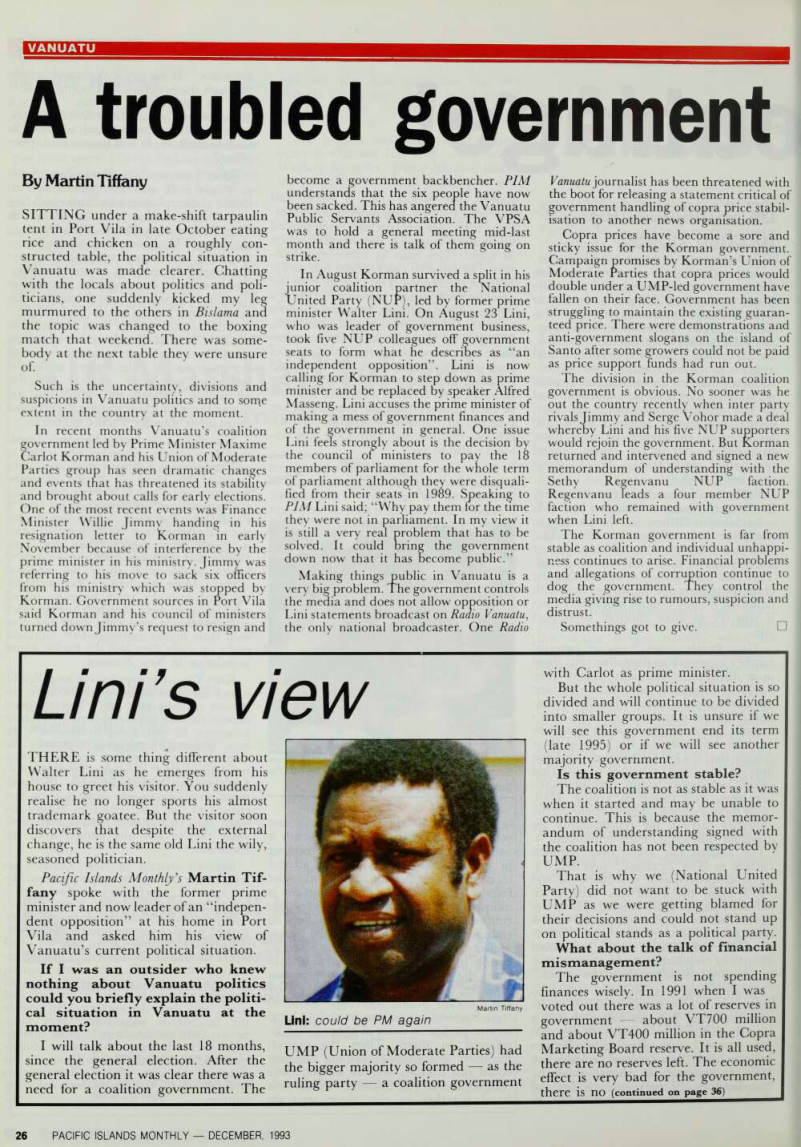
Vanuatu
By Martin Tiffany
SITTING under a make-shift tarpaulin tent in Port Vila in late October eating rice and chicken on a roughly con structed table, the political situation in Vanuatu was made clearer. Chatting with the locals about politics and poli ticians, one suddenly kicked my leg murmured to the others in Bislama and the topic was changed to the boxing match that weekend. There was some body at the next table they were unsure of.
Such is the uncertainty, divisions and suspicions in Vanuatu politics and to some extent in the country at the moment.
In recent months Vanuatu’s coalition government led by Prime Minister Maxime Carlot Korman and his Union of Moderate Parties group has seen dramatic changes and events that has threatened its stability and brought about calls for early elections.
One of the most recent events was Finance Minister Willie Jimmy handing in his resignation letter to Korman in early November because of interference by the prime minister in his ministry. Jimmy was referring to his move to sack six officers from his ministry which was stopped by Korman. Government sources in Port Vila said Korman and his council of ministers turned down Jimmy’s request to resign and
become a government backbencher. PIM understands that the six people have now been sacked. This has angered the Vanuatu Public Servants Association. The VPSA was to hold a general meeting mid-last month and there is talk of them going on strike.
In August Korman survived a split in his junior coalition partner the National United Party (NUP), led by former prime minister Walter Lini. On August 23 Lini, who was leader of government business, took five NUP colleagues off government seats to form what he describes as “an independent opposition”. Lini is now calling for Korman to step down as prime minister and be replaced by speaker Alfred Masseng. Lini accuses the prime minister of making a mess of government finances and of the government in general. One issue Lini feels strongly about is the decision by the council of ministers to pay the 18 members of parliament for the whole term
of parliament although they were disquali
fied from their seats in 1989. Speaking to PIM Lini said; “Why pay them for the time they were not in parliament. In my view it is still a very real problem that has to be solved. It could bring the government down now that it has become public.”
Making things public in Vanuatu is a very big problem. The government controls the media and does not allow opposition or Lini statements broadcast on Radio Vanuatu , the only national broadcaster. One Radio
Vanuatu journalist has been threatened with the boot for releasing a statement critical of government handling of copra price stabil isation to another news organisation.
Copra prices have become a sore and sticky issue for the Korman government.
Campaign promises by Korman’s Union of
Moderate Parties that copra prices would double under a UMP-led government have fallen on their face. Government has been struggling to maintain the existing guaran teed price. There were demonstrations and anti-government slogans on the island of Santo after some growers could not be paid as price support funds had run out.
The division in the Korman coalition government is obvious. No sooner was he out the country recently when inter party rivals Jimmy and Serge Vohor made a deal whereby Lini and his five NUP supporters would rejoin the government. But Korman returned and intervened and signed anew memorandum of understanding with the
Sethy Regenvanu NUP faction.
Regenvanu leads a four member NUP faction who remained with government when Lini left.
The Korman government is far from stable as coalition and individual unhappi ness continues to arise. Financial problems and allegations of corruption continue to dog the government. They control the media giving rise to rumours, suspicion and distrust.
Somethings got to give. □
Uni’s view
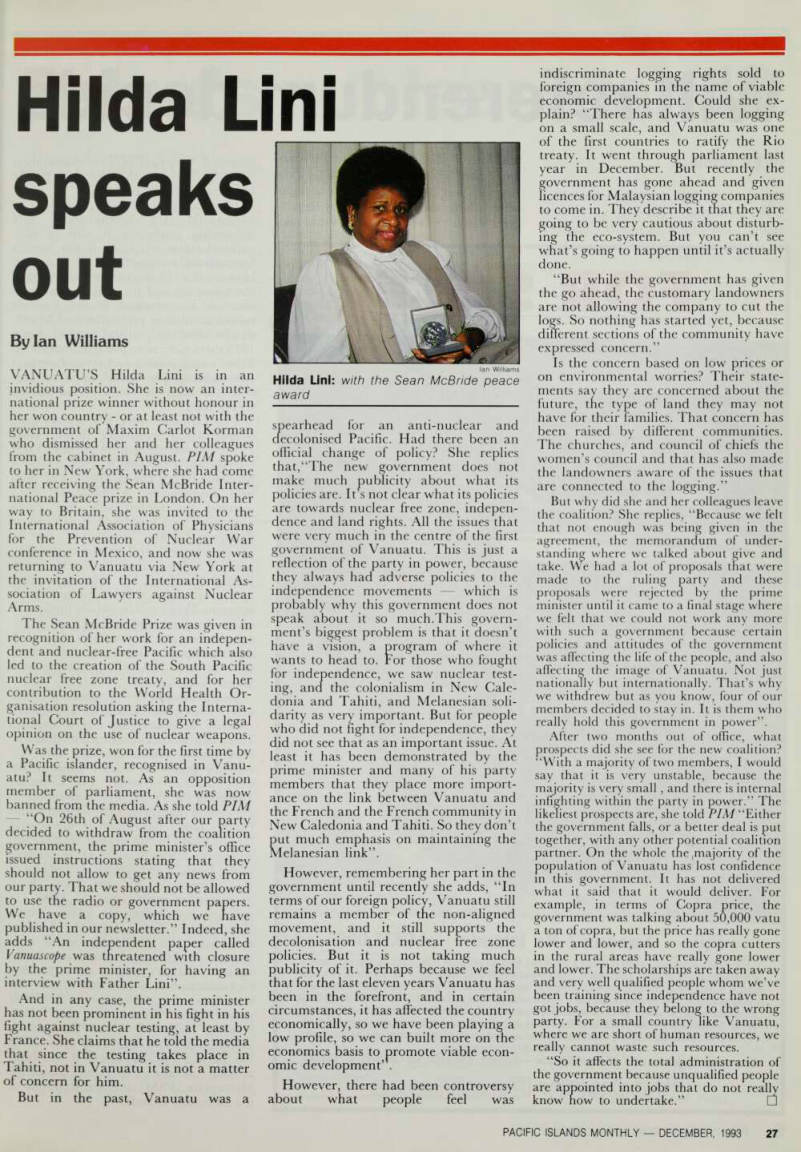
THERE is some thing different about Walter Lini as he emerges from his house to greet his visitor. You suddenly realise he no longer sports his almost trademark goatee. But the visitor soon discovers that despite the external change, he is the same old Lini the wily, seasoned politician.
Pacific Islands Monthly’s Martin Tif fany spoke with the former prime minister and now leader of an “indepen dent opposition” at his home in Port Vila and asked him his view of Vanuatu’s current political situation.
If I was an outsider who knew nothing about Vanuatu politics could you briefly explain the politi cal situation in Vanuatu at the moment?
I will talk about the last 18 months, since the general election. After the general election it was clear there was a need for a coalition government. The
UMP (Union of Moderate Parties) had the bigger majority so formed as the ruling party a coalition government
with Carlot as prime minister.
But the whole political situation is so divided and will continue to be divided into smaller groups. It is unsure if we will see this government end its term (late 1995) or if we will see another
majority government.
Is this government stable?
The coalition is not as stable as it was when it started and may be unable to continue. This is because the memor andum of understanding signed with the coalition has not been respected by
Ump.
That is why we (National United Party) did not want to be stuck with UMP as we were getting blamed for their decisions and could not stand up on political stands as a political party.
What about the talk of financial
mismanagement?
The government is not spending finances wisely. In 1991 when I was voted out there was a lot of reserves in government about VT7OO million and about VT4OO million in the Copra Marketing Board reserve. It is all used, there are no reserves left. The economic effect is very bad for the government,
there is no
(continued on page 36)
Martin Tiffany
Uni: could be PM again
(continued from page 27)COntrol. At the rate of current spending by the government, it is uncertain if there will be enough money to continue into the next two years. It will be shown more clearly next month (November) when the budget for next year is discussed it is going to break down.
Do you want to see fresh elections?
A lot want general elections but I would like to see the government see the term out. A new general election will not solve the problem. If held now it will still produce a result with no clear majority party. NUP would rather see a change of PM and in the government rather than a fresh election. Besides we have no funds for a fresh election.
What should the prime minister do now?
If the PM is concerned he should resign and we meet and select a new PM.
The instability is caused not by the coalition itself but the fact that the government is not able to manage its affairs and misuses it powers. Ministers travel everywhere and do not care about things such as schools, health and local government there is no money for them.
A number of government departments
are having difficulty paying their staff
each month. Some departments will stop and the whole government system will
stop it is very serious.
Who do you see becoming the next PM?
My view is the present speaker, Alfred Masseng, should become PM of a coalition government between NUP and UMP. I don’t know if he wants to be (PM), he has not been asked.
Could you realistically see a new prime minister being elected?
I have given the government three steps to follow that will save and redeem them.
I will not pursue this, I just put it to them. If they don’t think it necessary, so be it. I will just watch it till the end.
There has been talk of you becoming the next president, is this true and would you accept the post if offered?
I would not make a very good president (Lini laughs loudly). If I do (become president) it would be after I complete my term as a member of parliament and am elected as an ordinary person. And then only if there is no other person and
parliament agrees.
Do you agree with the government banning of Opposition, and I believe now your statements on Radio Vanu atu?
They are wrong. I am banned and the opposition is banned. In the 11 years I was prime minister there was more freedom of the press although there was criticism towards the end of my term.
Now there is no freedom of the media which means no freedom of expression.
There is direct control which in effect means the prime minister dictates, this goes against the democratically estab lished system.
What is your group’s position now?
I made my position clear. We are going to work with parliament. My group of six independent opposition members did not sign a memorandum of understanding with the other opposition or the govern ment. We go into the next parliament as
independent opposition.
We will push for a constitutional review committee as there are some points in the constitution that are not clear.
Is there any possibility of you returning as prime minister?
There is a possibility. NUP is developing in numbers and continues to win support in many islands. There are really only two parties in contention UMP and NUP. The Vanuaku Pati and the
Melanesian Progressive Party are going
down and the others are hardly in existence.
The NUP group will become a strong group and unless I am replaced as president of the party, I will be PM once we get the majority in government. □
speaks
Hilda Lini
speaks out
By lan Williams
VANUATU’S Hilda Lini is in an invidious position. She is now an inter national prize winner without honour in her won country - or at least not with the government of Maxim Carlot Korman who dismissed her and her colleagues from the cabinet in August. PIM spoke to her in New York, where she had come after receiving the Sean Mcßride Inter national Peace prize in London. On her way to Britain, she was invited to the International Association of Physicians for the Prevention of Nuclear War conference in Mexico, and now she was returning to Vanuatu via New York at the invitation of the International As sociation of Lawyers against Nuclear Arms.
The Sean Mcßride Prize was given in recognition of her work for an indepen dent and nuclear-free Pacific which also led to the creation of the South Pacific nuclear free zone treaty, and for her contribution to the World Health Or ganisation resolution asking the Interna tional Court of Justice to give a legal opinion on the use of nuclear weapons.
Was the prize, won for the first time by a Pacific islander, recognised in Vanu atu? It seems not. As an opposition member of parliament, she was now banned from the media. As she told PIM “On 26th of August after our party decided to withdraw from the coalition government, the prime minister’s office issued instructions stating that they should not allow to get any news from our party. That we should not be allowed to use the radio or government papers.
We have a copy, which we nave published in our newsletter.” Indeed, she adds “An independent paper called Vanuascope was threatened with closure by the prime minister, for having an interview with Father Lini”.
And in any case, the prime minister has not been prominent in his fight in his fight against nuclear testing, at least by France. She claims that he told the media that since the testing takes place in Tahiti, not in Vanuatu it is not a matter of concern for him.
But in the past, Vanuatu was a
spearhead for an anti-nuclear and decolonised Pacific. Had there been an official change of policy? She replies that,“The new government does not make much publicity about what its policies are. Its not clear what its policies are towards nuclear free zone, indepen dence and land rights. All the issues that were very much in the centre of the first government of Vanuatu. This is just a reflection of the party in power, because they always had adverse policies to the independence movements which is probably why this government does not speak about it so much. This govern ment’s biggest problem is that it doesn’t have a vision, a program of where it wants to head to. For those who fought for independence, we saw nuclear test ing, and the colonialism in New Cale donia and Tahiti, and Melanesian soli darity as very important. But for people who did not fight for independence, they did not see that as an important issue. At least it has been demonstrated by the prime minister and many of his party members that they place more import ance on the link between Vanuatu and the French and the French community in New Caledonia and Tahiti. So they don’t put much emphasis on maintaining the Melanesian link”.
However, remembering her part in the government until recently she adds, “In terms of our foreign policy, Vanuatu still remains a member of the non-aligned movement, and it still supports the decolonisation and nuclear free zone policies. But it is not taking much publicity of it. Perhaps because we feel that for the last eleven years Vanuatu has been in the forefront, and in certain circumstances, it has affected the country economically, so we have been playing a low profile, so we can built more on the economics basis to promote viable econ
omic development”.
However, there had been controversy about what people feel was
indiscriminate logging rights sold to foreign companies in the name of viable economic development. Could she ex
plain? “There has always been logging
on a small scale, and Vanuatu was one of the first countries to ratify the Rio treaty. It went through parliament last year in December. But recently the government has gone ahead and given
licences for Malaysian logging companies
to come in. They describe it that they are going to be very cautious about disturb ing the eco-system. But you can’t see what’s going to happen until it’s actually done.
“But while the government has given the go ahead, the customary landowners are not allowing the company to cut the logs. So nothing has started yet, because different sections of the community have
expressed concern.”
Is the concern based on low prices or on environmental worries? Their state ments say they are concerned about the future, tne type of land they may not have for their families. That concern has been raised by different communities.
The churches, and council of chiefs the women’s council and that has also made the landowners aware of the issues that are connected to the logging.”
But why did she and her colleagues leave the coalition? She replies, “Because we felt that not enough was being given in the agreement, the memorandum of under standing where we talked about give and take. We had a lot of proposals that were made to the ruling party and these proposals were rejected by the prime minister until it came to a final stage where we felt that we could not work any more with such a government because certain policies and attitudes of the government was affecting the life of the people, and also affecting the image of Vanuatu. Not just nationally but internationally. That’s why we withdrew but as you know, four of our members decided to stay in. It is them who really hold this government in power”.
After two months out of office, what prospects did she see for the new coalition?
“With a majority of two members, I would say that it is very unstable, because the majority is very small, and there is internal infighting within the party in power.” The likeliest prospects are, she told PIM “Either the government falls, or a better deal is put together, with any other potential coalition partner. On the whole the .majority of the population of Vanuatu has lost confidence m this government. It has not delivered what it said that it would deliver. For example, in terms of Copra price, the government was talking about 50,000 vatu a ton of copra, but the price has really gone lower and lower, and so the copra cutters in the rural areas have really gone lower and lower. The scholarships are taken away and very well qualified people whom we’ve been training since independence have not got jobs, because they belong to the wrong party. For a small country like Vanuatu, where we are short of human resources, we really cannot waste such resources.
“So it affects the total administration of the government because unqualified people are appointed into jobs that do not really know now to undertake.” □
lan Williams Hilda Uni: with the Sean Mcßride peace award
Will referendum decide
Palau
By Ed Rampell
AS baseball player/philosopher Yogi Berra once said: “It’s deja vu all over again.” Thirteen is an unlucky number.
and for the 13th time in about 13 years, November 9 (the anniversary of Jack the Ripper’s last brutal murder) a national referendum was scheduled at the Repub lic of Palau (ROP). Palauans voted on a
proposed Compact of Free Association (COFA) between the Western Pacific Island and the United States.
The Compact would phase out a 46-year-old US administered UN trusteeship, replacing it with a new political status. At stake is the world’s first national nuclear free zone. The clash between the US defence requirements of the Compact and the anti-nuclear con stitution has resulted in the Pacific’s record number of plebiscites and Micro nesia’s bloodiest political conflict. Since 1979 there have been five referendums on Palau’s constitution and seven Compact referendums. The COFA approval pro cess has been as controversial as the treaty itself.
The Compact vote has always been overwhelming favourable, ranging from 72 per cent-60 per cent (in the last COFA referendum February 6, 1990). COFA proponents say the majority has been held hostage by a minority. They contend the accord will give Palau autonomy and hundreds of millions of dollars in US aid. This will provide for self government and economic develop ment of a tiny, remote archipelago with limited resources. US defence commit ments will protect Palau from military invasion. Palau will be able to unravel its status deadlock and emerge from politi cal limbo as the world’s last UN trustreeship. Compact promoters virtu ally claim COFA will be like manna falling from heaven.
Compact critics a significant min ority regard COFA as a disguised military agreement because it requires Palau to abandon its staunch nuclear free constitution, which conflicts with US military policy to neither confirm nor deny nuclear presence. The Compact also gives the Pentagon an option on 33 per cent of the strategically located island chain’s land (Babeldaob is the second largest island in Micronesia after Guam, where the US military owns 33 per cent of the land). Furthermore, at the end of the Compact’s 50 year term, both governments must agree to close US military installations at Palau, which means that if Koror wants the Yankees to go home but Washington wants them to stay, the US can deploy troops there against Palau’s will for eternity.
Oppositionists maintain COFA’s 50 year term is too long. Due to the IPSECO power plant fiscal fiasco and other reasons, they believe the Compact is underfunded and that Free Association has been a disaster where it has been applied in the Federated States of Micronesia (FSM) and the Republic of the Marshall Islands.
Despite the support of most voters, the majority has repeatedly been unable to
prevail because the Compact required a
75 per cent vote in order to override the Republic’s nuclear free constitutional stipulations. Presidents Haruo Remeliik and Lazarus Salii denied this consti tutional reality; both died of mysterious gunshot wounds, consumed by the Com pact cause. COFA and its ratification procedures have generated reigns of terror, as well as numerous law suits.
Dramatic court cases filed by the oppo sition have repeatedly defeated the
Compact.
Palauans are Oceania’s kings of liti gation, and it is no surprise that there were several court cases oppositing the Compact and its ratification process. The appeals to April 1992 and July 1993 high court decisions were consolidated by agreement of both sides and considered jointly by a three judge panel of the ROP
Supreme Court’s appellate division
(Edward King, the FSM’s former chief justice, sat on the panel).
The law suits contended, among other things, that the ballot language for the November 4, 1992 constitutional amend ment misinformed voters and that less than 25 per cent of the electorate had signed the petition seeking the amend' ment. This referendum aimed at amend ing Palau’s framed rules and its hazard ous substances prohibitions so that Com pact approval would require a simple majority, instead of a 75 per cent vote.
A key complainant was Ibedul, High
Chief Yutaka Gibbons, co-represented by Ann Simon off the Manhattan-based Center for Constitutional Rights, a human rights group led by William Kunstler (who defended the Chicago 7 and now represents Muslim fundamen talists charged with bombing New York’s World Trade Center). In 1986 Simon represented Ibedul when he challenged the February 21, 1986 Compact refer endum, insisting that the pact could not be passed with only 72 per cent of the vote. Simon marched up to the judge then and declared that she’d prove Palau was still nuclear free and did just that,
defeating the Compact in a stunning
courtroom triumph.
But the outcome was different this time.
On October 29, the ROP court ruled against the appeals and reaffirmed the November 9 referendum date, declaring: “We find no grounds to undo at the courthouse what the people of Palau have done at the voting booth/’ The court found that the plaintiffs had failed to produce “a single witness who was misled by the language” or “present a single person to testify that his name had been forged or procured by fraud or coercion of any kind” on the constitutional amendment petition.
The court rulings are redolent with
irony. In the name of democracy, the ROP constitution has been used in order to cannibalise itself by amputating the anti nuclear clause that offends a superpower.
The latter of the law may have been carried out but are its spirit and the intent of its
framers preserved?
But there still may be hope on the horizon for the anti-nuke, anti-Compact cause. Another suit brought by anti nuclear activists has been filed in the US District Court in the Northern Marianas, a US Commonwealth. It contends the US
has not provided Compact implementation
assurances mandated by Palau’s congress in
the Compact Implementation Assurance
(RPPL No. 3-76). These improvements
include stipulation that America will only exercise its military land use rights in case of hostilities and crises (which are unde fined), that Palau will not be exempt from US federal programs, that Washington will assume responsibility for any nuclear acci dent taking place in Palau, etc. The
plaintiffs charge that the only “assurance”
Palau has received regarding these im provements is a May 6, 1993 letter (initially unsigned) from U.S. Secretary of State Warren Christopher to ROP PresidentKuniwo Nakamura agreeing to the desired changes. Critics insist a mere letter is not legally binding and that the US Congress has not enshrined the assurances
in legislation.
But the status of this suit is unsure, as of this writing as it is uncertain as to whether or not the plaintiffs’ attorney, Martin Wolff, is licensed to practice law in Saipan.
Furthermore, upon returning from the CNMI to Palau, on October 22 Wolff was charged with possession of firearms, a criminal offence that carries a 15 year sentence in Palau. According to a press release from President Nakamura’s office, Wolffs Filipina maids told authorities about the alleged weapons after he allegedly marched them naked through Ngeschar State, where Wolff lives with his Palauan wife.
Wolff, who first came to Palau in the mid-80s, is noted for controversy. Dubbed “Air Wolff’ for his confrontational man ner, Wolffs jeep was firebombed in 1986; he has been a Jimmy Swaggert proselytiser and a staunch Compact promoter.
Now that a constitutional amendment has struck down the need for Compact ratification by a super-majority of Palauan Voters, COFA adherents feel the Novem ber 9 referendum is the best chance since the Palau constitution was passed in 1979 and the first Compact plebiscite took place in 1983 for the accord to finally gain passage. And in the late 1980 s, the US
Congress already set aside COFA funding,
so there is no need for new monies to be allocated for the Compact.
But time and again in Palau, just when the anti-nuclear constitution seemed doomed, at the last minute, what seems to be divine providence has rescued the charter and snatched Palau’s nuclear free status from the jaws of defeat. While the US Congress has not legislated the assurances ROP enabling legislation demands before the Compact can go into effect, the US Congress has passed a law stipulating that the Compact can not go into effect until all outstanding relevant law suits have been resolved. Tnis requirement grew out of the terrorism targeting Palauan COFA dis senters in the late ’Bos, which, among other things, forced Palauan plaintiffs to drop an
anti-Compact law suit (which they
subsequently won when their case was reinstated). In other words, even if COFA gains 51 per cent of the ballots, should a
single Palauan legally challenge the Com
pact again, it may be years (if ever at all) before there’s Free Association between Palau and America (the “democracy” that can’t take “no” for an answer). President Nakamura is reportedly seeking an ad ditional $2 million from Washington for legal fees, and Palauans have petitioned the UN to postpone the plebiscite.
In Yogi Berra’s words: “It ain’t over till it’s over for nuclear free Palau. □
Advertisements & other items, p. 28 (1 item)
For Sale
T&vZ
m ■ n o f J0 * a
Fiji Nananu-I-Ra Island A 5335,000
Freehold traditional Fiji style home 5 years old, located offshore Raid Raki on approx 1 acre absolute frontage to white sand beach, living coral reef & blue water drop off. Exotic & peaceful tropical setting, beautiful gardens with advanced shade trees, sunny aspect and superb waterviews.
Accommodation over two levels includes 3 bedrooms & two s.c. flats 1 & 2 bedrooms, huge living areas with adjacent indoor-outdoor sundecks, separate s.c. guest bure and lock up boatshed with ramp. Secluded & private yet close to Raki Raid shopping & market, minutes to tar sealed road to Nadi International Airport, with fishing, boating, numerous white beaches and lagoons and world class scuba diving at doorstep.
Inspection Enquiries : AJ. (Tony) Triglone Sydney, Australia Tel: IDD-61-2-7121313
for self-rule
The people vote for self-rule
AS this edition of PIM was going to Press on November 10, residents of alau voted to approve self-rule and to endorse a political, economic and military pact with the United States.
With about 47 per cent of the vote counted and the margin of approval widening, the vote was 3225, or 64 per cent, yes, and 1793, or 36 per cent, no.
As the island’s trustee, the United States has administered Palau’s affairs. The Compact of Free As sociation allows Palauans self-rule and provides a total of nearly US$45O million in US economic aid.
The 50-year pact has failed in seven plebiscites since 1983, always getting more than 50 per cent of the vote but never the required 75 per cent. However, Palauans approved a constitutional amendment last year requiring the pact get only a simple majority for passage. Under the pact, the US military can operate on Palau in a crisis and open two
military bases.
The United States would be re sponsible for Palau’s defence, and other countries would be denied military access to the region. The United States also would clean up nuclear or toxic accidents in its waters. Nuclear, biological and chemical warfare materials would be prohibited. □
Advertisements & other items, p. 30 (1 item)
siamm
w \
clarion
High-Tech High-Touch - '
hiM
t :;0 * .r,O • • \ X x ?
VT * \
man
Biasn
siamm
raa - ■
f ' ;'£ fi| na r in„ Your car’s great, but what about your car audio system? You know what Clarion stands for: r ,--^ Hi-tech. User-friendly. Sound that gives you a blast from the past. Present and futore.
Whether you want a standard car radio or a multi-component stereo * system, Clarion’s the answer. Why settle for less than the best?
Install a Clarion in your car and break through the sound barrier. CRX227AM/FM RADIO CASSETTE COMBINATION and CDC96OO CD CHANGEF FOR FURTHER INFORMATION Australia: Clarion Australia Pty. Ltd. Unit 17, 50 Keys Road Moorabbin, Vic 3189 / New Zealand: AWA New Zealand Limited, P.O, box 50-248, Porirua / Fiji Islands: Brijial & Co., Ltd., G.P.O. Box 362, Suva / Tahiti: Comimpex S.A., BP 200, Papeete, Tahiti / New Caledonia: Caldis, B.PM 1, Noumea Cedex / Guam: Micropac Audio Inc., PO. Box 3478, Agana, Guam 96910, U.S.A. Tel: 472-8091, Cable Code; HIFI AUDIO AGANA
Sparteca
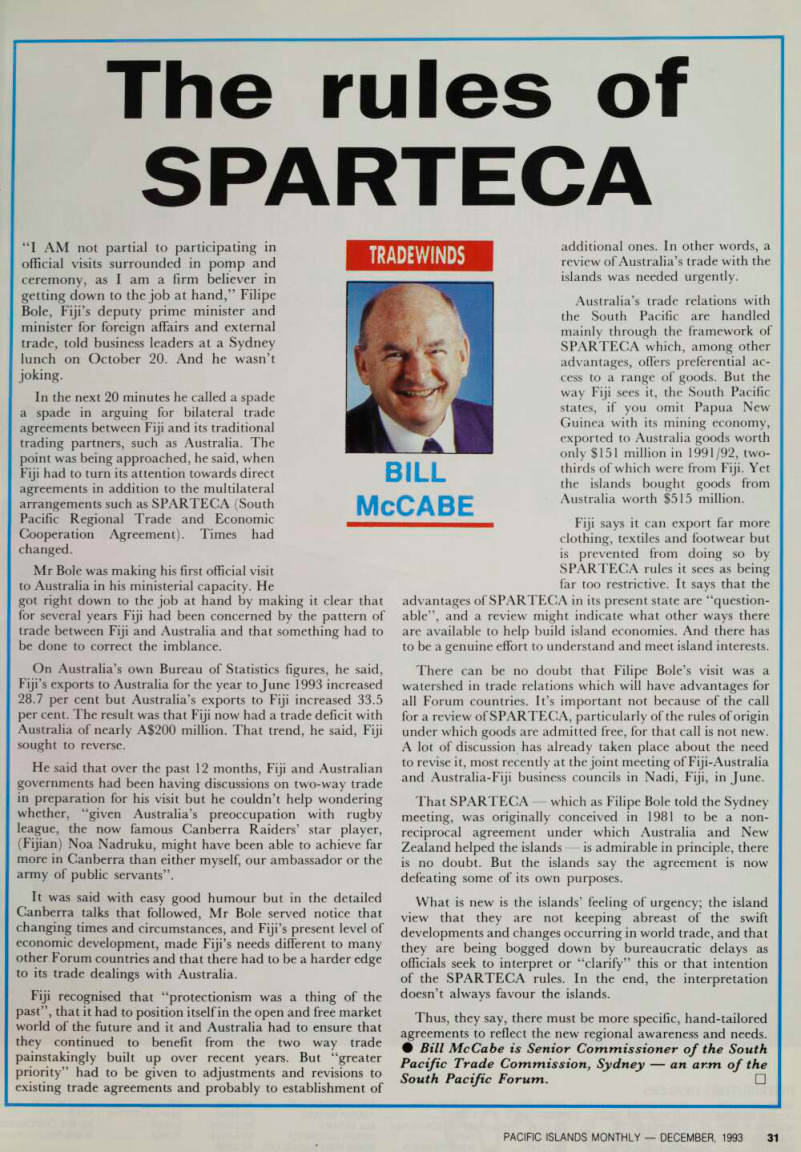
The rules of
“I AM not partial to participating in official visits surrounded in pomp and ceremony, as I am a firm believer in getting down to the job at hand,” Filipe
Bole, Fiji’s deputy prime minister and
minister for foreign affairs and external trade, told business leaders at a Sydney lunch on October 20. And he wasn’t
joking.
In the next 20 minutes he called a spade a spade in arguing for bilateral trade agreements between Fiji and its traditional trading partners, such as Australia. The point was being approached, he said, when Fiji had to turn its attention towards direct agreements in addition to the multilateral arrangements such as SPARTECA (South Pacific Regional Trade and Economic Cooperation Agreement). Times had changed.
Mr Bole was making his first official visit to Australia in his ministerial capacity. He
got right down to the job at hand by making it clear that for several years Fiji had been concerned by the pattern of trade between Fiji and Australia and that something had to be done to correct the imblance.
On Australia’s own Bureau of Statistics figures, he said, Fiji’s exports to Australia for the year to June 1993 increased 28.7 per cent but Australia’s exports to Fiji increased 33.5 per cent. The result was that Fiji now had a trade deficit with Australia of nearly As2oo million. That trend, he said, Fiji sought to reverse.
He said that over the past 12 months, Fiji and Australian governments had been having discussions on two-way trade in preparation for his visit but he couldn’t help wondering whether, “given Australia’s preoccupation with rugby league, the now famous Canberra Raiders’ star player, (Fijian) Noa Nadruku, might have been able to achieve far more in Canberra than either myself, our ambassador or the army of public servants”.
It was said with easy good humour but in the detailed Canberra talks that followed, Mr Bole served notice that changing times and circumstances, and Fiji’s present level of economic development, made Fiji’s needs different to many other Forum countries and that there had to be a harder edge to its trade dealings with Australia.
Fiji recognised that “protectionism was a thing of the past”, that it had to position itself in the open and free market world of the future and it and Australia had to ensure that they continued to benefit from the two way trade painstakingly built up over recent years. But “greater priority” had to be given to adjustments and revisions to existing trade agreements and probably to establishment of
additional ones. In other words, a review of Australia’s trade with the islands was needed urgently.
Australia’s trade relations with the South Pacific are handled mainly through the framework of SPARTECA which, among other advantages, offers preferential ac cess to a range of goods. But the way Fiji sees it, the South Pacific states, if you omit Papua New Guinea with its mining economy, exported to Australia goods worth only $l5l million in 1991/92, two thirds of which were from Fiji. Yet the islands bought goods from Australia worth $515 million.
Fiji says it can export far more clothing, textiles and footwear but is prevented from doing so by SPARTECA rules it sees as being far too restrictive. It says that the
advantages of SPARTECA in its present state are “question able”, and a review might indicate what other ways there are available to help build island economies. And there has to be a genuine effort to understand and meet island interests.
There can be no doubt that Filipe Bole’s visit was a watershed in trade relations which will have advantages for all Forum countries. It’s important not because of the call for a review of SPARTECA, particularly of the rules of origin under which goods are admitted free, for that call is not new.
A lot of discussion has already taken place about the need to revise it, most recently at the joint meeting of Fiji-Australia and Australia-Fiji business councils in Nadi, Fiji, in June.
That SPARTECA which as Filipe Bole told the Sydney meeting, was originally conceived in 1981 to be a non reciprocal agreement under which Australia and New Zealand helped the islands is admirable in principle, there is no doubt. But the islands say the agreement is now defeating some of its own purposes.
What is new is the islands’ feeling of urgency; the island view that they are not keeping abreast of the swift developments and changes occurring in world trade, and that they are being bogged down by bureaucratic delays as officials seek to interpret or “clarify” this or that intention of the SPARTECA rules. In the end, the interpretation doesn’t always favour the islands.
Thus, they say, there must be more specific, hand-tailored agreements to reflect the new regional awareness and needs. • Bill McCabe is Senior Commissioner of the South Pacific Trade Commission, Sydney an arm of the South Pacific Forum. □
Tradewinds
Bill
Mccabe
Advertisements & other items, pp. 32-33 (1 item)
Creating a highly efficient, dynamic-looking car wo
be simple if it weren’t for one complicating detail; passengers that must ride in it. Accommodating people comfortably in a pleasant, roo, interior usually means a certain amount of aerodynamic potential has to be sacrific % 4 %
wmm
Exact features and specifications may vary depending on country of purchase. Please check with your nearest TOYOTA distributor/dealer for details.
DISTRIBUTORS/DEALERS
AMERICAN SAMOA BURNS PHILP (S.S.) CO. LTD. PH 633-4281 GUAM & MICRONESIA... ATKINS KROLL. INC. PH 646-1876/9 NORFOLK ISLANDS BORRY’S PTY LTD. PH 2114
SOLOMON ISLANDS MENDANA MOTORS PH 30314
VANUATU VANUATU MOTORS PH 22341
COOK ISLANDS PACIFIC MOTORS LTD.
KIRIBATI TARAWA MOTORS
PAPUA NEW GUINEA ... ELA MOTORS
TAHITI NIPPON AUTOMOTO
WESTERN SAMOA BURNS PHILP (S.S.) CO. LTD.
PH 20796 PH 21090 PH 217036 PH 429819 PH 20800
FIJI ASCO MOTORS
NEW CALEDONIA .. .S.LA.P.
SAIPAN MICROL CORPORATION
TONGA BURNS PHILP (TONGA) L
ii mini
Until now. Using a concept called total airflow nagement, Toyota engineers were able to realize an efficient, wedge-shaped design ile at the same time perfecting the alignment between body panels and components, course our own innovative style of civilized Sneering makes sure that none of this comes the expense of the luxurious, leg-stretching 2 interior. Because we realize that even a 0.33 is useless if no one wants to drive the car.
TOYOTA
A voice in New York
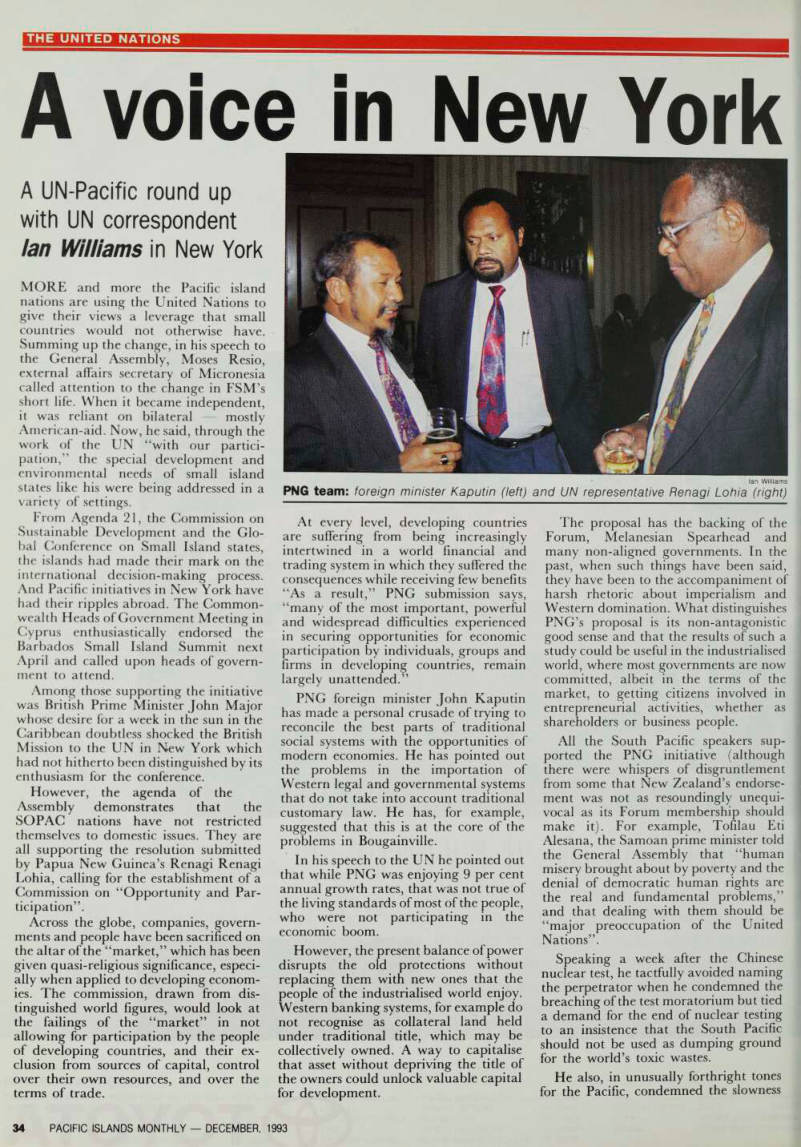
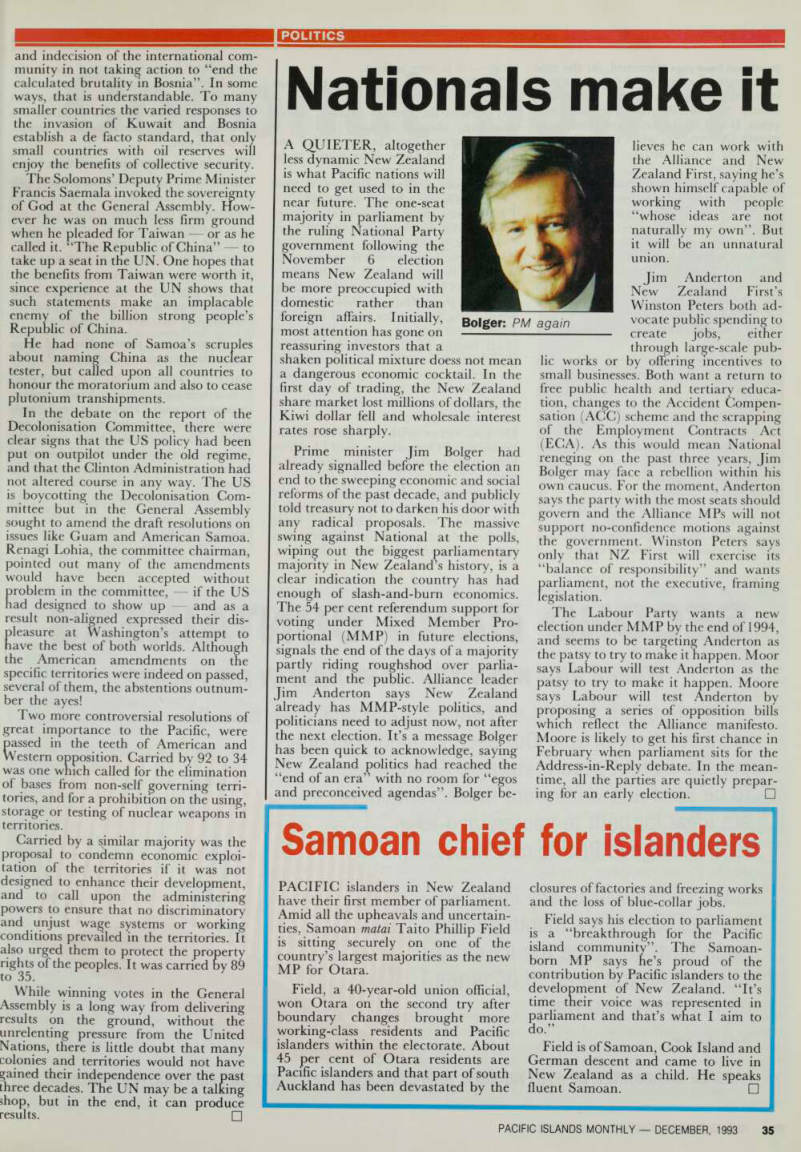
The United Nations
A UN-Pacific round up
with UN correspondent
fan Williams in New York
MORE and more the Pacific island nations are using the United Nations to give their views a leverage that small countries would not otherwise have.
Summing up the change, in his speech to the General Assembly, Moses Resio, external affairs secretary of Micronesia called attention to the change in FSM’s short life. When it became independent, it was reliant on bilateral mostly American-aid. Now, he said, through the work of the UN “with our partici pation,” the special development and environmental needs of small island states like his were being addressed in a variety of settings.
From Agenda 21, the Commission on Sustainable Development and the Glo bal Conference on Small Island states, the islands had made their mark on the international decision-making process.
And Pacific initiatives in New York have had their ripples abroad. The Common wealth Heads of Government Meeting in Cyprus enthusiastically endorsed the Barbados Small Island Summit next April and called upon heads of govern ment to attend.
Among those supporting the initiative was British Prime Minister John Major whose desire for a week in the sun in the Caribbean doubtless shocked the British Mission to the UN in New York which had not hitherto been distinguished by its enthusiasm for the conference.
However, the agenda of the Assembly demonstrates that the SOPAC nations have not restricted themselves to domestic issues. They are all supporting the resolution submitted by Papua New Guinea’s Renagi Renagi Lohia, calling for the establishment of a Commission on “Opportunity and Par
ticipation”.
Across the globe, companies, govern ments and people have been sacrificed on the altar of the “market,” which has been given quasi-religious significance, especi ally when applied to developing econom ies. The commission, drawn from dis tinguished world figures, would look at the failings of the “market” in not allowing for participation by the people of developing countries, and their ex clusion from sources of capital, control over their own resources, and over the terms of trade.
At every level, developing countries are suffering from being increasingly intertwined in a world financial and trading system in which they suffered the consequences while receiving few benefits “As a result,” PNG submission says, “many of the most important, powerful and widespread difficulties experienced in securing opportunities for economic participation by individuals, groups and firms in developing countries, remain largely unattended.”
PNG foreign minister John Kaputin has made a personal crusade of trying to reconcile the best parts of traditional social systems with the opportunities of modern economies. He has pointed out the problems in the importation of Western legal and governmental systems that do not take into account traditional customary law. He has, for example, suggested that this is at the core of the
problems in Bougainville.
In his speech to the UN he pointed out that while PNG was enjoying 9 per cent annual growth rates, that was not true of the living standards of most of the people, who were not participating in the economic boom.
However, the present balance of power disrupts the old protections without replacing them with new ones that the people of the industrialised world enjoy.
Western banking systems, for example do not recognise as collateral land held under traditional title, which may be collectively owned. A way to capitalise that asset without depriving the title of the owners could unlock valuable capital for development.
The proposal has the backing of the Forum, Melanesian Spearhead and many non-aligned governments. In the past, when such things have been said, they have been to the accompaniment of harsh rhetoric about imperialism and Western domination. What distinguishes PNG’s proposal is its non-antagonistic good sense and that the results of such a study could be useful in the industrialised world, where most governments are now committed, albeit in the terms of the market, to getting citizens involved in entrepreneurial activities, whether as shareholders or business people.
All the South Pacific speakers sup ported the PNG initiative (although there were whispers of disgruntlement from some that New Zealand’s endorse ment was not as resoundingly unequi vocal as its Forum membership should make it). For example, Tofilau Eti Alesana, the Samoan prime minister told the General Assembly that “human misery brought about by poverty and the denial of democratic human rights are the real and fundamental problems,” and that dealing with them should be “major preoccupation of the United Nations”.
Speaking a week after the Chinese nuclear test, he tactfully avoided naming the perpetrator when he condemned the breaching of the test moratorium but tied a demand for the end of nuclear testing to an insistence that the South Pacific should not be used as dumping ground for the world’s toxic wastes.
He also, in unusually forthright tones for the Pacific, condemned the slowness
lan Williams PNG team: foreign minister Kaputin (left) and UN representative Renagi Lohia (right)
and indecision of the international com munity in not taking action to “end the calculated brutality in Bosnia”. In some ways, that is understandable. To many smaller countries the varied responses to the invasion of Kuwait and Bosnia establish a de facto standard, that only small countries with oil reserves will enjoy the benefits of collective security.
The Solomons’ Deputy Prime Minister Francis Saemala invoked the sovereignty of God at the General Assembly. How ever he was on much less firm ground when he pleaded for Taiwan or as he called it. “The Republic of China” to take up a seat in the UN. One hopes that the benefits from Taiwan were worth it, since experience at the UN shows that such statements make an implacable enemy of the billion strong people’s Republic of China.
He had none of Samoa’s scruples about naming China as the nuclear tester, but called upon all countries to honour the moratorium and also to cease
plutonium transhipments.
In the debate on the report of the Decolonisation Committee, there were clear signs that the US policy had been put on outpilot under the old regime, and that the Clinton Administration had not altered course in any way. The US is boycotting the Decolonisation Com mittee but in the General Assembly sought to amend the draft resolutions on issues like Guam and American Samoa.
Renagi Lohia, the committee chairman, pointed out many of the amendments would have been accepted without problem in the committee, if the US had designed to show up and as a result non-aligned expressed their dis pleasure at Washington’s attempt to have the best of both worlds. Although the American amendments on the specific territories were indeed on passed, several of them, the abstentions outnum ber the ayes!
Two more controversial resolutions of great importance to the Pacific, were passed in the teeth of American and Western opposition. Carried by 92 to 34 was one which called for the elimination of bases from non-self governing terri tories, and for a prohibition on the using, storage or testing of nuclear weapons in territories.
Carried by a similar majority was the proposal to condemn economic exploi tation of the territories if it was not designed to enhance their development, and to call upon the administering powers to ensure that no discriminatory and unjust wage systems or working conditions prevailed in the territories. It also urged them to protect the property rights of the peoples. It was carried by 89 to 35.
While winning votes in the General Assembly is a long way from delivering results on the ground, without the unrelenting pressure from the United Nations, there is little doubt that many colonies and territories would not have gained their independence over the past three decades. The UN may be a talking >hop, but in the end, it can produce results. □
Nationals make it
Politics
A QUIETER, altogether less dynamic New Zealand is what Pacific nations will need to get used to in the near future. The one-seat majority in parliament by the ruling National Party government following the November 6 election means New Zealand will be more preoccupied with domestic rather than foreign affairs. Initially, most attention has gone on reassuring investors that a
shaken political mixture doess not mean a dangerous economic cocktail. In the first day of trading, the New Zealand share market lost millions of dollars, the Kiwi dollar fell and wholesale interest rates rose sharply.
Prime minister Jim Bolger had already signalled before the election an end to the sweeping economic and social reforms of the past decade, and publicly told treasury not to darken his door with any radical proposals. The massive swing against National at the polls, wiping out the biggest parliamentary majority in New Zealand’s history, is a clear indication the country has had enough of slash-and-burn economics.
The 54 per cent referendum support for voting under Mixed Member Pro portional (MMP) in future elections, signals the end of the days of a majority partly riding roughshod over parlia ment and the public. Alliance leader Jim Anderton says New Zealand
already has MMP-style politics, and
politicians need to adjust now, not after the next election. It’s a message Bolger
has been quick to acknowledge, saying
New Zealand politics had reached the “end of an era” with no room for “egos and preconceived agendas”. Bolger be-
lieves he can work with the Alliance and New Zealand First, saying he’s shown himself capable of
working with people
“whose ideas are not naturally my own”. But it will be an unnatural union.
Jim Anderton and New Zealand First’s Winston Peters both ad
vocate public spending to
create jobs, either through large-scale pub
lie works or by offering incentives to small businesses. Both want a return to free public health and tertiary educa tion, changes to the Accident Compen sation (ACC) scheme and the scrapping of the Employment Contracts Act (EGA). As this would mean National reneging on the past three years, Jim Bolger may face a rebellion within his own caucus. For the moment, Anderton says the party with the most seats should govern and the Alliance MPs will not support no-confidence motions against the government. Winston Peters says only that NZ First will exercise its “balance of responsibility” and wants parliament, not the executive, framing
legislation.
The Labour Party wants a new election under MMP by the end of 1994, and seems to be targeting Anderton as the patsy to try to make it happen. Moor says Labour will test Anderton as the patsy to try to make it happen. Moore says Labour will test Anderton by proposing a series of opposition bills which reflect the Alliance manifesto.
Moore is likely to get his first chance in February when parliament sits for the Address-in-Reply debate. In the mean time, all the parties are quietly prepar ing for an early election. □
Bolger: PM again
Samoan chief for islanders
PACIFIC islanders in New Zealand have their first member of parliament.
Amid all the upheavals and uncertain ties, Samoan matai Taito Phillip Field is sitting securely on one of the
country’s largest majorities as the new
MP for Otara.
Field, a 40-year-old union official, won Otara on the second try after
boundary changes brought more
working-class residents and Pacific islanders within the electorate. About 45 per cent of Otara residents are Pacific islanders and that part of south Auckland has been devastated by the
closures of factories and freezing works and the loss of blue-collar jobs.
Field says his election to parliament is a “breakthrough for the Pacific island community”. The Samoan born MP says ne’s proud of the contribution by Pacific islanders to the development of New Zealand. “It’s time their voice was represented in parliament and that’s what I aim to do.”
Field is of Samoan, Cook Island and German descent and came to live in New Zealand as a child. He speaks fluent Samoan. □
Advertisements & other items, p. 36 (1 item)
Second Hand Containers
WHERE AND WHEN YOU WANT THEM IN THE PACIFIC If you need a flexible and safe storage space we have the ideal solution for you. Our second h provide instant secure storage. Qua to be wind and waterproof these coi are ideal for both temporary and lon We can deliver to any island in the Pacific within a month and our rates have got to be the lowest you will find. All you need to do is tell us how many you want.
CONTACT:
PASCALE MARCONNET, BP 4757 NOUMEA, NEW CALEDONIA. TEL: (687) 28 7450. FAX: (687) 26 3248 term storage in Pacific conditions.
Coconut power
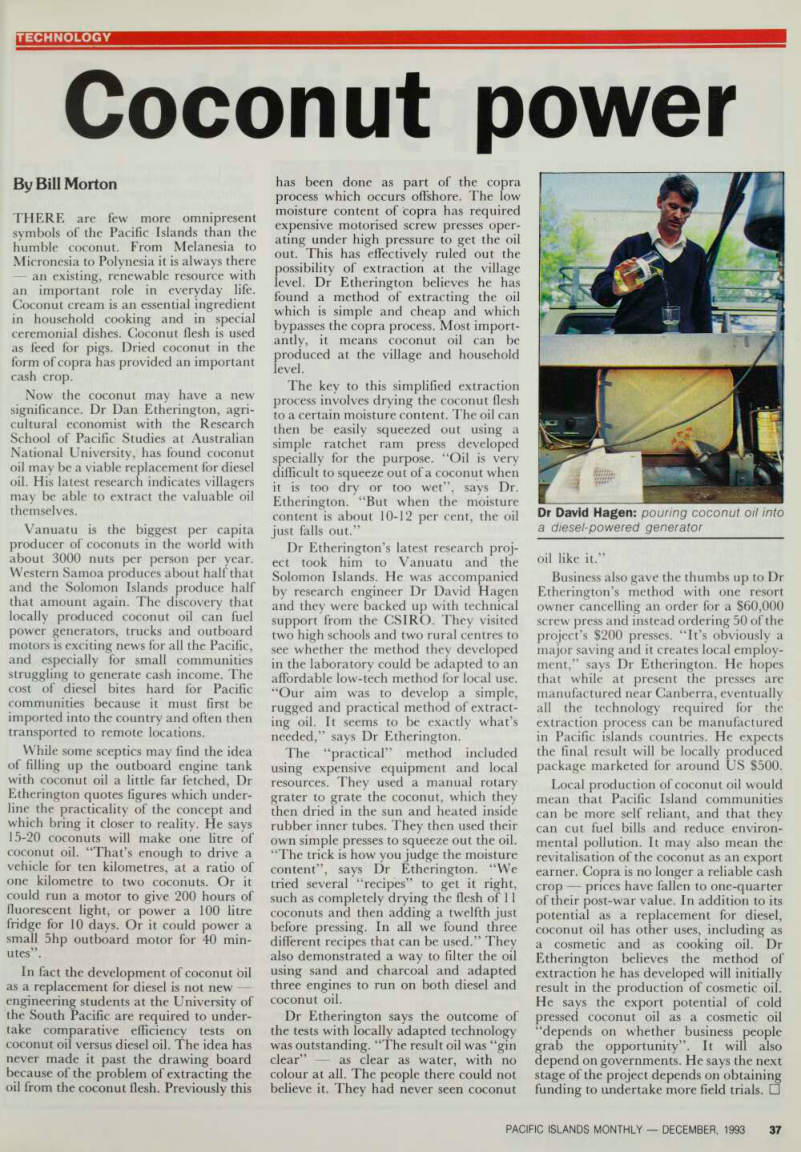
Technology
By Bill Morton
THERE are few more omnipresent symbols of the Pacific Islands than the humble coconut. From Melanesia to Micronesia to Polynesia it is always there an existing, renewable resource with an important role in everyday life.
Coconut cream is an essential ingredient in household cooking and in special ceremonial dishes. Coconut flesh is used as feed for pigs. Dried coconut in the form of copra has provided an important cash crop.
Now the coconut may have a new significance. Dr Dan Etherington, agri cultural economist with the Research School of Pacific Studies at Australian National University, has found coconut oil may be a viable replacement for diesel oil. His latest research indicates villagers may be able to extract the valuable oil themselves.
Vanuatu is the biggest per capita producer of coconuts in the world with about 3000 nuts per person per year.
Western Samoa produces about half that and the Solomon Islands produce half that amount again. The discovery that locally produced coconut oil can fuel power generators, trucks and outboard motors is exciting news for all the Pacific, and especially for small communities struggling to generate cash income. The cost of diesel bites hard for Pacific communities because it must first be imported into the country and often then transported to remote locations.
While some sceptics may find the idea of filling up the outboard engine tank with coconut oil a little far fetched, Dr Etherington quotes figures which under line the practicality of the concept and which bring it closer to reality. He says 15-20 coconuts will make one litre of coconut oil. “That’s enough to drive a vehicle for ten kilometres, at a ratio of one kilometre to two coconuts. Or it could run a motor to give 200 hours of fluorescent light, or power a 100 litre fridge for 10 days. Or it could power a small shp outboard motor for 40 min utes”.
In fact the development of coconut oil as a replacement for diesel is not new engineering students at the University of the South Pacific are required to under take comparative efficiency tests on coconut oil versus diesel oil. The idea has never made it past the drawing board because of the problem of extracting the oil from the coconut flesh. Previously this
has been done as part of the copra process which occurs offshore. The low moisture content of copra has required expensive motorised screw presses oper ating under high pressure to get the oil out. This has effectively ruled out the possibility of extraction at the village level. Dr Etherington believes he has found a method of extracting the oil which is simple and cheap and which bypasses the copra process. Most import antly, it means coconut oil can be produced at the village and household level.
The key to this simplified extraction process involves drying the coconut flesh to a certain moisture content. The oil can then be easily squeezed out using a simple ratchet ram press developed specially for the purpose. “Oil is very difficult to squeeze out of a coconut when it is too dry or too wet”, says Dr.
Etherington. “But when the moisture content is about 10-12 per cent, the oil just falls out.”
Dr Etherington’s latest research proj ect took him to Vanuatu and the Solomon Islands. He was accompanied
by research engineer Dr David Hagen
and they were backed up with technical support from the CSIRO. They visited two high schools and two rural centres to see whether the method they developed in the laboratory could be adapted to an affordable low-tech method for local use.
“Our aim was to develop a simple, rugged and practical method of extract ing oil. It seems to be exactly what’s needed,” says Dr Etherington.
The “practical” method included using expensive equipment and local resources. They used a manual rotary grater to grate the coconut, which they then dried in the sun and heated inside rubber inner tubes. They then used their own simple presses to squeeze out the oil.
“The trick is how you judge the moisture content”, says Dr Etherington. “We tried several “recipes” to get it right, such as completely drying the flesh of 11 coconuts and then adding a twelfth just before pressing. In all we found three different recipes that can be used.” They also demonstrated a way to filter the oil using sand and charcoal and adapted three engines to run on both diesel and coconut oil.
Dr Etherington says the outcome of the tests with locally adapted technology was outstanding. “The result oil was “gin clear” as clear as water, with no colour at all. The people there could not believe it. They had never seen coconut
oil like it.”
Business also gave the thumbs up to Dr Etherington’s method with one resort owner cancelling an order for a 560,000 screw press and instead ordering 50 of the project’s $2OO presses. “It’s obviously a major saving and it creates local employ ment,” says Dr Etherington. He hopes that while at present the presses are manufactured near Canberra, eventually all the technology required for the extraction process can be manufactured in Pacific islands countries. He expects the final result will be locally produced package marketed for around US $5OO.
Local production of coconut oil would mean that Pacific Island communities can be more self reliant, and that they can cut fuel bills and reduce environ mental pollution. It may also mean the revitalisation of the coconut as an export earner. Copra is no longer a reliable cash crop prices have fallen to one-quarter of their post-war value. In addition to its potential as a replacement for diesel, coconut oil has other uses, including as a cosmetic and as cooking oil. Dr Etherington believes the method of extraction he has developed will initially result in the production of cosmetic oil.
He says the export potential of cold pressed coconut oil as a cosmetic oil “depends on whether business people grab the opportunity”. It will also depend on governments. He says the next stage of the project depends on obtaining funding to undertake more field trials. □
Dr David Hagen: pouring coconut oil into a diesel-powered generator
Unhappy natives
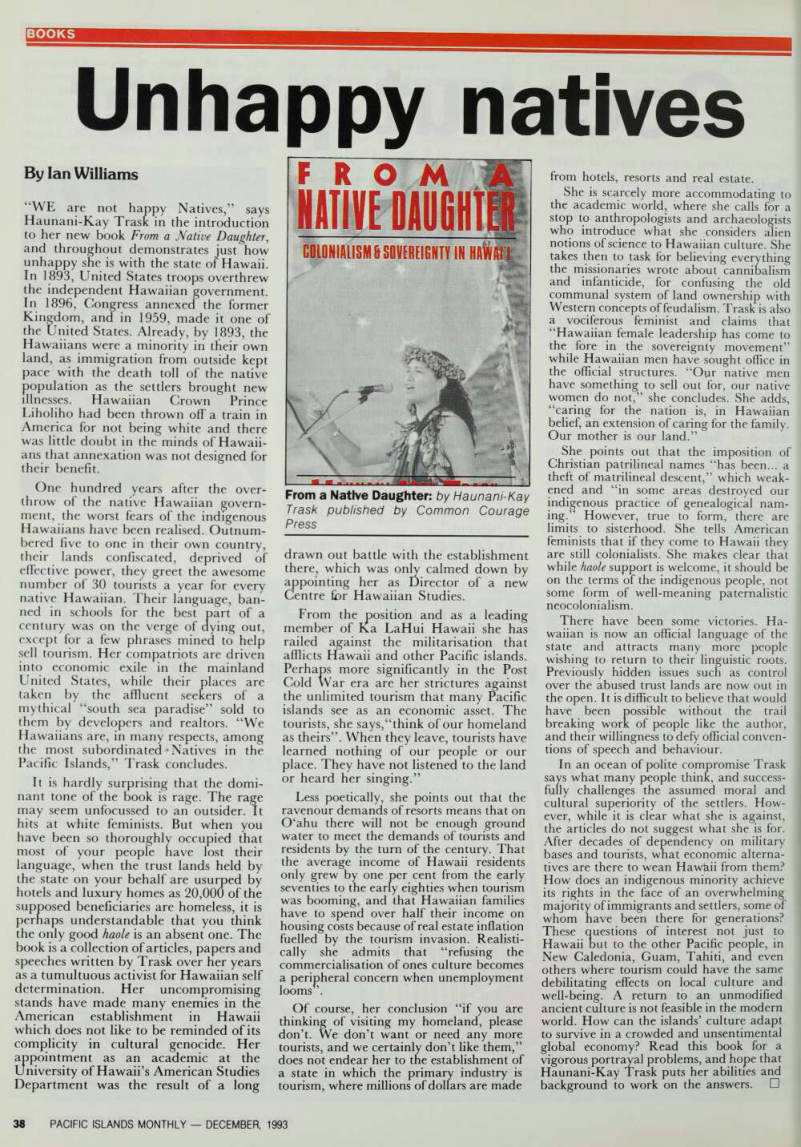
Books
By lan Williams
“WE are not happy Natives,” says Haunani-Kay Trask in the introduction to her new book From a Native Daughter , and throughout demonstrates just how unhappy she is with the state of Hawaii.
In 1893, United States troops overthrew the independent Hawaiian government.
In 1896, Congress annexed the former Kingdom, and in 1959, made it one of the United States. Already, by 1893, the Hawaiians were a minority in tlieir own land, as immigration from outside kept pace with the death toll of the native population as the settlers brought new illnesses. Hawaiian Crown Prince Liholiho had been thrown off a train in America for not being white and there was little doubt in the minds of Hawaii ans that annexation was not designed for their benefit.
One hundred years after the over throw of the native Hawaiian govern ment, the worst fears of the indigenous Hawaiians have been realised. Outnum bered five to one in their own country, their lands confiscated, deprived of effective power, they greet the awesome number of 30 tourists a year for every native Hawaiian. Their language, ban ned in schools for the best part of a century was on the verge of dying out, except for a few phrases mined to help sell tourism. Her compatriots are driven into economic exile in the mainland United States, while their places are taken by the affluent seekers of a mythical “south sea paradise” sold to them by developers and realtors. “We Hawaiians are, in many respects, among the most subordinated'Natives in the Pacific Islands,” Trask concludes.
It is hardly surprising that the domi nant tone of the book is rage. The rage may seem unfocussed to an outsider. It hits at white feminists. But when you have been so thoroughly occupied that most of your people have lost their language, when the trust lands held by the state on your behalf are usurped by hotels and luxury homes as 20,000 of the supposed beneficiaries are homeless, it is perhaps understandable that you think the only good haole is an absent one. The book is a collection of articles, papers and speeches written by Trask over her years as a tumultuous activist for Hawaiian self determination. Her uncompromising stands have made many enemies in the American establishment in Hawaii which does not like to be reminded of its complicity in cultural genocide. Her appointment as an academic at the University of Hawaii’s American Studies Department was the result of a long
drawn out battle with the establishment there, which was only calmed down by appointing her as Director of a new Centre for Hawaiian Studies.
From the position and as a leading member of Ka LaHui Hawaii she has railed against the militarisation that afflicts Hawaii and other Pacific islands.
Perhaps more significantly in the Post Cold War era are her strictures against the unlimited tourism that many Pacific islands see as an economic asset. The tourists, she says,“think of our homeland as theirs”. When they leave, tourists have learned nothing of our people or our place. They have not listened to the land or heard her singing.”
Less poetically, she points out that the ravenour demands of resorts means that on o‘ahu there will not be enough ground water to meet the demands of tourists and residents by the turn of the century. That the average income of Hawaii residents only grew by one per cent from the early seventies to the early eighties when tourism was booming, and that Hawaiian families have to spend over half their income on housing costs because of real estate inflation fuelled by the tourism invasion. Realisti cally she admits that “refusing the commercialisation of ones culture becomes a peripheral concern when unemployment looms .
Of course, her conclusion “if you are thinking of visiting my homeland, please don’t. We don’t want or need any more tourists, and we certainly don’t like them,” does not endear her to the establishment of a state in which the primary industry is tourism, where millions of dollars are made
from hotels, resorts and real estate.
She is scarcely more accommodating to the academic world, where she calls for a stop to anthropologists and archaeologists who introduce what she considers alien notions of science to Hawaiian culture. She takes then to task for believing everything the missionaries wrote about cannibalism and infanticide, for confusing the old communal system of land ownership with Western concepts of feudalism. Trask is also a vociferous feminist and claims that “Hawaiian female leadership has come to the fore in the sovereignty movement” while Hawaiian men have sought office in the official structures. “Ovir native men have something to sell out for, our native women do not,” she concludes. She adds, “caring for the nation is, in Hawaiian belief, an extension of caring for the family.
Our mother is our land.”
She points out that the imposition of Christian patrilineal names “has been... a theft of matrilineal descent,” which weak ened and “in some areas destroyed our
indigenous practice of genealogical nam
ing.” However, true to form, there are limits to sisterhood. She tells American feminists that if they come to Hawaii they are still colonialists. She makes clear that while haole support is welcome, it should be on the terms of the indigenous people, not some form of well-meaning paternalistic neocolonialism.
There have been some victories. Ha waiian is now an official language of the state and attracts many more people wishing to return to their linguistic roots.
Previously hidden issues such as control over the abused trust lands are now out in the open. It is difficult to believe that would have been possible without the trail breaking work of people like the author, and their willingness to defy official conven tions of speech and behaviour.
In an ocean of polite compromise Trask says what many people think, and success fully challenges the assumed moral and cultural superiority of the settlers. How ever, while it is dear what she is against, the articles do not suggest what she is for.
After decades of dependency on military bases and tourists, what economic alterna tives are there to wean Hawkii from them?
How does an indigenous minority achieve its rights in the face of an overwhelming majority of immigrants and settlers, some of whom have been there for generations?
These questions of interest not just to Hawaii but to the other Pacific people, in New Caledonia, Guam, Tahiti, and even others where tourism could have the same debilitating effects on local culture and well-being. A return to an unmodified ancient culture is not feasible in the modern world. How can the islands’ culture adapt to survive in a crowded and unsentimental global economy? Read this book for a
vigorous portrayal problems, and hope that
Haunani-Kay Trask puts her abilities and background to work on the answers. □
From a Native Daughter: by Haunani-Kay Trask published by Common Courage Press
Population debacle
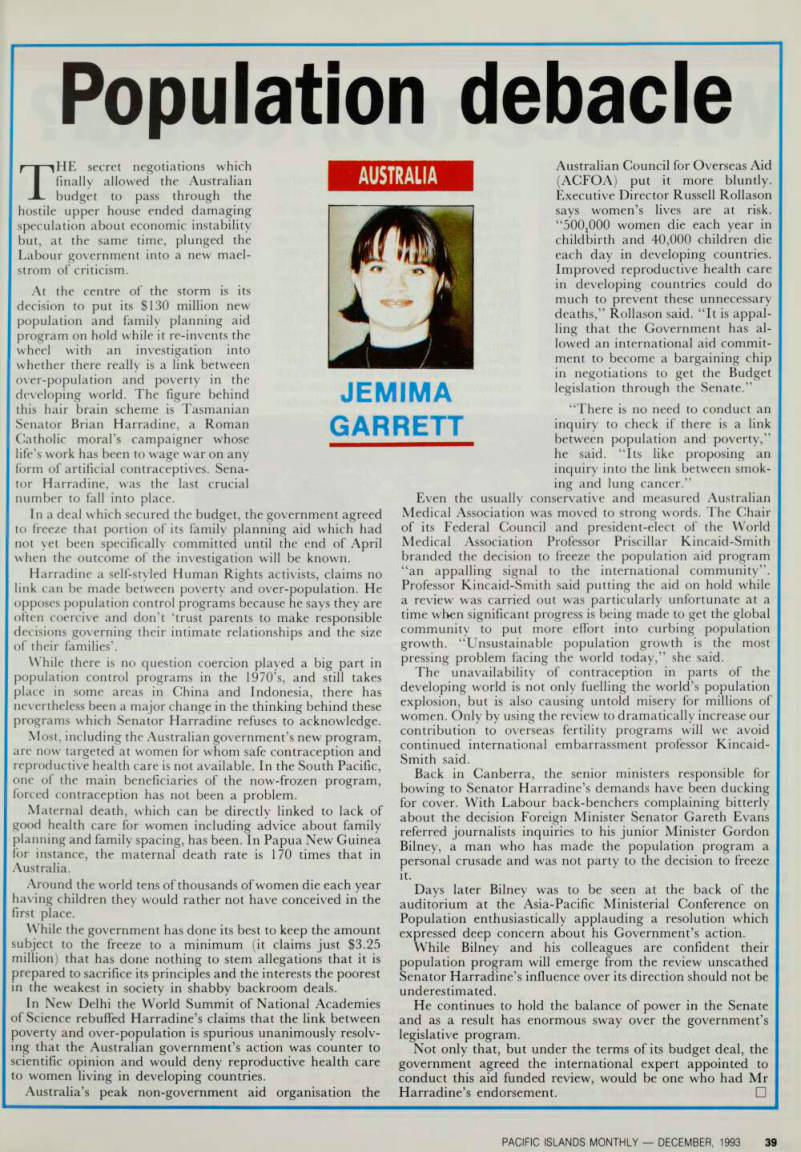
THE secret negotiations which
finally allowed the Australian budget to pass through the hostile upper house ended damaging
speculation about economic instability
but, at the same time, plunged the Labour government into a new mael strom of criticism.
At the centre of the storm is its decision to put its SI3O million new
population and family planning aid
program on hold while it re-invents the wheel with an investigation into whether there really is a link between over-population and poverty in the developing world. The figure behind this hair brain scheme is Tasmanian Senator Brian Harradine, a Roman Catholic moral’s campaigner whose life’s work has been to wage war on any form of artificial contraceptives. Sena tor Harradine, was the last crucial number to fall into place.
In a deal which secured the budget, the government agreed to freeze that portion of its family planning aid which had not yet been specifically committed until the end of April when the outcome of the investigation will be known.
Harradine a self-styled Human Rights activists, claims no link can be made between poverty and over-population. He opposes population control programs because he says they are often coercive and don’t ‘trust parents to make responsible decisions governing their intimate relationships and the size of their families’.
While there is no question coercion played a big part in population control programs in the 1970’5, and still takes place in some areas in China and Indonesia, there has nevertheless been a major change in the thinking behind these programs which Senator Harradine refuses to acknowledge.
Most, including the Australian government’s new program, are now targeted at women for whom safe contraception and reproductive health care is not available. In the South Pacific, one of the main beneficiaries of the now-frozen program, forced contraception has not been a problem.
Maternal death, which can be directly linked to lack of good health care for women including advice about family planning and family spacing, has been. In Papua New Guinea for instance, the maternal death rate is 170 times that in Australia.
Around the world tens of thousands of women die each year having children they would rather not have conceived in the first place.
While the government has done its best to keep the amount subject to the freeze to a minimum (it claims just 53.25 million) that has done nothing to stem allegations that it is prepared to sacrifice its principles and the interests the poorest in the weakest in society in shabby backroom deals.
In New Delhi the World Summit of National Academies of Science rebuffed Harradine’s claims that the link between poverty and over-population is spurious unanimously resolv ing that the Australian government’s action was counter to scientific opinion and would deny reproductive health care to women living in developing countries.
Australia’s peak non-government aid organisation the
Australian Council for Overseas Aid (ACFOA) put it more bluntly.
Executive Director Russell Rollason says women’s lives are at risk.
“500,000 women die each year in childbirth and 40,000 children die each day in developing countries.
Improved reproductive health care in developing countries could do much to prevent these unnecessary deaths,” Rollason said. “It is appal ling that the Government has al lowed an international aid commit ment to become a bargaining chip in negotiations to get the Budget legislation through the Senate.”
“There is no need to conduct an inquiry to check if there is a link between population and poverty,” he said. “Its like proposing an inquiry into the link between smok ing and lung cancer.”
Even the usually conservative and measured Australian Medical Association was moved to strong words. The Chair of its Federal Council and president-elect of the World Medical Association Professor Priscillar Kincaid-Smith branded the decision to freeze the population aid program “an appalling signal to the international community”.
Professor Kincaid-Smith said putting the aid on hold while a review was carried out was particularly unfortunate at a time when significant progress is being made to get the global community to put more effort into curbing population growth. “Unsustainable population growth is the most pressing problem facing the world today,” she said.
The unavailability of contraception in parts of the developing world is not only fuelling the world’s population explosion, but is also causing untold misery for millions of women. Only by using the review to dramatically increase our contribution to overseas fertility programs will we avoid continued international embarrassment professor Kincaid- Smith said.
Back in Canberra, the senior ministers responsible for bowing to Senator Harradine’s demands have been ducking for cover. With Labour back-benchers complaining bitterly about the decision Foreign Minister Senator Gareth Evans referred journalists inquiries to his junior Minister Gordon Bilney, a man who has made the population program a personal crusade and was not party to the decision to freeze it.
Days later Bilney was to be seen at the back of the auditorium at the Asia-Pacific Ministerial Conference on Population enthusiastically applauding a resolution which expressed deep concern about his Government’s action.
While Bilney and his colleagues are confident their population program will emerge from the review unscathed Senator Harradine’s influence over its direction should not be underestimated.
He continues to hold the balance of power in the Senate and as a result has enormous sway over the government’s
legislative program.
Not only that, but under the terms of its budget deal, the government agreed the international expert appointed to conduct this aid funded review, would be one who had Mr Harradine’s endorsement. □
Australia
Jemima
Garrett
Whither now, Tuvalu?
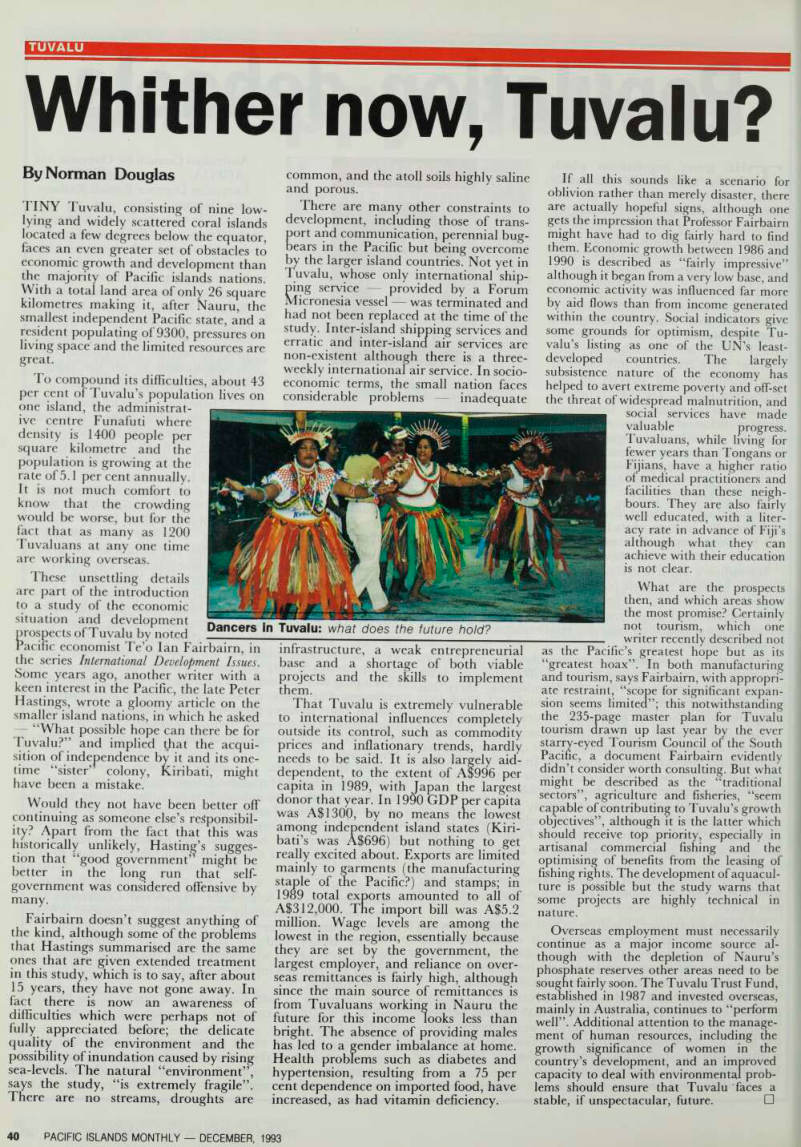
Tuvalu
By Norman Douglas
TINY Tuvalu, consisting of nine low lying and widely scattered coral islands located a few degrees below the equator, faces an even greater set of obstacles to economic growth and development than the majority of Pacific islands nations.
With a total land area of only 26 square kilometres making it, after Nauru, the smallest independent Pacific state, and a resident populating of 9300, pressures on living space and the limited resources are great.
To compound its difficulties, about 43 per cent of Tuvalu’s population lives on
one island, the administrat ive centre Funafuti where density is 1400 people per square kilometre and the population is growing at the rate of 5.1 per cent annually.
It is not much comfort to know that the crowding would be worse, but for the fact that as many as 1200 Tuvaluans at any one time are working overseas.
These unsettling details are part of the introduction to a study of the economic situation and development prospects of Tuvalu by noted
Pacific economist Te’o lan Fairbairn, in the series International Development Issues.
Some years ago, another writer with a keen interest in the Pacific, the late Peter Hastings, wrote a gloomy article on the smaller island nations, in which he asked “What possible hope can there be for Tuvalu?” and implied that the acqui sition of independence by it and its one time “sister’ colony, Kiribati, might have been a mistake.
Would they not have been better off continuing as someone else’s responsibil ity? Apart from the fact that this was
historically unlikely, Hasting’s sugges
tion that “good government” might be better in the long run that self government was considered offensive by many.
Fairbairn doesn’t suggest anything of the kind, although some of the problems that Hastings summarised are the same ones that are given extended treatment in this study, which is to say, after about 15 years, they have not gone away. In fact there is now an awareness of difficulties which were perhaps not of fully appreciated before; the delicate quality of the environment and the possibility of inundation caused by rising sea-levels. The natural “environment”, says the study, “is extremely fragile”.
There are no streams, droughts are
common, and the atoll soils highly saline and porous.
There are many other constraints to development, including those of trans- Eort and communication, perennial bug ears in the Pacific but being overcome by the larger island countries. Not yet in Tuvalu, whose only international ship ping service provided by a Forum Micronesia vessel was terminated and had not been replaced at the time of the study. Inter-island shipping services and erratic and inter-island air services are non-existent although there is a three weekly international air service. In socio economic terms, the small nation faces considerable problems inadequate
infrastructure, a weak entrepreneurial base and a shortage of both viable projects and the skills to implement them.
That Tuvalu is extremely vulnerable to international influences completely outside its control, such as commodity prices and inflationary trends, hardly needs to be said. It is also largely aid dependent, to the extent of A|)996 per capita in 1989, with Japan the largest donor that year. In 1990 GDP per capita was AS 1300, by no means tne lowest among independent island states (Kiri bati’s was A 5696) but nothing to get really excited about. Exports are limited mainly to garments (the manufacturing staple of the Pacific?) and stamps; in 1989 total exports amounted to all of A 5312,000. The import bill was A 55.2 million. Wage levels are among the lowest in the region, essentially because they are set by the government, the largest employer, and reliance on over
seas remittances is fairly high, although
since the main source of remittances is from Tuvaluans working in Nauru the future for this income looks less than bright. The absence of providing males has led to a gender imbalance at home.
Health problems such as diabetes and hypertension, resulting from a 75 per cent dependence on imported food, have increased, as had vitamin deficiency.
If all this sounds like a scenario for oblivion rather than merely disaster, there are actually hopeful signs, although one gets the impression that Professor Fairbairn might have had to dig fairly hard to find them. Economic growth between 1986 and 1990 is described as “fairly impressive” although it began from a very low base, and economic activity was influenced far more by aid flows than from income generated within the country. Social indicators give some grounds for optimism, despite Tu valu’s listing as one of the UN’s least developed countries. The largely subsistence nature of the economy has helped to avert extreme poverty and off-set the threat of widespread malnutrition, and
social services have made valuable progress.
Tuvaluans, while living for fewer years than Tongans or Fijians, have a higher ratio of medical practitioners and facilities than these neigh bours. They are also fairly well educated, with a liter acy rate in advance of Fiji’s although what they can achieve with their education is not clear.
What are the prospects then, and which areas show the most promise? Certainly not tourism, which one writer recently described not
as the Pacific’s greatest hope but as its “greatest hoax”. In both manufacturing and tourism, says Fairbairn, with appropri ate restraint, “scope for significant expan sion seems limited”; this notwithstanding the 235-page master plan for Tuvalu tourism drawn up last year by the ever starry-eyed Tourism Council of the South Pacific, a document Fairbairn evidently didn’t consider worth consulting. But what might be described as the “traditional sectors”, agriculture and fisheries, “seem capable of contributing to Tuvalu’s growth objectives”, although it is the latter which should receive top priority, especially in artisanal commercial fishing and the optimising of benefits from the leasing of fishing rights. The development of aquacul ture is possible but the study warns that some projects are highly technical in nature.
Overseas employment must necessarily continue as a major income source al though with the depletion of Nauru’s phosphate reserves other areas need to be sought fairly soon. The Tuvalu Trust Fund, established in 1987 and invested overseas, mainly in Australia, continues to “perform well”. Additional attention to the manage ment of human resources, including the growth significance of women in the country’s development, and an improved capacity to deal with environmental prob lems should ensure that Tuvalu faces a stable, if unspectacular, future. □
Dancers in Tuvalu: what does the future hold?
Guerrero’s out

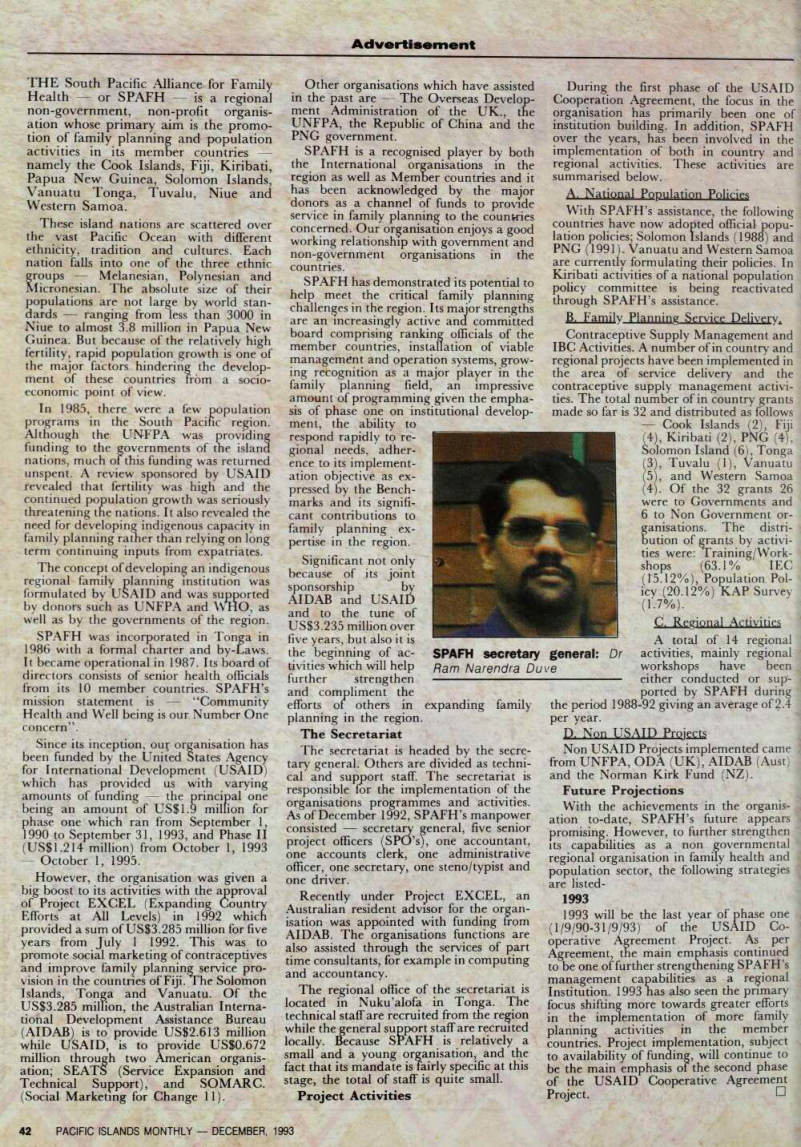
Cnmi Election
By David North
CNMI Governor Larry Guerrero was kicked out of office in a November election otherwise marked by the re election of incumbents.
Guerrero, a Republican, lost to Demo crat Froilan C. Tenorio, by a margin of 5,197 to 4,144 in the nearly complete returns. Tenorio, who had lost to Guerrero four years earlier, had pre viously served as the Marianas’ elected representative in Washington.
While the Governor was losing Juan Babauta, the sitting Washington rep resentative and a Republican, won another four years in Washington by 4,809 to 4,091; the loser in this race, who also lost four years ago, was Herman T.
Guerrero, a Democrat who had served both as a legislator and as a staffer to Tenorio in Washington.
Governor Guerrero’s runningmate, in cumbent Lt. Governor Benjamin T.
Manglona, lost to Tenorio’s ally, former Justice Jesus C. Borja.
Most of the seats in the two-house legislature were up for election, and the basic Republican majorities remain in place; but two prominent opponent of Guerrero are among those returning to their seats in the House. They are Stanley Torres and Heinz Hofschneider (a Chamorro despite the last name).
These two had an interesting year; first their names and that of another legislator were shot up, though no one was hurt.
Then the Republican party denied them renomination; they were then elected as independents in the November election.
CNMI politics, because of similar last names and shifting alliances, can be confusing. Sometimes it seems that the local politicians have only two last names, Tenorio (the last name of former Republican Governor, Pedro, and of his Lt. Governor, also Pedro) and Guerrero (there is also the retiring Governor’s cousin, Ray Guerrero, who runs the territories utilities authority, and yet another Guerrero in the legislature.) Further, Juan Babauta and his ally, House Speaker Thomas P. Villagomez, had run against Governor Guerrero and Manglona in the Republican primary earlier this, losing by the slimmest of margins. Subsequently Babauta was selected (presumably with the Governor’s support) to fill a vacancy as the Republican candidate for Washing ton Representative, while Villagomez moved up to one of the three Saipan seats
in the nine-member Senate (each major island gets three seats.) It was not an uplifting campaign.
Froilan Tenorio was accused of having a foul tongue (which apparently found its way into correspondence quoted in ads).
The Governor was said to have taken a large commission from Mitsubishi while deciding, as Governor, to buy a heavy duty Mitsubishi generator to beef up Saipan’s perpetually hard-pressed elec trical system. The Governor’s reply was, in effect, that the commission went to his son, and not to the Governor.
One predictable by-product of, the election will be better relations between Saipan and Washington. Babauta, well respected in the Capital, will be able to operate without the handicap of the apparently inept and certainly contro versial Governor Guerrero. The Governor had managed to become identified with an exploitive and very rich garment maker (Willie Tan), had fought to prevent the US Department of Interior from looking at CNMI’s
peculiar income-tax-rebate scheme, and had enraged George Miller, the Chair man of the US House Interior Commit tee. (See Trouble in Saipan, PIM , September, 1993.) One of the few real issues discussed in the campaign was the difficulty CNMI had in bringing previously-promised US fund to the islands; the Democrats laid these delays at the Governor’s door. □
Guerrero: lost to Tenorio
Advertisement
THE South Pacific Alliance for Family Health or SPAFH is a regional
non-government, non-profit organis
ation whose primary aim is the promo
tion of family planning and population
activities in its member countries namely the Cook Islands, Fiji, Kiribati, Papua New Guinea, Solomon Islands, Vanuatu Tonga, Tuvalu, Niue and Western Samoa.
These island nations are scattered over the vast Pacific Ocean with different ethnicity, tradition and cultures. Each nation falls into one of the three ethnic groups Melanesian, Polynesian and Micronesian. The absolute size of their populations are not large by world stan dards ranging from less than 3000 in Niue to almost 3.8 million in Papua New Guinea. But because of the relatively high fertility, rapid population growth is one of the major factors hindering the develop ment of these countries from a socio economic point of view.
In 1985, there were a few population programs in the South Pacific region.
Although the UNFPA was providing funding to the governments of the island nations, much of this funding was returned unspent. A review sponsored by USAID revealed that fertility was high and the continued population growth was seriously threatening the nations. It also revealed the need for developing indigenous capacity in family planning rather than relying on long term continuing inputs from expatriates.
The concept of developing an indigenous regional family planning institution was formulated by USAID and was supported by donors such as UNFPA and WHO, as well as by the governments of the region.
SPAFH was incorporated in Tonga in 1986 with a formal charter and by-Laws.
It became operational in 1987. Its board of directors consists of senior health officials from its 10 member countries. SPAFH’s mission statement is “Community Health and Well being is our Number One concern”.
Since its inception, organisation has been funded by the United States Agency for International Development (USAID) which has provided us with varying amounts of funding the principal one being an amount of US$l.9 million for phase one which ran from September 1, 1990 to September 31, 1993, and Phase II (U 551,214 million) from October 1, 1993 October 1, 1995.
However, the organisation was given a big boost to its activities with the approval
of Project EXCEL (Expanding Country
Efforts at All Levels) in 1992 whicn provided a sum of U 553,285 million for five years from July 1 1992. This was to promote social marketing of contraceptives and improve family planning service pro vision in the countries of Fiji. The Solomon Islands, Tonga and Vanuatu. Of the U 553,285 million, the Australian Interna tional Development Assistance Bureau (AIDAB) is to provide U 552,613 million while USAID, is to provide U 550,672 million through two American organis ation; SEATS (Service Expansion and Technical Support), and SOMARC. (Social Marketing for Change 11).
Other organisations which have assisted in the past are The Overseas Develop ment Administration of the UK., the UNFPA, the Republic of China and the PNG government.
SPAFH is a recognised player by both the International organisations in the region as well as Member countries and it has been acknowledged by the major donors as a channel of funds to provide service in family planning to the countries concerned. Our organisation enjoys a good working relationship with government and non-government organisations in the countries.
SPAFH has demonstrated its potential to help meet the critical family planning challenges in the region. Its major strengths are an increasingly active and committed board comprising ranking officials of the member countries, installation of viable management and operation systems, grow ing recognition as a major player in the family planning field, an impressive amount of programming given the empha sis of phase one on institutional develop
ment, the ability to respond rapidly to re gional needs, adher ence to its implement ation objective as ex pressed by the Bench marks and its signifi cant contributions to family planning ex pertise in the region.
Significant not only because of its joint sponsorship by
Aidab And Usaid
and to the tune of U 553,235 million over five years, but also it is the beginning of ac tivities which will help further strengthen and compliment the
efforts of others in expanding family planning in the region.
The Secretariat The secretariat is headed by the secre tary general. Others are divided as techni cal and support staff. The secretariat is responsible for the implementation of the organisations programmes and activities.
As of December 1992, SPAFH’s manpower consisted secretary general, five senior project officers fSPO’s), one accountant, one accounts clerk, one administrative officer, one secretary, one steno/typist and one driver.
Recently under Project EXCEL, an Australian resident advisor for the organ isation was appointed with funding from AIDAB. The organisations functions are also assisted through the services of part time consultants, for example in computing and accountancy.
The regional office of the secretariat is located in Nuku’alofa in Tonga. The technical staff are recruited from the region while the general support staff are recruited locally. Because SPAFH is relatively a small and a young organisation, and the fact that its mandate is fairly specific at this stage, the total of staff is quite small.
Project Activities
During the first phase of the USAID Cooperation Agreement, the focus in the organisation has primarily been one of institution building. In addition, SPAFH over the years, has been involved in the implementation of both in country and regional activities. These activities are summarised below.
A. National Population Policies With SPAFH’s assistance, the following countries have now adopted official popu lation policies; Solomon Islands (1988) and PNG (1991). Vanuatu and Western Samoa are currently formulating their policies. In Kiribati activities of a national population policy committee is being reactivated through SPAFH’s assistance.
B. Family Planning Service Delivery.
Contraceptive Supply Management and IBC Activities. A number of in country and regional projects have been implemented in the area of service delivery and the contraceptive supply management activi ties. The total number of in country grants made so far is 32 and distributed as follows
Cook Islands (2), Fiji (4) Kiribati (2), PNG (4), Solomon Island (6), Tonga (3f Tuvalu (1), Vanuatu (5) and Western Samoa (4). Of the 32 grants 26 were to Governments and 6 to Non Government or ganisations. The distri bution of grants by activi ties were: Training/Work shops (63.1% lEC (15.12%), Population Pol icy (20.12%) KAP Survey (1-7%).
C. Regional Activities A total of 14 regional activities, mainly regional workshops have been either conducted or sup ported by SPAFH during
the period 1988-92 giving an average of 2.4 per year.
Non USAID Projects implemented came from UNFPA, ODA (UK), AIDAB (Aust) and the Norman Kirk Fund (NZ).
Future Projections With the achievements in the organis ation to-date, SPAFH’s future appears promising. However, to further strengthen its capabilities as a non governmental regional organisation in family health and population sector, the following strategies are listed -1993 1993 will be the last year of phase one (1/9/90-31/9/93) of the USAID Co operative Agreement Project. As per Agreement, the main emphasis continued to be one of further strengthening SPAFH’s management capabilities as a regional Institution. 1993 has also seen the primary focus shifting more towards greater efforts in the implementation of more family planning activities in the member countries. Project implementation, subject to availability of funding, will continue to be the main emphasis of the second phase of the USAID Cooperative Agreement Project. D
SPAFH secretary general: Dr Ram Narendra Duve
Advertisements & other items, pp. 41-43 (1 item)
Lock Mechanism
LION’S FILING CABINET
WITH EXCLUSIVE ANTI-TILT
This exclusive anti-tilt lock mechanism is now a standard feature in all LION’S 3 and 4-drawer filing cabinets.
This mechanism is actually a safety device which allows only one drawer to be opened at a time thus preventing cabinet from accidentally tilting over as with conventional cabinet.
All LION'S filing cabinets are also fitted with the latest suspension rail system to ensure smooth and trouble free operation.
With a choice of 3 different colours, you can now choose one which match your office or home decor.
Other LION’s products: * Office Chairs * Steel Cupboards with and without * Fire-Resistive Filing Cabinets * Suspension Pocket Files Another Quality Product From LION.
Inter-Pacific Trading Ltd
No. 6 Edinburgh Drive, SIA House, P.O. Box 2276, Govt. Bldgs, Suva Tel: (679) 304889, 304388 Fax: (679) 304888
BE WISE.
ALWAYS WEAR
PROTECTOR CONDOMS
electronically tested condoms PROTECTOR® CONDOMS ARE STRONG, DEPENDABLE AND REASONABLY PRICED ANOTHER HIGH QUALITY PRODUCT FROM CJ. PATEL, SUVA, FIJI
ALSO AVAILABLE THROUGHOUT THE SOUTH PACIFIC
New horizons for Stanilite
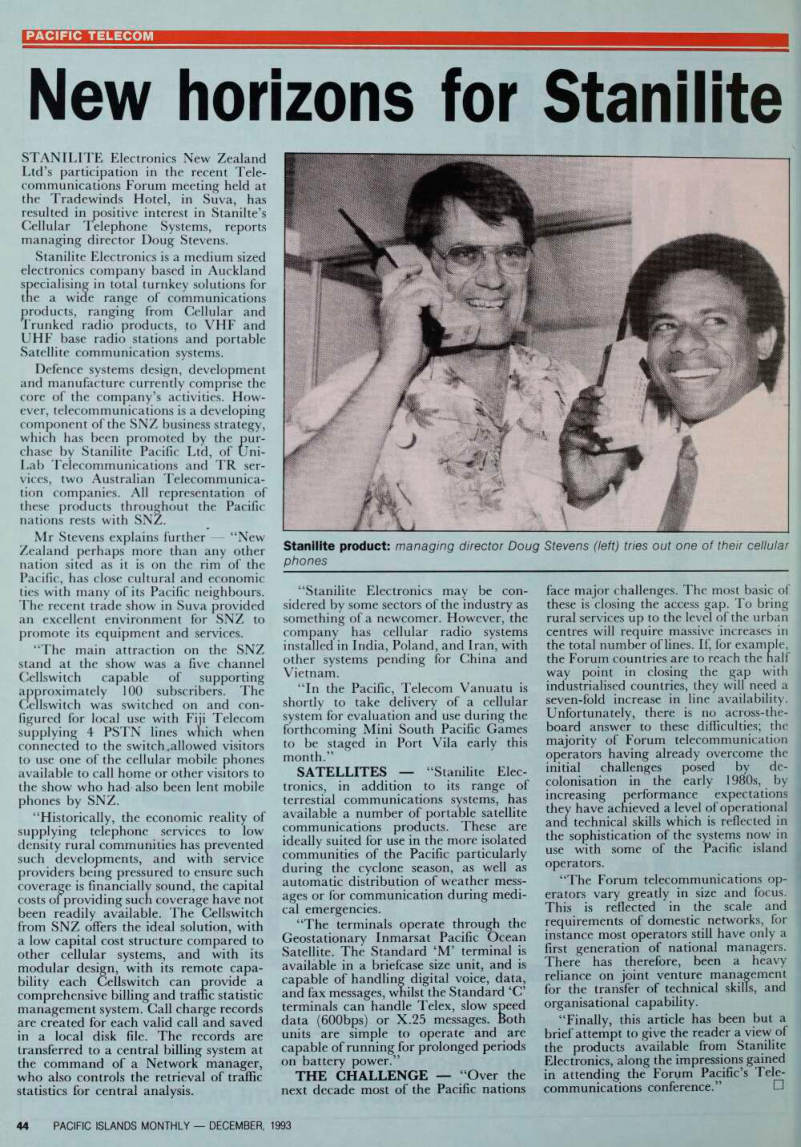
Pacific Telecom
STANILITE Electronics New Zealand Ltd’s participation in the recent Tele communications Forum meeting held at the Tradewinds Hotel, in Suva, has resulted in positive interest in Stanilte’s
Cellular Telephone Systems, reports
managing director Doug Stevens.
Stanilite Electronics is a medium sized electronics company based in Auckland specialising in total turnkey solutions for the a wide range of communications products, ranging from Cellular and Trunked radio products, to VHF and UHF base radio stations and portable Satellite communication systems.
Defence systems design, development and manufacture currently comprise the core of the company’s activities. How ever, telecommunications is a developing component of the SNZ business strategy, which has been promoted by the pur chase by Stanilite Pacific Ltd, of Uni- Lab Telecommunications and TR ser vices, two Australian Telecommunica tion companies. All representation of these products throughout the Pacific nations rests with SNz.
Mr Stevens explains further “New Zealand perhaps more than any other nation sited as it is on the rim of the Pacific, has close cultural and economic ties with many of its Pacific neighbours.
The recent trade show in Suva provided an excellent environment for SNZ to promote its equipment and services.
“The main attraction on the SNZ stand at the show was a five channel Cellswitch capable of supporting approximately 100 subscribers. The Cellswitch was switched on and con figured for local use with Fiji Telecom supplying 4 PSTN lines which when connected to the switch .allowed visitors to use one of the cellular mobile phones available to call home or other visitors to the show who had also been lent mobile phones by SNZ.
“Historically, the economic reality of supplying telephone services to low density rural communities has prevented such developments, and with service
providers being pressured to ensure such
coverage is financially sound, the capital costs of providing such coverage have not been readily available. The Cellswitch from SNZ offers the ideal solution, with a low capital cost structure compared to other cellular systems, and with its modular design, with its remote capa bility each Cellswitch can provide a comprehensive billing and traffic statistic management system. Call charge records are created for each valid call and saved in a local disk file. The records are transferred to a central billing system at the command of a Network manager, who also controls the retrieval of traffic statistics for central analysis.
“Stanilite Electronics may be considered by some sectors of the industry as something of a newcomer. However, the company has cellular radio systems installed in India, Poland, and Iran, with other systems pending for China and Vietnam.
“In the Pacific, Telecom Vanuatu is shortly to take delivery of a cellular system for evaluation and use during the forthcoming Mini South Pacific Games to be staged in Port Vila early this month.”
SATELLITES “Stanilite Electronics, in addition to its range of terrestial communications systems, has available a number of portable satellite communications products. These are ideally suited for use in the more isolated communities of the Pacific particularly during the cyclone season, as well as automatic distribution of weather messages or for communication during medical emergencies.
“The terminals operate through the Geostationary Inmarsat Pacific Ocean Satellite. The Standard ‘M’ terminal is available in a briefcase size unit, and is capable of handling digital voice, data, and fax messages, whilst the Standard ‘C’ terminals can handle Telex, slow speed data (600 bps) or X. 25 messages. Both units are simple to operate and are capable of running for prolonged periods on battery power.”
THE CHALLENGE “Over the next decade most of the Pacific nations
face major challenges. The most basic of these is closing the access gap. To bring rural services up to the level of the urban centres will require massive increases in the total number of lines. If, for example, the Forum countries are to reach the naif way point in closing the gap with industrialised countries, they will need a seven-fold increase in line availability.
Unfortunately, there is no across-the board answer to these difficulties; the majority of Forum telecommunication operators having already overcome the initial challenges posed by de colonisation in the early 1980 s, by
increasing performance expectations
they have achieved a level of operational and technical skills which is reflected in the sophistication of the systems now in use with some of the Pacific island operators.
“The Forum telecommunications op erators vary greatly in size and focus.
This is reflected in the scale and requirements of domestic networks, for instance most operators still have only a first generation of national managers.
There has therefore, been a heavy reliance on joint venture management for the transfer of technical skills, and
organisational capability.
“Finally, this article has been but a brief attempt to give the reader a view of the products available from Stanilite
Electronics, along the impressions gained
in attending the Forum Pacific’s Tele communications conference.” □
Stanilite product: managing director Doug Stevens (left) tries out one of their cellular phones
Advertisements & other items, p. 45 (1 item)
Ms**,
ill
'fill 1 ! 'Vwnwii' irnun \ \ y X \\ \ \ /i r 318V3 IX \ \ \ \
A Century Of Keeping
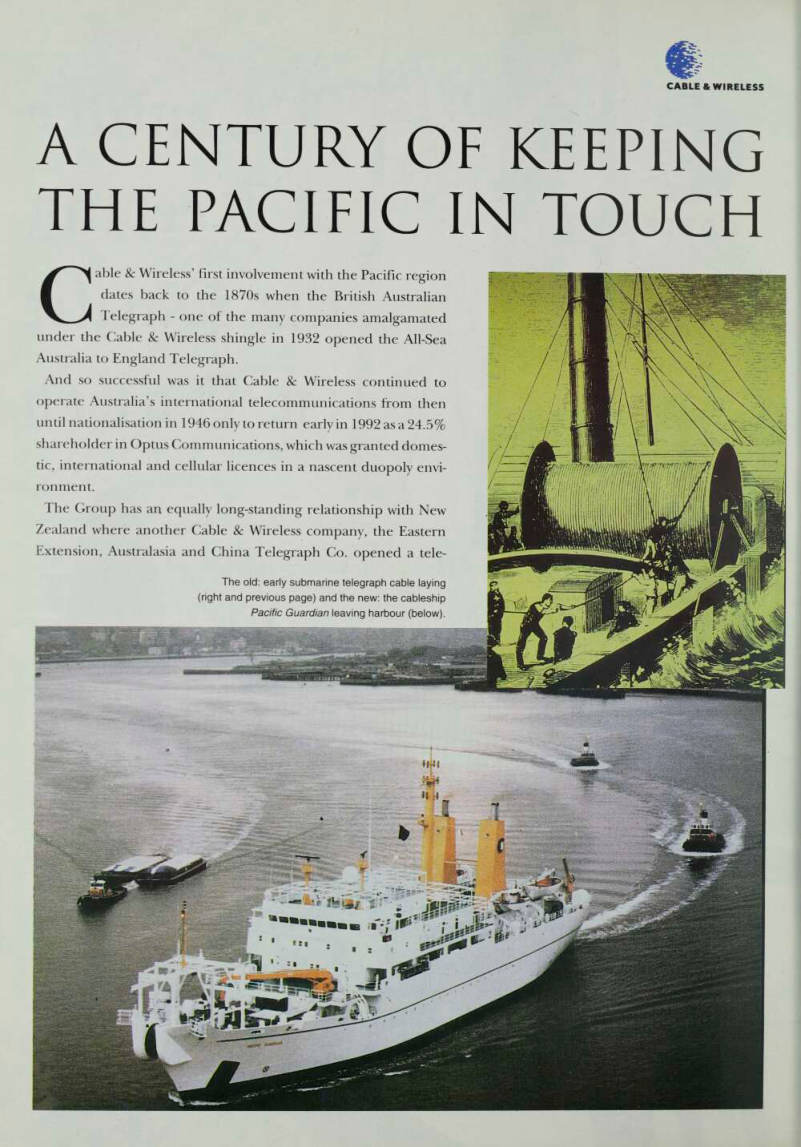
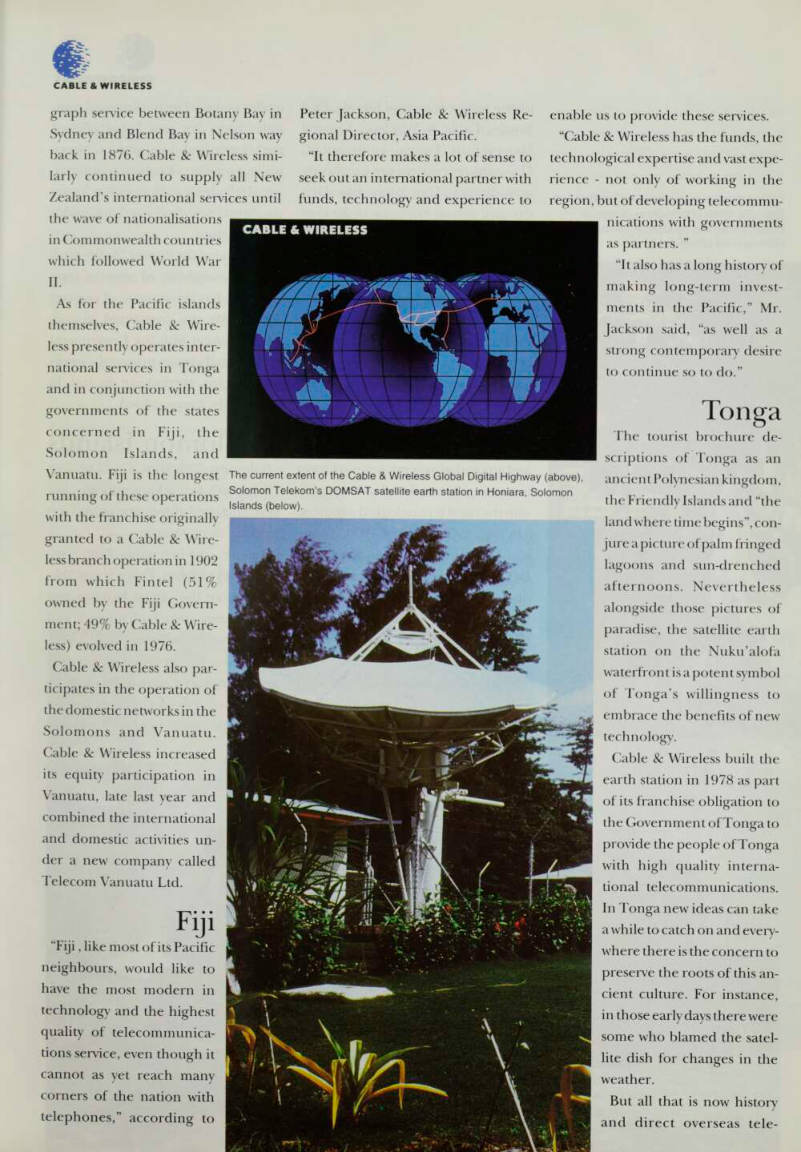
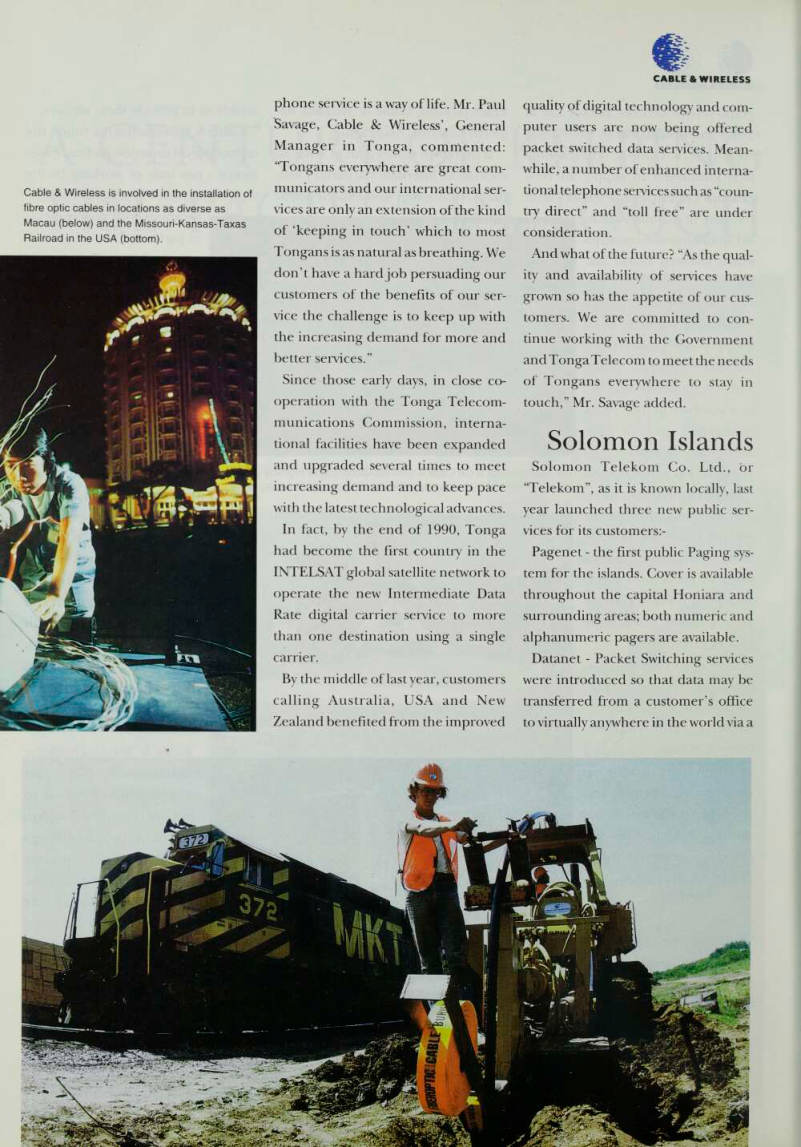
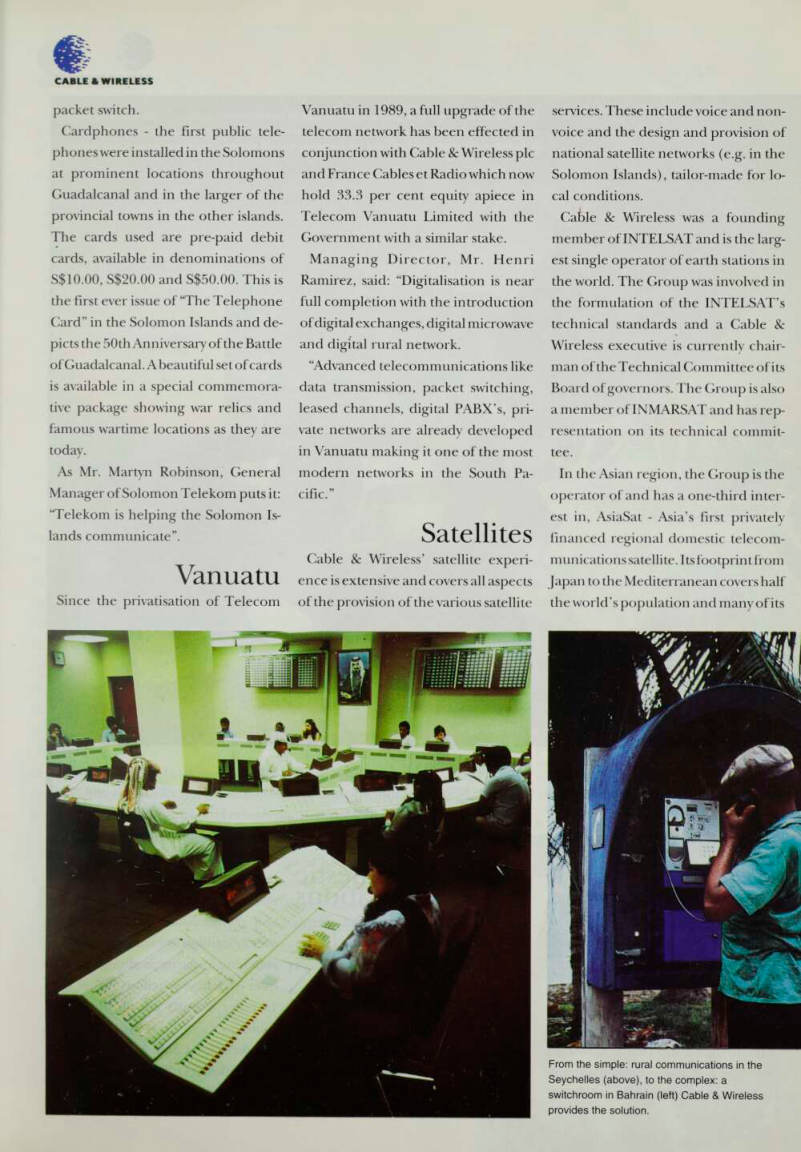
Cable & Wireless
The Pacific In Touch
Cable 8c Wireless’ first involvement with the Pacific region dates back to the 1870 s when the British Australian Telegraph - one of the many companies amalgamated under the Cable 8c Wireless shingle in 1932 opened the All-Sea
Australia to England Telegraph.
And so successful was it that Cable 8c Wireless continued to operate Australia’s international telecommunications from then until nationalisation in 1946 only to return early in 1992 as a 24.5% shareholder in Optus Communications, which was granted domes tic, international and cellular licences in a nascent duopoly envi ronment.
The Group has an equally long-standing relationship with New Zealand where another Cable 8c Wireless company, the Eastern Extension, Australasia and China Telegraph Co. opened a tele-
The old: early submarine telegraph cable laying (right and previous page) and the new: the cableship Pacific Guardian leaving harbour (below).
graph service between Botany Bay in
Sydney and Blend Bay in Nelson way back in 1876. Cable Sc Wireless simi larly continued to supply all New Zealand’s international services until
the wave of nationalisations in Commonwealth countries which followed World War 11.
As for the Pacific islands themselves, Cable Sc Wire less presently operates inter national services in Tonga and in conjunction with the governments of the states concerned in Fiji, the Solomon Islands, and Vanuatu. Fiji is the longest running of these operations with the franchise originally granted to a Cable Sc Wire less branch operation in 1902 from which Fintel (51% owned by the Fiji Govern ment; 49% by Cable Sc Wire less) evolved in 1976.
Cable Sc Wireless also par ticipates in the operation of the domestic networks in the Solomons and Vanuatu.
Cable Sc Wireless increased its equity participation in Vanuatu, late last year and combined the international and domestic activities un der a new company called Telecom Vanuatu Ltd.
Fiji
Fiji, like most of its Pacific neighbours, would like to have the most modern in
technology and the highest
quality of telecommunica tions service, even though it cannot as yet reach many corners of the nation with
telephones,” according to
Peter Jackson, Cable Sc Wireless Re gional Director, Asia Pacific.
“It therefore makes a lot of sense to seek out an international partner with funds, technology and experience to
enable us to provide these services.
“Cable Sc Wireless has the funds, the technological expertise and vast expe rience - not only of working in the region, but of developing telecommu
nications with governments as partners. ”
“It also has a long history of
making long-term invest
ments in the Pacific,” Mr.
Jackson said, “as well as a strong contemporary desire to continue so to do.”
Tonga
The tourist brochure de scriptions of Tonga as an
ancient Polynesian kingdom,
the Friendly Islands and “the land where time begins”, con
jure a picture of palm fringed
lagoons and sun-drenched afternoons. Nevertheless
alongside those pictures of
paradise, the satellite earth station on the Nuku’alofa waterfront is a potent symbol
of Tonga’s willingness to
embrace the benefits of new
technology.
Cable Sc Wireless built the earth station in 1978 as part of its franchise obligation to the Government of Tonga to
provide the people of Tonga
with high quality interna
tional telecommunications.
In Tonga new ideas can take awhile to catch on and every where there is the concern to preserve the roots of this an cient culture. For instance, in those early days there were some who blamed the satel lite dish for changes in the weather.
But all that is now history and direct overseas tele-
The current extent of the Cable & Wireless Global Digital Highway (above), Solomon Telekom’s DOMSAT satellite earth station in Honiara, Solomon Islands (below).
phone service is a way of life. Mr. Paul Savage, Cable & Wireless’, General
Manager in Tonga, commented:
“Tongans everywhere are great com municators and our international ser vices are only an extension of the kind of ‘keeping in touch’ which to most Tongans is as natural as breathing. We don’t have a hard job persuading our customers of the benefits of our ser vice the challenge is to keep up with the increasing demand for more and better services.”
Since those early days, in close co operation with the Tonga Telecom munications Commission, interna tional facilities have been expanded and upgraded several times to meet increasing demand and to keep pace with the latest technological advances.
In fact, by the end of 1990, Tonga had become the first country in the INTELSAT global satellite network to operate the new Intermediate Data Rate digital carrier service to more than one destination using a single carrier.
By the middle of last year, customers calling Australia, USA and New Zealand benefited from the improved
quality of digital technology and com
puter users are now being offered packet switched data services. Mean while, a number of enhanced interna tional telephone services such as “coun try direct” and “toll free” are under consideration.
And what of the future? “As the qual ity and availability of services have grown so has the appetite of our cus tomers. We are committed to con tinue working with the Government and Tonga Telecom to meet the needs of Tongans everywhere to stay in touch,” Mr. Savage added.
Solomon Islands
Solomon Telekom Co. Ltd., br ‘Telekom”, as it is known locally, last year launched three new public ser vices for its customers:- Pagenet - the first public Paging sys tem for the islands. Cover is available throughout the capital Honiara and surrounding areas; both numeric and alphanumeric pagers are available.
Datanet - Packet Switching services were introduced so that data may be transferred from a customer’s office to virtually anywhere in the world via a
Cable & Wireless is involved in the installation of fibre optic cables in locations as diverse as Macau (below) and the Missouri-Kansas-Taxas Railroad in the USA (bottom).
packet switch.
Cardphones - the first public tele phones were installed in the Solomons
at prominent locations throughout
Guadalcanal and in the larger of the provincial towns in the other islands.
The cards used are pre-paid debit cards, available in denominations of Sslo.oo, 5120.00 and 5550.00. This is the first ever issue of ‘The Telephone Card” in the Solomon Islands and de picts the 50th Anniversary of the Battle of Guadalcanal. A beautiful set of cards is available in a special commemora tive package showing war relics and famous wartime locations as they are
today.
As Mr. Martyn Robinson, General Manager of Solomon Telekom puts it: Telekom is helping the Solomon Is lands communicate”.
Vanuatu
Since the privatisation of Telecom
Vanuatu in 1989, a full upgrade of the telecom network has been effected in conjunction with Cable Sc Wireless pic and France Cables et Radio which now hold 33.3 per cent equity apiece in Telecom Vanuatu Limited with the Government with a similar stake.
Managing Director, Mr. Henri Ramirez, said: “Digitalisation is near full completion with the introduction
of digital exchanges, digital microwave
and digital rural network.
“Advanced telecommunications like
data transmission, packet switching,
leased channels, digital PABX’s, pri vate networks are already developed in Vanuatu making it one of the most modern networks in the South Pa cific.”
Satellites
Cable Sc Wireless’ satellite experi ence is extensive and covers all aspects of the provision of the various satellite
services. These include voice and non voice and the design and provision of national satellite networks (e.g. in the Solomon Islands), tailor-made for lo cal conditions.
Cable Sc Wireless was a founding member of INTELSAT and is the larg est single operator of earth stations in the world. The Group was involved in the formulation of the INTELSAT’s technical standards and a Cable Sc Wireless executive is currently chair man of the Technical Committee of its Board of governors. The Group is also a member of INMARSAT and has rep resentation on its technical commit tee.
In the Asian region, the Group is the operator of and has a one-third inter est in, Asia Sat - Asia’s first privately financed regional domestic telecom munications satellite. Its footprint from Japan to the Mediterranean covers half the world’s population and many of its
From the simple: rural communications in the Seychelles (above), to the complex: a switchroom in Bahrain (left) Cable & Wireless provides the solution.
most rapidly growing economies.
Asia Sat 11, with an even broader foot print, is already on the drawing-boards with an tentative launch-date of late 1994.
Cableships
The Group owns and operates the world’s largest and most sophisticated fleet of cableships and, in addition to cable-laying, Cable & Wireless provides cable maintenance and repair services for many countries.
One of the Group’s ships, CS Pacific Guardian, is based in Suva, maintain ing the southern sector of the ANZCAN
cable which links Australia, New Zealand, Norfolk Island, Fiji and Ha waii. Another is based in Manila to service the Asian region.
Domestic
Operations
In addition to supplying and operat ing international services, the Group is well experienced in the provision of domestic telephone services.
In the UK, for example, the 80%owned Mercury Communications op erates the country’s only alternative terrestrial telephone network and com
petitive public payphone service. Fi
bre optic cable and microwave links connect most major towns and cides.
And in Hong Kong, Hong Kong Tele communications (57.5% owned) operates one of the most advanced telecommunications networks in the world incorporating digital fibre optic and conventional technology. With over 2.6 million lines installed, all of its
switching capacity is digital and all
inter-exchange junctions (other than
14 outer islands) are on fibre optic cables.
In the USA, Cable & Wireless Com munications (100% owned) is the
fourth largest inter-exchange carrier.
Cable & Wireleśis the largest single operator of satellite earth sations in the world - a poilnlt well illustrated by the Mercury Communcations earth station complex at Whilehills, Oxfordshire, UK (large picture and the compan's earth station complex in Hong Kong (inset).
Other countries apart from the Solomon Islands and Vanuatu in which Cable Sc Wireless operates domestic network are:-
Asia/Pacific Australia, Macau, Phillipines, Thailand Middle East, Indian Ocean, Africa Bahrain, Diego Garcia, Maldives Western Hemisphere Anguilla, British Virgin Islands, Cayman Islands, Dominica, Falkland Islands, Grenada, Jamaica, Montserrat, St.
Helena, St. Kitts, St. Lucia, St.
Vincent, Trinidad & Tobago, Turks & Caicos.
Cellular
Telephones
Cable & Wireless is one of the few companies in the world to be both a systems designer and an owner/op erator of cellular networks. The Group designs, procures, tests and commis sion networks/systems to its own speci fications, quite independent of any equipment supplier. It also has exten sive experience in the field of national and international radio spectrum man agement.
Experience spans a broad spectrum of technology and cellular systems or networks with which Cable Sc Wireless is, or has been, involved are:
As for emerging technologies, Cable Sc Wireless is a leader in the develop ment of Personal Communication Networks (PCN) and is heading a con-
sortium to build and operate a PCN network in the UK. For launch this year, PCN will provide all digital mo bile telephone services. The new sys tem is fully portable and allows cus tomers to use the same telephone with the same personal number at home, at work and on the move.
Long-Term
Commitment
What all this emphasises is the Group’s long-term commitment to the countries in which it operates and the
depth of understanding born of long
experience that it brings to those op
erating environments.
Founded in 1870, the UK based Cable Sc Wireless is the world’s largest international
telecommunications operating
organisation with some 38,000 employees in 50 countries.
It is a publicly listed company whose shares are traded on the London, New York, Hong Kong, Tokyo, Frankfurt, Geneva, Zurich and Basle stock ex changes. The Group is the four teenth largest company on the
London Stock Exchange and its sub sidiary, Hong Kong Telecommunica tions, is the largest company in terms of market capitalisation listed on the
Hong Kong Stock Exchange.
Cable Sc Wireless is commit ted to the training of staff, both local and expatriate, to ensure the maintenance of in ternational and national tele communications at the high est possible standard.
For this purpose, formal training is undertaken at the
Group’s Engineering Colleges
in Hong Kong, Bahrain, and the UK. This includes a
scheme of progressive management training for all national staff in the countries in which it operates.
The Group operates technician train ing facilities in most of its operating locations and the Solomon Islands pro vides the Pacific’s regional training hub.
The Cable & Wireless station on Deep Water Bay, Hong Kong (above) and students training (below) at the Cable and Wireless Telecommunications College at Porthcurno (right).
Year Country Standard 1993 Australia
Gsm
1991
West Germany
Gsm
1990 Pakistan
Amps
1988 Caribbean
Amps
1988 Macau
Tags
1987 People’s Republic of China
Tags
1987 Hong Kong
Tags
1986 Bahrain
Tags
1983 Saudi Arabia
Nmt
1981 Hong Kong
Namts
1978 Qatar Proprietary
Advertisements & other items, pp. 47-54 (6 items)
Cable & Wireless
Cable & Wireless
Cable & Wireless
Cable & Wireless
Cable & Wireless
Cellswitch
StaniHte’s Cellswitch delivers cellular capacity with a number of unique
advantages:
a economical installation
and operation
a quick rollout capability
a design flexibility.
Because of these design features, Cellswitch is ideally suited for providing cellular service in a variety of key areas.
Through its modularity and scalable architecture, Cellswitch is equally effective in the city or in lower population density areas. Designed for expansion, Cellswitch provides a cost-competitive solution with as few as 50 subscribers, with enough expansion capacity to support many thousands more.
Cellswitch has achieved an installation base in a wide variety of settings around the world, ranging from conventional urban cellular systems to temporary public service support situations.
Cellswitch is based on proven technology and supports either the AMPS or ETACS cellular standards.
These standards are used by the majority of cellular systems and are renowned for their reliability and robustness. In contrast with emerging standards, AMPS and ETACS terminal equipment is relatively inexpensive, easy to obtain in quantity, and proven to be safe.
Cellswitch automatically enhances your capacity for continued expansion and improved service.
AA A A
AAA
sr/\/yi Because of Cellswitch’s design features, you can implement a comprehensive cellular capacity for a fraction of the price of competing systems.
Most cellular systems operate on the principle of “dumb” cell sites, each of which must be linked back to a “master” switching centre by expensive 2 megabit voice and data links. Even with only a small number of cells, this can be prohibitively expensive.
Design flexibility
The key to your system’s success is its proper planning. Prior to the installation of your system, Stanilite’s expert engineers will assemble a system plan, based on the physical geography of the coverage area and a range of environmental factors.
This ensures that your cellular system delivers peak performance at all times. ’ i ' - IJ In contrast, Cellswitch relies on intelligent, self-contained cell sites, each containing all the hardware and software necessary to operate as a complete local switch. This approach allows you to substantially reduce costs by networking only the sites you require. Links between Cellswitch sites can be provided by standard or leased telephone lines, optic fibres or microwave, further reducing setup costs.
Cellswitch has been designed to integrate instantly into your existing public switched telephone network (PSTN). It supports most common telephone signalling protocols, including those used by older style exchanges. Additional lines can be added to Cellswitch at any time by the simple installation of more line interface cards.
Adding capacity to the system is a simple task, so the initial installation can be tailored to suit immediate demand, reducing your “up front” capital outlay. To cater for growing demand, additional modules can be fitted in existing equipment racks.
Entire equipment racks can be added where necessary. Very importantly, upgrading Cellswitch requires very little “off-air” time, minimising service disruptions.
Cellswitch is built to operate remotely, without the need for onsite staff. Call charge information is downloaded from the cell site directly, and each cell site can be fully tested from your network control centre.
For further Information call: Robert Tomlinson Sales Manager Stan Hite Electronics (NZ) Ltd Ph: (649) 4156370 Fax(649)4156371
' ► mnnus I iEfnftnus DIGITAL OMninG 6 \ •V
communications/
throughout Papua New? wim/'
m / > / * M ' jjf f ** • . '• : \ ■***£& ■ \*tr. ■ ■f , f * ' * .*fc . : 4 . s**- ■•■■■ £ Hp“ 'M' " ■■: :V ~A > . -* ... - 'a * »■; > _v ■ " !
'TjM» ** \# -v- . xtk> '■** -:u ?» \#
WBmsSS&SL* '■• 31
ps: #» mm & ■%& ■* - &rl
ICATION CORPO
s it* l# if£ * &* m «. ; i ES
£ 'O. 0, »unuu
"""ll'fr/l
Telecom Vanuatu Ltd
Makes it Easy
to Call Home!
hmh i 'n ,f h
TELECOM VMCATCLTO
a joint venture between Government of Vanuatu Cable and wireless PLC France Cables ET Radio wwt % L.-
PhsaßH'"*'?
* i Jk r; - o> 11 ! 111 mu tun 11
Fptl, Nec
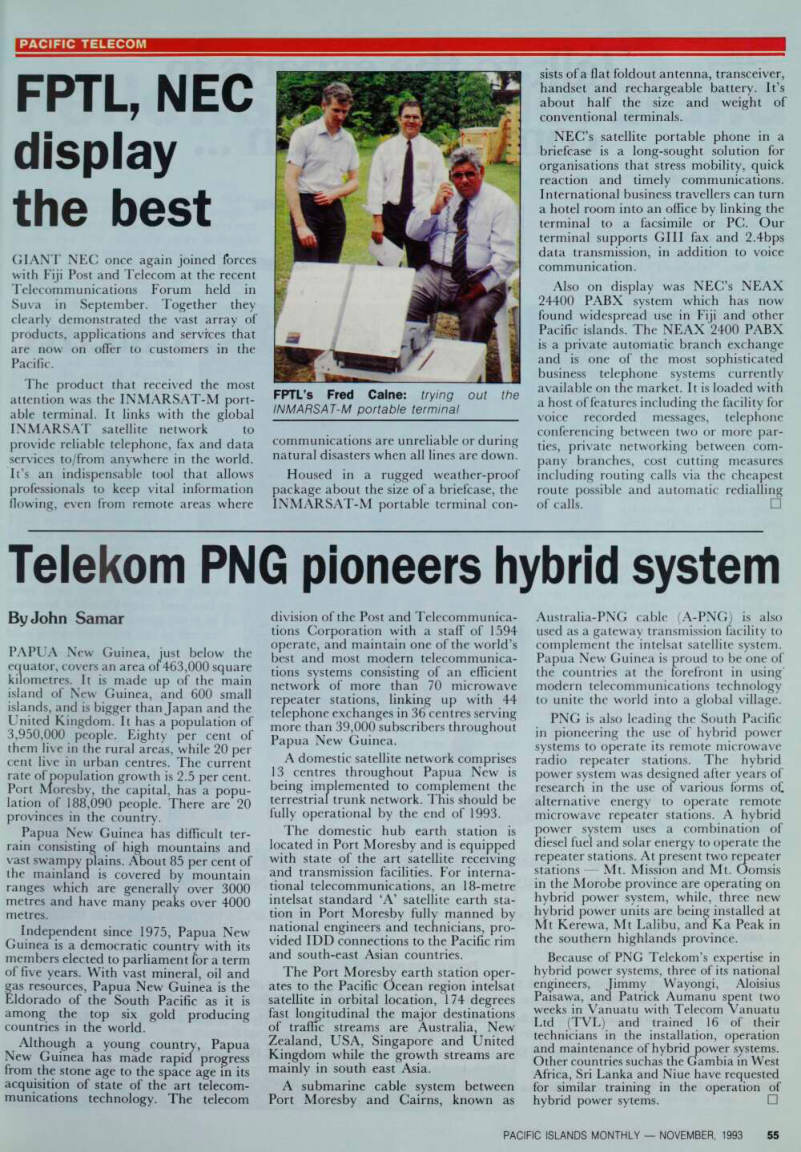
Pacific Telecom
display the best
GIANT NEC once again joined forces with Fiji Post and Telecom at the recent Telecommunications Forum held in Suva in September. Together they clearly demonstrated the vast array of products, applications and services that are now on offer to customers in the Pacific.
The product that received the most attention was the INMARSAT-M port able terminal. It links with the global INMARSAT satellite network to provide reliable telephone, fax and data services to/from anywhere in the world.
It’s an indispensable tool that allows professionals to keep vital information flowing, even from remote areas where
communications are unreliable or during natural disasters when all lines are down.
Housed in a rugged weather-proof package about the size of a briefcase, the INMARSAT-M portable terminal con
sists of a flat foldout antenna, transceiver, handset and rechargeable battery. It’s about half the size and weight of conventional terminals.
NEC’s satellite portable phone in a briefcase is a long-sought solution for organisations that stress mobility, quick reaction and timely communications.
International business travellers can turn a hotel room into an office by linking the terminal to a facsimile or PC. Our terminal supports GUI fax and 2.4 bps data transmission, in addition to voice communication.
Also on display was NEC’s NEAX 24400 PABX system which has now found widespread use in Fiji and other Pacific islands. The NEAX 2400 PABX is a private automatic branch exchange and is one of the most sophisticated business telephone systems currently available on the market. It is loaded with a host of features including the facility for voice recorded messages, telephone conferencing between two or more par ties, private networking between com pany branches, cost cutting measures
including routing calls via the cheapest
route possible and automatic redialling of calls. □
FPTL’s Fred Caine: trying out the INMARSAT-M portable terminal
Telekom PNG pioneers hybrid system
By John Samar
PAPUA New Guinea, Just below the equator, covers an area 0f463,000 square kilometres. It is made up of the main island of New Guinea, and 600 small islands, and is bigger than Japan and the United Kingdom. It has a population of 3,950,000 people. Eighty per cent of them live in the rural areas, while 20 per cent live in urban centres. The current rate of population growth is 2.5 per cent.
Port Moresby, the capital, has a popu lation of 188,090 people. There are 20 provinces in the country.
Papua New Guinea has difficult ter rain consisting of high mountains and vast swampy plains. About 85 per cent of the mainland is covered by mountain ranges which are generally over 3000 metres and have many peaks over 4000 metres.
Independent since 1975, Papua New Guinea is a democratic country with its members elected to parliament for a term of five years. With vast mineral, oil and tas resources, Papua New Guinea is the .Idorado of the South Pacific as it is among the top six gold producing countries in the world.
Although a young country, Papua New Guinea has made rapid progress from the stone age to the space age in its acquisition of state of the art telecom munications technology. The telecom
division of the Post and Telecommunica tions Corporation with a staff of 1594 operate, and maintain one of the world’s best and most modern telecommunica tions systems consisting of an efficient network of more than 70 microwave repeater stations, linking up with 44 telephone exchanges in 36 centres serving more than 39,000 subscribers throughout Papua New Guinea.
A domestic satellite network comprises 13 centres throughout Papua New is being implemented to complement the terrestrial trunk network. This should be fully operational by the end of 1993.
The domestic hub earth station is located in Port Moresby and is equipped with state of the art satellite receiving and transmission facilities. For interna tional telecommunications, an 18-metre intelsat standard ‘A’ satellite earth sta tion in Port Moresby fully manned by national engineers and technicians, pro vided IDD connections to the Pacific rim and south-east Asian countries.
The Port Moresby earth station oper ates to the Pacific Ocean region intelsat satellite in orbital location, 174 degrees fast longitudinal the major destinations of traffic streams are Australia, New Zealand, USA, Singapore and United Kingdom while the growth streams are mainly in south east Asia.
A submarine cable system between Port Moresby and Cairns, known as
Australia-PNG cable (A-PNG) is also used as a gateway transmission facility to complement the intelsat satellite system.
Papua New Guinea is proud to be one of the countries at the forefront in using modern telecommunications technology to unite the world into a global village. p N u • i leading the South Pacific • u of hvbr d now pioneering ttie use ol Hybrid power systems to operate its remote microwaye r3.dio repeater stations. The hybrid power system was designed after years of research in the use of various forms o£ alternative energy to operate remote microwave repeater stations. A hybrid power system uses a combination of diesel fuel and solar energy to operate the repeater stations. At present two repeater stations Mt. Mission and Mt. Oomsis in the Morobe province are operating on hybrid power system, while, three new hybrid power units are being installed at Mt Kerewa, Mt Lalibu, and Ka Peak in
the southern highlands province,
Because of PNG Telekom’s expertise in hybrid power systems, three of its national engineers, Jimmy Wayongi, Aloisius Paisawa, and Patrick Aumanu spent two weeks in Vanuatu with Telecom Vanuatu .(TVLy and trained 16 of their technicians in the installation, operation and maintenance of hybrid power systems.
Other countries suchas the Gambia in West Africa, Sri Lanka and Niue have requested for similar training in the operation of hybrid power sytems. □
Advertisements & other items, p. 56 (1 item)
PABX and key telephone systems
c&c for Human Potential
Talk to the experts in
commvmicarion...
PABX and key telephone systems
NEFS
R m h
•IED
\ wna ii m flccre '• L“V > ’ •. I I
• MOO i.
eh
’7/liW
NEC can supply all your needs for PABX equipment and key telephone systems. Our range includes the advanced NEAX 2400 Series PABX System and the RANGER Key Telephone System.
NEC provides rapid sales response, after sales support, deliveries and upgrades for clients through-
out the South Pacific region.
Please contact your NEC supplier: Fiji Post Telecommunications Ltd. Marketing Division, PO Box 40, Suva Fiji. Phone: (679) 210 600 Fax: (679) 305071 Distributors for Fiji, Vanuatu, Western Samoa, Tonga, Kiribati, Tuvalu, Niue, Wallis & Futuna, New Caledonia.
NEC Papua New Guinea. PO Box 937, Boroko NCD, Port Moresby, Papau New Guinea. Phone: (675) 252 644 Fax: (675) 252 948.
Distributors for Papua New Guinea, Solomon Islands, Micronesia and Nauru.
Telecom New Zealand Ltd, Business System Sales, 15 Lady Ruby Drive, East Tamaki, Auckland. Phone: (649) 274 3000 Fax: (649) 274 1999.
Distributors for New Zealand and Cook Islands.
NEC Australia Pty. Ltd, Business Communications Systems Group, PO Box 1111, Glen Waverley Vic, 3150. Phone: (03) 262 1111 Fax: (03) 262 1333.
Distributors for Australia.
Fellowship in Fiordland
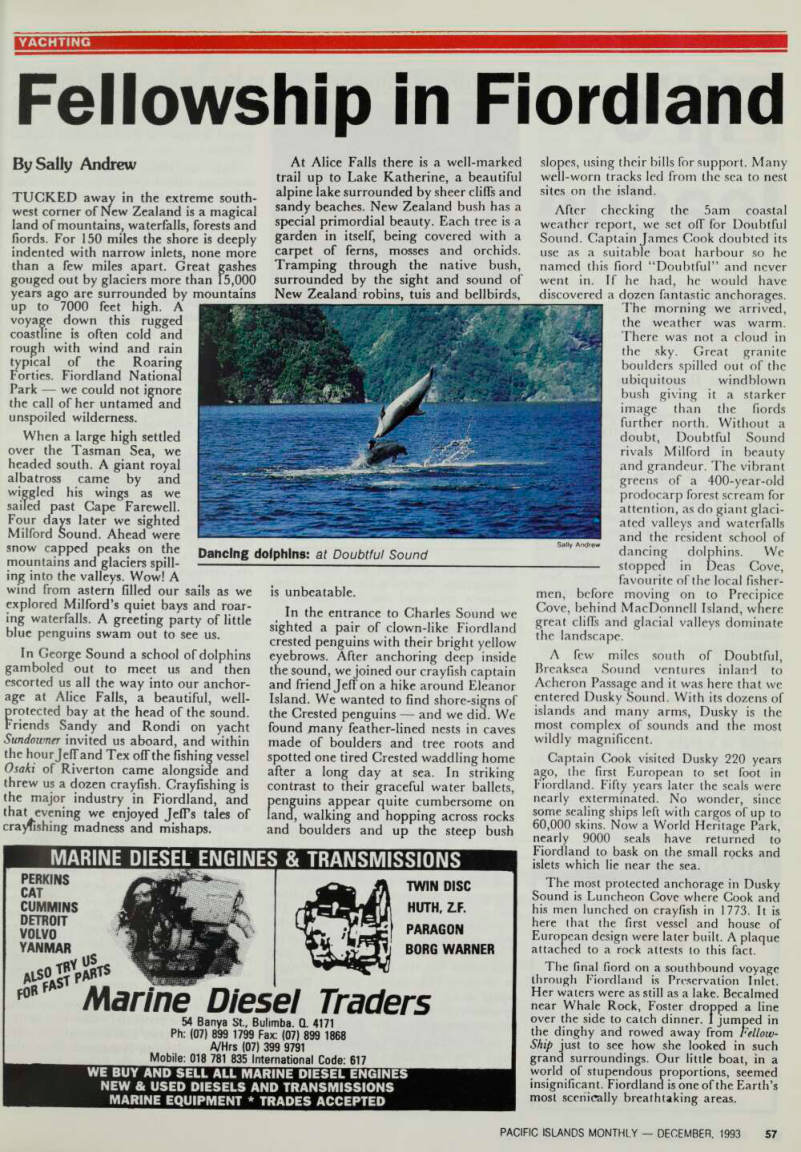
Yachting
By Sally Andrew
TUCKED away in the extreme south west comer of New Zealand is a magical land of mountains, waterfalls, forests and fiords. For 150 miles the shore is deeply indented with narrow inlets, none more than a few miles apart. Great gashes gouged out by glaciers more than 15,000 years ago are surrounded by mountains
up to 7000 feet high. A voyage down this rugged coastline is often cold and rough with wind and rain typical of the Roaring Forties. Fiordland National Park we could not ignore the call of her untamed and unspoiled wilderness.
When a large high settled over the Tasman Sea, we headed south. A giant royal albatross came by and wiggled his wings as we sailed past Cape Farewell.
Four days later we sighted Milford Sound. Ahead were snow capped peaks on the
mountains and glaciers spill
ing into the valleys. Wow! A
wind from astern filled our sails as we explored Milford’s quiet bays and roar ing waterfalls. A greeting party of little blue penguins swam out to see us.
In George Sound a school of dolphins gamboled out to meet us and then escorted us all the way into our anchor age at Alice Falls, a beautiful, well protected bay at the head of the sound.
Friends Sandy and Rondi on yacht Sundowner invited us aboard, and within the hour Jeff and Tex off the fishing vessel Osaki of Riverton came alongside and threw us a dozen crayfish. Crayfishing is the major industry in Fiordland, and that evening we enjoyed JelPs tales of cra>4ishing madness and mishaps.
At Alice Falls there is a well-marked trail up to Lake Katherine, a beautiful alpine lake surrounded by sheer cliffs and sandy beaches. New Zealand bush has a special primordial beauty. Each tree is a garden in itself, being covered with a carpet of ferns, mosses and orchids.
Tramping through the native bush, surrounded by the sight and sound of New Zealand robins, tuis and bellbirds,
is unbeatable.
In the entrance to Charles Sound we sighted a pair of clown-like Fiordland crested penguins with their bright yellow eyebrows. After anchoring deep inside the sound, we joined our crayfish captain and friend Jeff on a hike around Eleanor Island. We wanted to find shore-signs of the Crested penguins and we did. We found jmany feather-lined nests in caves made of boulders and tree roots and spotted one tired Crested waddling home after a long day at sea. In striking contrast to their graceful water ballets, penguins appear quite cumbersome on
land, walking and hopping across rocks
and boulders and up the steep bush
slopes, using their bills for support. Many well-worn tracks led from the sea to nest sites on the island.
After checking the sam coastal weather report, we set ofF for Doubtful Sound. Captain James Cook doubted its use as a suitable boat harbour so he named this fiord “Doubtful” and never went in. If he had, he would have discovered a dozen fantastic anchorages.
The morning we arrived, the weather was warm.
There was not a cloud in the sky. Great granite boulders spilled out of the übiquitous windblown bush giving it a starker image than the fiords further north. Without a doubt, Doubtful Sound rivals Milford in beauty and grandeur. The vibrant greens of a 400-year-old prodocarp forest scream for attention, as do giant glaci ated valleys and waterfalls and the resident school of
dancing dolphins. We
stopped in Deas Cove, favourite of the local fisher
men, before moving on to Precipice Cove, behind MacDonncll Island, where great clifts and glacial valleys dominate
the landscape.
A few miles south of Doubtful, Brcaksea Sound ventures inland to Acheron Passage and it was here that we entered Dusky Sound. With its dozens of islands and many arms, Dusky is the most complex of sounds and the most
wildly magnificent.
Captain Cook visited Dusky 220 years ago, the first European to set foot in Fiordland. Fifty years later the seals were nearly exterminated. No wonder, since some sealing ships left with cargos of up to 60,000 skins. Now a World Heritage Park, nearly 9000 seals have returned to Fiordland to bask on the small rocks and islets which lie near the sea.
The most protected anchorage in Dusky Sound is Luncheon Cove where Cook and his men lunched on crayfish in 1773. It is here that the first vessel and house of European design were later built. A plaque attached to a rock attests to this fact.
The final fiord on a southbound voyage through Fiordland is Preservation Inlet.
Her waters were as still as a lake. Becalmed near Whale Rock, Foster dropped a line over the side to catch dinner, f jumped in the dinghy and rowed away from Fellow- Ship just to see how she looked in such grand surroundings. Our little boat, in a world of stupendous proportions, seemed insignificant. Fiordland is one of the Earth’s most sceriically breathtaking areas.
Dancing dolphins: at Doubtful Sound
Sally Andrew
Advertisements & other items, p. 57 (1 item)
•uftSTrS* _
MARINE DIESEL ENGINES & TRANSMISSIONS
PERKINS
CAT
CUMMINS
DETROIT
VOLVO
YANMAR
•uftSTrS*
“ Marine Diesel Traders
TWIN DISC
HUTH, Z.F.
PARAGON
BORG WARNER
54 Banya St, Bulimba. Q. 4171 Ph: (07) 899 1799 Fax; (07) 899 1868 A/Hrs (07) 399 9791 Mobile: 018 781 835 International Code: 617 WE BUY AND SELL ALL MARINE DIESEL ENGINES
NEW & USED DIESELS AND TRANSMISSIONS
MARINE EQUIPMENT * TRADES ACCEPTED
Fiji’s
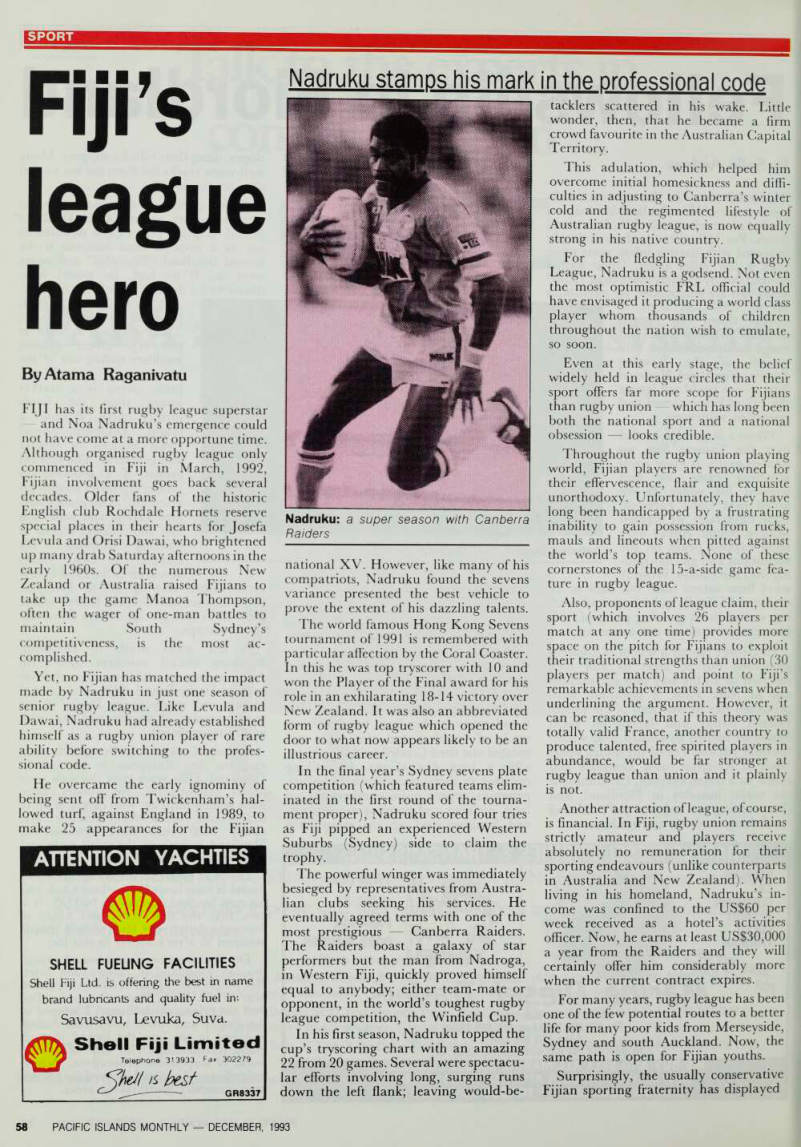
Sport
Fiji’s league hero
By Atama Raganivatu
FIJI has its first rugby league superstar and Noa Nadruku’s emergence could not have come at a more opportune time.
Although organised rugby league only commenced in Fiji in March, 1992, Fijian involvement goes back several decades. Older fans of the historic English club Rochdale Hornets reserve special places in their hearts for Josefa Levula and Orisi Dawai, who brightened up many drab Saturday afternoons in the early 19605. Of the numerous New Zealand or Australia raised Fijians to take up the game Manoa Thompson, often the wager of one-man battles to maintain South Sydney’s competitiveness, is the most ac complished.
Yet, no Fijian has matched the impact made by Nadruku in just one season of senior rugby league. Like Levula and Dawai, Nadruku had already established himself as a rugby union player of rare ability before switching to the profes sional code.
He overcame the early ignominy of being sent off from Twickenham’s hal lowed turf, against England in 1989, to make 25 appearances for the Fijian
Nadruku stamps his mark in the professional code
national XV. However, like many of his compatriots, Nadruku found the sevens variance presented the best vehicle to prove the extent of his dazzling talents.
The world famous Hong Kong Sevens tournament of 1991 is remembered with particular affection by the Coral Coaster.
In this he was top tryscorer with 10 and won the Player of the Final award for his role in an exhilarating 18-14 victory over New Zealand. It was also an abbreviated form of rugby league which opened the door to what now appears likely to be an illustrious career.
In the final year’s Sydney sevens plate competition (which featured teams elim inated in the first round of the tourna ment proper), Nadruku scored four tries as Fiji pipped an experienced Western Suburbs (Sydney) side to claim the trophy.
The powerful winger was immediately besieged by representatives from Austra lian clubs seeking his services. He eventually agreed terms with one of the most prestigious Canberra Raiders.
The Raiders boast a galaxy of star performers but the man from Nadroga, in Western Fiji, quickly proved himself equal to anybody; either team-mate or opponent, in the world’s toughest rugby league competition, the Winfield Cup.
In his first season, Nadruku topped the cup’s tryscoring chart with an amazing 22 from 20 games. Several were spectacu lar efforts involving long, surging runs down the left flank; leaving would-be
tacklers scattered in his wake. Little wonder, then, that he became a firm crowd favourite in the Australian Capital
Territory.
This adulation, which helped him overcome initial homesickness and diffi culties in adjusting to Canberra’s winter cold and the regimented lifestyle of Australian rugby league, is now equally strong in his native country.
For the fledgling Fijian Rugby
League, Nadruku is a godsend. Not even the most optimistic FRL official could have envisaged it producing a world class player whom thousands of children throughout the nation wish to emulate, so soon.
Even at this early stage, the belief widely held in league circles that their sport offers far more scope for Fijians than rugby union which has long been both the national sport and a national obsession looks credible.
Throughout the rugby union playing world, Fijian players are renowned for their effervescence, flair and exquisite unorthodoxy. Unfortunately, they have long been handicapped by a frustrating inability to gain possession from rucks, mauls and lineouts when pitted against the world’s top teams. None of these cornerstones of the 15-a-side game fea ture in rugby league.
Also, proponents of league claim, their sport (which involves 26 players per match at any one time) provides more space on the pitch for Fijians to exploit their traditional strengths than union (30 players per match) and point to Fiji’s remarkable achievements in sevens when underlining the argument. However, it can be reasoned, that if this theory was totally valid France, another country to produce talented, free spirited players in abundance, would be far stronger at rugby league than union and it plainly is not.
Another attraction of league, of course, is financial. In Fiji, rugby union remains strictly amateur and players receive absolutely no remuneration for their sporting endeavours (unlike counterparts in Australia and New Zealand). When living in his homeland, Nadruku’s in come was confined to the US$6O per week received as a hotel’s activities officer. Now, he earns at least US$3O,OOO a year from the Raiders and they will certainly offer him considerably more when the current contract expires.
For many years, rugby league has been one of the few potential routes to a better life for many poor kids from Merseyside, Sydney and south Auckland. Now, the same path is open for Fijian youths.
Surprisingly, the usually conservative Fijian sporting fraternity has displayed
Nadruku: a super season with Canberra Raiders
little animosity to the high profile the obvious threat of lost players, remains stoical. Undoubtedly Sitiveni Rabuka, in his role as FRL president, has given league a great deal of credibility.
Hopefully, the relationship between the two codes in Fiji will evolve into something akin to the situation existing in Australia and New Zealand. There they have learnt to live alongside each other; not exactly amicably but with a begrudging respect, and rugby union administrators in both countries realised long ago the best way of countering league’s attractions was to offer the highest quality of playing and social facilities feasible to participants in their sport.
Rugby league’s presence in Fiji must reduce the possibility that local rugby union officials will lapse into com placency. In the long run, the greatest beneficiary of league’s arrival could well be the average Fijian rugby union player.
With its grass roots strength and unique camaraderie (something no pro fessional sport can possibly match), rugby union will retain its revered place in a Fijian sport for, at least, the foreseeable future.
Certainly, a lot of work lies ahead of the Fijian representative rugby league selection before it equals the national XV in prestige. That was evident in October, when a visiting Queensland combination beat a side including both Nadruku and Thompson 28-4 at Suva.
The next major test for Bati, as the Fijians have been nicknamed, comes in June when France, rated fourth in the current international pecking order, tours. This will provide the best barometer yet of progress made.
However, if anyone still has any
lingering doubts about Fijian rugby
league’s future they should visit Nadruku’s home village of Namatakula,
near Sigatoka.
In July this year, the 300 inhabitants gained access to electricity and they had absolutely no doubts over their priorities.
The first electrical appliances obtained were a television and a video cassette recorder. Set up in the community hall, they enabled villagers to witness the exploits of Nadruku in Australia via
video tapes.
Every tape featuring the local hero has been played at least three times and, after
each showing, Namatakula’s youngsters
stream away to a nearby clearing to play
rugby league and dream of becoming
another Noa Nadruku. Fijian rugby
league is here to stay. □
Advertisements & other items, p. 58 (1 item)
Attention Yachties
SHELL FUEUNG FACILITIES
Shell Fiji Ltd. is offering the best in name brand lubricants and quality fuel in; Savusavu, Levuka, Suva.
©Shell Fiji Limited
Telephone 313933 Pax 302279 GR8337
games
Vanuatu’s games
By Shailendra Singh
VANUATU tak,es centre stage among island nations this month. The spotlight will be on the capital, Port Vila, venue of the fourth Mini South Pacific Games from December 6-16. For a short while the political bickerings, economic ills and environmental troubles of the
region will take backstage.
Sports will steal the headlines as the regions best athletes converge for two weeks of intense rivalry. The Mini Games is one of the biggest, if not the biggest event - sporting or otherwise hosted by Vanuatu. More than 800 athletes will compete in six different sports - namely athletics, soccer, box ing, lawn tennis, golf and netball.
They will be accompanied by about 168 coaches, officials and technical offi cers. Resources at Port Vila - population about 20,000 - have been stretched to the seams trying to accommodate the extravanagza. Added to that, there’s the red carpet treatment for 61 VIPs from the participating countries to think about.
Apart from sports ministers, many of the VIPs are expected to be high-ranking government officials.
Prime minister Maxime Carlot Korman’s government has pumped in millions of vatu on new construction projects and on renovations to upgrade Vanuatu’s outdated sports facilities to the required international standards. Hosting the games has been an expensive exercise for the government but there are the obvious benefits. The games is an excel lent public relations event which will give Vanuatu’s booming tourism industry more international exposure while Port Vila businessmen stand to make immedi ate gains from the Games economic spin off.
Games liasion officer Hendrick Ketner had acreditations of 80 journalsists which
he expected to increase to 100 through late applications. Vanuatu gets exposure in two prime tourism countries through Australian Channel Nine televison, Radio Australia, Radio New Zealand Interna tional and The Australian newspaper which will sent journalists to the games.
When the games are over, Vanuatu athletes will have a new 400 million vatu sports complex. The complex, with an international standard athletics track, a pavilion and a hall seating 2000 will be the boxing venue. Round-the-clock con struction was still in progress when this edition went to press.
Sports equipment donated by several
countries will further boost facilities for local athletes once the games are over.
France has given four million vatu worth of gear, the People’s Republic of China 2.28 m vatu and Germany 0.4 m vatu.
France has donated a further 20m vatu for the renovation of the games village and Australia 21.5 m vatu.
The sponsors are confident the extra milage their products receive will boost business during the games. Sixteen countries have confirmed participation.
The seven that have missed out mainly through of lack of finance are Kiribati, Tuvalu, Marshall Islands, Federated States of Micronesia, Palau and Tokelau.
Regional sporting giants, Papua New
Guinea, Fiji, and the French Territories are sending the biggest contingents. PNG with a 121 squad is the largest followed by Fiji with 108. Vanautu, which used to send only a handful of athletes apart from its soccer team to past games has the third largest squad with 84. New Caledonia has 75 and Tahiti 71.
The fourth games is bigger than the last one held in Tonga in 1989 which had 600 athletes from 15 countries. Many athletes competing have been recalled from over seas where they are either based or
training. The Fijian boxing team, for
instance, has called in Drewitt brothers William and Robert who are former British Columbia Golden Gloves Cham pions. The Fiji-born brothers whose father is Samoan are Canadian residents.
Tonga’s superheavyweight boxer, Paea Wolfgramme is based in Auckland and welterweight Viliame Saunasi fights out of Hawaii. The athletics squads of several countries also have local-born but over seas trained athletes which will enhance competiton and add to the excitement. □
Advertisements & other items, p. 59 (1 item)
Blairs
REPLACEMENT ENGINES
Largest Range In the South Pacific Over 800 engines available; Diesel-Gasoline lOhp to 400 hp Transmission to match if required Japanese English European Models Marine Engines Available Yanmar 3L 1908 cc 44hp/2100 RPM 4CH2SA 80hp Electrics Gauges Reduction Boxes
P.O. Box 14 Geraldine, New Zealand Telephone (643) 6934122 Fax (643) 6934120 New Zealand Established 1956 We ship anywhere In the Pacific
Aust database boon
PACIFIC Exporters of Seafood and seafood products will find FISHMAD the Australian Fish Market Analysis Database very useful.
Operated by Fisheries Services Brisbane (ISD Fax 617 2293702) in a joint venture with the Australian Fisheries Research and Development Corporation one of the major assets of the service is its market and consumption database.
FRDIC has spent some AS 1.2 million in a two-year national consumption survey of Australian seafood consumption, preferences, buying habits and trends.
Covering the spectrum of in-home and out of-home private consumption and buying by the trade, institutional, hospitality and catering markets the Australian Natural Seafood Consumption Survey offers com mercial and market intelligence of a very high order.
Subscribers receive a copy of the databse for installation on their own PC plus hard copy summary and copies of the master questions. Subscribers can load the data into a range of spreadsheet or Database formats on IBM or IBM clone PCs.
A program of refreshing and updating the data is in place with new surveys data being added each year. Seafood exporters in Canada, Europe, Scandinavia and Asia are accessing the service. To PIM it makes sense that as Australia is an important regional market Pacific seafood exporters should avail themselves of the service.
Entry costs are low (AS6OO to AS 1200 PA) and most processors and exporters would already have PC equipment and software to analyse the data.
Vanutu Resource Project Running The Vanuatu Resource Information System (VANRIS) is a Vanuatu government development with the technical assistance of Australia’s CSIRO and the Queensland Forestry Services with funding provided by AIDAB (Australian International Development Assistance Bureau).
John McAlpine, of CSIRO, said that VANRIS was vindication of the process of applying appropriately affordable levels of computing technology in the Pacific to assist in the management and planning of natural resources.
VANRIS successfully marries a geographically referenced database developed in Microsoft Fox Pro with a Mapping System developed in MAPINFO and a user friendly interface for data analysis.
Over six Vanuatu departments collaborated in the development of the system. VANRI now will assist in Management and Planning in a range of Government areas from Agriculture to Forestry to Local Government. Cur rently storing over one million data items VANRIS has been designed to row and evolve under local Vanuatu support.
The last stage of the project was to convert VANRIS to Windows which will provide a higher level of user friendliness through the GUI interface.
PNG’s New AIDAB-funded Computer Project Gordon Bilney, Australia’s Minister
for Development Co-operation and
Pacific Island Affairs announced in the 1993/1994 program funding of A 53.7 million for maintenance and expansion of a computer based Re source Information System for PNG.
Funding by AIDAB with technical support provided by Australia’s CSIRO the PNG RIS will be devel oped using Microsoft Fox Pro, MAPINFO and Windows.
Mr Bilney is expected to make further announcement on this project at the PNG seminar AIDAB is sponsoring later this month in Bris bane.
ASMA Shows Metrics
Appropriate for Pacific The Australian Software Metrics Association (ASMA) with the recent Incorporation of the Queensland Chapter is now represented in every state expect Western Australia.
Tough economic times have increasingly compelled IT managers to apply productivity measurement as well as more traditional cost benefit analysis to IT within organisations as senior management more closely quiz IT budgets.
Not only applicable to large organisations or mainframe sites Software Metrics is increasingly being applied in large and small organisations can be cost critical.
Two special interest groups, (SIGs), one in ASMA Victoria and one in ASMA Queensland are developing through research and case studies very important rules and methodoligies inthis area of Windows developments Metrics.
The Secretary of ASMA Queensland, Jack Van der Zwan said, “ASMA is very interested in hearing from IT professionals in the Pacific. Given sufficient interest we would be happy to help any groups who may wish to organise and share in the data and information resources we are collecting.
One of the features of ASMA is the excellentt communica tions between Chapters. We have been able by discussions and negotiation to have each chapter set up SIGs and research groups that concentrate on specific areas”.
He said “this saves on duplicating work and conserves resources. We then all share nationally in the output from each SIG. For instance Victoria is very strong in function point counting, Queensland is looking at CASE and System Life Cycle determinations while Sydney is very strong in Productivity measurement”.
“This pooled information is being built up into a body of knowledge that would be very applicable in the Pacific region. It has the potential to save much time in the development of metrics programs and skills with a consequent cost saving benefit in IT for many organisations”.
ASMA held its first .national conference in Sydney on November 18 and 19.
Shipping
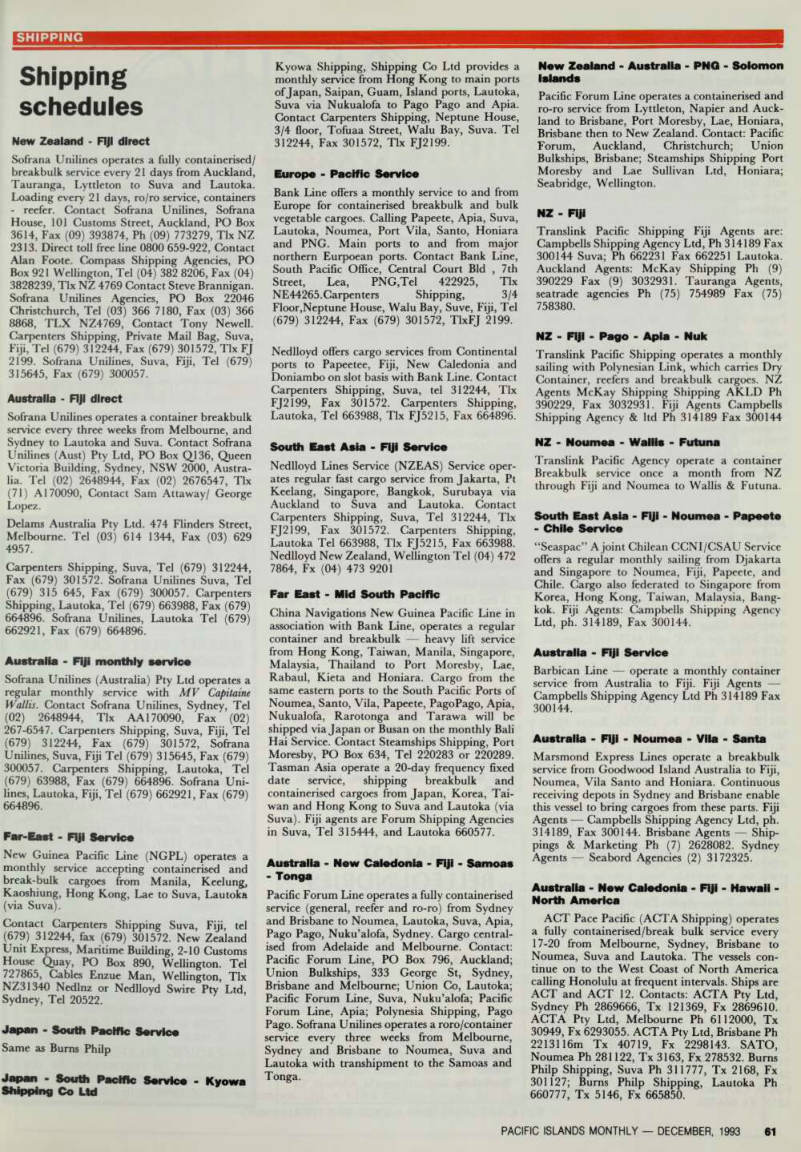
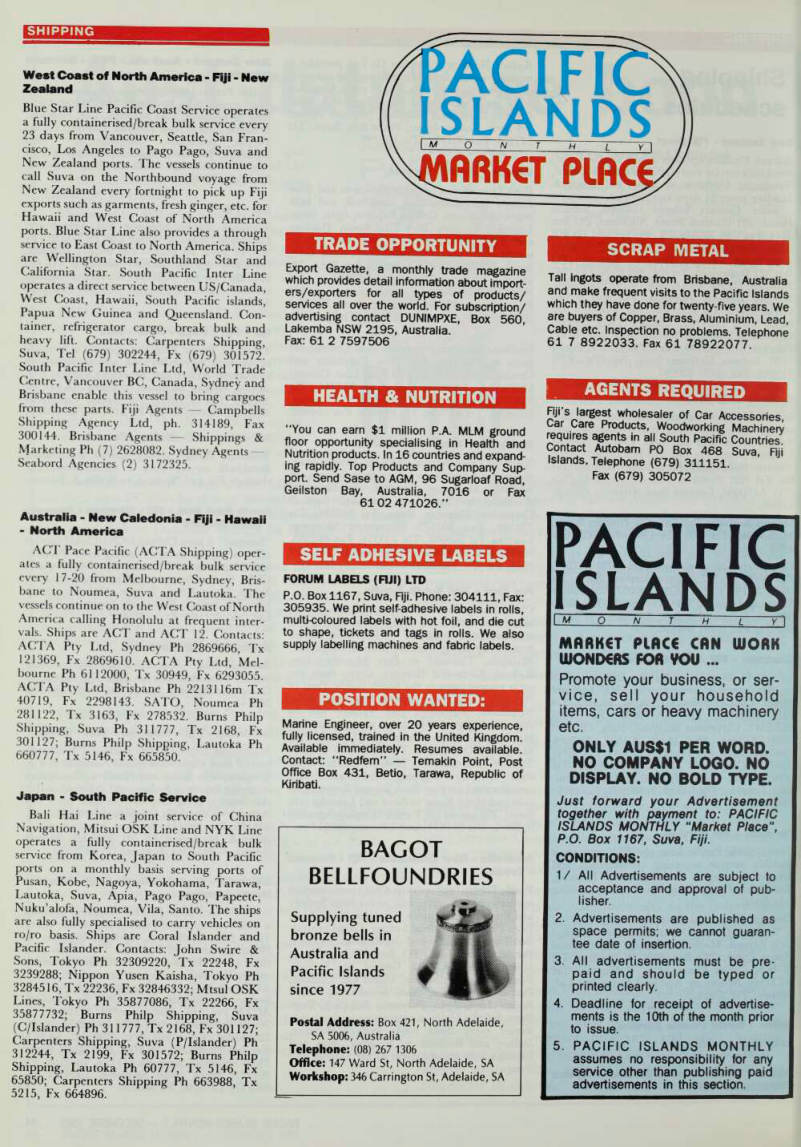
schedules
New Zealand - FIJI direct Sofrana Unilines operates a fully containerised/ breakbulk service every 21 days from Auckland, Tauranga, Lyttleton to Suva and Lautoka.
Loading every 21 days, ro/ro service, containers - reefer. Contact Sofrana Unilines, Sofrana House, 101 Customs Street, Auckland, PO Box 3614, Fax (09) 393874, Ph (09) 773279, Tlx NZ 2313. Direct toll free line 0800 659-922, Contact Alan Foote. Compass Shipping Agencies, PO Box 921 Wellington, Tel (04) 382 8206, Fax (04) 3828239, Tlx NZ 4769 Contact Steve Brannigan.
Sofrana Unilines Agencies, PO Box 22046 Christchurch, Tel (03) 366 7180, Fax (03) 366 8868, TLX NZ4769, Contact Tony Newell.
Carpenters Shipping, Private Mail Bag, Suva, Fiji, Tel (679) 312244, Fax (679) 301572, Tlx FJ 2199. Sofrana Unilines, Suva, Fiji, Tel (679) 315645, Fax (679) 300057.
Australia • FIJI direct Sofrana Unilines operates a container breakbulk service every three weeks from Melbourne, and Sydney to Lautoka and Suva. Contact Sofrana Unilines (Aust) Pty Ltd, PO Box Q 136, Queen Victoria Building, Sydney, NSW 2000, Austra lia. Tel (02) 2648944, Fax (02) 2676547, Tlx (71) A 170090, Contact Sam Attaway/ George Lopez.
Delams Australia Pty Ltd. 474 Flinders Street, Melbourne. Tel (03) 614 1344, Fax (03) 629 4957.
Carpenters Shipping, Suva, Tel (679) 312244, Fax (679) 301572. Sofrana Unilines Suva, Tel (679) 315 645, Fax (679) 300057. Carpenters Shipping, Lautoka, Tel (679) 663988, Fax (679) 664896. Sofrana Unilines, Lautoka Tel (679) 662921, Fax (679) 664896.
Australia - FIJI monthly service Sofrana Unilines (Australia) Pty Ltd operates a regular monthly service with MV Capitaine Wallis. Contact Sofrana Unilines, Sydney, Tel (02) 2648944, Tlx AA170090, Fax (02) 267-6547. Carpenters Shipping, Suva, Fiji, Tel (679) 312244, Fax (679) 301572, Sofrana Unilines, Suva, Fiji Tel (679) 315645, Fax (679) 300057. Carpenters Shipping, Lautoka, Tel (679) 63988, Fax (679) 664896. Sofrana Uni lines, Lautoka, Fiji, Tel (679) 662921, Fax (679) 664896.
Far-East - FIJI Service New Guinea Pacific Line (NGPL) operates a monthly service accepting containerised and break-bulk cargoes from Manila, Keelung, Kaoshiung, Hong Kong, Lae to Suva, Lautoka (via Suva).
Contact Carpenters Shipping Suva, Fiji, tel (679) 312244, fax (679) 301572. New Zealand Unit Express, Maritime Building, 2-10 Customs House Quay, PO Box 890, Wellington. Tel 727865, Cables Enzue Man, Wellington, Tlx NZ31340 Nedlnz or Nedlloyd Swire Pty Ltd, Sydney, Tel 20522.
Japan - South Pacific Service Same as Bums Philp Japan - South Pacific Service - Kyowa Shipping Co Ltd
Kyowa Shipping, Shipping Co Ltd provides a monthly service from Hong Kong to main ports of Japan, Saipan, Guam, Island ports, Lautoka, Suva via Nukualofa to Pago Pago and Apia.
Contact Carpenters Shipping, Neptune House, 3/4 floor, Tofuaa Street, Walu Bay, Suva. Tel 312244, Fax 301572, Tlx FJ2199.
Europe - Pacific Service Bank Line offers a monthly service to and from Europe for containerised breakbulk and bulk vegetable cargoes. Calling Papeete, Apia, Suva, Lautoka, Noumea, Port Vila, Santo, Honiara and PNG. Main ports to and from major northern Eurpoean ports. Contact Bank Line, South Pacific Office, Central Court Bid , 7th Street, Lea, PNG,TeI 422925, Tlx
NE4426s.Carpenters Shipping, 3/4
Floor,Neptune House, Walu Bay, Suve, Fiji, Tel (679) 312244, Fax (679) 301572, TIxFJ 2199.
Nedlloyd offers cargo services from Continental ports to Papeetee, Fiji, New Caledonia and Doniambo on slot basis with Bank Line. Contact Carpenters Shipping, Suva, tel 312244, Tlx FJ2199, Fax 301572. Carpenters Shipping, Lautoka, Tel 663988, Tlx FJ5215, Fax 664896.
South East Asia - FIJI Service Nedlloyd Lines Service (NZEAS) Service oper ates regular fast cargo service from Jakarta, Pt Keelang, Singapore, Bangkok, Surubaya via Auckland to Suva and Lautoka. Contact Carpenters Shipping, Suva, Tel 312244, Tlx FJ2199, Fax 301572. Carpenters Shipping, Lautoka Tel 663988, Tlx FJ5215, Fax 663988.
Nedlloyd New Zealand, Wellington Tel (04) 472 7864, Fx (04) 473 9201 Far East - Mid South Pacific China Navigations New Guinea Pacific Line in association with Bank Line, operates a regular container and breakbulk heavy lift service from Hong Kong, Taiwan, Manila, Singapore, Malaysia, Thailand to Port Moresby, Lae, Rabaul, Kieta and Honiara. Cargo from the same eastern ports to the South Pacific Ports of Noumea, Santo, Vila, Papeete, PagoPago, Apia, Nukualofa, Rarotonga and Tarawa will be shipped via Japan or Busan on the monthly Bali Hai Service. Contact Steamships Shipping, Port Moresby, PO Box 634, Tel 220283 or 220289.
Tasman Asia operate a 20-day frequency fixed date service, shipping breakbulk and containerised cargoes from Japan, Korea, Tai wan and Hong Kong to Suva and Lautoka (via Suva). Fiji agents are Forum Shipping Agencies in Suva, Tel 315444, and Lautoka 660577.
Australia - New Caledonia - FIJI - Samoas - Tonga Pacific Forum Line operates a fully containerised service (general, reefer and ro-ro) from Sydney and Brisbane to Noumea, Lautoka, Suva, Apia,
Pago Pago, Nuku’alofa, Sydney. Cargo central
ised from Adelaide and Melbourne. Contact: Pacific Forum Line, PO Box 796, Auckland;
Union Bulkships, 333 George St, Sydney,
Brisbane and Melbourne; Union Co, Lautoka; Pacific Forum Line, Suva, Nuku’alofa; Pacific
Forum Line, Apia; Polynesia Shipping, Pago
Pago. Sofrana Unilines operates a roro/container service every three weeks from Melbourne, Sydney and Brisbane to Noumea, Suva and Lautoka with transhipment to the Samoas and
Tonga.
New Zealand - Australia - PNG - Solomon Islands Pacific Forum Line operates a containerised and ro-ro service from Lyttleton, Napier and Auck land to Brisbane, Port Moresby, Lae, Honiara, Brisbane then to New Zealand. Contact: Pacific Forum, Auckland, Christchurch; Union Bulkships, Brisbane; Steamships Shipping Port Moresby and Lae Sullivan Ltd, Honiara;
Seabridge, Wellington.
Nz - Fiji
Translink Pacific Shipping Fiji Agents are:
Campbells Shipping Agency Ltd, Ph 314189 Fax 300144 Suva; Ph 662231 Fax 662251 Lautoka.
Auckland Agents: McKay Shipping Ph (9) 390229 Fax (9) 3032931. Tauranga Agents, seatrade agencies Ph (75) 754989 Fax (75) 758380.
NZ - FIJI - Pago - Apia - Nuk Translink Pacific Shipping operates a monthly sailing with Polynesian Link, which carries Dry Container, reefers and breakbulk cargoes. NZ
Agents McKay Shipping Shipping AKLD Ph
390229, Fax 3032931. Fiji Agents Campbells
Shipping Agency & ltd Ph 314189 Fax 300144 NZ - Noumea - Wallis - Futuna Translink Pacific Agency operate a container Breakbulk service once a month from NZ through Fiji and Noumea to Wallis & Futuna.
South East Asia - FIJI - Noumea - Papeete - Chile Service “Seaspac” A joint Chilean CCNI/CSAU Service offers a regular monthly sailing from Djakarta and Singapore to Noumea, Fiji, Papeete, and Chile. Cargo also federated to Singapore from Korea, Hong Kong, Taiwan, Malaysia, Bang
kok. Fiji Agents: Campbells Shipping Agency
Ltd, ph. 314189, Fax 300144.
Australia - FIJI Service Barbican Line operate a monthly container service from Australia to Fiji. Fiji Agents Campbells Shipping Agency Ltd Ph 314189 Fax 300144.
Australia - FIJI - Noumea - Vila - Santa Marsmond Express Lines operate a breakbulk service from Goodwood Island Australia to Fiji, Noumea, Vila Santo and Honiara. Continuous receiving depots in Sydney and Brisbane enable this vessel to bring cargoes from these parts. Fiji
Agents Campbells Shipping Agency Ltd, ph.
314189, Fax 300144. Brisbane Agents Ship pings & Marketing Ph (7) 2628082. Sydney Agents Seabord Agencies (2) 3172325.
Australia - Now Caledonia - Fiji - Hawaii - North America ACT Pace Pacific (ACTA Shipping) operates a fully containerised/break bulk service every 17-20 from Melbourne, Sydney, Brisbane to Noumea, Suva and Lautoka. The vessels con tinue on to the West Coast of North America calling Honolulu at frequent intervals. Ships are ACT and ACT 12. Contacts: ACTA Pty Ltd, Sydney Ph 2869666, Tx 121369, Fx 2869610.
ACTA Pty Ltd, Melbourne Ph 6112000, Tx 30949, Fx 6293055. ACTA Pty Ltd, Brisbane Ph 2213116 m Tx 40719, Fx 2298143. SATO, Noumea Ph 281122, Tx 3163, Fx 278532. Burns Philp Shipping, Suva Ph 311777, Tx 2168, Fx 301127; Bums Philp Shipping, Lautoka Ph 660777, Tx 5146, Fx 665850.
West Coast of North America - Fiji - New Zealand Blue Star Line Pacific Coast Service operates a fully containerised/break bulk service every 23 days from Vancouver, Seattle, San Fran cisco, Los Angeles to Pago Pago, Suva and New Zealand ports. The vessels continue to call Suva on the Northbound voyage from New Zealand every fortnight to pick up Fiji exports such as garments, fresh ginger, etc. for Hawaii and West Coast of North America ports. Blue Star Line also provides a through service to East Coast to North America. Ships are Wellington Star, Southland Star and California Star. South Pacific Inter Line operates a direct service between US/Canada, West Coast, Hawaii, South Pacific islands, Papua New Guinea and Queensland. Con tainer, refrigerator cargo, break bulk and
heavy lift. Contacts: Carpenters Shipping,
Suva, Tel (679) 302244, Fx (679) 301572.
South Pacific Inter Line Ltd, World Trade Centre, Vancouver BC, Canada, Sydney and Brisbane enable this vessel to bring cargoes from these parts. Fiji Agents Campbells Shipping Agency Ltd, ph. 314189, Fax 300144. Brisbane Agents Shippings & Marketing Ph (7) 2628082. Sydney Agents Seabord Agencies (2) 3172325.
Australia - New Caledonia - Fiji - Hawaii - North America ACT Pace Pacific (ACTA Shipping) oper ates a fully containerised/break bulk service every 17-20 from Melbourne, Sydney, Bris bane to Noumea, Suva and Lautoka. The vessels continue on to the West Coast of North America calling Honolulu at frequent inter vals. Ships are ACT and ACT 12. Contacts; ACTA Pty Ltd, Sydney Ph 2869666, Tx 121369, Fx 2869610. ACTA Pty Ltd, Mel bourne Ph 6112000, Tx 30949, Fx 6293055.
ACTA Pty Ltd, Brisbane Ph 2213116 m Tx 40719, Fx 2298143. SATO, Noumea Ph 281122, Tx 3163, Fx 278532. Burns Philp Shipping, Suva Ph 311777, Tx 2168, Fx 301127; Burns Philp Shipping, Lautoka Ph 660777, Tx 5146, Fx 665850.
Japan - South Pacific Service Bali Hai Line a joint service of China Navigation, Mitsui OSK Line and NYK Line operates a fully containerised/break bulk service from Korea, Japan to South Pacific ports on a monthly basis serving ports of Pusan, Kobe, Nagoya, Yokohama, Tarawa, Lautoka, Suva, Apia, Pago Pago, Papeete, Nukualofa, Noumea, Vila, Santo. The ships are also fully specialised to carry vehicles on ro/ro basis. Ships are Coral Islander and Pacific Islander. Contacts: John Swire & Sons, Tokyo Ph 32309220, Tx 22248, Fx 3239288; Nippon Yusen Kaisha, Tokyo Ph 3284516, Tx 22236, Fx 32846332; Mtsul OSK Lines, Tokyo Ph 35877086, Tx 22266, Fx 35877732; Burns Philp Shipping, Suva (C/Islander) Ph 311777, Tx 2168, Fx 301127;
Carpenters Shipping, Suva (P/Islander) Ph
312244, Tx 2199, Fx 301572; Burns Philp Shipping, Lautoka Ph 60777, Tx 5146, Fx 65850; Carpenters Shipping Ph 663988, Tx 5215, Fx 664896.
Advertisements & other items, pp. 62-64 (2 items)
Shipping
Pacific
ACIFI
ISLANDS
O N f H I
RRK€T PLfIC
TRADE OPPORTUNITY
Export Gazette, a monthly trade magazine which provides detail information about importers/exporters for all types of products/ services all over the world. For subscription/ advertising contact DUNIMPXE, Box 560, Lakemba NSW 2195, Australia.
Fax: 61 2 7597506
HEALTH & NUTRITION
“You can earn $1 million P.A. MLM ground floor opportunity specialising in Health and Nutrition products. In 16 countries and expanding rapidly. Top Products and Company Support. Send Sase to AGM, 96 Sugarloaf Road, Geilston Bay, Australia, 7016 or Fax 61 02 471026.”
SELF ADHESIVE LABELS
FORUM LABELS (FIJI) LTD
P.O. Box 1167, Suva, Fiji. Phone: 304111, Fax: 305935. We print self-adhesive labels in rolls, multi-coloured labels with hot foil, and die cut to shape, tickets and tags in rolls. We also supply labelling machines and fabric labels.
POSITION WANTED:
Marine Engineer, over 20 years experience, fully licensed, trained in the United Kingdom.
Available immediately. Resumes available.
Contact: “Redfem” Temakin Point, Post Office Box 431, Betio, Tarawa, Republic of Kiribati.
SCRAP METAL
Tall ingots operate from Brisbane, Australia and make frequent visits to the Pacific Islands which they have done for twenty-five years. We are buyers of Copper, Brass, Aluminium, Lead, Cable etc. Inspection no problems. Telephone 61 7 8922033. Fax 61 78922077.
AGENTS REQUIRED
Fiji s largest wholesaler of Car Accessories Car Care Products, Woodworking Machinery requires agents in all South Pacific Countries Contact Autobam PO Box 468 Suva, Fiji Islands. Telephone (679) 311151.
Fax (679) 305072
PACIFIC
SLANDS
I month l y~ I
MRAK6T PLRC€ CRN UJORK
UJONDCRS FOR VOU ...
Promote your business, or service, sell your household
items, cars or heavy machinery
etc.
ONLY AUSSI PER WORD.
NO COMPANY LOGO. NO
DISPLAY. NO BOLD TYPE.
Just forward your Advertisement together with payment to: PACIFIC ISLANDS MONTHLY “Market Place".
P.O. Box 1167, Suva. Fiji.
CONDITIONS:
1/ All Advertisements are subject to acceptance and approval of publisher. 2. Advertisements are published as space permits; we cannot guarantee date of insertion. 3. All advertisements must be prepaid and should be typed or printed clearly. 4. Deadline for receipt of advertisements is the 10th of the month prior to issue.
5. PACIFIC ISLANDS MONTHLY
assumes no responsibility for any service other than publishing paid advertisements in this section.
BAGOT
BELLFOUNDRIES
Pacific Islands since 1977 Postal Address: Box 421, North Adelaide, SA 5006, Australia Telephone: (08) 267 1306 Office: 147 Ward St, North Adelaide, SA Workshop: 346 Carrington St, Adelaide, SA
Supplying tuned
bronze bells in Australia and
♦ 1* -t ‘ ✓ . iS as M
1 if/i r ss
i ri BW3 I ©
Grand Pacific Life Insurance, Ltd.
A member of the Finance Factors Family
FEDERATED STATES
OF MICRONESIA
Actouka Executive Insurance Underwriters P.O. Box 55, Kolonia, Pohnpei, Federated States of Micronesia 96941 Pacific Basin Insurance & General Services, Inc P.O. Box 494, Chuuk State, Federated Stales of Micronesia 96942
TONGA
PesetiMa‘afu Ins. & Finance, Ltd.
Private Bag 2, Taumoepeau Bldg.
Nukualofa, Tonga
GUAM
Great National Insurance Underwriters, Inc.
P.O. Box GA, Agana, Guam 96910
AMERICAN SAMOA
Mark Solofa Pacific Insurance & Finance, Inc.
P.O. Box 3149 Pago Pago, American Samoa 96799 Pacific Financial Corporation P.O. Box AT, Agana, Guam 96910 Takagi & Associates, Inc.
GCIC Bldg., Suite 100 414 W. Soledad Ave.
Agana, Guam 96910
MARSHALL ISLANDS
Marshalls Insurance Agency P.O. Box 113, Majuro, Marshall Islands 96960
WESTERN SAMOA
Mark Solofa Pacific Insurance & Finance, Inc.
P.O. Box 3149 Pago Pago, American Samoa 96799
NORTHERN MARIANAS
Pacific Basin Insurance Underwriters, Inc.
P.O. Box 710 Saipan, Mariana Islands 96950 Pacifica Insurance Underwriters, Inc.
P.O. Box 168, Saipan, Mariana Islands 96950 Grand Pacific Life lnsurance / Ltd. *1164 Bishop Street sth Floor, Honolulu, HI 96813 Phone: (808) 548-3363 • FAX: (808) 548-5122
ry if do SX, ' - (553 V'V O/C
The All New Mitsubishi Galant —
A Car That Won’t Cramp Your Style Imagine... a car dynamic and sporty enough to excite your adrenaline, yet smooth and comfortable for a relaxing drive home at the end of a long day.
A car that lets you drive exactly how you feel. With the new Mitsubishi Galant, it’s finally here.
When you’re driving on winding or hilly roads, the new Galant assures effortless steering and quick response to give you the control you need for lively, enjoyable driving. Yet for relaxed cruising, you can also count on one of the smoothest, quietest rides on the road today. The new Galant literally handles to suit the way you want to drive.
The secret is a revolutionary new four wheel multi-link suspension, which you’ll find on every new Galant. Since every move a car makes, from accelerating to cornering to stopping, happens through four tiny patches where the tyres touch the ground, the new Galant’s multi-link suspension makes all four wheels work as effectively as they can to direct, manipulate and control.
It’s part of All Wheel Control, Mitsubishi’s unique new philosophy designed to give you total control over the driving experience. And with that control comes the choice to drive in the style that feels right to you.
Discover the meaning of driving freedom with the new Mitsubishi Galant—and feel how All Wheel Control sets you apart from the crowd.
The All New
MITSUBISHI GFILRNT M*.
AMERICAN SAMOA: PACIFIC MARKETING INC. RO. Box 698, Pago Pago, Tel. 699 9140 1 AUSTRALIA; MITSUBISHI MOTORS AUSTRALIA LTD. 1284 South Road, Clovelly Park, South Australia, Tel (08) 2757297 1 FIJI: NIVIS MOTOR & MACHINERY CO. LTD. G.RO, Box 150, Suva, Tel. 383411 1 GUAM: TRIPPLE J ENTERPRISES INC. PO. Box 6066, Tamuning, Tel. 6469126/ NEW CALEDONIA: SOCIETE D'IMPORTATION D'AUTD DU PACIFIQUE SUD S.A. RO. Box 2548, Noumea, Tel. 274144 /NEW ZEALAND; MITSUBISHI MOTORS NEW ZEALAND LTD. Private Bag. Porirua, Tel. 237-0109 1 NORFOLK ISLAND: BORRY’S FTY LTD. RO. Box 169, Tel. 2114 /PAPUA NEW GUINEA: TOBA PTY LTD. RO. Box 503, Port Moresby, Tel 217874/ SAIPAN: AUTO MOTION INC. RO. Box 569, SKV DisL 4, Tel 234 3332/ SOLOMON ISLANDS: HARVEST PACIFIC LTD. G.RO. Box 823 Honiara, Tel 30407 /TAHITI (FRENCH POLYNESIA); SOPADEP S.A. RO. Box 1617, Papeete, Tel. 427393/ TONGA: SITANI MAPI CO, LTD. RQ Box 83 Nuku'Alofa, Tel. 24044 /VANUATU; SOCOMETRA VANUATU LTD. BR 06, Route de Lagon, Port Vila, Tel. 2314 /WESTERN SAMOA: MOTOR DISTRIBUTORS (SAMOA) LTD. RO, Box 576, Apia. Tel. 20957
MITSUBISHI
MOTORS
CREATING TOGET