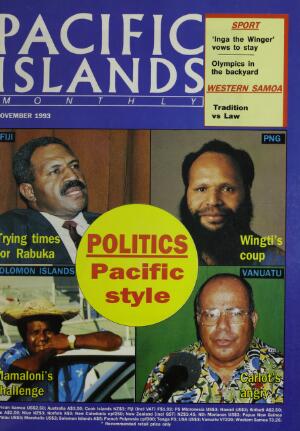
Pacific
Islands
Monthly
Sport
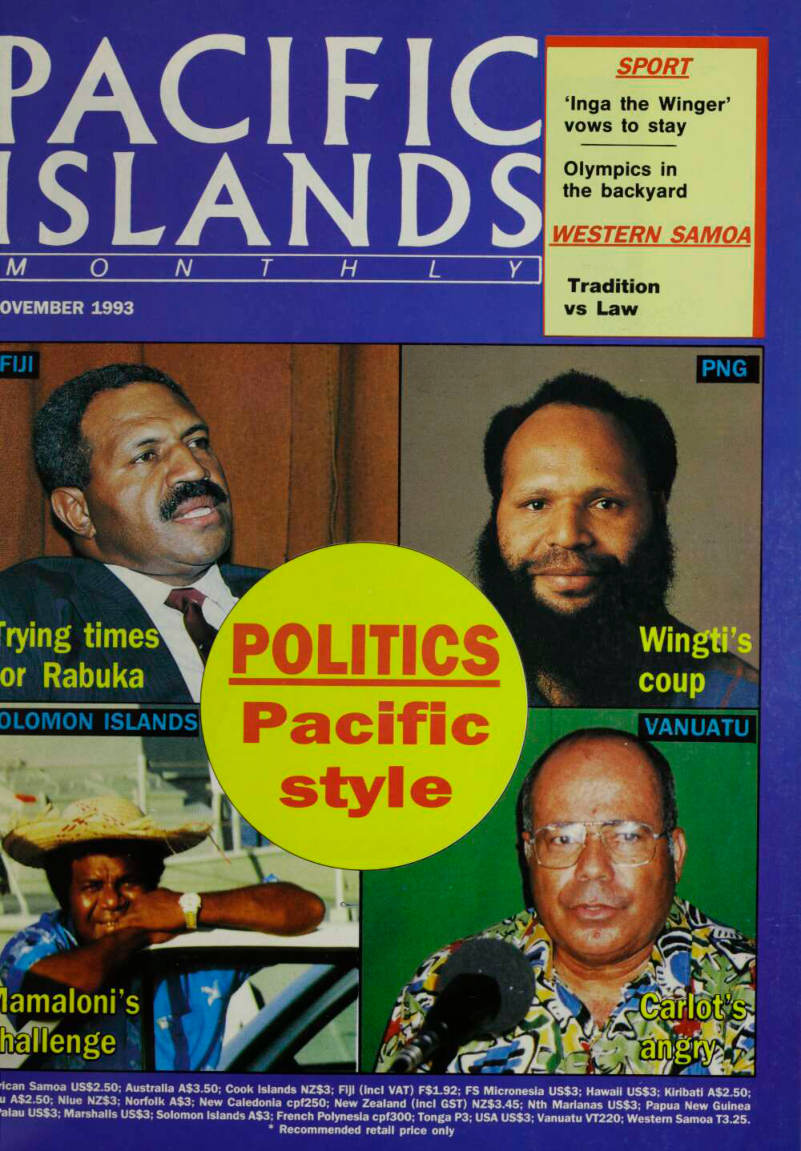
‘lnga the Winger’ vows to stay Olympics in the backyard
Western Samoa
Tradition vs Law
Ovember 1993
Fiji
[TtJTTTTM j I itfMH
Politics
Pacific k style i
m
Png
I i ihTli
Umj
[T^rnrYl
f * (o I n if **Lft7>||7 v
tean Sam° a US$2.5O; Australia A 53.50; Cook Islands NZ$3; FIJI (Incl VAT) F 51.92; FS Micronesia US$3; Hawaii US$3; Kiribati A 52.50; Hi i.e2o N,Ue NZ$3; Norfo,k As 3; New Caledonia cpf2so; New Zealand (incl GST) NZ53.45; Nth Marianas US$3; Papua New Guinea aiau US$3; Marshalls US$3; Solomon Islands As 3; French Polynesia cpf3oo; Tonga P 3; USA US$3; Vanuatu VT22O; Western Samoa T 3.25. * Recommended retail price only
Advertisements & other items, p. 2 (1 item)
%
/ rf f Uisa Bwt i The Beer of Paradise...
South Pacific Export Lager
Pacific
Islands
Monthly
/oI 63 No. 11
The News Magazine
November 1993
From The
Editor’S Desk 4
Letters 5
Headlines 6
Pacific Diary 10
Business Bulletin Ii
Business
>quash success 12 Jamosi; blessing or blight? 13 .ending crisis hits Vestern Samoa 14
;Over Stories
lolomons saga 15 Vingti’s coup 18 /Oconut politics 20 esting times for Rabuka 21
Fradition
radition vs law 17
Vestern Samoa
yes on America 23
Lawaii
reeway protest 24
Inited Nations
lot air 25
Computers
New column 27
History
Terrible Tarawa 29
Aviation/Shipping
In The Pacific 33
Taejon Expo 41
Sport
Inga the Winger vows to stay 49
Thunder strikes like lightning 50 Olympics in the backyard 51 Magnum force strikes right 51
Yachting
Cruising Tonga 52
Columnists
Jemima Garrett 7 David Barber 9 Julian Moti 28 Alfred Sasako 39 Bill McCabe 48
Publisher; Brian O’Flaherty
Acting Editor: Martin Tiffany
Associate Editor: Arvind Kumar Correspondents: Christine Hatcher. David North, Ed Rampell, lan Williams, Johnson Honimae, Karen Mangnall, Liz Thompson, Nicholas Rothwell, Pesi Fonua, Wally Hiambohn.
Columnists: David Barber (Wellington), Futa Helu (Tonga, covering the Pacific Islands). Jemima Garrett (Sydney).
Julian Moti (Pacific Law). Alfred Sasako (The Forum).
Advertising Sales: • Regional Sales (Soutn Pacific); Salendra Narayan. Tel (679) 304111. Fx (679) 303809 • Sydney, Canberra Bob Hill Media Represen tations, Tel (61-2) 4164245, Fx (61-2) 4165064 • Brisbane. Robert Walker, Media House, Tel (61 7) 3710533, Fx (61-7) 371-8904 • Adelaide: Hastwell Williamsons Representations.
Tel (61 8) 799522, Fx (61-8) 799735 • Melbourne; Brown Orr Fletcher Burrows (Aust).
Pty. Ltd. Tel (3) 696 5188 Fx (03) 696 5131. • Auckland: McKay & Bowman, International Media Representatives Ltd, Tel (64-9) 4190561, Fax (64-9) 4192243.
• Japan: Universal Media Corporation, Tokyo. Tel (3) 6663036. 6663094, Cable: UNIMEDIA Tokyo.
Tx 2524665.
Founded 1930 (USPS 952480). A Fiji Times Limited production.
Cover prices are recommended retail only. Regis tered by Australia Post, Publication No. NBP 1210.
O Copyright Fiji Times Limited. 177 Victoria Parade. Suva. Fiji. Tel (679) 304111, Fx (679)
303809. Tx Fj2124.
Pacific Islands Monthly is published monthly by The Fiji Times Limited, a division of Nationwide News, 2 Holt Street. Surry Hills. Sydney. NSW 2010.
Send address changes to: • Pacific Islands Monthly, PO Box 1167. Suva, Fiji.
Typeset and printed by The Fiji Times Limited, 17 7 Victoria Parade. Suva. Fiji.
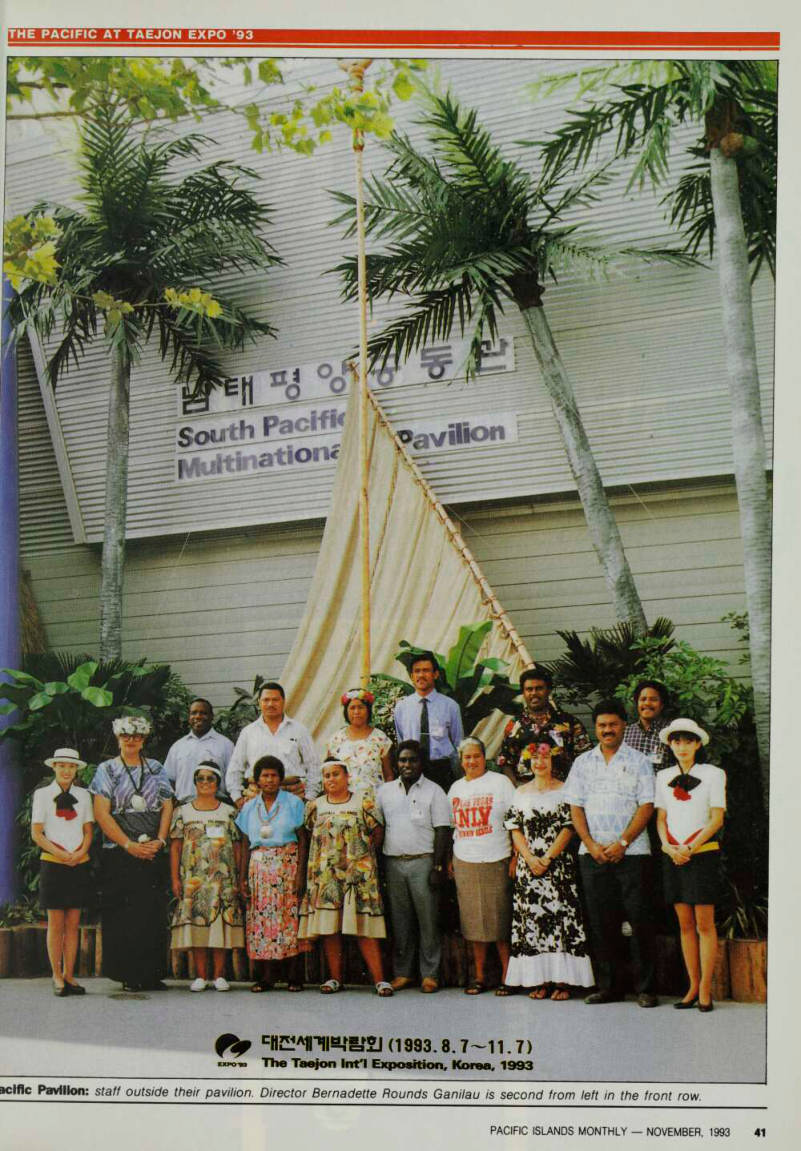
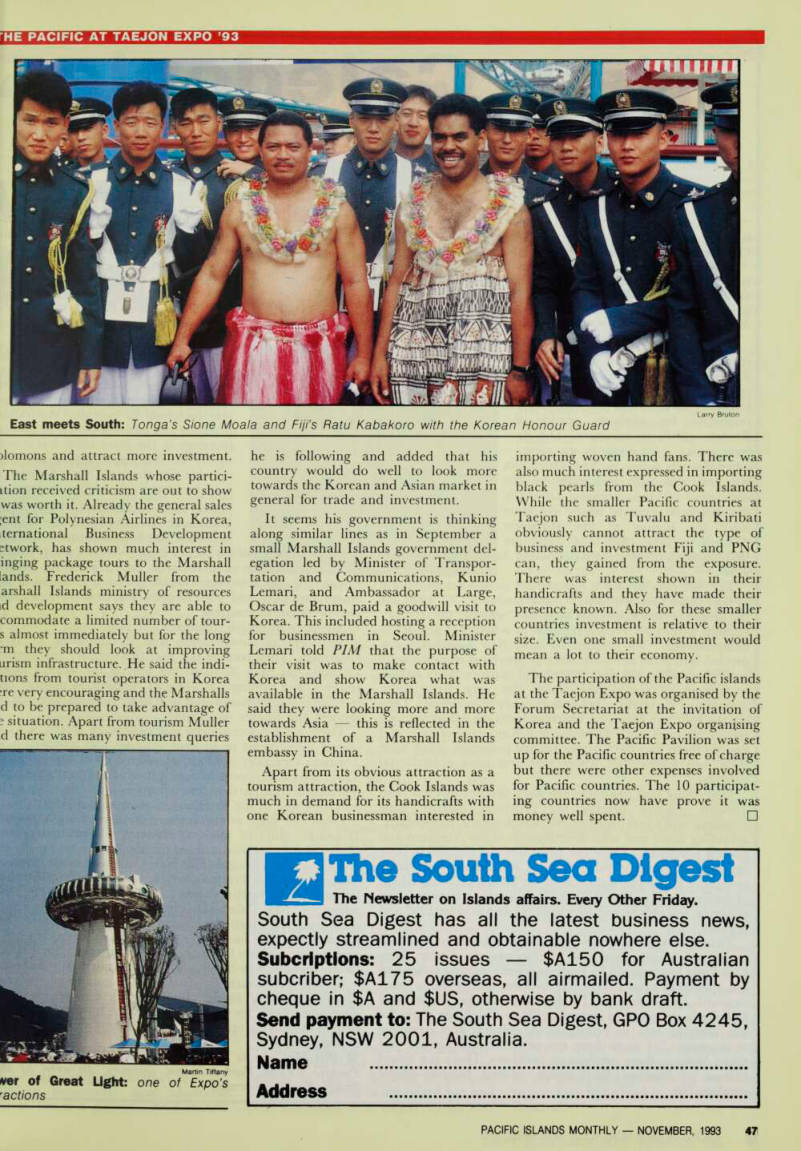
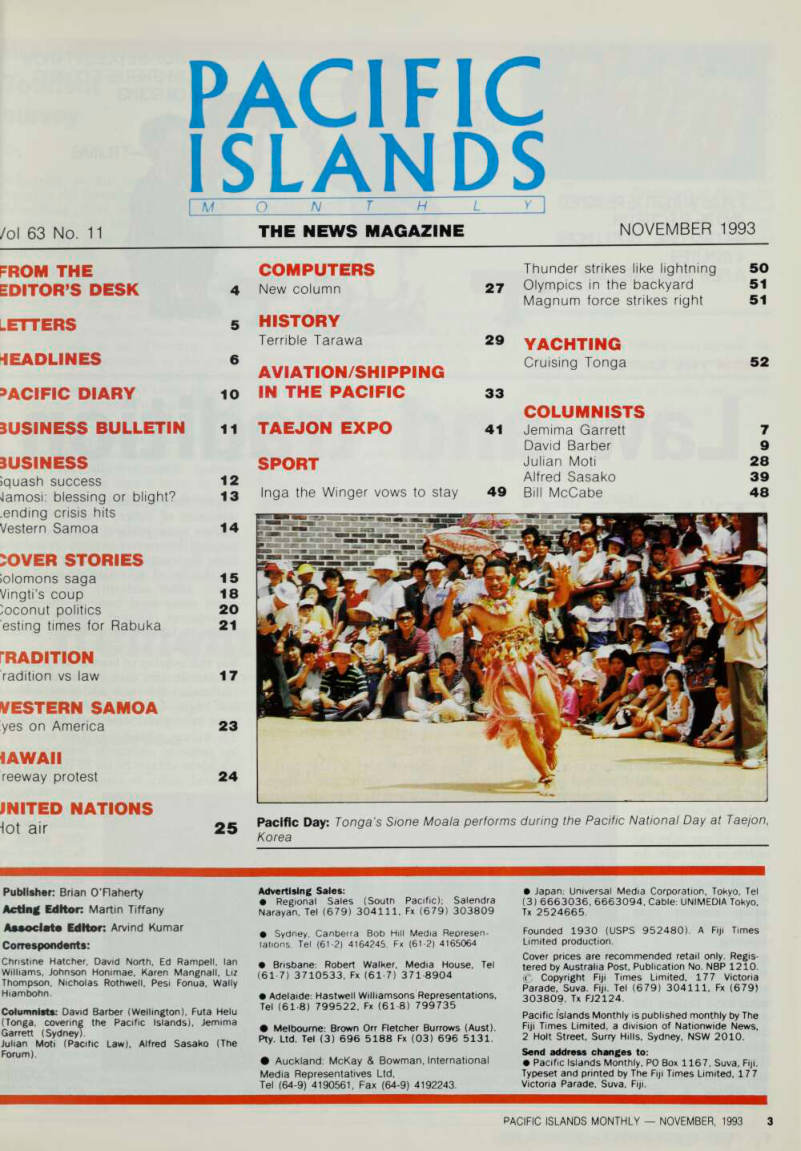
Pacific Day: Tonga's Sione Moala performs during the Pacific National Day at Taejon, Korea
Law and tradition
From The Editor’S Desk
TO an outsider the killing of Nuutai Mafulu in Western Samoa in late September (see story page 17) would be nothing short of murder. Plain and
simple, cut and dry.
Indeed, under the Western system of justice stipulated in Western Samoa’s post-independence constitution it would be premeditated murder. But the fact that it could be a matai (chiefs) ordered execution is causing a dilemma in the country. A dilemma that needs to be sorted out now. Or its implications are going to have far-reaching effects on life (and death) in Western Samoa in the future.
Mafulu’s crime was he refused to contrib ute to his village affairs, resisted council
decisions, and played cricket for and trans ported players of an other village. On the orders of the matai the villagers burnt the de ceased shop, bus and jeep although state ments conflict over who ordered the
shooting.
But the fact remains that under the guise of traditional law the matai have broken the constitutional law and therefore should be
charged accordingly.
However, it is not that
simple and police seem
to talking a softly, softly approach as they
try to figure out what to do for the best.
Life in Western Samoa is based for the most part on fa’aSamoa (the Samoan way). If you are Samoan you obey Samoan laws as laid down by matai although they often clash with consti tutional law and the issue of individual rights versus traditional authority raises its head.
Traditional law is enshrined in the Western Samoa constitution as long as the traditional way is confined to the limits of the constitution. One drawback of having two laws is offenders have sometimes been charged twice once by the matai and again by the court for the same crime But Matai councils play a large part in
keeping villages orderly and villagers
respect their authority. Even the Com missioner of Police, Galuvad Tanielu, realises matai perform the vital task of keeping the country in order. A task that saves the country the expense of increas ing the size of the relatively small police force. Matai authority has also been given some legal basis as the present government changed the law to allow judges to take village fines into account when passing sentence.
But this overlap of laws is dangerous as seen in this case as where does traditional law end and constitutional law begin. Especially as the matai now have been given some legal recognition, I The killing of Mafulu and the burning of his property ultimately involves almost the whole village. So far 36 villagers have i pleaded guilty to arson, wilful damage
and throwing stones. It is a delicate matter that needs to be given a lot of thought as it will affect the future of West ern Samoan life.
Meanwhile, the Western Samoa situ ation could and should be studied by many other Pacific countries where custom ary law exists.
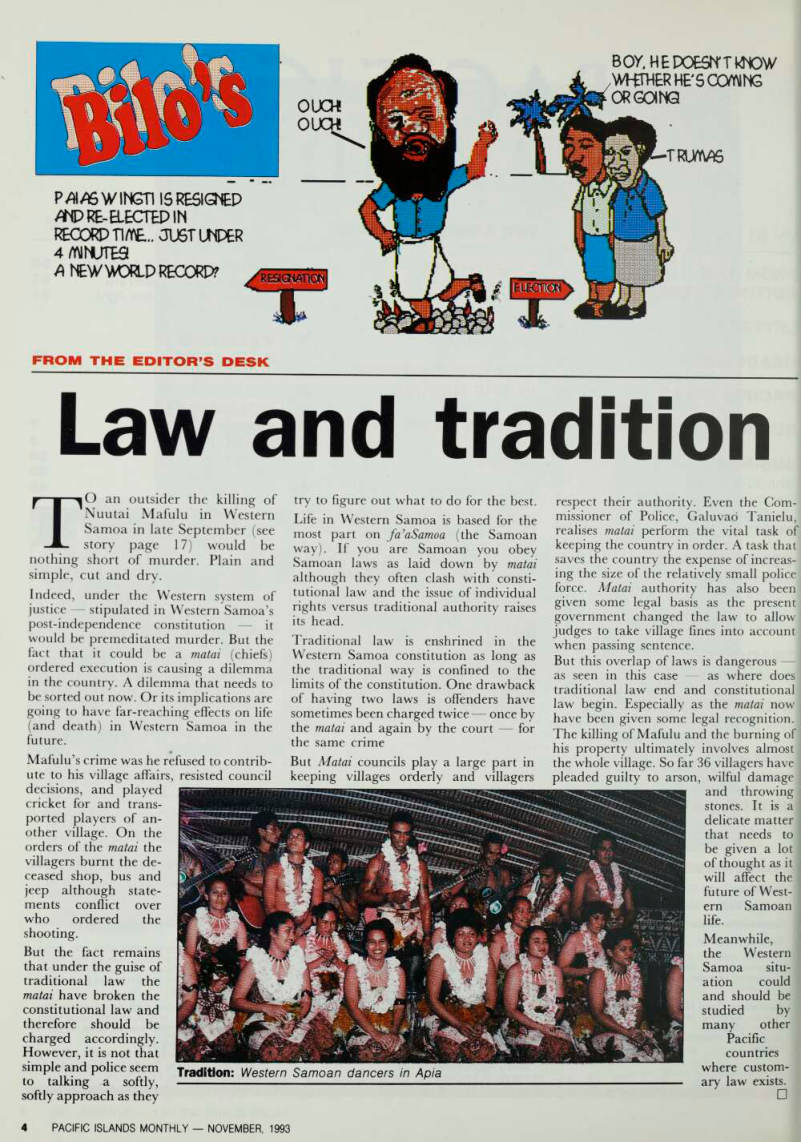
Tradition: Western Samoan dancers in Apia
Report
Letters
Tourism
survey
Sir, WE refer to the report Tourism and Nature: a Fiji Survey by Sean Weaver and Brian King {PIM, Sept 1993). We wish to emphasise that the report has created certain inaccurate impressions which need correction.
Brian King was for sometime attached to the Tourism Studies Programme of the University of the South Pacific but we are not aware of any such survey carried by him on its behalf. Sean Weaver is hardly known to us. Therefore, their comments and conclusions in this report are their personal views and should not be deemed to reflect the views either of :he Tourism Studies Programme or of
:he university.
Any reference to the report as emanat ng from the University of the South Pacific is factually inaccurate. Indeed, ve have not even seen a copy, in any brm, of the report from which the article vas written.
We feel the Fiji government, in the ecent past together with the Tourism Council of the South Pacific, has taken nany initiatives towards the protection
of the environment in relation to tourism development.
Nii-K Plange D R Rao
Tourism Studies Programme University of the South Pacific Suva
Report
research
Sir AS one of the co-authors of the research upon which the report is based, I would like to draw readers’ attention to an incorrect attribution in the report Tour ism and Nature: A Case Study published in the PIM September.
In my capacity as AIDAB (Australian International Development Assistance
Bureau) Visiting Principal Lecturer in
Tourism, I was indeed associated with the Tourism Studies Section of the University of the South Pacific during the early stages of the research. I cannot claim, however, to represent the views of the Tourism Studies Section at the
university.
Material support for the project at the Fiji end was provided by the National
Environment Management Project in Suva and data analysis services were provided by the Centre for Hospitality and Tourism Research at Victoria of Technology in Melbourne.
Brian King
Associate Professor Department of Hospitality and Tourism Management Victoria University Australia
Advertisements & other items, p. 5 (1 item)
Remember your Friend
LETTERS to the Editor must include the writer’s full name, address and home telephone number. All letters may be edited for purposes of clarity and space.
Letters should be addressed to: Pacific Islands Monthly P O Box 1167 Suva
Fiji Islands
OR Fax: (679) 303809.
Remember your Friend
There are times in your life when you feel your friends have been missing out on something good. Now’s your chance to do something about it and share with them one of the good tilings you have. Buy your friend a subscription to Pacific Islands Monthly and let him or her join you and the thousands of other people worldwide who are kept informed of the latest political, social and cultural changes taking place in the Pacific.
SUBSCRIPTIONS
American Samoa US$45 I I Australia A 542.00 I K A I , Canada US$45 1 V-* 11 1
I ISLANDS i
French Polynesia US$45 I Guam . US$45 I USS4S I Please send m X friend Pacific Islands Monthly for one year (12 issues).
Kiribati AUSS46 Marshaii/Micronesia US$4O I 1 enclose my cheque for $ (made payable to Pacific Islands Monthly) « Nauru auss42 or debit $ to my: n*Z NZSSS I n B a nkc ard □ Visacard □ Mastercard I Norfolk island ZZZZZZZZ." auls42 I Card No: I I I I I I I I I I I I I I I I Expiry Date I Northern Marianas/Palau US$4O I Papua New Guinea AUSS4S 1 MAK , C Solomon Islands AUSS46 . i Ton ga AUSS46
Tuvalu AUSS46 QIPMATI IRP i
United Kingdom Stg Pound2B —bIbNAIUHb US Mainland US$45 I XESS 5T AUS ! 4S IMY FRIEND'S NAME Western Samoa WS$6O 1 Elsewhere AUSS63 I Payment to Pacific Islands Monthly: Subscriptions I FRIEND S ADDRESS Dept, GPO Box 1167, Suva, FIJI.
Subscriptions rates include the cost of airspeeding I I to all destinations set out above. ' ' Direct airmail rates on application. Q|jy COUNTRY Telephone: 304111 Fax: 303809 I TZ J
Bougainville office
Headlines
Tonga
Bishop Finau dies
One of the driving forces behind Tonga’s pro-democracy move ment, Bishop Patelisio Finau, died of a heart attack in Niue on Octo ber 4. Bishop Finau, 59, was the Catholic Bishop of Tonga and chairman of the Pacific Conference of Churches. He was in Niue for a conference
executive meeting.
For a long time Bishop Finau had been critical of Tonga’s nobility-dominated
government and was one of the key speakers at last year’s pro democracy convention in Nuku’alofa.
In recent times he championed the struggles of the people of East Timor for independence from Indonesia. He has also been untiring in efforts to stop the bloodshed of the Bougainville conflict. As a member of the Nuclear Free and Independent Pacific movement his philosophy was a nuclear free Pacific must surely be a small but mighty step towards a nuclear free world.
After a mass in Niue, his body was flown to Tonga for burial.
Hawaii
Marcos returns to the Phillipines
The body of Ferdinand Marcos has made the long trip back to the Philippines, ending a ghoulish episode in the history of Hawaii, where the late dictator died in disgrace and exile. On Sept 1, 50 Marcos supporters gathered at the Valley of the Temples graveyard for a ceremony. The ex-president’s corpse was removed from a refrigerated crypt at the windward Oahu cemetery where it’s been stored in since 1989, and moved to a Honolulu mortuary. There, health officials inspected the cadaver.
Ecumenical services were held on Sept 4 for Marcos at a Honolulu high school. Fifty Filipino officials and pop stars, who flew to Hawaii for the occasion, held services, too. A video about the life of Marcos in Hawaii was shown. On Sunday Sept 5, there was a viewing of the open casket. Officials of the United States and the Hawaii state government, as well as Filipino community leaders participated in services. There were Catholic church blessings and a 21 gun salute fired in honor of the former president of the Republic of the Philippines.
Cook Islands
Anger over child killing
There’s been a call for a return to “an eye for an eye”, Old Testament law in the wake of the Cook Islands’ first recorded child murder. Parents on Rarotonga are voicing shock and anger after the body of a four year old girl was found on a village beach in late September.
Local parents have called on the government to impose stiff penalties for molesting and child abuse. A counselling and rape crisis group spokesperson says it’s highlighted the need for the Cook Islands government to step up its deliberations on whether the Cooks will ratify the UN convention on the rights of children.
Papua New Guinea
Islands region threatens breakaway
The premiers of Papua New Guinea’s Islands region have again threatened to breakaway and form a separate country. The New Guinea Islands Premiers Council said they will go ahead with a referendum on secession if the national government moves to implement proposed reforms to the provincial government system.
The reforms propose abolishing PNG’s 19 provincial governments and replacing them with provincial authorities headed by national parliamentarians. The premiers have rejected the proposals and called on the government to set up a broadly representative commission to review the country’s constitution. The premiers from the New Guinea Islands say if the reforms are implemented, they’ll conduct a referendum in the five Islands provinces that will allow the people to decide what is best for the future of the New Guinea Islands.
Solomon Islands
Bougainville office closed in Honiara
The Solomon Islands deputy prime minister Francis Saemala has announced the closure of the Bougainville secessionists office in Honiara. Saemala made the announcement during talks with PNG prime minister Paias Wingti in Port Moresby in September. Saemala said his government had also restricted the movement of the secessionist representative in Honiara, Martin Miriori.
The move is part of the new Solomon Islands government s six-point plan to normalise relations with PNG. The North Solomons provincial administrator Sam Tulo has welcomed the closure.
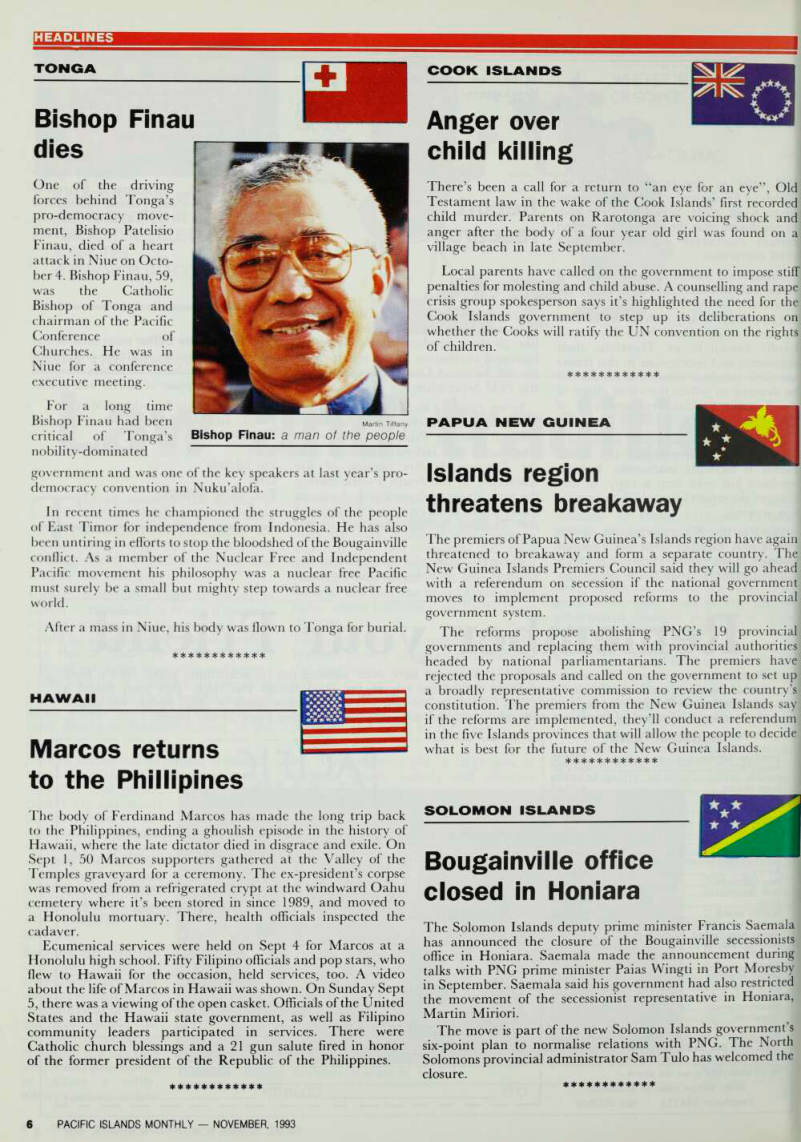
Martin Tiffany Bishop Finau: a man of the people
Aussie Islanders
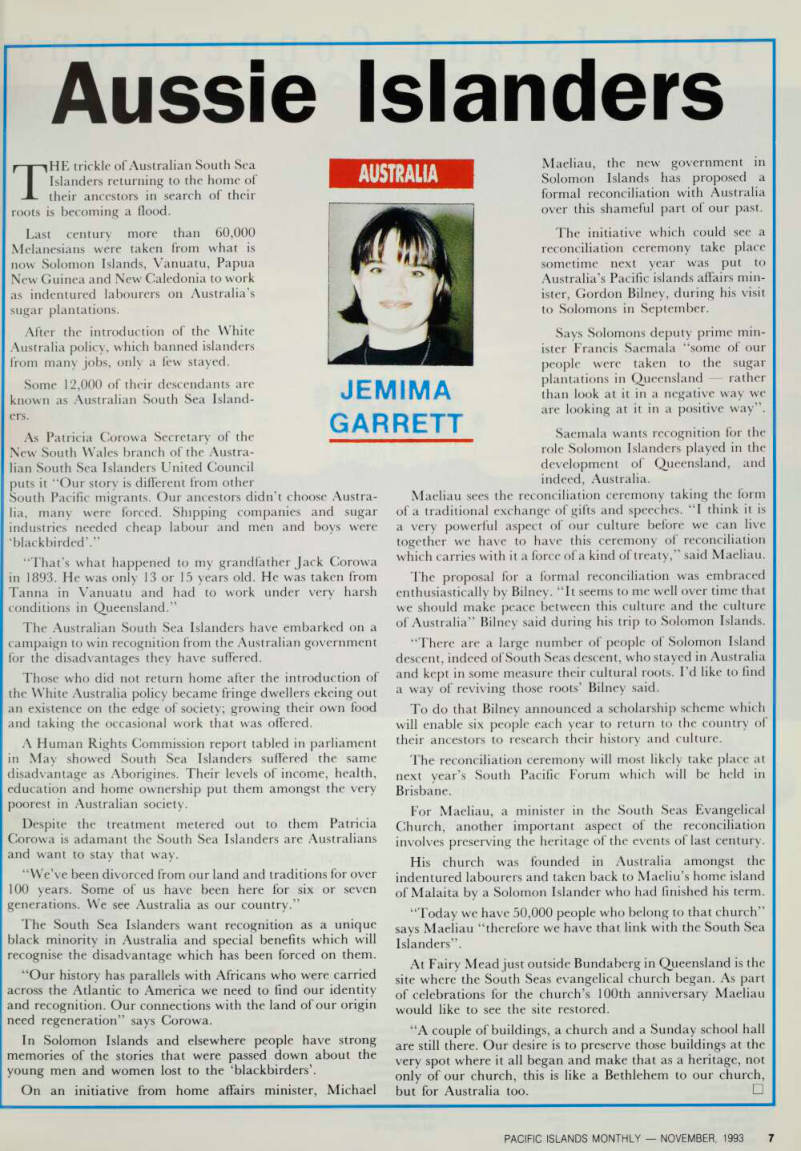
THE trickle of Australian South Sea Islanders returning to the home of their ancestors in search of their roots is becoming a flood.
Last century more than 60,000 Melanesians were taken from what is now Solomon Islands, Vanuatu, Papua New Guinea and New Caledonia to work as indentured labourers on Australia’s
sugar plantations.
After the introduction of the White Australia policy, which banned islanders from many jobs, only a few stayed.
Some 12,000 of their descendants are known as Australian South Sea Island ers.
As Patricia Corowa Secretary of the New South Wales branch of the Austra lian South Sea Islanders United Council puts it “Our story is different from other
South Pacific migrants. Our ancestors didn't choose Austra lia, many were forced. Shipping companies and sugar industries needed cheap labour and men and boys were ‘blackbirded’.”
“That’s what happened to my grandfather Jack Corowa in 1893. He was only 13 or 15 years old. He was taken from Tanna in Vanuatu and had to work under very harsh conditions in Queensland.”
The Australian South Sea Islanders have embarked on a campaign to win recognition from the Australian government for the disadvantages they have suffered.
Those who did not return home after the introduction of the White Australia policy became fringe dwellers ekeing out an existence on the edge of society; growing their own food and taking the occasional work that was offered.
A Human Rights Commission report tabled in parliament in May showed South Sea Islanders suffered the same disadvantage as Aborigines. Their levels of income, health, education and home ownership put them amongst the very poorest in Australian society.
Despite the treatment metered out to them Patricia Corowa is adamant the South Sea Islanders are Australians and want to stay that way.
“We’ve been divorced from our land and traditions for over 100 years. Some of us have been here for six or seven generations. We see Australia as our country.”
The South Sea Islanders want recognition as a unique black minority in Australia and special benefits which will recognise the disadvantage which has been forced on them.
“Our history has parallels with Africans who were carried across the Atlantic to America we need to find our identity and recognition. Our connections with the land of our origin need regeneration” says Corowa.
In Solomon Islands and elsewhere people have strong memories of the stories that were passed down about the young men and women lost to the ‘blackbirders’.
On an initiative from home affairs minister, Michael
Maeliau, the new government in Solomon Islands has proposed a formal reconciliation with Australia over this shameful part of our past.
The initiative which could see a reconciliation ceremony take place sometime next year was put to Australia’s Pacific islands affairs min ister, Gordon Bilney, during his visit to Solomons in September.
Says Solomons deputy prime min ister Francis Saemala “some of our people were taken to the sugar plantations in Queensland rather than look at it in a negative way we are looking at it in a positive way”.
Saemala wants recognition for the role Solomon Islanders played in the development of Queensland, and indeed, Australia.
Maeliau sees the reconciliation ceremony taking the form of a traditional exchange of gifts and speeches. “I think it is a very powerful aspect of our culture before we can live together we have to have this ceremony of reconciliation which carries with it a force of a kind of treaty,” said Maeliau.
The proposal for a formal reconciliation was embraced enthusiastically by Bilney. “It seems to me well over time that we should make peace between this culture and the culture of Australia” Bilney said during his trip to Solomon Islands.
“There are a large number of people of Solomon Island descent, indeed of South Seas descent, who stayed in Australia and kept in some measure their cultural roots. I’d like to find a way of reviving those roots’ Bilney said.
To do that Bilney announced a scholarship scheme which will enable six people each year to return to the country of their ancestors to research their history and culture.
The reconciliation ceremony will most likely take place at next year’s South Pacific Forum which will be held in Brisbane.
For Maeliau, a minister in the South Seas Evangelical Church, another important aspect of the reconciliation involves preserving the heritage of the events of last century.
His church was founded in Australia amongst the indentured labourers and taken back to Maeliu’s home island of Malaita by a Solomon Islander who had finished his term.
“Today we have 50,000 people who belong to that church” says Maeliau “therefore we have that link with the South Sea Islanders”.
At Fairy Mead just outside Bundaberg in Queensland is the site where the South Seas evangelical church began. As part of celebrations for the church’s 100th anniversary Maeliau would like to see the site restored.
“A couple of buildings, a church and a Sunday school hall are still there. Our desire is to preserve those buildings at the very spot where it all began and make that as a heritage, not only of our church, this is like a Bethlehem to our church, but for Australia too. d
Australia
Jemima
Garrett
Advertisements & other items, p. 8 (1 item)
Cable & Wireless
* * m
Cable and Wireless began keep-
ing people in touch around the
world more than a century ago. Today,
while the technology has changed,
the tradition of service to our customers in the
South Pacific is just the same.
We work in partnership with Governments,
dedicated to meeting the need of communities and businesses to stay in touch. From one island to the next or to the other side of the world, the message is the same: Cable and Wireless is
your South Pacific
connection bringing the
islands together.
CABLE & WIRELESS
Asia Pacific Head Office Cable and Wireless pic Cable and Wireless (Pacific) Limited 22nd Floor Office Tower Convention Plaza 1 Harbour Road Hong Kong Tfel: (852) 848 8620 Facsimile: (852) 868 5195 Fiji In association with the Government of Fiji Fiji International Telecommunications Ltd.
P.O. Box 59 Mercury House 158 Victoria Parade Suva Fiji Tel: (679) 312933 Solomon Islands In association with the Government of the Solomon Islands Solomon Telekom Company Limited P.O. Box 148 Honiara Solomon Islands Tel: (677) 21576 Tonga Cable and Wireless pic Private Mail Bag 4 General Post Office Nuku Alofa Tonga South Pacific Tfel: (676) 23499 Vanuatu In association with the Government of Vanuatu and France Cdbles et Radio Telecom Vanuatu Limited P.O. Box 146 Port Vila Vanuatu Tel: (678) 22185
Why the violence?
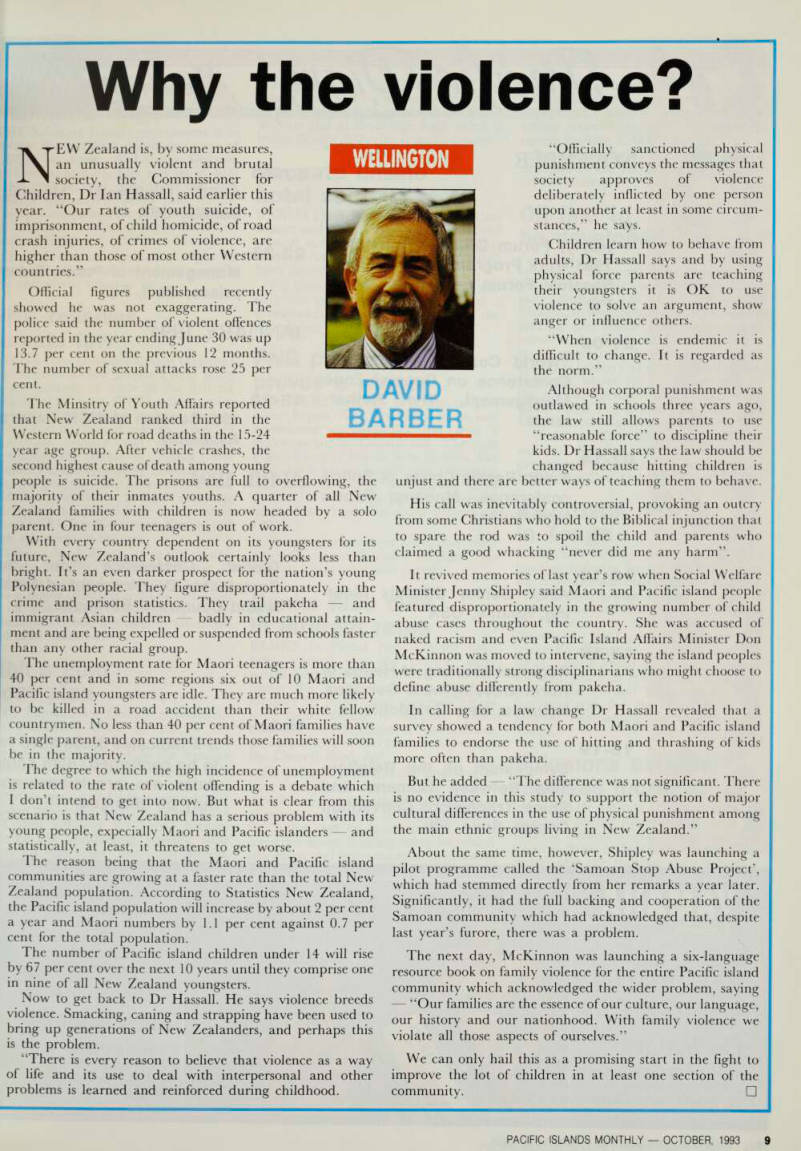
NEW Zealand is, by some measures, an unusually violent and brutal society, the Commissioner for Children, Dr lan Hassall, said earlier this year. “Our rates of youth suicide, of imprisonment, of child homicide, of road crash injuries, of crimes of violence, are higher than those of most other Western countries.”
Official figures published recently showed he was not exaggerating. The police said the number of violent offences reported in the year ending June 30 was up 13.7 per cent on the previous 12 months.
The number of sexual attacks rose 25 per cent.
The Minsitry of Youth Affairs reported that New Zealand ranked third in the Western World for road deaths in the 15-24 year age group. After vehicle crashes, the second highest cause of death among young
people is suicide. The prisons are full to overflowing, the majority of their inmates youths. A quarter of all New Zealand families with children is now headed by a solo parent. One in four teenagers is out of work.
With every country dependent on its youngsters for its future, New Zealand’s outlook certainly looks less than bright. It’s an even darker prospect for the nation’s young Polynesian people. They figure disproportionately in the crime and prison statistics. They trail pakeha and immigrant Asian children badly in educational attain ment and are being expelled or suspended from schools faster than any other racial group.
The unemployment rate for Maori teenagers is more than 40 per cent and in some regions six out of 10 Maori and Pacific island youngsters are idle. They are much more likely to be killed in a road accident than their white fellow countrymen. No less than 40 per cent of Maori families have a single parent, and on current trends those families will soon be in the majority.
The degree to which the high incidence of unemployment is related to the rate of violent offending is a debate which I don’t intend to get into now. But what is clear from this scenario is that New Zealand has a serious problem with its young people, expecially Maori and Pacific islanders and statistically, at least, it threatens to get worse.
The reason being that the Maori and Pacific island communities are growing at a faster rate than the total New Zealand population. According to Statistics New Zealand, the Pacific island population will increase by about 2 per cent a year and Maori numbers by 1.1 per cent against 0.7 per cent for the total population.
The number of Pacific island children under 14 will rise by 67 per cent over the next 10 years until they comprise one in nine of all New Zealand youngsters.
Now to get back to Dr Hassall. He says violence breeds violence. Smacking, caning and strapping have been used to bring up generations of New Zealanders, and perhaps this is the problem.
“There is every reason to believe that violence as a way of life and its use to deal with interpersonal and other problems is learned and reinforced during childhood.
“Officially sanctioned physical
punishment conveys the messages that society approves of violence deliberately inflicted by one person upon another at least in some circum stances,” he says.
Children learn how to behave from adults, Dr Hassall says and by using physical force parents are teaching their youngsters it is OK to use violence to solve an argument, show anger or influence others.
“When violence is endemic it is difficult to change. It is regarded as the norm.”
Although corporal punishment was
outlawed in schools three years ago, the law still allows parents to use “reasonable force” to discipline their kids. Dr Hassall says the law should be changed because hitting children is
unjust and there are better ways of teaching them to behave.
His call was inevitably controversial, provoking an outcry from some Christians who hold to the Biblical injunction that to spare the rod was to spoil the child and parents who claimed a good whacking “never did me any harm”.
It revived memories of last year’s row when Social Welfare Minister Jenny Shipley said Maori and Pacific island people featured disproportionately in the growing number of child abuse cases throughout the country. She was accused of naked racism and even Pacific Island Affairs Minister Don McKinnon was moved to intervene, saying the island peoples were traditionally strong disciplinarians who might choose to define abuse differently from pakeha.
In calling for a law change Dr Hassall revealed that a survey showed a tendency for both Maori and Pacific island families to endorse the use of hitting and thrashing of kids more often than pakeha.
But he added “The difference was not significant. There is no evidence in this study to support the notion of major cultural differences in the use of physical punishment among the main ethnic groups living in New Zealand.”
About the same time, however, Shipley was launching a pilot programme called the ‘Samoan Stop Abuse Project’, which had stemmed directly from her remarks a year later.
Significantly, it had the full backing and cooperation of the Samoan community which had acknowledged that, despite last year’s furore, there was a problem.
The next day, McKinnon was launching a six-language resource book on family violence for the entire Pacific island community which acknowledged the wider problem, saying “Our families are the essence of our culture, our language, our history and our nationhood. With family violence we violate all those aspects of ourselves,”
We can only hail this as a promising start in the fight to improve the lot of children in at least one section of the community. □
Wellington
David
Barber
Advertisements & other items, p. 10 (1 item)
cipc ( JJmnj
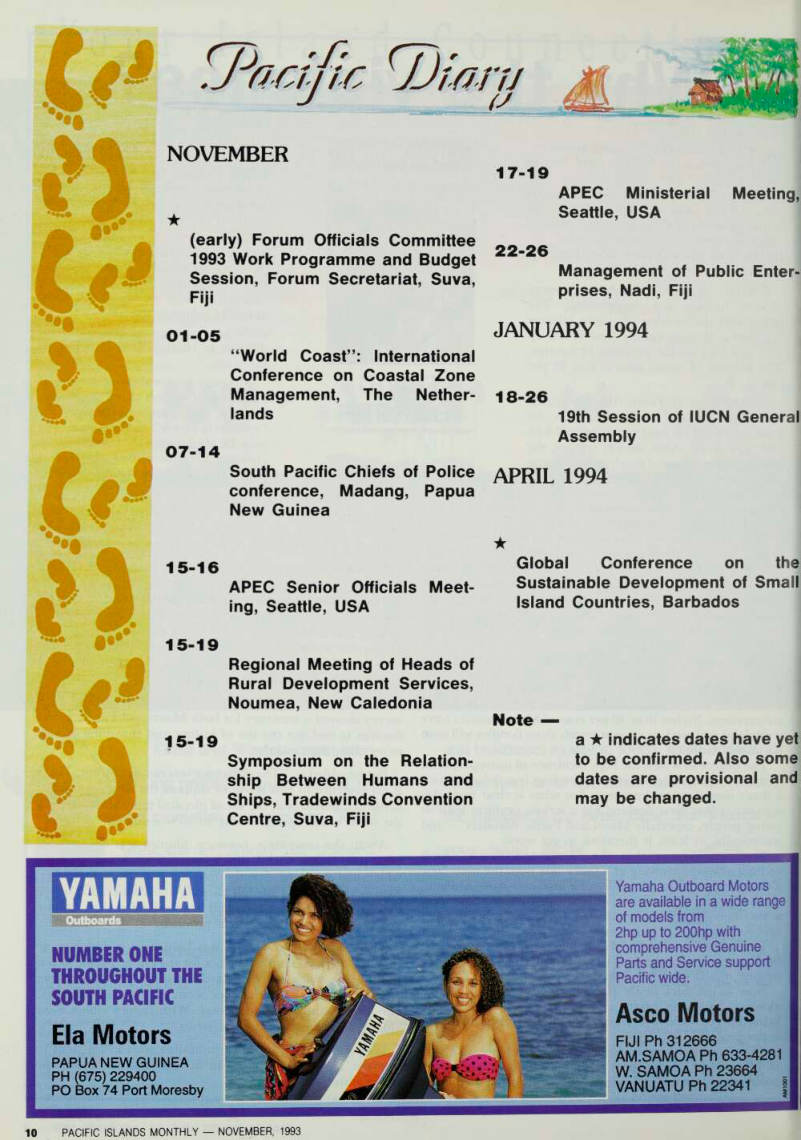
NOVEMBER
(early) Forum Officials Committee 1993 Work Programme and Budget Session, Forum Secretariat, Suva, Fiji 17-19 22-26 APEC Ministerial Meeting, Seattle, USA Management of Public Enter prises, Nadi, Fiji 01-05
JANUARY 1994
07-14 15-16 15-19 15-19 “World Coast”: International Conference on Coastal Zone Management, The Netherlands South Pacific Chiefs of Police conference, Madang, Papua New Guinea APEC Senior Officials Meeting, Seattle, USA Regional Meeting of Heads of Rural Development Services, Noumea, New Caledonia Symposium on the Relationship Between Humans and Ships, Tradewinds Convention Centre, Suva, Fiji 18-26 19th Session of lUCN General Assembly
APRIL 1994
Global Conference on the Sustainable Development of Small Island Countries, Barbados Note a ★ indicates dates have yet to be confirmed. Also some dates are provisional and may be changed.
NUMBER ONI
THROUGHOUT THE
SOUTH PACIFIC
Ela Motors
PAPUA NEW GUINEA
PH (675) 229400 PO Box 74 Port Moresby % Yamaha Outboard Motors ■■■l are available in a wide range of models from 2hp up to 200 hp with comprehensive Genuine Parts and Service support Pacific wide.
Asco Motors
FIJI Ph 312666
AM.SAMOA Ph 633-4281
W. SAMOA Ph 23664
VANUATU Ph 22341
shing industry
Business Bulletin
Solomons to review
minimum wage
fHE Solomon Islands government is to eview the national minimum wage of an hour. A Labour Division pokesman says the rate was set in July 988 and is now considered too low gainst the current retail price index, "he spokesman said his office would soon et national minimum wage level be ween and USS6O an hour.
He said the new guideline might be eady to be submitted^to cabinet towards he end of the year.
*NG reserves
emain low
APUA New Guinea’s foreign exchange remain low despite a huge jump i the balance of trade in the first six lonths of the year. PNG’s trade surplus rew to US$66O million in the six months > the end of June, thanks to expanded ude oil, copper and log exports, eleasing the Bank of Papua New uinea’s latest Quarterly Economic Bull in, the governor, Sir Mekere Morauta, id the country’s foreign exchange serves at the end of June amounted to xmt US$l4O million, equivalent to just 'er six weeks of imports.
While the balance of trade swung rongly in PNG’s favour because of gher exports and lower imports, there as a major offsetting outflow of capital oil and mining companies paid off bstantial debts, net interest payments id paid dividends.
ihir’s gold
oat plan
IE Papua New Guinea government s announced plans for one of the
>rld’s largest gold floats, proposing to
t up to 40 per cent of the massive lion dollar Lihir gold project out onto s market.
PNG’s mining and petroleum minister asket lanagalio says the government d joint ventures RTZ and Niugini
ining are considering pooling their
ireholdings into one corporation,
itatively known as Lihir Gold.
Small Canadian explorer Venezuelan
►ldfields would be involved as would
“ state-owned Malaysian Mining Cor
ration. Mr langalio says the new npany, subject to approval from finet and the partner’s boards, pro ses to raise between US$25O million d US$4OO million by a share float on
: Australian stock exchange.
iue boosts its
shing industry
UE has granted a fishing licence to a w Zealand company as part of efforts develop a small fishing industry. A ic government spokesman said the
licence was sold for US$55O and the fishing boat will have Niuean observers on board while fishing around the island of Niue and at Beveridge Reef which is inside Niue’s 200-mile economic zone.
Vanuatu casino
hotel sold
VANUATU’S Raddison Royals Palms Resort and Casino has been sold. Hotel general manager Maurice Cooks said a contract for the sale of the property had been signed.
Mr Cooks said the purchaser had met with the government and “obtained a memorandum of understanding” of the completion of the contract.
PNG promotion
proves a winner
A PUBLIC relations program to pro mote Papua New Guinea’s trade and investment opportunities has won a major award in Queensland. The pro gram, Faces of Papua New Guinea, has won the Brisbane-based public relations company, McCalls, the annual Gold Award for Excellence for being Queens land’s Best Public Relations project for 1993.
The project involved a one-day busi ness seminar in Brisbane in April this year that attracted 400 people.
Banks face cuts
in interest rates
BANKS in Papua New Guinea have been warned that the Central Bank would force a round of interest rate cuts unless the banks move first. Finance minister Sir Julius Chan says he is fed up with banks failing to support PNG*s economic development or government policies and he would intervene through the Central Bank Act.
Sir Julius said he was not prepared to have the banks abuse their market powers any longer without consideration of market realities or national priorities.
Sir Julius says he is committed in his quest for lower landing rates, increased efficiency, and lower margins to promote a faster rate of growth in lending, especially to Papua New Guineans.
He says he has directed the Central Bank to endorse section 38 of the Central Banking Act and so “play a far more interventionist, regulatory and supervis ory role in monetary policy determi nation”. The warning has come six months after the finance minister put similar pressure on the country’s five commercial banks to cut their indicator
lending rates.
Fiji’s timber
earnings up
EXPORT earnings from Fiji’s timber and timber products increased by nearly
US$3 million last year compared with the previous year. The forestry depart ment’s 1992 annual report put sawn timber exports at over 26,000 cubic metres earning US$4.6 million.
Revenue from Fiji’s pine-chip exports to Japan for the period was put at almost USSIS million.
Oil find to
be developed
A PAPUA New Guinea petroleum company, Barracuda Pty Limited, has reached agreement with operator of the rich Kutubu Oil Fields, Chevron Niugini, to develop the country’s new oil find in the South East Gobe region between the Gulf and Southern High lands provinces. Barracuda, a wholly owned subsidiary of Australian M.I.M.
Holdings, under the agreement will be the overall operator of the South East Gobe Fields . . . expected to come into full production in two years.
The South East Gobe Oilfield is linked with the Kutubu find and estimates of development construction are between US$l5O million and US$2OO million.
ANZ Bank now
in Tonga
COMPETITION will enter the Tongan banking industry for the first time when the Australia and New Zealand Banking Corporation begins operations in the kingdom next month. ANZ is finalising the lease of a building in central Nuku’alofa. ANZ general manager des ignate Bob Decourtney says the bank will be recruiting about 20 Tongan staff in the first phase of operations. ANZ will provide all normal banking and loan facilities and for the first time will provide competition to the Bank of Tonga.
Solomons external
reserves increase
SOLOMON Islands’ external reserves increased during the second quarter by US$4.5 million U 5522.4 million. The Central Bank of Solomon Islands June report says the increase reflects princi pally the improvement in the trade account which resulted mainly from improvements in receipts in almost all major export commodities.
Copra had declined by nine per cent to 6801 tonnes compared with a decline of seven per cent in the previous quarter.
But the report says that coconut oil production increased by 76 per cent to 1746 tonnes compred with a decline of eiight per cent in the previous quarter.
The report says that palm oil and kernal production increasea seven per cent to 10,583 tonnes compared with an 11 per cent increase in the first quarter.
Cocoa production increased by 49 per cent compared with a sharp fall of 50 per cent last quarter. □
Squash success
Business
By Roman Grynberg
Why Tonga has been able to get top prices in Japan
FOR the past six years, a visit to Tonga’s main island of Tongatapu in the month of October was a lesson that the myth of the unentrepreneurial Pacific islander was completely misplaced. The island is literally transformed, at least for a month or two into the hub of export driven commerce the sort of thing that would gladden the heart of any World Bank official.
Everywhere you look there are farmers busily harvesting their crop of squash ready for the lucrative Japanese market.
However, if the expansion that is cur rently beginning in Vanuatu and similar attempts to expand in Western Samoa and New Caledonia, then the lucrative Japanese niche market that exists in November and December of each year may well turn into a grave for squash growers.
Squash, despite its shape and appear ance, has become an attractive vegetable in western countries. High in fibre, it is a frequently recommended vegetable in diet conscious western countries. How ever, it is in the ‘far west’ ie. Japan, that the vegetable constitutes a standard staple for low income individuals. The Butternut or Delicia squash (cubrita maxima) is hybrid member of the pump kin family. Japanese consumption of squash stands at about 200,000 tonnes per annum with about 60 per cent being grown domestically and tne remainder being mainly imported from New Zea land, Mexico and the United States.
The New Zealand and Mexican sup pliers come on stream in January-May and the US and Pacific islands supply in the November-December period. The beauty of Tonga’s position is that it is able to supply squash just at the very time when there are virtually no other supplies on the market and as a result it gets peak prices for its product. Squash requires cool climates at night ana as a result there are few places mat are able to supply the Japanese market in the
peak period.
Fiji Situation
For years the agricultural experts have been telling the Pacific islanders what they painfully know for decades there is no future in copra and they had better find niche markets that are more appro griate. Fiji was the first country in the acific to discover that it had the potential to export squash to Japan. In 1984, Fiji’s National Marketing Author ity (NMA) contracted farmers to start growing squash in western Viti Levu.
The crop was a disaster. In 1987, the NMA tned again but this time with the assistance of some seasoned New Zealand squash growers. Unfortunately, divine rather human intervention caused the 1988 failure which resulted from one of
the worst droughts in Fiji’s history.
In 1988, the Fiji farmers were told that the maturity period of squash would be from 90-95 days. In reality the maturity period was only 65-70 days and as result the Fiji crop in that year hit the market too early and got the lowest possible prices, less than half the Tongan price.
Production in 1988 peaked in Fiji that year at 500 tonnes but by 1992 exports to Japan had fallen to 185 tonnes. While there are growers in the Sigatoka Valley
the export industry has gone nowhere in large measure because the Fiji Ministry of Primary Industries has not been successful in getting the industry organ ised.
Tonga gets it Right While Tiji could hardly be called a success in squash market, Tonga has in large measure been a text book case.
What made Tonga work and Fiji fail?
The first difference between Fiji and Tonga was that squash production got the whole-hearted support of the govern ment and in Tonga has royal patronage which has meant that the country has in large measure been mobilised behind it.
The other key factor was that govern ment has provided the industry with important financial credits whicn have helped facilitate the development of an industry which remains an intensive user of working capital (seed of the Delicia, for example, costs around Ts4oo/kg).
While officials may now not be happy to admit it, much of the reason for the industry’s early success stems also from involvement by New Zealanders experi enced in the industry who did muen to transfer the technology to Tonga.
While they provided the information that helped Tonga move quickly down its learning curve it has largely been Tongans who moved the industry into high gear. A good Tongan farmer will earn some T 52200 per acre from squash as compared to TSI9OO from vanilla and TS7OO from copra. With an average size
farm of four acres Tongan growers are
earning exceptionally high incomes by
regional standards from a crop that only occupied land 3-4 months per year.
Vanuatu Jumps In For a while tne Tongan squash industry puttered along nicely just as one would nave expected out as it was the best game in town the inevitable happened. In 1991, just as the law of supply and demand predicts everyone wanted tc grow squash and in a region where saying no” is considered impolite the Tongan government allowed it to hap pen.
The number of growers expanded rapidly form 39(3 in 1990 tc approximately 1500 in 1991. Productior for the Japanese market expanded frorr 5700 tonnes in 1990 to 21,900 tonnes ir 1991. This figure was well beyond the 18,000 tonnes that the Japanese markei could absorb. The price in Japar collapsed from Y275/kg in 1990 tc Y167/kg and a large number of Japanese
importers got their fingers badly burned
The near catastrophe of 1991 resultec in losses of at least T 52.7 million tc importers who set their prices for toe high. Fortunately for Tonga, the govern ment immediately took the right re medial measures to defend the industry In 1992 production was limited to 10,00( tonnes, legislation was introduced tc control standards and quality, and the number of exporters limited. The experi ence of 1991, however, was far longei reaching because Tonga’s reputation suffered. The Japanese mod market is 2 » profitable place if you can get ir e standards are high and exacting The losses of 1991 have meant that some Japanese importers have started looking to other suppliers.
In no small measure the mistakes of 1991 have given greater impetus to new supplier: like Vanuatu where large producers like Robert Bohn, an American plantation owner, are looking to expand productior substantially. Mr Bohn and his suppliers are intending to increase their productior from the current level of 500 tonnes tc eventually 5000 tonnes. Again whethei Vanuatu can supply will depend upon whether they will be able control quality and maintain regularity of supply.
Free Markets of Free For All?
The real question is whether Tonga can continue to control the small Japanese niche markets in November and December.
Squash is a very particular vegetable il likes cold nights which means that some countries that are busily eyeing the squash market, such as Western Samoa, are unlikely to ever succeed. However, New Caledonia does have the right market and can also hit the Japanese market at the same time as Tonga. So while the govern ment of Tonga has taken all the right measures to stop the development of over supply it cannot stop other countries entering the market. In theory, the right approach would be to have some form of regional co-operation to make sure that there is no repetition of 1991. However, that would seem inevitable as the new entrants such as Vanuatu and the potential entrants such as New Caledonia have nc interest in carving up a market which Tonga now dominates.
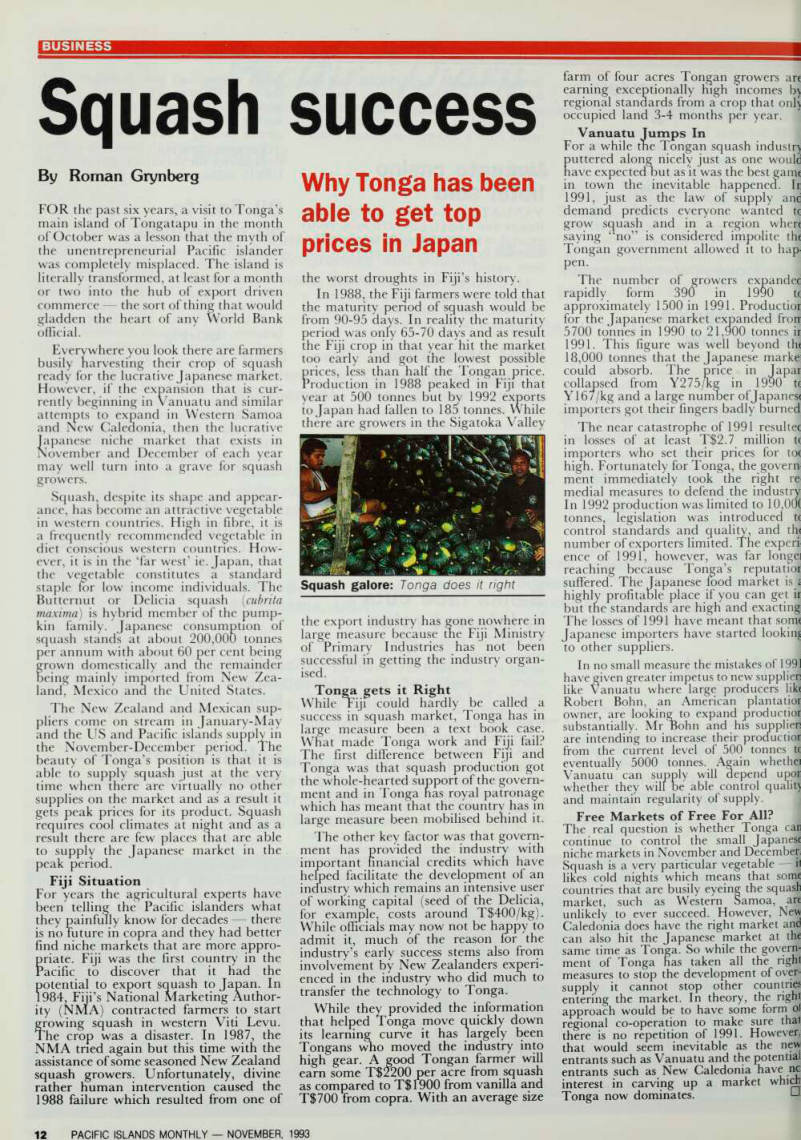
Squash galore: Tonga does it right
By Roman Grynberg
fHE Year 2000 is just around the corner md just like centuries and millenia in the >ast this one is giving rise to its fair share
>f predictions of massive change. Econ
unists, among others are also staring into heir computers and crystal balls and iredicting wild and wondrous events for he new millennium.
There is, however, much about the Year 000 that, in the case of Fiji will be
lomentous and epoch making and it
equires no crystal ball nor even a omputer to predict. By that time Placer 'acinc, the developer of the Porgera and lissima mines in Papaua New Guinea will
egin production at the huge Namosi
apper mine, 35km from Suva. The mine m many ways similar to the huge ougainville mine that was closed by the isurrection in the North Solomons Prov ice of PNG.The total estimated geological
•source (this includes proven, probable
itergories) is currently 930 million tonnes t a calculated average grade of 0.43 per mt copper and 0.14 grams per tonne gold >ing a cut off grade of 0.3 per cent copper r tne calculation. This was calculated ter completion of additional drill sam ing by Placer at Namosi during 1992. At ich low grades the mine would be msidered marginal. However, recent est
ates provided by the Fiji government
iggest that the head grade of the copper e is in the vicinity of 0.75 per cent copper, t such a grade it would make the mine the rgest in the Asia-Pacific region and nong the 10 largest in the world, owever, Placer’s Allen Jay says there is )thing in the work carried out by Placer by previous explorers to suggest that the ade is or could be in the vicinity of 0.75 t cent copper. He said if the estimated source is about 1000 million tonnes at 0.4 r cent copper then this would indicate at there would be approximately 100 illion tonnes of that resource that may be 7 per cent copper. Jay said in economic rms this is significantly different to the ggestion that the total resource may have of 0.75 per cent copper. He said if is surmise were true neither Placer nor e Fiji governemnt would have any Ficult financial choices.
At first Placer came to government with proposal to develop the mine at a scale output that was marginal at best. The tial proposal suggested a develpment of ,000 tonnes per day throughput with a c regime that resembled that of the Fiji c-free factories. At a daily throughput of ,000 tonnes the project was sub-economic d there was no tax regime that could ike it work. However, what is perfectly vious in the revised six-volume proposal it was given to the Fiji government in ptember is that the throughput of the ne is expected to increase to at least 3,000 tonnes per day which many servers feel to be a more realistic oughput for the mine. What this will an is that Placer will have to invest 1.4 billion to get the project going.
While the company has estimated that ployment at the mine would be in the mity of 1000 this appears unrealistic en the experience of smaller copper nes such as Ok Tedi in PNG wnich ploys as many as 2000 workers with a oughput in the vicinity of 60,000 tonnes
• day. Employment will almost certainly
between 2000-4000 permanent workers.
Blessing
Namosi
Blessing or blight?
Commenting on this Jay said neither employment nor capital costs are linear as production is scaled up. What is certain is that the mine will be the largest single investment in the history of Fin and will totally transform the history of tne country.
What concerns many observers is whether it will be a change for the better?
The response of the Fiji government to Placer’s initial proposal was ambiguous.
Most politicians are fully behind the proposal seeing it as a saviour from the vicious tutelage of the sugar industry and the low wages of the garment industry. The response from the public service was far more muted especially given the painful experience of PNG with mega-mining projects. There appears to have developed two quite divergent views about the project. The first is that the taxation proposal of the developer will; mean that the government will get virtually nothing from the project and second that the secondary macroeconomic effects of the proposal will through what economists call the Dutch Disease destroy the very low wage sectors of the economy.
The Dutch Disease, or booming sector effect as it is sometimes called, occurs when a boom in one sector of the economy drives up wages causing the destruction of other sectors of the economy. It is named after what happened to tne Dutch economy following tne discovery of natural gas in the north ofHolland. The effect caused wages to rise as well as the real effective exchange rate to rise which in turn caused certain sectors of the economy to go into decline.
The phenomenon is well documented and its effects have been clearly seen in PNG where the minerals boom has caused wages to rise which has had severe negative effects upon the low wage plantation sector.
According to Jay neither Placer nor the Fiji governmet is likely to be prepared to rush into any financial decision until all parties are satisfied that the consequences of the decisions taken are well understood.
To many Fijian politicians the destruc tion or at least the severe weakening of the largely Indian-dominated sugar industry is seen by many ethnic Fijian politicians as a political, if not economic plusL of the Namosi development. It is difficult for outsiders to appreciate how much the harvest boycotts of the late 1980 s following the coups severely damaged long term relations between many ethnic Fijian politicians and the industry. Moreover, the sugar industry is widely seen to be doomed in any case with the eventual elimination of trade preference into the European Community under the Lome Convention’s sugar protocol. The Lome Convention, but
possibly not the sugar protocol, is up for renegotiation in the year 2000. The gar ment industry is also similarly threatened
by the developments from the mining
project which could well cause wages to rise m an industry that already has difficulty competing with other low wage Asian
producers.
Moreover, just like the sugar industry the garment industry is dependent upon trade preference under (SPARTECA) South
Pacific Regional Economic Cooperation
Agreement to the Australian and New Zealand market or to the US under the multi-fiber agreement. Both Australia and New Zealand have announced plans to lower the rate of external tariff and under Australia’s Button Plan for the garment industry the rate of protection for the industry will diminish from 45 per cent to around 20 per cent by the Year 2000. This means that Fiji will have to compete increasingly witn very low wage countries just at the very time when the effects of Namosi mine will be pushing up wages
domestically.
Furthermore if the GATT (General Agreement on Trade and Tariff) nego tiations ever close then the trade preference created in the US market by the multi-fiber agreement for small countries like Fiji will
also disappear. The Fiji garment industry
which was the leading light following the coups is now increasingly being viewed as a niche industry with little longer term potential. Total garment exports declined from FSI3O million in 1991 to FSIOS million in 1992. While this can in part be explained by the recession in the Australian and New Zealand market there can be no doubt that the decline is also a result of increased competition, especially on the New Zealand market.
There is much that is both positive and frightening about the developments in the mining industry in Fiji for it could, if not handled with a great deal of wisdom and strength result m a disaster for the Fiji economy. Most regrettably fast money and wisdom make the most uncommon bed fellows. Economists know how to mitigate some of the negative effects of a minerals boom. The policy is called sterilisation and like the name suggests it is painful. The Kiribati government, for example, put all the earnings from the Banaba phosphate mine into an off-shore trust and spends annually only the income from the trust and in many years a good deal less. This is a classical case of sterilisation that has been
widely praised by the international devel
opment banks for its widsom and fiscal sense. As a result the adverse effects of mining are mitigated. But of course what this means is that the government of Kiribati has not spent the minerals earn
ings.
In 1987 and 1988, following the coups
Fiji government officials were openly using
the development model of Singapore as the role model they wished to emulate. The economic reforms that were instituted by the interim administration pointed Fiji in precisely that direction but now for just a moment it is beginning to look as though the PNG route is the development path (if what PNG is doing can be called a development route) Fiji will take into the next century. To borrow a metaphor, the three-legged stool upon which the Fiji economy now rests tourism garments and sugar may soon be shifted to two legs, just mining and tourism, and it takes no genius to know that for a two-legged stool to stand up requires the skill of an acrobat and not that of a politician. □
Western Samoa

Lending crisis hits
By Alan Ah Mu
A LENDING crisis has gripped Western Samoa’s two commercial banks, forcing one to limit credit to $5OOO per customer and the other to stop lending altogether.
Dropping deposit levels struck the banks a little over a month ago. The Pacific Commercial Bank (PCB), a joint venture
between the Bank of Hawaii and Westpac with a small number of local shareholders, watched it’s “main insti tutional depositors” lend their money to fheir customers or allocate them to other investments.
The National Provident Fund (NPF),
to which all wage-earners contribute t( under a compulsory government saving: scheme, lent $5 million to Polynesiai Airlines recently and has approved i $4.75 million loan to a new company The Accident Compensation Boarc (ACB) has allocated a six-figure sun towards development of a piece of lane for space to be leased out to small scab
business people. Remittances dropped
per cent during the first seven months o the year to million, compared wit! $68.7 million in the same period in 1992 according to the Central Bank. These an some of the factors PCB’s genera manager, Simon Millett said has contrib uted to the crisis. Millett is optimistic caling it a “short term anomaly* becaus< for one thing, it isn’t “unreasonable” t( expect NPF to collect $700,000 to million a week, some of which could spil over to the banks.
The bigger bank, the Bank of Westen Samoa, earlier this year lent Polynesiai Airlines $2.5 million for expansion perhaps a significant sum in the circum stances that nave come to prevail. In am case, BWS has limited credit to $5OOO pe' customer. Millett also explained tna commercial banks possess only 50 pe: cent of the market. And some of thei: main customers, like the NPF, are als< their competitors, along with othe; institutions Accident Compensatior Board, Housing Corporation, Post Ofilc( Savings Bank, the Western Samoa De velopment Bank, the Western Samo< Life Assurance Corporation.
Those “non-bank financia intermediaries are a major source o credit for production and investment” the Central Bank’s general manager Papalii Tommy Scanlan, has said. Thii can create difficulties for the Centra
Bank in implementing monetary policy
since while it tightly controls tne com mercial banks, it has limited say legalh in the operations of the non-bam financial institutions.
Fearing that unrestrained borrowing might lead to funds buying imports anc the consequent drain on international reserves, or an outbreak of inflation, the Central Bank reigned in the banks lasi year only to see the non-banks move in to fill in the gap. Legislation to right what Papalii describea as a “less than equitable” situation from the banks’ viewpoint is presently in draft form and oeing discussed with the banks.
If the impression so far is that the banks are facing bankruptcy, that’s not true. They have money, only the Central Bank rules means they can’t lend a significant part of their funds. The Central Bank’s “Deposit-linked Credit Expansion Formula’ allows bank lend ing to expand only when deposits do or when more long term deposits have been secured. Thus, since two years ago, banks may only lend 10 per cent of Savings Deposits, 30 per cent of 1-2 months term deposits ... the lendable percentage increasing the longer the term 80 per cent of 12-month term deposits may be lent out. Using the deposit-linked mech anism and a control of interest rates, the Central Bank aims to encourage long term savings so that money goes invest ment rather than consumption.
Advertisements & other items, p. 14 (2 items)
■Business
Designed for
the Pontic's
unique conditions.
7^ V
ipirji
r • 'VI a J§ f Maddren have designed a range of homes, especially to suit Pacific conditions. Built in strength from additional ties and bracing, and a wide choice of designs that we are happy to modify to suit individual needs.
These homes may be purchased, kitset shell or complete with construction arranged as required.
Delivery is available throughout the Pacific.
Maddren Homes
P.O. Box 244. Kumeu, New Zealand. Ph (09) 412-9070.
Fax (09) 412-7251. Please mail me your free catalogue.
Name P m m Address
The Solomon saga
Cover Story
By Martin Tiffany
like any good soap opera the political saga continues in the Sol omon Islands. Since coming into wer on June 18 the National Coalition Partnership government of prime minis ter Francis Billy Hilly has had little to relax and ease into its job.
Indeed, the little-known Hilly has not been given the chance to kick off his shoes and sit back securely in his prime minister’s chair. In addition to trying to keep the coalition afloat he is being kept on the edge of his seat by his predecessor, Solomon Mamaloni.
Within days of scraping home 24 votes to 23 in a secret ballot among the
47-newly elected parliamentarians, Hilly
was being given problems by the wily former prime minister. Mamaloni re fused to move out of the official prime minister’s residence after his defeat, forcing Hilly to stay at the Honiara Hotel. Eventually Mamaloni was per suaded to vacate the house although he had proved his point that he didn’t agree with the validity of the 24-23 result. Mamaloni queried the consti utional validity of the election in :ommunications with governor general
Mr George Lepping and formally sub
rutted the dispute for Sir George’s
ietermination on July 12 in accordance
vith the provisions of paragraph 10,
chedule 2 of the constitution.
In his letter to Sir George, Mamaloni intended that the election and sub equent appointment of Hilly as prime ninister was unconstitutional because he successful candidate had failed to ecure an “absolute majority of votes” as equired by the constitution.
Section 33 (1) of the constitution >rovides that; “There shall be a prime ninister who shall be elected as such by he members of parliament from amongst heir number in accordance with the ►revisions of schedule 2 to this consti ution.”
Paragraph 7 (1) of schedule 2 states; If any candidate should at any ballot eceive an absolute majority of votes he ball thereby be elected prime minister.”
The term “absolute majority” is de ned in section 144 (1) “absolute lajority” means at least one half of all le members plus one.
On the advice of his legal advisers, lamaloni contended that in conformity r ith the constitutional definition, “at :ast one half of all the members plus ne” meant that the requisite ‘absolute
majority’ was 25 and not 24. (Half of 47 is 23.5 plus one equals 24.5). Therefore, 25 was the nearest whole num ber capable of giving effect to and preserving the requirement of be ing “at least” 24.5 in a one man, one vote elec toral system.
At this time it was rumoured that former legal counsel to the Mamaloni government, Julian Moti, would be retained by Mamaloni to handle the case. Moti
had previously won a landmark case for the government when he appeared for finance minister Christopher Abe in proceedings involving the suspension of the directors of the Central Bank of Solomon Islands. On July 16, however, the Hilly government swiftly moved to close the door on any possible involve ment by Moti in the constitutional case by declaring Moti a persona non grata.
On August 5, the governor general wrote to Mamaloni informing him of the outcome of his determination of the dispute. Sir George’s letter said “I am now happy to inform you of my view on this matter based upon the following reasons; (1) I am convinced that the absolute majority in this case is 24 votes. One vote represents one member of parliament. In other words, one vote represents one person being a member of parliament.
The official result of the election of the prime minister on June 18, 1993 was Honourable Francis Billy Hilly 24 votes and yourself 23 votes. There were 47 members of parliament in person present and voting on that date. (2) If there was a dispute about the correct absolute majority, it should have been raised during that election or before June 18, 1993. Therefore, I find it rather difficult after 25 days to review my own determination when in the first place, I had already been convinced personally that the absolute majority was 24. In my view, paragraph 10 of schedule 2 is not an appeal provision. The whole intention of paragraph 10 is ensuring finality in the election of the prime minister. My determination on June 18, 1993 was to me therefore final on my part.
“I must say that for the above reasons I will not interfere with my own
determination made on June 18, 1993.
That is the absolute majority is 24 and not 25,” the governor general added.
Mamaloni’s law yer, Reginal Teutao, commenced pro ceedings for judicial review of Sir George’s determi nation in the High Court in early Aug ust.
The substance of Mamaloni’s applica
tion for judicial review was that the governor general had made various errors of law and therefore acted in excess of his jurisdictional powers.
September 23 was set by the High Court as the date for hearing Mamaloni’s application. However, on September 10, the governor general’s lawyer, Andrew Radclyffe (a British lawyer who formerly worked in the public solicitor’s office) filed an application to strike out the case from the High Court’s hearing list.
Radclyffe alleged that the High Court had no jurisdiction to deal with Mamaloni’s application. He also alleged that the governor general was immune from suit.
Justice Albert Parmer, a local judge, heard Radclyffe’s application and ruled against the objections. In a lengthy judgement Justice Palmer upheld the submissions made by Teutao that the High Court had jurisdiction to hear and determine Mamaloni’s case.
On September 24, the High Court sat all day to hear Mamaloni’s application.
Justice Palmer delivered his judgement on October 8.
In his judgement Justice Palmer said the governor general had not committed any error of law whatsoever, and was perfectly entitled to say as he did in his determination on August 6.
In his judgement Justice Palmer ad dressed the issue of the constitutional definition of what the absolute majority was as applied to this case.
He said: “Applying the formula there fore, at least one half of 47 members, is 24. There is no such person as a 23-an a-half person. However, that does not mean such a fraction should be ignored. 23.5 is the lowest minimum that one can
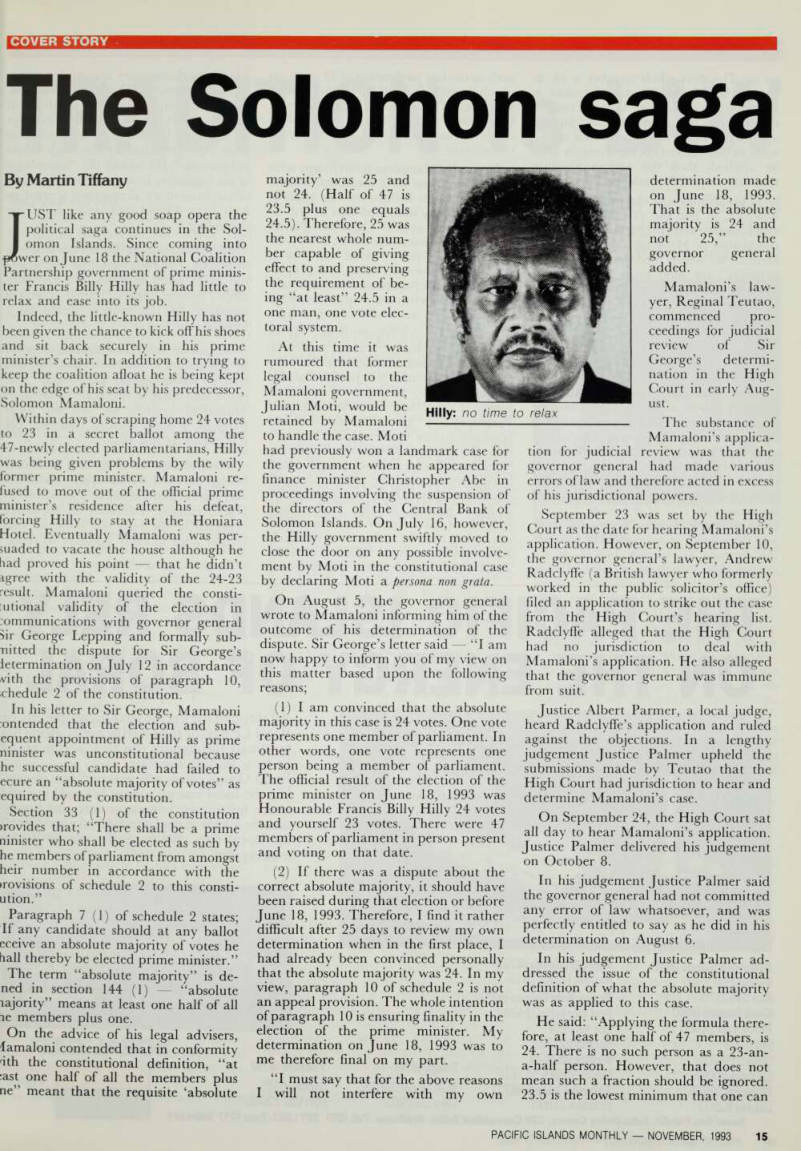
Hilly: no time to relax
go to. The next whole number is 24. It cannot be 23. Mr Teutao therefore is correct in his submission as to the correct definition of the words ‘at least’ and its application in the case where there are 47 seats in parliament. If the formula is to be applied, then the correct absolute majority required would be 25.
“The definition of the words ‘at least’ however, is not the crucial issue. The crucial issue, and this is contained in the submission of Mr Radclyffe, is that the context in which the words ‘absolute majority’ are used must first be con sidered, before coming to the conclusion that the definition in section 144(1) applies. The first part of the section 144(1) reads “In this constitution, unless the context otherwise re quires ”, Mr Radclyffe submits that in a 47 seat parliament, where the number is an odd number, an absolute majority can be obtained on a difference of one vote. This is what happened in this case. Honourable Francis Billy Hilly received 24 votes; one vote more than the total votes of his only rival, the applicant in this case. On that basis, the require ment of absolute majority as demanded in paragraph 7(1) of Schedule 2 to the constitution had been complied with, and therefore it is not necessary to apply the formula in section 144(1) of the constitution. In an even number of seats,
such as the last parliament of 38 seats, an absolute majority will be obtained on a difference of two votes. Since the increase was made to 47 seats, an absolute majority can be obtained on a difference of one vote.”
Naturally Mamaloni is not happy with the decision and feels the constitutional
definition is not being correctly applied.
He has already indicated that he will be
lodging an appeal against Justice
Palmer’s decision to the Court of Appeal.
When this story went to press Mamaloni’s lawyer, Teutao, was prepar ing the appeal papers and was unavail able for comment on the grounds of the
appeal.
Responding to a request from PIM for a response to Justice Palmer’s decision Mamaloni issued a statement. In it he said; "The grounds for Justice Palmer’ judgement may be assumed and it is highly likely that its effects to our Parliamentary system could be far reaching to say the least. Be that as it may the decision would also be seen as “clearing some elements of doubt” which have hovered over the prime minister’s election on June 18. It would seem that a good portion of the High Court judgement delved more into the politics of electing the PM rather than the likely adverse and practical effects which the 23/24 result could cause the Solomon
Islands parliamentary system, let alone, legislative process. The question of ‘ab solute majority’ within the contexts of parliamentary practice and procedures in Solomon Islands may seem to have
been over-simplified by the High Court
judgement.” He added the “sacredness of the legislative process... the foundation of parliamentary democracy seemed to
have been diluted fairly extensively” by
the ruling.
Mamaloni said no elected government in Solomon Islands would be safe under the 24/23 result in terms of a four-year office tenure, hence, much political instability in the country would be a
forgone conclusion.
On the invitation of PIM to respond to Mamaloni’s statement and the fact that he would appeal, Hilly said; “The court has made a decision, so be it. If Mamaloni appeals we will see what happens. I don’t wish to issue any big statements at this time.”
Meanwhile, over 10 election results are
being contested by unhappy candidates
and several petitions include ministers in Hilly’s cabinet. Decisions on these are expected in the next few months. This further adds to Hilly inability to relax.
So the saga continues. □
Advertisements & other items, p. 16 (1 item)
The Pacific Islands Rely
ON THE ENERGY OF BORAL
m awaRGJUf % <5% American Samoa (684) Tafuna 699 2948 Aua 6442170 Cook Islands (682) Rarotonga 24460 (679) Suva 315522 Lautoka 60088 Sigatoka 50578 Labasa 82973 Norfolk Islands (6723) Norfolk Island 2419 Papua New Guinea (675) Port Moresby 214248 Lae 422574 Rabaul 921225 WewakB62l2s Mount Hagen 551216 Solomon Islands (677) Honiara 21833 All through the Pacific Islands, people rely on Boral LP gas for their energy needs. Boral has terminals throughout the area, and is proud to be a leading supplier.
Boral Gas is clean, efficient and low in cost.
It’s the ideal energy source for cooking and water heating in homes, motels and hotels, and for a wide range of industrial uses. So call for Boral Gas. We have the energy you’re looking for.
BORAL GAS
Tonga(676) Nukualofa 24035 Vava’u 22903 Vanuatu (678) Santo 36455 Port Vila 22046 Boral Gas Pacific, John Oxley Centre, 339 Coronation Drive, Brisbane. Tel: (07) 3671365. Fax; (07) 3694347
Tradition Vs Law
Tradition
By Alan Ah Mu
LATE in September in scenic and isolated Lona village, Nuutai Mafulu, 40, to escape stones thrown by fellow villagers, ran towards his house a shotgun was fired at him. From inside his house, he cried out, “I want to live.”
“Come out,” replied his pursuers.
Nuutai did, and knelt in front of the village’s aumaga or untitled males, plead ing that he be taken away but for his wife and children to be spared. Soon after, he was fatally shot in the forehead with a .22 calibre gun and his body dumped near the house where the village council, made up of chiefs or matai, was meeting.
Nuutai’s wife, watched the gun being aimed at her husband and knew that their five children saw him being shot.
This much, the police have established, happened in Lona on Saturday, Septem ber 25. They’ve unraveled enough of what had happened for a murder charge to be pressed against Sesela Mateo Afoa, 31, in an investigation involving “the whole village,” the commissioner of police, Faluvao Tanielu said.
The murder was horrific enough to attract media attention from New Zea land. A TV crew turned up, something ordinarily occasioned by a Mam Samoa game or a cyclone, while the member of parliament of Lona, was tracked down in New Zealand, where he was for a funeral, and interviewed on TV.
For Samoans, fascination with details of the killing the actual event and other aspects like the fact that the defendant is a first cousin of the deceased - has been accompanied by sober discussions especi ally as Lena’s council was initially implicated. Statements given to police established that Nuutai had refused to contribute to village affairs, resisted council decisions, played cricket for another village where he had family and transported his team mates, while at the same time a family matai had been exiled by Lona.
Whatever the exact cause(s) of the villagers anger, they burned the de ceased’s shop, bus and Suzuki jeep on the orders of matai , though statements con flict of who ordered the shooting and why it’s occurred.
Sesela Afoa’s guilt or otherwise is ex pected to take months to be established.
But so far, 36 villagers have pleaded guilty to arson, wilful damage and throwing stones. Six other refute the :harges.
Fhe Samoa Times newspaper said “Such
barbaric and animalistic behaviour” is only seen in movies or “where the value of a human life is equal to a dog. “We ask the question, what it that prompts a civilised man or group of men to behave like a pack of dogs in ... mass hysteria?”
The head of the Catholic Church, Cardinal Pio Taofmuu released a state ment saying God alone has the “supreme authority over life. “Man has no author ity to take his own life or that of his fellowmen.” He asked if Samoa ever hears the cry of those “we kill”, the cry of “please let me live!” by innocent victims of abortion and “those who are gunned down like animals in the village malaes while their loved ones look on
helplessly.”
Reflections centre on the proud indepen dence declaration that Western Samoa is founded on God and the Samoan way or the faaSamoa, for the incident again raised the issue of individual rights versus traditional authority of matai on which so much of the faaSamoa is based.
“You and I know there’s a contradiction in authority,” Galuvao said to reporters.
“If you’re a Samoan you obey Samoa laws,” as laid down by matai, but these sometimes clash with post-independence, constitutional or “ palagi ’ (European) laws.
Matai councils, responsible for keeping villages cohesive, orderly entities, have traditionally fined offenders food, fine mats, money - governments within themselves as well as judges and jury rolled into one. The constitution, the supreme law, sets out individual rights to worship or not; the right to property etc - citizens may now resort to if
aggrieved by village rulings, but risk
being ostracised as a consequence. But several cases in recent memory demon strate that matai are still capable of regarding their traditional powers, rather than the constitution, as the ultimate authority in their own villages.
Two years ago, for example, an offender was tied up like a pig to be slaughtered as traditionally done, left outside in the sun while the council decided his fate, which was cremation. The victim was saved, bar minor burns, by the village pastor who threw himself on the offender and pleaded successfully for his life.
The co-existence of village and consti-
A man is killed as tradidonal Western Samoan law clashes with constitutional law
tutional laws led to double punishment, with an offender getting heavily fined by matai then receives a jail term by the court for the same offence.
To give matai authority some legal basis, the present government changed the law to allow judges to take village' fines which can amount to 10 pigs - into account when passing sentence on an offender. This recognition raised con cerns amongst lawyers that village rul ings may not ensure a fair hearing for offenders. One lawyer, a matai , said he wasn’t present when a member of his family had been fined by other matai of his village.
But, courts now also consider whether or not an offender had performed a tra ditional apology or ifoga.
Police face an unenviable task investigat ing disturbances involving a whole village, being Samoans charged with enforcing palagi laws and often outnum bered.
“My children (policemen) left for Lona yesterday and I prayed that the life lost was enough,” Galuvao said.
In such cases, the police adopt a softly, softly, softly approach, and withdrew when Lona villagers said they’d turn up at police headquarters the next day, a Monday. They did.
Ironically, Galuvao credits matai with performing the vital task of keeping order in the country, a task politicians realise, saves the country the expense of increas ing the relatively small police force. □
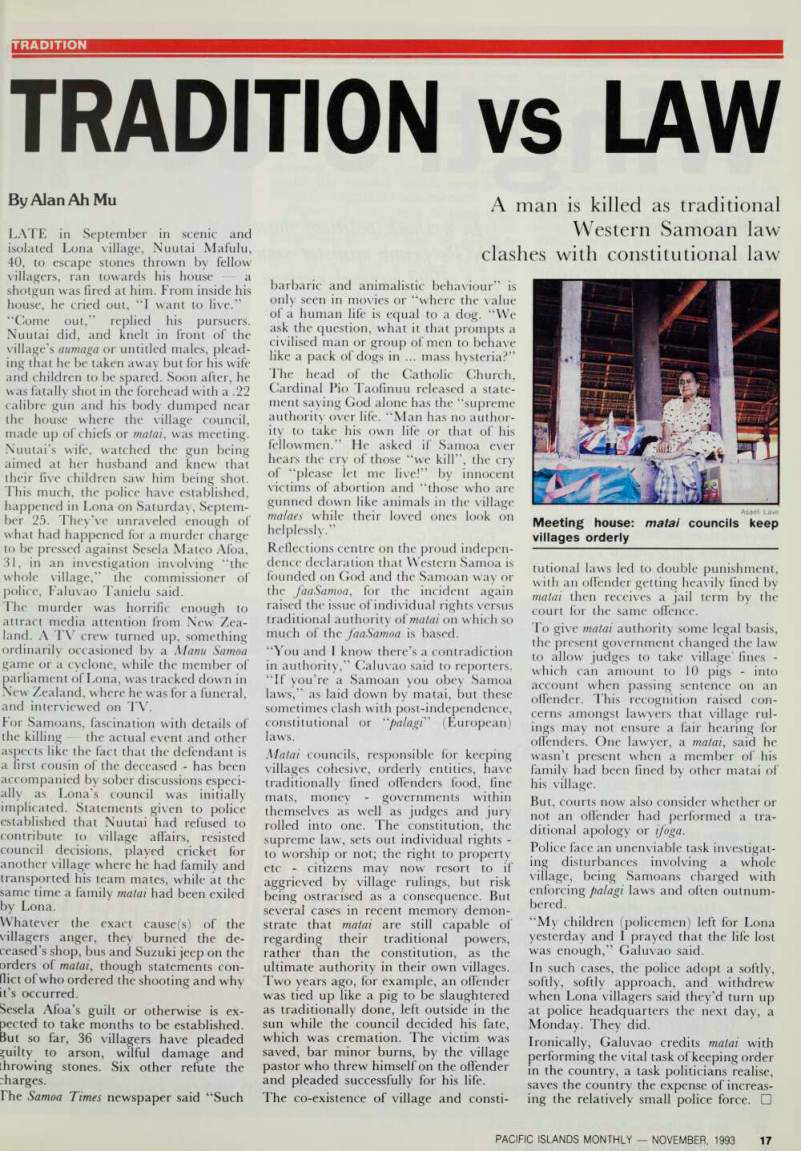
Asaeli Lave Meeting house: matai councils keep villages orderly
Wingti’s coup
Cover Stories
By Wally Hiambohn
In a shock political move that stunned the opposition PNG’s prime minister secures power for himself to the 1997 general election. But a court case continues.
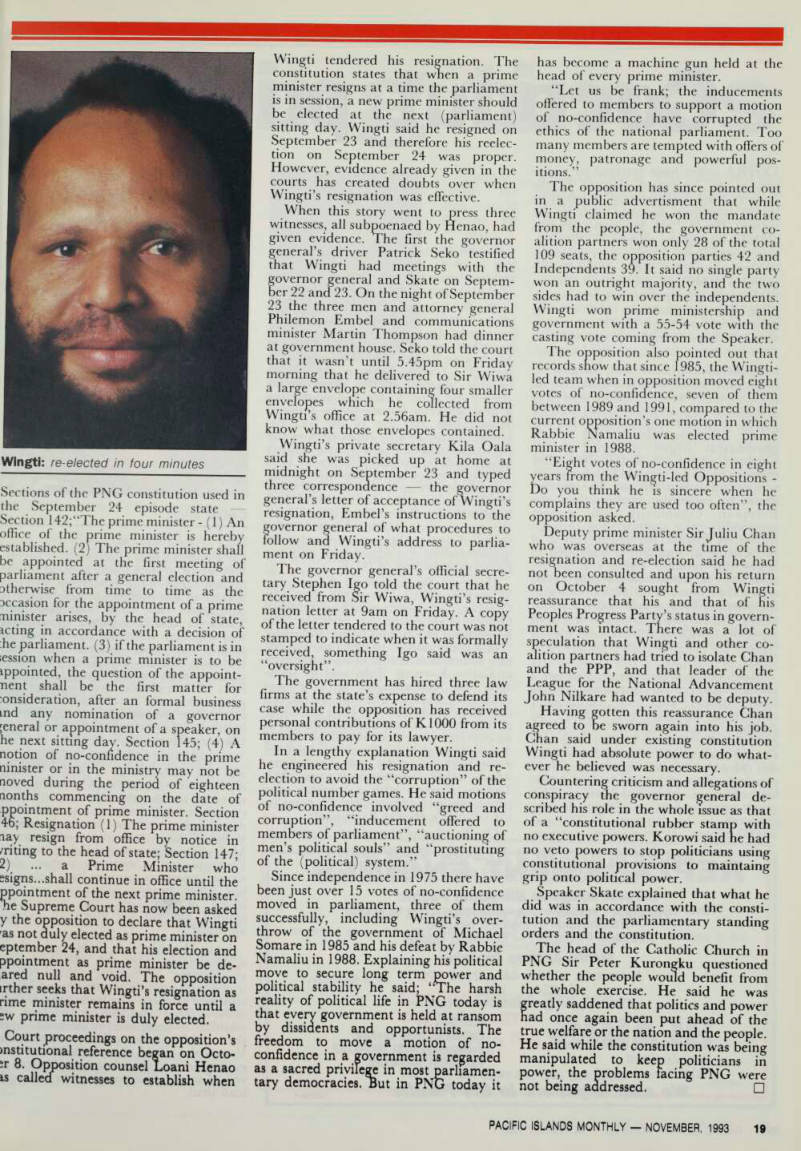
ON the night of September 23, Papua New Guinea went to sleep not knowing their prime minister, Paias Wingti had resigned from office. He did so in a letter to the governor general Sir Wiwa Korowi.
The next day there was sheer shock and surprise all around when speaker Bill Skate announced the resignation on the floor of parliament. He then immediately called for fresh nominations for prime ministership and Wingti was renomi nated and reelected as a stunned and horrified opposition walked out in pro test.
Only three opposition members voted against Wingti as the government, many of whose members were also caught by surprise, reelected Wingti with 59 votes.
While the whole episode took exactly four minutes it will nonetheless, enter
history as being the swiftest and most cunning political coup in the country’s 18 years of independence. In doing so Wingti secured power for himself to the 1997 general election.
In a reaction to the episode about 4000 students and other protesters marched to parliament to present three petitions to Skate calling for his he resignation and for the resignation of Wingti and the
governor general.
Student leaders described the moved as the first political coup in the Pacific since the Fiji military coups in 1987.
Under the Constitution, a vote of no confidence cannot be moved in a prime minister or his government 18 months
after its election. This grace period expires in March next year.
What Wingti has done is get himself re-elected and extend that grace period for another 18 months to March, 1995.
The Constitution also states that there shall be no vote of no-confidence 12 months before the next general election, due in 1997.
This leaves about eight months during which the opposition can move a motion of no confidence however the govern ment has the prerogative not to call for a parliamentary sitting during that period. A motion of no-confidence can only be moved and voted on during a
parliament sitting.
Sections of the PNG constitution used in the September 24 episode state Section 142;“The prime minister - (1) An office of the prime minister is hereby established. (2) The prime minister shall be appointed at the first meeting of parliament after a general election and otherwise from time to time as the Dccasion for the appointment of a prime minister arises, by the head of state, icting in accordance with a decision of :he parliament. (3) if the parliament is in ;ession when a prime minister is to be ippointed, the question of the appoint nent shall be the first matter for consideration, after an formal business ind any nomination of a governor general or appointment of a speaker, on he next sitting day. Section 145; (4) A notion of no-confidence in the prime ninister or in the ministry may not be noved during the period of eighteen nonths commencing on the date of ppointment of prime minister. Section 46; Resignation (1) The prime minister lay resign from office by notice in writing to the head of state; Section 147; 2), ••• a Prime Minister who ssigns...shall continue in office until the ppointment of the next prime minister, he Supreme Court has now been asked y the opposition to declare that Wingti as not duly elected as prime minister on eptember 24, and that his election and ppointment as prime minister be de ared null and void. The opposition
irther seeks that Wingti’s resignation as
rime minister remains in force until a sw prime minister is duly elected.
Court proceedings on the opposition’s institutional reference began on Octo :r 8. Opposition counsel Loani Henao is callecf witnesses to establish when
Wingti tendered his resignation. The constitution states that when a prime minister resigns at a time the parliament is in session, a new prime minister should be elected at the next (parliament) sitting day. Wingti said he resigned on September 23 and therefore his reelec tion on September 24 was proper.
However, evidence already given in the courts has created doubts over when Wingti’s resignation was effective.
When this story went to press three witnesses, all subpoenaed by Henao, had given evidence. The first the governor general’s driver Patrick Seko testified that Wingti had meetings with the governor general and Skate on Septem ber 22 and 23. On the night of September 23 the three men and attorney general Philemon Embel and communications minister Martin Thompson had dinner at government house. Seko told the court that it wasn’t until 5.45 pm on Friday morning that he delivered to Sir Wiwa a large envelope containing four smaller envelopes which he collected from Wingti’s office at 2.56 am. He did not know what those envelopes contained.
Wingti’s private secretary Kila Oala said she was picked up at home at midnight on September 23 and typed three correspondence the governor general’s letter of acceptance of Wingti’s resignation, Embel’s instructions to the governor general of what procedures to follow and Wingti’s address to parlia ment on Friday.
The governor general’s official secre tary Stephen Igo told the court that he received from Sir Wiwa, Wingti’s resig nation letter at 9am on Friday. A copy of the letter tendered to the court was not stamped to indicate when it was formally received, something Igo said was an
“oversight”.
The government has hired three law firms at the state’s expense to defend its case while the opposition has received personal contributions of KlOOO from its members to pay for its lawyer.
In a lengthy explanation Wingti said he engineered his resignation and re election to avoid the “corruption” of the political number games. He said motions of no-confidence involved “greed and corruption”, “inducement offered to members of parliament”, “auctioning of men’s political souls” and “prostituting of the (political) system,”
Since independence in 1975 there have been just over 15 votes of no-confidence moved in parliament, three of them
successfully, including Wingti’s over
throw of the government of Michael Somare in 1985 and his defeat by Rabbie Namaliu in 1988. Explaining his political move to secure long term power and political stability he said; ‘The harsh reality of political life in PNG today is that every government is held at ransom by dissidents and opportunists. The freedom to move a motion of no confidence in a government is regarded as a sacred privilege in most parliamen tary democracies. But in PNG today it
has become a machine gun held at the head of every prime minister.
“Let us be frank; the inducements offered to members to support a motion of no-confidence have corrupted the ethics of the national parliament. Too many members are tempted with offers of money, patronage and powerful pos itions.”
The opposition has since pointed out in a public advertisment that while Wingti claimed he won the mandate from the people, the government co alition partners won only 28 of the total 109 seats, the opposition parties 42 and Independents 39. It said no single party won an outright majority, and the two sides had to win over the independents.
Wingti won prime ministership and
government with a 55-54 vote with the casting vote coming from the Speaker.
The opposition also pointed out that records snow that since 1985, the Wingti led team when in opposition moved eight votes of no-confidence, seven of them between 1989 and 1991 , compared to the current opposition’s one motion in which Rabbie Namaliu was elected prime minister in 1988.
“Eight votes of no-confidence in eight years from the Wingti-led Oppositions - Do you think he is sincere when he complains they are used too often”, the opposition asked.
Deputy prime minister Sir Juliu Chan who was overseas at the time of the resignation and re-election said he had not been consulted and upon his return on October 4 sought from Wingti reassurance that his and that of his
Peoples Progress Party’s status in govern
ment was intact. There was a lot of speculation that Wingti and other co alition partners had tried to isolate Chan and the PPP, and that leader of the League for the National Advancement John Nilkare had wanted to be deputy.
Having gotten this reassurance Chan agreed to be sworn again into his job.
Chan said under existing constitution Wingti had absolute power to do what ever he believed was necessary.
Countering criticism and allegations of conspiracy the governor general de scribed his role in the whole issue as that of a “constitutional rubber stamp with no executive powers. Korowi said he had no veto powers to stop politicians using constitutional provisions to maintaing grip onto political power.
Speaker Skate explained that what he did was in accordance with the consti tution and the parliamentary standing orders and the constitution.
The head of the Catholic Church in PNG Sir Peter Kurongku questioned whether the people would benefit from the whole exercise. He said he was greatly saddened that politics and power had once again been put ahead of the true welfare or the nation and the people.
He said while the constitution was being
manipulated to keep politicians in
power, the problems Facing PNG were not being addressed. □
Wingti: re-elected in four minutes
Advertisements & other items, p. 18 (2 items)
18
PAmnn ISI AMDS MDMTHI Y NDVFMRFR 1993
Second Hand Containers
WHERE AND WHEN YOU WANT THEM IN THE PACIFIC If you need a flexible and safe storage space we have the ideal solution for you. Our second hand containers provide instant secure storage. Guaranteed to be wind and waterproof these containers are ideal for both temporary and longterm storage in Pacific conditions.
We can deliver to any island in the Pacific within a month and our rates have got to be the lowest you will find. All you need to do is tell us how many you want.
CONTACT:
PASCALE MARCONNET, BP 4757 NOUMEA, NEW CALEDONIA. TEL (687) 28 7450. FAX: (687) 26 3248
Coconut politics
COPRA prices have emerged in Vanu atu as an important element of the country’s political equation. Sensitivities partly arise from promises made by the ruling Union of Moderate Parties (UMP) during the country’s 1991 elec tion campaign. Prominent candidates pledged that copra prices would double under a UMP-led government. But in reality, the government has been strug
gling just to maintain the existing
guaranteed price of 25,000 vatu per tonne for hot-air-dried copra and 20,000 vatu per tonne for smoke-dried copra.
In the middle of October, the govern ment announced that it would give an additional 150 million vatu by the end of this year to the country’s Commodities Board to underwrite prices. This fol lowed demonstrations and anti government slogan painting on the northern island of Santo after some growers could not be paid because price support funds had run out. The govern ment is evidently hoping that the
European Community will step-up
commodity-price underwriting through
its Stabex scheme. An official review of the scheme in Vanuatu is scheduled to begin this month. There can be no certainty of additional funding. And regional planners know all too well that the wheels of European bureaucracy turn slowly. Significantly, the EC has moved generally to tighten control of the Stabex scheme m the Pacific region as well as in Africa and the Caribbean.
Much of the population in Vanuatu’s northern and central regions rely on cash from copra sales to supplement subsistence farming and fishing. So
pricing and marketing policies are politi
cally volatile. Sources m Port Vila said the government had banned Radio Vanu atu, the only national broadcaster, from running statements critical of its hand ling of copra price stabilisation. This year’s total production of copra is only expected to be between 25,000 and 30,000 tonnes. If production increases
substantially next year, and the EC does not come to the rescue, financial and political pressures arising from growing of the übiquitous coconut will intensify.
On the broader political front, when prime minister Maxime Carlot Korman returned from a recent overseas trip he described leading figures in his Union of Moderate Parties as “parasites and traitors”. Carlot Korman was angry because internal party rivals Willie Jimmy and Serge Vohor had stitched-up a deal whereby former prime minister Walter Lini and five of his National United Party (NUP) supporters would rejoin the coalition government. Lini’s had on August 23 moved to a
position in parliament following
a squabble over ministries. But four other NUP members, led by one-time Lini loyalist Sethy Regenvanu, stayed with the government. Carlot Korman pre vailed. A new coalition memorandum of understanding was signed with only the Regenvanu faction of NUP.
However, the agreement did not put an end to political fireworks. Early in October, telecommunications minister Onnyn Tahi, who is part of the Regenvanu group, said he was forced by “NUP commandos” to sign a parliamen tary notice of a motion of no-confidence in Carlot Korman. Tahi said he with drew his endorsement for the no confidence motion when he found out that Regenvanu had not been consulted on the move. It was unclear whether a no-confidence motion would go ahead during sittings of parliament scheduled to be held before the end of this year.
After luring across opposition MP Thomas Varatia with a ministry, the prime minister commanded 25 votes in the country’s 46-seat Parliament.
On the issue of corruption, Vanuatu’s
Copra plays a major part in Vanuatu politics.
Craig Skehan reports.
head of state, president Fred Timakata, has sounded a note of warning. “Corrup tion seems to be gaining ground in the highest ranks of our leadership, in gross breach of the leadership code which is enshrined in our constitution,”
Timakata said in a public speech. “It may be that the time has arrived to enforce that code against those who blatantly breach it.’ The president’s remarks take on added significance in the light of speculation over whether the government will act decisively on find ings of a corruption commission of inquiry being conducted by lawyer Clarence Marae.
Interestingly, the word “corruption” was not included in a Radio Vanuatu report on Timakata’s speech. Sources say that the station was also banned from carrying critical stories on a proposed big new logging venture. Finance minister Willie Jimmy had reportedly issued Malaysian logging group Delta/Premier/ Parklane with a business licence, and natural resources minister Paul Telukluk has lifted logging restrictions on the island of Afalakula. But apparently cabinet has not yet given an overall approval.
In its October issue, PIM reported on a perplexing plan by the Vanuatu government to borrow US$2 billion overseas to fund development and infra structure projects. The latest word is that a New York financier is involved in addition to companies in Australia and the Philippines. The opposition Vanua’aku rati has called on the government to lift what is regards as a veil of secrecy surrounding the unusual loan deal. D
Martin Tiffany Carlot: angry
Advertisements & other items, p. 20 (1 item)
Blairs
REPLACEMENT ENGINES
Largest Range In the South Pacific Over 800 engines available: Diesel-Gasoline lOhp to 400 hp Transmission to match if required Japanese English European Models Marine Engines Available Yanmar 3L 1908 cc 44hp/2100 RPM 4CH2SA 80hp Electrics Gauges Reduction Boxes
New Zealand Established 1956 We ship anywhere P.O. Box 14 Geraldine, New Zealand Telephone (643) 6934122 Fax (643) 693-8120 In the Pacific
Testing times
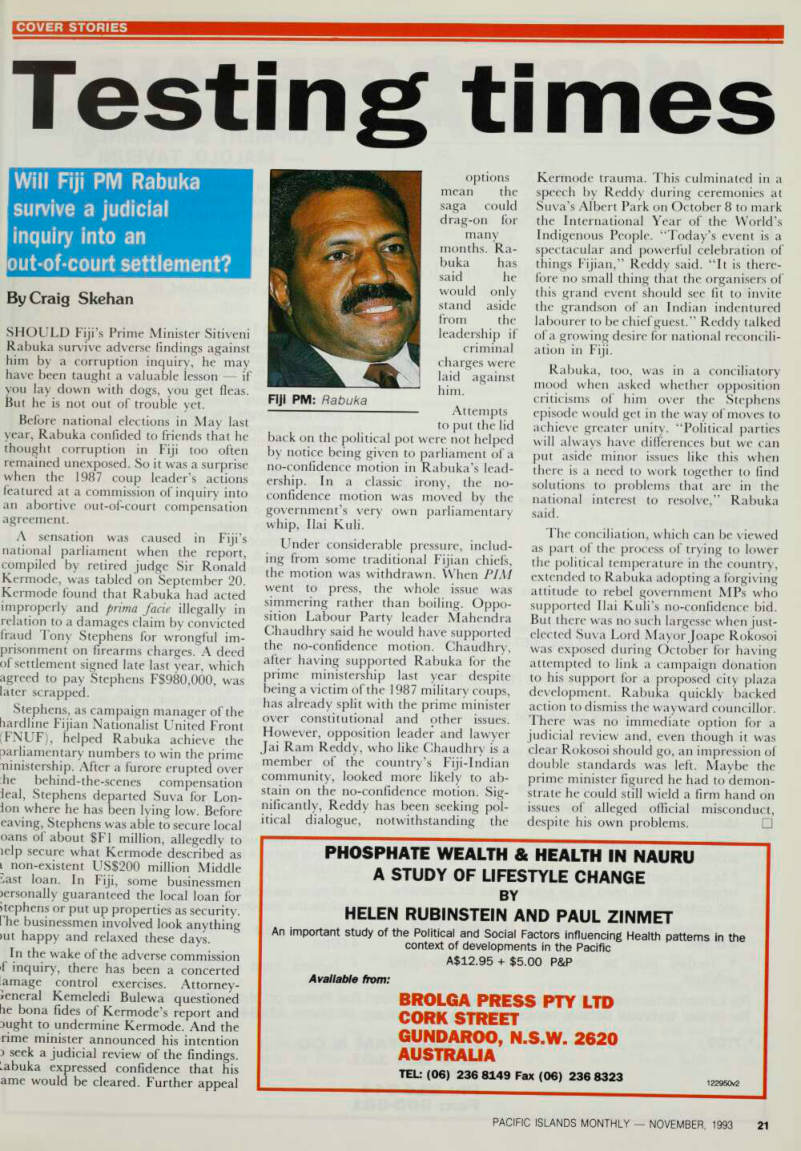
Will Fiji PM Rabuka survive a judicial inquiry into an out-of-court settlement?
By Craig Skehan
SHOULD Fiji’s Prime Minister Sitiveni Rabuka survive adverse findings against him by a corruption inquiry, he may have been taught a valuable lesson if you lay down with dogs, you get fleas.
But he is not out of trouble yet.
Before national elections in May last year, Rabuka confided to friends that he thought corruption in Fiji too often remained unexposed. So it was a surprise when the 1987 coup leader’s actions featured at a commission of inquiry into an abortive out-of-court compensation agreement.
A sensation was caused in Fiji’s national parliament when the report, compiled by retired judge Sir Ronald Kermode, was tabled on September 20.
Kermode found that Rabuka had acted improperly and prima facie illegally in relation to a damages claim by convicted fraud Tony Stephens for wrongful im prisonment on firearms charges. A deed of settlement signed late last year, which agreed to pay Stephens F 5980,000, was
later scrapped.
Stephens, as campaign manager of the hardline Fijian Nationalist United Front (FNUF), helped Rabuka achieve the parliamentary numbers to win the prime ninistership. After a furore erupted over he behind-the-scenes compensation
ieal, Stephens departed Suva for Lon
ion where he has been lying low. Before caving, Stephens was able to secure local cans of about SFI million, allegedly to lelp secure what Kermode described as i non-existent US$2OO million Middle i-ast loan. In Fiji, some businessmen personally guaranteed the local loan for Stephens or put up properties as security, fhe businessmen involved look anything >ut happy and relaxed these days.
In the wake of the adverse commission f inquiry, there has been a concerted
.amage control exercises. Attorney
xeneral Kemeledi Bulewa questioned he bona fides of Kermode’s report and Dught to undermine Kermode. And the rime minister announced his intention 3 seek a judicial review of the findings.
Labuka expressed confidence that his ame would be cleared. Further appeal
options mean the saga could drag-on for many months. Ra buka has said he
would only
stand aside from the
leadership if
criminal charges were laid against him.
Attempts
to P ut lid back on the political pot were not helped by notice being given to parliament of a no-confidence motion in Rabuka s leadership. In a classic irony, the noconfidence motion was moved by the government’s very own parliamentary j 3 ’ ' Under considerable pressure, including from some traditional Fijian chiefs, the motion was withdrawn. When PIM went to press, the whole issue was
simmering rather than boiling. Oppo-
sition Labour Party leader Mahendra Chaudhry said he would have supported the no-confidence motion. Chaudhry, after having supported Rabuka for the prime ministership last year despite being a victim of the 1987 military coups, has already split with the prime minister over constitutional and other issues.
However, opposition leader and lawyer Jai Ram Reddy, who like Chaudhry is a member of the country’s Fiji-Indian community, looked more likely to abstain on the no-confidence motion. Significantly, Reddy has been seeking political dialogue, notwithstanding the
Kermode trauma. This culminated in a speech by Reddy during ceremonies at Suva’s Albert Park on October 8 to mark the International Year of the World’s Indigenous People. “Today’s event is a spectacular and powerful celebration of things Fijian,” Reddy said. “It is there fore no small thing that the organisers of this grand event should see fit to invite the grandson of an Indian indentured labourer to be chief guest.” Reddy talked of a growing desire for national reconcili ation in Fiji.
Rabuka, too, was in a conciliatory mood when asked whether opposition criticisms of him over the Stephens episode would get in the way of moves to achieve greater unity. “Political parties will always have differences but we can put aside minor issues like this when there is a need to work together to find solutions to problems that are in the national interest to resolve,” Rabuka said.
The conciliation, which can be viewed as part of the process of trying to lower the political temperature in the country, extended to Rabuka adopting a forgiving attitude to rebel government MPs who supported Ilai Kuli’s no-confidence bid.
But there was no such largesse when just elected Suva Lord Mayor Joape Rokosoi was exposed during October for having attempted to link a campaign donation to his support for a proposed city plaza development. Rabuka quickly backed action to dismiss the wayward councillor.
There was no immediate option for a judicial review and, even though it was clear Rokosoi should go, an impression of double standards was left. Maybe the prime minister figured he had to demon strate he could still wield a firm hand on issues of alleged official misconduct, despite his own problems. □
Fiji PM: Rabuka
Advertisements & other items, pp. 21-22 (2 items)
[Cover Stories
Phosphate Wealth & Health In Nauru
A STUDY OF LIFESTYLE CHANGE
BY
HELEN RUBINSTEIN AND PAUL ZINMET
An important study of the Political and Social Factors influencing Health patterns in the context of developments in the Pacific
A 512.95 + $5.00 P&P
Available from:
BROLGA PRESS PTY LTD
CORK STREET
GUNDAROO, N.S.W. 2620
AUSTRALIA
TEL: (06) 236 8149 Fax (06) 236 8323
MORTGAGEE SALE
FREEHOLD REAL ESTATE MALOLO, TAVEUNI
77 V£
O/AG HOT TO ScACf
S c r 9 7as 77A 77HT #£Sffi V£
HAT/V£ LAUD
Scale chains per inch. All measurements are in links. <M7 * rgee < WRITTEN OFFERS are invited for the purchase of a freehold estate, relevant particulars of which are as follows:
A. OWNER
* Malolo Estate Ltd
B. LOCATION
* Taveuni Island, Fiji * Land is more commonly known as ‘Malolo Estate’
C. LEGAL DESCRIPTION
* Certificate of Title No. 20170, being Lots 2 and 4 on Deposited Plan Nos. 3193 and 3067 respectively.
D. AREA
* 298 acres 3 roods 11.0 perches (120.9275 Ha)
E. IMPROVEMENTS
* Usual farming dwelling houses and sheds.
F. CONDITIONS
* Sale herein is subject to a formal written contract being entered into and signed. * Any offers made shall be exclusive of VAT.
HEAVY GOODS VEHICLES, SAWMILL
EQUIPMENT & MACHINERY
MALOLO, TAVEUNI
WRITTEN OFFERS are invited for the purchase of the following items of heavy goods vehicles, sawmill equipment and accessories and farm machinery; particulars are as follows:
A. OWNER
* Malolo Estate Ltd
B. LOCATION
* Malolo Estate, Taveuni Island, Fiji
C. ITEMS
1. Nissan CWSO Truck Regn No. E3lBO 2. Ford Dump Truck Reg No. 3. John Deere 2850 4WD Tractor Regn No. E 3114. 4. International 630 Excavator. 5. Belarus 8X920 4WD Tractor. 6. Gatman portable sawmill. 7. John Deere single row planter. 8. Winstone sprayer boom & handgun. 9. Duncan rollertilla. 10. Aitcherson Rippers. 11. Hooper giant discs. 12. Vicon fertilizer spreader. 13. Hustler Forkllift. 14. Belarus C.A.F.E.L. 15. Howard rotary slasher. 16. Log staucheons. 17. Farm trailer & 3-pt levelling bars. 18. Radial arm saw, portable compressor/mixer. 19. Chainsaw. 20. Benchsaw. 21. Suzuki 370 SP motorbike.
D. GENERAL:
* These items are in a used condition as they have been used in the estate by the present owners. * Any purchaser may consider making an offer for the purchase of these chattels together with an offer for the purchase of the ‘Malolo Estate’ land (shown as a separate advertisement in this issue).
E. CONDITIONS
* Sale herein is subject to a formal written contract being entered into and signed. * Where purchaser is a non-resident, the consent of the Minister of Lands will be required under the Land Sales Act. * Any or the highest tender will not be necessarily accepted. * As the property is currently occupied by the owner, special arrangements will need to be entered into for inspection and possession. * Tenders close on Tuesday 16 November 1993 at 4.00 pm. * Any offers made shall be exclusive of VAT. * Any or the highest tender will not be necessarily accepted. Offers will be considered for any one or more of the above items. A lump sum offer for all items will also be considered. * All items are sold on an “as-is-where-is” basis. Removal shall be the responsibility of the successful purchaser. * Tenders close on Tuesday 16 November 1993 at 4.00 pm. * Tenders must be addressed to the undersigned * Tenders must be addressed to the undersigned solicitors. solicitors.
For further details relating to this property, please contact Raj Pratap on phone 312333 in the first instance.
For further technical details, contact Subhas Parshotam on phone 314844.
PARSHOTAM & CO
GPO Box 131
SUVA.
Ph: 314-844 Fax: 300-681 * 77V8
Eyes on America
Western Samoa
By Karen Mangnall
Samoan focus will turn to America this month as justice is sought over the shooting of two Samoan brothers by police
SAMOAN eyes will be turned on a courtroom in Los Angeles this month for a second attempt at justice over the police shooting of the Tualaulelei brothers. The two brothers, Pouvi, aged 34, and 22-year-old student Italia, were shot a total of 19 times by a police officer on February 12, 1991 in the driveway of their home in Compton, Los Angeles.
Now the Tualaulelei family is suing the City of Compton for US$lO million in the LA District Court starting on November 16. Last year, state criminal proceedings failed when the jury could not reach a verdict on two voluntary manslaughter charges against the police officer, A 1 Skiles. That trial was inter rupted by the riots surrounding a more notorious but non-fatal case of police brutality, the beating of black motorist Rodney King. His attackers were eventu ally imprisoned under federal laws and the Taulaulelei family is still pushing the FBI to bring similar charges against Skiles.
It began on the evening of Monday, February 12 1991 when Pouvi and his wife, Julie, had an argument and he left, taking their two sons. Julie called the police to help return the boys. An hour later, Julie was being questioned outside the house in a police car when Pouvi drove up with the two boys, Niles aged 7, and 5-year-old Noris. Family members still inside the house say Skiles went over to Pouvi, hurling obscenities. Pouvi was joined outside by Italia, and they both told Skiles he should leave the property.
Police claim the brothers then attacked Skiles, who shot them both. Even before the coroner had found all the bullets, Compton Police Commander Hourie
Taylor was publicly defending Skiles.
’There was some aggression. It was basically an attempt to remove his weapon from his holster.” Skiles, a 14-year-old veteran of 12 years on the Compton police, testified he fired repeat edly on the two unarmed men, stopping it one point to reload his 9mm semi mtomatic revolver. “I realised they were :oming at me and that the bullets veren’t working,” Skiles fired 19 bullets nto the two men. Pouvi was found to lave been shot 11 times, 8 times in the jack. Italia was shot 8 times, 5 times in he back.
The Tualaulelei family say the lo ation of the bullets proves their version
of events. Younger brother, leti, aged 16, told the court he was inside the house when he heard Skiles order the two brothers to kneel. Then came gunfire, leti says he was spotted at the window by Skiles who aimed his gun but had run out of bullets. Family members say Skiles then ran around the house trying to get in. Julie, still locked in the police car, testified Skiles ran back to his car tearing at his clothes, presumably to make it seem he’d been attacked. The shootings took place in full view of Pouvi’s two young sons. Deputy District Attorney Richard Healy told the court regardless of what sparked Skiles to fire, the second clip was fired illegally and unnecessarily, because both men were already seriously wounded.
After deliberating 7 days, the jury deadlocked at 9 votes to 3 in favour of acquitting Skiles. The judge declared a mistrial. The trial was suspended for several days during the rioting over the Rodney King trial and prosecutors said this had probably swung the mainly white jury in favour of the police. The real outry came on June 4, 1992 when Judge John Reid of the LA County Superior Court denied a routine motion to retry the criminal charges, and dismissed the manslaughter charges against Skiles. The move stymied any further state criminal charges and prompted outraged editorials in Califor nia and across the United States. The regional director of the Office of Samoan Affairs, June Pouesi, summed up the disbelief: “There is a sense of loss, a sense of confusion. Nineteen shots, 13 of them in the back. How can wrong be made right?”
The original shootings had caused sorrow and outrage within the 12,000-strong Samoan community in LA, centred on Compton. In March 1991, the Samoan Federation held a large but peaceful protest outside Compton City Hall. One of the placards held by Pouvi’s son, Noris, read: “My daddy knelt ... why 12 bullets?” The
killings had put the Compton police on full alert and they only gave the protesters a one-hour permit. The march was swelled by Italia’s classmates at El Camino College, where he’d been a defensive end in the Warriors college football team and president of the Pacific Islanders’ Club. June Pouesi made a pointed comparison between the riots which had won Rodney King a federal, retrial for a violation of his constitutional rights, and the peaceful protest which won the Tualaulelei family nothing.
“What is the difference between the two cases?” she asked the California media.
“One had a riot and one had a peace march. It seems that the message going out today is that non-violence is not the way to go.”
The Tualaulelei have not given up the fight for criminal and civil justice. Their civil case has been taken up by one of America’s most flamboyant and success ful trial lawyers, Melvin Belli. Julie, her four daughters and two sons, and the estate of Italia Tualaulelei are suing A 1 Skiles and Compton City for US$lO million in a “constitutional tort”. The civil case is under Amendment 14 of the US Constitution which says no person shall be deprived of their life, liberty or property without due process of law. Belli says the case will ask the jury to bring in a verdict of unjustifiable homicide against Skiles, and to find that the killings amounted to an unconstitutional deprivation of the right of members of the Tualaulelei to liberty, support and a relationship with their father and brothers. Meanwhile, the standard FBI investigation of the killings has resumed, with US Congressman for American
Samoa, Eni Faleomavaega, demanding
that the Attorney-General Janet Reno lay federal charges against Skiles. But the Justice Department says there’s no guarantee its findings will result in charges, or that they will ever be made public. Since the shootings, A 1 Skiles has left the police force with a stress
disability. □
Freeway
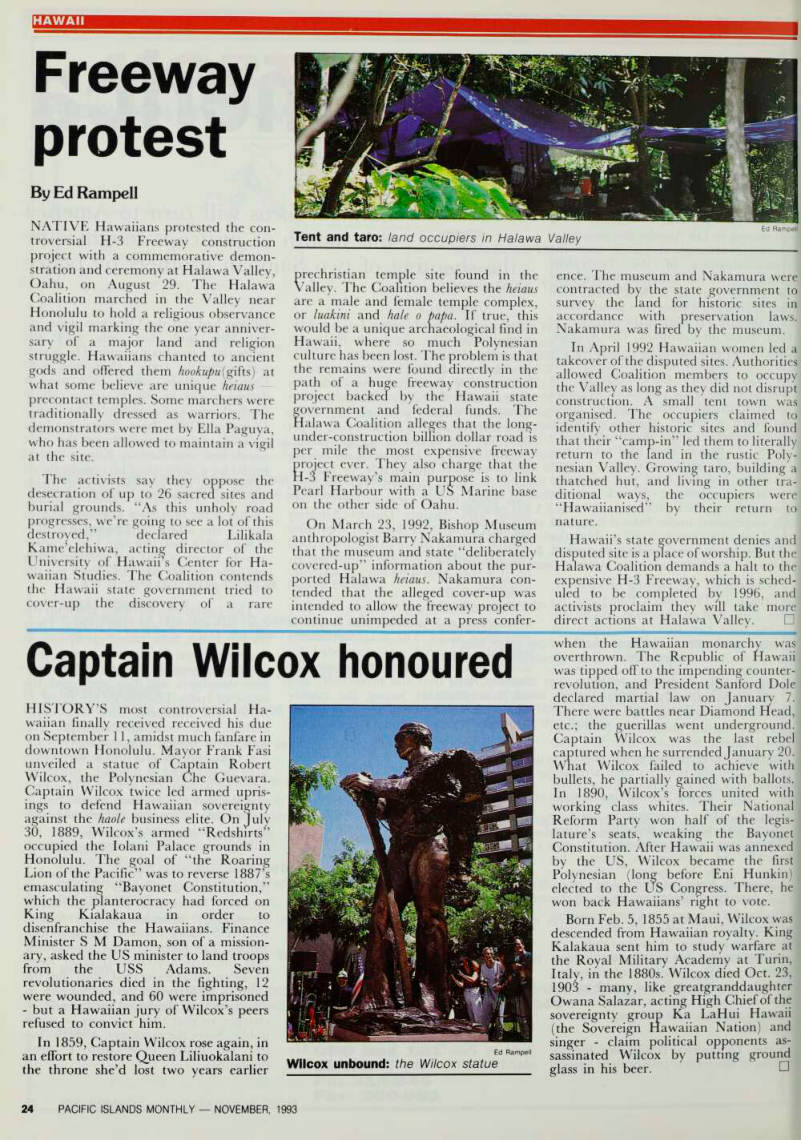
Hawaii
Freeway protest
By Ed Rampell
NATIVE Hawaiians protested the con troversial H-3 Freeway construction project with a commemorative demon stration and ceremony at Halawa Valley, Oahu, on August 29. The Halawa Coalition marched in the Valley near Honolulu to hold a religious observance and vigil marking the one year anniver sary of a major land and religion struggle. Hawaiians chanted to ancient gods and offered them hookupu{g ifts) at what some believe are unique heiaus precontact temples. Some marchers were traditionally dressed as warriors. The demonstrators were met by Ella Paguya, who has been allowed to maintain a vigil at the site.
The activists say they oppose the desecration of up to 26 sacred sites and burial grounds. “As this unholy road progresses, we’re going to see a lot of this destroyed,” declared Lilikala Kame’elehiwa, acting director of the University of Hawaii’s Center for Ha waiian Studies. The Coalition contends the Hawaii state government tried to cover-up the discovery of a rare
prechristian temple site found in the Valley. The Coalition believes the heiaus are a male and female temple complex, or luakini and hale o papa. If true, this would be a unique archaeological find in Hawaii, where so much Polynesian culture has been lost. The problem is that the remains were found directly in the path of a huge freeway construction project backed by the Hawaii state government and federal funds. The Halawa Coalition alleges that the long under-construction billion dollar road is per mile the most expensive freeway project ever. They also charge that the H-3 Freeway’s main purpose is to link Pearl Harbour with a U!S Marine base on the other side of Oahu.
On March 23, 1992, Bishop Museum anthropologist Barry Nakamura charged that the museum and state “deliberately covered-up” information about the pur ported Halawa heiaus. Nakamura con tended that the alleged cover-up was intended to allow the freeway project to continue unimpeded at a press confer
ence. The museum and Nakamura were contracted by the state government to survey the land for historic sites in accordance with preservation laws.
Nakamura was fired by the museum.
In April 1992 Hawaiian women led a takeover of the disputed sites. Authorities allowed Coalition members to occupy the Valley as long as they did not disrupt construction. A small tent town was organised. The occupiers claimed to identify other historic sites and found that their “camp-in” led them to literally return to the land in the rustic Poly
nesian Valley. Growing taro, building a
thatched hut, and living in other tra ditional ways, the occupiers were “Hawaiianised” by their return to nature.
Hawaii’s state government denies and disputed site is a place of worship. But the Halawa Coalition demands a halt to the expensive H-3 Freeway, which is sched uled to be completed by 1996, and activists proclaim they will take more direct actions at Halawa Valley. □
Tent and taro: land occupiers in Halawa Valley
Ed Rampell
Captain Wilcox honoured
HISTORY’S most controversial Ha waiian finally received received his due on September 11, amidst much fanfare in downtown Honolulu. Mayor Frank Fasi unveiled a statue of Captain Robert Wilcox, the Polynesian Che Guevara, Captain Wilcox twice led armed upris ings to defend Hawaiian sovereignty against the haole business elite. On July 30, 1889, Wilcox’s armed “Redshirts” occupied the lolani Palace grounds in Honolulu. The goal of “the Roaring Lion of the Pacific” was to reverse 1887’s emasculating “Bayonet Constitution,” which the planterocracy had forced on King Kialakaua in order to disenfranchise the Hawaiians. Finance Minister S M Damon, son of a mission ary, asked the US minister to land troops from the USS Adams. Seven revolutionaries died in the fighting, 12 were wounded, and 60 were imprisoned - but a Hawaiian jury of Wilcox’s peers refused to convict him.
In 1859, Captain Wilcox rose again, in an effort to restore Queen Liliuokalani to the throne she’d lost two years earlier
when the Hawaiian monarchy was overthrown. The Republic of Hawaii was tipped off to the impending counter revolution, and President Sanford Dole declared martial law on January 7.
There were battles near Diamond Head, etc.; the guerillas went underground.
Captain Wilcox was the last rebel captured when he surrended January 20.
What Wilcox failed to achieve with bullets, he partially gained with ballots.
In 1890, Wilcox’s forces united with working class whites. Their National Reform Party won half of the legis lature’s seats, weaking the Bayonet Constitution. After Hawaii was annexed by the US, Wilcox became the first Polynesian (long before Eni Hunkin) j elected to the US Congress. There, he won back Hawaiians’ right to vote.
Born Feb. 5, 1855 at Maui, Wilcox was descended from Hawaiian royalty. King Kalakaua sent him to study warfare at the Royal Military Academy at Turin, Italy, in the 1880 s. Wilcox died Oct. 23, 1903 - many, like greatgranddaughter Owana Salazar, acting High Chief of the sovereignty group Ka LaHui Hawaii (the Sovereign Hawaiian Nation) and singer - claim political opponents as sassinated Wilcox by putting ground glass in his beer. D
Ed Rampell Wilcox unbound: the Wilcox statue
Hot air
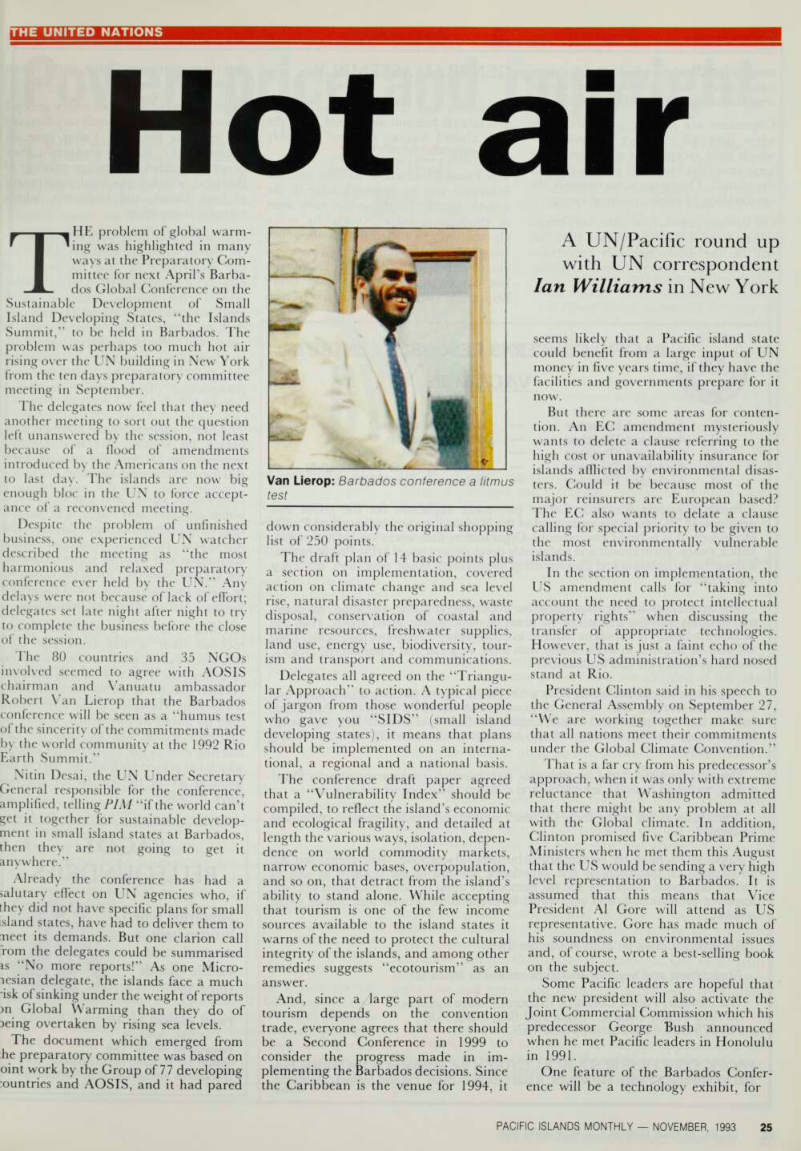
The United Nations
THE problem of global warm ing was highlighted in many ways at the Preparatory Com mittee for next April’s Barba dos Global Conference on the Sustainable Development of Small Island Developing States, “the Islands Summit,” to be held in Barbados. The problem was perhaps too much hot air rising over the UN building in New York from the ten days preparatory committee meeting in September.
The delegates now feel that they need another meeting to sort out the question left unanswered by the session, not least because of a flood of amendments introduced by the Americans on the next to last day. The islands are now big enough bloc in the UN to force accept ance of a reconvened meeting.
Despite the problem of unfinished business, one experienced UN watcher described the meeting as “the most harmonious and relaxed preparatory conference ever held by the UN.” Any delays were not because of lack of effort; delegates set late night after night to try to complete the business before the close of the session.
The 80 countries and 35 NGOs involved seemed to agree with AOSIS chairman and Vanuatu ambassador Robert Van Lierop that the Barbados conference will be seen as a “humus test of the sincerity of the commitments made by the world community at the 1992 Rio Earth Summit.”
Nitin Desai, the UN Under Secretary General responsible for the conference, amplified, telling PIM “if the world can’t get it together for sustainable develop ment in small island states at Barbados, then they are not going to get it anywhere.”
Already the conference has had a salutary effect on UN agencies who, if they did not have specific plans for small island states, have had to deliver them to meet its demands. But one clarion call rom the delegates could be summarised is “No more reports!” As one Micro icsian delegate, the islands face a much 'isk of sinking under the weight of reports m Global Warming than they do of Deing overtaken by rising sea levels.
The document which emerged from he preparatory committee was based on oint work by the Group of 77 developing mmtries and AOSIS, and it had pared
down considerably the original shopping list of 250 points.
The draft plan of 14 basic points plus a section on implementation, covered action on climate change and sea level rise, natural disaster preparedness, waste disposal, conservation of coastal and marine resources, freshwater supplies, land use, energy use, biodiversity, tour ism and transport and communications.
Delegates all agreed on the “Triangu lar Approach” to action. A typical piece of jargon from those wonderful people who gave you “SIDS” (small island developing states), it means that plans should be implemented on an interna tional, a regional and a national basis.
The conference draft paper agreed that a “Vulnerability Index” should be compiled, to reflect the island’s economic and ecological fragility, and detailed at length the various ways, isolation, depen dence on world commodity markets, narrow economic bases, overpopulation, and so on, that detract from the island’s ability to stand alone. While accepting that tourism is one of the few income sources available to the island states it warns of the need to protect the cultural integrity of the islands, and among other remedies suggests “ecotourism” as an answer.
And, since a large part of modern tourism depends on the convention trade, everyone agrees that there should be a Second Conference in 1999 to consider the progress made in im plementing the Barbados decisions. Since the Caribbean is the venue for 1994, it
A UN/Pacific round up
with UN correspondent
lan Williams in New York
seems likely that a Pacific island state could benefit from a large input of UN money in five years time, if they have the facilities and governments prepare for it now.
But there are some areas for conten tion. An EC amendment mysteriously wants to delete a clause referring to the high cost or unavailability insurance for islands afflicted by environmental disas ters. Could it be because most of the major reinsurers are European based?
The EC also wants to delate a clause calling for special priority to be given to the most environmentally vulnerable islands.
In the section on implementation, the US amendment calls for “taking into account the need to protect intellectual property rights” when discussing the transfer of appropriate technologies.
However, that is just a faint echo of the previous US administration’s hard nosed stand at Rio.
President Clinton said in his speech to the General Assembly on September 27, “We are working together make sure that all nations meet their commitments under the Global Climate Convention.”
That is a far cry from his predecessor’s approach, when it was only with extreme reluctance that Washington admitted that there might be any problem at all with the Global climate. In addition, Clinton promised five Caribbean Prime Ministers when he met them this August that the US would be sending a very high level representation to Barbados. It is assumed that this means that Vice President A 1 Gore will attend as US representative. Gore has made much of his soundness on environmental issues and, of course, wrote a best-selling book on the subject.
Some Pacific leaders are hopeful that the new president will also activate the Joint Commercial Commission which his predecessor George Bush announced when he met Pacific leaders in Honolulu in 1991.
One feature of the Barbados Confer ence will be a technology exhibit, for
Van Lierop: Barbados conference a litmus test
small island states, which could garner some world wide business for Pacific companies with particular expertise.
Organisers are looking particularly for what they all “fugitive technologies” which have escaped the attention of the large countries but could prove useful for the islands. They gave as an example the exploitation of ocean thermal energy.
On the less commercial side, conference officer Lelei Lelaulu promises that this will be the most open UN conference over for Non Governmental Organis ations.
General Assembly
No sooner had the Prep Comm for the first Islands Summit adjourned, than the 48th United Nations General Assembly convened.
The Prime Ministers of Samoa, and the Solomons will be speaking later in the month, but the Pacific got an early start in the session with a move by seven Central American countries to admit Taiwan as an independent state a move supported by many Taiwanese, but not by the governments in either Beijing or Taipei, each of which claim
that there is only one China, and Taiwan is part of it.
More successfully, the secretary general Boutros Ghali made a small step forward on resolving the East Timor issue on September 17. He met separately, then brought together the foreign minister of Portugal, which is the legal government of East Timor, and Indonesia, which
actually occupies it.
One hopes that there were no tongues in the cheeks when the ministers agreed on the importance of “the promotion of respect for human rights in all indivisible aspects (civil, political, economic, social and cultural) and fundamental freedoms in East Timor.” In a general spirit of good will “Both ministers agreed to continue to promote a balanced
exchange of visits by journalists and
personalities from their respective countries.”
The East Timorese should not hold their breath for results. The next meeting between the SG and the two ministers will be in May next year.
One Pacific Island that got an early, if unfair mention, was Palau. The Ameri can TVG programme Sixty Minutes did an expose of what it alleged to be corruption and waste of US taxpayers at the United Nations. One of the examples of waste mentioned was the Trusteeship Council and its meetings over Palau.
Needless to say, the programme did not mention that it has been the US’s insistence that it needs nuclear weapons to defend the 16,000 Palauans that has ensured that the Republic remains under trusteeship. However, if the referendum does go ahead as threatened, it may be that this session will see that the last meeting ever of the Trusteeship Council, which has played such a large part in the political life of the Pacific for the last three decades. □
Advertisements & other items, p. 26 (1 item)
Bellfoundries
T»OC/. t .
V ffa% PACIFIC CONCERNS RESOURCE CENTRE Inc.
Pacific Concerns Resource Centre Inc. seeks applicants for the above five positions. PCRC Inc. is the secretariat of the Nuclear Free and Independent Pacific Movement. It is a Non-Governmental Organisation that works on human rights, justice, peace, environment and sustainable development issues in the Pacific reqion If fklc- k., 1J: ; ul -t ‘x- 11- i , ° The appointees will be responsible for coordinating public education, advocacy and lobbying activities in each of the areas of responsibility listed above. They will be based in Suva, Fiji but will be required to travel widely throughout the Pacific. They will also be required to work closely with local, regional and international NGO’s Pacific governments and institutions.
Applicants should preferably have a University degree (undergraduate level) and experience working with NGO’s or government would be beneficial. Applicants must be fluent in spoken and written English and fluency in a Pacific language would be advantageous. Applicants must also have demonstrated ability to write briefing papers, reports etc.
The appointments carry an attractive remuneration package payable in Fijian dollars, including housing, education and children allowance where eligible.
Appointments will be for three (3) years initially and maybe renewed on mutual agreement.
Applications must be accompanied by detailed curricula vitae containing full information, on qualifications and experience relevant to the position as well as names, addresses, telephone and fax numbers of three persons associated with the applicant professionally and who would be prepared to provide testimonials when required.
Applications close on 30th November 1993.
Applications and inquiries should be mailed or faxed to: The Director, Pacific Concerns Resource Centre Inc. 83 Amy Street, Toorak, Private Mail Bag, Suva, FIJI.
Ph: 679-304 649, Fax: 679-304 755.
PACIFIC CONCERNS RESOURCE CENTRE is the secretariat of the Nuclear Free and Independent Pacific Movement. It has offices in Suva, Fiji and Sydney, Australia.
VACANCIES
i] Assistant Director it] Assistant Director iii] Assistant Director iv] Assistant Director vj Assistant Director Demilitarisation Decolonisation Environment Land Rights & Sovereignty Economic Development It does this by collating and disseminating information, public education, advocacy and lobbying. 101332V2
BACOT
BELLFOUNDRIES
Supplying tuned
bronze bells in Australia and Pacific Islands since 1977 Postal Address: Box 421, North Adelaide, SA 5006, Australia Telephone: (08) 267 1306 Office: 147 Ward St, North Adelaide, SA Workshop: 346 Carrington St, Adelaide, SA
Power, price and copyright
FOR Pacific island computer users power is not a question of geopoli tics but the often dispairing battle of keeping systems up in the face of power failure, storms, dirty power or generators which won’t do their job. A spate of recent blackouts and brown outs in Honiara over recent weeks really tested both users stress levels and back up power systems. It also promoted a re-look at equipment and backup strategies.
Sola Bacis of Australia distribute a range of UPS models suitable for power ing single PC’s to small clusters of computers. With Sola Equipment its a case of more is better than bigger as due to the technology employed the efficiency of units beyond 1.5 KVA falls off as the units get larger. Extra batteries can be added but with frequent power outs problems may be encountered in bring ing banks of batteries too full charge
quickly. Sola equipment is dependable and generally of good quality even if a little old fashioned.
Living Image from Adelaide, Australia has announced a range of new UPS equipment boasting totally new technology. Living Image claim new charging, monitoring and frequency management technology will offer not only full UPS but also efficient power filtering.
The units span from 300 VA to 600 VA and are light weight and may be installed on a desk top. Claimed to offer fast or continuous charge the Living Image UPS range is expensive by comparison with Sola equipment.
Planning for power outages is a lot like planning a visit to the dentist. The event is unpleasant, precautions are expensive (but not as costly as neglecting planning) and the discipline required is character building.
Clean power is a must, it’s not enough to plan only to back up supply. Spikes or dips in the voltage or frequency can cause problems. In buying UPS equipment make sure it offers frequency management and effective filtering as well as adequate back up power.
Speed of recharging and the capabilities of batteries to cycle through charge, discharge, charge and add on equipment for networks such as Novell network monitoring is another must to check. Unless UPS units are left on line you will lose data in a powerout.
Regular backing up and saving to the harddisk where long documents or large batches are involved should be done frequently. If you don’t you know what will happen. When you are on the last line of a fifty page document and you haven’t saved it “pop” and there goes a days work!
An efficient UPS can be cost justified in even sites where power is clean and powerouts rare and of course no critical system should omit power management from their manage ment strategy.
Microsoft Australia recently announced a new special pricing contract with the Queensland Government that allows Government Agencies to purchase Microsoft products at volume discount prices. Prices for some Microsoft products are up to fifty percent off list price making this a very attractive option for government buyers. The contract is being administered by the Queensland Government Infor mation Technology conditions (GITC) Services Unit.
Unit Manager Col Clapper said this was the first such agreement in Australia and was being closely watched by other state governments and Federal computer buyers. When asked by PIM if regional govern ments could also purchase from GITC Clapper responded by saying each case would have to be assessed on its merits and negotiated with the agreement of Microsoft. Tony Webber acting managing director of Microsoft Australia when asked by PIM said his major concern was copyright protection and that pro vided regional governments could provide adequate safeguards he saw governments negotiating with GITC Queensland as a good deal for Microsoft and those governments.
Given that Microsoft is now the largest software manufacture serving
the PC market, especially in the Pacific with a very wide range of packages and technology, including Windows and Windows NT user of all products can expect to see a real slugging match as firms such as Borland and Lotus fight to keep their market share.
Winners are grinners and users will laugh all the way to the bank as the price war hots up.
The recent PIM interview with Webber has highlighted a dilemma facing software companies, suppliers and users in the Pacific islands.
Manufacturers and suppliers are generally unhappy that full software copyright protection is not afforded at the same level in all Pacific nations. Some offer full protection backed by adequate legislation and reciprocal agreements in other nations software piracy reigns unchecked. On the face of it, and ethical considerations aside, there are some personal benefits for users in using pirated software. It’s cheap or free, you can get it quickly and you can build a collection of software that is the envy of your friends. The bad news is it’s illegal, unethical and in the long run costly. Legitimate suppliers won’t support you. Every illegal copy made is another brick in the wall that will keep you out of the worlds industry mainstream and when now and upgraded products are released your purloined software locks you out of licensed upgrades.
Computer software is a tool. There is no difference between illegally copying software and stealing a lathe, drill or bulldozer. Software companies agree it’s time for regional governments to follow the lead of Taiwan, Hong Kong.
Singapore and the Philippines governments. Get tough with software pirates, confiscate illegal products, toughen copy right law and enter into reciprocal agreements with other nations.
Until this occurs computer users in countries with lax copyrights law will not enjoy the market opportunities for software enjoyed by the rest of the world as suppliers will stay away in droves or add a costly premium to the price of their products. □
Reforming trade laws
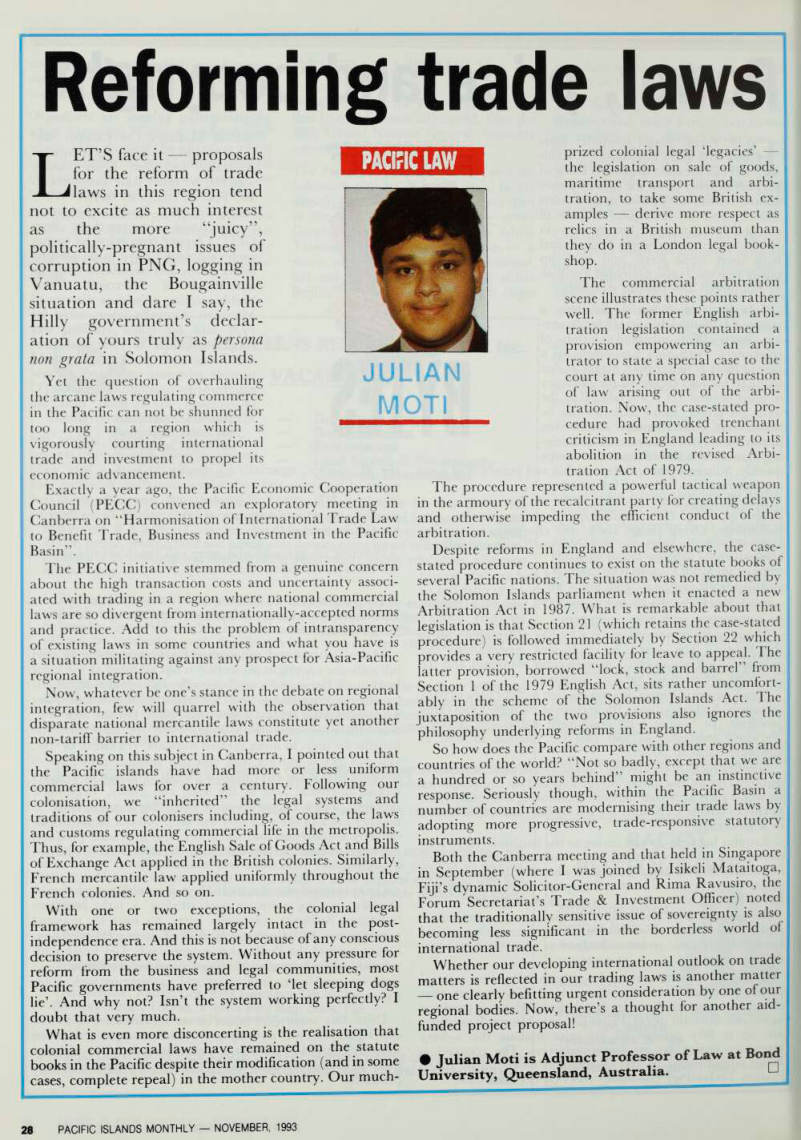
LET’S face it proposals
for the reform of trade laws in this region tend not to excite as much interest as the more “juicy”, politically-pregnant issues of corruption in PNG, logging in Vanuatu, the Bougainville situation and dare I say, the
Hilly government’s declar
ation of yours truly as persona non grata in Solomon Islands.
Yet the question of overhauling the arcane laws regulating commerce in the Pacific can not be shunned for too long in a region which is vigorously courting international trade and investment to propel its economic advancement.
Exactly a year ago, the Pacific Economic Cooperation Council (PECC) convened an exploratory meeting in Canberra on “Harmonisation of International Trade Law to Benefit Trade, Business and Investment in the Pacific Basin”.
The PECC initiative stemmed from a genuine concern about the high transaction costs and uncertainty associ ated with trading in a region where national commercial laws are so divergent from internationally-accepted norms and practice. Add to this the problem of intransparency of existing laws in some countries and what you have is a situation militating against any prospect for Asia-Pacific
regional integration.
Now, whatever be one’s stance in the debate on regional integration, few will quarrel with the observation that disparate national mercantile laws constitute yet another non-tariff barrier to international trade.
Speaking on this subject in Canberra, I pointed out that the Pacific islands have had more or less uniform commercial laws for over a century. Following our colonisation, we “inherited” the legal systems and traditions of our colonisers including, of course, the laws and customs regulating commercial life in the metropolis.
Thus, for example, the English Sale of Goods Act and Bills of Exchange Act applied in the British colonies. Similarly, French mercantile law applied uniformly throughout the French colonies. And so on.
With one or two exceptions, the colonial legal framework has remained largely intact in the post independence era. And this is not because of any conscious decision to preserve the system. Without any pressure for reform from the business and legal communities, most Pacific governments have preferred to ‘let sleeping dogs lie’. And why not? Isn’t the system working perfectly? I doubt that very much.
What is even more disconcerting is the realisation that colonial commercial laws have remained on the statute books in the Pacific despite their modification (and in some cases, complete repeal) in the mother country. Our much-
prized colonial legal ‘legacies’ the legislation on sale of goods, maritime transport and arbi tration, to take some British ex amples derive more respect as relics in a British museum than they do in a London legal book
shop.
The commercial arbitration scene illustrates these points rather well. The former English arbi tration legislation contained a
provision empowering an arbi
trator to state a special case to the court at any time on any question of law arising out of the arbi tration. Now, the case-stated pro cedure had provoked trenchant criticism in England leading to its abolition in the revised Arbi tration Act of 1979.
The procedure represented a powerful tactical weapon in the armoury of the recalcitrant party for creating delays and otherwise impeding the efficient conduct of the arbitration.
Despite reforms in England and elsewhere, the case stated procedure continues to exist on the statute books of several Pacific nations. The situation was not remedied by the Solomon Islands parliament when it enacted a new Arbitration Act in 1987. What is remarkable about that legislation is that Section 21 (which retains the case-stated procedure) is followed immediately by Section 22 which provides a very restricted facility for leave to appeal. The latter provision, borrowed “lock, stock and barrel from Section 1 of the 1979 English Act, sits rather uncomfort ably in the scheme of the Solomon Islands Act. The juxtaposition of the two provisions also ignores the
philosophy underlying reforms in England.
So how does the Pacific compare with other regions and countries of the world? “Not so badly, except that we are a hundred or so years behind” might be an instinctive response. Seriously though, within the Pacific Basin a number of countries are modernising their trade laws by
adopting more progressive, trade-responsive statutory
instruments.
Both the Canberra meeting and that held in Singapore in September (where I was joined by Isikeli Mataitoga, Fiji’s dynamic Solicitor-General and Rima Ravusiro, the Forum Secretariat’s Trade & Investment Officer) noted that the traditionally sensitive issue of sovereignty is also becoming less significant in the borderless world of international trade.
Whether our developing international outlook on trade matters is reflected in our trading laws is another matter one clearly befitting urgent consideration by one of our regional bodies. Now, there’s a thought for another aid
funded project proposal!
• Julian Moti is Adjunct Professor of Law at Bond University, Queensland, Australia.
Pacific Law
Julian
Moti
Terrible Tarawa
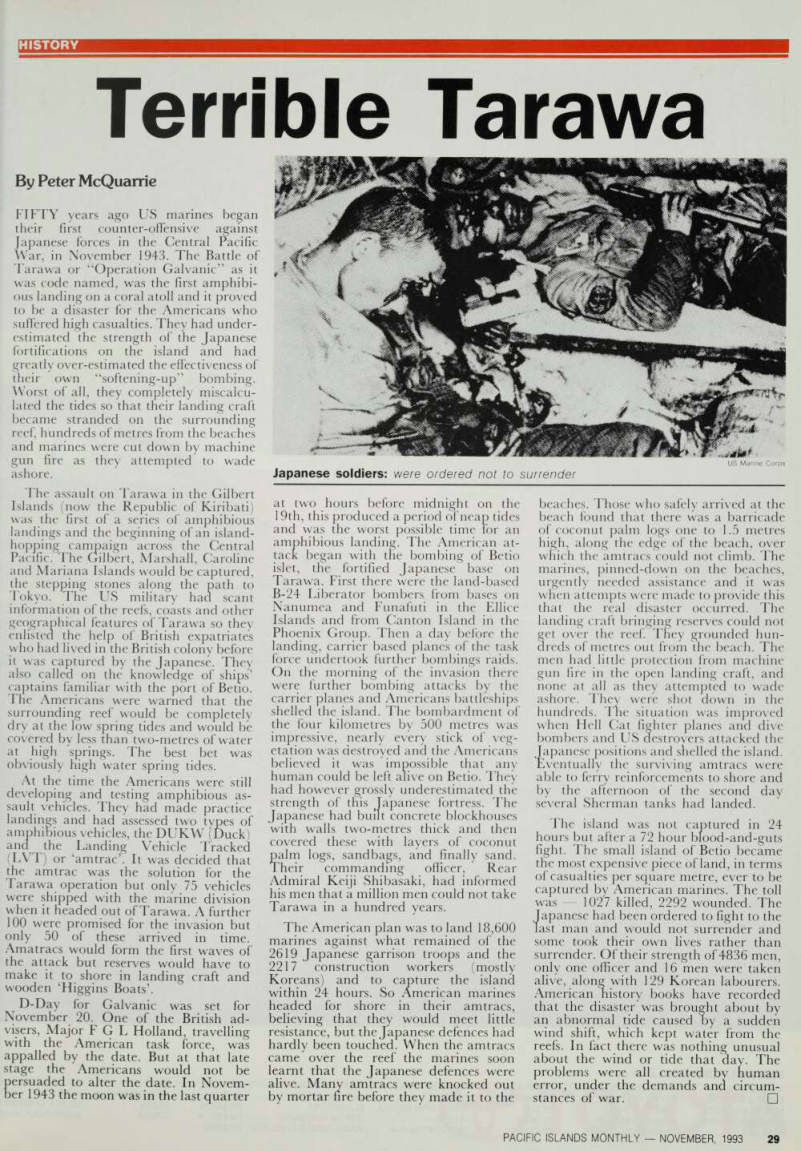
History
By Peter McQuarrie
FIFTY years ago US marines began their first counter-offensive against Japanese forces in the Central Pacific War, in November 1943. The Battle of Tarawa or “Operation Galvanic” as it was code named, was the first amphibi ous landing on a coral atoll and it proved to be a disaster for the Americans who suffered high casualties. They had under estimated the strength of the Japanese fortifications on the island and had greatly over-estimated the effectiveness of their own “softening-up” bombing.
Worst of all, they completely miscalcu lated the tides so that their landing craft became stranded on the surrounding reef, hundreds of metres from the beaches and marines were cut down by machine gun fire as they attempted to wade ashore.
The assault on Tarawa in the Gilbert Islands (now the Republic of Kiribati) was the first of a series of amphibious landings and the beginning of an island hopping campaign across the Central Pacific. The Gilbert, Marshall, Caroline and Mariana Islands would be captured, the stepping stones along the path to Tokyo. The US military had scant information of the reefs, coasts and other geographical features of Tarawa so they enlisted the help of British expatriates who had lived in the British colony before it was captured by the Japanese. They also called on the knowledge of ships’ captains familiar with the port of Betio.
The Americans were warned that the surrounding reef would be completely dry at the low spring tides and would be covered by less than two-metres of water at high springs. The best bet was obviously high water spring tides.
At the time the Americans were still developing and testing amphibious as sault vehicles. They had made practice landings and had assessed two types of amphibious vehicles, the DUKW (Duck) and the Landing Vehicle Tracked (LVT) or ‘amtrac’. It was decided that the amtrac was the solution for the Tarawa operation but only 75 vehicles were shipped with the marine division when it headed out of Tarawa. A further 100 were promised for the invasion but only 50 of these arrived in time.
Amatracs would form the first waves of the attack but reserves would have to make it to shore in landing craft and wooden ‘Higgins Boats’.
D-Day for Galvanic was set for November 20. One of the British ad visers, Major F G L Holland, travelling with the American task force, was appalled by the date. But at that late stage the Americans would not be persuaded to alter the date. In Novem ber 1943 the moon was in the last quarter
at two hours before midnight on the 19th, this produced a period of neap tides and vvas the worst possible time for an amphibious landing. The American attack began with the bombing of Betio islet, the fortified Japanese base on Tarawa. First there were the land-based B-24 Liberator bombers from bases on Nanumea and Funafuti in the Ellice Islands and from Canton Island in the Phoenix Group. Then a day before the landing, carrier based planes of the task force undertook further bombings raids.
On the morning of the invasion there were further bombing attacks by the carrier planes and Americans battleships shelled the island. The bombardment of the four kilometres by 500 metres was impressive, nearly every stick of vegelation was destroyed and the Americans believed it was impossible that any human could be left alive on Betio. They had however grossly underestimated the strength of this Japanese fortress. The Japanese had built concrete blockhouses with walls two-metres thick and then covered these with layers of coconut palm logs, sandbags, and finally sand.
Their commanding officer, Rear Admiral Keiji Shibasaki, had informed his men that a million men could not take Tarawa in a hundred years.
The American plan was to land 18,600 marines against what remained of the 2619 Japanese garrison troops and the 2217 construction workers (mostly Koreans) and to capture the island within 24 hours. So American marines headed for shore in their amtracs, believing that they would meet little resistance, but the Japanese defences had hardly been touched. When the amtracs came over the reef the marines soon learnt that the Japanese defences were alive. Many amtracs were knocked out by mortar fire before they made it to the
beaches. Those who safely arrived at the beach found that there was a barricade of coconut palm logs one to 1.5 metres high, along the edge of the beach, over which the amtracs could not climb. The marines, pinned-down on the beaches, urgently needed assistance and it was when attempts were made to provide this that the real disaster occurred. The landing craft bringing reserves could not get over the reef. Tfiey grounded hun dreds of metres out from the beach. The men had little protection from machine gun fire in the open landing craft, and none at all as they attempted to wade ashore. They were shot down in the hundreds. The situation was improved when Hell Cat fighter planes and dive bombers and US destroyers attacked the
Japanese positions and shelled the island.
Eventually the surviving amtracs were able to ferry reinforcements to shore and by the afternoon of the second day several Sherman tanks had landed.
The island was not captured in 24 hours but after a 72 hour blood-and-guts fight. The small island of Betio became the most expensive piece of land, in terms of casualties per square metre, ever to be captured by American marines. The toll was - 1027 killed, 2292 wounded. The Japanese had been ordered to fight to the last man and would not surrender and some took their own lives rather than surrender. Of their strength of 4836 men, only one officer and 16 men were taken alive, along with 129 Korean labourers.
American history books have recorded that the disaster was brought about by an abnormal tide caused By a sudden wind shift, which kept water from the reefs. In fact there was nothing unusual about the wind or tide that day. The problems were all created by human error, under the demands and circum stances of war. □
Japanese soldiers: were ordered not to surrender
US Marine Corps
Advertisements & other items, pp. 30-32 (1 item)
Is Ii Possible 10Ihieve A High Level Of Aerodynami
Creating a highly efficient, dynamic-looking car wot i be simple if it weren’t for one complicating detail; passengers that must ride in it. Accommodating people comfortably in a pleasant, root interior usually means a certain amount of aerodynamic potential has to be sacrific 4 © 0 * a $ * -ii ... mm jattHnHHl Exact features and specifications may vary depending on country of purchase. Please check with your nearest TOYOTA distributor/dealer for details.
distributors/dealeßs
AMERICAN SAMOA BURNS PHILP (S.S.) CO. LTD. PH 633-4281 GUAM & MICRONESIA. ATKINS KROLL. INC. PH 646-1876/9 NORFOLK ISLANDS BORRY’S PTY LTD. PH 2114
SOLOMON ISLANDS MENDANA MOTORS PH 30314
VANUATU VANUATU MOTORS PH 22341
COOK ISLANDS PACIFIC MOTORS LTD.
KIRIBATI TARAWA MOTORS
PAPUA NEW GUINEA .. ELA MOTORS
TAHITI NIPPON AUTOMOTO
WESTERN SAMOA BURNS PHILP (S.S.) CO. LTD.
PH 20796 PH 21090 PH 217036 PH 429819 PH 20800
FIJI ASCO MOTORS
NEW CALEDONIA .. .S.I.A.P
SAIPAN MICROL CORPORATION
TONGA BURNS PHILP (TONGA) i
E NEW COROLLA DUES II BEAUTIFULLY.
Until now. Using a concept called total airflow aagement, Toyota engineers were able to realize an efficient, wedge-shaped design ie at the same time perfecting the alignment between body panels and components, course our own innovative style of civilized ineering makes sure that none of this comes he expense of the luxurious, leg-stretching : interior. Because we realize that even a 0.33 is useless if no one wants to drive the car.
® TOYOTA
t .
' r
WORLDWIDE EXPRESS
wortun 0067 ER mm. 3 -i B«1 PB m cc Wa r C !f« Ik I 000
FORE
TOW
IMG
Wi
OSE 0
/3 ij HZ ss i y
ARE
1924
DHL
LBS
607
ARE
W T While we’re certainly equipped to rush your important comparable freight forwarder service, ocuments across the world, what you may not know is that many iternational distribution service for their products.
What’s more, as part of our total service commitment to c f our major customers are already using DHL to handle their customers for dutiable packages, all DHL offices provide shiprru ackage shipping requirements even to providing a complete tracing and tracking facilities, a convenient single all-indusi invoice and finally, the fastest possible customs clearance a That’s because our worldwide network is still the fastest and delivery at destination. So whether you’ve got truckloads of packaj lostreliablewayofmakinginternationaldeliveries—andformany or a single package, or business documents, why not call 317 83 lipment weights, cheaper on a full door to door service than a today. We promise you’ll be in safe hands all the way.
W£
'WORLDWIDE EXPRES
USTRAUA TEL: (02) 3178300 BANGLADESH TEL: (02)602219 BRUNEI TEL: 244991 CHINA TEL: (01) 486761 COOK ISLANDS TEL: 29341 FIJI TEL: 313166 HONGKONG FAR EAST TEL <IDIA TEL: (22) 294694 INDONESIA TEL: (21) 5781616 JAPAN TEL: (03) 8652580 KOREA TEL: (02) 7160001 LAOS TEL: 2066 MALAYSIA TEL: (03) 7574848 MALDIVES TEL: 322451 r>rn/~r -TT-I IiiiOOCCCAI Al ALEDONIA TEL: 275570 NEW ZEALAND TEL: (09)643799 PAPUA NEW GUINEA TEL: 259426 PHILIPPINES TEL: (02)888511 SINGAPORE SOUTH EAST ASIA m wKTCRN^LMOA' TB-- ; re, . mT -ru ah Akin rci ■ /m\ ifDiUT) TONGA TFI 71616 VANUATU TEL: 3943 VIETNAM TEL: 96203 WESTERN SAMOA
Call to review SPARTECA
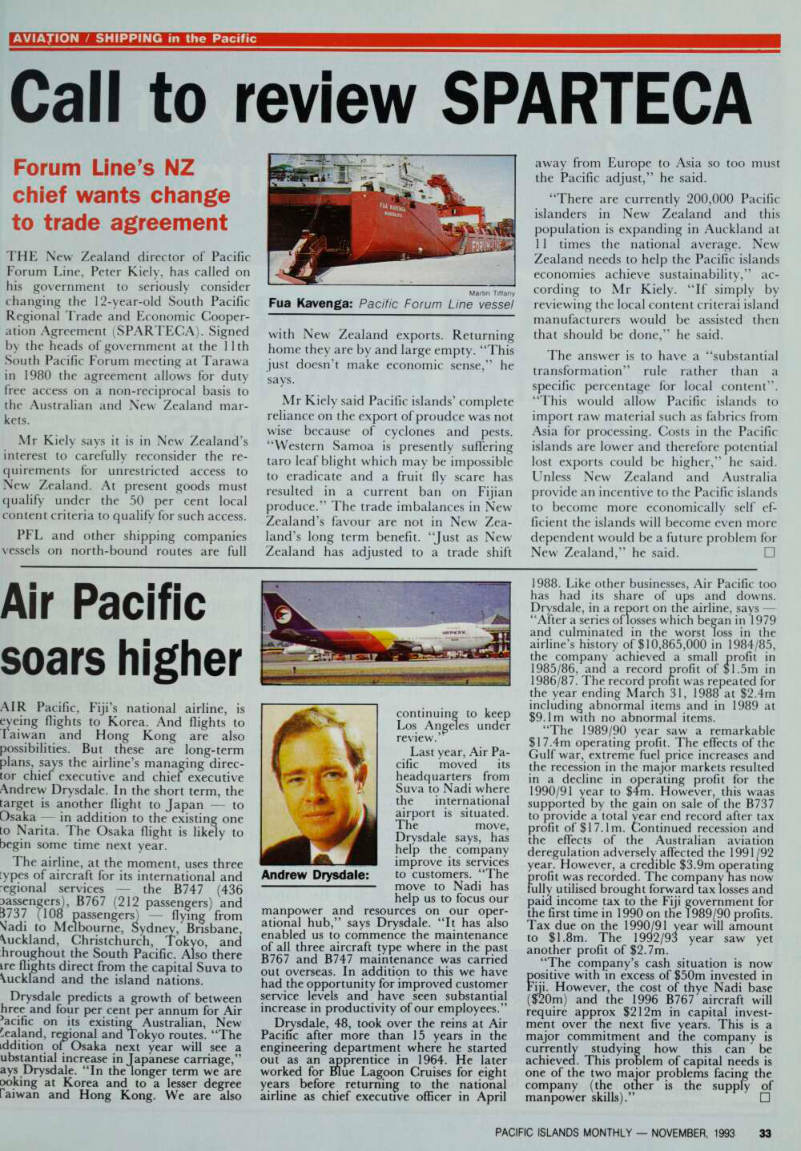
AVIATION / SHIPPING in the Pacific
Forum Line’s NZ chief wants change to trade agreement
THE New Zealand director of Pacific Forum Line, Peter Kiely, has called on his government to seriously consider changing the 12-year-old South Pacific Regional Trade and Economic Cooper ation Agreement (SPARTECA), Signed by the heads of government at the 11th South Pacific Forum meeting at Tarawa in 1980 the agreement allows for duty free access on a non-reciprocal basis to the Australian and New Zealand mar kets.
Mr Kiely says it is in New Zealand’s interest to carefully reconsider the re quirements for unrestricted access to New Zealand. At present goods must qualify under the 50 per cent local content criteria to qualify for such access.
PFL and other shipping companies vessels on north-bound routes are full
with New Zealand exports. Returning home they are by and large empty. “This just doesn’t make economic sense,” he says, Mr Kiely said Pacific islands’ complete reliance on the export ofproudce was not wise because of cyclones and pests.
“Western Samoa is presently suffering taro leaf blight which may be impossible to eradicate and a fruit fly scare has resulted in a current ban on Fijian produce,” The trade imbalances in New Zealand’s favour are not in New Zea land’s long term benefit. “Just as New Zealand has adjusted to a trade shift
away from Europe to Asia so too must the Pacific adjust,” he said.
“There are currently 200,000 Pacific islanders in New Zealand and this population is expanding in Auckland at 11 times the national average. New Zealand needs to help the Pacific islands economies achieve sustainability,” ac cording to Mr Kiely. “If simply by reviewing the local content criterai island manufacturers would be assisted then that should be done,” he said.
The answer is to have a “substantial transformation” rule rather than a specific percentage for local content”.
“This would allow Pacific islands to import raw material such as fabrics from Asia for processing. Costs in the Pacific islands are lower and therefore potential lost exports could be higher,” he said.
Unless New Zealand and Australia provide an incentive to the Pacific islands to become more economically self ef ficient the islands will become even more dependent would be a future problem for New Zealand,” he said. □
Martin Tiffany Fua Kavenga: Pacific Forum Line vessel
soars higher
Air Pacific soars higher
AIR Pacific, Fiji’s national airline, is eyeing flights to Korea. And flights to
Taiwan and Hong Kong are also
possibilities. But these are long-term plans, says the airline’s managing direc tor chief executive and chief executive Andrew Drysdale. In the short term, the target is another flight to Japan to Osaka in addition to the existing one to Narita. The Osaka flight is likely to begin some time next year.
The airline, at the moment, uses three types of aircraft for its international and "egional services the 8747 (436 Dassengers), 8767 (212 passengers) and
3737 (108 passengers} flying from
to Melbourne, oydney, Brisbane,
~nd, Christchurch, Tokyo, and
hroughout the South Pacific. Also there ire flights direct from the capital Suva to ~nd and the island nations.
Drysdale predicts a growth of between hree and four per cent per annum for Air on its existing Australian, New Zealand, regional and Tokyo routes. “The iddition of Osaka next year will see a übstantial increase in Japanese carriage,” ays Drysdale. “In the longer term we are ooking at Korea and to a lesser degree faiwan and Hong Kong. We are also
continuing to keep Los Angeles under review.’
Last year, Air Pa cific moved its headquarters from Suva to Nadi where the international airport is situated.
The move, Drysdale says, has help the company improve its services to customers. “The move to Nadi has help us to focus our
manpower and resources on our oper ational hub,” says Drysdale. “It has also enabled us to commence the maintenance of all three aircraft type where in the past 8767 and 8747 maintenance was carried out overseas. In addition to this we have had the opportunity for improved customer service levels and have seen substantial increase in productivity of our employees.”
Drysdale, 48, took over the reins at Air Pacific after more than 15 years in the engineering department where he started out as an apprentice in 1964. He later worked for Blue Lagoon Cruises for eight years before returning to the national airline as chief executive officer in April
1988. Like other businesses, Air Pacific too has had its share of ups and downs.
Drysdale, in a report on the airline, says “After a series ©flosses which began in 1979 and culminated in the worst loss in the airline’s history of $10,865,000 in 1984/85, the company achieved a small profit in 1985/86, and a record profit of sl.sm in 1986/87. The record profit was repeated for the year ending March 31, 1988 at $2.4m including abnormal items and in 1989 at s9.lm with no abnormal items.
“The 1989/90 year saw a remarkable $ 17.4 m operating profit. The effects of the Gulf war, extreme fuel price increases and the recession in the major markets resulted in a decline in operating profit for the 1990/91 year to s4m. However, this waas supported by the gain on sale of the 8737 to provide a total year end record after tax profit of $ 17.1 m. Continued recession and the effects of the Australian aviation deregulation adversely affected the 1991/92 year. However, a credible $3.9m operating firofit was recorded. The company nas now ully utilised brought forward tax losses and paid income tax to the Fiji government for the first time in 1990 on the 1989/90 profits.
Tax due on the 1990/91 year will amount to sl.Bm. The 1992/93 year saw yet another profit of $2.7m.
“The company’s cash situation is now positive with in excess of ssom invested in Fiji. However, the cost of thye Nadi base (s2om) and the 1996 8767 aircraft will require approx s2l2m in capital invest ment over the next five years. This is a major commitment and the company is currently studying how this can be achieved. This problem of capital needs is one of the two major problems facing the company (the other is the supply of manpower skills).” □
Andrew Drysdale:
Advertisements & other items, p. 34 (1 item)
University of
jf
kVi
Canterbury
I■■ M A a MW W AH A A. ■ 1 B
NEW ZEALAND
DIRECTOR
MACMILLAN BROWN CENTRE
FOR PACIFIC STUDIES
Applications are invited for the position of Director of the Macmillan Brown Centre for Pacific Studies from suitably qualified persons with research experience and an intimate knowledge of Pacific societies and cultures. The appointment will be for a term of up to five years.
It is expected that the Director will have an active research and publishing interest in an area of study appropriate to the Centre. The Director should also have the appropriate management and marketing skills to administer the Centre and encourage its research, teaching and publication programmes. The appointee should maintain close contact with Maori and Pacific Island communities. He or she may wish to expand the work of the Centre to include some consultancy work in Pacific countries.
The commencing salary will be within the range of NZ555,000 to NZ$7O,OOO per annum and will be subject to an annual review. Provision is made for research leave.
Enquiries should be made to Professor W D Mclntyre, Chair, Board of the Macmillan Brown Centre for Pacific Studies: telephone (64) 3 364-2085 or fax (64) 3 364-2003.
Conditions of Appointment may be obtained by telephoning Christchurch (64) 3 364-2084.
Applications, quoting Vacancy No. M 855, should be forwarded by the closing date of 20 December 1993 to:
The Registrar
Attention: Staffing Section, University of Canterbury,
Private Bag 4800, Christchurch, New Zealand The University has a policy of equality of opportunity in employment.
the Sky’

Air NZ’s the ‘Cellar in the Sky’
A FOUR-YEAR program to create a world class wine cellar has paid dividends for Air New Zealand, with its win in the prestigious “Cellar in the Sky” international wine competition. Run by the New York-based Business Traveller Inter national magazine, the competition placed Air New Zealand the “clear winner” ahead of other interna tional contenders including Ameri can Airlines, British Airways and
Singapore Airlines.
Air New Zealand managing di rector Jim McCrea says the airline has undertaken extensive work with noted New Zealand wine consult ants John Comerford and John Buck. “Our program has involved tasting hundreds of wines to select the best New Zealand has to offer,” he says. “We’re delighted with the win, and see it as a major accolade for New Zealand wines.”
Airline wine consultant and chairman of the Wine Institute of New Zealand, John Buck, says the win is “quite staggering”. “The odds were definitely stacked against us as we choose to put forward only New Zealand wines,” he says.
“When you consider the American and French airlines have a huge domestic base to select from while others, such as the Asian carriers, take their pick from the best wines available internationally, the win is wonderful for New Zealand and its national airline.”
Mr Buck says the first association many overseas passengers have with New Zealand wine is when they are on board an Air New Zealand flight, “We try to provide wine that is identifiably New Zealand with a good representation of the various regions and winemakers,” he says. Mr Buck says selection of wine for use by the airline involves four wine tastings per year, with blind tasting of up to 120 wines each time.
“As well as working very closely with catering to match wine to the menus developed for specific routes, one must be very careful to choose wine that performs well at altitude,” he says. ‘We see some interesting palate responses in the air. We look for more intensely flavoured wines with softer finishes, rather than the more delicate styles.”
X2P 10 cellars 1. Air New Zealand; 2. American Airlines; 3.
British Airways; 4. Singapore Airlines; 5. Delta Airlines; 6. Northwest Con tinental; 7. US Air; 8. Finnair; 9. Aer Lingus; 10. Canadian Airlines Inter national United. □
DHL offers Freight Express
DHL Worldwide Express, the world’s largest international express carrier has now expanded its operations in the Pacific to offer a new concept in the movement of packages and freight -
“Express Freight”. The DHL Express
Freight service is an alternative to the conventional air freight service which is often too slow and inflexible for time
sensitive shipments. DHL Express
Freight puts your shipments under one company control, door-to-door. By cut ting out the need for separate air freight agents, Customs agents and ground transport operators, it’s more cost ef ficient, more flexible and in most cases it’s faster.
This represents an additional commit ment by DHL in developing the interna tional air freight market on the back of the recent announcement of a 51.25 bijlion investment worldwide in upgrad
ing freight handling and information
systems. The Express Freight service enables DHL to meet time requirements and customer orders for companies
moving heavyweight shipments regu
larly. DHL has in place the right distribution network, airport infrastruc ture and technology to move product more reliably and faster then through
existing forwarding methods.
DHL continues to target companies exporting to the Asian and Pacific rim region which is the world’s fastest growing air express market. DHL Worldwide Express in the Pacific offers this service to all of their 3000 global destinations with the added benefit of tracking each individual shipment door to door with the most advanced compu terised system there is. In the South Pacific DHL has offices in Fiji, Western and American Samoa, Cook Islands, Funafuti, Kiribati, Nauru, Tonga, Sol omon Islands, Vanuatu, Tahiti, New Caledonia and Papua New Guinea. □
Advertisements & other items, pp. 35-36 (2 items)
35
AVIATION / SHIPPING in the Pacific
PACIFIC ISLANDS MONTHLY NOVEMBER, 1993
Trust Company ltd
USED JAPANESE VEHICLES
ANY MAKE, MODEL, YEAR
* TRUCKS, * CARS, ♦ TRACTORS, *
ENGINE & TYRES.
ALL SHIPPING AND DOCUMENTATION
ARRANGED. BUY DIRECT FROM JAPAN
AND SAVE
“CONTACT”
Trust Company Ltd
BID 3F 3-2-26 NISHIKI,
NAKAU NAGOYA, 460 JAPAN.
PHONE: 052-953-5602,
FAX 005, 2-953-5634
124069*4
Gb FORUM SECRETARIAT
•9 VACANCIES
Applications are invited from suitably qualified and experienced persons, who must be nationals of a member state of the South Pacific Forum*, for the following positions in the Legal and Political Division of the Forum Secretariat.
The Forum Secretariat was established in 1973 by the South Pacific Forum to encourage economic and political cooperation between its member states, and between those states and the more industrialised countries. Under the control of a Secretary General, the Secretariat undertakes a number of regional work programmes covering economic development, legal and political services and the civil aviation, energy, maritime, telecommunications and trade sectors. In pursuing these work programmes, the Secretariat works with a range of aid donor countries and organisations.
The Legal and Political Division aims to provide advice, services and programmes that further the interests of the Forum Island Countries (FICs) in respect of international relations, security and legal matters.
LAW ENFORCEMENT LIAISON OFFICER
The Law Enforcement Liaison Officer is responsible for assisting in the implementation of activities arising out of the South Pacific Forum’s Declaration on Law Enforcement Co-operation. Duties include regular liaison with regional law enforcement agencies, including South Pacific Chief of Police (SPCPC), Customs Heads of Administration Regional Meeting (CHARM) and Heads of National Law Enforcement Agencies (HONLEA) and the provision of technical and norvtechnical support for the enhancement of their administrative capacity. The Law Enforcement Liaison Officer is also required to regularly monitor and report to regional Customs Administrations on current trends and innovations in respect of facilitation of goods and passengers in the region. Applicants should have extensive experience in regional law enforcement issues and a proven ability to demonstrate initiatives in regional and international trade facilitation. Management and liaison skills must be of a high order and relevant tertiary qualifications would be an advantage.
LEGAL AND POLITICAL OFFICER/ADVISER
The Legal and Political Officer/Adviser is required to perform a range of duties which may include provision of in-house legal advice; supervision of the Secretariat’s Treaties Register; co-ordination of legal assistance to FICs; assistance in the co-ordination of regional meetings and preparation of meetings papers, briefs and reports as required: and assistance with broader aspects of the Secretariat’s law enforcement cooperation programme. An important aspect of the job will be assistance with the Division’s international relations functions. Applicants should have appropriate tertiary qualifications and preferably a background in law/intemational relations. A high level of written and oral skills is essential. Experience in a regional or international organisation, or ima FIC, would be an advantage.
GENERAL INFORMATION
These appointments carry an attractive remuneration package, payable in Fiji dollars. For non-Fiji citizens this is tax-free and includes housing or a housing allowance, education and child allowances where eligible. Other benefits for all staff include superannuation and medical, life and accident insurance coverage. Appointees will be based at the Secretariat’s headquarters in Suva. Appointments will be for three years initially, and can be renewed by mutual agreement.
Applications close on 31 December, 1993. They should contain full information on education and career backgrounds and should give names, addresses and telephone numbers of at least three referees with whom the applicants have been associated professionally.
Applications should be addressed to: The Secretary General Forum Secretariat GPO Box 856, Suva, FIJI.
Telephone 312600 Telex: 2229FJ Fax: 305573 Further information is available on request from Mr Tiu Livino, Administration Officer, on 312600 Extension: 335. * Member states of the South Pacific Forum: Australia, Cook Islands, Federated States of Micronesia, Fiji, Kiribati, Nauru, New Zealand, Niue, Papua New Guinea, Republic of the Marshall Islands, Solomon Islands, Tonga, Tuvalu, Vanuatu and Western Samoa. 103222v5
Qantas in Vanuatu deal
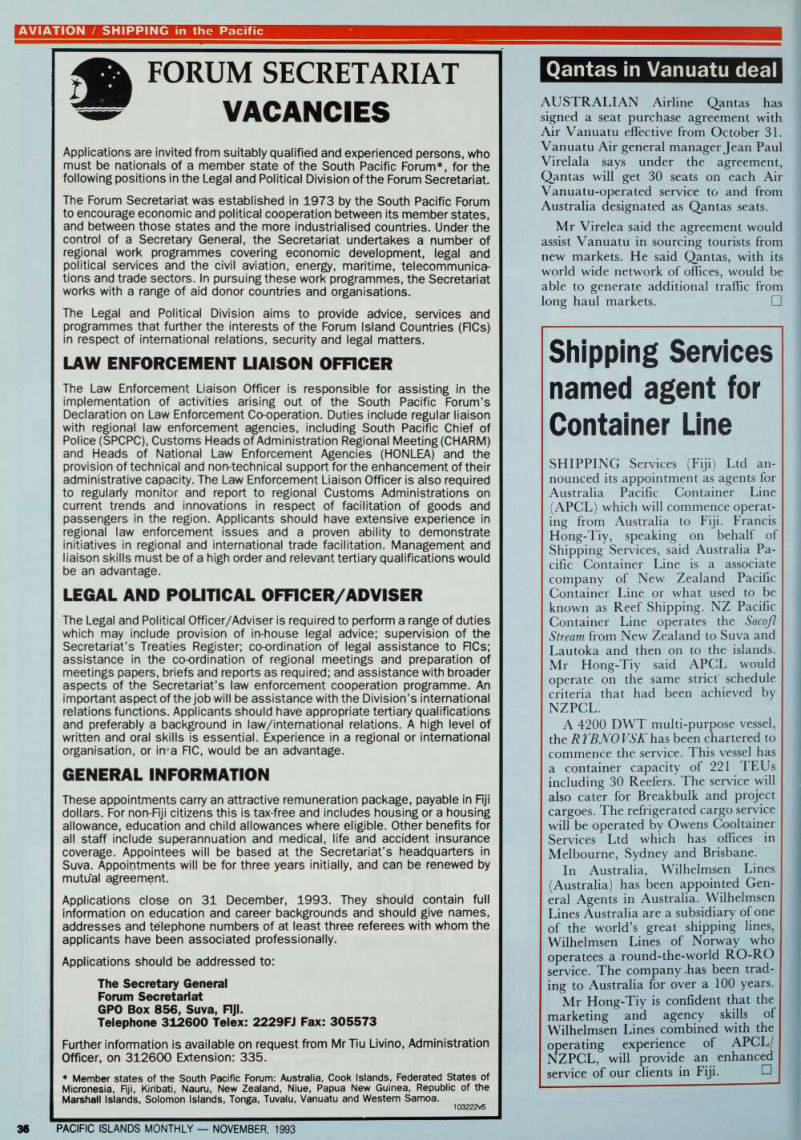
AUSTRALIAN Airline Qantas has signed a seat purchase agreement with Air Vanuatu effective from October 31.
Vanuatu Air general manager Jean Paul Virelala says under the agreement, Qantas will get 30 seats on each Air Vanuatu-operated service to and from Australia designated as Qantas seats.
Mr Virelea said the agreement would assist Vanuatu in sourcing tourists from new markets. He said Qantas, with its world wide network of offices, would be able to generate additional traffic from long haul markets. □
Shipping Services
named agent for Container Line
SHIPPING Services (Fiji) Ltd an nounced its appointment as agents for Australia Pacific Container Line (APCL) which will commence operat ing from Australia to Fiji. Francis Hong-Tiy, speaking on behalf of Shipping Services, said Australia Pa cific Container Line is a associate company of New Zealand Pacific Container Line or what used to be known as Reef Shipping. NZ Pacific Container Line operates the Socofl Stream from New Zealand to Suva and Lautoka and then on to the islands.
Mr Hong-Tiy said APCL would operate on the same strict schedule criteria that had been achieved by
Nzpcl.
A 4200 DWT multi-purpose vessel, the RTBNOVSK has been chartered to commence the service. This vessel has a container capacity of 221 TEUs including 30 Reefers. The service will also cater for Breakbulk and project cargoes. The refrigerated cargo service will be operated by Owens Cooltainer Services Ltd which has offices in Melbourne, Sydney and Brisbane.
In Australia, Wilhelmsen Lines (Australia) has been appointed Gen eral Agents in Australia. Wilhelmsen Lines Australia are a subsidiary of one of the world’s great shipping lines, Wilhelmsen Lines of Norway who operatees a round-the-world RO-RO service. The company .has been trad ing to Australia for over a 100 years.
Mr Hong-Tiy is confident that the marketing and agency skills of Wilhelmsen Lines combined with the
operating experience of APCL/
NZPCL, will provide an enhanced service of our clients in Fiji.
Advertisements & other items, p. 36 (1 item)
36
AVIATION / SHIPPING in the Pacific
PACIFIC ISLANDS MONTHLY NOVEMBER, 1993
Polynesian expands routes
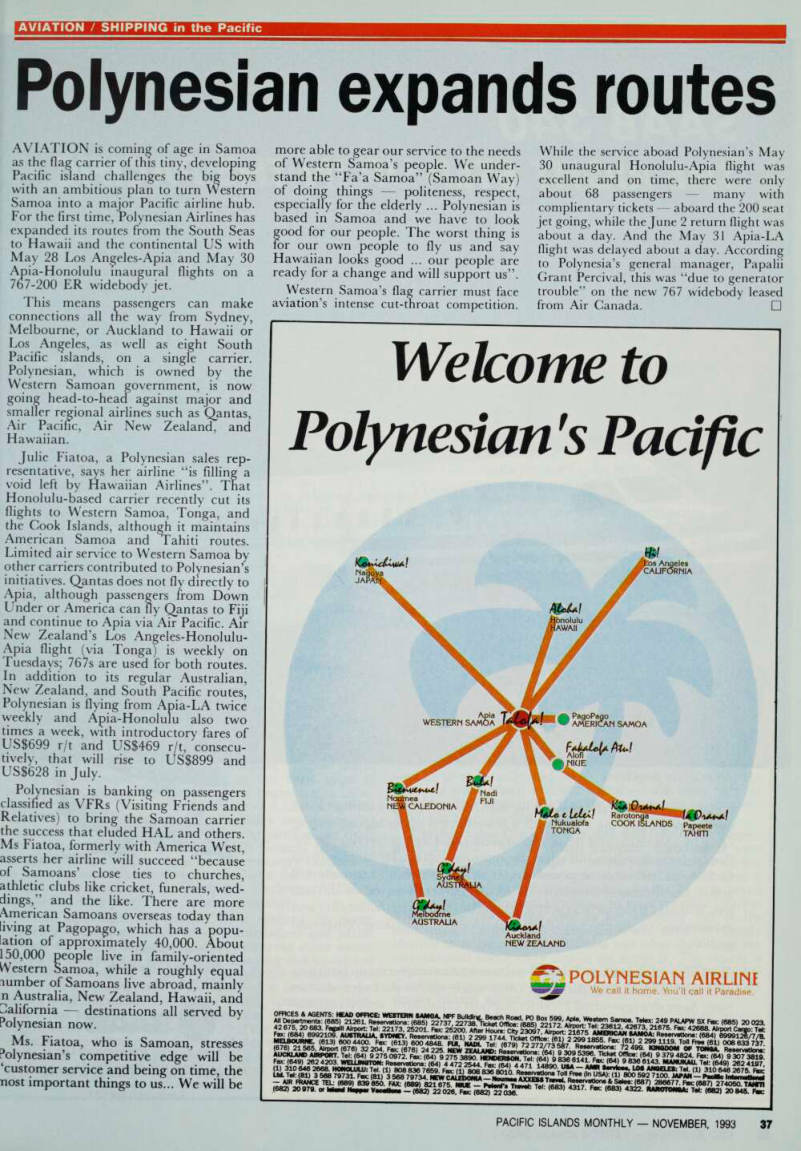
AVIATION is coming of age in Samoa as the flag carrier of this tiny, developing Pacific island challenges the big boys with an ambitious plan to turn Western Samoa into a major Pacific airline hub.
For the first time, Polynesian Airlines has expanded its routes from the South Seas to Hawaii and the continental US with May 28 Los Angeles-Apia and May 30 Apia-Honolulu inaugural flights on a 767-200 ER widebody jet.
This means passengers can make connections all the way from Sydney, Melbourne, or Auckland to Hawaii or Los Angeles, as well as eight South Pacific islands, on a single carrier, Polynesian, which is owned by the Western Samoan government, is now going head-to-head against major and smaller regional airlines such as Qantas, Air Pacific, Air New Zealand, and Hawaiian.
Julie Fiatoa, a Polynesian sales rep resentative, says her airline “is filling a void left by Hawaiian Airlines”. That Honolulu-based carrier recently cut its flights to Western Samoa, Tonga, and the Cook Islands, although it maintains American Samoa and Tahiti routes.
Limited air service to Western Samoa by other carriers contributed to Polynesian’s initiatives. Qantas does not fly directly to Apia, although passengers from Down Under or America can fly Qantas to Fiji and continue to Apia via Air Pacific. Air New Zealand’s Los Angeles-Honolulu- Apia flight (via Tonga) is weekly on Tuesdays; 767 s are used for both routes.
In addition to its regular Australian, New Zealand, and South Pacific routes,
Polynesian is flying from Apia-LA twice
weekly and Apia-Honolulu also two times a week, with introductory fares of US$699 r/t and US$469 r/t, consecu tively, that will rise to US$B99 and US$62B in July.
Polynesian is banking on passengers classified as VFRs (Visiting Friends and Relatives) to bring the Samoan carrier the success that eluded HAL and others.
Ms Fiatoa, formerly with America West, asserts her airline will succeed “because of Samoans’ close ties to churches, athletic clubs like cricket, funerals, wed dings,” and the like. There are more American Samoans overseas today than living at Pagopago, which has a popu lation of approximately 40,000. About
150,000 people live in family-oriented
Western Samoa, while a roughly equal
lumber of Samoans live abroad, mainly n Australia, New Zealand, Hawaii, and California destinations all served by Polynesian now.
Ms. Fiatoa, who is Samoan, stresses Polynesian’s competitive edge will be ‘customer service and being on time, the nost important things to us... We will be
more able to gear our service to the needs of Western Samoa’s people. We under stand the “Fa’a Samoa” (Samoan Way) of doing things politeness, respect, especially for the elderly ... Polynesian is based in Samoa and we have to look good for our people. The worst thing is for our own people to fly us and say Hawaiian looks good ... our people are ready for a change and will support us”.
Western Samoa’s flag carrier must face aviation’s intense cut-throat competition.
While the service aboad Polynesian’s May
30 unaugural Honolulu-Apia flight was
excellent and on time, there were only about 68 passengers many with complientary tickets aboard the 200 seat jet going, while the June 2 return flight was about a day. And the May 31 Apia-LA flight was delayed about a day. According
to Polynesia’s general manager, Papalii
Grant Percival, this was “due to generator trouble” on the new 767 widebody leased from Air Canada. □
Advertisements & other items, pp. 37-38 (2 items)
37
AVIATION / SHIPPING in the Pacific
PACIFIC ISLANDS MONTHLY NOVEMBER, 1993
Polynesian's Pacific
Welcome to
gW
'CALIFORNIA
Angeles
JFOR
lulu
WAII
PagoPago
AMERICAN SAMOA
sam6
WESTERN
f ,I ,# % 'W Nadi Noranea jB pi ■■
NEM CALEDONIA M
HaJLo. c UUil Rarotonga*®^BßM
& Nukualofa COOK ISLANDS p a ' peete nm
TONGA
Auckland
NEW ZEALAND
£ POLYNESIAN AIRLINE
m We call it home. You'll call It Paradise.
IJWWMIO9, AUSTRALIA. SVOfCY. (MnoMom: (61) 2 299 1764 699912?^/» F»: (649) 262 4203 MOUWm 4472^S4^M^44n' W AMsiISSL^. 8 * 0141 Tsi 262 4197
« X2sr^,s^r^;«j^rK'iKi6 T *s;
SAAB 340
THE RIGHT STEP UP IN THE PACIFIC
ZK-HSi
du nt w itaianu i\V • i» n For almost a decade, the best-selling Saab 340 has been providing 19 seat operators around the world with a low-risk step up to higher seating capacity and enhanced passenger appeal. On domestic services in the Pacific, local travellers will enjoy the spacious, full facility cabin with up to 37 seats, whilst on regional routes, businessmen and tourists will appreciate increased frequency on sectors currently served by 100 seat jets. With its 1100 m airfield performance, low fuel burn (5001tr/hr) and maintenance costs, the Saab 340 is able to turn loss making routes into
profit.
For more information contact: Acquistion costs are kept low with attractive financing terms on both new and used aircraft, together with tailor made spares packages. Add in Saab Aircraft's renowned Product Support capabilites, with a regional spares base in Australia and it's clear that the Saab 340 has what it takes to be a winner in the Pacific. Over 300 Saab 340 s currently fly the world's local service routes, including 30 with airlines around the Pacific Rim in Australia, China, Japan, New Zealand and Taiwan.
Saab 340. The right step up in the Pacific.
Mr Peter Greensmith Director of Sales Saab Aircraft International Ltd.
Asia/Pacific Regional Office, 2106, One Pacific Place, Queensway, Hong Kong.
Tel: (852) 810 4220, Telex: 64386 SABAC HX, Telefax: (852) 810 4135
Small islands,big problems
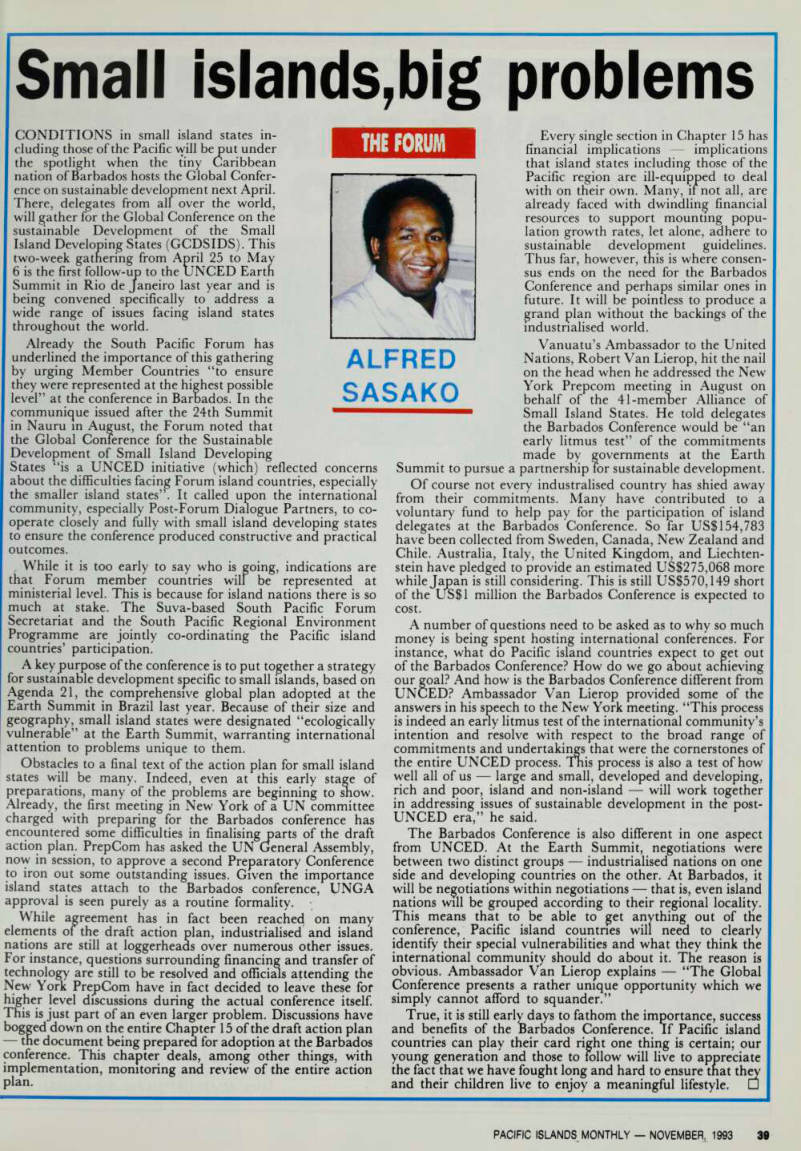
CONDITIONS in small island states in cluding those of the Pacific will be put under the spotlight when the tiny Caribbean nation of Barbados hosts the Global Confer ence on sustainable development next April.
There, delegates from all over the world, will gather for the Global Conference on the sustainable Development of the Small Island Developing States (GCDSIDS). This two-week gathering from April 25 to May 6 is the first follow-up to the UNCED Earth Summit in Rio de Janeiro last year and is being convened specifically to address a wide range of issues facing island states throughout the world.
Already the South Pacific Forum has underlined the importance of this gathering by urging Member Countries “to ensure they were represented at the highest possible level” at the conference in Barbados. In the communique issued after the 24th Summit in Nauru m August, the Forum noted that the Global Conference for the Sustainable Development of Small Island Developing
States is a UNCED initiative (which) reflected concerns about the difficulties facing Forum island countries, especially the smaller island states”. It called upon the international community, especially Post-Forum Dialogue Partners, to co operate closely and fully with small island developing states to ensure the conference produced constructive and practical outcomes.
While it is too early to say who is going, indications are that Forum member countries will be represented at ministerial level. This is because for island nations there is so much at stake. The Suva-based South Pacific Forum Secretariat and the South Pacific Regional Environment Programme are jointly co-ordinating the Pacific island countries’ participation.
A key purpose of the conference is to put together a strategy for sustainable development specific to small islands, based on Agenda 21, the comprehensive global plan adopted at the Earth Summit in Brazil last year. Because of their size and geography, small island states were designated “ecologically vulnerable” at the Earth Summit, warranting international attention to problems unique to them.
Obstacles to a final text of the action plan for small island states will be many. Indeed, even at this early stage of preparations, many of the problems are beginning to snow.
Already, the first meeting in New York of a UN committee charged with preparing for the Barbados conference has encountered some difficulties in finalising parts of the draft action plan. Prep Com has asked the UN General Assembly, now in session, to approve a second Preparatory Conference to iron out some outstanding issues. Given the importance island states attach to the Barbados conference, UNGA approval is seen purely as a routine formality.
While agreement has in fact been reached on many elements of the draft action plan, industrialised and island nations are still at loggerheads over numerous other issues.
For instance, questions surrounding financing and transfer of technology are still to be resolved and officials attending the New York Prep Com have in fact decided to leave these for higher level discussions during the actual conference itself.
This is just part of an even larger problem. Discussions have bogged down on the entire Chapter 15 of the draft action plan the document being prepared for adoption at the Barbados conference. This chapter deals, among other things, with implementation, monitoring and review of the entire action plan.
Every single section in Chapter 15 has financial implications implications that island states including those of the Pacific region are ill-equipped to deal with on their own. Many, if not all, are already faced with dwindling financial resources to support mounting popu lation growth rates, let alone, adhere to sustainable development guidelines.
Thus far, however, this is where consen sus ends on the need for the Barbados Conference and perhaps similar ones in future. It will be pointless to produce a grand plan without the backings of the industrialised world.
Vanuatu’s Ambassador to the United Nations, Robert Van Lierop, hit the nail on the head when he addressed the New York Prepcom meeting in August on behalf of the 41-member Alliance of Small Island States. He told delegates the Barbados Conference would be “an early litmus test” of the commitments maae by governments at the Earth
Summit to pursue a partnership for sustainable development.
Of course not every industralised country has shied away from their commitments. Many have contributed to a voluntary fund to help pay for the participation of island delegates at the Barbados Conference. So far U 55154,783 have been collected from Sweden, Canada, New Zealand and Chile. Australia, Italy, the United Kingdom, and Liechten stein have pledged to provide an estimated U 55275,068 more while Japan is still considering. This is still U 55570,149 short of the US$l million the Barbados Conference is expected to cost.
A number of questions need to be asked as to why so much money is being spent hosting international conferences. For instance, what do Pacific island countries expect to get out of the Barbados Conference? How do we go aoout achieving our goal? And how is the Barbados Conference different from UNCED? Ambassador Van Lierop provided some of the answers in his speech to the New York meeting. “This process is indeed an early litmus test of the international community’s intention and resolve with respect to the broad range of commitments and undertakings that were the cornerstones of the entire UNCED process. Tnis process is also a test of how well all of us large and small, developed and developing, rich and poor, island and non-island will work together in addressing issues of sustainable development in the post- UNCED era,” he said.
The Barbados Conference is also different in one aspect from UNCED. At the Earth Summit, negotiations were between two distinct groups industrialised nations on one side and developing countries on the other. At Barbados, it will be negotiations within negotiations that is, even island nations will be grouped according to their regional locality.
This means that to be able to get anything out of the conference, Pacific island countries will need to clearly identify their special vulnerabilities and what they think the international community should do about it. The reason is obvious. Ambassador Van Lierop explains “The Global Conference presents a rather unique opportunity which we simply cannot afford to squander,”
True, it is still early days to fathom the importance, success and benefits of the Barbados Conference. If Pacific island countries can play their card right one thing is certain; our young generation and those to follow will live to appreciate the fact that we have fought long and hard to ensure that they and their children live to enjoy a meaningful lifestyle. □
The Forum
Alfred
Sasako
Advertisements & other items, pp. 40-42 (3 items)
Long Range
THE LARS' FAMILY
ALARM RADIO SYSTEM
1AT2210
INTERROCATABLE
SMR 3300
AT2210
SMART REPEATER
AT2210 1AT2210
SMR 3300
SMART REPEATER
RCI 3300
O(0|QiO
0(01010 66-21 1 m $ Conveying alarm messages over long distances, requires the highest level of performance, reliability and dependability. It is not merely enough to transmit the message across the air, the information must be transmitted from the remote site and received at the Central Alarm Station with one hundred per cent 24 hour dependability. This is LARS™. Long-range Alarm Radio System. It offers the most advanced robot assembled surface-mounted components technology in Radio based security equipment. LARS™ is designed and manufactured to the highest standards for the security industry.
KP Electronic Systems Ltd, will confrigure LARS™ to meet the specific requirements of each customer. Data is gathered at the site with the client and then analized before determining which products are needed for his system.
LARS™ includes the AT22lO™- an Alarm Transmitter which contains the micro computer controlled ecoder and RF Transmitter. The lAT22IO™ an
Distributors to FIJI & South Pacific
Interrogatable Alarm Transmitter, which enables the computer at the Central Alam Station to initiate communication contact, scanning continuously the remote units and verfying their alarms status and proper operation, so that you can be absolutely confident that an alarm message will be transmitted and received. The SMR33OO™ Smart Repeater, receives, stores and re-transmits information to either the CAS or to another SMR33OO™ so that the distance over which a message can be transmitted is virtually unlimited. The heart of the system is the RCl33OO™, a Radio Communication Interface, interfaces between the RF channel and the operator or the Central Alarm Station. It receives messages from the remote alarm transmitters, displays the alarm transmitter address and alarm information on its LCD display. If the CAS computer fails the RCl33OO™ immediately alerts the operator and automatically takes over all functions for the Central Alarm Station.
LARS™ offers you reliable and dependable 24 hour alarm communication, essential in todays world. o
C Scvjlelij ecurilij Services Jdld.
LEAGUE HALL
280 TOORAK ROAD
P.O. BOX 2243
GOVERNMENT BUILDINGS
SUVA
PHONE: 679 312-357-315-506
FAX 679 303175
MANUFACTURER
ELECTRONIC
SYSTEMS LTD
KP ELECTRONIC SYSTEMS LTD.
P.0.80x 42 Tefen Industrial Park, 24959, Israel
Tel. 972-4-974066
Telex: 471439 TEFEN IE Fax: 972-4-973692
The Pacific At Taejon Expo '93
Pac ific Pavilion: staff outside their pavilion. Director Bernadette Rounds Ganilau is second from left in the front row.
Fly Free
Air Points *
LONDON-HONG KONG* LA.
AUCKLAND ♦SYDNEY
m Only our Air Points Frequent Flyer programme lets you fly from the South Pacific to the places you want to fly.
Read the fine print and you’ll find it really is pointless joining any Frequent Flyer programme other than one that’s based in your part of the world. We fly more often from the Pacific Islands to more world destinations than any other Airline, so you’ll build up Air Points faster.
And the rewards - FREE FLIGHTS UPGRADES and COMPANION tickets - * A' much quicker too.
For further details call your nearest Air New Zealand Travelcentre or lATA Travel Agent. iL *
air new ZEaiano
the pride of the pacific % * t * R
LY AIP 0757
Introducing the Pacific
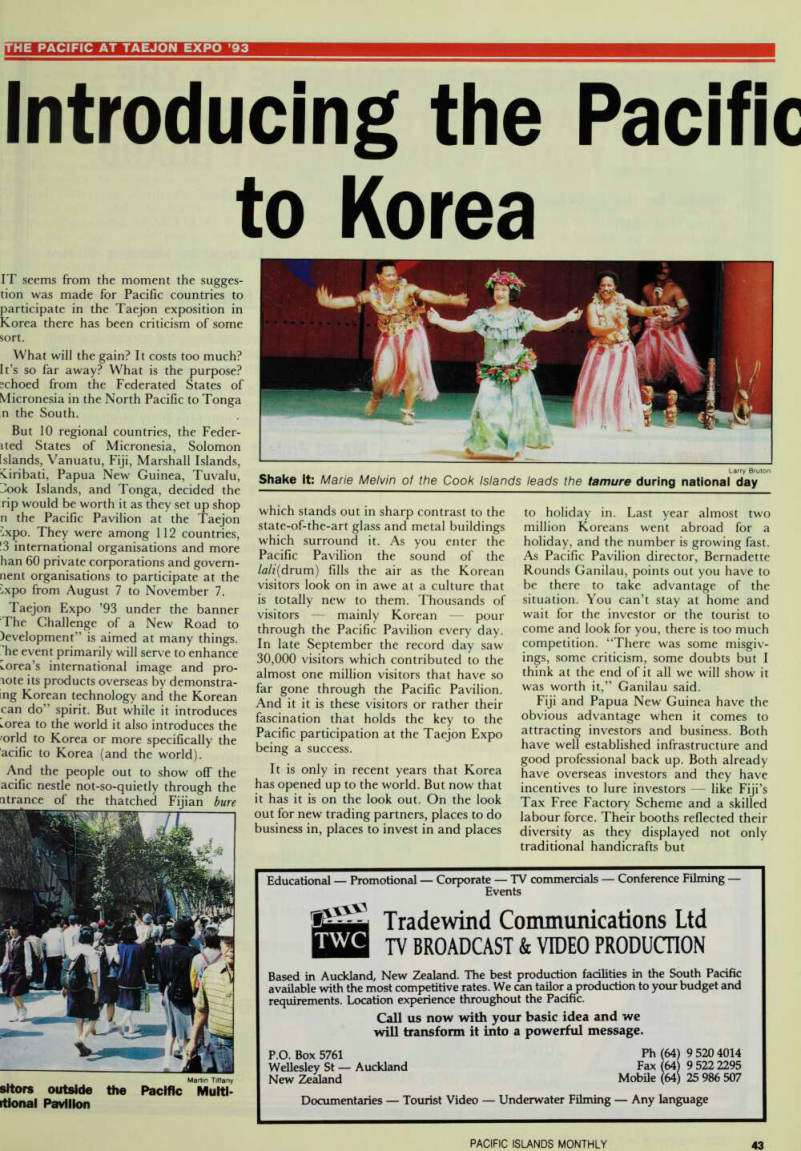

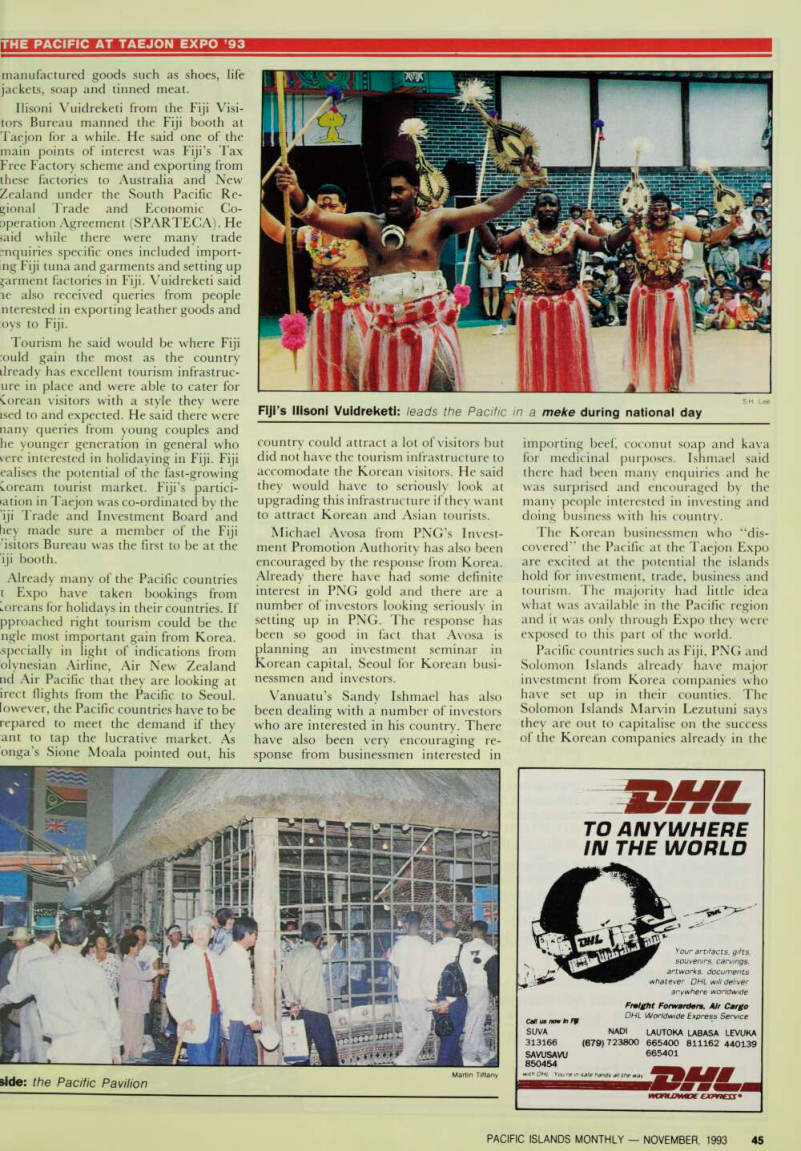
to Korea
IT seems from the moment the sugges tion was made for Pacific countries to participate in the Taejon exposition in Korea there has been criticism of some sort.
What will the gain? It costs too much?
It’s so far away? What is the purpose? echoed from the Federated States of Micronesia in the North Pacific to Tonga n the South.
But 10 regional countries, the Feder ited States of Micronesia, Solomon [slands, Vanuatu, Fiji, Marshall Islands, iCiribati, Papua New Guinea, Tuvalu, Hook Islands, and Tonga, decided the rip would be worth it as they set up shop n the Pacific Pavilion at the Taejon They were among 112 countries, 13 international organisations and more han 60 private corporations and govern nent organisations to participate at the from August 7 to November 7.
Taejon Expo ’93 under the banner The Challenge of a New Road to )evelopment” is aimed at many things, "he event primarily will serve to enhance Korea’s international image and pro mote its products overseas by demonstra ing Korean technology and the Korean can do” spirit. But while it introduces ».orea to the world it also introduces the 'orld to Korea or more specifically the acific to Korea (and the world).
And the people out to show off the acific nestle not-so-quietly through the itrance of the thatched Fijian bure
which stands out in sharp contrast to the state-of-the-art glass and metal buildings which surround it. As you enter the Pacific Pavilion the sound of the lali{ drum) fills the air as the Korean visitors look on in awe at a culture that is totally new to them. Thousands of visitors mainly Korean pour through the Pacific Pavilion every day.
In late September the record day saw 30,000 visitors which contributed to the almost one million visitors that have so far gone through the Pacific Pavilion.
And it it is these visitors or rather their fascination that holds the key to the Pacific participation at the Taejon Expo being a success.
It is only in recent years that Korea has opened up to the world. But now that it has it is on the look out. On the look out for new trading partners, places to do business in, places to invest in and places
to holiday in. Last year almost two million Koreans went abroad for a holiday, and the number is growing fast.
As Pacific Pavilion director, Bernadette Rounds Ganilau, points out you have to be there to take advantage of the situation. You can’t stay at home and wait for the investor or the tourist to come and look for you, there is too much competition. “There was some misgiv ings > some criticism, some doubts but I think at the end of it all we will show it was worth it,” Ganilau said.
Fiji and Papua New Guinea have the obvious advantage when it comes to attracting investors and business. Both have well established infrastructure and good professional back up. Both already have overseas investors and they have incentives to lure investors like Fiji’s Tax Free Factory Scheme and a skilled labour force. Their booths reflected their
diversity as they displayed not only
traditional handicrafts but
Martin Tiffany [?] sitors outside the Pacific Multi [?]tional Pavilion
Larry Bruton Shake it: Marie Melvin of the Cook Islands leads the tamure during national day
manufactured goods such as shoes, life jackets, soap and tinned meat.
Ilisoni Vuidreketi from the Fiji Visi tors Bureau manned the Fiji booth at Taejon for a while. He said one of the main points of interest was Fiji’s Tax Free Factory scheme and exporting from these factories to Australia and New Zealand under the South Pacific Re gional Trade and Economic Co operation Agreement (SPARTECA). He >aid while there were many trade enquiries specific ones included import ing Fiji tuna and garments and setting up garment factories in Fiji. Vuidreketi said
oe also received queries from people
nterested in exporting leather goods and :oys to Fiji, Tourism he said would be where Fiji :ould gain the most as the country ilready has excellent tourism infrastruc ure in place and were able to cater for Corean visitors with a style they were ised to and expected. He said there were nany queries from young couples and he younger generation in general who yere interested in holidaying in Fiji. Fiji ealises the potential of the fast-growing Scream tourist market. Fiji’s partici •ation in Taejon was co-ordinated by the iji Trade and Investment Board and bey made sure a member of the Fiji isitors Bureau was the first to be at the iji booth.
Already many of the Pacific countries t Expo have taken bookings from Koreans for holidays in their countries. If pproached right tourism could be the ngle most important gain from Korea, specially in light of indications from olynesian Airline, Air New Zealand nd Air Pacific that they are looking at irect flights from the Pacific to Seoul, lowever, the Pacific countries have to be repared to meet the demand if they ant to tap the lucrative market. As onga’s Sione Moala pointed out, his
country could attract a lot of visitors but did not have the tourism infrastructure to accomodate the Korean visitors. He said they would have to seriously look at upgrading this infrastructure if they want to attract Korean and Asian tourists.
Michael Avosa from PNG’s Invest ment Promotion Authority has also been encouraged by the response from Korea.
Already there have had some definite interest in PNG gold and there are a number of investors looking seriously in setting up in PNG. The response has been so good in fact that Avosa is planning an investment seminar in Korean capital, Seoul for Korean busi nessmen and investors.
Vanuatu’s Sandy Ishmael has also been dealing with a number of investors who are interested in his country. There have also been very encouraging re sponse from businessmen interested in
importing beef, coconut soap and kava for medicinal purposes. Ishmael said there had been many enquiries and he was surprised and encouraged by the many people interested in investing and doing business with his country.
The Korean businessmen who “dis covered” the Pacific at the Taejon Expo are excited at the potential the islands hold for investment, trade, business and tourism. The majority had little idea what was available in the Pacific region and it was only through Expo they were exposed to this part of the world.
Pacific countries such as Fiji, PNG and Solomon Islands already have major investment from Korea companies who have set up in their counties. The Solomon Islands Marvin Lezutuni says they are out to capitalise on the success of the Korean companies already in the
side: the Pacific Pavilion
Marlin Tiffany
Fiji’s Ilisoni Vuidreketi: leads the Pacific in a meke during national day
)lomons and attract more investment.
The Marshall Islands whose partici ition received criticism are out to show was worth it. Already the general sales for Polynesian Airlines in Korea, ternational Business Development has shown much interest in inging package tours to the Marshall lands. Frederick Muller from the arshall Islands ministry of resources id development says they are able to commodate a limited number of tour s almost immediately but for the long *m they should look at improving urism infrastructure. He said the indi tions from tourist operators in Korea •re very encouraging and the Marshalls d to be prepared to take advantage of “ situation. Apart from tourism Muller d there was many investment queries
he is following and added that his country would do well to look more towards the Korean and Asian market in general for trade and investment.
It seems his government is thinking along similar lines as in September a small Marshall Islands government del egation led by Minister of Transpor tation and Communications, Kunio Lemari, and Ambassador at Large, Oscar de Brum, paid a goodwill visit to Korea. This included hosting a reception for businessmen in Seoul. Minister Lemari told PIM that the purpose of their visit was to make contact with Korea and show Korea what was available in the Marshall Islands. He said they were looking more and more towards Asia this is reflected in the establishment of a Marshall Islands embassy in China.
Apart from its obvious attraction as a tourism attraction, the Cook Islands was much in demand for its handicrafts with one Korean businessman interested in
importing woven hand fans. There was also much interest expressed in importing black pearls from the Cook Islands.
While the smaller Pacific countries at Taejon such as Tuvalu and Kiribati obviously cannot attract the type of business and investment Fiji and PNG can, they gained from the exposure.
There was interest shown in their handicrafts and they have made their presence known. Also for these smaller countries investment is relative to their size. Even one small investment would mean a lot to their economy.
The participation of the Pacific islands at the Taejon Expo was organised by the Forum Secretariat at the invitation of
Korea and the Taejon Expo organising
committee. The Pacific Pavilion was set up for the Pacific countries free of charge but there were other expenses involved for Pacific countries. The 10 participat ing countries now have prove it was money well spent. □
East meets South: Tonga’s Sione Moaia and Fiji’s Ratu Kabakoro with the Korean Honour Guard
Martin Tiffany [?] wer of Great Light: one of Expo’s r actions
Larry Bruton
Advertisements & other items, pp. 43-47 (3 items)
Trade wind Communications Ltd
Educational Promotional Corporate TV commercials Conference Filming Events *» vV '
TV BROADCAST & VIDEO PRODUCTION
Based in Auckland, New Zealand. The best production facilities in the South Pacific available with the most competitive rates. We can tailor a production to your budget and requirements. Location experience throughout the Pacific. r*all us now with your basic idea and we will transform it into a powerful message.
P.O. Box 5761 Wellesley St Auckland New Zealand Ph (64) 9 520 4014 Fax (64 9 522 2295 Mobile (64) 25 986 507 Documentaries Tourist Video Underwater Filming Any language
ASSISTANCE AVAILABLE TO THE
PRIVATE SECTOR THROUGH THE
FIJI TRADE & INVESTMENT BOARD
Centre for the Development of Industry A practical operational service under the LOME Convention for establishing and strengthening industrial enterprises in ACR states. Assistance provided to help plan, start-up or expand businesses, to find joint venture partners, advice on marketing and product development and to arrange industrial training.
The South Pacific Project Facility Provides technical and business advisory services in the promotion, development and preparation of viable small-to-medium projects to accelerate the development of productive private sector enterprises.
Forum Secretariat Assistance * Marketing Support Fund * Fellowship Attachment * Handicraft Development Fund * Short Term Advisory Services * FIC Industrial Development Training Project South Pacific Trade Commission
Sydney
To assist with promotion of products in Australia and to assist with project development and promotion of investment.
Services include: * Attachment Programmes * Trade Promotions/Displays * Business Information/Communication * Management Training South Pacific Trade Office Auckland To assist with marketing and promotion of products in New Zealand.
Services include: * Market Research * Marketing Planning * Customer Identification * Trade Displays * Secondments * Financial Assistance for Marketing in New Zealand Pacific Island Industrial Development Scheme The scheme is aimed at fostering economic growth by assisting private sector entrepreneurial activity in partnership with New Zealand enterprises.
Assistance provided as funding grants in joint ventures with New Zealand enterprises and subsidy for any required feasibility studies.
MARC Project
The Market Access and Regional Competitiveness (MARC) Project is to help increase South Pacific access to and competitiveness in American markets. The focus will be on processing and marketing of higher value non-traditional exports, bettering understanding of the American Market and improving investment incentives between the South Pacific and American private sectors.
Assistance available under this scheme are: * South Pacific Investment and Trade Service * Short Term Technical Assistance for (a) Export Industry (b) Business Environment Improvement * Short Term Training * Business Research and Promotion * Long Term Advisors European Community Assistance An annually approved funding assistance to the private sector to assist by subsidising travel costs for overseas trade/investment missions, business exposure visits, training etc.
Export Promotion Incentive A tax rebate incentive scheme for non-tax free manufacturers for export promotion of products manufactured in Fiji.
B F T For further information, see us personally or write to:
THE DIRECTOR/CHIEF EXECUTIVE
FIJI TRADE & INVESTMENT BOARD
3RD aOOR, CIVIC HOUSE
TOWNHALL ROAD
P.O. BOX 2303, GOVERNMENT BUILDING
SUVA, PHONE: (679) 315988 FAX: (679) 301783.
TO ANYWHERE
IN THE WORLD
Your artifacts, gifts, souvenirs, carvings, artworks, documents whatever DHL will deliver anywhere worldwide Freight Forwarders, Air Cargo „ „ DHL Worldwide Express Service Cmf us now m rf
SUVA NADI LAUTOKA LABASA LEVUKA
313166 (679)723800 665400 811162 440139
SAVUSAVU 665401
850454 e. m
Thrilling Experience
all in one place!
FOR MORE INFORMATION
RMI Ministry of R «r D Tourist Authority P.O. 80x1727 Majuro, MH 96960 692-625-3206 or 3203 fax 692-625-3218 rmi u.n. Mission, mr 220 E. 42nd St. 31st FI.
New York, NY 10017 (212)983-3040 fax (212) 983-3202 RMI Embassy 2433 Massachusetts Ave. NW Washington, D.C. 20008 (202) 234-5414 fax (202) 232-3236 RMI Embassy 1-12-2 Tayuan Diplomatic Bldg.
Beijing, PRC 100600 86-1-5325778 or 5325819 fax 86-1-5325693 RMI Embassy 12-1 #3 Chome, Motoazabu FT Mlnato, KU Tokyo 106. Japan 81-3-54110972 or 73 or 74 fax 81-3-54110978 ,> O ' ■ l
It Can
M rV
jours
% In RMI Embassy PO Box 2038 Borron Road Suva, Fiji 679-387899 or 387094 or 387821, fax 679-387115 RMI Consulate 1357 Kapiolani Blvd. #1240 Honolulu, HI 96514 (808) 9424422 fax (808) 942-2009 RMI Consulate General 1500 Quail St. Ste. 210 Newport Beach, CA 92660 (714) 474-0331 fax (714) 474-1632 U.S. Tourist Representative Hilary Kaye 8f Associates 4000 Westerly PI. #2lO Newport Beach, CA 92660 (714) 851-5150 fax (714) 851-3111
£
The South Sea Digest
The Newsletter on Islands affairs. Eveiy Other Friday.
South Sea Digest has all the latest business news, expectly streamlined and obtainable nowhere else.
Subcriptions: 25 issues SAISO for Australian subcriber; SAI7S overseas, all airmailed. Payment by cheque in $A and SUS, otherwise by bank draft.
Send payment to: The South Sea Digest, GPO Box 4245, Sydney, NSW 2001, Australia.
Name Address
The Pacific At Taejon Expo 93
He Pacific At Taejon Expo ’93
calling ...
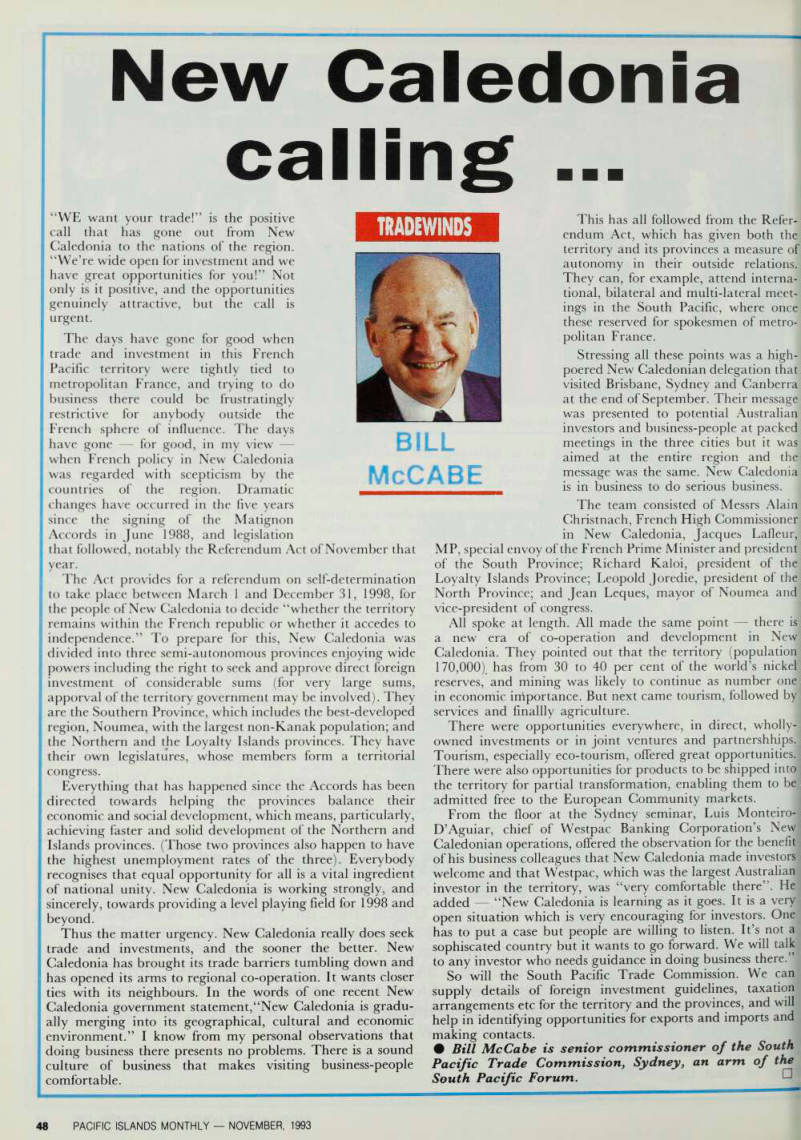
New Caledonia calling ...
“WE want your trade!” is the positive call that has gone out from New Caledonia to the nations of the region.
“We’re wide open for investment and we have great opportunities for you!” Not only is it positive, and the opportunities genuinely attractive, but the call is urgent.
The days have gone for good when trade and investment in this French Pacific territory were tightly tied to metropolitan France, and trying to do business there could be frustratingly restrictive for anybody outside the French sphere of influence. The days have gone for good, in my view when French policy in New Caledonia was regarded with scepticism by the countries of the region. Dramatic changes have occurred in the five years since the signing of the Matignon Accords in June 1988, and legislation
that followed, notably the Referendum Act of November that year.
The Act provides for a referendum on self-determination to take place between March 1 and December 31, 1998, for the people of New Caledonia to decide “whether the territory remains within the French republic or whether it accedes to independence.” To prepare for this, New Caledonia was divided into three semi-autonomous provinces enjoying wide powers including the right to seek and approve direct foreign investment of considerable sums (for very large sums, apporval of the territory government may be involved). They are the Southern Province, which includes the best-developed region, Noumea, with the largest non-Kanak population; and the Northern and the Loyalty Islands provinces. They have their own legislatures, whose members form a territorial congress.
Everything that has happened since the Accords has been directed towards helping the provinces balance their economic and social development, which means, particularly, achieving faster and solid development of the Northern and Islands provinces. (Those two provinces also happen to have the highest unemployment rates of the three). Everybody recognises that equal opportunity for all is a vital ingredient of national unity. New Caledonia is working strongly, and sincerely, towards providing a level playing field for 1998 and beyond.
Thus the matter urgency. New Caledonia really does seek trade and investments, and the sooner the better. New Caledonia has brought its trade barriers tumbling down and has opened its arms to regional co-operation. It wants closer ties with its neighbours. In the words of one recent New Caledonia government statement,“New Caledonia is gradu ally merging into its geographical, cultural and economic environment.” I know from my personal observations that doing business there presents no problems. There is a sound culture of business that makes visiting business-people comfortable.
This has all followed from the Refer endum Act, which has given both the territory and its provinces a measure of autonomy in their outside relations.
They can, for example, attend interna tional, bilateral and multi-lateral meet ings in the South Pacific, where once these reserved for spokesmen of metro
politan France.
Stressing all these points was a high poered New Caledonian delegation that visited Brisbane, Sydney and Canberra at the end of September. Their message was presented to potential Australian investors and business-people at packed meetings in the three cities but it was aimed at the entire region and the message was the same. New Caledonia is in business to do serious business.
The team consisted of Messrs Alain Christnach, French High Commissioner in New Caledonia, Jacques Lafleur,
MP, special envoy of the French Prime Minister and president of the South Province; Richard Kaloi, president of the Loyalty Islands Province; Leopold Joredie, president of the North Province; and Jean Leques, mayor of Noumea and vice-president of congress.
All spoke at length. All made the same point there is a new era of co-operation and development in New Caledonia. They pointed out that the territory (population 170,000) has from 30 to 40 per cent of the world’s nickel reserves, and mining was likely to continue as number one in economic importance. But next came tourism, followed by services and fmallly agriculture.
There were opportunities everywhere, in direct, wholly owned investments or in joint ventures and partnershhips.
Tourism, especially eco-tourism, offered great opportunities.
There were also opportunities for products to be shipped into the territory for partial transformation, enabling them to be admitted free to the European Community markets.
From the floor at the Sydney seminar, Luis Monteiro- D’Aguiar, chief of Westpac Banking Corporation’s New Caledonian operations, offered the observation for the benefit of his business colleagues that New Caledonia made investors welcome and that Westpac, which was the largest Australian investor in the territory, was “very comfortable there”. He added “New Caledonia is learning as it goes. It is a very open situation which is very encouraging for investors. One has to put a case but people are willing to listen. It’s not a sophiscated country but it wants to go forward. We will talk to any investor who needs guidance in doing business there.
So will the South Pacific Trade Commission. We can supply details of foreign investment guidelines, taxation arrangements etc for the territory and the provinces, and will help in identifying opportunities for exports and imports and making contacts. Bill McCabe is senior commissioner of the South Pacific Trade Commission, Sydney, an arm of the South Pacific Forum. O
Tradewinds
Bill
Mccabe
‘lnga the Winger’
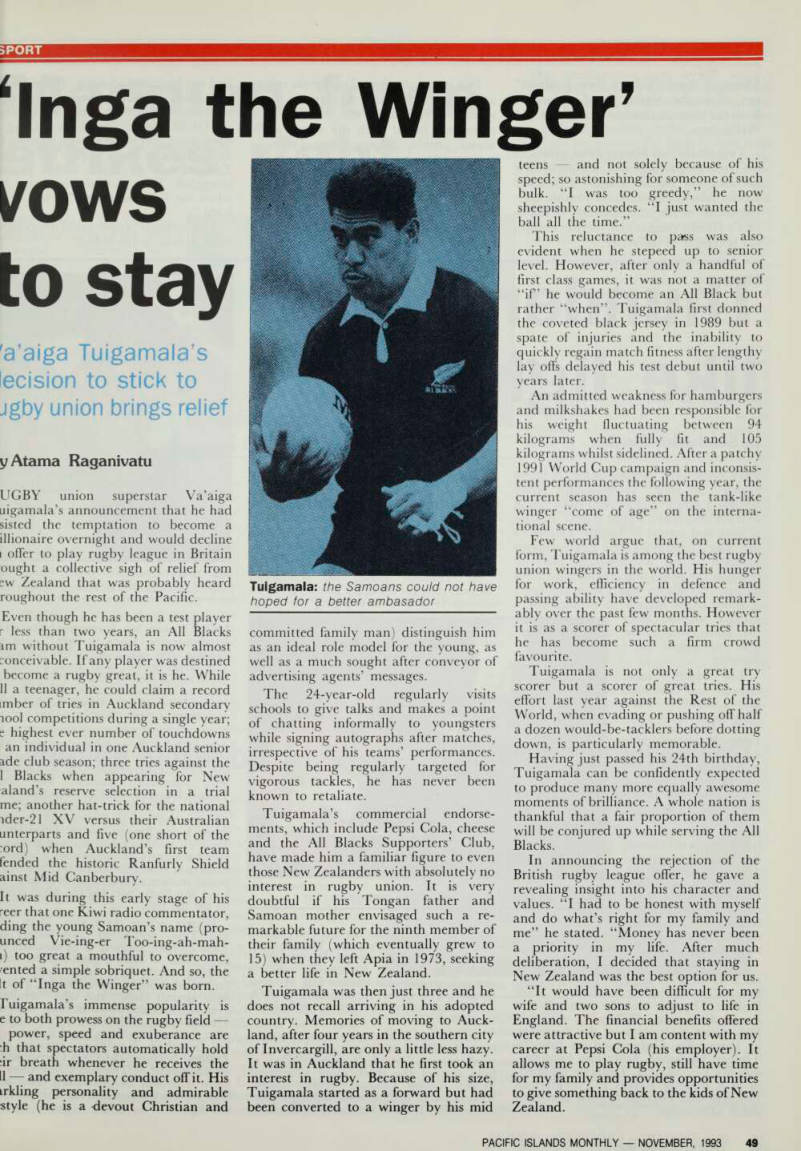
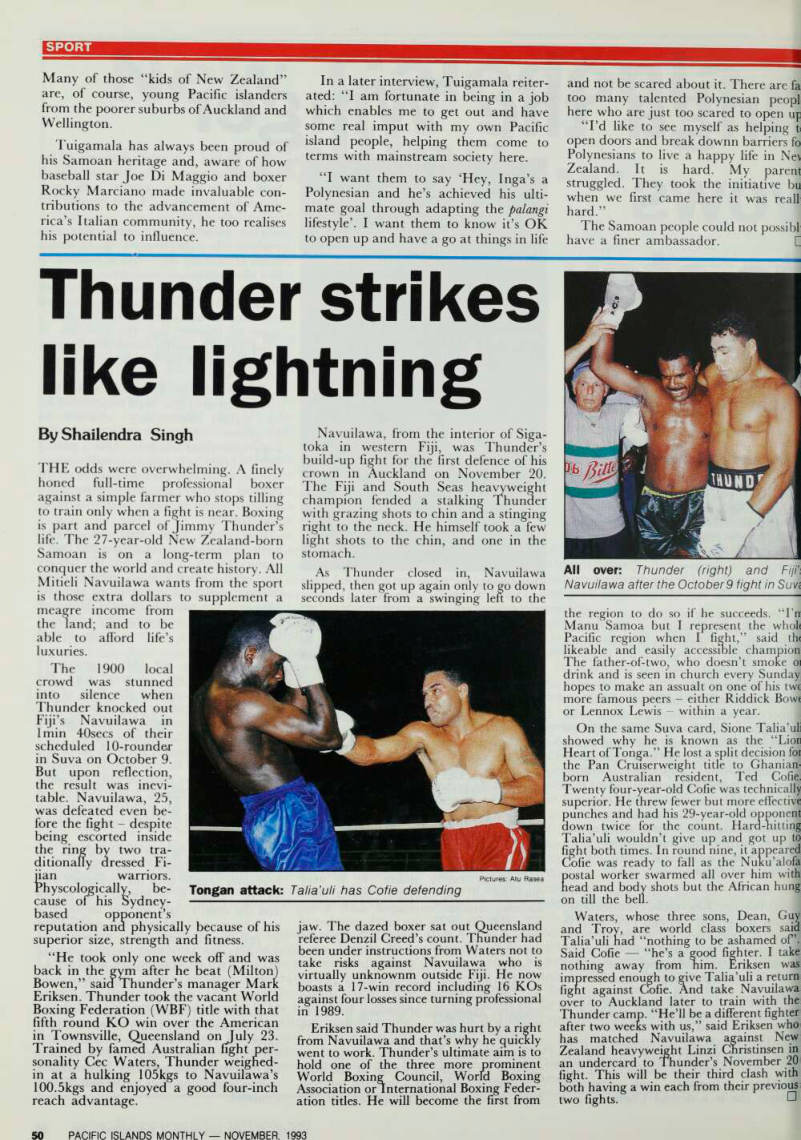
Sport
Nows to stay
'a’aiga Tuigamala’s lecision to stick to jgby union brings relief
By Atama Raganivatu
UGBY union superstar Va’aiga iiigamala’s announcement that he had sisted the temptation to become a illionaire overnight and would decline i offer to play rugby league in Britain ought a collective sigh of relief from sw Zealand that was probably heard roughout the rest of the Pacific.
Even though he has been a test player r less than two years, an All Blacks am without Tuigamala is now almost conceivable. If any player was destined become a rugby great, it is he. While 11 a teenager, he could claim a record imber of tries in Auckland secondary aool competitions during a single year; e highest ever number of touchdowns an individual in one Auckland senior ade club season; three tries against the 1 Blacks when appearing for New aland’s reserve selection in a trial me; another hat-trick for the national ider-21 XV versus their Australian unterparts and five (one short of the :ord) when Auckland’s first team fended the historic Ranfurly Shield
ainst Mid Canberbury.
It was during this early stage of his reer that one Kiwi radio commentator, ding the young Samoan’s name (pro
unced Vie-ing-er Too-ing-ah-mah
-0 too great a mouthful to overcome, rented a simple sobriquet. And so, the it of “Inga the Winger” was born.
Fuigamala’s immense popularity is e to both prowess on the rugby field power, speed and exuberance are h that spectators automatically hold ;ir breath whenever he receives the il and exemplary conduct off it. His irkling personality and admirable style (he is a -devout Christian and
committed family man) distinguish him as an ideal role model for the young, as well as a much sought after conveyor of advertising agents’ messages.
The 24-year-old regularly visits
schools to give talks and makes a point of chatting informally to youngsters while signing autographs after matches, irrespective of his teams’ performances.
Despite being regularly targeted for vigorous tackles, he has never been known to retaliate.
Tuigamala’s commercial endorse ments, which include Pepsi Cola, cheese and the All Blacks Supporters’ Club, have made him a familiar figure to even those New Zealanders with absolutely no interest in rugby union. It is very doubtful if his Tongan father and Samoan mother envisaged such a re markable future for the ninth member of their family (which eventually grew to 15) when they left Apia in 1973, seeking a better life in New Zealand.
Tuigamala was then just three and he does not recall arriving in his adopted country. Memories of moving to Auck land, after four years in the southern city of Invercargill, are only a little less hazy.
It was in Auckland that he first took an interest in rugby. Because of his size, Tuigamala started as a forward but had been converted to a winger by his mid
teens and not solely because of his speed; so astonishing for someone of such bulk. “I was too greedy,” he now sheepishly concedes. “I just wanted the ball all the time.”
This reluctance to pass was also evident when he stepeed up to senior level. However, after only a handful of first class games, it was not a matter of “if’ he would become an All Black but rather “when”. Tuigamala first donned the coveted black jersey in 1989 but a spate of injuries and the inability to quickly regain match fitness after lengthy lay offs delayed his test debut until two years later.
An admitted weakness for hamburgers and milkshakes had been responsible for his weight fluctuating between 94 kilograms when fully fit and 105 kilograms whilst sidelined. After a patchy 1991 World Cup campaign and inconsis tent performances the following year, the current season has seen the tank-like winger “come of age” on the interna tional scene.
Few world argue that, on current form, Tuigamala is among the best rugby union wingers in the world. His hunger for work, efficiency in defence and passing ability have developed remark ably over the past few months. However it is as a scorer of spectacular tries that he has become such a firm crowd favourite.
Tuigamala is not only a great try scorer but a scorer of great tries. His effort last year against the Rest of the World, when evading or pushing off half a dozen would-be-tacklers before dotting down, is particularly memorable.
Having just passed his 24th birthday, Tuigamala can be confidently expected to produce many more equally awesome moments of brilliance. A whole nation is thankful that a fair proportion of them will be conjured up while serving the All Blacks.
In announcing the rejection of the British rugby league offer, he gave a revealing insight into his character and values. “I had to be honest with myself and do what’s right for my family and me” he stated. “Money has never been a priority in my life. After much deliberation, I decided that staying in New Zealand was the best option for us.
“It would have been difficult for my wife and two sons to adjust to life in England. The financial benefits offered were attractive but I am content with my career at Pepsi Cola (his employer). It allows me to play rugby, still have time for my family and provides opportunities to give something back to the kids of New Zealand.
Tuigamala: the Samoans could not have hoped for a better ambasador
Many of those “kids of New Zealand” are, of course, young Pacific islanders from the poorer suburbs of Auckland and
Wellington.
Tuigamala has always been proud of his Samoan heritage and, aware of how baseball star Joe Di Maggio and boxer Rocky Marciano made invaluable con tributions to the advancement of Ame rica’s Italian community, he too realises his potential to influence.
In a later interview, Tuigamala reiter ated: “I am fortunate in being in a job which enables me to get out and have some real imput with my own Pacific island people, helping them come to terms with mainstream society here.
“I want them to say ‘Hey, Inga’s a Polynesian and he’s achieved his ulti
mate goal through adapting the palangi
lifestyle’. I want them to know it’s OK to open up and have a go at things in life
and not be scared about it. There are fa too many talented Polynesian peopl here who are just too scared to open up “I’d like to see myself as helping t( open doors and break downn barriers fo Polynesians to live a happy life in Ne\ Zealand. It is hard. My parent struggled. They took the initiative bu when we first came here it was real! hard.”
The Samoan people could not possibl have a finer ambassador. 0
like lightning
Thunder strikes like lightning
By Shailendra Singh
THE odds were overwhelming. A finely honed full-time professional boxer against a simple farmer who stops tilling to train only when a fight is near. Boxing is part and parcel of Jimmy Thunder’s life. The 27-year-old New Zealand-born Samoan is on a long-term plan to conquer the world and create history. All Mitieli Navuilawa wants from the sport is those extra dollars to supplement a
meagre income from the land; and to be able to afford life’s luxuries.
The 1900 local crowd was stunned into silence when Thunder knocked out Fiji’s Navuilawa in Imin 40secs of their scheduled 10-rounder in Suva on October 9.
But upon reflection, the result was inevi table. Navuilawa, 25, was defeated even be fore the fight - despite being escorted inside the ring by two tra ditionally dressed Fi jian warriors.
Physcologically, be
cause of his Sydney based opponent’s
reputation and physically because of his superior size, strength and fitness.
“He took only one week off and was back in the gym after he beat (Milton) Bowen,” said Thunder’s manager Marx Eriksen. Thunder took the vacant World Boxing Federation (WBF) title with that fifth round KO win over the American in Townsville, Queensland on July 23.
Trained by famed Australian fight per sonality Cec Waters, Thunder weighed in at a hulking 105kgs to Navuilawa’s 100.5kgs and enjoyed a good four-inch reach advantage.
Navuilawa, from the interior of Siga toka in western Fiji, was Thunder’s build-up fight for the first defence of his crown m Auckland on November 20.
The Fiji and South Seas heavyweight champion fended a stalking Thunder with grazing shots to chin and a stinging right to the neck. He himself took a few light shots to the chin, and one in the stomach.
As Thunder closed in, Navuilawa slipped, then got up again only to go down seconds later from a swinging leu to the
jaw. The dazed boxer sat out Queensland referee Denzil Creed’s count. Thunder had been under instructions from Waters not to take risks against Navuilawa who is virtually unknownm outside Fiji. He now boasts a 17-win record including 16 KOs against four losses since turning professional in 1989.
Eriksen said Thunder was hurt by a right from Navuilawa and that’s why he quickly went to work. Thunder’s ultimate aim is to hold one of the three more prominent World Boxing Council, World Boxing Association or International Boxing Feder ation titles. He will become the first from
the region to do so if he succeeds. “I’n Manu Samoa but I represent the whoh Pacific region when I fight,” said th( likeable and easily accessible champion The father-of-two, who doesn’t smoke 01 drink and is seen in church every Sunday hopes to make an assualt on one of his twc more famous peers - either Riddick Bow( or Lennox Lewis - within a year.
On the same Suva card, Sione Talia’uli showed why he is known as the “Lion Heart of Tonga.” He lost a split decision foi the Pan Cruiserweight title to Ghanian born Australian resident, Ted Cofie.
Twenty four-year-old Cofie was technically superior. He threw fewer but more effective punches and had his 29-year-old opponent down twice for the count. Hard-hitting Talia’uli wouldn’t give up and got up to fight both times. In round nine, it appeared (jofie was ready to fall as the Nuku’alofa postal worker swarmed all over him with head and body shots but the African hung on till the bell.
Waters, whose three sons, Dean, Guy and Troy, are world class boxers said Talia’uli nad “nothing to be ashamed of’.
Said Cofie “he’s a good fighter. I take nothing away from him. Eriksen was impressed enough to give Talia’uli a return fight against Cofie. And take Nayuilawa over to Auckland later to train with the Thunder camp. “He’ll be a different fighter after two weeks with us,” said Eriksen who has matched Navuilawa against New Zealand heavyweight Linzi Christinsen in an undercard to Thunder’s November 20 fight. This will be their third clash with both having a win each from their previous two fights. D
Pictures: Atu Rasea
Tongan attack: Talia’uli has Cofie defending
All over: Thunder (right) and Fiji's Navuilawa after the October 9 fight in Suva
Advertisements & other items, p. 50 (1 item)
| Sport
SPORT
strikes right
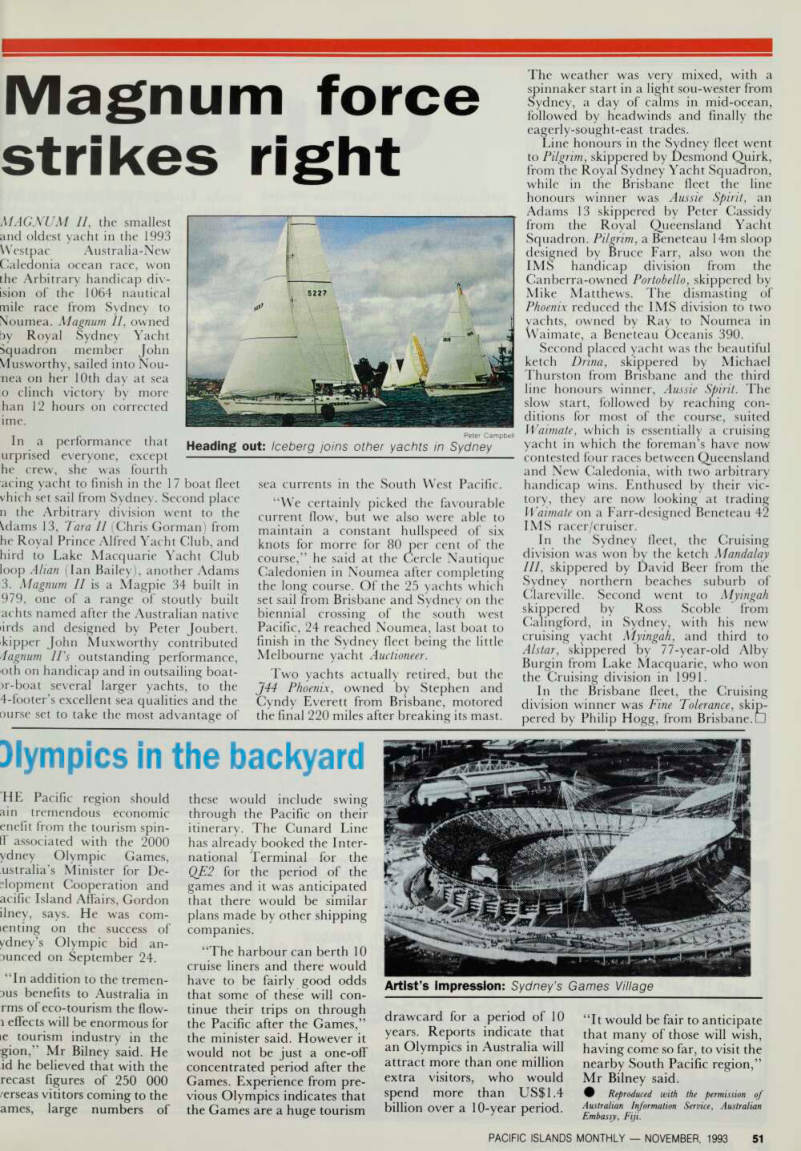
Magnum force strikes right
MAGNUM 11, the smallest and oldest yacht in the 1993 Westpac Australia-New Caledonia ocean race, won the Arbitrary handicap div ision of the 1064 nautical mile race from Sydney to Noumea. Magnum 11, owned
by Royal Sydney Yacht
Squadron member John Vlusworthy, sailed into Nou mea on her 10th day at sea o clinch victory by more han 12 hours on corrected ime.
In a performance that urprised everyone, except he crew, she was fourth
acing yacht to finish in the 17 boat fleet vhich set sail from Sydney. Second place n the Arbitrary division went to the Vdams 13, Tara II (Chris Gorman) from he Royal Prince Alfred Yacht Club, and bird to Lake Macquarie Yacht Club loop Alian (lan Bailey), another Adams 3. Magnum II is a Magpie 34 built in 979, one of a range of stoutly built achts named after the Australian native •irds and designed by Peter Joubert.
kipper John Muxworthy contributed
Aagnum IPs outstanding performance,
oth on handicap and in outsailing boat- Dr-boat several larger yachts, to the 4-footer’s excellent sea qualities and the ourse set to take the most advantage of
sea currents in the South West Pacific.
“We certainly picked the favourable current flow, but we also were able to maintain a constant hullspeed of six knots for morre for 80 per cent of the course,” he said at the Cercle Nautique Caledonien in Noumea after completing the long course. Of the 25 yachts which set sail from Brisbane and Sydney on the biennial crossing of the south west Pacific, 24 reached Noumea, last boat to finish in the Sydney fleet being the little Melbourne yacht Auctioneer.
Two yachts actually retired, but the J 44 Phoenix, owned by Stephen and Cyndy Everett from Brisbane, motored the final 220 miles after breaking its mast.
The weather was very mixed, with a spinnaker start in a light sou-wester from Sydney, a day of calms in mid-ocean, followed by headwinds and finally the eagerly-sought-east trades.
Line honours in the Sydney fleet went to Pilgrim, skippered by Desmond Quirk, from the Royal Sydney Yacht Squadron, while in the Brisbane fleet the line honours winner was Aussie Spirit, an Adams 13 skippered by Peter Cassidy from the Royal Queensland Yacht Squadron. Pilgrim, a Beneteau 14m sloop designed by Bruce Farr, also won the IMIS handicap division from the Canberra-owned Portobello, skippered by Mike Matthews. The dismasting of Phoenix reduced the IMS division to two yachts, owned by Ray to Noumea in Waimate, a Beneteau Oceanis 390.
Second placed yacht was the beautiful ketch Dnna, skippered by Michael Thurston from Brisbane and the third line honours winner, Aussie Spirit. The slow start, followed by reaching con ditions for most of the course, suited Waimate, which is essentially a cruising yacht in which the foreman’s have now contested four races between Queensland and New Caledonia, with two arbitrary handicap wins. Enthused by their vic tory, they are now looking at trading Waimate on a Farr-designed Beneteau 42 IMS racer/cruiser.
In the Sydney fleet, the Cruising division was won by the ketch Mandalay 111, skippered by David Beer from the Sydney northern beaches suburb of Clareville. Second went to Myingah skippered by Ross Scoble from Calingford, in Sydney, with his new cruising yacht Myingah , and third to Alstar, skippered by 77-year-old Alby Burgin from Lake Macquarie, who won the Cruising division in 1991.
In the Brisbane fleet, the Cruising division winner was Fine Tolerance, skip pered by Philip Hogg, from Brisbane. □
Peter Campbell Heading out: Iceberg joins other yachts in Sydney
Olympics in the backyard
HE Pacific region should ain tremendous economic enefit from the tourism spin [f associated with the 2000
ydney Olympic Games,
ustralia’s Minister for De
flopment Cooperation and
acific Island Affairs, Gordon ilney, says. He was com icnting on the success of
ydney’s Olympic bid an
aunced on September 24.
“In addition to the tremen aus benefits to Australia in rms of eco-tourism the flow i effects will be enormous for ie tourism industry in the gion,” Mr Bilney said. He id he believed that with the recast figures of 250 000 vititors coming to the ames, large numbers of
these would include swim; through the Pacific on theii itinerary. The Cunard Line has already booked the Inter national Terminal for the QE2 for the period of the games and it was anticipated that there would be similai plans made by other shipping companies.
“The harbour can berth 10 cruise liners and there would have to be fairly good odds that some of these will con tinue their trips on through the Pacific after the Games,” the minister said. However it would not be just a one-ofi concentrated period after the Games. Experience from pre vious Olympics indicates that the Games are a huge tourism
drawcard for a period of 10 years. Reports indicate that an Olympics in Australia will attract more than one million extra visitors, who would spend more than US$l.4 billion over a 10-year period.
“It would be fair to anticipate that many of those will wish, having come so far, to visit the
nearby South Pacific region,”
Mr Bilney said. ® Reproduced with the permission of Australian Information Service, Australian Embassy, Fiji.
Artist’s impression: Sydney’s Games Village
Cruising Tonga
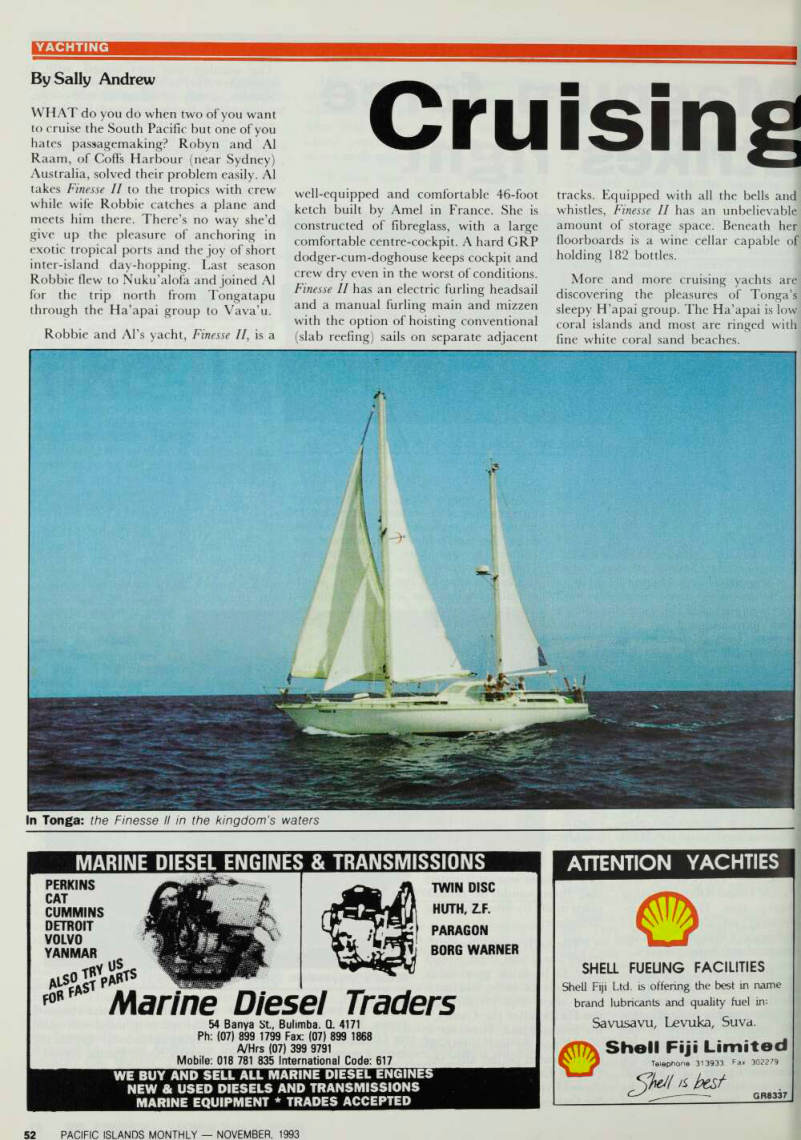

Yachting
By Sally Andrew
WHAT do you do when two of you want to cruise the South Pacific but one of you hates passagemaking? Robyn and A 1 Raam, of Cofis Harbour (near Sydney) Australia, solved their problem easily. A 1 takes Finesse II to the tropics with crew while wife Robbie catches a plane and meets him there. There’s no way she’d give up the pleasure of anchoring in exotic tropical ports and the joy of short inter-island day-hopping. Last season Robbie flew to Nuku’alofa and joined A 1 for the trip north from Tongatapu through the Ha’apai group to Vava’u.
Robbie and Al’s yacht, Finesse 11, is a
well-equipped and comfortable 46-foot ketch built by Amel in France. She is constructed of fibreglass, with a large comfortable centre-cockpit. A hard GRP dodger . cum . doghouse keeps cockpit and ° r r . c l ew m th <= W °J of conditions messe H has an electric furling headsail a hiding main and mizzen with the option of hoisting conventional (slab reefing) sails on separate adjacent
tracks. Equipped with all the bells and whistles, Finesse II has an unbelievable amount of storage space. Beneath her floorboards is a wine cellar capable of holding 182 bottles, dry even More and more cruising yachts are discovering the pleasures of Tonga’s sleepy H apai group. The Ha’apai is low coral islands and most are ringed with fine white coral sand beaches.
In Tonga: the Finesse II in the kingdom’s waters
‘More and more cruising yachts are discovering the pleasures of Tonga’s sleepy Ha’apai group’
Shoals and reefs present a
lavigational challenge to
nariners but in good weather he islands can be transited afely. Anchorages at Nomuka, lki, Ha’afeva, Joleva, Lifuka, Foa and ia’ano Island offer protection luring normal tradewind con litions. Ha’afeva has outstand ing snorkelling near the wreck f the Ekiaki , and Uoleva •oasts Tonga’s loveliest beach.
Tie beachcombing and slidi
ng on these mostly uninhabi ;d isles is outstanding.
West of the Ha’apai group re two volcanic islands that an be seen from the anchor ges at Ha’afeva and Uoleva.
'he volcanoes are especially striking at inset, with steam trailing out ufrom the orth end of the only active volcano in le Kingdom of Tonga. It was near here lat the infamous “Mutiny on the ounty” took place on April 28, 1789. aptain Bligh and his 18 crew were set drift by Fletcher Christian and his lutineers.
Pangai, the administrtive centre of the oup, is on the island of Lifuka. Lifuka still a pretty traditional island notwith anding her landing strip. Before a plane in leave or take off, pigs, dogs, goats id stray horses must be cleared off the inway which crosses the main road.
People in the Ha’apai are always flighted to greet outsiders whether they me by yacht or by plane, or aboard the ’ solution like Captain James Cook did in 74. A friendly reception is guaranteed, is encounters with the residents of Dmuka and Lifuka inspired Cook to 11 Tonga “The Friendly Archipelago”.
The best part of cruising for the Raams exploring new anchorages and seeing :al cultures first hand. By sailing, ibbie and Al can be more than just sual observers, and they like meeting ople. When Finesse II anchored off
Lotofoa Village on Foa Island, three
young ladies immediately befriended A 1
and Robbie. The local schoolteacher taught his class that the best way to learn English was to “adopt” an English speaker. So the girls adopted Robbie and a, I- n r it j i r Al. Full of life and with a keen sense of humour each was determmed to succeed in sc 001.
In contrast with the remoteness of the Ha’apai Group and the tenousness of her anchorages, Vava’u is a mecca for cruising boats. Vava’u’s many protected anchorages make her a sailor’s dream.
Mariner’s Cave awaits those wanting a little adventure. At the centre of it all is Neiafu with a daily market and a variety of amenities and facilities for visitors.
Several friends flew up to Vava’u from New Zealand to help celebrate Al’s 50th birthday at the Paradise International Hotel overlooking the Port of Refuge
Harbour. There are more than a dozen restaurants in Neiafu. The Bounty Bar and Cafe, the Double Dolphin, the Vava’u Guest House and La Paella (as well as the Paradise International Hotel)
are popular hangouts.
Always willing to lend a helping hand, Al invited three teachers and a class of 14 boys aboard Finesse II for some “practi cal” experience in navigation. Coastal navigation is an important part of the curriculum for Form Five schoolboys in Tonga. The day of the field trip the students worked out a compass course to take Finesse II out of the harbour. After a few false starts, the boys figured out the correct heading and from the main
harbour at Neiafu the young Tonga crew-in-training piloted Finesse II out of Vavau’s fiord-like en trance, past Port Maurelle. The students took plenty of compass bearings from ship to shore, con stantly plotting their position. By lunch time all the boys were exhaus ted. They teased
A 1 about teaching
at the palangi rate, then consumed 20 litres of juice, three
dozen loaves of bread, and oodles of jam, tomatoes, cheese and cucumbers. For Robbie and Al, the highlight of the excursion was after class, on the way back to Neiafu. The boys relaxed on deck singing and harmonising as Finesse II made her way in to the dock.
Finesse II found it very easy to spend a whole season crushing in Tonga, enjoying lovely beaches, good shelling, colourful snorkelling and the proximity of anchorages. It’s no wonder the number of boats cruising in Tonga has increased dramatically in recent years. □
Fresh: Neiafu's colourful market
Sally Andrew
Advertisements & other items, pp. 52-54 (1 item)
Marine Diesel Traders
MARINE DIESEL ENGINES & TRANSMISSIONS
PERKINS
CAT
CUMMINS
DETROIT
VOLVO
YANMAR
Marine Diesel Traders
TWIN DISC
HUTH, Z.F.
PARAGON
BORG WARNER
fOB
54 Banya St., Bulimba. Q. 4171 Ph: (07) 899 1799 Fax: (07) 899 1868 A/Hrs (07) 399 9791 Mobile: 018 781 835 International Code: 617 WE BUY AND SELL ALL MARINE DIESEL ENGINES
NEW & USED DIESELS AND TRANSMISSIONS
MARINE EQUIPMENT * TRADES ACCEPTED
ATTENTION YACHTIES
SHELL FUEUNG FACILITIES
Shell Fiji Ltd. is offering the best in name brand lubricants and quality fuel in; Savusavu, Levuka, Suva.
Shell Fiji Limited
A Telephone 313933 Fa* 302279
/s hesf
GR8337
The Specialist Consultants
to the Textile, Qothing k Footwear Industries
Exporting, Sourcing, Manufacturing, Marketing,
Business Planning, Human Resources, Feasibility Studies
Suite 3, 8/138 Albert Street Brisbane 4000 Australia T'Phone: 61 7 221 5988 Fax: 61 7 229 0055
petersen
J & associates
• CORPORATE MANAGEMENT CONSULTANTS •
PTY
LTD
k
A JOINT SERVICE OF
THE CHINA NAVIGATION CO. LTD.
(INC. IN U.K.)
Mitsui O.S.K. Lines Ltd.
(INC. IN JAPAN)
NIPPON YUSEN KAISHA
(INC. IN JAPAN)
SERVICE
TWO
OPERA TING A MONTHL Y SAILING FROM JAPAN
AND S.KOREA TO SOUTH PACIFIC PORTS
AS A MEMBER OF THE JAPAN SOUTH PACIFIC
FREIGHT CONFERENCE
CONTAINER / B/BULK
/RORO CAR CARRIERS
ON SERVICE
Yokohama
Nagoya\
Busan \V I Kobe 1
M.S. "PACIFIC ISLANDER”
(OPERATED By CNCO)
M.S. "CORAL ISLANDER”
(OPERATED By NYK/MOL)
Papua New Guinea v Tarawa £0
O' Yj
\ P i i i i i
Honiara^* 0
Santo Vila Noumea
LautokaVJ^--__
* % Suva
Apia
Pago a Nukua’lofa Q
Rarotonga
Papeet
For more information, please contact our AGENTS in SUVA, FIJI, or respective ports For "Pacific Islander"
Carpenters Shipping Private Mail Bag
G.P.O.
Suva
CABLE: CARPSHIP
TLX; 2199 CARPSHIP FJ
TEL: 679-312244
FAX; 679-301572
And calling at:
TARAWA (9 Days)
APIA (18 Days) NUKUALOFA (28days) SANTO (36 Days) New Zealand
LAUTOKA (13 Days)
PAGO PAGO (19 Days)
NOUMEA (31 Days)
* HONIARA (39 Days)
SUVA (14 Days)
PAPEETE (23 Day
VILA (35 Days) For "Coral Islander": Burns Philp(SS)Co Ltd G.P.O. Box 355
CABLE: BURNSOUTH
TLX; 2168 BURNSHIP FJ
TEL: 679-311777
RAROTONGA (Via APIA or PAGO PAGO)
( ) Average Transit Time From Yokohama Suva
FAX: 679-301127
On Inducement Basis For Schedule Details See Your Local Press
Shipping
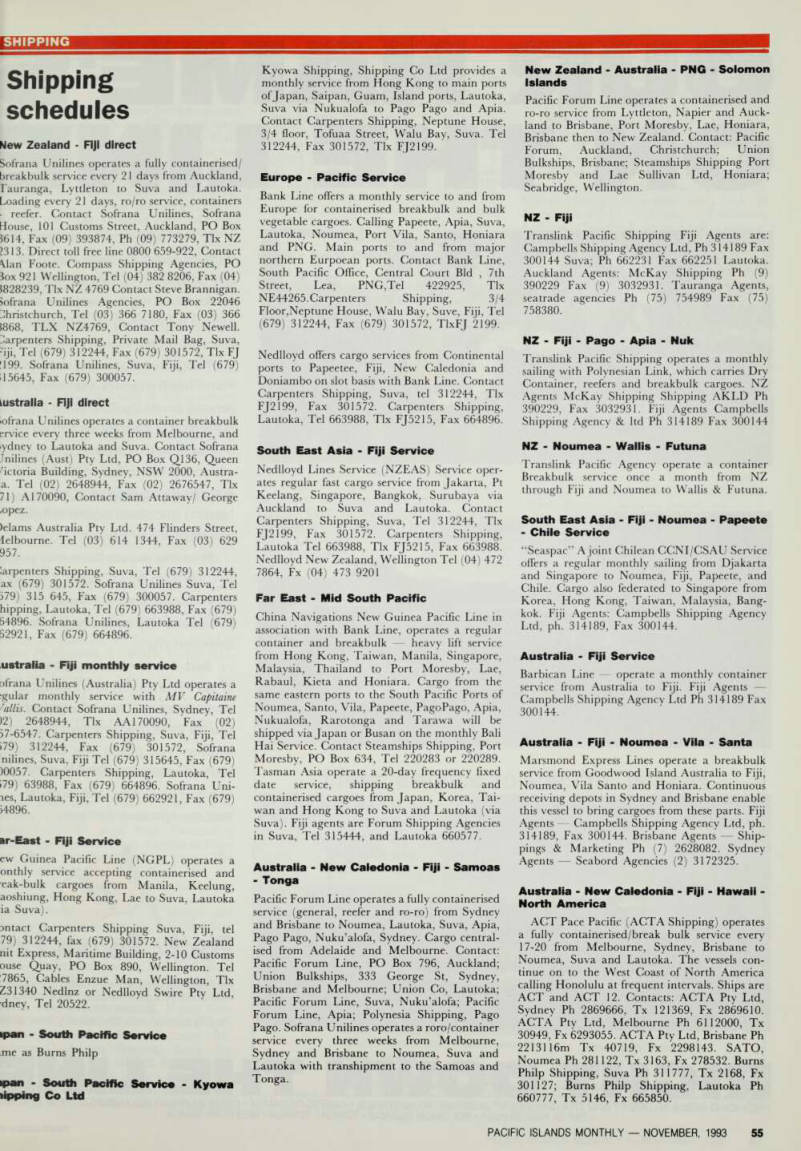
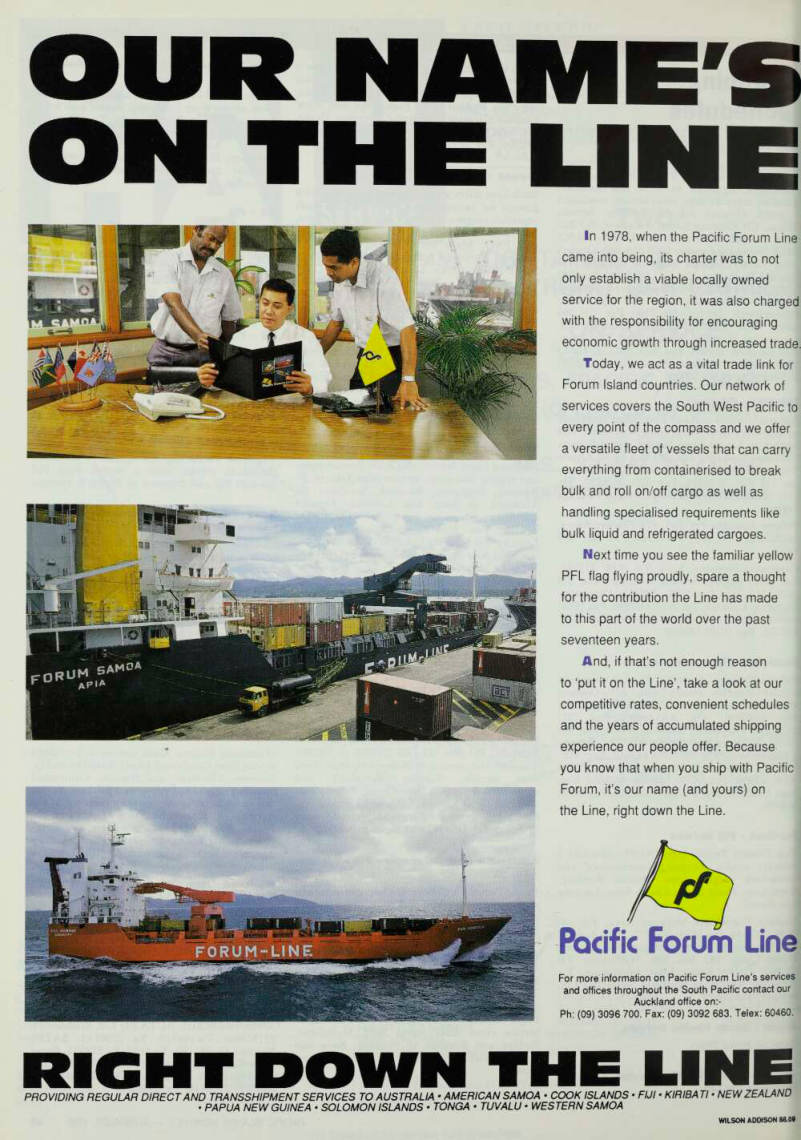
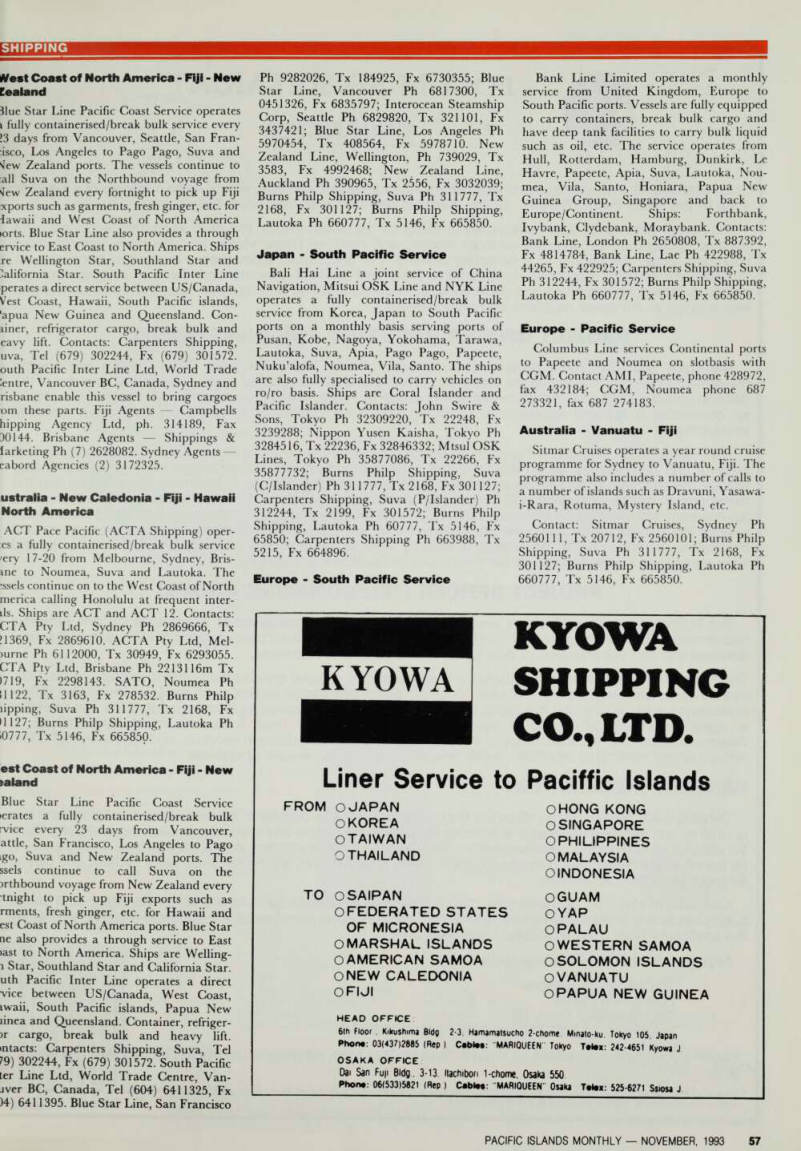
schedules
New Zealand - Fiji direct Sofrana Unilines operates a fully containerised/ breakbulk service every 21 days from Auckland, Fauranga, Lyttleton to Suva and Lautoka.
Loading every 21 days, ro/ro service, containers • reefer. Contact Sofrana Unilines, Sofrana House, 101 Customs Street, Auckland, PO Box 1614, Fax (09) 393874, Ph (09) 773279, Tlx NZ >313. Direct toll free line 0800 659-922, Contact Man Foote. Compass Shipping Agencies, PO 3ox 921 Wellington, Tel (04) 382 8206, Fax (04) 1828239, Tlx NZ 4769 Contact Steve Brannigan. iofrana Unilines Agencies, PO Box 22046 Christchurch, Tel (03) 366 7180, Fax (03) 366 1868, TLX NZ4769, Contact Tony Newell.
Carpenters Shipping, Private Mail Bag, Suva, •iji, Tel (679) 312244, Fax (679) 301572, Tlx FJ 1199. Sofrana Unilines, Suva, Fiji, Tel (679) 45645, Fax (679) 300057.
Australia - Fiji direct sofrana Unilines operates a container breakbulk ervice every three weeks from Melbourne, and ydney to Lautoka and Suva. Contact Sofrana Jnilines (Aust) Pty Ltd, PO Box CM36, Queen Victoria Building, Sydney, NSW 2000, Austra a. Tel (02) 2648944, Fax (02) 2676547, Tlx 71) A 170090, Contact Sam Attaway/ George .opez. )elams Australia Pty Ltd. 474 Flinders Street, lelbourne. Tel (03) 614 1344, Fax (03) 629 957. larpenters Shipping, Suva, Tel (679) 312244, ax (679) 301572. Sofrana Unilines Suva, Tel >79) 315 645, Fax (679) 300057. Carpenters hipping, Lautoka, Tel (679) 663988, Fax (679) 54896. Sofrana Unilines, Lautoka Tel (679) 52921, Fax (679) 664896. ustralia - Fiji monthly service ofrana Unilines (Australia) Pty Ltd operates a ;gular monthly service with MV Capitaine Contact Sofrana Unilines, Sydney, Tel 12) 2648944, Tlx AA170090, Fax (02) 37-6547. Carpenters Shipping, Suva, Fiji, Tel •79) 312244, Fax (679) 301572, Sofrana nilines, Suva, Fiji Tel (679) 315645, Fax (679) )0057. Carpenters Shipping, Lautoka, Tel ►79) 63988, Fax (679) 664896. Sofrana Uni ces, Lautoka, Fiji, Tel (679) 662921, Fax (679) 34896. ar-East - Fiji Service ew Guinea Pacific Line (NGPL) operates a onthly service accepting containerised and eak-bulk cargoes from Manila, Keelung, aoshiung, Hong Kong, Lae to Suva, Lautoka ia Suva). intact Carpenters Shipping Suva, Fiji, tel 79) 312244, fax (679) 301572. New Zealand nit Express, Maritime Building, 2-10 Customs ouse Quay, PO Box 890, Wellington. Tel 7865, Cables Enzue Man, Wellington, Tlx Z 31340 Nedlnz or Nedlloyd Swire Pty Ltd, dney, Tel 20522. ipan - South Pacific Service me as Burns Philp •pan - South Pacific Service - Kyowa lipping Co Ltd
Kyowa Shipping, Shipping Co Ltd provides a monthly service from Hong Kong to main ports of Japan, Saipan, Guam, Island ports, Lautoka, Suva via Nukualofa to Pago Pago and Apia.
Contact Carpenters Shipping, Neptune House, 3/4 floor, Tofuaa Street, Walu Bay, Suva. Tel 312244, Fax 301572, Tlx FJ2199.
Europe - Pacific Service Bank Line offers a monthly service to and from Europe for containerised breakbulk and bulk vegetable cargoes. Calling Papeete, Apia, Suva, Lautoka, Noumea, Port Vila, Santo, Honiara and PNG. Main ports to and from major northern Eurpoean ports. Contact Bank Line, South Pacific Office, Central Court Bid , 7th Street, Lea, PNG,TeI 422925, Tlx NE4426s.Carpenters Shipping, 3/4 Floor,Neptune House, Walu Bay, Suve, Fiji, Tel (679) 312244, Fax (679) 301572, TIxFJ 2199.
Nedlloyd offers cargo services from Continental ports to Papeetee, Fiji, New Caledonia and Doniambo on slot basis with Bank Line. Contact Carpenters Shipping, Suva, tel 312244, Tlx FJ2199, Fax 301572. Carpenters Shipping, Lautoka, Tel 663988, Tlx FJ5215, Fax 664896.
South East Asia - Fiji Service Nedlloyd Lines Service (NZEAS) Service oper ates regular fast cargo service from Jakarta, Pt Keelang, Singapore, Bangkok, Surubaya via Auckland to Suva and Lautoka. Contact Carpenters Shipping, Suva, Tel 312244, Tlx
FJ2199, Fax 301572. Carpenters Shipping,
Lautoka Tel 663988, Tlx FJ5215, Fax 663988.
Nedlloyd New Zealand, Wellington Tel (04) 472 7864, Fx (04) 473 9201 Far East - Mid South Pacific China Navigations New Guinea Pacific Line in association with Bank Line, operates a regular container and breakbulk heavy lift service from Hong Kong, Taiwan, Manila, Singapore, Malaysia, Thailand to Port Moresby, Lae, Rabaul, Kieta and Honiara. Cargo from the same eastern ports to the South Pacific Ports of Noumea, Santo, Vila, Papeete, PagoPago, Apia, Nukualofa, Rarotonga and Tarawa will be shipped via Japan or Busan on the monthly Bali Hai Service. Contact Steamships Shipping, Port Moresby, PO Box 634, Tel 220283 or 220289.
Tasman Asia operate a 20-day frequency fixed date service, shipping breakbulk and containerised cargoes from Japan, Korea, Tai wan and Hong Kong to Suva and Lautoka (via Suva). Fiji agents are Forum Shipping Agencies in Suva, Tel 315444, and Lautoka 660577.
Australia - New Caledonia - Fiji - Samoas - Tonga Pacific Forum Line operates a fully containerised service (general, reefer and ro-ro) from Sydney and Brisbane to Noumea, Lautoka, Suva, Apia, Pago Pago, Nuku’alofa, Sydney. Cargo central ised from Adelaide and Melbourne. Contact: Pacific Forum Line, PO Box 796, Auckland; Union Bulkships, 333 George St, Sydney, Brisbane and Melbourne; Union Co, Lautoka; Pacific Forum Line, Suva, Nuku’alofa; Pacific Forum Line, Apia; Polynesia Shipping, Pago Pago. Sofrana Unilines operates a roro/container service every three weeks from Melbourne, Sydney and Brisbane to Noumea, Suva and Lautoka with transhipment to the Samoas and Tonga.
New Zealand - Australia - PNG - Solomon Islands Pacific Forum Line operates a containerised and ro-ro service from Lyttleton, Napier and Auck land to Brisbane, Port Moresby, Lae, Honiara, Brisbane then to New Zealand. Contact: Pacific Forum, Auckland, Christchurch; Union
Bulkships, Brisbane; Steamships Shipping Port
Moresby and Lae Sullivan Ltd, Honiara;
Seabridge, Wellington.
NZ - Fiji
Translink Pacific Shipping Fiji Agents are:
Campbells Shipping Agency Ltd, Ph 314189 Fax 300144 Suva; Ph 662231 Fax 662251 Lautoka.
Auckland Agents: McKay Shipping Ph (9)
390229 Fax (9) 3032931. Tauranga Agents,
seatrade agencies Ph (75) 754989 Fax (75) 758380.
NZ - Fiji - Pago - Apia - Nuk Translink Pacific Shipping operates a monthly sailing with Polynesian Link, which carries Dry Container, reefers and breakbulk cargoes. NZ
Agents McKay Shipping Shipping AKLD Ph
390229, Fax 3032931. Fiji Agents Campbells
Shipping Agency & ltd Ph 314189 Fax 300144 NZ - Noumea - Wallis - Futuna Translink Pacific Agency operate a container Breakbulk service once a month from NZ through Fiji and Noumea to Wallis & Futuna.
South East Asia - Fiji - Noumea - Papeete - Chile Service
“Seaspac” A joint Chilean CCNI/CSAU Service
offers a regular monthly sailing from Djakarta and Singapore to Noumea, Fiji, Papeete, and Chile. Cargo also federated to Singapore from
Korea, Hong Kong, Taiwan, Malaysia, Bang
kok. Fiji Agents: Campbells Shipping Agency
Ltd, ph. 314189, Fax 300144.
Australia - Fiji Service Barbican Line operate a monthly container service from Australia to Fiji. Fiji Agents Campbells Shipping Agency Ltd Ph 314189 Fax 300144.
Australia - Fiji - Noumea - Vila - Santa Marsmond Express Lines operate a breakbulk service from Goodwood Island Australia to Fiji, Noumea, Vila Santo and Honiara. Continuous receiving depots in Sydney and Brisbane enable this vessel to bring cargoes from these parts. Fiji
Agents Campbells Shipping Agency Ltd, ph.
314189, Fax 300144. Brisbane Agents Ship pings & Marketing Ph (7) 2628082. Sydney
Agents Seabord Agencies (2) 3172325.
Australia - New Caledonia - Fiji - Hawaii - North America ACT Pace Pacific (ACTA Shipping) operates a fully containerised/break bulk service every 17-20 from Melbourne, Sydney, Brisbane to Noumea, Suva and Lautoka. The vessels con tinue on to the West Coast of North America calling Honolulu at frequent intervals. Ships are ACT and ACT 12. Contacts: ACTA Pty Ltd, Sydney Ph 2869666, Tx 121369, Fx 2869610.
ACTA Pty Ltd, Melbourne Ph 6112000, Tx 30949, Fx 6293055. ACTA Pty Ltd, Brisbane Ph 2213116 m Tx 40719, Fx 2298143. SATO, Noumea Ph 281122, Tx 3163, Fx 278532. Burns Philp Shipping, Suva Ph 311777, Tx 2168, Fx 301127; Burns Philp Shipping, Lautoka Ph 660777, Tx 5146, Fx 665850.
West Coast of North America - Fiji - New Zealand Slue Star Line Pacific Coast Service operates i fully containerised/break bulk service every 13 days from Vancouver, Seattle, San Fran :isco, Los Angeles to Pago Pago, Suva and 'Jew Zealand ports. The vessels continue to all Suva on the Northbound voyage from »Jew Zealand every fortnight to pick up Fiji xports such as garments, fresh ginger, etc. for lawaii and West Coast of North America >orts. Blue Star Line also provides a through ervice to East Coast to North America. Ships re Wellington Star, Southland Star and California Star. South Pacific Inter Line perates a direct service between US/Canada, Vest Coast, Hawaii, South Pacific islands, 'apua New Guinea and Queensland. Con liner, refrigerator cargo, break bulk and eavy lift. Contacts: Carpenters Shipping, uva, Tel (679) 302244, Fx (679) 301572. outh Pacific Inter Line Ltd, World Trade lentre, Vancouver BC, Canada, Sydney and risbane enable this vessel to bring cargoes om these parts. Fiji Agents Campbells hipping Agency Ltd, ph. 314189, Fax 30144. Brisbane Agents Shippings & larketing Ph (7) 2628082. Sydney Agents eabord Agencies (2) 3172325. ustralia - New Caledonia - Fiji - Hawaii North America ACT Pace Pacific (ACTA Shipping) oper as a fully containerised/break bulk service rery 17-20 from Melbourne, Sydney, Bris me to Noumea, Suva and Lautoka. The :ssels continue on to the West Coast of North merica calling Honolulu at frequent inter ds. Ships are ACT and ACT 12. Contacts: CTA Pty Ltd, Sydney Ph 2869666, Tx 11369, Fx 2869610. ACTA Pty Ltd, Mel )urne Ph 6112000, Tx 30949, Fx 6293055.
CTA Pty Ltd, Brisbane Ph 2213116 m Tx 1719, Fx 2298143. SATO, Noumea Ph 11122, Tx 3163, Fx 278532. Burns Philp lipping, Suva Ph 311777, Tx 2168, Fx • 1127; Burns Philp Shipping, Lautoka Ph .0777, Tx 5146, Fx 665850. est Coast of North America - Fiji - New »aland Blue Star Line Pacific Coast Service •crates a fully containerised/break bulk rvice every 23 days from Vancouver, attle, San Francisco, Los Angeles to Pago igo, Suva and New Zealand ports. The ssels continue to call Suva on the irthbound voyage from New Zealand every tnight to pick up Fiji exports such as rments, fresh ginger, etc. for Hawaii and est Coast of North America ports. Blue Star tie also provides a through service to East >ast to North America. Ships are Welling i Star, Southland Star and California Star, uth Pacific Inter Line operates a direct vice between US/Canada, West Coast, iwaii, South Pacific islands, Papua New linea and Queensland. Container, refriger >r cargo, break bulk and heavy lift.
•n tacts: Carpenters Shipping, Suva, Tel
79) 302244, Fx (679) 301572. South Pacific ter Line Ltd, World Trade Centre, Van jver BC, Canada, Tel (604) 6411325, Fx )4) 6411395. Blue Star Line, San Francisco
Ph 9282026, Tx 184925, Fx 6730355; Blue Star Line, Vancouver Ph 6817300, Tx 0451326, Fx 6835797; Interocean Steamship Corp, Seattle Ph 6829820, Tx 321101, Fx 3437421; Blue Star Line, Los Angeles Ph 5970454, Tx 408564, Fx 5978710. New Zealand Line, Wellington, Ph 739029, Tx 3583, Fx 4992468; New Zealand Line, Auckland Ph 390965, Tx 2556, Fx 3032039; Burns Philp Shipping, Suva Ph 31 1777, Tx 2168, Fx 301127; Burns Philp Shipping, Lautoka Ph 660777, Tx 5146, Fx 665850.
Japan - South Pacific Service Bali Hai Line a joint service of China Navigation, Mitsui OSK Line and NYK Line operates a fully containerised/break bulk service from Korea, Japan to South Pacific ports on a monthly basis serving ports of Pusan, Kobe, Nagoya, Yokohama, Tarawa, Lautoka, Suva, Apia, Pago Pago, Papeete, Nuku’alofa, Noumea, Vila, Santo. The ships are also fully specialised to carry vehicles on ro/ro basis. Ships are Coral Islander and Pacific Islander. Contacts: John Swire & Sons, Tokyo Ph 32309220, Tx 22248, Fx 3239288; Nippon Yusen Kaisha, Tokyo Ph 3284516, Tx 22236, Fx 32846332; Mtsul OSK Lines, Tokyo Ph 35877086, Tx 22266, Fx 35877732; Burns Philp Shipping, Suva (C/Islander) Ph 31 1777, Tx 2168, Fx 301127; Carpenters Shipping, Suva (P/Islander) Ph 312244, Tx 2199, Fx 301572; Burns Philp Shipping, Lautoka Ph 60777, Tx 5146, Fx 65850; Carpenters Shipping Ph 663988, Tx 5215, Fx 664896.
Europe - South Pacific Service
Bank Line Limited operates a monthly service from United Kingdom, Europe to South Pacific ports. Vessels are fully equipped to carry containers, break bulk cargo and have deep tank facilities to carry bulk liquid such as oil, etc. The service operates from Hull, Rotterdam, Hamburg, Dunkirk, Le Havre, Papeete, Apia, Suva, Lautoka, Nou mea, Vila, Santo, Honiara, Papua New Guinea Group, Singapore and back to
Europe/Continent. Ships: Forthbank,
Ivybank, Clydebank, Moraybank. Contacts:
Bank Line, London Ph 2650808, Tx 887392, Fx 4814784, Bank Line, Lae Ph 422988, Tx 44265, Fx 422925; Carpenters Shipping, Suva Ph 312244, Fx 301572; Burns Philp Shipping, Lautoka Ph 660777, Tx 5146, Fx 665850.
Europe - Pacific Service Columbus Line services Continental ports to Papeete and Noumea on slotbasis with CGM. Contact AMI, Papeete, phone 428972, fax 432184; CGM, Noumea phone 687 273321, fax 687 274183.
Australia - Vanuatu - Fiji Sitmar Cruises operates a year round cruise programme for Sydney to Vanuatu, Fiji. The programme also includes a number of calls to a number of islands such as Dravuni, Yasawa i-Rara, Rotuma, Mystery Island, etc.
Contact: Sitmar Cruises, Sydney Ph 2560111, Tx 20712, Fx 2560101; Burns Philp Shipping, Suva Ph 31 1777, Tx 2168, Fx 301127; Burns Philp Shipping, Lautoka Ph 660777, Tx 5146, Fx 665850.
Advertisements & other items, pp. 56-60 (1 item)
Right Down The Line
LIN
•f L ii
Ml mXjJ 1,. :
\- * ia ~\ ' % - . o S:.‘l In 1978, when the Pacific Forum Line came into being, its charter was to not only establish a viable locally owned service for the region, it was also charged with the responsibility for encouraging economic growth through increased trade Today, we act as a vital trade link for Forum Island countries. Our network of services covers the South West Pacific to every point of the compass and we offer a versatile fleet of vessels that can carry everything from containerised to break bulk and roll on/off cargo as well as handling specialised requirements like bulk liquid and refrigerated cargoes.
Next time you see the familiar yellow PFL flag flying proudly, spare a thought for the contribution the Line has made to this part of the world over the past seventeen years.
And, if that’s not enough reason to ‘put it on the Line’, take a look at our competitive rates, convenient schedules and the years of accumulated shipping experience our people offer. Because you know that when you ship with Pacific Forum, it’s our name (and yours) on the Line, right down the Line. rf
Pacific Forum Line
For more information on Pacific Forum Line’s services and offices throughout the South Pacific contact our Auckland office on:- Ph; (09) 3096 700. Fax: (09) 3092 683. Telex: 60460.
RIGHT DOWN THE LINE
PROVIDING REGULAR DIRECT AND TRANSSHIPMENT SERVICES TO AUSTRALIA • AMERICAN SAMOA • COOK ISLANDS • FIJI • KIR ISA Tl • NEW ZEALAND • PAPUA NEW GUINEA • SOLOMON ISLANDS • TONGA • TUVALU • WESTERN SAMOA
WILSON ADDISON 88.09
KYOWA
KYOWA
SHIPPING
CO., LTD.
Liner Service to Paciffic Islands
FROM OJAPAN
OKOREA
©TAIWAN
O THAILAND
OHONG KONG
©SINGAPORE
©PHILIPPINES
©MALAYSIA
©INDONESIA
TO ©SAIPAN
©FEDERATED STATES
OF MICRONESIA
©MARSHAL ISLANDS
©AMERICAN SAMOA
©NEW CALEDONIA
©FIJI
©GUAM
©YAP
©PALAU
©WESTERN SAMOA
©SOLOMON ISLANDS
©VANUATU
©PAPUA NEW GUINEA
HEAD OFFICE
6th floor Kikushima Bldg 2-3, Hamamalsucho 2-chome Mmato-ku. Tokyo 105 Japan Phon# : 03(437)2885 (Rep ) Cablaa: MARIQUEEN Tokyo Talai; 242-4651 Kyowa J
OSAKA OFFICE
Dai San Fuji Bldg 3-13, llachibon 1-chome, Osaka 550 Phona: 06(533)5821 (Rep ) Cablaa: MARIQUEEN Osaka Talai: 525-6271 Ssiosa J
FORUM SECRETARIAT
VACANCIES
Applications are invited from suitably qualified and experienced persons, who must be nationals of a member state of the South Pacific Forum*, for the following positions with the Forum Secretariat.
The Forum Secretariat was established in 1973 by the South Pacific Forum to encourage economic and political cooperation between its member states, and between those states and the more industrialised countries. Under the control of a Secretary General, the Secretariat undertakes a number of regional work programmes covering economic development, legal and political services and the civil aviation, energy, maritime, telecommunications and trade sectors. In pursuing these work programmes, the Secretariat works with a range of aid donor countries and organisations.
The Trade and Investment Division aims to assist Forum Island Countries (FICs) through encouraging investment in the the FICs and in the promotion of regional and international trade. The work programme of the Division covers all aspects of the marketing and export of Forum Island products although emphasis is placed on developing a regional approach to common issues and problems in promoting trade and industrial development.
The Project Officer (Industry & Investment) is responsible for the development and administration of regional projects and programmes aimed at facilitating industrial and private sector investment in the FICs. Duties include the provision of advice and assistance to FICs on the identification of business opportunities and the development of manufacturing and processing industries; the co-ordination of workshops/seminars; and assessment and reporting on activities within FICs in the industry and investment areas. Applicants should have appropriate qualifications and relevant experience in the industrial and private sector development and investment promotion fields. Knowledge of existing regional/international trade agreements is essential and work experience in one or more of the Forum Island Countries is desirable.
The Telecommunications Division aims to assist FICs in the development of telecommunications networks and services. The main emphasis of the division’s work programme is on policy support to FICs, human resource development and the provision of development and information services.
The Project Officer (Telecommunications) is responsible for regional telecommunications projects in the FICs, which include technical and non-technical consultancies, investigation and research projects. The Project Officer is responsible for writing and managing consultancy contracts, researching information for FICs and providing a reporting service on Divisional activities. Applicants should have formal technical qualifications in Telecommunications and experience in the provision of telecommunication services, and regulatory, tariff and policy matters relating to effective, public telecommunications network operations.
These appointments carry an attractive remuneration package, payable in Fiji dollars. For non-Fiji citizens this is tax-free and includes housing or a housing allowance, education and child allowances where eligible. Other benefits for all staff include superannuation, and medical, life and accident insurance coverage. Appointees will be based at the Secretariat’s headquarters in Suva. Appointments will be for three years initially, and can be renewed by mutual agreement.
Applications close on 30 November, 1993. They should contain full information on education and career backgrounds and should give names, addresses and telephone numbers of at least three referees with whom the applicants have been associated professionally.
Applications should be addressed to: The Secretary General Forum Secretariat GPO Box 856, Suva, Fiji Telephone 312-600 Telex: 229FJ Fax: 305^573 Further information is available on request from Mr Tiu Livlno, Administration Officer, on 312-600 Extension: 335. * Member states of the South Pacific Forum: Australia, Cook Islands, Federated States of Micronesia, Fiji, Kiribati, Naum, New Zealand, Niue, Papua New Guinea, Republic of the Marshall Islands, Solomon Islands, Tonga, Tuvalu, Vanuatu and Western Samoa. 103427v2
PROJECT OFFICER (INDUSTRY AND INVESTMENT)
PROJECT OFFICER (TELECOMMUNICATIONS)
GENERAL INFORMATION
my mi
Yfm
H - % •*25 IH V
jS&k
■ e’re different at Grand Pacific Life Insurance.
More like a family.
You feel it in the way we talk to you.
And you feel it in the way you can talk to us.
Because only one life insurance company in the Pacific is an island company... owned and operated by island people who understand the needs and lives of island people.
Grand
Pacific
LIFE
INSURANCE
COMPANY
FEDERATED STATES
i, i 96941 & derated
NCE, LTD.
Idg.
GUAM.
GREAT NATIONAL INSURANCE
UNDERWRITERS, INC.
P.O. Box GA, Agana, Guam 96910
PACIFIC FINANCIAL
CORPORATION
P.O. Box AT, Agana, Guam 96910
TAKAGI & ASSOCIATES, INC.
414 W. Soledad Ave.
Agana, Guam 96910 Today, Grand Pacific Life Insurance offers a full range of life insurance and annuity plans as well as financial planning. Our total life insurance in force exceeds $3 billion with assets in excess of $l4B million. Grand Pacific Life Insurance.. .The island insurance company so different from the rest,
it’s like comparing apples
and oranges.
xMARSHALL ISLANDS
MARSHALLS INSURANCE
AGENCY
P.O. Box 113, Majuro, Marshall Islands 96960
AMERICAN SAMOA
MARK SOLOFA
PACIFIC INSURANCE
& FINANCE, INC.
P, O. Box 3149, Pago Pago, American Samoa 96799 08 00155589 0 , Honolulu. HI 96813 • Phone: (808) 548-3363 • FAX: (808) 548-5122 . member of the Finance Factors Family of Companies.
WESTERN SAMOA
MARK SOLOFA
PACIFIC INSURANCE
& FINANCE, INC.
P. 0. Box 3149, Pago Pago, American Samoa 96799
NORTHERN
MARIANAS BELAU
PACIFIC BASIN INSURANCE
UNDERWRITERS, INC.
P.O. Box 710, Saipan, Marianas Islands 96950
PACIFICA INSURANCE
UNDERWRITERS, INC.
P.O. Box 168, Saipan, Marianas Islands 96950
Q w/9 A
PAZ
I 9 - »
EBBiB
£ £661 /lON s l
ie All New Mitsubishi Galant —
ir That Won’t Cramp Your Style
and sporty enough to excite your adrenaline, yet smooth and comfortable for a relaxing drive home at the end of a long day.
A car that lets you drive exactly how you feel. With the new Mitsubishi Galant, it’s finally here.
When you’re driving on winding or hilly roads, the new Galant assures effortless steering and quick response to give you the control you need for lively, enjoyable driving. Yet for relaxed cruising, you can also count on one of the smoothest, quietest rides on the road today. The new Galant literally handles to suit the way you want to drive.
The secret is a revolutionary new four wheel multi-link suspension, which you’ll find on every new Galant. Since every move a car makes, from accelerating to cornering to stopping, happens through four tiny patches where the tyres touch the ground, the new Galant’s multi-link suspension makes all four wheels work as effectively as they can to direct, manipulate and control.
It’s part of All Wheel Control, Mitsubishi’s unique new philosophy designed to give you total control over the driving experience. And with that control comes the choice to drive in the style that feels right to you.
Discover the meaning of driving freedom with the new Mitsubishi Galant —and feel how All Wheel Control sets you apart from the crowd.
The All New
MITSUBISHI GRLHNT
A AMERICAN SAMOA: PACIFIC MARKETING INC. P.O. Box 698, Pago Pago, Tel. 699 9140/ AUSTRALIA: MITSUBISHI MOTORS AUSTRALIA LTD. 1284 South Road, Clovelly Park, South Australia, Tel. (08) 2757297 / FUI; NIVIS MOTOR & MACHINERY CO. LTD. G.RO. Box 150, Suva, Tel 383411 / GUAM: TRIPPLE J ENTERPRISES INC. PO. Box 6066, Tamunmg, Tel 6469126 / NEW CALEDONIA; SOCIETE DTMPORTATION
MITSUBISHI
MOTORS
PTY LTD. PO. Box 169, Tel 2114 /PAPUA NEW GUINEA; TO BA PFY LTD. RO. Box 503, Port Moresby, Tel. 217-874 /SAIPAN: AUTO MOTION INC. PO. Box 569, SKV Dist. 4, Tel. 234 3332 / SOLOMON ISLANDS: HARVEST PACIFIC LTD. G.PO. Box 823, Honiara, Tel 30407 /TAHITI (FRENCH POLYNESIA): SOPADEP S.A. RO. Box 1617, Papeete Tel. 427393 1 TONGA; SITANI MAPI CO, LTD. PO. Box 83, Nuku'Alofa, Tel 24044/ VANUATU: SOCOMETRA VANUATU LTD. B.P 06, Route de Lagon, Port Vila, Tel. 2314 /WESTERN SAMOA: MOTOR DISTRIBUTORS (SAMOA) LTD. RO. Box 576, Apia, Tel. 20957
CREATING TOGETf]